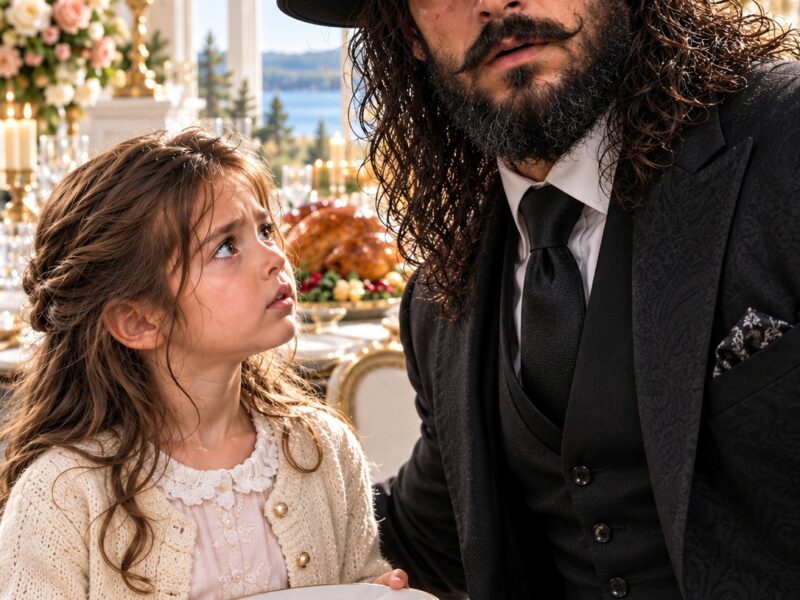
“Sir, Is There a Turkey Nobody Wants?” the Little Girl Whispered—The Mafia Boss Froze When She Said Her Mother’s Name and Her Birthday at Thanksgiving
I had forgotten most Thanksgivings before they were over.
But I remember the year an eight-year-old stranger walked into my family’s house asking for food nobody wanted.
Because before sunset, she told me the one name that turned my entire life into a lie.
There were thirty-one people in my house that Thanksgiving.
By noon, my aunt Teresa had taken command of the kitchen as if national security depended on gravy consistency. Cousins crowded around the televisions arguing about football. Children ran across polished hardwood floors while their parents shouted warnings nobody expected them to obey. Outside, four black SUVs sat along the circular drive beneath a cold November rain.
Anyone passing the property would have seen money.
Anyone who knew my name would have seen something else.
My name is Dominic Caruso.
In certain parts of New York, people did not say it loudly.
I was forty-one that year, old enough to understand the usefulness of reputation and young enough to still resent how completely mine had been inherited. My grandfather had built trucking routes before Interstate 95 existed. My father, Salvatore Caruso, had expanded those routes into warehouses, docks, construction companies, restaurants, waste contracts, and businesses that required considerably less paperwork.
By the time everything became mine, the Caruso name had two different definitions depending on which room you were standing in.
In a bank, we were investors.
In a courtroom, we were businessmen.
In neighborhoods where shopkeepers lowered their voices when one of our cars stopped outside, nobody bothered pretending.
I spent Thanksgiving every year at the old family house in Todt Hill because my mother had made me promise I would never turn holidays into business meetings.
My mother had been dead sixteen years.
I kept the promise anyway.
At four that afternoon, I escaped the dining room for five minutes.
I had learned long ago that if I disappeared through the narrow hallway between the kitchen and my father’s old library, nobody followed unless something was burning or somebody had been arrested.
I stood beside a row of winter coats with cold coffee in my hand and listened to the rain tapping against the back windows.
“Brooklyn wants your answer before six.”
I did not turn.
Frank Marzano was seventy-two, silver-haired and broad through the shoulders despite his age. He had worked for my father before I had been tall enough to see over a steering wheel and had stayed after Salvatore died.
Frank was one of those men who seemed to belong to another century.
He wore suits on Sundays.
He called women ma’am.
He still carried a handkerchief.
And on his right hand he wore a thick gold ring shaped like a lion’s head.
My father had given it to him after twenty-five years of loyalty.
“They can wait until tomorrow,” I said.
Frank raised an eyebrow.
“Did Thanksgiving make you charitable?”
“No.”
“Good. I was worried.”
I looked at him.
He smiled.
Frank had earned the right to tease me in ways that could get younger men thrown out of rooms.
He squeezed my shoulder.
“Eat something, Dom.”
“I will.”
“You said that three hours ago.”
“You becoming my doctor?”
“Your mother would come back from the grave and kill me if I let you starve at Thanksgiving.”
“My mother liked you better than me.”
“She had good judgment.”
For perhaps the thousandth time in my life, I almost smiled.
Frank started toward the dining room.
Then he stopped.
His head turned slightly.
“Did you bring somebody’s kid in?”
“No.”
“I thought I saw—”
A crash came from the kitchen.
Aunt Teresa shouted someone’s full legal name.
Frank sighed.
“Never mind.”
He disappeared around the corner.
I took another drink of cold coffee.
That was when I realized someone was standing beside me.
She barely reached my elbow.
Eight years old, maybe.
Her coat was too thin for November, pale blue and soaked dark along the shoulders. Rain had dampened the cuffs of her jeans. Her sneakers looked one size too small. Her dark hair had been braided neatly that morning, but several strands had escaped and were stuck against her cheeks.
She held a folded paper napkin between both hands.
For a moment neither of us spoke.
Then she looked up.
“Sir?”
Her voice was so quiet I nearly missed it.
“Yes?”
“Is there a turkey nobody wants?”
I stared at her.
The house had caterers coming and going all morning. Neighbors sent desserts. Parish volunteers collected trays for shelters. Every year somebody’s child ended up wandering where they were not supposed to be.
So my first thought was simple.
She was hungry.
“There’s plenty of turkey.”
She immediately shook her head.
“No, sir.”
“No?”
“It has to be one nobody wants.”
Her fingers tightened around the napkin.
“The leftover one. The one nobody will miss.”
Something in the way she said it made me put my coffee down.
I crouched.
Men in my position do not crouch often.
Too many people interpret body language as weakness.
There was nobody in that hallway except an eight-year-old girl, so for once I did not care.
“What’s your name?”
She hesitated.
“Madeline.”
“Madeline what?”
“Everyone calls me Maddie.”
“That wasn’t what I asked.”
Her eyes widened.
I softened my voice.
“Sorry. Bad habit.”
“Maddie Hart.”
“Okay, Maddie Hart. Why do you need a turkey nobody wants?”
“For my mom.”
“Your mother sent you here?”
She nodded.
“Where is she?”
Another hesitation.
“At the hospital.”
My attention sharpened.
“What hospital?”
“She said not to tell unless you helped me first.”
That was not the answer of a child improvising.
Someone had given her instructions.
Careful ones.
“Who told you to come to this house?”
“My mom.”
“And how does she know me?”
Maddie looked toward the dining room.
Noise washed down the hallway.
Twenty feet away, my family was laughing.
The little girl lowered her voice.
“She said you help people at Thanksgiving.”
I stopped breathing for half a second.
Very few people knew that.
Every November, for almost fifteen years, I paid for eight extra turkeys through St. Andrew’s Parish in Bay Ridge.
No publicity.
No Caruso name.
No photographs.
The only instruction attached to the delivery was a line I had written when I was twenty-six.
For whoever everybody else forgot.
My father had hated charity performed without leverage.
He believed generosity should buy loyalty.
Maybe that was exactly why I kept doing it anonymously.
“How does your mother know about that?”
Maddie began tapping her thumb against the side of her index finger.
Quick.
Repeated.
Barely noticeable.
My stomach tightened.
I had done exactly the same thing until I was fifteen.
My father used to reach across the pew during Mass and close his hand around mine to make me stop.
Tap.
Tap.
Tap.
“Who is your mother?”
Maddie swallowed.
“She said if you asked too many questions, I could tell you.”
“Tell me what?”
“Her name.”
Rain whispered against the window.
Somewhere in the dining room, my cousin Anthony shouted at the television.
I heard every sound distinctly.
“What is her name, Maddie?”
The girl looked straight at me.
“Rachel Sullivan.”
The hallway disappeared.
Not literally.
But that is the closest description I have.
For nine years, I had trained myself not to react when I heard names from my past. I had negotiated while men threatened businesses I spent twenty years building. I had sat across tables from people who wanted me dead and ordered dessert afterward.
Two words from a child made me put one hand against the wall.
Rachel Sullivan.
The only woman I had ever considered leaving the family for.
The woman who disappeared without saying goodbye.
The woman I had searched for until my father convinced me she had chosen another life.
The woman I had finally forced myself to hate because hating somebody was easier than missing them.
Maddie watched me.
“My mom said you might do that.”
I looked down.
“Do what?”
“Get quiet.”
My throat felt dry.
“What else did she tell you?”
Maddie unfolded the napkin.
Inside was a small plastic hospital bracelet.
The name had been cut away.
There was only a date written in faded blue ink.
March 14.
“She said tell you I’m eight.”
I looked at her.
“And my birthday is March fourteenth.”
Nine months before March was June.
I knew exactly where I had been that June.
I knew who had slept beside me in a small apartment above a laundromat in Bay Ridge while summer rain struck the fire escape.
My palm flattened against the wall.
“Maddie.”
“Yes?”
“How old are you exactly?”
“Eight years and eight months.”
I did the calculation again.
Because adults do stupid things when the first answer frightens them.
It did not change.
The girl watched me with gray-green eyes.
My mother’s eyes.
My eyes.
I stood too quickly.
The floor seemed to move beneath me.
Maddie stepped backward.
I immediately lowered my voice.
“I’m not angry.”
“Okay.”
“I’m not angry with you.”
She nodded, but children recognize tension better than adults give them credit for.
I took a breath.
“You asked for turkey.”
“Yes.”
“I’m going to get you turkey.”
“Just the leftover one.”
“No.”
Her face tightened.
“My mom said—”
“I know what she said.”
I crouched again.
“But your mother is wrong about one thing.”
“What?”
“Nobody in this house is going to be angry because you ate dinner.”
She stared at me.
Then she whispered, “Are you sure?”
That question did more damage to me than Rachel’s name.
Children from secure homes do not ask permission to eat with that kind of fear.
“Yes,” I said.
“I’m sure.”
I took her through the kitchen instead of the dining room.
Aunt Teresa spotted us immediately.
“Dominic, who—”
She saw my face.
Thirty years around Caruso men had taught her when not to ask.
“Plate,” I said.
She looked at Maddie.
“Sweetheart, turkey?”
Maddie nodded.
“Mashed potatoes?”
Another nod.
“Stuffing?”
Maddie glanced at me.
I said, “Everything.”
Teresa gave me a strange look.
Then she prepared enough food for three children.
I carried the plate myself.
I took Maddie to my father’s old library at the far end of the hall.
Nobody had used it properly since Salvatore died six years earlier.
His books still filled the shelves.
His desk remained beneath the window.
Even the dent in the leather chair where he used to keep his wallet was still visible.
I turned on the radiator.
Maddie sat on the edge of the sofa.
Her wet sneakers squeaked against the rug.
“Take those off.”
She looked alarmed.
“They need to dry.”
“Oh.”
I knelt and helped untie them because the laces had swollen from rain.
Her socks were thin.
One had a hole over the big toe.
Maddie immediately tucked her foot underneath herself.
Embarrassed.
I pretended not to notice.
I had learned enough about pride to recognize it in small bodies.
I put her shoes beside the radiator.
Then I handed her the plate.
She stared at it.
“You can eat.”
“What about my mom?”
“We’ll bring her food.”
“She can’t eat much.”
“Then we’ll bring whatever she can eat.”
Maddie picked up her fork.
She ate slowly.
Too slowly for a hungry child.
Carefully cutting pieces as if somebody had taught her that taking more than necessary could make adults angry.
I sat across from her.
“What happened to your mother?”
Her fork paused.
“She got sick.”
“How sick?”
“She doesn’t like me talking about it.”
“Maddie.”
She looked up.
“I need you to tell me.”
Her thumb started tapping again.
“She coughs in the bathroom.”
My chest tightened.
“She thinks I can’t hear because she runs water.”
Maddie pushed a piece of turkey around the plate.
“But I hear.”
“How long?”
“A long time.”
“Months?”
She nodded.
“She sold the sewing machine.”
Rachel had loved sewing.
She repaired church vestments when we met.
Made dresses for women who paid her in envelopes of wrinkled cash.
I remembered teasing her because her fingers were always stained with blue tailor’s chalk.
“She sold the television too,” Maddie continued. “And her necklace.”
“What necklace?”
“The little gold one.”
I knew immediately.
I had given Rachel a thin gold chain with a tiny saint medal when she turned twenty-six.
I had looked for that necklace in every pawn shop I could reach after she vanished.
“Which hospital?”
“Bellevue.”
“Since when?”
“Monday.”
It was Thursday.
“Who has been taking care of you?”
“Mrs. Harper downstairs.”
“And today?”
“Mrs. Harper drove me.”
“Here?”
Maddie nodded.
“She was mad.”
“At your mother?”
“No. At something.”
“Where is Mrs. Harper now?”
“She said she’d wait at the diner down the road until six.”
I checked the clock.
Four twenty-three.
Rachel had planned this carefully.
Too carefully.
“How did you get through the gate?”
Maddie took another bite.
“Mom said wait for the church van.”
My spine stiffened.
Every Thanksgiving, St. Andrew’s sent a volunteer van to collect food from our kitchen.
Almost nobody outside the household knew the schedule.
“When the van came, I walked behind the people carrying boxes.”
“And security?”
“A lady named Rosa saw me.”
Rosa had worked in our kitchen twenty-eight years.
“She asked if I was with the church.”
“What did you say?”
“That my mom told me to find Mr. Dominic.”
I rubbed my jaw.
Rachel knew the house.
She knew my habits.
She knew things from nine years ago well enough to put a child through one narrow gap in security without drawing attention.
Something about that frightened me more than it should have.
Maddie removed the crust from her dinner roll and placed it neatly on the edge of her plate.
My hand stopped.
I had done that my entire life.
Still did.
I looked at her eyes again.
Gray around the outside.
A narrow ring of green around the pupils.
My mother’s eyes.
There are moments when suspicion becomes knowledge before proof arrives.
That was one.
“Where is your father?”
Maddie looked confused.
“I don’t have one.”
Everyone has one.
She meant something different.
“Your mother never talked about him?”
“A little.”
My heartbeat changed.
“What did she say?”
“She said he didn’t know about me.”
I stared at her.
Maddie continued eating.
“And she said if I met him someday, I shouldn’t be mad.”
The room became very quiet.
“Why would you meet him?”
“She said maybe.”
“Maddie.”
“Yes?”
“Did your mother send you here because she thinks I know your father?”
The child looked at me.
Then she put her fork down.
“She wrote you letters.”
My mouth went dry.
“What?”
“Mom wrote letters.”
“To me?”
Maddie nodded.
“Lots.”
“I never received a letter from your mother.”
She studied my face.
Children have an unnerving way of searching adults for lies without pretending politeness.
“She said maybe you didn’t.”
“What does that mean?”
Maddie leaned closer.
“Mama said people around you decide things before you get to decide them.”
A chill moved through me.
“Who told her that?”
“I don’t know.”
“When did she write?”
“When I was little.”
“How little?”
“Before I remember.”
“Did she mail them?”
“At first.”
I leaned forward.
“And then?”
Maddie hesitated.
“She gave them to somebody.”
Every instinct I had sharpened at once.
“Who?”
The library door opened.
Frank Marzano stood there.
Gold lion ring against the dark wood.
He looked at me.
Then Maddie.
Then the plate.
Something crossed his face.
It lasted less than a second.
But I had spent twenty years reading men who lied for a living.
It was not surprise.
It was dread.
“You needed me?” I asked.
Frank recovered immediately.
“Tony Mancini is waiting for you in the dining room. Brooklyn again.”
“Tell him tomorrow.”
“He came in person.”
“Then he can enjoy pie.”
Frank looked at Maddie one more time.
“Who’s your friend?”
Before I could answer, Maddie lowered her eyes.
“She came with the parish group.”
I watched her.
Interesting.
Frank nodded.
“Five minutes, Dom.”
He closed the door.
I remained still.
Maddie waited.
Then she climbed off the sofa and crossed the rug.
She cupped both hands around her mouth.
“Mom said something else.”
I bent down.
Her whisper was barely audible.
“She said if the man with the gold lion ring was here, I shouldn’t tell him anything.”
My blood went cold.
I looked through the narrow opening between the door and frame.
Frank was walking away.
The lion on his hand caught the hallway light.
“Why?”
Maddie shook her head.
“Mom just said wait until he’s gone.”
I had known Frank Marzano since I was seven.
He had driven me to school after my mother died.
He taught me how to tie a Windsor knot.
When I broke my wrist at thirteen, Frank sat in the emergency room because my father had been in Atlantic City handling business.
At my mother’s funeral, Frank had held the umbrella above my head while rain soaked his own coat.
At my father’s funeral, he stood beside me for eight hours.
There were maybe five living people I trusted without qualification.
Frank was one.
Until an eight-year-old girl whispered about a ring.
“Maddie.”
“Yes?”
“From this moment on, you don’t leave Rosa.”
“Okay.”
“Not even if somebody says I sent them.”
Her expression changed.
“Even you?”
“If it’s really me, I’ll come myself.”
She nodded.
I walked back into the Thanksgiving dinner.
For the next forty minutes, I performed normality better than I ever had in my life.
I carved turkey.
I listened to Uncle Marco complain about referees.
I kissed Aunt Teresa on the cheek when she demanded I eat dessert.
Frank sat two seats to my right.
He did not ask about Maddie.
That silence screamed.
After pie, I stood.
“An old friend is in Bellevue.”
My cousin Daniel looked up.
“Tonight?”
“Yes.”
“Everything okay?”
“I don’t know yet.”
Frank’s fork stopped against his plate.
Only for a moment.
I noticed.
He noticed me noticing.
Neither of us spoke.
I left with Danny Russo, my driver, and a security man everyone called Bear because nobody remembered when the nickname started.
Maddie wore a wool coat Rosa had found in a closet upstairs.
It was red and slightly too large.
She carried a foil-wrapped Thanksgiving plate on her lap.
The entire drive into Manhattan, I watched rain move across the window.
Maddie fell asleep twenty minutes in.
Her head rested against the seat.
I studied her profile.
The chin was Rachel’s.
The nose might have been mine.
Or I was seeing what I needed to see.
I hated that possibility.
I had spent my adult life demanding facts from other people.
Now I was afraid facts might arrive.
Bellevue on Thanksgiving night felt hollow.
Long hallways.
Dimmed lights.
A security guard watching basketball behind a desk.
A vending machine humming louder than conversations.
Maddie woke the moment the elevator opened on the fourth floor.
She grabbed my hand.
Not Bear’s.
Not Danny’s.
Mine.
That small hand nearly stopped me.
Nobody had held my hand because they trusted it in years.
Room 417 was halfway down the corridor.
Maddie started running.
I followed more slowly.
When she reached the door, she disappeared inside.
“Mom!”
I stopped at the threshold.
Nine years.
I had imagined finding Rachel in restaurants, airports, train stations, church steps, somebody else’s wedding.
Never here.
She was thinner than memory.
Much thinner.
Her dark hair had been cut to her jaw, streaked now with a few strands of gray. Her cheekbones stood sharply beneath pale skin. A clear tube ran beneath her nose. An IV entered her left arm.
But when Rachel Sullivan turned and saw me, she smiled exactly the way she had the first morning I met her.
Like she knew something about me I had not figured out yet.
Then Maddie climbed onto the bed beside her.
Rachel’s smile collapsed.
“Oh, sweetheart.”
She pulled her daughter close.
Her eyes lifted to mine.
“Dominic.”
I had rehearsed speeches to Rachel for years.
Angry ones.
Cold ones.
Indifferent ones.
None survived that room.
“You sent her to my house.”
Rachel closed her eyes.
“I’m sorry.”
“No.”
“I had no right.”
“Stop.”
She looked at me.
I crossed the room.
“You had every right.”
Her mouth trembled.
I glanced at Maddie.
“She ate.”
“Good.”
“She asked for a turkey nobody wanted.”
Rachel actually laughed.
Weakly.
“That sounds like her.”
“No.”
My voice changed.
“That sounds like you.”
Rachel looked down.
Maddie leaned against her mother.
I pulled a chair toward the bed.
“Tell me.”
Rachel’s eyes moved toward Bear outside the room.
I closed the door.
“Everything.”
She waited until Maddie fell asleep.
It took almost an hour.
The little girl curled against Rachel’s side beneath the hospital blanket while Rachel stroked her hair.
Then she started talking.
“Three weeks after I found out I was pregnant, someone came to my apartment.”
I already knew the answer.
“Frank.”
Her eyes lifted.
“Yes.”
Something inside me clenched.
“What did he say?”
“That your father knew about us.”
I said nothing.
“He said Salvatore had known for months. He said the Valenti family had been following you and there had been conversations about using me if things escalated.”
I remembered that year.
My father had been fighting for control of two waterfront contracts against Anthony Valenti.
Three men were hospitalized.
A warehouse was burned.
A federal task force appeared.
I had kept Rachel outside my world because I thought ignorance protected her.
Apparently everyone except Rachel had understood the danger.
“He said my father sent him?”
“Yes.”
“With what message?”
Rachel’s eyes filled.
She looked toward our sleeping daughter.
“Frank told me your father said I had one choice if I loved you.”
My hands became fists against my knees.
“Leave.”
She nodded.
“He said there was money. A new apartment. Documents if I needed them. He said I couldn’t contact you because anyone watching would follow the connection.”
I stood.
Walked to the window.
Turned back.
“And you believed my father ordered that?”
“Yes.”
“That isn’t what I asked.”
Rachel looked at me.
I knew what was coming.
“You believed I agreed.”
Silence.
She nodded.
Frank had told her.
Of course he had.
“He said you knew I was pregnant?”
“No.”
My voice was sharper than I intended.
Rachel flinched.
I lowered it.
“No. I didn’t know.”
She pressed her fingertips against her eyes.
“Frank told me you did.”
I looked toward the door.
“Exactly what did he say?”
“That you had decided it was safer this way.”
Her voice broke.
“He said you couldn’t bring a child into your life. That you were sorry, but you wanted me to take the money and disappear.”
I closed my eyes.
The room blurred behind my eyelids.
“You believed that about me?”
Rachel’s answer came quietly.
“You never told me what your life really was.”
I looked at her.
“You told me your family had businesses. You told me there were people you avoided. You told me never to open your apartment door unless I called first.”
She swallowed.
“And then this seventy-year-old man I knew you trusted appeared at my home with an envelope and details nobody else should have known.”
“He wasn’t seventy then.”
“You know what I mean.”
I did.
“And after you left?”
“I wrote.”
My chest tightened.
“Maddie said.”
“One letter every week for the first three months.”
“I never got them.”
“I know that now.”
“How?”
“Because I stopped mailing them.”
I stared.
Rachel looked toward the door.
“Frank came to see me.”
“When?”
“About four months after I left.”
“He knew where you were.”
“Yes.”
I felt suddenly sick.
“He said sending letters was dangerous. He told me he’d deliver them personally.”
My jaw tightened.
“So you gave him the letters.”
“Every month.”
“For how long?”
“A year.”
I laughed.
There was nothing humorous in it.
“A year.”
“Dominic—”
“He sat beside me while I looked for you.”
Rachel’s face tightened.
“He told me you’d answered.”
My breathing stopped.
“What?”
“He told me you wanted us safe but separate.”
I stepped backward.
“He told you I answered letters I never saw.”
“Yes.”
“He told me you’d chosen not to answer at all.”
Rachel covered her mouth.
For a moment, both of us simply stared at each other across nine stolen years.
“I hated you,” I said.
Tears slid down her face.
“I know.”
“I needed to.”
“I know.”
“Because if you had left without caring, then I could survive it.”
Rachel looked at Maddie.
“I needed to believe you had chosen it too.”
There are betrayals so large anger cannot find their edges.
That was how Frank’s felt.
Then Rachel said, “There’s something else.”
I almost laughed again.
“Of course there is.”
She did not react.
“Every month since Maddie was born, money has appeared under my apartment door.”
I stopped.
“How much?”
“At first eight hundred. Then a thousand.”
“From who?”
“No note.”
“My father?”
“That’s what I thought.”
“My father died six years ago.”
“I know.”
“And the payments continued.”
“Yes.”
I turned slowly.
“Every month?”
“Yes.”
“For eight years?”
“Yes.”
“Why didn’t you use it to get treatment?”
“I did use some. Rent. Maddie’s school things. Doctors.”
“Rachel.”
“I was afraid.”
“Of money?”
“Of whoever knew where we lived.”
That silenced me.
She continued.
“There’s more.”
I stared at her.
“There’s always a gray Buick across from my building.”
“What?”
“Not every hour. But most evenings.”
“How long?”
“Years.”
“And you never called police?”
She gave me a tired look.
“Dominic, a man connected to your family paid me to disappear because another family wanted me dead.”
Fair point.
“Did you recognize the driver?”
“No.”
“License plate?”
Rachel reached into the bedside drawer.
She handed me a folded receipt.
Numbers were written on the back.
I passed them to Bear outside.
“Find it.”
He nodded and walked away.
Rachel watched him.
“I used to tell myself the car was yours.”
“It wasn’t.”
“I know that now too.”
A noise came from the hallway.
A shoe against tile.
Low voices.
Then a nurse entered.
“Mr. Caruso?”
“Yes?”
“There’s a gentleman downstairs asking for you.”
“Who?”
“He wouldn’t give a name.”
My stomach tightened.
The nurse looked uncomfortable.
“He said you’d recognize him.”
“How?”
She glanced toward my hands.
“He’s wearing a gold lion ring.”
I stood.
Rachel’s face went white.
“No.”
“Maddie stays here.”
“Dominic.”
“Bear stays outside this door.”
“What are you going to do?”
I looked at her.
“I’m going to ask an old friend why he stole nine years from me.”
Frank waited near the hospital chapel.
His hat was in his hands.
Under fluorescent light, he looked older than he had at Thanksgiving dinner.
For the first time in my life, I saw the seventy-two-year-old man beneath the legend.
He did not say hello.
He looked at me.
“She told you.”
I stopped ten feet away.
“Did you take the letters?”
Frank closed his eyes.
“Yes.”
No excuse.
No hesitation.
Just yes.
That hurt worse.
I crossed the distance and grabbed his coat.
His back struck the chapel wall.
The gold lion ring pressed against my wrist.
Frank did not resist.
He looked directly into my eyes.
For one terrible second, I understood that he wanted me to hit him.
Maybe because pain would be easier than explanation.
“Nine years.”
My voice barely sounded like mine.
“Yes.”
“You watched me search for her.”
“Yes.”
“You sat in my house.”
“Yes.”
“You listened while I said she abandoned me.”
“Yes.”
My grip tightened.
“And every time you looked at me, you knew she was raising my daughter.”
Frank’s face broke.
“I didn’t know about the child at first.”
I shoved him harder.
“When?”
“Three months after Rachel left.”
“And you still said nothing.”
“Your father ordered me not to.”
“My father has been dead six years.”
Frank swallowed.
I released his coat.
That was the question.
The real one.
Frank adjusted his jacket with trembling fingers.
“No,” he said. “After Sal died, the order wasn’t his anymore.”
“Then whose?”
“Mine.”
I stared.
Frank lowered his head.
“I thought I was protecting them.”
“From me?”
“From what follows you.”
“I would have protected them.”
“That’s what your father believed about your mother.”
The sentence stopped me.
Frank looked up.
“You remember Highland Boulevard?”
I did.
I was twelve.
My mother sat in the passenger seat of my father’s Lincoln.
I had been in back reading a comic book.
Rain.
Headlights from the right.
Metal collapsing.
My mother’s scream ending before I understood it had begun.
My father pulling me from broken glass.
His hands crushing my shoulders while he shouted my name.
My mother died before the ambulance arrived.
I had never forgotten the sound.
“That car was meant for Sal,” Frank said.
“I know.”
“It came from the Valentis.”
“I know.”
“Your father spent the rest of his life believing he had killed your mother simply by loving her.”
I looked away.
“He learned about Rachel.”
Frank’s voice shook.
“And he saw the same car.”
“That did not give him the right.”
“No.”
The answer surprised me.
Frank continued.
“I told him that.”
“You obeyed anyway.”
“Yes.”
“Why?”
“Because I was a coward.”
For the first time that night, I had no response.
Frank looked at the lion ring.
“I told myself loyalty meant carrying orders I hated.”
His thumb rubbed the gold.
“I learned too late that sometimes loyalty means refusing.”
I thought about Maddie asking whether there was food nobody would miss.
“The money?”
“Mine.”
“What?”
“The envelopes.”
Frank’s eyes filled.
“I couldn’t undo what I did.”
“So you paid her?”
“I made sure she had rent.”
“That isn’t the same thing.”
“I know.”
“The Buick?”
“One of my men.”
I stared at him.
“You’ve had Rachel watched for eight years.”
“Protected.”
“She didn’t feel protected.”
Frank flinched.
I let the silence punish him.
“Did the Valentis ever find out about Maddie?”
Frank hesitated.
“Frank.”
“Yes.”
Every muscle in my body tightened.
“When?”
“The year she was born.”
“And?”
“I paid people to forget.”
I stared.
“The driver?”
“Same man.”
“The envelopes?”
“Yes.”
“Rachel’s hospital deposit?”
He shook his head.
“Not me.”
Something did not fit.
“You came here tonight because you knew I’d found out.”
“No.”
“Then why?”
Frank’s face changed.
“This afternoon, my son heard the girl.”
I knew his son.
Peter Marzano.
Thirty-three.
Ambitious.
Restless.
The kind of man who mistook inherited access for earned authority.
“What did Peter hear?”
“Enough.”
“Where is he?”
“I don’t know.”
Frank’s voice dropped.
“And that is why I came.”
A cold sensation moved through me.
“He’s been meeting with Anthony Valenti’s nephew since summer.”
My hands went still.
“You knew?”
“I suspected.”
“How long?”
“Two months.”
“And you didn’t tell me?”
“I was trying to stop him myself.”
I laughed bitterly.
“You really learned nothing from my father.”
Frank looked away.
“Tonight he left your house ten minutes after you.”
“Where?”
“I called him twice.”
“No answer?”
Frank shook his head.
My phone rang.
Unknown number.
We both looked at it.
Neither of us needed to say anything.
I answered.
“Dominic Caruso.”
The voice belonged to an older man.
Smooth.
Almost pleasant.
“Happy Thanksgiving.”
I recognized Anthony Valenti immediately.
He had spent twenty-five years pretending our families had peace.
My eyes moved toward the elevator.
“Anthony.”
“I hear congratulations are in order.”
Every sound in the hospital seemed to disappear.
“What do you want?”
“A daughter.”
He laughed softly.
“After all this time.”
Frank closed his eyes.
Valenti continued.
“Bellevue. Fourth floor. Room four-seventeen.”
I said nothing.
“Hospitals really should improve security.”
“Say what you want.”
“The Red Hook terminal deeds.”
I almost smiled.
That was it.
For fourteen years, Valenti had wanted access to the Caruso waterfront contracts.
“You’ve lost your mind.”
“Midnight.”
“Anthony.”
“Bring me the deeds, and your former girlfriend and your daughter finish Thanksgiving peacefully.”
My hand tightened around the phone.
“If anybody enters that room—”
“Threats are boring, Dominic.”
His voice remained almost cheerful.
“Midnight. Pier Nine office.”
The call ended.
I looked at Frank.
For twenty years, I had imagined what I would do if someone threatened my child.
I simply had not known I had one.
There was a version of that night that ended in gunfire.
Most men around me expected that version.
My cousin Michael arrived at Bellevue within forty minutes with six men and enough anger for all of us.
“We hit Red Hook first,” he said in the parking garage. “Then Bensonhurst.”
“No.”
He stared.
“Dom.”
“No.”
“They threatened your daughter.”
“Which is why nobody fires a shot tonight.”
Michael looked at me as if I had suddenly started speaking another language.
“You want to give Valenti the terminals?”
“No.”
“Then what?”
I looked toward Frank.
He already knew.
“You still have the favor with Arthur Bellomo?”
Frank went pale.
Arthur Bellomo was eighty-six years old and technically retired from everything.
Technically.
For four decades, disputes that could not be resolved without blood often ended in Arthur’s dining room instead.
Both our family and the Valentis had promised him things over the years.
More importantly, both sides feared the consequences of publicly violating an agreement he witnessed.
Frank had one favor left.
He had always joked he was saving it for his funeral.
He took out his phone.
“What do you want me to ask?”
“Tell him a child is involved.”
Frank nodded.
“That’s enough.”
At eleven fifty-seven, I entered the old pier office in Red Hook.
The harbor beyond the windows was black.
Rain struck the glass.
Anthony Valenti sat behind a metal desk wearing a camel-colored coat.
Peter Marzano stood behind him.
He could not look at his father.
Across the room sat Arthur Bellomo.
His hands rested on a cane.
Anthony looked less amused than he had sounded on the phone.
“Dominic.”
I placed a folder on the desk.
“The deeds.”
Peter looked up.
Frank sucked in a breath.
Anthony touched the folder but did not open it.
“Just like that?”
“No.”
He leaned back.
“I knew there would be a speech.”
“No speech.”
I took out another document.
“What’s that?”
“My resignation from every organization outside the legitimate Caruso companies.”
Anthony stared at me.
I continued.
“Michael takes whatever seat I used to occupy. The warehouses, restaurants, and legal trucking companies stay mine. Everything else ends tonight.”
Peter laughed.
Nobody joined him.
Anthony looked toward Arthur.
Then back at me.
“You’re walking away.”
“Yes.”
“For a woman who disappeared on you?”
“No.”
“For a kid you met this afternoon?”
I looked at him.
“I met my daughter eight years late.”
The room went still.
“I won’t be late again.”
Anthony studied my face.
“And what do you want?”
“One thing.”
“Of course.”
“Rachel Sullivan and Madeline Caruso are untouchable.”
Peter moved.
I turned toward him.
“Not you.”
He froze.
I looked back at Anthony.
“Not your sons. Not your nephews. Not anybody who answers to your name.”
“And if the girl grows up?”
“The agreement stands.”
Anthony almost laughed.
“You want protection forever.”
“I want irrelevance.”
He frowned.
“They walk into a restaurant owned by your people, nobody notices. They drive through your neighborhood, nobody follows. Their names are never spoken in business.”
Arthur Bellomo raised his head.
“Reasonable.”
Anthony looked irritated.
I continued.
“And Peter Marzano is finished.”
Frank’s face tightened.
Anthony glanced at Peter.
“He works for me now.”
“No.”
“You don’t decide that.”
Arthur tapped his cane once against the floor.
Everyone looked at him.
The old man spoke softly.
“The boy brought a child into business.”
Peter’s face changed.
Arthur continued.
“There are rules older than all of you.”
Anthony’s jaw tightened.
Peter stepped forward.
“I didn’t touch anybody.”
“You gave the hospital room number,” Frank said.
His voice broke.
Peter looked at his father.
“I was proving myself.”
Frank closed his eyes.
That may have been the worst thing his son could say.
Anthony uncapped a pen.
He signed the acknowledgment Arthur placed before him.
“No one touches the woman or the girl.”
Arthur looked at me.
I signed too.
Anthony slid the terminal deeds toward himself.
I did not reach for them.
Forty years of Caruso power sat inside that folder.
My grandfather had fought dock unions for it.
My father had made enemies for it.
I had lost sleep protecting it.
It looked strangely small.
Peter stared at me.
“You’re really giving everything up.”
“Not everything.”
“What do you have left?”
For the first time that night, I thought about Maddie sleeping beside Rachel.
“A lot more than I had this morning.”
Outside, rain blew sideways across the harbor.
My men stared when I emerged.
Michael looked furious.
Frank looked destroyed.
Peter remained inside with Anthony.
Arthur Bellomo’s people would make sure he left New York before sunrise.
Frank stopped beside my car.
“Dominic.”
I turned.
He reached inside his coat.
For a moment my body prepared for danger out of habit.
Instead, he removed an envelope.
Old.
Creased.
Soft along the corners.
“What is that?”
Frank held it toward me.
“Your father gave it to me three weeks before he died.”
I did not take it.
“Another secret?”
“Yes.”
Something in his expression silenced my anger.
“He said I should give it to you if a child ever came looking for you.”
I stared at him.
“What?”
Frank began crying.
I had seen that man bury friends.
Attend funerals.
Sit beside hospital beds.
I had never seen tears move down his face.
“He knew, Dom.”
“Knew what?”
“About Maddie.”
My stomach dropped.
“No.”
“He found out Rachel had given birth.”
“When?”
“The first year.”
“And said nothing?”
Frank looked down.
“He told himself he had saved you both.”
I wanted to hit something.
Instead I looked at the envelope.
My name was written across the front.
My father’s handwriting.
For Dominic.
I took it.
“Why didn’t you give me this?”
Frank whispered, “Because I was still protecting a dead man from admitting he had been wrong.”
I opened it in the back seat.
Danny drove.
Nobody spoke.
The interior light shook with every pothole.
My father’s letter was short.
Salvatore Caruso had never used ten words where five would do.
Dominic,
If Frank gives you this, then the child came looking for you, which means everything I feared came true in a different way than I expected.
I stopped reading.
My hands shook.
Then I continued.
I told myself separating you from Rachel would keep you alive. I told myself a man can survive loneliness better than he can survive burying a wife and child.
That was cowardice dressed as wisdom.
My eyes blurred.
I watched you carry Thanksgiving turkeys into St. Andrew’s every November. You thought I didn’t know. I always knew.
A sound escaped me.
Half laugh.
Half sob.
Danny looked at the rearview mirror and immediately returned his eyes to the road.
I spent my life teaching you that people take advantage of kindness. I forgot to teach you something more important: that being afraid to love people is not the same as protecting them.
I swallowed.
If the child comes, say her name aloud.
Do not make her inherit our fear.
Do not become me.
Papa.
I read it twice.
Then folded it carefully.
For the first time since I was twelve, I understood something about my father that anger had prevented me from seeing.
Salvatore Caruso had not been fearless.
He had been terrified.
His control, his secrecy, his rules—everything I had mistaken for certainty—had been built around the memory of my mother dying beside him.
He had loved me.
He had loved me badly.
Sometimes that distinction is the tragedy.
When I returned to Bellevue, Rachel was awake.
Maddie slept across her lap.
She looked at my face.
“What happened?”
I sat beside the bed.
“I lost some docks.”
Her eyebrows lifted.
“That sounds expensive.”
“It was.”
“Dominic.”
I smiled faintly.
“It’s done.”
“What is?”
“The reason you had to disappear.”
She stared at me.
“You can’t promise that.”
“I can tonight.”
“What did you do?”
“Something my father should have done nine years ago.”
Rachel studied me.
“And Frank?”
I looked toward the hallway.
He was sitting two chairs outside the room, his hat between his hands.
“I don’t know yet.”
She nodded.
That answer apparently satisfied her more than easy forgiveness would have.
“Dominic.”
“Yes?”
“The doctors…”
Her voice changed.
I leaned forward.
“What?”
“I didn’t send Maddie to your house only because we needed food.”
“I know.”
“No.”
Her eyes filled.
“You don’t.”
I waited.
“The surgeon says I need an operation.”
My chest tightened.
“For what?”
Rachel looked toward Maddie.
“They found a tumor.”
For one second, the room tilted again.
“Cancer?”
“Yes.”
“How long have you known?”
“Two months.”
“And you didn’t call me.”
“How?”
“You knew where I lived.”
“I knew the address.”
“You knew St. Andrew’s.”
She stared at me.
“And if Frank was still intercepting everything?”
Fair.
“When is surgery?”
“They wouldn’t schedule it.”
“Why?”
“Deposit.”
“How much?”
“Dominic—”
“How much?”
“Thirty-two thousand.”
I stood.
Rachel grabbed my wrist.
“No.”
I looked down.
“I didn’t send her there to buy me.”
The sentence stopped me.
“What?”
“I sent Maddie because if something happened during surgery, I needed somebody to know she existed.”
Her voice cracked.
“I needed her to know you.”
I slowly sat again.
Rachel wiped her cheek.
“I thought maybe you’d give her food. Maybe she’d see you once. Maybe someday when she asked, I could say she had met her father.”
I stared at our daughter.
“That was your plan?”
“I didn’t have another one.”
My anger rose.
Not at Rachel.
At nine years.
At my father.
At Frank.
At myself.
At a world in which a woman had to send an eight-year-old child through a Thanksgiving delivery gate because she believed that was safer than asking directly for help.
“You should have come to me.”
Rachel smiled sadly.
“That is easy to say when you are the man people come to.”
I looked away.
She continued.
“You were not the one standing outside your world trying to decide which part of it might kill you.”
That truth remained between us.
At six the next morning, Rachel went into surgery.
The deposit had already been paid before I reached billing.
Not by me.
Frank sat two chairs away in the waiting room.
I looked at him.
“You?”
He shook his head.
“No.”
“Then who?”
He stared into his coffee.
“Maybe somebody who had nine years to feel guilty.”
“Peter?”
Frank almost smiled.
“My son has many problems. Generosity isn’t currently one.”
Arthur Bellomo, I suspected.
I never confirmed it.
Maddie slept across my lap.
Her head rested on my folded jacket.
Her sneakers were finally dry.
At seven fifteen, she woke.
She looked around.
“Where’s Mom?”
“Doctors.”
“Is she scared?”
“Yes.”
The honesty surprised both of us.
Maddie sat upright.
“Are you scared?”
I looked at her.
Nobody had asked me that directly in decades.
“Yes.”
She considered.
Then she put her hand over mine.
“My mom says being scared means you know something matters.”
I smiled.
“Your mother says a lot of things.”
“She talks a lot.”
“That I remember.”
Maddie leaned against me.
After a while, she said, “Are you my dad?”
There are moments a person imagines will require speeches.
They rarely do.
“Yes.”
Maddie nodded.
That was all.
No tears.
No dramatic music.
No accusation.
Just acceptance.
Then she asked, “Did you know?”
“No.”
Her fingers tightened around mine.
“Mom said maybe you didn’t.”
“I wish I had.”
“Would you have come?”
Immediately I said, “Yes.”
Then I stopped.
Because she deserved more honesty than that.
“I would have wanted to.”
Maddie looked up.
“What’s that mean?”
“It means the man I was eight years ago might have made mistakes.”
She frowned.
“Like bad mistakes?”
“Very bad.”
“Are you better now?”
I looked at Frank across the waiting room.
At my father’s letter folded inside my coat.
At the life I had surrendered hours earlier.
“I’m trying.”
Maddie seemed satisfied.
Children understand trying.
Adults demand guarantees.
At nine forty-two, the surgeon appeared.
Every person in the waiting room stood.
My legs felt strangely weak.
The doctor removed her surgical cap.
“The procedure went well.”
Maddie’s hand crushed mine.
“There were complications we expected, but we removed what we could safely remove.”
I barely breathed.
“What does that mean?”
“It means we have reasons to be optimistic.”
I had negotiated deals worth tens of millions.
No sentence had ever sounded more valuable.
“There will be treatment,” the doctor continued. “Scans. Follow-ups. Difficult weeks.”
“Will she be okay?” Maddie asked.
The doctor crouched.
“We are going to work very hard to make sure your mom gets stronger.”
Maddie looked at me.
“That’s doctor talk.”
Despite everything, I laughed.
The surgeon smiled.
“It is.”
Three months later, I moved out of the Todt Hill house.
Everybody assumed I had lost it in whatever agreement happened at Red Hook.
I hadn’t.
I simply stopped wanting it.
Rachel refused to move in with me.
That surprised nobody who knew her.
“You don’t get nine years back in three months,” she told me.
“I know.”
“You don’t get to fix everything with a house.”
“I know.”
“You agreeing this quickly is irritating.”
“I know.”
“Stop saying that.”
I smiled.
“No.”
So I rented a brick townhouse in Bay Ridge three blocks from St. Andrew’s.
Rachel kept her apartment.
At first, Maddie stayed with me one night a week.
Then two.
The first time I had to prepare her for school by myself, I discovered I could manage three hundred employees and not properly braid hair.
“It’s crooked,” Maddie told me.
“I can see that.”
“And loose.”
“I can see that too.”
“Mom does it better.”
“Your mother has had eight years of practice.”
“You have hands.”
“I am aware.”
She sighed.
The braid lasted until breakfast.
Eventually I learned.
Badly.
But enough.
I learned other things too.
Maddie hated peas but liked broccoli, which made no biological sense.
She slept with a lamp on when thunder started.
She could read a book for two hours without moving and then suddenly spend twenty minutes spinning in circles because she was bored.
She inherited my inability to whistle.
She inherited Rachel’s habit of humming while washing dishes.
She tapped her thumb when nervous.
So did I again sometimes.
Frank did not disappear from our lives.
Forgiving him would have been easier if he were simply evil.
He was not.
That was the problem.
He had stolen letters from me.
He had helped my father erase my daughter from my life.
He had also spent eight years paying Rachel’s rent from his own pocket.
He placed a man outside her building every night.
He quietly paid people connected to the Valentis to forget Maddie existed.
Two opposite truths occupied the same person.
For months, I did not know what to do with that.
One afternoon in March, Rachel found me outside the hospital while she waited for a scan.
“You haven’t spoken to Frank.”
“No.”
“He asks Rosa about Maddie.”
“I know.”
“He sent birthday presents.”
“I returned them.”
“I know.”
I looked at her.
“Whose side are you on?”
“Not his.”
Rachel sat beside me.
“But he kept us alive.”
“He kept you away from me.”
“Yes.”
“He lied.”
“Yes.”
“He manipulated both of us.”
“Yes.”
I became irritated.
“Are you going to disagree with anything?”
She smiled.
“No.”
I looked away.
Rachel continued.
“What I am saying is that forgiveness doesn’t require you to pretend he was right.”
I said nothing.
“It means deciding whether what he did gets to control everything he does next.”
I thought about my father.
Frank.
Myself.
“That sounds annoyingly wise.”
“I had nine years to think.”
The next Sunday, I allowed Frank to carry groceries upstairs.
That was all.
He brought three bags.
Put them on the kitchen counter.
Maddie walked in.
She stopped.
Frank stopped.
For perhaps the first time, the old man looked frightened of a child.
Maddie looked at the gold lion ring.
“You’re the ring man.”
Frank’s face drained.
“Yes.”
“My mom said not to talk to you.”
“I know.”
“Did you do something bad?”
Frank looked at me.
I said nothing.
This answer was his.
“Yes.”
Maddie considered.
“Did you say sorry?”
Frank’s eyes filled.
“Not enough.”
She nodded as if evaluating a math problem.
Then she opened the refrigerator.
“We have cake.”
Frank stared.
“What?”
“Dad says I can’t eat it before dinner.”
She lowered her voice.
“But he’s new.”
I closed my eyes.
Frank laughed.
It was the first time I’d heard that sound from him since Thanksgiving.
By summer, he was occasionally invited for Sunday dinner.
Not every Sunday.
Forgiveness should not be rushed simply because endings look cleaner that way.
Some doors open one inch at a time.
Peter Marzano left New York.
Frank told me he was living with his sister outside Tampa and working for a landscaping company.
We did not speak about him often.
I knew Frank called every week.
I also knew Peter rarely answered.
Consequences do not become cruelty simply because they hurt.
That was a lesson I had spent most of my life misunderstanding from the opposite direction.
The legitimate Caruso businesses became smaller after I left everything else behind.
We lost two contracts.
One bank froze credit temporarily.
Three executives resigned because they assumed my name no longer protected them.
Then strange things began happening.
Companies that had refused to work with us called.
A shipping insurer lowered our rate.
Managers who wanted normal careers sent résumés.
For the first time, employees could explain where they worked without lowering their voices.
I still had money.
Less than before.
More than any sane person needed.
I learned something uncomfortable.
Power had cost me far more than I realized.
I had merely been paying in currencies other than dollars.
Rachel finished chemotherapy the following winter.
The first time the doctor said remission, she cried.
I did not.
Not immediately.
I waited until I was alone in the hospital parking garage.
Then I sat behind the steering wheel and put my forehead against both hands.
Nine years earlier, I had believed losing Rachel had taught me never to need anyone.
I had been wrong.
It taught me how thoroughly a person can mistake numbness for strength.
Maddie turned nine in March.
We held the party at St. Andrew’s because she insisted the church basement had “better echo” for music.
Rachel wore the saint medal again.
I noticed immediately.
“You bought another?”
She touched the chain.
“No.”
My throat tightened.
“The pawn shop?”
“Frank found it.”
Of course he did.
“He kept it all these years?”
“No. Apparently your father bought it back after I sold it.”
I stared.
Rachel looked at the medal.
“He just never gave it back.”
My father.
Always loving people from behind walls.
Always doing the right thing in a way that created three new wrong things.
I smiled sadly.
“What?”
“Nothing.”
“Dominic.”
“I was just thinking genetics are terrifying.”
Rachel laughed.
There was more color in her face now.
Her hair had grown back in dark waves.
Not exactly the same.
Neither were we.
That became the important part.
We did not try to rebuild what we had nine years earlier.
That relationship belonged to two people who no longer existed.
Instead, slowly, inconveniently, we built something else.
Coffee after appointments.
School pickups.
Arguments over Maddie’s screen time.
Dinner when Rachel felt strong enough.
One night she fell asleep on my sofa during a movie.
I covered her with a blanket.
Did not touch her.
The following morning, she kissed me in the kitchen.
No music.
No declarations.
Just a kiss.
Then she said, “Don’t make this a big thing.”
I smiled.
“Wouldn’t dream of it.”
“You’re smiling like an idiot.”
“That’s impossible. I have a reputation.”
“You gave away your reputation.”
“Apparently not all of it.”
She kissed me again.
The following Thanksgiving, St. Andrew’s kitchen began serving dinner at eleven in the morning.
I arrived at nine.
Not secretly.
No anonymous note.
No assistant delivering checks.
Me.
Eight turkeys.
Rachel was already at the stove with her sleeves pushed up.
Blue ink covered two fingers because she had volunteered to handle sign-in and somehow managed to stain herself exactly the way she had nine years earlier.
I stood in the doorway watching her.
She looked up.
“What?”
“Nothing.”
“That face means something.”
“You still get ink everywhere.”
She looked at her fingers.
“So?”
“So nothing.”
She smiled.
That same smile.
Across the room, Maddie was arranging dinner rolls.
Badly.
Frank sat at a folding table cutting pies.
The gold lion ring was gone.
I had noticed months earlier.
He never explained.
I never asked.
Maybe some symbols do not deserve a ceremony when they disappear.
By three, every chair was occupied.
Families.
Elderly neighbors.
A veteran named Carl who came every year.
Three construction workers between jobs.
A woman with two children who kept apologizing for needing seconds.
Nobody cared who sat where.
Nobody asked which turkey had belonged to whom.
Near the end of the afternoon, Maddie picked up a plate.
She walked past me toward the last table.
An older man sat alone there.
Worn coat.
Hands rough with age.
He had barely spoken.
Maddie put turkey, potatoes, stuffing, and cranberry sauce on the plate.
Then she carried it to him.
I could not hear what she said.
The man looked at her.
Then laughed.
His entire face changed.
Maddie returned to me.
She tugged my sleeve.
“Dad?”
I looked down.
Even after a year, the word still did something to me.
“Yes?”
She lowered her voice.
“Is there a turkey nobody wants?”
For one second, I was back in my father’s hallway.
Rain on glass.
Cold coffee.
A little girl in a wet blue coat asking permission to eat.
Only now Rachel stood twenty feet away, alive.
Frank was cutting pie.
My daughter knew my name.
And there was nobody left deciding for us whether love was too dangerous to keep.
I picked up the carving knife.
“No.”
Maddie frowned.
“No?”
I smiled.
“In this place, sweetheart, there isn’t any food nobody wants.”
She pointed toward the serving trays.
“But that one is extra.”
“Extra isn’t unwanted.”
“What is it?”
I looked around the church kitchen.
At people who would once have crossed a street rather than meet my eyes.
At Rachel.
At Frank.
At the daughter I almost spent an entire lifetime never knowing.
“One more place at the table.”
Maddie considered that.
Then she nodded.
“Okay.”
She took another plate.
Rachel walked over after Maddie left.
“You made that sound almost profound.”
“Almost?”
“Don’t get cocky.”
I looked toward our daughter.
“Too late.”
Rachel followed my gaze.
“She changed you.”
I thought about it.
“No.”
Rachel raised an eyebrow.
“She found me.”
“There’s a difference?”
“Yes.”
I looked at her.
“I think part of me was already waiting to be found.”
Rachel’s expression softened.
Behind us, Frank laughed at something one of the volunteers said.
The church doors opened.
Cold November air moved through the room.
For most of my life, I had believed everything valuable needed protection.
Money.
Territory.
Reputation.
Family.
My father believed it too.
So strongly that he protected me from love until love could no longer reach me.
Frank protected Rachel by watching her from across a street instead of bringing her home.
I protected myself by turning abandonment into anger because anger was easier to carry than grief.
We had all confused walls with safety.
An eight-year-old girl understood something none of us had.
Sometimes the way you protect a person is not by keeping danger away from them.
Sometimes you make sure they never have to face danger alone.
Later that evening, after everyone had eaten, I found Frank outside the church.
Light snow had begun falling.
He stood beneath the awning.
His hands were in his coat pockets.
“You leaving?”
“Soon.”
I stood beside him.
Neither of us spoke for a while.
Finally Frank said, “Your father would have liked this.”
“No.”
Frank looked at me.
“He would have complained the tables were cheap, the coffee was terrible, and half these people hadn’t earned anything.”
Frank laughed.
“That sounds more like Sal.”
Then his smile faded.
“I miss him.”
“So do I.”
“He was wrong.”
“Yes.”
“So was I.”
“Yes.”
Frank nodded.
“You still don’t make forgiveness easy.”
“It shouldn’t be easy.”
“No.”
Snow collected along the curb.
After a while I asked, “Why the lion?”
Frank looked at his bare hand.
“You noticed.”
“I notice everything eventually.”
“Eventually being the problem.”
“Apparently.”
He smiled.
“Your father gave me that ring because he said a lion protects the pride.”
I waited.
“I spent thirty years thinking protection meant standing between people and danger.”
Frank looked through the church window.
Maddie was helping Rachel stack cups.
“I finally figured out sometimes you’re the danger.”
His voice broke slightly.
“I didn’t want to wear it anymore.”
I looked at him.
“Where is it?”
“In a drawer.”
“Good.”
Frank nodded.
Then he started toward his car.
“Frank.”
He turned.
“Dinner next Sunday.”
He stared.
“That an order?”
“No.”
That mattered.
After a moment, he smiled.
“I’ll be there.”
He walked away.
I went back inside.
Maddie ran toward me carrying two paper plates.
“Dad.”
“What?”
“We have extra pie.”
“Impossible.”
“Two slices.”
“Then we failed.”
She looked horrified.
“At what?”
I took one plate.
“Making sure everybody had enough.”
Maddie thought about it.
“We could give it to somebody outside.”
“Good idea.”
She grabbed her coat.
Rachel called across the room.
“Where are you two going?”
“Maddie found something nobody wants.”
“Dad!”
I smiled.
“Apparently I’ve been corrected.”
Rachel shook her head.
“Ten minutes.”
“Yes, ma’am.”
Maddie giggled.
We stepped into the cold.
The sidewalks of Bay Ridge were wet with melting snow. Cars passed beneath yellow streetlights. Bells from St. Andrew’s rang the hour above us.
We found a man beneath the subway entrance three blocks away.
Maddie handed him the pie.
He thanked her.
She said, “There was extra.”
Not nobody wanted it.
Extra.
I noticed the difference.
Children learn quickly when adults stop teaching them fear.
On the walk back, Maddie slipped her hand into mine.
“Dad?”
“Yes?”
“Do you miss Grandpa?”
I looked ahead.
“I do.”
“Was he nice?”
That question required more thought than she realized.
“Sometimes.”
“Was he bad?”
“Sometimes.”
She frowned.
“Can people be both?”
“Yes.”
“That’s confusing.”
“It is.”
“Are you both?”
I looked down at her.
The city moved around us.
Nine years ago, my father had decided I could not be trusted with the consequences of loving somebody.
Frank decided the same.
For years afterward, I decided everyone around me could be categorized as loyal or disloyal, useful or dangerous, family or enemy.
Children are less impressed by categories.
They ask the question underneath them.
“Sometimes,” I said.
Maddie nodded.
“At least you know.”
I laughed.
“What does that mean?”
“Mom says people who don’t know they’re being mean are harder.”
Rachel apparently needed fewer private conversations with my daughter.
We reached the church.
Light poured through the windows.
Before opening the door, Maddie stopped.
“What?”
She looked at me.
“You didn’t know I was coming last Thanksgiving.”
“No.”
“Were you happy?”
“When?”
“When I came.”
I thought about the question.
The truthful answer was complicated.
So I gave her the simplest true part.
“It was the best thing that ever scared me.”
Maddie smiled.
Then she opened the door and ran inside.
I remained outside for a second.
Through the glass, I could see Rachel waiting for us.
Frank had apparently returned because his hat was on a chair.
Someone had put another pot of coffee on.
The tables were messy.
Paper plates everywhere.
Nothing looked like the Caruso family Thanksgivings I had grown up believing were permanent.
I did not miss them.
My phone vibrated.
An old business contact.
I silenced it.
Then I walked inside.
Rachel handed me a dish towel.
“You’re late.”
“By two minutes.”
“Two minutes is late.”
“You survived nine years without me and now two minutes is unacceptable?”
Her expression changed.
For one second I regretted the joke.
Then she threw the towel at my chest.
“That was terrible.”
“I know.”
“Really terrible.”
“Probably.”
She looked toward Maddie.
“She’s happy.”
I followed her eyes.
Our daughter stood beside Frank.
She was teaching him how to fold a paper turkey.
He was doing it wrong.
She was correcting him with ruthless authority.
“Yes.”
Rachel’s fingers slipped into mine.
I looked down.
“Don’t make a big thing out of this,” she warned.
“I wouldn’t dream of it.”
“You’re smiling.”
“I have no idea what you’re talking about.”
She leaned against my shoulder.
I thought about my father’s letter.
Say her name aloud.
Maybe Salvatore had understood more at the end than I had given him credit for.
Maybe regret is sometimes wisdom arriving after the damage.
It does not repair the past.
But if somebody is brave enough to listen, perhaps it can change what happens next.
“Maddie,” I called.
She looked up.
“Yes, Dad?”
Nothing important followed.
I did not need anything from her.
I simply wanted to hear myself say her name.
“Maddie.”
She laughed.
“What?”
I looked at Rachel.
At Frank.
At the church tables.
At the last tray of turkey waiting in case another person walked through the door.
“Nothing.”
She rolled her eyes.
Adults, apparently, were exhausting.
Outside, snow continued falling over Brooklyn.
Inside, we kept one table open until the doors closed.
Not for the forgotten.
Not for the unwanted.
For whoever arrived late.
I understood something then that my father had spent his whole life missing.
There is a difference.
And in the end, that difference became the only inheritance from the Caruso family I wanted my daughter to keep.









