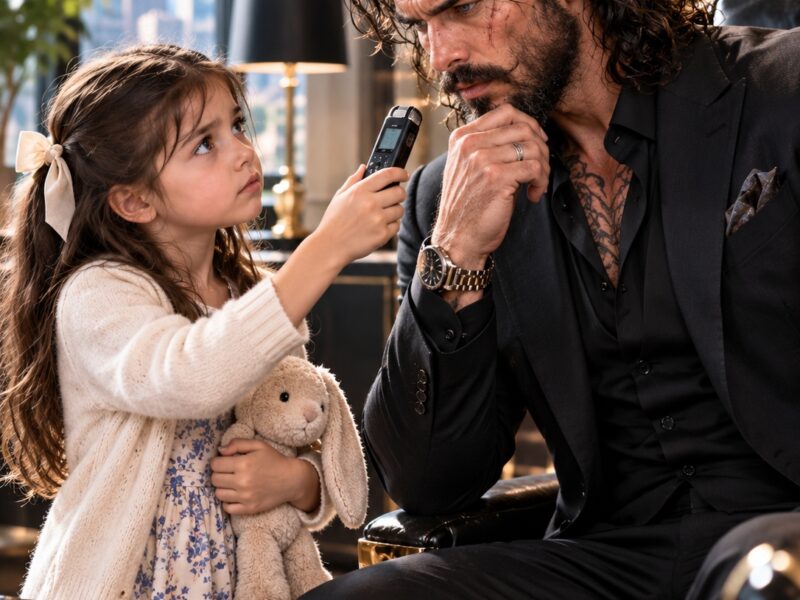
“Sir, Is This Little Recorder Yours?” the Maid’s Daughter Asked the Mafia Boss—Then a Dead Man’s Voice Exposed the Secret His Family Buried for Three Years
“Sir, is this little recorder yours?”
Seven-year-old Lucy Brooks stood in the doorway of Dominic Ferraro’s study holding a silver voice recorder in both hands.
Then Dominic pressed Play—and heard the voice of Lucy’s father, a man who had been dead for three years, whisper, “Mrs. Ferraro, if anything happens to me, don’t trust the man Dominic calls his brother.”
Dominic did not breathe.
Neither did Elena Brooks.
Outside, October rain moved across the windows of the Ferraro estate in long gray sheets.
Inside, one of the most feared men in New York stared at a machine barely longer than a child’s fingers.
Lucy looked from him to her mother.
“Did I do something wrong?”
That question broke the silence.
Dominic lowered himself slowly until he was at her eye level.
He was forty-three.
Six feet two.
Dark suit.
Silver beginning at his temples.
The kind of face newspapers described as controlled and prosecutors described as unreadable.
Men who owed Dominic money rarely looked directly at him.
Lucy did.
“No,” he said.
His voice sounded different.
“You did exactly what you should have done.”
“But Mr. Nolan said it was just an old toy.”
Dominic’s eyes moved toward the second man in the room.
Patrick Nolan sat in the leather chair beside the fireplace.
Sixty-one.
Silver-haired.
Broad through the shoulders even at his age.
He had been Dominic’s father’s closest friend.
Then Dominic’s mentor.
Then his consigliere.
He had carried twelve-year-old Dominic away from the church steps after Dominic’s father was killed.
For thirty-one years, Patrick had been the man Dominic trusted before he trusted himself.
Now Patrick’s glass of bourbon had stopped halfway toward his mouth.
Dominic noticed.
Only because Lucy had taught him where to look.
“Patrick,” Dominic said.
Patrick smiled.
Warmly.
Almost sadly.
“It probably is an old toy.”
Dominic held Lucy’s gaze.
“Where did you find it?”
“In the wooden horse.”
“What wooden horse?”
“The one in Mrs. Ferraro’s room.”
Patrick’s smile disappeared for less than a second.
Dominic saw that too.
Lucy continued.
“It has a little door in its belly.”
Elena finally found her voice.
“Mr. Ferraro, I’m so sorry. I told her not to touch anything.”
Dominic stood.
Elena Brooks had worked in his house eleven months.
Thirty-two.
Widowed.
Careful.
Quiet without being submissive.
She wore the dark gray uniform chosen by his household manager, but there was nothing of the estate in the way she held herself.
Her husband had been dead three years.
She had one daughter.
She never complained.
Never asked favors.
Never entered rooms not assigned to her.
Today had been different.
Lucy’s elementary school had closed because a heating line burst.
Elena had no childcare.
Dominic’s housekeeper had allowed the girl to sit in the staff kitchen.
Then Dominic himself had ordered the locked east sitting room opened for cleaning.
For the first time in three years.
His dead wife’s room.
Anna’s room.
Dominic looked at Elena.
“You were assigned to clean it?”
“Yes.”
“Who opened it?”
“Mrs. Whitaker.”
His head housekeeper.
“And Lucy?”
“She was with me.”
Elena’s hand tightened around the hem of her apron.
“I should have kept her beside me.”
Lucy frowned.
“I was beside you.”
Her mother looked down.
“Lucy.”
“I was.”
Dominic almost smiled.
Could not.
Not now.
He looked at the recorder.
Michael Brooks’s voice still seemed to exist in the air.
Elena’s dead husband.
A man Dominic remembered only imperfectly.
Driver.
Occasional warehouse foreman.
Reliable.
Killed when his car left the Saw Mill River Parkway during heavy rain.
Police reported excessive speed.
A small amount of alcohol.
Loss of control.
Dominic had seen hundreds of incident reports in his life.
That one had never sat correctly.
Now a dead man had spoken from his wife’s room.
Dominic pressed Play again.
Static.
Rain.
A car engine somewhere in the background.
Then Michael.
“Mrs. Ferraro, forgive me for coming to you instead of Mr. Ferraro. I know what that looks like.”
Elena’s hand flew to her mouth.
Dominic’s thumb froze above the controls.
Patrick stood.
“That is enough.”
Dominic looked at him.
Patrick’s expression softened.
“Not in front of the child.”
Reasonable.
Too reasonable.
Dominic turned toward Lucy.
Patrick was right about one thing.
Whatever waited inside the recorder did not belong in the mind of a seven-year-old.
Dominic opened the bottom drawer of his desk.
Inside was a tin of almond cookies his late wife had once insisted the staff keep near his office because Dominic routinely forgot to eat lunch.
He had not known they still replaced them.
He held the tin toward Lucy.
“Two.”
She considered.
“Three?”
Dominic stared.
Lucy stared back.
Elena whispered:
“Lucy.”
Dominic said:
“Two now.”
Lucy took two.
“And the third?”
“If you stay in the reading corner until your mother comes for you.”
“Deal.”
She walked to the rug near the library shelves and sat cross-legged.
Dominic looked at Patrick.
“Leave us.”
Patrick’s eyebrows moved.
“Dominic.”
“Please.”
That word had not existed between them professionally in years.
Patrick studied him.
Then nodded.
At the door, he stopped beside Lucy.
“You’re a clever girl.”
Lucy looked up.
Patrick touched the top of her head.
Dominic did not like the gesture.
He could not have explained why.
Patrick left.
Dominic waited until his footsteps disappeared.
Then he locked the door.
Elena stared at him.
“You locked it.”
“Yes.”
“Why?”
Dominic looked at the recorder.
“Because your husband may have died carrying something someone wanted buried.”
Her face lost color.
Three years earlier, Elena had buried Michael Brooks beneath rain.
She had stood beside a coffin with a five-year-old child gripping one hand and Michael’s mother gripping the other.
People at the funeral whispered about alcohol.
The police report listed his blood alcohol above zero but below the level people repeated later.
Rumor did what paperwork had not.
By the following month, Michael had become “the drunk driver.”
Elena stopped correcting people because defending a dead man became another full-time job layered on top of rent, grief, childcare and work.
Now Dominic Ferraro sat across from her saying he had never believed it.
“You knew?”
Dominic’s eyes lifted.
“Knew what?”
“That Michael wasn’t drunk.”
“I knew the story was incomplete.”
“And you said nothing.”
“Yes.”
The honesty hurt more than an excuse.
“Why?”
Dominic did not answer immediately.
Elena’s voice sharpened.
“Three years.”
Lucy looked over.
Elena lowered her volume.
“My daughter heard people say her father killed himself because he drank too much.”
Dominic’s jaw tightened.
“I know.”
“No, you don’t.”
“You are right.”
That stopped her.
Dominic looked toward Lucy.
Then back.
“I read the toxicology report personally.”
Elena’s eyes filled.
“Michael had not been drinking.”
“He had alcohol in his system.”
“How much?”
“One drink, perhaps two, hours earlier.”
Elena stared.
“Not enough to explain the crash.”
“No.”
“Then why let everyone believe—”
“Because the person who encouraged that version needed to think I accepted it.”
Elena went completely still.
“What person?”
Dominic looked toward the locked door.
Then at the recorder.
“I think we are about to find out.”
He pressed Play.
Michael’s voice returned.
“I drive Mr. Nolan every other Thursday.”
Elena’s knees weakened.
She sat.
Dominic did not.
Michael continued.
“He says they’re meetings with union people. Sometimes city inspectors. I don’t ask.”
Static.
“He had me take him to the abandoned Fulton Cold Storage building twice this month.”
Dominic’s eyes hardened.
The building sat near the Brooklyn waterfront.
Ferraro property once.
Sold years earlier.
Michael continued.
“Last night I saw the man he met.”
Pause.
“Alec Voss.”
Dominic stopped the recording.
Elena looked up.
“Who is that?”
Dominic did not answer.
His face had changed.
Not dramatically.
That made it worse.
“Mr. Ferraro.”
“A rival.”
“Business?”
“Yes.”
“Your kind of business?”
“Yes.”
Lucy looked up again.
Dominic glanced toward her.
Elena understood.
“Lucy.”
“Yes, Mama?”
“Mrs. Whitaker is probably looking for you.”
“I’m eating.”
“You can eat downstairs.”
Lucy sighed.
Children had a gift for making dangerous rooms ordinary.
Dominic unlocked the door.
Before Lucy left, she turned.
“Sir?”
“Yes?”
“Can I have number three?”
For one second Dominic simply looked at her.
Then he took the third cookie from the tin.
Handed it over.
She smiled.
“Thank you.”
The door closed.
Dominic locked it again.
Elena said:
“Play it.”
He did.
Michael’s voice:
“I watched Nolan give Voss an envelope.”
Rain on the recording.
“He saw me through the windshield.”
Dominic’s eyes closed briefly.
“He smiled.”
Michael continued.
“That’s what scared me.”
Elena pressed both hands against the desk.
“He asked me later whether I had a family.”
Her breath broke.
“He knew I did.”
Dominic stared toward the dark window.
“He said a man drives more carefully when people are waiting at home.”
Elena whispered:
“Oh God.”
Michael’s voice became rougher.
“I don’t know what’s inside those envelopes. But I know enough to know I shouldn’t have seen them.”
Then another voice entered.
Anna Ferraro.
Dominic’s dead wife.
The sound struck him physically.
“Michael.”
Soft.
Calm.
Alive.
Dominic sat.
Not because he chose to.
His legs did.
Anna continued:
“Thank you for coming to me.”
Michael:
“I should tell your husband.”
“No.”
Dominic closed his eyes.
Anna’s voice:
“Not until I know whether Patrick is alone.”
Dominic opened his eyes.
Elena watched him.
He looked suddenly older.
Michael said:
“You think other people are involved?”
“I think Patrick knows every weakness Dominic has because he helped raise him.”
Pause.
“And I think that is exactly why Dominic will not believe me without proof.”
Dominic’s mouth tightened.
Anna had known him.
Better than he deserved.
The recording continued.
“I need a week.”
Michael:
“I don’t think we have one.”
Anna:
“Then give me three days.”
A small click.
Silence.
Then Anna spoke again.
Closer to the recorder now.
Alone.
“Dominic, if you hear this, I failed to tell you myself.”
His hand closed around the arm of the chair.
“I hid this in the nursery horse because no one knows I kept it.”
Dominic looked toward the ceiling as though the room above them still existed.
There had been no nursery.
Not that he knew.
Anna continued.
“Patrick will tell you to seal my rooms.”
Dominic stopped breathing.
“He will tell you grief makes men reckless.”
Elena saw the color leave his face.
“He will say preserving things untouched preserves me.”
Dominic whispered:
“No.”
Anna:
“Listen carefully.”
His eyes filled.
“The person most afraid of what I left behind will be the person most determined that you never touch my things.”
Dominic looked toward the door.
Three years ago, in the hospital, Patrick Nolan had sat beside him.
Anna dead.
Michael dead.
Rain against the windows.
Patrick had put one hand on Dominic’s shoulder.
Close the east wing.
Dominic remembered every word.
Do not let staff box her life into labels while you’re grieving. Leave it exactly as she left it. You’ll thank me one day.
Dominic had thanked him.
The day after the funeral.
He had given Patrick the second key.
Elena whispered:
“He kept the room closed.”
Dominic nodded.
“Who?”
Dominic’s voice barely existed.
“Patrick.”
Anna’s recording continued.
“There is another thing.”
A sound.
Almost laughter.
Then a breath trembling around happiness.
“I was going to tell you Sunday.”
Dominic’s face changed.
“I practiced twice because I knew you would stare at me like I’d handed you a bomb.”
Elena looked down.
This part felt private.
But Dominic could not stop it.
“I’m pregnant.”
The room disappeared.
Dominic heard nothing after that for several seconds.
Not rain.
Not traffic.
Not Elena breathing.
Anna’s voice:
“Eleven weeks.”
Dominic’s hand released the chair.
Then tightened again.
“I went to Dr. Rebecca Hall this morning.”
Tears reached his eyes.
He did not wipe them.
“I know you’re afraid of becoming your father.”
Dominic bowed his head.
“But you won’t.”
Anna laughed softly.
“You worry too much about becoming cruel to realize cruel men rarely worry about it.”
Elena looked away.
“I am happy.”
Anna’s voice cracked.
“Dominic, I am so happy.”
He made one sound.
Not a sob.
Less than that.
Worse.
“If something happens before I tell you, please don’t let the last thing you remember about me be fear.”
Click.
The recording ended.
Dominic sat completely still.
Three years.
He had mourned a wife.
Now he mourned a child he had never known existed.
Elena stood.
She almost touched him.
Did not.
That restraint was what he remembered later.
Everyone in Dominic’s life touched him when they wanted something.
Comfort.
Permission.
Reassurance.
Access.
Elena simply stood nearby.
After a long time Dominic whispered:
“She was going to the doctor.”
Elena looked at him.
“The day she died?”
He nodded.
“Michael drove her.”
Elena’s hand covered her mouth.
The police report.
Anna’s car had been in service.
Michael had driven her into Manhattan.
Their sedan left the West Side Highway during a violent storm.
Both died.
Patrick had been first at the hospital.
Patrick had told Dominic the road was slick.
Michael had been drinking.
Anna should never have gotten into the car.
Dominic had hated Michael for one night.
Then hated himself for hating a dead man.
Patrick had comforted him through both.
Elena said:
“Did Patrick know she was pregnant?”
“I don’t know.”
“Did he know she was investigating him?”
“Yes.”
Dominic looked toward the recorder.
“He does now.”
Elena’s eyes widened.
“He saw it.”
“He saw enough.”
“He knows Lucy found it.”
“Yes.”
“Then my daughter—”
“No.”
Dominic stood.
The grief disappeared behind something colder.
“Elena.”
His voice became the voice men obeyed.
“You and Lucy are not leaving this estate tonight.”
Her body tightened.
“You do not decide that.”
Dominic stopped.
A different man might have continued.
Dominic looked at her.
“You’re right.”
Silence.
He tried again.
“I believe Patrick may consider you a threat.”
“That is different.”
“Yes.”
“If we stay?”
“I put people I trust outside your room.”
“People you trust.”
Dominic understood the irony.
“People Marcus trusts.”
“Is Marcus safe?”
“I believe so.”
“You believed Patrick.”
That landed.
“Yes.”
Dominic picked up his phone.
“So I verify.”
He called Marcus Hale.
Marcus arrived seven minutes later.
He listened to the recording once.
No expression.
Then again.
At Anna’s pregnancy announcement, Marcus looked toward the floor.
Dominic ended playback.
“Tell me what you know about Patrick’s Thursday movements.”
Marcus was quiet.
“Not enough.”
“Why?”
“Because he outranked every internal security protocol except you.”
Dominic’s jaw tightened.
“And I exempted him.”
“Yes.”
“Fix it.”
Marcus nodded.
“Where is he?”
“Gardens.”
“With who?”
Marcus checked.
Then looked up.
“No one.”
Dominic moved toward the window.
Patrick stood outside beneath a black umbrella.
Phone at his ear.
Looking directly at the study.
Dominic pulled the curtain shut.
Marcus said:
“He knows.”
“Yes.”
“What do you want?”
Dominic looked at Elena.
She stood beside the desk.
A maid.
A widow.
A mother whose husband’s voice had just returned from death.
And suddenly the most vulnerable person in Dominic’s world because his family had turned her grief into evidence.
Dominic said:
“Nothing dramatic.”
Marcus raised one eyebrow.
“Your definition or mine?”
“Legal.”
Marcus stared.
“That word has become popular lately.”
“I’m serious.”
“So am I.”
Dominic breathed slowly.
“Patrick has captains loyal to him.”
“Yes.”
“If I confront him privately, he denies everything.”
“Yes.”
“If I remove him without proof, the organization fractures.”
“Yes.”
“And if I retaliate the old way—”
Marcus waited.
Dominic looked at Anna’s recorder.
“I become exactly what she thought I could still choose not to be.”
Marcus’s expression changed.
Slightly.
“What then?”
“Evidence.”
Elena said:
“My husband left something else.”
Both men looked at her.
She swallowed.
“Lucy found a paper inside the wooden horse.”
Dominic stood.
“Where is it?”
Elena’s face changed.
“I forgot.”
Marcus closed his eyes.
Dominic said:
“What do you mean forgot?”
“She tucked it into her coloring book.”
They all moved.
Not running.
Running would have alarmed the house.
Dominic hated that truth.
The staff kitchen was empty except for Mrs. Whitaker.
“Lucy?”
The older woman looked toward the pantry.
“She was here.”
Elena’s pulse spiked.
“Was?”
Mrs. Whitaker looked frightened.
“Mr. Nolan came down.”
Dominic went perfectly still.
“What did he want?”
“He said he was taking Lucy to see the roses.”
Elena was already at the window.
Outside, in the rain, Patrick Nolan crouched beside her daughter.
Black umbrella.
Peppermint in one hand.
Lucy’s coloring book tucked under her arm.
Elena ran.
Dominic followed.
The rain soaked him before the first terrace step.
Patrick looked up as they approached.
No surprise.
That frightened Dominic more than guilt would have.
“Elena.”
Patrick smiled.
“You’ll catch cold.”
Lucy looked excited.
“Mr. Nolan knows where the best roses grow.”
The rose bushes were nearly bare.
Patrick stood.
Dominic stopped six feet away.
“Lucy.”
The child looked at him.
“Come here.”
Patrick’s hand rested lightly on her shoulder.
Dominic’s voice changed.
“Patrick.”
Patrick removed it.
Lucy walked to Elena.
Elena held her.
Patrick looked at Dominic.
“So.”
Rain ran from his silver hair.
“You opened Anna’s room.”
“Yes.”
“After three years.”
“Yes.”
“And found a child’s toy.”
Dominic held his gaze.
“Apparently.”
Patrick smiled.
“Strange what houses keep.”
“Strange what people hide.”
Patrick’s expression remained warm.
“The captains are coming tonight.”
Dominic had invited no one.
“Why?”
“Because certain questions are starting to move.”
“What questions?”
Patrick looked toward Elena.
Then Lucy.
“Why a maid’s daughter is wandering through family rooms with family property.”
Dominic stepped closer.
“She is a child.”
“Children repeat things.”
Lucy frowned.
“I don’t repeat secrets.”
Patrick looked down.
“Of course not.”
He smiled.
“What was the paper?”
Dominic saw Elena stiffen.
Lucy answered before either adult could.
“Boring.”
Patrick laughed.
“Where is it?”
Lucy looked at him.
Then at Dominic.
“Secret.”
For the first time, Patrick’s face changed.
Only his eyes.
Dominic saw hunger.
Fear.
Then it was gone.
Patrick handed his umbrella to Elena.
“Nine o’clock.”
“What?”
“Dinner.”
He looked at Dominic.
“Like family.”
Then walked toward the house.
Dominic crouched in wet grass.
“Lucy.”
She looked at him.
“Did you tell him where the paper is?”
“No.”
“Why?”
“He asked too many times.”
Dominic stared.
Lucy added:
“Mom says when grown-ups ask the same thing three times, they already know what answer they want.”
Elena almost laughed despite everything.
“Can I have the book?”
Lucy held it tighter.
“Why?”
“Because the boring paper may be important.”
She considered.
Then handed it to her mother.
Inside, folded behind a page covered in blue stars, lay one square of old paper.
Elena unfolded it in Dominic’s study.
Handwritten numbers.
Dates.
Transfer amounts.
Routing information.
Initials.
At the bottom:
A.F. — If Michael gives this to you, trust him. P.N. is moving our money through Voss.
Anna.
Below it, another line.
Michael’s handwriting.
Elena recognized the crooked sevens immediately.
Elena, if you ever see this, I’m sorry I brought danger near you. Everything I did was for you and Lucy.
Elena sat.
Dominic remained standing.
Marcus photographed the document.
“Accounts?”
Dominic looked.
“Three of them.”
“You recognize?”
“One.”
“What?”
“A reserve company Patrick insisted my father create fifteen years ago.”
Marcus’s jaw tightened.
“How much access?”
“Patrick and me.”
“Anybody else?”
“No.”
Marcus pointed at the transfers.
“Then this is enough for subpoenas.”
Dominic looked at him.
“Call Rebecca Walsh.”
Elena frowned.
“Who?”
“Federal investigator.”
Marcus looked surprised.
“You’ve been avoiding her for five years.”
“I’m done avoiding.”
Dominic turned toward Elena.
“I need to tell you something you may hate.”
She waited.
“If I give her this, I cannot control where the investigation stops.”
“Meaning?”
“My companies.”
“Your criminal business.”
“Yes.”
“You might lose it.”
“Yes.”
“You might be charged.”
“Yes.”
Elena studied him.
Dominic did not look away.
“Why would you do that?”
He looked toward Anna’s recorder.
“Because my wife died trying to tell me the truth about the thing I kept pretending was protection.”
His eyes returned to Elena.
“And because your husband died helping her.”
There was no redemption in the sentence.
Only responsibility.
Agent Rebecca Walsh arrived at seven-thirty through the service entrance.
Fifty.
Federal organized-crime task force.
Practical shoes.
Expression of a woman who had spent twenty-five years watching powerful men discover evidence was less impressed by reputation than people were.
She sat in Dominic’s library.
Listened.
Read the paper.
Then looked at him.
“You understand what you’re offering?”
“Yes.”
“Access to books?”
“Yes.”
“Corporate entities?”
“If counsel approves procedure.”
Rebecca almost smiled.
“Still Dominic Ferraro.”
“I’m not volunteering stupidity.”
“No.”
She leaned back.
“What do you want in return?”
“Protection for Elena and Lucy.”
Rebecca’s face hardened.
“Not immunity?”
“No.”
“Not a deal?”
“No.”
“Protection.”
“Yes.”
“And Michael Brooks’s name cleared if evidence supports it.”
Rebecca studied him.
“Anything else?”
Dominic looked at Anna’s recorder.
“Truth.”
Rebecca said:
“That one is usually expensive.”
“I know.”
At nine, eleven men sat around Dominic’s dining table.
Patrick to his right.
Victor Marino at the opposite end.
Marcus near the doors.
Rebecca and her team waited in a surveillance van beyond the east wall with warrants in process and microphones monitoring through equipment Marcus had lawfully installed in Dominic’s own home under counsel.
No guns on tables.
No threats.
Dominic wanted words.
Words were harder to deny later.
Patrick spoke first.
“Three years ago grief made this family fragile.”
Dominic listened.
“Tonight, I am afraid grief may be doing it again.”
Several captains looked at Dominic.
Patrick continued.
“A housekeeper’s child found a recording in Anna’s room.”
No reaction.
“Conveniently, it contains accusations against me.”
Dominic said:
“You haven’t heard the whole recording.”
Patrick’s eyes shifted.
Tiny.
Enough.
Dominic placed the silver recorder on the table.
Pressed Play.
Michael’s voice.
Patrick sat still.
Then Anna.
When her pregnancy confession entered the room, two men looked down.
One crossed himself.
Patrick’s right hand flattened slowly against the table.
The recording ended.
Patrick exhaled.
“Grief makes people hear what they need.”
Dominic looked at him.
“You think it’s fake.”
“I think dead voices cannot answer questions.”
Elena stepped into the doorway.
Patrick turned.
She had not planned to enter.
Dominic could tell.
Her hands trembled.
Her voice did not.
“That is my husband.”
Patrick smiled sadly.
“Elena.”
“Do not say my name like you knew him.”
“He worked for us.”
“He died for you.”
Silence.
Patrick’s smile faded.
Elena held the copied account sheet.
“And he wrote this.”
Victor took it first.
Read.
Passed it left.
By the time the paper reached Patrick, his face had changed.
“Meaningless.”
Dominic said:
“Account 7716.”
Patrick looked up.
“That funded the East Hampton property.”
One captain frowned.
Patrick said:
“Personal investment.”
“Yours.”
“Yes.”
“With family reserve funds routed through Voss.”
“No.”
Marcus placed bank records on the table.
Patrick stared.
Dominic continued.
“I called the bank.”
“You had no right—”
Dominic almost smiled.
“My name is on the account.”
Patrick realized the mistake.
Too late.
“Three years of transfers.”
Dominic’s voice stayed quiet.
“Dates matching your Thursday meetings.”
Patrick looked around the table.
“Do you understand what he is doing?”
No one spoke.
“He is destroying the structure that feeds every family sitting here because a dead woman left him a tape.”
Dominic said:
“No.”
Patrick looked at him.
“I’m destroying the structure because it required my wife and Michael Brooks to die before I questioned who benefited from it.”
Patrick stood.
Not violent.
But the room tightened.
“You think you are better than your father.”
“No.”
“Then what?”
“I think he was wrong about enough things that I’m done treating inheritance as evidence.”
Patrick laughed.
“Anna did this to you.”
Dominic’s eyes hardened.
“Anna tried to warn me.”
“You always were weak around her.”
There.
Something honest.
Patrick heard himself.
Dominic did too.
“What happened on the West Side Highway?”
Patrick stopped.
Nobody moved.
Dominic repeated:
“What happened?”
Patrick’s eyes went toward the recorder.
Then the account page.
Then Elena.
“You want a confession.”
“I want the answer.”
Patrick looked tired suddenly.
Twenty years older.
“It was not supposed to be Anna.”
Dominic did not blink.
Elena’s fingers tightened around the doorframe.
Patrick continued.
“Michael was the problem.”
Her face drained.
“He saw Voss.”
Patrick’s voice sharpened.
“He should have stayed a driver.”
Dominic whispered:
“So you targeted his car.”
“I had someone tamper with the service schedule.”
Marcus’s face changed.
Patrick saw.
“It was supposed to strand him.”
“On the highway?”
“No.”
“Then?”
“Before.”
Patrick looked at Dominic.
“To frighten him.”
Dominic said nothing.
“He was supposed to understand that he had a daughter.”
Elena made a sound.
Patrick closed his eyes.
“The storm made it worse.”
Dominic’s voice went flat.
“Anna was in the car.”
“I did not know.”
“You had men watching Michael.”
“Not that morning.”
“You did not know Anna was there because you were sloppy.”
Patrick’s composure cracked.
“I spent thirty years cleaning up your family’s mistakes.”
Dominic stared.
“There it is.”
“Your father treated me like staff.”
Patrick’s voice rose.
“I built half of what he owned.”
“He gave you money.”
“He never gave me the name.”
“You had your own.”
“That is easy for a Ferraro to say.”
Patrick’s eyes filled with something uglier than greed.
Humiliation preserved too long.
“Voss offered me the Brooklyn routes.”
Dominic understood.
“In exchange for access.”
“At first.”
“And then?”
“Control.”
Patrick breathed hard.
“I did not intend Anna.”
“You intended Michael.”
Silence.
Elena stepped forward.
Dominic lifted one hand.
Not stopping her.
Warning the room to remain still.
She looked directly at Patrick.
“My daughter spent three years hearing people say her father died drunk.”
Patrick looked away.
“You started that too.”
He said nothing.
“Look at me.”
He did.
“You killed his name after you killed his safety.”
Patrick’s face crumpled for one second.
Then hardened again.
“I did what survival required.”
Elena shook her head.
“No.”
Her voice stayed quiet.
“You did what pride required and called it survival.”
Nobody at the table moved.
Dominic looked at the recorder.
A small red light blinked.
Patrick saw it.
His eyes widened.
Dominic said:
“You always told me never to ask a question unless I already knew where the exits were.”
The dining-room doors opened.
Rebecca Walsh entered with federal agents and warrant documents.
No screaming.
No weapons raised.
No theatrical chaos.
Just paperwork.
Patrick looked at Dominic.
“You brought them into your father’s house.”
Dominic stood.
“No.”
He looked around the room.
“I brought the truth into mine.”
The investigation took nineteen months.
That mattered.
Because consequences worth believing rarely arrive before the commercial break.
Patrick was charged with conspiracy, financial crimes, obstruction and offenses connected to the vehicle tampering that led to Michael and Anna’s deaths.
He eventually pleaded guilty.
Not because conscience won.
Because bank records, Michael’s account sheet, the recorder and his own recorded admissions left little room for theater.
Several captains cooperated.
Some were charged.
Others exited before charges reached them.
Dominic turned over corporate records through counsel.
Legitimate companies survived.
Several did not.
Ferraro Shipping was sold.
Two warehouses entered federal receivership.
One construction subsidiary paid massive safety penalties and wrongful-death settlements.
Dominic faced charges tied to financial reporting and conspiracy conduct he had inherited but continued.
His lawyers negotiated.
He accepted a plea to financial offenses.
Eleven months.
Not heroism.
Consequence.
Before surrendering, he met Elena in a small conference room.
She sat across from him.
Michael’s official record had been corrected.
The word intoxication remained in the toxicology data because a small amount was present.
But the cause investigation now explicitly stated alcohol did not materially contribute to the crash.
Vehicle neglect and intentional interference did.
Michael’s name was cleared of responsibility.
Elena held the amended report.
For almost a minute she said nothing.
Then:
“Lucy can read this someday.”
“Yes.”
“She’ll know.”
“Yes.”
Elena looked at Dominic.
“I don’t know whether I forgive you for staying silent for three years.”
“I don’t expect you to.”
“You protected us.”
“After.”
“Yes.”
She folded the report.
“You also protected the investigation before you protected our dignity.”
“Yes.”
Dominic did not defend himself.
That mattered.
Elena continued:
“But when the truth finally cost you something, you still told it.”
He looked at her.
“I should have done it earlier.”
“Yes.”
Silence.
Then Elena asked:
“What happens to this house?”
“Sold.”
Her eyebrows lifted.
“All of it?”
“Mostly.”
“Why?”
Dominic looked around.
“Too many rooms devoted to things no one was allowed to say.”
That answer stayed with her.
He served eleven months.
Lucy sent letters.
Every one began:
Dear Mr. Ferraro, prison sounds boring.
Dominic answered all of them.
Elena allowed it.
She did not write herself at first.
Then, six months in, a card arrived.
No message inside except:
Lucy got an A in science. Thought you’d want to know. — E
Dominic read it twenty times.
After his release, he did not return to organized crime.
People did not believe that immediately.
Maybe reasonably.
He kept legitimate interests that had survived review.
A hotel.
Three restaurants.
A small commercial-property company.
Enough money.
More than enough.
He bought no estate.
Instead he purchased a brownstone in Brooklyn Heights with a small garden and too many stairs.
Mrs. Whitaker called it character building.
She came to dinner once a month after retiring.
Marcus became COO of the legitimate property company.
He wore suits with fewer secrets.
Elena left domestic service.
The wrongful-death settlement and survivor compensation gave her choices, but she did not stop working.
She trained in nonprofit administration.
Eventually became director of a childcare center funded from the sale of Anna’s former townhouse.
Dominic wanted to name it after Anna.
Elena refused.
“Children do not need to walk into someone else’s grief every morning.”
He listened.
They named it Harbor House.
Affordable childcare.
Extended hours.
Near the train.
No mother cleaning someone else’s mansion would have to bring a child to work because school closed unexpectedly.
Lucy chose the logo.
A yellow umbrella.
Dominic stared the first time he saw it.
“You remember that?”
Lucy was ten.
“Of course.”
“The umbrella was enormous.”
“It kept me dry.”
“You looked like a mushroom.”
She gasped.
Elena laughed.
That was the first time Dominic heard her laugh at him.
He wanted to hear it again.
Their relationship did not become romantic because he rescued her.
He had not rescued her.
That distinction mattered to both of them.
Michael helped expose the truth.
Anna preserved it.
Lucy found it.
Elena confronted it.
Dominic finally stopped hiding from it.
No one owed him love for doing what came last.
Two years after his release, Elena invited Dominic to dinner.
Not at one of his restaurants.
Her apartment.
Lucy was spending the night with a friend.
Dominic arrived carrying wine.
Elena looked at the bottle.
“That costs more than my first car.”
“I can take it back.”
“No.”
She took it.
“I want to know what irresponsibility tastes like.”
Dinner was chicken.
Rice.
Roasted vegetables.
Nothing dramatic.
Halfway through, Elena asked:
“Do you still hear Anna’s voice?”
Dominic put down his fork.
“Sometimes.”
“From the recorder?”
“No.”
He looked toward the window.
“Before.”
Elena understood.
“Do you feel guilty when you’re happy?”
“Yes.”
“Me too.”
Michael.
Anna.
Both in the room without being ghosts.
That was when Dominic understood Elena might someday love him.
Not because they had forgotten the dead.
Because neither demanded forgetting.
Their first kiss came almost a year later.
Slow.
Asked for.
No debt attached.
Lucy discovered them two months after that.
She entered Elena’s kitchen and found Dominic pouring coffee barefoot.
She stared.
Dominic stared back.
“Why are your shoes off?”
He considered.
“Complicated.”
Lucy looked at her mother.
“Is he sleeping over?”
Elena nearly dropped a mug.
Dominic said:
“In the guest room.”
True.
Lucy narrowed her eyes.
“Why?”
Dominic had faced prosecutors more comfortably.
Elena laughed.
“We’re dating.”
Lucy stared.
Then:
“That took forever.”
She took cereal from the cabinet.
Dominic looked offended.
“You’re eleven.”
“I have eyes.”
Fair.
Three years later, Dominic asked Elena to marry him.
He did not buy a ring first.
That surprised her.
“I thought powerful men came with jewelry.”
“I’m reforming.”
“Slowly.”
“Yes.”
They were sitting on a bench outside Harbor House after closing.
Children’s paintings taped inside the windows.
Yellow umbrella logo on the door.
Dominic said:
“If you say no, nothing changes about Harbor House.”
Elena looked at him.
“I know.”
“Nothing changes for Lucy.”
“I know.”
“No money.”
“No home.”
“No job.”
“I know.”
“I need you to know.”
She touched his hand.
“Dominic.”
He stopped.
“You spent years learning to separate giving from owning.”
“Yes.”
“I noticed.”
His throat tightened.
“Then?”
“Yes.”
He stared.
“Yes?”
“Yes.”
He laughed.
Elena kissed him.
Lucy complained later that nobody filmed it.
Dominic considered that a benefit.
At the wedding, Michael’s photograph sat beside Anna’s.
Not in the center.
Not hidden.
Two people whose lives had ended too early and whose courage had made the new family possible.
Lucy placed the recorder between the frames.
Dominic saw it.
His breath caught.
After the ceremony, he found Lucy near the garden.
“You brought it.”
She nodded.
“The court said it belongs to you.”
Dominic crouched.
He was fifty by then.
His knees complained more loudly.
Lucy held the silver recorder out exactly the way she had at seven.
“Sir.”
Dominic almost laughed.
“Is this little recorder yours?”
He looked at it.
Then at her.
“No.”
Lucy frowned.
“It was Anna’s.”
“Yes.”
“It has Dad’s voice.”
“Yes.”
“It changed your life.”
“Yes.”
“Then whose is it?”
Dominic closed her fingers around it.
“Yours.”
Her eyes widened.
“Why?”
“Because you were the one brave enough to carry it into a room full of adults who were afraid of it.”
Lucy looked down at the recorder.
“I wasn’t brave.”
“You walked into my study.”
“I didn’t know you were scary yet.”
Dominic laughed.
“That may be the definition of courage.”
She hugged him.
Years passed.
The recorder remained in Lucy’s desk through high school.
Then college.
She studied investigative journalism.
Dominic blamed the recorder.
Elena blamed genetics nobody could identify.
At twenty-four, Lucy produced a documentary on construction-worker safety and corporate reporting failures.
She did not use Dominic’s story.
Not directly.
She used Michael’s.
With Elena’s permission.
The documentary ended with one sentence from Michael’s recording:
“I don’t know who else to trust.”
Then statistics.
Not sentiment.
Dominic watched the premiere from the back row.
He cried.
Quietly.
Elena handed him a tissue.
“You’re becoming soft.”
“I’m elderly.”
“You’re fifty-nine.”
“Ancient.”
Afterward, Lucy joined them.
“You okay?”
Dominic looked at her.
“No.”
She smiled.
“Good documentary?”
“Terrible.”
“Liar.”
“Your camera angles were questionable.”
She hugged him.
Then whispered:
“Thank you for letting Dad’s voice be his.”
Dominic closed his eyes.
That was perhaps the kindest thing anyone ever thanked him for.
Not controlling the story.
Years earlier, control had been his entire language.
Now restraint had become one.
The Bellini name did not disappear.
Names rarely do.
It changed shape.
Some remembered Dominic as a crime boss.
Correct.
Some remembered the prosecution.
Also correct.
Some knew the restaurants.
The property company.
Harbor House.
The safety fund established in Michael and Anna’s names.
All correct.
Dominic never asked anyone to choose which version counted.
People are not court exhibits.
They contain contradictions.
The important part was not whether Dominic became a good man in some clean, final way.
The important part was that after spending decades believing power meant deciding what everyone else had to carry, he finally learned another use for it.
Opening the locked room.
Listening to the voice.
Telling the truth when it cost him.
And not taking from people simply because he had enough power to make them stay.
On the tenth anniversary of the day Lucy found the recorder, Dominic returned to the old Ferraro estate.
The property no longer belonged to him.
It had been purchased by a university foundation and converted into a residential fellowship center.
The east sitting room was now a reading room.
The locked door was gone.
Dominic stood in the doorway.
Lucy beside him.
Elena behind them.
A group of students sat where Anna’s furniture had once been covered in sheets.
Books.
Laptop chargers.
Coffee.
Noise.
Life.
Lucy smiled.
“Better.”
Dominic looked around.
“Yes.”
“Do you miss the house?”
“No.”
“Not even the study?”
“No.”
“Your giant desk?”
“Sometimes.”
Elena laughed.
Lucy reached into her bag.
The recorder.
Older now.
Scratched.
She carried a digital copy of everything, but kept the original.
Dominic looked at it.
“You still bring that places?”
“Sometimes.”
“Why?”
Lucy considered.
“Because people like locked rooms.”
Dominic smiled faintly.
“They do.”
“And somebody has to keep asking what’s inside.”
Elena slipped her hand into his.
Dominic looked toward the open door.
Three years of his life had been destroyed by a room no one was allowed to enter.
Then one rainy afternoon, a housekeeper’s daughter had opened a toy horse and found the truth.
Not because she was investigating.
Not because she knew anyone was lying.
Because she saw something that did not belong to her and believed the obvious thing was to find its owner.
“Sir, is this little recorder yours?”
Dominic had thought the question was about an object.
It had never been about the recorder.
It was about the truth inside it.
Whether he would claim it.
Whether he would listen.
Whether he would accept that something could belong to him even when he hated what it said about the people he loved.
Dominic squeezed Elena’s hand.
Lucy walked into the old room first.
This time no one stopped her.
No one lowered their voice.
No one locked the door behind her.
And Dominic followed.









