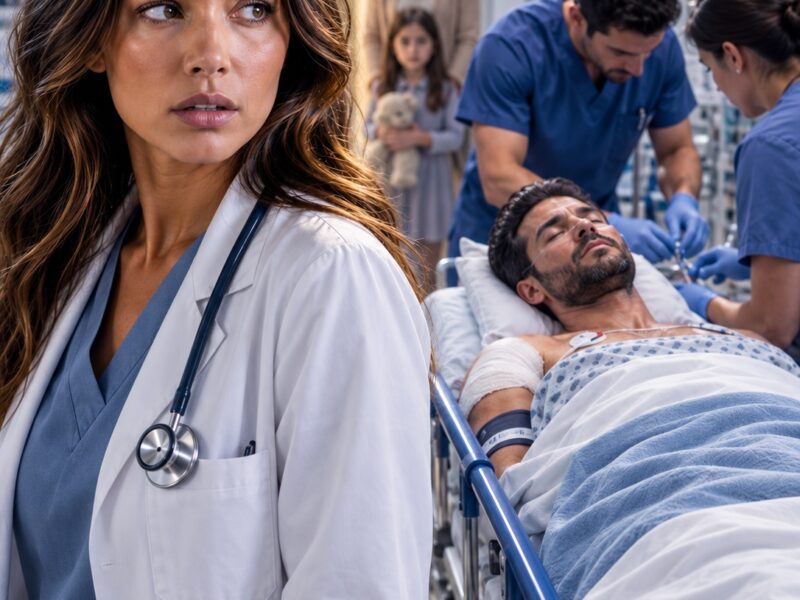
Six Years After He Left Her, the Crime Lord Was Wheeled Into Her ER — And She Froze
The trauma doors opened at 11:43 p.m., and the man I had spent six years learning how not to miss arrived with blood soaking through his shirt.
My hands recognized Dante Vasquez before my heart was willing to.
What he did not know was that six miles away, a six-year-old girl with his dark eyes was asleep beneath a blanket covered in horses.
Rain came sideways across Seattle that night, hard enough to turn the windows of St. Callaway Medical Center into sheets of trembling silver.
I had been on shift for fourteen hours.
Fourteen hours of chest pain, broken bones, a frightened college freshman who had taken too much of something he would not name, and an eighty-two-year-old woman who apologized every time I touched her because she had spent her entire life believing inconvenience was a moral failure.
By eleven-thirty, my feet hurt.
My coffee had gone cold twice.
There was dried blood on the cuff of my navy scrub top that did not belong to me.
Normal night.
Then the trauma radio crackled.
“Male, late thirties. Multiple gunshot wounds, left chest and shoulder. Hypotensive. Decreased breath sounds left side. Lost consciousness once en route. ETA sixty seconds.”
The room changed.
That is what emergency medicine does.
One moment you are thinking about whether you remembered to sign an order.
The next, the unnecessary parts of you disappear.
“Trauma One,” I said.
Kate Monroe, our charge nurse, was already moving.
“Blood bank notified.”
“Thoracic tray.”
“Coming.”
“Ultrasound.”
“Here.”
Gloves.
Gown.
Mask.
The doors opened.
Paramedics came through fast.
“Three wounds. One lateral shoulder, one upper chest, one left posterior thorax. BP seventy-eight over forty. Pulse one-thirty-eight.”
I moved toward the gurney.
“Airway?”
“Patent but deteriorating.”
“Name?”
“Dante Vasquez.”
My hands stopped.
Not visibly.
Not long.
Half a second, maybe less.
But inside me, six years opened like a trapdoor.
I looked down.
His face was paler than I remembered.
Older.
Dark hair damp from rain and sweat.
A new scar along his jaw.
Another near his right temple.
His lashes lay still against skin that had once been warm beneath my fingertips in a small apartment two neighborhoods from Puget Sound.
Dante Vasquez.
The man who had disappeared before sunrise one November morning.
The man who left a note on our kitchen table.
I’m sorry, Freya. Please don’t look for me.
No explanation.
No second page.
No call.
No body.
No funeral.
Just absence.
Two weeks later, I learned I was pregnant.
“Doctor?”
Kate’s voice snapped the room back into focus.
I reached for the shears.
“Cut the shirt.”
My voice was steady.
I hated that I noticed.
“Two large-bore IVs. Type and cross. Chest tube tray.”
His blood pressure dropped again.
Someone said, “Sixty systolic.”
I put my stethoscope to the left side of his chest.
Almost nothing.
“Needle decompression now.”
The room moved around me.
Not chaos.
Controlled urgency.
I had spent six years building a life around one fact: if something was in front of me and needed doing, I did it.
Dante became a patient.
That was how I survived the next twenty minutes.
His name disappeared.
His history disappeared.
The way he used to stand barefoot in the kitchen at two in the morning drinking water straight from the glass pitcher disappeared.
The sound of him laughing the first time I burned pancakes disappeared.
The fact that our daughter had his eyes disappeared.
He was male, thirty-eight, penetrating trauma, unstable.
That was enough.
“Pressure improving.”
“Eighty-six over fifty.”
“Breath sounds better.”
“Get portable chest.”
Kate looked at me over the monitor.
“You good?”
“Yes.”
She knew me too well to believe the speed of that answer.
She did not challenge it.
Not then.
Dante woke briefly as we were preparing to move him.
His eyes opened.
Dark.
Disoriented.
They found my face.
For one impossible second, he looked exactly like the man I had known.
Not the crime lord newspapers would later call him.
Not the name whispered around ports from Tacoma to Oakland.
Just Dante.
His lips moved.
No sound.
Then:
“Freya?”
My throat closed.
“Don’t talk.”
His gaze sharpened.
“Freya.”
“You have a chest injury.”
He tried to move.
Pain stopped him.
I put one hand against his shoulder.
“Do not.”
His eyes stayed on me.
Even drugged, pale, half-conscious, he looked like a man trying to solve something.
I knew that look.
Mia did it too.
That thought almost broke me.
“We’re taking you upstairs.”
His eyes closed.
I stepped back.
“Move.”
Two hours later, he was stable enough for the ICU.
The worst bullet had passed through soft tissue near his shoulder before entering the upper left chest, damaging part of the lung but missing the heart and major vessels by inches.
One more inch inward and the night would have ended differently.
I signed the transfer note.
Washed my hands.
Then kept washing them after they were already clean.
The water ran hot over my fingers.
Kate entered the scrub room and closed the door behind her.
She leaned against it.
“You want to tell me why the extremely dangerous-looking man in Trauma One said your name like he’d been dying for six years?”
I stared at the sink.
“No.”
“Excellent.”
She crossed her arms.
“We’ll begin there.”
“Kate.”
“You froze.”
“For half a second.”
“You never freeze.”
“I didn’t compromise care.”
“I didn’t say you did.”
That was Kate.
Forty-two.
Emergency nurse for nineteen years.
Red hair she wore in a severe knot that came loose by hour ten.
No patience for emotional dishonesty.
She had been the second person to hold Mia after my sister Rachel.
Kate knew I had been abandoned while pregnant.
She did not know by whom.
She had never pushed.
Until now.
My phone buzzed inside my pocket.
I dried my hands.
Message from Rachel.
Mia finally went down. She asked if you were saving somebody. I said yes. She says tell you not to forget pancakes tomorrow.
My eyes burned.
Kate saw the screen.
Then looked at me.
“Oh.”
I said nothing.
Her face changed slowly.
“No.”
“Kate.”
“No.”
I put the phone down.
“He’s Mia’s father?”
My silence answered.
Kate swore.
“Does he know?”
“No.”
“Freya.”
“I didn’t know how to find him.”
“That is not what I asked.”
I looked at her.
“He left before I knew.”
Her anger softened.
“Six years.”
“Yes.”
“And he never came back.”
“No.”
“Never contacted you.”
“No.”
She glanced toward the ICU hallway beyond the door.
“What are you going to do?”
“I’m going to finish my shift.”
“That was not the question.”
“It’s the answer I have.”
She stared at me.
Then sighed.
“Fine.”
I picked up my phone.
Rachel had sent another message.
A photograph.
Mia asleep sideways across the bed, one sock missing, dark hair spread across a pillow printed with tiny yellow horses.
Her face in sleep had a seriousness I had never understood until that night.
Dante’s brow.
Dante’s mouth when he was thinking.
Dante’s eyes.
I locked the screen.
At 2:17 a.m., ICU paged me.
Patient Vasquez awake, requesting physician.
There were several physicians who could have gone.
I went.
I told myself it was because I knew the case.
That was mostly true.
The ICU lights were low.
Machines made the quiet noises machines make when they are satisfied.
Dante sat partially upright, oxygen beneath his nose, one arm immobilized, chest dressing white beneath the gown.
He looked worse awake.
Not physically.
More human.
His eyes found me immediately.
“Six years.”
I stopped beside the foot of the bed.
“You should be asleep.”
“I have questions.”
“You were shot three times.”
“Two passed through.”
“One did not.”
“I noticed.”
“Then perhaps this is not the evening to be argumentative.”
His mouth almost curved.
That was worse than anything.
I checked his monitor.
Heart rate ninety-eight.
Too fast for rest.
Fine for seeing someone you abandoned six years ago.
He watched me.
“You’re a doctor.”
“Emergency attending.”
“You finished residency.”
“Yes.”
“You used to say you would.”
“I did a lot of things after you left.”
That landed.
He looked toward the window.
Rain ran against the dark glass.
“Freya.”
“No.”
“I need to explain.”
“No.”
His eyes came back.
“I spent six years wondering what explanation could possibly make one paragraph enough.”
My voice stayed low because patients were sleeping nearby.
That made it sharper.
“You left your keys.”
“I know.”
“You emptied your closet.”
“I know.”
“You transferred half the rent for the rest of the lease.”
“I know.”
“You left a note telling me not to look for you.”
His jaw tightened.
“I know.”
“I needed you.”
The words broke slightly.
I hated them for it.
Dante closed his eyes.
“Freya.”
“I needed you, and I had no idea whether you were dead.”
“I’m sorry.”
“That is six years late.”
“Yes.”
He opened his eyes.
“And still true.”
I wanted to hate him.
That would have been easier.
Instead I saw pain.
Not the chest wound.
Something older.
“Why?”
He stared at me for several seconds.
Then:
“My father died three months before I left.”
“I remember.”
I had attended that funeral.
Three hundred men in dark suits.
None of them looked like accountants despite what some of the obituaries claimed Dante’s father did for a living.
“I inherited more than I knew.”
“Meaning?”
“My father ran money through freight companies, unions, security contractors. Some legal. Some not.”
“I know what people say about you now.”
His expression shifted.
“Do you?”
“I have the internet.”
“Fair.”
“What happened?”
He looked at his hands.
“I told them I wanted out.”
I almost laughed.
“Out of what?”
“All of it.”
His voice was tired.
“My father’s organization. The port arrangements. Collections. The men who believed my last name meant I belonged to them.”
“You became more powerful after you left.”
“Yes.”
“That doesn’t sound like getting out.”
“No.”
He did not defend himself.
That caught my attention.
“You don’t dismantle something like that by resigning.”
I stared.
“So you became a crime lord to stop being one.”
“It sounds stupid when you say it.”
“It sounds stupid when you do it.”
A faint, exhausted smile.
Then gone.
“I had to control enough of the structure to close it without leaving pieces that could grow back.”
“What does that have to do with me?”
His face became still.
“There was a man named Marcus Vale.”
I knew the name from news reports.
Federal indictments.
Port corruption.
Alleged organized crime.
Never convicted.
Dante continued.
“Vale was my father’s chief lieutenant.”
“Was?”
“He’s dead.”
Something in his tone told me not to ask how.
I did anyway.
“Did you kill him?”
“No.”
I waited.
“He died in federal custody last year.”
That was better.
Not good.
Better.
Dante took a slow breath.
“Two weeks before I left, I received a photograph.”
“Of what?”
“You.”
I stopped.
“Walking across the Fremont Bridge.”
My skin went cold.
“Timestamped.”
“What?”
“Two days earlier.”
Rain struck the window.
Dante continued.
“Another envelope came the next morning. Your hospital. Your shift schedule. Your apartment building.”
My mouth went dry.
“Who sent them?”
“The card had one sentence.”
He looked at me.
“Walk away from the woman, or we make her the message.”
I did not move.
“You should have told me.”
“I know.”
“You should have gone to police.”
“The police were part of the problem.”
“You should have given me a choice.”
His face tightened.
“Yes.”
No excuse.
That made me angrier.
“You decided for me.”
“Yes.”
“Exactly like your father.”
He flinched.
That was the first time.
I saw it.
“Maybe.”
“No.”
My voice sharpened.
“Not maybe.”
His eyes lowered.
“You decided my fear was less important than your plan.”
“I decided your survival was.”
“That is not the same thing.”
“I know that now.”
I almost laughed.
“You know a lot now.”
“I’ve had six years.”
“So have I.”
He looked at me.
There.
The opening.
I could have waited.
Could have let him sleep.
Could have called Rachel first.
Could have asked a therapist.
Could have done anything sensible.
Instead I said:
“When you left, I was pregnant.”
Dante did not react.
Not at first.
His mind seemed to reject the sentence.
“What?”
“I didn’t know yet.”
He stared.
“I found out two weeks later.”
His heart rate increased on the monitor.
One-oh-six.
One-twelve.
I looked at the screen automatically.
Then back at him.
“Freya.”
“I have a daughter.”
He went completely still.
“She’s six.”
His mouth opened.
Nothing.
“Her name is Mia.”
The monitor continued.
One-fifteen.
“Slow your breathing.”
He ignored me.
“Six?”
“Yes.”
He looked away.
Then back.
The man who had faced gunfire badly enough to arrive with three wounds looked frightened.
“Six.”
“Yes.”
“Mine?”
I felt anger.
Then let it go.
“Unless biology learned tricks while you were gone.”
His eyes closed.
“I’m sorry.”
“I know why you asked.”
He pressed one hand against his mouth.
For several seconds he did not speak.
Then:
“What does she look like?”
That was the question that broke me.
Not why didn’t you tell me.
Not where is she.
What does she look like?
I looked down.
“Dark hair.”
His eyes opened.
“Brown?”
“Almost black in winter.”
He waited.
“She has my nose.”
A pause.
“Your eyes.”
His face crumpled for half a second before he repaired it.
“She draws horses.”
“Horses?”
“Everywhere.”
A tiny laugh escaped me.
“Paper. Shoes. Once on the wall behind her bed, then tried to convince me it had always been there.”
Dante smiled.
Tears filled his eyes.
He looked away immediately.
“She’s stubborn.”
“That part could be either of us.”
“It is absolutely you.”
His smile stayed.
Then vanished.
“I missed six years.”
I did not answer.
“I missed her being born.”
“Yes.”
“First word.”
“Yes.”
“First steps.”
“Yes.”
“First day of school?”
“Kindergarten started last month.”
His head dropped.
I watched his shoulders.
The old instinct rose.
Comfort him.
I suppressed it.
This pain belonged partly to him.
Partly to me.
Nobody needed to rush in and clean it up.
“I didn’t know where you were,” I said.
He looked up.
“I searched.”
“For me?”
“Yes.”
“How?”
“Public records. Old contacts. Nothing.”
“I changed names.”
I stared.
“What?”
“Not legally.”
His voice lowered.
“But I erased the obvious trail.”
“Why?”
“Because every connection to my old life could be used to find you.”
I folded my arms.
“So even if I had tried harder—”
“You might have gotten killed.”
My anger returned.
“You still don’t know that.”
“No.”
“Stop saying it like certainty.”
He looked at me.
“You’re right.”
Good.
He was learning.
Too late.
Still.
“I thought you were dead twice,” I said.
His expression changed.
“Twice?”
“First year.”
I swallowed.
“There was a news report about a burned car outside Spokane. They said a man matching your age had been found inside.”
Dante closed his eyes.
“I saw that.”
“You saw it?”
“Yes.”
“You knew I might see it.”
“I couldn’t contact you.”
“You could have found another way.”
“I should have.”
The admission hit harder than defense.
I looked toward the door.
“I need to go.”
“Freya.”
I turned.
“Can I meet her?”
The question was quiet.
Careful.
Not demand.
I looked at the man in the bed.
The crime lord.
The ghost.
The father Mia did not know she had.
“Not tonight.”
“I know.”
“Not tomorrow.”
He nodded.
“I know.”
“I need time.”
“I have no right to rush you.”
“That may be the smartest thing you’ve said.”
His mouth moved faintly.
I left before I changed my mind about anything.
Rachel was awake when I got home.
She sat at my kitchen table in leggings and one of my college sweatshirts.
Mia slept in the next room.
Rachel looked at my face.
“Oh.”
I put my keys down.
“He’s alive.”
She froze.
Not because she knew who I meant.
Because there was only one he in my life capable of making that sentence enough.
“Dante.”
“Yes.”
She stood.
“How?”
“Gunshot wounds.”
Rachel stared.
“I’m sorry. What?”
“He came into my ER.”
“Of course he did.”
I almost laughed.
Rachel pulled out a chair.
“Sit.”
I did.
She poured me water.
“Does he know?”
“Yes.”
The glass stopped halfway to my hand.
“You told him?”
“Yes.”
“How did he react?”
I looked toward Mia’s closed bedroom door.
“He asked what she looks like.”
Rachel’s face softened despite herself.
“Damn him.”
“Exactly.”
“Why did he leave?”
I told her.
The photograph.
Threat.
His father’s criminal network.
Six years underground dismantling it.
Rachel listened.
Then:
“That explains.”
“Yes.”
“It doesn’t excuse.”
“No.”
She reached across the table.
“Good.”
“What?”
“I was worried you’d skip that part because he almost died.”
I looked at her.
“You know me better.”
“Yes.”
“That’s why I worried.”
At four-thirty, we finally slept.
At seven, Mia climbed into my bed.
She smelled like strawberry shampoo and sleep.
“Mom.”
I opened one eye.
“What?”
“Pancakes.”
I stared at her.
Six years.
Dark eyes.
Dante’s brows.
An entire life he had missed.
“What?”
Mia frowned.
“You’re looking weird.”
I pulled her against me.
She squealed.
“Mom.”
“Give me a minute.”
“For what?”
“Nothing.”
She hugged back.
Children will accept almost any adult collapse if breakfast remains possible.
Dante spent four more days in the hospital.
I did not bring Mia immediately.
I spoke to a child therapist first.
Then Rachel.
Then Dante’s attorney, at his request.
That surprised me.
Her name was Celeste Marino.
Sixty-one.
Former federal prosecutor.
Gray hair cut at her jaw.
Zero visible fear of Dante.
She came to the hospital on his third day.
We met in a consultation room.
Celeste placed a folder on the table.
“I’m not here to pressure you.”
“Good.”
“Mr. Vasquez has instructed me not to file anything.”
That surprised me.
“Nothing?”
“No paternity petition, custody request, discovery, private investigator.”
“Why?”
“Because he finally understands that using power to compensate for six years of absence would be idiotic.”
I looked at her.
“Your words?”
“Mine.”
From the doorway, Dante said:
“I said intrusive.”
Celeste did not look around.
“You hired me for vocabulary.”
He entered slowly.
Less pale.
Still stiff through the ribs.
I said:
“You’re supposed to be resting.”
“I was told this was about my daughter.”
“Potential daughter.”
His expression shifted.
“Fair.”
Celeste continued.
“Neutral paternity testing. If you agree. Independent lab. Results to both counsel.”
“I don’t have counsel.”
“I can recommend someone.”
“I can find my own.”
Dante almost smiled.
“That sounds like Freya.”
I looked at him.
“Don’t.”
He stopped.
Good.
The test happened that afternoon.
No drama.
Cheek swab.
Paperwork.
Forty-eight hours.
99.9999 percent.
I read the report at the kitchen counter.
Rachel beside me.
Mia coloring a horse purple.
Rachel whispered:
“As if we needed science.”
“I did.”
She looked at me.
“For what?”
“To make every next decision about Mia instead of old feelings.”
Rachel nodded.
“That was annoyingly mature.”
“I hate you.”
“Love you too.”
The first meeting happened Thursday.
Not at Dante’s penthouse.
Not in some fortified estate.
His recovery room.
Neutral.
Monitored.
Easy to leave.
I told Mia only:
“We’re meeting someone I used to know.”
“From work?”
“No.”
“School?”
“No.”
“Is he boring?”
“Possibly.”
That was safest.
She carried a sketchbook.
Three pencils.
Stuffed horse named Captain.
Dante stood when we entered.
Too quickly.
Pain crossed his face.
I noticed.
Mia noticed too.
“You’re hurt.”
He looked at her.
“Yes.”
“Mom said somebody hurt you.”
“She was being polite.”
I stared.
“Dante.”
“Sorry.”
Mia tilted her head.
That exact tilt.
His.
I watched him see it.
“Hi,” she said.
“Hi.”
His voice changed.
Softer than I had heard in six years.
“I’m Dante.”
“I’m Mia.”
“I know.”
She frowned.
“How?”
He glanced at me.
I said:
“I told him.”
“Oh.”
Then Mia stared into his face.
No embarrassment.
Children do not understand why adults pretend not to study each other.
She looked at his eyes.
Then touched below one of hers.
“You have my eyes.”
The room went still.
Dante swallowed.
“Maybe you have mine.”
Mia thought about it.
“That’s weird.”
“Yes.”
“Mom’s are green.”
“I remember.”
I looked away.
Mia opened her sketchbook.
“I draw horses.”
“I heard.”
“Who told you?”
“Your mom.”
“She exaggerates.”
“I do not.”
Mia looked at Dante confidentially.
“She does.”
He smiled.
It destroyed me.
Not because it was romantic.
Because he looked like a father without knowing how.
Mia sat beside his bed.
For forty minutes she explained horses.
Thoroughbred versus quarter horse.
Why gray horses are technically born darker.
Why unicorns would probably have poor neck balance if horns were too heavy.
Dante listened as though the survival of a company depended on every word.
When we left, Mia surprised both of us.
She hugged him.
Quick.
Entire.
Then pulled away.
“Get better.”
Dante’s hands remained suspended in the air for half a second after she released him.
“I will.”
Outside, Mia asked:
“Is he your old boyfriend?”
I nearly choked.
“What?”
“You’re weird around him.”
“Six-year-olds should not say things like that.”
“So yes?”
“Get in the elevator.”
She smiled.
Four days after Dante was discharged, the black sedan appeared.
Rachel noticed first.
She lived three blocks away and had stopped by to return Mia’s purple raincoat.
“Car across the street.”
“What?”
“Same one from yesterday.”
My body went cold.
“You saw it yesterday?”
“At pickup.”
“Why didn’t you tell me?”
“I thought neighbor.”
The sedan had tinted windows.
Engine running.
Two shapes inside.
Dante’s old warning returned:
They knew where you worked. Where you lived.
I hated how quickly fear made his explanation feel more reasonable.
I called police first.
That mattered to me.
Then Dante.
He answered immediately.
“Freya?”
“There’s a car outside.”
His entire voice changed.
“Color.”
“Black.”
“Make.”
“Sedan. Maybe Chrysler.”
“Two people?”
“I think.”
“Inside. Now.”
“We are inside.”
“Lock everything.”
“I already did.”
“Stay away from windows.”
“Dante.”
“What?”
“I called police.”
“Good.”
Not offended.
Good.
“I’m twelve minutes away.”
“Do not bring a war to my street.”
Silence.
Then:
“I’ll bring me.”
I closed my eyes.
“That was almost reassuring.”
“I’m learning.”
He arrived in nine minutes.
Not with armed men spilling from SUVs.
One car.
One driver.
Jonah Mercer.
Forty-five.
Dante’s security chief.
Former Coast Guard investigator, according to Celeste.
The black sedan left when police turned onto the street.
One officer took the plate partial.
Jonah photographed the vehicle from an intersection camera.
No confrontation.
That was good.
Dante came inside only after I said he could.
Mia was in her room with Rachel.
Dante stood in my kitchen.
He looked at the small table.
The magnet-covered refrigerator.
The school calendar.
A life he had not built.
“This is because of me.”
“Yes.”
No softening.
His jaw tightened.
“I thought the last group was gone.”
“Thought.”
“Yes.”
“Not knew.”
“No.”
That mattered.
He removed his coat.
Blood appeared faintly through his shirt near the healing wound.
I stared.
“You’re bleeding.”
“It’s nothing.”
“Sit.”
“Freya.”
“I did not spend two hours keeping you alive so you could tear sutures in my kitchen.”
He sat.
I fetched supplies.
Rachel appeared in the doorway.
She looked at Dante.
He stood automatically.
Pain again.
Rachel said:
“Sit before my sister kills you herself.”
He sat.
“This is Rachel.”
“I remember.”
“You met once.”
“At a Christmas party.”
Rachel stared.
“Annoying.”
“What?”
“I wanted you not to remember me.”
Dante almost smiled.
Rachel crossed her arms.
“You have a daughter.”
“I know.”
“No.”
Her voice sharpened.
“You know the sentence. You do not know the six years.”
He took it.
“I know.”
“That answer is going to irritate me.”
“It irritates Freya too.”
I said:
“Do not bond over me.”
Rachel’s mouth moved.
Then footsteps.
Mia entered.
She had heard voices.
She saw Dante.
Her face brightened.
“You got out.”
“Yes.”
She looked at his shirt.
“You’re bleeding.”
“Apparently everyone in this family notices everything.”
Mia frowned.
“We’re not your family.”
Silence.
Rachel looked at me.
I looked at Dante.
Mia continued casually.
“You’re Mom’s friend.”
Dante’s face remained calm.
“That’s right.”
The cost of that answer showed only in his eyes.
Good.
He did not claim her.
Not yet.
That night, after police left, Dante told us what he knew.
The last remnant of his father’s network was led by Lucas Vane.
Not Marcus Vale.
I frowned.
“You said Vale was dead.”
“Marcus Vale was.”
“Lucas?”
“His younger brother.”
Jonah stood near the kitchen counter.
He spoke for the first time.
“Lucas handled logistics and surveillance. Stayed mostly outside criminal indictments. Clean companies. Security contracts.”
“Why now?”
Dante looked at me.
“Because I was shot.”
“That doesn’t answer.”
“The shooting was not random.”
I went still.
He continued.
“We think Lucas arranged it.”
“For what?”
“To force me into public medical care.”
I understood.
“Where records could leak.”
“Yes.”
“He wanted to find out who came.”
“Yes.”
My stomach turned.
“The hospital.”
Jonah nodded.
“A staff-access log was breached six hours after admission.”
“By whom?”
“We don’t know yet.”
I stood.
“You knew there was a possibility.”
Dante looked at me.
“Not when I arrived.”
“When?”
“After.”
“Before I brought Mia?”
“No.”
That mattered.
I studied him.
“If I find out you knew before Thursday—”
“I didn’t.”
Rachel interrupted.
“I believe him.”
I looked at her.
She shrugged.
“He looks too terrified of you to lie.”
Dante actually laughed.
Short.
Painful.
Then serious.
“I need to move you.”
“No.”
His face tightened.
“Freya.”
“No.”
“Lucas may know this address.”
“So we build security here.”
“This house cannot be hardened enough.”
“This is not a house. It is my home.”
He stopped.
Good.
“I will not take Mia into some compound filled with your people.”
“I understand.”
“Do you?”
“Yes.”
He looked around.
“What would you accept?”
That was different.
I thought.
“Independent security.”
He glanced at Jonah.
Jonah did not look offended.
“Not your organization.”
“Okay.”
“Licensed.”
“Yes.”
“Background checked by Celeste.”
“Yes.”
“Police liaison.”
“Yes.”
“No one inside without asking.”
His mouth tightened.
“Yes.”
“And we stay until there is a specific reason not to.”
Dante stared.
Then nodded.
“Read first. Defend later.”
“What?”
“Something my father used to say badly.”
He looked tired.
“I’m trying to use it correctly.”
That night Jonah and Celeste arranged an independent security company.
Two guards.
One outside.
One rotating.
Discreet.
Mia thought they were “boring neighbors.”
I let her.
The first evidence arrived the next morning.
Jonah brought an envelope to my kitchen.
Inside:
A photograph.
Me.
Six years earlier.
Fremont Bridge.
Timestamp.
I stopped breathing.
Dante sat across from me.
“I kept it.”
I looked at the back.
One line.
WALK AWAY OR SHE BECOMES THE MESSAGE.
My fingers shook.
“Why show me now?”
“Because Celeste had it fingerprinted.”
“And?”
“One partial belonged to Lucas Vane.”
There.
Evidence.
Not an explanation.
A link.
“He threatened me six years ago.”
“Yes.”
“And now he may be watching Mia.”
“Yes.”
I looked at Dante.
“You left because of him.”
“Partly.”
“What does partly mean?”
He hesitated.
I felt anger rise.
“What?”
“My father was dying.”
“I know.”
“He told me something the week before he died.”
“What?”
“That if I wanted you alive, I needed to stop being soft.”
I stared.
“That sounds like him.”
“You barely knew him.”
“I knew enough.”
Dante looked down.
“He wanted me to take over.”
“And you did.”
“Yes.”
“Then why leave?”
“Because I thought I could do it faster if there was nothing outside the organization tying me down.”
The sentence hurt.
He saw.
“That came out wrong.”
“No.”
I stood.
“It came out honest.”
“Freya.”
“You did not only leave to protect me.”
His face tightened.
“No.”
“You left because part of you wanted the power.”
Silence.
There it was.
The missing layer.
Dante did not deny it.
“Yes.”
I turned toward the sink.
Rain had stopped.
Gray morning.
“I need that truth.”
“I know.”
“No heroic version.”
“I know.”
“You were scared for me.”
“Yes.”
“You were also angry.”
“Yes.”
“You wanted to destroy them.”
“Yes.”
“And maybe you wanted to know what it felt like to become the man everyone feared.”
He looked at me.
“Yes.”
Pain is strange.
Sometimes the ugly truth hurts less than the beautiful lie.
I sat again.
“Thank you.”
Dante looked almost startled.
“For what?”
“For not making me forgive a version of you that never existed.”
He did not speak.
That was one of the first moments I trusted him again.
Not enough.
Beginning.
Weeks passed.
Dante did not move in.
He visited.
Tuesday dinners.
Saturday mornings.
Mia still did not know.
We agreed with her therapist to wait until the immediate security threat was resolved before telling her.
That decision felt strange.
Another secret.
This time shared.
Discussed.
Temporary.
Not imposed.
Dante learned Mia’s life in pieces.
She liked cinnamon toast.
Hated socks.
Could not pronounce “particularly” but insisted on using it.
Refused to color horses brown because “brown is boring unless the horse chooses it.”
He came to a school art show disguised badly in a baseball cap.
Mia stared.
“You look weird.”
“Thank you.”
“Why are you wearing that?”
“Fashion.”
“No.”
I coughed to hide laughter.
Dante took the cap off.
Better.
He learned not to over-gift.
The first time, he arrived with a child-sized electric horse ride-on that cost more than my first car.
I stared.
“No.”
Mia shouted:
“Yes.”
Dante looked between us.
I pointed at him.
“Return it.”
“She likes horses.”
“She likes drawing horses.”
“They’re related.”
“They are not six-thousand-dollars related.”
Mia tugged his sleeve.
“I can keep it.”
“No.”
She sighed.
“Mom has rules.”
Dante whispered:
“I’m learning.”
He returned it.
Next visit, he brought pencils.
Mia hugged him.
He looked at me over her shoulder.
“Cheaper.”
“Better.”
A month after the shooting, Celeste called.
“We found Lucas.”
“Where?”
“Not physically.”
She meant financially.
Lucas Vane owned a security consulting company called Northline Risk.
Northline held a subcontract with the company that maintained St. Callaway’s employee credentialing servers.
That was how hospital access logs had been breached.
Not a corrupt nurse.
Not a dramatic spy.
A vendor relationship nobody had examined closely enough.
More important, Northline’s corporate account paid the two men who sat outside my house.
Evidence number two.
That was enough.
Dante wanted Lucas immediately.
I saw it.
His posture changed.
Old instinct.
“What are you going to do?”
“Nothing stupid.”
“That is not a plan.”
He almost smiled.
“I’m meeting Celeste.”
“Good.”
“And federal investigators.”
I stared.
“What?”
He looked at me.
“I told you I was dismantling the organization.”
“You’re cooperating?”
“In specific cases.”
“Since when?”
“Two years.”
Another piece of him I had not known.
“Why?”
“Because burning things down from inside still leaves ashes.”
He looked tired.
“I want Mia to inherit nothing from this except a name she can choose not to use.”
My throat tightened.
“You’re giving them records.”
“Yes.”
“About Lucas?”
“And me.”
I stared.
“What does that mean?”
“It means I may lose companies.”
“Prison?”
“Possible exposure on financial crimes.”
My stomach dropped.
“And you’re doing it anyway.”
He looked toward Mia’s drawing taped to the refrigerator.
“I already missed six years because I thought controlling the outcome mattered more than telling the truth.”
Then at me.
“I’m done learning that lesson.”
Federal agents arrested Lucas Vane three weeks later.
Quietly.
At an airport hotel near Sea-Tac.
No gunfight.
No vengeance.
No bodies.
Northline records connected him to the surveillance photographs from six years earlier, the recent hospital access breach, the men outside my house, and payments to the crew tied to Dante’s shooting.
He was also implicated in extortion and financial crimes stretching back fifteen years.
Dante did not attend the arrest.
He was in my kitchen making grilled cheese for Mia.
Badly.
She watched the bread burn.
“You’re not good at this.”
“No.”
“Mom is.”
“Your mother is good at many terrifying things.”
I entered.
“What?”
“Compliment.”
Mia pointed at the pan.
“He killed lunch.”
I took over.
At 3:12, Celeste called Dante.
He listened.
Then:
“Understood.”
He put down the phone.
I knew.
“Done?”
“Yes.”
Mia looked between us.
“What’s done?”
Dante froze.
I looked at him.
Then at her.
It was time.
Not because the threat was magically gone.
Because we had reached the point where secrecy would become its own harm.
That Sunday morning, we sat in my living room.
Mia on the rug.
Sketchbook open.
Dante on the chair across from her.
I sat beside Mia.
“There’s something I need to tell you about Dante.”
She kept drawing.
“Is he secretly rich?”
Dante looked at me.
I closed my eyes.
“Why would you ask that?”
“He doesn’t know normal prices.”
Fair.
“Yes.”
She shrugged.
“I knew.”
“That is not the thing.”
Now she looked up.
I took a breath.
“He isn’t only my old friend.”
Her eyes moved to Dante.
He looked frightened.
Good.
That meant he understood the moment belonged to her.
“He’s your father.”
Mia stopped.
The pencil remained against the page.
“My dad?”
“Yes.”
She looked at Dante.
Then at me.
Then at him again.
“But you said my dad didn’t know where I was.”
“I said he wasn’t in our life.”
“You said it was complicated.”
“It was.”
“That’s annoying.”
“Yes.”
She put down the pencil.
“Did you know?”
Dante answered.
“Not until the night I came to your mom’s hospital.”
Mia frowned.
“You didn’t know about me?”
“No.”
“Why?”
He looked at me.
I nodded.
Tell her the truth she can carry.
“I left before your mom knew she was pregnant.”
“Why?”
“There were dangerous people around me.”
Mia’s eyes widened.
“Like criminals?”
Dante paused.
“Yes.”
“Are you a criminal?”
Silence.
There it was.
Dante did not lie.
“I have done illegal things.”
I swallowed.
Mia looked at me.
“Mom?”
“He has.”
“Bad things?”
“Yes.”
Dante’s face changed.
I continued.
“He is trying to stop doing them.”
Mia looked at him.
“Why did you leave Mom?”
Dante took a breath.
“Because I was scared people would hurt her because of me.”
“That sounds nice.”
He almost smiled.
“It wasn’t only nice.”
Mia waited.
“I was also angry. And I thought I could fix everything myself.”
Mia looked at me.
“That sounds like you.”
I stared.
Dante choked on a laugh.
“Excuse me?”
“You fix everything.”
Rachel had clearly been talking.
I would address that later.
Mia returned to Dante.
“Are you going to leave again?”
His face became still.
“No.”
“How do you know?”
Excellent question.
Dante did not say because I promise.
He said:
“I don’t know everything that will happen.”
Mia listened.
“But I know leaving without talking to you would be wrong.”
She looked down.
“If you leave, can I be mad?”
“Yes.”
“At you?”
“Especially at me.”
She considered.
Then picked up the sketchbook.
“Okay.”
That was all.
For six minutes.
Then she looked up.
“Can I call you Dad?”
Dante stopped breathing.
“You can call me whatever feels right.”
“Dante is weird.”
“Fair.”
She went back to drawing.
“Dad, is this horse’s leg wrong?”
He pressed both hands against his knees.
“Probably.”
I looked away.
Not because I was sad.
Because sometimes witnessing someone receive something they never expected feels too intimate.
Recovery came in ordinary pieces.
Not a grand reconciliation.
Not one kiss in the rain.
Paperwork.
Paternity.
Custody.
Therapy.
Tuesday dinner.
Saturday park.
School pickup.
Dante learned to sit in traffic.
He hated it.
Mia learned that her father could not draw horses.
He insisted he could.
His looked like injured deer.
The first time she stayed overnight with him, I cried in my empty apartment.
Rachel called.
“You okay?”
“No.”
“Want me to come over?”
“No.”
“Okay.”
Then:
“Want me to stay on the phone?”
“Yes.”
That was my own lesson.
Help did not become dependence simply because I accepted it.
Dante’s world changed too.
His cooperation with federal investigators became public after one of his legitimate companies entered a deferred-prosecution agreement.
He lost two port contracts.
Sold three businesses.
One newspaper called him “a criminal executive attempting reinvention.”
He hated the phrase.
I clipped the article.
“Why?”
“It is accurate.”
“It is insulting.”
“Those can coexist.”
He glared.
Mia asked:
“What’s reinvention?”
I answered:
“When someone tries to become different.”
She looked at Dante.
“Like Dad learning grilled cheese?”
“Exactly.”
He stopped arguing.
Celeste negotiated his exposure.
No blanket immunity.
No magic forgiveness.
He paid fines.
Resigned from one board.
Entered independent compliance monitoring for his logistics company.
He testified in Lucas’s case.
Some old associates called him weak.
One sent a message:
Your father would be ashamed.
Dante showed it to me.
“What do you think?” he asked.
I looked at the screen.
“About your father?”
“Yes.”
“I think dead men are extremely convenient judges.”
He stared.
Then smiled.
“That is going in therapy.”
“Charge him royalties.”
He did go to therapy.
Weekly.
Not because I demanded it.
Because Mia asked why he sometimes woke from naps looking angry.
That embarrassed him.
Good.
His therapist, Dr. Samuel Price, eventually asked me to join one session.
I agreed.
Not to discuss romance.
Parenting.
Dante said:
“I thought leaving was protection.”
Dr. Price asked:
“What did leaving protect you from?”
Dante went quiet.
I watched.
“Having to see what it did to her.”
There.
Not the heroic answer.
The real one.
Dante continued.
“If I had told Freya everything, she might have asked me to stay.”
He looked at me.
“And I wanted to go.”
My chest tightened.
He looked ashamed.
Dr. Price said:
“Why?”
“I wanted power.”
Dante’s voice was flat.
“I wanted to stop being afraid of men like my father by becoming the man they were afraid of.”
I had known that.
Hearing it fully still hurt.
“I loved you,” he said.
“I believe you.”
“That doesn’t make it better.”
“No.”
He nodded.
That session changed something.
Not because I forgave him.
Because I stopped needing his regret to fit a romantic story.
He had left partly to protect me.
Partly because he was ambitious.
Partly because he was afraid.
Partly because he wanted power.
People rarely make life-altering choices for one clean reason.
Six months after the shooting, Dante asked me to dinner.
Not with Mia.
Not family logistics.
Dinner.
I stared.
“Why?”
“Because I would like to spend two hours with you when neither of us is discussing security, homework, custody, or bowel movements.”
I laughed.
“Bowel movements?”
“Mia gave me a seventeen-minute lecture about fiber yesterday.”
“She learned from me.”
“I know.”
I became serious.
“If I say no?”
“Tuesday remains Tuesday.”
“Saturday?”
“Ten a.m.”
“Support?”
“Automated.”
“Security?”
“Independent.”
“Good.”
He waited.
“Dinner.”
His face changed.
Small.
Hope.
That scared me.
We went slowly.
Painfully.
Like adults who already knew chemistry could coexist with terrible choices.
He asked before sending cars.
I usually drove myself.
He stopped buying expensive things unless Mia specifically needed them.
Once he bought me a vintage drafting table I had mentioned liking.
I made him return it.
“You wanted it.”
“I wanted to admire it.”
“You said your desk hurts your back.”
“That is not permission to furnish my life.”
He closed his eyes.
“I did it again.”
“Yes.”
“I hate this.”
“Learning?”
“Your standards.”
“Return it.”
He did.
Two weeks later, he texted me a link.
Want this?
I stared.
Then replied:
Maybe. Let me think.
He sent:
Okay.
That word mattered.
A year after the shooting, I went with Dante and Mia to Golden Gardens.
Cold wind.
Gray water.
Mia collected rocks and ranked them according to “horse energy.”
Dante accepted this system without question.
At sunset, Mia ran ahead toward Rachel.
Dante and I remained near the seawall.
He reached into his coat.
“Before you panic, not a ring.”
“Good.”
He handed me a folded piece of paper sealed inside thin plastic.
I recognized my handwriting.
Six years old.
A stupid little map of Seattle I had drawn when we first dated.
Coffee shop in Capitol Hill.
Used bookstore in Fremont.
Pier where he first kissed me.
Tiny heart near our apartment.
I stared.
“You kept this?”
“It was in my coat the night I left.”
“You took it?”
“Yes.”
“Why?”
Dante looked toward Mia.
“Because I wanted something that belonged to the life I was abandoning.”
My throat tightened.
“That is not romantic.”
“I know.”
“Good.”
“It was selfish.”
“Yes.”
He nodded.
“I’m not asking you to turn it into something prettier.”
I looked at the map.
That mattered.
“What are you asking?”
“I don’t know.”
He smiled faintly.
“Maybe just that you know I did not stop loving you when I left.”
I folded the map.
“I know.”
His eyes lifted.
“That doesn’t mean I forgive how you left.”
“I know.”
“Stop saying that.”
He laughed.
“Sorry.”
I put the map into my coat pocket.
Mia shouted from twenty yards away:
“Dad!”
Dante turned instantly.
She held up a rock.
“This one has stallion energy.”
He looked at me.
“Duty.”
“Go.”
He went.
I watched him run badly in expensive shoes across wet sand.
For years, I had imagined reunion as a dramatic thing.
Either I would slam a door.
Or fall into his arms.
Real life gave me something less cinematic.
A man limping slightly across Seattle sand because his daughter wanted an opinion about a rock.
It was better.
Not everything healed.
There were nights I woke angry.
Not frightened.
Angry.
At twenty-seven-year-old me sitting on a bathroom floor with a positive pregnancy test and a note folded on the kitchen counter.
That woman deserved anger.
I stopped trying to talk myself out of it.
Dante learned not to panic when I said:
“I’m angry about what happened.”
He no longer heard:
“I’m leaving.”
Progress.
Mia had her own anger too.
At seven, she asked:
“Why didn’t Dad call on my birthdays if he loved Mom?”
We sat at the kitchen table.
Dante was there.
I let him answer.
“I was afraid calling would help bad people find your mom.”
Mia frowned.
“You couldn’t send a card?”
Dante looked at me.
I shrugged.
Excellent question.
“I could have found a safer way.”
“So you were wrong.”
“Yes.”
She ate one grape.
“Okay.”
He stared.
“What?”
“Nothing.”
“You look weird.”
“I’ve been told.”
She continued eating.
Children do not demand that adults suffer forever.
They demand accuracy.
That is harder.
Two years after Dante arrived in my ER, we were not married.
Not yet.
We lived separately.
By choice.
Mia spent three nights a week with him and four with me.
Sometimes all three of us had dinner.
Sometimes we did not.
People around us kept asking what we were.
Rachel stopped after I threatened to block her.
One Friday, Dante was in my kitchen repairing a cabinet hinge.
I watched.
“You know I can call maintenance.”
“I know.”
“You have people for this.”
“I know.”
“Then why?”
He looked at the screwdriver.
“Because I broke it.”
“You did.”
“Therefore I fix it.”
I leaned against the counter.
“Growth.”
He smiled.
Then:
“Come live with me.”
I froze.
Dante immediately raised both hands.
“That was badly phrased.”
“Very.”
“I have a proposal.”
“That is worse.”
“Not marriage.”
I stared.
He took a breath.
“There’s a house.”
“Dante.”
“Not mine.”
“What?”
“One we would choose.”
He looked nervous.
Actually nervous.
“Not my estate. Not your townhouse. Something neutral.”
I said nothing.
“Your name on title.”
“Our names.”
“Yes.”
“No shell companies.”
“Obviously.”
“No gates.”
He hesitated.
“Some security.”
“Normal alarm.”
“Freya.”
“Normal.”
He sighed.
“Negotiable.”
I almost smiled.
“Where?”
“Ballard.”
That surprised me.
“Why Ballard?”
“Mia likes her school.”
Good answer.
“Do you already own it?”
“No.”
“Did you make an offer?”
“No.”
“Did you have someone inspect it?”
Silence.
“Dante.”
“I had Jonah check the neighborhood crime statistics.”
I closed my eyes.
“That is not buying.”
“No.”
I tried not to laugh.
“Show me.”
We chose a different house.
I hated the first one.
Dante hated the second.
Mia chose the third because there was a maple tree in the yard shaped “like a horse’s neck.”
That became our home.
Both names on the deed.
Two identical keys.
No one’s staff handed mine to me.
I picked it up from the locksmith.
The first night, we had no curtains and three pieces of furniture.
Mia slept upstairs surrounded by boxes.
Dante and I sat on the floor eating Thai food.
Rain tapped against the windows.
Seattle.
Always rain.
I took the old map from my wallet.
The plastic edges were softer now.
I placed it between us.
“This place isn’t on it.”
“No.”
“You think that bothers you?”
Dante considered.
“No.”
He looked around the unfinished room.
“I think maybe that’s the point.”
Three years after the shooting, Dante proposed.
Not during a gala.
Not with armed security.
Not on a yacht, despite Rachel loudly predicting one.
He did it on a Wednesday morning while packing Mia’s lunch.
I came downstairs.
He was standing beside the counter.
Peanut butter on one cuff.
Ring box near the apple slices.
I stared.
“No.”
His face fell.
I pointed.
“I mean no to this setting.”
He looked around.
“What’s wrong with the setting?”
“You have peanut butter on you.”
He looked at his sleeve.
“Damn.”
I started laughing.
Mia came in.
“What?”
I pointed.
“Your father has lost his mind.”
She saw the box.
Her eyes widened.
“Finally.”
I stared.
“You knew?”
“Dad asked if horses could be at weddings.”
Dante closed his eyes.
“Confidentiality is still developing.”
Mia shrugged.
I looked at him.
“Ask.”
His expression became serious.
No speech.
Good.
“Freya Callahan.”
“Yes?”
“I do not want to repair the life we had.”
My chest tightened.
“I want the one we built after.”
He opened the box.
“And if you still want it too, I’d like to keep building it with you.”
I looked at Mia.
She was pretending not to listen.
Badly.
Then at Dante.
“Yes.”
He exhaled.
Mia shouted:
“Horse wedding!”
“No,” we both said.
She looked offended.
We married six months later.
Small.
Seattle.
Rachel.
Kate.
Celeste.
Jonah.
Mia wore blue and carried no rings because nobody trusted her with jewelry after she once buried a bracelet in the yard “for future archaeologists.”
Dante’s vows were short.
“I will not confuse protection with permission.”
That one nearly broke me.
Mine were shorter.
“I will tell you when staying is a choice.”
Because that had become our language.
Choice.
Not guilt.
Not history.
Not fear.
After the ceremony, Kate hugged me.
Then whispered:
“Remember the night he came through Trauma One?”
“Yes.”
“You looked like you’d seen a dead man.”
“In a way, I had.”
She pulled back.
“Would you have believed this?”
“No.”
“Good.”
I frowned.
“Why good?”
“Because if you had, you might have skipped the hard parts.”
She was right.
The hard parts were the story.
Not the reunion.
Not the reveal.
Not the romance.
The work.
Six years after Dante left, he had been wheeled into my emergency department half-conscious and bleeding.
I froze.
For half a second.
Then I saved his life because that was my job.
Everything afterward required a different kind of skill.
Knowing when to believe.
When not to.
When anger was information.
When fear was.
When forgiveness had earned a place and when it was only impatience wearing a beautiful name.
The last time I thought about that night clearly was on a Tuesday in October.
Mia was nine.
She sat at the kitchen table drawing, of course, a horse.
Dante stood at the stove.
Still bad at grilled cheese.
I was reviewing charts on my laptop.
Ordinary.
Then Mia asked:
“Mom?”
“Yeah?”
“If Dad never got shot, would I still know him?”
The room went quiet.
Dante turned off the stove.
I looked at him.
He looked at me.
Mia waited.
I answered carefully.
“I don’t know.”
She frowned.
“That’s not a real answer.”
“It’s the realest one I have.”
Dante came to the table.
“If I hadn’t been hurt, I still should have found a way.”
Mia looked at him.
“But would you?”
He did not lie.
“I hope so.”
“That means maybe.”
“Yes.”
She returned to the horse.
“That’s annoying.”
Dante smiled.
“I agree.”
Then Mia said:
“I’m glad the doctors fixed you.”
Dante looked at me.
My throat tightened.
“So am I.”
Mia added:
“But getting shot was still stupid.”
“Also true.”
She nodded, satisfied.
Conversation over.
Dante returned to the stove.
I returned to my charts.
Rain tapped against the kitchen windows.
Two keys rested in the ceramic bowl beside the door.
A school permission slip waited for signature.
Mia’s purple backpack lay open beneath the table.
Nothing dramatic.
Nothing hidden.
That was the life we had earned.
Later that night, I found Dante asleep on the couch.
Mia’s sketchbook lay open beside him.
On one page, three stick figures stood beneath an aggressively large horse.
Above them she had written:
HOME
I stood there for a long time.
Six years earlier, Dante had left because he believed love meant disappearing before danger could reach me.
I spent the next six years believing being abandoned meant I had been foolish to trust him at all.
Both ideas had been too simple.
He had loved me.
He had left me.
He had protected me.
He had hurt me.
I had survived.
I had hidden his daughter from a man I thought was gone forever.
I had reasons.
So did he.
Reasons are not absolution.
They are simply where understanding begins.
Dante stirred.
Opened one eye.
“What?”
“Nothing.”
“You’re watching me.”
“I’m allowed.”
He closed his eye again.
“Good.”
I picked up Mia’s sketchbook.
Set it safely on the table.
Then covered Dante with the throw blanket because he always pretended not to be cold.
Outside, Seattle rain moved softly across the glass.
No sirens.
No men following us.
No old network waiting in the dark.
Upstairs, our daughter slept beneath a wall covered in horses.
I turned off the lamp.
Three years earlier, Dante had been wheeled through bright trauma doors and back into my life.
I had frozen when I saw him.
That night, looking at him asleep in our home, I finally understood why.
Some part of me had recognized him before the rest of me could decide whether recognition was mercy or danger.
It took years to learn it could be neither.
Sometimes recognition is only a door opening.
What happens afterward depends on whether both people are willing to walk through it differently.
I went upstairs.
A moment later, I heard Dante wake and follow.
This time, neither of us disappeared.









