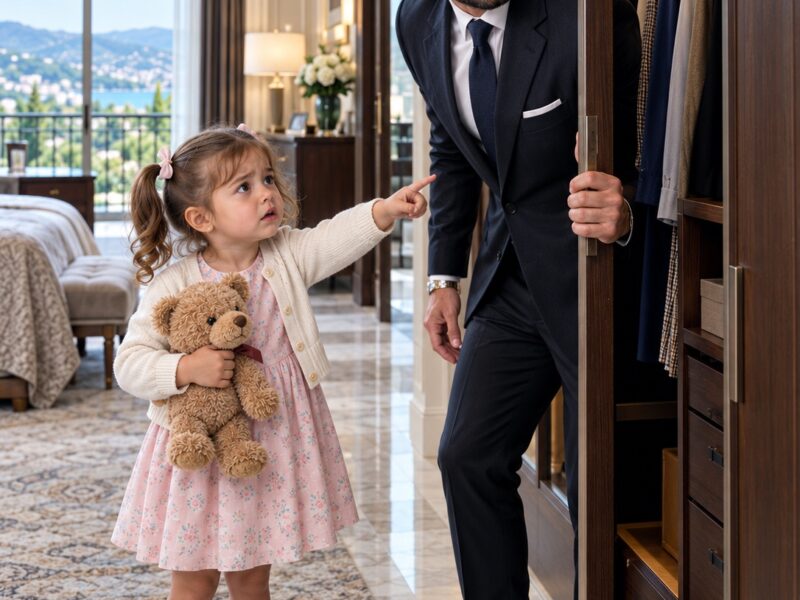
“Someone’s Hiding in My Closet!” the Maid’s Little Girl Told the Mafia Boss — He Froze!
I was six years old the night I learned that grown men could be afraid of a closet door.
People have asked me about that night for most of my adult life, usually because they already know the version that became a story whispered around courtrooms, newspaper offices, and old Italian restaurants where men still lower their voices when they say Alessandro Romano’s name.
They want to know whether I remember the gunshot.
I do.
They want to know whether I understood that a man had come into our house intending to destroy everyone inside it.
I did not.
They want to know whether Alessandro was truly as frightening as people said.
That answer is complicated.
What I remember most clearly is something smaller.
Rain against the windows.
My mother humming downstairs.
My teddy bear’s left ear bent the wrong way.
And the sound of someone breathing inside my closet.
Slow.
Measured.
Trying very hard not to be heard.
My mother, Elena Carter, had worked at the Romano estate for almost three years by then.
The house stood on twenty-six acres in Westchester County, New York, behind old stone walls and iron gates that looked more appropriate for a monastery than a private home. The original part had been built in the 1920s by a railroad executive, but generations of Romanos had expanded it until the place seemed to have developed rooms out of habit.
There were forty-three of them, depending on what counted as a room.
A marble foyer.
A ballroom nobody danced in.
A dining room with a table long enough to seat twenty.
An indoor pool that smelled faintly of chlorine even when it wasn’t being used.
A library in the west wing.
A private office in the east wing.
And a smaller section behind the kitchen where household employees had bedrooms.
That was where Mama and I lived.
Our room had once been used by two live-in cooks. By the time we moved in, one wall had been painted pale yellow, the radiator clanged when it got cold, and the window looked over the side garden where hydrangeas grew in summer.
It was small.
I loved it.
My mother had made it ours.
She taped my drawings above the bed.
She put a blue ceramic bowl on the dresser for hair ribbons.
She kept a photograph of us at Coney Island beside a cheap lamp.
And every night before bed, she checked the closet because I had once seen a spider disappear beneath the door and decided spiders probably organized meetings in there.
Nothing was ever inside.
Not until October 17.
The rain began before dinner.
By eight, it had become the kind of storm that made the house sound alive.
Water hammered the gutters.
Tree branches scraped the windows.
Old pipes knocked behind the plaster.
A dinner Alessandro had planned with business associates was canceled when flooding closed several roads, which meant half the staff went home early.
My mother stayed.
She was polishing silver in the downstairs pantry because Mrs. Donnelly, the house manager, believed weather was never an excuse for fingerprints on serving trays.
I was supposed to remain in our room.
That was one of the rules.
There were many rules at the Romano house, but most were simple.
Never enter the east wing unless invited.
Never touch anything on Alessandro’s desk.
Never ask questions when men arrived after midnight.
Never repeat anything you heard.
And, most important for me, never wander when Mama was working.
“You are not invisible,” she would tell me. “But sometimes it is safer to behave as though you are.”
I never understood that sentence when I was little.
I thought she meant rich people disliked children.
So I tried to be quiet.
That night I sat cross-legged on the rug with my bear, Arthur.
Arthur had been washed so often that his fur had gone from brown to gray. One plastic eye was scratched. His left ear had developed a permanent fold.
I was brushing that ear with a pink doll comb when I heard the sound.
Scrape.
I stopped.
The storm continued outside.
I waited.
Nothing.
Then—
Scrape.
Soft.
Close.
Inside the closet.
I looked at the door.
It was open perhaps an inch.
Mama had definitely closed it.
I knew because I had watched her check before going downstairs.
My heart started pounding so hard I could feel it in my throat.
“Hello?”
No answer.
I stood.
I took one step toward the closet.
Then I heard breathing.
A man’s breathing.
There are things children know without having language for them.
I knew the sound was not normal.
It was too controlled.
Someone was trying to breathe quietly.
I did not scream.
I wish I could tell you I was brave.
I wasn’t.
I was too frightened to make noise.
I picked up Arthur by the middle and backed toward the door.
The hallway outside was empty.
I could have gone left toward the kitchen.
Mama was there.
But she had told me not to interrupt her while she was working, and when you are six years old, rules can survive fear longer than common sense.
The other direction led toward the east wing.
Toward Alessandro.
I knew his office was there.
I also knew I was forbidden to go near it.
I went anyway.
The corridor seemed twice as long in the dark.
Portraits of dead Romanos watched me from the walls.
One man wore a military uniform.
Another had a mustache that made him look angry even though he had been dead since 1951.
At the end of the hall, golden light shone beneath a heavy wooden door.
I knocked.
Nothing.
I knocked again.
A voice came from inside.
“What?”
I opened the door.
Alessandro Romano sat behind a walnut desk so large I once believed it had been built inside the room because there was no way it could fit through the doorway.
He was thirty-eight then.
That surprised me later, when I learned his age.
To a child, powerful adults all seem ancient.
He wore dark trousers and a white shirt with the sleeves rolled to his elbows. His suit jacket hung from the back of a chair. A glass of whiskey sat untouched beside a stack of papers.
He looked tired.
Then he looked irritated.
Then he saw me.
The irritation disappeared.
“Mia?”
I stood in the doorway.
Arthur was crushed against my chest.
“What are you doing here?”
I tried to speak.
Nothing came out.
Alessandro rose slowly.
“Mia?”
“Someone’s hiding in my closet.”
He did not laugh.
That is important.
Many adults would have smiled.
Asked whether I had a nightmare.
Told me to find my mother.
Alessandro simply looked at me.
“Are you sure?”
I nodded.
“I heard him.”
“Him?”
“Breathing.”
Something changed in his face.
He came around the desk.
“Did you see anyone?”
“No.”
“Did anyone speak to you?”
“No.”
“Is your mother downstairs?”
“Yes.”
He reached for a telephone on the desk.
His hand stopped.
For years, I wondered why.
Eventually I understood.
Alessandro had guards.
A lot of them.
If a stranger had entered the estate without being seen, then either the guards had failed—
or someone inside had helped him.
Calling everyone immediately might warn the wrong person.
Alessandro put the phone back down.
Then he held out his hand.
“Show me.”
I stared at it.
His hands were large and rougher than I expected.
I took one.
His palm was warm.
We walked back through the corridor.
Two men stood near the stairs.
One was Nico Valenti, one of the estate guards.
He stepped forward.
“Boss?”
Alessandro lifted one finger.
Nico stopped.
“We’re fine.”
The men exchanged looks.
Neither followed us.
That was the first thing that made me realize Alessandro believed me.
My bedroom door remained open.
He entered first.
I stayed behind him.
For several seconds, he did nothing.
He simply looked.
The lamp.
The bed.
My crayons.
The bear drawings taped to the wall.
Then his eyes dropped to the floor.
Wet footprints crossed the wood.
Heavy boots.
Mud.
They began beneath the window.
The window was open slightly.
Rain had blown onto the sill.
The prints crossed the room and disappeared at the closet.
Alessandro released my hand.
“Stand behind me.”
I obeyed.
He took off his watch.
It was gold, heavy, expensive.
He placed it carefully on my bed.
“Why are you taking that off?”
He glanced at me.
“So it doesn’t catch on anything.”
That answer made sense to a six-year-old.
As an adult, I think he simply needed one second to steady himself.
He approached the closet.
His hand closed around the knob.
The breathing had stopped.
Rain tapped against the glass.
Somewhere far below us, Mama was humming.
Alessandro opened the door.
For the first time in my life, I watched fear cross his face.
Not surprise.
Fear.
His shoulders went rigid.
His hand slipped from the knob.
He took one step backward.
“No.”
A man stood inside my closet.
He was thin, soaked, and perhaps fifty-five. Gray stubble covered his jaw. His coat hung from him as though he had lost a great deal of weight. A pale scar ran from below his left ear toward his chin.
He held one arm against his side.
His sleeve was dark.
At the time, I thought it was rain.
It wasn’t.
The stranger looked at Alessandro.
“Hello, Sandro.”
Alessandro’s jaw tightened.
“You’re dead.”
The stranger tried to smile.
“So I’ve been told.”
Then he looked at me.
“Hello, Mia.”
That frightened me more than anything.
He knew my name.
I moved closer to Alessandro.
“How do you know me?”
Neither man answered.
Alessandro’s voice became very quiet.
“Marco Bellini.”
The man nodded.
“You’re supposed to have died in Naples.”
“Yes.”
“Seven years ago.”
“Almost.”
Alessandro stared at him.
I had never seen him uncertain.
Angry, yes.
Impatient, often.
Cold, frequently.
But uncertainty did not fit him.
“How did you get in?”
Marco leaned against the closet frame.
“Your guards watch roads.”
Alessandro waited.
“They don’t watch the drainage cut behind the south wall.”
“Impossible.”
“I helped build the wall.”
That landed differently.
Alessandro looked toward the window.
“You climbed it?”
“Eventually.”
“You’re bleeding.”
“I noticed.”
Marco’s knees suddenly buckled.
He slid against the wall and sat on the floor.
I gasped.
Alessandro caught his shoulder before his head struck the dresser.
“Stay awake.”
“I’m trying.”
Alessandro looked at me.
“Mia.”
“Yes?”
“You did exactly the right thing.”
I did not believe him.
“Is he bad?”
Marco gave a weak laugh.
“That depends who you ask.”
Alessandro ignored him.
“I need your mother.”
I started toward the door.
He caught my shoulder gently.
“Listen first.”
I stopped.
“Go downstairs. Tell Elena I asked for the first-aid box. Tell her to make strong tea.”
“Why tea?”
Marco closed his eyes.
“Because your boss has always believed tea fixes dying men.”
“I never said it fixed them.”
“It tastes terrible enough to motivate survival.”
Alessandro almost smiled.
Then he looked at me again.
“Don’t tell anyone else what you saw.”
I nodded.
I looked at Marco.
He was pale.
“Why does he know my name?”
The room changed.
Marco opened his eyes.
Alessandro’s hand tightened slightly on my shoulder.
Marco answered before he could stop him.
“Because I’ve been watching over you longer than he has.”
I looked at Alessandro.
His face hardened.
“Go, Mia.”
I went.
But children are excellent at disobedience when curiosity feels more urgent than fear.
At the turn of the corridor, I stopped.
The men’s voices traveled through the open door.
“You shouldn’t have come here,” Alessandro said.
“I had nowhere else.”
“You had Europe.”
“Not anymore.”
“What happened?”
“They found the safe house in Naples.”
Silence.
Marco continued.
“Two nights ago. Someone gave them the address.”
“Who?”
“Someone close to you.”
My stomach tightened.
“Who, Marco?”
“I don’t know which man yet.”
“Then why come here?”
“Because there are things you deserve to know before whoever sold me finds me again.”
Another pause.
Then Alessandro asked the question I remembered for years afterward.
“Why did you hide in the child’s room?”
Marco answered slowly.
“Because no one searches a maid’s daughter’s closet.”
I hugged Arthur tighter.
“And because,” Marco added, “I wanted to see her once before everything fell apart.”
Alessandro’s voice dropped.
“Why?”
Marco took a breath.
“Because I came to tell you what really happened to Giulia.”
I did not know that name.
But Alessandro made a sound.
Barely a sound.
A broken breath.
Then I ran downstairs.
Mama stood in the pantry polishing a serving tray.
She wore a simple black dress beneath a white apron. Her brown hair was twisted into a loose knot.
When she saw me, her face changed.
“Mia?”
“Mr. Romano needs the medicine box.”
Her hand stopped.
“What happened?”
I remembered the instruction.
“And strong tea.”
My mother stared at me.
“Strong tea?”
“Yes.”
I expected questions.
There were none.
That was strange.
Mama opened the pantry cabinet immediately.
“Stay here.”
“I’m coming.”
“No.”
“Please.”
She looked at me.
Whatever she saw made her change her mind.
“Stay beside me.”
We carried the first-aid box upstairs.
When we entered our room, Marco was in the armchair.
His coat had been removed.
Alessandro stood beside him holding a towel against a wound near his upper arm.
Mama stopped.
Marco looked at her.
For a second, nobody spoke.
Then Alessandro said, “Elena.”
Not Mrs. Carter.
Not Elena in the distant, polite way employers sometimes used first names.
Just Elena.
Familiar.
Careful.
Mama handed him the box.
Her fingers trembled.
Alessandro noticed.
“I’m sorry,” he said.
“For what?”
“I should have told you.”
Mama’s face drained.
“Told me what?”
That was what I asked.
Nobody answered.
Marco watched my mother.
“You never told her.”
Mama looked at him sharply.
“Not now.”
“Told me what?”
My voice cracked.
Mama knelt.
She took my face between her hands.
“You are safe.”
Adults say that when they are afraid.
I know that now.
At six, I simply knew her thumbs were shaking.
Alessandro cleaned Marco’s wound.
It was not as serious as it looked.
A bullet had grazed his upper arm.
He needed stitches, but he wasn’t dying.
Marco drank the tea and made a face.
“Still terrible.”
“Good,” Alessandro said.
Then he stood.
“Tell me about Giulia.”
Marco looked toward me.
“She shouldn’t hear this.”
Mama lifted me.
“I’ll take her downstairs.”
“No.”
The word came from Alessandro.
Mama looked at him.
He hesitated.
Then his gaze moved toward the hallway.
“If someone inside this house is compromised, I don’t want either of you moving around alone.”
Mama understood before I did.
We stayed.
I sat on my bed with Arthur.
Mama sat beside me.
Marco leaned back in the chair.
Rain moved down the glass.
Then he began.
“Giulia didn’t die because of an accident.”
Alessandro went perfectly still.
The entire estate knew about Giulia Romano.
Even I knew something.
There was a silver photograph on Alessandro’s desk.
A dark-haired woman laughing beside a lake.
Staff members never spoke about her.
One afternoon I had asked Rosa who she was.
Rosa said, “Someone he loved.”
That was all.
Marco continued.
“The brakes didn’t fail on their own.”
Alessandro’s face changed.
“I buried her.”
“You buried a coffin.”
“Don’t.”
“I’m telling you what I know.”
“I saw the car.”
“You saw what was left of it.”
Alessandro turned away.
For years afterward, I remembered his hands.
They hung at his sides.
Open.
Useless.
Marco spoke carefully.
“Six years ago, someone ordered the road cameras disabled for one hour.”
Alessandro looked at him.
“You?”
Marco nodded.
“I was told it involved a meeting with the Grecos. A loyalty test.”
“Who told you?”
Marco looked down.
“I obeyed.”
“Who?”
“I didn’t know what they were planning.”
“Who gave the order?”
Marco lifted his eyes.
“Vincenzo Moretti.”
The name meant nothing to me.
It meant everything to Alessandro.
He stared at Marco.
“No.”
“Yes.”
“No.”
“Sandro—”
“He stood beside me at her funeral.”
“I know.”
“He carried the coffin.”
“I know.”
“He was my father’s godson.”
“I know.”
Alessandro’s voice rose.
“He was my brother!”
Marco’s expression broke.
“I know.”
The room went quiet.
Mama held me closer.
Alessandro walked to the window.
He pressed both hands against the sill.
For a long time, he said nothing.
Then he asked, “Why?”
“Giulia discovered financial records she wasn’t supposed to find.”
“What records?”
“Shipping accounts. Payments. Routes being sold without your authorization.”
Alessandro turned.
“Sold by whom?”
“Vincenzo.”
Marco explained.
After Alessandro’s father became ill, the organization had begun to fragment. Giulia’s family controlled several legitimate shipping companies and port contracts. Her marriage to Alessandro joined two powerful business networks.
Vincenzo had managed parts of the logistics operation.
Quietly, he began diverting contracts.
Taking payments.
Selling information to rivals.
Giulia noticed.
“She told me she was going to show you,” Marco said.
Alessandro’s eyes were wet.
“She never did.”
“No.”
“Because he killed her.”
Marco nodded.
Alessandro looked toward the floor.
“And you knew.”
Marco’s voice broke.
“Not until afterward.”
“You disabled those cameras.”
“Yes.”
“You helped him.”
“Yes.”
Mama whispered, “Alessandro.”
He turned on her.
Not angrily.
Desperately.
“You knew he was alive?”
Mama’s shoulders lowered.
I felt the change in her immediately.
“Yes.”
I looked at her.
“What?”
She closed her eyes.
“Not everything.”
Marco sat forward.
“Elena didn’t know about Giulia.”
“How long?” Alessandro asked.
Mama swallowed.
“Before Mia was born.”
Alessandro stared.
“You knew Marco seven years ago?”
“Yes.”
“How?”
Mama took my hand.
For the first time that night, she looked frightened of me.
Not for me.
Of what I might think.
“Marco came to my apartment.”
“Why?”
“He offered me a job here.”
Alessandro’s face hardened.
“My house?”
Mama nodded.
“He said there was someone inside the Romano organization he didn’t trust. He wanted someone ordinary inside the household.”
“You were spying on me?”
“No.”
The word came hard.
Mama stood.
“I cleaned your house. I raised my daughter. When unusual people came, sometimes I wrote down names. That was it.”
“You reported to him?”
“Occasionally.”
“Without telling me.”
“Yes.”
Alessandro took one step back.
Mama started crying.
“I was twenty-three. Pregnant. Alone. I needed work.”
I looked at her.
“Pregnant?”
She froze.
Marco looked away.
Alessandro noticed.
His gaze moved from Mama to Marco.
Then to me.
Something about his expression frightened me more than anger.
He was putting pieces together.
“Why Elena?” he asked Marco.
Marco did not answer.
Alessandro’s voice became very quiet.
“Why choose her?”
Marco stared at his hands.
“Because she could be trusted.”
“That isn’t enough.”
“Alessandro.”
“Why?”
Marco closed his eyes.
“Because Mia isn’t Elena’s biological daughter.”
My world stopped.
I looked at Mama.
“No.”
She dropped to her knees.
“Mia—”
“No.”
My voice was small.
“You’re my mommy.”
“Yes.”
Tears were pouring down her face.
“Yes. I am.”
Marco looked at me.
“My daughter was named Sofia.”
Mama squeezed my hands.
“Sofia lived upstairs from me.”
Marco continued.
“She was eighteen.”
I remember his voice more than the words.
Slow.
Tender.
Destroyed.
“She had no mother. I had disappeared because Vincenzo was hunting anyone connected to me. I couldn’t visit her. I sent money through people I trusted.”
Sofia became pregnant.
The father left.
She died from complications after giving birth.
Mama had been her neighbor.
“She had nobody,” Mama whispered. “I stayed with her at the hospital.”
I looked at her.
“You took me?”
She nodded.
“Your grandmother wanted you to go into foster care until family could be found. But Marco had enemies. He was supposed to be dead. There wasn’t anyone safe.”
“So you kept me?”
“I asked to.”
“Why?”
Mama smiled through tears.
“You were three days old.”
That did not answer my question.
Maybe no answer could.
“I held you,” she said. “And you grabbed my finger.”
I started crying.
“Mama.”
She pulled me against her.
“I am your mother.”
“You didn’t have me?”
“No.”
“Do you love me?”
Her face broke.
“Oh, baby.”
She held me so tightly I could hardly breathe.
“More than anything in this world.”
I believed her immediately.
Children understand love more simply than adults do.
Blood was information.
Mama was the person who sat beside me when I was sick.
Who cut crusts off my sandwiches.
Who checked the closet every night.
That truth did not disappear because another truth arrived.
Across the room, Alessandro stared at Marco.
“You hid your granddaughter here.”
“I protected her here.”
“Without my knowledge.”
“If you knew, Vincenzo might learn.”
“You used my house.”
“I trusted one thing about you.”
Alessandro’s eyes narrowed.
“What?”
“That nobody harms a child under your roof.”
The anger left Alessandro’s face.
Only pain remained.
Then someone knocked.
Three sharp knocks.
Every adult froze.
A man’s voice came from the hallway.
“Sandro?”
Marco’s face changed.
Pure terror.
Alessandro looked at him.
Marco mouthed one word.
Him.
“Sandro,” the voice called again. “I heard the little girl was frightened. Is everything all right?”
Alessandro transformed.
I saw it happen.
The grief disappeared.
His shoulders relaxed.
His face became calm.
He pushed Marco’s chair toward the closet.
Mama lifted me onto the bed.
Marco slipped inside.
Alessandro closed the door.
Then he opened the bedroom door.
Vincenzo Moretti stood outside.
He was fifty-two, silver-haired, handsome in the way older men become handsome when they have excellent tailors and never carry their own luggage.
I knew him.
Everyone did.
Uncle Vince.
That was what he told me to call him.
He brought chocolates.
He remembered birthdays.
He gave Christmas envelopes to staff.
He had once carried me through the garden because I stepped in mud and ruined my shoes.
He smiled.
“There she is.”
My entire body went cold.
He looked at Alessandro.
“A nightmare?”
“Storm frightened her.”
Vincenzo stepped inside.
His eyes moved around the room.
The open first-aid box.
Wet marks near the window.
Mama.
Me.
The closet.
He smiled.
“Poor little thing.”
He crouched.
From his coat pocket, he removed a gold-wrapped chocolate.
“For you.”
I had taken those chocolates many times.
That night, I didn’t.
“I’m not hungry.”
His smile stayed in place.
His eyes changed.
Only slightly.
“Of course.”
He returned it to his pocket.
Then he looked at Alessandro.
“We should speak tonight.”
“Tomorrow.”
“There are developments with the Greco situation.”
“Tomorrow.”
Vincenzo held his gaze.
The room felt suddenly too small.
After a long moment, Vincenzo nodded.
“As you wish.”
He kissed two fingers and touched them lightly to my head.
“Sleep well, little bird.”
I hated that nickname afterward.
He left.
We listened to his footsteps fade.
Marco came out of the closet.
“He knows something.”
“He suspects,” Alessandro said.
“He saw the water.”
“Yes.”
“He’ll move tonight.”
Alessandro walked to the window.
“You’re sure it was Vincenzo?”
Marco laughed bitterly.
“I carried his orders for twenty years.”
Alessandro turned.
“You also lied to me for six.”
Marco flinched.
“Fair.”
Alessandro looked exhausted.
Then his phone vibrated.
He read the screen.
His face went still.
Mama whispered, “What?”
He turned the phone toward us.
A message from an unknown number.
MIDNIGHT. SOUTH GARDEN. COME ALONE.
Beneath it was a photograph.
Taken through our bedroom window.
Mama holding me.
Minutes earlier.
She gasped.
Marco cursed.
I looked toward the glass.
Someone had been outside.
Watching.
Mama stood.
“We’re leaving.”
“No,” Alessandro said.
“He has a picture of my daughter.”
“I know.”
“Then move.”
She tried to pass him.
He blocked the door.
Not roughly.
“Elena.”
“Get out of my way.”
“If you walk through this house now, you don’t know which guard reports to him.”
She stopped.
“Every gate team was hired through Vincenzo’s division. Three drivers answer directly to him. He controls the overnight security roster.”
Mama went pale.
“Then what do we do?”
Alessandro looked at the message.
“We let him believe I’m coming alone.”
Marco shook his head.
“That’s suicide.”
“No.”
Alessandro looked toward him.
“That’s how we find out who comes with him.”
For the next hour, adults planned around me.
I understood very little.
Marco knew the old garden wall.
There was a service gate behind a stone fountain that had not been used in years.
Alessandro trusted one guard completely.
Tommaso Russo.
Tommaso’s father had protected Alessandro’s father.
More importantly, Tommaso had once refused a direct order from Vincenzo when that order would have put a civilian family in danger.
That mattered now.
Tommaso was brought upstairs through a servants’ staircase.
When he saw Marco, he crossed himself.
“Madonna.”
Marco smiled weakly.
“I get that a lot.”
Alessandro explained.
Tommaso did not interrupt.
When he finished, Tommaso said, “My brother is working the north perimeter.”
“Do you trust him?”
“With my children.”
“Good.”
Alessandro instructed him to quietly reposition only two men.
No radios.
No group messages.
No unusual movements.
If Vincenzo had access to communications, they would give him nothing to hear.
Mama sat with me on the bed.
I could feel how tense she was.
At eleven forty-five, Alessandro put on his jacket.
Then he walked toward me.
He knelt.
The most feared man I had ever known lowered himself until his eyes were level with mine.
“Mia.”
“Yes?”
“You did something very brave tonight.”
“I ran away.”
“No.”
“You went for help.”
I looked at him.
“Are you scared?”
He smiled slightly.
“Yes.”
Adults had never told me that before.
“Then don’t go.”
“I have to.”
“Why?”
“Because sometimes being afraid tells you something matters.”
I thought about that.
“Will you come back?”
His eyes changed.
“I’m going to work very hard to.”
He removed a gold cufflink from his left sleeve.
Two letters were engraved into it.
G.R.
Giulia Romano.
He placed it in my hand.
“Keep this.”
“Why?”
“So I have a reason to come back for it.”
I closed my fingers around the metal.
He stood.
Mama looked at him.
“Alessandro.”
He stopped.
“Don’t become him.”
Alessandro stared at her.
Mama continued.
“Whatever happens outside, don’t let him decide what kind of man walks back through that door.”
He said nothing.
Then he left.
We waited.
Waiting is a terrible thing when you are a child.
Adults fill silence with possibilities.
Children fill it with pictures.
I imagined Alessandro standing alone in the rain.
I imagined Vincenzo turning into something monstrous.
I imagined every closet in the house opening at once.
Marco sat in the chair.
Tommaso stood beside the door.
Mama held me.
Midnight came.
Nothing.
Twelve-oh-three.
Nothing.
At twelve-oh-six, we heard a gunshot.
Mama covered my ears too late.
Marco stood.
Tommaso reached for the door.
“Wait,” Marco said.
They listened.
Footsteps.
Slow.
Approaching.
Mama stopped breathing.
The door opened.
Alessandro stood there.
His jacket was torn at one shoulder.
A thin cut crossed his forehead.
One hand pressed against his side.
But he was standing.
Behind him came two men.
Between them was Vincenzo.
His hands were restrained behind him.
The friendly uncle face was gone.
He looked older.
Smaller.
Furious.
Alessandro leaned against the doorframe.
“He brought four men.”
Tommaso exhaled.
“Your brother?”
“Good.”
“What happened?”
“They planned to shoot me near the fountain. Then send men upstairs.”
Mama went rigid.
“Upstairs?”
Vincenzo looked at me.
That confirmed everything.
Alessandro stepped between us.
“He was going to kill everyone in this room.”
Marco closed his eyes.
Vincenzo laughed.
“You’re being dramatic.”
Alessandro turned.
“My wife was dramatic too?”
The word wife hit the room strangely.
Giulia remained his wife in some part of him.
Vincenzo’s jaw tightened.
“She found something she didn’t understand.”
“You cut her brakes.”
“I made a business decision.”
Mama made a sound of disgust.
Alessandro walked toward him.
I expected violence.
Everyone did.
His hands remained at his sides.
“Why her?”
Vincenzo rolled his eyes.
“She discovered ledgers.”
“She trusted you.”
“That was her mistake.”
Alessandro closed his eyes.
When he opened them, tears were there.
“You stood beside me while I buried her.”
Vincenzo said nothing.
“You watched me blame myself.”
Still nothing.
“You told me she had been distracted because we argued that morning.”
A faint smile touched Vincenzo’s mouth.
That smile nearly changed the night.
Alessandro lunged.
Tommaso caught him.
Mama stood.
“Alessandro!”
He froze.
She crossed the room.
Her voice shook, but she did not lower it.
“If you kill him now, he wins.”
Vincenzo laughed.
Mama looked directly at Alessandro.
“He stole Giulia from you. Don’t let him take the rest.”
Alessandro’s chest rose and fell.
“Move.”
“No.”
“Elena.”
“No.”
Nobody had ever spoken to him that way.
Not in that house.
Maybe that was why he listened.
Marco stood.
“She’s right.”
Alessandro looked toward him.
“You don’t get a vote.”
“I know.”
Marco’s eyes filled.
“But I helped create this. I disabled those cameras. I ran instead of telling you.”
He looked at Vincenzo.
“If we kill him, all anyone learns is that one criminal killed another.”
Vincenzo’s smile disappeared.
Marco continued.
“I want him in a courtroom.”
That surprised everyone.
“I want Giulia’s name in the record. I want every account. Every judge. Every mechanic. Every officer he paid.”
Alessandro stared at him.
“I want my daughter to know I finally told the truth.”
He looked at me.
“And someday I want Mia to know that her family did one thing right.”
Silence filled the room.
Finally Alessandro looked at Tommaso.
“Take Vincenzo downstairs.”
Vincenzo laughed.
“To the cellar?”
“No.”
Alessandro wiped blood from his forehead.
“To the library.”
Everyone stared.
“There are cameras there.”
Vincenzo’s face changed.
“Record everything.”
The confession took four hours.
I did not see it.
Mama put me to bed.
But I learned what happened later.
Marco spoke first.
He admitted disabling the road cameras.
He named the man who instructed him.
Vincenzo denied everything.
Then Alessandro produced financial records Giulia had copied years earlier and hidden in a trust account under her maiden name.
Arthur Kensington—yes, the same banker who appears in half the stories people tell about that era—had preserved them because Giulia had sent him instructions before she died.
Vincenzo had never known.
Once he saw the documents, he began negotiating.
That was the kind of man he was.
His loyalty lasted exactly as long as denial remained profitable.
He named the mechanic who sabotaged Giulia’s car.
Two former police officers.
A county judge.
An accountant.
A port official.
He named shell companies.
Offshore accounts.
Payments.
The entire structure he had built beneath Alessandro’s organization.
At five seventeen in the morning, federal agents entered the Romano estate.
That part is usually left out of the legend.
People prefer the idea that Alessandro handled everything privately.
He didn’t.
His attorney called the FBI.
The evidence was copied.
Vincenzo left in handcuffs.
Alive.
That decision changed more than one life.
I woke shortly after dawn.
Marco slept in the armchair beside my bed.
Mama was downstairs giving a statement.
My room smelled like rain, antiseptic, and terrible tea.
Alessandro stood in the doorway.
He had changed shirts.
A small bandage covered the cut on his forehead.
“You came back.”
He smiled.
“I did.”
I sat up.
“I kept your thing.”
I opened my hand.
I had fallen asleep holding the cufflink so tightly that its edges had left marks in my skin.
Alessandro crossed the room.
I held it out.
He stared at it.
Then he folded my fingers around it again.
“Keep it.”
“But it’s yours.”
“It was Giulia’s initials.”
I looked at the letters.
“Was she nice?”
His face softened.
“Yes.”
“Did she love you?”
“I think so.”
“Did you love her?”
He sat on the edge of the bed.
“More than I knew how to say.”
I thought about that.
Then I asked the most important question in my six-year-old mind.
“Is Mama still my mama?”
Alessandro looked at me.
“Yes.”
“Even if she didn’t make me?”
He took a breath.
“Mia, there are people who give us life.”
I listened.
“And there are people who teach us how to live it.”
He looked toward the hallway where Mama’s voice could be heard below.
“Sometimes we are lucky enough to get both from the same person.”
“And sometimes?”
“Sometimes the person who stays becomes your family.”
That was enough.
Marco survived.
His wound required eight stitches.
For the next year, he lived under federal protection while prosecutors built cases around his testimony and Giulia’s records.
Mama and I visited whenever we were allowed.
The first time, Marco sat behind thick glass in a secure facility in New Jersey.
He looked uncomfortable.
I held the telephone receiver.
“Are you really my grandpa?”
He smiled.
“Biologically, yes.”
“What does that mean?”
“It means your mother had my nose.”
I looked at Mama.
She laughed.
“You do have her nose.”
“Was she nice?”
Marco’s eyes filled.
“She was stubborn.”
Mama said, “So yes.”
I liked that answer.
“What did she call me?”
Marco swallowed.
“She never got the chance.”
That hurt.
I did not understand why.
He continued.
“But before you were born, she wrote down names.”
“Was Mia one?”
“Yes.”
That mattered to me for years.
Marco had not saved me.
Mama had.
Sofia had given me a name.
Mama had given me a life.
There was room for both truths.
Vincenzo Moretti went to federal prison.
The trial lasted eleven weeks.
His attorneys attacked Marco’s credibility.
They attacked the financial records.
They suggested Giulia’s death had been a coincidence.
Then the mechanic testified.
Then the accountant.
Then one of the former officers.
The structure collapsed.
Vincenzo was convicted of conspiracy, financial crimes, obstruction, and charges connected to Giulia’s death.
Alessandro attended every day.
He sat in the second row.
He never looked at Vincenzo.
When the verdict was read, Mama squeezed Alessandro’s hand.
I saw it.
Neither of them noticed me watching.
People say Alessandro changed afterward.
That is true.
It is also not true.
He did not become gentle overnight.
He was still a difficult man.
Still impatient.
Still capable of freezing a room with one look.
Still involved in businesses I did not understand until I was much older.
But things began changing.
The east wing became quieter.
Men who arrived after midnight stopped coming.
Certain companies were sold.
Others were cleaned up.
Illegal operations were dismantled gradually because cutting every connection overnight would have endangered hundreds of ordinary employees.
That is the boring version.
It is also the truthful one.
Change required accountants.
Lawyers.
Audits.
Taxes.
Contracts.
People finding new jobs.
Alessandro spent years separating the legitimate businesses his father had built from the criminal structures grown around them.
He cooperated with investigators when necessary.
He paid fines.
He lost contracts.
He lost friends.
Some people called him weak.
He survived.
Mama stayed at the estate.
Not as a maid.
At first, she refused Alessandro’s offer to manage the household.
“I clean,” she said.
“You do more than clean.”
“I’m not qualified.”
“You’ve been managing everyone for three years without the title.”
She laughed.
Eventually she accepted.
Mrs. Donnelly retired.
Mama became estate manager.
She hired staff.
Handled budgets.
Supervised repairs.
And told Alessandro when he was being unreasonable, which happened frequently.
Their relationship changed slowly.
So slowly that neither admitted it.
When I was eight, I noticed Alessandro had begun waiting until Mama sat down before starting dinner.
At nine, I noticed tea appeared outside her office when she worked late.
At ten, I noticed she was the only person who could walk into his study without knocking.
At eleven, I asked Mama whether she loved him.
She nearly dropped a plate.
“Mia.”
“What?”
“That is none of your business.”
“So yes?”
“No.”
“You’re blushing.”
“I am angry.”
“Your face gets red differently.”
She pointed toward the door.
“Homework.”
I asked Alessandro the same question.
He stared at me for almost a minute.
Then said, “Math.”
“What?”
“You should be doing math.”
Adults are cowardly in surprising ways.
They never married.
I’m glad.
Mama had spent too much of her life surviving through other people’s choices.
She bought a house in town when I was twelve.
Alessandro looked personally offended.
“You can live here.”
“I know.”
“Then why buy a house?”
“Because I want one that is mine.”
He thought about that.
Then nodded.
On moving day, he carried boxes.
No staff.
No guards.
Him.
A lamp.
Three boxes of books.
And a ridiculous ceramic rooster Mama had bought at a yard sale.
He hated the rooster.
She kept it for twenty years.
Marco lived long enough to see me graduate from high school.
He sat beside Mama.
Alessandro sat three rows behind them because he claimed he did not want to make the day “about him.”
That was absurd.
Everyone knew who he was.
He wore a plain gray suit.
After the ceremony, I could not find him.
On Mama’s chair lay one white rose.
That was his habit.
Being present, then disappearing before gratitude could make him uncomfortable.
Marco died when I was nineteen.
Natural causes.
A phrase our family learned to appreciate.
Before he died, he gave me a box containing photographs of Sofia.
My biological mother.
The first photograph showed her at seven.
I looked exactly like her.
Same eyes.
Same stubborn mouth.
Same tendency to tilt the head when skeptical.
Another showed her at eighteen.
Pregnant.
Laughing.
One hand resting over her stomach.
On the back, she had written:
Mia, if she is a girl. Michael, if he is a boy. Please let her be louder than I was.
I cried for an hour.
Mama sat beside me.
“I’m sorry.”
“For what?”
“That I didn’t tell you earlier.”
I looked at her.
“Would I have understood?”
“No.”
“Then you told me when life forced you to.”
“That is not the same as doing it right.”
“No.”
She waited.
“But you stayed.”
She started crying.
I leaned against her.
“That counts for a lot.”
Years passed.
The Romano mansion changed.
The east wing became a library.
The old private office remained, but the locked cabinets disappeared.
The ballroom hosted charity dinners instead of midnight meetings.
The security gates stayed.
Alessandro said there was no reason to become foolish simply because you were trying to become better.
He became something difficult to explain.
Not innocent.
Not redeemed in the clean way stories like.
But accountable.
He funded legal aid programs for families affected by the industries his organization had damaged.
He donated anonymously to domestic violence shelters.
He invested in trucking companies with actual labor protections.
When reporters asked about his past, he rarely answered.
When one journalist called him reformed, Alessandro laughed.
“Reformed sounds finished,” he said. “I’m not.”
I went to college.
Then law school.
People always assume I became a prosecutor because of Vincenzo.
I didn’t.
I became an attorney because of Mama.
Because I watched a woman with no degree, no money, and no biological claim to me stand in front of powerful men and insist that truth mattered more than fear.
I became a public defender.
That confused Alessandro.
“You went through Columbia Law School to defend criminals?”
“I defend people.”
“Some are criminals.”
“Some are accused.”
He frowned.
“That distinction seems expensive.”
“It’s called due process.”
“I have heard of it.”
“Recently.”
He stared.
Then laughed.
Alessandro attended my swearing-in ceremony.
He sat beside Mama.
They had gray in their hair by then.
Afterward, he gave me a velvet box.
Inside was his old gold watch.
The one he had placed on my bed before opening the closet.
“I can’t take this.”
“Yes, you can.”
“It’s worth too much.”
“It’s a watch.”
“It probably costs more than my car.”
“Your car is terrible.”
“That is not the point.”
He smiled.
“Look underneath.”
I turned it over.
There was a new engraving.
TAKE TIME BEFORE OPENING THE DOOR.
I looked at him.
“Very subtle.”
“I am known for subtlety.”
Mama laughed so hard she had to sit down.
I still have the cufflink.
The watch too.
The Romano mansion was sold when Alessandro was sixty-eight.
He had no children.
No biological heirs.
By then, Mama had retired and lived near me in Connecticut.
Alessandro moved into a smaller house ten minutes away.
Smaller was relative.
It had six bedrooms.
I called it a villa.
He called it “reasonable.”
The old mansion went to a foundation that converted part of it into a residential training center for young people aging out of foster care.
The room where Marco hid was preserved accidentally.
Nobody knew it mattered except us.
Before the sale closed, I visited one last time.
I was thirty-two.
The hydrangeas still grew beside the window.
The radiator still knocked.
The pale yellow wall had been repainted.
My crayon drawings were gone.
The closet looked smaller than I remembered.
Most childhood places do.
I opened the door.
Empty.
I stood there for a long time.
Alessandro appeared in the doorway.
He walked with a cane then.
Age had finally done what enemies never managed.
It slowed him.
“You found the scene of the crime.”
I smiled.
“Scene of the closet.”
He leaned against the frame.
“I hated that room for years.”
“Why?”
“Because I almost sent you away.”
I looked at him.
“What?”
“When you came to my office.”
He looked toward the old hallway.
“My first thought was to tell you to find your mother.”
“But you didn’t.”
“No.”
“Why?”
He thought about it.
“You weren’t crying.”
I laughed.
“That’s your reason?”
“You looked too frightened to cry.”
His face softened.
“And I remembered Giulia.”
“Why?”
“She once told me children are rarely listened to because adults assume importance comes with age.”
I looked toward the closet.
“She was right.”
“Yes.”
We stood quietly.
Then I asked something I had asked him when I was eleven.
“Why did you take off the watch?”
He smiled.
This time, he answered honestly.
“I was afraid.”
I waited.
“I didn’t want you to see it.”
“You told me you didn’t want it to make noise.”
“That too.”
He walked toward the bed.
Or where the bed had once been.
“I knew somebody had bypassed the guards. I knew if they were hiding in a child’s closet, they were either desperate or dangerous.”
He looked at me.
“And I suddenly understood that if I opened that door badly, the first memory you might carry of me would be violence.”
I swallowed.
“So you took your time.”
“Yes.”
He smiled faintly.
“You were six. Something important was watching.”
That line stayed with me.
Alessandro died two years later.
His funeral was nothing like Giulia’s.
No secret alliances.
No armored convoys.
No men whispering in corners.
There were business partners.
Employees.
Lawyers.
Former drivers.
A retired FBI agent who had spent years investigating him and somehow become one of his closest friends.
Mama sat in the front row.
I sat beside her.
On Alessandro’s coffin lay a photograph of Giulia.
The same one from his desk.
For decades, he had kept it angled toward himself.
At the funeral, it faced everyone.
After the service, Mama and I remained.
“You okay?” I asked.
“No.”
She smiled through tears.
“Which is probably appropriate.”
I held her hand.
She looked toward the coffin.
“He was difficult.”
“Yes.”
“Infuriating.”
“Constantly.”
“Stubborn.”
“Professionally.”
Mama laughed.
Then cried harder.
“He made good tea eventually.”
“That is a very low bar.”
“He improved.”
We stood there until the church emptied.
Before leaving, I placed the gold cufflink beside Giulia’s photograph.
Mama looked at me.
“You kept that all these years.”
“He told me to keep it until I understood what it cost.”
“And do you?”
I looked at the coffin.
Then at Giulia.
Then at my mother.
“Yes.”
The cost was not a man nearly dying in a garden.
Not the gunshot.
Not Marco spending years in hiding.
Not even Giulia’s life, though that was part of it.
The cost was silence.
Every adult in that house had been silent about something.
Marco stayed silent because he was afraid.
Mama stayed silent because she wanted to protect me.
Alessandro stayed silent about his grief because he had been taught grief was weakness.
Employees stayed silent because powerful men paid their salaries.
Vincenzo survived for years because he understood that fear could turn an entire household into locked rooms.
Then a six-year-old heard breathing in a closet.
And she talked.
That is what I remember now.
Not courage.
I was not courageous.
I was frightened.
I simply told someone.
That was enough to begin.
I am forty-one now.
I have two children.
My youngest daughter is six.
Sometimes, when rain hits the windows hard enough, I still remember that room.
Last fall, my daughter woke me after midnight.
“Mom?”
“What?”
“There’s something in my closet.”
My whole body reacted before my mind did.
I sat up.
“What kind of something?”
“I don’t know.”
I walked with her.
My husband followed.
We opened the closet.
Nothing.
Then a tiny gray mouse ran out beneath a pile of shoes.
My daughter screamed.
My husband screamed louder.
I laughed until I cried.
Later, after everyone settled down, I sat on the edge of her bed.
“Mom?”
“Yes?”
“Were you scared?”
“Very.”
“Of the mouse?”
I looked at the closet.
“No.”
She waited.
I touched her hair.
“When I was your age, I found someone hiding in my closet.”
Her eyes widened.
“A robber?”
“No.”
“A ghost?”
“Almost.”
“Who?”
I smiled.
“A man everyone thought was dead.”
She stared at me.
“That is way better than a mouse.”
“Depends on the mouse.”
“Did Grandpa Alessandro fight him?”
The family titles had become strange over the years.
Alessandro was never technically my grandfather.
Marco was.
But children choose their own maps.
“No.”
“What did he do?”
“He listened.”
“That’s boring.”
I laughed.
“It didn’t feel boring.”
She pulled the blanket to her chin.
“Was he scared?”
“Yes.”
“Grandpa Alessandro?”
“Yes.”
“I thought he wasn’t scared of anything.”
“That’s what he wanted people to think.”
She considered this.
“Did he run away?”
“No.”
“Then he was brave.”
I looked at her.
Children make difficult ideas simple.
Maybe she was right.
Before leaving, I checked her closet.
Completely empty.
I closed the door.
Then she called after me.
“Mom?”
“Yes?”
“If I tell you something scary, you’ll believe me, right?”
I turned.
There are promises adults should make carefully.
This one I could.
“I’ll listen.”
She smiled.
“Okay.”
I turned off the light.
For most of my childhood, people described Alessandro Romano as a man who made others afraid.
That was how power was measured in his old world.
By silence.
By lowered eyes.
By people stepping aside.
But the version of Alessandro I remember most clearly is not the man who frightened rooms.
It is the man sitting behind a desk on a rainy October night when a maid’s little girl broke every rule she had been taught and knocked on his forbidden door.
He could have dismissed me.
He could have summoned guards.
He could have told me children imagined things.
Instead, he put down his glass.
He took my hand.
And when I told him there was someone hiding in the dark, he walked back into that darkness with me.
Everything that happened afterward—the betrayal, the truth about Giulia, Marco’s return, my mother’s secret, Vincenzo’s arrest, the collapse of one world and the slow construction of another—began because of that small choice.
A frightened child spoke.
A powerful man listened.
The closet door opened.
And nothing in our lives was ever hidden quite the same way again.









