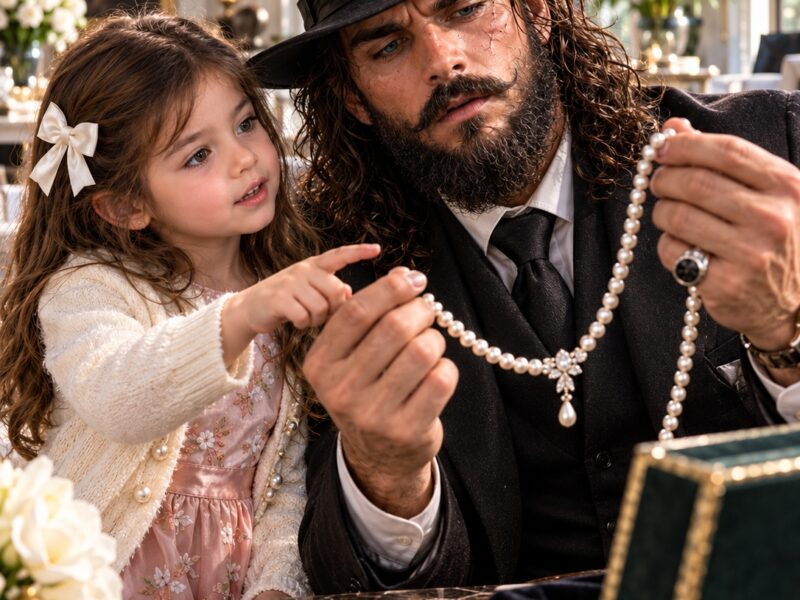
“SOMETHING’S WRONG WITH THOSE PEARLS,” THE JEWELER’S GRANDDAUGHTER WARNED THE MAFIA BOSS—THEN ONE HIDDEN PEARL EXPOSED THE MAN HE TRUSTED FOR TWENTY-SIX YEARS
The first thing twelve-year-old Emma Bennett noticed about the pearls was not that they were beautiful.
It was that one of them was lying.
She had no better word for it.
The necklace rested against the black velvet lining of a presentation box beneath forty candles, surrounded by men in expensive suits who had stopped speaking the moment Anthony Moretti’s mother lifted it into the light.
Every pearl glowed warm and soft.
Every pearl except one.
Emma leaned forward.
Her mother’s fingers immediately closed around her wrist beneath the table.
Hard.
A warning.
Do not speak.
Not here.
Not in this house.
Not in front of these people.
Emma knew what Anthony Moretti’s name meant in Boston even if adults never explained it directly.
Everybody did.
Her grandfather had once told her there were some customers you treated exactly like everybody else because treating them differently was how you revealed you were afraid.
Then he would smile and add, “But you still make sure their clasp doesn’t break.”
Her grandfather, Nathan Bennett, had been dead eleven months.
Emma still sometimes expected to hear him humming from the back room of the jewelry shop.
She still caught herself looking toward his empty workbench when the polishing wheel clicked off.
The little shop in the North End had belonged to him for fifty-two years.
Tiny front window.
Brass bell over the door.
Three display cases.
A workshop so narrow two adults had to turn sideways to pass.
Nathan had repaired wedding rings, reset stones, shortened watch bracelets, rebuilt antique clasps, and occasionally accepted strange private commissions he never discussed.
He had taught Emma nearly everything he knew because Emma asked better questions than most adults.
“How can you tell if a pearl is real?”
“It behaves like one.”
“That’s not an answer.”
“It is if you learn to look.”
Now Emma was looking.
And something was wrong.
Across the table, Walter Russo lifted his wineglass.
Walter was seventy-two and silver-haired, with the soft manner of a retired professor and a gold lion ring on his right hand.
Everybody called him Uncle Walter.
He was not actually Anthony’s uncle.
But he had stood beside Anthony’s father for thirty years, held Anthony’s mother’s hand at the funeral, and helped a fifteen-year-old boy inherit a family empire before he was old enough to vote.
Tonight was Eleanor Moretti’s eightieth birthday.
Walter had just announced the necklace as a surprise.
“I found them through an estate broker in Geneva,” he said. “I almost didn’t believe it when I saw the clasp.”
Eleanor touched the pearls with trembling fingers.
“They’re mine.”
Her voice broke.
Anthony had not moved.
He sat at the head of the table in a charcoal suit, broad-shouldered, controlled, forty-one years old and already carrying the exhausted stillness of a man much older.
Emma had watched grown men wait for him to touch his fork before eating.
She had watched one city councilman laugh too loudly at something Anthony had not meant as a joke.
She had watched two guards outside search a florist’s van for fifteen minutes before allowing roses through the gate.
Anthony frightened people without appearing to try.
But when he looked at his mother holding the pearls, Emma saw something else.
Pain.
Not surprise.
Recognition.
Twenty-six years.
Walter had said that was how long they had been gone.
Anthony had been fifteen.
His father died twenty-six years earlier.
Emma looked at the necklace again.
One pearl near the clasp hung lower.
Not enough for anyone else to notice.
Enough for her.
She forgot her mother’s hand.
“Something’s wrong with those pearls.”
The words escaped into the silence after the applause.
Forty heads turned.
Emma’s mother, Grace, went white.
Somebody laughed.
Then another.
Within seconds, the table filled with warm adult laughter, relieved to have permission to dismiss the strange interruption as childhood.
Walter laughed too.
Half a second late.
Emma noticed.
He turned toward her.
“What’s wrong with them, sweetheart?”
His voice was kind.
Too kind.
Emma pointed.
“That one.”
“Which one?”
“The one by the clasp.”
Eleanor held the strand closer.
“They look perfect.”
“They are.”
Emma frowned.
“That’s the problem.”
The laughter weakened.
Anthony looked at her.
“What do you mean?”
Emma glanced at her mother.
Grace looked terrified.
But Anthony was waiting.
And when Nathan Bennett taught Emma jewelry, he taught her something else.
If someone asks you what you see, never change the answer because you dislike the room.
“That pearl is heavier.”
Walter chuckled.
“You weighed it from across the table?”
“No.”
Emma pointed.
“It pulls the silk differently.”
Nobody laughed now.
She continued.
“And the clasp is Grandpa’s.”
Grace inhaled sharply.
Anthony’s eyes moved to the gold fastening.
“What?”
Emma pointed at the tiny flower engraved in the metal.
“Grandpa used six petals when he made something he was proud of.”
Anthony stood.
The entire room seemed to rise with him even though nobody moved.
He walked to his mother.
“May I?”
Eleanor placed the necklace in his palm.
Anthony turned the clasp beneath the candlelight.
There.
Tiny.
Almost invisible.
A six-petaled rosette.
His thumb stopped.
Walter no longer touched his wine.
Anthony looked at one of the large men near the wall.
“James.”
“Yes, boss?”
“Take Mrs. Bennett and Emma to my study.”
Grace immediately stood.
“We don’t want any trouble.”
Anthony looked at her.
“You’re not in trouble.”
Then he looked toward Walter.
“Please stay and enjoy dessert.”
Walter smiled.
“Of course.”
But the smile did not reach his eyes.
The study was quieter than the dining room.
Leather.
Old books.
Rain beginning against tall windows.
James closed the door and stood beside it.
Anthony entered five minutes later carrying the necklace.
He laid it on a clean white cloth beneath a green-shaded desk lamp.
Grace stood with both hands locked together.
“Mr. Moretti, my father never told me anything about this.”
“I believe you.”
“You do?”
Anthony glanced at Emma.
“Your daughter announced a problem with a missing family heirloom in front of forty people. That is not how conspirators usually operate.”
Emma sat in a leather chair too deep for her feet to touch the floor.
Anthony looked at Grace.
“Your father made this clasp.”
“Yes.”
“You recognize the mark?”
Grace leaned closer.
Her breath caught.
“That is his.”
Anthony looked down.
“My mother wore these pearls the night my father proposed.”
Grace stared.
“They disappeared after he died?”
“Yes.”
“How?”
“That depends which version you believe.”
He looked toward the rain-dark window.
“The official version said my father took the necklace to New York to have the clasp repaired.”
“By my father?”
“I didn’t know that until tonight.”
Grace’s face changed.
Anthony continued.
“After he died, Walter told us the jeweler never returned them.”
Grace whispered, “My father would never steal from a customer.”
“I know.”
Her head snapped up.
“You knew him?”
Anthony’s eyes shifted toward the rosette.
“Not well.”
Something in his voice said more.
Emma leaned forward.
“Can I touch it?”
Grace looked horrified.
“Emma.”
Anthony looked at the necklace.
Then at her.
“What would you do?”
“Check the pearl.”
“How?”
Emma thought of Nathan’s hands.
Slow.
Always slow.
“Gently.”
Anthony slid the necklace toward her.
Grace started to object.
Then stopped.
Emma picked up the pearl nearest the clasp.
Warm from Eleanor’s hands.
She rolled it between her fingers.
“There.”
Anthony leaned closer.
Emma rotated it again.
A faint hairline seam appeared.
James moved away from the door.
Grace whispered, “Oh my God.”
Anthony’s expression changed.
“Can you open it?”
Emma nodded.
“Maybe.”
“Maybe?”
“Grandpa didn’t like people forcing things.”
Anthony almost smiled.
“That sounds wise.”
Emma turned the pearl left.
Then right.
Then left again.
A soft click.
The pearl split into two perfect halves.
Grace covered her mouth.
Inside the hollow center rested a roll of paper no larger than a fingernail.
Beside it lay a tiny brass key.
The room became completely silent.
Anthony reached for the paper.
His hand stopped.
He looked at Emma.
“May I?”
The question surprised her.
It belonged to her grandfather’s work.
She nodded.
Anthony lifted the paper carefully.
Unrolled it beneath the lamp.
At first, his face did not move.
Then something inside it broke.
Not visibly enough for another person to call it crying.
Enough for Emma.
He read once.
Twice.
A third time.
Grace whispered, “What does it say?”
Anthony sat down.
When he spoke, his voice sounded different.
Younger.
“My father wrote it.”
James turned away slightly.
Anthony began reading.
“Anthony. If the pearls have reached you, I am no longer alive to explain what I found.”
He stopped.
Rain pressed harder against the windows.
He continued.
“Nathan Bennett has kept them because there are people near me I cannot trust.”
Grace looked at Emma.
Emma’s heart began beating faster.
Anthony read on.
“Everything else is in Safe Deposit Box 417 at Harbor Commonwealth Bank. The key is with this note.”
His fingers tightened.
Then the final sentence.
“Trust carefully the first man who comes to comfort you after I’m gone.”
Anthony stopped reading.
James whispered, “Boss?”
Anthony looked up.
His face had gone pale.
“My father died on a Saturday night.”
No one spoke.
Anthony looked through the study door toward the dining room beyond.
“The first person at our house was Walter.”
Grace sat down slowly.
“How soon?”
“Forty minutes.”
“He knew?”
Anthony did not answer.
He looked at the pearl.
Then at Emma.
“Your grandfather hid this.”
Emma nodded.
“Grandpa liked secret things.”
Grace stared at her daughter.
“What do you mean secret things?”
Emma shrugged.
“Hidden hinges. Lockets with false backs. Watch cases with little doors.”
Grace looked shaken.
“My father never told me that.”
“He said adults talk too much.”
Anthony gave a small, involuntary laugh.
Then his expression hardened again.
He looked at Grace.
“Three months ago, your shop was burglarized.”
“Yes.”
“What was taken?”
“Nothing from the front.”
“The safe?”
Grace nodded.
“Police said whoever broke in probably thought Papa kept cash there.”
“Did he?”
“No.”
“You checked?”
“It was empty when we found it.”
Anthony stared.
“What if it was not empty before the burglary?”
Grace went still.
He tapped the rosette.
“My father’s note says Nathan Bennett had these pearls.”
Grace’s eyes widened.
“Then someone took them from the shop.”
“And tonight Walter claims he found them in Geneva.”
Nobody spoke.
Anthony closed his hand around the brass key.
James asked, “Want me to bring Russo in?”
Anthony looked toward the door.
“No.”
James frowned.
“If he stole—”
“If I’m wrong, I accuse the man who practically raised me of betraying my father.”
“And if you’re right?”
Anthony’s jaw tightened.
“Then he has been sitting at my mother’s table for twenty-six years.”
He looked at the letter.
“Smiling.”
Walter knocked on the study door twenty minutes later.
Anthony had already replaced the paper and key inside a plain envelope.
Emma and Grace sat near the fireplace.
The necklace lay on the desk.
Walter entered.
“Everything all right?”
Anthony looked at him.
“Loose pearl.”
Walter smiled.
“Children have sharp eyes.”
“They do.”
Walter’s gaze moved to Emma.
Too long.
“Your grandfather was a gifted man.”
Emma looked at him.
“You knew him?”
Walter paused.
“Everyone knew Nathan Bennett.”
That was not an answer.
Anthony noticed.
“So where exactly did you find the pearls?”
“Geneva.”
“I heard that.”
Walter’s smile remained.
“An estate sale.”
“Whose estate?”
A small silence.
“Private seller.”
“Name?”
Walter looked amused.
“Anthony.”
“I’m curious.”
“Since when do you care about paperwork on birthday presents?”
Anthony smiled faintly.
“Since tonight.”
Walter’s eyes sharpened.
Only for a second.
Then he spread his hands.
“I’ll get the records.”
“Thank you.”
Walter moved toward the door.
He stopped beside Emma.
“Your grandfather ever teach you not to embarrass adults at dinner?”
Emma looked at him.
“He taught me adults shouldn’t sell fake things.”
Grace inhaled.
Anthony looked down.
James covered a cough.
Walter smiled.
Then left.
Once the door closed, Anthony said, “I like her.”
Grace looked exhausted.
“So did my father.”
At four thirty in the morning, two black cars left the Moretti estate with their headlights off.
Emma saw them from the upstairs bedroom because she could not sleep.
Anthony Moretti sat in the first.
James drove.
Grace and Emma had been asked to remain overnight because of the rain.
Emma knew that was not the real reason.
Children often know when adults replace truth with weather.
Harbor Commonwealth Bank did not officially open until nine.
But Anthony’s father had helped its former president survive a financial scandal decades earlier.
Some debts outlive business hours.
At five twelve, a side entrance opened.
At five twenty-three, Anthony inserted the tiny brass key into Box 417.
The lock turned.
Inside waited a steel case.
Anthony carried it into a private room.
James remained outside.
For almost an hour, Anthony said nothing.
Later, he would tell Emma the silence was because every object inside forced him to rebuild a piece of his life.
The first was a clothbound ledger.
His father’s handwriting filled every page.
Names.
Dates.
Payments.
Warehouse numbers.
Judges.
Union men.
Police.
Some were familiar.
Some had died years earlier.
The second item was an old cassette tape sealed in plastic.
The third was a photograph.
Anthony’s father, Robert Moretti.
Young.
Laughing.
One arm around Walter Russo.
Anthony’s mother between them.
All three looked happy.
Normal.
That hurt more than the ledger.
The final item was an envelope.
ANTHONY.
His father’s handwriting.
Anthony had to put it down twice before opening it.
The letter began with business.
Robert Moretti had discovered Walter stealing from family accounts.
Not large amounts.
Small percentages.
Careful.
Smart.
Then something worse.
Walter had been feeding selected information to the DeMarco organization, Moretti’s oldest rival.
Not enough to destroy Moretti.
Enough to create friction.
A missing truck.
A tipped police raid.
A warehouse inspected at exactly the wrong time.
A rumor at a wedding.
Every crisis weakened both sides.
Every crisis increased Walter’s value as the negotiator who could fix things.
He was creating problems to make himself indispensable.
Anthony turned pages.
Payment.
Incident.
Payment.
Incident.
For years.
Robert had discovered it.
He planned to confront Walter privately.
Give him one chance.
Leave Boston.
Return what he stole.
Disappear.
Robert never reached that meeting.
His car exploded on a highway ramp Saturday night.
Police blamed a fuel-line failure.
Walter arrived at Anthony’s house forty minutes later.
Held the fifteen-year-old boy on the kitchen floor until sunrise.
Promised him:
“I’ll find who did this.”
Anthony had spent twenty-six years loving him for that promise.
He closed his eyes.
Then opened his father’s letter again.
The final page was not about Walter.
It was about Anthony.
You will want revenge.
Anthony read slowly.
If I know my son, anger will feel cleaner than grief. Be careful. Anger makes simple stories because simple stories are easier to survive.
Anthony swallowed.
Do not make my death an excuse to become a man you would have hated while I was alive.
The final line:
Ask your mother what she saw.
Anthony stared at those words until James knocked.
“Boss?”
Anthony gathered the documents.
“We’re going home.”
James looked at him.
“What did you find?”
Anthony lifted the photograph.
“A war I spent twenty-six years fighting for the wrong reason.”
By seven, Emma was eating pancakes in the Moretti kitchen.
She liked the cook because the woman put chocolate chips in one pancake and pretended it was an accident.
Anthony entered.
Emma almost did not recognize him.
Same suit.
Same face.
Different man.
He stopped when he saw her.
Pancake syrup on her chin.
Hair unbrushed.
One sock sliding down.
Ordinary things.
Anthony put one hand lightly on top of her head.
“Thank you.”
Emma looked up.
“For what?”
“For looking closely.”
She nodded.
“Grandpa said people don’t.”
Anthony smiled sadly.
“He was right.”
His phone rang.
He looked at the name.
Every trace of warmth disappeared.
James stepped closer.
“Who?”
Anthony turned the screen.
Walter.
He answered on speaker.
“Good morning, Anthony.”
Warm voice.
Rolling.
Familiar.
“I hope I didn’t wake you.”
“No.”
“Your mother enjoyed herself?”
“She did.”
“The girl was delightful.”
Grace immediately put one hand on Emma’s shoulder.
Anthony said, “She has sharp eyes.”
“Children do.”
Walter chuckled.
“They notice things adults learn to ignore.”
A pause.
“That can be dangerous.”
The kitchen became still.
Anthony’s face did not change.
“Dangerous?”
“For children.”
Grace pulled Emma closer.
Walter continued, “I’ll stop by this afternoon.”
“Why?”
“To see Eleanor.”
“Of course.”
“Keep the little jeweler around.”
Walter laughed.
“I think I like her.”
The line went dead.
James said, “That sounded like a threat.”
Anthony looked at Emma.
“It was.”
Grace stood.
“We’re leaving.”
“No.”
She looked at him.
“My daughter is not staying where a man threatens her.”
“If you leave now, Walter knows we discovered something.”
“I don’t care.”
“You should.”
Anthony’s voice remained calm.
“If he believes you know what was inside the pearl, your shop becomes the first place he checks.”
Grace stared.
“What are you saying?”
“I’m saying you and Emma are safest here for the moment.”
“Safest?”
Grace laughed bitterly.
“There are armed men outside your breakfast room.”
“Yes.”
“That word means something very different in your life.”
Anthony accepted that.
“You’re right.”
The answer disarmed her.
“I can put you somewhere else.”
“Where?”
Anthony did not answer immediately.
Grace understood.
Anywhere he controlled would be watched.
Anywhere he did not control would be vulnerable.
Emma continued eating.
Adults became upset when danger acquired vocabulary.
Children often did better when danger remained simply something to be avoided.
Anthony said, “Give me today.”
Grace looked at Emma.
Then nodded.
“One day.”
Anthony went upstairs to his mother.
Eleanor sat beside the window in a black robe.
The pearls lay on the table.
She had not taken them off until dawn.
Anthony knelt in front of her.
Not boss.
Son.
“Mom.”
She looked at him.
Something in his face made her hands begin to shake.
“What?”
“Dad left me something.”
Eleanor closed her eyes.
Anthony stopped.
“You knew.”
“No.”
“You knew something.”
Her lips trembled.
“Anthony.”
“Dad wrote one sentence.”
He put the letter in her lap.
“Ask your mother what she saw.”
For a long time Eleanor said nothing.
Then:
“I hoped you would never ask.”
Anthony felt fifteen again.
“What did you see?”
She turned toward the rain-streaked window.
“Walter.”
His chest tightened.
“Where?”
“In the garden.”
“When?”
“The night your father died.”
Anthony’s jaw clenched.
“What time?”
“An hour before the call.”
“Why didn’t you tell me?”
Eleanor looked at him.
“Because Walter told me not to.”
The sentence hurt more than it should have.
“You trusted him?”
“I was forty-eight. My husband was dead. My son was fifteen.”
Her voice cracked.
“Walter came into the hallway while the house was full of police and relatives.”
She gripped the rosary in her lap.
“He held my hands.”
Anthony remembered.
Walter comforting everyone.
Making coffee.
Taking phone calls.
Directing cars.
Acting like family.
Eleanor whispered, “He said, ‘You saw nothing tonight.’”
Anthony’s face hardened.
“And you obeyed.”
“He said if you went looking for whoever killed your father, you would die too.”
“You let me spend twenty-six years blaming DeMarco.”
“I let you live.”
Anthony stood.
She looked up at him.
“I thought those were the same thing.”
He turned away.
His shoulders rose once.
Then settled.
Eleanor began to cry.
“Anthony.”
“I understand.”
She stared.
He turned back.
“I understand why.”
That hurt her more.
“But I don’t understand how you watched me bury men over a lie.”
Eleanor covered her mouth.
Anthony looked away again.
There it was.
The real damage of silence.
It did not merely preserve one life.
It redirected every choice afterward.
“I’m sorry.”
He nodded.
“I know.”
“Can you forgive me?”
“Not this morning.”
Eleanor nodded.
That answer was honest.
She deserved honesty more than comfort.
Anthony crouched again.
“But I still love you.”
Her face broke.
She touched his cheek.
He closed his eyes.
For a moment, the mafia boss disappeared.
Only a son remained.
Later that morning, Emma played in the garden while James sat on a bench pretending to read the newspaper.
Grace was inside with Eleanor.
Anthony was meeting attorneys.
The day had cleared.
Rainwater glittered on the hedges.
Emma was kneeling beside a flower bed when a shadow fell over her.
“Hello, little jeweler.”
Walter Russo stood on the path.
Emma’s hand stopped in the dirt.
He carried a cane today.
She had not seen him use one at dinner.
His lion ring caught the sun.
“Hi.”
Walter sat on the stone bench.
James folded his newspaper.
Walter smiled.
“No need, James.”
James stood anyway.
Walter looked at Emma.
“I wanted to apologize.”
“For what?”
“Laughing.”
“At dinner?”
“Yes.”
He sounded sincere.
Emma distrusted that more than anger.
“Did Mr. Moretti fix the pearl?”
Emma remembered Nathan.
When you do not want someone seeing what is inside the drawer, look them in the eye and talk about something boring.
“It was cracked.”
Walter’s eyes stayed on her face.
“Cracked?”
“Yes.”
“What did he do?”
“Said he’d glue it.”
Walter almost smiled.
“Glue.”
Emma nodded.
“Pearls don’t glue well.”
Emma shrugged.
“Maybe rich people have better glue.”
James coughed behind them.
Walter’s smile thinned.
“Your grandfather would have known better.”
“You knew Grandpa?”
“Oh yes.”
“How?”
Walter tapped the lion ring against his cane.
“He did work for people I knew.”
“What kind?”
“Private work.”
Emma’s stomach tightened.
Walter leaned closer.
“Did he ever talk about me?”
“No.”
That was true.
Nathan rarely talked about anyone.
Walter studied her.
“He came to me once.”
“When?”
“The week Robert Moretti died.”
Emma stopped breathing.
“He was frightened.”
Walter smiled.
“Said he had something he wanted to burn.”
James was walking toward them now.
Walter stood.
“Your grandfather lied.”
Emma looked up.
“About what?”
Walter’s smile disappeared.
“Everything.”
James reached them.
“Mr. Russo.”
Walter looked at him.
“Relax.”
Then he looked back at Emma.
“Give Anthony my regards.”
He stepped away.
Stopped.
“Oh.”
He reached into his coat.
Emma stiffened.
Walter removed a photograph.
Placed it on the bench.
“Tell your mother she should close the blinds at the jewelry shop.”
He walked away.
Emma picked up the photograph.
Her mother’s store.
Taken that morning.
Grace visible through the front window.
James swore.
“Come with me.”
Anthony looked at the photograph for a long time.
Then put it down.
“He wants midnight.”
James nodded.
“Walter left another message at the gate.”
“Where?”
“Pier seventeen.”
Anthony knew the place.
An old freight pier owned through a company nobody admitted owning.
“What does he want?”
“The bank box.”
Anthony laughed once.
Not humor.
“Of course.”
James said, “We take twenty men.”
“No.”
“Boss.”
“No.”
“He threatened a child.”
“I know.”
“Then let me—”
“No.”
Anthony walked to the window.
Twenty-six years of anger pressed against him.
His father dead.
Men lost in a feud Walter manufactured.
His mother silenced.
Nathan Bennett’s shop violated.
A twelve-year-old girl threatened because she noticed weight distribution on a necklace.
The old Anthony knew exactly what to do.
Call captains.
Bring guns.
End Walter.
Nobody in his world would object.
Some would applaud.
Then he remembered his father’s sentence.
Do it so you can still look at your own face in the morning.
Anthony asked, “Where’s the DeMarco file?”
James froze.
“What?”
“The old numbers.”
“You mean Vincent?”
“Yes.”
Vincent DeMarco was sixty-seven now.
Anthony’s enemy since adolescence.
They had attended funerals caused by each other.
Controlled opposite ends of the docks.
Spoken directly only twice in twenty-six years.
James looked alarmed.
“What are you thinking?”
“That I owe someone a conversation.”
At eleven seventeen, Anthony dialed a number he had not called since he was fifteen.
Vincent answered himself.
“Who is this?”
“Anthony Moretti.”
Silence.
Then a dry laugh.
“Should I sit down?”
“Probably.”
“What do you want?”
“To tell you my father was right.”
Vincent did not answer.
Anthony continued.
“And I was wrong.”
Another silence.
Longer.
“About?”
“The war.”
Vincent’s voice changed.
“What game are you playing?”
“None.”
“Anthony.”
“Walter Russo started it.”
Nothing.
Anthony told him about the ledger.
The payments.
The sabotage.
Nathan.
The pearl.
Walter.
Vincent remained silent so long Anthony checked the call.
Then Vincent said, “My brother Michael died in your warehouse.”
Anthony closed his eyes.
“I know.”
“You ordered that retaliation.”
“Yes.”
“And now you call me to say your father’s friend tricked you?”
“Yes.”
“Do you understand what you’re asking me to believe?”
“Yes.”
“Why should I?”
“You shouldn’t.”
That stopped him.
Anthony continued.
“Come to pier seventeen at midnight.”
Vincent laughed bitterly.
“There it is.”
“I’ll come alone.”
“You expect me to?”
“No.”
A pause.
“I’m bringing the ledger.”
Vincent’s voice hardened.
“Why?”
“Because part of it belongs to you.”
That sentence changed the call.
At midnight, fog covered the waterfront.
Walter stood at the end of pier seventeen.
Two men behind him.
Anthony approached alone carrying the steel box.
His father’s box.
The evidence inside.
Walter smiled.
“I knew you’d be sensible.”
Anthony stopped twenty feet away.
“You keep saying that.”
“Because sometimes you are.”
Walter leaned on his cane.
“Give me the box.”
Anthony looked at him.
“Why?”
Walter sighed.
“Because your father never understood what men like us build.”
“What did he not understand?”
“That truth is expensive.”
Walter gestured toward the city.
“You think Boston survives because everyone knows everything?”
Anthony said nothing.
“People need enemies.”
Walter continued.
“They need fear.”
“They needed you.”
Walter’s expression changed.
Anthony saw it.
“You made both families dependent on you.”
“I kept balance.”
“You stole.”
“I redirected.”
“You sold information.”
“I managed pressure.”
“You killed my father.”
Walter’s eyes hardened.
“Careful.”
“You came to my house before the police called.”
Walter’s hand tightened around the cane.
“You’re listening to your mother now?”
“Yes.”
“Twenty-six years late.”
“That’s still earlier than never.”
Walter stared.
Then smiled sadly.
“You were fifteen.”
“Yes.”
“You were terrified.”
“Yes.”
“I held you on the kitchen floor.”
“Yes.”
Walter’s voice cracked slightly.
“I loved you.”
Anthony looked at him.
That was the worst part.
“I believe you.”
Walter’s face shifted.
Anthony continued.
“And you still betrayed me.”
For several seconds, neither spoke.
Walter looked tired.
“Your father was going to destroy everything.”
“He was going to expose you.”
“He was going to fracture the family.”
“He gave you a chance to leave.”
Walter froze.
Anthony saw it.
His father’s letter had been right.
“ You knew.”
Walter looked toward the water.
“He always thought morality made him stronger.”
“And you thought fear did.”
“Fear works.”
Anthony nodded.
“For a while.”
Walter looked at the steel box.
“Give it to me.”
“No.”
“Anthony.”
“No.”
Walter’s voice lowered.
“You’ll lose half your people.”
“Probably.”
“Your territory.”
“Some.”
“Your reputation.”
“Good.”
Walter stared.
Anthony said, “I spent twenty-six years being respected for something built on your lie.”
He set the steel box on the pier.
“I’m tired.”
Walter laughed.
“You sound like your father.”
“I hope so.”
Walter’s eyes filled with something ugly.
“You think the little jeweler made you noble?”
“No.”
Anthony looked toward the darkness behind Walter.
“She made me curious.”
Walter turned.
A figure stepped out of the fog.
Vincent DeMarco.
Walter’s face emptied.
Two more people followed.
A retired judge.
An attorney recognized by every old family in Boston.
Then James.
Walter looked at Anthony.
“What is this?”
“The truth being expensive.”
Vincent approached.
Anthony opened the box.
Removed the ledger.
Held it out.
Vincent did not take it immediately.
Anthony said, “Three warehouses. Two shipping routes. The East Harbor block.”
Vincent stared.
“What?”
“They were taken from you during retaliations based on information Walter manufactured.”
Walter snapped, “Anthony.”
Anthony ignored him.
“They go back.”
Vincent’s face hardened.
“You think property fixes dead men?”
“No.”
“Then why?”
“Because keeping it would mean I learned nothing.”
Walter laughed bitterly.
“You’re giving away your father’s city.”
Anthony turned.
“My father never owned the city.”
“You’re weak.”
Anthony almost smiled.
“My daughter-sized accountant friend said something interesting.”
Walter’s face tightened.
Anthony continued.
“She noticed one pearl was heavier because it behaved differently.”
He stepped closer.
“You behaved differently too.”
Walter stared.
“You comforted everyone first.”
Anthony’s voice dropped.
“You always arrived first.”
Walter’s eyes flickered.
“When something went wrong, you were already there.”
Silence.
“Because sometimes you knew before anyone else.”
Vincent looked at Walter.
The retired judge did too.
Walter’s shoulders sagged.
For the first time, Anthony saw an old man instead of a legend.
“I did what was necessary.”
Vincent said, “For who?”
Walter looked at Anthony.
Not Vincent.
“Family.”
Anthony shook his head.
“No.”
“What would you know?”
“Enough.”
“You were a boy.”
“I’m not now.”
Walter’s mouth tightened.
“You’ll regret this.”
“Probably.”
“You’ll hate me.”
Anthony looked at him.
“I already loved you.”
Walter flinched.
“That’s enough.”
The old-family council convened three nights later.
No violence.
No spectacle.
Walter’s businesses were stripped from him.
His influence removed.
His lion ring placed on the center of the table.
Nobody touched him.
That punishment surprised outsiders.
It did not surprise Walter.
Men like him fear irrelevance more than pain.
He left Boston before sunrise.
Moved to a small town in Maine.
Died eight years later in a rented apartment.
Anthony attended no funeral.
But when James asked whether he hated Walter, Anthony said:
“No.”
James looked surprised.
Anthony continued.
“I hated what he did.”
“What’s the difference?”
“I loved him for most of my life.”
James waited.
Anthony looked out at the harbor.
“Some grief turns into hatred if you don’t examine it carefully.”
He had learned that from pearls.
The Moretti-DeMarco war ended badly before it ended well.
Three captains left Anthony.
One called him weak.
Another said returning territory insulted dead Moretti men.
Anthony answered:
“The insult was sending them to die for a lie.”
That conversation spread.
Some men hated him.
Some respected him more.
His territory shrank.
His legitimate businesses grew.
The world did not collapse.
That surprised Anthony more than anyone.
Eleanor slept through the night for the first time in twenty-six years after Walter left.
She lived another six.
On her last birthday, she wore the pearls.
Emma had repaired the hidden pearl so carefully nobody could see the seam.
“Still wrong?” Eleanor asked.
Emma smiled.
“Secret isn’t the same as wrong.”
Eleanor liked that.
Grace Bennett received another surprise from Safe Deposit Box 417.
A deed.
The building housing Nathan’s jewelry shop belonged to Nathan.
Not the landlord Grace had been paying.
Robert Moretti had bought it decades earlier and transferred ownership privately to Nathan as payment for keeping the pearls and evidence safe.
Nathan never told Grace.
He feared knowing would make her vulnerable.
The property was hers.
Grace cried at the kitchen table.
Emma stood beside her.
“Does this mean we don’t have to move?”
“No.”
“Ever?”
“Probably not.”
Emma thought.
“Can I have Grandpa’s bench?”
Grace laughed through tears.
“You already act like it’s yours.”
Emma grew up inside that shop.
By sixteen, she could restring pearls faster than Grace.
At eighteen, she could identify antique European clasps by sight.
At twenty-three, she became a certified gemologist.
At twenty-seven, she bought the neighboring storefront.
Anthony never interfered.
That mattered.
He sent no envelopes of cash.
No demands.
No public generosity.
When Emma received a college scholarship from an anonymous foundation, she knew.
When the shop’s insurance premium was mysteriously prepaid the year Grace underwent surgery, she knew.
Some kindness did not need recognition.
Anthony visited rarely.
Once every few years.
Usually with something broken.
A watch.
A cuff link.
A ring he claimed belonged to “a friend.”
Emma never believed that.
At thirty-eight, she finally asked him.
“Why do you always bring me repairs you could take anywhere?”
Anthony looked at Nathan’s old bench.
“Because your grandfather never lied about whether something could be fixed.”
Emma smiled.
“Neither do I.”
“I noticed.”
The winter after Emma turned forty, snow covered Boston.
The bell above the shop door rang near closing.
Anthony entered.
White hair at the temples now.
Slower.
Still unmistakable.
He carried a black velvet box.
Emma looked at it.
“That seems ominous.”
Anthony smiled.
“My mother left you something.”
He set the box down.
Emma opened it.
The pearls.
Twenty-six years ago, she had held one in twelve-year-old fingers beneath a green desk lamp.
Now they glowed beneath the warm lights of her own shop.
She touched the clasp.
Nathan’s rosette.
“Why me?”
“Mother said a Bennett kept them safe once.”
Anthony looked at her.
“She thought another Bennett should keep them honest.”
Emma laughed.
“That sounds like her.”
Anthony sat.
Emma lifted the hidden pearl.
Turned it left.
Right.
Left.
Click.
The halves opened.
Empty.
Clean.
Anthony watched.
“Anything wrong with them?”
Emma looked at the hollow pearl.
The place where a frightened father once hid the truth.
The place that cost families twenty-six years.
“No.”
Anthony smiled faintly.
“For the first time?”
“For the first time.”
He took something from his coat.
A tiny folded paper.
Emma raised an eyebrow.
“No.”
“I haven’t asked anything.”
“You’re eighty years old and still putting secrets in jewelry.”
“Seventy-three.”
“That doesn’t improve your case.”
Anthony held out the paper.
“Put it inside.”
“What is it?”
“For whoever owns them next.”
Emma looked at him.
“What does it say?”
“Wouldn’t be a secret if I told you.”
She accepted it.
“Grandpa would hate you.”
“Your grandfather did hate me.”
“No.”
Emma smiled.
“He thought you were too impatient.”
Anthony laughed.
“That sounds worse.”
She placed the note inside.
Closed the pearl.
The click sounded exactly as it had decades earlier.
Anthony rested both hands on his cane.
Emma looked at him.
“Do you miss Walter?”
The question surprised him.
He did not evade it.
“Yes.”
“Still?”
“Yes.”
Emma nodded.
“That must be difficult.”
“It used to be.”
“What changed?”
Anthony looked at the pearls.
“I stopped believing missing somebody means you owe them innocence.”
Emma went quiet.
That was the sentence she remembered years later.
People wanted betrayal to simplify love.
It rarely did.
Walter Russo had loved Anthony.
He had also manipulated him.
Eleanor loved her son.
She also let fear send him into the wrong war.
Robert Moretti loved his family.
He also hid truth in a pearl rather than risk telling it openly.
Nathan Bennett protected people by keeping secrets.
His silence saved some and burdened others.
Anthony spent twenty-six years mistaking vengeance for loyalty.
None of them fit cleanly into one word.
Hero.
Villain.
Coward.
Good man.
Bad man.
People were choices.
Some beautiful.
Some unforgivable.
Most mixed together.
But Emma always returned to one thing Nathan taught her.
Beautiful objects told the truth if you learned how they behaved.
Pearls had weight.
Gold had memory.
Clasps showed wear.
Stones carried fractures.
People did too.
That night, after Anthony left, Emma locked the shop.
Snow tapped against the front glass.
She placed the necklace on Nathan’s old workbench.
The pearls glowed under the lamp.
She turned the hidden pearl between her fingers.
For a moment, she considered opening it.
Reading Anthony’s note.
She did not.
Some secrets exist because people are afraid.
Some exist because people deserve privacy.
Learning the difference had taken an entire generation.
Emma returned the pearls to the velvet box.
Then she noticed something.
The rosette.
Nathan’s six-petaled mark.
One petal had been polished nearly smooth from decades of touch.
Her grandfather.
Robert.
Eleanor.
Anthony.
Her own fingers.
All of them had carried the same object.
Different reasons.
Different fears.
Different truths.
When Emma was twelve, she had looked across a candlelit table and said:
“Something’s wrong with those pearls.”
She had been right.
But the real problem was never the necklace.
The pearls had simply carried the truth until somebody finally looked closely enough.
And once Emma understood that, she understood her grandfather’s oldest lesson too.
Never judge something by how perfectly it shines.
Look at how it hangs.
Look at what it carries.
Look at who becomes nervous when you ask to see it closer.
That is usually where the truth begins.









