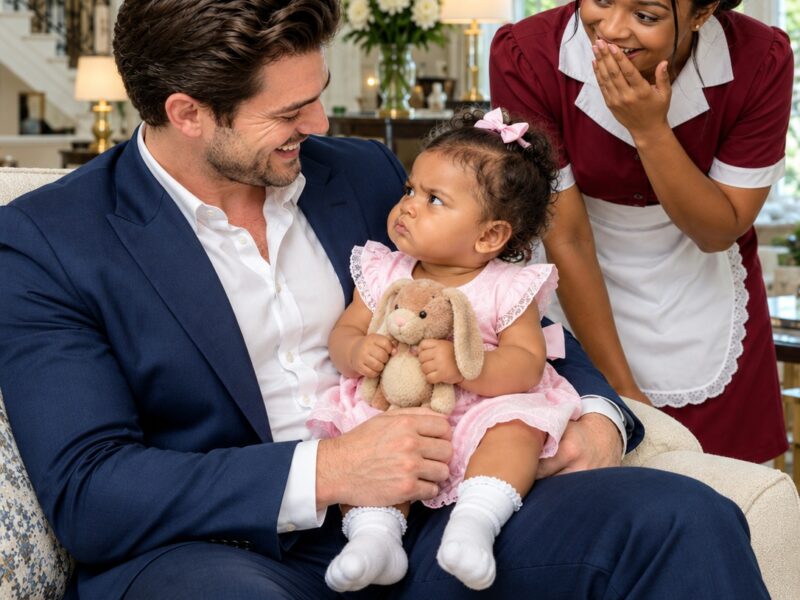
The Baby Copied the Billionaire’s Angry Face—His Reaction Made Everyone Laugh!
The wineglass broke at 8:17 on a Thursday night.
Nathaniel Cross had not thrown it.
That somehow made the room more uncomfortable.
He had only set it down too hard on the marble console beside the dining room, the stem snapping beneath his hand before the bowl rolled once and shattered across the floor.
Thirty people stopped talking.
Three members of the CrossAtlas board lowered their eyes to their plates.
The caterer froze with a tray of salmon halfway between the kitchen and the table.
Rosa Delgado, who had worked in the Cross household long enough to recognize every variety of Nathaniel’s silence, reached automatically for a towel.
Nathaniel noticed none of them.
He stood with his phone pressed to his ear, staring through the tall windows at the dark line of Boston Harbor.
“No,” he said.
His voice did not rise.
“That is not what we agreed to.”
Someone on the other end spoke rapidly.
Nathaniel’s jaw hardened.
“No. I’m not interested in which department made the mistake.”
A pause.
“I’m interested in which department fixes it before six tomorrow morning.”
At the far end of the table, a ten-month-old baby watched him from a high chair.
Lily Cross had oatmeal dried along one cheek and half a strawberry clenched in one fist.
Her gray-blue eyes never left her father.
Nathaniel ended the call.
He frowned at the screen.
Lily lowered her eyebrows.
Her small mouth flattened.
Her nose wrinkled.
She produced a perfect miniature copy of Nathaniel Cross’s most feared expression.
Rosa saw it first.
Her lips twitched.
The private chef caught Rosa’s face and followed her gaze.
Then Evelyn Park, CrossAtlas’s chief operating officer, noticed.
Within five seconds, nearly every adult in the dining room was trying not to laugh.
Nathaniel looked up.
“What?”
No one answered.
His eyes narrowed.
Lily narrowed hers.
A board member coughed into his napkin.
Nathaniel slowly turned toward his daughter.
Lily sat with one sticky hand lifted in the air, glaring at him with such precise imitation that for the first time that evening Nathaniel looked genuinely uncertain.
Lily lifted her chin.
Nathaniel’s chin had been lifted too.
He lowered it.
She lowered hers.
He tightened his mouth.
She did the same.
That was when Evelyn made a choking sound.
Nathaniel looked at her.
Evelyn became suddenly fascinated with her water glass.
Nathaniel turned back to Lily.
His daughter stared solemnly.
For one impossible second, the room seemed to wait and see whether a man who had once fired a vice president during his own anniversary dinner would be offended by a baby mocking him.
Nathaniel leaned closer to the high chair.
He exaggerated the frown.
Lily gasped.
Then copied it.
Someone laughed.
Nathaniel narrowed one eye.
Lily narrowed both.
He pushed his lower lip out slightly.
She pushed hers farther.
The chef lost control first.
His laugh escaped loud and round from the kitchen doorway.
Evelyn followed.
Then Rosa.
Within seconds, the entire room broke.
Not polite laughter.
Real laughter.
People lowered their heads.
One board member slapped the table.
Someone else nearly spilled wine.
Nathaniel stared around the room as if his guests had collectively suffered a nervous breakdown.
Then Lily slapped both palms against her tray and squealed.
Her face opened into a huge, gummy grin.
Nathaniel looked back at her.
Something in him shifted.
The left corner of his mouth lifted.
Only slightly.
Lily’s grin vanished.
She studied the new shape of his face.
Then copied that too.
Nathaniel smiled.
Actually smiled.
The room became quiet for a completely different reason.
Rosa looked away.
She had not seen that smile in months.
The expression remained maybe four seconds.
Then Nathaniel’s phone vibrated.
His eyes dropped.
The warmth disappeared.
He picked it up.
“I need to take this.”
He walked toward the walnut doors of his study.
Lily frowned after him.
This time nobody laughed.
Rosa watched Nathaniel disappear.
Then she looked at the child.
Lily’s small brow remained furrowed.
Rosa whispered, “Oh, sweetheart.”
Because she knew something Nathaniel did not.
Someone had been waiting for that face.
Nathaniel Cross was thirty-six years old and worth just under four billion dollars on paper.
The number changed daily.
He hated when magazines printed it because half of it was company valuation, a large portion was restricted stock, and none of it explained anything important about him.
He had built CrossAtlas Logistics Systems from a rented office above a dry cleaner in Somerville.
The first version of the software crashed during two investor demonstrations.
Nathaniel kept going.
The program could predict bottlenecks across ports, warehouses, truck routes, and distribution centers better than anything available at the time.
He understood logistics because he hated uncertainty.
Containers could be tracked.
Delays could be measured.
Routes could be corrected.
Human lives were not so cooperative.
By thirty-two, Nathaniel owned homes he rarely entered.
By thirty-four, CrossAtlas software moved goods through ports on three continents.
By thirty-five, he had married Clare Whitmore, the only person who could make fun of him without making him defensive.
“You schedule relaxation,” Clare told him once while they stood barefoot in their kitchen at midnight.
“It increases the likelihood that relaxation happens.”
“That sentence is the reason God invented wine.”
Nathaniel checked his calendar.
Clare laughed.
“You’re doing it again.”
“What?”
“Trying to optimize being teased.”
“I am not.”
“You absolutely are.”
Her laughter filled the kitchen so easily that Nathaniel sometimes wondered whether she knew a secret about life the rest of them had missed.
Then Lily was born.
Three weeks later, Clare found a lump beneath her arm.
Tests followed.
Then scans.
Then an oncologist.
Then a room with pale walls and tissues placed strategically beside every chair.
Aggressive metastatic cancer.
There were treatment options.
Percentages.
Trials.
Words Nathaniel wrote down because writing them made them look like problems someone could solve.
Clare listened.
Then asked the only question that mattered.
“How much time?”
The oncologist said nobody could answer exactly.
Nathaniel counted anyway.
One hundred nine days passed from diagnosis to funeral.
He remembered every one.
Day eleven: Clare lost her appetite.
Day twenty-six: first hospital admission.
Day forty-eight: she cut her hair before the chemotherapy could take it.
Day seventy-two: she asked Nathaniel to stop calling specialists after midnight.
Day ninety-one: she asked Rosa to bring Lily to the bedroom and leave them alone for an hour.
Day one hundred nine: Clare died at 3:18 in the morning.
Lily was four months old.
Nathaniel emerged from the hospital room carrying the tiny knitted hat Lily had worn during the visit because somehow it had remained inside his coat pocket.
Rosa was sitting in the corridor.
She stood.
Nathaniel did not cry.
He looked at the hat.
Then at Rosa.
“I don’t know why I have this.”
Rosa had no answer.
He put the hat into his pocket.
For the next six months, Nathaniel turned his calendar into a wall.
Meetings at six in the morning.
Calls during breakfast.
Flights scheduled overnight.
Documents read in the nursery while Lily slept.
He told himself he was preserving the company Clare had helped him build.
He told himself Lily needed security.
College.
Inheritance.
Options.
A stable future.
He never finished the sentence.
Because Lily already had enough money to choose almost anything.
What she did not have was her mother.
And increasingly, she had very little of her father.
Rosa watched it happen one meeting at a time.
She had joined the household four years earlier.
Clare had interviewed seven candidates for household manager and ignored Rosa’s résumé almost immediately.
“Can you make arroz con pollo?”
Rosa blinked.
“Yes.”
“Good.”
Clare leaned closer.
“Nate believes salt is a personality defect.”
From the doorway, Nathaniel said, “I can hear you.”
“That was the objective.”
Rosa took the job.
Within a year she knew which coffee Nathaniel drank, which sheets Clare hated, where the spare nursery thermometer lived, and which song made Lily stop crying.
After Clare died, Rosa became the only person in the house willing to tell Nathaniel when grief was making him ridiculous.
He did not always appreciate it.
He rarely fired her.
The rest of the staff learned to read him like weather.
When his brow dropped low, the gardener called it “the front coming in.”
When he answered emails while walking, the chef called it “high winds.”
When he cancelled dinner, “deep freeze.”
Nobody meant cruelty.
Humor was easier than saying that the warm man Clare had loved now moved through his own house as if every room contained something dangerous.
Lily noticed too.
That unsettled Rosa most.
The baby watched everything.
At breakfast, she watched Nathaniel scroll through his phone.
At night, she turned toward the study whenever his footsteps crossed the hall.
When Nathaniel entered the nursery, Lily studied his face as if committing it to memory.
Then she started copying him.
The morning after the dinner incident, Nathaniel came downstairs at 6:42.
Phone in hand.
Tie unfinished.
“Morning.”
Rosa sat beside Lily with oatmeal.
“Good morning.”
Nathaniel went to the coffee machine.
His phone lit.
Whatever he read made his forehead crease.
Lily immediately creased hers.
Rosa bit the inside of her cheek.
Nathaniel glanced toward the high chair.
Lily maintained the expression.
His eyes narrowed.
So did hers.
“Is she doing that deliberately?”
Rosa failed.
A laugh escaped.
Nathaniel looked offended.
Lily copied that expression too.
Rosa laughed harder.
“I’m sorry.”
“You are not.”
“No.”
Nathaniel turned to his daughter.
“Why does she do that?”
“Because she watches you.”
“That does not explain why she looks furious.”
“Babies imitate faces.”
“Why that face?”
Rosa considered him.
“Because you wear it more than the others.”
Nathaniel looked at the coffee machine as if it had betrayed him.
Lily kept staring.
He picked up the mug.
“I regret initiating this conversation.”
He walked toward the study.
Lily twisted in her chair to follow him.
Rosa stopped laughing.
There it was again.
Not imitation.
Reaching.
Three days later, the Cross face followed Nathaniel into a board meeting.
Lily had a mild fever.
Nothing serious.
Rosa had nevertheless refused to let Nathaniel leave the house.
“She has a pediatrician.”
“She also has a father.”
“I have a board call.”
“You also have Wi-Fi.”
Nathaniel gave her the look.
Rosa pointed toward Lily.
“She does it better.”
So Nathaniel worked from home.
At two, he sat in his study discussing quarterly projections with Evelyn and two directors.
Rosa deliberately left the door open.
Lily crawled in.
Nathaniel did not notice until a small hand grabbed his trouser leg.
He looked down.
“Where did you come from?”
Lily stared up.
Nathaniel still wore his board-meeting expression.
She copied it instantly.
On the monitor, Evelyn laughed.
Nathaniel looked at the screen.
“What?”
“Nathaniel.”
“What?”
“Look down.”
He did.
Lily’s forehead matched his perfectly.
Evelyn covered her mouth.
“Is that your daughter or did someone install a mirror under your desk?”
The other directors laughed.
Nathaniel crouched.
For once, he really looked.
Not checked.
Not glanced.
Looked.
Lily had Clare’s eyes.
That was usually where Nathaniel’s attention stopped.
Color.
Shape.
Memory.
Pain.
But now he saw something else.
Curiosity.
Concentration.
A tiny person studying him so carefully that she had learned the geometry of his unhappiness.
His expression softened.
Lily’s softened too.
Nathaniel almost smiled.
Then his cell phone rang.
He stood.
“Two minutes.”
The moment disappeared.
That night, however, it returned.
Nathaniel sat alone in the study after midnight.
Laptop closed.
No television.
No drink.
He remembered Clare sitting on their kitchen counter five years earlier while Nathaniel searched for his keys.
He had been frowning.
Clare touched one finger between his eyebrows.
“There.”
“What?”
“Your global-emergency face.”
“I lost my keys.”
“Exactly.”
“I’m late.”
“You’re always late because you put twelve things inside ten hours.”
“Have you seen them?”
“My keys?”
“Yes.”
Clare smiled.
“In your hand.”
Nathaniel looked down.
She laughed so hard she nearly fell from the counter.
He had forgotten that sound.
No.
That was not true.
He had refused to remember it.
There was a difference.
For months, every memory of Clare had been attached to oxygen tubes, medications, hospital sheets, and the final shape of her body beneath blankets.
Now the memory of her laughing hurt differently.
Less like a blade.
More like touching a bruise and discovering pain was not the only thing left.
The next morning Rosa came to the study carrying an envelope.
Nathaniel was already dressed.
“What is that?”
She closed the door.
His attention sharpened.
“Rosa.”
“Clare gave me this.”
Everything in him stopped.
“When?”
“Six days before she died.”
His eyes moved to the envelope.
“Why do you still have it?”
“She asked me to keep it.”
“For six months?”
“Yes.”
“You decided when I was ready?”
“No.”
Rosa stepped closer.
“Clare did.”
Nathaniel’s mouth tightened.
“What instructions?”
Rosa turned the envelope.
Clare’s handwriting covered the front.
FOR NATE — WHEN LILY FINDS HER FROWN.
Nathaniel stared.
He read it twice.
“What does that mean?”
“You know.”
“I want you to say it.”
Rosa breathed out.
“She told me Lily would eventually start copying the expression you make when you disappear into your own head.”
Nathaniel looked toward the windows.
“She said when it happens often enough for other people to notice, I should give you this.”
His laugh was dry.
“Apparently the entire board noticed.”
“Yes.”
“I’m very entertaining now.”
“You were.”
He glared.
Rosa did not smile.
“Read the letter.”
Then she left.
Nathaniel waited eleven minutes before opening it.
He knew because he watched the clock.
Control where he could find it.
Inside was one page.
My love,
If Rosa has finally given you this, Lily has found your frown.
I’m sorry. I know how much you hate when I am right after the fact.
Nathaniel stopped reading.
He could hear Clare.
He continued.
I don’t mean the face you make when you’re angry at somebody. I mean the other one. The serious face you wear when your mind runs somewhere far away and the rest of you stays in the room.
You made it during my first scan.
You made it when Lily was born.
You made it the first time you held her because the nurse told you to support her neck, and you immediately looked like you had been handed a live explosive.
I loved that face.
But I know what grief will do to you.
You will turn work into armor.
You will convince yourself that providing is the same thing as being present because providing is measurable and presence is not.
Nathaniel’s hand rose to his mouth.
He kept reading.
If Lily copies your frown, don’t be embarrassed.
Pay attention.
She will be watching you more closely than you realize.
Babies learn faces before they understand explanations. She may not know why you look sad or angry or absent. She will only know that this is the face of the person she keeps searching for.
So when you catch her copying you, please do one ridiculous thing for me.
Smile back.
Especially when you don’t feel like it.
Teach her that reaching toward you gets answered.
Do not let our daughter spend her childhood learning how to knock on a door you are always too busy to open.
Nathaniel lowered the page.
The room blurred.
For months, he had congratulated himself for never crying in front of the staff.
Now there was no one to impress.
He pressed his sleeve to his eyes.
Clare would have mocked the suit.
He read the final paragraph.
One more thing.
You will think this letter is about Lily.
It is partly about you.
You are allowed to love her without betraying me.
You are allowed to laugh in the house where I died.
You are allowed to become somebody I never got to meet.
Please do.
I love you.
C.
Nathaniel remained at the desk until noon.
His assistant called twice.
He rejected both calls.
A third message arrived from Evelyn asking whether he had died.
Nathaniel typed:
No.
She replied:
Then this is historic.
He almost smiled.
At four thirteen, Lily woke from her nap.
Nathaniel was waiting on the nursery floor.
No phone.
No laptop.
Rosa stopped in the doorway.
Lily blinked.
Then saw him.
Her eyebrows lowered automatically.
Nathaniel felt pain climb into his throat.
Smile back.
He smiled.
Wide.
Awkward.
The expression felt unused.
Lily stopped frowning.
She stared.
Nathaniel held the smile.
Lily tilted her head.
Her mouth moved experimentally.
One corner lifted.
Then the other.
Nathaniel’s practiced smile broke into a real one.
Lily squealed.
Her grin widened.
Rosa pressed her hand over her mouth.
Nathaniel looked at her.
“Don’t.”
“I didn’t say anything.”
“You’re crying.”
“So are you.”
“That’s different.”
“How?”
“I own the house.”
Rosa laughed.
Lily laughed because Rosa did.
Nathaniel laughed because Lily did.
For maybe thirty seconds, grief lost jurisdiction over the room.
The next morning did not produce a new man.
That would have been easier.
Nathaniel still checked email at breakfast.
He still grew impatient when meetings ran long.
He still said “one second” to Lily and discovered six minutes later she had crawled away.
But now he noticed afterward.
That was the beginning.
At dinner, his phone rang.
He looked at it.
Then at Lily.
She was watching.
Nathaniel turned the phone facedown.
Lily slapped her tray.
Rosa called it “the trade.”
Nathaniel frowned.
Lily copied.
He caught himself.
Smiled.
She traded the scowl for a grin.
Sometimes they did it six times before lunch.
The staff started keeping count.
Nathaniel discovered this because he found a chalkboard in the kitchen.
MONDAY — 4 TRADES.
TUESDAY — 7.
WEDNESDAY — 3.
He stared.
Rosa entered.
“What is this?”
“Data.”
“Why is my face being tracked?”
“You enjoy metrics.”
“I do not enjoy this metric.”
“Current record is nine.”
Nathaniel frowned.
Rosa pointed.
“That’s one.”
He smiled despite himself.
From the high chair, Lily smiled too.
Rosa added another mark.
Nathaniel walked out shaking his head.
For the first time since Clare died, the house developed noise unrelated to work.
Nathaniel protected dinner.
His assistant, Aaron Mills, saw a calendar block marked LILY every weekday from 5:30 to 7:00.
“What does LILY stand for?”
Nathaniel looked up.
“My daughter.”
Aaron stopped typing.
“Right.”
“It is not flexible.”
“Understood.”
“No investor calls.”
“Yes.”
“No board meetings.”
“Yes.”
“No travel unless unavoidable.”
Aaron nodded.
Then asked carefully, “What qualifies as unavoidable?”
Nathaniel considered.
“Hospital.”
“Government summons.”
“Natural disaster.”
Aaron typed.
“Anything else?”
Nathaniel looked toward Lily, who was sitting on the office carpet chewing a wooden block.
“If she says her first word.”
Aaron blinked.
“That would mean you are already with her.”
“Good point.”
“You’re adjusting.”
“Leave.”
Aaron left smiling.
Nathaniel’s first unsupervised afternoon with Lily nearly destroyed his confidence.
Rosa’s sister had surgery.
Rosa took the day off.
The nanny called sick.
Nathaniel said, “I can handle six hours.”
Rosa looked at him.
“You once negotiated with three governments simultaneously.”
“Yes.”
“This is harder.”
“I doubt that.”
At 2:15, Lily removed one sock.
At 2:18, Nathaniel found it inside a plant.
At 2:29, he realized the diaper bag contained three sweaters, a book, two pacifiers, and no diapers.
He called Rosa.
She answered from the hospital.
“You packed the blue bag?”
“Yes.”
“There are three blue bags.”
“That is irresponsible.”
“You own a logistics company.”
“Where are the diapers?”
“Cabinet beside the changing table.”
“There are four cabinets.”
Rosa hung up.
Nathaniel found the diapers.
Later he attempted lunch.
Lily rejected peas by throwing them.
The dog ate three.
Nathaniel stared at the retriever.
“Do not encourage her.”
The dog wagged its tail.
Lily laughed.
Nathaniel tried sweet potato.
Lily accepted two bites, then applied the third to Nathaniel’s shirt.
He looked down.
She studied his face.
He frowned.
She copied.
Nathaniel sighed.
Then smiled.
Lily clapped.
By five, Nathaniel was exhausted.
Rosa returned at six.
He was on the living-room floor with Lily asleep on his chest.
One sock missing.
Food on his shoulder.
Tie discarded across a lamp.
Rosa took out her phone.
“If you photograph this, you are fired.”
She took the photograph.
“You’ve threatened that for four years.”
Nathaniel looked down at Lily.
“Did Clare ever feel like she had no idea what she was doing?”
Rosa’s expression softened.
“Every day.”
“She never looked like it.”
“Neither do you to Lily.”
That stayed with him.
Then CrossAtlas received the offer.
Helix Meridian wanted CrossAtlas to acquire a controlling stake in a European logistics platform that would give Nathaniel’s company access to forty-two major distribution hubs.
The financial impact could double CrossAtlas’s international business within five years.
The board was ecstatic.
Everett Sloan, the chairman, called it “the deal Nathaniel had built the company to make.”
Nathaniel read the integration plan.
Page seventy-four stopped him.
Singapore.
Minimum twelve-month relocation.
He looked at Everett across the boardroom.
“You expect me to move.”
“We expect leadership.”
“I can lead from Boston.”
“Not this transition.”
Nathaniel flipped another page.
“Why twelve months?”
“Six is unrealistic.”
“Eight?”
“Still aggressive.”
Evelyn sat two chairs away.
She watched Nathaniel without speaking.
Everett leaned forward.
“This is the defining transaction of your career.”
Once, that sentence would have ended the discussion.
Nathaniel looked down at the document.
His career.
Growth.
Scale.
Market dominance.
Every familiar word pointed outward.
At home, Lily was learning to stand.
He closed the folder.
“I’ll review.”
Everett smiled.
“There is not much to review.”
Nathaniel looked up.
“There is always something to redesign.”
He went home late that night.
Lily was asleep.
He stood outside the nursery.
Failure had never felt so quiet.
The next morning he arrived for breakfast.
Then left before Lily finished eating.
On Tuesday, a call with London ran through dinner.
On Wednesday, Nathaniel returned at 5:48.
Lily was standing beside the sofa.
Rosa sat on the floor five feet away.
“Come on.”
Lily let go.
One step.
Then another.
Then a third.
She fell onto her diaper and clapped for herself.
Nathaniel stopped in the doorway.
“Did she just walk?”
Rosa looked up.
“Yes.”
“How long?”
“Yesterday.”
The words struck harder than they should have.
“You didn’t tell me.”
“I sent you a video.”
Nathaniel checked.
Received 3:09 p.m.
Unread.
He stared at the screen.
Rosa did not rescue him from it.
“You were on the Helix call.”
Nathaniel said nothing.
That night he found the message from the previous day.
Lily wobbling toward Rosa.
Rosa cheering.
Then Lily turning toward the phone as if searching beyond it.
Nathaniel watched three times.
On the fourth, he put the phone down.
He went upstairs.
Lily was asleep.
On the nursery chair lay the Helix integration plan.
Nathaniel picked it up.
Twelve months.
He pictured first words arriving through video.
Birthdays arranged around flights.
Lily learning to run while he watched recordings at midnight in Singapore.
He could explain it.
She would not remember.
That thought was dangerous.
Children forget early absence.
Adults use that fact to forgive themselves.
Nathaniel sat.
Lily moved in the crib.
Her eyes opened.
She saw him.
Both arms rose immediately.
No hesitation.
He put the contract down.
Picked her up.
She pressed her cheek against his neck.
The next morning Everett had champagne in the boardroom.
Nathaniel stopped beside the table.
“That is premature.”
“Optimism.”
“I’m not relocating.”
The room went silent.
Everett’s smile disappeared.
“Nathaniel.”
“I’ll lead the transaction.”
“You cannot lead this integration from Boston.”
“I can if we change the structure.”
“We have spent six weeks designing it.”
“And I spent last night redesigning it.”
Nathaniel opened a new folder.
Regional operating committee.
Evelyn would control implementation.
The CFO would receive expanded authority.
Nathaniel would spend no more than seven days per month overseas during the first two quarters.
The operations center would remain in Boston.
Everett stared.
“This is slower.”
“Yes.”
“More expensive.”
“For the first year.”
“It reduces projected value.”
“Nine percent in the conservative model.”
Everett blinked.
“You calculated it.”
“Obviously.”
“Then you understand what you’re giving up.”
“Yes.”
“Why?”
Nathaniel looked around the table.
“My daughter took three steps Tuesday.”
No one spoke.
“I watched them on video.”
Everett’s expression tightened.
“Nathaniel, with respect, we cannot run a public company around a toddler.”
“No.”
Nathaniel nodded.
“We run it around a leadership structure that does not collapse because one man refuses to live on another continent.”
Everett leaned back.
“You are making an emotional decision.”
Nathaniel shook his head.
“An emotional decision would be rejecting the acquisition.”
“I am proposing a different operating model.”
“You are asking shareholders to accept less.”
“I’m asking them to accept slower.”
“That is less.”
“Not necessarily.”
They argued for two hours.
Everett was not a villain.
His concerns were legitimate.
Investor patience.
Integration risk.
Competitor response.
Leadership credibility.
Nathaniel’s boundary was legitimate too.
At noon, the board rejected his structure.
Five votes to four.
Nathaniel stared at the result.
Everett folded his hands.
“You built CrossAtlas.”
Nathaniel said nothing.
“Do not sabotage your own work because you are frightened of repeating a personal mistake.”
That sentence landed harder than the others.
Nathaniel looked at him.
Everett continued.
“You can visit home every month.”
“She can visit you.”
“You have resources most fathers would dream of.”
“This does not make you absent.”
Nathaniel sat very still.
Evelyn spoke for the first time.
“Nate.”
He looked at her.
She had almost never used his nickname at work.
“You have another option.”
Everett frowned.
“What?”
Evelyn closed her folder.
“Let him resign as integration lead.”
The room shifted.
Nathaniel stared.
Evelyn continued.
“I’ll take it.”
Everett said, “You already run operations.”
“Yes.”
“I’ll relocate for six months.”
“My husband works remotely.”
“My kids are teenagers.”
Nathaniel said, “Evelyn, you do not have to—”
“I know.”
She looked at him.
“That’s why it is a choice.”
Then she looked around the table.
“The company claims it has succession depth.”
“Perhaps we should prove it before telling Nathaniel fatherhood is an operational defect.”
No one spoke.
Everett rubbed one hand over his mouth.
The board reconvened after lunch.
The new structure passed six to three.
Evelyn relocated temporarily.
Nathaniel travelled frequently but remained based in Boston.
CrossAtlas stock dropped seven percent when analysts learned the integration would take longer.
Financial television called it “a surprisingly cautious move from an aggressive founder.”
One columnist wrote that Nathaniel Cross had lost his appetite for growth.
Nathaniel clipped the article.
He kept it inside a drawer.
Not because he was angry.
Because he wanted to remember that sometimes a good decision looked unimpressive from far away.
The transaction closed ten months later.
Growth was slower than projected.
Two years afterward, margins were better than the original plan.
Everett admitted this privately.
Nathaniel asked him to say it again.
Everett refused.
During those months, Nathaniel kept failing at fatherhood in smaller ways.
He missed a pediatric appointment after a flight delay.
He shouted at Aaron while Lily was in the office and watched her flinch.
That night he sat beside her crib feeling ashamed.
The next morning he found Rosa in the kitchen.
“I scared her.”
Rosa looked up.
“You raised your voice.”
“I don’t raise my voice at her.”
“You weren’t speaking to her.”
“She doesn’t know that.”
Nathaniel rubbed his forehead.
“What do I do?”
“Say sorry.”
“She’s eleven months old.”
“Then practice before she understands.”
He found Lily in the playroom.
He sat on the floor.
She crawled toward him.
Nathaniel touched one finger to her hand.
“I was loud yesterday.”
Lily tried to eat his finger.
“I frightened you.”
She laughed.
“That was not the intended reaction.”
He smiled.
“I’m sorry.”
Rosa heard from the doorway.
She said nothing.
Change accumulated that way.
Tiny repetitions.
The first birthday arrived in April.
Nathaniel wanted something small.
Cross standards translated that into forty-three guests.
Clare’s parents came from Vermont.
Board members came without laptops under threat.
Rosa made the cake because she refused Nathaniel’s suggestion of a professional pastry chef.
“You are not launching a product.”
“I did not say that.”
“You sent a mood board.”
“It was inspiration.”
“It had typography.”
Nathaniel conceded defeat.
Lily wore yellow.
At two sixteen, she sat before her cake and immediately put both hands into the frosting.
Everyone sang.
Lily stared at them suspiciously.
Then found Nathaniel.
Her famous frown appeared.
People laughed.
Nathaniel copied it.
Lily frowned harder.
He did too.
Then he smiled.
She broke into a grin.
She pointed.
“Da.”
The room stopped.
Nathaniel did not move.
Lily slapped the table.
“Da!”
Rosa covered her mouth.
Nathaniel crossed the room.
He lifted Lily from the high chair.
“I’m here.”
His voice cracked.
Lily touched his cheek.
Then frowned again.
Nathaniel laughed.
The entire room followed.
Not because a baby made a funny face.
Because many of them remembered the man who once shattered a glass without noticing.
That evening, after everyone left, Rosa found Nathaniel sitting on the floor beside torn wrapping paper.
Lily slept upstairs.
A box sat open beside him.
Inside were envelopes.
Dozens.
Rosa stopped.
“You found them.”
Nathaniel looked up.
“There are eighteen.”
He picked up the first row.
LILY — AGE 2.
LILY — AGE 3.
LILY — AGE 4.
All the way to eighteen.
Another set carried Nathaniel’s name.
Clare had written herself forward into years she knew she would never see.
Nathaniel touched one envelope.
“I don’t know if I can do this eighteen times.”
Rosa sat beside him.
“You do not have to do eighteen tonight.”
Nathaniel laughed faintly.
“She would say that.”
“Yes.”
“She would also have written instructions.”
“Probably color-coded.”
He opened NATE — AFTER HER FIRST BIRTHDAY.
My love,
If Lily made it to one, congratulations.
If you made it to one, bigger congratulations.
I hope she has your seriousness and none of your inability to locate objects already in your hand.
Nathaniel laughed through tears.
Then the letter changed.
There is something I need you to know about me.
Not cancer.
Before you.
Before Boston.
Before I became the woman who pretended not to care that you own six identical white shirts.
Nathaniel’s smile faded.
He read.
Clare’s parents had died in a highway accident when she was nine.
Nathaniel knew that.
What he did not know was that Clare had an older sister.
Diane.
Fourteen at the time.
The girls were placed in separate foster homes.
At first, letters travelled between them.
Then Diane’s placement changed.
Then Clare’s.
Records moved.
Addresses disappeared.
Clare was eventually adopted.
Diane aged out.
They lost one another.
As an adult, Clare searched.
Then stopped.
I told myself stopping was acceptance.
It wasn’t.
I was afraid of finding her and learning she no longer wanted me.
Nathaniel looked up.
Rosa’s eyes filled.
“You knew?”
“Only that there was someone.”
“She never told me the details.”
Nathaniel continued.
There is a file in the safe.
I do not want you turning this into one of your projects.
Rosa laughed softly.
“She knew you.”
Nathaniel glared.
The letter continued.
If Lily someday asks where she comes from, tell her she had an aunt named Diane.
If you ever find Diane, do not arrive with investigators and money and decide family is automatically owed access.
Ask what she wants.
Ask Lily what she wants when she is old enough.
Please do not buy the door open.
Some doors need knocking.
Nathaniel sat still.
Another instruction.
Another accurate prediction of his worst instinct.
Two weeks later he hired a private investigator.
Twenty-four hours after that, he fired him.
Rosa found out because Nathaniel complained about the invoice.
“What happened?”
“He wanted Diane’s credit history.”
“Clare said do not turn it into a project.”
“I remember.”
“You made it twenty-four hours.”
“Progress.”
Nathaniel contacted a nonprofit specializing in family-reunification records.
Slow.
Legal.
No private databases.
No pressure.
Three months passed.
Then six.
Nothing.
Meanwhile Lily became mobile enough to make every room unsafe.
Nathaniel learned to secure cabinets.
He learned babies considered electrical cords invitations.
He learned the expensive glass coffee table Clare had loved was incompatible with a toddler who believed furniture existed for climbing.
The table went into storage.
Nathaniel stared at the empty space.
Rosa said, “Clare would approve.”
“She loved that table.”
“She loved Lily more.”
At fourteen months, Lily discovered “no.”
No bath.
No shoes.
No carrots.
No nap.
No Daddy.
The last one hurt disproportionately.
“You said no to pants too,” Nathaniel told her.
“No.”
“Exactly.”
Rosa watched.
“You negotiate billion-dollar contracts.”
“This counterparty is irrational.”
Lily threw a sock at him.
Rosa laughed.
At eighteen months, Lily developed a fever high enough to frighten Nathaniel.
The pediatrician said it was viral.
Hydration.
Rest.
Monitor.
Nathaniel called twice overnight.
The third time, the doctor said, “Mr. Cross, I need you to stop Googling.”
Nathaniel said, “I own no medical search company.”
“That is not what I said.”
At three in the morning, Lily slept against Nathaniel’s chest on the nursery floor because she cried every time he tried putting her down.
Rosa came in with water.
Nathaniel whispered, “I hate this.”
“The fever?”
“Not being able to fix it.”
Rosa sat beside him.
“Welcome to loving someone.”
He looked down at Lily.
“She’s miserable.”
“Yes.”
“And all I can do is hold her.”
“Yes.”
“That feels inadequate.”
Rosa smiled sadly.
“Only to people who think holding does not count as doing.”
That sentence stayed.
When Lily turned two, Clare’s letter asked Nathaniel to take her somewhere ordinary.
No private room.
No closed museum event.
No security spectacle unless necessary.
Nathaniel took Lily to the New England Aquarium on a Tuesday.
Security followed discreetly.
Lily pressed both palms against the enormous ocean tank.
A stingray passed.
She gasped.
Nathaniel crouched beside her.
For two hours, nobody cared that he was worth billions.
He carried snacks.
Lost a stuffed dolphin.
Recovered it beneath a bench.
Spilled juice on his coat.
Helped Lily through a public bathroom where someone had abandoned paper towels across the floor.
She fell asleep against him on the drive home.
Nathaniel looked out the window.
He had once believed wealth existed partly to protect people from inconvenience.
Now he understood inconvenience was often where life happened.
At CrossAtlas, the Helix integration produced an unexpected consequence.
Because Nathaniel delegated, Evelyn became indispensable.
Two younger executives grew stronger.
The company stopped routing every decision through its founder.
Everett hated admitting this was healthy.
Eventually Evelyn became president.
Reporters asked whether Nathaniel was stepping back.
He said, “I’m stepping differently.”
Everett called later.
“That phrase is terrible.”
“I agree.”
“Then why did you say it?”
Nathaniel considered.
“Sleep deprivation.”
The Clare Foundation began because of another letter.
At three, Clare asked Nathaniel one question.
What did you need most while I was dying that money could not provide?
He hated the question.
Money had provided everything.
Private oncologists.
Experimental treatment.
Home nurses.
Drivers.
Meals.
Childcare.
Therapists.
The best hospice team in Massachusetts.
And still he had been drowning.
He asked Rosa.
She said, “Someone who understood day three.”
Nathaniel frowned.
“Explain.”
“Not a pamphlet.”
“Not a therapist you meet once.”
“Another person who understands why suddenly the cereal aisle makes you cry because your spouse always chose cereal.”
Nathaniel sat with that.
They built the foundation slowly.
Counseling grants.
Emergency childcare.
Meal support.
Peer groups for widowed parents.
No giant gala.
Nathaniel insisted.
“I refuse to photograph grief next to champagne.”
Evelyn said, “That may be the first intelligent branding sentence you’ve ever said.”
The foundation launched publicly a year later.
Nathaniel had spoken to thousands of investors without fear.
This speech terrified him.
Lily, almost four, sat in the front row with Rosa.
Nathaniel looked down.
Lily frowned.
The audience laughed because staff had already spread the story.
Nathaniel frowned back.
Lily giggled.
The room relaxed.
He began.
“My daughter learned my saddest expression before she learned my smile.”
His throat tightened.
“I believed I was hiding grief from her.”
“I wasn’t.”
“I was teaching her its shape.”
The room went still.
Nathaniel talked about Clare.
Not every detail.
Some grief still belonged privately to the dead.
He talked about work becoming armor.
About providing because providing was measurable.
About discovering too late that presence could not be outsourced.
“My daughter was not mocking me.”
He looked at Lily.
“She was paying attention.”
“That was harder to admit.”
The speech spread online.
Not because Nathaniel was famous.
Because exhausted parents recognized themselves.
Messages arrived.
Widows.
Widowers.
Parents grieving children.
People who had spent years working because stopping meant feeling.
Then an email arrived from Ohio.
Subject line:
I THINK CLARE WAS MY SISTER.
Nathaniel stared for several minutes.
He did not answer.
Instead, he sent it to the nonprofit helping with Clare’s records.
Verification took six weeks.
Birth certificates.
Old foster files.
School records.
A photograph.
Diane Whitmore was real.
Fifty.
School librarian outside Columbus.
Two adult sons.
She had spent decades believing Clare had stopped wanting contact.
Clare had spent decades fearing the same about Diane.
No villain.
Bad records.
Moves.
Fear.
Time.
Nathaniel called.
Diane answered cautiously.
“Hello?”
“Diane Whitmore?”
“Yes.”
“My name is Nathaniel Cross.”
Silence.
Then a breath.
“I know.”
Nathaniel closed his eyes.
“She wrote about you.”
Diane began crying.
Nathaniel waited.
After a while she said, “Is Clare…”
The question broke.
Nathaniel told her.
Diane did not speak for almost two minutes.
Then:
“Did she have children?”
Nathaniel looked through the glass wall into his home office play area.
Lily was putting stickers on Rosa’s shoes.
“One.”
“A girl.”
“What’s her name?”
“Lily.”
Diane made a sound that hurt to hear.
Nathaniel remembered Clare’s instruction.
Do not buy the door open.
“Diane.”
“Yes?”
“If you want to know about her, I’ll tell you.”
“If you want photographs, I’ll send them.”
“If you want nothing from us, I will respect that.”
A weak laugh.
“Clare married a man who says ‘I will respect that’ like a contract clause?”
Nathaniel smiled.
“She criticized that.”
“I bet she did.”
They exchanged photographs first.
Then letters.
Then video calls without Lily.
Months passed before Diane asked to meet.
Nathaniel proposed Boston.
Diane said no.
Too much.
They chose a public garden halfway between the airport and the city.
Neutral.
Lily knew she was meeting “Mommy’s sister.”
Nothing more was demanded.
Diane arrived carrying no gift.
Nathaniel noticed.
Probably intentional.
She saw Lily.
Stopped.
Lily stared back.
Diane whispered, “She has Clare’s eyes.”
Nathaniel nodded.
Lily frowned.
Diane laughed immediately.
“Oh, that is not Clare.”
Nathaniel almost smiled.
“Unfortunately, that part is mine.”
Lily looked at Diane.
“Why are you crying?”
Diane wiped her face.
“I’m happy.”
Lily frowned harder.
“That’s confusing.”
Nathaniel said, “Correct.”
Diane laughed again.
The first meeting lasted forty-three minutes.
The second lasted two hours.
There was no instant family.
No miraculous healing.
Diane and Nathaniel sometimes disagreed.
She remembered Clare as a scared child.
Nathaniel remembered a fearless woman.
Both versions were true.
Diane gave him photographs.
Clare at ten with missing front teeth.
Clare holding a library book almost as large as her torso.
Two sisters asleep against each other on a couch weeks before their parents died.
Nathaniel took that photograph home.
He placed it on Lily’s shelf.
Not in the safe.
Not inside a drawer.
At four, Lily asked why Mommy was not at home.
Nathaniel sat on the floor.
Because she died.
“What does died mean?”
Her body stopped working.
“Why?”
Cancer.
“What is cancer?”
Cells inside her body grew wrong.
“Did doctors fix it?”
They tried.
“Did you fix it?”
Nathaniel’s throat tightened.
“No.”
“Why?”
“Because some things cannot be fixed.”
Lily stared.
“Did you try?”
“Yes.”
“Did Mommy know?”
“Yes.”
“Was she scared?”
Nathaniel wanted to say no.
He almost did.
Then remembered every lesson Clare had left him.
“Yes.”
Lily looked surprised.
“Mommy was scared?”
“Yes.”
“And brave?”
“Yes.”
“At same time?”
Nathaniel nodded.
“Most brave people are.”
Lily crawled into his lap.
He held her.
Later that night he opened Clare’s letter labeled LILY — AGE 4.
Clare wrote:
If Daddy ever tells you I wasn’t scared, he is trying to make me into a superhero because superheroes are easier to lose than ordinary people.
Please know I was frightened.
I was angry.
I was jealous of people who got more time.
And I loved you so much that sometimes love itself felt frightening.
Nathaniel had to stop reading.
He understood then why Clare’s letters mattered.
They did not preserve perfection.
They preserved humanity.
At five, Lily started kindergarten.
Nathaniel insisted he could do drop-off alone.
Rosa did not believe him.
“You know the address?”
Nathaniel stared.
“I founded a logistics company.”
“That wasn’t my question.”
He arrived twenty minutes early.
Lily refused to get out.
Nathaniel sat in the parked car.
“What’s wrong?”
“Nothing.”
“You’re holding the seat belt.”
“No.”
“You are.”
Lily looked toward the school entrance.
“What if nobody likes me?”
Nathaniel’s first instinct was to solve.
“You already know two children from orientation.”
“Dad.”
He stopped.
“What?”
“Don’t do business.”
He stared.
“What does that mean?”
“You make lists when feelings.”
Nathaniel leaned back.
His own child had audited him.
“Okay.”
He waited.
Lily whispered, “I’m scared.”
Nathaniel nodded.
“Me too.”
She looked at him.
“You don’t go school.”
“No.”
“But I’m scared you’ll need me and I won’t be there.”
Lily considered.
“That’s silly.”
“Yes.”
“Can I go now?”
Nathaniel smiled.
“Yes.”
She opened the door.
Then leaned back in.
“Trade.”
She frowned.
Nathaniel copied.
Then smiled.
Lily smiled.
She went inside.
Nathaniel sat in the parking lot for seven minutes after the doors closed.
Then he drove to work.
That afternoon, a different crisis waited.
CrossAtlas’s largest institutional investor had demanded a strategic review.
Growth was strong but slower than competitors.
Everett wanted an aggressive acquisition.
Nathaniel disagreed.
The disagreement became public after someone leaked board discussions.
Financial press speculated Nathaniel had become distracted.
One headline read:
HAS FATHERHOOD SOFTENED CROSSATLAS’S FOUNDER?
Nathaniel printed it.
Evelyn found it on his desk.
“You planning to sue?”
“No.”
“Frame it?”
“Maybe.”
“Why?”
Nathaniel looked at the headline.
“Because five years ago I would have considered that devastating.”
“And now?”
“Now I think softness is an imprecise word.”
The strategic review forced a choice.
CrossAtlas could borrow heavily and acquire a competitor.
Or invest slower in internal infrastructure.
The first option promised a larger valuation.
The second protected jobs and reduced integration risk.
Everett pushed for acquisition.
Nathaniel pushed back.
At the board meeting, Everett said, “You’re becoming conservative.”
Nathaniel replied, “I’m becoming less impressed by size.”
“That is convenient once you already own the company.”
“Fair criticism.”
Everett paused.
Nathaniel continued.
“But we have twelve thousand employees who do not experience this as a stock chart.”
Silence.
“You sound like Clare.”
Nathaniel’s eyes lifted.
Everett immediately regretted it.
“Sorry.”
“No.”
Nathaniel looked down.
“She would enjoy that.”
The board chose the slower path.
CrossAtlas did not become the largest company in its category.
It became more stable.
Three years later, Everett admitted the debt market crash would have crushed them under the acquisition plan.
Nathaniel said nothing.
Everett frowned.
“You are enjoying this.”
“Extensively.”
Nathaniel’s life did not become simple.
Grief did not end because he became a better father.
Some nights he still woke at 3:18.
Some mornings he looked toward Clare’s side of the bed before remembering.
On the anniversary of her death, he often became difficult.
Rosa recognized it.
Lily eventually did too.
When Lily was six, she found him sitting alone in the kitchen before sunrise.
“Sad day?”
Nathaniel looked at her.
“Yes.”
She climbed onto the chair.
No speech.
No advice.
She sat beside him.
After a while Nathaniel said, “You don’t have to stay.”
“I know.”
“School.”
“Later.”
He smiled.
“Rosa taught you that.”
“No.”
“Mommy did.”
Nathaniel looked at her.
Lily pointed to Clare’s letters on the table.
“She says people don’t always need fixing.”
Nathaniel laughed softly.
“She absolutely wrote that for me.”
Diane became part of their lives slowly.
She visited twice a year.
Lily called her Aunt Diane after asking permission.
Diane told stories Clare had never told Nathaniel.
The time Clare stole peaches from a neighbor’s tree.
The foster home where they slept in bunk beds.
The way Clare used to sing to Diane during storms.
Nathaniel understood the lullaby Clare had sung to Lily came from that childhood.
One evening Diane admitted something.
“I stopped looking too.”
Nathaniel looked at her.
“I always thought Clare chose not to find me.”
Diane stared into her tea.
“Truth is, I was scared.”
“Of what?”
“That she had built a better family.”
“And there would be no room.”
Nathaniel understood that fear too well.
“Did she?”
Diane looked at Lily asleep on the couch.
“Yes.”
Then smiled.
“But apparently she kept adding rooms.”
The Clare Foundation expanded its work.
Not because Nathaniel planned a grand mission.
Because people kept bringing needs that fit the original wound.
Grief counseling.
Emergency childcare.
Support for foster siblings trying to reconnect.
Legal help for widowed parents navigating benefits.
Nathaniel insisted every program be reviewed by people who had actually lived the problem.
“No billionaire designing poverty solutions alone.”
Evelyn raised an eyebrow.
“Self-awareness.”
“Rare but improving.”
At the fifth-anniversary gathering of the foundation, families filled a renovated warehouse near the harbor.
No huge donor wall.
No velvet rope.
Children drew pictures at tables.
Counselors ran workshops in side rooms.
Diane came.
Rosa came.
CrossAtlas employees came without talking about work.
Nathaniel stood on a small stage.
Lily, now seven, held his hand.
He had prepared remarks.
Then ignored them.
“Seven years ago,” he began, “I thought being a good father meant making sure my daughter would never need anything.”
Lily looked up.
Nathaniel continued.
“It took her approximately ten months to expose the problem with that theory.”
People laughed.
“She already had everything money could buy.”
“What she needed was someone who looked up.”
Lily scrunched her face.
Perfect Cross frown.
The audience laughed harder.
Nathaniel looked down.
He copied it.
Lily exaggerated hers.
He exaggerated his.
She folded her arms and produced such theatrical executive outrage that Nathaniel broke.
He laughed.
Not the controlled public smile cameras expected.
A real laugh.
He bent slightly at the waist.
Covered his mouth.
Lily started laughing too.
The room joined them.
For several seconds there was no billionaire.
No grief foundation.
No founder.
No audience.
Just a father and daughter sharing a joke that had taken years to become harmless.
Nathaniel straightened.
Lily still held his hand.
“My daughter copied my saddest expression before she copied my smile.”
His voice softened.
“I thought something was wrong.”
“It wasn’t.”
“She was learning me.”
“And I almost taught her that the person she loved most was always somewhere else.”
He squeezed Lily’s fingers.
“Presence is not complicated.”
“It does not scale.”
“It ruins schedules.”
Evelyn called from a table, “Constantly.”
The room laughed.
Nathaniel smiled.
“But it is the only thing I have ever built that I’m unwilling to outsource.”
After the event, they returned home.
No caterers.
No board dinner.
No broken wineglass.
Rosa made grilled cheese.
Lily sat at the kitchen island in pajamas doing homework.
Nathaniel’s phone vibrated.
Singapore.
Urgent.
He looked at the screen.
Then turned it facedown.
Lily noticed.
“What was it?”
“Work.”
“Important?”
“Probably.”
“Are you going?”
“No.”
She studied him.
Then made the frown.
Nathaniel copied it.
She smiled.
He smiled too.
Rosa shook her head.
“Seven years.”
“What?”
“That ridiculous face.”
Nathaniel looked offended.
Lily copied him instantly.
Rosa laughed.
Nathaniel did too.
Later, after Lily went upstairs, Nathaniel remained in the kitchen.
Clare’s first letter lived in his wallet now.
Folded soft at the creases.
Not because he needed to read it every day.
Because some memories felt different when carried.
Rosa poured tea.
“You know Clare would be unbearable about all this.”
Nathaniel smiled.
“She would take credit.”
“Complete credit.”
“She did not fix me.”
“No.”
Rosa sat across from him.
“She left instructions.”
“I ignored many.”
“Fewer now.”
They sat quietly.
Upstairs, Lily laughed at something on the phone with Diane.
Nathaniel looked toward the ceiling.
For years, silence had been his preferred form of control.
Now he preferred hearing the house occupied.
Doors opening.
Footsteps.
Someone singing badly in the shower.
Life making itself impossible to optimize.
The next morning Nathaniel woke before six.
Old habit.
He reached for his phone.
Stopped.
Outside, Boston was still dark.
He went upstairs instead.
Lily’s door stood slightly open.
She had kicked the blankets away.
A stuffed dinosaur lay on the floor.
Nathaniel picked it up.
Sat on the bed.
Lily stirred.
Her eyes opened halfway.
“Dad?”
“I’m here.”
She frowned sleepily.
Even half asleep, the face remained.
Nathaniel smiled.
Lily’s mouth curved automatically.
Trade.
He pulled the blanket over her.
Then stayed.
There was an investor call at six thirty.
A revised forecast waiting.
Four unread messages marked urgent.
Nathaniel knew he would answer them.
Work had not become meaningless.
CrossAtlas employed thousands of people.
Decisions mattered.
Deadlines mattered.
Responsibility mattered.
He simply understood their proper size now.
Lily’s hand moved through sleep.
Found his finger.
Closed around it.
Nathaniel looked down.
Years earlier, he would have called success the ability to build something the world could not ignore.
Clare had known better.
Lily had taught him better.
The people we love rarely ask for us in language convenient enough to place on a calendar.
Sometimes they cry.
Sometimes they interrupt.
Sometimes they crawl beneath a desk during a board call.
Sometimes they ask questions at the exact moment you are trying not to feel anything.
And sometimes a baby looks at the angriest, saddest face in the room, copies it perfectly, and waits to see whether the person wearing it will finally look back.
Nathaniel stayed until Lily released his finger.
Then he stood.
At the doorway, her sleepy voice stopped him.
“Dad?”
He turned.
Her eyes remained closed.
“Yeah?”
“Don’t forget your phone.”
Nathaniel looked at the device lying on the hallway table.
Then at his daughter.
He smiled.
“I won’t.”
Lily’s face scrunched into the familiar frown without opening her eyes.
Nathaniel laughed quietly.
This time she smiled first.









