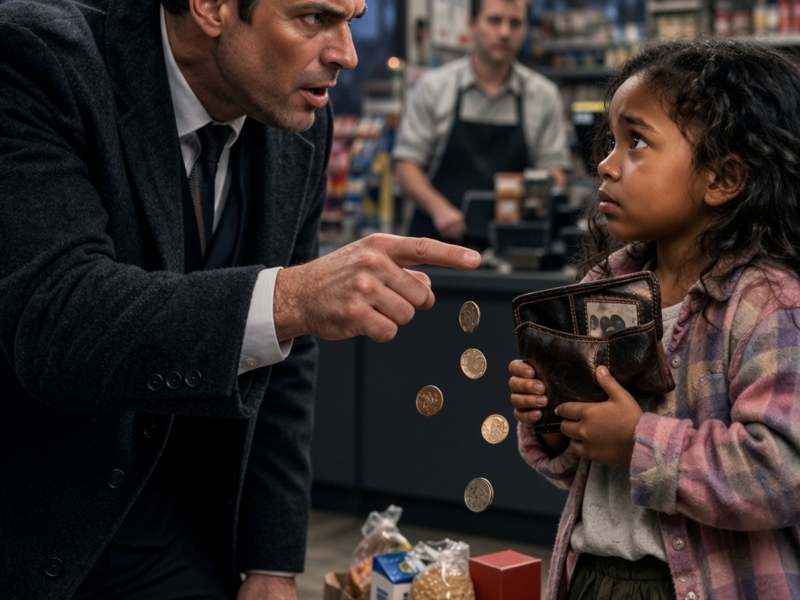
The Billionaire Asked a Black Girl Where She Got the Old Wallet—Her Answer Reopened a Family Secret Buried for Twenty-Two Years
The little girl was counting coins for milk when the billionaire saw the wallet he had not touched since he was sixteen.
When she said it belonged to her mother, his hands went cold—because he knew exactly who had owned it before.
Then she showed him the photograph hidden inside, and a twenty-two-year family disappearance stopped looking accidental.
The Wallet On The Counter
“Where did you get that wallet?”
The question came out sharper than Ethan Cole intended.
The girl standing at the convenience-store register turned around so quickly that three nickels slipped from her small brown hand and clicked across the tile.
She looked about eleven.
Maybe twelve.
Black girl. Dark braids gathered into two low ponytails. Navy winter coat a little too thin for a January evening in Chicago. A canvas school bag hung from one shoulder, patched near the bottom with silver duct tape.
The old wallet rested open beside a loaf of white bread, a half-gallon of milk, and a box of store-brand crackers.
Brown leather.
Cracked along the fold.
One corner darker than the others.
Ethan knew that wallet.
He had bought it with nine dollars and seventy-five cents from a drugstore in Bronzeville when he was sixteen.
The girl bent to collect her coins.
“I’m sorry.”
The cashier, a middle-aged man with a Bulls cap, looked at Ethan.
“You know her?”
“No.”
The answer was true.
Ethan set his unopened bottle of water on the counter and crouched to pick up a dime that had rolled beneath the gum display.
He placed it gently beside the girl’s hand.
She straightened.
Her eyes were cautious now.
Not frightened.
Cautious.
Ethan recognized the difference.
“I’m sorry,” he said. “I didn’t mean to scare you.”
“You didn’t.”
Her tone suggested he had, but she preferred not to grant him the satisfaction.
The cashier finished scanning.
“Six eighty-seven.”
The girl counted again.
Three dollars in bills.
Coins.
A quarter.
Two dimes.
Four pennies.
She was short.
Ethan saw the moment she realized it.
She looked at the crackers.
Then at the milk.
Then at the bread.
The choice took less than two seconds.
“Take the crackers off.”
The cashier reached for them.
Ethan said:
“Leave them.”
The girl turned.
“I have money.”
“I can see that.”
“I just don’t have enough.”
“I can also see that.”
Her expression hardened.
He understood immediately that charity offered badly could feel like another form of humiliation.
So he picked up his bottle of water.
“Add this.”
The cashier did.
Ethan handed over a twenty.
The girl frowned.
“You bought your water.”
“Yes.”
“And accidentally bought crackers.”
“That appears to be what happened.”
She studied him.
Then, against her will, smiled slightly.
“Thank you.”
“You’re welcome.”
The cashier gave Ethan change.
The girl reached for the wallet.
It slid toward the edge.
Ethan caught it before it fell.
His thumb touched the embossed mark near the lower corner.
A small imperfect letter M.
He had made it himself with the heated tip of a screwdriver because his younger sister had complained the wallet looked “too much like a grown man’s.”
He remembered her standing at their kitchen table.
Nine years old.
Skinny knees.
Two braids.
Missing front tooth.
She had laughed when he burned the M crooked.
Now it’s mine forever.
Ethan’s chest tightened.
The girl held out her hand.
“Sir?”
He gave the wallet back immediately.
“Sorry.”
She tucked it against her coat.
He forced his voice lower.
“Can I ask you one question?”
She looked toward the cashier.
The man remained watchful.
Good.
Ethan wanted somebody watchful nearby.
“About the wallet.”
The girl hesitated.
“Okay.”
“Is it yours?”
“My mama’s.”
Ethan forgot the sound of the refrigerator cases behind him.
Forgot the cold air leaking beneath the front door.
Forgot that he had a seven-thirty dinner with three investors downtown.
“What’s your mother’s name?”
The girl’s eyes narrowed.
“Why?”
“Because I knew someone who had that wallet.”
“You knew my mama?”
“I don’t know yet.”
That answer seemed to satisfy her more than certainty would have.
She shifted the grocery bag against her hip.
“Her name is Denise.”
Something in Ethan released.
Wrong name.
Not Marissa.
Then the girl added:
“Denise is her middle name.”
He went still again.
“She uses it because she says her first name belongs to another life.”
Ethan swallowed.
“What is her first name?”
The cashier stopped pretending not to listen.
The girl looked at Ethan for a long moment.
Then said:
“Marissa.”
The bottle of water slipped from Ethan’s fingers.
It struck the counter.
Nobody spoke.
The girl stared.
Ethan heard his own voice as if it belonged to someone farther away.
“Marissa what?”
“Jackson.”
Not Cole.
But that meant nothing.
Names changed.
People married.
People started over.
He looked at the wallet again.
“Your mother had a brother?”
The girl’s expression changed.
“Yes.”
“What was his name?”
She did not answer immediately.
Then:
“Ethan.”
The store became impossibly quiet.
Ethan Cole had spent twenty-two years becoming the kind of man who never visibly lost control.
He built a regional logistics company from two leased trucks into a national shipping network.
He acquired warehouses.
Negotiated unions.
Survived recessions.
Turned down buyouts.
Business magazines called him disciplined.
Employees called him fair when they liked him and terrifying when they did not.
None of that helped him now.
He looked at an eleven-year-old girl holding a wallet he had given his nine-year-old sister before they were separated.
“What’s your name?”
“Lena.”
He nodded slowly.
“Lena Jackson.”
She nodded.
“My mama says Uncle Ethan used to read all the time.”
His throat tightened.
“She says he didn’t like basketball even though everybody else did.”
“That is slander.”
Lena blinked.
Then smiled.
“You do know her.”
“I think I do.”
He pointed toward the wallet.
“Is there still a picture inside?”
Lena held it closer.
“My mama says not to show family pictures to strangers.”
“She’s right.”
Ethan stepped back.
“Don’t show me.”
That surprised her.
He took a business card from his coat.
Set it on the counter.
“My name is Ethan Cole.”
Lena looked at it.
Then at him.
Her face changed.
Only slightly.
But childhood intelligence moved quickly when adults finally said enough truth.
“Cole.”
“Yes.”
“My mama’s name used to be Cole.”
Ethan could not speak.
Lena opened the wallet herself.
Behind an old cloudy plastic sleeve was a photograph.
A man sitting in a folding chair.
A serious teenage boy beside him.
A little Black girl standing in front, smiling hard enough to show the missing tooth.
Ethan knew the afternoon.
July.
Their father’s birthday.
Two weeks before everything broke apart.
He stared at the photograph.
Then at Lena.
His hands were no longer cold.
They were shaking.
The girl noticed.
“You’re him.”
Ethan breathed once.
“I think I’m your mother’s brother.”
Lena’s face emptied of expression.
Children sometimes reacted to impossible things by becoming very still.
She looked at the photo.
Then at him.
Then back to the photograph.
“My mama says he disappeared.”
Ethan’s heart cracked around the word.
“No.”
He said quietly.
“I didn’t disappear.”
Lena looked up.
“Then where were you?”
And that was the question Ethan had feared for twenty-two years.
He had no answer that fit inside a convenience store.
So he gave her the truth he could.
“I was a kid when we got separated.”
“I looked for her when I got older.”
“I never found her.”
Lena’s eyes stayed on his.
“She looked for you too.”
Ethan pressed his lips together.
The cashier looked away.
That kindness almost undid him.
“Is she nearby?”
Lena nodded.
“Three blocks.”
“Does she know you’re here?”
“Yes.”
“Does she know you’re talking to me?”
“No.”
“Then call her.”
Lena frowned.
“You don’t want me to take you?”
“No.”
“Why?”
“Because if I’m wrong, I don’t want to show up at a stranger’s home with an eleven-year-old girl.”
“And if I’m right, your mother deserves warning.”
Lena considered that.
Then took out an old phone with a cracked green case.
She called.
“Mama?”
A pause.
“No, I’m okay.”
“I’m at Mr. Patel’s.”
She looked at Ethan.
“There’s a man here.”
Ethan winced.
The cashier mouthed:
Bad opening.
Lena continued.
“No, Mama, listen.”
“He says his name is Ethan Cole.”
Silence.
Even from six feet away, Ethan felt it.
Lena’s eyes widened.
“Mama?”
She put the phone on speaker without asking.
A woman’s breathing filled the tiny store.
Then a voice.
Older.
Rougher.
But unmistakable.
“Lena.”
“Yeah?”
“Give him the phone.”
Lena handed it over.
Ethan held it carefully.
“Marissa?”
No answer.
His eyes burned.
“Riss?”
A sound.
One breath broken in the middle.
Nobody had called her that in twenty-two years.
Then:
“Professor?”
Ethan closed his eyes.
The cashier quietly walked to the other end of the counter.
Lena stared at him.
Ethan whispered:
“Yeah.”
Marissa began crying.
Not loudly.
That made it worse.
“Oh my God.”
He leaned against the counter.
“I’m sorry.”
“For what?”
“For not finding you.”
She laughed through tears.
“I didn’t find you either.”
“You were nine.”
“You were sixteen.”
“We were children.”
That was the first mercy either of them offered.
Marissa finally said:
“Where are you?”
“Mr. Patel’s store.”
“Stay there.”
“I’m coming.”
Ethan looked at Lena.
“She’s coming.”
Lena hugged the grocery bag to her chest.
“I know.”
Ten minutes later, the store door opened so hard the bell above it struck twice.
Marissa Jackson stepped inside.
Ethan recognized her immediately.
Time had changed everything and nothing.
Her face was fuller.
Her hair shorter.
There were fine lines beside her eyes.
She wore navy scrubs beneath a long puffer coat and hospital sneakers damp with street slush.
She stopped three feet inside.
Ethan stopped breathing.
Lena moved toward her mother.
“Mama.”
Marissa barely seemed to hear.
Her eyes stayed on Ethan.
He saw recognition arrive layer by layer.
His height.
His face.
Their father’s eyes.
Then something older than appearance.
Memory.
“You got gray hair.”
she whispered.
Ethan laughed once.
“You got mean.”
Her mouth shook.
“You deserve it.”
“I probably do.”
She crossed the store.
Then stopped.
Two feet away.
Not touching.
Twenty-two years sat between them.
Ethan did not close the distance.
Marissa did.
She threw both arms around him.
Ethan held his sister.
The first thing he noticed was how small she still felt.
That was ridiculous.
She was a grown woman.
A mother.
A nurse’s aide, judging by the badge clipped beneath her coat.
But his body remembered the child.
He held her harder.
Marissa whispered into his shoulder:
“I thought you were dead.”
Ethan closed his eyes.
“I thought you hated me.”
She pulled back.
“What?”
“Someone told me you didn’t want contact.”
Her face changed.
“Who?”
That single word became the first crack in the version of their childhood both had believed for more than two decades.
The Years Between Them
They did not solve twenty-two years in Mr. Patel’s convenience store.
Marissa took Lena’s groceries.
Ethan carried the milk.
Mr. Patel insisted the crackers were “on the house this time,” despite Ethan reminding him he had already paid.
The three of them walked to Marissa’s apartment.
Ethan’s driver followed at a distance because Ethan had texted him not to approach.
Lena noticed the black SUV.
“Is that yours?”
“Yes.”
“You have a driver?”
“Yes.”
“Why?”
“Because parking downtown destroys character.”
Marissa looked at him.
“You always hated driving.”
“I evolved.”
“You failed your road test twice.”
“Once.”
“Twice.”
Lena looked delighted.
“Billionaires fail road tests?”
Ethan stopped walking.
“Who said billionaire?”
Lena pointed to his business card.
“I Googled you while Mama was coming.”
Marissa looked horrified.
“Lena.”
“What?”
“It was public.”
Ethan laughed.
Something inside his chest loosened.
The apartment was small.
Clean.
Warm.
A radiator hissed beneath the living-room window.
Two chairs at a kitchen table.
A worn sofa.
Homework spread across one end.
Marissa placed the groceries away with the practiced movements of someone who could organize a room while emotionally unraveling.
Ethan noticed every sign of financial pressure without meaning to.
Coupons clipped beneath a magnet.
A payment reminder on the counter.
Generic medication.
A winter coat patched carefully at the cuff.
He hated himself for noticing money first.
Marissa caught him looking.
“Don’t.”
He turned.
“Don’t what?”
“Walk in here and start calculating.”
The accuracy startled him.
“I wasn’t.”
“You were.”
“I calculate everything.”
“I remember.”
She sat at the kitchen table.
“Sit.”
Ethan obeyed.
Lena took the old wallet and placed it between them.
The object looked almost absurdly small.
Marissa touched it.
“You gave me this after Dad died.”
Ethan nodded.
“Our aunt came three weeks later.”
Marissa looked at him.
“Aunt Gloria.”
“Yeah.”
The name changed the atmosphere.
Lena climbed onto the sofa with her homework but did not pretend not to listen.
Marissa said:
“She told me you had gone to Indiana.”
Ethan frowned.
“She told me you went with the Harris family.”
“No.”
“She said you didn’t want to come with us.”
“What?”
Marissa’s face tightened.
“She said you were angry.”
“That you blamed Mom.”
“That you wanted a different life.”
Ethan pushed back from the table.
“That never happened.”
Marissa’s eyes filled.
“Then what happened?”
He stared at her.
Their father died suddenly from a heart condition.
Their mother had already been gone almost three years.
Ethan was sixteen.
Marissa nine.
Aunt Gloria arrived from Indiana claiming she would help.
For six weeks, they lived in chaos.
Social workers.
School records.
Court hearings Ethan barely understood.
One morning, Gloria told Ethan Marissa had been placed temporarily with relatives in Milwaukee.
Ethan asked to go.
Gloria said he could not.
“You’re almost an adult.”
“Separate placement is easier.”
Then she gave him another story.
Marissa was scared of him.
Wanted distance.
Ethan believed none of it initially.
He wrote letters.
They came back.
No forwarding address.
Then Gloria moved him to Indiana.
Marissa was nowhere.
“I ran away twice trying to get back to Chicago.”
Ethan said.
Marissa covered her mouth.
“They told me you left.”
“Who?”
“Gloria.”
“And a woman from the agency.”
Ethan’s expression hardened.
“What agency?”
“St. Margaret Family Services.”
Ethan knew the name.
It no longer existed.
Merged years ago into a larger child-services nonprofit.
Marissa continued.
“I was placed with the Jacksons.”
“They became my guardians.”
“They were good people.”
“They didn’t keep me from you.”
“They were told you refused contact.”
Ethan stared.
“You believed that?”
“I was nine.”
The sentence stopped him.
He lowered his eyes.
“You’re right.”
Marissa continued more gently.
“I didn’t believe it forever.”
“When I was fourteen, I wrote to the Indiana address Gloria gave me.”
“It came back.”
“When I was eighteen, I searched public records.”
“You had already moved.”
Ethan nodded.
College scholarship.
St. Louis.
Then Kansas City.
Then Chicago again years later.
“I hired someone when I was twenty-eight.”
Marissa blinked.
“A private investigator?”
“Yes.”
“How dramatic.”
“He found four Marissa Coles.”
“None were you because you were Marissa Jackson.”
“Yes.”
They both laughed.
Then stopped because grief sat too close.
Lena raised her hand from the sofa.
“Can I ask something?”
Marissa sighed.
“You’ve been listening.”
“Yes.”
“What?”
“Why would Aunt Gloria lie?”
Neither adult answered.
Because neither knew.
That night, after Ethan left, Marissa opened a storage box from the bedroom.
Letters.
Returned envelopes.
School records.
Old guardianship papers.
She called Ethan at midnight.
“I found something.”
He was awake.
Of course he was.
“What?”
“A copy of the guardianship petition.”
“And?”
“There’s a statement attached.”
“Signed by you.”
Ethan stood in his study.
“I never signed anything.”
Marissa’s voice went quiet.
“It says you voluntarily declined sibling placement because you planned to leave the state.”
Ethan stopped moving.
“Send it.”
She photographed the page.
The signature looked like his.
Not perfect.
Close.
His name.
His teenage handwriting approximately imitated.
The next morning, Ethan’s attorney confirmed the document had been filed in Cook County juvenile court twenty-two years earlier.
The original case was sealed.
But because Ethan had been a party, he could petition for access.
Marissa could too.
They did.
The family reunion became an investigation.
That was the first turn neither had expected.
The wallet had not simply found a lost brother.
It had reopened a legal record someone once needed buried.
The File With Missing Pages
Three weeks passed before the court released a redacted copy of the old dependency file.
Marissa refused Ethan’s offer to send a lawyer to explain it.
“We read it together.”
So they sat at her kitchen table on a Saturday morning.
Lena was at a friend’s birthday party.
Snow moved softly outside.
Ethan brought coffee.
Marissa brought a yellow highlighter.
Two hundred and fourteen pages.
Dates.
Home visits.
School reports.
Temporary placements.
Family interviews.
Half the story bureaucratic.
The other half devastating.
They found the alleged waiver.
Then a case note.
Minor Ethan Cole expressed desire not to remain responsible for younger sibling.
Ethan stared.
“I never said that.”
Marissa believed him now.
Not automatically because he was her brother.
Because another page contradicted it.
Three days earlier:
Ethan demonstrates unusually high protective involvement with younger sibling. Expresses persistent desire for joint placement.
Marissa highlighted both.
“Someone changed the narrative.”
Ethan nodded.
Next:
Aunt Gloria petitioned for custody of Ethan but not Marissa.
Why?
Financial assistance tied to guardianship.
Survivor benefits from their father.
A small life-insurance policy.
Ethan did not immediately understand.
Marissa did.
“She got money.”
“Not much.”
“Enough to matter to her.”
The file showed Gloria received guardianship-related funds for Ethan until he turned eighteen.
Marissa’s placement with the Jackson family generated separate support through the agency.
Nothing automatically criminal.
Then they found something worse.
Their father had left a modest trust.
Not millions.
$186,000 from life insurance and savings.
To be divided equally.
A trustee had been appointed.
Gloria.
Ethan leaned back.
“I never saw a trust.”
“Neither did I.”
They called Ethan’s attorney.
Records were old.
Banks merged.
Trust administration complicated.
But financial history could be reconstructed.
A week later, the answer arrived.
Most of the trust had been depleted over five years.
Payments marked:
Housing.
Education.
Medical care.
Support.
Some legitimate.
Some impossible.
One tuition payment occurred after Ethan had already received a full scholarship.
One medical expense appeared under Marissa’s name during a period she was covered by foster Medicaid and living with the Jacksons.
Marissa stared at the spreadsheet.
“She stole from us.”
Ethan said:
“Maybe.”
She looked at him.
“Maybe?”
“Some payments may have been authorized.”
“I want to know exactly.”
Marissa smiled faintly.
“You really did become a businessman.”
“I became annoying professionally.”
“That part existed before.”
The larger secret arrived through a retired caseworker.
Her name was Barbara Wills.
Seventy-six.
Living in Evanston.
Marissa found her through old staff directories.
Barbara agreed to meet.
She remembered the Cole case.
Not everything.
Enough.
They met at a diner.
Barbara wrapped both hands around tea.
“A lot was bad in those days.”
she said.
“Too many cases.”
“Not enough oversight.”
“We trusted relatives more than we should have.”
Ethan placed the waiver copy down.
“Did I sign this?”
Barbara put on glasses.
Stared.
“I don’t know.”
“Do you remember me refusing placement with Marissa?”
Barbara looked at him.
“No.”
“I remember the opposite.”
Marissa’s hand tightened around her coffee mug.
Barbara continued.
“You were furious.”
“You kept asking where she was.”
“We were told contact destabilized both placements.”
“Who told you?”
Barbara’s face changed.
“Your aunt.”
“And the agency supervisor.”
“Name?”
“Robert Ellman.”
Ethan’s attorney already knew the name.
Deceased.
Barbara looked ashamed.
“I’m sorry.”
Ethan’s anger rose.
Then Marissa asked:
“Why separate us?”
Barbara looked at her.
“Officially?”
“Yes.”
“Your aunt said she could only manage Ethan.”
“And that you had behavioral needs better handled by the Jacksons.”
Marissa blinked.
“What behavioral needs?”
Barbara looked uncomfortable.
“You cried.”
A long silence.
“I was nine.”
“I know.”
“You stopped eating for a while.”
“You kept asking for your brother.”
Marissa laughed once.
Not humor.
“So they separated me from him because I was upset about losing him.”
Barbara lowered her eyes.
“That is one way to say it.”
Ethan looked toward the diner window because if he stayed focused on Barbara, he might say something unfair to the only person willing to admit failure.
Marissa asked:
“Did Gloria know where I was?”
Barbara hesitated.
“Yes.”
That answer changed everything.
Ethan looked back.
“What?”
“She received placement notices.”
“Required for family-contact review.”
Marissa went pale.
“So she knew.”
“Yes.”
“Did she know how to contact Ethan?”
“Yes.”
Ethan’s jaw tightened.
Barbara continued:
“I remember one call.”
“Gloria said joint contact was not healthy.”
“That Ethan wanted to move on.”
“I accepted it.”
“I should not have.”
Marissa stared at the table.
All those years.
Not lost.
Managed apart.
Aunt Gloria had not merely failed to reconnect them.
She had actively maintained separation.
“Why?”
Ethan asked.
Barbara shook her head.
“I don’t know.”
But Ethan did now.
Money.
Control.
Convenience.
Maybe resentment.
Maybe some combination.
A person did not need to be a monster to do enormous damage.
Sometimes selfishness repeated long enough became indistinguishable from cruelty.
They found Gloria in Indianapolis.
Seventy-one.
Still alive.
Ethan wanted to call immediately.
Marissa refused.
“No.”
He stared.
“No?”
“You don’t get to do the thing you always do.”
“What thing?”
“Attack the problem before deciding what outcome you want.”
“I don’t attack.”
Marissa laughed.
“You own a logistics empire.”
“You attack using spreadsheets.”
He sat back.
“What do you want?”
Marissa thought.
“I want proof.”
“We have proof.”
“No.”
“We have documents.”
“I want to hear her say it.”
That became the next decision.
They drove to Indiana together.
Not in Ethan’s chauffeured SUV.
Marissa insisted they rent a regular car.
“Why?”
“Because if you arrive looking like a bank merger, she’ll prepare.”
Ethan looked offended.
“I don’t look like a bank merger.”
“You absolutely do.”
They drove three hours through gray interstate.
Stopped for gas.
Argued about music.
Marissa chose old R&B.
Ethan complained.
She reminded him he still hated basketball.
He accepted defeat.
At Gloria’s house, neither felt ready.
Small ranch home.
Plastic winter wreath.
Wind chimes.
Ordinary.
Gloria opened the door.
She recognized Ethan first.
Her face collapsed.
Then Marissa stepped into view.
Gloria whispered:
“Oh.”
That one sound contained guilt.
No lawyer could have drafted it better.
What Aunt Gloria Took
Gloria did not deny everything.
That surprised them.
She made coffee.
Nobody drank it.
They sat in a living room filled with family photographs that did not include Ethan or Marissa.
Gloria’s hands trembled.
“I was young.”
Marissa stared.
“You were thirty-seven.”
“I felt young.”
“You were an adult.”
“Yes.”
Gloria looked down.
“Your father left a mess.”
Ethan’s voice went flat.
“He died.”
“I know.”
“You call that a mess?”
“I mean financially.”
“Emotionally.”
“There were bills.”
“No plan.”
“He thought he had more time.”
Marissa said:
“So you separated us?”
Gloria looked at her.
“I didn’t decide alone.”
“You lied.”
“Yes.”
The direct admission took air from the room.
Ethan leaned forward.
“Why?”
Gloria rubbed her thumb against one finger.
“I could manage you.”
She nodded toward Ethan.
“You were older.”
“You could work.”
“You didn’t need constant care.”
“Marissa was grieving.”
“She wouldn’t sleep.”
“She cried.”
“She needed more than I could give.”
Marissa’s face remained still.
“So you sent me away.”
“To a good family.”
“They were good.”
“That is not your defense.”
Gloria flinched.
“No.”
Ethan said:
“And the trust?”
Gloria closed her eyes.
“I used some of it.”
“How much?”
“I don’t know.”
“You know.”
“I kept records.”
“Where?”
“In storage.”
Ethan felt anger become something colder.
“You forged my signature.”
Gloria looked at him.
“I signed your name.”
“Same thing.”
“Yes.”
“Why tell Marissa I abandoned her?”
Gloria began crying.
Not theatrically.
The exhausted crying of someone who had rehearsed justifications for twenty years and discovered they sounded smaller aloud.
“Because she wouldn’t stop asking.”
Marissa stared.
“And me?”
Ethan asked.
“Why tell me she didn’t want me?”
Gloria looked at him.
“Because you tried to take her.”
Silence.
“What?”
“You said you’d leave school.”
“Get a job.”
“Raise her.”
“You were sixteen.”
“And?”
“I was afraid you’d do it.”
Ethan remembered.
He had forgotten the conversation.
Standing in Gloria’s kitchen.
Telling her he would quit school.
Work construction.
Take Marissa.
He had meant it.
Gloria had panicked.
“So instead of telling me no, you made me think she rejected me.”
“I thought you’d eventually build a life.”
“And you did.”
She looked around as if wealth proved the wisdom of betrayal.
Ethan’s face changed.
Marissa saw it.
He stood.
“Don’t.”
she said.
He looked at her.
“Sit.”
Against every instinct, Ethan sat.
Marissa turned toward Gloria.
“My brother’s success does not retroactively make what you did good.”
Gloria lowered her head.
“I know.”
“No.”
“I don’t think you do.”
Marissa’s voice shook for the first time.
“I spent years believing I was too difficult to keep.”
Ethan looked at her.
She continued.
“The Jacksons loved me.”
“But I always wondered why my own brother could walk away.”
“Every birthday.”
“Every graduation.”
“When I had Lena.”
“When her father left.”
“When I worked nights and came home exhausted.”
“There was always a small part of me thinking maybe Ethan knew where I was and simply didn’t care enough to come.”
Gloria covered her face.
“I’m sorry.”
Marissa’s eyes filled.
“You should be.”
No screaming.
No revenge.
No dramatic punishment.
The truth was enough.
They took the boxes of financial records.
Left.
In the rental car, Ethan gripped the steering wheel but did not start the engine.
Marissa stared out the window.
After several minutes, she said:
“You really were going to quit school for me?”
He looked at her.
“Yes.”
“That would have been stupid.”
“Probably.”
“You had a scholarship.”
“I know.”
“You always wanted college.”
“I wanted you more.”
Marissa started crying.
Ethan did too.
That was the first time since finding each other.
Not in the store.
Not the apartment.
Not with Gloria.
In a rental Toyota parked outside a beige ranch house in Indianapolis.
They cried for the children they had been.
Then Marissa laughed.
“You look terrible.”
“So do you.”
They drove home.
The financial records later showed Gloria had misused roughly $61,000 from the trust.
Statute-of-limitations questions complicated criminal exposure.
Some records too old.
Some claims difficult.
Ethan’s attorneys outlined options.
Civil action.
Settlement.
Restitution.
Public litigation.
Ethan wanted all of it.
Marissa did not.
“You’re letting her keep money.”
“No.”
“I’m deciding what my peace costs.”
“That is different.”
In the end, Gloria agreed through counsel to repay $45,000 from the sale of a rental property and sign a sworn acknowledgment of the forged waiver and financial misuse.
Half went to Marissa.
Half to Ethan.
Ethan donated his portion to the legal-aid nonprofit that had absorbed St. Margaret’s successor organization.
Marissa kept hers.
That mattered.
When Ethan asked what she would do with it, she said:
“Pay off Lena’s school trip.”
“Fix my car.”
“Put the rest away.”
He almost offered more.
Stopped.
She noticed.
“Good.”
“I didn’t say anything.”
“Exactly.”
Their relationship was learning boundaries.
The House On Sheridan Road
Ethan’s wealth became the next problem.
Not because Marissa wanted it.
Because he wanted to use it.
He visited every weekend.
Sometimes Wednesday dinners.
He brought no groceries after Marissa told him to stop.
Then he started bringing absurdly specific things instead.
A replacement kitchen faucet because hers leaked.
A used copy of a novel Lena wanted.
A heating pad when Marissa complained about her back.
“Those are still gifts.”
she said.
“They are objects.”
“Objects you purchase.”
“That is generally how commerce works.”
She rolled her eyes.
Lena loved him immediately.
That frightened Marissa.
Children could forgive absence faster than adults.
One Saturday, Ethan helped Lena with math.
She was struggling with fractions.
He explained using pizza slices.
Marissa watched from the stove.
“You hated math.”
“I hated teachers who made it boring.”
“You got a C.”
“That was political.”
Lena laughed.
The kitchen felt full.
Not wealthy.
Not rescued.
Full.
Then Ethan invited them to his home.
Sheridan Road.
Stone and glass.
Lake visible through bare winter trees.
Eight-seat dining table.
Piano no one used.
Art chosen by consultants.
A refrigerator containing sparkling water, eggs, mustard, and no evidence of actual appetite.
Lena walked through the living room slowly.
“You live here alone?”
“Yes.”
“All of it?”
“Yes.”
“That seems inefficient.”
Ethan looked at Marissa.
“She’s yours.”
Marissa smiled.
Lena counted dining chairs.
“Eight.”
“Yes.”
“Why?”
“Table came with them.”
“That is the worst answer.”
Ethan laughed.
At the piano, Lena pressed one key.
A clean note rang through the room.
“You play?”
“I used to.”
“Why did you stop?”
“Work.”
“That’s not a reason.”
“It was at the time.”
Marissa stood near the window.
Her brother’s life looked successful from every angle.
Also lonely.
She understood something.
Ethan had not escaped their separation without damage.
He had built control because childhood had taught him people could disappear while adults explained nothing.
Schedules.
Contracts.
Companies.
Ownership.
Everything named.
Tracked.
Signed.
He had created a life where nothing important could vanish without paperwork.
Except family.
At dinner, Ethan finally said:
“I want you both to move here.”
Marissa did not answer.
Lena looked at her.
Then at Ethan.
Ethan continued.
“Not because you need it.”
“Because I do.”
Marissa’s eyes narrowed.
“That is a dangerous sentence.”
“I know.”
“I have twenty-two years of missing family.”
“I found you.”
“I don’t want to see you twice a month.”
“I want dinner.”
“I want Lena’s backpack somewhere inconvenient.”
“I want someone to complain that the house is cold.”
“I want arguments about what to watch.”
He looked around.
“I spent years thinking quiet meant success.”
“It doesn’t.”
Marissa looked at the empty dining room.
Then at Lena.
Then back at him.
“No.”
Ethan absorbed it.
“All right.”
Lena’s eyes widened.
“That’s it?”
Ethan looked at her.
“What else should happen?”
“I don’t know.”
“Rich people in movies usually keep asking.”
Marissa laughed so hard she had to put down her glass.
Ethan said:
“Your mother said no.”
“That is an answer.”
Lena looked impressed.
That moment mattered more than moving in would have.
Because Marissa needed proof Ethan wanted family, not control.
Weeks passed.
Their routines grew.
Ethan drove Lena to a school science fair.
Marissa attended one of his company charity events in a simple navy dress and spent most of the night telling executives Ethan used to snore during cartoons.
He retaliated by showing Lena a childhood photo of Marissa wearing rain boots with a formal dress.
Trust accumulated in embarrassing increments.
Then Marissa lost her job.
The hospital subcontractor outsourced her unit.
Thirty-two positions eliminated.
No scandal.
No villain.
Budget restructuring.
She came home carrying a cardboard box.
Lena was at school.
Ethan arrived twenty minutes later because Marissa had texted:
Bad day. Don’t fix it. Just come.
He read the instruction twice.
At her apartment, she sat on the sofa.
Badge in the box.
Mug.
Photos.
A plant already dying.
“They gave me six weeks severance.”
Ethan sat across from her.
“That’s terrible.”
“I know.”
Silence.
He did not mention jobs at his company.
Did not mention money.
Did not call anyone.
After five minutes, Marissa looked up.
“This is excruciating for you, isn’t it?”
“Yes.”
“You have nine solutions.”
“Thirteen.”
She laughed.
“Tell me none.”
“All right.”
They ordered Chinese food.
At nine, after Lena went to bed, Marissa said:
“I’m scared.”
Ethan nodded.
“I know.”
“Rent is manageable for maybe four months.”
“Then?”
“I don’t know.”
Ethan wanted to say you have me.
Instead:
“What do you want to do tomorrow?”
“Apply.”
“Then apply.”
“Can you look at my résumé?”
“Yes.”
That was help she requested.
Different.
Marissa found a job six weeks later as an administrative coordinator at a community health nonprofit.
Lower salary.
Better hours.
She accepted.
Ethan said:
“Congratulations.”
Nothing about the pay cut.
That night, Marissa reconsidered the house.
Not because she needed free housing.
Because Ethan had demonstrated he could hear no.
She told Lena:
“We could try six months.”
Lena nearly screamed.
Marissa set conditions.
She would contribute household expenses.
Not market rent.
But something.
She kept her own bank account.
Her name went on no company payroll unless she actually worked there.
Lena kept the same school through the year.
Marissa kept her apartment lease for three months.
Ethan agreed to everything.
Then added one condition.
“What?”
Marissa asked.
“You stop calling it my house.”
She looked at him.
“If you move in, it’s ours.”
That landed harder than luxury.
They moved slowly.
Boxes.
Books.
Lena’s drawings.
The old wallet.
Marissa insisted on bringing her worn dishes.
Ethan’s designer dinnerware disappeared gradually behind mismatched bowls.
The first morning, Lena left cereal open on the counter.
Ethan stared.
Marissa said:
“Welcome to family.”
He closed the box himself.
The house changed.
Not dramatically.
A backpack by the door.
Shoes beneath the bench.
Steam from pasta.
Homework on the dining table.
Music.
Lena began taking piano lessons.
Ethan practiced again because she refused to learn from someone “who quit.”
One evening, she played a simple melody three times.
Made the same mistake.
Stopped.
“I’m bad.”
Ethan said:
“You’re learning.”
“Same thing.”
“No.”
“Bad is an identity.”
“Learning is a process.”
Lena stared.
“Do billionaires practice sentences?”
Marissa called from the kitchen:
“Yes.”
Ethan looked offended.
The melody began again.
This time Lena finished.
The house had finally learned noise.
The Letter In The Wallet
The next secret had been present from the beginning.
No one had noticed.
The wallet contained more than the photograph.
The plastic lining had separated with age.
One Sunday, Lena tried to clean it.
Marissa told her not to use water.
Too late.
The inner seam loosened.
A folded piece of paper slipped out.
Small.
Yellowed.
Ethan picked it up.
“What is that?”
Marissa frowned.
“I don’t know.”
The paper had been folded four times.
Inside, handwriting.
Their father’s.
Ethan knew it instantly.
Ethan—if anything happens to me, take care of your sister, but do not become her father. You are her brother. You deserve a life too. Gloria has copies of the insurance papers. Mr. Bennett at Lakeshore Bank has the originals. Trust nobody who tells you family means giving up your future. Family should make the future bigger. Dad.
Nobody spoke.
Marissa sat down.
Lena whispered:
“Grandpa wrote that?”
“Yes.”
Ethan read it again.
Twenty-two years earlier, he had done exactly what his father feared.
Tried to sacrifice school.
Future.
Everything.
And Gloria used that instinct to separate them.
Marissa touched the letter.
“He knew you.”
“Apparently.”
Ethan looked at the wallet.
“How did this get inside?”
Marissa thought.
“Dad carried it.”
“You gave it to me after he died.”
“I never opened the lining.”
The message had traveled between them for decades.
Unseen.
The final line stayed with Ethan.
Family should make the future bigger.
He had spent his adult life making everything bigger except family.
Company.
House.
Net worth.
Influence.
Now the sentence gave those achievements different scale.
A month later, Ethan announced a scholarship program through the Cole Foundation for siblings separated through foster care and guardianship.
Marissa objected immediately.
“Don’t make our trauma into branding.”
“I won’t.”
“No gala video.”
“No magazine profile about the billionaire reunited with his poor Black sister.”
Ethan’s face tightened.
“Who said poor?”
“The press will.”
“Then they don’t get the story.”
The foundation funded legal searches, sibling-contact services, transportation for reunification visits, and small grants to families trying to keep siblings together.
No family names.
No photographs.
Marissa joined the advisory board only after confirming members were paid for their time.
“You’re billing me?”
“I’m consulting.”
Ethan smiled.
“Definitely my sister.”
The program exposed a broader issue.
Old records from St. Margaret Family Services contained inconsistent sibling-separation practices across dozens of cases.
Not necessarily corruption.
Often neglect.
Understaffing.
Bias.
Poor oversight.
Marissa became interested.
Not obsessed.
Focused.
She began working with a legal-aid group to help former foster youth obtain records.
Ethan offered lawyers.
Marissa said:
“Fund the clinic.”
“Don’t direct it.”
He did.
That distinction became their pattern.
Lena watched.
Children learn power by watching adults use it.
At school, she wrote an essay about the wallet.
Not Ethan’s wealth.
The wallet.
Her teacher asked permission to submit it to a city writing contest.
Lena won second place.
At the ceremony, she read:
“My family was not saved by money. My family was saved because my mother kept something old even when she was tired of hoping.”
Marissa cried.
Ethan looked down.
Afterward, a reporter approached.
“Mr. Cole, how does it feel knowing this child changed your life?”
Ethan looked at Lena.
She answered first.
“He changed mine too.”
Then added:
“But don’t make it weird.”
The reporter laughed.
Ethan did too.
The story might have ended there.
It almost did.
Then Gloria died.
Heart failure.
Nine months after their confrontation.
Her attorney contacted Ethan.
There was a will.
Marissa received a sealed envelope.
Inside:
A letter.
Not apology enough.
But honest.
Gloria admitted jealousy.
Their father had always trusted Ethan more.
Praised Marissa more.
Gloria spent her childhood feeling secondary in the family.
After his death, she suddenly had control.
Money.
Authority.
Two children who needed her.
She confused being needed with being owed.
When Ethan threatened to leave with Marissa, Gloria panicked that both would disappear.
So she separated them.
Then, once the lie existed, correcting it meant admitting what she had done.
Years passed.
Shame became another excuse.
Marissa finished the letter.
Ethan asked:
“Does it help?”
“No.”
Then:
“Yes.”
Then:
“I don’t know.”
That was the honest answer.
Gloria left the remainder of her estate to a foster-family legal clinic.
Whether from guilt or change no longer mattered.
Consequences had arrived late.
Not perfectly.
But they arrived.
The Night Lena Disappeared
The lowest point came because Ethan forgot the lesson.
Not completely.
Enough.
Lena was twelve now.
Middle school.
Old enough to hate being monitored.
Ethan paid for a family security system after a break-in occurred three houses away.
Cameras outside.
No cameras inside.
Everyone agreed.
Then he quietly enabled location sharing on the family phones through a household safety account.
Marissa knew.
Lena did not.
One Friday evening, Lena was supposed to attend a school movie night.
At nine-thirty, she was not answering.
Marissa called.
Nothing.
Ethan checked the location app.
Phone showed near a train station five miles away.
He immediately called his security chief.
Two vehicles left.
Marissa saw.
“What are you doing?”
“Finding her.”
“Call the school.”
“I did.”
“She left early.”
“Who with?”
“Unknown.”
Marissa’s face tightened.
“You sent security?”
“Yes.”
“Ethan.”
“She’s twelve.”
“I know.”
“You don’t send men in black SUVs after a twelve-year-old without telling her mother.”
“I’m telling you now.”
“That is not permission.”
The words stopped him.
Same architecture.
Protection becoming control.
Again.
They found Lena twenty minutes later at a public library branch.
Safe.
Her friend Maya’s mother had picked them up when the school event ended early.
Lena’s phone had died.
The location app was showing the last network ping.
When Ethan’s security team arrived outside, Lena saw them through the window.
She was humiliated.
At home, she exploded.
“You tracked me?”
Ethan said:
“For safety.”
“That’s creepy.”
“Lena.”
“No.”
“You always tell me people have choices.”
“You didn’t tell me.”
Marissa stayed silent.
Because Ethan needed to hear it.
Lena’s eyes filled.
“You’re just like the people in Mama’s stories.”
That cut.
She ran upstairs.
Door closed.
Not slammed.
Worse.
Ethan stood in the kitchen.
Marissa folded her arms.
“I knew about the app.”
“Yes.”
“So I’m not innocent.”
“No.”
“But the security team was you.”
“Yes.”
He sat down.
“What do I do?”
Marissa looked at him.
“Ask her.”
The next morning, Ethan knocked on Lena’s door.
“Can I come in?”
Silence.
Then:
“Fine.”
He entered.
Lena sat by the window.
The old wallet lay on her desk.
Ethan sat on the floor instead of the chair.
“I was wrong.”
She looked at him.
“That fast?”
“Yes.”
“You scared me.”
“I’m sorry.”
“You embarrassed me.”
“I’m sorry.”
“You tracked me.”
“Yes.”
He did not soften it.
“That was wrong.”
Lena’s anger loosened slightly.
“Why did you?”
“Because you didn’t answer.”
“I got scared.”
“And when I get scared, I try to control information.”
“That is not your fault.”
“It is my responsibility.”
She looked at him.
“What happens now?”
“You decide whether you want location sharing.”
She thought.
“I want it.”
Ethan blinked.
“What?”
“In case something actually happens.”
“But I want to know it’s on.”
“And only you and Mama.”
“No security people unless Mama says yes.”
Ethan nodded.
“Done.”
“And if I’m late, call me before launching the FBI.”
“I don’t control the FBI.”
“You know what I mean.”
He smiled.
“Yes.”
Lena looked toward the wallet.
“Grandpa said family should make the future bigger.”
“Yes.”
“Not smaller.”
Ethan absorbed it.
“No.”
He whispered.
“Not smaller.”
That mistake changed him more than many successes.
Because love had not cured his flaws.
Family did not transform him into a perfect man.
It simply gave people permission to tell him when power had outrun judgment.
The Question Everyone Finally Answered
Two years after the convenience store, Lena stood backstage at a city youth-concert hall preparing to play piano.
Not professionally.
Not brilliantly.
But well enough.
She had practiced.
Marissa sat in the third row.
Ethan beside her.
No reserved billionaire section.
No press.
The program listed:
Lena Jackson — “Homeward,” original composition.
She had written it herself.
Three simple themes.
One for separation.
One for searching.
One for return.
Before going onstage, she touched the wallet in her bag.
She no longer carried it every day.
Too fragile.
Tonight mattered.
Her teacher whispered:
“You ready?”
“No.”
“Good answer.”
Lena smiled.
She walked onto the stage.
Lights bright.
Audience dim.
She saw Marissa.
Then Ethan.
Marissa lifted one hand.
Ethan did nothing.
His stillness said enough.
Lena sat.
Placed her fingers on the keys.
Breathed.
Played.
The first theme was sparse.
Single notes.
Long space between them.
Then a second line entered.
Searching.
Uncertain.
Sometimes nearly meeting the first.
Then separating.
Marissa started crying before the third minute.
Ethan heard her.
Did not look away from Lena.
The final section brought the themes together.
Not perfectly merged.
Different melodies.
Same key.
Lena finished on one quiet chord.
Silence.
Then applause.
She stood.
Bowed.
Backstage, Ethan hugged her only after she opened her arms first.
Marissa kissed her forehead.
“You wrote that?”
“Yes.”
“When?”
“At night.”
“Instead of sleeping?”
“Art requires sacrifice.”
Ethan said:
“That sounds expensive.”
Lena rolled her eyes.
A local arts coordinator approached.
“You three must be the family from the essay.”
Marissa smiled cautiously.
“We are.”
The woman looked at Lena.
“I remember your wallet story.”
Lena reached into her bag.
Pulled it out.
The leather had been professionally conserved.
Still cracked.
Still imperfect.
The crooked M remained.
The coordinator said:
“That little thing did all this.”
Lena looked at her mother.
Then her uncle.
“No.”
“It just made somebody ask the right question.”
Ethan smiled.
Because that was true.
The wallet had not reunited them by magic.
Lena answered.
Marissa came.
Ethan listened.
They opened records.
Confronted lies.
Set boundaries.
Made mistakes.
Apologized.
Chose again.
Family was not the discovery.
Family was everything they did after it.
That winter, Ethan sold the enormous Sheridan Road house.
Not because Marissa asked.
Because he had finally admitted it was too large even with three people.
They bought a smaller home together—not gifted from Ethan to Marissa, but structured deliberately.
Marissa contributed from the sale of her old savings investments and the restitution money.
Ethan contributed more.
Ownership percentages documented.
Separate finances maintained.
Shared household account.
Lawyers involved.
Lena complained that adults could turn a house into homework.
Marissa said:
“That’s how you keep love from becoming confusion.”
The new house had four bedrooms.
A piano room.
A kitchen table built for six.
Not eight.
Ethan requested six.
Lena asked:
“Why six?”
“Because eight was excessive.”
“That’s growth.”
On moving day, Lena labeled one box:
IMPORTANT THINGS.
Inside:
Photo albums.
Her mother’s old nursing badge.
Ethan’s father’s letter.
School programs.
A cracked green phone.
The wallet.
Marissa picked up the box.
“This one comes with me.”
Ethan said:
“I can carry it.”
“No.”
“I know.”
Marissa smiled.
“I want to.”
Same language.
Different meaning.
They drove to the new house.
No gates.
No long driveway.
Big maple tree in the front yard.
Neighbors close enough to wave.
Lena chose the bedroom overlooking the tree.
Marissa chose the room with morning light.
Ethan took whichever remained.
“Billionaire loses bedroom negotiation.”
Lena announced.
“Historic.”
That evening they ate pizza on the floor because the dining table had not arrived.
Ethan got sauce on his shirt.
Marissa laughed.
“You used to panic over stains.”
“I own detergent.”
“Another breakthrough.”
After dinner, Lena took the wallet from the important box.
She placed it on the mantel.
Ethan looked at it.
“You sure?”
“Yes.”
“It should be somewhere we can see it.”
Marissa shook her head.
“It was hidden long enough.”
They stood in the half-unpacked living room.
Boxes everywhere.
No curtains.
One lamp.
Traffic outside.
Nothing polished.
Nothing complete.
It felt more like home than Ethan’s estate ever had.
Lena looked at him.
“Can I ask you something?”
“Always.”
She smiled.
“Where did you get that wallet?”
Ethan stared.
Then laughed.
The same question.
Returned.
He sat on the floor beside her.
“My first job.”
“Stocking shelves at a pharmacy.”
“I saved for two weeks.”
“Your mama wanted something that made her feel grown.”
Marissa sat opposite them.
“I was nine.”
“You were demanding.”
“I had standards.”
Ethan continued.
“I bought it.”
“Burned the M into it badly.”
“Gave it to her.”
“And then we lost each other.”
Lena touched the cracked leather.
“But not forever.”
“No.”
Ethan looked at Marissa.
“No.”
Years earlier, he believed loss was permanent because no adult had taught him otherwise.
Marissa believed abandonment because lies repeated through childhood became memory.
Lena had inherited neither story.
She inherited evidence.
Questions.
Choices.
A family willing to correct itself.
Outside, snow began falling.
Lightly.
The kind that barely covered the sidewalk.
Marissa went to the kitchen to make tea.
Lena opened the piano.
Ethan sat beside her.
“What are we playing?”
she asked.
“Your song.”
“You miss the transition every time.”
“I’m improvising.”
“You’re failing.”
“Politically.”
She laughed.
They began.
The notes moved through the new house.
Not perfect.
Not polished.
Together.
On the mantel, the old brown wallet sat beneath the light.
Once, it had been evidence of everything their family lost.
Now it meant something else.
Someone had kept it.
Someone had recognized it.
Someone had asked.
And this time, someone had answered.
The house filled with music.
Nobody disappeared.









