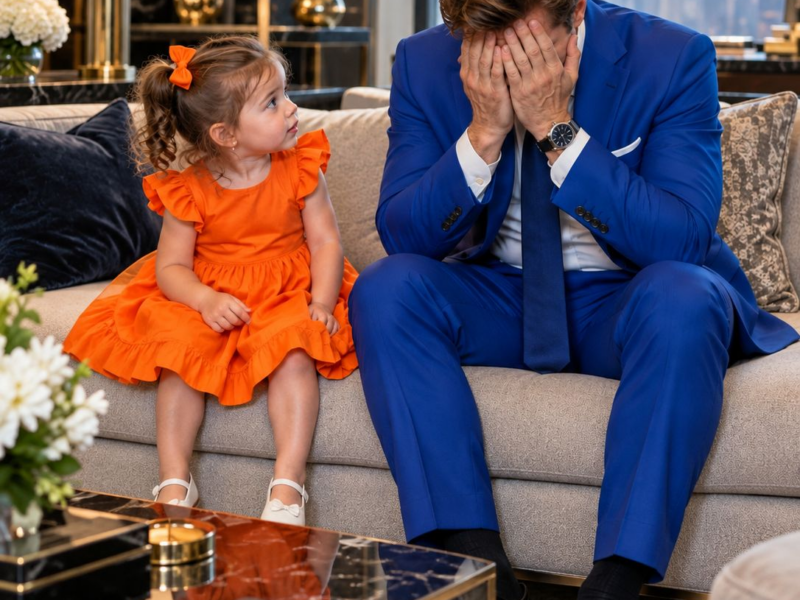
The Billionaire Tried to Hide His Face—But the Maid’s Toddler Noticed Immediately
He covered his face so nobody would see him cry.
The maid’s toddler said the name of the daughter he had buried three years earlier.
Then her dress slipped from one shoulder, and Julian Cross saw the mark he had spent thirty-two months trying to forget.
“Mister?”
Julian did not move.
His elbows rested on his knees in the private study of his Manhattan penthouse, both hands pressed over his face hard enough to leave red marks around his temples. Outside the fifty-second-floor windows, September rain slid down the glass in silver lines, turning the city below into a blur of headlights and wet roofs.
He had been alone.
He had made certain of it.
His assistant had been sent downstairs. The breakfast tray remained untouched. His phone lay facedown beside a cup of coffee that had gone cold forty minutes earlier.
Then a child spoke from three feet away.
“Mister, why you hiding?”
Julian slowly lowered his hands.
The little girl stood beside the gray sofa in an orange cotton dress and white sneakers with one loose strap.
Three years old, perhaps.
Dark curls.
Large brown eyes.
No fear.
That was the first impossible thing.
Most adults changed when Julian Cross looked directly at them. Lawyers straightened. Bankers softened bad news. Employees remembered urgent reasons to stand farther away.
This child simply tilted her head.
“Are you sad?”
Julian’s throat tightened.
“No.”
She studied the wetness around his eyes.
“My mama says people say no when they mean yes.”
Despite himself, Julian almost laughed.
Almost.
Then the girl climbed onto the edge of the sofa as if the private office of a billionaire who terrified half of Wall Street belonged to her.
“You miss somebody?”
His fingers curled.
“Who are you?”
“Ivy.”
“Where is your mother?”
“Working.”
Julian closed his eyes for one second.
Of course.
Staff.
A child was forbidden in the private residence during working hours. Everyone knew it. Especially today.
September fourteenth.
The anniversary.
He should have called security.
Instead he said, “You need to go find your mother.”
Ivy did not move.
“Mama says Lily watches me.”
Julian stopped breathing.
The rain kept moving down the windows.
A taxi horn sounded somewhere fifty floors below.
Inside the study, nothing moved.
“What did you say?”
Ivy blinked.
“Lily.”
Julian’s hands slowly left his knees.
“Say it again.”
“Lily.”
His voice cracked.
“Who is Lily?”
The little girl smiled as if the answer were obvious.
“My angel.”
Julian stared.
Ivy pointed upward.
“Mama says she watches when I sleep.”
Thirty-two months earlier, Julian had stood beside an empty white casket while a priest spoke words he could no longer remember.
His wife, Elena, had been in the grave beside it.
Their daughter had not.
Lily Cross had been five months old when Elena’s car went through a guardrail during a storm in the Hudson Valley.
Elena’s body was recovered two days later.
The infant car seat was found cracked and empty among branches downstream.
Lily was never found.
For eleven days, Julian paid for divers, boats, thermal searches, volunteers, dogs, helicopters, and every private team money could place beside that river.
Eventually the county sheriff had stood in front of him beneath a gray sky and said the sentence Julian still heard in dreams.
“We have to consider the current.”
Consider the current.
A polite way of saying the river had taken his daughter somewhere no father could follow.
Julian looked at Ivy.
“Who told your mother that name?”
The toddler frowned.
“Mama.”
“I understand that.”
His voice sharpened without meaning to.
“Where did your mother hear it?”
Ivy’s face changed.
Her lower lip moved.
Julian immediately hated himself.
He softened his tone.
“I’m sorry.”
She rubbed one sneaker against the carpet.
“You mad.”
“No.”
“You look mad.”
“I’m not mad at you.”
That seemed acceptable.
Then Ivy reached inside the collar of her dress.
Something pale yellow appeared between her fingers.
Fabric.
A narrow strip, old enough that its edges had softened.
She held it out.
“My Lily.”
Julian saw gold thread.
Five letters.
L-I-L-Y.
He stood so fast the coffee cup rattled against its saucer.
Ivy stepped backward.
Julian stopped himself.
Not yet.
His body wanted to cross the room, take the fabric, turn the child toward the light, demand answers from a three-year-old who had none.
Instead he stayed where he was.
“May I see that?”
Ivy looked suspicious.
“Give back?”
“Yes.”
“Promise?”
Julian swallowed.
“I promise.”
She approached.
Placed the fabric in his palm.
The world narrowed to six inches of yellow cotton.
Elena had sewn Lily’s name into three blankets before the baby was born.
Not because they needed labels.
Because pregnancy had made her sentimental.
Julian remembered teasing her.
“She cannot read.”
“She’ll grow.”
“She’s currently the size of a grapefruit.”
“You’re emotionally defective.”
“Probably.”
Elena had laughed.
He had forgotten the exact sound until that moment.
His thumb traced the L.
Same thread.
Same imperfect curve.
His hands began shaking.
The study door opened.
“Oh my God.”
A woman rushed in wearing a housekeeping uniform beneath a dark cardigan.
Marisol Reyes.
Julian knew the name.
Six months on staff.
Reliable.
Quiet.
One of the live-in employees assigned to the residence floors.
She crossed the room and scooped Ivy into her arms.
“Baby, what did I tell you?”
Ivy pointed at Julian.
“Sad man.”
Marisol’s face lost color.
“Mr. Cross, I am so sorry.”
She tightened one arm around the child.
“My sitter was taken to the hospital this morning. Ms. Whitfield said I could keep Ivy in the staff kitchen until my sister got off work. I turned around for maybe a minute and—”
“Where did you get this?”
Marisol stopped.
Julian held up the fabric.
Ivy reached for it immediately.
“My Lily.”
Marisol stared at the strip.
Then at Julian.
For the first time, he saw something beyond embarrassment in her expression.
Fear.
“It belongs to Ivy.”
“Where did it come from?”
Marisol’s arms tightened.
“I don’t know.”
Julian’s jaw hardened.
She saw it.
“I mean that literally.”
Her voice steadied.
“I don’t know.”
“How can you not know where your daughter’s blanket came from?”
Marisol looked toward Ivy.
Then back at him.
“She’s adopted.”
The word struck harder than it should have.
Julian did not move.
Marisol continued carefully.
“I fostered her first.”
“For eight months.”
“The adoption was finalized a year and a half ago.”
Julian’s heartbeat became loud enough to feel behind his eyes.
“How old was she when she entered care?”
“About seven months.”
His fingers tightened around the fabric.
“Where?”
Marisol hesitated.
Old caution entered her face.
Julian knew that expression too.
People calculating what his money could do to them.
He hated it.
“Ms. Reyes.”
“Before I answer anything else, I need to know why.”
Fair.
Julian forced his voice level.
“My daughter’s name was Lily.”
Marisol went still.
“She died three years ago.”
Ivy looked between them.
Julian corrected himself.
“She was presumed dead.”
The distinction hurt.
Marisol slowly lowered herself onto the sofa with Ivy still against her chest.
“I didn’t know.”
“No.”
He looked at the strip.
“I don’t imagine you did.”
“The blanket came with her.”
Marisol spoke slowly now.
“When the foster agency brought her to me, she had almost nothing.”
“Two onesies.”
“A bottle.”
“That yellow blanket.”
“There was no label from a family. Only the name stitched into one edge.”
“Lily.”
“Yes.”
“Why is she called Ivy?”
Marisol glanced at the child.
“Because by the time she was placed with me, county records had already assigned her another temporary name.”
“I didn’t want to keep a name that might belong to someone else’s missing child without knowing.”
“That sounds strange now.”
“No.”
Julian’s voice came too quickly.
“It doesn’t.”
Marisol studied him.
“I kept Lily as a bedtime story.”
“I told her maybe Lily was an angel who had sent the blanket.”
“She liked that.”
“I eventually cut off a small strip because the blanket was falling apart and she panicked whenever I washed it.”
“She wears the strip sometimes.”
Julian looked at Ivy.
The toddler was tracing circles on Marisol’s cardigan with one finger.
“Where was she found?”
Marisol’s eyes sharpened.
“That is sealed information.”
“I’m asking what you were told.”
She remained silent.
Julian stood very still.
Then he saw it.
Ivy’s dress had shifted where Marisol had lifted her.
Just beneath the left collarbone was a tiny pale-gold mark shaped almost like a five-pointed star.
Julian gripped the back of a chair.
Elena had called Lily’s birthmark her little star.
The pediatrician had said it would probably fade with age.
Julian had kissed it every morning during the five months he had known his daughter.
Marisol saw his face.
“What?”
Julian could barely speak.
“That mark.”
Marisol looked down.
“This?”
“How long has she had it?”
“Always.”
Julian closed his eyes.
Not proof.
He knew that.
A name could repeat.
A blanket could travel.
Birthmarks could resemble each other.
Hope was not evidence.
He had learned that beside a river.
He opened his eyes.
“I need to tell you something, and then I need you to decide what happens next.”
Marisol stood.
“Decide what?”
“Whether you let me ask any more questions.”
That surprised her.
Julian placed the strip of blanket on the coffee table instead of keeping it.
“You take that with you.”
Marisol picked it up immediately.
Good.
Julian continued.
“Lily was five months old when my wife’s car went through the guardrail on Route Nine near Millbrook.”
Marisol’s face changed.
“Millbrook?”
“Yes.”
She sat again.
Julian felt his pulse shift.
“Why?”
Marisol looked at Ivy.
Then whispered, “Because she was found outside Millbrook.”
Silence.
“A safe-surrender station attached to a firehouse.”
Julian’s knuckles whitened.
“When?”
Marisol swallowed.
“Four days after your accident.”
Julian looked away.
The study windows reflected a man he barely recognized.
For three years he had trained himself not to hope.
Hope was undisciplined.
Hope had made him stand beside that river long after the sheriff stopped looking him in the eye.
Hope had made every unidentified-child report feel like a blade.
Now it was back.
Small.
Orange dress.
Loose sneaker strap.
Sitting on his sofa.
He pressed one hand over his mouth.
Ivy watched.
“You hiding face again.”
The words hit him harder than anything else.
He lowered his hand.
“No.”
“Good.”
Marisol’s eyes filled.
Not because she believed him.
Because she understood something had begun that neither of them could undo.
“I need a lawyer.”
She said it quietly.
Julian nodded.
“Yes.”
Her expression changed.
“You’re not offended?”
“No.”
“I mean my own lawyer.”
“Yes.”
“One you don’t choose.”
“Yes.”
“One you don’t pay.”
Julian paused.
“That may be difficult if cost becomes an issue.”
Marisol’s eyes hardened.
“Then it becomes difficult.”
He nodded.
“Fair.”
She stood.
“I’m taking Ivy home.”
Julian’s body reacted before his mind.
Every instinct screamed no.
Lock the elevator.
Put security at the door.
Do not let the child who might be Lily disappear into Manhattan.
He did none of those things.
“Okay.”
Marisol seemed almost disappointed by how quickly he agreed.
“You’re not going to stop us?”
“No.”
“You believe she might be your daughter.”
“Yes.”
“And you’re letting me leave.”
Julian looked at Ivy.
“She does not know me.”
His voice became rough.
“She knows you.”
“That matters more tonight.”
Marisol’s face softened by one degree.
Julian added, “Please give my assistant a number where your attorney can contact mine.”
“I’ll do it tomorrow.”
“Fine.”
“And Mr. Cross?”
“Yes?”
“If this turns out to be a coincidence, you do not get to punish me for it.”
The sentence hurt because he understood exactly why she needed to say it.
“I won’t.”
“And if it isn’t…”
Her voice weakened.
Julian waited.
Marisol looked down at Ivy.
“If it isn’t, she is still my daughter.”
Julian’s throat closed.
“I know.”
“No.”
Marisol looked directly at him.
“You know words.”
“You do not know what I mean yet.”
Then she carried Ivy out.
The elevator doors closed.
Julian remained in the hallway long after the numbers descended.
Diane Mercer found him there twenty minutes later.
She had been his executive assistant for twelve years and one of the few people who could say his first name without requesting permission.
She looked at his face.
“What happened?”
Julian said, “I may have found Lily.”
Diane’s hand dropped from the folder she was carrying.
The folder hit the floor.
Neither of them bent to pick it up.
“What?”
He told her.
The name.
The blanket.
The birthmark.
Millbrook.
Diane listened without interruption.
When he finished, she closed her eyes.
Then opened them.
“You are not calling Thomas yet.”
Julian frowned.
“Thomas is an investigator.”
“Exactly.”
“We need facts.”
“We need consent.”
He stared.
Diane stepped closer.
“You are Julian Cross.”
“You can make sealed things become unsealed simply by making enough people nervous.”
“That does not mean you should.”
His jaw tightened.
“I am not going to sit here while—”
“She told you she was getting a lawyer.”
“Yes.”
“Then wait.”
Every cell in his body hated that word.
Diane saw it.
“That little girl has already had one life built around adults making decisions for her.”
“Do not make the second one about how fast you can buy answers.”
Julian looked toward the closed elevator.
Then said, “Call Thomas.”
Diane’s eyes narrowed.
“To tell him to stand by.”
She waited.
“No sealed records.”
“No contact with Marisol.”
“No surveillance.”
Diane picked up her folder.
“Now you sound almost house-trained.”
Julian glared.
She walked away.
The next morning Marisol called from the office of Asha Patel, a family-law attorney in Queens.
Asha spoke first.
“Mr. Cross.”
“Yes.”
“I represent Marisol Reyes.”
“I understand.”
“No one from your office, company, security staff, investigative contractors, or family representatives is to contact Ms. Reyes’s employer records, adoption agency, pediatrician, childcare provider, or apartment management without written consent or legal process.”
Julian sat back.
“Agreed.”
A pause.
Asha had probably expected resistance.
She continued.
“Ms. Reyes is willing to share the limited records she lawfully possesses.”
“Placement date.”
“Approximate age at surrender.”
“Hospital intake summary.”
“She is also willing to allow the yellow blanket fragment to be examined by an independent textile conservator for comparison with photographs or remaining materials belonging to your family.”
Julian’s pulse changed.
“And DNA?”
Another pause.
“Not yet.”
His fingers tightened around the desk.
Asha continued before he could object.
“You have several circumstantial similarities.”
“None justify putting a three-year-old through genetic testing before my client understands the legal consequences.”
“It’s a cheek swab.”
“It is not the swab I’m concerned about.”
Julian leaned back.
Point taken.
Asha added, “First, you give us proof of your daughter’s age, identifying medical information that predates the accident, and details about the crash that are not public.”
“Then we decide.”
Julian almost said he did not need permission to prove his child was alive.
The sentence formed.
Then died.
He remembered Marisol:
You know words. You do not know what I mean yet.
“Fine.”
The first evidence arrived that afternoon.
Lily’s pediatric records showed the star-shaped café-au-lait mark beneath her left collarbone.
The hospital footprint card recorded a slight curvature of the smallest toe on her right foot from intrauterine positioning.
Julian stared at that detail.
He had forgotten it.
Elena used to kiss that tiny crooked toe and call it Lily’s comma.
He sent the documents.
Two hours later, Asha called.
Marisol had checked Ivy’s foot.
The toe curved inward.
Still not proof.
But the space available for coincidence was shrinking.
The independent conservator compared the blanket strip to a second strip from one of Lily’s old nursery quilts still preserved in a box at Cross Tower.
Same fabric manufacturer.
Same discontinued dye lot.
Same metallic embroidery thread.
The stitch pattern appeared hand-made and consistent with photographs of Elena’s blankets.
Still not proof.
The next step required the safe-surrender record.
Asha petitioned the family court herself.
Julian’s lawyers did not file.
That mattered to Marisol.
The court granted a limited unsealing after reviewing the circumstances and appointing an independent attorney for Ivy.
The infant had been surrendered at 4:07 a.m. on September eighteenth.
Estimated age: four to six months.
Body temperature low.
Skin and clothing showed signs of prolonged exposure to cold water and mud.
The firehouse sat six miles downstream from the crash site.
Julian read the report once.
Then again.
On the third time, the words blurred.
Diane stood across from his desk.
“Julian.”
He covered his face.
Not crying.
Not yet.
“Four days.”
His voice broke.
“She was alive for four days while I was searching the river.”
Diane said nothing.
“She was six miles away.”
“You didn’t know.”
“I had helicopters.”
“I had divers.”
“I had people walking every riverbank.”
“And my daughter was in a firehouse.”
“You did not know.”
He looked up.
“What kind of father misses six miles?”
Diane’s face hardened.
“The kind who was given the wrong map.”
That sentence stayed with him.
The first truly dangerous thing happened two days later.
Marisol noticed the gray sedan three times.
Outside her apartment.
Near the grocery store.
Across from the little park where she took Ivy after lunch.
She did not call Julian.
She called Asha.
Asha told her to document it and notify police.
Marisol photographed the plate.
It came back to a rental company.
No crime.
No direct threat.
Still, the detective assigned after Asha explained the emerging paternity issue advised Marisol to vary routines and report any contact.
Julian learned about the sedan through the attorney channel.
His immediate response was exactly what Marisol feared.
He hired two additional private-security teams.
Then stopped before deploying them.
He called her.
“Someone is following you.”
Marisol went quiet.
“You know.”
“My attorney told yours.”
“Yes.”
“What are you planning?”
“A car.”
“No.”
“Marisol.”
“No.”
“Unmarked.”
“I said no.”
Julian stood at his office window.
“There may be an actual threat.”
“Then tell the police what you know.”
“I am.”
“Good.”
“And I want someone watching your building.”
“No.”
His jaw tightened.
“Why are you fighting me on this?”
“Because you still think fear turns your preferences into authority.”
The sentence hit him.
He said nothing.
Marisol continued.
“If police recommend protection, we discuss it.”
“If my lawyer recommends it, we discuss it.”
“You do not decide my daughter and I suddenly live inside your security system because you are scared.”
Julian looked at the city.
His reflection in the glass looked very much like his father.
That frightened him more than the sedan.
“Okay.”
Marisol went quiet.
“You mean that?”
“No.”
He answered honestly.
“I hate it.”
“But yes.”
That evening he called Thomas Reyes.
Thomas had done discreet due diligence for Cross Dynamics for years.
A former financial-crimes investigator with a permanent coffee stain on one cuff, he was irritatingly calm around very rich people.
Julian placed the sedan plate in front of him.
“Public records only.”
Thomas raised one eyebrow.
“Someone taught you manners.”
“Work.”
Thomas traced the rental through ordinary channels.
The account paying for it belonged to a shell company called Westbridge Advisory.
Westbridge had no employees.
Its registered agent represented several entities connected to the Ashworth Trust.
Julian stared at the report.
The Ashworth Trust owned sixty percent of the voting shares in Cross Dynamics.
It had been created by Elena’s grandfather.
Julian served as one trustee.
The second was Marcus Doyle.
Elena’s cousin.
Julian’s closest friend.
The man who had stood beside him at Elena’s funeral.
The man who had run Cross Dynamics for six months when Julian could barely walk through a board meeting.
Thomas tapped the page.
“This does not mean Marcus is following the child.”
“His trust uses the same registered agent.”
“I know.”
“Then why are you looking at me like that?”
“Because you are about to accuse the man who kept your company alive based on a corporate-service address.”
Julian leaned back.
“Find more.”
Thomas nodded.
“Now we’re working.”
Marcus came to Cross Tower the next morning.
He hugged Julian.
That was normal for Marcus.
Julian nearly flinched.
“You look like hell.”
Marcus set a leather folio on the desk.
“Foundation dinner tonight.”
“Diane says you finally agreed to attend.”
“I haven’t.”
Marcus smiled.
“Elena built that foundation.”
“Eventually you have to stop treating her memorial work like a hostage situation.”
Ordinarily, Julian would have resented the sentence.
Today he studied him.
Fifty.
Expensive navy suit.
Gold cuff links.
The calm face of a man Julian had trusted with his company, voting control, and grief.
Marcus noticed.
“What?”
“Nothing.”
“You’re staring.”
Julian looked away.
“I’ve been distracted.”
“I heard.”
His pulse changed.
“From whom?”
Marcus did not miss the trap.
He leaned back.
“The building talks.”
“A housekeeper brought a child upstairs.”
“You asked for old accident records.”
“People notice.”
Julian’s expression cooled.
“Which people?”
“Julian.”
Marcus sighed.
“You think I’m spying on you?”
“I asked a question.”
“I am answering the question beneath it.”
He lowered his voice.
“I know you.”
“I know what September does to you.”
“If some child triggered something—”
“Her name is Ivy.”
Marcus paused.
Too small to prove anything.
Large enough to remember.
“Ivy.”
“Yes.”
Marcus nodded.
“Then Ivy.”
He opened the folio.
“Trust review next month.”
“You need to sign the updated succession schedule.”
Julian’s eyes moved to the page.
The Ashworth Trust had an old, ugly provision.
If Elena died without a living direct descendant, her family branch’s voting proxy consolidated temporarily under the surviving family trustees until a future distribution.
For three years, Marcus had effectively controlled a larger share of the trust because Lily was legally presumed dead.
If Lily lived, that control changed.
Not the fortune.
Not overnight.
But power.
Board seats.
Voting proxies.
Management authority.
Julian looked at Marcus.
“How much control do you lose if Lily is alive?”
Silence.
Marcus’s face changed.
Only for a second.
Then:
“What did you just say?”
Julian heard his own heartbeat.
“I asked a hypothetical.”
“No.”
Marcus closed the folio.
“You said her name.”
Julian held his gaze.
Marcus stood.
“Julian.”
His voice became careful.
“What has happened?”
“Nothing proven.”
“Tell me.”
For three years, Julian had told Marcus almost everything.
Today he said, “Not yet.”
Marcus stared.
Then nodded slowly.
“Fine.”
He left.
Ten minutes later, Thomas called.
“I found another layer.”
Julian closed the door.
“What?”
“Westbridge Advisory paid the gray-sedan rental.”
“Westbridge’s bank is not public.”
“But its commercial insurance filing lists a controlling manager.”
“Who?”
“Doyle Family Office.”
Julian sat.
For the first time, Marcus’s name existed on paper beside the surveillance.
Not proof of an abduction plot.
Not proof of the crash.
Proof that someone inside Marcus’s family office had paid for the car following Marisol.
Julian felt physically cold.
“Get this to Asha Patel and the detective.”
“You sure?”
“Yes.”
“No private confrontation.”
Thomas almost smiled.
“Diane really has been working on you.”
The attempted abduction happened before anyone could ask Marcus for an explanation.
Saturday afternoon.
A public park four blocks from Cross Tower.
Marisol had avoided it for a week.
Ivy begged.
“Slide.”
“Later.”
“Slide now.”
By the third repetition, Marisol gave in.
The detective had told her public places with cameras and crowds were preferable to isolated routines.
So they went.
Children screamed around plastic climbing structures.
Dogs pulled at leashes.
A food cart smelled like burned onions and pretzels.
Marisol sat six feet from the slide.
She watched Ivy climb.
Orange dress.
White sneakers.
Her phone buzzed.
A text from Asha.
CALL ME WHEN FREE.
Marisol looked down for three seconds.
Maybe four.
When she looked up, Ivy was gone.
Her body knew before her mind.
She stood.
“Ivy?”
No answer.
Her eyes moved.
Slide.
Swings.
Sandbox.
Then gray.
The coat.
The same gray coat from the bus stop.
A man walked quickly toward the east gate.
Ivy was in his arms.
One hand covered her mouth.
Marisol screamed.
Not words at first.
Then:
“He has my daughter!”
People turned.
The man moved faster.
Marisol ran.
A stroller blocked her.
She hit it with her hip.
Nearly fell.
“Stop him!”
The gray-coated man reached the curb.
A black sedan waited.
Then another man stepped directly into his path.
Not Julian.
That mattered.
It was Officer Lena Morales, off duty, pushing her nephew’s stroller twenty yards away.
She had heard Marisol.
She pulled her badge and shouted.
The man dropped Ivy.
Not onto pavement.
Into the grass.
Then ran.
Marisol reached Ivy first.
The child screamed.
Alive.
Angry.
Terrified.
Marisol fell to her knees and held her.
Officer Morales chased only far enough to get direction and description before returning.
“Do not run after him.”
She shouted at three bystanders preparing to do exactly that.
Police arrived within minutes.
The sedan was abandoned.
Inside they found gloves.
A prepaid phone.
Printed photographs of Marisol’s building.
Cross Tower.
The park.
Ivy.
No weapons.
No dramatic arsenal.
Just preparation.
That was worse.
Julian arrived twelve minutes after the first police car.
He stopped thirty feet away.
Marisol sat on the curb with Ivy wrapped around her body.
The instinct to run to them almost overpowered him.
He forced himself to wait until Marisol looked up.
She saw him.
For one second he expected anger.
Instead she extended one hand.
Julian crossed the distance.
He crouched.
Ivy looked at him through tears.
“Mister.”
“Yes.”
“Bad man.”
His jaw tightened.
“Yes.”
Marisol saw it.
“Do not make that face.”
“What face?”
“The one where you decide this is now yours to solve.”
He looked at her.
Her hair stuck to her cheeks.
Her hands shook.
She was terrified.
Still setting boundaries.
Julian lowered his voice.
“Okay.”
Police took the burner phone.
They did not hand it to Thomas.
They did not hand it to Julian.
That boundary mattered too.
The records obtained under warrant traced several calls to Westbridge Advisory.
One went directly to an executive assistant in Marcus Doyle’s family office.
The assistant denied knowledge.
Then asked for counsel.
By evening, Marcus had three lawyers.
Julian had none in the room when Marcus finally called.
“You think I ordered this.”
Julian stood in the dark study.
“I think your company paid for the car.”
“Westbridge handles dozens of security expenses.”
“Why was one of them following Marisol?”
“I don’t know.”
“Why did the man using it try to take Ivy?”
“I don’t know.”
“You are running out of useful answers.”
Marcus’s voice hardened.
“And you are letting grief decide guilt.”
Julian stared at the yellow blanket strip inside a clear archival sleeve on his desk.
“No.”
“Evidence came first.”
Silence.
Then Marcus said, “Is she Lily?”
Julian did not answer.
Marcus exhaled.
“That silence is an answer.”
The DNA test happened on Monday.
Not in a Cross-owned clinic.
Not through Cross Dynamics.
Asha selected an independent accredited laboratory in New Jersey.
An attorney for Ivy observed chain of custody.
Marisol provided written consent.
Julian sat across the waiting room while Ivy colored a whale purple.
She looked at him.
“You sad?”
“Tired.”
“You hide face?”
“Not today.”
“Good.”
The technician swabbed Ivy’s cheek.
Then Julian’s.
That was all.
Something capable of rearranging three lives took less than five minutes.
Forty-eight hours later, Julian was in a board meeting when Asha called.
He left without explanation.
Marisol was already on the line.
Asha spoke carefully.
“The laboratory reports a greater than 99.99 percent probability of biological paternity.”
No one spoke.
Julian sat down.
The leather chair made a small sound beneath him.
He stared at his own hand.
“Say it.”
Marisol whispered.
Asha’s voice softened.
“Ivy is biologically Julian Cross’s daughter.”
Julian covered his face.
Three years.
River.
Empty casket.
News reports.
A nursery locked behind glass and code.
Thirty-two birthdays measured in months he had never witnessed.
First word.
First steps.
Fevers.
Nightmares.
All of it had happened six miles, then forty miles, then finally fifteen floors away.
He made a sound he would later deny.
Half laugh.
Half sob.
On the other end of the call, Marisol cried silently.
Different grief.
Julian heard it.
He lowered his hands.
“Marisol.”
“What?”
“I’m not filing anything today.”
Silence.
“I’m not challenging the adoption.”
Another silence.
“You don’t know what your lawyers will tell you.”
“I know what I’m telling you.”
She inhaled.
“Julian.”
It was the first time she had used his name.
“I am her mother.”
“Yes.”
“And you are her father.”
His eyes closed.
“Yes.”
“I don’t know how both things fit.”
“Neither do I.”
She cried then.
Audibly.
Julian did not try to fix it.
That was new.
Asha spoke after a moment.
“The child’s adoption remains legally valid.”
“Biology does not erase Marisol’s status.”
“Any change to legal parentage or contact will involve the court, Ivy’s independent counsel, and everyone’s consent where legally possible.”
Julian nodded though no one could see.
“Good.”
Marisol gave a broken laugh.
“You say that like contracts calm you.”
“They do.”
“Of course they do.”
For one second, both of them almost smiled.
Then Asha’s tone changed.
“There is another issue.”
Julian straightened.
“What?”
“The detective has asked us not to discuss the DNA result outside this group.”
“Why?”
“The burner-phone investigation.”
“They believe whoever arranged the park attempt may have been trying to prevent confirmation of Ivy’s identity.”
Julian’s grief cooled into something more precise.
Marcus.
Not proof yet.
But the line was shortening.
Thomas found the crash mechanic two days later.
Or rather, he found his estate.
Raymond Ortiz had died fourteen months after Elena’s crash from pancreatic cancer.
He had serviced Cross family vehicles through a subcontracted garage.
Police, now formally investigating the connection, obtained financial records with warrants.
One payment stood out.
Forty-eight thousand dollars.
Paid to Raymond through Westbridge Advisory six days before the crash.
Julian stared at the copy in Detective Morales’s office.
He wanted to leave.
Drive to Marcus.
Demand the truth.
Instead he said, “What does that prove?”
The detective looked at him.
“That someone at Westbridge paid your mechanic.”
“For what?”
“We don’t know yet.”
Good.
Not accusation before evidence.
Marisol sat beside Asha on the other side of the room.
Ivy was with her sister.
Julian continued.
“Anything from Ortiz?”
“Possibly.”
Raymond’s daughter, Sofia Ortiz, had turned over a sealed envelope found among his probate papers.
It was addressed:
IF THE CROSS CASE EVER OPENS AGAIN.
Inside was a signed statement.
Not notarized.
Not enough by itself.
But detailed.
Raymond wrote that he had accepted money from a man representing “M.D.” to create a brake failure on Julian Cross’s sedan.
He had been told Julian would be driving alone to the country house.
Raymond claimed he did not know Elena and Lily would take the car.
He followed the vehicle that night because guilt overwhelmed him.
He saw the sedan leave the road.
He climbed down toward the river.
He could not reach Elena.
He did find the infant car seat downstream, wedged against branches.
Lily was alive.
Cold.
Crying weakly.
Raymond wrote:
I knew if I called police, they would ask why I was there. I knew M.D. would know I had talked. I had a sick daughter and I was a coward twice in one night.
He drove Lily to the Millbrook fire station.
He left her in the safe-surrender box wrapped in the yellow blanket recovered from the car.
He did not remove her name.
Then he disappeared from the Cross service network.
Julian read the final paragraph twice.
I killed a woman because I needed money. I saved her baby because I could not become the kind of man who finished the job. Neither makes me good. If anyone finds this, tell Mr. Cross his daughter was alive when I left her. Tell him she cried the whole drive. I was grateful for every sound.
Julian put the pages down.
His hands shook.
Marisol looked at him.
“Do you want me to stay?”
The question surprised him.
“Yes.”
She stayed.
The next evidence arrived the same afternoon.
Westbridge Advisory’s controlling officer.
Marcus Doyle.
Not merely the family office.
Marcus himself had signing authority on the account that paid Raymond.
Then the burner phone from the park showed a call made forty minutes before the attempted abduction to a number registered under Westbridge’s corporate telecom package.
For the first time, the chain became more than suspicion.
Julian looked at Detective Morales.
“What happens now?”
“We follow it.”
“You don’t confront him.”
“I know.”
The detective almost smiled.
“Good.”
Julian’s mouth tightened.
“I am learning to disappoint everyone’s expectations of me.”
That evening, Marcus asked for a private meeting.
Julian refused.
Marcus appeared at Cross Tower anyway.
Security stopped him in the lobby.
For fifteen years, Marcus had possessed unrestricted access.
Julian revoked it that morning.
Marcus called from downstairs.
“This is humiliating.”
Julian stood in his office beside Diane.
“Probably.”
“You believe a dead mechanic over me.”
“I believe bank records.”
“Julian.”
Marcus’s voice cracked with anger.
“I held your company together while you spent a year barely speaking.”
“I know.”
“I sat beside you at Elena’s funeral.”
“I know.”
“I watched you bury an empty box.”
“I know.”
“Then why am I being treated like a stranger?”
Julian looked toward the framed photograph of Elena holding Lily.
“Because strangers get the benefit of not having betrayed me yet.”
Silence.
Marcus lowered his voice.
“You think I killed Elena.”
“I think money from an account you controlled paid the mechanic who tampered with my car.”
“You think I tried to take the child.”
“I think a phone used by the man who tried to take her called your office.”
“Then you have already convicted me.”
“No.”
Julian’s voice went flat.
“That is the difference between us.”
“I’m waiting for the whole file.”
Marcus hung up.
Two hours later, Cross Dynamics’ board received an emergency memorandum from Marcus’s attorneys.
It alleged Julian’s grief had impaired his judgment.
That he had become emotionally obsessed with a child whose legal identity remained unresolved.
That he had diverted corporate resources into private surveillance.
That his recent decisions created governance risk.
Marcus requested temporary activation of the Ashworth Trust’s emergency voting proxy until an independent mental-capacity review could occur.
Diane read the memorandum twice.
Then looked at Julian.
“He moved first.”
Julian almost smiled.
“Good.”
Diane stared.
“That is not the reaction I expected.”
“He put his motive on paper.”
She understood.
Marcus needed control.
Not only freedom.
Control before Lily’s existence restored a voting block that reduced his influence.
Julian called Nora Bennett, his personal corporate attorney.
She arrived forty minutes later carrying almonds.
She read the emergency filing.
Then Raymond’s statement.
Then the bank record.
Then burner-phone summary.
She ate one almond.
“Excellent.”
Diane looked at her.
“A child was almost abducted.”
“The facts are awful.”
“The documentation is excellent.”
Nora opened a legal pad.
“We are not committing crimes tonight.”
Julian rubbed his face.
“Nobody said we were.”
“You have the posture.”
Diane sat.
“What do we do?”
Nora looked at Julian.
“Nothing theatrical.”
“Good.”
“Tomorrow’s trust-board meeting proceeds.”
“You disclose the conflict.”
“You recuse yourself from any vote directly affecting your own authority.”
“Independent counsel presents the evidence.”
“Law enforcement handles the criminal side.”
Julian stared.
“That sounds unsatisfying.”
“Justice is frequently administrative.”
She pushed the almonds toward him.
“Eat.”
The trust meeting took place Friday morning.
No ballroom.
No cameras.
Eleven people around a walnut table on the thirty-first floor.
Marcus arrived with counsel.
Julian arrived with Nora.
An independent trust attorney chaired.
Two board members appeared by secure video.
Marcus looked composed.
That was his gift.
He could make outrage look like responsibility.
He began first.
“No one in this room doubts Julian has suffered more than most of us can imagine.”
Julian almost admired the sentence.
Marcus continued.
“But corporate governance cannot hinge on trauma.”
“A child has appeared.”
“A paternity test has been conducted outside established family-trust procedures.”
Julian’s fingers remained flat on the table.
Marcus looked at him.
“My cousin wants desperately to believe this child is Lily.”
“She is Lily.”
The room went still.
Marcus’s face barely changed.
Julian continued.
“The laboratory result has been independently verified and is available to the child’s counsel and appropriate court.”
Marcus’s attorney whispered something.
Marcus ignored him.
“Even if true, that does not answer whether you are presently capable—”
Nora slid a folder across the table.
“Read first.”
Marcus stopped.
Julian looked at him.
“Defend later.”
The phrase landed harder than shouting would have.
Folders opened.
Westbridge bank authorization.
Payment to Raymond Ortiz.
Raymond’s statement.
Rental-car funding.
Burner-phone records.
Marcus stopped turning pages.
His thumb rested beside the payment authorization.
No one moved.
The independent chair looked up.
“Mr. Doyle.”
Marcus’s face changed.
Not guilt.
Calculation.
“Raymond Ortiz extorted my family office.”
Nora said, “Then perhaps you can explain why Westbridge paid him before the crash rather than after.”
Marcus turned toward her.
“I am not answering accusations constructed from a dying man’s unsworn letter.”
“Good.”
Nora closed her own file.
“You can answer investigators.”
Marcus looked at Julian.
“You brought police into this family.”
Julian’s voice remained low.
“You brought a mechanic into mine.”
For the first time, Marcus lost control.
“You have no idea what your father was planning.”
The room changed.
Julian’s eyes narrowed.
“What does my father have to do with this?”
Marcus laughed bitterly.
“There.”
“The part nobody ever tells you.”
“Your father intended to strip the Doyle branch of voting authority.”
“Elena’s grandfather’s trust was a cage.”
“My family spent decades keeping Cross Dynamics alive while your branch inherited control.”
“Then Elena married you.”
“Then Lily was born.”
“The entire next generation of voting power disappeared into your household.”
Julian stared.
“So you tried to kill me.”
Marcus’s jaw tightened.
“I ordered the car disabled.”
Nora’s pen stopped.
Everyone in the room froze.
Marcus realized what he had said.
Too late.
His lawyer whispered, “Stop talking.”
Marcus looked at Julian.
“I was told you would be driving.”
Julian’s face became white.
“Elena took the car.”
“I did not know.”
“Lily was in the back seat.”
“I did not know.”
“But afterward?”
Marcus looked away.
Julian’s voice cracked.
“You knew they were missing.”
“Yes.”
“And when no child was found?”
Marcus said nothing.
“You did nothing.”
“I thought she was dead.”
“You hoped she was.”
Marcus slammed one palm against the table.
“I was trying to prevent one family from owning everything.”
Nora said quietly, “That would be an extraordinary statement to stop making.”
Marcus’s attorney touched his sleeve.
He pulled away.
“For three years, I ran this company while Julian mourned.”
“I made the decisions.”
“I saved jobs.”
“I stopped lenders from tearing through us.”
“And now one child appears and suddenly the whole structure belongs to him again.”
Julian stared at the man who had sat beside him through nightmares.
“You did help me.”
Marcus stopped.
Julian continued.
“You kept Cross Dynamics alive.”
“You took calls I could not take.”
“You stood beside me when I could not walk into Lily’s nursery.”
“All of that is true.”
Confusion moved across Marcus’s face.
Julian’s voice hardened.
“And none of it buys you forgiveness for trying to kill me.”
The conference-room door opened.
Detective Morales entered with two investigators.
Not dramatic.
No weapons drawn.
No shouting.
A warrant.
Marcus looked at Julian.
“You planned this.”
“No.”
Julian leaned back.
“I stopped planning everyone else’s consequences.”
“They did.”
Marcus was arrested on charges related initially to conspiracy, attempted kidnapping, obstruction, and financial crimes while the crash investigation continued.
Months later, prosecutors added charges connected to Elena’s death after Raymond’s payment records, phone metadata, Marcus’s own trust-meeting statement, and other evidence were corroborated.
There was no triumphant press conference from Julian.
No leaked photographs of Marcus in handcuffs.
Nora advised silence.
Julian agreed.
Marisol did not.
Not exactly.
When reporters discovered Ivy’s identity, cameras appeared outside her apartment.
One television truck parked across from Ivy’s preschool.
Marisol called Julian furious.
“This is what I was afraid of.”
“I know.”
“I cannot get her through the front door.”
“I’m fixing it.”
“No.”
He stopped.
Old reflex.
Same mistake.
“What do you want?”
Marisol breathed hard.
“I want the press away from her school.”
“I want her teachers to have one contact person.”
“I want no guards standing beside her classroom like she is a diplomat.”
“I want my apartment address kept out of court filings where legally possible.”
“And I want somebody to explain to me what happens when every stranger in America suddenly thinks they know my child.”
Julian sat.
“Okay.”
That was what he did.
Attorneys sought privacy protections.
The school handled security through normal school procedures.
Cross Dynamics issued one statement.
Julian Cross has learned that a child long believed lost survived the 2023 accident involving his late wife. The child is safe and has been raised by a loving legal parent. Mr. Cross will not discuss her medical history, address, school, adoption, or private family proceedings.
No photograph.
No dramatic reunion.
No phrase like miracle daughter.
Marisol read the statement twice.
Then called.
“You called me her parent.”
“You are.”
A pause.
“You didn’t call yourself her father.”
“I am.”
“Then why not say it?”
Julian looked toward Lily’s photograph.
“Because that statement was for people who wanted information.”
“Father is for her.”
Marisol said nothing for a long time.
Then:
“That was the right answer.”
Legal recovery took longer than the criminal case.
Julian could have challenged the adoption.
His attorneys explained several theories.
Fraud.
Mistaken identity.
Failure of notice caused by exceptional circumstances.
He listened.
Then said no.
His attorney frowned.
“You understand that maintaining the adoption means Ms. Reyes remains Ivy’s sole legal parent unless another arrangement is created.”
“Yes.”
“You may have biological standing but not automatic custodial rights.”
“Yes.”
“You are giving up leverage.”
Julian looked at her.
“That word is why we are not doing this.”
Marisol’s adoption remained untouched.
Instead they built something slower.
A court-appointed child specialist.
Therapy.
Short visits.
Then longer ones.
No overnights at first.
No sudden relocation to Cross Tower.
No changing Ivy’s name because adults were excited by biology.
Julian learned to call her Ivy.
That mattered.
The first time he slipped and called her Lily, she frowned.
“Ivy.”
He crouched.
“You’re right.”
“Lily angel.”
Julian’s eyes burned.
“Yes.”
“Lily me?”
He looked toward Marisol.
The therapist had told them not to build mythology.
Truth.
Simple.
Age appropriate.
Julian said, “Lily was the name Mommy Elena and I gave you when you were a baby.”
Ivy thought.
“And Ivy?”
“Your mom Marisol gave you that name when she became your mom.”
Ivy frowned harder.
“Both?”
“Yes.”
She considered.
Then announced:
“I have lots name.”
Marisol laughed.
Julian did too.
The legal record eventually added Lily as a middle name with Marisol’s consent.
Ivy Lily Reyes.
Not Cross.
Julian surprised everyone by agreeing.
His lawyer asked why.
He answered:
“Because a last name is not a receipt.”
He created a trust for Ivy.
Not controlled solely by him.
Marisol chose one independent trustee.
The court approved another.
Money existed for education, health, and future needs without becoming a tool Julian could use to negotiate access.
Nora called the arrangement “shockingly adult.”
Julian ignored her.
Cross Dynamics changed too.
Marcus’s betrayal exposed how concentrated power had become.
Julian resigned as chairman.
Stayed CEO temporarily.
Installed an independent board chair.
The Ashworth Trust’s emergency provisions were rewritten so no single family trustee could control voting proxies during a personal crisis.
Diane became chief operating officer.
At the announcement, she looked at Julian.
“You realize you are giving away power voluntarily.”
“Yes.”
“Are you ill?”
“Probably.”
She smiled.
Recovery did not turn Julian into a different species.
He still worked too late.
Still reread contracts three times.
Still disliked surprises.
The first time he arrived twenty-five minutes late to an Ivy visit, Marisol did not protect him.
Ivy sat on the apartment floor wearing pajamas.
“You said five.”
Julian crouched.
“I know.”
“Now dark.”
“I know.”
“Why?”
He almost said board meeting.
Traffic.
Investors.
Then stopped.
“Because I chose work too long.”
Marisol looked at him.
Ivy thought.
“Bad choice.”
“Yes.”
“You do again?”
“I will try not to.”
“That not promise.”
Julian stared.
Marisol covered a smile.
He corrected himself.
“I will call before I’m late.”
“And I will leave earlier.”
Ivy nodded.
“Okay.”
Later, after she slept, Julian stood in Marisol’s kitchen holding a glass of water.
“She terrifies me.”
“She should.”
“You enjoy this.”
“A little.”
He looked around the apartment.
Small kitchen.
Magnetic alphabet on the refrigerator.
Laundry basket beside the hallway.
A life Ivy understood.
Julian said, “I keep wanting to give you a bigger place.”
Marisol’s expression changed.
He held up one hand.
“I’m not offering.”
“Good.”
“I’m noticing the impulse.”
“That is progress.”
“I hate progress.”
“I’ve noticed.”
They became friends before anything else.
Not employer and employee.
Marisol resigned from Cross Tower after the identity became public.
“I cannot negotiate family boundaries while you sign my paycheck.”
Julian did not argue.
He gave her an ordinary reference.
No hidden bonus.
No apartment.
No secret debt payment.
She completed a hospitality-management certificate at night and became operations manager for a boutique hotel group.
Julian found out about the promotion from Ivy.
“Mommy boss now.”
Marisol groaned.
“I am not the boss.”
Ivy looked at Julian.
“She boss.”
Julian nodded.
“I believe you.”
Marisol pointed at him.
“Do not encourage this.”
“I would never.”
“You have a terrible face when you lie.”
Ivy immediately looked at him.
“Hide face.”
Julian froze.
The phrase still reached the oldest wound.
Then Ivy covered her own face with both hands.
“Like this.”
Julian laughed.
Not much.
Enough.
Marcus’s trial began eighteen months after his arrest.
Julian testified.
So did Raymond Ortiz’s daughter regarding the provenance of the confession.
Forensic accountants traced Westbridge payments.
Telecom analysts tied the park burner phone to Marcus’s office network.
The prosecution did not rely on one dramatic letter.
That mattered to Julian.
No single fragile object had to carry the weight of truth.
Documents agreed with each other.
People agreed with records.
Timeline agreed with money.
Marcus’s own recorded trust-board statements agreed with motive.
The jury convicted him on multiple counts, including conspiracy and charges tied to the crash and later attempted abduction.
Julian listened to the verdict without smiling.
Marcus looked at him once.
No hatred.
Something more tired.
Afterward, a reporter shouted:
“Mr. Cross, do you feel justice was done?”
Julian stopped.
For a second Diane looked worried he might answer badly.
He said:
“A verdict is not a resurrection.”
Then walked away.
That evening he went to Marisol’s apartment.
Ivy was making pancakes for dinner.
Technically Marisol was making them.
Ivy was manufacturing batter-related hazards.
She looked at Julian.
“Dad!”
The word stopped him.
She had never called him that before.
Not once.
Marisol stopped too.
Ivy kept stirring.
“What?”
Julian’s eyes filled.
She frowned.
“Why hiding face?”
He realized he had covered his mouth.
He lowered his hand.
“Nothing.”
“Sad?”
He looked at Marisol.
Then Ivy.
“No.”
“Happy?”
“Yes.”
Ivy considered.
“Happy cry weird.”
“It is.”
“Want pancake?”
“Very much.”
The pancake was burned on one side and raw in the middle.
Julian ate all of it.
No one commented.
Two years after the first day in his study, Julian returned to the river.
He had avoided it since the search ended.
Marisol came.
Ivy came.
No press.
No security visible except one officer in an unmarked car farther up the road because privacy and stupidity were not the same thing.
Autumn had turned the hills gold.
The river looked smaller than Julian remembered.
That offended him.
Something that had controlled three years of his life should have been enormous.
Ivy threw a yellow leaf into the current.
“Mommy Elena went here?”
Julian swallowed.
“Yes.”
“She die?”
“Yes.”
“Saving me?”
“We don’t know exactly what happened inside the car.”
He would not invent heroism because it hurt less.
“But she loved you.”
“I know that.”
Ivy watched the leaf move.
“Raymond save me.”
“Yes.”
“He bad man?”
Julian thought.
“He made a very bad choice.”
“Then a good one?”
“Yes.”
“Can people both?”
Marisol looked at Julian.
He answered.
“Yes.”
“That’s what makes people difficult.”
Ivy accepted this.
Children often accepted complexity faster than adults.
She took Julian’s hand.
Then Marisol’s.
They stood that way beside the river.
Not a replacement family.
Not a repaired version of the one that had been lost.
Something new that made room for the old.
Eventually Julian left Cross Dynamics as CEO.
Not because fatherhood magically made business meaningless.
Because the company finally had people capable of running it without requiring him to prove every day that he still could.
Diane became CEO.
At the board dinner, she raised a glass.
“To Julian.”
He looked suspicious.
“For finally discovering succession planning is not abandonment.”
Everyone laughed.
Julian did too.
He remained chairman of a smaller strategy committee.
Worked three days from the office.
Two from wherever made sense.
Sometimes that meant Cross Tower.
Sometimes a hotel lobby while Marisol finished a shift and Ivy did homework beside him.
Their relationship changed carefully.
Neither of them named it for a long time.
They had too much history that was not romantic.
Too much power imbalance to pretend did not matter.
Too much of Ivy’s identity already tied to adults making enormous choices.
So they did nothing for nearly three years.
Coffee.
Birthdays.
Therapy appointments.
Parent-teacher conferences.
Arguments about screen time.
Ordinary intimacy.
When Julian eventually asked Marisol to dinner without Ivy, he looked more nervous than he had before testifying against Marcus.
Marisol stared at him.
“You mean dinner dinner?”
“Yes.”
“As in a date?”
“Yes.”
“You rehearsed that?”
“Yes.”
She almost smiled.
“Then ask again without sounding like a merger.”
Julian inhaled.
“Would you like to have dinner with me because I like you, not because you are Ivy’s mother, not because you once worked for me, and not because I have confused gratitude with love?”
Marisol blinked.
“That was significantly worse.”
Julian closed his eyes.
She laughed.
Then touched his hand.
“Yes.”
They dated slowly.
Painfully slowly, according to Diane.
“Two glaciers have stronger forward guidance.”
Julian ignored her.
Ivy noticed immediately.
“You kiss Mommy?”
Julian nearly choked on coffee.
Marisol stared at her daughter.
“Where did that come from?”
“You look weird.”
Julian said, “Excellent observational skills.”
Marisol pointed at him.
“Not helping.”
They did not move in together until Ivy was seven.
By then she understood her story in layers.
Elena was her biological mother.
Julian was her biological father.
Marisol was her mother because love, law, breakfast, fevers, daycare forms, and three thousand ordinary nights had made that true long before DNA entered the room.
Raymond had done something terrible and then saved her.
Marcus had hurt their family and faced consequences.
No ghosts.
No fairy tale that required erasing anyone.
The yellow blanket strip remained in a small frame beside Ivy’s bed.
Lily stitched in gold.
Not angel.
Not secret.
History.
One winter morning, Julian sat at the kitchen island with his face buried in his hands.
Ivy came downstairs in pajamas.
Seven now.
Hair wild.
One sock.
She stopped.
The first morning came back so sharply he could almost smell the rain on Cross Tower’s windows.
“Mister?”
She sometimes called him that when teasing.
Julian kept his hands over his face.
“Yes?”
“Why hiding?”
He lowered them.
A plate sat in front of him.
Marisol had attempted sourdough pancakes.
They were terrible.
Julian had laughed until his eyes watered.
Ivy examined him.
“You cry.”
“I’m laughing.”
“Same wet.”
“Different reason.”
She climbed onto the stool beside him.
Marisol stood at the stove.
“Do not encourage him.”
“I am being supportive.”
“You told me the pancakes look like roofing material.”
“They do.”
Ivy copied Julian’s most severe expression.
Eyebrows lowered.
Mouth flat.
Marisol laughed.
Julian stared.
Ivy maintained the face.
Then said:
“Dad.”
“Yes?”
“You still look sad when you hide.”
He looked at her.
Morning light came through the kitchen windows.
The phone on the counter stayed silent.
Coffee remained warm.
Marisol turned another disastrous pancake.
Julian no longer lived on the fifty-second floor.
Cross Tower still existed.
His name still appeared on buildings.
But home was now a renovated brownstone in Brooklyn chosen because Ivy liked the tree outside and Marisol refused to live anywhere with an elevator that required staff.
Julian reached over and straightened Ivy’s missing sock.
“I used to hide because I thought if people saw what hurt, they could use it.”
Ivy frowned.
“Do you now?”
“Sometimes.”
“Why?”
“Habit.”
She nodded like a doctor considering a difficult patient.
“Bad habit.”
“Yes.”
“Stop.”
Julian smiled.
“I’m working on it.”
Ivy leaned against his arm.
Marisol placed another pancake in front of him.
He looked at it.
“This one appears legally actionable.”
“Eat.”
“Yes, ma’am.”
Ivy laughed.
Julian picked up his fork.
Years earlier, a toddler in an orange dress had found him with his face buried in his hands and asked the only question everyone else in his life had been too careful to ask.
Why are you sad?
He had spent three years believing that question would destroy him if he answered it.
Instead, answering it had led him to a blanket.
A firehouse record.
A DNA swab.
A payment trail.
A betrayal.
A daughter.
And eventually, a life where hiding his face was no longer the same thing as surviving.
Ivy took his coffee mug.
“Hey.”
She sniffed it.
“Bad.”
“It’s coffee.”
“Still bad.”
She gave it back.
Julian looked at Marisol.
Marisol looked at Ivy.
Nothing about the room resembled the life he had once considered successful.
Thank God.
He took another bite of the terrible pancake.
And when his daughter looked up to make sure he was still there, Julian did not hide his face.









