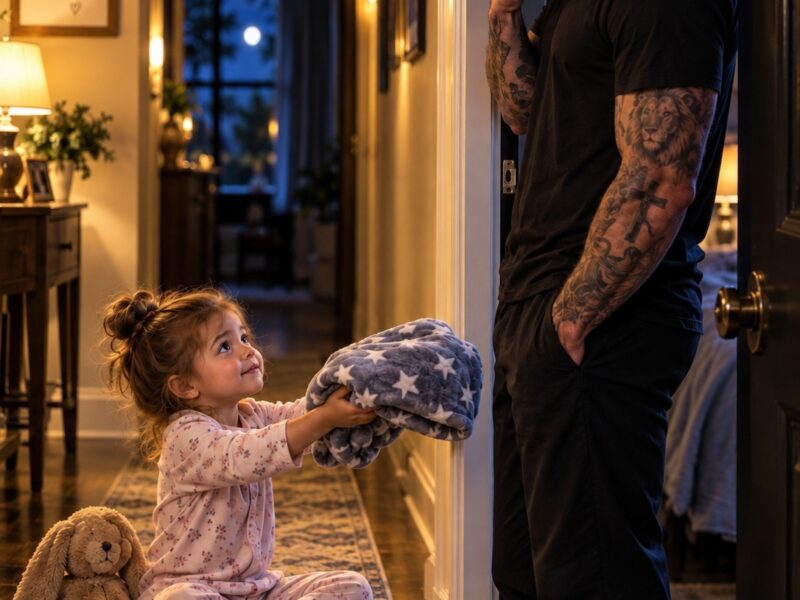
The first time the mafia boss found his housekeeper’s little girl outside his bedroom, she was holding a blanket covered in yellow stars.
She had waited in the dark because she believed the most feared man in Maine had nobody to keep him warm.
But when her mother saw what he was holding, the color drained from her face—and he realized the blanket had belonged to someone he thought was dead.
“Where did you get this?” Dominic Vale asked.
The little girl looked up from the hallway rug, her bare feet tucked beneath her pink pajamas. She couldn’t have been more than three. Her dark curls were tangled from sleep, and one small hand clutched the corner of the blanket as though she was afraid he might refuse it.
“It’s for you,” she said. “Mommy says you work too much.”
Dominic stood motionless outside his bedroom.
Behind him, the enormous house was silent except for rain tapping against the tall windows. It was almost eleven on a Thursday night in November, and he had just finished a meeting that would have frightened most men into leaving the state.
He was forty-two years old. Men twice his size lowered their voices when he entered a room. Judges, businessmen, and politicians knew his name, although few admitted knowing what his family actually did.
Yet a toddler sitting outside his bedroom had managed to stop him more completely than any enemy ever had.
“What’s your name, sweetheart?” he asked.
“Ellie.”
“Ellie,” he repeated carefully. “Why are you sitting here?”
She lifted the blanket higher.
“Because you’re lonely.”
Dominic’s expression changed.
Nobody in that house had ever dared call him lonely.
He glanced down the corridor, expecting a member of his security team to appear. The second floor was private. Staff members weren’t permitted upstairs after nine unless specifically requested, and children were never supposed to wander through the estate unattended.
But Ellie seemed completely unaware that she had broken half a dozen household rules.
“Who told you that?”
She considered the question with the seriousness only a small child could manage.
“Nobody.”
“Then how do you know?”
“Because nobody waits for you.”
The words landed somewhere Dominic had spent ten years making certain nothing could reach.
He looked at the blanket again.
It was old, washed soft, with yellow stars stitched across pale blue cotton. One corner had been repaired with a crooked line of white thread. Near the hem, a tiny crescent moon had been embroidered in silver.
Dominic knew that moon.
He had seen it before.
Not in this house.
Not in years.
His fingers closed around the fabric.
“Ellie,” he said, his voice suddenly quieter, “where did you get this blanket?”
Before she could answer, hurried footsteps sounded behind him.
“Ellie!”
A young woman appeared at the end of the corridor.
She wore a gray housekeeping uniform, her dark hair pulled into a loose knot. Her face was pale, and she was breathing hard, as though she had been searching the entire house.
“Ellie, sweetheart, I’ve been looking everywhere.”
She stopped when she saw Dominic.
For a moment, nobody moved.
Then her gaze dropped to the blanket in his hands.
Whatever relief she had felt at finding her daughter disappeared.
“Oh, God,” she whispered.
Dominic watched her closely.
“Miss Bennett.”
Clara Bennett had worked at the Vale estate for eight months. She was thirty-one, quiet, efficient, and unfailingly polite. She arrived at seven each morning, kept the west wing immaculate, and rarely spoke unless spoken to.
Until that night, Dominic knew almost nothing about her.
Now he noticed that she was staring at the blanket as if it were something dangerous.
“I’m terribly sorry, Mr. Vale,” Clara said quickly. “She must have slipped away while I was getting our coats. It won’t happen again.”
Ellie looked between them.
“Mommy, I gave him the stars.”
Clara’s lips parted.
Dominic lowered himself slowly onto one knee.
“Thank you, Ellie.”
The child smiled.
“Now you won’t be cold.”
He accepted the blanket.
Then he looked up at her mother.
“Where did this come from?”
Clara swallowed.
“It belongs to my daughter.”
“That isn’t what I asked.”
The silence stretched.
Rain struck the windows harder.
Finally, Clara said, “It belonged to her father.”
Dominic felt the blood drain from his face.
“Her father?”
Clara nodded.
“He died before she was born.”
Dominic looked down at the small silver moon.
His younger brother had stitched that exact symbol onto a blanket years earlier, when they were boys pretending they still had ordinary futures.
And his brother had been buried six years ago.
Dominic rose slowly.
“What was your husband’s name?”
Clara took a step backward.
“Please, Mr. Vale. My daughter is tired.”
“What was his name?”
Her eyes filled with tears.
For one terrible second, Dominic thought she might run.
Then Ellie spoke.
“Daddy’s name was Gabriel.”
The hallway seemed to tilt beneath Dominic’s feet.
Gabriel Vale.
His younger brother.
The man whose death had destroyed what remained of their family.
And the little girl standing in front of him had just spoken his name.
Six years earlier, Dominic had buried his brother beneath a gray November sky.
There had been no open casket. The funeral director had explained that the accident had left the remains unsuitable for viewing. Dominic remembered standing beside the polished mahogany coffin while the priest spoke about mercy and forgiveness, words that seemed obscene in a cemetery filled with men who had built their lives around neither.
Gabriel had been thirty.
He was the gentler of the Vale brothers, although gentleness was a dangerous quality in their family.
Their father, Vincent Vale, had controlled a network of illegal gambling operations, waterfront businesses, and protection arrangements stretching from Boston to the Canadian border. Dominic had inherited the organization when Vincent died. Gabriel had wanted no part of it.
“You know what I want?” Gabriel had asked one summer evening, sitting on the terrace with a beer balanced on his knee.
Dominic had been reviewing financial statements.
“A yacht?”
“A normal life.”
Dominic hadn’t looked up.
“Those are more expensive.”
Gabriel laughed.
“A little house. A wife who doesn’t care what our last name is. Kids who think their father sells furniture or fixes boats. Something boring.”
“You’d hate being bored.”
“I’d love being bored.”
Dominic remembered that conversation with painful clarity.
He remembered Gabriel’s easy smile, the scar above his left eyebrow, the way he had always leaned backward in his chair despite their mother’s repeated warnings.
Most of all, he remembered their final argument.
Gabriel had come to Dominic’s office carrying a folder. Inside were financial records showing irregular transfers from one of the family’s shipping companies.
“I think someone’s stealing from us,” Gabriel said.
Dominic barely glanced at the documents.
“Then give them to accounting.”
“This isn’t an accounting mistake.”
“Gabriel, I have a meeting in ten minutes.”
His brother had placed both palms on the desk.
“Dom, listen to me. Somebody’s using the company to move money we can’t account for. And the signatures—”
“Enough.”
Gabriel went quiet.
Dominic remembered looking up and seeing disappointment rather than anger.
“You’ve become exactly like Dad,” Gabriel said.
Those were the last words his brother ever spoke to him.
Two nights later, Gabriel’s car was found at the bottom of a ravine outside Portsmouth, New Hampshire.
The vehicle had burned.
The police ruled it an accident.
Dominic never believed it.
But believing something and proving it were different matters, especially when half the people offering to help investigate had reasons to conceal the truth.
His father’s oldest associate, Raymond Cross, had handled the funeral arrangements.
Raymond had also brought Dominic the news.
“There was nothing anyone could do,” he said.
Dominic had stood in his study staring at the rain.
For six years, he had carried those words like a stone inside his chest.
And now a little girl had appeared outside his bedroom holding a blanket that belonged to his dead brother.
“Take Ellie downstairs,” Dominic said.
Clara’s face tightened.
“Mr. Vale—”
“Please.”
The word surprised them both.
Dominic rarely said please.
He looked toward the staircase, where two security officers had appeared after hearing voices.
“Anthony, make sure Mrs. Bennett and her daughter get home safely. Nobody questions them. Nobody interferes with them.”
Anthony nodded.
Clara gathered Ellie into her arms.
The child reached toward Dominic.
“My blanket.”
He looked down.
“May I borrow it tonight?”
Ellie considered this.
“Only if you give it back.”
“I promise.”
She nodded solemnly.
“Good night, Mr. Dom.”
He watched them disappear down the staircase.
Then he turned toward Anthony.
“Find Marcus.”
“At this hour?”
“Now.”
Anthony saw his expression and stopped asking questions.
Dominic entered his bedroom, closed the door, and laid the blanket across his bed.
The room was enormous.
Floor-to-ceiling windows overlooked the dark Atlantic. A marble fireplace burned quietly beneath a painting worth more than most houses in Portland. His bed was covered in Egyptian cotton, and his closet held suits tailored in Milan.
Nothing in the room looked remotely lived in.
He sat on the edge of the mattress.
The blanket looked absurdly small against the expensive bedding.
He turned over the repaired corner.
There it was.
A tiny letter G embroidered beneath the silver moon.
Gabriel had always marked his belongings.
When they were children, their mother had taught him to sew because he kept losing his gloves, scarves, and school sweaters. Gabriel had taken the lesson seriously, stitching his initial onto everything he owned.
Dominic remembered teasing him.
“Are you planning to lose your entire bedroom?”
Gabriel had grinned.
“Maybe. Then somebody can mail it back.”
Dominic pressed his thumb against the crooked stitches.
For the first time in years, he allowed himself to remember his brother without immediately burying the memory beneath anger.
At midnight, Marcus Hale entered the study.
Marcus was fifty-eight, broad-shouldered, with silver hair and the patient expression of a man who had spent most of his adult life preventing powerful people from making catastrophic decisions.
He had served as Dominic’s attorney and adviser for nearly twenty years.
“You sounded concerned,” Marcus said.
Dominic placed the blanket on the desk.
Marcus stopped walking.
For several seconds, he stared.
“Where did you get that?”
“A child brought it to me.”
“What child?”
“Clara Bennett’s daughter.”
Marcus slowly approached the desk.
He touched the silver moon.
“Gabriel’s blanket.”
“You recognize it.”
“Your mother made it for him when he was sixteen. He kept it in his car during winter.”
Dominic’s jaw tightened.
“Exactly.”
Marcus looked up.
“Dom, what are you thinking?”
“That Gabriel had a family.”
“Gabriel never married.”
“Maybe not legally.”
Marcus remained silent.
Dominic leaned forward.
“Clara says the child’s father died before she was born.”
“How old is she?”
“Almost three.”
Marcus frowned.
“Then the dates don’t work.”
Dominic stared at him.
Gabriel had died six years earlier.
Ellie was three.
The realization should have ended the conversation.
Instead, it made the blanket more disturbing.
“Someone gave Clara that blanket,” Dominic said. “Someone who knew Gabriel. And Clara looked terrified when I recognized it.”
Marcus folded his arms.
“Then don’t frighten her further.”
Dominic gave him a hard look.
Marcus didn’t retreat.
“If she’s hiding something, there’s a reason. You don’t get answers by cornering a woman who’s afraid of losing her job and her child’s security.”
Dominic looked away.
He knew Marcus was right.
But that didn’t make the questions any easier to live with.
“Find out who Gabriel was seeing before he died,” Dominic said.
Marcus hesitated.
“Dominic.”
“What?”
“There’s something you should know.”
Dominic waited.
Marcus glanced toward the blanket.
“Three weeks before Gabriel’s accident, he came to see me.”
Dominic straightened.
“You never told me that.”
“He asked for legal advice.”
“About what?”
Marcus’s expression darkened.
“Leaving the family business.”
Dominic stared.
“He wanted to sever his financial interests, establish an independent business, and relocate,” Marcus continued.
“Where?”
“He wouldn’t say.”
“Why didn’t you tell me?”
“Because he asked me not to. And because after he died, I thought respecting that confidence was the last thing I could do for him.”
Dominic walked toward the window.
The Atlantic was invisible beyond the rain.
“Did he mention a woman?”
“Yes.”
“What woman?”
“He didn’t give me her name.”
“Then what did he say?”
Marcus looked at him for a long moment.
“He said he’d finally found someone who made him want to live long enough to become a better man.”
Dominic’s hands curled into fists.
His brother had been planning a future.
A future Dominic had never known existed.
And someone had taken it from him.
The next morning, Clara arrived at the estate twenty minutes early.
She had barely slept.
Ellie had spent most of the night asking whether Mr. Dom liked the stars, whether he had remembered to put the blanket on his bed, and whether he would be lonely again when she wasn’t there.
Clara answered patiently.
But every time her daughter mentioned the blanket, Clara felt the same cold pressure beneath her ribs.
She had made a mistake.
A terrible one.
She should never have brought the blanket to work.
She should never have allowed Ellie to see it.
And she certainly should never have let Dominic Vale touch it.
The house looked different in the morning.
Sunlight fell across the marble entrance hall. Fresh flowers stood in a silver vase beside the staircase, and the scent of coffee drifted from the kitchen.
Everything was orderly.
Everything was expensive.
Everything reminded Clara that she was a guest in a world where powerful men could change the direction of other people’s lives with a single telephone call.
She had taken the job because she needed stability.
After years of moving between small apartments, temporary positions, and relatives’ spare bedrooms, she wanted Ellie to grow up somewhere predictable.
The Vale estate paid well.
The staff housing was clean.
The work was demanding but honest.
Most importantly, Dominic had never shown the slightest interest in her personal life.
Until last night.
“Mrs. Bennett.”
Clara turned.
Dominic stood at the end of the corridor.
He wore dark trousers and a white shirt with the sleeves rolled to his forearms. Without his usual jacket, he looked less like the intimidating owner of the estate and more like a man who had been awake all night.
“Good morning, sir.”
“Could we speak?”
Her fingers tightened around the handle of her cleaning cart.
“Of course.”
He gestured toward the breakfast room.
Clara followed him reluctantly.
The room overlooked a garden where frost silvered the grass. Two cups of coffee waited on the table, along with a plate of untouched toast.
Dominic pulled out a chair.
Clara remained standing.
“Please sit.”
She sat.
He took the chair opposite her.
For a moment, neither spoke.
Then Dominic placed the folded blanket on the table.
Clara looked at it.
“Ellie was worried you wouldn’t give it back,” she said quietly.
“I told her I would.”
He pushed it toward her.
“I keep my promises.”
Clara touched the fabric but didn’t pick it up.
Dominic studied her.
“I’m not going to ask you questions about your private life unless you’re willing to answer them. But I need to ask one thing.”
Clara waited.
“Did you know my brother?”
The silence became unbearable.
Clara’s eyes filled immediately.
“You did,” Dominic said.
She lowered her gaze.
“Yes.”
“Were you close?”
“Very.”
Dominic looked at the blanket.
“Clara, I’m not angry.”
“You should be.”
“Why?”
She looked up.
“Because I lied to you.”
Dominic’s pulse quickened.
“About what?”
She took a shaky breath.
“My daughter’s father wasn’t Gabriel Vale.”
Dominic remained perfectly still.
“He was someone else.”
“Then why do you have Gabriel’s blanket?”
Clara wiped her cheek.
“Because Gabriel gave it to me.”
“When?”
“Six years ago.”
Dominic waited.
Clara looked toward the garden.
“He saved my life.”
Clara had met Gabriel Vale in a small diner outside Portsmouth.
She was twenty-five, working double shifts, and living with a man who had gradually turned her life into something she barely recognized.
His name was Daniel Mercer.
At first, Daniel had seemed charming.
He worked in private security, wore expensive watches, and spoke confidently about the future. He brought Clara flowers, remembered her favorite coffee, and made promises that sounded like plans.
Then he began controlling her money.
He questioned her friendships.
He checked her phone.
When she tried to leave, he threatened to destroy her reputation and make sure nobody would hire her.
Clara had believed him.
Daniel knew influential people.
He also knew how to make a threat sound like a reasonable prediction.
One rainy afternoon, Gabriel entered the diner.
He ordered coffee and apple pie.
Clara remembered him because he looked out of place in the worn vinyl booth, wearing a beautifully tailored coat while staring at the menu as though choosing dessert required serious consideration.
“You recommend the pie?” he asked.
“It’s yesterday’s.”
“That’s refreshingly honest.”
“The blueberry’s fresh.”
“Then blueberry it is.”
He came back the next day.
And the day after.
For weeks, he never asked for her number.
He simply talked to her.
About books.
About the weather.
About the old boats in the harbor.
About how much he hated wearing suits.
Eventually, Clara learned that his name was Gabriel.
She didn’t learn his last name until much later.
One evening, Daniel arrived at the diner and began arguing with her near the register.
Gabriel was sitting in his usual booth.
He didn’t raise his voice.
He didn’t threaten Daniel.
He simply stood and asked Clara whether she wanted him to call someone.
Daniel laughed.
“Mind your business.”
Gabriel looked at Clara.
“Do you want help?”
She remembered that question because nobody had asked her what she wanted in a very long time.
“Yes,” she whispered.
Gabriel called the diner manager over and stayed while Clara contacted a friend. He offered to help her find a lawyer, but he didn’t insist when she hesitated.
For the next month, he helped her move her belongings, arrange a new bank account, and find an apartment Daniel didn’t know about.
He never asked for anything in return.
Then, one evening, Clara invited him to dinner.
They ate spaghetti at a tiny kitchen table.
Gabriel washed the dishes.
When he left, he kissed her cheek.
And Clara realized she was falling in love.
What she hadn’t known was that Gabriel was already frightened.
He had discovered discrepancies in the financial records of Vale Maritime Holdings, the legitimate shipping company supporting much of the family’s wealth. Millions of dollars were moving between companies that existed only on paper, and several transactions carried authorizations that should have required Dominic’s personal approval.
Gabriel had initially suspected his older brother.
That suspicion had nearly destroyed him.
But the more he investigated, the clearer it became that someone had been using Dominic’s authority without his knowledge.
Clara remembered the night Gabriel finally told her.
They were sitting on the floor of her apartment because she hadn’t bought a couch yet. Rain tapped against the fire escape, and Gabriel had brought Chinese takeout in paper containers.
“My family isn’t what you think,” he said.
Clara looked at him.
“You sell boats?”
He smiled sadly.
“Sometimes.”
Then he told her enough to make her understand the danger, without asking her to carry details she couldn’t safely use.
Clara listened until the noodles went cold.
When he finished, she stood and walked toward the kitchen window.
“You lied about who you were.”
“Yes.”
“Were you ever going to tell me?”
“I was trying to become someone who could.”
She turned.
“That’s not an answer.”
“No,” Gabriel admitted. “It isn’t.”
Clara remembered his expression then. He looked ashamed in a way she’d never seen before.
“You should leave,” he said. “I won’t stop you.”
Instead, she sat down beside him.
“I need time.”
He nodded.
“You can have all of it.”
Three days later, Gabriel returned with the blanket.
It had been folded inside an old wooden trunk in his childhood bedroom. The blue cotton had faded, and several of the yellow stars had come loose along their edges.
“My mother made this,” he explained. “She used to say stars were reminders that darkness wasn’t the whole sky.”
Clara ran her fingers across the embroidery.
“It’s beautiful.”
“It’s old.”
“Those aren’t opposites.”
Gabriel smiled.
“I thought you might like something that wasn’t expensive or complicated or connected to anything my family owns.”
Clara looked up.
“Why?”
“Because I want you to know there was a boy before there was a Vale.”
That night, she told him she loved him.
He didn’t answer immediately.
Instead, he pulled her into his arms and held her so tightly she could feel his heart beating through his sweater.
“I love you too,” he whispered. “More than is probably safe.”
Three weeks later, Gabriel was dead.
Clara paused.
Across the breakfast table, Dominic hadn’t moved.
“You were the woman Marcus told me about,” he said.
“I think so.”
“Did you know Gabriel was planning to leave Maine?”
“Yes.”
“Were you going with him?”
Clara nodded.
Dominic looked toward the window.
“What happened after the accident?”
Her fingers tightened around the edge of the blanket.
“A man came to my apartment.”
“Who?”
“Raymond Cross.”
Dominic’s expression changed.
Clara saw it.
“He told me Gabriel had been killed because he was trying to steal money from his family. He said the investigation was finished, that nobody wanted a scandal, and that your family would make sure I was left alone if I disappeared.”
Dominic leaned forward.
“Raymond said that?”
“Yes.”
“What exactly did he tell you about me?”
Clara looked down.
“That you knew about Gabriel’s plans. That you were angry he’d chosen me. And that you believed I had encouraged him to betray you.”
Dominic felt a cold sensation spread through his chest.
“I never knew you existed.”
Clara’s eyes filled again.
“That’s what I’ve started to believe.”
“Why?”
“Because when Ellie brought you the blanket last night, you looked at it the way Gabriel did.”
Dominic didn’t understand.
Clara touched the silver moon.
“Like it belonged to someone you loved.”
For several seconds, the only sound was the faint ticking of the clock above the fireplace.
Then Dominic asked the question that had been troubling him since the hallway encounter.
“Why does Ellie call Gabriel her father?”
Clara looked exhausted.
“Because she saw his photograph and asked who he was. I told her he was someone who loved me very much, someone who would have loved her too if he’d had the chance.”
“But he wasn’t her biological father.”
“No.”
“Was Daniel?”
Clara nodded.
“He came back into my life after Gabriel died.”
Dominic waited.
“I was alone, frightened, and convinced your family wanted me gone. Daniel promised he’d changed. I wanted to believe him.”
She paused, staring at her hands.
“For a few months, things were different. Then I discovered I was pregnant, and he started controlling everything again.”
“Did you marry him?”
“No. I left before Ellie was born.”
Clara swallowed.
“When she was a baby, Daniel died in a highway accident. I never told her much about him. Someday, when she’s old enough, I’ll explain everything honestly. For now, Gabriel is the man in the photograph beside her bed. She calls him Daddy Gabriel because she knows he was someone I loved.”
Dominic’s expression softened.
“Does she know he died?”
“She knows he’s in heaven. She doesn’t understand the rest.”
Clara folded the blanket.
“Gabriel wanted children. He talked about teaching them to swim and taking them to baseball games. He would have been wonderful with her.”
Dominic looked away.
He had spent six years believing his brother died alone.
Now he knew Gabriel had been loved.
It should have comforted him.
Instead, it exposed how much of his brother’s life he’d missed.
“Why did you come to work here?” he asked.
Clara stiffened.
“I didn’t know this was your house when I applied.”
“Clara.”
She exhaled.
“The position was advertised through an employment agency. They didn’t disclose the owner’s name. I learned when I arrived for the interview.”
“And you stayed?”
“I needed the job.”
Dominic studied her.
“That isn’t the whole answer.”
“No,” she admitted.
“Then tell me.”
Clara’s eyes settled on the blanket.
“I wanted to see the kind of man Gabriel believed his brother could still become.”
Dominic felt the words strike him harder than an accusation.
“What did he say about me?”
She hesitated.
“He said you were a good man who had forgotten how to be one.”
Dominic lowered his gaze.
Clara stood.
“I should get back to work.”
“Wait.”
She stopped.
“I owe you an apology.”
Clara looked surprised.
“For what?”
“For the way my family treated you. For what Raymond told you. And for whatever part my refusal to listen played in Gabriel’s death.”
“You didn’t know.”
“I should have.”
Dominic’s voice had become rough.
“He came to me with something important. I dismissed him because I thought I already understood everything.”
Clara watched him for a long moment.
Then she said quietly, “Gabriel wasn’t asking you to know everything, Mr. Vale. He was asking you to listen.”
Dominic couldn’t answer.
She gathered the blanket and left him alone with the cold coffee.
By noon, Dominic had summoned Raymond Cross.
Raymond arrived in a charcoal suit, carrying a leather briefcase and the comfortable arrogance of a man who had spent thirty years believing he was indispensable.
He was sixty-one, with carefully styled silver hair and a reputation for solving problems before they reached Dominic’s desk.
“What’s happened?” Raymond asked.
Dominic remained seated behind his desk.
“I’ve been reviewing Gabriel’s old accounts.”
Raymond’s expression barely changed.
“After all this time?”
“There were discrepancies.”
“Gabriel was emotional. He misunderstood several transactions.”
Dominic leaned back.
“Did he?”
Raymond set down his briefcase.
“Dominic, we’ve discussed this. Your brother was a decent boy, but business wasn’t his strength.”
“He was thirty years old.”
“A young thirty.”
“He found transfers he believed were unauthorized.”
Raymond sighed.
“Those were administrative errors.”
“Then there should be records correcting them.”
“There probably are.”
“Where?”
Raymond looked at him more carefully.
“Why are we reopening something that brought your family so much pain?”
Dominic let the silence stretch.
“Because I never understood it.”
Raymond folded his hands.
“Grief makes people search for explanations.”
“And sometimes explanations are missing because someone removed them.”
Raymond’s smile disappeared.
For the first time, Dominic saw a flicker of calculation behind his familiar expression.
“Are you accusing me of something?”
“No.”
Dominic stood.
“I’m asking you to bring me every document connected to Gabriel’s final investigation.”
Raymond held his gaze.
“Of course.”
He left ten minutes later.
Dominic watched his car disappear through the gates.
Then he called Marcus.
“Raymond knows something.”
Marcus was quiet.
“What makes you certain?”
“He didn’t ask what documents I’d found. He wanted to know why I was looking.”
“That doesn’t prove guilt.”
“No,” Dominic said. “But it tells me he’s worried.”
Marcus sighed.
“Then we proceed carefully.”
Dominic glanced at the photograph of Gabriel on his desk.
His brother was smiling in it.
For six years, Dominic had avoided looking directly at that photograph.
Now he couldn’t stop.
“Carefully,” he agreed.
But he had no intention of stopping.
The next week changed the rhythm of the estate.
Dominic began appearing in places he had previously avoided.
The kitchen.
The breakfast room.
The covered veranda where Ellie sometimes played while Clara finished her work.
He hadn’t made a deliberate decision to seek the child out.
At least, that was what he told himself.
But when he passed the kitchen one afternoon and heard Ellie laughing, he stopped.
She was sitting at a small table with crayons scattered around her.
Mrs. Whitcomb, the estate’s longtime cook, was supervising from the stove.
Ellie looked up.
“Mr. Dom!”
He hesitated.
“Hello, Ellie.”
She held up a sheet of paper.
“I made you something.”
Mrs. Whitcomb smiled.
“She’s been very busy.”
Dominic approached.
The drawing showed a tall black figure beside a small pink one. Above them were enormous yellow stars, and between them was something blue that looked vaguely like a cloud.
“What’s this?” Dominic asked.
“A blanket.”
“And these?”
“Us.”
He studied the picture.
“I’m very tall.”
Ellie nodded.
“Too tall.”
Mrs. Whitcomb covered a laugh.
Dominic glanced at her.
She immediately turned toward the stove.
He looked back at Ellie.
“Would you like me to sit down?”
She considered the question.
“Yes. But you have to color.”
Dominic looked at the tiny chair.
Then at his expensive trousers.
Then at the crayons.
Mrs. Whitcomb turned again, openly interested now.
A minute later, the most feared businessman in coastal Maine was sitting with his knees nearly touching his chest, coloring a crooked yellow sun.
Ellie watched him critically.
“That’s not how the sun goes.”
Dominic looked at his drawing.
“How does it go?”
“Round.”
“It is round.”
“Not that round.”
He looked toward Mrs. Whitcomb.
She was shaking with silent laughter.
Dominic turned back.
“I suppose I’ll need lessons.”
Ellie nodded gravely.
“Lots.”
That evening, Clara found the drawing on Dominic’s desk.
He had placed it beside Gabriel’s photograph.
She stopped in the doorway.
Dominic looked up from his paperwork.
“Ellie gave it to me.”
“I can see that.”
“She says my artistic skills need improvement.”
Despite herself, Clara smiled.
“She’s a demanding teacher.”
“Apparently.”
The smile faded slowly from his face.
“I wanted to ask you something.”
Clara waited.
“Does she always worry about people being alone?”
Clara leaned against the doorframe.
“She notices things.”
“Like what?”
“Whether someone has eaten. Whether someone looks tired. Whether a person sitting by themselves wants company.”
Dominic looked down at the drawing.
“That’s unusual for a child her age.”
“She’s spent a lot of time watching me.”
Clara’s voice softened.
“When we lived in our last apartment, I worked evenings at a hotel. I used to come home exhausted. Ellie would bring me her blanket and say, ‘Mommy, rest.’”
Dominic traced one of the yellow stars.
“And you told her I had nobody to give me one.”
“I told her you lived alone.”
“That’s not quite the same thing.”
“No,” Clara admitted.
A small silence settled between them.
Then she added, “I didn’t mean to make you sound unhappy.”
Dominic gave a humorless smile.
“You didn’t have to.”
Clara watched him.
He looked tired in a way expensive clothing couldn’t disguise.
“You don’t have to be alone just because you’re used to it,” she said.
Dominic looked up.
The words were simple.
But he found himself unable to answer them.
That night, he stayed in the kitchen until Clara and Ellie left.
He didn’t pretend it was accidental.
And when Ellie waved goodbye, he waved back.
Three days later, the first warning arrived.
Clara found a plain white envelope tucked beneath the windshield wiper of her car.
There was no stamp.
No address.
Inside was a photograph.
It showed Ellie sitting beside Dominic in the kitchen, drawing with crayons.
On the back, someone had written five words.
Some people should stay forgotten.
Clara stood in the parking area for a long time.
The photograph trembled between her fingers.
She recognized the warning.
Not the handwriting.
The meaning.
Six years earlier, after Gabriel’s funeral, Raymond Cross had handed her a similar envelope.
Inside had been a plane ticket and enough cash to leave the country.
He had told her she would be safer if she disappeared.
She had refused the money but left Portsmouth anyway.
Now someone was telling her to disappear again.
Only this time, Ellie was involved.
Clara folded the photograph and slipped it into her pocket.
She didn’t tell Dominic.
That was her first mistake.
Her second was deciding she could handle the threat alone.
That evening, she called an old friend in New Hampshire named Rebecca Shaw.
Rebecca had worked with her at the diner and remained one of the few people who knew about Gabriel.
“I need a place to stay,” Clara said.
Rebecca’s voice sharpened.
“What’s happened?”
“Someone knows where I am.”
“Daniel’s family?”
“I don’t think so.”
“Clara, you sound frightened.”
Clara glanced toward the living room, where Ellie was stacking wooden blocks.
“I need to get away for a while.”
Rebecca didn’t hesitate.
“Come here.”
Clara began packing after Ellie fell asleep.
She folded clothes into a worn blue suitcase, gathered important documents, and placed Gabriel’s blanket on top.
Then she stopped.
Underneath the blanket, sewn into the lining of the old suitcase, was a narrow pocket she’d forgotten about.
Gabriel had made it years earlier.
He had been frightened during the final weeks of his life, constantly checking the locks and refusing to use his usual phone.
One night, he had brought Clara the suitcase.
“Keep this,” he said.
“Why?”
“Because I trust you.”
She remembered laughing nervously.
“That’s a strange answer.”
Gabriel hadn’t laughed.
“If anything happens, don’t give it to anyone from my family.”
Clara had searched the suitcase after his death.
It had been empty.
Now, as she ran her fingers along the lining, she felt something stiff beneath the fabric.
Her heartbeat quickened.
She found the hidden seam.
Inside was a small brass key wrapped in paper.
The paper had yellowed with age.
Written across it in Gabriel’s handwriting were six words.
For the day Dominic finally listens.
Clara sat down on the bedroom floor.
The room seemed suddenly too quiet.
She read the sentence again.
Then a sound came from outside.
A car door closing.
Clara turned toward the window.
A dark sedan was parked across the street.
Its headlights were off.
She recognized the vehicle.
She had seen it twice that week.
Once outside the grocery store.
Once near Ellie’s daycare.
She picked up her phone.
For several seconds, she stared at Dominic’s number.
Then she called.
He answered on the second ring.
“Clara?”
Her voice shook.
“I think someone’s watching my house.”
Dominic was already standing.
“Where’s Ellie?”
“Asleep.”
“Lock your doors.”
“I have.”
“I’m sending Anthony. Stay inside until he gets there.”
Clara swallowed.
“Mr. Vale—”
“Dominic.”
“What?”
“My name is Dominic.”
The gentle insistence nearly undid her.
“Dominic,” she whispered. “I found something Gabriel left.”
There was silence.
“What?”
“A key.”
Dominic closed his eyes.
“Clara, listen carefully. Don’t show it to anyone else.”
“I wasn’t going to.”
“Good.”
She looked at the blanket beside her.
“There’s a note.”
“What does it say?”
Clara hesitated.
Then she read it aloud.
For a moment, Dominic couldn’t speak.
His brother had left him a message.
Not through lawyers.
Not through the men who worked for him.
Through the woman he had loved.
And Gabriel had somehow believed that one day Dominic would finally be ready to hear it.
Anthony arrived twelve minutes later.
He didn’t confront the sedan.
He parked directly outside Clara’s building, walked to her door, and waited while she gathered Ellie.
When they came outside, the dark car was gone.
Clara carried her sleeping daughter to Anthony’s SUV.
The little girl stirred once.
“Mommy?”
“I’m here.”
“Are we going home?”
Clara kissed her hair.
“We’re going somewhere safe.”
Ellie closed her eyes again.
Clara looked back at the building.
For two years, she’d been trying to create a life that belonged to her.
Now she was leaving another home in the middle of the night.
And she hated how familiar it felt.
Dominic was waiting at the estate when they arrived.
He had changed out of his suit and into a dark sweater. His hair was slightly disordered, and he held a cup of coffee he hadn’t touched.
Ellie woke when Clara carried her through the entrance.
“Mr. Dom?”
Dominic stepped forward.
“Hello, sweetheart.”
She blinked.
“Why are we here?”
He crouched beside her.
“Your mom needs a little help tonight.”
Ellie looked at Clara.
“Is Mommy sad?”
Clara felt tears rise.
Dominic answered before she could.
“She’s had a difficult day. We’re going to make sure she gets some rest.”
Ellie considered this.
Then she reached toward him.
Dominic froze.
Clara saw his hesitation.
“It’s all right,” she whispered.
He took Ellie carefully into his arms.
She rested her head against his shoulder.
“You need a blanket,” she murmured.
Dominic looked at Clara.
Something painful and tender passed between them.
“I think I do,” he said.
Marcus arrived before midnight.
Clara sat in the study while Mrs. Whitcomb settled Ellie in a guest bedroom down the hall.
The brass key lay on Dominic’s desk.
It was old-fashioned, with a numbered metal tag attached.
Marcus examined it.
“Storage facility,” he said.
Dominic frowned.
“How can you tell?”
“The tag. Businesses used these years ago before everything became electronic.”
Clara watched him.
“Can you find out where?”
“Possibly.”
Dominic handed Marcus the note.
The older man read it twice.
Then he removed his glasses.
“Gabriel always thought ahead.”
“Not far enough,” Dominic said.
Marcus looked up.
“He may have thought farther than we realized.”
The following morning, Marcus discovered that the key belonged to a private storage company outside Portsmouth.
The facility had changed owners twice since Gabriel’s death, but its older rental records remained archived.
One unit stood out.
It had been rented six years earlier under a business name Gabriel had registered through his attorney.
The fees were paid automatically from a small trust account.
No one had accessed it in more than five years.
Dominic wanted to leave immediately.
Marcus stopped him.
“We need to do this legally.”
“It belongs to Gabriel.”
“The rental account belongs to a dissolved company. We need proper authorization.”
Dominic’s expression hardened.
“Then get it.”
Marcus spent the afternoon making calls.
By the next morning, he had arranged access with the facility’s manager after establishing Gabriel’s ownership and Dominic’s authority as representative of the estate.
Clara insisted on going.
Dominic objected.
“Someone’s watching you.”
“Then someone can watch me walk into a storage facility with two grown men.”
“This isn’t a joke.”
“I know.”
She stepped closer.
“Gabriel trusted me with that key. If there’s something inside, I need to see it.”
Dominic studied her.
For a moment, Clara expected him to forbid it.
Then he nodded.
“All right.”
She looked surprised.
“That’s it?”
“You’re not one of my employees right now, Clara. You’re someone helping me understand what happened to my brother.”
He paused.
“And I don’t get to make your decisions.”
Clara felt an unfamiliar warmth in her chest.
Gabriel had understood that.
Perhaps Dominic was finally learning it too.
The storage facility stood behind a gas station on the outskirts of Portsmouth.
Its narrow corridors smelled of dust and old cardboard. Fluorescent lights hummed overhead, and somewhere beyond the wall, rainwater dripped into a metal gutter.
The manager led them to unit 114.
Marcus checked the paperwork.
Dominic inserted the brass key.
The lock turned.
Inside were three cardboard boxes, a metal filing cabinet, and an old leather duffel bag.
For several seconds, nobody spoke.
Then Clara stepped forward.
On top of the nearest box was a photograph.
Gabriel stood outside a small white house with a crooked porch. His arm was around Clara, and they were both laughing at something beyond the camera.
Clara touched the photograph.
“I forgot this existed.”
Dominic stared at his brother’s face.
Gabriel looked happy.
Not politely happy.
Not the practiced smile he wore in family portraits.
Genuinely happy.
Dominic felt ashamed of the jealousy that briefly moved through him.
His brother had found something beautiful without him.
And Dominic had been too consumed by business to notice.
Marcus opened the first box.
Inside were printed financial statements, corporate registration documents, and copies of payment authorizations.
He scanned a page.
Then another.
His expression changed.
“Dominic.”
“What?”
“These aren’t ordinary discrepancies.”
He spread the documents across the top of the filing cabinet.
Several companies appeared repeatedly, receiving payments from Vale Maritime Holdings and transferring money into unrelated accounts.
The transactions were disguised as port maintenance fees, consulting expenses, and equipment purchases.
But the companies had no employees.
No offices.
No legitimate services.
Dominic looked at the dates.
“Who approved these?”
Marcus turned a document around.
At the bottom was Dominic’s signature.
Or something that looked like it.
Dominic stared.
“I never signed this.”
“Are you certain?”
“I was in Italy that week.”
Marcus examined the authorization.
“Someone copied your signature.”
Clara opened the second box.
Inside were notebooks.
Gabriel’s handwriting filled the pages.
Names.
Dates.
Questions.
Observations written in increasingly hurried lines.
Near the end of one notebook, Clara found a sentence underlined twice.
R.C. isn’t stealing from Dominic. He’s building something Dominic won’t survive discovering.
She looked at Marcus.
“R.C.”
Dominic’s face darkened.
“Raymond Cross.”
Marcus didn’t answer.
He was staring at another document.
A copy of an insurance payment.
The beneficiary was a holding company controlled by Raymond.
The insured asset was a shipment that had supposedly been destroyed in a warehouse fire.
The payout had occurred three days after Gabriel’s death.
Marcus sat down on an overturned crate.
“Dear God.”
Dominic looked at him.
“What?”
Marcus held up the paper.
“Gabriel wasn’t investigating stolen money.”
He swallowed.
“He was investigating a fraud scheme that used your company’s name. And whoever arranged it made certain you would take the blame if the authorities discovered it.”
Dominic felt the familiar pull of anger.
But beneath it was something worse.
Fear.
For six years, he had trusted Raymond with decisions affecting thousands of employees, millions of dollars, and the lives of people dependent on his organization.
If Raymond had betrayed him, the consequences extended far beyond a family tragedy.
“There’s another box,” Clara said.
Dominic turned.
The third box contained personal items.
A worn baseball glove.
A collection of postcards.
An old wristwatch.
And a small digital recorder wrapped in a gray scarf.
Clara recognized the scarf immediately.
She had given it to Gabriel for Christmas.
Her hands trembled as she picked up the recorder.
“Dominic.”
He approached.
She pressed the power button.
The screen flickered.
One recording remained.
The date was two days before Gabriel’s accident.
Clara looked at Dominic.
“Are you ready?”
He stared at the device.
Then nodded.
Gabriel’s voice filled the storage unit.
“If you’re hearing this, something went wrong.”
Clara covered her mouth.
Dominic gripped the filing cabinet.
The voice was unmistakable.
Older than in his memories.
Tired.
But Gabriel.
“I don’t know who will find this. I hope it’s Dominic. I hope he finally listens.”
A pause.
Then Gabriel continued.
“Raymond Cross has been moving money through companies he controls. He’s using Dominic’s signature, and I have enough records to prove it. But that’s not the worst part.”
The recording crackled.
“I found a connection between Raymond and Daniel Mercer. Daniel worked security for one of the companies receiving the transfers. He threatened Clara after she left him. I thought it was personal. Now I’m not sure.”
Clara stared at the recorder.
Gabriel’s voice grew quieter.
“I confronted Raymond yesterday. He denied everything, but he knew details about Clara that I never told him. He knew where she lived.”
Dominic closed his eyes.
“I don’t think I’m safe,” Gabriel said. “And I don’t think Clara is either.”
Another pause.
Then the words Dominic had waited six years to hear.
“Dom, I know we left things badly. I know you think I don’t respect you. But I do. I always have. I just wish you’d remember that being powerful isn’t the same as being right.”
Dominic pressed a hand against the cold metal cabinet.
Gabriel continued.
“I don’t want the business. I don’t want the money. I want a life where nobody has to be afraid of the person I love.”
His voice broke slightly.
“And if I don’t get that life, please make sure Clara gets hers.”
The recording ended.
No one moved.
Clara was crying silently.
Marcus stared at the floor.
Dominic stood motionless, his jaw clenched so tightly it hurt.
His brother had known.
He had known he might die.
And he had still tried to protect Clara.
After a long silence, Dominic reached for the recorder.
Clara handed it to him.
He looked at the small device.
Then he whispered, “I’m sorry, Gabe.”
The words were barely audible.
But for the first time in six years, they were spoken aloud.
Back at the estate, Dominic called a meeting with Marcus and his head of security, Anthony Russo.
Anthony had served the Vale family for twelve years. He was a former police officer who had left public service after becoming disillusioned with the politics surrounding a corruption investigation.
Dominic trusted him because Anthony had never confused loyalty with obedience.
They met in the study after Clara and Ellie had gone to the guest wing.
Marcus spread the documents across the desk.
“We have enough to begin an independent investigation,” he said. “But we need professionals outside the family organization.”
Dominic looked at him.
“Who?”
“A forensic accounting firm. A criminal defense attorney. And eventually federal investigators.”
Anthony nodded.
“If Raymond’s involved in this, he won’t act alone.”
Dominic stared at Gabriel’s notebook.
“He watched Clara.”
“Possibly,” Anthony said.
“He threatened her six years ago.”
“We have her account.”
“He followed her daughter.”
Anthony hesitated.
“We don’t know who took the photograph.”
Dominic looked up.
“Then find out.”
Anthony met his gaze.
“We’ll investigate. But we need to be careful about how. I won’t have anyone harassing civilians or creating more problems.”
Dominic leaned back.
There had been a time when he would have interpreted that warning as insubordination.
Now he heard what it was.
A man refusing to let fear become an excuse for cruelty.
“Do it properly,” Dominic said.
Anthony nodded.
“I will.”
The following day, Clara asked Dominic for permission to return to work.
He looked at her across the kitchen table.
“You don’t have to.”
“I know.”
“You can take paid leave.”
“I know that too.”
“Then why?”
Clara folded her hands.
“Because I don’t want Ellie growing up believing fear means we stop living.”
Dominic studied her.
“You’re allowed to be afraid.”
“I am afraid.”
She smiled faintly.
“I’m afraid every morning when I wake up. I’m afraid when my phone rings from an unfamiliar number. I’m afraid when someone walks behind me for too long.”
Her voice steadied.
“But I spent years building a life for my daughter. I won’t let another man decide when I abandon it.”
Dominic looked down at his coffee.
“You sound like Gabriel.”
Clara’s smile became sad.
“He taught me some of that.”
Dominic was quiet.
Then he said, “I’ll make sure the estate is safe. But if you want to work, you work. And if you want to leave, you leave.”
Clara blinked.
“No conditions?”
“No conditions.”
She looked at him for a long moment.
“Thank you.”
He shook his head.
“Don’t thank me for giving you a choice that was always yours.”
Something shifted between them.
Not romance.
Not yet.
Something quieter.
Respect.
That afternoon, Ellie found Dominic sitting in the library.
He had been staring at Gabriel’s photograph for nearly twenty minutes.
She approached carrying a stuffed rabbit with one drooping ear.
“Mr. Dom?”
He looked up.
“Hello, Ellie.”
“Why are you sad?”
Dominic hesitated.
Children asked questions adults spent years avoiding.
“I miss someone,” he said.
Ellie climbed onto the chair beside him.
“Who?”
“My brother.”
She looked at the photograph.
“Daddy Gabriel?”
Dominic turned toward her.
“Yes.”
Ellie studied the picture.
“He was nice.”
“He was.”
“Mommy says he helped people.”
Dominic swallowed.
“He did.”
“Did he help you?”
The question caught him off guard.
Dominic looked at his brother’s face.
“When we were little, he did.”
Ellie nodded.
“Then you can miss him.”
Dominic stared at her.
She said it as though grief were something simple and permitted.
Something that didn’t need to be hidden behind locked doors and expensive suits.
“Do you miss him?” he asked.
Ellie looked thoughtful.
“Mommy does.”
Then she touched his hand.
“So I give her hugs.”
Dominic felt his throat tighten.
Ellie leaned against him.
“You can have one too.”
He remained still.
Then, carefully, he put an arm around her small shoulders.
The child settled comfortably against him, satisfied that the matter had been handled.
For several minutes, they sat in silence.
Dominic looked at Gabriel’s photograph.
For the first time, remembering his brother didn’t feel entirely like punishment.
Three weeks later, the forensic accountants delivered their preliminary findings.
The numbers were worse than anyone expected.
Raymond had diverted millions of dollars through fraudulent contracts over nearly a decade. He had established shell companies, fabricated invoices, and manipulated approval systems that made the transactions appear legitimate.
But the money wasn’t simply disappearing.
It was being used to acquire properties, finance private security operations, and build a business empire entirely separate from the Vale organization.
Raymond had been preparing to leave Dominic behind.
And he had been doing it while pretending to serve him.
Marcus placed the report on Dominic’s desk.
“This is enough to establish a serious pattern.”
Dominic scanned the pages.
“What about Gabriel?”
Marcus hesitated.
“We found something else.”
He opened another folder.
Inside was a photograph of Daniel Mercer.
Clara’s former partner.
“He worked for Raymond,” Marcus said.
Dominic looked up sharply.
“Directly?”
“Through one of the security firms Raymond controlled.”
“When?”
“During the year Gabriel died.”
Dominic’s fingers tightened around the report.
Marcus continued.
“Daniel was assigned to monitor certain employees and business associates. Gabriel appears in the records.”
The room went still.
“Monitor him?”
“Yes.”
Dominic stared.
“And Clara?”
Marcus nodded.
“Her name appears as a related contact.”
Dominic stood.
“Raymond knew about her because he had someone watching Gabriel.”
“That’s what the records suggest.”
Dominic walked toward the window.
Beyond the glass, Ellie was playing on the lawn with Mrs. Whitcomb. She wore a yellow coat and bright red rain boots, jumping over shallow puddles.
Clara stood nearby, laughing at something her daughter said.
Dominic watched them.
Then he turned.
“Does Clara know?”
“Not yet.”
“She needs to.”
Marcus nodded.
“Agreed.”
That evening, Dominic told Clara everything they had found.
She sat very still while Marcus explained the documents.
When he mentioned Daniel’s employment, she covered her mouth.
“I thought he found me because he was obsessed with controlling me,” she whispered.
“That may have been part of it,” Marcus said. “But Raymond also had reasons to monitor Gabriel.”
Clara stared at the table.
“So when Daniel came back after Gabriel died…”
Her voice faded.
Dominic felt a cold realization settle over him.
Daniel’s return had occurred only months after the funeral.
He had promised Clara he’d changed.
He had convinced her to trust him again.
And all that time, he had been connected to the man Gabriel feared.
“Did Daniel ever ask about Gabriel’s belongings?” Dominic asked.
Clara nodded slowly.
“He asked whether Gabriel left me anything.”
“What did you say?”
“That I had some clothes, photographs, and the blanket.”
“Did he search your apartment?”
Clara looked up.
“Yes.”
Dominic closed his eyes.
She understood immediately.
“Oh, God.”
Marcus leaned forward.
“Clara, listen to me. You couldn’t have known what he was looking for.”
She shook her head.
“He used to get angry about that suitcase.”
Dominic opened his eyes.
“What suitcase?”
“The one with the key.”
Clara’s voice trembled.
“He said it was ugly. That I should throw it away. Once, I came home and found him going through it.”
“Did he find anything?”
“I don’t know.”
Dominic glanced at Marcus.
Marcus’s expression was grave.
If Daniel had been searching for Gabriel’s evidence, then Raymond had spent years trying to determine what his former employee had hidden.
And now that the key had surfaced, Raymond had reason to be afraid.
That night, Clara couldn’t sleep.
She lay in the guest bedroom listening to the wind against the windows.
Ellie slept beside her, one hand resting on the blue blanket.
The room was warm.
The doors were locked.
Security officers patrolled the grounds.
But safety still felt unfamiliar.
Clara thought of Gabriel.
Of the way he’d stood in her small kitchen washing dishes.
Of how patiently he’d waited when she struggled to trust him.
Of the night he’d told her that fear didn’t disappear just because the danger was gone.
“Sometimes,” he’d said, “you have to teach your body that tomorrow isn’t yesterday.”
She turned toward Ellie.
Her daughter was breathing softly.
For years, Clara had believed surviving meant moving forward without looking back.
Now she understood that some things couldn’t heal until they were finally named.
There was a quiet knock at the door.
Clara sat up.
“Who is it?”
“Dominic.”
She opened the door slightly.
He stood in the hallway holding two mugs.
“Mrs. Whitcomb said you might be awake.”
Clara smiled faintly.
“She knows everything.”
“She does.”
He offered a mug.
“Chamomile.”
“Thank you.”
They stood awkwardly for a moment.
Then Clara stepped into the corridor and pulled the door mostly closed behind her.
“Is something wrong?”
Dominic shook his head.
“I wanted to make sure you were all right.”
She looked down at the tea.
“I’m not sure what all right means anymore.”
He nodded.
“I understand that.”
For several seconds, neither spoke.
Then Dominic said, “I keep thinking about what Gabriel said in the recording.”
Clara looked up.
“Which part?”
“That he wanted a life where nobody had to be afraid of the person they loved.”
She swallowed.
“He meant that.”
“I know.”
Dominic stared toward the dark staircase.
“I spent so many years making people afraid of me that I forgot fear isn’t the same as respect.”
Clara didn’t answer.
He looked at her.
“Were you afraid of me when you came here?”
She hesitated.
“Yes.”
The honesty seemed to surprise him.
“Are you still?”
Clara thought carefully.
“Sometimes.”
Dominic nodded.
“Fair enough.”
“But not when you’re with Ellie.”
He looked at her.
“She makes it difficult to be frightening.”
Clara smiled.
“She has that effect.”
Dominic’s expression softened.
“I don’t know what I’m doing with her.”
“You don’t have to.”
“She asks questions I can’t answer.”
“So do most three-year-olds.”
“She thinks I need someone to tuck me in.”
Clara laughed quietly.
“She thinks everyone does.”
Dominic looked toward the bedroom door.
“Maybe she’s right.”
The words hung between them.
Clara felt something warm and painful move through her chest.
She looked down at her tea.
“You know, Gabriel used to talk about you.”
Dominic became still.
“Did he?”
“He said you were the first person who ever made him feel safe.”
Dominic looked confused.
“When?”
“When you were children.”
Clara smiled sadly.
“He said there was a winter when your father was away and the house lost electricity. You were twelve. Gabriel was eight. You spent the whole night feeding wood into the fireplace so he wouldn’t get cold.”
Dominic remembered.
The old house.
The snow outside.
Gabriel curled beneath a blanket.
Their mother had been ill upstairs.
Dominic had stayed awake because somebody had to.
“I’d forgotten that,” he whispered.
“Gabriel hadn’t.”
Clara touched his arm lightly.
“He said you used to be very good at keeping people warm.”
Dominic looked away.
For a moment, he seemed unable to breathe.
Then he said, “I wish he’d told me.”
“He tried.”
The words were gentle.
But they were true.
Dominic nodded slowly.
“I know.”
They stood together in the hallway until the tea cooled.
Neither tried to turn the moment into something larger.
For once, Dominic didn’t feel the need to.
The next morning brought a new problem.
Anthony entered the study carrying a security report.
“We identified the car outside Clara’s apartment.”
Dominic looked up.
“Who owns it?”
“A leasing company connected to Cross Security Solutions.”
Raymond’s company.
Dominic’s jaw tightened.
“Who was driving?”
“We haven’t confirmed that yet.”
Anthony placed several photographs on the desk.
The images showed the sedan near Clara’s building, outside Ellie’s daycare, and parked two blocks from the Vale estate.
Dominic studied them.
“How long?”
“At least two weeks.”
Marcus, standing beside the fireplace, folded his arms.
“Then Raymond knows Clara’s here.”
Dominic looked at him.
“He always knew.”
The realization settled heavily.
Raymond had been responsible for vetting household staff until Dominic changed the procedure earlier that year.
Clara’s application had passed through the old system.
Someone had approved her employment despite her connection to Gabriel.
Or because of it.
Dominic stared at the photographs.
“Raymond didn’t lose track of Clara.”
Marcus frowned.
“What do you mean?”
“He let her come here.”
Anthony looked uneasy.
“Why would he do that?”
Dominic glanced toward Gabriel’s blanket, folded on the chair beside his desk.
“Because he wanted to know whether she had anything Gabriel left behind.”
The room fell silent.
Then Marcus said, “If that’s true, he’s been using your own house to watch her.”
Dominic felt anger rise.
Not the explosive anger of his younger years.
Something colder.
A profound disgust at how easily he had allowed another man to control the people around him.
“Get Clara’s personnel file,” he said.
Marcus nodded.
“And Dominic?”
“What?”
“We need to inform the investigators handling the financial case. Don’t confront Raymond yourself.”
Dominic looked at him.
For a moment, the old instincts rose.
Call Raymond.
Demand answers.
Make him afraid.
But then he remembered Gabriel’s voice.
Being powerful isn’t the same as being right.
Dominic exhaled.
“Call them.”
The investigation moved quickly after that.
The outside accounting firm completed its report. Marcus arranged meetings with federal authorities, who reviewed the financial evidence and began seeking additional records.
Dominic understood that cooperation carried risks.
His family organization had operated for decades in a world where legitimate business and criminal activity overlapped. He couldn’t expose Raymond’s crimes while pretending his own hands were clean.
For the first time, he faced that truth without finding an excuse to look away.
Marcus warned him plainly.
“If we do this, everything changes.”
Dominic sat behind his desk.
“I know.”
“Your companies will be investigated.”
“I know.”
“People may go to prison.”
Dominic looked up.
“People should.”
Marcus studied him.
“You understand that may include people who’ve been loyal to you.”
“Loyal to what?”
Marcus didn’t answer.
Dominic leaned back.
“My father built a business where everyone was afraid to ask questions. I inherited it and called that discipline. Gabriel tried to tell me what was happening, and I refused to listen.”
His voice tightened.
“I won’t make the same mistake twice.”
Marcus nodded slowly.
“Then we do it properly.”
But Raymond Cross had spent thirty years surviving powerful men.
He wasn’t going to surrender quietly.
On a cold Tuesday morning, Clara received a call from an unfamiliar number.
She was folding towels in the laundry room.
“Hello?”
“Clara Bennett?”
“Yes.”
“This is Attorney William Sloane. I represent the estate of Daniel Mercer.”
Clara went still.
Daniel had been dead for almost three years.
“What is this about?”
“There are questions concerning certain assets your former partner may have held before his death.”
Clara frowned.
“I don’t know anything about his finances.”
“Perhaps not. But your daughter may have a legal interest in the matter.”
Her grip tightened around the phone.
“What does Ellie have to do with it?”
“Mr. Mercer was her father, correct?”
“Yes.”
“Then we may need to discuss documentation establishing her identity and residence.”
Clara felt the old fear return.
“Why?”
“It’s a routine administrative matter.”
But something about the man’s tone felt rehearsed.
She ended the call without providing any information.
Then she went directly to Dominic.
He listened without interrupting.
When she finished, he called Marcus.
Within an hour, they discovered that William Sloane was a real attorney—but he had never contacted Clara.
Someone had used his name.
Dominic stood in the study staring at the phone.
Raymond was escalating.
He had moved from watching Clara to trying to obtain information about Ellie.
Marcus looked at him.
“We need to document everything.”
Dominic nodded.
“And increase security.”
Anthony stepped forward.
“Already done.”
Clara sat in the chair beside the fireplace, her hands clenched in her lap.
“I can’t keep living like this.”
Dominic turned.
She looked up at him.
“I left Daniel because I wanted Ellie to grow up without fear. I moved. I changed jobs. I rebuilt everything. And now someone is using my daughter to get to me.”
Her voice broke.
“I don’t want her childhood to become a collection of locked doors and men standing outside them.”
Dominic felt the words land.
He had spent years believing protection meant controlling every possible threat.
But Clara was telling him something different.
She wanted freedom.
Not a more comfortable prison.
He crossed the room and sat opposite her.
“What do you need?”
She blinked.
“Right now?”
“Yes.”
Clara looked toward the window.
“I need to know this will end.”
Dominic swallowed.
“I can’t promise when.”
She nodded.
“But I can promise I won’t hide the truth from you. And I won’t make decisions about Ellie without you.”
Clara studied him.
“Even if I decide to leave?”
“Especially then.”
Her eyes filled.
For a long moment, she couldn’t speak.
Then she whispered, “Thank you.”
Dominic reached across the space between them.
He didn’t touch her.
He simply rested his hand on the table, close enough that she could choose whether to take it.
After several seconds, Clara placed her hand over his.
Neither moved.
Outside, the wind shook the bare branches against the windows.
Inside, something fragile began to take shape.
Two days later, Raymond Cross came to the estate uninvited.
Anthony met him at the front entrance.
“Mr. Vale isn’t receiving visitors.”
Raymond smiled.
“Anthony, I’ve been coming to this house since before you wore a badge.”
“That doesn’t change my instructions.”
Raymond’s smile thinned.
“Tell Dominic I’m here.”
Anthony didn’t move.
Then Dominic appeared at the top of the staircase.
“Let him in.”
Marcus, standing nearby, turned sharply.
“Dominic.”
“I know.”
Raymond entered the hall with the easy confidence of a man who had once believed every room in the estate belonged partly to him.
He removed his gloves.
“Dom. We need to talk.”
Dominic descended the staircase slowly.
“About what?”
Raymond glanced at Anthony.
“Privately.”
“No.”
The single word altered the atmosphere.
Raymond looked surprised.
Dominic stopped several feet away.
“Whatever you have to say, you can say here.”
Raymond’s expression tightened.
“I hear you’ve been speaking with accountants.”
“I have.”
“And lawyers.”
“Yes.”
“You’re making a mistake.”
Dominic looked at him.
“Am I?”
Raymond lowered his voice.
“Your father trusted me.”
“My father trusted many people.”
“I helped build everything you have.”
Dominic nodded.
“You did.”
Raymond seemed encouraged.
“Then you understand what will happen if outsiders start examining our business.”
“I do.”
“Your brother didn’t.”
The words fell between them.
Dominic became very still.
“Be careful,” Marcus said quietly.
Raymond glanced toward him.
“I’m simply saying Gabriel was naive. He believed numbers on paper told the whole story.”
Dominic studied the older man’s face.
“Gabriel believed someone was stealing from us.”
Raymond sighed.
“And he was wrong.”
“Was he?”
“Yes.”
Dominic reached into his jacket.
Raymond stiffened.
But Dominic only removed a folded copy of a financial authorization.
He held it out.
“Is this my signature?”
Raymond glanced at the page.
“It appears to be.”
“I was overseas when it was signed.”
“Administrative staff sometimes process—”
“Is it my signature?”
Raymond fell silent.
Dominic lowered the paper.
“For six years, I wondered why Gabriel died. I wondered what he’d found and why he was afraid. I trusted you when you told me it was an accident.”
Raymond’s face hardened.
“Because it was.”
Dominic looked directly at him.
“Then you shouldn’t be worried about the truth.”
For a moment, Raymond looked older.
Then his expression changed.
The familiar warmth disappeared.
“You have no idea what you’re doing.”
Dominic nodded.
“That’s what you used to tell Gabriel.”
Raymond took a step closer.
“Your father understood that families like ours survive because people know when to stop asking questions.”
Dominic didn’t move.
“And Gabriel died because someone decided he asked too many.”
Raymond’s jaw tightened.
Marcus stepped forward.
“This conversation is over.”
Raymond looked from one man to the other.
Then he smiled again.
A cold, empty smile.
“I hope you know what you’re risking, Dominic.”
Dominic held his gaze.
“For the first time in years, I do.”
Raymond left without another word.
Anthony followed him to the door.
When the car disappeared through the gates, Dominic turned toward Marcus.
“Did he say enough?”
Marcus nodded.
“The recording captured everything.”
Dominic glanced toward the discreet security camera above the entrance.
He had insisted the conversation take place in the hall because he knew Raymond would try to control a private meeting.
It wasn’t a confession.
But it was another piece of the pattern.
And Dominic had finally learned the value of patience.
The real breakthrough came four days later.
Federal investigators obtained financial and communication records linking Raymond’s companies to Daniel Mercer.
The evidence established that Daniel had been paid to monitor Gabriel and Clara during the weeks before Gabriel’s death.
It also showed that Raymond’s organization had continued searching for Gabriel’s missing documents long afterward.
Then investigators found an archived maintenance report from the garage that serviced Gabriel’s car.
The report documented a suspicious defect discovered shortly before the fatal crash.
It had never appeared in the original police investigation.
The mechanic who wrote it had been pressured to withdraw his concerns.
When investigators contacted him, he agreed to cooperate.
The reopened investigation found additional evidence that the crash might have been deliberately caused.
Dominic received the news in Marcus’s office.
He sat without moving while Marcus explained.
For years, he’d imagined this moment.
The moment someone would tell him his brother hadn’t simply lost control of his car.
The moment the terrible uncertainty would end.
But when it came, he felt no triumph.
Only grief.
Gabriel had died because he’d tried to tell the truth.
Dominic looked at Marcus.
“Can they prove who was responsible?”
“Not yet. But they’re closer.”
Dominic nodded.
Then he stood.
“Where are you going?”
“To see Clara.”
Marcus watched him leave.
For once, he didn’t try to stop him.
Clara was in the garden with Ellie.
The afternoon was cold but sunny, and the grass glittered with melting frost.
Ellie had discovered a ladybug crawling along the edge of a flowerpot.
“Mommy, look!”
Clara crouched beside her.
“It’s beautiful.”
Dominic approached slowly.
Clara looked up.
One glance at his face told her something had happened.
“Ellie,” she said gently, “why don’t you show Mrs. Whitcomb your ladybug?”
The child hesitated.
Then she ran toward the veranda.
Clara stood.
“What is it?”
Dominic looked at her.
“They’re reopening Gabriel’s death investigation.”
Her hand flew to her mouth.
“Why?”
“They found evidence the crash wasn’t an accident.”
Clara closed her eyes.
For a moment, she seemed to sway.
Dominic stepped forward instinctively.
But she steadied herself.
“I knew,” she whispered.
He looked at her.
“I knew something was wrong. Gabriel was afraid. He kept checking the windows. He wouldn’t let me drive his car.”
Her voice broke.
“I thought I was imagining it afterward. I thought grief was making everything look suspicious.”
Dominic waited.
Clara looked toward the garden.
“He told me he was going to fix things.”
Tears slid down her cheeks.
“He said we’d find somewhere quiet. Somewhere nobody knew our names.”
Dominic swallowed.
“He wanted that.”
“Yes.”
She looked at him.
“And he trusted you.”
The words hurt.
But Dominic didn’t look away.
“He shouldn’t have had to trust me from a distance.”
Clara shook her head.
“He loved you, Dominic.”
He stared at her.
“Even when he was angry. Even when he was frightened. He loved you.”
Dominic looked down.
For six years, he had carried the memory of their last argument as proof that he had failed his brother.
Now he understood something else.
Gabriel had died still hoping Dominic would change.
That hope was both a gift and a burden.
Clara stepped closer.
“You can’t go back and listen to him then.”
Dominic looked up.
“But you can listen now.”
He nodded slowly.
Then, for the first time since his brother’s funeral, Dominic Vale cried.
Not loudly.
Not dramatically.
His shoulders barely moved.
But the tears came, and he didn’t turn away or pretend they weren’t there.
Clara reached for his hand.
He held it.
Neither said anything.
Some grief was too old for comforting words.
It simply needed someone willing to stay.
The federal investigation continued through December.
Raymond’s business partners began distancing themselves from him. Several employees agreed to provide information, and his financial accounts came under scrutiny.
Dominic cooperated with the investigation into his own companies.
It was not an easy decision.
The Vale organization had been built over generations on a culture of secrecy. Some associates threatened to leave. Others accused Dominic of betraying the family.
He listened.
Then he told them the truth.
“My brother died trying to expose corruption inside this organization. I ignored him. I won’t ignore it again.”
There were consequences.
Certain operations were shut down.
Contracts were terminated.
Properties were sold.
And several longtime employees found themselves facing difficult questions about what they had known.
Dominic did not pretend the transition made him innocent.
He met with his attorneys, accepted responsibility where it belonged, and began dismantling the criminal structures he had inherited and maintained.
Marcus warned him that the process could take years.
Dominic understood.
For the first time, he was willing to build something that didn’t depend on fear.
Meanwhile, the estate began changing in smaller ways.
Dominic stopped working through dinner.
He asked Mrs. Whitcomb to serve meals in the family dining room rather than his study.
He invited his sister, Vanessa, to visit for Christmas.
She hadn’t spent a holiday at the estate in almost a decade.
When she arrived, she stood in the entrance hall staring at the decorations.
“You put up a tree,” she said.
Dominic looked mildly embarrassed.
“Ellie insisted.”
Vanessa glanced toward the enormous evergreen beside the staircase.
Its lower branches were crowded with handmade paper ornaments.
One glitter-covered star hung upside down.
Vanessa laughed.
“That’s quite a tree.”
“Apparently it needed more personality.”
She turned toward him.
“You look different.”
Dominic shrugged.
“I’ve been sleeping more.”
“That’s not it.”
She stepped closer.
“You look like you’re actually here.”
He looked away.
Vanessa’s expression softened.
“I missed you, Dom.”
He swallowed.
“I know.”
For a moment, she waited.
Then Dominic stepped forward and hugged his sister.
She held him tightly.
Neither mentioned the years they’d lost.
Some reunions didn’t need an inventory of every absence.
They needed a beginning.
On Christmas Eve, Ellie insisted Dominic help decorate cookies.
He had never decorated a cookie in his life.
Mrs. Whitcomb placed a tray of sugar cookies on the kitchen table.
Clara tied an apron around Ellie’s waist.
Dominic stood nearby looking uncertain.
“What exactly am I supposed to do?”
Ellie pointed at the icing.
“Make stars.”
Dominic examined the piping bag.
“How difficult can that be?”
Twenty minutes later, the kitchen looked as though a small bakery had experienced a minor catastrophe.
Blue icing covered Dominic’s fingers.
Ellie had somehow managed to get flour in her hair.
Clara was laughing so hard she had to lean against the counter.
Dominic looked at his cookie.
It resembled a wounded snowflake.
“This is unacceptable,” he said solemnly.
Ellie giggled.
“It’s beautiful!”
“You’re being generous.”
She reached for the cookie.
“I’ll eat it.”
Dominic held it out.
“Then it’s yours.”
Ellie took a bite.
“Mmm.”
He watched her.
“Good?”
She nodded.
“Best one.”
Clara looked at him.
The expression on his face was unfamiliar.
Open.
Almost boyish.
For a moment, she saw what Gabriel must have seen in his older brother all those years ago.
Not the powerful man.
Not the frightening name.
Just Dominic.
Later that evening, after Ellie had fallen asleep beside the Christmas tree, Clara found Dominic standing on the veranda.
Snow had begun falling.
Small white flakes drifted through the warm light spilling from the windows.
He turned when she approached.
“Cold?”
“A little.”
He held out his coat.
Clara smiled.
“I thought Ellie was supposed to take care of that.”
“She’d be disappointed in me if I let you freeze.”
Clara accepted the coat.
For a while, they watched the snow.
Then Dominic spoke.
“I’m going to sell the waterfront properties.”
Clara turned.
“All of them?”
“The ones connected to the old operations.”
“That’s a big decision.”
“It should have been made years ago.”
She studied him.
“What will you do afterward?”
He looked toward the dark trees.
“I don’t know.”
The admission seemed to surprise him.
Clara smiled faintly.
“You’re allowed not to know.”
Dominic looked at her.
“Gabriel used to say that.”
“Did he?”
“He said I planned everything so carefully there was no room left for living.”
Clara laughed softly.
“He was right.”
Dominic smiled.
“Usually.”
The smile faded.
“I keep wondering what he’d think of all this.”
Clara looked through the window.
Ellie was asleep beneath the Christmas tree, Gabriel’s blanket tucked around her.
“I think he’d be happy you finally met her.”
Dominic followed her gaze.
“She reminds me of him.”
“How?”
“She doesn’t accept that people have to be lonely.”
Clara nodded.
“He was like that.”
Dominic looked at her.
“And you?”
“What about me?”
“Do you still feel lonely?”
Clara’s smile faded.
She thought about the years after Gabriel died.
The difficult months with Daniel.
The nights spent rocking Ellie while worrying about bills.
The endless effort of making everything appear manageable.
“Sometimes,” she admitted.
Dominic nodded.
“Me too.”
A silence settled between them.
Then Clara said, “It doesn’t feel quite as lonely here anymore.”
Dominic looked toward the house.
“No,” he said quietly. “It doesn’t.”
They stood close enough that their shoulders nearly touched.
Neither moved closer.
Neither moved away.
For once, there was no need to hurry.
The new year brought the arrest of Raymond Cross.
Federal prosecutors charged him with multiple financial offenses connected to the fraudulent companies and forged authorizations.
The investigation into Gabriel’s death remained separate and ongoing.
Dominic watched the news from his study.
Raymond appeared on the television screen outside a federal courthouse, surrounded by attorneys.
He looked older than Dominic remembered.
Smaller.
The cameras followed him as he entered the building.
Dominic felt no satisfaction.
He had imagined revenge for six years.
Now he understood that revenge wouldn’t bring Gabriel back.
Justice mattered.
But it wasn’t the same thing as healing.
Marcus entered the room.
“Raymond’s lawyers want to negotiate.”
Dominic switched off the television.
“That’s for the prosecutors to handle.”
Marcus studied him.
“You’ve changed.”
Dominic looked at him.
“Have I?”
“Yes.”
“Enough?”
Marcus smiled sadly.
“That’s not a question anyone gets to answer once.”
Dominic nodded.
Then he looked toward Gabriel’s photograph.
“I wish he could see it.”
Marcus followed his gaze.
“Maybe the better question is whether you’re willing to keep going without him.”
Dominic was quiet.
Then he said, “I am.”
In February, the investigators delivered another piece of news.
A former employee of Raymond’s security company had agreed to cooperate in the reopened death investigation.
His testimony, combined with recovered records and forensic findings, led authorities to conclude that Gabriel’s fatal crash had been deliberately caused.
Raymond was later charged in connection with the conspiracy that led to Gabriel’s death.
The legal process would take time.
Dominic knew that.
But for the first time, the truth was no longer confined to his memories and suspicions.
It existed in documents.
In testimony.
In evidence that other people could examine.
Gabriel had not died because he was careless.
He had died because he threatened men who believed their power entitled them to silence anyone who challenged them.
Dominic received the news in the same study where he’d once dismissed his brother.
He sat at his desk for a long time.
Then he opened the bottom drawer.
Inside was the old photograph of Gabriel he’d kept hidden for years.
He placed it on the desk beside Ellie’s drawing.
The two images looked strange together.
A grown man smiling at a camera.
A child’s crooked stars.
Past and present.
Loss and possibility.
Dominic stared at them.
Then he picked up his phone.
“Clara?”
“Everything okay?”
“Yes.”
He paused.
“Would you and Ellie like to have dinner with me tonight?”
There was silence.
Then Clara said, “In the dining room?”
“Yes.”
“Not the kitchen?”
“No.”
She laughed softly.
“What’s the occasion?”
Dominic looked at the photographs.
“I think I’d like to stop eating alone.”
Clara didn’t answer immediately.
Then she said, “We’d love to.”
That evening, Dominic waited at the dining room table.
He had changed into a dark blue sweater.
Mrs. Whitcomb had prepared roast chicken, mashed potatoes, and green beans.
Dominic had insisted the meal be simple.
Clara entered holding Ellie’s hand.
The child stopped at the doorway.
“Wow.”
Dominic stood.
“Too much?”
Ellie looked at the long table.
“It’s big.”
“It is.”
“Where do I sit?”
He pulled out a chair beside his own.
“Right here.”
Ellie climbed onto the seat.
Clara sat opposite them.
For a moment, the room felt awkward.
Then Ellie picked up her fork.
“Can I have potatoes?”
Dominic smiled.
“Of course.”
He served her.
Then Clara.
Then himself.
And something extraordinary happened.
They ate dinner.
Nothing dramatic.
Nothing dangerous.
No urgent telephone calls.
No whispered conversations about money or enemies.
Just a man, a woman, and a little girl sharing an ordinary meal.
Ellie talked about a bird she’d seen outside.
Clara told Dominic about a book she was reading.
Dominic admitted he’d never learned how to make pancakes.
Ellie looked horrified.
“Never?”
“Never.”
She turned toward her mother.
“Mommy, we have to teach him.”
Clara laughed.
“I think we do.”
Dominic looked between them.
For the first time in years, he didn’t feel like a stranger in his own house.
Spring arrived slowly along the Maine coast.
The snow retreated from the gardens, revealing damp soil and pale green shoots.
The Atlantic wind softened.
Birds returned to the trees lining the driveway.
The estate itself seemed to breathe differently.
Dominic began working fewer hours.
He hired independent managers for the legitimate portions of his business and continued cooperating with investigators reviewing the company’s past.
The process was complicated.
Some days were exhausting.
But he no longer believed that surviving required isolating himself from everyone who mattered.
Vanessa visited regularly.
Marcus began taking weekends off.
Mrs. Whitcomb complained that the household was becoming too noisy, although she smiled whenever she said it.
And Ellie continued her mission to make certain nobody in the house was cold.
She brought blankets to the library.
She reminded Anthony to wear his coat.
She once insisted Marcus take a scarf because his neck looked “too chilly.”
Marcus wore it for three days.
Dominic never let him forget it.
But the greatest change happened quietly.
One afternoon in April, Clara found Dominic sitting on the terrace with a stack of old photographs.
Gabriel’s photographs.
He looked up.
“Would you sit with me?”
Clara nodded.
They spent the next hour sorting through memories.
Gabriel at ten, missing his front teeth.
Gabriel at seventeen, holding a fishing rod and looking deeply offended by the small fish he’d caught.
Gabriel at twenty-four, standing beside Dominic in front of their father’s old house.
Clara smiled at one photograph.
“He looks so happy.”
Dominic studied it.
“He was.”
“Do you miss being young?”
Dominic considered the question.
“I miss believing there was always more time.”
Clara looked at him.
He continued.
“When Gabriel was alive, I thought there would be another conversation. Another holiday. Another chance to tell him I was proud of him.”
His voice softened.
“I never imagined the last argument would be the last conversation.”
Clara reached for his hand.
Dominic let her take it.
“I wish I’d known him longer,” she said.
Dominic looked at her.
“He loved you.”
She smiled sadly.
“I loved him.”
“I know.”
A silence settled between them.
Then Dominic said, “I used to think loving someone meant being responsible for everything that happened to them.”
Clara looked at him.
“And now?”
“Now I think it means being willing to stand beside them, even when you can’t control what happens.”
Clara squeezed his hand.
“That’s a better definition.”
Dominic smiled faintly.
“I had some help.”
They sat together until the afternoon light turned gold.
Neither mentioned the way their hands remained joined.
Some things deserved time to become clear.
In May, Clara received an offer from a small hospitality company in Portland.
They wanted her to manage housekeeping operations for a newly renovated waterfront hotel.
The position paid more than her job at the estate.
It included benefits.
A predictable schedule.
And the chance to build a career beyond domestic service.
Clara stared at the offer letter for a long time.
She had dreamed of something like this for years.
But accepting meant leaving the Vale estate.
Leaving the place where Ellie had finally begun to feel secure.
Leaving Dominic.
She found him in the library.
He looked up from a book.
“Everything okay?”
Clara held out the letter.
“I got a job offer.”
He read it carefully.
Then looked up.
“This is excellent.”
She blinked.
“You think so?”
“Absolutely.”
“You don’t mind?”
“Why would I?”
Clara looked down.
“Because it means leaving.”
Dominic folded the letter.
“Clara, you worked hard for this.”
“I know.”
“You deserve it.”
She smiled uncertainly.
“I thought you might be disappointed.”
He considered that.
“I will miss having you here.”
Her expression softened.
“But I’d be more disappointed if you gave up something you wanted because you thought I needed you to stay.”
Clara stared at him.
For a moment, she saw the man Gabriel had once believed his brother could become.
Not someone who possessed people.
Someone who loved them enough to let them choose.
She stepped closer.
“Dominic.”
He stood.
“Yes?”
“I’m not leaving your life.”
He looked at her.
“I know.”
“No, I don’t think you do.”
Clara took a breath.
“I want to take the job. I want Ellie to see me build something of my own. But I also want to keep having dinner with you.”
Dominic’s expression changed.
“I’d like that.”
“And I want you to come to the park with us on Sundays.”
He smiled.
“I can do that.”
“And maybe,” Clara continued, her voice trembling slightly, “I want to see what happens if we stop pretending there’s nothing between us.”
Dominic became very still.
Clara looked up at him.
“I loved Gabriel. Part of me always will. That doesn’t mean I can’t love someone again.”
Dominic swallowed.
“I know.”
“Do you?”
He took her hand.
“I’ve spent years believing love was something I was too dangerous to deserve.”
Clara stepped closer.
“And now?”
Dominic looked at her.
“Now I’m trying to become someone who doesn’t make that decision for other people.”
She smiled through tears.
“That’s a start.”
He brushed a loose strand of hair away from her face.
“May I kiss you?”
Clara laughed softly.
“You can.”
He kissed her gently.
There was no rush.
No grand declaration.
Just two people who had spent years carrying grief finally allowing themselves a new beginning.
When they separated, Clara rested her forehead against his.
“Gabriel would have teased you mercilessly,” she whispered.
Dominic smiled.
“He absolutely would.”
They laughed.
And for once, the memory of Gabriel brought warmth rather than only pain.
Clara accepted the hotel position.
She and Ellie moved into a small house near Portland’s Eastern Promenade, close enough to the water that they could smell the ocean on windy mornings.
Dominic helped them move.
Not by sending employees.
By carrying boxes himself.
On the first day, Ellie stood in the doorway holding a stuffed rabbit.
“Mr. Dom?”
He turned.
“Yes?”
“Are you going away?”
He set down a box.
“I’m going home after we finish.”
Her face fell.
“Oh.”
Dominic crouched.
“But I’ll come back.”
“When?”
“Tomorrow.”
“And after tomorrow?”
“Whenever your mom says it’s okay.”
Ellie looked at Clara.
“Can he come lots?”
Clara smiled.
“Yes, sweetheart.”
Ellie considered this.
Then she looked at Dominic.
“Okay.”
She ran toward her bedroom.
Dominic watched her disappear.
Then he stood.
Clara touched his arm.
“You handled that well.”
He exhaled.
“I was terrified.”
She laughed.
“Of Ellie?”
“Of promising something I couldn’t keep.”
Clara looked at him.
“Then don’t promise forever all at once.”
He turned.
“What should I promise?”
“Tomorrow.”
Dominic smiled.
“I can promise tomorrow.”
And he did.
He came back the next day.
And the next week.
And the week after that.
He learned to make pancakes.
Badly, at first.
Ellie insisted his first attempts looked like “sad circles.”
He learned which stories she liked before bed.
He learned that Clara preferred coffee with too much cream when she was tired.
He learned that a house could feel warm without expensive furniture, that silence could be comfortable when shared, and that being needed didn’t always mean being burdened.
Sometimes it meant somebody trusted you enough to ask.
The following November, one year after Ellie appeared outside his bedroom, Dominic returned to the estate for a small family gathering.
Vanessa was there.
Marcus and Mrs. Whitcomb had prepared dinner.
Anthony had brought his wife.
Clara arrived with Ellie just before sunset.
The little girl wore a red coat and carried a carefully wrapped package.
Dominic opened the door himself.
“Mr. Dom!”
Ellie ran toward him.
He caught her easily.
“Hello, sweetheart.”
She held up the package.
“I made you something.”
Dominic smiled.
“Should I open it now?”
“Yes!”
He carried her into the living room.
Everyone gathered around as he untied the ribbon.
Inside was a small wooden picture frame.
Clara had helped Ellie decorate it with painted stars.
Behind the glass was a photograph taken that summer.
Dominic stood on a beach with Ellie sitting on his shoulders. Clara stood beside them, laughing, her hair blowing across her face.
They looked like a family.
Not a perfect family.
Not a family without grief or complicated history.
But a family built through a thousand ordinary choices to keep showing up.
Dominic stared at the photograph.
Ellie leaned forward.
“Do you like it?”
He swallowed.
“Very much.”
She pointed to the frame.
“Look.”
Along the bottom, Clara had helped her write three words.
You Are Loved.
Dominic felt his throat tighten.
He looked at Clara.
She smiled.
“Ellie’s idea.”
He turned back to the child.
“Thank you.”
Ellie wrapped her arms around his neck.
“You’re welcome.”
Then she whispered, “You’re not lonely anymore.”
Dominic closed his eyes.
“No,” he said softly. “I’m not.”
Later that evening, after the guests had left and Ellie had fallen asleep on the sofa, Dominic stood beside the fireplace with Clara.
The house was quiet.
But it was no longer empty.
There were coats hanging by the entrance.
Children’s drawings on the refrigerator.
A half-finished puzzle on the coffee table.
Evidence of ordinary life everywhere he looked.
Clara joined him.
“What are you thinking about?”
Dominic looked toward the sofa.
Ellie slept beneath Gabriel’s old blanket.
The blue cotton had faded even more.
Several stars had been repaired.
The little silver moon still shone near the hem.
“I’m thinking about the night she brought that blanket upstairs.”
Clara smiled.
“She was very determined.”
“She terrified you.”
“She terrified both of us.”
Dominic laughed quietly.
Then his expression softened.
“I spent years believing nobody could reach me.”
Clara looked at him.
“And then?”
He watched Ellie sleep.
“Then a little girl decided I looked cold.”
Clara rested her head against his shoulder.
Dominic put his arm around her.
For a long time, they stood together without speaking.
Outside, snow began falling across the dark lawn.
The Atlantic wind pressed against the windows.
But inside, the fire burned steadily.
The next morning, Dominic woke before sunrise.
For years, he had begun his days alone.
He would dress in silence, drink coffee in his study, and review problems that seemed to multiply faster than he could solve them.
But this morning, something was different.
A small sound came from the hallway.
Soft footsteps.
Then a gentle knock.
Dominic opened his bedroom door.
Ellie stood there in her pajamas.
She held the familiar blue blanket in both hands.
“Mr. Dom?”
He smiled.
“Good morning, sweetheart.”
She looked up at him.
“Are you cold?”
Dominic crouched.
“A little.”
Ellie lifted the blanket.
“Then this is for you.”
He accepted it.
But before she could turn away, he gently caught her hand.
“Ellie?”
“Yes?”
“Can I tell you something?”
She nodded.
He looked at the blanket.
Then at the little girl who had changed his life without ever understanding what she had done.
“When you first brought me this, I thought you were giving me something to keep me warm.”
Ellie looked confused.
“That’s what blankets do.”
Dominic smiled.
“Yes. They do.”
He glanced toward the bedroom, where Clara was still sleeping peacefully.
Then he looked back at Ellie.
“But you gave me something else.”
“What?”
Dominic’s eyes filled.
“A reason to open the door.”
Ellie thought about that.
Then she smiled.
“Good.”
She took his hand.
“Mommy’s making pancakes.”
Dominic stood.
“Is she?”
“Yes.”
“Are they better than mine?”
Ellie gave him a serious look.
“Much better.”
Dominic laughed.
The sound echoed through the hallway.
Not the restrained, polite laugh he’d once used in business meetings.
A real laugh.
Warm and unguarded.
He lifted Ellie into his arms and carried her downstairs.
The blanket trailed over his shoulder.
And for the first time in more than a decade, Dominic Vale walked into the morning without feeling the need to prepare himself for loneliness.
Months later, he would visit Gabriel’s grave and tell his brother everything.
He would tell him about the investigation, the changes to the business, and the long road still ahead.
He would tell him about Clara’s new career and how proud he was of her.
He would tell him about Ellie, her stubborn kindness, her terrible jokes, and her passionate belief that nobody should eat dinner alone.
And he would admit something he’d never said aloud.
“You were right, Gabe. I thought being strong meant never needing anyone. I thought love made people vulnerable.”
Dominic would look at the name carved into the stone.
“I was wrong.”
Then he would place a small bouquet of yellow flowers beside the grave.
Not expensive flowers.
Not the carefully arranged white roses the family had always used.
Just yellow daisies.
The kind Gabriel used to buy for Clara at the grocery store because he said flowers didn’t need to be impressive to be beautiful.
Dominic would stand there for a while.
Then he would smile.
Because he finally understood what his brother had tried to teach him.
Power could protect a house.
Money could fill its rooms.
Fear could keep enemies outside its gates.
But none of those things could make a home.
That required something far more difficult.
It required letting someone see the parts of you that were lonely, frightened, imperfect, and still healing.
It required accepting kindness without turning it into a debt.
It required opening the door.
And sometimes, the person who taught you how was small enough to carry a blanket in both hands.
On a cold November night, a little girl had waited outside the bedroom of a man the world feared.
She had not known his reputation.
She had not known his wealth.
She had not known the history of grief and violence that surrounded his name.
She had only known that he came home late, ate alone, and slept in a room where nobody waited for him.
So she brought him the softest blanket she could find.
It had belonged to someone he’d lost.
It carried a truth he’d spent years refusing to see.
And in the hands of a child, it became the beginning of everything he thought he would never have again.
A family.
A future.
A home.
And the simple, extraordinary comfort of knowing that when the night grew cold, someone would always be there to remind him he wasn’t alone.









