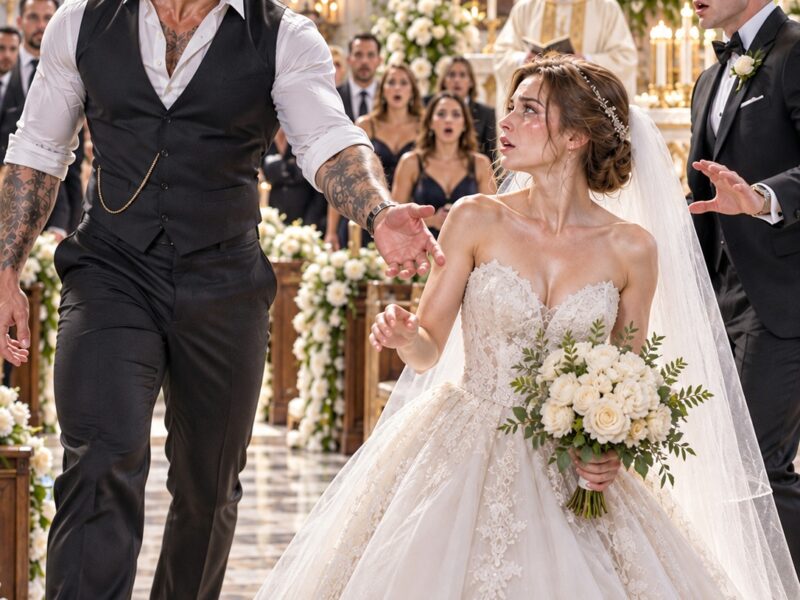
The Groom Refused Her at the Altar — So the Mafia Boss Stepped Forward: “Then She’s Mine.”
“I can’t marry you.”
Four words turned five hundred wedding guests into witnesses.
And before Genevieve Caldwell could decide whether to collapse, scream, or walk away, a man New York whispered about only behind locked doors rose from the final pew and said, “Then she’s mine.”
The silence inside Trinity Church became so complete that Genevieve could hear the candles burning.
She stood beneath a vaulted ceiling older than most of the fortunes represented in the pews, one hand still extended toward the man who had just refused her. White hydrangeas climbed the stone columns. Beeswax candles flickered along the altar rail. A string quartet had gone motionless behind the choir screen, their bows suspended above the strings as though even music had understood that it no longer belonged in the room.
Preston Harrington stared at her with the face of a man who wished someone else would take responsibility for the cruelty he had just committed.
“Preston,” Genevieve whispered.
His fingers slipped from hers.
That hurt more than the words.
Not because she loved him. She had stopped pretending that months ago.
But because they had made an agreement.
He knew exactly what this marriage was.
So did she.
At twenty-six, Genevieve Caldwell had learned that marriages between families like hers rarely began with love. They began with balance sheets, introductions, legacy considerations, political ambitions, tax strategies, and whispered negotiations held over single-malt whiskey after daughters had left the room.
Preston had never lied to her about wanting the Caldwell name beside his when he eventually ran for office.
She had never lied to him about needing the Harrington money to stabilize her father’s collapsing real-estate empire.
It had been cold.
It had been practical.
But she had believed it was at least honest.
Until now.
Bishop Thomas O’Grady cleared his throat, uncertain whether centuries of church tradition offered guidance for a groom refusing his bride in front of half the political and financial elite of Manhattan.
“Mr. Harrington?”
Preston’s skin had gone gray.
He looked toward the first pew.
Genevieve followed his gaze.
Charles Harrington sat perfectly upright beside his wife. Silver-haired, broad-shouldered and immaculate in morning dress, he looked less like the chairman of Harrington National Bank than the portrait of a man who believed entire institutions existed to obey him.
He gave his son the smallest shake of the head.
Genevieve saw it.
And suddenly she understood.
This had not happened spontaneously.
Preston had known.
Maybe not yesterday.
Maybe not when she walked into the church.
But before the bishop asked the question, he had known.
“What did your father tell you?” she asked.
Preston flinched.
“Genevieve—”
“What did he tell you?”
Her voice carried farther than she intended.
Several guests leaned forward.
Preston glanced toward the microphone pinned near his lapel, then seemed to realize there was no dignified way to undo what had already happened.
“The audit came in this morning.”
A pulse began beating hard beneath Genevieve’s jaw.
“What audit?”
“Private investigators found offshore transfers connected to Caldwell Development.”
Her father shifted sharply in the front row.
Genevieve did not look at him.
She kept her eyes on Preston.
“The Cayman accounts,” he continued. “The federal investigation is real.”
A faint sound passed through the church.
Not quite a gasp.
Worse.
Recognition.
The sound of powerful people realizing that a rumor had become useful information.
Preston swallowed.
“My father was told the indictment against Richard could be unsealed Monday.”
This time the church erupted.
Whispers burst across the pews.
Someone behind Genevieve said, “My God.”
A camera shutter clicked.
Then another.
Genevieve turned toward the sound.
The official wedding photographer had lowered his camera in horror, but one society photographer near the center aisle was still shooting.
Click.
Genevieve standing abandoned.
Click.
Her mother covering her mouth.
Click.
Richard Caldwell sinking against the back of the pew.
By midnight, every photograph would be everywhere.
The bride whose family collapsed at the altar.
Preston stepped closer.
“I’m sorry.”
Genevieve looked at him.
She had spent twelve months defending him whenever friends called him shallow.
She had told herself caution was not cowardice.
She had told herself ambition did not make someone cruel.
She had told herself a marriage could become a partnership even if it never became a love story.
Now she saw him clearly.
“You knew before I walked down the aisle.”
He said nothing.
Her stomach turned.
“How long?”
“Genevieve.”
“How long, Preston?”
“This morning.”
“And you let me come here.”
His eyes closed.
That was answer enough.
She looked down at herself.
The ivory gown had required nine fittings.
Her mother had cried when the veil arrived from Paris.
Her father had stood in her childhood bedroom two hours ago and told her she looked exactly like the woman he had always known she would become.
And Preston had been waiting at the end of the aisle knowing he would destroy her in public.
Something inside Genevieve stopped hurting.
It hardened.
“You could have told me privately.”
“My father advised—”
“Of course he did.”
Preston’s face tightened.
“I cannot attach my family to a federal criminal investigation.”
“Yesterday you were perfectly willing to attach yourself to my family’s Fifth Avenue address.”
“That’s unfair.”
A strange laugh escaped her.
Unfair.
Five hundred people had watched him turn her family’s disaster into a public execution, and he wanted fairness.
Behind him, Charles Harrington rose.
“That is enough.”
Genevieve finally turned.
Charles looked at her with an expression almost resembling regret.
Almost.
“Our families entered these discussions under materially false assumptions,” he said. “Had the Harrington family known the extent of the Caldwell liabilities—”
“My daughter did not know,” Richard Caldwell snapped.
Every eye shifted.
Genevieve’s father was on his feet now.
He looked older than he had that morning.
His face was red, his tie crooked, his breathing uneven.
Charles regarded him without sympathy.
“You expect anyone here to believe that?”
Genevieve looked at her father.
“Is it true?”
Richard’s anger vanished.
That frightened her more than Charles’s accusation.
“Dad.”
He opened his mouth.
Nothing came out.
Her mother reached for him.
“Richard.”
Genevieve felt the church tilt beneath her.
Not because Preston had left her.
Not anymore.
Because the one question her father could not answer had told her everything she needed to know.
Charles straightened his cuffs.
“Our attorney will contact yours.”
Then he looked at his son.
“Preston.”
Preston hesitated.
For one second, Genevieve thought he might stay.
Might finally do one brave thing.
Instead he stepped away from the altar.
“I’m sorry,” he said again.
She did not answer.
He walked down the side steps.
Charles followed.
Private security surrounded them before they reached the transept.
Preston never looked back.
The side door closed behind him.
Genevieve remained where she was.
Five hundred people watched.
Politicians.
Judges.
Bankers.
Developers.
Women who had kissed her cheeks at charity galas and men who had praised her intelligence in boardrooms while privately calling her Richard Caldwell’s pretty daughter.
She saw pity.
Curiosity.
Calculation.
Already they were deciding which Caldwell properties might be available below market value.
Which partnerships could be terminated.
Which invitations could quietly stop arriving.
Which secrets might become valuable now that the family was weak.
Genevieve’s knees trembled.
She tightened them.
She would not fall.
Bishop O’Grady came closer.
“My child—”
“Please don’t.”
He stopped.
Genevieve closed her eyes.
All she had to do was walk.
Twenty-seven yards.
From the altar to the doors.
She had walked that aisle once while everyone admired her.
Now she would walk it again while everyone watched her life collapse.
She gathered the skirt of her gown.
Then came the first clap.
Slow.
Deliberate.
From the rear of the church.
Another followed.
Then another.
Genevieve opened her eyes.
The congregation turned.
A man stood beneath the shadow of the organ loft.
Tall.
Broad through the shoulders.
Charcoal suit.
No tie.
Dark hair swept back from a face too composed for the chaos surrounding him.
Mateo Coretti.
Genevieve knew the name before she fully recognized the man.
Everyone in certain New York circles did.
Coretti Global Logistics controlled freight terminals from Newark to Savannah. Coretti Maritime owned warehouses, trucking fleets, security contractors and enough port leases to make Fortune 500 executives answer calls at midnight.
That was the daylight version.
The other version lived in federal indictments that never quite reached court, union rumors, sealed testimony, vanished witnesses and stories told by men who always checked the door before lowering their voices.
Genevieve had seen Mateo twice before.
Once at a museum fundraiser.
Once across a conference table during a waterfront negotiation three years earlier.
Neither meeting had prepared her for the effect of seeing him here.
He began walking down the aisle.
No one stopped him.
Two men followed several paces behind, both dressed with the quiet precision of professionals who did not need to advertise what they were capable of.
Senator David Aris lowered his eyes.
A banking executive moved his knees aside before Mateo reached his pew.
Even men richer than Richard Caldwell made room.
Mateo stopped below the altar.
His gaze moved once toward the side door Preston had used.
“Predictable.”
Genevieve’s humiliation flared into anger.
“If you came to enjoy the spectacle, Mr. Coretti, you chose an excellent seat.”
Something changed in his eyes.
Not amusement.
Approval.
“Still standing.”
“I wasn’t aware I needed your permission.”
A few guests visibly recoiled.
Mateo climbed the altar steps.
Her father rose again.
“Coretti, this is a private family matter.”
Mateo did not look at him.
“That would have been true before Harrington announced your federal exposure through the church sound system.”
Richard froze.
Mateo reached Genevieve.
Up close, he was less theatrical than rumor made him.
No gold watch.
No ostentatious jewelry.
Only a dark suit cut perfectly across a powerful frame and a faint scar near his jaw that disappeared when he turned his head.
His eyes remained on hers.
“What do you want?” Genevieve asked.
“To prevent a waste.”
Her fingers tightened around her bouquet.
“I’m not in the mood for riddles.”
“Good. Neither am I.”
He reached into his jacket.
Several people in the front rows stiffened.
Mateo withdrew a folded document.
He handed it to her.
Genevieve stared at it.
A transfer confirmation.
Five hundred million dollars.
Deposited eleven minutes earlier into a Caldwell corporate stabilization account.
Her mind refused the number.
She read it again.
“What is this?”
“Liquidity.”
Her eyes snapped toward him.
“My father’s company does not have an account at your bank.”
“It does now.”
Richard came forward.
“What have you done?”
Mateo finally looked at him.
“Something you should have done six months ago. I stopped the bleeding.”
Genevieve’s heartbeat accelerated.
She lowered her voice.
“Why?”
Mateo removed a small black drive from another pocket.
“This is why.”
She did not take it.
“What’s on it?”
“The original Apex Holdings ledger.”
Her father made a sound behind her.
Genevieve turned.
Richard was staring at the drive.
For the first time that afternoon, he looked genuinely terrified.
Not embarrassed.
Terrified.
Genevieve faced Mateo again.
“What is Apex Holdings?”
“That,” Mateo said, “is a much more interesting question than whether your father has offshore accounts.”
Richard stepped onto the altar.
“Genevieve, do not listen to him.”
She looked at her father.
“Then you tell me.”
“Not here.”
“Everyone here already knows I may be bankrupt by Monday. Privacy seems a little late.”
“Genevieve.”
“Tell me what Apex Holdings is.”
Richard’s jaw moved.
No answer.
Mateo watched the exchange without interrupting.
That disturbed her.
He knew something.
Something big enough to make him comfortable waiting.
Genevieve looked again at the drive.
“What do you want in return?”
Her father closed his eyes.
Mateo’s expression barely changed.
“A wife.”
For a moment she thought she had misheard him.
Then someone in the first pew whispered, “Jesus Christ.”
Genevieve stared.
Mateo continued as calmly as if discussing an acquisition.
“My companies are entering regulated infrastructure markets. Ports. Public transit. Energy. The Coretti name opens certain doors and closes others.”
“And you think marrying me fixes that?”
“I think marrying the woman who rebuilt three failing Caldwell divisions before she turned twenty-five gives my board something more valuable than pedigree.”
She blinked.
“You know about that?”
“I know considerably more about you than Preston Harrington did.”
Her skin went cold.
That sentence should have frightened her.
Instead, because of the morning she had survived, it made her curious.
Mateo glanced toward the side door.
“Harrington wanted your surname.”
His eyes returned to hers.
“I want your judgment.”
Genevieve looked at the transfer paper.
“And my father?”
“The funds keep Caldwell Development solvent.”
“The investigation?”
“The files on this drive establish that the government’s theory is incomplete.”
“Incomplete is not innocent.”
“No.”
Her father flinched.
Genevieve noticed.
Mateo had not promised innocence.
Interesting.
“Will he go to prison?”
“That depends on which crimes are actually his.”
Richard exploded.
“You son of a bitch.”
Mateo remained still.
Genevieve turned sharply.
“Which crimes are his?”
“Genevieve—”
“No.”
Her voice cracked across the church.
For the first time, her father stopped speaking because she had told him to.
She looked at Mateo.
“If you expect me to marry you, you will not lie to me.”
“I wasn’t planning to.”
“Did my father commit a crime?”
Mateo considered the question.
“Yes.”
Her mother gasped.
Richard’s face collapsed.
Genevieve felt a strange calm settle over her.
“What did he do?”
“He concealed losses. Misrepresented collateral. Authorized payments through entities he should have reported.”
Richard sank into the front pew.
“But,” Mateo continued, “he did not steal the three hundred million dollars the government believes he stole.”
Genevieve stared at him.
“Who did?”
Mateo’s gaze moved briefly toward the empty place where Charles Harrington had been sitting.
The implication hit her.
“No.”
“He built the structure.”
“Charles?”
“His bank moved the money.”
“And Preston knew?”
“That I don’t know.”
The distinction mattered.
Mateo was giving her facts rather than convenient certainty.
She hated that this made her trust him slightly more.
Richard whispered, “I didn’t know.”
Genevieve looked at him.
Her father’s eyes were wet.
“I covered the losses,” he said. “I thought I could fix them before anyone discovered them. Charles offered bridge financing. He told me the Cayman structure would protect the development entities.”
“And you believed him?”
“I was desperate.”
“You signed things you didn’t understand.”
Richard looked away.
Genevieve closed her eyes.
Her entire life, her father had confused confidence with competence.
She had cleaned up behind him for years.
Renegotiated leases.
Soothed lenders.
Replaced executives he had hired because they golfed together.
And when his recklessness finally became criminal, he had allowed her to solve that too.
By marrying Preston.
A bitter laugh escaped her.
Mateo watched her.
“You knew,” she said.
“Yes.”
“How long?”
“Four months.”
“You could have exposed Charles.”
“I could have.”
“You waited.”
“I did.”
Anger returned.
“So this is a trap.”
“No.”
“You let me walk into this church.”
“Yes.”
“You let Preston humiliate me.”
A muscle moved in Mateo’s jaw.
“I did not know he would do it publicly.”
“But you knew he would abandon the marriage.”
“I believed Charles would stop it before the vows.”
“And you positioned yourself here to benefit.”
Mateo said nothing.
That silence was more honest than denial.
Genevieve stepped closer.
“You are not rescuing me.”
“No.”
That answer startled her.
“I am offering you leverage,” he said. “There is a difference.”
The church listened.
Mateo did not seem to care.
“I can stop the collapse. I can prove Charles engineered the theft. I can keep your father from being charged for crimes he did not commit.”
“And the ones he did?”
“He answers for them.”
Richard stood.
“You cannot be serious.”
Genevieve looked at her father.
Something inside her finally snapped.
“I was supposed to marry a man I did not love so you wouldn’t have to answer for them.”
Richard went silent.
She continued.
“You let me negotiate my life because you were afraid to negotiate your consequences.”
Margaret Caldwell began crying quietly.
Richard looked at his daughter as if seeing the distance between them for the first time.
“Ginny—”
“Don’t call me that.”
He stopped.
Genevieve turned back to Mateo.
“If I say no?”
“The five hundred million stays in place for forty-eight hours. Enough time for your board to stabilize payroll and creditors.”
Her eyebrows rose.
“You transferred it before I agreed.”
“Yes.”
“Why?”
“Because desperation is not consent.”
The words landed differently than everything else he had said.
She studied him.
“If you wanted to force me, you would have made the money conditional.”
“I want you dangerous, Genevieve. Not grateful.”
A murmur moved through the nearest pews.
She barely heard it.
“What exactly would this marriage be?”
“A legal partnership.”
“Bedrooms?”
“Your choice.”
“Public appearances?”
“When necessary.”
“My career?”
“Yours.”
“My shares in Caldwell Development?”
“Yours.”
“My name?”
“Whichever one you choose.”
“My vote in your companies?”
Mateo’s eyes sharpened.
“We negotiate that.”
“Then we’re not done.”
For the first time, a faint smile touched his mouth.
“There she is.”
Genevieve hated the warmth that moved through her.
She looked down the aisle.
At all those faces.
People who had watched her be traded.
People who had watched Preston reject her.
People already composing versions of the story in which she was pathetic.
Then she looked at the empty side doorway.
She thought of Preston saying, I’m sorry as though apology transformed cowardice into decency.
She looked at Mateo again.
“Do you have a marriage license?”
Bishop O’Grady made a choking sound.
Mateo’s smile vanished.
Not because he was displeased.
Because he understood that the game had changed.
One of his men approached carrying a leather portfolio.
Genevieve almost laughed.
“You actually brought one.”
“I dislike improvising with legal documents.”
The bishop stared at him.
“You cannot simply replace one groom with another.”
Genevieve looked at the priest.
“Can two consenting adults with a valid marriage license marry in this church?”
Bishop O’Grady turned pale.
“Technically, yes, but—”
“Then technically is enough.”
Her mother stood.
“Genevieve.”
Genevieve looked at Margaret.
Her mother’s face was devastated.
Not because she loved Preston.
Because mothers spent years imagining certain moments, and reality had torn this one apart.
“Are you sure?” Margaret asked.
No command.
No accusation.
Just the question.
Genevieve considered it.
“No,” she said.
The honesty surprised everyone.
Then she looked at Mateo.
“But I am sure I will never again make a life decision because the men around me are afraid.”
Mateo extended his hand.
She did not take it immediately.
“One condition.”
“Name it.”
“If I discover you lied about Charles, the money, my father, or why you chose me, I walk away.”
“You can walk away whether I lie or not.”
“Put it in writing.”
His eyes held hers.
Then he looked at his attorney.
“Add it.”
A lawyer near the aisle opened a tablet.
Genevieve almost smiled.
Only Mateo Coretti would bring counsel to another man’s wedding.
The amendment took seven minutes.
No one left.
Not one of the five hundred guests dared move while Genevieve Caldwell rewrote her future at the altar where it had just been destroyed.
When the lawyer finished, she read every line.
Mateo waited.
No pressure.
No whispered persuasion.
Her father tried twice to speak.
She ignored him.
Finally, Genevieve signed.
Mateo signed beneath her.
The bishop looked as though retirement had become extremely attractive.
“Mr. Coretti,” he said, “do you take Genevieve Caldwell to be your lawful wife?”
Mateo faced her.
There was no triumphant amusement now.
No performance.
“I do.”
The bishop turned.
“Miss Caldwell, do you take Mateo Coretti to be your lawful husband?”
Genevieve heard the rain beginning outside.
Soft at first.
Then harder against the old stained glass.
She thought of how strange it was that a life could separate into before and after because of two syllables.
“I do.”
The bishop exhaled.
“Then by the authority vested in me by the State of New York and the church, I pronounce you husband and wife.”
He hesitated.
“You may kiss the bride.”
Genevieve’s muscles tightened.
Mateo noticed.
He stepped close enough that only she could hear him.
“May I?”
That almost undid her.
Preston had never asked what she wanted when it mattered.
Her father had not asked.
Charles had certainly not asked.
But the most feared man in the room did.
Genevieve nodded once.
Mateo touched the side of her face.
His hand was warm.
The kiss was brief.
Controlled.
Nothing like the declaration that had preceded it.
When he stepped back, she saw something in his expression she had not expected.
Relief.
Before she could examine it, the main church doors opened.
Rain-cooled air swept through the nave.
Mateo offered his arm.
Genevieve took it.
They walked down the aisle together.
No applause followed.
Only stunned silence.
Halfway to the doors, she saw movement near the back pew.
A man in a navy suit was holding a phone against his chest.
He caught Mateo’s attention.
One small nod passed between them.
Genevieve noticed.
“What was that?”
Mateo kept walking.
“Nothing you need to worry about yet.”
She stopped.
He took one more step before realizing she had not moved.
Genevieve released his arm.
“Our marriage is eight minutes old.”
Mateo turned.
“And?”
“You just broke the first rule.”
His gaze narrowed.
“What rule?”
“No deciding what I need to know.”
For a second they stood in the center aisle facing each other while hundreds watched.
Then Mateo returned to her.
“The man is one of mine.”
“I assumed.”
“He received notice that federal agents are on their way to the reception.”
Her stomach tightened.
“For my father?”
Mateo’s gaze hardened.
“No.”
The church doors stood open behind him.
Rain fell over Broadway.
“For me.”
The Plaza ballroom had been designed for celebrations.
That afternoon, it felt like a courtroom dressed in gold.
Crystal chandeliers cast warm light over white orchids, polished silver and tables set for people who had spent the past hour frantically rewriting their loyalties.
No one mentioned the groom who had vanished.
No one mentioned that another man now occupied his chair.
Society survived humiliation by pretending it had intended everything.
Genevieve sat at the center table beside Mateo and watched New York’s elite perform normalcy.
Senator Aris drank too quickly.
Judge Beatrice Montgomery barely touched her food.
Executives who had avoided Mateo for years approached to congratulate him.
He accepted each greeting with calm politeness that somehow frightened them more than aggression would have.
“You enjoy this,” Genevieve murmured.
He cut into his steak.
“What?”
“Watching powerful people discover they aren’t the most powerful people in the room.”
Mateo looked around.
“No.”
She waited.
“I enjoy watching dishonest people become temporarily honest.”
Despite herself, she almost smiled.
The ballroom doors burst open.
Conversation died.
Charles Harrington entered first.
Preston followed.
Six federal agents came behind them.
Genevieve’s smile disappeared.
Special Agent Thomas Reynolds crossed the room.
She knew him from newspaper photographs. Organized crime division. Thirty years in federal service. He had built a career investigating men like Mateo.
Reynolds stopped ten feet from the table.
“Mateo Coretti.”
Mateo calmly set down his wineglass.
“Agent Reynolds.”
“You’re under investigation for witness tampering, coercion and obstruction of a federal proceeding.”
Genevieve’s pulse spiked.
Charles stepped forward.
“He forced her into that marriage.”
Genevieve stood.
“No, he did not.”
Charles looked at her as though she had betrayed him personally.
“Genevieve, you don’t understand what this man is.”
“I understand exactly what he offered me.”
“You were distressed.”
“I was humiliated. There is a difference.”
Preston finally looked at her.
He had removed his boutonniere.
His bow tie hung loose.
For the first time all day, he looked less like a Harrington heir than a frightened man who had inherited a script and suddenly forgotten the lines.
“Genevieve,” he said.
She met his eyes.
He stopped.
Whatever he had intended to say disappeared.
Reynolds turned toward Mateo.
“Stand up.”
Mateo did.
Two of his security men shifted.
He lifted one finger.
They remained still.
Then he looked at Reynolds.
“Have you checked the evidence your office received twenty-three minutes ago?”
Reynolds’s expression changed slightly.
Charles went rigid.
Genevieve saw it.
Mateo saw her seeing it.
Reynolds pulled out an encrypted phone.
He read.
No one spoke.
The seconds lengthened.
Then Reynolds lifted his head.
“Where did you get this?”
Mateo leaned against the table.
“Does the chain of custody concern you more than the ledger?”
“It concerns me where you obtained sealed financial records.”
“You can investigate that tomorrow.”
Charles backed away.
Reynolds noticed.
“So can I.”
He turned.
“Mr. Harrington.”
Charles’s face hardened.
“Do not let him manipulate you.”
Reynolds approached.
“Do you control Apex Holdings?”
“No.”
“Have you ever controlled it?”
“No.”
Mateo spoke from behind him.
“Ask him about Bellweather Fiduciary.”
Charles turned sharply.
That was enough.
Reynolds looked back at his phone.
“Bellweather owns seventy-three percent of Apex.”
Mateo nodded.
“Bellweather is administered through Nassau by three trustees.”
Reynolds scrolled.
“One deceased. One retired.”
“And the third?”
Reynolds stared at Charles.
“Elaine Harrington.”
Preston went pale.
“My mother?”
Charles spun toward his son.
“Stay out of this.”
Preston stared.
“What did you do?”
Charles’s control broke.
“What I had to do.”
The room seemed to contract.
Genevieve watched Preston’s face change as he finally realized what loyalty had cost him.
Mateo moved beside her.
Not touching.
Just there.
Reynolds spoke.
“The records show three hundred and twelve million dollars transferred from Caldwell-backed development loans into Apex-controlled accounts over thirty-one months.”
Richard Caldwell staggered to his feet.
“You told me those were refinancing facilities.”
Charles laughed once.
A bitter, exhausted sound.
“You signed every document.”
“I trusted you.”
“That was your mistake.”
Genevieve closed her eyes.
There it was.
The truth beneath generations of polished manners.
Not friendship.
Predation.
Charles had not simply planned to avoid Caldwell scandal.
He had created it.
Preston stared at his father.
“You knew Genevieve’s father would be blamed.”
Charles said nothing.
“Dad.”
“You have no idea what was at stake.”
“You made me leave her at the altar.”
“I stopped you from marrying into a collapsing family.”
“You collapsed them.”
Charles looked at his son.
Something cold returned to his face.
“I preserved ours.”
Preston recoiled.
Genevieve expected satisfaction.
Instead, she felt tired.
A few hours earlier she might have wanted Preston punished.
Now she saw him clearly: not innocent, but not powerful either.
A man trained to obey strength until obedience destroyed whatever might have made him decent.
Reynolds approached Charles.
“Charles Harrington, you are being detained pending investigation into federal wire fraud, bank fraud, conspiracy and obstruction.”
“This is absurd.”
“Turn around.”
Charles did not.
Two agents moved.
He looked across the room at Mateo.
“You think you’ve won?”
Mateo’s face remained blank.
Charles smiled.
That smile made Genevieve uneasy.
“You have no idea what she costs.”
Mateo’s voice went very quiet.
“Take him out.”
Reynolds glanced at him.
“I don’t work for you.”
“No. But at the moment we share an objective.”
Reynolds almost smiled.
The agents removed Charles.
As he passed Genevieve, he stopped.
“You should ask your new husband what happened to Daniel Mercer.”
Mateo went still.
Genevieve felt it beside her.
Charles noticed.
His smile widened.
Then the agents pulled him forward.
The doors closed.
Genevieve turned slowly toward Mateo.
“Who is Daniel Mercer?”
Mateo’s jaw tightened.
“Not here.”
Her stomach dropped.
That was the second time.
“No deciding what I need to know.”
“I remember.”
“Then answer.”
Around them, five hundred guests pretended not to listen.
Mateo lowered his voice.
“Daniel Mercer was my brother.”
Genevieve stared.
“I thought you were an only child.”
“So does almost everyone.”
“What happened to him?”
Mateo looked toward the closed ballroom doors.
“He died three years ago.”
The date hit her.
Three years.
The Brooklyn waterfront strike.
The year Mateo had first noticed her.
Genevieve’s fingers went cold.
“How?”
Mateo looked back at her.
“In a fire.”
“An accident?”
He did not answer.
And for the first time since he had walked into the church, Genevieve saw fear in his eyes.
Not fear of federal agents.
Not fear of Charles.
Fear of what she might learn.
By midnight, the ballroom had emptied.
The story had already reached every major New York news desk.
Genevieve Caldwell had been abandoned at the altar.
Genevieve Caldwell had married Mateo Coretti minutes later.
Charles Harrington had been removed from the reception by federal agents.
Three banking stocks were falling in after-hours trading.
Caldwell Development’s creditors had suspended emergency collection actions.
And somewhere across the city, hundreds of people were wondering whether Genevieve had been rescued, kidnapped, bought, or transformed into something more dangerous than all three.
She stood before the windows of the Astor Suite overlooking Central Park.
Her wedding gown lay heavy around her.
She wanted it off.
Not because she regretted the marriage.
Because the dress belonged to a version of herself who no longer existed.
Mateo entered without his jacket.
He carried two glasses of bourbon.
Genevieve accepted one.
She did not drink.
“Daniel Mercer.”
Mateo stopped.
“You’re persistent.”
“You married me.”
“That doesn’t explain the persistence.”
“It means your secrets became relevant to my survival.”
He looked toward the city.
For a long moment, he said nothing.
Then: “Daniel was my half brother.”
“Older?”
“By six years.”
“Why Mercer?”
“Our mother’s maiden name. After my father died, Daniel wanted distance from the Coretti organization.”
“What did he do?”
“He became an accountant.”
Genevieve blinked.
Mateo almost smiled.
“He was offensively respectable.”
She heard affection beneath the words.
That mattered.
“He handled financial compliance for one of our legitimate companies. Then he discovered irregular transfers connected to a port redevelopment fund.”
“Apex?”
Mateo looked at her.
“Yes.”
Genevieve set down the bourbon.
“Daniel discovered Charles stealing from Caldwell?”
“Not exactly.”
“Then what?”
“He discovered Charles laundering money through development loans issued to both our families.”
Her breathing slowed.
“Our families?”
“Your father wasn’t the only target.”
Genevieve stepped closer.
“What happened?”
“Daniel copied the records. He intended to go to federal prosecutors.”
“And?”
“He never arrived.”
The room became very quiet.
“The warehouse where he kept the backup records caught fire that night.”
Genevieve’s voice softened.
“Was he inside?”
“Yes.”
Mateo looked toward the windows.
“He was identified from dental records.”
Genevieve saw his hand tighten around his glass.
The city feared Mateo Coretti.
Federal investigators watched him.
Board members obeyed him.
Men stepped out of his path.
But grief had reduced him to something painfully ordinary.
A brother staring at a memory.
“Why didn’t you expose Charles then?”
“Because the evidence burned.”
“You had suspicions.”
“I had rage.”
He looked at her.
“Those are not the same thing.”
That answer surprised her.
“Most men in your position wouldn’t care about the distinction.”
“Most men in my position don’t survive long enough to learn it.”
Genevieve thought of the rumors surrounding him.
“How much of what people say about you is true?”
“Enough.”
“That isn’t an answer.”
“It is the only honest one I can give tonight.”
She studied him.
“Did you kill people?”
Mateo held her gaze.
“I have ordered things I am not proud of.”
“That isn’t an answer either.”
“No.”
The bluntness chilled her.
But he did not romanticize it.
Did not offer noble excuses.
He looked like a man who understood the moral weight of what he was refusing to describe.
Genevieve crossed her arms.
“You told me you wanted a partner.”
“I do.”
“Partners don’t survive on selective truth.”
“I know.”
“Then start.”
Mateo put down his glass.
“When Daniel died, I nearly destroyed everything he had tried to protect.”
He walked toward the window.
“I wanted Charles Harrington dead. I wanted the bank broken. I wanted everyone connected to him afraid.”
“What stopped you?”
“A notebook.”
Genevieve frowned.
Mateo opened a drawer and removed a small black book.
He handed it to her.
The pages contained columns of numbers, names and shorthand.
Near the back, one sentence appeared in block letters.
IF SOMETHING HAPPENS TO ME, FOLLOW THE LOANS, NOT THE CASH.
Genevieve looked up.
“Daniel wrote this?”
Mateo nodded.
“He knew laundering structures were disposable. Loans weren’t. They had signatures. Appraisals. Trustees. Lawyers.”
“So you spent three years following them.”
“Yes.”
“And you found Charles.”
“Eventually.”
Genevieve flipped the page.
A familiar name appeared.
Richard Caldwell.
Her chest tightened.
“Why is my father here?”
“Because Daniel met him.”
“When?”
“Two weeks before the fire.”
She looked up.
“My father knew your brother?”
“Yes.”
Genevieve’s mind raced.
“Did he tell you that?”
“No.”
“How do you know?”
“Daniel wrote it down.”
Her father had lied again.
Genevieve closed the notebook.
“You said you watched me at the waterfront strike.”
Mateo’s eyes shifted.
“Yes.”
“That happened after Daniel died.”
“Six weeks after.”
“And my father was involved in those waterfront loans.”
“Yes.”
“So when you first saw me, you were already investigating my family.”
“Yes.”
The word struck like cold water.
Everything shifted.
His attention.
His surveillance.
The marriage.
Maybe even the rescue.
Genevieve stepped back.
“You didn’t notice me because I was negotiating with dockworkers.”
“I did.”
“But that isn’t why you were there.”
“No.”
“You were investigating my father.”
“Yes.”
Her throat tightened.
“And for three years you watched me because you thought I might lead you to evidence.”
“At first.”
“At first?”
“Yes.”
She laughed without humor.
“How convenient.”
“Genevieve.”
“Do not.”
Her voice sharpened.
“Do not turn three years of surveillance into some romantic story because I impressed you in the rain.”
Mateo’s face hardened.
“I never said it was romantic.”
“You said you respected me.”
“I do.”
“You used me.”
“I watched you.”
“For information.”
“For months.”
“And after?”
Mateo came closer.
“After, I continued because every report about Caldwell Development eventually included one person fixing everyone else’s mistakes.”
“That sounds flattering enough to make manipulation easier.”
“It isn’t flattery.”
“Then what is it?”
His answer came quietly.
“Recognition.”
She went still.
Mateo looked at her with none of the power he had displayed in the church.
“When you walked onto that dock, you were the only person from your father’s company who asked why the workers were angry instead of asking how much it would cost to silence them.”
Genevieve remembered that night.
Rain inside her shoes.
Men yelling.
Her father screaming through her phone to call police.
A union foreman named Sal refusing to negotiate until she had sat beside him on an overturned crate and listened for forty minutes.
“I watched you solve in six hours what your father had made worse for six months,” Mateo said. “And I realized you did the same thing I had spent my adult life doing.”
“What?”
“Cleaning up after men who inherited power they had not earned.”
That landed too close.
Genevieve looked away.
Mateo stepped back.
“I began investigating you for information.”
She faced him again.
“I stopped because I wanted to know you.”
“You never spoke to me.”
“You were engaged.”
“To Preston.”
“Yes.”
“You don’t seem like a man intimidated by another woman’s fiancé.”
His expression turned dry.
“Intimidated? No.”
“Then why?”
“Because taking someone’s choice from her is not the same thing as winning.”
The room fell quiet.
Genevieve looked at the man she had married hours earlier.
She did not trust him.
Not fully.
Perhaps not even mostly.
But something stranger had begun.
She believed him when he said things that did not benefit him.
That was more dangerous than attraction.
Her phone rang.
She looked down.
Her father.
She considered ignoring it.
Then answered.
“Dad.”
Richard’s voice sounded broken.
“Genevieve, I need to see you.”
“It’s midnight.”
“I know.”
“Then tomorrow.”
“No.”
Something in his voice changed her posture.
“Why?”
A pause.
Then Richard said, “Because Mateo Coretti does not know everything about his brother’s death.”
Genevieve looked at Mateo.
He saw her expression.
“What?”
She put the phone on speaker.
Richard breathed heavily.
“I was there the night Daniel Mercer died.”
Mateo’s face emptied.
Genevieve felt the entire room change.
“What did you say?” Mateo asked.
Richard went silent.
Mateo stepped toward the phone.
“Richard.”
“I didn’t kill him.”
Mateo’s voice dropped.
“I asked what you said.”
“I was there.”
Genevieve’s stomach twisted.
Mateo looked at her.
His eyes no longer held fear.
Only something colder.
Something she suspected New York had learned not to provoke.
“Where is he?” Mateo asked.
Genevieve did not answer immediately.
“Genevieve.”
She looked at her husband.
Then at the phone.
For the first time that day, she understood the true danger of the marriage she had entered.
It was not that Mateo might destroy her father.
It was that she might discover he had a reason to.
Richard Caldwell arrived forty minutes later.
Mateo wanted security in the room.
Genevieve refused.
“My father talks to me.”
“He lies to you.”
“So does everyone when they’re afraid.”
“That is not reassuring.”
“It wasn’t meant to be.”
Mateo finally agreed.
Richard entered the suite looking twenty years older.
Margaret had not come.
He stood awkwardly near the door, staring at Mateo.
Mateo remained beside the window.
“Talk.”
Richard looked at Genevieve.
She pointed to a chair.
“Sit.”
He obeyed.
For once, she controlled the room.
“What happened to Daniel?”
Richard rubbed his hands together.
“He came to me two weeks before the fire.”
“Why?”
“He showed me documents.”
“The Apex transfers?”
“Yes.”
“You knew Charles was stealing?”
“Not then. Daniel believed someone inside Harrington Bank was manipulating project financing.”
“Did you tell Charles?”
Richard closed his eyes.
Genevieve knew.
“Oh, my God.”
“I thought Charles would investigate.”
Mateo laughed.
No amusement.
A terrible, quiet sound.
“You gave him Daniel’s name.”
Richard looked at him.
“I trusted him.”
Mateo moved.
Genevieve stepped between them.
“Mateo.”
He stopped.
Barely.
She turned to Richard.
“What happened after that?”
“Charles told me Daniel was extorting the bank.”
Mateo’s hands curled.
Richard continued quickly.
“He said Daniel had ties to organized crime. He said he needed proof. He asked me to arrange another meeting.”
“You set Daniel up.”
“I didn’t know what Charles intended.”
“What did you intend?”
“To solve the problem.”
Genevieve stared at her father.
That phrase.
Her whole childhood had been built around versions of it.
Solve the problem.
Move the money.
Delay the creditor.
Quiet the journalist.
Marry Preston.
“What happened?”
Richard looked at Mateo.
“I met Daniel at the old warehouse on Kent Avenue.”
Mateo’s face changed.
“You were inside?”
“Yes.”
“What did he say?”
“He told me Charles was stealing from both of us. He had copies of loan schedules. Trustee records. He said he was going to the U.S. attorney.”
“And then?”
“Charles arrived.”
Genevieve’s pulse pounded.
“With who?”
“Two men.”
Mateo asked, “Names.”
“I don’t know.”
“Describe them.”
“Mateo.”
Genevieve’s voice stopped him again.
She looked at Richard.
“Continue.”
“They argued. Daniel accused him directly. Charles offered him money.”
“How much?”
“Ten million.”
Mateo’s mouth tightened.
“Daniel refused.”
Richard nodded.
“He said something I’ll never forget.”
Mateo waited.
Richard looked at him.
“He said, ‘My brother thinks fear is power. You think money is power. You’re both wrong. Evidence is power because it survives you.’”
Mateo closed his eyes.
For one second.
Genevieve saw grief pass through him.
Then it vanished.
“What happened next?”
“I left.”
Mateo stared.
“You left.”
“I was scared.”
“You left my brother alone with Charles Harrington.”
“I didn’t know—”
“You knew enough to run.”
The words cut through the room.
Richard had no defense.
Genevieve felt sick.
“When did you hear about the fire?”
“The next morning.”
“And you never told anyone?”
Richard shook his head.
“Charles called me before the news broke. He said Daniel had caused an electrical fire destroying evidence while trying to blackmail him.”
“You believed that?”
“No.”
“Then why stay silent?”
Richard’s eyes filled.
“Because Charles had my signatures.”
Genevieve understood.
Not justification.
Leverage.
“He could implicate you.”
“Yes.”
Mateo turned away.
Genevieve looked at her father.
“You let another family believe a man died accidentally because you were afraid of losing your company.”
“I was afraid of prison.”
“So you gave me to Preston.”
Richard flinched.
She continued.
“You didn’t arrange my marriage to save the family.”
“Genevieve—”
“You arranged it to keep Charles close.”
Her father said nothing.
The truth was worse than she had expected.
The wedding had not merely been a bailout.
It had been insurance.
If Genevieve married Preston, Richard believed Charles would never expose him because their families would become one.
She had been currency again.
Something inside her finally detached.
She did not hate her father.
Hatred required energy she no longer wanted to spend.
She pitied him.
That was worse.
Mateo spoke behind her.
“Leave.”
Richard stood slowly.
“Mateo—”
“Leave before I forget she asked me not to touch you.”
Genevieve turned.
“I didn’t ask that.”
Mateo looked at her.
She looked back.
“No violence.”
Something passed between them.
A boundary.
Mateo nodded.
“No violence.”
Richard walked toward the door.
Genevieve stopped him.
“Tomorrow morning, you resign from Caldwell Development.”
He stared at her.
“What?”
“You will issue a statement admitting you concealed corporate losses and cooperated with improper financing.”
“That will destroy me.”
“No.”
Her voice remained calm.
“It will make you accountable.”
He looked at her as if the distinction were meaningless.
To Genevieve, it had become everything.
“And the company?”
“You sign voting control of your shares into an independent trust until the investigation is resolved.”
“You can’t demand that.”
“I can.”
“Why?”
“Because Mateo’s money saved the company today.”
She glanced at her husband.
“But I am going to save it tomorrow.”
Richard opened his mouth.
Genevieve shook her head.
“Go home.”
He left.
The door closed.
Silence.
Mateo looked at her.
“You just removed your own father.”
“He removed himself years ago. The paperwork is catching up.”
Mateo walked toward her.
“You stopped me from hurting him.”
“I stopped you from becoming useful to Charles Harrington.”
He frowned.
“If you touch my father, Charles gets exactly what he wants. The story changes from banking fraud to mafia retaliation.”
A slow realization crossed Mateo’s face.
“He provoked me through Reynolds.”
“Yes.”
“And through your father.”
“Yes.”
“You think Richard’s confession was planned?”
“No.”
She paused.
“But Charles telling me to ask about Daniel was.”
Mateo stared.
Genevieve moved toward Daniel’s notebook.
“Charles wanted you angry.”
“He succeeded.”
“He wanted you reckless.”
Mateo’s eyes sharpened.
“Why?”
Genevieve opened the notebook.
“Because Daniel said evidence survives people.”
She flipped through several pages.
“And Charles has spent three years assuming all the evidence died with him.”
Mateo came beside her.
Genevieve stopped on a page containing one repeated notation.
H-17.
“What is this?”
Mateo looked.
“I don’t know.”
“It appears eleven times.”
“I’ve seen it.”
“You never identified it?”
“No.”
“What about this?”
Beside several entries were initials.
G.C.
Mateo shook his head.
“Not Genevieve Caldwell. You were twenty-two.”
“I know.”
She looked closer.
“What if it isn’t a person?”
Mateo frowned.
Genevieve took out her phone.
“Your brother was an accountant. He wouldn’t write poetic riddles. He’d use references.”
“To what?”
“Loan schedules. Storage numbers. Ledger categories.”
She enlarged a photograph of the page.
“H-17.”
Mateo suddenly went still.
“What?”
He took the notebook.
“Our old harbor terminal.”
“Which one?”
“Hoboken.”
Genevieve felt electricity move through her.
“Seventeen could be a container.”
Mateo was already reaching for his phone.
“Wait.”
He looked at her.
“If Charles wants you reckless, assume he watches anything connected to Daniel.”
Mateo lowered the phone.
“What do you suggest?”
Genevieve looked toward the city.
“We don’t send your men.”
“Then who?”
She smiled for the first time since the wedding.
“The federal government.”
At eight the next morning, Genevieve walked into Special Agent Reynolds’s Manhattan office wearing the same white dress she had worn to marry Mateo Coretti.
Not because she wanted drama.
Because her overnight bag remained in Preston Harrington’s penthouse.
And because some symbolism was too useful to waste.
Reynolds looked at her dress.
“You’ve had an unusual twenty-four hours.”
“You have no idea.”
Mateo sat beside her.
Reynolds looked at him.
“You are enjoying this far too much.”
“I enjoy competent people.”
Reynolds turned to Genevieve.
“He wasn’t talking about me.”
“I know.”
Genevieve placed Daniel’s notebook on the desk.
For the next hour, they explained everything.
Richard’s confession.
Daniel’s meeting with Charles.
H-17.
The Hoboken terminal.
Reynolds listened without interruption.
Finally, he leaned back.
“You understand that if I find evidence implicating Coretti, I use it.”
Mateo nodded.
“Yes.”
Genevieve looked at him.
He meant it.
That mattered.
Reynolds assembled a team.
No Coretti employee was permitted near the search.
By noon, federal agents reached the old Hoboken terminal.
H-17 was not a container.
It was a storage bay beneath a disused customs office.
Behind a false wall, agents discovered a fireproof records box.
Inside were copies of Daniel Mercer’s files.
Loan schedules.
Trust documents.
Emails.
Audio recordings.
And a handwritten letter addressed to Mateo.
Reynolds read it first.
Then handed it over.
Mateo stood in the fluorescent hallway outside the evidence room.
Genevieve stayed beside him.
He unfolded the letter.
His brother’s handwriting began in blue ink.
Mateo read silently.
His face did not change until the final paragraph.
Then his breathing stopped.
Genevieve touched his wrist.
“What?”
He gave her the letter.
The final lines read:
If you’re reading this, I was right to be afraid. Do not answer this with blood. That is what men like Harrington expect from you. Beat him where he believes you are weak. In daylight. With witnesses. With law. And if you ever meet someone who makes you want a different life, don’t insult her by dragging her into the old one.
Genevieve read the final sentence twice.
Then looked at Mateo.
He stared through the glass into the evidence room.
“All these years,” he said.
“What?”
“I thought I was honoring him by hunting Charles.”
Genevieve folded the letter carefully.
“Maybe you were.”
Mateo shook his head.
“No. I was becoming predictable.”
She thought of Charles deliberately mentioning Daniel at the reception.
“Yes.”
Mateo looked at her.
“And you saw it before I did.”
“That doesn’t make you weak.”
“It makes you useful.”
She raised an eyebrow.
Mateo almost smiled.
“To me,” he corrected.
“That was nearly a terrible compliment.”
“I’m learning.”
Reynolds emerged from the evidence room.
His expression was grim.
“We found the recording.”
Mateo straightened.
“What recording?”
“Daniel’s last meeting.”
They listened in a secure room.
Daniel’s voice filled the speakers.
Calm.
Precise.
Charles Harrington sounded irritated.
Then Richard Caldwell entered.
Genevieve heard her father’s younger voice.
Nervous.
Defensive.
The conversation unfolded almost exactly as Richard had described.
Then Richard left.
The recording continued.
Charles offered Daniel money.
Daniel refused.
Charles threatened his family.
Daniel laughed.
“You don’t understand Mateo,” Daniel said. “Threatening him doesn’t frighten him. It simplifies him.”
Genevieve glanced at Mateo.
His jaw tightened.
Then another voice entered the recording.
A voice none of them expected.
Preston Harrington.
Genevieve went cold.
On the recording, Preston sounded younger.
“Dad, what the hell is going on?”
Charles told him to leave.
Preston refused.
Daniel said, “Good. Let your son hear what you are.”
A struggle followed.
Furniture moving.
Someone shouted.
Then Preston’s voice:
“Stop!”
A crash.
The recording distorted.
And Charles said something that changed everything.
“Preston, get the gasoline.”
Genevieve felt Mateo move.
She grabbed his hand.
Not to restrain him.
To anchor him.
Preston’s recorded voice came back, horrified.
“No.”
“Do it.”
“No.”
“You want everything I’ve built? Then learn what protecting it costs.”
The recording ended three minutes later.
There was no sound of murder.
No confession.
But there was enough.
Conspiracy.
Threat.
Evidence destruction.
And proof Preston had known far more about Daniel Mercer than he had admitted.
Genevieve stared at the dead speaker.
Preston had stood at the altar less than twenty-four hours earlier and told her the Caldwell investigation had surprised him.
Another lie.
Reynolds stood.
“We need Harrington.”
Mateo’s voice was flat.
“Which one?”
“Both.”
They found Preston at the family townhouse.
Charles had been released overnight pending formal charging because prosecutors were still structuring the case.
He had returned home.
That had been a mistake.
By the time federal agents arrived, Elaine Harrington was gone.
So were two passports.
Charles was in the library.
Preston was upstairs.
Reynolds brought them down separately.
Genevieve watched from an adjoining room through a monitor.
Mateo stood beside her.
Reynolds questioned Preston first.
For twenty minutes, he denied everything.
Then Reynolds played the recording.
Preston’s face collapsed.
“I didn’t know he would burn the warehouse.”
Reynolds said nothing.
“I swear.”
“Why did you bring gasoline?”
“I didn’t.”
“But your father asked you to.”
“Yes.”
“What did you do?”
“I left.”
Genevieve closed her eyes.
Again.
Preston had spent his entire life leaving when courage became expensive.
Reynolds leaned forward.
“You knew Daniel Mercer was inside.”
“Yes.”
“You knew your father threatened him.”
“Yes.”
“You knew there was a fire fifteen minutes later.”
Preston began crying.
“Yes.”
“And you told no one.”
“My father said if I spoke, he would destroy me.”
Reynolds stared.
“With what?”
Preston hesitated.
Then the final secret emerged.
Charles had used Preston as a nominee shareholder in multiple companies.
Millions had moved under Preston’s name.
If exposed without context, the transactions could make him appear complicit.
Charles had imprisoned his own son using money.
Genevieve watched Preston sob.
She felt no desire to comfort him.
But neither did she feel satisfaction.
Just clarity.
He had been abused by his father.
And then he had passed that cowardice forward until it reached her at the altar.
Pain could explain cruelty.
It did not erase it.
When Reynolds finished, Preston asked to speak with Genevieve.
Mateo looked at her.
“You don’t owe him anything.”
“I know.”
She entered anyway.
Preston stood when she came in.
He looked wrecked.
“Genevieve.”
She remained near the door.
“I wanted to say I’m sorry.”
“You’ve said that before.”
“I know.”
“Usually right before leaving.”
He lowered his eyes.
“I loved you.”
Genevieve felt something almost like grief.
Not for the relationship.
For how little he understood himself.
“No,” she said.
Preston looked up.
“I did.”
“You loved how I made your life easier.”
“That isn’t fair.”
“It is more fair than anything you gave me yesterday.”
He flinched.
Genevieve continued quietly.
“You may have cared about me. You may have wanted to love me. But love requires the ability to stand beside someone when doing so costs you something.”
His eyes filled.
“I was afraid of him.”
“I know.”
“Since I was a kid.”
“I know.”
“You don’t know what he was like.”
“No.”
She paused.
“But I know what my father was like. He used guilt instead of fear. Obligation instead of money. Different weapon. Same cage.”
Preston stared.
“How did you get out?”
Genevieve thought about the question.
“I stopped calling obedience loyalty.”
He cried then.
Silently.
Genevieve let him.
“I hope you testify,” she said.
“Against my father?”
“For yourself.”
She turned toward the door.
“Genevieve.”
She stopped.
“Are you really staying with Coretti?”
She looked back.
“I don’t know.”
Preston seemed surprised.
“You married him.”
“Yes.”
“But you don’t know?”
“For the first time in my life, I am allowing myself not to know.”
She opened the door.
“That is what choice feels like.”
Three weeks later, Richard Caldwell resigned publicly.
He admitted concealing losses and signing misleading financial statements.
Federal prosecutors charged him with lesser financial offenses but acknowledged that the principal theft had been orchestrated through Harrington-controlled entities.
Charles Harrington faced an expanding list of charges.
Preston entered a cooperation agreement.
Elaine Harrington returned voluntarily through counsel.
Caldwell Development survived.
Barely.
Genevieve became interim chief executive by unanimous board vote.
Mateo abstained from influencing it.
She checked.
Twice.
He laughed when she told him.
“You don’t trust me.”
“I trust verification.”
“Daniel would have liked you.”
The sentence still quieted both of them.
Their marriage occupied a strange space.
Publicly, they were New York’s most discussed couple.
Privately, they had separate rooms.
Separate schedules.
Separate attorneys.
And dinner together almost every night.
Genevieve discovered Mateo hated truffle oil, loved terrible old gangster movies and read nineteenth-century history when he could not sleep.
Mateo discovered Genevieve drank coffee cold because she forgot it existed during meetings, kept handwritten lists despite owning three tablets and became ruthlessly sarcastic when hungry.
They argued over Coretti Logistics governance.
Often.
Loudly.
The first time she defeated him in a board vote, every director went silent.
Mateo looked around the table.
“Why is everyone staring?”
His chief financial officer shifted uncomfortably.
“You lost.”
“I noticed.”
Genevieve closed her folder.
Mateo leaned back.
Then smiled.
“Good argument, Mrs. Coretti.”
Afterward, she cornered him in the hallway.
“You enjoyed that.”
“Immensely.”
“You lost forty million dollars in projected short-term savings.”
“I gained a board willing to disagree with me.”
She stared.
“You planned that vote.”
“No.”
“You’re lying.”
“I suspected you were right.”
“That is not better.”
He laughed.
She hated how much she liked the sound.
Then came December.
Snow covered Manhattan.
Genevieve returned to the Coretti townhouse after midnight and found Mateo alone in the library.
Daniel’s letter lay open on the desk.
Tomorrow marked three years since the fire.
Genevieve took off her coat.
“You couldn’t sleep.”
“No.”
She sat opposite him.
For a while neither spoke.
Mateo traced the edge of the letter.
“Charles accepted a plea.”
“I heard.”
“Thirty-two years.”
“He’ll probably serve less.”
“Probably.”
“Are you angry?”
Mateo considered.
“No.”
She waited.
“I thought I would be.”
“What do you feel?”
“Finished.”
Genevieve understood.
Revenge promised heat.
Closure often arrived cold.
Mateo looked at her.
“The federal monitors start at the ports Monday.”
“I know.”
“Half the men my father built relationships with are furious.”
“Good.”
He smiled faintly.
“You have made reform remarkably unpleasant.”
“I take pride in efficiency.”
He closed the letter.
“Genevieve.”
Something in his voice changed.
She looked at him.
“I have something for you.”
“If it is another company, I decline.”
“It isn’t.”
“A building?”
“No.”
“A senator?”
“Tempting.”
She raised an eyebrow.
Mateo handed her an envelope.
Inside were annulment documents.
Already signed by him.
Genevieve stopped breathing.
“What is this?”
“Your exit.”
She looked up.
“You don’t need me to legitimize Coretti anymore. The compliance restructuring is complete. Charles is convicted. Caldwell is stable.”
Her throat tightened unexpectedly.
“You told me I could leave.”
“I did.”
“And now?”
“Now I’m making sure you know I meant it.”
She stared at the papers.
The room felt suddenly too quiet.
“When were these prepared?”
“The week after the wedding.”
Anger flashed.
“You’ve had them for two months?”
“Yes.”
“Why give them to me tonight?”
Mateo looked toward Daniel’s letter.
“Because I finally understood something he wrote.”
Genevieve waited.
Mateo stood.
He came around the desk but kept distance between them.
“I stepped forward in that church because I believed I could give you a better deal than Harrington.”
“You did.”
“That wasn’t enough.”
“No.”
“I told myself I was offering freedom while arranging your choices so that one path was obviously safer.”
Genevieve said nothing.
He continued.
“I did not force you. But I also arrived knowing exactly how frightened you were.”
“That bothered you?”
“It does now.”
A lump formed in her throat.
Mateo Coretti was not asking absolution.
He was doing something harder.
Giving away leverage.
“I don’t want a wife who stays because leaving feels dangerous,” he said. “I don’t want you beside me because I saved your company, or your father, or your reputation.”
His voice roughened.
“I want you here because tomorrow morning you could walk away and still decide not to.”
Genevieve looked down at the annulment papers.
For months she had wondered whether the marriage could ever become real when it had started as an emergency agreement.
Now he had answered.
Not by declaring love.
By reopening the door.
She tore the documents in half.
Mateo froze.
Genevieve tore them again.
Then placed the pieces on the desk.
His eyes lifted to hers.
“That was expensive legal work.”
“I’ll reimburse you.”
“Genevieve.”
She walked closer.
“I’ve spent my entire life being offered cages by men who called them protection.”
Mateo said nothing.
“My father offered family obligation.”
Another step.
“Preston offered respectability.”
Another.
“You offered power.”
His expression changed.
“And for a while, I thought yours was simply the most attractive cage.”
Mateo’s jaw tightened.
“But then you did something neither of them ever did.”
“What?”
“You changed when I challenged you.”
She stood directly before him.
“You gave me information when the truth made you look worse.”
His breathing slowed.
“You let me disagree with you in public.”
Closer.
“You accepted federal monitors in your companies because I told you Daniel would have wanted daylight.”
Her voice softened.
“And tonight you handed me the door.”
Mateo looked at the shredded papers.
“Yes.”
Genevieve touched his face.
“So now I can finally answer the question I couldn’t honestly answer at the altar.”
He covered her hand with his.
“What question?”
“Whether I choose you.”
Something vulnerable moved through his eyes.
The most feared man in New York suddenly looked less certain than he had standing before federal agents.
“And?”
Genevieve smiled.
“Yes.”
He kissed her.
Not like the church.
Not like an agreement.
Not like a claim.
Slowly.
Carefully.
As if this kiss mattered precisely because nothing forced it to happen.
When they separated, Mateo rested his forehead against hers.
“You realize the tabloids are going to be unbearable when they discover we’re actually happy.”
“We’ll survive.”
“They’ll call you the mafia queen again.”
Genevieve sighed.
“I hate that.”
“I know.”
“You don’t.”
“I absolutely do.”
“You framed the first article.”
“It was historically significant.”
She laughed.
Then his phone vibrated.
Mateo glanced at the screen.
His expression changed.
“What?”
He handed it to her.
A message from Special Agent Reynolds.
One more item from Daniel Mercer evidence archive. You should both see it. Tomorrow. 9 a.m.
Genevieve looked at Mateo.
“What else could there be?”
“I don’t know.”
The next morning, they found out.
Reynolds placed an old photograph on the conference table.
Daniel Mercer stood outside the Hoboken terminal.
Beside him was Richard Caldwell.
And beside Richard stood Genevieve’s mother.
Margaret.
Genevieve stared.
“My mother knew him.”
Reynolds nodded.
“She contacted Daniel before your father did.”
Mateo leaned forward.
“Why?”
Reynolds slid another document across the table.
A beneficiary agreement.
Genevieve read the first line.
Then the second.
She looked at Mateo.
“No.”
Reynolds remained silent.
The agreement concerned an entity called Gardner Community Trust.
It held seventeen percent of Caldwell waterfront redevelopment equity.
The beneficial owner was not Richard.
Not Margaret.
Not even Genevieve.
It belonged to a fund established twenty-six years earlier by Genevieve’s grandfather.
For dockworkers displaced by Caldwell redevelopment projects.
Her mother had secretly maintained it for decades.
Richard had borrowed against it without authorization.
Daniel discovered the fraud.
Genevieve closed her eyes.
“So my father didn’t just risk the company.”
“No,” Reynolds said.
“He risked workers’ pensions.”
“Yes.”
The betrayal struck differently.
She could understand desperation.
She could understand bad investments.
She could even understand fear.
But the people on the Brooklyn docks had demanded health care because many could barely afford medicine.
And her father had been borrowing against money intended for them.
Mateo watched her.
Genevieve’s hands shook.
“My mother knew.”
“She tried to stop him,” Reynolds said.
“Why didn’t she tell me?”
“You’ll have to ask her.”
Genevieve did.
Margaret was waiting in the Caldwell apartment when they arrived.
She looked at Genevieve and knew immediately.
“You found the trust.”
Genevieve put the document on the table.
“How long?”
Margaret sat down.
“Since before you were born.”
The story came quietly.
Genevieve’s grandfather had built much of the Caldwell fortune through waterfront development.
Late in life, ashamed of how families had been displaced, he created a compensation trust.
Richard resented it.
When the Hudson Yards project began failing, he secretly pledged trust interests as collateral.
Margaret discovered it.
She approached Daniel because his compliance firm had reviewed related loans.
Daniel began investigating.
That led him to Charles.
One act of greed collided with another.
And a man died between them.
“Why didn’t you tell me?” Genevieve whispered.
Margaret’s face crumpled.
“Because I had spent twenty-five years teaching you that protecting family was the highest form of love.”
She looked down.
“And by the time I understood how wrong that was, you were already preparing to marry Preston to protect us.”
Genevieve sat opposite her.
“You could have stopped me.”
“I was afraid.”
The same answer.
Always fear.
But Margaret did something Richard never had.
She did not defend it.
“I failed you,” she said.
Genevieve’s eyes filled.
Margaret continued.
“I kept telling myself silence prevented the family from breaking apart. The truth is silence only made you carry what the rest of us refused to.”
Genevieve looked at her mother.
Months earlier, she might have demanded an apology that could never be enough.
Now she understood something else.
Accountability was not the same as permanent exile.
“What happens to the trust?”
Margaret looked confused.
“What?”
“We restore it.”
Genevieve turned to Mateo.
“How much was borrowed?”
He had already calculated.
“Eighty-seven million plus lost growth.”
Margaret shook her head.
“Caldwell cannot repay that immediately.”
“No,” Genevieve said.
“But I can restructure the Hudson waterfront assets.”
Mateo understood.
“You give the trust equity.”
“Twenty-five percent.”
“That dilutes Caldwell control.”
“I know.”
Margaret stared.
“Your father will fight it.”
Genevieve looked at her.
“My father no longer runs the company.”
And with those words, the Caldwell dynasty changed.
Not ended.
Changed.
One year after the wedding, Genevieve returned to Trinity Church.
This time there were no five hundred guests.
No senators.
No photographers.
Only Margaret.
A few close friends.
Several dockworkers Genevieve had known since the Brooklyn strike.
Special Agent Reynolds, looking deeply uncomfortable in a pew.
And Mateo.
Bishop O’Grady stood at the altar.
When Genevieve had called him, he had been silent for almost ten seconds.
“You are already married.”
“I know.”
“Then what exactly are you asking me to perform?”
“A wedding.”
He had sighed.
“I was afraid you would say that.”
Now Genevieve stood at the same place where Preston had once released her hands.
There were no orchids.
Only white roses from a florist in Brooklyn.
Her dress was simple.
No train.
No veil.
Mateo wore a dark suit.
No security stood inside the church.
That had been Genevieve’s rule.
Mateo had complained for seventeen minutes.
Then obeyed.
Bishop O’Grady looked between them.
“I understand you have written your own vows.”
Genevieve nodded.
Mateo did not look away from her.
She spoke first.
“The last time I stood here, I thought marriage was something people entered because they needed something from each other.”
Mateo’s expression softened.
“I needed rescue.”
She shook her head.
“Or I thought I did.”
The small church remained quiet.
“What I actually needed was the right to make mistakes that belonged to me.”
Her voice trembled.
“You gave me that.”
Mateo swallowed.
“You never made me smaller so you could feel stronger. You never asked me to become innocent enough to excuse your past. You let me challenge you. And when loving me required you to surrender control, you did.”
Her eyes filled.
“So I choose you.”
No bargain.
No spectators to impress.
No collapsing company.
No federal agents outside.
“I choose you when I can leave.”
Mateo looked down once.
When he raised his eyes, they were wet.
He took her hands.
“The first time I saw you,” he said, “you were standing in the rain arguing with twelve angry dockworkers.”
A few men in the pews laughed quietly.
“You had ruined shoes, wet hair and absolutely no understanding that everyone around you was terrified of the people you were negotiating with.”
Genevieve smiled.
“I understood.”
“You behaved recklessly.”
“I behaved effectively.”
“See?”
More laughter.
Mateo’s smile faded into something gentler.
“I spent most of my life believing strength meant making sure no one could hurt you.”
His thumbs moved over her hands.
“Then I met a woman who taught me strength is knowing someone can leave and still treating her well enough that she wants to stay.”
Genevieve’s breath caught.
“I cannot promise you an easy life.”
“Obviously.”
“I cannot promise that every part of my past can be repaired.”
“I know.”
“But I promise you there will never be a locked door in our marriage that only I have the key to.”
His voice lowered.
“No secrets used as chains. No fear disguised as protection. No love that requires obedience.”
Genevieve squeezed his hands.
Mateo looked at her.
“And when you are impossible—”
She raised an eyebrow.
“Careful.”
“—I will remember that I specifically asked for this.”
She laughed through tears.
Bishop O’Grady shook his head.
“I believe that is sufficient.”
He looked almost amused this time.
“Mateo Coretti, do you choose Genevieve Caldwell?”
Mateo answered without hesitation.
“Every day.”
The bishop turned.
“Genevieve Caldwell, do you choose Mateo Coretti?”
She looked at the man who had once stepped from the shadows when another man abandoned her.
A year earlier, he had said, Then she’s mine.
At the time, everyone in the church had heard possession.
Now she understood something he had taken longer to learn himself.
Love was not possession.
Power was not protection.
And being chosen meant nothing until the person beside you remained free to choose differently.
Genevieve smiled.
“He’s not getting rid of me that easily.”
Mateo laughed.
Bishop O’Grady sighed.
“I will accept that as yes.”
“It’s yes.”
They kissed.
Outside, autumn rain had begun to fall over lower Manhattan.
Later, after everyone left, Genevieve and Mateo walked down the church steps alone.
A black sedan waited across the street.
Mateo opened an umbrella.
Genevieve stopped beneath it.
“What?”
He followed her gaze.
On the opposite sidewalk stood Preston Harrington.
No limousine.
No security.
Just a dark coat and tired eyes.
His testimony against Charles had ended months earlier.
He had surrendered his positions at Harrington National.
Sold his apartment.
Disappeared from society pages.
Genevieve had heard he was teaching a financial-literacy program through a nonprofit in Queens.
For a moment, none of them moved.
Then Preston approached.
Mateo’s shoulders tightened.
Genevieve touched his arm.
Preston stopped several feet away.
“I won’t keep you.”
Genevieve waited.
He looked toward the church.
“I heard you were doing this today.”
“Who told you?”
“Your mother.”
Genevieve almost smiled.
Of course.
Preston looked at Mateo.
Then back at Genevieve.
“I wanted to say something I should have said before.”
Mateo’s expression remained unreadable.
Preston continued.
“When I left you at that altar, I told myself I was choosing survival.”
Rain struck the umbrella.
“I wasn’t.”
He swallowed.
“I was choosing the person my father had trained me to be.”
Genevieve said nothing.
“I blamed him for a long time.”
Preston looked down.
“But eventually I realized that being afraid explains why I failed you. It doesn’t excuse it.”
Genevieve felt the last small knot inside her loosen.
Not love.
Not forgiveness exactly.
Something quieter.
Release.
“I hope you build a better life,” she said.
Preston nodded.
“I’m trying.”
He looked at Mateo.
“You were right about one thing.”
Mateo raised an eyebrow.
Preston almost smiled.
“I did run.”
Then he looked back at Genevieve.
“You didn’t.”
“No.”
“I know.”
Preston stepped away.
Genevieve watched him cross Broadway and disappear into the rain.
Mateo opened the car door.
“You okay?”
She looked at the church behind them.
One year ago, those doors had opened on the worst moment of her life.
She had believed everyone inside had witnessed her destruction.
They had not.
They had witnessed the destruction of an arrangement she had mistaken for a future.
Her father no longer controlled Caldwell Development.
The dockworkers’ trust now owned twenty-five percent of the waterfront portfolio and had funded health coverage, pensions and housing grants.
Richard was serving eighteen months in a minimum-security federal facility after accepting responsibility for financial fraud.
Margaret visited him.
Genevieve did too.
Sometimes.
Not because she owed him.
Because forgiveness, she had learned, could include boundaries.
Coretti Logistics had independent compliance officers, union representation on its labor committee and a federal monitor who drove Mateo insane.
Reynolds claimed this was his favorite part of retirement preparation.
And Daniel Mercer’s name now appeared above a scholarship program for first-generation accounting students.
None of it made the past clean.
That was not how life worked.
But damage did not have to become destiny.
Mateo waited beside the open car door.
Genevieve looked at him.
“You know what I was thinking?”
“That I should have threatened Harrington?”
“No.”
“Good. Because I wasn’t thinking that either.”
She smiled.
“Liar.”
“Reformed liar.”
“Work in progress.”
“Extremely expensive work in progress.”
Genevieve stepped closer.
“One year ago, you stood in that church and said, ‘Then she’s mine.’”
Mateo winced slightly.
“In retrospect, possessive phrasing.”
“Very.”
“I was having a dramatic afternoon.”
“So was I.”
He slid an arm around her waist.
“What would you prefer I say now?”
Genevieve considered.
Rain blurred the lights of lower Manhattan around them.
She could hear traffic.
A church bell.
Someone laughing across the street.
Ordinary sounds.
A year ago, she had thought power would save her.
Then she thought truth would.
Eventually she learned neither was enough without choice.
She touched Mateo’s jaw.
“Say I’m here because I want to be.”
His expression softened.
“You are.”
“And?”
“And if tomorrow you decide differently, the door stays open.”
Genevieve smiled.
“Better.”
Mateo kissed her forehead.
They got into the car.
As it pulled away from Trinity Church, Genevieve looked back once.
She did not see the abandoned bride anymore.
She saw the woman who had been forced, in one brutal afternoon, to stop confusing sacrifice with loyalty.
The woman who discovered that her father’s mistakes did not have to become her sentence.
That a coward’s rejection did not determine her worth.
That even a dangerous man could change if love required him to surrender power instead of collecting more of it.
And that sometimes the person who stepped forward when everyone else stepped away was not necessarily a rescuer.
Sometimes he was simply the first person willing to offer a choice.
Mateo reached across the seat and took her hand.
Genevieve laced her fingers through his.
No contracts waited.
No cameras watched.
No family fortune depended on what she did next.
The city moved beyond the rain-streaked windows, enormous and indifferent.
For the first time in her life, Genevieve did not need New York to understand her decision.
It belonged entirely to her.
And that was why, this time, when she held her husband’s hand, she did not feel claimed.
She felt free.









