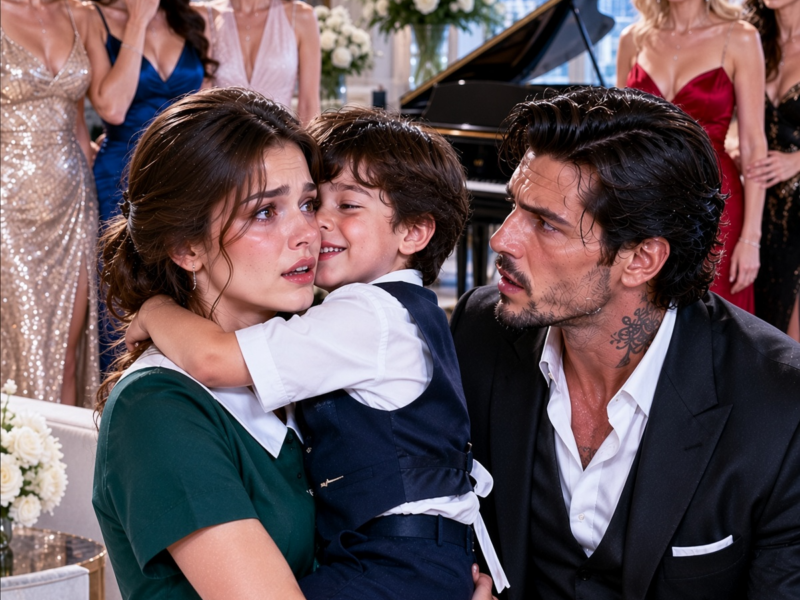
The Mafia Boss Asked His Son to Choose a New Mother From Five Wealthy Women—But the Boy Walked Past Them All and Took the Nanny’s Hand
Five women arrived at Lucas Ravalini’s Manhattan penthouse dressed like they were attending a merger, each one certain a five-year-old boy was about to choose the next Mrs. Ravalini.
Matteo had already rejected every nanny his father hired, and Lucas believed the child’s instincts might succeed where background checks, family alliances, and money had failed.
But when Matteo walked past five jeweled hands and wrapped both arms around the unemployed former teacher nobody had invited to compete, every adult in the room understood the evening had just become something else.
Hannah Cooper realized she was not at a nanny interview when the first woman handed a five-year-old boy a Cartier watch.
The child stared at the red leather box as though someone had offered him a tax document.
“What does it do?”
The woman laughed.
“It’s for when you’re older.”
Matteo Ravalini pushed the box back toward her.
“I’m five.”
Nobody laughed except Hannah.
It escaped before she could stop it.
A small sound.
Wrong room.
Wrong people.
The woman with the Cartier box turned.
Hannah immediately looked down at her shoes.
They were black flats from a department store clearance rack. The sole on the right one had begun separating near the heel, and she had used clear glue to hold it together that morning.
Across the room, the five women looked nothing like people who had ever glued their own shoes.
One wore cream silk and a diamond necklace understated enough to be more expensive than Hannah’s car.
Another wore a fitted navy dress and an expression suggesting she expected rooms to rearrange around her.
The third had brought an Hermès bag and a stuffed elephant larger than Matteo.
The fourth had arrived with no gift at all, which Hannah privately respected until the woman announced her family owned a ranch in Wyoming and Matteo could choose “his own pony.”
The fifth wore black.
No visible jewelry.
Perfect posture.
She seemed the least interested in the child and the most interested in the man seated near the fireplace.
Lucas Ravalini.
Forty-one.
Dark hair.
Charcoal suit.
A pale scar running from his right cheekbone toward his jaw.
He held a glass of whiskey he had not touched.
He had interviewed Hannah three days earlier and told her one unusual thing.
“My son chooses the nanny.”
She had thought he meant after trial interactions.
She had not imagined this.
Matteo stood in the center of the penthouse living room in a navy sweater and gray trousers, looking smaller every time another woman bent toward him.
The second woman crouched.
“I have horses.”
Matteo looked at her.
“Real ones?”
“Six.”
“Do they live with you?”
“At our estate in Connecticut.”
“Do you feed them?”
“Someone does.”
Matteo walked away.
The third woman opened a bag.
“I brought you the new PlayStation.”
Matteo stared at the box.
“I already have one.”
She laughed too loudly.
“Then you can have two.”
His shoulders rose toward his ears.
Hannah had taught children for eight years.
She knew that movement.
Overload.
He was five and surrounded by adults who were treating him like a prize in a contest he had never asked to enter.
Hannah lowered herself onto the carpet beside a low bookcase.
Not beside Matteo.
Not in front of him.
Just down.
There was a wooden train under the coffee table.
One wheel hung crooked.
She picked it up.
The first woman glanced over.
The fourth whispered something to the fifth.
Hannah ignored them.
She turned the train upside down.
Matteo noticed.
He did not approach.
“What are you doing?”
“Trying to figure out why this wheel hates the train.”
“It doesn’t hate it.”
“Looks personal.”
“It falls off.”
“I noticed.”
“You’re holding it wrong.”
Hannah looked at him.
“That could explain everything.”
He came two steps closer.
She turned the axle.
“Do you know where the pin went?”
Matteo pointed beneath the sofa.
Hannah got on her stomach and reached underneath.
Dust.
A Lego head.
A dried raisin.
Something metallic.
She pulled out a tiny brass pin.
“Evidence.”
Matteo came closer.
“That’s it.”
Hannah repaired the wheel.
Rolled the train across the carpet.
Straight.
Matteo watched.
Then looked toward his father.
Lucas set down his glass.
“All right.”
Every conversation stopped.
“Matteo.”
The boy looked at him.
“You’ve met everyone.”
“Yes.”
“You understand what I asked?”
Matteo nodded.
“Choose the person you want here.”
The woman in cream smiled.
The pony woman adjusted her dress.
The woman in black looked directly at Lucas.
Hannah frowned.
The wording bothered her.
Not the nanny.
The person.
Matteo turned.
He walked past the Cartier box.
Past the horses.
Past the PlayStation.
Past the promise of Disneyland from a woman Hannah had almost forgotten.
Past the black dress.
Then he crossed the entire room to Hannah.
He took her hand.
“Her.”
For one second, nobody moved.
The woman with the Cartier box laughed.
Not kindly.
“I’m sorry?”
Matteo tightened his fingers around Hannah’s.
Lucas kept his eyes on his son.
“You’re sure?”
“Yes.”
The woman in cream stood.
“Lucas, this is absurd.”
Lucas finally looked at her.
“Is it?”
“He was supposed to choose from us.”
Matteo leaned against Hannah’s leg.
Hannah looked down at him.
Then at Lucas.
And suddenly she understood the room.
The five women were not nanny candidates.
They were marriage candidates.
She was the nanny.
The control.
The ordinary person placed among women whose last names opened banks, boardrooms, and private clubs.
A five-year-old boy had just walked past every alliance his father had arranged and chosen the help.
The woman in black rose slowly.
“My father will hear about this.”
Lucas’s expression barely changed.
“I assume your father hears about most things you do.”
Her face hardened.
The pony woman snapped, “You told the council this dinner was about stability.”
“It was.”
“You said Matteo would select someone suitable.”
“He did.”
Every woman looked at Hannah.
Hannah wanted to disappear into the carpet.
Lucas rose.
The room changed with him.
“Ladies.”
His tone remained calm.
“Thank you for coming.”
The woman with the Cartier box stared.
“That’s it?”
“That’s it.”
“You are going to insult five families because a child likes his nanny?”
Lucas’s eyes cooled.
“My son did not insult anyone.”
The distinction was enough.
One by one they left.
Perfume.
High heels.
Controlled rage.
The private elevator swallowed them.
When the doors finally closed, Hannah released Matteo’s hand.
“Mr. Ravalini.”
“Yes?”
“What exactly did I just participate in?”
Matteo immediately went still.
Lucas noticed.
So did Hannah.
He said, “Matteo, Teresa has dessert in the kitchen.”
Matteo did not move.
“Are you leaving?”
The question came too quickly.
Too practiced.
Hannah’s anger paused.
“No.”
“Tonight?”
“No.”
“Tomorrow?”
Lucas looked away.
Hannah crouched until she and Matteo were eye level.
“I don’t know what tomorrow looks like yet.”
His mouth tightened.
“That means maybe.”
“It means I don’t lie to children.”
He studied her.
Then nodded once.
“Okay.”
He walked toward the kitchen.
Only after he disappeared did Hannah stand.
Lucas said, “You deserved an explanation.”
“Yes.”
“I did not give you one.”
“No.”
“I apologize.”
That surprised her.
Not because the apology was elegant.
Because it arrived without defense.
Lucas crossed toward the windows.
Manhattan spread below in lights.
“My family wants me remarried.”
“That sounds personal.”
“It is political.”
“That sounds worse.”
“It is.”
He turned.
“The Ravalini companies include shipping, commercial real estate, hospitality, and logistics.”
“And other interests.”
Hannah knew what that meant.
Everybody in New York had heard some version of the rumors.
The Ravalinis were legitimate enough to own hotels and feared enough that newspapers chose their verbs carefully.
Lucas continued.
“Three years ago my daughter died.”
Hannah’s anger softened despite herself.
“Matteo’s sister?”
“Yes.”
“Her name was Lucia.”
“What happened?”
“Not tonight.”
That answer told her enough.
“And the women?”
“Five families connected to mine.”
“Marriage would calm several business disputes.”
“You had your son choose?”
“Yes.”
“That is a terrible thing to put on a five-year-old.”
Lucas’s jaw shifted.
“I know.”
“Then why?”
“Because Matteo has rejected every adult I selected for him.”
“Nannies?”
“Nannies.”
“Tutors.”
“Two therapists.”
“Three family friends.”
“He no longer trusts my judgment.”
Hannah stared at him.
“That is not normal.”
“No.”
“Why doesn’t he trust you?”
Lucas looked down the hallway where Matteo had gone.
“That is the longer answer.”
“Then maybe you should have had a longer interview.”
Something almost like amusement crossed his face.
“You’re angry.”
“You used me.”
“Yes.”
The honesty was almost insulting.
“As what?”
“A control.”
Hannah laughed once.
“You invited five women worth hundreds of millions of dollars, put me in a clearance blouse at the edge of the room, and wanted to see whether your son could tell the difference?”
“Yes.”
“That is sociopathic.”
“I’ve been called worse.”
“I’m sure.”
She picked up her bag.
“I’m leaving.”
Lucas did not stop her.
That mattered.
At the elevator, Matteo appeared with chocolate on his mouth.
He saw the bag.
His face changed.
Not tears.
Recognition.
“You said tonight.”
Hannah stopped.
“I said I wasn’t leaving tonight.”
“It’s still tonight.”
Lucas remained across the room.
He did not interfere.
Hannah looked at the elevator.
Then at the little boy.
She put her bag down.
“I’m not leaving tonight.”
Matteo’s shoulders dropped.
“Tomorrow?”
“We talk tomorrow.”
He accepted that.
Barely.
Hannah slept in the guest room because it was nearly eleven and because leaving after telling Matteo otherwise would teach him the exact lesson he seemed determined to prove.
People leave.
Especially after saying they won’t.
At six-thirty, someone knocked.
Matteo stood outside in dinosaur pajamas.
“You’re still here.”
“Yes.”
He nodded, then said, “I’m hungry.”
The kitchen smelled faintly of coffee.
Lucas was already there.
No jacket.
White shirt sleeves rolled.
He looked less like the man whose name appeared in whispered stories and more like someone who had slept badly.
Matteo climbed onto a stool.
“Dinosaur cereal.”
Lucas opened one cabinet.
“No.”
“It’s there.”
“No.”
Hannah looked behind a bag of organic granola.
Found bright box.
Matteo smiled.
Lucas looked offended.
“That has never been there.”
Matteo said, “You don’t look.”
Hannah bit the inside of her cheek.
Lucas caught it.
“You may laugh.”
“I’m trying to keep my job.”
“You haven’t accepted it.”
“Then I’m preserving negotiating leverage.”
Matteo giggled.
Lucas looked at his son.
The sound seemed to surprise him.
Not because it was loud.
Because it existed.
Hannah saw something on Lucas’s face then she had not seen the night before.
Hunger.
Not for money.
Not power.
For the sound of his child being ordinary.
After breakfast, Hannah requested a meeting.
“No Matteo.”
Lucas nodded.
His office occupied the eastern corner of the penthouse.
Dark wood.
Glass.
Books that had actually been opened.
A desk positioned so Lucas could see both the door and the reflected hallway in a framed piece of art.
Hannah noticed.
Lucas noticed her noticing.
She sat.
“My conditions.”
His eyebrow rose.
“You have conditions?”
“I’m a professional.”
“Go ahead.”
“Written employment agreement.”
“Payroll.”
“Taxes.”
“Health insurance.”
“Defined hours.”
“Overtime.”
“Emergency authority limited to childcare.”
“Access to Matteo’s therapist if appropriate.”
“Background check on me.”
“And I get a background disclosure on you.”
Lucas almost smiled.
“That last one may take several binders.”
“I don’t need rumors.”
“I need to know what can affect the child.”
His expression changed.
“That’s fair.”
“One month trial.”
“Then either of us can end it.”
“Matteo doesn’t make final employment decisions.”
Lucas leaned back.
“He chose you.”
“He gets a voice.”
“Adults carry the decision.”
Lucas looked at her for a long moment.
“Agreed.”
“And one more thing.”
“Of course.”
“I am the nanny.”
“Not your girlfriend.”
“Not your wife.”
“Not a substitute mother.”
“Not a prop for whatever council runs your family.”
“If you need to demonstrate stability, buy a PowerPoint.”
Lucas’s mouth twitched.
“You were a teacher.”
“Eight years.”
“What happened?”
Hannah’s fingers tightened around legal pad.
“You already ran the background check.”
“I know the record.”
“I asked what happened.”
That distinction landed.
She told him.
Four teachers taking direct payments for inflated grades.
Hannah noticed.
Documented what she could.
Went to district superintendent.
The other teachers had attorneys and relationships.
Hannah had eight years of excellent reviews.
By the end, she was labeled disruptive.
Creating hostile environment.
Terminated.
No severance.
No reference.
Her certification still technically valid, but every district saw dismissal.
“Why didn’t you sue?”
“No money.”
“My brother offered.”
“Your brother?”
“David.”
“NYPD.”
“I didn’t want his money.”
Lucas studied her.
“You reported corruption and lost your job.”
“Yes.”
“Would you do it again?”
Hannah thought.
“I’d document better.”
He almost smiled.
“That was not my question.”
“Yes.”
“I’d do it again.”
Lucas nodded.
“You start Monday.”
She looked at him.
“You agreed to conditions?”
“All of them.”
“Why?”
“Because I don’t want somebody around my son who becomes cheaper when they’re desperate.”
That offended her.
Then she understood.
He meant boundaries.
People who kept them.
“All right.”
“One month.”
“One month.”
That was how Hannah Cooper became Matteo Ravalini’s nanny.
Not his mother.
Not Lucas’s answer.
An employee.
It mattered.
Matteo tested every promise.
The first week he refused lunch.
Hannah offered grilled cheese or soup.
He knocked both bowls away.
She made herself soup.
Sat at the island.
Ate.
Ten minutes later he climbed onto the stool beside her.
“Can I have some?”
“Yes.”
“You’re not mad?”
“I was annoyed.”
“That’s mad.”
“Annoyed is mad with better manners.”
He smiled.
The second week he woke at 2:14 a.m. screaming.
Hannah reached his room.
He threw his stuffed rabbit at her.
“Go away.”
She picked up the rabbit.
Placed it by door.
Sat in hallway.
“I’ll sit here.”
“I said go away.”
“I heard.”
“Then go.”
“No.”
“Why?”
“Because sometimes people say go when they mean prove you won’t.”
Silence.
Then:
“Come back.”
“I’m already here.”
By week three, he stopped asking every morning whether she would leave.
Lucas remained distant.
He came home late.
Read one story when he could.
Asked Hannah factual questions.
Did Matteo eat?
Nap?
Any nightmares?
Any calls from Sophia?
Hannah answered.
One morning, Matteo lined toy cars beneath the coffee table.
He turned one red car upside down.
Hannah sat nearby.
“Accident?”
“Bad man.”
Her stomach tightened.
“Who was in the car?”
“Lucia.”
Matteo’s face closed immediately.
“No one.”
He swept the cars into a bin.
That night Hannah told Lucas.
He went still.
“Do not ask him about Lucia.”
“That sounds like the exact reason I should understand.”
“She was my daughter.”
“I know.”
“No.”
His voice changed.
“You know the name.”
“You don’t know.”
Hannah waited.
Lucas looked toward window.
“She was five.”
“My former wife Catherine was her mother.”
“They died three years ago.”
“Car crash.”
“I’m sorry.”
Lucas’s hand tightened around the edge of desk.
“Matteo was two.”
“He did not see it.”
“But he saw what happened after.”
“To you?”
“To everyone.”
“Is he in therapy?”
“Yes.”
“Trauma specialist.”
“Then I need coordination if I’m his daily caregiver.”
Lucas frowned.
“You’re asking for access to medical treatment?”
“I’m asking for whatever the therapist believes I should know to avoid making things worse.”
Two days later, Dr. Maya Feld joined a secure call.
She explained attachment disruption.
Matteo’s mother, Sophia Bellini, lived in Miami and had become inconsistent after family crisis.
Not absent entirely.
Just distant.
Matteo experienced enough separations that his nervous system expected permanence to break.
“Don’t promise forever,” Dr. Feld said.
“Promise what you control.”
“Tonight.”
“Tomorrow morning.”
“After school.”
“Children who have lost too much often hear forever as a setup.”
Hannah wrote it down.
Lucas watched.
When call ended he said, “You take notes.”
“I’m a teacher.”
“You’re not anymore.”
The words came wrong.
Both knew it.
Hannah closed notebook.
“No.”
“I’m not.”
Lucas exhaled.
“That wasn’t what I meant.”
“I know.”
“I still heard it.”
He nodded.
“Fair.”
That was first time she saw him accept correction without turning it into contest.
Their relationship changed by inches.
One rainy Thursday, Lucas came home after nine.
Hannah was asleep on the sofa.
Matteo curled against her.
A picture book lay open across her chest.
Lucas covered them with a blanket.
Hannah opened her eyes.
“You’re home.”
“Yes.”
“What time?”
“Nine-fifteen.”
“You eat?”
“No.”
“There’s soup.”
“You made it?”
“Matteo helped.”
“That concerns me.”
“It should.”
She sat carefully so Matteo would not wake.
Lucas looked at his son.
“He doesn’t sleep on people.”
“He does now.”
Lucas’s fingers rested briefly on the back of the sofa.
“Thank you.”
“For what?”
“Staying.”
Hannah looked directly at him.
“That is not free.”
“I know.”
“Don’t turn gratitude into ownership.”
His expression tightened.
“I won’t.”
That was the first moment between them that felt intimate.
Not romantic.
A line drawn.
A line respected.
The second came ten days later.
Lucas canceled a family dinner where Matteo was expected to appear beside him.
Teresa, the house manager, told Hannah the council had been furious.
“Mr. Ravalini said his son is not a campaign poster.”
Hannah found Lucas on the balcony that evening.
Cold wind moved off Hudson.
“You canceled.”
“Yes.”
“Because of me?”
“Because you were right.”
She turned.
“You don’t say that often.”
“I don’t experience it often.”
She laughed.
He smiled faintly.
The wind lifted her hair.
Lucas removed his jacket.
Held it open.
“May I?”
She nodded.
He placed it around her shoulders.
His hands lingered for half a second at collar.
Warm.
Then moved away.
“Thank you.”
“Good night, Hannah.”
“Good night.”
No kiss.
No confession.
Trust first.
Then Marco Ravalini began coming more often.
Lucas’s older half-brother had silver hair, immaculate suits, and the kind of smile that suggested he believed every room contained a weakness if you waited long enough.
The first time he entered the kitchen, Matteo’s body stiffened against Hannah’s side.
Marco noticed.
“So this is famous nanny.”
“Hannah Cooper.”
“I know.”
His eyes moved to Matteo.
“Your father says you’re very happy.”
Matteo said nothing.
Marco crouched.
“Did you miss your uncle?”
Matteo stepped behind Hannah.
Lucas entered.
“Marco.”
“You have somewhere to be.”
Marco straightened.
“Always.”
His gaze rested on Hannah too long.
Then he left.
After that he appeared Thursdays.
Sometimes Wednesdays.
Always disappearing into Lucas’s office.
On those days Matteo’s nightmares worsened.
One afternoon Hannah passed the office carrying laundry.
The door was slightly open.
Marco’s voice traveled.
“She is a tool, Lucas.”
Hannah stopped.
“Nothing more.”
“She proves stability.”
“She gives council the appearance that your heir has normal household.”
Lucas answered:
“Hannah is not going anywhere.”
“How do you know?”
“Because my son chose her.”
“Your son chooses based on emotion.”
“He’s five.”
“Exactly.”
Marco laughed.
“When novelty ends, she’ll understand what you are.”
“She’ll run.”
“They always run.”
Silence.
Lucas finally said:
“If she runs, then staying here was not right for her.”
“And if she doesn’t?”
Marco’s tone changed.
“Then she knows too much.”
“Then she becomes leverage.”
“Then you’ll have to decide whether affection is worth risk.”
Hannah kept walking.
The basket suddenly felt heavier.
That evening she folded Matteo’s shirts with hands that did not quite feel connected to her.
Lucas found her in laundry room.
“You heard.”
“Yes.”
“How much?”
“Enough.”
He leaned against doorframe.
Hannah did not look up.
“You called me a tool.”
“I did.”
“Was he right?”
“Yes.”
The answer hurt despite expectation.
Lucas continued.
“When I hired you, yes.”
“I needed Matteo stable.”
“I needed council to see stability.”
“You served both.”
Hannah folded another shirt.
“And now?”
Lucas did not answer quickly.
Good.
“I don’t know what you are now.”
She looked up.
“That’s supposed to help?”
“No.”
“It is honest.”
“Truth after someone overhears it is cheaper.”
He absorbed that.
“I know.”
Hannah placed shirt down.
“I am staying for Matteo.”
“Not you.”
“I understand.”
“You don’t get to turn that into something romantic.”
“I won’t.”
“You don’t get to decide I belong here because your son likes me.”
“I know.”
“Do you?”
Lucas looked tired.
“I’m trying.”
She believed that more than confidence.
Three nights later, everything changed.
Matteo disappeared.
Hannah woke on the floor beside his bed after a nightmare vigil.
The mattress was empty.
Bathroom empty.
Closet empty.
Window locked.
Her voice tore through the penthouse.
“Matteo!”
Lucas appeared in hallway already moving.
No shoes.
Phone in hand.
“What?”
“He’s gone.”
Security sealed elevators.
Building reviewed cameras.
A service-camera feed had gone dark for thirty-two seconds.
One image appeared before failure.
Marco.
Holding Matteo’s hand.
Lucas’s face went white.
He called.
Marco answered on second ring.
“Where is my son?”
“Safe.”
“Where?”
“Central Park.”
“Why?”
“To prove a point.”
Lucas’s voice dropped.
“What point?”
“Your security is theater.”
“You brought a child into it.”
“I brought your heir three miles south.”
“You should thank me for showing you how easily someone else could.”
Lucas ended call.
Matteo was found near the closed carousel with Marco’s driver.
Physically unharmed.
Terrified.
Lucas carried him home.
Hannah took the child without asking.
Matteo pressed face into her neck.
Later, after he slept, Hannah stood in hallway.
“Call police.”
Lucas looked at her.
“No.”
“You brother took your child without permission.”
“It is more complicated.”
“No.”
“Hannah.”
“That phrase is how children get hurt twice.”
Lucas’s jaw tightened.
“If I publicly charge Marco, the organization fractures.”
“People choose sides.”
“Violence follows.”
“So instead you teach Marco your son is negotiable.”
“He is not.”
“Then prove it.”
Lucas stared at her.
“I can’t do what you’re asking without consequences.”
Hannah picked up her overnight bag.
“Every choice has consequences.”
His face changed.
“You’re leaving.”
“Yes.”
“You said you’d stay.”
“I promised Matteo I would be present.”
“I did not promise to stay inside a system that protects whoever frightens him.”
Lucas looked as if she had struck him.
“Hannah.”
“No.”
“Do not make me into your moral witness.”
“I’m not asking you to become good because I’m here.”
“I’m telling you I won’t help you call this normal.”
Matteo appeared at doorway.
Barefoot.
Rabbit in hand.
“Are you leaving?”
Hannah crouched.
“Tonight.”
His lower lip trembled.
“Because me?”
“No.”
“Because Daddy?”
“Because grown-ups need to fix something.”
“That means maybe.”
She remembered Dr. Feld.
Promise what you control.
“I will video-call you at breakfast.”
“Promise?”
“Yes.”
He nodded.
Cried anyway.
Hannah left.
Her brother David lived in Brooklyn.
Second-floor walk-up.
Two bedrooms.
A kitchen with one cabinet door that never stayed closed.
He opened door in sweatpants and stared at her suitcase.
“What happened?”
“I quit.”
“Good.”
“You don’t know job.”
“I know you only show up at midnight with luggage when somebody rich has done something stupid.”
She laughed and cried simultaneously.
David pulled her in.
He had been a detective with NYPD for nine years.
He disliked Lucas’s surname before meeting him.
When Hannah explained Matteo’s disappearance, David’s expression changed.
“Call child services.”
“His mother’s involved.”
“Family court.”
“Lawyer.”
“Something.”
“I know.”
“Do you?”
Hannah rubbed eyes.
“I love the kid.”
“That does not make you his legal guardian.”
“I know.”
“Say it again.”
“I know.”
David handed water.
“You can love somebody and still require adults around him to behave legally.”
That sentence stayed.
At seven-thirty Hannah called Matteo.
He was eating dinosaur cereal.
Lucas sat beside him.
Matteo held tablet.
“You called.”
“I promised.”
“Are you coming?”
“I don’t know yet.”
His face tightened.
Then he nodded.
“Okay.”
It was small.
It was enormous.
Lucas called ten minutes later.
“I reported Marco.”
Hannah sat upright.
“To who?”
“My attorney.”
“Family court counsel.”
“District attorney’s office.”
She went silent.
“You did?”
“Yes.”
“Why?”
“Because you were right.”
“That cannot be the reason.”
“It isn’t.”
Lucas’s voice roughened.
“I nearly lost one child protecting power.”
“I am not using another child to preserve it.”
That was the first true reversal.
Marco called it misunderstanding.
Security exercise.
Family protocol.
His attorneys objected to criminal framing.
But facts mattered.
He had transported a child without parental consent.
Matteo’s mother, Sophia Bellini, returned from Miami.
Hannah met her three days later.
Sophia was thirty-seven.
Dark hair.
Beautiful in a tired way.
She walked into Lucas’s penthouse and wrapped Matteo in both arms.
He went rigid.
Then collapsed against her.
“I’m sorry.”
she whispered.
“I’m sorry.”
Matteo looked at her.
“Are you staying?”
Sophia’s face broke.
“For this week.”
His eyes dropped.
She corrected:
“I will tell you exactly when I leave.”
“I won’t disappear.”
He nodded.
Dr. Feld later called that progress.
Sophia met Hannah in kitchen.
“You’re Hannah.”
“Yes.”
“Matteo talks about you.”
Hannah braced.
Sophia said:
“Thank you.”
Then, after a pause:
“Do not become his mother by accident.”
Hannah nodded.
“I won’t.”
Sophia looked relieved.
“I left because I could not live in Lucas’s world.”
“That doesn’t mean I stopped loving my son.”
“I know.”
“Do you?”
“Yes.”
“He does too.”
Sophia’s eyes filled.
“Good.”
For the first time, Hannah understood that absence was not always abandonment.
Sometimes people left because staying had become impossible.
That did not make the absence harmless.
It made it complicated.
Family court formalized Lucas and Sophia’s custody arrangement.
No more private understandings.
Matteo remained primarily in New York for school continuity, with scheduled time in Miami and regular calls.
Sophia gained direct access to therapists and school.
Lucas surrendered the idea that money and internal promises could replace legal structure.
Hannah returned after three weeks.
Not because Lucas asked.
Because conditions changed.
Marco was barred from residence.
Professional licensed security replaced family crews around Matteo.
Emergency protocols included police.
Matteo would not appear at council events.
Hannah had a signed employment agreement with exit rights and independent counsel review.
Lucas signed every page.
Then said:
“Welcome back.”
Hannah looked at him.
“That’s it?”
“What else?”
“I expected speech.”
“I’m trying to stop speeches from replacing behavior.”
She smiled.
“Good.”
The midpoint truth came from an old case file.
David called Hannah.
“Need talk.”
They met coffee shop.
He brought no police records illegally.
Only information from a retired investigator who had approached counsel after Marco’s name surfaced publicly in custody case.
“Lucia’s crash.”
Hannah’s stomach tightened.
“There was evidence it was deliberate.”
“I know.”
“More than Lucas told you.”
She stared.
David continued.
“Payments tied to shell company.”
“Burner-phone contacts.”
“Driver connected indirectly to Marco.”
“Lucas suspected.”
“Did he know?”
“He had copies.”
“Copies of what?”
“Enough to take police years ago.”
Hannah felt cold.
“Why didn’t he?”
David looked at her.
“You should ask him.”
That evening she did.
Lucas did not lie.
That made it worse.
“I suspected Marco.”
“You had records.”
“Yes.”
“You kept them.”
“Yes.”
“Why?”
He stared at floor.
“Because full investigation would expose the organization.”
Hannah’s voice rose.
“Your daughter died.”
“I know.”
“And you protected business?”
“I told myself I was protecting Matteo.”
“He was two.”
“I know.”
“You were protecting yourself.”
“Yes.”
The word landed without resistance.
Lucas looked at her.
“I chose power.”
“Because if I admitted my brother arranged Lucia’s death, council would say I could not control my own house.”
“So you let him stay.”
“Yes.”
“Near Matteo.”
“Yes.”
Hannah turned away.
“That isn’t grief.”
“No.”
“That is cowardice.”
Lucas closed eyes.
“Yes.”
For the first time she saw him without armor.
Not misunderstood dangerous man.
Not secret protector.
A man who had made a terrible decision.
She said:
“What are you going to do?”
Lucas looked at her.
“Give them everything.”
“Who?”
“Police.”
“Prosecutors.”
“My attorney.”
“And when it exposes you?”
“It exposes me.”
“That could destroy you.”
“Yes.”
“Your companies.”
“Some.”
“Your freedom.”
“Possibly.”
Hannah believed him when he said:
“I already paid for silence once.”
“I’m not billing my son again.”
Within forty-eight hours, Lucas turned over documents through counsel.
The investigation widened.
Marco’s financial interests.
Legacy Ravalini operations.
Shell companies.
Coercive business practices.
Tax violations.
Not everything involved Lucas personally.
Enough did.
Press began.
Headlines.
Rumors became allegations with dates.
Lucas stepped down from executive control of legitimate holdings pending review.
Several old allies vanished.
The five families stopped calling.
One lender pulled credit.
One development project collapsed.
For the first time, Lucas Ravalini lost power in public.
He did not retaliate.
That was the point.
Hannah moved out of the penthouse during investigation.
Not because she stopped caring.
Because she needed to know whether she could choose him without his world choosing for her.
She kept working with Matteo during afternoons by agreement with Sophia and Lucas.
Stayed nights at her own apartment.
Lucas hated it.
Accepted it.
One evening he came to Brooklyn to pick Matteo up after tutoring.
Hannah was packing snacks.
Lucas looked around the small kitchen.
“You lived here when I hired you?”
“Yes.”
“This is very small.”
“It gets bigger when you stop standing in doorway.”
He moved.
She zipped lunch bag.
Lucas said:
“You were desperate.”
“Yes.”
“I knew.”
“Yes.”
“I withheld context anyway.”
Hannah stopped.
He continued.
“I exploited that.”
“You offered a job.”
“I let you accept risk without knowing risk.”
“That is exploitation.”
Silence.
Then:
“I’m sorry.”
Not flowers.
Not jewelry.
Not grand gesture.
Just the sentence.
Hannah asked:
“For which part?”
“All the parts where I decided what you could handle instead of letting you decide.”
That answer mattered.
She handed him lunch bag.
“That’s better.”
“High praise.”
Their fingers touched.
Neither pulled away immediately.
Hannah said:
“I care about you.”
Lucas swallowed.
“I know.”
“I do not trust the world you built.”
“I don’t either.”
That was the third intimate scene.
Trust still unfinished.
Affection no longer denied.
Then the case became public.
Federal prosecutors charged Lucas with financial conspiracy, commercial coercion, tax-related offenses, and obstruction tied to withholding evidence in Lucia investigation.
No accusation that he ordered physical harm.
Enough to threaten years.
His lawyers could fight.
They had arguments.
Statute issues.
Evidentiary questions.
Lucas chose cooperation.
Not surrender without counsel.
A structured proffer.
Restitution.
Corporate monitorship.
Truth.
The low point came when Matteo heard at school.
A boy told him:
“Your dad’s mafia.”
Matteo did not hit him.
He swept his own books off desk and crawled beneath a reading table.
The school called Hannah because Lucas was with attorneys and Sophia was in transit.
Hannah found him under table.
“Want company?”
“No.”
She sat outside.
Ten minutes passed.
“Is Daddy bad?”
The question came from underneath.
Hannah closed eyes.
“That is a very big word.”
“Did he do bad things?”
“Yes.”
“Is he going to jail?”
“Maybe.”
“Will you leave if he does?”
There it was.
Same wound.
Different day.
Hannah said:
“I will be here after school tomorrow.”
“What about next week?”
“I plan to be.”
“No forever?”
“No forever promises.”
Matteo crawled out.
His face wet.
“Good.”
Why good?”
“Because forever people leave.”
Hannah’s chest hurt.
She opened arms.
He came.
Lucas heard about conversation later.
He sat in Hannah’s apartment without coat.
“Thank you for telling him truth.”
“You’re welcome.”
“Do you still care about me?”
Hannah looked at him.
“Yes.”
“Is that all I get?”
“For now.”
He almost smiled.
“Fair.”
Marco’s case developed separately.
Evidence connected his shell companies to the paid driver in Lucia’s collision and later to Matteo’s unauthorized removal.
He denied intent for Lucia’s death at first.
Claimed pressure tactic.
Eventually plea negotiations changed.
He admitted conspiracy surrounding collision and subsequent obstruction, plus kidnapping-related offense for Matteo incident and financial crimes.
His motive was not simple hatred.
He believed Lucas had made the family weak.
He had spent decades watching Lucas inherit authority he thought should have been shared.
Lucia’s presence softened Lucas publicly.
Marco believed removing emotional leverage would restore ruthless leader family required.
It was monstrous logic.
Still logic.
At a hearing, Marco looked at Lucas and said:
“You became exactly what I warned everyone you would become.”
Lucas answered:
“A father?”
Marco smiled bitterly.
“A man willing to lose power.”
Lucas said:
“Yes.”
No louder.
That was the change.
Lucas eventually reached a plea agreement.
Thirty months federal custody.
Financial restitution.
Loss of certain business roles.
Continued monitorship.
Hannah did not marry him before sentencing.
He asked once.
Not with a ring.
“Would legal marriage make anything easier for you and Matteo?”
“No.”
“Would you marry me anyway?”
“No.”
He looked surprised.
Hannah continued:
“Not because I don’t love you.”
That was first time.
Lucas went still.
She swallowed.
“I do.”
“But I will not marry you because prison makes time feel urgent.”
“I won’t let fear write that contract.”
Lucas’s eyes filled.
“Okay.”
“You’re not going to argue?”
“No.”
“I’m learning.”
The night before he reported, they sat on her fire escape.
No penthouse.
No skyline glass.
Just Brooklyn brick, sirens far away, somebody cooking garlic downstairs.
Lucas said:
“I thought love meant control.”
Hannah leaned shoulder against his.
“What do you think now?”
“That control is what you reach for when you don’t trust love to survive choice.”
She looked at him.
“That was annoyingly good.”
“I practiced.”
“I knew it.”
He laughed.
Then kissed her.
Slow.
No claim.
No promise beyond that night.
Lucas served twenty-six months with credit and program completion.
Matteo spent scheduled time between Sophia and New York.
Hannah remained his nanny for another six months.
Then stopped.
Not because leaving.
Because her own life began moving again.
The state education department reopened cases tied to her former district after an audit uncovered grade manipulation and improper payments.
Records supported what Hannah had reported.
Her termination was rescinded administratively.
She received amended personnel file.
Certification restored without cloud.
The district offered settlement.
She accepted enough to clear debt and fund retraining, not enough to make life magically rich.
Then a small Brooklyn elementary school hired her.
Second grade.
Twenty-two children.
One classroom.
Dry erase markers.
Paper snowflakes.
Noise.
On first morning she stood at door and almost cried.
Matteo visited after school.
He looked around.
“You have lots of kids now.”
“Yes.”
“Am I still favorite?”
“I’m a professional.”
“That means yes.”
“Go do your homework.”
Lucas called from prison that evening.
“How was first day?”
“Twenty-two second-graders.”
“That sounds more dangerous than my old life.”
“It is.”
“Did you miss nannying?”
“No.”
He laughed.
Then said:
“I’m proud of you.”
Hannah closed eyes.
Not because she needed approval.
Because he finally celebrated a life that did not revolve around him.
Sophia and Hannah built something careful.
Not friendship immediately.
Respect.
At Miami pickup, Sophia said:
“Matteo loves you.”
“I love him.”
“I know.”
“Hannah.”
“Yes?”
“You are not replacing me.”
“I know.”
Sophia looked toward Matteo.
“He knows too.”
“That took me a while.”
“Thank you for not making him choose.”
The sentence carried entire story.
Hannah nodded.
“He had enough choosing for adults.”
When Lucas was released, Hannah did not bring Matteo to prison gate.
They met at a reentry center later that day.
Lucas walked into waiting room carrying a clear plastic bag.
Two shirts.
Letters.
Books.
Matteo was seven now.
Taller.
Still serious.
He saw his father.
Stopped.
Lucas crouched.
Did not open arms first.
“Hi.”
Matteo swallowed.
“You staying now?”
“I’m coming home.”
“Forever?”
Lucas glanced at Hannah.
She said nothing.
He looked back at son.
“No one can promise forever.”
Matteo’s mouth trembled.
Lucas continued.
“But I can promise what I control.”
“I will pick you up from school tomorrow.”
“And Friday.”
“And Saturday breakfast.”
“And every day after that I’m able.”
Matteo stared.
Then ran.
Lucas closed arms around him.
His eyes shut.
Hannah looked away.
Some moments belonged first to parent and child.
Later, outside, Lucas approached.
“Hi.”
“Hi.”
“You look different.”
“So do you.”
“Bad?”
“Less expensive.”
He laughed.
“Federal wardrobe.”
They did not kiss.
He asked:
“Dinner?”
“A date?”
“Yes.”
“Real one?”
“No council.”
“No nanny contract.”
“No child choosing.”
“No child.”
Hannah smiled.
“Friday.”
Their first real date happened at a small Italian restaurant in Brooklyn.
Red checkered cloth.
Candles in old wine bottles.
Lucas looked deeply out of place.
Hannah liked that.
“Are you still angry?”
“Yes.”
“Good.”
“Why good?”
“Because you stayed long enough to stop performing forgiveness.”
She looked at him.
“What did prison teach you?”
“That I hate fluorescent lighting.”
“Anything useful?”
“That consequences are quieter than fear.”
He paused.
“And that I spent most of my life calling control responsibility.”
“That one’s useful.”
“I thought so.”
They moved slowly.
Lucas rented a townhouse instead of returning to penthouse.
The penthouse sold during restructuring.
Some legitimate Ravalini holdings survived under independent governance.
Lucas retained minority interests where permitted and worked as compliance consultant for logistics firms after supervised-release approval.
It paid well.
Not empire well.
Enough.
He discovered groceries had prices.
Hannah enjoyed this more than she should.
At a supermarket he stared at berries.
“Eight dollars?”
“Yes.”
“For this?”
“Yes.”
“Why?”
“Because capitalism.”
“I used to own warehouses.”
“Congratulations.”
He bought berries.
Matteo ate them all.
Lucas learned ordinary fatherhood.
School pickup.
Dentist.
Soccer practices he did not understand.
Birthday parties where nobody cared about his surname.
He attended Hannah’s parent night once.
Sat in back.
Watched her explain reading groups.
Afterward, he said:
“You’re different there.”
“How?”
“You’re completely yourself.”
“That concerns you?”
“It makes me like you more.”
She smiled.
Another night, on anniversary of Lucia’s death, Lucas called instead of disappearing.
“I’m not okay.”
Hannah drove over.
Found him sitting on kitchen floor.
No whiskey.
Just photograph.
Lucia, five.
Red balloon.
Hannah sat beside.
Did not say it’s okay.
Did not tell him she was in better place.
Did not fix.
After twenty minutes, Lucas said:
“I think I loved you before I understood love without possession.”
“That sounds alarming.”
“It was.”
Hannah took his hand.
“I love you too.”
He looked at her.
“You already said it once.”
“I know.”
“I’m saying it when nobody’s about to go to prison.”
“That seems healthier.”
A year after his release, Matteo turned eight.
Dinner included Sophia.
David.
Margaret.
Hannah.
Lucas.
No council.
No wealthy candidates.
No strategic photographers.
Matteo asked:
“Did I really pick Hannah?”
Sophia raised eyebrow.
Lucas looked guilty.
Hannah said:
“You picked me as nanny.”
Matteo grinned.
“Then Dad fell in love with you.”
“Years later.”
“Not years.”
“Emotionally, years.”
David laughed.
Lucas said:
“You were five.”
Matteo shrugged.
“I knew.”
Hannah pointed fork.
“No.”
“You had a preference.”
“You were not responsible for adult decisions.”
Matteo looked thoughtful.
“That sounds like Dr. Feld.”
“Dr. Feld is smart.”
“So I didn’t choose my new mom.”
“No.”
Sophia answered first.
“You chose someone you trusted.”
Matteo looked at her.
“And then all the adults finally did their own jobs.”
Sophia smiled.
“Exactly.”
Later on balcony, Lucas asked Hannah:
“Do you want marriage?”
Not marry me.
Do you want it.
She thought.
“Eventually.”
He nodded.
No ring.
Six months later, she brought it up.
“Still want marriage?”
“Yes.”
“Good.”
“Because I do now.”
He smiled.
“Do I get to propose?”
“You may submit request.”
He proposed in kitchen.
No orchestra.
No penthouse.
Matteo doing homework nearby.
A simple ring.
Independent prenup attorneys for both.
Sophia listed clearly in parenting agreements.
Hannah did not adopt Matteo because Sophia remained his mother.
Instead, family court eventually recognized Hannah as step-parent after marriage with limited delegated authority under parental consent.
Clean.
Respectful.
Real.
The wedding was small.
Civil ceremony.
David.
Margaret.
Sophia.
Matteo.
Dr. Feld jokingly declined invitation but sent card:
No child was consulted regarding this marriage. Excellent progress.
Hannah laughed until she cried.
Years later, Hannah became assistant principal at her school.
Not because Lucas donated.
He was forbidden from trying.
She warned him.
“If a building gets named after me, divorce.”
“I wasn’t—”
“You were.”
“Maybe lightly.”
“No.”
“Yes, ma’am.”
Matteo grew.
At ten he no longer woke from nightmares often.
At twelve he asked directly what his father had done.
Lucas told age-appropriate truth.
No mythology.
No glamorous mafia story.
“I made choices that harmed people.”
“I paid legal consequences.”
“I am trying to live differently.”
Matteo asked:
“Was Uncle Marco evil?”
Lucas answered:
“No.”
“He was responsible.”
“That is more useful word.”
Hannah heard from hallway.
Another lesson.
Years after original penthouse night, Hannah’s school hired new after-school coordinator.
Five finalists.
Students would participate in demo activity.
Matteo, now thirteen, volunteered because Hannah needed adolescent feedback.
Before interviews he joked:
“Do I get to choose?”
Hannah stared.
Lucas, seated nearby with coffee, nearly choked.
Matteo grinned.
“What?”
Hannah said:
“You get a voice.”
“Adults carry decision.”
He rolled eyes.
“I know.”
Lucas looked at Hannah.
Same principle.
Finally learned.
After demos, students loved candidate three.
Teachers favored candidate four.
Hannah reviewed references, safeguarding experience, schedule, and feedback.
They chose candidate three after adults completed full assessment.
Matteo asked:
“So my opinion mattered?”
“Yes.”
“Was it everything?”
“No.”
“Good.”
He smiled.
That evening the three of them ate dinner in townhouse kitchen.
No marble.
No private elevator.
No council.
Lucas made pasta badly.
Hannah fixed salt.
Matteo complained.
Ordinary.
After dishes, Lucas found Hannah by window.
“Do you ever think about that first night?”
“Sometimes.”
“I was awful.”
“You were.”
“You stayed.”
“For Matteo.”
“I know.”
“Then later for me.”
“Eventually.”
Lucas smiled.
“Do you regret it?”
Hannah looked toward dining table where Matteo had left math homework open beside a glass of milk.
Then at Lucas.
“No.”
“But I’m glad he didn’t actually choose my life for me.”
Lucas nodded.
“So am I.”
The city outside had changed.
Or maybe they had.
Hannah remembered five wealthy women standing beneath expensive lights, waiting for a frightened little boy to carry a decision no child should have been asked to make.
Matteo had walked past all of them.
He had taken her hand.
That mattered.
But it had never been the ending.
It had only been the first honest thing anyone in that room had done.
And this time, the child was allowed a voice without being asked to carry the choice.









