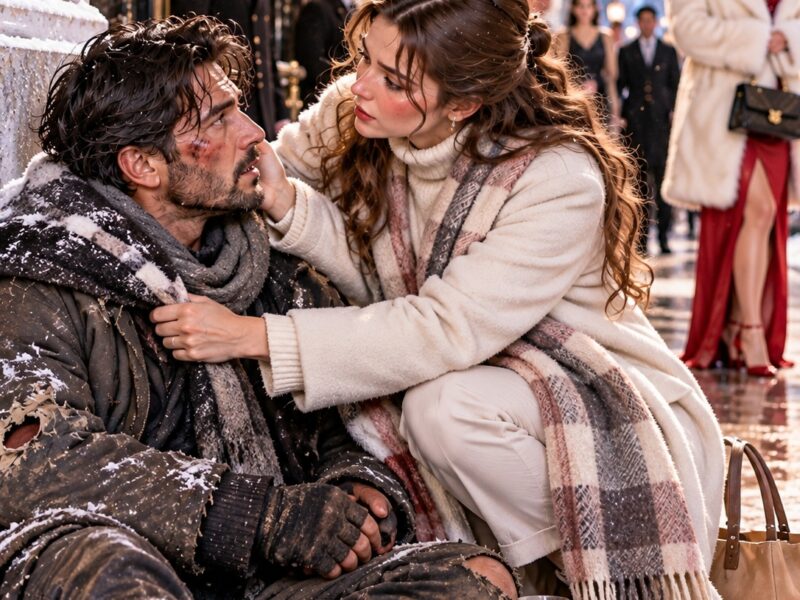
The Mafia Boss Disguised Himself as a Beggar Before the Winter Gala—Every Heiress Failed His Test Until One Florist Gave Away the Only Warmth She Had
Dominic Callahan controlled half of Manhattan’s criminal economy, yet for three days he sat freezing outside a Fifth Avenue hotel in torn boots and a filthy surplus coat.
The women his advisers wanted him to marry stepped over him, insulted him, or never looked down long enough to see his face.
Then a broke florist who had just lost the contract that might save her father’s shop knelt on the sidewalk, gave him her lunch and scarf—and unknowingly changed the question he had been asking.
The December wind came down Fifth Avenue hard enough to turn every corner into a blade.
Dominic Callahan sat against the limestone façade of the St. Regis with his knees drawn beneath an oversized military-surplus coat, a dirty knit cap pulled low over his forehead, and one battered paper cup near his boot.
The cup held forty-three cents.
He knew because he had counted.
Twenty-five cents came from an elderly woman who apologized because she had no cash and then dug through her purse until she found a quarter.
A nickel came from a delivery driver.
The rest had been thrown without eye contact.
Dominic had spent the first thirty-two years of his life learning how money moved when people feared him.
The last three days had taught him how money moved when people believed he was powerless.
The lesson was not flattering.
A woman stepped from a black town car wearing white mink and cream boots.
Victoria Harrington.
Thirty.
Daughter of Judge Calvin Harrington.
Graduate degree from Columbia.
Enough inherited money to live three lifetimes without repeating a dress.
Also number two on the list Dominic’s council had prepared.
She saw the cup.
She saw him.
Then nudged the cardboard with one polished boot until the coins spilled across the icy pavement.
“Get a job.”
Dominic lowered his eyes.
Victoria walked into the hotel.
Behind the fogged windows, she would probably order champagne and tell someone the city had gotten disgusting.
Dominic waited until the revolving doors swallowed her.
Then spoke softly into the microphone hidden beneath the collar of his coat.
“Victoria Harrington.”
A voice answered through the almost invisible receiver in his ear.
“Got it.”
“Remove her.”
Leo Mercer, Dominic’s closest adviser, hesitated.
“From the dinner list?”
“From every list.”
“Understood.”
Dominic gathered the coins.
Not because he needed them.
Because leaving them scattered on the sidewalk felt wasteful.
Three days earlier, the Callahan Council had given him a deadline.
The annual Winter Foundation Gala was Saturday night.
Dominic had until then to name a woman he intended to court seriously.
Not necessarily marry.
The council no longer had the legal power to force a Callahan marriage, despite the old men speaking as though nineteenth-century contracts still controlled modern corporations.
But their leverage was real.
Five families jointly owned pieces of the port unions, private-security firms, commercial real estate, hospitality groups, and shipping interests that kept the legitimate side of Dominic’s organization stable.
His father had died seven months earlier.
Since then, three senior families had challenged Dominic’s authority indirectly.
Contracts delayed.
Meetings missed.
One warehouse mysteriously lost an insurance renewal.
A customs brokerage firm suddenly wanted new guarantees.
The message was simple.
Prove continuity.
Marry into an established family.
Or accept a slow war over everything his father built.
Dominic could have chosen any woman they offered.
That was the problem.
He did not trust any of them.
He had grown up around women and men who could smile during lunch and destroy each other before dinner.
So he designed an experiment.
Leo called it ridiculous.
His attorney called it potentially embarrassing.
His security director called it “a logistical nightmare.”
Dominic called it necessary.
For three days, he dressed like a man everybody assumed had failed at life and positioned himself outside the places where the council’s preferred candidates naturally appeared.
Hotel entrances.
Charity offices.
Luxury boutiques.
Private clubs.
He did not ask anyone for money.
He only watched.
People behaved differently around power they did not recognize.
That was what he wanted to see.
Most ignored him.
A few were kind in the efficient way people were kind when they wanted to feel finished quickly.
One woman gave him twenty dollars while keeping six feet between them and immediately photographed the interaction from across the street.
Victoria kicked his cup.
Dominic almost ended the experiment after that.
At four-fifteen, the sky turned the color of steel.
Leo’s voice came through his earpiece.
“Boss, we need to pull you. Temperature is dropping.”
“Another hour.”
“The board meeting is in forty minutes.”
“They can wait.”
“You said that yesterday.”
“They survived.”
Leo sighed.
“You’re going to catch pneumonia looking for a saint.”
“I’m not looking for a saint.”
“What are you looking for?”
Dominic considered.
“Someone who is still themselves when they think I have nothing.”
Leo became quiet.
That answer was closer to the truth than Dominic intended.
A crash sounded twenty feet away.
Cardboard hit pavement.
Someone cursed softly.
Dominic looked up.
A young woman had slipped near the curb.
Her navy pea coat was worn at the cuffs.
One knee of her dark trousers had landed on wet sidewalk.
A cardboard flower box had burst open.
White orchids scattered across gray slush.
Baby’s breath tangled around a parking sign.
Blocks of green floral foam rolled toward the gutter.
The woman stared at the wreckage.
For several seconds, she did not move.
Then she whispered:
“No.”
Not loudly.
The word sounded exhausted rather than dramatic.
She scrambled after the orchids.
Pedestrians moved around her.
Nobody stopped.
One man actually stepped over a flower.
Dominic watched her gather stems one at a time.
Several were snapped.
The white petals had already begun browning where salt touched them.
Whatever those flowers were for, they mattered.
He knew that from the way she held one broken stem as though it had personally betrayed her.
Finally, she looked toward him.
Amber eyes.
Dark hair blown loose from a low ponytail.
No makeup he could identify.
Red nose from cold.
She stared.
Dominic waited for the usual quick glance away.
Instead, she stood.
Then walked toward him.
He instinctively checked the sidewalk behind her.
No accomplice.
No phone camera.
Nothing.
She stopped two feet away.
“Are you okay?”
Dominic almost laughed.
Her flowers were destroyed.
Her trousers were wet.
She was asking him.
He roughened his voice.
“I’m fine.”
She looked at his boots.
Duct tape.
Leo had overdone those.
“You don’t look fine.”
“Occupational hazard.”
That made her blink.
Then smile slightly.
She opened her oversized canvas tote.
Pulled out a foil-wrapped sandwich.
Then a stainless-steel thermos.
“I was supposed to eat this two hours ago.”
Dominic looked at them.
“Why didn’t you?”
She glanced at the ruined orchids.
“I had bigger problems.”
“Then keep it.”
“You’re sitting outside in twelve-degree weather.”
“I said I’m fine.”
“And I said you don’t look fine.”
There was no pity in her voice.
That mattered.
She knelt.
Actually knelt.
On dirty pavement.
Placed the sandwich beside his cup.
Then unscrewed the thermos.
Steam rose.
“Coffee.”
Dominic stared.
“Milk, no sugar.”
“How do you know I drink coffee?”
“I don’t.”
“Could be tea.”
“You look like coffee.”
That was the first thing anyone had said to him in three days that genuinely surprised him.
He almost smiled.
“What kind of sandwich?”
“Turkey. Swiss. Mustard.”
“Mustard?”
She looked offended.
“Obviously.”
Dominic glanced toward her ruined flowers.
“You need this more.”
“Probably.”
“Then why give it away?”
She looked at him.
“Because I can buy another sandwich.”
“Can you?”
The question came out too sharp.
Her expression changed.
He had touched something.
“Eventually.”
She stood.
Wind caught the edges of her coat.
Without warning, she unwound the deep crimson scarf around her neck.
Dominic frowned.
“No.”
“Yes.”
“You’re cold.”
“So are you.”
“You don’t know me.”
“That seems unrelated.”
Before he could stop her, she draped the scarf around his shoulders.
Warm wool.
Faint scent of vanilla and eucalyptus.
Her fingers brushed the side of his cheek.
Not flirtation.
Not fear.
Simple human contact.
Dominic had forgotten what that felt like without context attached.
“Why?”
She gave him a tired smile.
“Because nobody deserves to be invisible.”
Then she went back to the flowers.
Dominic watched her gather the ruined orchids into the box.
She threw away only the stems that could not be saved.
The rest she carried with her.
No dramatic glance back.
No expectation of gratitude.
She simply walked east into the wind without her scarf.
Dominic sat there until she disappeared.
Leo’s voice came through.
“Boss?”
Dominic did not answer.
“Boss?”
“I heard you.”
“Who is she?”
“I don’t know.”
Silence.
Then Leo understood.
“You want me to find out.”
“No.”
Leo sounded surprised.
“No?”
Dominic picked up the sandwich.
“Not yet.”
He opened the foil.
Turkey.
Swiss.
Mustard.
Exactly what she said.
He ate half.
Then wrapped the other half again.
“Pull the car around.”
“Board meeting?”
“First.”
“And then?”
Dominic looked at the crimson scarf.
“Then we find out who she is.”
The woman’s name was Beatrice Monroe.
Twenty-seven.
Owner of Monroe Blooms on West Fifty-Fourth.
Her father, Samuel Monroe, had opened the flower shop thirty-one years earlier.
He died eight months ago from lung cancer.
Beatrice had inherited the business.
And the debt.
Dominic stood in the penthouse of Callahan Tower while Leo read from a folder.
“Medical bills?”
“Some.”
“Business debt?”
“Most.”
“How bad?”
“About one hundred thirty-six thousand.”
Dominic looked toward the skyline.
“Bank?”
“Originally.”
“Originally?”
Leo’s mouth tightened.
“The note was sold.”
“To?”
“RGM Recovery.”
Dominic turned.
He knew the company.
Private debt collection firm with aggressive tactics.
Not illegal enough to close.
Not clean enough for decent people.
“Who owns it?”
“Minority stake controlled through a Russo holding company.”
Tommy Russo.
Moretti associate.
Dominic’s expression sharpened.
Leo continued.
“The orchids today were samples for the St. Regis gala floral contract.”
Dominic looked at the scarf on the table.
“She was bidding?”
“Yes.”
“Did she get it?”
“No.”
“Because they were destroyed?”
“Hotel went with Bellamy Floral after she missed presentation.”
Dominic’s jaw tightened.
Leo waited.
“You want me to fix it?”
“No.”
That surprised Leo again.
“No?”
“If I fix every problem she has before she knows who I am, I’m not learning anything about her.”
“Then why investigate?”
“Because Russo is involved.”
“That sounds like fixing.”
“It’s risk assessment.”
Leo smiled.
“You paid someone to say that to you?”
Dominic ignored him.
“Anything else?”
“She teaches free floral workshops twice a month at a women’s shelter in Queens.”
Dominic looked over.
“She’s late on her own commercial rent.”
“Yes.”
“But works for free.”
“Yes.”
“Anyone dependent on her?”
“Mother lives in Vermont. Estranged brother in California. No spouse. No children.”
Dominic closed the file.
“Stop.”
Leo frowned.
“Stop what?”
“Looking into her.”
“You asked.”
“I know enough.”
“What are you going to do?”
Dominic looked at the Winter Gala invitation sitting on the desk.
“Invite her.”
Leo stared.
“You can’t invite a stranger to a syndicate gala.”
“Watch me.”
“No, I mean legally and emotionally and just generally—”
“Leo.”
“Yes?”
“Find out whether RGM is violating collection law.”
“That I can do.”
“Quietly.”
“Of course.”
“And send the St. Regis florist contract to open rebid.”
Leo stared again.
“You said no fixing.”
“I’m not giving it to her.”
“You’re reopening the bid.”
“Fair process.”
“You’re impossible.”
“I’ve heard.”
Beatrice arrived at Monroe Blooms the next morning at six-twenty.
The store was colder inside than outside.
The boiler had failed again.
She kept her coat on while turning on lights.
Her father’s old radio sat behind the register.
For nine months she had refused to move it.
She switched it on.
Static.
Then jazz.
She liked mornings before customers.
Flowers made more sense before people wanted something from them.
She checked the back office.
No broken window.
No threatening note.
That was already an improvement.
Two nights earlier, someone from RGM had taped a FINAL DEMAND letter to the glass.
Not illegal.
Humiliating.
She removed it before opening.
At seven, her employee Nina arrived.
Twenty-two.
Art student.
Three earrings in one ear.
“Did we win the St. Regis?”
Beatrice looked toward the trash bin.
“No.”
Nina stopped.
“What happened?”
“I slipped.”
“Oh God.”
“Orchids lost a fight with New York City.”
“Are you okay?”
“My dignity has been pronounced dead.”
Nina laughed.
Then noticed Beatrice’s neck.
“Where’s your red scarf?”
Beatrice hesitated.
“Gave it away.”
“To whom?”
“Someone.”
Nina’s eyebrows climbed.
“Someone attractive?”
“Someone freezing.”
“Those categories can overlap.”
“Not relevant.”
The bell above the front door rang.
A courier entered.
Dark coat.
Leather gloves.
Carrying a cream envelope.
“For Beatrice Monroe.”
She signed.
Inside:
Formal invitation to the Metropolitan Winter Foundation Gala.
Saturday.
St. Regis.
VIP access.
No explanation.
No dress.
No diamonds.
No fairy-tale box.
Just an invitation and one handwritten card.
You lost the floral bid because the city knocked you down, not because your work failed. The hotel has reopened the presentation process. If you want another chance, take it.
No signature.
Beatrice stared.
Nina leaned over.
“What?”
“I don’t know.”
Then a second line:
And if you attend the gala, wear the red scarf if you still have it.
Beatrice’s stomach shifted.
The man outside the hotel.
Impossible.
Nina read her face.
“What happened yesterday?”
“Nothing.”
“That is never your face for nothing.”
Beatrice folded the card.
“Nina.”
“Yes?”
“Do we have enough salvage orchids to make one sample arrangement?”
Nina smiled slowly.
“Now you’re talking.”
Beatrice rebuilt the presentation.
Not with rare imported orchids.
Those were gone.
She used white ranunculus, winter eucalyptus, red berries, and bare quince branches.
Cheaper.
Stronger.
More original.
At noon, the St. Regis called.
The selection committee had reopened bids because of a procurement irregularity discovered in the original scoring.
That was not Dominic.
Not entirely.
Leo’s review had found Bellamy Floral’s owner was the cousin of a hotel purchasing manager who failed to disclose the relationship.
The hotel canceled the award.
Beatrice presented at four.
She did not win.
A larger firm still had better capacity.
But the hotel offered her the smaller contract for the private supper rooms.
Twenty-two thousand dollars.
Enough to pay staff.
Not enough to erase her debt.
It was fair.
That mattered more.
Saturday evening, Beatrice nearly did not attend.
She owned no gown suitable for the St. Regis.
Nina solved that.
Her older sister worked in wardrobe for Broadway.
A black velvet dress appeared.
Simple.
Elegant.
Borrowed.
No diamonds.
Beatrice wore small gold earrings that had belonged to her mother.
And the red scarf.
She had retrieved it the previous evening.
The man had disappeared from the sidewalk, but the scarf had been folded beneath the hotel awning with a note.
Thank you for the warmth.
She carried it over one arm.
At the gala entrance, security scanned her invitation.
The guard’s posture shifted.
“Ms. Monroe.”
“Yes?”
“This way.”
“Why?”
“You’re on Mr. Callahan’s guest list.”
Beatrice stopped.
“What?”
The guard smiled carefully.
“Mr. Dominic Callahan.”
She knew the name.
Everybody in New York did.
Publicly:
Callahan Maritime.
Callahan Properties.
Callahan Security Holdings.
Privately:
Stories.
Whispers.
People lowering voices.
The doors opened.
The ballroom glowed.
Three hundred people.
String quartet.
Crystal.
Gold.
Beatrice immediately regretted coming.
Then the room quieted.
She looked toward the staircase.
A man in a black tuxedo stood at the top.
Tall.
Broad-shouldered.
Dark hair.
Blue eyes.
She knew those eyes.
Her breath caught.
“No.”
Dominic descended.
The crowd opened.
Beatrice stared.
“Are you serious?”
He stopped in front of her.
“Unfortunately.”
“You.”
“Yes.”
“You sat outside the hotel pretending to be homeless.”
“Yes.”
“For three days?”
He hesitated.
“Yes.”
Her face hardened.
Dominic had imagined surprise.
Maybe laughter.
He had not imagined anger.
“That was you.”
“Yes.”
She shoved the scarf against his chest.
“That was cruel.”
The room was quiet enough for nearby guests to hear.
Dominic frowned.
“To whom?”
“To everyone.”
He blinked.
“You let people think you were freezing.”
“I was freezing.”
“You had a security team.”
“Yes.”
“You had a home.”
“Yes.”
“You had options.”
“Yes.”
She lowered her voice.
“Some people out there don’t.”
That landed.
Hard.
Dominic looked at the scarf.
“I wasn’t mocking them.”
“You used their suffering as camouflage.”
He had no defense he liked.
“I was trying to learn who people were when they thought I had nothing.”
Beatrice folded her arms.
“And did you?”
“Yes.”
“At whose expense?”
He stared.
Then nodded.
“Fair.”
That answer surprised her.
She expected arrogance.
He continued.
“I owe you an apology.”
“You do.”
“I’m sorry.”
No qualification.
No “but.”
Beatrice’s anger eased by one degree.
Dominic held out the scarf.
“Will you stay ten minutes?”
“Why?”
“Because if you leave now, every person in this room will spend the next decade telling the story wrong.”
“How?”
“They’ll say the florist saw who I was and ran.”
“And what actually happened?”
“You saw who I was and told me I was an idiot.”
Beatrice almost smiled.
Almost.
“You get ten minutes.”
They entered together.
Whispers erupted immediately.
Victoria Harrington appeared first.
Crimson dress.
Perfect hair.
Then she saw the scarf.
Recognition destroyed her smile.
Dominic said nothing.
Beatrice watched Victoria’s face.
“Did she…”
“Yes.”
“What?”
“Kicked my cup.”
Beatrice closed her eyes.
“Oh.”
Victoria recovered.
“Dominic.”
Her tone became syrup.
“We missed you.”
He looked at her.
“I was outside.”
She went pale.
“I—”
He interrupted.
“No need.”
That was worse.
He turned to Beatrice.
“Victoria Harrington. Beatrice Monroe.”
Beatrice nodded politely.
Victoria stared at the borrowed dress.
Then:
“Monroe.”
“Yes.”
“Flowers?”
“I own Monroe Blooms.”
“How charming.”
The insult came wrapped as compliment.
Beatrice smiled.
“Thank you.”
Victoria glanced toward Dominic.
“Is this your latest charity project?”
Dominic’s expression cooled.
Beatrice spoke before he could.
“No.”
Victoria looked at her.
“I’m his latest bad decision.”
Dominic actually laughed.
Heads turned.
Beatrice continued.
“He’s apparently collecting those.”
Victoria’s smile vanished.
Dominic leaned closer.
“I like you.”
“You have eight minutes.”
The next confrontation came from Albert Rossi.
Council member.
Seventy-one.
Heavy silver beard.
Old enough to remember when Dominic’s grandfather ran docks with cash envelopes.
He looked at Beatrice the way bankers inspected collateral.
“Dominic.”
“Albert.”
“This is the woman?”
Beatrice frowned.
“The woman what?”
Rossi ignored her.
“You cannot possibly be serious.”
Dominic’s jaw tightened.
Beatrice said:
“I’m standing here.”
Rossi looked at her.
Finally.
“This world requires pedigree.”
Beatrice glanced around.
“Does it?”
“Yes.”
“That seems inefficient.”
Rossi blinked.
Dominic hid a smile.
Rossi continued.
“Mr. Callahan requires alliances.”
“Then he should make alliances.”
“Marriage is an alliance.”
“Sometimes.”
Rossi’s expression hardened.
“You know nothing about the pressures on him.”
Beatrice nodded.
“Correct.”
That disarmed him more than argument.
Then:
“But I know one thing.”
“What?”
“If the stability of your companies depends on a man marrying someone he doesn’t trust, you have a governance problem.”
Dominic stared at her.
Rossi did too.
Beatrice continued.
“Money runs out. Family names lose value. Fear creates resentment. If you want stability, build contracts that survive personalities.”
Rossi’s eyes narrowed.
“Who are you?”
“A florist.”
Dominic laughed again.
Rossi did not.
But he no longer looked amused.
The ten minutes ended.
Beatrice turned to Dominic.
“I’m leaving.”
He looked genuinely disappointed.
“You said ten.”
“I stayed twelve.”
“Dinner?”
“No.”
“Coffee?”
“You already had mine.”
He smiled.
“Another?”
“Maybe.”
She looked around the ballroom.
“And if you ever pretend to be homeless again, I will personally drag you to an actual shelter and make you work a shift.”
Dominic nodded.
“Understood.”
She left.
The council watched.
Leo approached.
“You found your queen.”
Dominic looked at him.
“No.”
“What?”
“I found a woman who thinks I’m an idiot.”
Leo smiled.
“Worse.”
“Why?”
“You like her.”
Dominic did.
That did not mean she owed him anything.
He learned that immediately.
The next morning he sent flowers.
She sent them back.
Not because she hated flowers.
Because he had sent twelve dozen red roses.
Her note:
Never send a florist roses unless she asks. We know what wholesale costs.
Dominic laughed for five full minutes.
Then sent coffee.
She accepted.
Their first real conversation happened at Monroe Blooms after closing.
Dominic arrived alone.
Beatrice noticed.
“No entourage?”
“Across the street.”
“That still counts.”
“They stay outside.”
“Why are you here?”
“To apologize better.”
She gestured toward a stool.
“Try.”
Dominic sat among buckets of eucalyptus.
“I should not have used homelessness as costume.”
“Good start.”
“I was trying to expose hypocrisy.”
“You did.”
“But I used somebody else’s reality to do it.”
“Yes.”
He looked at her.
“I’m sorry.”
Beatrice nodded.
“Accepted.”
He exhaled.
“That was easier than expected.”
“I didn’t say forgiven.”
He smiled.
“Of course not.”
She trimmed stems.
Dominic watched.
“Why did you give me your lunch?”
“Because you looked hungry.”
“Why the scarf?”
“You looked colder.”
“That simple?”
“Yes.”
He found that difficult to believe.
Beatrice noticed.
“You don’t trust uncomplicated things.”
“No.”
“That sounds exhausting.”
“It is.”
She cut another stem.
“Why did you need to test women?”
“My council wants me married.”
“So you dressed like a beggar.”
“Yes.”
“Normal reaction.”
“I didn’t say it was normal.”
“Why not simply date somebody?”
Dominic looked at the floor.
“Because everyone around me knows what I own.”
Beatrice became quiet.
“You wanted to know what they saw without it.”
“Yes.”
“And now?”
“I still don’t know how to date.”
She laughed.
“I believe you.”
They talked two hours.
No romance.
Business.
Flowers.
His father.
Her father.
Debt.
Dominic did not tell her he knew the exact amount.
He had ordered Leo to stop investigating.
He knew enough.
Beatrice told him anyway.
“RGM owns the note.”
Dominic’s expression changed.
She caught it.
“You know them.”
“Yes.”
“Bad?”
“Yes.”
She put down the clippers.
“How bad?”
“Aggressive.”
“Illegal?”
“Sometimes.”
“Can I prove it?”
“Maybe.”
That was the first time Dominic helped without simply paying.
He connected her with a consumer-debt attorney named Rachel Kim.
Rachel reviewed the note.
Found improper fees.
Threatening communications.
Potential violations of New York debt-collection rules.
Beatrice filed complaints and challenged parts of the balance.
The case bought time.
No miracle.
No suitcase of cash.
Dominic hated that.
He wanted to erase the debt.
Rachel told him:
“You pay it secretly, she’ll hate you.”
He believed her.
So he didn’t.
Instead, he hired Monroe Blooms for one legitimate corporate event after competitive bids.
Beatrice almost refused.
Then saw the contract terms.
“Market rate?”
“Yes.”
“No hidden bonus?”
“No.”
“Did you pressure procurement?”
“No.”
She narrowed her eyes.
Leo later admitted Dominic had threatened procurement only with “complete transparency,” which was apparently terrifying enough.
Beatrice did good work.
The contract led to others.
Her cash flow improved.
Not enough.
But real.
Their second close scene happened during a snowstorm.
Dominic arrived at the shop after midnight.
Beatrice was still working.
“Why are you here?”
“Your lights were on.”
“That is not an answer.”
“I was nearby.”
“Also not an answer.”
He removed his coat.
“Leo said you were still here.”
“Better.”
They built centerpieces for a corporate holiday dinner after Nina called out sick.
Dominic was terrible.
“Those stems are too short.”
“They look fine.”
“They look murdered.”
“I run port terminals.”
“Congratulations.”
She took the arrangement apart.
He watched.
“You know what your problem is?”
“I assume you’re going to tell me.”
“You think everything improves when you make it bigger.”
Dominic looked at the mountain of flowers he had crammed into one vase.
“Sometimes.”
“Not flowers.”
She showed him.
Negative space.
Shape.
Restraint.
He listened.
At two in the morning, they ate pizza on overturned flower buckets.
Beatrice asked:
“Did you love your father?”
“Yes.”
“Was he good?”
Dominic stared at the pizza.
“No.”
“Both can be true.”
“Yes.”
She did not ask for stories.
He offered one anyway.
His father taught him to box at nine.
How to read contracts at thirteen.
How to tell when someone was lying.
Never taught him how to apologize.
“That explains things.”
Dominic looked offended.
She laughed.
Their third close scene happened at a hospital.
Beatrice’s mother slipped on ice in Vermont.
Nothing life-threatening.
Broken wrist.
Dominic offered a helicopter.
Beatrice stared.
“No.”
“Plane?”
“No.”
“Car?”
“Yes.”
He drove.
Himself.
Six hours round-trip.
No bodyguard in the room.
He sat in a plastic chair while Beatrice helped her mother with discharge paperwork.
Her mother, Elaine, looked at Dominic.
“You’re the gangster?”
Beatrice nearly choked.
“Mom.”
Dominic answered:
“Depends who you ask.”
Elaine nodded.
“At least you’re honest.”
Beatrice mouthed:
Sorry.
Dominic almost smiled.
On the drive home, Beatrice fell asleep.
Head against the passenger window.
Dominic turned the heat higher.
He did not touch her.
That mattered.
By January, the council’s marriage deadline had technically passed.
Dominic refused to name a fiancée.
Rossi complained.
Dominic responded with governance reforms instead.
Independent oversight.
Succession plan.
Separation of business voting rights from personal marriage.
It irritated the old families.
Which meant it was probably useful.
Then the first real threat arrived.
Not to Beatrice.
To the shop.
A brick through the front window at 3:12 a.m.
No message.
No injury.
Security footage showed masked figure.
Dominic wanted guards on every corner.
Beatrice allowed one plainclothes security consultant during closing hours.
Nothing else.
“This is because of you.”
“Yes.”
He did not lie.
“Should I stop seeing you?”
Dominic’s face became unreadable.
“If you want.”
“That’s not what I asked.”
“I know.”
“What do you want?”
He looked at her.
“For you to stay.”
“Even if it puts me at risk?”
“No.”
He struggled.
“I want both things.”
“That’s more honest.”
They installed better cameras.
Reinforced locks.
No fortress.
Then Beatrice found the first clue the threat was not purely Moretti.
The brick had landed beside a box of invoices.
One invoice disappeared.
Small.
Easy to miss.
RGM Recovery.
She noticed because she knew every paper in that shop.
Rachel Kim reviewed the file.
The missing invoice related to a debt-purchase chain.
RGM had bought Monroe Blooms’ note through an entity linked to a commercial property company.
That company had another investor.
Callahan Harbor Development.
Beatrice stared at Dominic across his office.
“You own part of the company that bought my debt.”
His face went still.
“No.”
“Rachel traced it.”
“I own minority interests in hundreds of entities.”
“That is not an answer.”
Dominic summoned Leo.
Records came.
He was telling the truth.
Callahan Harbor had a passive interest in a fund.
The fund financed RGM.
Not direct ownership.
But enough.
Beatrice felt sick.
“So your money helped trap me.”
“Indirectly.”
“That doesn’t make it better.”
“No.”
“Did you know before you met me?”
“No.”
“After?”
“I knew Russo held the note.”
“You did not tell me your network touched it.”
Dominic looked down.
“I didn’t know that part.”
“Why should I believe you?”
Because I love you.
The sentence nearly came.
He did not say it.
Instead:
“You shouldn’t because I say it.”
Beatrice crossed her arms.
“Then?”
“I’ll give Rachel full records through counsel.”
He did.
Independent accountants confirmed he had not known about the fund link before.
But the discovery changed something.
Dominic began auditing the legitimate businesses under his control.
What else had old family money funded without his attention?
Predatory lending.
Tenant harassment.
Security vendors with questionable practices.
He did not like what he found.
Neither did the council.
Rossi called him naive.
Dominic replied:
“If a business only works because nobody important looks at it, it is not stable.”
Beatrice heard about that later.
Not from Dominic.
From Leo.
That mattered.
Their relationship recovered slowly.
Then the gala incident returned in a new form.
Victoria Harrington leaked a story to a society columnist.
DOMINIC CALLAHAN’S FLOWER GIRL.
Photos of Beatrice leaving the St. Regis.
Speculation she was “auditioning to become syndicate bride.”
Comments mocked her shop.
Her father’s debt.
Her clothes.
The borrowed dress.
Dominic wanted to destroy the publication financially.
Beatrice said:
“No.”
“They humiliated you.”
“So?”
“So I can make them stop.”
“Then I become the woman everyone thinks survives because you erase consequences.”
He hated how often she was right.
“What do you want?”
“A statement.”
“From me?”
“No.”
“From me.”
She wrote it herself.
Monroe Blooms is a small independent business. I am not engaged to Dominic Callahan. I am not seeking a title. I attended the gala as an invited guest. My father’s illness and my company’s debt are private matters, and mocking either says more about the writer than about me.
No drama.
No threats.
The columnist removed two false claims after counsel contacted the publication.
That was enough.
Then Beatrice received a call from the city shelter where she volunteered.
A donor canceled.
Winter beds were being reduced.
She organized a floral fundraising dinner.
Dominic offered the Callahan Foundation ballroom free.
She said:
“Yes, if the invoice shows donated venue value.”
“Why?”
“Transparency.”
He smiled.
“Of course.”
The fundraiser raised $184,000.
No mafia spectacle.
No dirty money repurposed at gunpoint.
Legitimate donations.
Audited.
Public.
Afterward, Dominic found Beatrice alone stacking chairs.
“You know staff does that.”
“I have hands.”
“So do they.”
“Excellent observation.”
He helped.
At midnight, they sat on the stage.
Dominic looked at the empty room.
“I spent years thinking power meant nobody could say no to me.”
Beatrice looked at him.
“And?”
“It is more useful when people can.”
That was the first time she kissed him.
Not because he paid a debt.
Not because he threatened anyone.
Because he learned something.
Quick kiss.
Then she pulled back.
Dominic stared.
“That happened.”
“Yes.”
“Again?”
“No.”
“Why?”
“I enjoyed it too much.”
He smiled.
Months passed.
Their courtship became public.
Carefully.
No engagement.
No palace.
No instant queen.
Beatrice paid down the shop debt through increased contracts and a negotiated settlement after Rachel challenged illegal fees.
Dominic offered to pay the final balance only once.
She said no.
He never asked again.
Then Tommy Russo disappeared.
Not literally.
He stopped answering calls.
RGM announced restructuring.
Dominic assumed Moretti had pulled him inward.
Leo brought worse news.
“Rossi met with Moretti.”
Dominic looked up.
“Albert?”
“Twice.”
Councilman Rossi.
The man who called Beatrice a liability.
“What about?”
“Unknown.”
The first major reversal arrived there.
The pressure for Dominic to marry had never been only about stability.
Rossi had quietly negotiated with Moretti interests to split Callahan port control if Dominic appeared politically weak.
A marriage into one of Rossi’s preferred families would secure voting support.
Beatrice had disrupted the plan.
Not because she was poor.
Because she was independent.
She owed nobody in the old system.
That made her dangerous.
Dominic confronted Rossi privately.
No violence.
Recording present.
Attorneys.
Rossi denied everything.
Then Beatrice found another piece.
An old invoice in her father’s files.
Monroe Blooms had supplied flowers for Callahan family events for twenty years.
Samuel Monroe had once billed Rossi Properties.
Never paid.
Amount small.
But handwritten note on copy:
A. Rossi says Callahan account covers it.
Beatrice showed Dominic.
He frowned.
“My father never used Rossi for floral accounts.”
“Could mean nothing.”
“Could.”
They audited.
The invoice pattern led to a shell vendor.
The shell vendor received payments from Callahan Foundation accounts years earlier.
Rossi had skimmed charitable-event budgets through fake suppliers.
Not billions.
Enough to matter.
More importantly, it established a habit.
Rossi moved money through “small” expenses nobody important reviewed.
Exactly the kind of thing Beatrice’s father noticed because small vendors lived on small payments.
Samuel Monroe had kept records.
One box after another.
Beatrice had inherited evidence without knowing it.
That changed the story again.
Her father’s debt was not random.
RGM had aggressively purchased Monroe Blooms’ note months after Samuel questioned unpaid invoices tied to Rossi.
Pressure.
Not proof of conspiracy yet.
But the timing mattered.
Beatrice felt physically sick.
“My father knew something.”
Dominic nodded.
“And they squeezed him.”
“Maybe.”
“Don’t say maybe.”
“We prove it.”
She looked at him.
Same rule he had learned from her.
Evidence.
They turned everything over to outside counsel and financial investigators.
Then Rossi moved first.
A complaint accused Dominic of using corporate security to intimidate lenders on behalf of his girlfriend.
Separate complaint challenged Beatrice’s debt settlement as coerced.
Media picked it up.
The council called emergency review.
Dominic’s legitimate businesses faced bank questions.
The lowest point started quietly.
Beatrice’s largest wedding client canceled.
Then a hotel contract paused.
Nina asked whether the shop could make payroll.
Beatrice said yes.
It was technically true for two weeks.
Dominic offered a bridge loan.
She refused.
Then reconsidered.
Not from him.
From a community-development lender.
She applied normally.
Was rejected because recent revenue had dropped.
For the first time, independence felt less heroic than expensive.
That night she sat alone in the shop.
Dominic arrived.
No security inside.
“Talk to me.”
“I’m tired.”
“I know.”
“No.”
She looked at him.
“You don’t.”
Her voice broke.
“I did everything right.”
He stayed quiet.
“I didn’t take your money. I filed complaints. I used lawyers. I paid staff first. I built the business back.”
Tears came.
“And because I stood next to you at one gala, men with more money than I will ever see can turn my father’s shop into collateral damage.”
Dominic closed his eyes.
“I should leave you.”
Beatrice laughed bitterly.
“That would make it worse.”
“Maybe not.”
“Do not make my decision for me.”
He nodded.
“Sorry.”
She wiped her face.
“I hate this.”
“So do I.”
“Part of me wishes you had just paid the debt.”
“I know.”
“That would have been easier.”
“Yes.”
She looked at him.
“Why didn’t you?”
“Because you told me not to.”
That answer saved them.
Not romance.
Respect.
The investigation produced results two weeks later.
Rossi’s charitable shell vendors.
Payments.
RGM connections.
Emails between Rossi staff and Moretti intermediaries discussing “pressure points.”
One line:
Monroe note may produce useful leverage if Callahan continues resisting.
There.
Not assassination.
Not kidnapping.
Financial coercion.
More realistic.
More dangerous in its own way.
Beatrice’s shop had been targeted because Rossi believed hurting her would make Dominic bend.
The same theory that drove Dominic’s disguise in the first place.
Love as vulnerability.
Only now he had learned the difference between vulnerability and control.
The climax came at the Winter Council review one year after Dominic first sat outside the St. Regis.
Not underground.
Not secret.
A conference suite at a law firm in Midtown.
Attorneys present.
Accountants.
Independent directors.
No weapons.
No threats.
Beatrice attended because her company records were evidence.
Rossi objected.
“She has no standing.”
Beatrice’s attorney replied:
“She is a creditor witness and affected business owner.”
Dominic said nothing.
He let process work.
That was growth.
Financial investigators presented the chain.
Foundation money routed through fake vendors.
Debt buyers linked to Rossi.
Pressure strategy.
Undisclosed meetings with Moretti.
Then Samuel Monroe’s old invoice.
Tiny.
Three thousand eight hundred dollars.
The number that opened everything.
Rossi looked at Beatrice.
“Your father should have thrown that away.”
Beatrice’s face changed.
“So you remember it.”
Silence.
His attorney closed his eyes.
That one sentence mattered more than any dramatic confession.
Rossi had just linked himself directly.
The review adjourned.
Regulators received evidence.
Banks suspended Rossi-controlled accounts pending investigation.
Council voting agreements shifted.
No execution.
No territorial beheading.
Rossi resigned from several boards within a month.
Civil suits followed.
Moretti’s involvement became subject to separate investigation.
Dominic’s companies adopted independent compliance rules.
The old council lost power.
Not because Dominic conquered it.
Because he made it unnecessary.
That was Beatrice’s influence without becoming “queen.”
Months later, Monroe Blooms survived.
Barely at first.
Then well.
The St. Regis awarded them a regular seasonal contract after three clean competitive bids.
Nina became assistant manager.
Beatrice hired two more staff.
The red scarf remained in a drawer under the register.
Dominic saw it one afternoon.
“You kept it.”
“Yes.”
“Why?”
“Good wool.”
He smiled.
“Right.”
They had been together almost a year.
Still no engagement.
One evening Dominic brought dinner to the shop.
No diamonds.
No gala.
Two paper containers.
Beatrice looked inside.
“Turkey?”
“Yes.”
“Swiss?”
“Yes.”
“Mustard?”
“Obviously.”
She laughed.
He waited until she stopped.
Then:
“I love you.”
Beatrice became still.
No music.
No witnesses.
She looked down at the sandwich.
“Timing.”
“I practiced.”
“That makes it worse.”
“I know.”
She looked at him.
“I love you too.”
Dominic exhaled.
Then smiled.
“Can I ask something?”
“No.”
“You don’t know what.”
“I know you.”
“Fair.”
Six months later, he asked anyway.
Not at a gala.
Not in front of the council.
In the shop at closing.
“Do you want to marry me?”
Beatrice stared.
“Eventually.”
He nodded.
“Good.”
“You’re not disappointed?”
“Yes.”
“Then why good?”
“Because eventually is not no.”
She smiled.
A year after that, they married.
City Hall.
Twenty-eight guests.
Her mother.
Nina.
Leo.
Rachel Kim.
A few people Dominic trusted enough not to impress.
No council requirement.
No strategic alliance.
No white horse.
Beatrice wore a cream suit.
Dominic wore navy.
The red scarf was tied around her handbag.
Afterward, they held a reception at the shelter where Beatrice volunteered.
Flowers by Monroe Blooms.
Catering paid through the Callahan Foundation.
Invoices public.
Audited.
Beatrice insisted.
Dominic expected nothing else.
Years later, people still told the story wrong.
They called it Cinderella.
A mafia boss dressed like a beggar.
A poor florist gave him food.
He turned her into a queen.
Beatrice hated that version.
She corrected it whenever anyone was foolish enough to repeat it in front of her.
“I was never rescued.”
Usually they smiled politely.
She continued anyway.
“I gave a freezing man a sandwich.”
“He happened to be rich.”
“He helped me find a lawyer.”
“I saved my own shop.”
“He learned how to be honest.”
“We both did work.”
That was less romantic to strangers.
It was more romantic to them.
On the fifth anniversary of the day they met, Dominic drove to the St. Regis.
No disguise.
No security visible.
Beatrice came with him.
December.
Cold.
They stood beneath the same awning.
A man sat nearby with a backpack and layered coats.
Real.
No experiment.
No hidden camera.
No test.
Beatrice looked at Dominic.
He already knew.
They walked to a nearby outreach van.
Asked what was needed.
Socks.
Hand warmers.
Transit cards.
Coffee.
Dominic funded supplies quietly through the foundation.
Beatrice handed out coffee.
No photographs.
No press.
The man from the sidewalk accepted a cup.
“Thanks.”
Beatrice smiled.
“Stay warm.”
Later, Dominic and Beatrice stood by the hotel entrance.
He wrapped the crimson scarf around her neck.
She looked at him.
“You know what I hated most?”
“The disguise.”
“Yes.”
“You’ve mentioned it.”
“I’m mentioning it again.”
“Of course.”
She tucked the scarf into her coat.
“You thought kindness needed a test.”
Dominic looked toward the street.
“I did.”
“What do you think now?”
He watched pedestrians move beneath winter lights.
Some stopping.
Some not.
“Kindness doesn’t need me to verify it.”
Beatrice smiled.
“Growth.”
“Painful.”
“Usually.”
He offered his hand.
She took it.
The hotel doors opened behind them.
Warm light spilled across the sidewalk where, years earlier, Dominic had sat in rags asking the wrong question.
He had thought he was looking for a wife.
He had really been looking for proof that goodness could exist around power without wanting anything from it.
Beatrice gave him something better.
She showed him goodness had boundaries.
It could say no.
It could refuse money.
It could demand accountability.
It could love someone without surrendering itself.
Dominic had once believed a queen was simply the woman who stood beside a king.
He learned differently.
A queen was the woman who could stand beside him without ever needing to kneel.
And that was why he chose her.
More importantly, it was why she eventually chose him.









