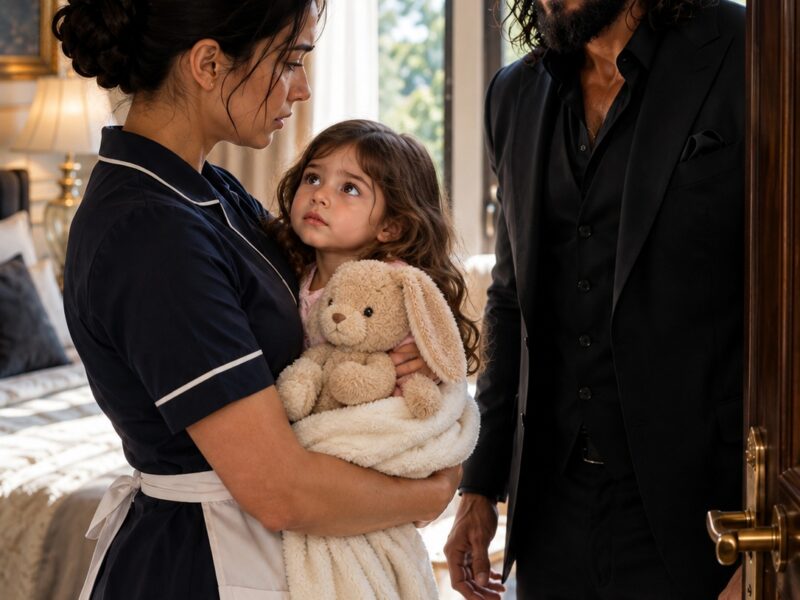
The Mafia Boss Found His Maid Hiding a Baby—Then He Saw the Child Had His Eyes
I had broken every rule in Damiano Rossi’s house for one reason: a three-week-old baby sleeping in a dresser drawer.
When he opened the forbidden room and asked whose child I was hiding, I still believed I could protect the secret.
Then the baby opened her eyes—and the most feared man in Chicago forgot how to breathe.
I remember the sound of the door more clearly than anything else.
A soft wooden creak.
Nothing dramatic.
No crash. No shouted warning. No gunshot in the distance, no alarm from the guards stationed at the end of the corridor.
Just a door opening in the middle of the night.
Yet that sound divided my life into two parts.
Before Damiano Rossi saw the baby.
And after.
I stood with my back pressed against the faded wallpaper of the old servants’ room, one hand over my mouth, staring at the man in the doorway.
The mansion was almost completely dark behind him.
Only the low amber lights from the east corridor outlined his shoulders.
Damiano did not need guards beside him to look dangerous. He carried the kind of stillness that made other people rush to explain themselves.
I had worked in his house for almost three years.
In those three years, I had never once given him a reason to say my name in anger.
I arrived before six.
I kept my uniform clean.
I did not listen at doors.
I did not repeat what I heard.
I never entered his study unless the house manager sent me.
I never asked why men arrived after midnight in black sedans and left before sunrise with pale faces.
The Rossi house had rules.
Some were written in the employee manual.
Most were not.
Do not touch anything locked.
Do not photograph the property.
Do not bring strangers onto the grounds.
Never enter the east wing after midnight unless there is an emergency.
And under no circumstances bring anyone into the mansion without authorization.
That night I had broken the last rule.
The smallest person in the house was also the one person who could destroy every lie I had spent three years protecting.
Behind me, in the open bottom drawer of an antique dresser, lay a baby wrapped in a gray blanket.
Three weeks old.
Dark hair pressed softly against her head.
One tiny fist beside her cheek.
Marisol.
My niece.
My dead sister’s daughter.
And, although I had promised I would take the truth to my grave if necessary, the daughter of Damiano Rossi.
He did not know that yet.
At least I wanted to believe he did not.
His eyes moved from me to the dresser.
Then back.
“Elina.”
My name sounded worse in his voice than a threat would have.
“What is this?”
I could not answer.
My tongue seemed too large for my mouth.
Damiano stepped inside.
He wore dark trousers and a white shirt with the sleeves rolled halfway up his forearms. No jacket. No tie.
He must have been working.
He always worked when the house slept.
At forty-two, Damiano Rossi had learned how to make exhaustion look like discipline.
He owned Rossi Freight Systems, four warehouses, part of a private security company, and enough commercial property along the Chicago River that newspapers described him as a logistics investor.
People closer to the old neighborhoods used different language.
Family.
Organization.
Boss.
They said his father had once controlled half the illegal freight moving through the city.
They said Damiano had made things cleaner after inheriting the empire.
Cleaner did not mean clean.
It meant fewer men disappeared.
More attorneys appeared.
In my experience, that qualified as progress in the Rossi family.
Damiano stopped near the dresser.
I moved instinctively.
Not enough to block him.
Enough that he noticed.
His gaze sharpened.
“Move.”
“Mr. Rossi—”
“Elina.”
His voice never rose.
That was the problem.
People who shouted could be measured.
Damiano’s anger became quieter as it grew.
I stepped aside.
He looked down.
Marisol slept through the moment.
Damiano’s jaw tightened.
For a few seconds, the old version of him remained—the employer who had discovered a maid hiding a child on his property.
Then something changed.
He leaned closer.
His shoulders softened by one degree.
His right hand rose.
I had seen that hand sign contracts that made powerful men smile reluctantly.
I had watched two security officers stop mid-argument when he lifted one finger.
Now it hovered above a baby’s cheek.
He did not touch her.
“Whose child is this?”
The question came differently.
Less authority.
More uncertainty.
I swallowed.
“My cousin’s.”
The lie sounded terrible before it finished leaving my mouth.
Damiano looked at me.
“You don’t have a cousin with an infant.”
Cold moved through me.
“How would you know?”
His eyes narrowed.
A fair question.
I had asked it too quickly.
“I know who works inside my home.”
“That does not mean you know everyone related to us.”
“No.”
He straightened slightly.
“But it means I know when someone who has worked for me almost three years suddenly arrives with a newborn and hides her in a room nobody uses.”
Marisol moved.
I froze.
Damiano looked down again.
She made the soft questioning sound newborns make when deciding whether waking is worth the effort.
Her fist opened.
Closed.
Then she yawned.
Damiano’s mouth tightened.
“Please.”
I whispered.
He looked at me.
“Give me two days.”
“For what?”
“I’ll take her somewhere else.”
“That is not what I asked.”
“I know.”
“Then answer.”
I could not.
Not because I feared losing my job.
That barely registered anymore.
I had spent three weeks sleeping in forty-minute pieces, carrying a promise made beside a hospital bed, waiting for men I did not know to find an address they should never have had.
Jobs could be replaced.
Marisol could not.
The baby stirred again.
Then opened her eyes.
Damiano stopped breathing.
It happened so visibly that for a second I thought he was hurt.
His face emptied.
His hand lowered slowly.
Marisol blinked at him.
Newborn eyes often change color. Everyone knows that.
They can darken.
Lighten.
Settle.
But some things are not color.
They are shape.
The slight downward tilt at the outer corners.
The dark ring around an otherwise unusual gray.
The way one eye opened a fraction wider than the other.
Damiano had those eyes.
So had his father.
There were portraits downstairs that proved it across three generations.
Marisol looked at him with the sleepy, unfocused stare of a child who had no idea she was carrying a family signature across her face.
Damiano whispered:
“No.”
I closed my eyes.
When I opened them, he was still staring.
The house’s heating system hummed somewhere behind the walls.
Rain touched the windows.
Nothing else moved.
“Elina.”
His voice was no longer the voice he used with employees.
“Whose eyes are those?”
I had prepared lies.
So many.
A cousin.
A friend.
A woman from church.
A temporary emergency.
I had practiced answers while driving to the estate with Marisol strapped into a secondhand infant seat in the back of my car.
None survived the way Damiano looked at her.
“I can’t tell you.”
His gaze snapped toward me.
“What?”
“Not tonight.”
I heard how absurd that sounded.
“You brought a baby into my house.”
He said.
“A baby who looks—”
He stopped.
Could not finish.
“Give me forty-eight hours.”
“For what?”
“To figure out what to do.”
Damiano took one step toward me.
I did not step back.
That surprised both of us.
“What exactly happens in forty-eight hours that cannot happen now?”
“I made a promise.”
“To whom?”
My eyes burned.
“Someone who is dead.”
Damiano became still.
He looked at the baby again.
Then at me.
Something old seemed to move behind his eyes.
Memory.
Pain.
He turned slightly away.
“Three years ago.”
My stomach dropped.
He continued without looking at me.
“There was a woman.”
I said nothing.
“I knew her for four months.”
Four.
Camila had told me five.
Maybe she had counted the first weeks he had not.
Damiano rubbed two fingers against his forehead.
“My father had just died.”
“I was taking over businesses I did not want, settling problems he had left unfinished.”
“I slept maybe three hours a night.”
“She worked at a small gallery in River North.”
My throat tightened.
Camila.
He stared toward the rain-black window.
“She laughed at me the first time we met.”
Despite everything, something almost human touched his mouth.
“I had gone in because one of my attorneys wanted to buy a painting.”
“She asked if I always looked angry around landscapes.”
That sounded like my sister.
Pain pressed behind my ribs.
“She did not know who I was?”
I asked.
“Not at first.”
“When she found out?”
“She said it explained the cars.”
“What happened?”
Damiano looked at me.
“You know something.”
It was not a question.
I held his gaze.
He saw it.
People like Damiano survived because they recognized a room changing before anyone else did.
His voice dropped.
“What was her name?”
My eyes filled before I could stop them.
He answered himself.
“Camila.”
The name crossed the room like something alive.
“Camila Dart.”
I sat down because my knees gave me no choice.
Damiano’s face changed.
“Elina.”
He took one step toward me.
“You knew her.”
I looked at Marisol.
Not him.
“She was my sister.”
Color left Damiano’s face.
For the first time since I had met him, I saw the feared head of the Rossi family look completely lost.
“Where is she?”
My silence answered.
He shook his head.
“No.”
“Damiano—”
He seemed not to notice that I had used his first name.
“Where is Camila?”
“She died.”
The words came quietly.
“Three weeks ago.”
His eyes moved toward the dresser.
Then back.
“When?”
“The night Marisol was born.”
His jaw worked.
No sound emerged.
He turned away from me.
One hand went to the back of his neck.
His breathing changed.
I had expected anger.
Threats.
Accusations.
I had not prepared for grief.
Maybe because Camila had spent the final year of her life insisting Damiano would be safer as a memory.
She had convinced herself he had forgotten her.
I had believed her.
Standing there, I knew we had both been wrong.
Damiano pressed both palms to the dresser.
His head lowered.
“She was pregnant.”
“Yes.”
“With my child.”
I said nothing.
He looked over his shoulder.
“Say it.”
My throat closed.
“Yes.”
His eyes shut.
For several seconds, the room belonged only to Marisol’s breathing.
Then Damiano whispered:
“I searched for her.”
I looked at him.
“For how long?”
“Eleven months.”
That surprised me.
Camila never knew.
Or never admitted she knew.
“I thought she left because she was afraid.”
“She was.”
“Of me?”
“No.”
The answer came immediately.
Damiano turned.
“No?”
“She was afraid of your life.”
His expression hardened defensively.
“There is a difference?”
“Yes.”
I stood.
“She never believed you would hurt her.”
“She believed the people who wanted to hurt you eventually would.”
Damiano looked toward Marisol.
“She knew she was pregnant when she left?”
“Yes.”
His face tightened.
“And she never told me.”
“She wanted to.”
“How do you know?”
“Because I was the person listening every time she almost called.”
The anger arrived then.
Not explosive.
Damiano’s anger turned his face to stone.
“She decided for me.”
I flinched.
“Yes.”
“She decided I did not deserve to know I had a child.”
“Do not make this simple.”
His gaze sharpened.
“I have just learned a woman I loved died three weeks ago and that my daughter has been alive in this city while I knew nothing.”
“Do not tell me what is simple.”
“You loved her?”
The question escaped.
Damiano stared.
“Yes.”
No hesitation.
That hurt in a different way.
Camila had died believing something less certain.
“She loved you too.”
Damiano looked away.
I continued before courage disappeared.
“She talked about you while she was in labor.”
His shoulders went rigid.
“She made me promise you would never know.”
“What exactly did she think I would do?”
“Bring Marisol here.”
He looked around the small forgotten room.
“As opposed to hiding her in one of my dresser drawers?”
My face burned.
“That was not the plan.”
“What was?”
“To keep her away.”
“Then why is she here?”
That was the question I had been avoiding.
Because answering it meant the danger was no longer theoretical.
I looked toward the door.
Damiano noticed.
His grief changed shape.
“Who?”
“I don’t know.”
“Elina.”
“I don’t know their names.”
“Tell me what happened.”
I sat again.
“Camila rented a small apartment in Oak Park under her middle name.”
“She moved every few months after she found out she was pregnant.”
“Why?”
“Because someone asked about her at the gallery.”
“Who?”
“She never found out.”
Damiano’s face darkened.
“She left the gallery after that.”
“Yes.”
“Where did you come into this?”
“I had already been working here.”
That stopped him.
He stared.
“You came to work in my house after she disappeared.”
“Yes.”
“Why?”
I forced myself not to look away.
“Because she asked me to.”
Understanding arrived slowly.
“You were watching me.”
“Not the way that sounds.”
“It sounds like espionage.”
“She wanted to know if the danger around you had changed.”
“Through my housekeeper.”
“She wanted to know if you were at war.”
“Whether rivals were watching the property.”
“Whether anyone mentioned her.”
Damiano laughed once.
No humor.
“Three years.”
“I paid you.”
“I trusted you inside my home.”
“And all that time, you were reporting to her.”
“Only about danger.”
“Do you hear yourself?”
“Yes.”
My voice broke.
“I have heard myself every night for three years.”
Damiano looked at me.
“I never gave her business information.”
“I never copied anything.”
“I never listened at your study.”
“I told her when security doubled.”
“When cars followed yours.”
“When men I recognized from newspapers started appearing at the gate.”
“I told her when things seemed calm.”
He stared.
“And she stayed away anyway.”
“Yes.”
“Why?”
“Because then she found out she was pregnant.”
His eyes closed.
I continued.
“She said calm was temporary in your world.”
“She had seen a man follow her from the gallery once.”
“She did not know whose man.”
“She became convinced the safest child of Damiano Rossi was a child nobody knew existed.”
He opened his eyes.
“And you agreed?”
“At first?”
“Yes.”
“After working here?”
I hesitated.
“That answer changed.”
Something in his face shifted.
“How?”
“I saw you.”
“That is not an answer.”
“I saw how you treated people who could not help you.”
“The cook’s son when he broke his arm.”
“Mrs. Howard when her husband died.”
“The groundskeeper after his immigration paperwork became a problem.”
“You helped quietly.”
“You never used it to make them owe you.”
His jaw loosened slightly.
“I told Camila.”
“What did she say?”
“That kindness did not cancel danger.”
Damiano nodded once.
“She was right.”
No defense.
That mattered.
I continued.
“She planned to tell you after Marisol was born.”
His face changed.
“She changed her mind?”
“She got sick.”
The words came slowly.
“Pregnancy complication.”
“Her blood pressure went dangerously high.”
“The delivery became an emergency.”
“She lost too much blood.”
I swallowed.
“She had time to hold Marisol once.”
Damiano lowered his head.
“What did she say?”
I could barely speak.
“She said, ‘Don’t let him turn her into something the world can threaten.’”
His eyes filled.
Not tears yet.
Close.
“And?”
“She said you would love her.”
His face broke.
Only for one second.
Then control returned badly.
“She said that?”
“Yes.”
“She said, ‘That is what scares me most.’”
Damiano stared at his daughter.
My niece made a small sound.
He reached down.
This time his fingertip touched her hand.
Marisol’s tiny fingers curled around one of his.
Damiano went still.
I watched the most dangerous man I knew become afraid of moving because a newborn held him.
Then he whispered:
“Why tonight?”
I knew what he meant.
Why bring her now?
“Two nights ago, men came to the apartment.”
His head lifted.
“What men?”
“Two.”
“Names?”
“None.”
“What did they want?”
“They asked the landlord whether a woman had recently brought home a newborn.”
“Did they mention you?”
“No.”
“Camila?”
“No.”
“One said something outside.”
“What?”
I had tried not to remember.
Now I made myself.
“He told the other one, ‘Salvatore wants confirmation before we move.’”
Damiano’s hand slowly withdrew from the crib.
“Salvatore.”
The name came out differently.
“Greco?”
“I don’t know.”
He did.
His entire body changed.
Salvatore Greco was older than Damiano by twenty years.
His father’s oldest surviving rival.
They had spent the previous five years avoiding open conflict while fighting through warehouse leases, freight contracts, union influence, and legitimate companies that were legitimate only until someone looked closely enough.
“If Greco knows there is a baby—”
Damiano stopped.
He crossed to the door.
Looked into the corridor.
Then closed it.
Locked it.
I stood.
“What are you doing?”
“Thinking.”
“Open the door.”
He looked at me.
“I am not locking you in.”
He turned the key and put it on the table between us.
Fair.
Then he took out his phone.
I moved closer.
“No.”
His eyes narrowed.
“No what?”
“No army.”
“Elina.”
“If the entire mansion suddenly changes, everyone learns something happened.”
He stopped.
I had spent three years cleaning that house.
Invisible people see patterns.
“Who knows Marisol is here?”
He asked.
“Only me.”
“No one helped you enter?”
“I used the staff parking entrance during shift change.”
“Cameras?”
I had forgotten.
My stomach dropped.
Damiano saw it.
“Exactly.”
He called one person.
“Marco.”
A pause.
“Come to the east servants’ corridor.”
“Alone.”
He hung up.
“Who is Marco?”
“My driver.”
“I know his job.”
“He was with my father twenty-six years.”
“That makes him safe?”
“No.”
The answer surprised me.
“It makes him someone whose behavior I know well enough to test.”
Two minutes later, Marco Bellini entered.
Gray hair.
Dark coat.
Expression mildly annoyed until he saw the dresser.
Then the baby.
Then Damiano.
His eyebrows rose.
“I assume there is a story.”
Damiano looked at me.
“My daughter.”
Marco’s face emptied.
I watched him process.
“Camila?”
Damiano nodded.
Marco closed his eyes.
“God.”
“You knew her?”
“Met her twice.”
He looked at Marisol.
“Eyes.”
“Yes.”
Marco recovered quickly.
“What do you need?”
“Camera footage for the east staff entrance.”
“No copies.”
“No security team.”
“Bring me the original access log and tell nobody why.”
Marco looked at me.
Then Damiano.
“Done.”
He left.
Damiano turned toward me.
“You and Marisol move to the room beside my study.”
“No.”
His jaw tightened.
“You said no army.”
“I listened.”
“I am asking you to listen now.”
“The room beside your study is the first place an enemy would look.”
“No.”
“The first place an enemy would look is every place I obviously protect.”
“That room appears on no staff schedule.”
“It was my mother’s dressing room.”
“Only Marco and I have keys.”
I hesitated.
“Cameras?”
“Hallway only.”
“I control access personally.”
“You are not taking her from me.”
Damiano’s expression changed.
“I did not say I was.”
“You said my daughter.”
“She is.”
“She is also my sister’s child and I am the person who has held her since she took her first breath.”
The room became silent.
Damiano nodded slowly.
“You’re right.”
The ease of the admission disarmed me.
“I need to say this correctly.”
He looked at Marisol.
“She is my daughter.”
“She is your niece.”
“You are the only parent she has known.”
“And until a court, a lawyer, and most importantly you decide otherwise, I am not removing her from you.”
I stared.
Damiano continued.
“But someone is looking for her.”
“So I am asking both of you to move to a safer room tonight.”
“Asking?”
“Yes.”
“And if I say no?”
His jaw tightened.
“I will hate it.”
“But?”
“But I will put security around this corridor instead.”
I looked at Marisol.
Then at him.
“Fine.”
The next forty-eight hours changed the mansion without anyone being told why.
The first thing Damiano did surprised me.
He called an attorney.
Not a fixer.
Not a captain.
Rachel Sloan arrived before sunrise.
Family law.
Estate law.
No visible fear of Damiano Rossi.
I liked her immediately.
She listened to everything.
Then looked at him.
“You are not Marisol’s legal father yet.”
Damiano’s expression hardened slightly.
“She is my child.”
“Biologically, probably.”
“Legally, we establish it.”
“Safely.”
“Privately.”
“With Elina’s cooperation.”
Damiano looked at me.
“Fine.”
Rachel continued.
“Camila’s wishes matter.”
“Elina’s guardianship status matters.”
“You cannot solve this by putting your surname on paperwork and moving furniture.”
Marco coughed.
Possibly to hide amusement.
Damiano stared at him.
Rachel did not care.
“We arrange DNA testing through a confidential accredited lab.”
“We document Camila’s death certificate.”
“We establish temporary guardianship continuity so nobody can exploit ambiguity.”
My stomach tightened.
“Exploit?”
“If an outside party learns a wealthy man has an unacknowledged infant and the legal custody situation is unclear, they do not need to physically take her to cause damage.”
“They can make claims.”
“Leak information.”
“Pressure relatives.”
“Challenge guardianship.”
Damiano’s expression turned cold.
“Noted.”
Rachel held up a hand.
“That face is exactly why I am here.”
“What face?”
“The one where you start imagining solutions I do not want described in my office.”
“This is not your office.”
“Then imagine I brought it with me.”
Marco looked at the floor again.
For the first time since Camila died, I almost laughed.
Rachel drafted temporary documents.
I signed.
Damiano signed only what concerned testing and security consent.
No ownership disguised as protection.
That mattered.
By noon, Marisol had a proper bassinet.
Not gold.
Not absurd.
Damiano had apparently attempted absurd.
Rachel stopped him.
“You do not need a six-thousand-dollar Italian crib.”
“It had safety certification.”
“So does the four-hundred-dollar one.”
Damiano looked offended.
I bought the four-hundred-dollar one.
With my money.
Damiano stared at the receipt.
“You realize I can afford—”
“Yes.”
“That is not the point.”
“I know.”
He stopped.
Learning boundaries did not come naturally to him.
He tried.
That mattered more.
The DNA result came two days later.
99.99 percent probability of paternity.
Damiano read the page once.
Then again.
He sat down.
No dramatic speech.
He only asked:
“Can I hold her?”
I had been waiting for that question without realizing it.
“Yes.”
He washed his hands.
Twice.
Then stood beside the bassinet looking completely incapable.
“You support her head.”
“I know that.”
“You’re holding your arms like she is a bomb.”
“I have held guns with less instruction.”
“That is not comforting.”
Marco, standing near the door, said:
“Boss, this may be the first negotiation you lose before anyone speaks.”
Damiano ignored him.
I lifted Marisol.
Placed her carefully against his chest.
His entire body changed.
He became still enough to hear.
Marisol shifted.
One tiny cheek against his shirt.
Her fist closed around the fabric.
Damiano looked down.
“She is very small.”
“She is three weeks old.”
“I know.”
“You sound surprised.”
“I expected…”
“What?”
He hesitated.
“More weight.”
I almost smiled.
“That comes later.”
He stood there fifteen minutes.
At minute sixteen, Marisol started crying.
Damiano panicked.
Not visibly to most people.
I had spent three years observing him.
I saw it immediately.
“What happened?”
“She’s hungry.”
“Are you sure?”
“Yes.”
“How?”
“She is a baby.”
“That does not answer—”
I held out my arms.
“Give her.”
He did.
Reluctantly.
That was the first ordinary moment between us.
It lasted less than a minute.
The danger returned with headlights.
At 11:43 that night, a black car stopped beyond the outer gate.
No visitor scheduled.
It remained forty seconds.
Then left.
Security recorded the plate.
Rental.
Paid through a corporate account linked to a law office that had represented Greco Maritime.
Damiano watched the footage in his study.
His face became cold.
“We move you.”
I folded my arms.
“Again?”
“Off property.”
“That seems safer to you?”
“No.”
He looked at the screen.
“It seems less predictable.”
“Where?”
“My mother’s old house in Lake Forest.”
“Who knows about it?”
“Almost nobody.”
“Almost is not nobody.”
“Marco.”
“Rachel.”
“Me.”
“Security?”
“One driver.”
“Which driver?”
“Daniel Ruiz.”
“Twenty-two years with the family.”
“That did not answer whether you trust him.”
Damiano looked at me.
“Yes.”
“I trust him.”
Then he added:
“And I am beginning to dislike that word.”
Good.
Trust should withstand questions.
I did not leave that night.
We agreed on morning.
Before dawn, Marco arrived with the east entrance access records.
He closed the study door.
“We have a problem.”
Damiano looked up.
“What?”
“The night Elina brought the baby in, someone downloaded the camera clip.”
My blood turned cold.
“Who?”
“User credentials belong to Vittorio Serra.”
Damiano stood.
Vittorio was his closest adviser.
I knew him.
Everyone did.
Elegant.
Fifty-five.
Soft voice.
He brought pastries to the kitchen during Christmas week.
Had been beside Damiano at his father’s funeral.
Damiano stared at the log.
“No.”
Marco said nothing.
Damiano looked again.
“Vittorio was in Milwaukee that night.”
“His credentials were not.”
“So stolen login.”
“Possibly.”
“Or remote access.”
“Yes.”
“Does he know about Camila?”
Marco hesitated.
“He knew you were seeing a woman three years ago.”
“Name?”
“I don’t know.”
Damiano grabbed his coat.
I stepped forward.
“Where are you going?”
“To see him.”
“No.”
He looked at me.
“You do not get to ‘no’ every dangerous thing I do.”
“I can when my niece is the reason.”
His jaw tightened.
Fair point.
“Then tell me the plan.”
“Neutral location.”
“Marco comes.”
“No weapons visible.”
“Vittorio thinks we are discussing the Greco lease conflict.”
“What if he is the leak?”
“Then I learn that without letting him know Marisol is here.”
“What if he isn’t?”
“Then I have insulted a man who has been loyal to me twenty years.”
“You can apologize.”
Damiano gave me a look.
“Novel concept.”
“Practice.”
He left.
I spent two hours beside Marisol’s bassinet.
Every noise became footsteps.
Every car on the distant road became Greco.
At 10:17, my phone buzzed.
Damiano.
A message.
VITTORIO IS DEAD.
I stared.
Another appeared.
DO NOT LEAVE THE ROOM. DO NOT OPEN THE DOOR FOR ANYONE EXCEPT MARCO OR ME.
Then:
HE WAS KILLED BEFORE I ARRIVED. THIS IS BIGGER THAN A LEAK.
My hands began shaking.
I locked the door.
Moved a chair beneath the handle despite knowing it would do almost nothing.
Marisol slept.
That seemed offensive.
How could a child sleep while adults destroyed entire worlds around her existence?
Damiano returned forty minutes later.
He came alone.
I unlocked the door only after he said a phrase we had agreed on.
“Gray roses.”
He entered.
Closed it.
His shirt collar was open.
Hands unsteady.
I had never seen Damiano visibly shaken after someone died.
“Vittorio?”
“He was found in his car.”
“Parking structure.”
“No details.”
I was grateful.
“What happened?”
“He called Marco yesterday.”
“Said he had been tracing irregular transfers from Greco-linked companies into one of our security vendors.”
“He believed somebody inside my perimeter was selling information.”
“Who?”
“He never said.”
“Maybe he did.”
Damiano looked at me.
“What?”
“If someone killed him because he knew, maybe whoever killed him found what he had.”
“That means—”
“They may know he suspected them.”
“Yes.”
“And now they know you will too.”
Damiano looked toward Marisol.
“Then she is not safe here.”
The sentence landed differently from before.
Not boss logic.
Father fear.
“What do you want to do?”
“Send you to the Lake Forest house tonight.”
“You?”
“Stay.”
“No.”
“Elina.”
“No.”
“You cannot use that word as a complete security doctrine.”
“I’m improving.”
Despite everything, he nearly smiled.
Then serious again.
“If I disappear with you, Greco knows he succeeded.”
“He pushes harder.”
“If I remain visible, meet people, act as if nothing changed, whoever inside my operation is feeding him information may keep moving.”
“So you become bait.”
“Yes.”
“That is stupid.”
“Probably.”
“What does Rachel say?”
“That is an unfair question because Rachel says everything I do is stupid until documented.”
“Call her.”
He did.
Rachel agreed with relocation.
Disagreed with Damiano’s plan to remain without law-enforcement notification.
That started an argument.
“I cannot bring police into every legacy operation I inherited.”
She said through speakerphone.
“Why not?”
“Because some of those operations would become evidence.”
“Yes.”
“That is generally what evidence is.”
Marco looked away.
I liked Rachel more every day.
Damiano paced.
“If I disclose everything, I destroy legitimate companies employing six hundred people.”
“Then disclose what relates to this threat.”
“Use outside counsel.”
“Use the federal contact you already have for compliance negotiations.”
Damiano stopped.
I stared.
“You already have a federal contact?”
He looked irritated.
“We have been discussing restructuring.”
“For how long?”
“Eight months.”
“You were trying to leave the criminal side?”
He did not answer quickly.
“Yes.”
That changed him in my mind.
Not redeemed.
Not innocent.
Moving.
Camila had never known.
“You never told her.”
“No.”
“Why?”
“Because when she knew me, I had not decided yet.”
Rachel interrupted.
“Can we return to the infant currently creating an interstate conspiracy issue?”
Fair.
The plan changed.
Elina and Marisol would move.
Damiano would remain.
Rachel would contact Assistant U.S. Attorney Naomi Price, who had been working with Rossi counsel on voluntary disclosure tied to several legacy freight schemes.
No dramatic police raid.
No vigilante hunt.
Evidence.
Logs.
Payments.
Phones.
Boring things that survive court.
Damiano hated boring things when frightened.
That was precisely why they were useful.
Rain started after sunset.
Of course it did.
Stories like ours seemed to attract weather.
Daniel Ruiz drove.
No convoy.
No marked security car.
A second vehicle remained several miles back with plainclothes protection arranged through a licensed firm outside Rossi’s usual team.
Before I climbed in, Damiano stood beside the rear door.
I held Marisol.
He looked at her.
“Can I?”
I passed her over.
He held his daughter beneath the rain-dark sky.
Three weeks ago, he had not known she existed.
Now he looked like handing her back might tear something physical.
“I’m sorry.”
He whispered.
Marisol slept.
“I’m sorry I wasn’t there.”
His voice cracked.
“I know that wasn’t my choice.”
“But I’m still sorry.”
He touched his forehead to hers.
“I will not make your mother’s fear come true.”
I swallowed.
“Her mother.”
Damiano looked at me.
“Camila.”
“Yes.”
He nodded.
“I’m not replacing her.”
Good.
Another necessary distinction.
He handed Marisol back.
“Keep her safe.”
“I have been.”
“I know.”
That was the closest thing to an apology for doubting me.
I climbed into the car.
As we pulled away, Damiano remained in the driveway.
No umbrella.
Hands in his pockets.
Growing smaller through the rain.
For the first time, I understood what Camila had seen in him.
And what had frightened her.
Damiano loved like a man used to defending territory.
If he did not learn the difference between protecting a person and possessing their safety, Marisol would grow inside a different version of the same prison.
I hoped he could learn.
The Lake Forest house belonged to Damiano’s mother before she died.
Small by Rossi standards.
Four bedrooms.
White clapboard siding.
Old oak trees.
No gate.
That was intentional.
Security disguised as ordinary life.
I slept beside Marisol’s bassinet with my shoes on.
At 4:52 a.m., my phone rang.
Damiano.
I answered immediately.
“Is she okay?”
His first question.
“Yes.”
A breath.
Then:
“We found the man.”
“Who?”
“Anthony Vale.”
I knew the name.
Deputy security coordinator.
Thirty-eight.
Quiet.
Never memorable.
Which, in security, was probably useful.
“He had access to gate logs.”
Damiano said.
“Camera systems.”
“Staff vehicle records.”
“Vittorio found payments into an account controlled through Anthony’s brother.”
“Did Anthony kill him?”
“We do not know.”
That wording mattered.
Source stories like ours often wanted certainty immediately.
Life rarely offered it.
“Where is Anthony?”
“In federal custody.”
I sat up.
“You called Price?”
“Rachel called Price.”
“I agreed.”
“What did they find?”
“Enough probable cause for a warrant after we provided the payment records.”
“Anthony tried to destroy a phone when agents arrived.”
“Data was recovered from a cloud backup.”
My skin went cold.
“Marisol?”
“Photographs.”
“Camila’s old Oak Park addresses.”
“Your staff schedule.”
“The apartment.”
“And messages with a Greco intermediary asking whether ‘the baby matches.’”
Matches.
Her eyes.
The words made me sick.
“Vittorio?”
“Anthony’s messages indicate he told the intermediary Vittorio was investigating.”
“After that, someone outside our operation followed Vittorio.”
“Price believes Greco’s people arranged the killing.”
“Believes.”
“Yes.”
“No proof yet.”
“What now?”
“Now we keep you where you are until Price says otherwise.”
“And you?”
Silence.
“Damiano.”
“I’m coming to you after I finish interviews.”
“You are being interviewed?”
“Yes.”
“By federal agents?”
“Yes.”
“You’re cooperating?”
Another pause.
“Yes.”
That one word changed the future more than any threat could have.
Three days later, Damiano came to Lake Forest.
No entourage.
Marco drove.
Damiano stepped through the front door looking as if he had aged months.
Marisol was awake.
I held her near the window.
He stopped.
“Can I?”
The question had become habit.
I handed her over.
This time he knew how to hold her.
Support the neck.
Keep one arm beneath her.
Do not panic when she made a strange face.
Progress.
Marisol stared at him.
His eyes looking back through hers.
“Hello.”
He whispered.
“You caused a surprising amount of paperwork.”
I laughed before I could stop myself.
He looked at me.
“That was a joke.”
“I know.”
“You seemed surprised.”
“I am.”
Marisol sneezed.
Damiano nearly dropped his dignity.
“What was that?”
“A sneeze.”
“Very violent.”
“She weighs eight pounds.”
“That is irrelevant.”
I laughed again.
For a few minutes, we became ordinary.
Then the larger world returned.
“What happens with Greco?”
I asked.
Damiano sat.
“Price believes she can build extortion and conspiracy charges around the information network.”
“Anthony is cooperating.”
“Two others too.”
“Salvatore?”
“Not yet.”
“And you?”
He looked at his daughter.
“I gave Price records.”
“How many?”
“Enough.”
“That sounds evasive.”
“All records connected to Greco.”
“Vittorio.”
“Security payments.”
“And several operations of mine that overlap.”
“What does that mean for you?”
Damiano rubbed his thumb over Marisol’s blanket.
“Possibly charges.”
My chest tightened.
“What kind?”
“Financial.”
“Conspiracy.”
“Depends what evidence corroborates.”
“You knew that before you gave it?”
“Yes.”
“Why?”
He looked up.
“Because otherwise Marisol grows up protected by the same system that put her in danger.”
That answer was better than any promise.
“What about your companies?”
“Legitimate ones will continue under independent management.”
“Some assets may be sold.”
“Some frozen.”
“Do you care?”
“Very much.”
He looked tired.
“But I care differently than I did a month ago.”
That afternoon Rachel arrived.
We discussed guardianship.
Paternity.
Marisol’s surname.
That became the first real conflict between Damiano and me after the danger eased.
“Rossi.”
He said.
I stared.
“She is not a corporate acquisition.”
“I did not say that.”
“You said her name like you were naming a building.”
“Her father’s surname is Rossi.”
“Her mother’s surname was Dart.”
“Camila used Dart professionally.”
“It was her name.”
Damiano’s jaw tightened.
Rachel raised one hand.
“Excellent.”
We both looked at her.
“This is exactly why nobody signs anything today.”
Damiano leaned back.
I crossed my arms.
Rachel continued.
“The child can legally have either surname or a hyphenated name.”
“But the more important question is not which adult wins.”
“It is what reflects the identity her parents and guardian want preserved.”
Damiano looked at Marisol sleeping in a portable bassinet.
“Camila.”
He said quietly.
“Yes?”
I asked.
“She gave her the name Marisol Dart?”
“Yes.”
“Then that stays.”
Simple.
He exhaled.
“Marisol Dart Rossi?”
I considered.
“Maybe.”
Rachel smiled.
“Progress.”
We eventually chose Marisol Camila Dart-Rossi.
Camila’s name in the middle.
Both family names.
No erasure.
Damiano’s paternity was legally established.
I remained Marisol’s legal guardian during the transitional period because I had been designated in Camila’s signed hospital directive and because Damiano’s legal situation was uncertain.
He did not fight it.
That mattered more than he understood.
He visited daily.
Changed diapers badly.
Learned formula temperatures.
Attended the pediatrician.
The first time the doctor asked:
“Any family history of congenital conditions?”
Damiano looked at me helplessly.
Powerful men dislike questions money cannot answer.
We worked together.
Camila’s side.
Rossi side.
Medical history became another way of building the child’s story from both families rather than letting one consume the other.
At six weeks old, Marisol smiled.
Probably gas.
Damiano rejected science.
“She smiled at me.”
“She has no idea who you are.”
“That seems unnecessarily harsh.”
“You are competing with a ceiling fan.”
“I am winning.”
He was not.
The federal investigation moved slowly.
Months.
Not days.
Salvatore Greco was eventually indicted on extortion, conspiracy, unlawful surveillance, and charges connected to Vittorio’s death after two cooperating defendants tied him to the order.
Damiano testified before a grand jury.
He also faced his own exposure.
Some Rossi practices were legal businesses wrapped around old criminal habits.
He could not cooperate only where truth benefited him.
Naomi Price made that clear.
“You want the law to protect your daughter?”
She told him.
“Then you do not get to treat the law as a subcontractor.”
Damiano later repeated that sentence with visible resentment.
“She enjoys herself too much.”
I said:
“I like her.”
“Of course you do.”
He entered a cooperation agreement.
Sold stakes in two companies.
Resigned from operational control of Rossi Freight while the investigation continued.
Paid penalties.
Eventually pleaded guilty to financial conspiracy tied to contracts inherited from his father but maintained under his leadership.
No dramatic escape.
No judge impressed by fatherhood enough to erase crimes.
At sentencing, the judge acknowledged his substantial cooperation, his voluntary disclosures, and the danger those disclosures had helped dismantle.
Then she said:
“Becoming accountable after years of avoiding accountability does not make the earlier years disappear.”
Damiano nodded.
“I understand.”
He received eighteen months in federal custody followed by supervised release.
Less than prosecutors might once have sought.
More than his former associates believed he should accept.
He accepted it.
Marisol was eleven months old when he began his sentence.
The night before, he came to my apartment.
Not the Lake Forest house.
My apartment.
I had moved after the old address became part of the investigation.
Small.
Two bedrooms.
A secondhand sofa.
Baby toys everywhere.
Damiano stood in the doorway looking more uncomfortable than he ever had in his mansion.
“You can come in.”
“I know.”
“You’re blocking the hall.”
He entered.
Marisol crawled toward him.
He immediately crouched.
She slapped both hands onto his knees.
“Da.”
Everyone froze.
I stared.
Damiano stared.
Marisol drooled.
“Did she…”
“No.”
I said too quickly.
“She says random sounds.”
“Da.”
Damiano looked at me.
I pointed.
“Ceiling fan remains her primary emotional relationship.”
“Da.”
His eyes filled.
I stopped joking.
He picked her up.
Marisol touched his face.
For the first time since I had met him, Damiano cried without turning away.
Not loudly.
Tears simply moved down his face while he held his daughter.
“I’m going to miss everything.”
“No.”
I said.
“You’re going to miss some things.”
“That matters.”
“Yes.”
“But everything is what Camila feared.”
He looked at me.
“She thought your world would swallow her daughter.”
“You are leaving that world partly because of what happened.”
“You are going to prison because accountability is part of leaving it.”
“You do not get to call that abandonment.”
Damiano swallowed.
“What do I call it?”
“Consequences.”
He almost smiled.
“You and Price would be intolerable together.”
“We have lunch Thursday.”
He gave me a betrayed look.
Good.
During his sentence, I brought Marisol every other weekend when travel and health allowed.
Not because Damiano demanded it.
Because keeping fatherhood alive required ordinary repetition.
He read picture books terribly.
Too serious.
Every character sounded like a business meeting.
“Bear says good night.”
I interrupted once.
“You sound like Bear is terminating someone.”
“I am reading the text.”
“You are threatening the moon.”
Marisol laughed.
Damiano’s entire face changed.
He learned.
By sixteen months, he had voices.
Bad ones.
But different.
Marco visited separately.
Rachel handled paperwork.
Rossi Freight appointed an independent board and compliance officers.
Several old associates left.
Some were charged.
Some retired.
Some discovered, miraculously, that they had always wanted legal careers in property management.
Enzo would have called that evolution.
I called it self-preservation.
When Damiano came home, there was no mansion.
The estate had been sold.
He had agreed to surrender it as part of asset settlements tied to the old organization.
Marco offered him a luxury apartment.
Damiano refused.
He rented a townhouse ten minutes from us.
Three bedrooms.
One for him.
One for Marisol.
One he claimed was an office.
It contained a crib before the desk arrived.
I noticed.
Said nothing.
He learned fatherhood there.
Not with staff.
Not twenty rooms away.
Laundry.
Grocery lists.
Pediatric fevers at two in the morning.
The first stomach virus nearly defeated him.
He called me at 1:08 a.m.
“She threw up.”
“Yes.”
“Twice.”
“Yes.”
“She feels warm.”
“Temperature?”
“Hundred point two.”
“Fluids?”
“She drank.”
“Wet diaper?”
Pause.
“I did not document the time.”
I closed my eyes.
“You don’t need a spreadsheet.”
“I disagree.”
“Damiano.”
“Yes?”
“She has a stomach bug.”
A pause.
“What do normal fathers do?”
The question softened me.
“They worry.”
“I have completed that portion.”
“They clean up.”
“Done.”
“They sit with her.”
He looked toward Marisol.
I could hear her fussing through the phone.
“Then I can do that.”
“Yes.”
He did.
No guards required.
Marisol’s second birthday was small.
My apartment.
Cake from a bakery near the park.
Marco.
Rachel.
Damiano.
Camila’s photograph placed on a shelf, not as tragedy but family.
Marisol had Damiano’s eyes.
Camila’s mouth.
My mother’s habit of raising one eyebrow when unimpressed.
That final feature terrified everyone.
Damiano eventually purchased the Oak Park building where Camila had lived during pregnancy.
I was furious.
“You cannot keep buying emotionally significant real estate.”
“I have bought one.”
“You owned a mansion.”
“Past tense.”
“What are you doing with it?”
He handed me a folder.
There it was.
His new habit.
Documents first.
The property would become transitional housing for single mothers leaving unsafe situations.
Independent nonprofit.
No Rossi name.
Board included Rachel and two community organizations.
Damiano would fund renovation but not control placements.
I looked at him.
“Why?”
“Because Camila spent months moving from apartment to apartment believing nowhere was safe.”
He swallowed.
“I cannot change that.”
“But I can make several rooms safe for someone else.”
I signed onto the advisory board.
Not because I owed him.
Because the idea was good.
That distinction became central to our relationship.
Years passed.
Marisol grew.
At four, she asked why other children had mothers and she had Aunt Elina and Dad.
We had prepared.
Age-appropriate truth.
No saints.
No villains where complexity mattered.
“Your mommy Camila loved you.”
I said.
“She died when you were born because her body got very sick.”
“Dad knew?”
Damiano answered.
“No.”
She frowned.
“Why?”
He took a breath.
“Your mom was afraid bad people might hurt you if they knew you were my daughter.”
“Were you bad?”
Silence.
Children ask questions adults spend years avoiding.
Damiano answered carefully.
“I did bad things.”
“Yes.”
“I also lived around people who did bad things.”
“Your mom did not trust that I could keep danger away from you.”
“Was she right?”
Damiano looked at me.
I did not save him.
“Yes.”
He said.
“At that time, she had good reasons.”
Marisol considered.
Then:
“Are you bad now?”
Damiano almost laughed.
“I try to make better choices now.”
“That wasn’t question.”
I covered my mouth.
His daughter.
Definitely.
“No.”
He said.
“I am not doing the things I did before.”
Marisol nodded.
“Okay.”
Then she asked for strawberries.
Childhood preserved.
At six, she wanted to know why I had hidden her in a dresser drawer.
“That sounds dumb.”
She told me.
“It was.”
“There was crib?”
“Not in that room.”
“Why dresser?”
“Panic.”
She accepted this.
“Dad found me?”
“Yes.”
“What did he do?”
Damiano answered:
“Asked too many questions.”
“You always do that.”
I laughed.
He glared.
At eight, she asked about Vittorio.
Harder.
We told her he had tried to stop the leak and died because of it.
No graphic detail.
She wanted to know if he was family.
Damiano said:
“He was like family.”
“That made it worse.”
She said.
“Yes.”
He answered.
“That made it worse.”
At ten, she asked whether Camila had been wrong to hide her.
That one took an evening.
I said:
“Your mother made the best decision she thought she could make with the fear and information she had.”
Damiano said:
“I wish she had chosen differently.”
Both statements true.
Marisol looked between us.
“So adults can love you and still make a choice that hurts you.”
I looked at Damiano.
He looked at me.
“Yes.”
We said together.
She nodded.
“That seems inconvenient.”
“Extremely.”
Damiano said.
The Oak Park housing program opened its third property that year.
Rossi Freight, under independent management, became a completely legitimate regional logistics company.
Damiano held a minority investment but no operational control for several years after supervision ended.
He hated board meetings because people disagreed with him without fear.
Good for him.
Marco retired.
Again.
He came to breakfast every Sunday anyway.
Rachel remained our attorney until she claimed our family generated more unnecessary paperwork than a small nation.
She also became Marisol’s godmother.
Nobody remembered exactly how that happened.
Probably one of her contracts.
On Marisol’s twelfth birthday, Damiano gave her something he had kept locked away.
Not jewelry.
Not money.
A letter.
Camila had written it days before delivery.
Addressed to Marisol.
She had left it with me.
I had kept it until she was old enough.
Damiano had never read it.
He refused.
“It is hers.”
He said.
Marisol opened it in our living room.
We gave her privacy.
She came out twenty minutes later crying.
She handed the letter to Damiano.
“I want you to read one part.”
He looked at me.
Not permission.
Instinct.
Then back at Marisol.
“Okay.”
She pointed.
Damiano read silently.
His face changed.
“What does it say?”
I asked only when Marisol nodded.
He read aloud:
“Your father may never know you exist.”
His voice tightened.
“If that happens, do not believe it means he did not want you.”
“I knew him when he was hurting.”
“I knew him when he was kind.”
“I knew the world around him frightened me more than he did.”
“I hope by the time you read this, one of us was brave enough to make a better world than the one we inherited.”
Damiano stopped.
Marisol watched him.
“Did you?”
He looked at her.
“Make it better?”
“Yes.”
He took a long time.
“Some of it.”
“Not all.”
“Good.”
She said.
“Because all sounds fake.”
He laughed through tears.
That evening, after Marisol went to bed, Damiano sat on my porch.
Our lives had changed enough that nobody feared him sitting outside after dark.
Neighbors waved.
One asked if he could move his car because it blocked a trash bin.
He moved it.
Humility through municipal inconvenience.
I brought coffee.
He looked toward my apartment window.
“Do you ever think about the night I found her?”
“Every time someone mentions antique furniture.”
He smiled.
“I was angry at you.”
“I noticed.”
“I thought you had betrayed me.”
“In fairness, I did lie to you for three years.”
“Yes.”
“Then I thought Camila betrayed me.”
“You were entitled to feel that.”
He stared at the coffee.
“Then I thought protecting Marisol meant I needed to own every decision.”
“You were very annoying.”
“I remain annoying.”
“True.”
He looked at me.
“You stopped me.”
“Sometimes.”
“Rachel stopped me more.”
“She bills better.”
A pause.
“Do you think Camila would forgive me?”
There it was.
The question beneath years of work.
I answered the only honest way.
“I don’t know.”
He looked down.
“I wish I could give you something prettier.”
“No.”
He nodded.
“That is probably why I asked you.”
I continued.
“I think she would see that you listened after being wrong.”
“That matters.”
“But forgiveness belonged to her.”
“Not me.”
“Not Marisol.”
Damiano absorbed that.
Some grief does not resolve.
It becomes a room in the house you learn not to lock.
By fifteen, Marisol had Camila’s height.
Damiano’s eyes.
My impatience.
She volunteered at the housing program.
Not because we forced her.
Because she liked the childcare room.
One afternoon I found her rocking a newborn whose mother was meeting with a case manager.
Damiano stood at the doorway.
He had gone very still.
I knew why.
Marisol looked up.
“What?”
“Nothing.”
“You’re doing face.”
“What face?”
“The emotional one you pretend is allergies.”
I laughed.
He glared at me.
Marisol adjusted the baby.
“Do you want to hold him?”
Damiano approached.
Even after fifteen years, he still asked the baby’s mother first.
Good habits.
The mother nodded.
Marisol handed the infant over.
Damiano supported the head automatically now.
No panic.
No stiffness.
I thought about the old servants’ room.
The dresser drawer.
His trembling hand stopping above Marisol’s cheek.
Life rarely announces when a circle closes.
Sometimes it simply places another sleeping infant in the arms of a man who once believed tenderness was leverage.
On Marisol’s eighteenth birthday, Damiano gave her a file.
She groaned.
“Dad.”
“Read first.”
“That is the least fun sentence ever spoken at a birthday.”
“It contains ownership documents.”
She stopped complaining.
Not a company.
Not a trust designed to make her wealthy without purpose.
The Oak Park housing nonprofit had acquired an adjoining property.
Damiano had funded a training center there.
Childcare certification.
Administrative skills.
Healthcare navigation.
Programs for women rebuilding work histories after leaving unstable homes.
He had named nothing after himself.
He wanted Marisol to join the board when she was ready.
Not inherit control.
Earn a vote.
She looked through the documents.
“Why me?”
“Because you grew up around it.”
“That doesn’t make me qualified.”
“No.”
Damiano smiled.
“That is why this is an invitation to train.”
“Not a title.”
Marisol looked at him suspiciously.
“Who taught you that?”
“Elina.”
“Rachel.”
“Prison.”
“Life is repetitive.”
I nearly spilled my tea.
Marisol accepted the training.
Two years later, she became the youngest board member after completing nonprofit governance coursework and spending summers doing actual program work.
No ceremonial seat.
She hated ceremonial seats.
Camila would have loved that.
Damiano never returned to the kind of power he had once held.
Sometimes people still called him a mafia boss in old articles.
He did not fight the label.
“It is part of the record.”
He said.
“You cannot demand people remember only the part of you that improved.”
Marisol once asked whether that bothered him.
“Yes.”
“Then why not correct them?”
“Because correction is for false information.”
“Not uncomfortable information.”
She rolled her eyes.
“You and Rachel have become unbearable.”
He took that as a compliment.
When I was sixty, I finally stopped working full time.
Damiano was sixty-three.
Still broad-shouldered.
More gray than black.
Marisol was twenty-one and studying pediatric social work.
Marco was officially retired and unofficially everywhere.
We gathered one Sunday at the Oak Park center for its tenth anniversary.
Children ran through hallways.
Parents carried coffee.
A baby cried somewhere upstairs.
Nobody lowered their voice when Damiano entered.
That might have been his proudest achievement.
He stood beside an old framed photograph of Camila.
She was twenty-six in it.
Laughing.
Sunlight behind her.
Marisol approached.
“You okay?”
“Yes.”
“Liar.”
Damiano glanced at her.
“Moderately okay.”
“Better.”
She leaned against the wall.
“Do I still have her eyes?”
Damiano looked at her.
“No.”
Marisol frowned.
“Everyone says I have yours.”
“You do.”
“Then what do I have from her?”
He considered.
“The way you leave every cabinet door open.”
“That cannot be genetic.”
“Your mother did it.”
“What else?”
“The way you laugh before the joke ends.”
Marisol smiled.
“And?”
Damiano touched his chest.
“Courage I did not have at her age.”
Her smile disappeared.
“Dad.”
“It is true.”
“She left.”
“You stayed.”
“That does not make one braver.”
“No.”
He nodded.
“You’re right.”
Then:
“She knew when to leave.”
“You knew when to come back.”
Marisol’s eyes filled.
I turned away.
Some moments do not need witnesses pretending they are not witnessing.
Later that afternoon, I found the two of them in the childcare room.
A young mother had arrived for intake unexpectedly.
Her six-week-old daughter slept in a portable bassinet.
The mother apologized repeatedly.
“I didn’t have anyone to watch her.”
Marisol shook her head.
“You do not need to apologize for bringing your baby.”
Those words stopped me.
The young woman looked close to tears.
“Really?”
“Really.”
Marisol moved a chair beside the bassinet.
“You’re safe here.”
Damiano stood near the doorway.
He looked at me.
We both remembered.
A different house.
A different night.
A maid hiding a baby because she believed permission mattered more than safety.
The young mother left two hours later with temporary housing arranged, a benefits appointment scheduled, and three phone numbers she could call without owing anyone loyalty.
No black cars.
No secret rooms.
No powerful man deciding what happened next.
Just systems.
People.
Choices.
Boring protections.
The kind Camila never had.
When the center emptied that evening, Damiano and I remained behind.
Marisol had gone to dinner with friends.
He walked through the nursery.
Stopped beside an ordinary white crib.
“You know.”
He said.
“What?”
“The drawer was probably unsafe.”
I stared.
“Fifteen years.”
“What?”
“It took you fifteen years to criticize my emergency crib.”
“I had concerns immediately.”
“You were distracted by paternity.”
“Fair.”
I laughed.
He looked toward the photograph of Camila visible through the open door.
“I used to think the moment I saw Marisol’s eyes was when she became my daughter.”
I waited.
“I was wrong.”
“When?”
He looked toward the empty crib.
“The eyes made me understand who she was.”
“Fatherhood started later.”
“When?”
“The first time you told me no and I listened.”
That answer surprised me.
“Why?”
“Because before that, protecting her was still about what I could control.”
“Listening meant accepting she had relationships and history that did not belong to me.”
He smiled faintly.
“That was considerably harder.”
“Poor man.”
“Cruel.”
We turned off the lights.
Outside, Chicago moved around us.
Buses.
Sirens.
Apartment windows glowing above storefronts.
No gates.
No guards.
Damiano locked the center door.
A simple key.
Nothing biometric.
He held it out to me.
“Your turn.”
“Why?”
“You always check twice.”
“I do not.”
“You absolutely do.”
I checked.
Twice.
He said nothing.
Smart man.
As we walked toward the parking lot, rain began.
Soft.
Warm.
Not the hard autumn storm from the night I carried Marisol through the servants’ entrance.
I thought about Camila.
Her fear.
Her decision.
The promise I kept too long and broke just in time.
I thought about Vittorio, who died trying to identify the danger inside a system he had helped build.
About Marco, who stayed.
Rachel, who made power sign forms.
Naomi Price, who taught Damiano that using the law meant accepting it when it pointed back at him.
Mostly, I thought about Marisol.
She grew up knowing everything gradually.
Not as a secret weapon.
Not as an heir to an empire.
Not as the baby with the mafia boss’s eyes.
As herself.
Damiano opened his car.
Then paused.
“Elina.”
“Yes?”
“Do you regret bringing her into the mansion?”
I thought about the question.
“No.”
“Even knowing what followed?”
“I regret that I had to.”
“That is different.”
“Yes.”
He nodded.
“What do you regret?”
I asked.
Damiano looked through the rain toward the center.
“That Camila never saw this.”
The answer was immediate.
I swallowed.
Then told him what I had learned years earlier.
“Some endings belong to the people who survive.”
“That does not mean the people we lost are absent from them.”
Damiano looked at me.
“That sounds like something Rachel would bill for.”
“She probably did.”
He smiled.
We got into our cars.
Before pulling away, I looked once through the rain at the second-floor nursery window.
Warm light.
Empty crib.
Tomorrow another family would come.
Another woman would sit with a caseworker.
Another child would be carried through the door openly.
No hiding.
No permission required to exist.
Years earlier, Damiano Rossi had opened an old servants’ room and found me protecting a baby he did not know was his.
What changed him was not that Marisol had his eyes.
Blood can shock a person.
It cannot teach them how to love.
What changed him came afterward.
The questions he learned to ask instead of orders he expected people to obey.
The consequences he finally accepted.
The people he stopped calling weak simply because they were afraid.
The child he protected without turning protection into ownership.
And the promise he eventually learned Camila had been asking from him all along.
Not keep her inside your walls.
Not make everyone fear touching her.
Something harder.
Build a world where she does not need to hide.
By the time Marisol was old enough to understand the whole story, those gray Rossi eyes no longer frightened me.
They were simply hers.
And that was exactly how it should have been.









