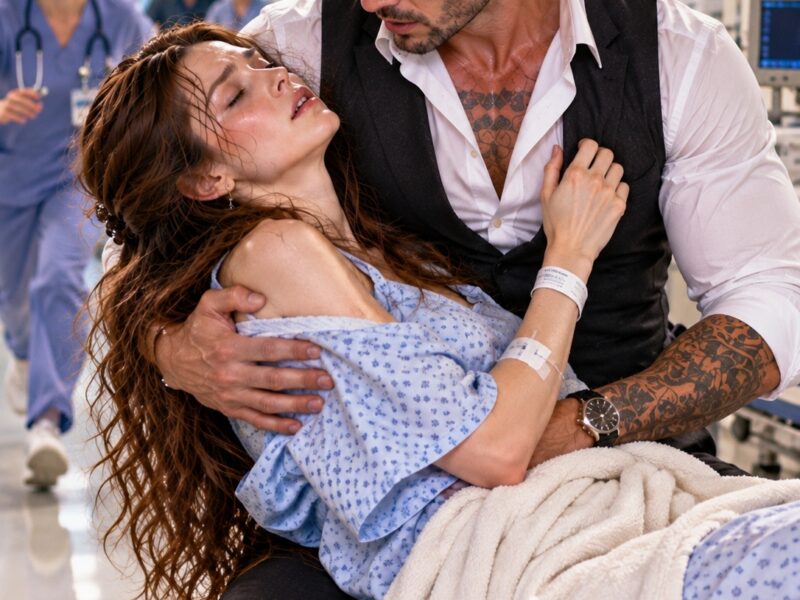
The Mafia Boss Missed Her Birthday Dinner Again—Then a Hospital Wristband in Her Coat Pocket Exposed the Secret She Had Been Hiding for Months
Luca Ferraro caught his wife two steps before her head struck the marble, her skin burning while rainwater dripped from the blue dress she had worn to a birthday dinner he never attended.
When her coat slid from the banister, a hospital wristband fell from the pocket, stamped with yesterday’s date and the name of a pediatric oncology unit she had never mentioned.
By sunrise, Luca would discover that Norah had been quietly giving away far more than blood—and that the secret behind those hospital visits reached directly into the family he thought he understood.
The Empty Chair
Norah Quinn’s knees gave out on the ninth stair.
Luca was standing in the foyer below, still wearing the charcoal suit from the meeting that had cost him another evening with his wife, when he saw her hand miss the banister. He crossed the marble before either of the two guards near the front doors reacted, catching her under the arms with enough force that her wet hair struck his shoulder instead of the stone.
She weighed almost nothing.
That frightened him first.
Not the collapse.
Not the grayness around her mouth.
Not even the heat coming through the soaked fabric of her coat.
His wife of eleven months folded against him like a coat slipping from a hanger.
“Norah.”
Her eyelids fluttered.
“Look at me.”
She opened them halfway.
Rain clung to her lashes.
“You came home.”
She smiled.
Not bitterly.
Not accusingly.
Like his presence at midnight was a gift instead of the bare minimum.
That smile cut deeper than anger would have.
Luca lifted her.
The foyer smelled of rain, polished wood, and the faint smoke from the library fireplace. Behind him, one of his men reached for a radio, but Luca shook his head once.
“Get Dr. Behan.”
“Now.”
He carried Norah upstairs himself.
Her room occupied the east wing because clause nine of the marriage agreement gave them separate bedrooms unless they mutually chose otherwise. At the time, Luca had considered the arrangement civilized. Efficient. A practical protection for two people entering a marriage neither had pretended was romantic.
Tonight, the distance between their rooms felt like evidence.
He placed Norah on the bed.
She stirred.
“My shoes.”
“I don’t care about your shoes.”
“You always care about the floors.”
“Not tonight.”
Her eyes closed again.
Luca removed the soaked heels.
Cheap heels.
Not the designer pair he had sent upstairs that morning with a note his assistant chose because Luca had forgotten until noon that October fourteenth was Norah’s birthday.
He looked at the blue dress.
The one she had shown him three nights earlier.
“Too much?”
she had asked.
“No.”
“Too little?”
“No.”
“Then perhaps tonight you could try a complete sentence.”
He had told her she looked beautiful.
She had looked startled.
Luca remembered that now and hated himself for it.
Delfina’s had held their table from eight until ten-thirty.
His driver had called at eleven.
“Mrs. Ferraro walked home.”
“Why?”
“She dismissed the car.”
“Is she all right?”
Luca had looked across a warehouse conference table at three captains arguing over a dock contract and let the call end unanswered.
There was always a problem at the docks.
Tonight there had been Marco DeSantis threatening to freeze two shipping routes unless Luca surrendered a warehouse lease.
Yesterday it had been insurance.
Tomorrow would be something else.
He had trained everyone around him to believe emergencies outranked ordinary promises.
Including himself.
Luca lifted Norah’s coat from the banister where it had slipped.
Something inside the pocket crackled.
He reached in.
A white paper wristband.
Hospital issue.
The clasp had been cut cleanly with scissors.
He turned it over.
ST. BRIDGET’S CHILDREN’S HOSPITAL
QUINN, NORAH
APHERESIS / PEDIATRIC ONCOLOGY
Date:
Yesterday.
Luca stopped breathing.
For several seconds, the storm, the guards, the doctor being summoned, all of it disappeared beneath one word.
Oncology.
His mother had died of lymphoma when Luca was twelve.
He remembered hospital wristbands.
Plastic mattresses.
The chemical smell of hand sanitizer.
His mother apologizing to nurses for needing help.
He remembered her becoming lighter every week until he was afraid to hug her too tightly.
Norah was twenty-nine.
She had walked a mile and a half home through October rain after sitting alone on her birthday.
And yesterday she had been in pediatric oncology.
Luca stood beside her bed holding the paper strip.
His hands were not steady.
Dr. Behan arrived twenty minutes later.
When the physician emerged from Norah’s room, Luca was waiting in the hallway with the wristband flat in his palm.
“Is she sick?”
It did not sound like a question.
Behan hesitated.
And Luca knew the night had only begun.
The Blood She Was Giving Away
Dr. Michael Behan had treated the Ferraro family long enough to understand the difference between privacy and secrecy.
He was sixty, broad through the shoulders, with gray hair and a physician’s habit of speaking more slowly when everyone else wanted speed. He had stitched Luca after accidents nobody reported, treated guards injured during incidents described to hospitals as workplace falls, and once told Luca’s father that money could not intimidate bacteria.
He did not hesitate often.
Now he did.
“She’s severely anemic.”
Luca’s fingers closed around the wristband.
“How severe?”
“Enough that standing up after walking in cold rain was a poor idea.”
“What caused it?”
“Exhaustion.”
“Dehydration.”
“Repeated blood loss.”
Luca looked at him.
“What blood loss?”
Behan’s face tightened.
“Both arms have venipuncture bruising.”
“Different ages.”
“Several weeks of it.”
“She has been donating.”
Luca stared.
“Blood?”
“Platelets, most likely.”
“Possibly other components depending on the sessions.”
“How often?”
“More often than I like.”
“More often than a responsible program should allow without monitoring her counts.”
Luca looked toward the bedroom door.
Norah had access to everything he could legally place in her name.
A monthly allowance she barely touched.
Cars she rarely used.
A household where meals appeared whether she requested them or not.
His accountant had once mentioned that Norah spent less than three hundred dollars on herself over several months.
Luca had taken that as proof she did not want his money.
He had not asked what she was spending it on instead.
“For whom?”
Behan exhaled.
“She would not tell me.”
Luca opened the door.
Norah was propped against pillows.
Someone had removed her wet dress and put her into cotton sleep clothes.
Her face had regained a little color.
When she saw the wristband in Luca’s hand, her expression closed.
“That’s nothing.”
He stood at the foot of the bed.
“Nothing?”
“A volunteer thing.”
“What kind?”
“Hospital.”
“Pediatric oncology.”
“Yes.”
“You’re donating platelets.”
A pause.
“Yes.”
“How often?”
Norah looked toward the window.
“Norah.”
“Enough.”
“That is not an answer.”
“Neither is missing your wife’s birthday dinner three years in a row.”
The sentence landed quietly.
Luca deserved worse.
“I know.”
Her eyes came back to him.
Apparently she had expected defense.
He gave none.
“Who are you donating for?”
“A child.”
“Name?”
“No.”
“Why not?”
“Because you do not get to investigate every person I care about.”
His jaw tightened automatically.
Norah saw it.
“There.”
“What?”
“That face.”
“What face?”
“The one where concern becomes authority.”
Luca went silent.
Norah adjusted the blanket.
“I’m tired.”
“You collapsed.”
“And I am awake now.”
“You could have been seriously hurt.”
“I wasn’t.”
“You could have—”
“Please.”
One word.
No fear.
Only exhaustion.
Luca stopped.
She looked smaller than she had at dinner parties where his associates ignored her until they wanted the room softened.
Norah had been a pediatric nurse before their marriage.
He knew that much.
Her license was suspended after a medication error at a hospital in Providence.
The marriage contract had arrived six months later through one of Luca’s attorneys.
He needed a wife to prevent a forced alliance with another family.
Norah needed money.
At least, that was the story he believed.
She had accepted the agreement quickly.
Twenty-five thousand dollars a month.
Independent suite.
Privacy.
No obligation to participate in criminal business.
No requirement of intimacy.
Public appearances when mutually agreed.
One-year minimum term.
It had seemed honest.
Clean.
No romantic lies.
Luca looked at her now.
“Your transfer was frozen last month.”
Norah’s eyes sharpened.
“How do you know?”
“I know now.”
She looked away.
“Victor said there was an account review.”
“Victor controls family finance.”
“Apparently.”
“What did you do when the money stopped?”
Nothing.
Then Luca noticed her left wrist.
No Cartier watch.
He had given it to her at Christmas.
Fourteen thousand dollars.
He had assumed she disliked it.
“The watch.”
Norah’s cheeks flushed.
“What?”
“Where is it?”
“Gone.”
“Where?”
“Pawned.”
For several seconds Luca could not process the sentence.
“You pawned a fourteen-thousand-dollar watch?”
“I received thirty-four hundred.”
“That is criminal.”
“It was the best offer near the hospital.”
“Why didn’t you ask me?”
Norah laughed once.
“Ask you?”
“Yes.”
“For money?”
“You receive money every month.”
“Not last month.”
“Before that.”
Her expression changed.
Shame.
That angered him more than the secrecy.
“What did you spend it on?”
Norah looked straight at him.
“A child’s treatment.”
“How much?”
“Two hundred sixty-eight thousand.”
The number sounded absurd.
“From your account?”
“Yes.”
“Why?”
“Because the treatment working for her was not fully covered.”
“Because the social worker was drowning in cases.”
“Because her mother died.”
“Because there was nobody else.”
Luca lowered himself into the chair.
For once, not because he chose stillness as intimidation.
Because standing felt uncertain.
“Who is she?”
Norah closed her eyes.
“Maisie.”
“How old?”
“Seven.”
“Diagnosis?”
“Acute myeloid leukemia.”
The medical words meant little.
The fear behind them did not.
Norah continued.
“She relapsed.”
“The standard treatment bought time.”
“There is a transplant protocol they believe can work.”
“She needs donor support.”
“And you?”
“I’m a platelet match.”
“Potential marrow match too.”
Luca looked at her arms.
“You’re planning marrow donation.”
Norah said nothing.
“When?”
“Thursday.”
Behan’s warning returned.
Counts too low.
“Does your doctor approve?”
“No.”
“Then you are not doing it.”
The words left before Luca could stop them.
Norah’s face went blank.
He heard himself.
Authority.
Control.
Concern becoming command.
She said:
“That is exactly why I didn’t tell you.”
Silence.
Luca leaned back.
He forced the next question.
“What does the doctor recommend?”
“Wait four weeks.”
“And Maisie?”
“May not have four weeks.”
Norah’s voice stayed level.
That frightened him.
“I counted.”
“What?”
“Days.”
“Her counts.”
“Conditioning schedule.”
“The donor window.”
“I counted.”
Luca looked at his wife.
Eleven months.
He had thought he bought a convenient arrangement.
A woman with sixty-one dollars in checking when his attorney found her.
Quiet.
Smart.
No family connections useful enough to complicate him.
And while he missed dinners, she had ridden buses across Providence, pawned jewelry, skipped meals, drained the allowance he thought represented generosity, and given pieces of her body to keep a sick child alive.
Then she had put on a blue dress and waited for him on her birthday.
Luca asked:
“Why Maisie?”
Norah’s eyes filled.
“She was my patient.”
“Before I lost my license.”
“She used to call me Nurse Nori.”
“Her mother, Jess, worked nights.”
“Sometimes Maisie stayed late because there was nobody to pick her up.”
“I read her books.”
“Held her when procedures hurt.”
“Then the dosage incident happened.”
“The hospital needed someone responsible.”
“And you were convenient.”
“Yes.”
“Did you make the error?”
Norah’s jaw tightened.
“I signed the administration record.”
“That is not what I asked.”
“No.”
Luca’s breathing slowed.
“Who did?”
“I don’t know anymore.”
“You were blamed for something you didn’t do.”
“I was young.”
“They offered a settlement.”
“My lawyer told me fighting could take years.”
“I had no money.”
“My mother had just died.”
“I signed.”
“And then?”
“I lost Maisie.”
“You found her again.”
“Her mother found me.”
“Jess tracked me down nine months later.”
“She said Maisie kept asking whether Nurse Nori was coming back.”
“So I started visiting.”
“And Jess died this spring.”
Luca watched her face.
“How?”
“Overdose.”
“History?”
Norah hesitated.
“No.”
Luca filed that away.
Not because he intended to turn the conversation into an investigation.
Because a healthy mother without a drug history dying suddenly sounded wrong in his world.
He did not say it.
Yet.
“Sleep.”
he said.
Norah stared.
“You’re not going to ask more?”
“Tomorrow.”
“Luca.”
“Yes?”
“Do not send money to the hospital tonight.”
He looked at her.
“Why?”
“Because if everything changes the second you know, then it becomes yours.”
“I need one thing in my life that was mine because I chose it.”
That hurt.
Luca nodded.
“No money tonight.”
Norah’s shoulders lowered.
He turned off the lamp.
Outside her door, he stood until four in the morning with the hospital wristband in his fist.
At six forty, Norah slipped out through the side entrance wearing the same gray coat.
Luca watched from the library window.
She passed two parked Ferraro cars.
Ignored them.
Walked three blocks.
Caught a city bus.
He should have stopped her.
Instead he called Donovan Price.
“Car.”
“Which one?”
“One she doesn’t know.”
Donovan paused.
“You’re following your wife.”
“Yes.”
“This marriage is thriving.”
“Donovan.”
“Car coming.”
For the first time in twenty years, Luca Ferraro followed someone instead of being followed.
The bus stopped on Eddy Street beside a brick building painted with a mural of paper boats.
St. Bridget’s Children’s Hospital.
Norah entered like the front desk already knew her.
Luca waited ten minutes.
Then followed.
No entourage.
One security man in the lobby.
That was already more than Norah wanted.
A volunteer gave Luca a visitor badge without asking much because expensive coats remained a form of social clearance.
He found Norah through an interior glass wall on the oncology floor.
She sat in a recliner.
Sleeve rolled.
A tube ran from her arm into an apheresis machine.
Beside her, in a hospital bed, a small girl with no hair wore a purple knit crown.
Maisie.
She held Norah’s free hand with both of hers.
Norah said something.
Maisie laughed so hard the IV pole rattled.
Luca stood behind the glass.
A nurse stopped beside him.
“Are you here for Maisie?”
Luca looked at the child.
“Are you family?”
the nurse asked.
Luca Ferraro had lied fluently since adolescence.
He opened his mouth.
Nothing came.
Norah looked up.
Saw him.
All the color she had recovered drained away.
She could not come to him.
The machine still held her blood.
So Luca went to her.
Maisie watched him approach with solemn curiosity.
Norah’s pulse jumped visibly in her throat.
“Maisie.”
she said.
“This is Luca.”
Maisie considered him.
“The husband.”
Luca almost smiled.
“Yes.”
“You missed the birthday.”
Norah closed her eyes.
“Maisie.”
“What?”
Maisie asked.
“She wore the blue dress.”
“I did.”
Luca said.
“I missed it.”
Maisie’s expression softened with terrible mercy.
“That’s okay.”
“My mom said men are mostly late.”
“You can hold her other hand.”
“It’s free.”
Luca sat.
Norah looked at him.
He looked at her.
Then took her hand.
The machine hummed.
Pale gold platelets collected slowly.
And for the next hour, Luca watched his wife give away something he had never understood he could not replace with money.
The Girl in the Purple Crown
Luca returned the next morning.
Norah had told him not to.
He came anyway.
But he stood in the hallway until she saw him and nodded.
Permission.
Small thing.
Difficult habit.
Maisie was eating cereal.
She wore the purple crown over a thin layer of dark fuzz beginning to return along her scalp.
She pointed her spoon.
“You came back.”
“So did you.”
“I live here.”
“Then you have an advantage.”
Maisie looked at Norah.
“He talks weird.”
“I know.”
“What do you do?”
Maisie asked him.
“Shipping.”
“That sounds boring.”
“It often is.”
Norah coughed into her coffee.
Maisie studied his suit.
“Are you rich?”
Norah nearly dropped the cup.
Luca answered:
“Yes.”
“How rich?”
“Enough that answering would sound rude.”
Maisie nodded.
“Very rich.”
Apparently settled.
Then:
“Do you like frogs?”
“No.”
“Bad answer.”
She handed him a picture book.
The next twenty minutes changed nothing important.
That was why Luca remembered them.
He read a story about a frog trying to become mayor.
His voices were poor.
Maisie rated them four out of ten.
Norah laughed quietly.
That sound moved through him in a way he found inconvenient.
He came again the following day.
And the next.
Not because Norah asked.
Because she eventually stopped telling him not to.
He learned the chair nearest the window squeaked.
Maisie drank apple juice with exactly three pieces of ice.
The nurse named Kelly had a son applying to college.
The oncology floor kept extra blankets too warm because chemotherapy patients were often cold.
He learned children could speak openly about death in ways grown men avoided.
Maisie asked:
“Are you scared of hospitals?”
Luca looked at her.
“Why?”
“You keep looking at the doors.”
Norah watched.
Luca answered carefully.
“My mother died in one.”
Maisie nodded.
“Mine too.”
No false comfort.
No statement about better places.
Just fact.
Then Maisie pushed a yellow crayon toward him.
“You can color the sun.”
Luca Ferraro colored a sun badly for fourteen minutes.
His captains would have lost faith in civilization if they saw him.
Donovan did see.
He stood at the ward entrance later that afternoon.
“You’re coloring.”
“Leave.”
“Yellow outside the lines.”
“Donovan.”
“I’ll alert the commission.”
Luca almost laughed.
Donovan’s expression softened.
“You look better.”
“I look ridiculous.”
“Both can be true.”
When Norah finished treatment that afternoon, Luca offered a car.
She said:
“No.”
“Why?”
“I took the bus.”
“The bus does not care that you’re anemic.”
“It also doesn’t ask questions.”
Luca forced himself not to insist.
“May I ride the bus with you?”
Norah stared.
“You?”
“Yes.”
“In that coat?”
“It appears structurally capable.”
She smiled despite herself.
“That is not what I meant.”
He rode.
People stared more at the coat than the man.
Norah sat beside him.
The bus windows fogged.
For twenty minutes, Luca experienced life at a speed he did not control.
Second intimate scene.
No romance confession.
Just shoulders touching whenever the bus turned.
At one stop, an elderly woman boarded.
Luca stood immediately.
Norah looked amused.
“What?”
“You surprise me.”
“That sounds insulting.”
“It’s not.”
Then:
“You missed dinner.”
There it was.
“I know.”
“You knew it mattered.”
“Yes.”
“Why?”
“Because I thought the dock problem mattered more.”
“Did it?”
Luca looked out at wet storefronts.
“No.”
Norah’s eyes shifted.
“What happened?”
“Nothing that couldn’t wait.”
She nodded.
Not forgiveness.
Recognition.
“Thank you for saying that.”
Nine days after her birthday, Luca closed Delfina’s for one evening.
Not bought.
Closed.
He paid the staff.
Maisie came with a nurse.
Paper crown.
Blue dress.
Norah wore hers again.
Luca arrived forty minutes early.
Maisie noticed.
“Scared?”
she asked.
“Yes.”
“Of dinner?”
“Apparently.”
The cake had HAPPY BIRTHDAY NORAH — NINE DAYS LATE written in crooked purple icing because Maisie insisted.
Norah laughed until she had to sit down.
Luca watched.
Then looked at Maisie.
He had been around her more than a week now.
Something about the child bothered him in a way he could not place.
Not danger.
Familiarity.
The way her chin lifted when annoyed.
A tiny line between the brows.
Her dislike of bananas.
Pieces of someone he could not name.
That night, back at the hospital, Maisie slept.
Green monitor numbers ticked.
Norah sat beside Luca.
He said:
“I had a brother.”
She turned.
He had never told her.
“Enzo.”
The name came out younger than the man saying it.
“He wanted out.”
“Of the family.”
“I called him weak.”
“Once in front of men whose respect mattered.”
“Twenty months ago he drowned.”
“Boat accident.”
“I did not give the eulogy.”
“Why?”
“I couldn’t.”
Norah did not offer wisdom.
She did not say Enzo forgave him.
She simply moved her hand over his.
Left it there.
That was the third intimate scene.
Luca slept without dreaming of water that night.
The secret changed two days later.
Maisie had a shoebox.
Treasures.
Bus ticket.
Four stones.
A photograph strip of her mother, Jess.
A silver medal on a chain.
“Daddy’s.”
she said.
Luca stopped.
“Your father’s?”
“Mama said his brother gave it to him.”
“For what?”
“Keeping his head above water.”
The room moved away.
Luca held out his hand.
“May I?”
Maisie gave him the medal.
St. Christopher.
Silver worn soft.
He turned it over.
Engraving.
E.F. — KEEP YOUR HEAD ABOVE WATER. L.F.
Luca knew every scratch.
He had bought it on Federal Hill when Enzo turned sixteen.
Paid cash because their father thought sentimental gifts made boys soft.
Luca stared at the girl.
Jess.
Enzo’s Jess.
The girlfriend Enzo kept away from the family.
From Carlo.
From Luca.
Because Enzo wanted one life that did not belong to Ferraro.
Maisie’s chin.
Her eyes.
The shape he had failed to see.
Norah noticed.
“Luca?”
He stood too quickly.
Walked to the window.
Air would not fill his lungs.
Maisie was Enzo’s daughter.
His niece.
The child Norah had nearly drained herself trying to save.
The child his own family did not know existed.
Then Luca looked through the rain-streaked glass.
Across Eddy Street sat a black Lincoln Navigator.
Engine running.
He recognized it.
Victor Cain’s.
Victor did not visit hospitals.
Victor sent flowers.
The Navigator had been parked there nine minutes.
Watching the third-floor windows.
Luca handed the medal back to Maisie.
“I’ll be back.”
Norah stood.
“What happened?”
“Stay here.”
Her expression hardened.
“No.”
He stopped.
Old reflex.
Control.
He corrected.
“Please stay with Maisie while I find out why Victor is outside.”
Better.
Norah nodded.
Luca went down alone.
He opened the Navigator’s rear door and climbed in beside the man who had taught him chess at nine.
Victor Cain smelled of cedar and winter wool.
Gray hair.
Sixty-five.
Calm enough to make every sentence sound reasonable.
“Nine minutes.”
Luca said.
Victor smiled faintly.
“You time my visits now?”
“You don’t sit outside hospitals.”
Victor looked toward the building.
“You have been spending considerable time in one.”
“Eleven days.”
“The captains notice.”
“I don’t care.”
“You should.”
Victor folded his hands.
“Your wife’s withdrawals attracted attention.”
“Two hundred sixty-eight thousand dollars.”
“I froze her monthly transfer because I suspected blackmail.”
“You did not ask me.”
“You were busy inheriting a war.”
“Now you know it wasn’t blackmail.”
Victor looked at him.
“Now I know something worse.”
Silence.
Then:
“It’s Jess Kerry’s daughter.”
Luca did not move.
The heater clicked.
Victor knew.
Maybe he had always known.
“She is Enzo’s.”
Luca said.
Victor’s response came too fast.
“Your brother had no child.”
There.
A door closing one second before the wind arrived.
Luca looked at him.
“Interesting.”
Victor softened.
“Luca.”
“Grief creates patterns.”
“You’re tired.”
“Go home.”
“I will deal with the loose ends.”
Loose ends.
The phrase followed Luca back through the rain.
It followed him upstairs.
It followed him when Maisie asked if Victor was another uncle.
It followed him home.
At 9:40 that night, a courier arrived.
Emergency complaint.
Anonymous donor-registry report alleging Norah falsified eligibility information.
Her planned marrow harvest cancelled pending review.
She was temporarily barred from the oncology floor.
A separate family-court motion sought Maisie’s immediate transfer to a long-term state facility in Pawtucket.
The filing came from a law firm Luca recognized.
Victor had used them twice.
Norah read the documents at the kitchen table.
Slowly.
Then set them down.
“She has a window.”
“What?”
“Her treatment.”
“If transplant doesn’t happen inside three weeks, the next conditioning cycle may not be possible.”
“How certain?”
“I counted.”
That phrase again.
“I counted.”
Luca saw the structure.
Enzo drowned.
Jess died of an overdose despite no known drug history.
Now anonymous complaints appeared within hours of Luca realizing Maisie was family.
Three accidents.
One bloodline.
The last living loose end slept beneath a purple crown.
Luca could not simply accuse Victor.
The older captains had been Victor’s allies before they became Luca’s.
A medal proved lineage.
Not murder.
The moment Luca publicly claimed Maisie as Ferraro blood, he made her more valuable.
Checkmate.
At four the next morning, Luca went to Norah’s room with the only plan he believed remained.
Her bed was empty.
Gray coat gone.
On the pillow:
A bus schedule.
First departure.
4:55 a.m.
Hospital circled.
Luca reached St. Bridget’s at 5:20.
He heard the alarm before he reached the third floor.
The Nurse Who Refused to Move
Norah stood in Maisie’s doorway with both hands braced against the frame.
Pale.
Still weak.
Completely immovable.
A broad man in transport scrubs stood in front of her beside a gurney.
“Transfer order.”
he said.
“No.”
Norah’s voice carried through the corridor.
“Mrs. Quinn—”
“Mercy Trust does not transport from this hospital.”
The man stopped.
“You are no longer staff.”
“I was staff long enough to know who we contract.”
She pointed.
“And that syringe on your tray is potassium chloride.”
“It is not on her chart.”
The man’s hand moved toward the tray.
Norah hit the code-blue button.
Light.
Noise.
Doors opened.
Nurses emerged.
The transport man grabbed Norah’s arm and tried to pull her from the frame.
She went down against the doorjamb.
Still kept her body between him and Maisie.
Then the corridor filled.
Hospital security.
Nurses.
Luca.
The transport man looked toward the stairwell.
Ran.
Luca did not chase him.
Old Luca would have.
The syringe remained on the tray.
Camera above the nurse station had recorded everything.
Witnesses mattered more than revenge.
Luca dropped beside Norah.
Her wrist already swelling.
“How did you know?”
She was counting Maisie’s breaths through the open doorway.
“Nine.”
“Ten.”
“Eleven.”
“Norah.”
“Twelve.”
She looked at him.
“Fine.”
Then handed him an old phone.
Jess’s.
“I came to retrieve pictures before the transfer.”
“The phone was dead.”
“I charged it.”
“There’s a voicemail.”
Luca pressed play.
Jess’s voice.
Scared.
Steady.
“Say it again.”
“I’m not signing anything until you say it again.”
Then Victor Cain’s voice.
Cedar and patience.
“Your man couldn’t keep his head above water.”
“Fifty thousand.”
“You take the girl and disappear.”
“Or I teach the same swimming lesson twice.”
Luca stopped breathing.
Twenty months.
Enzo branded traitor.
Drowned.
Jess intimidated.
Then dead.
The man responsible had poured Luca’s coffee.
Taught him chess.
Sat at his right hand during Carlo’s funeral.
Norah said:
“I already sent copies.”
Luca looked up.
“To whom?”
“FBI Providence field office.”
“State attorney general.”
“Rebecca Dwyer from legal aid.”
“You did that before telling me?”
“Yes.”
Her chin lifted.
Doomed level look.
Except not doomed anymore.
“You bury things, Luca.”
“I chart them.”
“I wanted this on record before anybody could make it another accident.”
He stared at her.
That choice—hers—became the climax before the official one.
Not Luca ordering men.
Not mafia justice.
Norah documenting truth.
Independent institutions.
Multiple copies.
Public chain.
Victor could not erase all of it.
Luca slowly nodded.
“What do you need from me?”
Norah looked surprised.
“Do not warn him.”
“Okay.”
“Do not hurt him.”
His jaw tightened.
“Norah.”
“Evidence.”
“Witnesses.”
“Records.”
“You told me you wanted to become something other than what killed your brother.”
“This is where you prove it.”
Luca looked through the window at Maisie sleeping.
Then:
“Okay.”
Norah exhaled.
That afternoon Victor arrived at the Benefit Street house expecting a war council.
Three captains waited.
One laptop open.
Norah stood at the far end of the table in a cardigan.
Luca stood beside the window.
Victor looked around.
“What is this?”
Norah pressed play.
Jess’s voice filled the room.
Then Victor’s.
He aged in seconds.
One captain looked at him.
Another leaned back.
Victor turned toward Luca.
“You brought her into this?”
Luca answered:
“She brought us.”
Victor’s eyes moved to Norah.
“You don’t understand what you recorded.”
“I understand threats.”
“I understand coercion.”
“I understand someone used the death of a man and fear for a child.”
Victor looked at Luca.
“Your brother was going to destroy everything.”
“He was going to testify.”
Victor’s face hardened.
“He was going to expose Carlo.”
“Ports.”
“Judges.”
“Shipping arrangements.”
“He would have put half this family in prison.”
“So you killed him.”
Victor’s eyes flashed.
“I protected what your father built.”
“My father?”
Luca stepped forward.
“Carlo was my uncle.”
“My father died believing Enzo betrayed us.”
Victor stared.
Luca continued.
“You didn’t protect family.”
“You protected structure.”
“Same thing.”
Victor said.
“No.”
Norah’s voice cut through.
“It isn’t.”
Everyone looked at her.
Victor almost laughed.
“You think because you married into this house you understand anything about survival?”
Norah’s face remained still.
“No.”
“I understand oncology.”
“I understand what fear does to pulse rates.”
“I understand charting dosage.”
“And I understand that you keep calling people liabilities when you mean people who can contradict you.”
Victor’s composure finally cracked.
He turned toward the door.
Opened it.
Four federal agents waited in the hall.
Luca had allowed them onto the property.
For the first time in his adult life, he had invited authorities into a Ferraro residence.
Victor looked back.
“You did this.”
Luca shook his head.
“No.”
“She did.”
The agents entered.
No gunfight.
No execution.
No secret room.
Victor was arrested on federal charges relating to racketeering conspiracy and murder-for-hire investigations that expanded rapidly once Jess’s recording unlocked older evidence.
The fake transporter was arrested in Cranston two days later.
The matching syringe was recovered from his vehicle.
The family-court motion evaporated when the law firm that filed it discovered who had actually authorized the action.
Hospital counsel opened a review of Norah’s donor eligibility.
More importantly, old records connected to her nursing suspension resurfaced.
Medication logs.
Resident notes.
Original chart copies.
The dosage error had been altered after the fact.
Norah had been blamed because her signature appeared on an administration sheet even though a resident physician changed the dose without documenting it properly.
The state nursing board reopened the case.
Six weeks later, her license was reinstated.
The apology letter arrived by certified mail.
Norah framed it crooked.
“Why crooked?”
Luca asked.
“Because they took four years.”
“A straight frame would be dishonest.”
He accepted that.
Maisie’s transplant happened eight days after Victor’s arrest.
Norah’s counts were still not ideal.
This time nobody romanticized sacrifice.
A separate donor match emerged through the national registry after her case gained proper review.
Norah provided platelets only within safe clinical limits.
That mattered.
She did not save Maisie by destroying herself.
She helped create the conditions for the child to receive appropriate care.
Three weeks later, Maisie’s counts began rising.
Small numbers.
Huge meaning.
Luca stood outside her room with Norah.
“ANC?”
he asked.
Norah looked at him.
“You know ANC now?”
“I study.”
“Terrifying.”
Maisie’s hair began returning.
Dark.
Stubborn.
Ferraro hair.
On a cold Sunday, Luca took her to Enzo’s grave.
Norah stood several steps behind.
Maisie wore the St. Christopher medal.
Luca held a folded page he had rewritten eleven times.
He finally spoke.
“Your father kept his head above water longer than any of us knew.”
His voice held.
Barely.
He told the truth.
Not every detail suitable for a seven-year-old.
Enough.
Enzo had wanted a different life.
Had tried to protect Jess.
Had tried to protect Maisie.
Had been brave.
Had not been a traitor.
Maisie squeezed Luca’s fingers.
“Can I call you Uncle Luca?”
He looked at her.
“Yes.”
“Okay.”
Then:
“Uncle Luca, your eulogy was sad.”
“I was aiming for dignified.”
“You missed.”
Norah laughed behind them.
Luca laughed too.
Enzo’s grave received the sound.
For once, grief did not require silence.
The Birthday He Finally Attended
That night Luca placed two documents on the kitchen table.
Norah entered wearing a sweater and socks.
“What now?”
He pointed.
First document:
Marriage dissolution agreement signed by Luca.
No penalty.
No confidentiality clause beyond existing legal protections.
A financial settlement large enough for Norah to build a life without asking him for anything.
Second document:
A petition to become Maisie’s legal guardian jointly with Norah if the court determined family placement appropriate.
Two blank signature lines.
Norah stared.
“What is this?”
“The contract is done.”
Luca’s voice sounded steadier than his hands.
“No more marriage agreement.”
“No obligation.”
“No stipend.”
“No east wing because a lawyer thought separate rooms made us civilized.”
He pushed the papers slightly toward her.
“You never chose this life freely.”
“Choose now.”
“Either paper.”
“Neither.”
“Both.”
“Whatever you want.”
“I’ll honor it.”
Norah looked at the settlement check.
Then at him.
“You’re trying to free me with money.”
Luca winced.
“Yes.”
“Badly.”
“Apparently.”
She sat.
“What if I don’t want the money?”
“Then don’t take it.”
“What if I don’t want the divorce?”
Luca stopped.
“That is your choice.”
“What do you want?”
Old Luca would have answered strategically.
New Luca took longer.
“I want you.”
“Not as a wife on paper.”
“Not as protection from alliances.”
“Not because Maisie makes us family.”
“I want another chance to become someone you choose voluntarily.”
Norah’s eyes filled.
“That’s almost a complete sentence.”
“I’ve practiced.”
She touched the divorce papers.
“You missed my birthday three years in a row.”
“Yes.”
“You followed me to a hospital.”
“Yes.”
“You tried to order me not to donate.”
“Yes.”
“You have a terrible habit of deciding what protection looks like.”
“Yes.”
“And?”
“I am trying to stop.”
Norah looked down.
“I don’t forgive everything because you learned one lesson.”
“I know.”
“I don’t trust you completely.”
“I know.”
“I love you.”
Luca’s face changed.
Norah continued before he could move.
“That does not solve either of the other two.”
He nodded.
“I know.”
She smiled through tears.
“Annoyingly good answer.”
She tore the settlement check in half.
Not because rejecting money proved love.
Because she wanted the financial terms renegotiated through her own attorney, independently.
Then she signed the guardianship petition only after adding:
Subject to independent child advocate review and court approval.
Luca stared.
“You amended it.”
“I was a nurse.”
“Not a lawyer.”
“I married badly and learned.”
He laughed.
Two months later, they finally held the birthday dinner.
Delfina’s.
Same table.
Blue dress.
Maisie in a paper crown.
Norah’s nursing license restored.
Maisie in remission but still monitored closely.
Luca arrived twenty minutes early.
Then forty-five.
Then one hour.
Norah found him already seated when she arrived.
“You’re early.”
“I panicked.”
“About dinner?”
“Yes.”
“Growth.”
Maisie rated the tiramisu nine out of ten.
“Why not ten?”
Luca asked.
“No frog decoration.”
“Reasonable.”
The waiter arrived with a bottle of Barolo nobody ordered.
Cream-colored card.
Luca opened it.
A crest belonging to the Marchetti family.
One sentence.
Congratulations on the empty chair. We should discuss who fills it.
Norah watched Luca.
Months earlier, a message like that would have pulled him out of dinner before the appetizers.
His hand tightened.
Then relaxed.
He placed the card face down.
“What?”
Norah asked.
“Tomorrow.”
“Dangerous?”
“Probably.”
“Urgent?”
Luca considered.
“No.”
That word mattered.
He put the card in his pocket.
Stayed.
Maisie told a story about a nurse who accidentally wore two different shoes.
Norah laughed.
Luca listened.
Not perfectly.
His phone buzzed twice.
He silenced it.
No empire collapsed.
No one died because he ate dessert.
At the end of the night, Norah slid the old hospital wristband onto the table.
Luca stared.
“You kept it.”
“So did you.”
He had carried a copy in his wallet for months.
Norah touched the paper.
“This was the night you found out I had a life you knew nothing about.”
Luca shook his head.
“No.”
“This was the night I found out you had a life because I knew almost nothing about you.”
Norah looked at him.
“That’s worse.”
“Yes.”
“More accurate.”
“Yes.”
She smiled.
“Happy birthday to me.”
Luca reached across.
Stopped before touching her hand.
Waited.
Norah placed her fingers in his.
The gesture was small.
Chosen.
Maisie groaned.
“You two are being weird.”
Norah laughed.
Luca looked at the child.
“Your opinion has been recorded.”
“Can we get more cake?”
“Yes.”
“That is the correct uncle answer.”
Years passed.
Not in a perfect montage.
In ordinary days.
Norah returned to nursing.
Part-time first.
Then full-time pediatric oncology after completing continuing education and supervision requirements.
She never accepted a Ferraro donation made in her name without reviewing how it was structured.
Luca learned that philanthropy could become another form of control if the giver needed gratitude.
So when St. Bridget’s expanded its family-support fund, the Ferraro foundation contributed through an independent board.
No naming rights.
Maisie hated that.
“You could have named the playroom after me.”
Norah said:
“You are alive.”
“That is better.”
Maisie considered.
“Can I still get a plaque?”
Luca arranged nothing.
He had learned.
Norah laughed when she discovered how difficult restraint remained for him.
Their marriage changed too.
The original contract ended.
They did not immediately replace it with romantic vows.
They went to counseling.
Luca hated the first therapist.
Norah liked her.
Therefore they kept her.
Sessions were not cinematic.
Sometimes they argued about calendars.
Sometimes about Luca assigning security without asking.
Sometimes about Norah hiding problems until they became crises because she feared control.
Both had flaws.
Luca protected by deciding.
Norah preserved autonomy by withholding.
Each habit had once helped them survive.
Together, they could destroy trust.
They practiced different choices.
When Luca needed to increase security after a credible threat, he explained.
Asked.
Listened.
When Norah had a medical concern, she told him before collapsing.
Mostly.
One winter, she developed pneumonia.
She waited twelve hours too long.
Luca found out and became furious.
“You promised.”
“I promised to tell you serious things.”
“You have a fever of 103.”
“Borderline.”
He stared.
“Do not litigate temperature.”
She laughed until coughing hurt.
He brought soup.
No armed medical team.
Progress.
Maisie eventually became their legal ward.
Later, after careful court proceedings and her own child advocate confirmed the placement served her interests, Luca and Norah adopted her together.
Not because she was Enzo’s blood.
Because she chose them too.
The judge asked Maisie what she wanted.
She said:
“Norah already is my person.”
“Luca is still learning.”
The courtroom laughed.
Luca nodded.
“Accurate.”
When Maisie turned eleven, she asked about her father.
Luca told more truth.
Enzo wanted out.
He was brave.
Victor believed Enzo threatened the organization.
Victor made a choice that could never be excused as loyalty.
Maisie cried.
Then asked:
“Did you help make the kind of world where Victor thought that was okay?”
Luca went quiet.
Norah did not rescue him.
“Yes.”
he said eventually.
“I did.”
Maisie looked at him.
“What are you doing about it?”
That question followed Luca longer than any prosecutor’s.
Over the next several years, the remaining Ferraro companies became increasingly legitimate.
Not because love magically cleaned them.
Because investigations, prosecutions, generational change, and Luca’s own decisions made the old structure unsustainable.
He sold risky interests.
Closed coercive operations.
Accepted compliance oversight.
Lost money.
Lost influence.
Some men left.
Some cursed him.
Some adapted.
Donovan stayed until retirement.
On his last day, Luca gave him a watch.
Donovan looked at it.
“This better not be fourteen thousand dollars.”
“Why?”
“Your family has a bad history with watches.”
Norah laughed from across the room.
Donovan retired to Maine.
Sent postcards nobody asked for.
Maisie went into medicine.
Of course.
At eighteen, she told Norah:
“I want oncology.”
Norah sat very still.
“Because of what happened?”
“Because I’m good at chemistry.”
“And because hospitals shouldn’t be scarier than disease.”
Norah cried later in private.
Luca found her.
“Proud?”
“Terrified.”
“Both.”
“Yes.”
He sat beside her.
No fixing.
Just presence.
By then, missing dinners had become a family joke Luca did not entirely enjoy.
He was still late sometimes.
Human.
But he learned to call.
Explain.
Ask whether waiting was acceptable.
He discovered the world rarely ended because a meeting moved.
And on Norah’s fortieth birthday, he arrived at Delfina’s one hour early.
Maisie, home from college, found him staring at the clock.
“You know the reservation is at eight?”
“Yes.”
“It’s seven.”
“Yes.”
“You’re unwell.”
“History has consequences.”
Norah arrived at eight-oh-two.
Luca stood.
“Late.”
She stared.
Then laughed.
He kissed her cheek.
On the table beside his plate was the old hospital wristband inside a small glass frame.
Norah looked at it.
“You framed evidence.”
“You frame apologies crooked.”
“Fair.”
Below the wristband, Luca had placed no diamond.
No contract.
No check.
Only a handwritten note.
Thank you for teaching me that showing up is not a small thing.
Norah read it twice.
Then looked at him.
“You wrote this?”
“Eleven drafts.”
“Too many.”
“I’m emotional.”
“Apparently.”
They ate.
Phones stayed away.
Maisie joined after rounds at St. Bridget’s because she was completing clinical rotations there.
Same hospital.
Different future.
She sat down, exhausted.
“You two started without me.”
“You were late.”
Luca said.
Norah almost choked on wine.
Maisie pointed.
“Do not develop irony now.”
Luca smiled.
Outside, rain began.
Soft against restaurant windows.
Norah looked toward it.
For one second, she remembered walking home alone in a blue dress.
Cold.
Hungry.
Hospital wristband in her pocket.
Husband absent.
A child’s survival hidden inside her silence.
Then Luca reached across the table.
Stopped halfway.
As always now.
Choice.
Norah gave him her hand.
There were still things in their lives neither could control.
Illness.
Memory.
Consequences.
Age.
The past remained true even after people changed.
Victor’s betrayal did not become smaller because justice came.
Enzo did not return because Maisie learned his name.
Norah did not get four nursing years back because the board apologized.
Luca could not retroactively attend the dinners he missed.
But people could decide what happened next.
That was the part neither power nor grief could own.
Maisie lifted her glass of sparkling water.
“To Aunt Norah.”
“Mom.”
Norah corrected.
Maisie smiled.
“Still getting used to it.”
Then:
“To Mom.”
Luca lifted his wine.
“To Norah.”
Norah looked at him.
“You’re supposed to say something sentimental.”
“I’m forty-four.”
“I’ve reached my annual limit.”
Maisie groaned.
Norah squeezed his fingers.
“You’re early.”
she said.
Luca looked at the wristband.
Then at the woman whose quiet life had once existed completely outside his attention.
“Yes.”
“Finally.”
Rain moved down the glass.
Nobody left the table.
And this time, the chair beside Norah was not empty.









