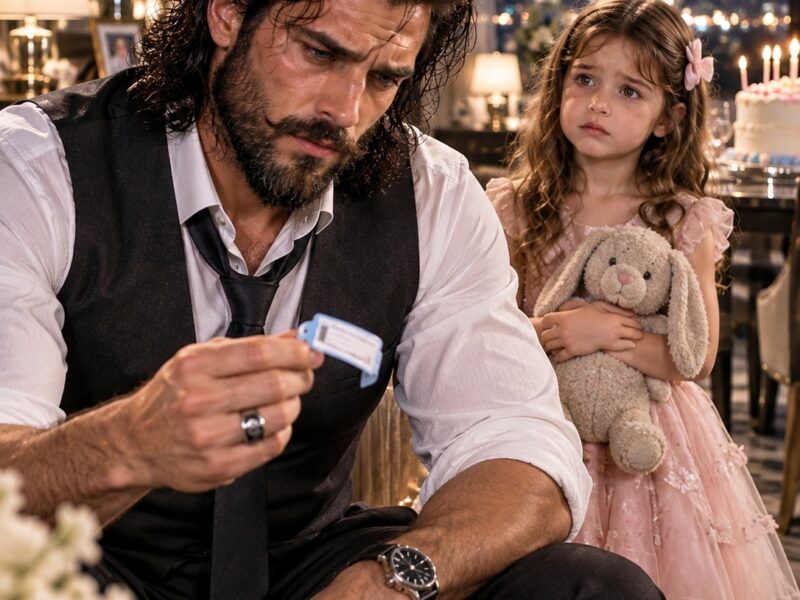
The Mafia Boss Missed Her Birthday Dinner Again—Then a Hospital Wristband in His Daughter’s Coat Exposed the Secret Everyone Had Been Hiding From Him
Dominic Ferrante missed his daughter’s tenth birthday dinner while she waited beneath white roses with a cake she had asked the restaurant to save for him.
When he finally came home after midnight, he found a hospital wristband hidden inside the yellow coat she had deliberately left beside his study door.
By sunrise, Dominic would discover that his daughter had been sick for months—and that the people closest to him had learned to fear telling him the truth more than they feared hiding it.
At 7:08 p.m., Dominic Ferrante looked at the clock above the warehouse office door and told himself he still had time.
His daughter’s reservation was for seven at Casa Lucia. Paulo had closed the back dining room without being asked, because people in Newark had a habit of making arrangements for Dominic before he requested them. White roses would be on the table. Alina would order the brown-butter ravioli she had ordered every birthday since she was six, eat six bites, and insist she was full until somebody brought dessert.
At 7:12, Dominic’s phone lit up.
PAULO.
He silenced it.
Across the metal desk, Aldo Benassi kept explaining how forty containers of imported electronics had disappeared from the East Docks without appearing on a single customs correction. Aldo was the night foreman, fifty-three, sweating visibly through a blue work shirt despite the cold October evening.
“I swear on my mother, Mr. Ferrante—”
“Don’t.”
Aldo stopped.
Dominic leaned back.
“Tell me the last time you personally saw the manifest.”
Aldo swallowed.
“Tuesday morning.”
“And after that?”
“Control office.”
“Who had access?”
“Three clerks.”
“Names.”
The questions continued.
7:31.
7:48.
8:06.
Dominic’s phone lit again.
PAULO.
Then ROSA.
He looked at both names.
Did not answer either.
That was how his life worked. The urgent thing in front of him defeated the important thing somewhere else because urgency came wearing numbers, threats, shipments, signatures, payrolls, and men who needed answers immediately.
Alina had never demanded immediate answers.
That had made her easy to postpone.
By 8:40, Dominic knew Aldo had not stolen anything.
The man was frightened for another reason.
His hands shook whenever Dominic mentioned dismissal but steadied whenever the missing freight came up.
“You’re not worried about the containers.”
Aldo looked down.
Dominic waited.
Silence did most of his work for him.
“My wife is at University Hospital.”
“What happened?”
“Kidneys.”
Aldo rubbed both palms against his pants.
“They say dialysis now. Maybe transplant later. I’ve been sleeping in my car near the hospital because she wakes confused.”
Dominic glanced at Tio Salerno, who stood near the window.
Tio had worked beside Dominic’s father before Dominic was old enough to drive. Sixty-one now, silver-haired, quiet, and capable of hearing instructions Dominic did not say aloud.
“Send him home.”
Aldo looked up.
“Mr. Ferrante—”
“You keep your job.”
Dominic stood.
“Your wife’s hospital balance gets handled through the employees’ medical fund.”
Aldo’s face collapsed.
“I don’t know what to—”
“Then don’t.”
Dominic turned away before the man could thank him.
He disliked being watched while he did decent things.
It made decency feel theatrical.
When Dominic looked at the clock again, it was 10:09.
The restaurant had been closed for more than an hour.
Tio spoke quietly.
“Casa Lucia?”
Dominic picked up his coat.
“Take me home.”
Benny drove.
For eleven years Benny Russo had filled car rides with baseball scores, complaints about New Jersey traffic, and updates about his daughter’s nursing program. That night he drove with both hands at ten and two and said nothing.
Dominic noticed.
He did not ask why.
That small failure would bother him later almost as much as the larger ones.
The Ferrante house stood behind iron gates on a wooded hill overlooking the river. The guards nodded when the sedan passed, porch lights glowing against the wet pavement.
Rosa opened the door before Dominic reached it.
She wore the gray cardigan Alina said made her look like somebody’s favorite aunt.
Rosa had kept Dominic’s house for fourteen years.
She had never once raised her voice to him.
“She waited until eight.”
Dominic removed his coat.
“Did she eat?”
Rosa looked down.
On the hall table sat a bakery box.
One unlit candle had been taped to the lid.
Across the top, in Alina’s careful slanted handwriting:
Save for Papa.
Dominic stood there longer than he would later admit.
Then he noticed the yellow coat hanging beside his study door.
Every coat in the house belonged on the rack by the stairs.
Even Alina, who forgot piano books, lunch boxes, and sometimes one shoe, never left her coat there.
Dominic lifted it.
Something crackled in the pocket.
A strip of white plastic slid into his palm.
Hospital wristband.
He turned it beneath the hallway light.
ALINA FERRANTE.
ST. BRIDGET’S CHILDREN’S HOSPITAL.
PEDIATRIC CARDIOLOGY.
Today’s date.
Admitted 2:10 p.m.
Discharged 5:40 p.m.
Dominic had read contracts worth hundreds of millions.
He had read indictments, threats, settlement demands, and messages from men who wanted him afraid.
He could not read the hospital line twice.
While he sat at the docks telling himself he still had time before dinner, his ten-year-old daughter had been inside a cardiology unit.
Someone had taken her.
Someone had brought her home.
Someone had known.
And Dominic had known none of it.
He looked toward Rosa.
“Who drove her?”
Rosa’s face changed.
Dominic already knew.
“Benny.”
Rosa nodded.
The silent ride home.
Benny’s white-knuckled grip.
Dominic shut his eyes.
“Wake him.”
“Mr. Ferrante—”
“Not Alina.”
His voice softened instantly.
“Let her sleep.”
He looked toward the staircase.
“I want Benny here.”
Rosa hesitated.
“There’s something you should know first.”
Dominic looked at her.
Rosa’s hands were trembling.
That frightened him more than anger would have.
“What?”
She pressed her lips together.
Then:
“This was not her first hospital visit.”
The words moved through the hall slowly.
Dominic did not understand them at first.
“How many?”
Rosa looked away.
“Rosa.”
“Since March.”
He stared.
“March?”
“The school nurse called me.”
“Alina fainted in gym.”
“She said she skipped breakfast.”
“We thought…”
Rosa stopped.
Dominic’s voice became very quiet.
“How many times?”
Benny arrived before she answered.
He came through the kitchen entrance wearing jeans, an old Yankees jacket, and the expression of a man arriving for judgment.
Dominic carried the wristband into the kitchen.
Set it on the table.
Rosa sat.
Benny remained standing.
“Sit.”
Benny obeyed.
“How many?”
Benny looked at Rosa.
Dominic repeated:
“How many hospital visits?”
“Twelve.”
The refrigerator hummed.
Somewhere upstairs, plumbing shifted.
Twelve.
Dominic pressed both hands flat against the table.
“My daughter has been inside a hospital twelve times since March.”
“Yes, boss.”
“And nobody told me.”
Benny’s face crumpled.
“She asked us not to.”
“She’s ten.”
“She was nine the first time.”
“That makes it worse.”
“I know.”
Dominic stood.
Benny flinched.
Small movement.
Shoulders tightening.
Dominic saw it.
A man who had driven Dominic through riots, federal raids, funerals, and territorial wars had just recoiled because Dominic stood too quickly.
That realization stopped him colder than the wristband.
He sat again.
“Tell me everything.”
Rosa looked at Benny.
Then at Dominic.
“The first time was March seventh.”
“Gym class.”
“She fainted.”
“The nurse thought dehydration.”
“Then May, piano recital.”
Dominic remembered.
He had been in Manhattan.
Tio told him not to leave because negotiations with the labor union had turned ugly.
“You said she was tired.”
Rosa nodded.
“I did.”
“I told you to buy vitamins.”
“Yes.”
Dominic remembered the exact hallway.
Phone against his ear.
Rosa standing near the study.
He had not even stopped walking.
Benny continued.
“June was worse.”
“She got dizzy in the car.”
“Heart beating real fast.”
“I took her to St. Bridget’s.”
“Dr. Nadia Aref.”
“She’s good, boss.”
“I checked.”
“Checked what?”
“Everything.”
Benny swallowed.
“Who goes in.”
“Who comes out.”
“Who parks nearby.”
“I sat in the waiting room every time.”
Dominic stared.
“You treated my daughter’s cardiology appointments like covert meetings.”
“I didn’t know what else to do.”
“And you never thought maybe her father should sit in that waiting room?”
Benny looked down.
“She made me promise.”
“What did she say?”
Benny twisted his cap.
“The first time… she asked if I told you.”
“I said no.”
“She said, ‘Please don’t. Papa has the docks.’”
Dominic’s mouth went dry.
Benny’s voice broke.
“She said you told her the docks are why the house is safe.”
“That if you stop working, bad people might come.”
“She thought telling you she was sick would make something happen to you.”
Dominic looked toward the ceiling.
His child had interpreted his absence as protection.
Rosa covered her mouth.
“She watched you at Easter.”
“You fell asleep at breakfast.”
“She told me you looked older.”
“She said she would tell you after her birthday dinner because birthdays made you stay at the table.”
Dominic shut his eyes.
He had missed the dinner.
Of course he had.
“You should have told me.”
Rosa lifted her chin.
“I tried.”
“When?”
“June.”
“You came down the upstairs hall.”
“I said, ‘Mr. Ferrante, it’s about Alina.’”
“You had the phone against your ear.”
“You said, ‘Handle it, Rosa.’”
Dominic remembered.
Every word.
That was the cruelest part.
He remembered dismissing the moment.
The kitchen became unbearable.
He walked to the sink.
Did not turn on the water.
Outside the window, the yard lights threw pale circles onto wet grass.
Nobody had kept his daughter’s illness from him because they hated him.
They had done it because every person in his house had learned the same lesson.
Dominic Ferrante wanted problems handled.
He did not want to hear them.
Not when they were emotional.
Not when they could not be solved before the next meeting.
Not when somebody might need him instead of his authority.
He had built that lesson one closed door at a time.
Dominic turned.
“You did what she asked.”
Benny looked up.
“I’m not angry at either of you for keeping her confidence.”
Rosa frowned.
“You have every right—”
“No.”
Dominic pointed gently at the wristband.
“I’m angry that she believed she had to ask.”
No one answered.
“What is wrong with her?”
Rosa and Benny exchanged another glance.
That was enough.
“You don’t know?”
“We know some.”
Rosa said.
“They’re still testing.”
“Dr. Aref mentioned thickened heart muscle.”
Dominic’s stomach tightened.
“What does that mean?”
“She said she should explain it.”
“Tomorrow?”
“Eight-thirty.”
Dominic looked toward the ceiling again.
“Did Alina know I was coming?”
Rosa shook her head.
“She thinks she’s going to school.”
Dominic did not sleep.
At three in the morning he found himself outside Alina’s bedroom.
He had brought a chair from the hall without knowing why.
He sat.
Listened to her breathe.
Slow.
Even.
He imagined a heart beneath her pajamas doing something nobody could see.
Dominic had spent thirty years believing danger announced itself.
Men followed you.
Cars appeared where they should not.
Contracts changed language.
Employees stopped making eye contact.
But this danger lived inside a ten-year-old girl and had come home twelve times without him noticing.
Near six, Alina moved inside.
The bathroom tap ran.
Dominic stood.
Carried the chair away before she opened the door.
Cowardice disguised itself as consideration surprisingly well.
At seven she entered the kitchen wearing her school uniform.
White blouse.
Navy cardigan.
Hair braided down her back.
She stopped when she saw him.
The hospital wristband lay beside his coffee cup.
Alina looked at it.
Then at him.
No surprise.
Only resignation.
“You found it.”
Dominic’s heart seemed to stop.
“Yes.”
She sat across from him.
Folded her hands like a person preparing for a difficult meeting.
Something about the gesture made Dominic ashamed.
“Why didn’t you tell me?”
Alina looked down.
“I tried.”
“When?”
“A lot.”
That answer hurt more than a date.
“Rosa said you wanted to wait until your birthday.”
Alina nodded.
“I thought you’d be happy.”
“I was going to tell you after cake.”
Dominic looked toward the untouched bakery box on the counter.
“I’m sorry.”
She shrugged too quickly.
“It’s okay.”
“No.”
Dominic leaned forward.
“It isn’t.”
Alina’s eyes filled but she blinked the tears away.
“Dr. Aref says it might run in families.”
Dominic stopped.
“She asked about Mama.”
His chest tightened.
Alina looked directly at him.
“Papa.”
“Yes?”
“Is this why Mama died?”
There are questions powerful men cannot command into easier shapes.
Dominic had no answer.
Mariana Ferrante died six years earlier.
Thirty-four years old.
Sudden cardiac event, the doctors said.
Dominic had accepted those words because they required nothing from him except burial.
He buried her.
Returned to work.
Turned grief into hours.
Turned hours into money.
Turned money into walls, cars, security, private schools, locked gates, and a house where everyone was safe except from his absence.
“I don’t know.”
Alina nodded.
For the first time Dominic saw that she had prepared herself for that answer too.
He canceled school.
Canceled every meeting.
Tio called twice.
Dominic ignored him.
At 8:25, Dominic drove Alina to St. Bridget’s himself.
Benny sat in front but did not speak.
Two Ferrante security men followed in another vehicle.
The pediatric lobby went quiet when Dominic entered.
Receptionist stopped typing.
A father moved his toddler slightly closer.
Dominic hated that.
Not because they were wrong to be careful.
Because Alina saw it.
Dr. Nadia Aref appeared at her office door.
Forty-two.
Dark curls escaping a low bun.
White coat wrinkled at the elbows.
She looked at Dominic’s men.
“They wait outside.”
Dominic was accustomed to people adjusting rules when he entered rooms.
Nadia did not.
He turned.
“Outside.”
They left.
Nadia closed the door.
On her desk sat Alina’s chart.
Thick.
Dominic stared at it.
“Twelve visits makes a large folder.”
Nadia met his eyes.
“Yes.”
No accusation.
Worse.
“Tell me.”
She drew a heart.
Simple.
Four chambers.
Then thickened the wall between them.
“Alina has hypertrophic cardiomyopathy.”
Dominic repeated the words.
“Meaning?”
“Part of her heart muscle is abnormally thick.”
“It can obstruct blood flow.”
“It can also destabilize the electrical rhythm.”
“The fainting?”
“Yes.”
“Can medicine fix it?”
“It’s helped.”
“Not enough.”
“No.”
“What do you do?”
Nadia turned the page.
“There is a surgical option.”
Dominic’s fingers tightened around the chair.
“What option?”
“Septal myectomy.”
“We remove a portion of the thickened muscle causing the obstruction.”
“Open-heart surgery?”
“Yes.”
Alina looked at her shoes.
Dominic stared at Nadia.
“When?”
“Friday next week.”
“Make it tomorrow.”
“If I could safely move the surgical team and operating room, I would.”
“I’ll pay whatever—”
Nadia’s expression changed.
Not offended.
Tired.
“This is not a restaurant reservation.”
Dominic went silent.
Alina looked between them.
Nadia softened.
“Mr. Ferrante, money is not the limiting factor.”
“We need the right surgeon.”
“The pediatric cardiac ICU.”
“Perfusion team.”
“Blood products matched.”
“Those people are scheduled for next Friday.”
Dominic nodded.
“Then Friday.”
“One more thing.”
Nadia opened another folder.
“This condition is often inherited.”
“We requested Mariana’s cardiology records.”
Dominic stared.
“She had a cardiologist?”
“For several months before her death.”
He did not know that.
Nadia continued.
“Dr. Weiss documented concerns about familial cardiomyopathy.”
“He wrote that he sent follow-up guidance to the spouse after her death.”
Her eyes met Dominic’s.
“Did you receive anything?”
A cream envelope appeared in Dominic’s memory.
Heavy paper.
Dr. Weiss embossed in blue.
Bottom drawer of his study.
Six years.
He had believed it contained a bill.
Condolences.
Something he could not bear to read.
“Yes.”
Nadia waited.
“I never opened it.”
Alina turned toward him.
Dominic could not look at her.
They drove home in silence.
Dominic left Alina with Rosa.
Entered his study.
Locked the door.
Bottom drawer.
Tax files.
Old correspondence.
There.
Cream envelope.
The corner still pristine.
He opened it.
Clinical note first.
Recommendation: first-degree relatives receive screening echocardiography and ECG.
Children beginning in early childhood.
Repeat evaluations.
Then a smaller envelope.
His name.
Mariana’s handwriting.
Dom.
His hands shook.
He opened it.
The letter was short.
Mariana said she had been scared to tell him how serious the doctors thought her heart problem might be.
Not because Dominic was cruel.
Because he was never still long enough for difficult things.
She wrote that she understood why he worked.
That she knew his father had taught him safety came from control.
Then:
If anything happens to me, please have Alina checked. Every year. She will not ask you for much. She is too much like you. But she needs you, Dom. Not the house. Not the guards. Not your money. She needs you to come home when you say you are coming home.
The final line:
Please come home.
Dominic read it three times.
Then placed both hands against the desk.
Six years.
The instruction that might have found Alina’s condition years earlier had existed forty feet from the kitchen table.
He had not opened it.
Not because anyone stopped him.
Because grief was something Dominic preferred to outrun.
His phone buzzed.
Unknown number.
Photograph.
Alina in a yellow hospital corridor.
Birthday afternoon.
Sitting alone near vending machines.
Coat zipped to her chin.
Small feet not reaching the floor.
Second message:
Beautiful child. Hospitals have so many doors. See you Friday. —V.S.
Vincent Strada.
For two years Strada had pressured Dominic’s East Dock interests.
Not through gunfire.
Through unions.
Permits.
Customs complaints.
Financing.
Shipments redirected.
Warehouses quietly purchased.
Men like them had learned modern empires could be taken with signatures more efficiently than force.
Friday had been scheduled as their final negotiation.
Dominic stared at the photograph.
Someone had photographed Alina inside a pediatric hospital.
A place Tio supposedly protected.
Dominic found Tio in the garden before dawn.
The older man walked the gravel path whenever he could not sleep.
Dominic held out the phone.
Tio looked once.
His face surrendered.
“You knew.”
Tio looked at the ground.
“Since June.”
Six months.
Dominic’s voice dropped.
“Benny came to you?”
“Yes.”
“And you put security at the hospital.”
“Plainclothes.”
“Two men each visit.”
“They failed.”
Tio’s voice cracked.
“I know.”
Dominic looked at him.
“You decided what I could bear.”
“Dom—”
“You looked at me every morning for six months.”
Tio finally raised his eyes.
“When Mariana died, you disappeared without leaving the house.”
Dominic froze.
“You signed nothing.”
“You ate because Rosa put plates in front of you.”
“You slept two hours.”
“Your father’s people were waiting to see whether Ferrante would survive without her.”
“Strada was already moving.”
“I held the organization together.”
“And yes.”
Tio’s eyes filled.
“I was afraid if you learned Alina might have the same thing, you would break where everyone could see.”
“So you protected the business.”
“I protected you.”
“No.”
Dominic stepped closer.
“You protected the version of me you needed.”
Tio absorbed that.
Dominic continued.
“You saw the Weiss envelope.”
Tio’s face changed.
“You remember.”
“You were in my study the day it arrived.”
“Yes.”
“You saw me put it in the drawer.”
“Yes.”
“And?”
Tio closed his eyes.
“I let it stay.”
“Why?”
“I thought opening it would destroy you.”
Dominic wanted anger.
Anger would have been easier.
Instead he saw the old man who had buried Dominic’s father beside him.
Who had held his shoulders at Mariana’s funeral.
Who had kept payroll moving while Dominic stared through walls.
Tio had betrayed him from love contaminated by fear.
That made forgiveness harder.
Dominic walked away.
Inside his study, he took out his phone.
Scrolled six years.
One saved voicemail.
Mariana.
Eleven seconds.
He had never played it.
The night she died, Dominic had been outside a warehouse meeting in Newark.
Phone rang.
MARIANA.
Twice.
He silenced it.
He would call back.
He always planned to call back.
At two in the morning, he found her beside the kitchen table.
Now he pressed play.
“Dom. Hi.”
Small laugh.
“It’s nothing. Don’t worry. I just feel strange and wanted to hear your voice.”
Pause.
“Call me when you can.”
Another breath.
“I love you.”
That was all.
Dominic sat motionless.
She had not known she was dying.
She had simply wanted him to answer.
The scream from the front hall came before he could play it twice.
Rosa.
Raw.
Dominic ran.
Alina lay halfway down the staircase.
Small body twisted into the carpet.
Her lips gray.
Eyes half open.
“Papa?”
Dominic reached her.
“I’m here.”
He would repeat those words for years.
Not because he had always been.
Because he finally understood what they required.
The ambulance took them to St. Bridget’s.
Dominic rode beside her.
Held one hand.
Paramedic placed monitors.
Alina’s rhythm jumped across the screen.
Dominic watched every number despite understanding none.
At the hospital, double doors swallowed her.
A nurse placed one palm against Dominic’s chest.
“You cannot go farther.”
Dominic stopped.
No threats.
No name.
No argument.
He stopped because somebody who knew more than he did had said stop.
An hour later Nadia found him.
“They stabilized her.”
Dominic stood.
“But?”
“We cannot wait until Friday.”
“When?”
“Tonight.”
His stomach dropped.
“Nine.”
Nadia looked directly at him.
“Mr. Ferrante, this is serious.”
“I believe Alina can do very well.”
“But I will not tell you it is small.”
“Tell me everything.”
Nadia did.
Mortality risk.
Arrhythmia.
Bleeding.
ICU.
Recovery.
Possible complications.
Dominic listened.
Did not interrupt.
Did not make one call.
Then his phone buzzed.
Vincent Strada.
Midnight. East Dock office. Transfer controlling interest or my people take possession at dawn. Three hundred jobs become my problem instead of yours. Come personally if you still intend to negotiate. If you do not come, you will learn what absence costs.
Dominic stared at the final sentence.
Tio approached twenty minutes later.
He stopped several feet away.
Not sure he was welcome.
“Three hundred men.”
Tio said.
“Families.”
“If Strada freezes payroll or cancels union agreements—”
“I know.”
“You can go at midnight.”
“Alina will be in surgery.”
Tio’s voice softened.
“There is nothing you can physically do in a waiting room.”
Dominic looked at him.
That sentence.
He had lived by it.
If you cannot affect the outcome, go somewhere you can.
Work where action matters.
Leave love to people better suited for waiting.
Dominic stood.
“Sit with Benny.”
“Dom.”
“I need ten minutes.”
Before surgery, Nadia let Dominic into pre-op.
Alina looked tiny beneath the hospital blanket.
Her braid had come loose.
IV taped to one hand.
She smiled when she saw him.
Weak.
Brave.
The smile hurt.
“Papa.”
Dominic sat.
Held her other hand.
“I’m sorry.”
“For falling?”
“No.”
“You never apologize for being sick.”
Alina watched him.
“I should have been at every appointment.”
“You were busy.”
“That isn’t an excuse.”
“You said the docks—”
“I was wrong.”
She looked toward the ceiling.
Then:
“I put the coat there.”
Dominic stopped.
“What?”
“The yellow coat.”
“I hung it beside your study on purpose.”
His heart tightened.
“And the wristband?”
“I put it in the pocket.”
“Why?”
Alina swallowed.
“I didn’t know how else to make you stop.”
Dominic could not breathe.
“I tried telling you.”
“But you always had your phone.”
“And when Rosa tried, you said handle it.”
“I thought if you found something from the hospital, you’d have to look.”
She finally met his eyes.
“I didn’t know how else to ask.”
There it was.
The midpoint truth that changed the whole opening.
The wristband had not been forgotten.
It was a message.
A ten-year-old girl had designed a clue because direct conversation with her father felt less reliable than leaving evidence where he might accidentally touch it.
Dominic bent his head.
Pressed her fingers to his forehead.
“Do you have to go to the docks?”
Her voice was almost a whisper.
He looked up.
“No.”
“Really?”
“No.”
“What happens?”
“I lose them.”
Alina’s eyes widened.
“Is that bad?”
Dominic thought of money.
Influence.
Thirty years.
His father’s pride.
Employees.
Everything he once considered permanent.
“It will be complicated.”
“Are people safe?”
“That’s what I’ll make sure of.”
“And you?”
Dominic leaned closer.
“I’m exactly where I’m supposed to be.”
He kissed her forehead.
Then walked into the hallway.
Called Vincent Strada.
Vincent answered quickly.
“Dominic.”
“Take the docks.”
Silence.
“What?”
“I’ll transfer controlling interest tonight through counsel.”
“Every existing employee stays.”
“Pension obligations honored.”
“Union contract untouched for eighteen months.”
“No retaliation against management.”
Vincent sounded almost amused.
“You are negotiating while surrendering.”
“I am protecting people.”
“That sounds expensive.”
“It is.”
Vincent paused.
“You built those docks for twenty-two years.”
“My father started them.”
“And you would hand them away for one girl.”
Dominic looked through the glass toward the pre-op doors.
“For ten more minutes with her, I would hand you the whole city.”
Vincent stopped laughing.
Dominic ended the call.
The surgery began at nine-sixteen.
Dominic sat.
That was all.
Sat.
Waiting proved harder than every negotiation he had ever survived.
In the first hour he walked the corridor eleven times.
Then Nadia’s nurse asked him to stop wearing a trench into the floor.
Rosa arrived with coffee and a rosary.
Benny arrived with Alina’s stuffed rabbit even though Alina had not slept with it in years.
Tio came last.
He sat across from Dominic.
Neither spoke for an hour.
At midnight, Dominic’s attorney texted.
Transfer signed. Strada accepted employment terms.
Dominic read it.
Turned his phone facedown.
His empire changed hands somewhere beyond hospital walls.
He felt almost nothing.
Only the clock.
At one-fifteen Tio spoke.
“I was wrong.”
Dominic looked at him.
“I spent years believing my job was keeping you functional.”
“I forgot functional is not the same as alive.”
Dominic leaned back.
“You were wrong to hide Alina.”
“Yes.”
“You were wrong to decide I could not hear it.”
“Yes.”
“But you put people in that waiting room.”
Tio looked down.
“I failed even there.”
“Yes.”
Dominic’s voice softened.
“But you tried.”
Tio looked up.
“That does not erase it.”
“No.”
Dominic held his gaze.
“I am learning not everything has to be erased before it can be forgiven.”
Tio’s face crumpled slightly.
He covered his eyes.
Dominic looked away to give him privacy.
At 1:43 a.m., an elderly man came down the corridor carrying a brown paper bag.
No entourage.
Gray overcoat.
Slow steps.
Dominic recognized Vincent Strada only when he was twenty feet away.
Tio stood.
Dominic raised a hand.
Vincent sat two chairs away.
“I signed an hour ago.”
Dominic said nothing.
Vincent placed the bag on his knees.
“I wanted to see what kind of man gives away a port to sit in a hospital chair.”
“You found him.”
Vincent looked toward the operating-room doors.
“I sent the photograph.”
“I know.”
“I wanted to find your weakness.”
“You did.”
Vincent’s mouth tightened.
“I thought that would feel better.”
“It doesn’t?”
Vincent looked old suddenly.
“My wife died in a hospital in Newark in 1991.”
Dominic stared.
“I was outside a warehouse.”
Vincent gave a small humorless laugh.
“Men like us have very repetitive biographies.”
“You missed it?”
“She called.”
“I said I would come after the meeting.”
“She died before I arrived.”
Dominic looked down.
Vincent continued.
“I spent thirty-five years calling that discipline.”
“Tonight it looks more like cowardice.”
Dominic said nothing.
Vincent stood.
“I will honor the employment terms.”
“No one touches your daughter.”
“No one photographs her.”
“No one enters that hospital on my behalf.”
“Not because I am becoming a better man.”
He looked at Dominic.
“Because I am too old to become this kind of man again in a corridor like this.”
He placed the paper bag on the chair.
Walked away.
Inside:
Cheap butter cookies in a blue tin.
Rosa ate three.
Cried through all of them.
At 4:51, Nadia came through the double doors.
Surgical cap damp.
Shoulders bowed with exhaustion.
Dominic stood too quickly.
Chair scraped.
His legs nearly failed.
Nadia held up one hand.
“She’s through.”
Dominic could not speak.
“Surgery went well.”
“Better than I expected.”
“We removed the obstructing muscle.”
“Her pressures improved immediately.”
“She has a long recovery.”
“ICU tonight.”
“But right now, her heart looks strong.”
Dominic covered his face.
Not crying exactly.
Not yet.
Then Nadia added:
“She’s asking whether you stayed.”
That broke him.
They let Dominic into recovery after six.
Alina looked pale beneath white blankets.
Machines blinked.
A scar disappeared beneath the collar of her gown.
Dominic sat.
Took her hand.
Did not look at his phone.
Her eyelids moved.
Opened.
“Papa?”
“I’m here.”
“Did you come back?”
Dominic leaned closer.
“I never left.”
She smiled.
Small.
Real.
Then slept.
Dominic remained until morning.
And the morning after that.
His new life began badly.
That was important.
Transformation did not arrive because a child survived surgery.
Dominic still reached automatically for his phone during conversations.
Still checked business updates at breakfast.
Still tried solving Alina’s discomfort by ordering things.
The first week home, he bought a hospital-grade adjustable bed without asking.
Alina stared at it.
“I like my bed.”
“This is better.”
“For who?”
Dominic stopped.
Called the company.
Sent it back.
Rosa applauded from the hallway.
“Do not encourage her.”
“I encourage truth.”
Dominic looked at Alina.
“Apparently everyone does now.”
The smaller legitimate companies remaining under Ferrante control required restructuring.
Without East Dock revenue, several luxury expenses disappeared.
Dominic sold two warehouses.
Closed an offshore holding company.
Moved some employees into legal freight brokerage and commercial property management.
He worked with attorneys to separate the legitimate businesses from arrangements he no longer wanted Alina inheriting around her.
Not because losing the docks purified him.
It did not.
But surrendering the port showed him something frightening.
The thing he thought could never be lost had been lost.
Morning still came.
Alina still needed breakfast.
The house still stood.
Rosa still criticized his coffee.
He began asking whether problems were urgent before treating them as more important than people.
Sometimes he failed.
Alina kept score.
“Phone.”
He would put it down.
“Meeting voice.”
He would lower his tone.
“You’re doing the face.”
“What face?”
“The one where everybody stops talking.”
Dominic learned he had many faces nobody had ever named to him.
Nadia became an ally beyond medicine.
She did not flatter him.
At follow-up visits she spoke to Alina first.
Always.
“How do you feel?”
Not:
“What has your father noticed?”
At the three-month appointment, Alina’s rhythm monitor looked good.
Nadia said:
“You can return to light activity.”
Dominic asked:
“What counts as light?”
Alina answered:
“Not mafia meetings.”
Nadia laughed.
Dominic did not.
Then he did.
Slowly.
Tio remained in Dominic’s life.
Not in the same position.
That mattered.
Dominic removed him from decisions involving family security.
Benny handled transportation.
Rosa had unrestricted access to interrupt any meeting if Alina needed something.
Tio accepted the boundary without complaint.
One afternoon he came to Dominic’s study carrying the old Weiss envelope.
“You should have fired me.”
Dominic looked up.
“Maybe.”
“Why didn’t you?”
“Because punishment is easy.”
“And?”
Dominic closed the folder he was reading.
“I needed you to understand what you did.”
Tio’s eyes lowered.
“I do.”
“No.”
Dominic pointed toward the chair.
“Sit.”
Tio sat.
“You thought loyalty meant protecting me from information.”
“Yes.”
“My father taught you that.”
“Yes.”
“I taught everyone else.”
Tio looked up.
Dominic continued.
“If I throw you out and keep running the house the same way, I make you the problem.”
“You were not the whole problem.”
Tio nodded slowly.
“So what am I now?”
“Uncle Tio.”
The older man stared.
Dominic almost smiled.
“Alina still likes you.”
“That is more than I deserve.”
“Stop deciding what other people can give you.”
Tio gave a broken laugh.
“Where did you learn that?”
“My daughter.”
The relationship between Dominic and Alina repaired differently.
No dramatic forgiveness.
Children do not owe instant absolution because adults finally improve.
For months Alina tested him without knowing she was testing him.
“Parent-teacher meeting Thursday.”
Dominic wrote it down.
Thursday came.
A shipping dispute erupted at noon.
At 4:20, his attorney called.
Dominic said:
“Handle it.”
Rosa, passing his door, stopped.
Dominic saw the expression.
“What?”
She smiled.
“Nothing.”
He reached school at five-forty-five.
Alina sat outside her classroom.
Saw him.
Looked at the clock.
“You’re early.”
“Meeting starts at six.”
“You’re twenty minutes early.”
“I know.”
She tried hiding her smile.
Failed.
Another test:
School winter concert.
Dominic sat in the third row.
His phone buzzed six times.
He ignored it.
Alina played piano.
Not brilliantly.
One wrong note.
Dominic clapped too loudly.
Afterward:
“You embarrassed me.”
“I attended correctly.”
“You clapped like I won something.”
“You survived Chopin.”
“That is not an award.”
He bought flowers.
Alina looked suspicious.
“Did Rosa tell you?”
“No.”
“Benny?”
“No.”
“You remembered?”
Dominic pretended offense.
“I remember things.”
“You remember containers.”
“I am expanding.”
She hugged him.
Fast.
Then walked away before he could make the moment heavy.
The first anniversary of Mariana’s death after Alina’s surgery came in March.
Usually Dominic visited the cemetery alone before sunrise.
That year he asked Alina if she wanted to come.
She did.
Cold morning.
Bare trees.
Alina carried yellow tulips.
At the grave:
“Did Mama know she was sick?”
“Yes.”
“Did she know I might be?”
“Yes.”
“Was she angry you worked?”
Dominic looked at Mariana’s name.
“She loved me.”
“That isn’t the same answer.”
Alina was very good at those distinctions.
Dominic nodded.
“No.”
“She was not angry all the time.”
“But she was lonely.”
“So were you?”
“Yes.”
“Why didn’t you tell anybody?”
“Because I thought needing people gave them power over me.”
Alina frowned.
“That sounds dumb.”
“It was.”
They stood quietly.
Then Alina asked:
“Did you love her more than the business?”
“Yes.”
“Then why did you choose work?”
Dominic looked at his daughter.
Because love and priorities were not always aligned.
People often loved something they repeatedly failed to choose.
“I thought love stayed put.”
Alina waited.
“I thought work could disappear if I neglected it.”
“But family would understand.”
“Did Mama?”
“For a long time.”
“And then?”
Dominic looked toward the headstone.
“I ran out of time.”
Alina took his hand.
No forgiveness speech.
No lesson.
Just warmth.
That was enough.
Vincent Strada kept his agreement.
He also made money from the docks.
A great deal.
Dominic occasionally saw his name in trade publications tied to new logistics contracts.
Their old rivalry did not become friendship.
But it changed.
Six months later Vincent sent a letter.
Handwritten.
The port is profitable. You were a fool to give it up. You were also right. Those facts apparently coexist.
Dominic laughed when he read it.
At the bottom:
My granddaughter was born yesterday. I answered the phone.
Dominic placed the letter in the same drawer that had once held Mariana’s unopened envelope.
This time, nothing remained unopened.
A year after surgery, Nadia cleared Alina for moderate exercise.
No competitive intensity.
No sudden maximal exertion.
But walking.
Swimming.
Cycling carefully.
Alina chose dance.
Dominic hated that because dance looked medically suspicious.
“It involves jumping.”
“Not my class.”
“Turning.”
“Humans turn.”
“Rapidly.”
“Papa.”
Nadia intervened.
“Let her dance.”
Dominic looked betrayed.
“You’re her doctor.”
“Exactly.”
Alina attended beginner contemporary dance.
Dominic drove her the first day.
She stopped at the studio entrance.
“You don’t have to wait.”
“I know.”
“You can go.”
“I know.”
“You’re going to sit in the parking lot, aren’t you?”
“Yes.”
“That is creepy.”
“I own a book.”
“You read now?”
“I’m expanding.”
She rolled her eyes.
He sat in the parking lot forty-five minutes reading three pages because he kept checking the door.
Still progress.
The second year was harder in a quieter way.
Dominic had more time.
He did not always know what to do with it.
Without East Dock emergencies every night, he found himself home at six.
Rosa eventually said:
“You hover.”
“I live here.”
“You hover while living.”
Alina sometimes wanted to be alone.
Dominic had to learn presence was not surveillance.
One Friday he knocked on her bedroom door.
“No.”
He stopped.
“What?”
“No.”
“You didn’t ask anything.”
“I know what you’re going to ask.”
“What?”
“If I need anything.”
Dominic paused.
“Do you?”
Alina groaned.
He smiled.
“Good night.”
He walked away.
Small victories.
At fifteen, Alina asked to see her complete medical records.
Dominic’s instinct was to say she was too young.
He stopped himself.
Nadia sat with her.
Explained terminology.
Mariana’s records too.
Alina cried when she read her mother’s warnings.
Dominic waited outside because Alina asked him to.
After two hours she opened the door.
“Come in.”
He did.
She held Mariana’s letter.
“You kept this?”
“Yes.”
“Can I have it?”
Every possessive instinct in Dominic resisted.
It was Mariana’s last letter to him.
But it was also a mother’s message about her child.
He handed it over.
Alina read.
Then folded it carefully.
“I’m keeping it.”
Dominic nodded.
“Okay.”
She looked surprised.
“You’re not going to argue?”
“No.”
“Why?”
Dominic looked at her.
“Because it’s yours if you need it.”
Alina smiled faintly.
“Look at you.”
“What?”
“Growth.”
He laughed.
At sixteen, Alina asked another question.
“Why did you really give Strada the docks?”
Dominic told her the same answer.
“Because you were in surgery.”
“No.”
She shook her head.
“That’s what happened.”
“Why did you decide it?”
Dominic thought.
“Because you asked if I had to go.”
“And?”
“You sounded like your mother.”
Alina went quiet.
“I had heard that question before.”
“I ignored it the first time.”
“I knew if I walked out of that hospital, I would spend the rest of my life pretending I had no choice.”
Alina looked at him.
“Did you regret it?”
“The money?”
“The docks.”
“Yes.”
She seemed startled.
Dominic continued.
“I regretted it three times the first month.”
“Twice the second.”
“Once during taxes.”
Alina laughed.
“But never enough to wish I had left.”
“That’s different.”
“Yes.”
“That is what choices are.”
Not decisions without cost.
Decisions whose cost you accept because the alternative costs more of who you want to be.
By the time Alina turned eighteen, Dominic Ferrante was no longer the man whose name emptied restaurants.
Some people still knew him.
Some still feared the history attached to him.
But his business world had narrowed into legitimate freight consulting, warehouses, and commercial property.
He paid taxes through accountants who complained loudly.
He had fewer men standing at doors.
He slept better.
Not always.
His gray hair increased.
Rosa blamed vegetables.
Benny’s daughter became a nurse at St. Bridget’s.
Tio retired officially and continued appearing every morning at nine, which made retirement mostly a legal fiction.
Alina graduated high school wearing a white dress beneath her gown.
Dominic sat beside Rosa and Benny.
No reserved VIP row.
Alina had refused.
When her name was called, Dominic stood before anyone else.
She pointed at him from the stage.
“Sit.”
The entire row laughed.
He sat.
At dinner afterward, Dominic gave her one gift.
Not a car.
Not property.
A small leather wallet.
Inside was the old hospital wristband.
Alina stared.
“You kept it?”
“Every day.”
“Why?”
Dominic touched his own wallet.
“It was behind my driver’s license for eight years.”
“The only document that ever forced me to read my own life correctly.”
Alina held it carefully.
“I thought you’d throw it away.”
“I almost did.”
“Why didn’t you?”
“Because forgetting is easy when reminders are convenient to lose.”
She put it back.
“Keep it.”
Dominic frowned.
“It belongs to you.”
“No.”
She pushed the wallet toward him.
“It did its job for me.”
“You still need it.”
Dominic looked at her.
She smiled.
“Sometimes.”
Another October came.
Alina turned nineteen.
Casa Lucia still existed.
Paulo’s nephew now ran the kitchen.
White roses waited.
Brown-butter ravioli still arrived whether Alina requested them or not.
Dominic arrived at 6:15.
Reservation seven.
Paulo, older now, stood in the doorway.
“Mr. Ferrante.”
“Paulo.”
“You’re early.”
Dominic looked at the empty table.
“No.”
He smiled.
“I’m just not late anymore.”
He sat.
Waited.
No phone on the table.
At seven, Alina entered wearing a yellow coat.
Older now.
Taller.
Healthy.
A small scar beneath her collarbone visible when she moved.
For one second, Dominic saw the ten-year-old standing in the hallway behind her.
The child who had learned to leave evidence because words could not reach her father.
Alina stopped beside the table.
Her eyes went to his chair.
Occupied.
That old cautious expression appeared for half a heartbeat.
Then disappeared.
“Papa.”
Dominic stood.
Pulled out her chair.
“You staying for the whole dinner?”
He looked at her.
The question was playful now.
Mostly.
Some questions retain old scars.
Dominic reached into his wallet.
Touched the curled edge of white plastic.
Then put the wallet away.
“I’m already here.”
Alina sat.
Paulo brought ravioli.
Dominic stayed through dinner.
Through cake.
Through coffee.
Through Alina explaining a college professor Dominic immediately disliked for reasons he promised not to investigate.
At nine-thirty she finally looked at the clock.
“Don’t you have work?”
“Yes.”
“Shouldn’t you go?”
Dominic shook his head.
“It can wait.”
Alina smiled.
Outside, rain moved softly against the restaurant windows.
Years earlier Dominic had believed power meant making the world wait for him.
Then a ten-year-old girl left a hospital wristband inside a yellow coat because she had no other way to make her father stop.
He had spent the rest of his life learning the difference.
This time, he stayed.









