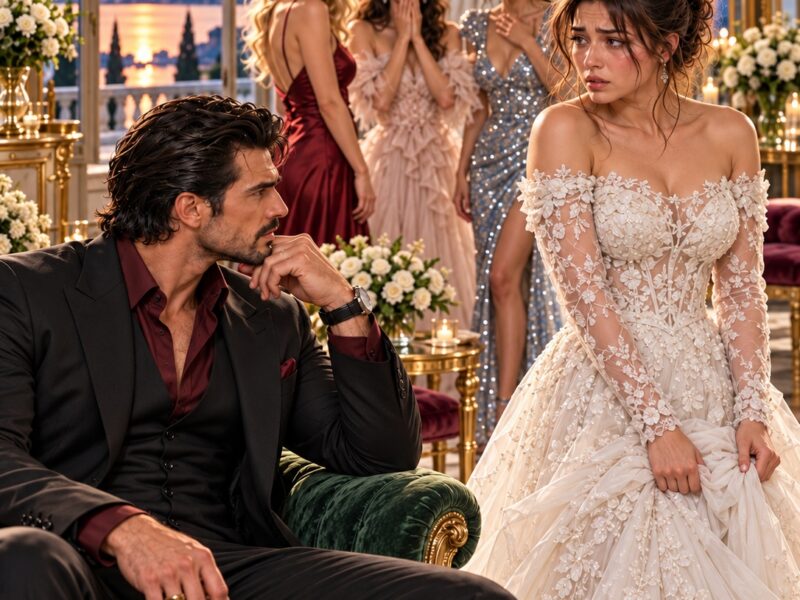
The Mafia Boss Rejected Twenty Brides—Until His Quiet Assistant Accidentally Wore the Forbidden Wedding Gown and Exposed the Secret His Family Had Buried for Forty Years
The dress fit.
That was the first disaster.
The second was Roman Bellandi walking into the room and seeing Maya Bennett inside it.
For perhaps five seconds, nobody moved.
Not the seamstress standing behind Maya with both hands suspended in the air.
Not the two housemaids holding boxes of pearl buttons near the mirror.
Not Maya herself, whose first instinct was to tear the ivory silk off her body before somebody remembered she was only the assistant.
And certainly not Roman.
He stood beneath the carved archway of the fitting salon in his Manhattan townhouse wearing a black overcoat over a charcoal suit, rain still darkening his shoulders from the October night outside.
His gaze moved slowly over Maya.
Not hungrily.
That would have been easier.
Recognition was more frightening.
His eyes dropped to the waist of the gown.
Then the sleeves.
Then the long line of antique silk falling naturally over Maya’s full figure without a single pin, temporary stitch, hidden clip, or adjustment.
Finally, he looked toward the enormous oil portrait above the fireplace.
Serafina Bellandi.
His grandmother.
The first woman to wear the dress.
Roman went completely still.
Maya wished the floor would open.
“Mr. Bellandi, this isn’t what it looks like.”
His eyes returned to her.
“What does it look like?”
She swallowed.
“Bad.”
Behind her, Evelyn Russo, the Bellandi family seamstress for thirty-six years, made a strangled sound.
Maya glanced at her desperately.
“Please explain.”
Evelyn found her voice.
“Mr. Bellandi, Miss Barone’s rehearsal gown was ruined.”
Roman’s expression changed.
“How?”
“Red wine.”
“Accident?”
Evelyn hesitated.
Maya noticed.
So did Roman.
“That’s a conversation for later,” he said.
Evelyn nodded quickly.
“I needed to compare the damaged construction against the original before morning. Every model had gone home, and Miss Bennett was still here.”
“I was finishing tomorrow’s presentation schedule,” Maya said.
Roman’s gaze never left the gown.
“And you put it on.”
“Under protest.”
Evelyn muttered, “She fought like I was taking her to an execution.”
Maya turned.
“Not helping.”
Something almost happened at the corner of Roman’s mouth.
Almost.
Then he crossed the room.
Maya’s pulse accelerated.
The Bellandi wedding gown was not simply old.
It was an institution.
Every serious bride presented to a Bellandi heir for the last four decades had been expected to stand before the family council wearing the original gown exactly as Serafina Bellandi had left it.
No cutting.
No permanent alteration.
No reconstruction.
The rule was absurd.
Everyone knew it.
Nobody challenged it.
Twenty women had tried.
Twenty daughters of powerful families.
Heiresses.
Political daughters.
Women raised from childhood to understand the value of marrying into Bellandi power.
Some had been too narrow through the shoulders.
Others too small through the chest.
Some could not close the waist.
Others disappeared inside the skirt.
The family had quietly used pins, hidden panels, and temporary tacking for years while insisting the gown remained untouched.
Roman knew.
That was why he rejected them.
At least, that was the explanation everyone assumed.
Maya knew better.
She had managed Roman Bellandi’s calendar for four years.
She knew what time he called his mother every Sunday.
Which city councilman he refused to meet alone.
Which business partners lied when they began sentences with to be completely honest.
She knew he hated lilies because they reminded him of funerals.
She knew he slept badly before family presentations.
She knew twenty beautiful women had walked into his life wearing expensive perfume and carefully rehearsed affection.
And one by one, Roman had sent them away.
People called him cold.
Impossible.
Arrogant.
The most difficult unmarried man in New York.
Maya had personally rescheduled six family dinners because another potential bride had been rejected.
She had sent flowers to offended fathers.
Returned jewelry.
Canceled photographers.
Prepared polite statements explaining that “the families had mutually agreed not to proceed.”
They had almost never mutually agreed.
Roman simply said no.
Then Maya cleaned up the consequences.
That was what assistants did.
Roman stopped three feet in front of her now.
Maya looked down at herself.
The gown terrified her.
Not because it was beautiful.
Because it did not make her disappear.
Maya had spent most of her life learning exactly how to disappear.
At thirty-one, she wore dark sweaters, loose trousers, flat shoes, and hair pinned into practical knots. She had a soft, full figure that strangers had treated as public discussion since she was fourteen.
Too much.
Too big.
Pretty if she lost weight.
Beautiful face.
Shame about the rest.
By adulthood, Maya had discovered the easiest defense.
Neutrality.
Dress correctly.
Speak carefully.
Become so competent nobody had time to discuss anything else.
Roman knew her as efficient.
Calm.
Indispensable when three problems arrived at once.
He did not know how many mornings she changed outfits because a fitted blouse made her feel visible.
Or perhaps he did.
That possibility was suddenly worse.
The antique gown did not hide her.
It emphasized everything Maya usually concealed.
Wide shoulders.
Full bust.
Defined waist.
Curved hips.
But nothing pulled.
Nothing strained.
The silk simply fell.
As if the dress had been cut yesterday.
For her.
Roman stopped beside Evelyn.
“Pins?”
“None.”
“Temporary seams?”
“No.”
“Corset panel?”
Evelyn looked almost offended.
“Nothing.”
Roman turned back toward Maya.
She crossed her arms instinctively.
The gown shifted with her.
“Please stop staring.”
Everyone in the room seemed to stop breathing.
Very few people told Roman Bellandi what not to do.
His gaze lifted to hers.
“I apologize.”
Maya’s arms slowly lowered.
That surprised her more than anger would have.
Roman looked toward Serafina’s portrait again.
The resemblance was not facial.
Maya saw that immediately.
Serafina Bellandi had dark Italian features, black hair, and an uncompromising expression.
Maya had auburn-brown hair, pale skin that freckled during summer, and gray-green eyes inherited from an Irish-American mother.
But the dress looked the same.
Not because Maya resembled Serafina.
Because neither woman had been built delicately.
Serafina’s painted shoulders were broad.
Her body was full and grounded.
She stood beside Roman’s grandfather without leaning toward him, chin lifted, one hand resting openly against the folds of the wedding gown.
Maya had looked at that painting hundreds of times.
She had never understood how carefully history had lied about the woman inside it.
Roman spoke softly.
“My grandmother was your size.”
Maya’s face heated.
“I don’t think discussing my size is improving this.”
“No.”
He looked at her.
“I mean the family photographs make her look smaller.”
Evelyn spoke behind them.
“Later portraits were retouched.”
Roman turned.
“What?”
Evelyn suddenly looked as though she regretted being alive.
“Your grandfather preferred a more… conventional image.”
Roman stared.
“Conventional.”
Evelyn lowered her eyes.
Maya looked at the portrait.
Something uncomfortable shifted inside her.
Even Serafina Bellandi had been made smaller after death.
Roman seemed to reach the same conclusion.
His jaw tightened.
Maya reached for the hooks at the back of the gown.
“I’m taking it off.”
“Don’t.”
One word.
Quiet.
Absolute.
Maya froze.
Roman saw her expression.
Then corrected himself.
“Please.”
That changed the room.
Maya’s hand lowered slowly.
Roman Bellandi did not say please often.
Not because he was rude.
Because his world had trained people to move before he finished sentences.
“What?” she asked.
He approached another step.
“There’s something wrong with the bodice.”
Evelyn frowned.
“Wrong?”
Roman pointed.
“Left side.”
Maya looked down.
The silk seemed smooth.
Then she felt it.
A small hard pressure against the inside of her ribs.
She had assumed it was boning.
“Something’s poking me.”
Evelyn went pale.
“That’s impossible.”
Roman noticed.
“Why?”
“The gown was restored after Serafina died. Every internal panel was documented.”
“When?”
“1986.”
Roman’s expression sharpened.
“My grandmother died in 1987.”
Nobody spoke.
Maya touched the spot again.
Hard.
Small.
Definitely not part of the dress.
Roman looked at her.
“Take it off carefully.”
This time she did not argue.
Behind the folding screen, Evelyn helped Maya out of the gown while Roman waited outside.
Maya pulled her sweater back over her head with an almost embarrassing amount of relief.
Invisible again.
Safe again.
Except nothing felt safe.
Evelyn laid the gown flat across a padded table.
She examined the interior seam.
“There.”
A section of hand stitching ran beneath the left side of the bodice.
The thread had aged differently from the original construction.
Roman leaned closer.
“That was added later.”
Evelyn nodded.
“By hand.”
Maya stood beside him.
“Should we open it?”
Roman looked at the clock.
11:47 p.m.
Tomorrow night, three hundred guests from New York’s most powerful families would enter the Bellandi estate in Westchester for the bride presentation.
Celeste Barone was expected to be selected.
Her father, Victor Barone, had spent two years arranging the alliance.
Half the city already treated the marriage as inevitable.
Roman stared at the hidden stitching.
Then shook his head.
“Not tonight.”
Maya looked at him.
“Why?”
“Because three people know you wore this dress.”
Evelyn’s face changed.
Roman continued.
“By morning, thirty will know.”
“That seems pessimistic.”
“It is generous.”
Maya’s stomach tightened.
“And?”
“And everyone who has spent years believing Celeste Barone will become my wife is about to learn that the one family symbol none of them could satisfy fit my assistant without alteration.”
Maya stared.
“You make it sound like I committed a political crime with my hips.”
Evelyn coughed into her hand.
Roman almost smiled again.
Almost.
“In this family,” he said, “less has started wars.”
By eight the next morning, he was proven correct.
Maya entered Roman’s Midtown office carrying two coffees and discovered six missed calls from reporters on her desk.
Her personal phone had twenty-three messages.
Three from former coworkers.
Four from numbers she did not recognize.
One from her mother in Queens.
WHY IS SOME WOMAN FROM PAGE SIX ASKING WHETHER YOU ARE ENGAGED TO A MAFIA BOSS?
Maya closed her eyes.
Across the office, Roman stood near the windows talking to his security chief, Daniel Cross.
Daniel was forty-six, former military, unfailingly polite, and one of the few people who spoke to Roman as if his last name meant nothing.
He looked at Maya.
“Morning.”
“No.”
Daniel nodded.
“Fair.”
Roman ended the call.
“How bad?”
Maya set down his coffee.
“My mother thinks I’m engaged to you.”
“That seems premature.”
“Roman.”
He looked at her.
She almost never used his first name at work.
That told him how angry she was.
“You said thirty people.”
“I underestimated.”
“You think?”
He glanced at her phone.
“What does your mother know?”
“That you pay me too much to answer emails after midnight and you once sent a car when my subway line shut down.”
“Dangerous information.”
“She now believes we’ve been conducting a secret romance.”
Roman’s expression changed by a degree.
Maya noticed.
She hated that she noticed.
“This is not funny.”
“I know.”
“Do you?”
“Yes.”
He came around the desk.
“Maya, nobody will force you into tomorrow’s presentation.”
“Good.”
“I mean it.”
She looked at him.
“You should marry Celeste.”
The answer came too quickly.
“No.”
Maya blinked.
Roman’s face closed.
“I wasn’t planning to marry Celeste before last night.”
“Then why let her family organize half the presentation?”
“Because my uncle wanted the alliance considered.”
“And you?”
“I considered it.”
“Twenty women.”
“Yes.”
“You rejected twenty.”
“Nineteen.”
Maya stared.
“What?”
“Celeste would be twenty.”
“This is not the correction you think it is.”
Daniel turned discreetly toward the window.
Roman sighed.
“Maya.”
“What is wrong with all of them?”
His eyes sharpened.
“Nothing.”
“Then what are you waiting for?”
He did not answer.
That frustrated her.
“You know what people say about you?”
“Yes.”
“That you bring women into that ballroom just to humiliate them.”
“I know.”
“That you enjoy rejecting daughters from powerful families.”
“I don’t.”
“Then explain it.”
Roman looked toward Daniel.
“Give us five minutes.”
Daniel left.
The office door closed.
Roman walked toward the bookshelf where a framed photograph of Serafina stood.
“My grandmother hated the bride presentations.”
Maya folded her arms.
“She created the dress rule.”
“That is what everyone says.”
“And?”
“My mother told me something different when I was eighteen.”
Roman looked at the photograph.
“Serafina wrote the rule because her own marriage had been arranged.”
Maya’s irritation softened slightly.
“She was seventeen when my grandfather’s family chose her.”
“That sounds horrifying.”
“She thought so too.”
Roman’s mouth moved faintly.
“She eventually loved him. That part was real. But she never forgave the family for behaving as though marriage gave them the right to redesign her.”
“Redesign?”
“Weight. Clothes. Speech. Friends. Everything.”
Maya looked at the portrait again.
Roman continued.
“She was the daughter of a butcher from Arthur Avenue. Broad shoulders. Strong hands. Not what anyone considered an appropriate Bellandi bride.”
“But the dress…”
“She commissioned it herself.”
The realization came slowly.
“Made for her.”
“Yes.”
“Exactly as she was.”
“Yes.”
Maya remembered the twenty candidates.
The hidden pins.
Secret alterations.
Roman’s face grew harder.
“After Serafina died, the men in this family turned her refusal to change herself into another test women were expected to fail.”
Maya stared.
“And you’ve been rejecting brides because they altered the dress?”
“Partly.”
“That is still ridiculous.”
“Yes.”
He accepted that too easily.
“The dress shouldn’t decide who you marry.”
“No.”
“Then what?”
Roman looked directly at her.
“I want one woman in this world who can stand next to my name without performing for it.”
Something changed in Maya’s chest.
She ignored it.
“And you think wearing a dress proves that?”
“No.”
His voice lowered.
“But watching nineteen women allow their fathers, stylists, and family negotiators to secretly reshape it told me something.”
“About them?”
“About the arrangements.”
That distinction mattered.
He continued.
“None of those women came because they wanted me.”
“That seems arrogant.”
“Most had met me once.”
“Fair.”
“They came because marriage to Bellandi solved a business problem.”
Maya looked toward the city.
“And Celeste?”
“Same.”
“You could simply refuse.”
“I was going to.”
“Tomorrow?”
“Yes.”
“You might have mentioned that while I spent six months scheduling her dress fittings.”
“I should have.”
Maya gave him a look.
Roman nodded.
“Definitely should have.”
She almost laughed.
Did not.
“What happens now?”
Roman returned to his desk.
“Now Victor Barone believes last night was deliberate.”
“It wasn’t.”
“He won’t care.”
“And Celeste?”
A flicker crossed his face.
“She will.”
Maya understood before he said more.
Celeste Barone was not stupid.
She was proud.
Beautiful.
Raised inside the same system.
Public humiliation would matter more than private truth.
“She’ll think I stole something from her.”
“Yes.”
“I didn’t want it.”
Roman’s eyes held hers.
“I know.”
The office door opened without a knock.
Celeste walked in.
Daniel followed.
“I tried.”
Celeste removed her sunglasses.
“No, you didn’t.”
Daniel looked at Roman.
Roman nodded.
Daniel left.
Celeste was thirty, dark-haired, poised, and wearing an ivory wool coat that probably cost as much as Maya’s annual rent.
She looked at Maya.
Then smiled.
That was worse.
“So.”
Maya stayed still.
Celeste crossed the room.
“The dress fit.”
Roman spoke.
“This is between you and me.”
“No.”
Celeste never looked away from Maya.
“It became about her the minute half New York received a photograph.”
Maya’s stomach dropped.
“Photograph?”
Celeste removed her phone.
A grainy image.
Maya inside the gown.
Roman standing three feet away.
Taken through the fitting-room doorway.
Maya looked toward Roman.
His face became cold.
“Who took that?”
Celeste laughed.
“You don’t know?”
Roman took the phone.
Daniel was called back immediately.
For the first time, the rumor became a security problem.
Not because Maya had worn the dress.
Because someone had been watching a private family fitting and leaked the image within hours.
Roman handed the phone to Daniel.
“Find the source.”
Daniel nodded.
Celeste folded her arms.
“My father believes you staged this.”
Roman looked at her.
“Your father believes whatever benefits him.”
“And you think yours was different?”
The question landed.
Roman said nothing.
Celeste looked at Maya.
“You should be careful.”
Maya’s posture tightened.
“Is that a threat?”
“No.”
Something exhausted moved beneath Celeste’s polished face.
“It’s advice.”
She stepped closer.
“My father has spent eighteen months telling every man in our family that this marriage saves us.”
“From what?”
Celeste’s mouth tightened.
“Things assistants aren’t briefed on.”
Maya almost responded.
Celeste continued.
“You accidentally became the obstacle between Victor Barone and the one alliance he cannot afford to lose.”
Roman stepped forward.
“Enough.”
Celeste turned.
“Is it?”
Her composure cracked for the first time.
“You get to reject me and remain Roman Bellandi.”
She touched her own chest.
“I go home as the daughter who failed.”
Maya’s anger changed.
Not into sympathy exactly.
Understanding.
Roman saw it too.
Celeste laughed bitterly.
“Look at you both.”
Then she left.
The room remained quiet.
Maya whispered, “She doesn’t want to marry you.”
“No.”
“You knew.”
“I suspected.”
“And everyone kept going anyway.”
Roman looked tired.
“That is how families like ours survive long enough to become rotten.”
That afternoon, Daniel found the leak.
One of the temporary event stylists.
Paid through a public-relations firm linked to Barone Holdings.
Not enough to prove Victor ordered it.
Enough to worry Roman.
Maya spent the rest of the day canceling things she had scheduled for a future that no longer existed.
Floral consultation.
Press rehearsal.
Photographer.
Private menu tasting.
By six, her inbox had accumulated four death threats and eleven marriage congratulations.
Daniel moved a security officer outside her apartment.
Maya objected.
Roman overruled her.
That caused the first real argument they had in four years.
“You do not get to assign a man to my front door.”
“You received threats.”
“So call the police.”
“I did.”
“And?”
“Officer stays.”
“No.”
Roman looked at her.
“Maya.”
“No.”
The office went still.
Daniel quietly exited.
Roman walked around the desk.
“This is not about controlling you.”
“That’s always what powerful men say before explaining why control is necessary.”
His face changed.
The accuracy annoyed him.
Good.
Maya continued.
“If I have protection, I choose the form.”
“What do you suggest?”
The question surprised her.
He meant it.
“My building has a lobby.”
“I know.”
Of course he did.
“One person downstairs, not outside my apartment.”
Roman considered.
“Two.”
“One.”
“Two shifts. One person at a time.”
Maya sighed.
“Fine.”
“Unmarked car.”
“Yes.”
“No following me.”
“If you leave the building—”
“No.”
“Maya.”
“No.”
He rubbed a hand across his jaw.
“You are very difficult to protect.”
“I am not an acquisition.”
Something softened in his face.
“No.”
His eyes stayed on hers.
“You are not.”
She looked away first.
The next night should have been the bride presentation.
Instead, the Bellandi estate hosted a crisis.
Victor Barone arrived before noon.
He was sixty-three.
Silver hair.
Beautiful suit.
A smile with no warmth.
He placed a brass cartridge on Roman’s desk.
Not a threat he intended to carry out personally.
A message.
“Our agreement stands.”
Roman did not touch the cartridge.
“There was never an agreement.”
“There was understanding.”
“Between you and my uncle.”
“Your family.”
“Not me.”
Victor leaned back.
“You’re going to destroy forty years of cooperation because your secretary filled out an old dress?”
“Maya is my executive assistant.”
Victor smiled.
“How modern.”
Roman’s eyes cooled.
“Be careful.”
Victor’s smile disappeared.
“You will present Celeste tonight.”
“No.”
Victor stared.
Roman continued.
“Not because of Maya. Because Celeste does not want the marriage, and neither do I.”
“My daughter knows her responsibilities.”
“That is not consent.”
Victor laughed.
“Since when does a Bellandi use that word?”
The insult landed because it was deserved.
Roman’s family had not always cared.
He did now.
“That changes.”
Victor stood.
“You think you can change rules because you’ve become sentimental?”
“No.”
Roman looked toward the cartridge.
“I think rules written by dead men can die too.”
Victor leaned closer.
“You present that assistant tonight and every family in this city will understand what you are saying.”
“What am I saying?”
“That blood means nothing.”
Roman’s expression went almost calm.
“Maybe it means less than character.”
Victor’s face hardened.
“Then prepare for consequences.”
When he left, Roman remained behind the desk.
Daniel entered.
“Should I move the presentation?”
“No.”
“You’re still holding it?”
“Yes.”
“With whom?”
Roman looked toward the office door.
Maya had arrived.
She heard the question.
Her stomach tightened.
“No.”
Roman stood.
“I haven’t asked yet.”
“You’re not asking.”
“I might.”
“Then I’m preemptively refusing.”
Daniel looked at the ceiling.
Roman almost smiled.
“Maya.”
“No.”
“Would you let me explain?”
“No.”
“I’ll wait.”
That irritated her more.
“You can’t just put me in that dress in front of three hundred people because it happens to fit.”
“I agree.”
“Good.”
“That isn’t why.”
She stopped.
Roman looked toward Daniel.
Again, Daniel left.
Poor man.
Maya folded her arms.
“Five minutes.”
Roman walked toward the windows.
“My grandmother left a private journal.”
Maya waited.
“I inherited it when my mother died.”
“You never told your family.”
“No.”
“Why?”
“Because half the entries would insult them.”
Maya almost smiled.
“Continue.”
“Serafina wrote that the gown was never supposed to identify a bride.”
Roman looked at her.
“It was supposed to identify whether the family deserved one.”
Maya frowned.
“That sounds dramatic even for your family.”
“It was Serafina.”
“Fair.”
“She hated the presentation ritual. After my grandfather died, she tried to abolish it.”
“What stopped her?”
“She died.”
The room became quieter.
“Natural causes?”
“That is what I was told.”
Maya thought about the hidden seam.
The hard object.
Roman saw the thought happen.
“Yes.”
“You think the dress contains something.”
“I think my grandmother sewed something into it before she died.”
“And you want me to wear it again.”
“No.”
Maya blinked.
“No?”
“I want to open it.”
“That seems more sensible.”
“But the family commission won’t allow me to alter the gown privately.”
“You’re the head of the family.”
“Tradition makes cowards of powerful men.”
That sentence stayed with her.
Roman continued.
“The gown can only be handled formally during a bride presentation or for conservation.”
“And Evelyn already documented it last night.”
“Yes.”
Maya understood.
“If we open that seam tonight, the family commission has to be present.”
“Yes.”
“And because I’m apparently the only available person it actually fits…”
Roman did not answer.
She stared.
“You planned this.”
“No.”
“You’re lying.”
“I considered possibilities.”
“That is rich-man language for planned.”
A small smile touched his mouth.
Maya wanted to stay angry.
It was inconvenient.
“What exactly are you asking?”
Roman became serious.
“Stand beside me tonight.”
“As what?”
“Not my bride.”
Something inside her dropped anyway.
She ignored it.
“As the person who found the seam.”
“Your family will still think—”
“I’ll tell them the truth.”
“Victor Barone will humiliate me.”
“Yes.”
“Celeste may too.”
“Yes.”
“Half the room will think I manipulated you.”
“Yes.”
Maya stared.
“You make terrible proposals.”
“I’m not finished.”
“Please improve.”
Roman stepped closer.
“I am not asking you because the dress fit.”
His voice lowered.
“I’m asking because for four years you have been the only person in my life who tells me when I’m wrong before checking whether it’s safe.”
Maya’s throat tightened.
“You know where every weak point in this organization is because everybody speaks freely when the assistant is in the room.”
“That sounds ominous.”
“It is why you’re more valuable than half the people sitting on the commission.”
Her eyes burned.
She hated that.
Roman continued.
“If Serafina hid something because she didn’t trust the men around her, I want the person beside me who understands what it means to be overlooked by them.”
Maya said nothing.
Roman did not offer his hand.
Did not corner her.
Did not say she owed him.
“If you say no, I cancel the presentation and fight the commission another way.”
“Victor?”
“My problem.”
“Your family?”
“My problem.”
“And if I say yes?”
Roman met her eyes.
“Then for once they have to look directly at the woman they’ve spent four years asking to refill coffee.”
That was unfairly effective.
Maya hated him a little.
“When?”
“Eight.”
She looked at the clock.
“Three hours?”
“Yes.”
“I hate you.”
“I’ve had worse responses.”
She stared another few seconds.
Then exhaled.
“One condition.”
Roman waited.
“I speak for myself.”
“Always.”
“No correcting me.”
“I reserve the right if you say something factually—”
“Roman.”
“Fine.”
“No presenting me as some mystical chosen bride.”
His expression almost betrayed amusement.
“Agreed.”
“And afterward, regardless of what the dress contains, I go home.”
His smile faded.
“Agreed.”
At seven forty-five, Maya stood at the top of the Bellandi ballroom staircase wearing Serafina’s gown.
Three hundred people looked up.
The room reacted exactly as she feared.
Whispers.
Laughter that pretended not to be laughter.
Shock.
Anger.
Celeste stood beside her father near the front.
Victor did not hide his contempt.
Roman waited at the bottom of the staircase.
He did not climb toward Maya.
That had been her request.
If I walk into this, I walk myself.
So Roman remained still.
Maya gripped the railing.
For one second, her body remembered every room she had entered and immediately apologized for occupying.
School dances.
Department stores.
Job interviews.
Her cousin’s wedding, where an aunt had whispered that empire-waist dresses were “forgiving.”
Shrink.
Cover.
Smile.
Do not make anyone uncomfortable with how much space you occupy.
The gown refused.
Its old silk held her upright.
Maya lifted her chin.
Then walked.
One step.
Another.
No stumble.
No rush.
By the time she reached the floor, the whispers had thinned.
Roman’s eyes met hers.
Nothing possessive.
Only:
You’re here.
She joined him.
The commission sat at a long table beneath the Bellandi crest.
Five older men.
Two older women.
Decades of money, violence, alliances, and family memory.
Thomas Bellandi, Roman’s uncle, spoke first.
“This is inappropriate.”
Maya almost laughed.
Instead:
“Good evening to you too.”
One of the women hid a smile.
Thomas’s face tightened.
“You are an employee.”
“Yes.”
“You have no standing in this ceremony.”
“Then we agree.”
Murmurs.
Roman remained silent.
Maya glanced at him.
He had promised.
She turned back.
“I’m not here to be presented as anyone’s bride.”
Victor Barone spoke.
“Then take off the gown.”
Maya looked at him.
“You first.”
The ballroom went completely silent.
Roman coughed into his hand.
Victor’s face reddened.
Maya continued before courage disappeared.
“The gown developed a structural irregularity last night during conservation review.”
“That is not your concern,” Thomas said.
“It was pressing into my ribs.”
A commission woman leaned forward.
“What kind of irregularity?”
“Something sewn inside the bodice.”
Now the room changed.
Even Victor stopped looking amused.
Evelyn entered carrying her conservation kit.
She joined Maya.
“We documented the seam this morning. Thread does not match original construction.”
Thomas looked toward Roman.
“You knew?”
“Since last night.”
“Why not open it privately?”
Roman answered calmly.
“Because your rules prohibit cutting or opening the gown outside formal presentation or conservation with commission witnesses.”
The old woman at the table laughed.
“Serafina would have enjoyed that.”
Thomas glared.
Evelyn approached Maya.
“Ready?”
No.
Maya nodded.
The gown was not cut while she wore it.
Instead, behind a screen, Evelyn removed the garment and Maya changed into a simple black dress.
When she returned, the ceremonial gown lay across a padded table in the center of the ballroom.
Three hundred people gathered around at a respectful distance.
Evelyn opened the hand-stitched seam.
Something small dropped into her palm.
A brass key.
Then a folded oilskin packet.
Nobody spoke.
Roman stepped forward.
Maya did too.
Evelyn opened the packet.
Inside was a letter.
The handwriting matched Serafina’s journals.
Roman knew immediately.
He read the first line.
Then stopped.
Maya watched his face change.
“What?”
Roman looked toward Victor Barone.
Every instinct in Maya sharpened.
“Roman.”
He handed her the letter.
Her eyes moved across old ink.
To whichever woman finally stands inside this dress without changing either herself or it: I hope the Bellandi men have learned something by the time you find this.
A few people laughed nervously.
Then Maya continued.
The next lines erased the laughter.
Serafina described discovering a long-running theft from Bellandi shipping accounts.
Shell companies.
False invoices.
Bribes.
A partnership between Roman’s late grandfather’s business manager and another family.
The Barones.
Victor went pale.
Maya kept reading.
Serafina had confronted the men.
They threatened her.
She copied records.
Locked originals somewhere accessible only with the brass key.
Then came the sentence that made Roman grip the edge of the table.
If I die before presenting this evidence, do not accept the word illness until you know what was in my wine.
The ballroom went silent.
Maya looked at Roman.
“How did she die?”
He did not answer.
Thomas Bellandi did.
“Cardiac failure.”
Maya looked at the letter.
“After dinner?”
Thomas’s face changed.
The old commission woman whispered, “Anniversary banquet.”
Victor stepped forward.
“This is theater.”
Roman turned toward him.
For the first time that evening, the coldest man in New York looked exactly like the reputation people had built around him.
“A dead woman accused your family of theft.”
“Forty years ago.”
“And suggested she was poisoned.”
“By men who are dead.”
Maya looked back at the letter.
“No.”
Everyone turned.
She pointed.
“She names one person still alive.”
Victor stopped breathing.
Maya read the line.
Victor Barone was young then, but he knew what his father was doing. I heard him outside the office the night they discussed stopping me before the anniversary dinner.
Celeste looked at her father.
“Dad?”
Victor’s face hardened.
“She was confused.”
“You were twenty-three,” Roman said.
“Roman.”
“Old enough to remember.”
Victor laughed.
“This proves nothing.”
Maya looked at the key.
“What does it open?”
Roman’s uncle answered reluctantly.
“There’s an old family vault beneath the chapel.”
Roman turned.
“You knew?”
“I knew the vault. Not the key.”
The room began moving.
People speaking.
Security radios.
Victor stepped backward.
Celeste noticed.
“Dad.”
He looked at her.
For the first time, fear entered his face.
Then all the lights went out.
Darkness swallowed the ballroom.
Someone screamed.
Roman’s voice cut through instantly.
“Nobody move.”
Maya heard chairs scraping.
Footsteps.
Then Daniel shouting from somewhere near the west doors.
“Lock the exits!”
Emergency lights came on.
Red.
Uneven.
Victor was gone.
So was Celeste.
Roman turned toward Maya.
“You okay?”
“Yes.”
He touched her arm.
Only after she nodded.
“Daniel.”
“Barone’s moving toward the chapel corridor.”
Roman started after him.
Maya grabbed his sleeve.
“Don’t.”
He turned.
“What?”
“You have security.”
“He knows where the evidence is.”
“So do we.”
“He could destroy it.”
“Then send Daniel.”
Roman’s face tightened.
Every part of him wanted to chase.
Maya saw it.
Revenge.
Family history.
Control.
She lowered her voice.
“You asked me to stand beside you because I see what everybody else misses.”
He stopped.
“What am I missing?”
“That if Victor planned the blackout, he wants you moving exactly where he expects.”
Roman stared.
Then looked toward Daniel.
“Take four. Secure the chapel from the exterior tunnel.”
Daniel nodded and disappeared.
Roman stayed.
That choice mattered.
Five minutes later, security reported Victor had been stopped before reaching the vault.
Celeste was with him.
But she was not helping.
She had been trying to stop her father.
Victor had struck her.
Not badly.
Enough.
When they brought them back, Celeste’s lip was split.
Her face looked empty.
Victor shouted the entire way.
“You think this woman belongs here?”
He pointed at Maya.
“Look at her!”
Roman’s jaw hardened.
Maya stepped forward before he could speak.
Victor laughed.
“What? The secretary has a speech now?”
Maya looked at him.
“For four years I scheduled meetings for men like you.”
His smile narrowed.
“You all did the same thing.”
“What?”
“You stopped seeing me thirty seconds after I entered the room.”
A few commission members shifted.
“So I heard everything.”
Victor’s expression changed.
“Who drinks too much before negotiating.”
“Who lies when he touches his cuff.”
“Who hates his son.”
“Who is afraid of his daughter.”
Celeste’s eyes lifted.
Maya continued.
“You thought being overlooked made me powerless.”
Her voice remained steady.
“It made me informed.”
Victor lunged verbally.
“You’re nothing.”
Roman moved.
Maya held out one hand.
He stopped.
She looked at Victor.
“I know.”
The answer confused him.
“I was nothing to you.”
Maya stepped closer.
“That is not the same thing.”
Silence.
Security took Victor away.
The vault was opened before dawn.
Inside were ledgers.
Original shipping contracts.
Copies of wire transfers.
Photographs.
A sealed medical report Serafina had obtained days before her death showing traces of a cardiac toxin in a private blood sample.
Enough to reopen questions that had been buried for four decades.
Enough to destroy Victor Barone’s public credibility.
Enough to prove his father had stolen from the Bellandis.
And enough to show something nobody expected.
Serafina had not intended the Bellandi empire to remain entirely under male control.
Her original trust named a future female co-chair.
Not wife.
Not decorative matriarch.
An independent voting partner selected by the family council from outside the bloodline every generation.
The clause had disappeared after her death.
Thomas Bellandi sat down when he read it.
Roman looked at Maya.
She immediately pointed at him.
“No.”
He blinked.
“I didn’t say anything.”
“You made the face.”
“What face?”
“The give-Maya-a-job-she-did-not-ask-for face.”
For the first time in twelve hours, Roman laughed.
The commission heard.
Half of them looked startled.
Maya smiled despite herself.
The evidence went to attorneys.
Then investigators.
Roman did not burn buildings.
Did not send men into the night.
That disappointed some of his older associates.
Good.
Victor Barone was indicted on financial charges months later after current accounts linked him to ongoing fraud.
The old murder allegation remained harder to prove.
But the Bellandi family publicly corrected Serafina’s history.
Her death certificate was reviewed.
Her original trust restored.
Her journal published privately for the family.
Celeste testified against her father.
Maya saw her once during the legal proceedings.
They stood opposite each other in a courthouse corridor.
Celeste looked exhausted.
No makeup.
No couture armor.
“Maya.”
Maya waited.
“I’m sorry.”
“For?”
Celeste almost smiled bitterly.
“You’re going to make me say all of it.”
“Yes.”
“For treating you like you were beneath me.”
Maya nodded.
“For letting my father turn you into the reason my marriage disappeared.”
Another nod.
“And for saying Roman would be ashamed of you.”
Maya’s face changed.
That one had stayed.
Celeste saw it.
“I knew exactly where to hurt you.”
“Yes.”
“I’m sorry.”
Maya looked at her.
“Thank you.”
Celeste seemed surprised.
“That’s it?”
“Did you want punishment?”
“No.”
“Then don’t ask me to perform forgiveness for you.”
Celeste exhaled.
“Fair.”
They never became friends.
That would have been too neat.
But years later, Maya would hear Celeste had opened a consulting firm in Boston under her mother’s maiden name.
No family empire.
No strategic marriage.
Her own work.
Maya hoped she was happy.
Not because Celeste deserved absolution.
Because Maya had learned revenge was often just another way of staying tied to people who hurt you.
The bride presentation tradition ended.
Roman abolished it publicly.
Thomas protested.
The commission argued for five hours.
Roman waited.
Then placed Serafina’s journal on the table.
“Read page eighty-two.”
Thomas did.
Serafina had written:
If these men ever make another young woman stand in my dress and call it tradition, haunt them for me.
The rule died immediately.
The gown went on display behind museum-grade glass in the Bellandi family foundation.
Not as a bride test.
As Serafina’s garment.
Her true measurements listed beside it.
No retouching.
No euphemism.
Maya visited once after installation.
She stood before the dress.
Roman joined her.
“You hate the plaque.”
“It says formidable.”
“She was.”
“It’s coded language.”
“For?”
“Large.”
Roman considered.
“You want me to change it?”
“No.”
“Why?”
“Because formidable is also accurate.”
He smiled.
Maya looked at the gown.
“I don’t want people saying it chose me.”
“They already do.”
“It didn’t.”
“No.”
“It fit because Serafina and I happened to have similar proportions.”
“Yes.”
“That’s all.”
Roman looked at her.
“No.”
She turned.
He continued.
“The dress fitting was coincidence.”
“Good.”
“You staying in that ballroom after Victor threatened you was not.”
Maya looked away.
“Neither was stopping me from walking into a trap.”
“That was self-preservation. I’d already trained four years of a replacement schedule.”
Roman laughed.
Then became quiet.
“Maya.”
“No.”
“I haven’t asked anything.”
“You are about to.”
He leaned against the display case.
“Dinner.”
“We eat dinner constantly.”
“Not because Daniel orders takeout during a crisis.”
She looked at him.
Roman Bellandi was actually nervous.
The discovery delighted her.
“Are you asking me on a date?”
“Yes.”
“After four years of employment.”
“You no longer work for me.”
That was true.
Three months after the Barone scandal, Maya had resigned.
Not because Roman asked.
Because everything about her role had changed.
She no longer wanted to be the woman behind his calendar.
She took a position as chief operations officer for the Bellandi Foundation—selected by an independent board after Maya insisted Roman recuse himself from the vote.
Same family orbit.
Different authority.
Her own contract.
Her own office.
Roman continued.
“One dinner.”
“Public.”
“Yes.”
“No private room.”
“Fine.”
“No restaurant you own.”
“That narrows Manhattan unnecessarily.”
“Roman.”
“Fine.”
“No drivers waiting at the table.”
“They usually wait outside.”
She gave him a look.
“One car.”
“Reasonable.”
“One date.”
“One.”
She smiled.
“Friday.”
Their first date was terrible.
Roman chose a restaurant too expensive to relax in.
Maya chose an outfit so carefully she barely felt like herself.
The waiter knew Roman.
The owner came over twice.
Three people stared.
Maya lasted twenty-seven minutes.
“I hate this.”
Roman put down his wine.
“The food?”
“This.”
She gestured around.
“What?”
“I feel like I’m being presented again.”
His face changed immediately.
“Leave.”
“What?”
“We’ll go.”
“You made reservations.”
“I also know how doors work.”
They left.
Walked four blocks.
Bought pizza slices.
Maya sat on a bench in Bryant Park wearing a wool dress and sneakers she kept in her bag because heels were a conspiracy.
Roman ate folding his slice incorrectly.
Maya stared.
“You’re doing that on purpose.”
“What?”
“You cannot be Italian-American and hold pizza like that.”
“I grew up on the Upper East Side.”
“That is not a defense.”
He laughed.
The date improved.
They spoke about things four years of employment had somehow avoided.
Maya’s father dying when she was nineteen.
Her mother working payroll for a construction company in Queens.
Roman’s fear that every relationship around him contained negotiation.
Maya’s habit of assuming attraction was pity until proven otherwise.
Roman grew quiet.
“Who taught you that?”
She looked at her pizza.
“Everybody.”
“That’s not an answer.”
“It’s the only one.”
Roman did not tell her she was beautiful.
That would have been easy.
Instead:
“I have watched you enter rooms full of people who underestimated you and fix problems none of them even noticed.”
Maya looked at him.
“That is not pity.”
Her throat tightened.
He continued eating.
No pressure.
No expectation that she reward the sentence.
That was when the date truly became dangerous.
Their relationship grew slowly.
Not through threats.
Not through violence.
Through ordinary inconvenience.
Roman learned Maya hated people rearranging her desk.
Maya learned Roman cleaned when anxious.
He reorganized entire kitchens before commission votes.
She caught him alphabetizing spices at two in the morning once.
“You run a criminal organization.”
“Allegedly.”
“You’re sorting cumin.”
“It was beside paprika.”
“Monster.”
He smiled.
They argued.
Frequently.
Maya did not become softer because Roman loved her.
Roman did not become harmless because Maya challenged him.
The Bellandi organization still existed in complicated territory.
But Roman began separating legitimate businesses from the old structures more aggressively.
Independent audits.
Outside boards.
Fewer favors.
Men who had benefited from ambiguity complained.
Some left.
One older capo accused Maya of turning Roman weak.
Roman fired him.
Maya was furious.
“You fired a man for insulting me?”
“He was also stealing.”
“That better not be added afterward.”
“It was actually first on the list.”
“Show me.”
He did.
She apologized.
Barely.
Two years after the gown incident, Roman asked Maya to visit the Bellandi estate.
Not the Manhattan townhouse.
The older property near Tarrytown where Serafina had lived.
He drove himself.
No bodyguards in the car.
Daniel followed at an insulting distance and claimed coincidence.
The house had changed.
Most of the darker rooms had been renovated.
Old portraits restored.
Serafina’s private study reopened after forty years.
Roman led Maya inside.
On the desk sat the brass key.
Maya stopped.
“I thought that went into evidence.”
“It was returned.”
Beside it was Serafina’s letter.
Framed.
Maya touched the glass.
“She started all this.”
“She started it before either of us existed.”
Roman stood beside her.
“My family spent forty years misunderstanding what she left.”
Maya looked at him.
“What do you mean?”
“We thought the dress rule meant only a particular kind of woman deserved to stand beside a Bellandi.”
He shook his head.
“She meant the opposite.”
Maya smiled slightly.
“She meant Bellandi men needed to stop asking women to change shape for them.”
“Yes.”
They stood quietly.
Then Roman said, “I bought a dress.”
Maya’s entire body stiffened.
“No.”
He laughed.
“Not that kind.”
“Your timing is terrible.”
“I realize.”
He opened a wardrobe.
Inside hung a simple navy evening dress.
Maya frowned.
“What is that?”
“Your dress.”
“I own dresses.”
“This one has pockets.”
Her expression changed.
“Continue.”
Roman looked pleased.
“And it was made to your measurements.”
Maya’s eyes narrowed.
“Where did you get my measurements?”
“Evelyn.”
“Traitor.”
“She made me promise it wasn’t for a proposal.”
Maya stared.
“So this is not a proposal.”
“No.”
Disappointment arrived.
Unexpected.
Annoying.
She covered it.
Roman saw anyway.
Of course.
His expression changed.
“Maya.”
“No.”
“You looked disappointed.”
“I did not.”
“You did.”
“Dangerous observation.”
He came closer.
“I said the dress wasn’t for a proposal.”
Her heart began beating harder.
Roman reached into his pocket.
“Oh, for God’s sake.”
He smiled.
“What?”
“That pocket.”
“Apparently my pockets have developed a reputation.”
He removed a small box.
Maya closed her eyes.
“Roman.”
“Let me finish before you reject me on principle.”
“No promises.”
He opened the box.
The ring was not enormous.
Thank God.
An antique sapphire surrounded by small diamonds.
Maya recognized it.
Serafina wore it in several photographs.
She stared.
“No.”
Roman immediately closed the box.
Maya blinked.
“What are you doing?”
“You said no.”
“I said no because that’s Serafina’s.”
“Yes.”
“Roman.”
“You don’t want it.”
“That is not the same as not wanting—”
She stopped.
Roman’s eyes changed.
Maya glared.
“You did that intentionally.”
“I did nothing.”
“You weaponized consent.”
He laughed.
She covered her face.
“This is terrible.”
“May I ask now?”
Maya lowered her hands.
Roman became serious.
No audience.
No commission.
No family.
No gown.
Just the two of them inside Serafina’s study.
“I rejected nineteen women because every marriage offered to me felt like a contract written by somebody else.”
Maya listened.
“Then you accidentally put on a dress.”
“That’s romantic.”
“I practiced a better opening.”
“Use it.”
Roman smiled.
Then:
“I spent years thinking I was waiting for somebody who could fit into my life without changing.”
Maya’s expression softened.
“I was wrong.”
He took one step closer.
“I needed to become the kind of man who could make room without asking someone else to shrink.”
Her eyes filled.
“That was better.”
“I know.”
“Arrogant.”
“Occupational.”
He opened the box again.
“The ring was Serafina’s.”
“Yes.”
“She left instructions.”
Maya groaned.
“Of course she did.”
Roman handed her a copied page.
Serafina’s handwriting.
If a Bellandi man ever gives this ring to a woman because she strengthens his name, take it away from him. If he gives it to a woman whose name remains entirely her own beside his, let her decide.
Maya laughed through tears.
“I love her.”
“So do I.”
Roman’s voice became quiet.
“Maya Bennett, you do not owe my family anything.”
She held his gaze.
“You don’t owe me the four years you worked beside me.”
Another breath.
“You don’t owe that dress a meaning.”
He went down on one knee.
Maya’s heart stumbled.
“And you definitely do not owe me yes.”
His eyes stayed on hers.
“But if you want the same life I want—the arguments, your office twenty minutes away because you refuse to work in mine, Sunday dinner with your mother, Daniel pretending not to follow us, and whatever comes after that—will you marry me?”
Maya wiped one cheek.
“You forgot something.”
Roman looked alarmed.
“What?”
“No bride presentation.”
“Never.”
“No commission approval.”
“Absolutely not.”
“No family voting.”
“I’d sooner burn the table.”
“No dress test.”
“The gown is in a museum.”
“Good.”
“No calling me queen.”
His mouth twitched.
“That may be difficult.”
“Roman.”
“Fine.”
“And I keep my last name professionally.”
“Obviously.”
She looked at him.
He waited.
The powerful man who once made entire rooms answer immediately waited.
Maya smiled.
“Yes.”
Roman closed his eyes.
For one second, she saw pure relief.
Then he stood.
Maya pointed at the ring.
“I’m still not wearing that every day.”
“What?”
“It belongs in a collection.”
“You just accepted.”
“I accepted you.”
She took the sapphire ring.
“That doesn’t mean I suddenly become irresponsible around artifacts.”
Roman stared.
Then started laughing.
Their wedding happened eight months later.
Not in the Bellandi ballroom.
Not before the commission.
Not with three hundred dangerous people deciding what Maya represented.
They married in the courtyard of the New York Public Library.
Small ceremony.
Family.
Friends.
Daniel.
Evelyn.
Roman’s mother.
Maya’s mother, who cried from the moment she arrived and loudly told anyone listening that she had always known Maya would “marry somebody difficult.”
Celeste sent flowers.
No note beyond:
Wear whatever you want.
Maya did.
A new dress.
Made specifically for her.
No tradition.
No symbolism.
No test.
It had pockets.
Roman cried when he saw her.
Daniel pretended not to notice.
Maya absolutely noticed.
“You’re crying.”
“No.”
“You are.”
“Wind.”
“We’re indoors.”
“Architectural wind.”
She laughed.
During the vows, Roman said:
“I spent half my life rejecting women because I believed refusing the wrong marriage was enough.”
He looked at Maya.
“It wasn’t.”
People listened.
“I had to learn how not to turn love into another structure somebody else had to fit.”
Maya’s eyes filled.
“And you taught me that.”
Her vow was shorter.
“Roman, I loved you before I trusted that loving you wouldn’t require disappearing.”
His face changed.
Maya continued.
“I love you now because every time I tell you where the boundary is, you have learned to stop before it.”
She smiled.
“Mostly.”
People laughed.
Roman whispered, “Mostly?”
“Later.”
They married.
The Bellandi gown remained behind glass.
Years passed.
The family slowly changed.
Not cleanly.
Not completely.
Institutions built around power resist becoming ordinary.
But Roman kept working.
The old commission became a legal advisory board for legitimate holdings.
Criminal operations shrank.
Some vanished.
Others were sold.
The Bellandi Foundation expanded under Maya’s leadership into workforce programs, legal aid, and grants for women returning to employment after caregiving gaps.
Maya refused to call any initiative the Serafina Project.
“That sounds like a luxury skincare line.”
Roman lost the argument.
Their daughter was born three years later.
They named her Anna.
Not Serafina.
Roman’s mother complained for exactly six minutes.
Then Anna grabbed her finger.
Complaint over.
When Anna was eight, Maya took her to see the wedding gown.
The little girl pressed both hands against the museum glass.
“Mom?”
“Yes?”
“Is that the dress?”
“That is the dress.”
“The one Daddy says caused all the trouble?”
Maya laughed.
“Your father exaggerates.”
Roman, standing behind them, said, “I do not.”
Anna looked at Serafina’s portrait.
“She was big like you.”
The room went quiet.
Maya looked at her daughter.
Children rarely understand which sentences adults spent decades fearing.
“Yes.”
Anna smiled.
“She looks strong.”
Maya’s throat tightened.
“Yes.”
“She looks like she could carry stuff.”
Roman turned away, pretending to inspect another display.
Maya knew his face too well.
He was crying.
Anna pointed at the plaque.
“Why did people make her look smaller in other pictures?”
Maya crouched.
“Because sometimes people think a woman has to look a certain way before they’ll call her beautiful or powerful.”
Anna frowned.
“That’s dumb.”
“Yes.”
“Did you think that?”
The question landed softly.
Maya looked toward her reflection in the glass.
At thirty-nine, she still wore dark sweaters sometimes.
Still heard old voices in fitting rooms.
Still occasionally stepped into photographs and wondered how much space she occupied.
Healing had not erased memory.
It had simply given memory less authority.
“I used to.”
Anna looked horrified.
“But you’re Mom.”
Maya laughed.
“Excellent argument.”
Roman approached.
Anna pointed at him.
“Did Dad know?”
Roman crouched beside them.
“Know what?”
“That Mom was strong.”
He looked at Maya.
“Before she did.”
Maya raised an eyebrow.
“Careful.”
Roman corrected himself.
“I noticed before she believed I noticed.”
“Better.”
Anna looked between them.
“Did the dress choose Mom?”
Roman opened his mouth.
Maya answered first.
“No.”
Anna frowned.
“But everybody says it did.”
“People like simple stories.”
Maya touched the glass gently.
“The dress fit me.”
“That’s different?”
“Very.”
“How?”
Maya considered.
“Because saying the dress chose me makes it sound like I became important because something old and fancy approved of me.”
Anna listened seriously.
Maya continued.
“I was important before I ever put it on.”
Roman looked at her.
Years earlier, he had said something similar.
She finally believed it.
Anna thought.
“So the dress was just late?”
Maya smiled.
“Exactly.”
Roman laughed.
“Your daughter.”
“Our daughter.”
“Unfortunately.”
Anna returned to the display.
Maya stood beside Roman.
His hand brushed hers.
Not taking.
Offering.
She intertwined their fingers.
Inside the glass, Serafina Bellandi’s old gown rested beneath soft museum lights.
For forty years, families had treated it like a judge.
A test.
A weapon.
A way to tell women whether they belonged.
But Serafina had never intended any of that.
She had made the gown for one woman.
Herself.
Exactly as she was.
The secret hidden inside it had exposed corruption.
The key had unlocked evidence.
The letter had changed a family.
But none of those things were the deepest inheritance Serafina left.
That inheritance was simpler.
A woman should never have to become smaller to be accepted into a life that claims to love her.
Maya had spent thirty-one years learning the opposite.
Then one exhausted night, because a glass of red wine ruined somebody else’s rehearsal gown, a seamstress told her to lift her arms.
Maya stepped into a dress she was never supposed to touch.
It closed.
A powerful man saw her.
A dangerous family finally had to look.
But the real transformation did not happen because Roman Bellandi chose Maya Bennett.
It happened when Maya stopped believing being chosen was the highest thing a woman could become.
She chose too.
Her work.
Her boundaries.
Her name.
Her body.
Her marriage.
Her life.
And years later, when strangers still told the romantic version—the cold mafia boss who rejected every perfect bride until his overlooked assistant accidentally wore the wedding dress—Maya would smile.
Then correct them.
“The dress fit,” she would say.
“That’s all.”
And if they asked what happened next, she would give them the truth Serafina Bellandi had spent forty years waiting for another woman to understand.
“I stopped trying to.”









