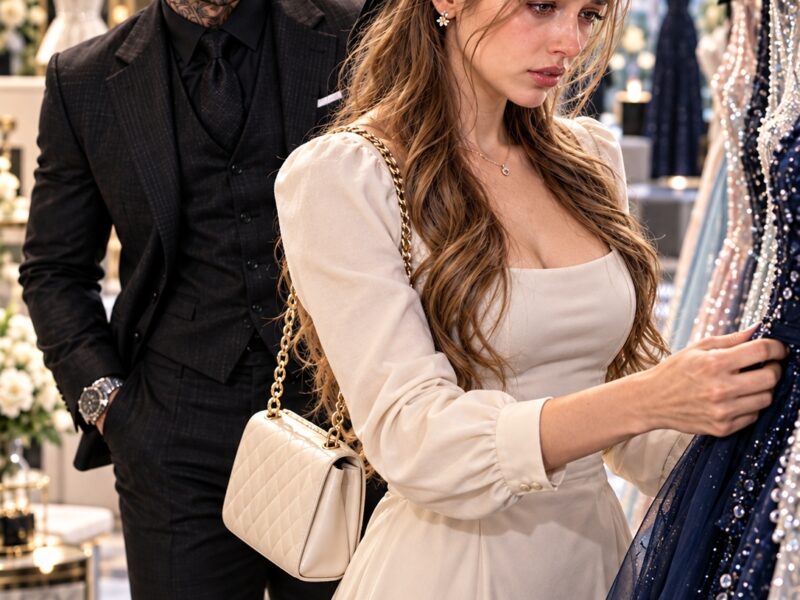
The Mafia Boss Saw a Hotel Receptionist Staring at a Dress She Could Never Afford—She Walked Away, Never Knowing He Had Already Decided to Remember Her
The first time Elena Brooks saw the dress, she stood in front of the window for exactly fifty-three seconds.
The first time Dominic Vale saw Elena, he watched her spend forty-five of those seconds talking herself out of wanting it.
Neither of them knew that before winter ended, she would be the only person in Chicago who could identify the voice of the man trying to destroy him.
And neither of them understood yet that the most expensive thing Dominic would ever give her would not be the dress.
It would be a choice.
Elena was twenty-seven and had become very good at wanting things quietly.
That happened when you grew up learning that every dollar already belonged somewhere before it reached your hand.
Rent.
Electricity.
Medication.
Groceries.
Tuition.
Emergencies that never bothered asking whether you had room in the budget.
She lived in a third-floor walk-up in Pilsen where the radiator knocked all winter and the kitchen window faced the brick wall of the building next door.
The apartment had one bedroom.
Her younger sister, Sophie, had used it until she left for college.
Elena slept on the pullout couch then and still slept there now because after Sophie moved into a dorm at Northwestern, converting the bedroom somehow felt like spending money they had not earned.
On the top shelf of Elena’s kitchen cabinet sat an old coffee tin.
Across it, in black marker:
SOPHIE — SPRING.
Inside were twenty-dollar bills.
Tens.
Sometimes a five.
Whatever Elena could spare.
Sophie was nineteen, studying civil engineering, brilliant enough to make professors remember her after one class and stubborn enough to pretend scholarships covered more than they did.
Their mother had died five years earlier.
Cancer had taken almost everything before it took her.
Savings.
Retirement.
Their small house.
Then, eventually, her.
Their father had disappeared when Sophie was three and had never developed the inconvenient habit of returning.
At twenty-two, Elena had looked across a hospital cafeteria at a fourteen-year-old girl trying not to cry into a paper cup of cocoa and decided something without saying it aloud.
Sophie would finish school.
She would never feel guilty for needing books.
Or shoes.
Or food.
Elena would make sure of it.
Promises made silently are often the most dangerous because nobody can tell you when you have carried them far enough.
For five years, Elena carried hers.
She worked the front desk at the Beaumont Hotel, an old Michigan Avenue landmark whose lobby smelled of lilies, furniture polish, and money inherited before anyone currently living had earned it.
Elena wore a navy jacket with brass buttons and a rectangular nameplate.
ELENA BROOKS — GUEST SERVICES.
She was the best receptionist the Beaumont had employed in years.
Her manager never said that.
He preferred phrases like “reliably adequate.”
But the guests knew.
Elena remembered who needed feather-free pillows.
Who hated elevators.
Who liked corner rooms.
Who wanted newspapers they could easily read online because ritual mattered more than convenience.
She remembered faces particularly well.
Not approximately.
Precisely.
Once Elena saw someone, details stayed.
A scar near an eyebrow.
The rhythm of a voice.
A silver watch.
A habit of touching the left cuff before lying.
Her friend Tasha, who worked the desk beside her, called it Elena’s “creepy little superpower.”
“You should use that for something more profitable,” Tasha said one afternoon.
“Such as?”
“Casino cheating.”
“I don’t know how cards work.”
“Blackmail.”
“That feels ethically complicated.”
“Marriage.”
Elena laughed.
“That feels even more complicated.”
Tasha was forty-nine, divorced twice, magnificently nosy, and convinced romance was a problem Elena had postponed longer than any responsible person should.
Leon Mercer, the Beaumont’s senior doorman, disagreed.
“You leave the girl alone,” he told Tasha.
“She’s twenty-seven.”
“She looks tired.”
“She is tired.”
“Then let her sleep instead of dating.”
Elena loved him for that.
Every afternoon she bought two coffees at the kiosk across Michigan Avenue.
A vanilla latte for herself.
Black coffee for Leon.
Then, without fail, Elena drank half of hers and gave the rest to whichever bell attendant looked closest to collapse.
Tasha hated this habit.
“One day,” she said, “you will give away your last dollar and say it was only money.”
“That seems dramatic.”
“You said that last week about your scarf.”
“He was cold.”
“And you?”
“I had a coat.”
“You always have an answer.”
Elena smiled.
Answers were cheaper than admitting Tasha was right.
On a gray Thursday in late October, Elena’s manager called her into his office at two ten.
Gerald Pike was fifty-seven, narrow-faced, permanently dissatisfied, and apparently allergic to beginning any request with please.
“A client left this.”
He handed her a sealed legal envelope.
“Needs to go to Oak Street.”
“Courier?”
“Unavailable.”
“You want me to take it?”
“I want it delivered.”
That was Gerald’s way.
Elena looked at the clock.
Her break had begun nine minutes earlier.
“Who am I giving it to?”
“Assistant named Mia Grant.”
“Signature?”
“Yes.”
“Anything else?”
“Come back.”
“Ambitious plan.”
Gerald looked up.
She smiled sweetly.
“Leaving now.”
The wind off Lake Michigan had teeth.
Elena buttoned her secondhand black wool coat and walked north with the envelope tucked beneath one arm.
Oak Street existed in a different Chicago.
Same sky.
Same wind.
Different gravity.
The windows looked like museums devoted to objects people bought without checking their accounts first.
Shoes displayed individually.
Handbags with no price tags.
Jewelry resting beneath spotlights like religious artifacts.
Elena felt no resentment toward any of it.
Mostly curiosity.
What did it feel like, she sometimes wondered, to see something beautiful and ask whether you liked it before asking whether you could afford it?
Mia Grant texted when Elena reached the block.
Running 20 minutes late. Sorry!
Elena sighed.
Then stepped out of the pedestrian traffic beside a boutique window.
That was when she saw the dress.
Black.
Nothing dramatic.
That was what made it beautiful.
No glitter.
No crystals.
No enormous designer logo.
The neckline curved cleanly across the collarbones.
The waist was structured but soft.
The skirt fell in a dark line that seemed capable of moving even while the mannequin stood perfectly still.
Elena stopped.
She told herself she was only looking because she had twenty minutes.
Then thirty seconds passed.
A minute almost did.
She imagined wearing it somewhere with warm lights.
Music.
A room where nobody knew how much her shoes cost.
Where nobody expected her to refill anything, arrange anything, carry anything, solve anything.
For one dangerous second, Elena imagined entering such a room and simply occupying it.
Not working.
Not helping.
Not apologizing.
Just being there.
Her mother entered her mind.
Unexpectedly.
Martha Brooks had owned one beautiful dress.
Green.
Cheap fabric made expensive by the way she carried herself.
She had worn it to Sophie’s middle-school recital three months before the diagnosis.
Elena had helped with the zipper.
“Too much?” Martha asked.
Elena, twenty-one then, had stared at her.
“You look like somebody who is going to leave us for George Clooney.”
Her mother laughed until mascara ran.
Elena remembered that laugh now.
The shop window blurred slightly.
She blinked.
Then looked at the price card.
$7,950.
Elena read it twice.
Three months of living expenses.
Almost one semester of Sophie’s remaining tuition gap.
A used car.
Half the medical debt she still paid even though the patient had been dead five years.
Something shifted across Elena’s face.
Then she laughed softly.
At herself.
At the absurdity.
“Maybe in another life.”
She said it to the glass.
Then straightened the legal envelope against her chest.
Turned.
Walked away.
She never looked across the street.
If she had, she would have seen a black SUV parked beneath a bare tree.
And a man in the back seat who had stopped reading the same paragraph almost two minutes earlier.
Dominic Vale was thirty-seven.
Chicago knew several versions of him.
The newspapers knew the chairman of Vale Holdings.
Shipping.
Commercial real estate.
Private infrastructure.
A charitable foundation with unusually generous grants to addiction treatment centers and trade schools.
City politicians knew the donor who never asked for photographs.
Union leaders knew the man whose agreements were short because Dominic disliked promises nobody intended to keep.
Another Chicago knew something else.
His grandfather had made money through gambling rooms, protection schemes, and dock theft when half the South Side still communicated important business through pay phones.
His father had turned those profits into warehouses, trucking companies, and political influence.
Dominic inherited both versions at twenty-six.
He spent eleven years trying to kill one without letting the other kill him first.
He was not a romantic man.
He distrusted flowers because they died quickly and cost too much.
He disliked jewelry on principle.
He owned four identical black suits because variety wasted time.
His driver and closest friend, Marcus Bell, once described Dominic’s emotional range as “mild irritation through biblical disappointment.”
Dominic considered this unfair.
He occasionally experienced amusement.
Across Oak Street, Elena Brooks looked at the black dress.
Dominic watched.
Not because she was beautiful in the conspicuous way wealthy men were accustomed to noticing.
She was attractive.
But quietly.
Brown hair pinned carelessly.
Gray eyes.
No makeup he could identify from across the street.
Secondhand coat worn shiny near the pockets.
She looked like someone Oak Street had trained itself not to see.
That may have been why he noticed.
She stood completely still before the window.
Then looked at the price.
Dominic saw the exact second desire became arithmetic.
He had seen that expression once before.
He was nine.
State Street.
February.
His mother, Lucia, cleaned offices downtown at night and came home smelling of lemon solvent and winter air.
They had stopped beneath a department-store window because Dominic complained his feet hurt.
Inside hung a camel-colored wool coat.
Lucia touched the glass.
Looked at the price.
Then laughed.
Quietly.
Embarrassed that she had wanted it at all.
“Maybe another year.”
Dominic had said, with all the conviction available to a nine-year-old boy with seventy-three cents in his pocket:
“When I’m rich, I’m buying you the whole store.”
Lucia kissed his forehead.
“You’ll buy groceries first.”
She died eight years later.
Dominic eventually became rich enough to buy the store.
He did not.
He bought fifty winter coats one December and anonymously delivered them to a women’s shelter.
Marcus discovered the donation.
“You know normal grief counseling is cheaper.”
“Drive.”
Now, across Oak Street, Elena laughed at the price exactly as Lucia had.
Not the same laugh.
The same surrender.
Dominic felt something old move beneath his ribs.
“Boss?”
Marcus looked at him through the mirror.
“The attorney’s here.”
“Let him wait.”
Marcus turned.
Dominic rarely made late people wait once they finally arrived.
Time mattered too much to him.
“What?”
“Go inside.”
“Where?”
“The boutique.”
Marcus stared.
Dominic looked toward the black dress.
“That one.”
Marcus followed his gaze.
Then slowly looked back.
“You are buying a dress.”
Dominic’s expression flattened.
“Apparently.”
“For…”
Dominic said nothing.
Marcus turned farther.
“Who is she?”
“I don’t know.”
“Excellent.”
“Marcus.”
“Yes.”
“Buy it.”
“Size?”
Dominic looked at the mannequin.
Then at the direction Elena had walked.
He frowned.
Marcus waited.
Dominic hated questions he could not answer.
“Find out.”
Marcus’s eyebrows rose.
“Without frightening her.”
“Important clarification.”
“Extremely.”
Dominic looked back at his report.
“Also find out where she works.”
“This is becoming slightly more frightening.”
“Then be less frightening.”
Marcus sighed.
“You realize I am six foot four.”
“Develop subtlety.”
“I work for you. Nobody encouraged subtlety.”
Dominic ignored him.
The dress arrived at the Beaumont the next morning at nine twelve.
Elena had just finished explaining to an angry businessman that the hotel was unable to control airline weather delays when a deliveryman approached carrying an ivory box tied with black ribbon.
“Elena Brooks?”
She frowned.
“Yes?”
“Signature.”
“For what?”
“Delivery.”
“I can see that.”
He smiled.
“Signature.”
She signed.
Tasha had already abandoned professionalism.
“What is that?”
“No idea.”
“Open it.”
“No.”
“Elena.”
“No.”
“Could be chocolates.”
“It is shaped like a coffin.”
“A fashionable coffin.”
Leon glanced over from the entrance.
“I vote bomb.”
“Thank you, Leon.”
“Happy to help.”
The deliveryman left.
Elena stared at the box.
Her name was handwritten across the top.
No return address.
No store label visible.
Tasha leaned closer.
“That ribbon costs more than my first wedding.”
“How do you know?”
“My first wedding was at a bowling alley.”
Elena untied it.
Tissue.
Black.
The dress lay inside.
Her body went cold.
For several seconds she could not speak.
Tasha stopped joking.
“Elena?”
She touched the fabric.
Same dress.
Not similar.
The display piece itself.
A slight fold remained where the mannequin’s arm had pressed the shoulder.
“No.”
“What?”
“No.”
Elena found a cream card.
One sentence.
You should not have to apologize to yourself for wanting something beautiful.
No signature.
Her throat tightened.
Tasha read over her shoulder.
“Oh.”
Elena looked up.
“What?”
“This is either very romantic or the beginning of a documentary where your neighbors describe you as quiet.”
“Thank you.”
“I’m serious.”
“So am I.”
Elena immediately called the boutique.
A woman named Celeste Moreau answered.
Yes, the dress had been purchased.
No, the purchaser had not provided a name for the recipient.
No, Celeste could not disclose client information.
“Yes, but he knows my name.”
“He asked that it be delivered to you.”
“How?”
“I cannot say.”
“You can’t tell me anything?”
“I can tell you it was paid for in full.”
“That is not reassuring.”
Celeste’s voice softened.
“He asked for no message beyond the card.”
“I need to return it.”
“We cannot process a gift return without purchaser authorization.”
Elena stared at the dress.
“That is an insane policy.”
“It is a designer boutique.”
“Those are not mutually exclusive.”
Celeste laughed despite herself.
Elena went there on lunch.
Celeste was elegant, French, perhaps sixty, and impossible to intimidate.
“Please.”
Elena stood at the counter.
“I cannot accept this.”
Celeste studied her.
“Why?”
“Because it costs almost eight thousand dollars.”
“That is why most people accept it.”
“I’m not most people.”
“No.”
Something in Celeste’s expression suggested she knew exactly who had purchased it.
Elena noticed.
“You know him.”
Celeste smiled politely.
“I know many clients.”
“He.”
Silence.
Elena leaned forward.
“So it is a man.”
Celeste closed her eyes briefly.
“I have made a tactical error.”
Elena almost smiled.
“Who?”
“No.”
“Older?”
“Mademoiselle.”
“Married?”
“I will now stop speaking.”
“Dangerous?”
Celeste’s eyes flickered.
Tiny.
There.
Elena straightened.
“That was not comforting.”
Celeste sighed.
“He chose the dress because he saw you looking at it.”
Elena went still.
“What?”
“He did not ask your size from me.”
“Then how—”
“Someone returned later with information.”
“That is worse.”
“Perhaps.”
“Was he standing near me?”
“No.”
“Then where?”
Celeste gave nothing away.
Elena’s skin prickled.
Someone had watched from across the street.
A car.
Window.
Building.
She walked back to the Beaumont carrying the box.
For the first time, the gift did not feel romantic.
It felt like a question.
Who had been watching?
And why?
Five days later, Dominic Vale entered the Beaumont.
The lobby changed before Elena knew why.
She heard Gerald Pike’s voice from near the elevators.
“Mr. Vale.”
Not friendly.
Reverent.
Tasha went rigid beside Elena.
“No.”
“What?”
Tasha whispered:
“Don’t look yet.”
Elena immediately looked.
Four men.
Two security.
Marcus Bell.
And Dominic.
He wore a charcoal overcoat that fit so perfectly it almost looked severe.
Dark hair beginning to silver at the temples.
No visible jewelry except a watch.
He moved slowly.
Not for effect.
Because the world waited.
Elena had seen photographs.
Newspapers.
Business journals.
They did not capture the unsettling stillness.
Dominic Vale looked like a man who never needed to prove he was paying attention because everyone around him assumed he was.
Tasha whispered:
“That is him.”
“I know.”
“Do you know know?”
“No.”
“I once heard—”
Leon coughed loudly.
Tasha stopped.
Dominic approached the desk.
Elena switched automatically into work.
“Good afternoon, Mr. Vale. Welcome to the Beaumont.”
His eyes settled on her nameplate.
Then her face.
Something moved there.
Almost recognition.
“Ms. Brooks.”
Her stomach tightened.
“How may I assist you?”
“I need the Belmont Room next Thursday.”
“Dinner?”
“Six people.”
“Seven thirty?”
“Eight.”
“Dietary restrictions?”
“One guest pretends he cannot eat gluten when what he means is he dislikes bread.”
Elena blinked.
Dominic’s expression remained perfectly straight.
Behind him, Marcus looked at the ceiling.
Elena typed.
“We’ll put him down as gluten-sensitive.”
“That sounds diplomatic.”
“It’s a hotel.”
She slid the reservation form toward him.
“Signature.”
Dominic took her pen.
Signed.
Elena looked down.
Stopped.
The handwriting.
Forward slant.
Controlled.
Same narrow capital D.
Same low cross.
The same hand that had written the card.
Her pulse jumped.
She looked at Dominic.
He was watching her.
Not smugly.
Waiting.
He knew.
Elena took the form.
“Everything will be arranged.”
“Thank you.”
He turned.
Walked toward Gerald.
Elena waited six minutes.
Then told Tasha:
“Cover me.”
“Where are you going?”
“To do something stupid.”
“Finally.”
Elena found Dominic alone near the service corridor.
“Mr. Vale.”
He turned.
No security.
No Marcus.
Just him.
She walked directly up.
“You were there.”
Dominic did not pretend confusion.
“That day.”
He waited.
“Oak Street.”
“Yes.”
Her anger sharpened because denial would have been easier.
“You watched me.”
“I saw you.”
“That is a nicer word.”
“Yes.”
“You bought the dress.”
“Yes.”
“You had someone find out who I was.”
“Yes.”
“Do you hear how disturbing this sounds?”
Dominic considered.
“More clearly when you list it.”
“That is not funny.”
“No.”
“Why?”
He looked at her.
For the first time, Dominic seemed uncertain.
Not afraid.
Uncertain.
Elena folded her arms.
“Why me?”
“You reminded me of someone.”
Her expression hardened.
“That is a terrible answer.”
“My mother.”
That stopped her.
Dominic glanced toward the gray service hallway.
Not exactly where one expected Chicago’s most feared logistics executive to discuss his mother.
“She used to stop outside store windows.”
Elena said nothing.
“We didn’t have money.”
His voice remained level, but something beneath it altered.
“She would want something for perhaps thirty seconds.”
He looked at Elena.
“Then she would calculate.”
Elena’s arms slowly lowered.
“And laugh.”
Her throat tightened.
Dominic continued.
“As if wanting it had been the embarrassing part.”
Silence.
“That’s why?”
“At first.”
“At first?”
“I bought the dress because I remembered her.”
“That somehow makes this stranger.”
“Yes.”
He almost smiled.
Then:
“But afterward I wanted you to have it because I watched you walk away and realized you looked like somebody who had spent a long time deciding wanting things was irresponsible.”
Elena’s eyes stung.
She hated that.
“You don’t know me.”
“No.”
“You cannot decide what I need.”
“No.”
He accepted it too quickly.
She frowned.
“You agree?”
“Yes.”
“Then why did you?”
“Because apparently I am occasionally arrogant.”
“Occasionally.”
Marcus’s voice came faintly from around the corner:
“Very occasionally.”
Dominic closed his eyes.
Elena laughed despite herself.
Then remembered she was angry.
“I’m paying you back.”
His eyes opened.
“No.”
“Yes.”
“It was a gift.”
“It is now a loan.”
“I did not agree.”
“You bought an eight-thousand-dollar dress for someone who didn’t agree.”
Fair.
Dominic looked at her.
“How much?”
“Two hundred dollars a month.”
He calculated instantly.
“That will take almost forty months.”
“Then practice patience.”
Something extraordinary happened.
Dominic smiled.
Not much.
But enough to change his entire face.
“I have been accused of patience.”
“Good.”
“First of the month?”
“Yes.”
“Cash?”
“If you prefer.”
“Receipt?”
“Obviously.”
He nodded solemnly.
“Accepted.”
Elena stared.
“You’re serious.”
“You appeared serious.”
“I am.”
“So am I.”
She turned.
Then stopped.
“One more thing.”
“Yes?”
“I know who you are.”
His expression became unreadable.
Elena continued.
“And despite appearances, this conversation is terrifying.”
“Then why did you confront me?”
She tucked a loose strand of hair behind one ear.
“Because my shift ends at five and I didn’t have three weeks to work up courage.”
Dominic watched her leave.
Marcus appeared beside him.
“Boss.”
“No.”
“I haven’t said anything.”
“You are about to.”
“I believe a hotel receptionist just financed your own gift back to you.”
Dominic looked toward the empty corridor.
“Yes.”
“Romantically, this is not going well.”
Dominic’s mouth moved slightly.
“Drive.”
The first envelope arrived on November first.
PAYMENT 1 OF 40.
Two hundred dollars.
A handwritten receipt waiting for Dominic’s signature.
He came personally.
Tasha almost knocked over a lamp when he walked in alone.
Elena glared.
“You didn’t have to come.”
“Payments require receipts.”
“You are receiving.”
“Then receipts require acknowledgment.”
“You made that rule up.”
“Yes.”
He signed.
Received with thanks.
Handed it back.
Walked away.
That should have been all.
It was not.
The next afternoon a vanilla latte appeared.
Black coffee for Leon.
Elena looked toward the entrance.
Nobody.
The day after that, nothing.
Good.
Then Friday came.
Yellow freesias.
Her mother used to grow them in a window box.
Elena stared.
Tasha whispered:
“Does this man have a surveillance satellite?”
“I mentioned them yesterday.”
“When?”
“To you.”
“And?”
Elena looked around.
“He was in the lobby.”
“Oh.”
“He was twenty feet away.”
“Apparently twenty feet is intimacy now.”
Elena called Dominic’s office.
Marcus answered.
“Vale Holdings.”
“I want to speak to your emotionally intrusive employer.”
Marcus coughed.
“One moment.”
Dominic came on.
“Elena.”
“You cannot send me things every time you overhear me liking them.”
Pause.
“Why?”
“Because normal people don’t do that.”
“I have never been accused of normality.”
“It creates obligation.”
“No.”
“It feels like it.”
“That is different.”
She went quiet.
Dominic seemed to understand.
“No more gifts.”
“Thank you.”
“Except the dress.”
“I’m paying for the dress.”
“Yes.”
“Goodbye.”
“Elena.”
“What?”
“The flowers cost twelve dollars.”
“That is not relevant.”
“I thought context might help.”
“It did not.”
He almost laughed.
Then obeyed.
No more gifts.
That mattered.
The relationship, if it could be called one yet, formed in spaces where neither intended it.
Coffee at the front desk.
Five-minute conversations.
Dominic staying after meetings because Elena recommended the Beaumont’s terrible lemon cake solely to watch him discover she had been lying about its quality.
He began making reservations himself instead of sending assistants.
Elena called this suspicious.
Dominic called it efficient.
Marcus called it humiliating.
Then, one Thursday afternoon, everything changed.
Two men sat in the lobby alcove behind a potted palm.
Elena noticed them because she noticed everyone.
One wore a gold ring carved with a lion’s head.
The other had a silver watch with a cracked crystal.
They spoke quietly.
Not English.
Sicilian.
Elena’s grandmother had been born outside Agrigento.
She had lived with Elena until Elena was fifteen.
Cooked in Sicilian.
Prayed in Sicilian.
Scolded in Sicilian.
Elena understood enough that the words reached her before she consciously recognized the language.
“…the private dinner…”
Her fingers stopped above the keyboard.
“…waiter has it…”
Lion Ring spoke.
The older man replied.
“…eight o’clock.”
Elena kept looking at her monitor.
Her heart began pounding.
Wine.
Table.
Dominic Vale.
Heart.
Clean.
Chair afterward.
She understood fragments.
Enough.
They were discussing a plan to make Dominic’s death look natural.
At tonight’s dinner.
The dinner she had booked.
Elena felt cold.
The men rose.
She looked up only after they passed.
Lion ring.
Cracked silver watch.
Gray coat.
The older man coughed.
Dry.
Distinctive.
Then they left.
“Elena?”
Tasha touched her arm.
“You’re white.”
“I need Gerald.”
“What happened?”
“Now.”
Gerald listened for forty seconds.
Then sighed.
“You overheard foreign-language gossip.”
“It was not gossip.”
“Elena.”
“They said Mr. Vale.”
“That could mean anything.”
“They described his dinner.”
“You don’t know that.”
“I booked it.”
Gerald’s face tightened.
“Do not involve yourself in matters concerning Mr. Vale.”
“So I should ignore somebody planning to kill a hotel guest?”
Gerald lowered his voice.
“Do you have proof?”
“No.”
“Names?”
“No.”
“Recording?”
“No.”
“Then what exactly would you like me to do?”
Elena stared.
“Believe me.”
Gerald looked away first.
She called police.
The dispatcher asked whether a crime had occurred.
“No.”
Threat?
“I overheard one.”
English?
“No.”
Names?
“No.
Description?
“Yes.”
Location of intended crime?
“My hotel.”
Victim?
Elena hesitated.
Then gave Dominic’s name.
The tone changed.
Not helpfully.
Carefully.
The dispatcher promised to forward it.
Elena hung up.
She knew bureaucratic delay when she heard it.
Seven forty-three.
The Garnet Room dinner had begun.
Elena stood in the service corridor.
She could do nothing.
Or walk in.
The guards would never let her.
Then she saw the wine waiter.
Young.
Sweating.
Silver tray.
Decanter.
Elena’s body moved before fear caught up.
She grabbed a leather folio.
Walked toward the doors.
“I have updated billing documents.”
One guard barely looked at her.
“No entry.”
“Mr. Vale needs to initial the authorization.”
“No.”
“It will take five seconds.”
“No.”
The waiter arrived.
The second guard checked his name.
Elena saw the opening.
She walked behind the tray.
Straight into the room.
Six men looked up.
Dominic at the head.
His surprise lasted less than a second.
“Elena?”
“Sorry.”
She walked quickly toward him.
The waiter poured.
Dark red wine.
Elena saw the glass.
Eight seconds.
Maybe less.
She deliberately caught her heel on the carpet.
Threw herself forward.
The table shook.
Wine went everywhere.
Across the white linen.
Dominic’s shirt.
Floor.
Glass shattered.
Everyone stood.
Elena grabbed Dominic’s sleeve as though steadying herself.
Then whispered in Sicilian against his ear:
“Do not drink it.”
His body went still.
She continued.
“Someone paid the waiter.”
Dominic’s hand closed around her wrist.
Not hurting.
Anchoring.
His eyes searched hers.
Elena whispered:
“They want your heart to stop.”
Dominic turned.
“Marcus.”
His voice was calm.
“Nobody touches the wine.”
Marcus was already moving.
“The waiter stays.”
But the waiter ran.
The room exploded into motion.
Two men went after him.
Dominic remained seated.
Wine dripping from his cuff.
Still holding Elena.
She was shaking now.
Badly.
He switched to Sicilian.
Old.
Rough.
The sound of her grandmother’s kitchen.
“Sit down.”
Elena stared.
“You speak it.”
“My mother.”
Her knees weakened.
Dominic pulled a chair beside him.
“Sit before you fall.”
She did.
The doctor arrived forty minutes later.
Not a gangster doctor.
A toxicologist Dominic’s security director knew through the hospital network.
The wine contained a fast-acting compound capable of causing cardiac collapse.
Enough uncertainty remained that law enforcement was called formally.
That was Dominic’s choice.
Elena noticed.
The old version of his family would have made the problem disappear privately.
Dominic did not.
The attempt became evidence.
The waiter disappeared before police reached him.
Security footage showed him leaving through a loading corridor.
The next morning, they found his abandoned car.
Nothing else.
Elena sat in a private hotel office at eleven thirty that night with tea between both hands.
Dominic stood across from her in a fresh shirt.
“You speak Sicilian.”
“My grandmother.”
“You remembered everything?”
“Yes.”
“The ring.”
“Yes.”
“Watch.”
“Yes.”
“Cough.”
“Yes.”
“Words.”
“Mostly.”
Dominic watched her.
“You saved my life.”
Elena looked toward the stained cuff he had discarded.
“I ruined an extremely expensive shirt.”
He laughed.
Actually laughed.
Elena stared.
“What?”
“I have known you for three weeks and you nearly died of social discomfort over accepting a dress, then walked into a room where you believed six criminals were sitting to stop someone poisoning me.”
“When you phrase it like that, it sounds unbalanced.”
“It is profoundly unbalanced.”
“I panicked.”
“You planned a fake fall.”
“I have customer-service experience.”
Dominic laughed again.
Then sobered.
“Elena.”
“What?”
“Thank you.”
No joke.
No money.
No gift.
Just words.
She lowered her eyes.
“You’re welcome.”
Then he became Dominic Vale again.
“You cannot go home alone.”
“No.”
His expression changed.
“No?”
“I am going home.”
“Elena.”
“There are police downstairs.”
“That is not sufficient.”
“For whom?”
“For me.”
She looked up.
Interesting.
Dominic caught himself.
“For your safety.”
“Better.”
He exhaled.
“Marcus drives you.”
Elena considered.
“One ride.”
“Yes.”
“No guards afterward.”
His jaw tightened.
“Elena.”
“You do not get to convert gratitude into ownership.”
That hit him.
He nodded.
“Agreed.”
Marcus drove her home.
He talked about his rescue dog, Pepper, for twenty minutes.
Elena suspected he was trying to keep her from shaking.
It worked.
At her building, Marcus stopped.
“You did something brave.”
“I did something stupid.”
“Those categories overlap.”
“Frequently?”
“In our business?”
“Please stop saying our business.”
Marcus smiled.
“Fair.”
Elena climbed the stairs.
Locked her door.
Set down her bag.
Then cried.
Not because she regretted it.
Because fear often waits until you are safe before demanding its share.
Across the city, Dominic stood in his office.
The attempted poisoning should have occupied every thought.
Instead, Elena kept entering.
Black coat.
Wine on the table.
Her grandmother’s Sicilian in his ear.
More troubling:
the fact that when she had walked into danger, his first feeling had not been fear for himself.
It had been terror for her.
The first payment of December arrived anyway.
Dominic came to the Beaumont.
Elena slid him the envelope.
He stared.
“You saved my life.”
“You still sold me a dress.”
“I gave—”
“Loaned.”
Dominic closed his eyes.
Marcus, several feet away, smiled.
Dominic counted the cash.
Signed.
Elena took the receipt.
“Thank you.”
“You are impossible.”
“Two hundred dollars less impossible.”
He walked away.
It became a ritual.
Not courtship.
Not officially.
Coffee sometimes.
Conversations.
One Sunday, Dominic took Elena and Sophie to dinner.
Sophie looked him over like an engineer inspecting a bridge.
“So you’re the dress man.”
Dominic glanced at Elena.
“She told you.”
“She tells me everything.”
Elena gave Sophie a warning look.
Sophie ignored it.
“What do you want from my sister?”
Dominic set down his fork.
“Currently?”
“Yes.”
“For her to finish her soup before it gets cold.”
Sophie stared.
Then laughed.
Later, in the restroom, Sophie looked at Elena through the mirror.
“He scares me.”
“Good.”
“But he listens when you say no.”
Elena stopped.
That mattered more than Sophie knew.
“He is learning.”
“Is that your job?”
“No.”
“Good.”
Sophie dried her hands.
“Because Mom taught us enough projects.”
Elena smiled sadly.
Outside, Dominic stood when they returned.
Small thing.
Old-fashioned perhaps.
But his eyes found Elena first.
Sophie noticed.
She said nothing.
Weeks passed.
Dominic told Elena about his mother.
The coat.
The department-store window.
Why the dress had stopped him.
“It was never really about you,” he said beside Lake Michigan one winter afternoon.
Elena smiled.
“That is unexpectedly insulting.”
Dominic looked toward the water.
“At first.”
She waited.
“Then it was.”
He did not elaborate.
He did not need to.
Elena placed her gloved hand over his.
He looked down.
Slowly turned his palm.
Held hers.
No kiss.
No claim.
It was enough.
Then December brought the man with the cracked watch back into her life.
Dominic invited Elena to his mother’s memorial mass in Bridgeport.
Not as a date.
Not exactly.
“Why me?”
“She would have liked you.”
“You cannot know that.”
“No.”
He paused.
“I would like you there.”
Better.
Elena agreed.
After Mass, an older man approached.
Silver hair.
Gray mustache.
Beautiful wool overcoat.
Dominic’s face softened instantly.
“Uncle Sal.”
Not biological uncle.
Something older.
Closer.
Salvatore DeLuca had been Dominic’s father’s closest friend.
Helped raise Dominic after Lucia died.
Taught him to drive.
Taught him business.
Held him at his father’s funeral.
Salvatore took Elena’s hand warmly.
“So this is the young woman.”
Elena smiled.
Then he coughed.
Dry.
Rasping.
Her blood turned cold.
She smelled bergamot.
Cigar.
Then his sleeve shifted.
Silver watch.
Crack across the crystal.
Like ice.
Elena’s smile stayed in place.
Years of hospitality training saved her.
She finished the conversation.
Walked outside.
Dominic followed.
She waited until they were inside the car.
Then:
“It was him.”
Dominic frowned.
“Who?”
“The man in the lobby.”
Silence.
“Gray coat.”
“Elena.”
“Cracked watch.”
Dominic’s face changed.
“Stop.”
“Bergamot.”
“That is enough.”
“Same cough.”
He looked away.
“Dominic.”
“No.”
She stared.
He continued.
“You were terrified that night.”
“Yes.”
“Memory changes under stress.”
“Mine doesn’t.”
“Elena.”
“You know that.”
His jaw tightened.
“There are thousands of silver watches.”
“Not with the same crack.”
“Enough.”
She went still.
Not because his voice was loud.
It wasn’t.
Because for the first time, he had chosen disbelief over listening.
“My memory is the one thing I have never doubted.”
Dominic looked at her.
“You are asking me to believe the man who raised me arranged my murder.”
“I am telling you what I saw.”
His expression hardened.
“Go home.”
Elena stared.
“Excuse me?”
“I need to handle this.”
“You mean without me.”
“Yes.”
“Because you don’t believe me.”
“Because I cannot make decisions from one identification made under stress.”
“That is not what you said five minutes ago.”
Dominic said nothing.
Elena opened the door.
Marcus looked back from the front.
“Elena—”
“No.”
She stepped onto the curb.
Dominic did not stop her.
That hurt more than she expected.
Three days passed.
No calls.
No coffee.
No Dominic.
Elena told herself she preferred it.
The lie lasted approximately twenty minutes.
Then fear arrived.
Gray sedan outside her building.
First night.
Second night.
A man called the hotel asking what shift Elena worked.
Tasha refused.
Sophie texted that someone had photographed her outside Northwestern’s engineering building.
Elena stared at the message.
Her stomach dropped.
Dominic called that evening.
“Elena.”
She almost hung up.
Then heard his voice.
Not controlled.
Stripped.
“You were right.”
Silence.
“Say it again.”
“You were right.”
Elena sat.
Dominic continued.
“Salvatore has been communicating with Carlo Rizzi for over a year.”
The rival family.
“He arranged the waiter.”
Her eyes closed.
“The young man with the lion ring?”
“His nephew.”
She could hear Dominic breathing.
“I didn’t want it to be him.”
There.
Truth.
Not excuse.
“I know.”
“I treated that desire like evidence.”
“Yes.”
“I am sorry.”
Elena said nothing.
“Now listen.”
His voice changed.
“There is a vehicle outside your building.”
“I know.”
“You knew?”
“I have windows.”
“Why didn’t you call?”
“Because three days ago you told me my memory was unreliable.”
Silence.
She regretted it immediately.
Not the truth.
The cruelty.
Dominic accepted it anyway.
“Fair.”
“What about Sophie?”
“Campus security has been alerted through legitimate channels.”
“Legitimate?”
“Yes.”
“No armed men following her.”
“No.”
Elena breathed.
“Thank you.”
“I need to move you.”
“No.”
“Elena.”
“No.”
“They know where you live.”
“I’ll stay with Tasha.”
“They know where you work.”
“I will take leave.”
His breathing changed.
“I can protect you.”
“And I can make decisions.”
Silence.
Then Dominic said:
“Tell me what you will accept.”
Elena closed her eyes.
Progress.
“Temporary apartment.”
“Yes.”
“Not yours.”
“Fine.”
“Two security people outside. Not inside.”
“Yes.”
“Sophie knows exactly what is happening.”
“Yes.”
“No tracking my phone without telling me.”
He hesitated.
“Dominic.”
“Yes.”
“And I still go to work.”
“No.”
“Why?”
“Because somebody called asking for your shift.”
She knew he was right.
She hated it.
“Three days.”
“Seven.”
“Four.”
“Five.”
“Fine.”
It almost felt absurd.
Negotiating security with a mafia boss like PTO.
Then he said quietly:
“Elena.”
“What?”
“I’m afraid.”
She stopped.
Dominic Vale admitted many things.
Fear was not usually one.
“So am I.”
“I know.”
“No.”
She swallowed.
“You don’t get to know mine better than I do.”
A pause.
“Right.”
Five days became eight.
Salvatore disappeared.
Rizzi’s people became nervous.
Dominic uncovered a larger plan.
Salvatore had not simply betrayed him for money.
He believed Dominic was destroying the old family.
Selling illegal assets.
Ending protection arrangements.
Cooperating quietly with federal investigations against businesses Dominic considered poison.
Salvatore believed the chair belonged to someone willing to preserve the old order.
He had promised Rizzi access to one of Vale’s largest legitimate freight terminals once Dominic was gone.
The phrase Elena overheard—
the chair will go where it was promised
—had not referred to furniture.
It meant Dominic’s position.
His death would create succession chaos.
Rizzi would step in.
Elena had accidentally heard a coup.
Then she became evidence.
That made her dangerous.
Dominic wanted her outside Chicago.
She refused.
“I am not moving to Europe because two old men are angry.”
“New York.”
“No.”
“Boston.”
“Still no.”
“Sophie can come.”
“She has school.”
“Elena.”
“My life does not become disposable because yours is dangerous.”
He went quiet.
That sentence stayed with him.
Two nights later, Elena disappeared.
Not violently.
No public scene.
She left the Beaumont through the employee entrance after meeting Tasha to retrieve medication from her locker.
Marcus was supposed to be outside.
A stalled delivery truck blocked the alley.
Forty seconds.
That was enough.
When Marcus reached the corner, Elena’s scarf lay near the curb.
Dominic received the call at 10:18 p.m.
He did not shout.
Marcus later said that was worse.
Dominic asked three questions.
Where?
When?
Camera?
Then:
“Find her.”
No speech.
No threat.
The city moved.
But Elena had already started working.
She woke in a storage office near the river.
Wrists tied loosely in front.
Not injured.
Cold.
One overhead light.
She heard a freight bridge.
Barge horn.
Water.
Diesel.
Calumet corridor.
She stored the information.
The guard outside looked nineteen.
Maybe twenty.
His hands shook.
He wore a jacket too thin for December.
Elena studied him.
“Hey.”
He looked away.
“What’s your name?”
“No talking.”
“You look sick.”
“I said no talking.”
“Your hands are shaking.”
He tightened his grip on the gun.
Elena lowered her voice.
“Are you cold?”
Nothing.
“Hungry?”
His face changed.
Small.
Enough.
Elena remembered hotel guests.
People tell you who they are through what they refuse to answer.
“Someone is sick.”
He stared.
“How do you know?”
“You look like somebody waiting for a phone call.”
His eyes filled instantly.
Oh.
Elena softened.
“Mother?”
He looked toward the door.
Then whispered:
“Kidney failure.”
“What hospital?”
“Loretto.”
“My mom died after three months in a hospital.”
He stared.
Elena switched to Sicilian.
Old words.
Grandmother words.
“I am sorry.”
The boy’s face broke.
His name was Luca.
He needed money.
Salvatore promised enough to cover his mother’s medication gap.
Elena did not tell him he was stupid.
Desperate people do not need lectures from people whose desperation happens to look different.
She said:
“Your mother would rather owe a hospital than owe your life to this room.”
Luca looked down.
“They said nobody would hurt you.”
“Do you believe them?”
Silence.
The door opened in the distance.
Voices.
Luca panicked.
Then knelt.
Untied her.
Handed her a phone.
“One call.”
Elena dialed Marcus from memory.
He answered instantly.
“Elena?”
“Calumet.”
Breath.
“Freight bridge.”
A door slammed outside.
“Barges.”
“Elena—”
“Bergamot.”
Line ended.
Salvatore entered.
Beautiful coat.
Perfect hair.
Sad eyes.
He looked genuinely disappointed.
“Elena.”
She sat against the wall.
“Mr. DeLuca.”
“Such a clever girl.”
“Your watch is still cracked.”
He stopped.
Elena smiled faintly.
“It was the first thing I remembered.”
His expression cooled.
“Dominic should have listened to you sooner.”
“Yes.”
“That is his weakness.”
“No.”
Salvatore frowned.
“Loving you.”
Elena shook her head.
“Not listening was his weakness.”
That landed differently.
Salvatore sat opposite.
“You do not belong in his world.”
“I told him that myself.”
“And yet here you are.”
“You brought me.”
He almost smiled.
“You think very quickly.”
“I work hospitality.”
Salvatore laughed.
Then became serious.
“Dominic is destroying everything his father built.”
“Maybe it needed destroying.”
“You know nothing about our family.”
“I know enough men use the word family when they mean obedience.”
His face hardened.
“You are brave because you do not understand danger.”
“No.”
Elena held his gaze.
“I am brave because I understand it and still have opinions.”
Salvatore stood.
“You will help me correct his course.”
“I doubt that.”
“You will.”
He left.
Dominic arrived twenty-one minutes later.
Alone.
Hands visible.
Salvatore had called him once Marcus’s team neared the district.
Terms.
Transfer controlling rights in Vale Freight Terminal Four to an entity tied to Rizzi.
In exchange, Elena leaves.
Dominic entered the warehouse.
Elena stood beside Salvatore.
No weapon pressed to her.
Not necessary.
Three men behind her.
Dominic saw her.
Everything in his face disappeared.
“Elena.”
“I’m okay.”
Salvatore pointed toward papers.
“Sign.”
Dominic looked down.
“You know what the terminal is worth.”
“Yes.”
“Then you understand.”
“Yes.”
“Sign.”
Dominic picked up the pen.
Elena shook her head.
“No.”
Salvatore looked at her.
Dominic did not.
“Dominic.”
He signed.
Without reading.
Salvatore stared.
Perhaps he had expected negotiation.
Dominic dropped the pen.
“A terminal is property.”
His voice was low.
“She isn’t.”
Elena’s throat tightened.
Salvatore laughed.
“Your father would spit on you.”
Dominic looked at him.
“My father has been dead eleven years.”
“You are giving away the foundation of this family for a receptionist.”
Dominic finally looked at Elena.
“No.”
Then back at Salvatore.
“I am giving away a building because you confused buildings with family.”
Silence.
Salvatore’s face changed.
Dominic continued.
“You taught me loyalty meant protecting the structure.”
A breath.
“My mother taught me loyalty meant protecting people.”
Elena felt tears burn.
Salvatore did too.
For one second.
Then Luca moved.
Not heroically.
Terrified.
He opened the side door.
Marcus and federal tactical officers entered.
Dominic had not come without a plan.
Of course.
Salvatore froze.
No gunfight.
No blood.
Commands.
Hands visible.
Men arrested.
Rizzi had already been picked up forty minutes earlier after evidence Dominic had accumulated over months finally became actionable.
The transfer papers Salvatore demanded were worthless.
Dominic had known.
Elena learned that later.
When everyone was safe, she looked at him.
“You knew the transfer could not legally stand.”
“Yes.”
“You still signed.”
“Yes.”
“Why?”
He looked genuinely confused.
“Because I didn’t know what else they might do while I argued.”
Simple.
No performance.
Elena started crying.
Dominic moved toward her.
Stopped.
“Can I?”
She nodded.
He held her.
Not tightly.
Enough.
Her face pressed against his coat.
“You were right.”
“About?”
“You do make terrible decisions when frightened.”
He almost laughed.
“So do you.”
“I walked into a poisoned dinner.”
“Yes.”
“You signed a fake terminal transfer.”
“Yes.”
“Balanced.”
“Perhaps.”
At dawn, they sat beside the river wrapped in borrowed blankets.
Marcus brought coffee.
Leon would have hated it.
Too weak.
Elena held the cup.
Dominic sat beside her.
His cheek was bruised from nothing serious.
His suit ruined.
She touched his hand.
“You signed away the terminal.”
“It was never going anywhere.”
“You didn’t know that until after?”
“I knew legal structure would delay it.”
“That was not what I asked.”
He understood.
“No.”
Elena looked toward the water.
“I don’t want your money.”
“I know.”
“Cars.”
“I know.”
“Security forever.”
“I know.”
“Buildings.”
“I know.”
She turned.
“I don’t want what you own.”
Dominic’s face became very still.
“I want the man who saw somebody at a window and remembered his mother.”
His eyes closed.
Elena continued.
“The man who eventually learned to ask before helping.”
“That version has had mixed performance.”
“He can improve.”
Dominic opened his eyes.
“And if he doesn’t?”
“I leave.”
There.
No romantic surrender.
No promise she would endure anything.
Dominic nodded.
“As you should.”
Elena rested her forehead against his.
He did not kiss her.
Waited.
She closed the distance.
The kiss was quiet.
Cold morning.
Coffee nearby.
No audience.
Exactly right.
The black dress remained in Elena’s closet for months.
She had paid five installments.
One thousand dollars.
Dominic continued accepting every payment.
Marcus called this “the most expensive courtship accounting system in Illinois.”
Then spring came.
The Lucia Vale Foundation announced its first public gala.
Not a front.
Not a reputation wash.
A fund for women returning to education after caregiving, medical debt, widowhood, or family financial crises.
Elena helped design the application process.
Not because Dominic asked.
Because Sophie told her the first draft was “structurally stupid.”
Dominic hired Sophie as a paid consultant.
Elena inspected the contract twice.
“It is market rate.”
“Good.”
“I was told not to overpay.”
“Correct.”
“Sophie negotiated higher.”
“Also correct.”
He looked exhausted.
Elena smiled.
The gala returned them to the Beaumont.
Tasha cried when Elena arrived upstairs to change.
“You’re wearing it.”
Elena looked at the dress.
“Yes.”
Black.
Simple.
Still beautiful.
“Your mafia boyfriend bought you an eight-thousand-dollar dress.”
“He loaned me an eight-thousand-dollar dress.”
“You have issues.”
“I know.”
Leon waited downstairs in his first tuxedo.
“You look like your mother.”
Elena stopped.
Her eyes filled.
Leon kissed her forehead.
“Go.”
She reached the top of the ballroom stairs.
Hundreds of people below.
Powerful ones.
Dangerous ones.
Good ones.
Complicated ones.
Dominic stood across the room.
Black tuxedo.
Hands at his sides.
No security beside him.
He saw her.
Something happened to his face.
Elena remembered the window.
The price tag.
That small laugh.
Maybe another life.
She walked down the stairs.
Not because the dress transformed her.
It didn’t.
She had been the same woman in a navy hotel blazer.
The same woman when she spilled poisoned wine.
The same woman sitting tied in a warehouse using memory instead of panic.
The dress had never given her worth.
It merely marked the first moment someone noticed how thoroughly she denied herself permission to enjoy any.
The ballroom quieted.
People knew who Dominic was.
They also knew enough now about Elena.
She crossed the marble floor.
Dominic waited.
He did not reach first.
Good.
Elena took his hand.
A small collective inhale moved through the room.
Dominic looked down.
“Ms. Brooks.”
“Mr. Vale.”
“You are late.”
“For?”
“Payment six.”
She raised an eyebrow.
“It is the twenty-eighth.”
“I am preparing emotionally.”
“For two hundred dollars?”
“You remain a difficult creditor.”
“I learned from specialists.”
Dominic reached inside his jacket.
Elena immediately narrowed her eyes.
“What?”
“Paper.”
“Better be.”
He handed her an envelope.
Inside was her handwritten payment schedule.
Five lines crossed off.
Beneath them:
Balance transferred.
Elena looked up.
“No.”
Dominic sighed.
“I anticipated this.”
“You cannot forgive the loan.”
“I can.”
“You agreed.”
“I did.”
“Dominic.”
He held up one hand.
“Read the second page.”
She did.
A receipt.
Five payments totaling one thousand dollars.
Then a donation receipt.
The remaining $6,950 had been donated in Elena’s name to the foundation’s emergency textbook fund.
Elena stared.
“You did not pay off my dress.”
“No.”
“You donated money.”
“Yes.”
“That still sounds suspiciously like you solved something without asking.”
Dominic nodded.
“So you may reject it.”
She blinked.
“What?”
“If you reject it, I reverse the donation and continue accepting payments.”
Elena stared.
He had built an exit.
Choice.
That mattered.
“You really can reverse it?”
“Yes.”
“No tricks?”
“No.”
Marcus appeared behind Dominic.
“He made attorneys draft three versions because he was terrified you would say exactly that.”
Dominic glared.
Elena laughed.
“What do you want?” Dominic asked.
She looked at the page.
Textbooks.
Women like Sophie.
Women like Elena had once been.
She folded the receipt.
“Keep the donation.”
Relief moved through him.
“But.”
Of course.
“The dress is still technically a loan.”
His eyebrows rose.
“Why?”
“Because I enjoy watching you collect payments.”
Marcus turned away, shoulders shaking.
Dominic looked offended.
“Elena.”
“Two hundred a month.”
“You are weaponizing accounting.”
“Yes.”
He stared at her.
Then smiled.
“Accepted.”
Later, Dominic stepped toward the microphone.
Elena touched his arm.
“What are you doing?”
“Introducing you.”
“No.”
He stopped.
She had learned how powerful that was.
Not obedience.
Listening.
“Why?”
“I don’t want to be introduced as yours.”
Dominic’s face changed.
Elena continued.
“Introduce the foundation.”
He nodded.
Then walked onstage.
No declaration that Elena was under his protection.
No claim that she belonged to him.
No threat toward anyone who looked at her.
He simply said:
“This foundation exists because somebody once reminded me that helping a person is not the same as owning the outcome.”
His gaze found Elena.
“The rest is her story to tell if she wants to.”
Then he moved on.
Elena stood beneath the chandeliers and realized how far they had come.
Not because the mafia boss had become gentle.
That would have been dishonest.
Dominic remained difficult.
Controlling instincts did not evaporate through romance.
He still sometimes arranged solutions before remembering to ask.
Elena still became angry.
He apologized.
Changed procedures.
Tried again.
She still paid two hundred dollars every month.
Partly principle.
Mostly because by payment fourteen the ritual had become ridiculous enough to feel sacred.
The following year, Sophie graduated.
Dominic attended.
Sat beside Tasha and Leon.
No VIP seats.
No security inside the ceremony.
When Sophie walked across the stage, Elena cried.
Dominic passed her a handkerchief.
“Don’t say anything.”
“I wasn’t.”
“You were thinking it.”
“I was thinking your sister appears happy.”
“That was acceptable.”
Sophie joined them afterward.
She hugged Elena first.
Then Dominic.
He froze.
Sophie stepped back.
“You can move your arms, mob boss.”
“Engineer.”
He awkwardly hugged her.
Elena laughed.
Later that evening, Sophie gave Elena a small box.
Inside was the coffee tin label.
SOPHIE — SPRING.
Elena stared.
“I saved it.”
“Sophie.”
“You spent six years making sure my future had somewhere to go.”
Her sister’s eyes filled.
“Now stop acting like yours is a luxury item.”
Elena cried.
Dominic looked away.
He had learned some moments did not belong to him.
Another year passed.
The Vale organization changed.
Slowly.
Some illegal structures closed.
Others were sold.
Dominic cooperated with prosecutors where he could do so without sacrificing innocent employees.
Men who believed his father’s version of strength drifted away.
Marcus stayed.
Of course.
“There is no retirement plan in hell,” he explained.
Leon eventually retired from the Beaumont.
Dominic offered him a job.
Elena made him ask.
Leon accepted part-time security consulting for the foundation on the condition that no one call him security.
He preferred “door specialist.”
Tasha became guest-relations director after Gerald Pike was finally fired for insulting the daughter of a hotel owner.
Nobody mourned him.
Elena left the Beaumont.
Not because Dominic asked.
She went to work full-time for the foundation.
Operations.
Financial oversight.
Scholarship administration.
Her salary was negotiated by an independent board.
She made sure of it.
Dominic never signed her paychecks.
She made sure of that too.
The relationship became public gradually.
No declaration.
No ballroom announcement.
Chicago simply noticed that Elena Brooks sometimes arrived beside Dominic Vale and sometimes did not.
That she kept her own apartment.
That she corrected him in public without fear.
That Dominic waited when she said wait.
One reporter once asked whether Elena was his “weakness.”
Dominic looked genuinely confused.
“No.”
“What would you call her?”
He thought.
“My equal in matters she chooses to share.”
Elena read that quote over breakfast.
“You rehearsed.”
“I did not.”
“You absolutely did.”
“I had Marcus review it.”
“Worse.”
Marcus texted:
YOU’RE WELCOME.
Three years after Oak Street, Dominic took Elena walking past the boutique.
Same window.
Different dress.
He stopped.
Elena looked over.
“No.”
“I did not say anything.”
“You’re looking.”
“So are you.”
“I am allowed.”
“So am I.”
She smiled.
The black dress was no longer there.
Of course.
Seasons changed.
Windows changed.
Elena found that comforting.
Dominic said:
“I have something.”
She groaned.
“No jewelry ambushes.”
“No.”
“Cars?”
“No.”
“Real estate?”
“No.”
“Human organs?”
“Elena.”
“Just checking.”
He handed her an envelope.
Inside was the original cream note.
You should not have to apologize to yourself for wanting something beautiful.
Elena looked up.
“How did you get this?”
“The boutique kept a scanned copy.”
“Why?”
“I asked.”
“Of course.”
On the back, Dominic had written something else.
You were right about one thing.
“What?”
“Keep reading.”
I had no right to decide what you needed.
Below it:
Thank you for teaching me the difference between giving and choosing together.
Elena’s eyes filled.
Dominic did not move closer.
Waited.
“Why are you giving me this?”
“I want to ask you something.”
She looked at him.
There it was.
Fear.
Real.
Good.
“Ask.”
“I want a life with you.”
Elena remained still.
“I already have one.”
“Yes.”
He swallowed.
“I mean a legally complicated version.”
She laughed.
Dominic almost smiled.
“Marriage.”
The word hung between them.
No ring.
She noticed.
“Where is it?”
“What?”
“The ring you definitely bought.”
Dominic looked toward the street.
“Elena.”
“You bought one.”
“Yes.”
“Where?”
“Marcus has it.”
She laughed so hard pedestrians looked over.
“Why does Marcus have my engagement ring?”
“Because you have established a documented dislike of surprise jewelry.”
“That is incredible.”
“I am trying.”
She looked at him.
Marriage frightened her.
Not because she doubted Dominic’s feelings.
Because she had spent her entire adult life holding an exit door for everyone else and feared accidentally closing her own.
Dominic seemed to understand.
“You can say no.”
“Would you be okay?”
“No.”
Honest.
“But?”
“I would survive.”
She smiled.
“You’ve rehearsed that too.”
“No.”
“Marcus?”
“No.”
“Therapist?”
Dominic glared.
Interesting.
She laughed.
“You have a therapist.”
“This conversation has lost structure.”
“Oh my God.”
“Elena.”
“I’m proud of you.”
“That is humiliating.”
“Good.”
She looked at the note again.
Then at the boutique window.
Three years earlier she had stood here believing the beautiful things belonged to another life.
Now she knew better.
Beautiful did not mean expensive.
Nor safe.
Nor permanent.
It meant chosen with your eyes open.
“Yes.”
Dominic stopped breathing.
Elena smiled.
“I will marry you.”
He exhaled.
“But.”
He closed his eyes.
“Of course.”
“My name stays Brooks.”
“Yes.”
“My finances remain independent.”
“Yes.”
“Prenup.”
“I already drafted one protecting you.”
“Independent counsel reviews it.”
“Obviously.”
“No security tailing me without explicit threat.”
“Yes.”
“No fixing my radiators secretly.”
A pause.
“Dominic.”
“Yes.”
“And if I tell you something dangerous, you believe my memory until evidence proves otherwise.”
His face changed.
That one still hurt.
“Yes.”
“Good.”
She held out her hand.
Dominic did nothing.
Elena laughed.
“You can ask Marcus for the ring now.”
Marcus appeared from the SUV twenty feet away.
“I have been standing here for fourteen minutes.”
Elena doubled over laughing.
Dominic looked murderous.
Marcus handed him the box.
“I would like it noted that I advised flowers.”
“No one asked you.”
“I am always asked spiritually.”
Dominic opened the box.
The ring was simple.
No giant stone.
Vintage.
Elena recognized immediately that someone had considered her rather than his bank balance.
“You chose this?”
“Yes.”
“Alone?”
“Celeste helped.”
“The boutique woman.”
“She fears you.”
“Good.”
Dominic slipped it onto Elena’s finger only after she nodded.
It fit.
They married six months later.
Not in a cathedral.
Not at the Vale estate.
At the Beaumont.
Elena insisted.
Tasha ran the event and terrorized three florists.
Leon opened the ballroom doors.
Sophie designed a ridiculous seating diagram to prove engineering had real-world applications.
Marcus cried.
Denied it.
There were no underworld theatrics.
No declaration of ownership.
No line about being under Dominic’s name.
When the officiant asked Dominic to make his vows, he looked at Elena.
“I spent most of my life thinking love meant preventing every possible loss.”
Elena listened.
“I learned from you that love does not eliminate another person’s choices simply because those choices frighten you.”
His voice broke slightly.
“I promise to ask.”
Nothing grander.
Elena cried anyway.
Her vow was shorter.
“I promise not to turn self-sacrifice into a personality.”
Tasha shouted:
“Finally.”
The ballroom laughed.
Elena smiled.
“And I promise to keep telling you the truth even when you hate it.”
Dominic nodded.
“Especially then.”
They kissed.
Somewhere near the bar, Marcus started clapping too early.
Nobody cared.
Years later, Elena still owned the black dress.
Not preserved in glass.
Not displayed.
Just hanging in a garment bag.
She wore it sometimes.
Foundation galas.
Dinner.
Sophie’s wedding.
Once to a terrible opera Dominic pretended to understand.
She never stopped paying for it.
This became a private joke.
Forty months came and went.
Payment number forty arrived in a white envelope on Dominic’s breakfast plate.
He opened it.
Two hundred dollars.
Final receipt.
“Elena.”
“Yes?”
“You realize we share a house.”
“Prenup.”
“That is not relevant.”
“It is spiritually relevant.”
He signed.
Received with thanks. Balance: $0.
Elena took the receipt.
Stared at it.
Something tightened in her chest.
Dominic noticed.
“What?”
“Nothing.”
He waited.
She looked at the total.
The dress was hers now in every possible sense.
Oddly, she felt sad.
“Forty months.”
“Yes.”
“You came to the hotel every month.”
“Yes.”
“Even after we were dating.”
“Yes.”
“After we were engaged.”
“Yes.”
“After we married.”
“Yes.”
She smiled.
“You’re ridiculous.”
“Yes.”
Then Dominic slid another envelope across the table.
“No.”
He held up his hands.
“Not a gift.”
“Suspicious.”
“Open.”
Inside were photocopies of all forty receipts.
Every one.
Elena stared.
On the last page Dominic had written:
You never owed me for the dress.
Then beneath:
But I am grateful you gave me forty reasons to keep showing up.
Elena pressed the page to her chest.
“That was manipulative.”
“Was it effective?”
“Yes.”
He almost smiled.
She walked around the table.
Sat in his lap.
Kissed him.
Their daughter, Lucia, walked into the kitchen at exactly that moment.
Four years old.
She stared.
“Daddy.”
Dominic froze.
“Yes?”
“You are squishing Mommy.”
Elena burst out laughing.
Dominic looked exhausted.
“I am not.”
“You are.”
Lucia considered them.
Then:
“Can I have pancakes?”
Life.
Ordinary.
Messy.
Beautiful.
Not because every danger vanished.
It did not.
Dominic’s past remained part of him.
Some relationships never recovered.
Some decisions carried consequences no love story could erase.
But the old organization became smaller.
Cleaner.
More legal.
More boring.
Dominic discovered boredom was underrated.
Elena discovered wanting was a skill.
She wanted vacations.
Good shoes.
Time alone.
A child.
Then eventually another.
She wanted work that mattered without devouring her.
She wanted Dominic.
Not his city.
Not his cars.
Not his name.
Him.
And perhaps that was why it lasted.
Years after their first meeting, the Beaumont invited Elena to speak at an anniversary event for the foundation.
She stood upstairs before the gala, fastening earrings.
Lucia, now nine, sat on the bed watching.
Her younger brother, Matteo, was somewhere downstairs driving Marcus insane.
Lucia opened the closet.
“Mom?”
“Yes?”
“Is this the dress?”
Elena turned.
Her daughter held the black garment bag.
“Yes.”
“The one Dad bought when he was creepy?”
Elena laughed.
“Your father strongly objects to that version.”
“It was creepy.”
“A little.”
Lucia unzipped the bag.
The dress was still beautiful.
Simple black.
Quiet.
“Was it really almost eight thousand dollars?”
“Yes.”
Lucia looked horrified.
“For a dress?”
“Correct.”
“Dad was stupid.”
“He had a complicated childhood.”
“That is not an excuse for bad budgeting.”
Sophie had clearly influenced her.
Elena sat on the bed.
Lucia touched the fabric.
“Why did you keep it?”
Elena thought.
“Because it reminds me of something.”
“Dad?”
“Partly.”
She looked toward the window.
Chicago below.
“Mostly me.”
Lucia frowned.
“What about you?”
Elena smiled.
“I used to think being responsible meant never wanting anything expensive, unnecessary, inconvenient, or just mine.”
“That sounds sad.”
“It was.”
“Did Dad teach you not to?”
Elena considered.
“No.”
Important answer.
“He noticed it.”
Lucia waited.
“Then I had to teach myself.”
Her daughter nodded with the serious expression children use when filing away an adult truth for later.
“Can I wear it someday?”
Elena smiled.
“If you like it.”
Lucia grinned.
“Even if Dad says no?”
“Especially if he thinks he gets a vote.”
From the hallway:
“I heard that.”
Dominic stood in the doorway.
Older.
Gray at both temples now.
Lucia pointed.
“Mom says you were creepy.”
“Elena.”
“She said a little.”
“Betrayal.”
Lucia ran past him laughing.
Dominic entered.
Saw the dress.
His expression softened.
“You wearing it?”
“No.”
“Why?”
Elena stepped closer.
“Because tonight I want the red one.”
Dominic smiled.
Years ago that sentence would have made her immediately explain its price.
Now she did not.
“Good,” he said.
Nothing more.
No offer to buy it.
No question whether she needed it.
Just good.
He had learned.
So had she.
Downstairs, the Beaumont ballroom filled with people.
Some had known Dominic Vale before he changed.
Some knew only the foundation.
Young women sat beside scholarship recipients.
Single mothers.
Widows.
Former caregivers rebuilding careers.
People who understood what it meant to perform arithmetic in front of windows.
Elena walked down the stairs in red.
The room turned.
Not because Dominic Vale’s wife had entered.
Because Elena Brooks Vale had.
Dominic stood beside the stage.
He watched her with the same expression he had worn from inside a black SUV years ago.
Only now she saw him watching.
And she chose to walk toward him.
That was the difference.
He held out his hand.
Elena took it.
“Beautiful,” he said.
“The dress?”
“You.”
“Safe answer.”
“I have survived marriage.”
“Barely.”
They smiled.
Across the ballroom, Lucia and Matteo argued with Marcus over dessert.
Sophie stood near Leon discussing some foundation renovation project with an architect.
Tasha was criticizing the flowers.
Everything Elena loved had become loud enough to fill a room.
Dominic looked at her.
“Do you remember what you said at the window?”
She stared.
“You heard me?”
“Yes.”
“What?”
“Maybe in another life.”
Elena had forgotten.
Dominic had not.
She looked around.
“This one turned out fine.”
“Yes.”
Then she noticed something beside the stage.
A display case.
Inside was a camel-colored wool coat with dark honey buttons.
Dominic’s mother’s story.
Not the original coat.
That one was gone forever.
This coat had been donated years earlier after Dominic finally told Elena why store windows hurt him.
A small plaque explained Lucia Vale’s life.
Cleaner.
Mother.
Immigrant.
Woman who raised a boy in a city that taught him power before it taught him tenderness.
Beside it sat another plaque.
No mention of crime.
No mythology.
Only:
For every person who has ever looked through glass and mistaken price for permission.
Elena’s eyes filled.
“You did this?”
“The board.”
“Did you ask?”
“Yes.”
“Who?”
“You.”
She frowned.
“When?”
“Six months ago.”
“You told me it was for an archive display.”
“It is.”
“That was irritatingly compliant.”
“I practice.”
She laughed.
The program began.
Elena stepped to the microphone.
She had no dramatic story prepared.
No mafia declaration.
No revenge.
She simply told the truth.
“There was a time in my life when I believed wanting something for myself meant somebody else would have less.”
The room quieted.
“So I became very good at giving.”
She looked toward Sophie.
“Sometimes giving is love.”
Then toward Dominic.
“Sometimes giving is fear wearing good manners.”
A few people shifted.
“The difficult part is learning the difference.”
She paused.
“I was lucky enough to have people who eventually asked me what I wanted.”
Dominic lowered his eyes.
“And I was lucky enough to become brave enough to answer.”
No applause yet.
Good.
Elena preferred listening.
She continued.
“This foundation is not here to teach women to want expensive dresses.”
Soft laughter.
“It exists because nobody should spend an entire life treating her own future like the optional line in the budget.”
That earned silence again.
The good kind.
“When we help someone, the goal is not to own the outcome.”
Her voice steadied.
“It is to give her enough room to choose one.”
Dominic met her eyes.
That was their story.
Not the dress.
Not the poisoning.
Not Salvatore.
Not the warehouse.
Choice.
When the speech ended, applause rose.
Elena stepped down.
Dominic waited.
“Good?”
He nodded.
“Very.”
“You disagree with anything?”
“No.”
“That’s suspicious.”
“I have grown.”
“Debatable.”
He smiled.
Later, after the ballroom thinned, they walked outside.
Michigan Avenue glowed.
Shop windows bright against the night.
They passed Oak Street.
The boutique was still there.
Different name now.
Different owners.
Elena stopped.
Dominic did too.
A young woman stood in front of the window.
Maybe twenty-three.
Delivery uniform.
Phone in one hand.
She stared at a pair of shoes.
Then looked at the price.
Her face shifted.
Elena knew that expression.
Dominic knew it too.
He looked at Elena.
She looked at him.
“No.”
“I did not say anything.”
“You thought it.”
“I have learned.”
The young woman laughed softly at herself.
Turned away.
Dominic remained still.
Elena squeezed his hand.
“Do not buy the shoes.”
“I know.”
“Good.”
They started walking.
After five steps Dominic said:
“What if the foundation has an emergency footwear grant?”
Elena stopped.
He kept a perfectly straight face.
She laughed so loudly the young woman turned around.
Dominic smiled.
The city moved around them.
Cars.
Cold air.
Lights.
Nothing paused because two people had finally learned something simple.
You could see another person clearly without deciding what she needed.
You could offer without controlling.
Love could be generous without becoming ownership.
And sometimes the most meaningful thing you could give someone was not the beautiful object behind the glass.
It was the freedom to look at it—
want it—
walk away from it—
or choose it—
without ever believing her worth depended on what she could afford.
Elena took Dominic’s hand.
Years earlier, he had watched her through dark glass without her knowing.
Now there was no glass between them.
And neither of them wanted it back.









