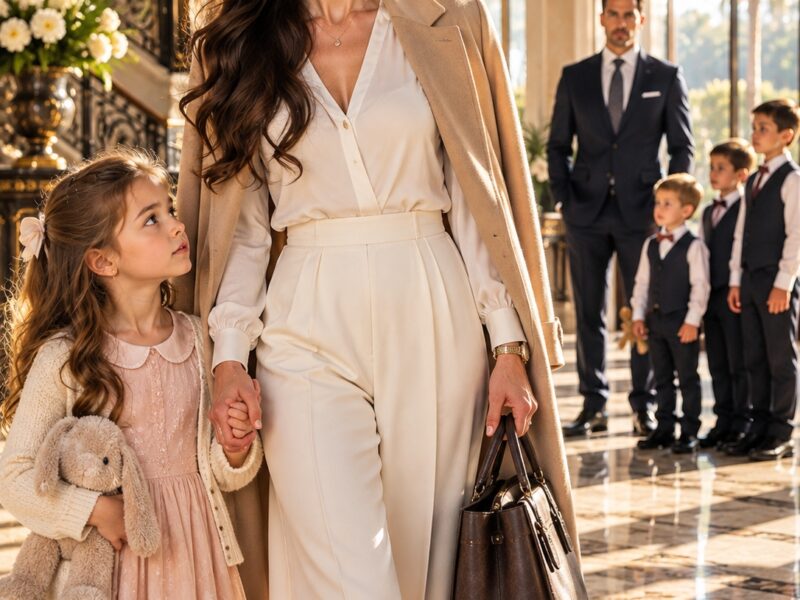
The Mafia Boss Told Me to Pick One of Our Three Sons in the Divorce—So I Chose the Daughter He Never Thought Worth Fighting For
My husband slid the divorce papers across his desk and told me I could take one of our three sons while he kept the other two.
He never mentioned our seven-year-old daughter, as if she were furniture neither of us would bother dividing.
So I walked past the boys, knelt in front of the child everyone had overlooked, and made the choice that would eventually cost him far more than our marriage.
The Child He Forgot to Name
“Pick one.”
Dante Valente did not raise his voice.
He never needed to.
He sat behind the walnut desk in the study he had occupied for eleven years, one hand resting beside a silver pen, the other on a stack of divorce papers already marked with yellow tabs.
Outside the tall windows, January snow drifted over Lake Michigan.
Inside, Seraphina Rossi Valente stared at the man she had married at twenty-six and tried to understand how a marriage could end with the administrative calm of a quarterly review.
“One of them,” Dante said.
He nodded toward the hallway.
“You take one son. I keep the other two.”
For a moment, Seraphina genuinely believed she had misheard him.
“Excuse me?”
“Matteo is twelve. Leo is nine. Enzo is five.”
“I know how old my children are.”
His mouth tightened.
“The boys should not be dragged through a custody war.”
“So your solution is to divide them like inherited property?”
“My solution is stability.”
“Yours.”
“Theirs.”
Behind Seraphina, through the half-open door, she could hear the boys.
Matteo pretending to be absorbed in his phone.
Leo whispering questions.
Enzo humming the same four notes from a cartoon he had been watching all week.
Then Seraphina saw Bella.
Seven years old.
Sitting at the far end of the hall with her knees tucked under a blue dress, a coloring book open in her lap.
Not coloring.
Listening.
Bella had Dante’s dark eyes and Seraphina’s habit of becoming quieter when rooms became dangerous.
Seraphina turned back.
“And Bella?”
Dante looked at her.
Not confused.
Not guilty.
Worse.
Unprepared.
He had not forgotten Bella’s existence.
He had simply constructed an entire custody ultimatum around the children he considered relevant.
“Bella stays with you,” he said after a beat.
“As what?”
“Seraphina.”
“As what, Dante?”
“She’s your daughter.”
The sentence entered the room and changed its temperature.
Seraphina stared at him.
“Our daughter.”
Dante exhaled.
“That’s what I meant.”
“No.”
She looked toward the hallway again.
Bella’s head had lowered.
The purple crayon in her hand had stopped moving.
Seraphina understood something then with an almost frightening clarity.
For eleven years, she had been waiting for Dante to notice what he overlooked.
Her work.
Her judgment.
Her silence.
Her daughter.
She had believed blindness was temporary if love remained patient enough.
It was not.
Sometimes people failed to see because seeing would require them to change what they valued.
Dante said:
“You’re making this something it isn’t.”
“What is it?”
“A practical arrangement.”
“Three sons divided.”
“One daughter automatically assigned to the mother.”
His eyes sharpened.
“That is not how I said it.”
“No.”
“It’s how you thought it.”
Dante stood.
He was forty-four, broad-shouldered, immaculately dressed, and powerful enough that people in Chicago lowered their voices when they said his last name.
Legitimate businesses surrounded the darker machinery of the Valente organization like polished walls around a locked room.
Shipping.
Construction.
Hotels.
Security.
Real estate.
Dante had built an empire that could move steel across oceans and money across borders without leaving fingerprints.
And somehow, in his own house, he had never learned how to look at his daughter.
Seraphina walked past him.
No screaming.
No thrown papers.
No tears.
Not yet.
She stepped into the hallway.
Matteo looked up.
Leo stopped whispering.
Enzo stopped humming.
Bella remained still.
Seraphina crouched in front of her.
The child looked at her mother with eyes already asking a question nobody had been brave enough to answer.
Seraphina held out her hand.
“Bella.”
“Yes, Mama?”
“Get your coat.”
Bella blinked.
“Where are we going?”
Seraphina looked back once toward the man standing in the study doorway.
Then she looked at her daughter.
“Somewhere nobody has to wait to be chosen.”
Bella closed the coloring book.
And for the first time that morning, Dante moved as if something had finally surprised him.
The Woman Above the Garage
Eleven years earlier, Dante had married Seraphina because she was the first woman in his world who did not seem impressed by him.
That was the story he liked to tell.
It was not entirely true.
Seraphina had been impressed.
Not by the cars.
Not the restaurants closing private rooms for him.
Not the men who answered phones before the second ring.
She had been impressed by the precision.
Dante entered rooms knowing who mattered, what they wanted, and how long before they would reveal it.
Seraphina understood that kind of mind.
She had one too.
At twenty-five, she worked in corporate finance for a midwestern logistics group.
State university.
No famous MBA.
No family connections.
She could read a balance sheet the way other people read facial expressions.
When Dante acquired a minority position in her employer, Seraphina found a forecasting error that would have cost the company eight million dollars.
She corrected it.
Dante asked who had found it.
Someone said:
“The Rossi girl.”
He invited her to dinner.
She refused.
He invited her again.
She refused again.
The third time, he asked why.
“Because every time you invite me, the reservation is already made.”
Dante stared.
“What does that mean?”
“It means you’re not asking.”
He canceled the reservation.
Then asked:
“Where would you like to eat?”
That was the first time Seraphina believed he might learn.
For years, he did.
Marriage brought a mansion north of the city.
Security.
Children.
Matteo first.
Then Leo.
Then Enzo.
Then Bella.
And slowly, without either of them naming it, Seraphina stopped being the woman Dante consulted and became the wife he introduced.
At dinners:
“My wife used to work in finance.”
At galas:
“She’s brilliant with numbers.”
Always past tense.
Always decorative.
He had never forbidden her from working.
That would have been easier to fight.
He simply behaved as if her work had become unnecessary.
So Seraphina made herself necessary somewhere nobody was watching.
Above the detached garage sat a narrow office with sloped ceilings and one window facing the lake.
She turned it into hers.
Laptop.
Printer.
Locked cabinets.
A cheap desk lamp.
At night, after the children slept, she worked.
At first, legitimate Valente businesses.
She fixed compliance gaps.
Reconciled intercompany transfers.
Mapped debt.
Found tax exposures before accountants did.
Dante often benefited without knowing.
Executives assumed his instructions had produced the improvements.
Then Seraphina began noticing the other money.
Shell companies.
Consulting entities without employees.
Leases between related corporations.
Offshore transfers layered through ordinary operating expenses.
She never participated in criminal activity.
That mattered.
What she did was track.
Observe.
Preserve.
A private ledger.
Not to blackmail Dante.
Not then.
Because numbers without documentation became stories powerful men could rewrite.
Seraphina trusted documentation.
Rosa Alvarez, the longtime housekeeper, was the only person who knew she worked there.
Some mornings Seraphina arrived to find a thermos beside the keyboard.
No note.
Coffee.
Once Rosa said:
“You work very hard for a woman married to a man this rich.”
Seraphina smiled.
“He doesn’t know I work at all.”
Rosa considered.
“That is not something to be proud of.”
“For which one of us?”
“Either.”
Bella entered the world during the seventh year of the marriage.
A difficult pregnancy.
Emergency cesarean.
Tiny baby with black hair and enormous eyes.
Dante loved her.
Seraphina believed that.
He kissed Bella’s forehead.
Bought ridiculous dresses.
Ordered a nursery renovated twice.
But the boys belonged to the future.
Bella belonged to affection.
That difference appeared early.
Matteo sat beside Dante at business dinners.
Leo was taken to the shipping terminals.
Enzo received miniature suits people joked made him look like a future chairman.
Bella got dolls.
Piano lessons.
A pony she had not requested.
At six, she asked:
“Can I go to the office with Papa?”
Seraphina said:
“Ask him.”
Dante answered:
“There’s nothing there for you.”
Bella nodded.
Children accepted cruelty when adults presented it as logistics.
That night, Seraphina found her drawing at the top of the trash.
Four figures labeled:
PAPA + THE BOYS
Then two figures on the other side:
MAMA + ME
A thick line separated them.
Seraphina smoothed the paper.
Saved it.
Months later, she found Bella sitting outside Dante’s study.
Cross-legged.
Waiting.
“What are you doing?”
Bella answered:
“Waiting for him to notice I’m here.”
Seraphina sat beside her.
Did not knock.
Did not rescue the moment.
She simply refused to let Bella wait alone.
Behind the door, Dante spoke to men about Victor Moretti.
Port leases.
Union contracts.
A dispute that had become something colder and more dangerous with every month.
Seraphina listened to Bella breathe.
That was the night she began moving copies of her financial records away from the garage.
Not because she had decided to leave.
Because some part of her finally understood she might need to.
Two encrypted drives.
One bank box under her maiden name.
One sealed file with attorney Rebecca Lin, a college friend who specialized in forensic accounting disputes.
Rebecca had asked:
“Should I be worried?”
Seraphina answered:
“Not yet.”
Rebecca hated the answer.
Three weeks later, Marco Santoro told Seraphina about the drawings.
Marco had been Dante’s friend since adolescence.
Consigliere, officially general counsel to several legitimate companies.
He found Seraphina in the kitchen.
“Bella thinks he doesn’t care.”
Seraphina looked up.
“Does he?”
Marco sighed.
“He keeps every drawing.”
“What?”
“Bottom drawer of his study.”
“Under the real estate files.”
“All of them.”
Seraphina stared.
“He never looks at them with her.”
“I know.”
“Then what good does the drawer do?”
Marco rubbed his face.
“Dante grew up in a house where caring visibly gave people a target.”
“He learned young.”
Seraphina’s expression hardened.
“He’s forty-four.”
“I didn’t say it excused him.”
“What are you saying?”
“That he loves her.”
“Badly.”
“Yes.”
“Love practiced badly can still damage a child.”
Marco nodded.
“I know.”
Seraphina filed the information where she filed everything.
Not forgiveness.
Evidence.
Then Dante asked for the divorce.
The Price of Being Overlooked
The public learned about the separation before Seraphina’s mother did.
That was how powerful families worked.
Privacy was the thing everyone advertised and nobody actually possessed.
Two nights after the ultimatum, Seraphina attended the Ellsworth Children’s Foundation fundraiser because canceling would create speculation.
She wore black.
Bella stayed with Rosa.
Dante stood on the opposite side of the ballroom.
Victor Moretti found Seraphina near the bar.
Victor was fifty-two, charming in the deliberate way of men who enjoyed being underestimated as much as Seraphina did.
His rivalry with Dante was partly business.
Partly inherited resentment.
Partly theater that had become real through repetition.
He raised his glass.
“I hear Dante finally decided which children matter.”
Seraphina looked at him.
“Good evening, Victor.”
“Choosing between sons like livestock.”
He smiled.
“And the girl?”
The smile stayed.
“Well.”
“I suppose nobody fights over depreciating assets.”
Seraphina set down her glass.
Nearby conversations softened.
Victor wanted an audience.
He had one.
“My daughter is worth more than every port contract you and Dante are currently destroying each other over.”
Victor’s smile thinned.
Seraphina continued.
“And I would be careful using the word asset around this family.”
“Why?”
“Because some of the accounts keeping both sides respectable on paper were built by someone standing closer than you think.”
Across the room, Dante went still.
Victor studied her.
“You?”
Seraphina smiled.
“I said closer than you think.”
Then walked away.
She had not meant to reveal that much.
Anger made people sloppy.
Seraphina rarely allowed herself anger for exactly that reason.
Dante followed her into the corridor.
“What did that mean?”
“You’ll have to be specific.”
“The accounts.”
“You heard me.”
“Were you involved in Valente Holdings restructuring?”
Seraphina stared.
“You truly don’t know.”
Dante’s face tightened.
“Answer me.”
“No.”
“What?”
“I don’t work for you anymore.”
“You are still my wife.”
“For another few weeks.”
“That doesn’t change—”
“It changes exactly what I decide it changes.”
Dante’s jaw flexed.
This was the man who could command boardrooms and warehouses.
He looked genuinely unprepared for a wife who no longer accepted jurisdiction.
“You kept financial records?”
“Yes.”
“Of what?”
“Ask your CFO.”
“He works for me.”
“That is the problem.”
Dante stared.
“What are you planning?”
“Tonight?”
“To go home.”
“To my daughter.”
She walked away.
Dante did not follow.
The divorce lawyers moved faster than the grief.
Rebecca referred Seraphina to family attorney David Cho.
David read Dante’s initial custody proposal and swore quietly.
“This isn’t enforceable as written.”
“I know.”
“You can’t trade children.”
“I know.”
“He proposed primary custody of two sons, you choose the third, daughter with you.”
“Yes.”
David leaned back.
“Why?”
“Control.”
“Legacy.”
“Fear.”
“Habit.”
“Which one?”
“All.”
“Do you want custody of all four?”
Seraphina’s heart contracted.
“Yes.”
Then:
“No.”
David waited.
“I want the children protected from being made into symbols.”
“That is different.”
“Yes.”
“I will not drag Matteo through a public fight if he wants to stay near school and his father.”
“I will not force Leo to choose.”
“Enzo is five.”
“Bella—”
Her voice changed.
“Bella comes with me.”
David nodded.
“Then we need child-focused evaluation.”
“Guardian ad litem if necessary.”
“Parenting plan.”
“Real custody structure.”
“Not his ultimatum.”
Good.
Seraphina’s first act of agency was not stealing a child.
It was rejecting the fiction that Dante could allocate them.
The temporary order kept all four children in the marital home for two weeks while evaluations occurred.
Seraphina hated it.
Bella hated it more.
At breakfast, Matteo said:
“Dad said Mom gets one of us.”
Dante froze.
Seraphina set down her coffee.
“Your father was wrong.”
Matteo looked at Dante.
Dante did not defend himself.
Good.
Seraphina continued.
“No one is choosing one child.”
“Adults made a bad plan.”
“We’re fixing it.”
Leo asked:
“Are you divorcing because of Moretti?”
“No.”
“Because Dad works too much?”
“Partly.”
Dante looked at her.
She held his gaze.
Enzo asked:
“Can I have pancakes?”
“Yes.”
Children.
Even during collapse, syrup mattered.
Bella said nothing.
Later, Seraphina found her packing socks into a backpack.
“Sweetheart?”
Bella froze.
“What are you doing?”
“Being ready.”
“For what?”
“When you pick.”
Seraphina’s heart broke silently.
She sat on the carpet.
“I already told you.”
“No one is picking like that.”
Bella looked confused.
“But Papa said.”
“Papa made a mistake.”
“Does he know?”
Seraphina almost smiled.
“He’s beginning to.”
Bella sat.
“If you could only take one?”
The question.
Original.
Sharp.
Seraphina answered carefully.
“I would not accept the rule.”
Bella frowned.
“That’s cheating.”
“Yes.”
“Sometimes bad rules need to be broken.”
Bella thought.
“Would you still take me?”
“Yes.”
“Why?”
Seraphina touched her cheek.
“Because you are not the extra child.”
“You were never the extra child.”
Outside the room, the floor creaked.
Seraphina looked toward the door.
Nobody there.
But later that night, Dante opened the bottom desk drawer.
Bella’s drawings.
Every one.
He spread them across the desk.
Purple suns.
Dogs too large for houses.
Four siblings.
A mother.
Sometimes him.
Sometimes not.
He found one drawing labeled:
PAPA’S DOOR
A black rectangle.
Tiny girl outside.
Dante sat for a long time.
Then he did something Seraphina would not learn about until months later.
He cried.
Alone.
That did not fix anything.
Private remorse rarely did.
But it was the first time he stopped calling the problem misunderstanding.
The Ledger No One Knew She Built
Seraphina moved into a two-bedroom apartment in Lincoln Park.
Not because she could not afford more.
Because Bella liked the windows.
Sun in the kitchen.
Tree branches outside her bedroom.
Rosa brought groceries.
Bella arranged crayons across the dining table.
The boys remained temporarily in the family home with alternating weekend time.
No clean split.
Real family court.
Messy.
Matteo initially chose school stability.
Leo wanted equal time.
Enzo wanted whichever house had his stuffed bear.
They built around actual children rather than dynasty.
Bella’s first night in the apartment, she asked:
“Did Papa not want me?”
Seraphina sat on the floor.
“No.”
Bella’s eyes filled.
“That sounded like no.”
Seraphina corrected.
“No, sweetheart.”
“He did want you.”
“He just failed to show you in a way a child could understand.”
“That is his failure.”
“Not yours.”
“He picked the boys.”
“He thought about the boys first.”
“That hurt you.”
“It should not have happened.”
Bella whispered:
“Did being a girl make me wrong?”
Seraphina’s throat tightened.
“No.”
“Never.”
She held her daughter.
“You were wanted before you had a name.”
“You were wanted before anyone knew whether you were a boy or girl.”
“You were wanted because you were you.”
Bella cried.
Children did not heal because adults produced one correct sentence.
She asked again the next week.
Different wording.
Then again.
Seraphina answered each version.
Meanwhile, the ledger waited.
Eleven years of observations.
Seraphina did not release it.
That mattered.
She could have destroyed Dante.
Potential tax exposure.
Regulatory risk.
Undisclosed beneficial ownership.
Contracts structured to obscure control.
Some records pointed toward criminal liability.
She sent nothing to Moretti.
Nothing to press.
Nothing anonymously.
Instead, she hired Rebecca.
“Forensic review.”
Rebecca opened the first drive.
Then stared.
“How long?”
“Eleven years.”
“You built this alone?”
“Yes.”
“Does Dante know?”
“Not what’s here.”
Rebecca looked genuinely alarmed.
“What do you want?”
“Separate legitimate from illegal.”
“Protect anything I personally signed.”
“Protect the children’s trusts.”
“Identify what belongs in divorce disclosure.”
“And anything criminal?”
Seraphina was quiet.
Rebecca waited.
“I don’t want to blackmail him.”
“Good.”
“I also will not obstruct.”
“Better.”
“If legal reporting obligations exist, we comply.”
Rebecca nodded.
“This can’t be revenge.”
“It isn’t.”
“Are you sure?”
Seraphina thought about Bella outside the study door.
“Yes.”
“I want consequence.”
Not destruction.
The distinction guided everything.
The first major twist came from the trusts.
Dante believed the sons were heirs to everything meaningful.
He was wrong.
His father’s estate structure, created decades earlier, placed controlling interests in several legitimate companies into trusts for all descendants, not male descendants.
A later family memorandum referred repeatedly to “sons,” but the binding documents did not.
Bella owned the same future class interest as her brothers.
Dante had built an entire worldview on tradition that the law itself did not support.
Seraphina laughed when Rebecca explained it.
Not joy.
Disbelief.
“What?”
Rebecca asked.
“He spent seven years treating her like she didn’t belong to the legacy.”
“She legally does.”
“Yes.”
Rebecca looked at the documents.
“More than that.”
“What?”
“Her trust is unusually protected.”
“How?”
“Independent trustee.”
“Your signature required for extraordinary distributions until twenty-five.”
Seraphina stopped.
“My signature?”
“You.”
“Why?”
Rebecca turned the page.
“Amendment nine years ago.”
“Signed by Dante.”
Seraphina stared.
Dante had added her oversight.
Before Bella was born.
He had trusted Seraphina enough to give her future control over their children’s financial protections.
Then forgotten she understood the system.
Another contradiction.
Evidence.
Not forgiveness.
The second reveal came from the Moretti war.
Many contract losses Dante blamed on Victor were not sabotage.
They were compliance failures.
Valente entities had grown too fast.
Leo Navarro—different Leo, Dante’s finance chief, not their son—had routed contracts through shell structures Seraphina repeatedly flagged in private notes.
Dante’s men ignored the risks.
Seraphina had quietly corrected dozens over years.
When she stopped correcting them after separation, problems surfaced naturally.
Audits.
Delayed shipments.
Bank questions.
Not an attack.
An absence.
Her absence.
Four months later, Dante sat in his office with Marco and three lawyers.
Another contract frozen.
Dante slammed the report down.
“Moretti.”
Marco shook his head.
“No.”
“You know something.”
“Yes.”
“Say it.”
Marco looked tired.
“This is Seraphina’s handwriting.”
Dante stared.
“There is no handwriting.”
“The pattern.”
“She’s been repairing these structures for years.”
“Quietly.”
“How do you know?”
“I asked her once what she did upstairs.”
“And?”
“She told me to mind my own business.”
Dante looked at him.
Marco shrugged.
“She was right.”
Dante went cold.
“You knew she worked.”
“I knew she worked.”
“Not what.”
“You never asked.”
The sentence landed.
Again.
Always the same wound.
Dante stood.
“What happens if she releases everything?”
Marco answered honestly.
“We lose companies.”
“Potential prosecutions.”
“Moretti eats what remains.”
Dante stared out the window.
“And she hasn’t.”
“No.”
“Why?”
“You should ask her.”
Dante did.
He found Rossi Strategic Partners on a Wednesday afternoon.
Seraphina had opened the firm three months after moving out.
Small office.
Her name on the glass.
Two employees.
Three clients.
One was Priya Anand, chief financial officer for a regional logistics group Dante had pursued for years.
He entered without entourage.
Seraphina looked up.
No surprise.
“You need an appointment.”
“I know.”
“Then why are you here?”
“I underestimated you.”
She leaned back.
“You underestimated Bella.”
Dante went quiet.
“I was never the first apology.”
“No.”
He accepted it.
That surprised her.
Then:
“Can I see her?”
Not demand.
Question.
Seraphina studied him.
“That depends.”
“On?”
“Whether you can visit without buying your way through shame.”
His jaw tightened.
“I wouldn’t.”
“You sent her a pony at four.”
“She wanted a pony.”
“She wanted you to sit through her piano recital.”
Dante looked down.
“That’s fair.”
“Can you come to my apartment with no security inside?”
“Yes.”
“No gifts.”
He hesitated.
“None?”
“No gifts.”
“What do I bring?”
“Yourself.”
That frightened him more than any rival had.
Seraphina saw it.
And for the first time, she understood Dante’s cruelty toward Bella more clearly.
He did not dismiss her because she meant nothing.
He dismissed what he could not convert into usefulness.
Love without utility terrified him.
His sons could be heirs.
Projects.
Extensions.
Bella simply wanted him.
That required presence.
No armor.
No metric.
No victory.
Understanding did not excuse him.
But it told Seraphina what change would have to look like if it were real.
Sunday at ten.
Dante arrived seven minutes early.
No gifts.
Bella opened the door.
He crouched.
Awkward.
“Hi.”
Bella stared.
“Hi.”
Dante swallowed.
“I’m sorry I made you wait outside doors that should have opened for you.”
Bella looked at Seraphina.
Seraphina said nothing.
Bella looked back.
“Do you want to color?”
Dante blinked.
“Yes.”
He was terrible.
For two hours.
He did not check his phone once.
After he left, Bella whispered:
“Papa made the sun green.”
Seraphina smiled.
“He has poor judgment.”
Bella laughed.
That laugh became the first thing Seraphina allowed herself to call hope.
Not for the marriage.
For the father.
Different.
The Secret Behind the Divorce
The midpoint truth arrived from Marco.
He came to Seraphina’s office after closing.
No appointment.
She almost sent him away.
Then saw his face.
“What?”
Marco shut the door.
“The divorce wasn’t entirely Dante’s idea.”
Seraphina went still.
“Explain.”
“Victor Moretti.”
She stared.
“Moretti threatened the children?”
“No.”
“Not directly.”
Marco sat.
“Six months before Dante filed, Moretti acquired documents linking several Valente companies to laundering activity.”
“Real documents?”
“Yes.”
“From where?”
“We still don’t know.”
Seraphina’s mind accelerated.
“What did he want?”
“Dante out of two port concessions.”
“And?”
“A restructuring of control.”
“And?”
Marco hesitated.
“Public separation from you.”
Seraphina stared.
“Why me?”
“Because Moretti believed you were the person stabilizing the legitimate books.”
Silence.
Marco continued.
“He knew more about your work than Dante did.”
That was almost funny.
“Victor knew.”
“Yes.”
“And Dante?”
“Didn’t.”
“No.”
Marco looked ashamed.
“Moretti told Dante that if he publicly removed you from the business family structure, he would keep your name and the children out of certain disclosures.”
Seraphina’s face went cold.
“So Dante divorced me to protect me.”
“Partly.”
She laughed.
No humor.
“That is exactly the kind of stupid heroic explanation he would like.”
Marco shook his head.
“There’s more.”
“Of course.”
“Dante also believed separating the sons would make succession harder for Moretti to target.”
Seraphina stared.
“He turned custody into strategy.”
“Yes.”
“He decided which children were risks.”
“Yes.”
“And Bella?”
Marco looked away.
“She was considered outside succession.”
Seraphina stood.
Anger moved through her.
Not because Dante hated Bella.
Because even his attempt to protect his family reproduced the same hierarchy that hurt her.
“He used them as pieces.”
“Yes.”
“Without asking me.”
“Yes.”
“Without asking them.”
“Yes.”
Marco said:
“He thought distance was protection.”
“Men like Dante always call control protection.”
Marco flinched.
“You should know something else.”
“What?”
“The files Moretti had.”
“I’ve seen references.”
“They include pages from your ledger.”
Everything stopped.
Seraphina’s breathing changed.
“That is impossible.”
“No.”
“My drives are secured.”
“These were photographs.”
“Old.”
“Maybe taken in the garage office.”
Seraphina thought.
Rosa?
No.
Staff?
Security?
Dante?
Then the answer arrived.
Not through emotion.
Access.
Who knew when she worked?
Who entered the garage?
Who managed cameras?
Marco.
She looked at him.
His face changed.
“No.”
“Marco.”
“I did not give them to Moretti.”
“But you knew.”
“I knew the office existed.”
“Who else?”
Marco hesitated.
“Rosa.”
“Security.”
“Dante’s CFO, occasionally.”
“And you.”
“Yes.”
Seraphina stood.
“Leave.”
“Seraphina—”
“Now.”
Marco stood.
“I’m trying to help.”
“Then help by leaving before I say something I can’t take back.”
He left.
Seraphina called Rebecca.
Then David.
Then Rosa.
Rosa cried when she heard.
“I never touched your papers.”
“I know.”
“How?”
“I know you.”
That was enough.
Security logs from the estate went back eighteen months.
Rebecca obtained them through divorce discovery because the garage office had contained marital financial records.
One name appeared repeatedly after midnight.
Matteo.
Her twelve-year-old son.
Seraphina stared at the log.
No.
Not betrayal.
Child.
She waited until his weekend visit.
“Have you been in the office above the garage?”
Matteo froze.
There.
“Yes.”
“Why?”
“I wanted the old printer.”
“Did you photograph documents?”
His face went white.
Seraphina’s heart sank.
“Matteo.”
He started crying.
Not loudly.
“I didn’t know.”
She sat beside him.
“Tell me.”
“Uncle Marco said Dad was in trouble.”
Seraphina went still.
“Marco?”
“He said Moretti had financial stuff.”
“He said if I ever saw papers with certain company names, I should tell him.”
“So you took pictures.”
“Yes.”
“With your phone?”
“Yes.”
“Sent them to Marco?”
Matteo nodded.
Seraphina’s chest tightened.
“Did he tell you not to tell me?”
“He said it was grown-up business.”
There.
Betrayal.
Not Moretti first.
Marco.
Trusted ally.
But motive still unknown.
Seraphina did not explode.
She hugged Matteo.
“You are not in trouble.”
“But I—”
“You were a child asked to do an adult thing.”
“That was wrong.”
“Not yours.”
She looked at him.
“Did Uncle Marco ask for anything else?”
Matteo shook his head.
“Just company names.”
Seraphina believed him.
Then she called Dante.
“Come alone.”
He arrived twenty minutes later.
Saw Matteo crying.
His face changed.
“What happened?”
Seraphina told him.
Dante stood completely still.
“Marco.”
“Yes.”
“That doesn’t make sense.”
“No.”
“It makes terrible sense.”
Dante looked at Matteo.
“Go sit with Rosa.”
Matteo left.
Seraphina said:
“Do not blame him.”
“I don’t.”
“Your face does.”
“My face is about Marco.”
Good.
Dante turned toward the window.
“Marco knew Moretti had the records.”
“Because he gave him access.”
“Maybe.”
“Dante.”
“I need proof.”
Seraphina almost admired it.
Once, he would have acted.
Now evidence.
She said:
“I have something better than proof.”
“What?”
“A false ledger.”
Dante looked at her.
“What?”
“I create a version with three fabricated accounts.”
“Specific enough to be tempting.”
“Harmless enough not to hurt anyone.”
“We let Marco see it.”
“If Moretti moves on any of those accounts, we know.”
Dante stared.
“You want to bait my consigliere.”
“Our son’s uncle.”
“Yes.”
“Why?”
“Because I am done letting men turn my children into evidence.”
That sentence ended the debate.
They built the trap legally.
Through attorneys.
No illegal wiretaps.
No vigilante surveillance.
A draft restructuring document intentionally placed in a shared discovery folder Marco was authorized to review.
Three fictional entities.
Three fake acquisition vulnerabilities.
Seventy-two hours later, a Moretti-affiliated investment company contacted one of the fictional counterparties.
Proof enough.
Marco had leaked.
Dante looked older when Seraphina told him.
“How long?”
“Unknown.”
“Why?”
“We ask him.”
“You want to be there?”
“Yes.”
Dante looked at her.
“I don’t.”
“I know.”
“I’m still coming.”
He nodded.
Marco arrived at Seraphina’s office at six.
Saw Dante.
Saw Rebecca.
Saw the documents.
Understood.
He sat.
Did not deny it.
“Why?”
Dante asked.
Marco looked at both of them.
“Because you were losing.”
Dante’s face hardened.
Marco continued.
“Moretti was pushing toward open conflict.”
“You were closing criminal routes.”
“Men inside the organization were panicking.”
“I thought if Victor understood Seraphina’s role, he would negotiate instead of escalate.”
Seraphina stared.
“You gave a rival my work.”
“I gave him enough to understand leverage.”
“You used Matteo.”
Marco closed his eyes.
“That was unforgivable.”
“Yes.”
“I thought asking a child to identify names was safer than sending men into your office.”
“You thought wrong.”
“Yes.”
Dante’s voice was low.
“You engineered my divorce.”
Marco looked at him.
“No.”
“You did that.”
“You asked me whether separating Seraphina protected her.”
“I said maybe.”
“You chose the rest.”
Dante flinched.
Accurate.
Marco continued.
“I wanted the war stopped.”
“I believed Moretti needed something valuable enough to bargain over.”
“Seraphina’s financial architecture was that thing.”
Seraphina’s voice turned cold.
“So I was leverage.”
“Yes.”
“At least you’re honest now.”
“I’m sorry.”
“Doesn’t repair it.”
“No.”
“What happens to Marco?”
Dante looked at Seraphina.
Once, that question would have had only one kind of answer.
Now:
“He resigns from every Valente position.”
“Turns over communications.”
“Cooperates with attorneys and federal investigators if required.”
“No retaliation.”
Marco looked at him.
Surprised.
Dante said:
“Do not mistake restraint for forgiveness.”
Marco nodded.
Seraphina watched.
The man she had divorced was changing.
Slowly.
Imperfectly.
Not because she loved him.
Because consequences had finally made old behavior expensive enough to question.
That was not redemption.
But it was real.
The Night Everything Almost Collapsed
Victor Moretti did not respond well to losing Marco.
His leverage disappeared.
Then the federal inquiry expanded.
Several Valente entities became subjects of investigation.
So did Moretti companies.
The private war became legally dangerous for both sides.
Good.
Then Bella vanished.
For eleven minutes.
That was all.
Eleven minutes.
Enough.
Seraphina was at her office.
Rosa picked Bella up from school.
At 3:17, Seraphina’s phone rang.
Rosa.
Voice shaking.
“She isn’t here.”
“What?”
“I went inside because the teacher said she left with approved pickup.”
“Who?”
“Dante.”
Seraphina’s blood turned cold.
She called him.
No answer.
Again.
No answer.
Then a text from an unknown number.
Family should negotiate as family.
No threat.
No photo.
Worse.
Seraphina called Detective Lena Ortiz, the organized-crime investigator assigned to the financial case.
Then Dante.
Again.
This time:
“Seraphina?”
“Do you have Bella?”
“What?”
Everything in his voice told her no.
He was at the lakefront office.
“School says someone used your authorization.”
Dante went silent.
Then:
“I’m coming.”
“No.”
“Dante—”
“Listen.”
Seraphina forced herself calm.
“If somebody used your name, they want us predictable.”
“You go to the school.”
“I go nowhere until Ortiz coordinates.”
Silence.
Then Dante said:
“You’re right.”
Huge.
Too late to matter emotionally.
Exactly right tactically.
Police traced the pickup.
A car service reservation.
Corporate account.
Moretti subsidiary.
Vehicle found six blocks away.
Driver interviewed.
He had dropped Bella at a hotel lobby with a woman identifying herself as family counsel.
Hotel footage.
Woman recognized.
Victor Moretti’s daughter, Alessandra.
Not a criminal operative.
Attorney.
Thirty-one.
Works for her father’s companies.
Why take Bella?
At 3:41, Alessandra called Seraphina directly.
“Bella is safe.”
Seraphina’s voice went flat.
“Put her on.”
Bella came.
“Mama?”
“Are you hurt?”
“No.”
“Are you scared?”
“A little.”
Seraphina closed her eyes.
“Tell me what room you’re in.”
“A big one.”
“Windows?”
“Yes.”
“What do you see?”
“The river.”
Alessandra returned.
“I’m not kidnapping your daughter.”
“You removed a seven-year-old child without parental permission.”
“That is kidnapping-adjacent enough for me.”
“I needed you to listen.”
“You had my number.”
“My father monitors my phone.”
There.
New layer.
“What do you want?”
“To give you something.”
“Then give it to the police.”
“I can’t.”
“Why?”
“Because my father will know.”
Seraphina looked at Detective Ortiz.
Ortiz mouthed:
Keep talking.
Alessandra continued.
“My father has been falsifying evidence to make the federal inquiry look like Valente-only conduct.”
“He intends to push criminal exposure onto Dante while negotiating immunity.”
“I have documents.”
“Why involve Bella?”
“Because your office is watched.”
“Dante’s is watched.”
“Your lawyers are watched.”
“I panicked.”
Seraphina’s rage sharpened.
“You used my daughter because you panicked.”
“Yes.”
“At least we agree.”
“I’m sorry.”
“Where are you?”
Alessandra gave the hotel.
Police already knew.
Seraphina said:
“Stay there.”
“No one leaves.”
“I’m coming with Detective Ortiz.”
Dante arrived at the hotel twelve minutes later despite instructions.
Of course.
But he remained downstairs with officers.
That was the compromise.
Seraphina went up.
Bella ran to her.
Seraphina held her.
No speech.
No strategic questions.
Just child.
Then looked at Alessandra.
“You get one chance.”
Alessandra placed a flash drive on the table.
Emails.
Payment instructions.
Fabricated ledgers.
Her father’s communication with Marco.
Moretti had not simply used Marco’s leaks.
He had amplified them.
Invented transactions.
Manufactured the appearance that Dante’s organization alone controlled certain criminal routes.
Why?
Because Victor wanted federal prosecutors to destroy Valente power without exposing his parallel involvement.
War by indictment.
Alessandra discovered it while reviewing privilege logs.
She wanted out.
But feared her father.
Seraphina asked:
“Why trust me?”
“Because you took your daughter.”
“What?”
Alessandra looked at Bella.
“My father has three sons.”
“And me.”
Seraphina understood.
Same architecture.
Different house.
“He calls me his lawyer.”
“Never his heir.”
“Never his child when business matters.”
Alessandra swallowed.
“I saw what you did.”
“You walked away with the daughter.”
“You built something.”
“I thought…”
Her voice cracked.
“I thought maybe daughters could stop agreeing to disappear.”
Seraphina looked at her.
The story widened.
Not Valente.
Not Moretti.
A whole culture of men treating daughters as emotional possessions and sons as structural ones.
Seraphina handed the drive to Detective Ortiz.
No bargains.
No secret use.
Law.
Then she crouched beside Bella.
“We’re leaving.”
Downstairs, Dante waited.
Bella saw him.
Stopped.
Dante did not rush her.
Good.
Bella walked over.
Then hugged him.
Dante’s face collapsed.
He held her carefully.
“I’m sorry.”
Bella said:
“You didn’t do it.”
“I’m sorry it was possible.”
Seraphina heard that.
Different apology.
Better.
The lowest point had passed.
Not because Bella was safe.
Because for eleven minutes, Seraphina had felt the old system reach for her daughter again.
And she realized the ledger could no longer remain private.
Not for leverage.
For truth.
That night, she made the decision.
She would testify.
Fully.
Everything she legally knew.
Valente.
Moretti.
Her own role.
No protected mythology.
Dante did not ask her not to.
He said:
“What do you need?”
Seraphina looked at him.
“Childcare.”
Dante almost laughed.
“I’m serious.”
“So am I.”
“Good.”
He took the boys and Bella for three days while Seraphina spent sixteen hours with federal prosecutors and forensic accountants.
That was what partnership looked like now.
Not marriage.
Responsibility.
What She Chose in the End
The federal cases took eighteen months.
Victor Moretti was indicted on financial conspiracy, obstruction, bribery, and related charges.
Several Valente associates faced charges.
Dante negotiated cooperation.
Not immunity.
He surrendered control of companies tied to unlawful activity.
Kept legitimate holdings under monitors.
Paid penalties.
Accepted a guilty plea on two financial counts.
No prison under the final agreement, but years of supervision, reporting requirements, and permanent loss of parts of the empire he once considered indivisible.
He told Seraphina:
“I built something that required hiding to survive.”
“Yes.”
“That should have told me something.”
“Yes.”
“You enjoy agreeing when it hurts.”
“A little.”
The divorce finalized before the federal cases ended.
Custody did not become the dramatic split Dante first proposed.
All four children had meaningful time with both parents.
Matteo remained primarily near his school.
Leo alternated.
Enzo flowed between homes with the emotional adaptability of a five-year-old who mainly cared about breakfast.
Bella lived primarily with Seraphina but spent Sundays and one overnight each week with Dante.
At first, those Sundays were formal.
Then ordinary.
Dante learned Bella liked astronomy.
Not piano.
He had paid for piano lessons for three years.
Never asked.
He took her to the planetarium.
First time.
Came back carrying no gifts.
Just a program Bella folded into her coloring book.
Matteo started joining visits.
Then Leo.
Then Enzo.
The siblings stopped becoming “sons and daughter.”
They became children again.
Dante changed the family trust documents.
Not to give Bella extra.
To remove gendered language from governance expectations.
Every child equal.
No predetermined heir.
At twenty-five, each could choose involvement.
Or not.
He showed Seraphina the draft.
She read it.
“Better.”
“Only better?”
“You want a medal?”
“No.”
“Good.”
Rossi Strategic Partners grew.
Priya Anand became client three.
Then referral source.
Seraphina hired forensic analysts.
Compliance lawyers.
A former bank examiner.
No secret office.
No midnight invisible labor.
Her name on invoices.
Her name on reports.
Bella sometimes did homework in the conference room.
One afternoon, she asked:
“Mama, are you the boss?”
Seraphina said:
“Yes.”
Bella nodded.
“Papa used to be a boss.”
“He still runs companies.”
“No.”
Bella corrected.
“Different boss.”
Seraphina smiled.
Kids noticed structures too.
Rosa retired from the Valente house.
Started coming to Seraphina’s office twice a week under the pretense of helping organize lunch.
Nobody believed her.
She became unofficial grandmother to everyone.
Marco cooperated fully.
Lost his career with Dante.
Kept his freedom.
Years later, Matteo asked to see him.
Seraphina allowed it after therapy consultation and supervision.
Why?
Because accountability did not require pretending people had never mattered.
The hardest conversation between Seraphina and Dante happened two years after the ultimatum.
Bella’s tenth birthday.
Small dinner.
All four children.
Rosa.
Dante.
Seraphina.
After cake, the kids watched a movie.
Dante stood on the balcony.
Seraphina joined him.
Chicago cold.
City lights.
“You could have destroyed me.”
he said.
“I know.”
“Why didn’t you?”
She considered.
“Because I didn’t build the ledger to hurt you.”
“Why did you build it?”
“To have one thing that was mine.”
Dante looked at her.
“That’s worse.”
“I know.”
“You were married to me and needed a secret room to remember who you were.”
“Yes.”
He closed his eyes.
“I did that.”
“We did parts of it together.”
“No.”
His voice was quiet.
“I stopped asking.”
Seraphina looked through the glass at Bella laughing between her brothers.
Dante continued.
“I thought providing was seeing.”
“I thought protecting was loving.”
“I thought silence meant peace.”
“And?”
“I was wrong.”
She looked at him.
“Yes.”
He smiled faintly.
“You could make it easier.”
“Why start now?”
They stood.
Then Dante asked:
“Is there any version of us again?”
Seraphina did not answer quickly.
That mattered.
“No.”
His face changed.
Pain.
Accepted.
She continued.
“But there is a version of family.”
Dante looked inside.
The children.
“Yes.”
“If we do it well.”
“Yes.”
He nodded.
No begging.
No dramatic reconciliation.
No remarriage.
Correct ending.
Some relationships were not meant to be restored to their old form.
Growth did not erase the damage that required it.
Dante became a better father.
Seraphina became visible to herself.
Those could both be true without making them husband and wife again.
Three years later, Seraphina attended a financial ethics panel.
Bella sat in the front row.
Twelve now.
Longer hair.
Purple notebook.
Afterward, a reporter asked Seraphina:
“What was the hardest decision you ever made?”
Bella looked up.
Seraphina smiled.
“Rejecting a false choice.”
The reporter looked confused.
“What do you mean?”
“Sometimes powerful people hand you two bad options and tell you maturity means choosing one.”
“The most important decision I ever made was realizing I could reject the frame.”
Bella smiled.
She understood.
That evening, Dante picked Bella up.
He arrived at Seraphina’s office.
Waited in reception.
Not walked in.
Boundaries had become ordinary.
Bella came out carrying a drawing tube.
“Papa.”
“Yes?”
“I made something.”
“For school?”
“For you.”
Dante smiled.
“Can I see?”
Bella unrolled it.
Four children.
Mother.
Father.
Two houses.
A bridge between them.
Above both houses, one enormous purple sun.
Dante stared.
“Purple.”
Bella nodded.
“Mama says suns can be any color if you’re the one drawing.”
Dante looked at Seraphina.
“That sounds like her.”
“It is.”
Bella handed him the drawing.
“This one goes in your drawer.”
Dante swallowed.
“No.”
Bella frowned.
He looked at her.
“This one goes on the wall.”
Bella smiled.
They left.
Seraphina stood in the doorway.
Watched her daughter walk beside the father who had once failed even to include her in an ultimatum.
Not healed into perfection.
Not rewritten.
Changed.
That difference mattered.
Back at the apartment, Seraphina found one of Bella’s old coloring books in a moving box.
The page from the day of the divorce was still inside.
Purple crayon.
Half-finished sun.
Tiny figure at the end of a hallway.
Seraphina sat at the kitchen table.
Years earlier, Dante had told her:
Pick one.
He had thought the cruelty lived in forcing her to choose among sons.
He had not understood the deeper cruelty.
That he had already chosen which child counted before she entered the room.
Seraphina had taken Bella’s hand because Bella needed someone to make the opposite choice plainly.
Not strategically.
Not financially.
Not because daughters were secretly more valuable.
Because children were not portfolios.
Because love did not require usefulness.
Because being overlooked did not make a person lesser.
The next morning, Bella returned from Dante’s carrying a cardboard tube.
“He hung it.”
Seraphina smiled.
“The drawing?”
“In his office.”
“Big wall.”
“Everyone can see it.”
Bella dropped her backpack.
Then looked at her mother.
“Do you think Papa loves me now?”
Seraphina set down her coffee.
“He loved you then.”
Bella frowned.
“That doesn’t make sense.”
“No.”
“It doesn’t.”
She pulled out a chair.
“Love isn’t always enough if someone doesn’t know how to behave like it.”
Bella thought.
“So now he behaves like it?”
“Most days.”
“What about the other days?”
“We remind him.”
Bella grinned.
“That sounds fun.”
“It can be.”
Bella sat.
Opened her purple notebook.
Started drawing.
Seraphina watched.
No closed door.
No waiting.
No need to earn attention.
Outside, morning traffic moved through Chicago.
Phones rang in the next room.
Her company was already waking up.
Her children would arrive that weekend.
Dante would probably text about scheduling and overcomplicate something simple.
Life continued.
Not victorious.
Not ruined.
Real.
Bella held up the page.
Another sun.
Purple again.
Seraphina smiled.
“It’s perfect.”
Bella rolled her eyes.
“You always say that.”
“I always mean it.”
And this time, nobody had to be chosen last.









