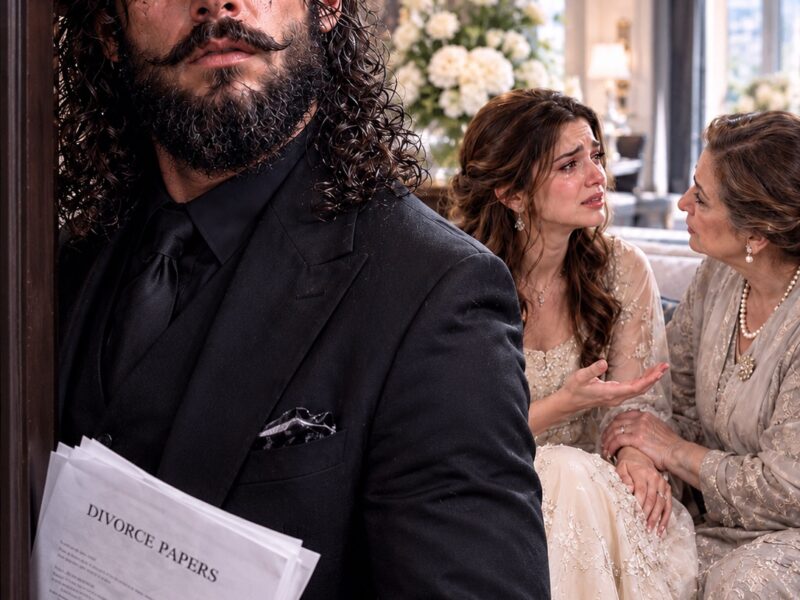
The Mafia Boss Was About to Divorce His Wife—Then He Overheard What She Told Her Mom About Him
Dante Moretti had already chosen the pen he would use to end his marriage.
Then he heard his wife whisper to her mother, “I love him too much to let him stay with me out of pity.”
The divorce papers were still waiting on his desk when he realized he might have misunderstood the quietest woman in his life for three years.
The pen felt heavier than it should have.
Dante Moretti stood behind the desk in his study and stared at the divorce papers spread beneath his hand.
Rain tapped against the tall windows behind him.
Not hard.
Just steadily.
The kind of rain Chicago produced in late October when the sky seemed too tired for thunder.
Dante had signed contracts worth tens of millions of dollars without hesitation. He had signed settlements that ended lawsuits, agreements that saved companies, and papers that had quietly removed dangerous men from his business before they became impossible to control.
His hand had never shaken.
It shook now.
Three years of marriage.
Twenty-seven pages.
Two signatures.
That was what remained.
Across the first page, his attorney had placed small yellow tabs where Dante needed to sign the following morning.
He had asked for the documents himself.
He had told his lawyer there would be no fighting over property, no public accusations, no humiliation. Alina could keep the townhouse in Evanston she liked, the trust established in her name, and anything she had brought into the marriage.
He would make the ending clean.
That was how Dante solved problems.
Quickly.
Privately.
Without letting them become more painful than necessary.
The flaw in that philosophy was that sometimes clean endings were built on dirty assumptions.
Dante did not know that yet.
He looked toward the framed photograph on the shelf beside the fireplace.
His wedding day.
Alina in ivory silk.
Dark hair pinned beneath a simple veil.
Dante beside her in black.
Neither looked unhappy.
Neither looked in love.
That was how the marriage had begun.
An arrangement.
Not forced, exactly.
That would have been too crude for families like theirs.
But encouraged strongly enough that saying no would have produced consequences neither family wanted.
Dante’s father had owed Alina’s father a favor dating back nearly twenty years. Alina’s family needed protection for a manufacturing business being squeezed by lenders and criminal intermediaries. Dante needed a wife acceptable to old allies who distrusted the fact that a forty-year-old unmarried man controlled a large and complicated organization with no obvious private life.
A wedding solved several problems.
So they married.
Dante had expected courtesy.
Alina gave him more than that.
She remembered how he took his coffee.
Black.
Half a teaspoon of brown sugar only on Sundays, though he had never consciously told her Sundays were different.
She knew he hated lilies because they smelled like funeral parlors.
She replaced them with white roses without asking.
She learned which evenings he came home too tired to talk and which evenings silence meant he needed someone to sit near him without demanding anything.
She never complained about the men who arrived after midnight.
Never asked where he went when he left before dawn.
Never searched his phone.
Never demanded jewelry.
Never asked for a larger allowance.
Never said, “Do you love me?”
That last thing had ruined him.
Because Dante did.
He had not intended to.
He had thought affection would be enough.
Respect.
Comfort.
A decent life together.
Then one morning six months into the marriage, Alina had set tea beside him while he was reading a report.
She touched his shoulder.
Just once.
Nothing dramatic.
But Dante remembered feeling the room change.
He wanted her hand to remain.
It did not.
Over the following years, he began collecting those small moments.
Her sleeping with a book open across her chest.
The way she laughed with the cook when she thought nobody important was listening.
The way she touched his sleeve at crowded dinners when she sensed his patience thinning.
Hope entered slowly.
Then became unbearable.
Because Alina never asked anything emotional of him in return.
Dante eventually reached the conclusion that seemed safest.
She was kind because she was a kind woman.
Loyal because she believed in vows.
Gentle because gentleness was her nature.
But love?
No.
A woman in love would ask.
Would become jealous.
Would fight.
Would demand pieces of him.
Alina took nothing.
And Dante Moretti had spent most of his adult life believing anyone who wanted nothing from him probably wanted nothing of him.
He closed the pen.
Tomorrow.
His lawyer would arrive at ten.
Alina had been told there were documents requiring her attention but not what they were. Dante had hated that part, yet he had convinced himself that telling her the night before would only create an unnecessary scene.
A coward’s logic dressed as efficiency.
Someone knocked.
Dante turned.
Marco Bellini stood in the doorway.
Marco was fifty, gray beginning at his temples, and had driven for the Moretti family since Dante was twenty-two. Officially he was transportation director.
Unofficially he was the closest thing Dante had to a friend who could tell him he was behaving like an idiot without losing employment.
“Sir.”
“What?”
“Mrs. Moretti is in the east garden.”
Dante waited.
Marco did not usually report his wife’s location.
“And?”
“She’s on the phone with her mother.”
Dante’s expression hardened.
“Why are you telling me?”
Marco hesitated.
That alone mattered.
Dante’s eyes narrowed.
“What did you hear?”
“Enough to think you should decide whether you want to hear the rest yourself.”
“That sounds remarkably like eavesdropping.”
“It probably is.”
“And you recommend it?”
“No.”
Marco held his gaze.
“I recommend not signing anything tonight.”
The words hit too close to the papers.
Dante stood.
“Did Alina tell you something?”
“No.”
“Then how do you know?”
“I walked through the covered passage.”
“She didn’t know I was there.”
Marco shifted.
“She was crying.”
Dante’s chest tightened.
Alina almost never cried.
At her father’s funeral, she had stood beside her mother holding tissues for everyone else.
When Dante once returned home with blood on his cuff after a shooting near one of his warehouses, Alina’s hands shook while she cleaned a cut near his eyebrow.
Her eyes remained dry.
“Why?”
“I don’t know.”
Marco stepped aside.
“But she said your name.”
Dante should have stayed.
He knew that.
Privacy mattered.
Even in a marriage already ending.
Especially then.
But the human mind can resist temptation only until temptation begins speaking in the voice of the person one loves.
Dante left the study.
The east garden sat beyond a covered stone arcade attached to the mansion. Glass enclosed one side during winter. Ivy climbed the opposite wall, now red and brown beneath the rain.
Alina stood near the far end.
Her back faced the house.
Phone pressed to her ear.
Dante stopped behind a wide stone column.
He hated himself immediately.
Then he heard her voice.
“Mama, please don’t cry.”
He did not move.
“I’m all right.”
A pause.
“No.”
Her voice trembled.
“He doesn’t know.”
Dante’s fingers closed around the edge of the column.
Alina listened.
Then:
“No, Mama. He cannot know because I don’t know what he would do with the truth.”
Dante’s heartbeat changed.
He almost stepped out.
Then Alina continued.
“You think I don’t want to tell him?”
Her voice broke.
“Every day.”
Rain whispered beyond the glass.
“I want to tell him every day.”
She turned slightly, enough that Dante could see one side of her face.
Wet.
Not from rain.
She pressed two fingers against her eyes.
“I want to tell him why I don’t ask where he goes at night.”
“Why I never complain.”
“Why I never ask him to stay home.”
Another pause.
“Because what right would I have to ask him for more when I already know how much he carries?”
Dante stopped breathing.
Alina’s mother said something.
Alina shook her head.
“No.”
“The doctor did not say that.”
“He said the treatment is working.”
Treatment.
The word struck.
Dante’s hand slipped slightly against the stone.
“You remember what happened to Sophia.”
Alina whispered.
“I remember every day.”
Dante did not know any Sophia.
Not one connected to his wife.
“She didn’t have my options.”
“She didn’t have the money.”
“She barely had time.”
Alina covered her mouth.
For several seconds, no words came.
When they did, they were smaller.
“I sold the ring because I could.”
Dante felt something cold move through him.
Ring?
“You gave it to me.”
“I know.”
“I know what Grandma would have wanted.”
Her shoulders shook.
“I was not going to ask Dante for money.”
“No.”
“No, Mama.”
“Please listen.”
The name sounded different in her mouth.
Not formal.
Not afraid.
Dante.
“I couldn’t let him stay with me because he felt responsible.”
Dante’s eyes closed.
Stay.
“What if he finds out and suddenly every choice he makes is about whether I’m sick?”
“What if he stops going places because I’m afraid?”
“What if every time he looks at me he sees something fragile?”
Her mother apparently interrupted.
Alina’s answer came immediately.
“I know what marriage means.”
“I know.”
Then a bitter, almost helpless laugh.
“But ours did not begin with love.”
Dante felt that sentence exactly where he expected.
Then Alina said:
“Mine did.”
He opened his eyes.
She was crying openly now.
“I loved him from that stupid wedding day.”
A small laugh escaped through the tears.
“He stood beside me like I was some diplomatic assignment he was determined to complete correctly.”
Dante almost stepped out.
Almost.
“I remember thinking he looked so lonely.”
The word hit harder than cruelty would have.
“He had two hundred people at the reception and looked like there wasn’t one person in the room he could lean on.”
Alina’s voice softened.
“I wanted to tell him.”
“Not that day.”
“I wasn’t insane.”
Her mother said something that made Alina laugh again.
Then the laugh became a sob.
“I love him.”
She whispered.
“I love him enough that I would rather he leave me thinking I never cared than stay because he thinks a sick wife is another responsibility he has to carry.”
Dante’s hand left the column.
For one terrible second, he thought he might fall.
Fifty feet away, divorce papers waited beneath yellow tabs.
He had spent months convincing himself Alina’s silence meant absence.
Meanwhile, she had filled the silence with a love too frightened to ask for anything.
“Mama, promise me.”
Alina said.
“You do not tell him.”
“Not yet.”
“I want one thing in my life with him that isn’t built on obligation.”
“If he chooses me, I want him to choose the woman he thinks I am.”
“Not the woman he’s afraid might die.”
She listened.
Then:
“I have to go.”
“He’ll be home soon.”
Dante stepped backward into the darker passage.
His heart pounded harder than it had in rooms where men carried guns.
Alina ended the call.
She stayed beneath the garden arch another minute, one hand pressed to her mouth.
Then she straightened.
Wiped her face.
Composed herself.
By the time she entered the house, the quiet wife Dante knew had returned.
That frightened him more than the tears.
He went back to the study.
Locked the door.
Took the divorce papers in both hands.
For a moment, he considered tearing them.
He did not.
That would have been another emotional decision made without Alina.
Instead, he placed them inside a drawer.
Then called his attorney.
“Tomorrow is canceled.”
A pause.
“Yes.”
“Everything.”
Another pause.
“No explanation tonight.”
Dante hung up.
He sat behind the desk until after midnight.
One sentence replayed endlessly.
I love him enough that I would rather he leave me thinking I never cared than stay because he thinks a sick wife is another responsibility.
He wanted to be angry.
At Alina for hiding something so large.
At her mother for knowing.
At himself for standing behind a column and listening.
Mostly he felt ashamed.
Three years.
He had shared a bed with her.
Shared breakfasts.
Funerals.
Public obligations.
Quiet Sundays.
He knew the perfume she wore when nervous.
The exact temperature she preferred the bedroom at night.
The way she tucked one foot beneath herself while reading.
And he did not know she was ill.
Dante got up.
Walked toward the bedroom.
Stopped halfway.
Confront her now?
No.
She had cried herself empty in the garden.
He would not turn confession into interrogation before midnight.
For once, he would wait.
That did not mean he slept.
At dawn, Alina opened her eyes and found Dante sitting in the armchair beside the bedroom windows.
Still dressed.
“What happened?”
She pushed herself upright.
“Nothing.”
“That is never true when you say it that way.”
He looked at her.
Morning light softened her face.
There were shadows beneath her eyes.
Had they always been there?
Had he simply not looked?
“Alina.”
Her expression changed at his tone.
“Yes?”
“I canceled the lawyers.”
She became still.
“What lawyers?”
There it was.
The moment he realized another failure.
She had not even known.
Dante rubbed a hand across his face.
“The lawyers who were coming today.”
“For?”
He looked at her.
“Divorce papers.”
All color left her face.
The pain was immediate.
No practiced stillness could hide it.
Dante hated himself for every second she had to carry it.
“You were going to divorce me.”
Not a question.
“Yes.”
She looked away.
Her hands folded in her lap.
“I see.”
“No.”
He leaned forward.
“You do not.”
She laughed once.
Small.
“Dante, I think that part is fairly clear.”
“I canceled it.”
Her eyes returned to his.
“Why?”
He had planned an honest conversation.
No accusations.
No drama.
But honesty began earlier than expected.
“Because I heard you in the garden.”
Alina stopped moving.
The silence between them changed completely.
“What did you hear?”
“Enough.”
Her face closed.
Not anger.
Fear.
Dante stood but did not approach.
“I am sorry.”
“You listened?”
“Yes.”
“On purpose?”
“After I heard my name.”
“Yes.”
Shame heated his neck.
“I should not have.”
“No.”
“You shouldn’t have.”
The correction mattered.
Dante nodded.
“You’re right.”
She stared at him.
Perhaps waiting for defense.
There was none.
“How much?”
“I heard you say you love me.”
Her eyes filled immediately.
Dante continued.
“I heard something about a doctor.”
“A ring.”
“Treatment.”
“Your sister Sophia.”
The last name made her turn away.
Dante saw her shoulders tighten.
“I did not understand all of it.”
“Good.”
He swallowed.
“Alina.”
“No.”
She stood.
“I cannot do this right now.”
She walked toward the bathroom.
Dante did not block her.
At the door, she stopped.
“You were ready to divorce me yesterday.”
“Yes.”
“And today you are not because you found out I love you?”
“Not only because of that.”
She looked at him.
“What else?”
“Because I realized I had built an entire conclusion about our marriage without ever asking you if it was true.”
Her mouth trembled.
“That is not the same as wanting to stay.”
“No.”
Dante nodded.
“But it is enough reason not to leave before we talk.”
Alina looked down.
“And the illness?”
“Whatever you choose to tell me.”
She glanced up sharply.
“You’re not going to investigate?”
The question hurt.
Because the answer she expected told him something about the man he had been.
“No.”
Dante said.
“I want to.”
Her expression changed.
He almost smiled bitterly.
“I want to call every doctor in Chicago and make somebody hand me your entire chart.”
“But I won’t.”
“Why?”
“Because it is your body.”
“Your information.”
“And because yesterday I almost ended our marriage without asking you a question.”
“I’m trying not to repeat myself before breakfast.”
A tear slipped down her cheek.
She wiped it away.
“I have an appointment this afternoon.”
Dante remained still.
“Do you want me there?”
Alina closed her eyes.
Long pause.
Then:
“Yes.”
That one word changed the day.
The clinic was not hidden.
That was the first assumption Dante had gotten wrong.
It sat on the seventh floor of a medical building near Northwestern Memorial Hospital.
Normal waiting room.
Gray chairs.
Old magazines.
A television mounted too high.
Dante had expected something secretive because secrecy was how he understood the world.
Alina’s secrecy had been personal.
Not logistical.
They sat side by side.
No security inside.
Marco waited downstairs.
Dante’s knee moved slightly.
Alina noticed.
“You’re nervous.”
“No.”
“You are moving your leg.”
“I do that.”
“You absolutely do not.”
He looked at her.
She almost smiled.
That tiny familiarity nearly broke him.
A nurse called her name.
Dr. Miriam Chen met them in an examination room.
Middle-aged.
Calm.
Completely unimpressed by Dante Moretti.
He liked her immediately.
Alina spoke first.
“My husband knows now.”
Dr. Chen’s eyes moved toward Dante.
“How much?”
“Almost nothing.”
Dante answered.
“And only what Alina wants me to know.”
Dr. Chen looked back at Alina.
Approval.
Good.
Alina inhaled.
“Tell him.”
Dr. Chen explained.
Autoimmune aplastic anemia.
Rare.
Serious.
But in Alina’s case, manageable.
The name sounded worse than the prognosis.
Her bone marrow had begun producing too few blood cells, discovered during a routine physical sixteen months earlier. Initial treatment had stabilized her counts.
She required regular monitoring and an expensive medication regimen.
Possibly for years.
Maybe longer.
Dante listened without interrupting.
“Is she dying?”
He finally asked.
Dr. Chen did not soften unnecessarily.
“Everyone is dying eventually.”
Alina almost laughed.
The doctor continued.
“Is this condition expected to kill her in the near future if she continues responding to treatment?”
“No.”
Dante’s lungs released air.
He had not realized he was holding it.
“Could it become more serious?”
“Yes.”
“Could she require a transplant someday?”
“Possibly.”
“But right now?”
“Right now she is responding well.”
Dante looked at Alina.
She had been afraid he would stay out of pity.
He had spent half the morning believing he was about to lose her.
Anger rose.
He pressed it down.
Not here.
“What does treatment cost?”
Alina’s shoulders tightened.
Dr. Chen looked to her.
Alina answered.
“A lot.”
“How much?”
“Dante.”
“I’m asking.”
“And I’m not.”
He caught himself.
Nodded.
“Okay.”
Dr. Chen looked between them.
“You two may need a different room for that conversation.”
Alina actually laughed.
Dante exhaled through his nose.
Fair.
After the appointment, they sat in the car without asking Marco to drive.
Rain streaked the windshield.
Alina folded her hands.
Dante stared forward.
“Your sister.”
He said.
“Sophia.”
Alina’s face changed.
“She had the same illness?”
“Yes.”
“How old?”
“Twenty-six when she died.”
Alina swallowed.
“I was nineteen.”
Dante turned toward her.
“Was there no treatment?”
“There was.”
“But we did not understand the disease early enough.”
“And by the time we did…”
Her voice trailed.
Dante waited.
“My mother sold everything.”
Alina continued.
“Car.”
“Jewelry.”
“Furniture.”
“We borrowed.”
“Asked relatives.”
“By the time we had enough money for the specialist we wanted, Sophia was too sick for the option we had been chasing.”
Dante looked down.
“I’m sorry.”
“I know.”
“Is that why you hid yours?”
“Partly.”
She touched the plain wedding band on her finger.
“When Dr. Chen told me, I remembered my mother sitting in hospital hallways asking people how much things cost before she asked whether they worked.”
“I promised myself I would never make somebody love me like that.”
Dante frowned.
“Love you like what?”
“Terrified.”
The answer stopped him.
Alina stared at the windshield.
“Sophia became the center of every room.”
“Every meal.”
“Every bill.”
“Every decision.”
“She hated it.”
“She used to apologize when she needed help walking to the bathroom.”
“I watched illness take her body and guilt take everything else.”
“So when I found out…”
“You decided to carry it alone.”
“I decided to manage it.”
“That is a nicer word.”
She looked at him.
“Maybe.”
Dante’s voice hardened despite himself.
“You sold your grandmother’s ring.”
Alina went still.
“You heard that.”
“Yes.”
“Why?”
“Because I needed to pay for medication.”
“You could have asked me.”
“I know.”
“Then why didn’t you?”
Her expression changed.
There it was.
The real wound.
“Because I did not know what I was to you.”
Dante looked at her.
“You were my wife.”
“That is a legal answer.”
“It is true.”
“So is this.”
Alina turned fully toward him.
“You were kind to me.”
“Generous.”
“Never cruel.”
“But you kept part of yourself locked so far away that sometimes I felt ridiculous for loving you.”
Dante did not move.
“I did not know whether asking you for money would feel like asking a husband or approaching a banker.”
The words landed cleanly.
No drama.
That made them sharper.
“You never let me see you need me.”
Alina said.
“So I learned not to need you out loud.”
Dante looked toward the rain.
Everything inside him wanted to defend.
To tell her he had protected her.
Provided.
Made sure no one insulted her.
Made her untouchable in rooms where powerful men disrespected everyone else.
But she had not accused him of failing to provide.
She had accused him of never letting her close enough to know whether provision meant love.
And she was right.
“I thought…”
He stopped.
“What?”
“I thought you didn’t love me because you never asked me for anything.”
Alina stared.
Then almost laughed.
Not because it was funny.
Because it was tragic.
“You thought my silence meant I did not care.”
“Yes.”
“I thought your silence meant I should not ask.”
They sat there.
Two intelligent adults.
Three wasted years.
One misunderstanding so simple it became cruel.
Alina covered her eyes.
Dante leaned forward.
Not touching.
Waiting.
Finally she laughed through tears.
“We are idiots.”
Dante’s mouth moved.
“Yes.”
“Very expensive idiots.”
“Yes.”
That was the first honest laugh they shared about their marriage.
It lasted maybe ten seconds.
Then Dante said:
“There is one thing I cannot accept.”
Alina stiffened.
“What?”
“That you almost stopped treatment because you thought the money moving might make me ask questions.”
She looked away.
“How do you know that?”
“You told your mother.”
Dante’s voice softened.
“I won’t use what I overheard against you.”
“But if you are deciding whether to continue medicine based on whether I notice a bank transfer, then we have a problem larger than the money.”
Alina stared at him.
“So what do you want?”
The question felt important.
Dante took his time.
“I want us to stop guessing.”
“About what?”
“Everything.”
She looked skeptical.
“Specific.”
“I tell you when something in my work could affect you.”
“You tell me when your health changes.”
“We do not confuse privacy with secrecy.”
“If you need help, you decide whether to ask.”
“I don’t get to force it.”
“And if I am afraid?”
“Say it.”
“If I am jealous?”
Dante looked surprised.
“Are you?”
“Not currently.”
“That sounds temporary.”
She smiled faintly.
“What about you?”
“I was about to divorce you because you were too polite.”
“That seems dramatic.”
“I am Sicilian-American.”
“Not a defense.”
“No.”
He looked at her.
“And I want the divorce papers destroyed.”
Alina’s expression sobered.
“Not yet.”
The answer hit.
Dante did not hide it.
“Why?”
“Because canceling divorce is not the same as repairing a marriage.”
He went still.
She continued.
“You heard me say I love you.”
“You discovered I am sick.”
“Both of those things are emotionally powerful.”
“But if we simply rush toward each other now, we might confuse fear with change.”
Dante hated the wisdom of that.
“What do you want?”
“Thirty days.”
“For?”
“To decide whether we know how to be married honestly.”
Dante nodded slowly.
“No lawyers?”
“No lawyers.”
“No papers?”
“Put them away.”
“Not destroy?”
“Not yet.”
Pain moved across his face.
Alina saw it.
She reached for his hand.
The first voluntary touch between them that day.
“If you still want to destroy them in thirty days…”
She said.
“Then we do it together.”
Dante closed his fingers around hers.
“Fine.”
The first week was awkward.
Honesty did not magically produce ease.
Sometimes it made ordinary meals feel like negotiations.
Dante told Alina where he went on Tuesday night.
“Warehouse meeting.”
“With whom?”
“Two union representatives.”
“Dangerous?”
“Possibly boring.”
“Which is more dangerous for you?”
“Boredom.”
She almost smiled.
Alina told him about her medication schedule.
Showed him the drawer where she kept bottles.
Explained which days left her tired.
The first time Dante saw her swallow three pills after breakfast, guilt crossed his face so clearly she put the glass down.
“No.”
He looked up.
“What?”
“You are doing it.”
“Doing what?”
“Making my treatment about your guilt.”
His jaw tightened.
“I am trying not to.”
“Try quieter.”
That irritated him.
Good.
Healthy marriages occasionally require irritation more than worship.
He nodded.
“Fair.”
He stopped watching the pills.
Instead he asked:
“Anything you need today?”
Most days she said no.
Once she said:
“Yes.”
He almost straightened visibly.
“Can you cancel dinner with the Bellinis?”
“Why?”
“I’m tired.”
“And I want you home.”
Dante looked at her.
Alina flushed slightly.
“That was difficult to say.”
“I noticed.”
“Don’t make it a ceremony.”
“I’m canceling dinner.”
He did.
No questions.
That mattered.
The grandmother’s ring did not disappear from the story.
Dante offered to buy it back.
Alina refused.
“It was mine.”
“Yes.”
“I chose to sell it.”
“You regret it?”
“Of course.”
“Then let me—”
“No.”
He stopped.
Alina touched his sleeve.
“If you buy it back, it becomes the ring you rescued.”
“I need it to remain the ring I sold to save myself.”
Dante did not like that.
He understood it.
Different thing.
“What if someday you want it back?”
“Then I will ask.”
He nodded.
“Good.”
What neither of them knew was that the ring had already become dangerous for another reason.
The buyer was a private collector named Charles Meyers.
Legitimate on paper.
Less legitimate in relationships.
Meyers purchased jewelry for wealthy families that preferred discretion.
He also enjoyed talking.
One of the men he talked to worked for Salvador Felli.
The Felli family had competed with Moretti interests around freight logistics, waterfront warehousing, and private security for years.
Not open war.
That was expensive.
Modern criminal organizations preferred contracts, unions, shell companies, political donations, and selective fear.
A Moretti wife quietly selling a family heirloom attracted attention.
Not because the Fellis cared about jewelry.
Because powerful men spend their lives looking for cracks in other powerful men’s walls.
The buyer mentioned the sale.
Someone checked the date.
Then the bank movement.
Then a driver recalled seeing Alina entering a medical building several times.
Information assembled itself.
Three days after Dante and Alina’s clinic visit, Marco called at 1:12 in the morning.
Dante was awake.
Alina slept beside him.
He answered quietly.
“Yes?”
“The ring buyer.”
Marco’s tone immediately changed the room.
“What about him?”
“He talks to a broker named Miles Corwin.”
“Corwin works around Felli.”
Dante stood.
Walked into the hallway.
“What do they know?”
“Not everything.”
“Enough.”
“Say it.”
“They know Mrs. Moretti sold a family heirloom privately.”
“They know the amount.”
“They know she has been going to a specialty clinic.”
Dante closed his eyes.
“Who told them the clinic?”
“Still tracing.”
“What do they think?”
“That you have liquidity problems.”
“Or domestic trouble.”
“Or both.”
Marco paused.
“And they know the clinic is hematology.”
Dante’s hand tightened around the phone.
“How?”
“We’re finding out.”
“No.”
He lowered his voice.
“You are not finding out the old way.”
Marco went silent.
Dante continued.
“No men pulled into rooms.”
“No threats to clerks.”
“Use counsel.”
“Use the investigator on retainer.”
“Legal methods.”
Marco exhaled.
“You have changed.”
“I am tired.”
“Different thing.”
“Maybe.”
Dante looked toward the bedroom door.
“Anything else?”
“Yes.”
“Salvador is requesting a meeting.”
“On what pretext?”
“Port insurance agreements.”
Dante almost laughed.
“Of course.”
“What do you want me to tell him?”
“That I’ll answer tomorrow.”
He hung up.
When he turned, Alina stood in the bedroom doorway.
She wore one of his shirts.
Bare feet.
Hair loose.
“You told me we would not guess.”
Dante stared.
“You heard?”
“Enough.”
He hated the phrase immediately.
Alina walked closer.
“What happened?”
Dante told her.
All of it.
No softening.
The ring.
The collector.
The clinic.
Felli.
When he finished, Alina’s face had gone pale.
“This is my fault.”
“No.”
“If I had not sold—”
“No.”
Dante stepped closer.
Then stopped before touching her.
“This is their decision.”
“Not yours.”
“You were paying for medicine.”
“That is not weakness.”
“It is private.”
“Yes.”
He nodded.
“And I am sorry your privacy has become useful to men who treat human beings like balance sheets.”
“What are you going to do?”
Dante looked toward the dark windows.
The old answer appeared immediately.
Deny.
Counterattack.
Create uncertainty.
Find something Salvador Felli feared and press until he forgot Alina existed.
Fifteen years of leadership had made that instinct nearly automatic.
Then he remembered Alina saying:
If I tell him, everything becomes about whether I’m sick.
He looked back.
“What do you want me to do?”
She blinked.
“You’re asking?”
“Yes.”
“I don’t know.”
“Then we figure it out.”
Together.
The word remained unspoken.
Still present.
The next morning, Dante called his attorney, federal compliance counsel, and two senior executives from the legitimate side of Moretti Logistics.
No captains.
No armed men.
Marco watched from the corner.
Dante explained the problem.
One executive suggested public silence.
Another suggested medical privacy counsel.
The criminal attorney advised controlling rumors through allied businesses.
Alina attended.
That alone changed the room.
Some men looked uncomfortable.
Dante noticed.
“Anyone who believes my wife should leave while you discuss her private medical information can leave instead.”
Nobody moved.
Good.
They agreed on a plan.
No public disclosure unless necessary.
Legal warning to the ring broker regarding medical privacy rumors.
Corporate review of any Felli-linked financing pressure.
Security increased discreetly, but Alina would approve any changes affecting her movements.
Most importantly:
No retaliation based solely on gossip.
Dante hated that one.
Which was why he knew it mattered.
Salvador Felli called by noon.
“Dinner tomorrow.”
Neutral private club.
Dante agreed.
Alina did not attend.
Her decision.
“I don’t want my illness to become theater.”
Dante respected it.
The meeting lasted ninety minutes.
Salvador was sixty-three.
Silver hair.
Thin smile.
Educated enough to make threats sound like observations.
They discussed insurance first.
Then port access.
Then Salvador leaned back.
“I hear marriage disagrees with you.”
Dante’s expression did not change.
“Does it?”
“Women become expensive when unhappy.”
“My wife is not unhappy.”
“Then perhaps unwell.”
There it was.
Dante waited.
Salvador smiled.
“Chicago is a small city when the right people listen.”
“Then they should find better hobbies.”
“I worry about stability.”
“No, you don’t.”
Dante’s voice stayed calm.
“You are hoping illness creates hesitation.”
Salvador lifted a glass.
“Does it?”
Dante thought of the old answer.
Never reveal what matters.
Instead:
“Yes.”
Salvador’s smile stopped.
“My wife’s health matters to me.”
“If that makes me hesitate before making decisions that affect her, good.”
“If you think that means I cannot make decisions affecting you, test the theory.”
Silence.
Salvador studied him.
“You admit it.”
“I admit I love my wife.”
“That is not leverage unless I pretend it is a secret.”
Something shifted.
Dante felt it.
Power does not always move through threats.
Sometimes it moves when one person refuses to be embarrassed by the thing another planned to weaponize.
Salvador leaned forward.
“What is wrong with her?”
“None of your business.”
“Then there is still a secret.”
“Privacy is not shame.”
Dante stood.
“We are done.”
Salvador laughed.
“You think love makes you modern?”
“No.”
“I think spying on medical appointments makes you pathetic.”
The dinner ended badly.
Which sometimes means honestly.
By the end of the week, the Fellis pressured two insurance brokers tied to Moretti shipping.
One lender delayed renewal on a warehouse facility.
A port subcontractor suddenly reconsidered a deal.
Nothing illegal enough to prosecute.
Everything coordinated enough to understand.
Dante’s lieutenants wanted retaliation.
Frank Bellini, who had been with the Moretti family twenty years, said it directly.
“They smell weakness.”
Dante sat at the head of the conference table.
Marco stood near the window.
Alina was not present.
“This has nothing to do with my wife.”
Dante said.
“It has everything to do with her.”
Frank replied.
“You changed your behavior.”
“Yes.”
“You showed Felli he can move you.”
“No.”
Dante looked around the table.
“I stopped moving the way you expected.”
“That is different.”
Frank shook his head.
“Your father would have put three trucks out of service by now.”
“My father died believing fear was the only language men understood.”
“It worked.”
“Until it didn’t.”
The room went quiet.
Dante continued.
“We answer contracts with contracts.”
“Pressure with audits.”
“Extortion with prosecutors.”
“If anyone here wants a street war because my wife has a blood disorder, you have confused masculinity with stupidity.”
Marco looked down to hide a smile.
Frank did not.
“You are changing the rules.”
“Yes.”
“Why?”
Dante thought about divorce papers in a drawer.
“Because the old ones almost cost me the only person in my house who never tried to use me.”
Nobody had an answer.
The business fight continued.
Dante won some.
Lost some.
That mattered too.
Change without cost is usually fantasy.
Moretti Logistics lost a shipping lane through New Jersey.
A warehouse expansion was delayed.
Two men from the older organization left because they believed Dante had become soft.
One joined Felli.
Dante did not stop him.
Three younger executives stayed because they preferred compliance officers to funerals.
Marco called that progress.
Dante called it expensive.
At home, the thirty days continued.
Not romantically.
Honestly.
Alina had bad treatment days.
One Thursday, nausea kept her in bed.
Dante canceled meetings.
She became furious.
“I did not ask you to.”
“You are vomiting.”
“And?”
“And I want to stay.”
“Want?”
Dante caught the distinction.
“Yes.”
Alina watched him.
“You are not staying because you think you have to?”
“No.”
“I can take care of myself.”
“I know.”
“Then why?”
He sat in the chair near the bed.
“Because I missed three years of being allowed to worry about you.”
She stared.
“That sentence is manipulative.”
“Probably.”
“You cannot collect backdated worry.”
“I can try.”
She threw a pillow at him.
It was the first object his wife ever threw in their marriage.
Dante smiled for an hour.
Another evening, Alina asked where he was going.
“Meeting.”
“With?”
“Marco and an attorney.”
“About Felli?”
“Yes.”
“Dangerous?”
“No.”
“Can I come?”
Dante almost answered no automatically.
Then stopped.
“If you want.”
“I do.”
She attended.
Not because she needed protection.
Because she wanted information.
That distinction became the architecture of their repair.
On the twenty-ninth day, Dante returned home early.
Alina was in the garden.
Same place.
Phone in her hand.
He stopped at the entrance.
Old memory.
Old shame.
She saw him.
“Come here.”
Dante walked toward her.
“My mother.”
She said.
“Would you like to say hello?”
That simple invitation hurt in the best way.
Alina put the call on speaker.
Her mother, Evelyn Hart, had a warm voice and absolutely no fear of Dante Moretti.
“So.”
She said.
“You are the idiot.”
Alina covered her face.
“Mama.”
Dante almost smiled.
“I have been called worse.”
“I am sure.”
Evelyn continued.
“My daughter says you know.”
“Yes.”
“Everything?”
“Enough to know I should have asked more questions.”
“Good answer.”
“Mama.”
“What?”
“You wanted honesty.”
Dante looked at Alina.
Then spoke.
“Mrs. Hart.”
“Evelyn.”
“Evelyn.”
He paused.
“Why did Alina believe asking me for help would make love less real?”
Silence.
Alina looked at him.
Evelyn answered slowly.
“Because she watched me spend years turning my fear for Sophia into control.”
Alina closed her eyes.
“I checked Sophia’s food.”
“Her sleep.”
“Her medications.”
“Who visited.”
“Whether she rested.”
“I loved her until she could barely breathe around my love.”
Dante listened.
“After she died, Alina promised herself she would never become the reason someone else’s life narrowed.”
“And she married a man whose life was already very narrow.”
Evelyn said.
“I think she decided the kindest thing she could do was take up as little space as possible.”
Dante looked at his wife.
Alina’s eyes filled.
“I’m sorry.”
She whispered.
“No.”
Dante’s voice sharpened.
“Don’t apologize for adapting to the room I built.”
Evelyn went quiet.
Alina stared.
Dante continued.
“I just want us to build another one.”
Thirty days ended the next morning.
The divorce papers still sat in Dante’s drawer.
Alina came to the study.
Closed the door.
“Do you still want to destroy them?”
Dante stood.
“Yes.”
She nodded.
“So do I.”
He opened the drawer.
Removed the papers.
Placed them on the desk.
Dante reached for a lighter.
Alina raised an eyebrow.
“That is dramatic.”
He stopped.
“What do you suggest?”
“Shredder.”
“That seems anticlimactic.”
“Healthy things often are.”
They carried twenty-seven pages to the office shredder.
Dante fed the first sheet.
Alina the second.
By page five, the shredder jammed.
Alina laughed so hard she had to sit down.
Dante stared at the machine.
“This is insulting.”
“It is symbolic.”
“Of what?”
“That marriage requires maintenance.”
He looked at her.
“That is terrible.”
“I know.”
Marco entered because he heard the noise.
Saw divorce papers hanging halfway from the machine.
Turned around.
“No.”
Dante called.
“Fix it.”
Marco looked over his shoulder.
“I have served you for fourteen years.”
“Yes.”
“I have hidden bodies from the media.”
“That sentence sounds worse than the reality.”
“I have negotiated kidnappings.”
“One.”
“And now you want me to repair a shredder during a marital ceremony?”
“Yes.”
Marco sighed.
“Love has destroyed this organization.”
Alina laughed again.
The Fellis chose that week to escalate.
Not violently.
Strategically.
Salvador had acquired copies of medical billing data through someone tied to the ring broker.
Illegal.
Very illegal.
Marco’s investigators traced access to a third-party billing contractor.
Dante’s attorney contacted federal authorities before anyone touched the employee.
The old Dante would have sent men.
The new Dante sent subpoenas.
He hated subpoenas.
They worked.
The contractor cooperated.
Emails connected the leak to Corwin.
Corwin connected it to a Felli consultant.
The evidence was enough for investigation.
Salvador realized too late that he had treated private health data like street gossip in an era where digital records created receipts.
He requested another meeting.
Dante refused privately.
Instead, he invited representatives from four families, two legitimate freight companies, their attorneys, and an outside mediator to neutral ground.
Alina asked why.
“Because if he wants to make your illness a public measure of my strength, I want to remove the market for the information.”
She stared.
“You intend to tell them.”
“Only what you permit.”
“What do you want to say?”
“That you have a chronic condition.”
“That treatment is working.”
“That anyone trading medical rumors will deal with counsel and law enforcement.”
“Nothing else.”
Alina thought.
“My sister?”
“No.”
“The ring?”
“Only if you want.”
She looked toward her bare right hand.
The finger where her grandmother’s ring used to sit.
“Tell them I sold it.”
Dante frowned.
“Why?”
“Because I’m done being ashamed of surviving.”
The meeting took place at an old Italian social club near the river.
Neutral territory.
No weapons inside.
Everyone searched equally.
Dante arrived with Alina.
Not behind him.
Beside him.
That mattered.
Salvador Felli sat across the long table.
His sons flanked him.
Representatives from other organizations watched carefully.
Everyone had heard some version of the rumor.
Dante waited until the room settled.
Then stood.
“My wife has a chronic blood disorder.”
No introduction.
No dance.
The sentence dropped hard.
Salvador’s expression barely moved.
Dante continued.
“She has been receiving treatment for almost a year.”
“The treatment is working.”
“She sold a family ring to pay for part of it because she believed asking me for money might turn our marriage into obligation.”
He looked around.
“That belief was partly my fault.”
Several men shifted.
Dante Moretti did not admit fault publicly.
Until now.
“She did not sell the ring because Moretti companies are insolvent.”
“She did not attend a clinic because my household is collapsing.”
“She did not hide treatment because anyone controls her.”
“She hid it because our marriage was not honest enough for her to feel safe asking.”
Silence.
Dante looked directly at Salvador.
“If anyone here believes that makes me weaker, you are welcome to make decisions based on that assumption.”
Salvador smiled.
“Dante.”
His voice was smooth.
“You make this very emotional.”
“No.”
Dante said.
“You did.”
“You paid men to obtain my wife’s medical information because you believed emotion would make me irrational.”
“It almost did.”
“Then my lawyers reminded me prisons are full of men who thought anger was strategy.”
A few smiles appeared around the table.
Salvador’s did not.
Alina spoke.
Every face turned.
“I sold the ring.”
Her voice was calm.
“My grandmother gave it to me.”
“I loved it.”
“I sold it because I wanted treatment.”
“I would make the same decision again.”
She looked around the room.
“If any of you hear that story and think the important fact is that my husband can be manipulated because he loves me, then perhaps your marriages are sadder than mine was.”
Marco looked down.
Dante almost did too.
Salvador’s oldest son coughed.
Possibly laughter.
Alina continued.
“My health is private.”
“Not shameful.”
“If you use it for business leverage, we will respond legally.”
“If you threaten me personally, we will document it.”
“And if you expect me to disappear so my husband can look stronger…”
She leaned back.
“…then you have misunderstood both of us.”
Dante did not touch her.
He wanted to.
He let the words belong to her.
Salvador’s smile faded.
“Are we finished?”
He asked.
Dante answered:
“Almost.”
He placed a folder on the table.
Inside were copies of the contractor-access logs and attorney notices.
“We know how the information was obtained.”
Salvador’s eyes hardened.
“Careful.”
“I am.”
“That is why counsel has the originals.”
“And federal investigators have copies.”
The room changed.
Not dramatically.
More effectively.
Salvador understood.
Old warfare had rules he knew.
Dante had moved the battlefield.
“You brought authorities into family business.”
Salvador said.
Dante’s expression cooled.
“You brought my wife’s medical records into business.”
“There are consequences.”
“For both of us.”
That last part was deliberate.
Dante did not pretend law enforcement scrutiny would leave Moretti interests untouched.
He had already begun restructuring.
He had also provided his lawyers with information on questionable legacy operations that might surface during investigation.
The cost of changing rules was being willing to live under them too.
Salvador stared for a long time.
Then leaned back.
“A toast.”
He finally said.
Nobody moved.
Salvador looked at his glass.
“Perhaps not.”
The meeting ended without blood.
No one called it a victory.
That made it more believable.
The investigation into the medical-data breach eventually produced charges against the contractor and Corwin. Evidence against Salvador personally was not strong enough for criminal prosecution.
Dante accepted that.
The old Dante would not have.
Felli-linked companies lost two partnerships after other businessmen decided Salvador’s methods created too much legal exposure.
Moretti Logistics lost one too.
Fair enough.
The conflict settled into something almost civilized.
Mutual distrust.
Lawyers.
Paperwork.
Dante found paperwork strangely satisfying after discovering nobody bled on it.
Alina’s health improved over the following months.
Not perfectly.
Some blood counts dipped.
Medication changed.
One treatment made her hair thin near the temples.
She cried the first time she noticed.
Dante sat on the bathroom floor outside the door.
Not entering.
“Do you want me inside?”
“No.”
“Okay.”
He waited.
Twenty minutes.
Then Alina opened the door.
He did not say she looked beautiful.
Not immediately.
That would have felt like correcting an emotion.
Instead he said:
“Bad day?”
She nodded.
“Very.”
“Want company?”
Another nod.
He sat beside her on the floor.
Five minutes later she leaned against him.
That was marriage now.
Asking.
Answering.
Sometimes nothing else.
They attended counseling.
Dante objected at first.
Not to counseling itself.
To the fact that the therapist was younger than Marco.
“How old is she?”
“Thirty-eight.”
“That seems insufficient.”
“For what?”
“To tell me things.”
Alina stared.
“You regularly take advice from twenty-nine-year-old attorneys.”
“They have degrees.”
“So does she.”
“Different.”
“You are going.”
He went.
The therapist asked why Dante equated being needed with being loved.
He did not return the following week.
Alina went alone.
Dante returned the week after.
That counted.
He learned that his father had taught him usefulness early.
People remained close because you solved problems.
Provided money.
Protection.
Fear.
If someone asked for nothing, Dante assumed they needed nothing from him.
If they needed nothing, perhaps they did not love him.
Alina had learned the opposite.
Need was dangerous.
Need trapped people.
So she proved love by asking for as little as possible.
They had built matching walls from opposite instructions.
Counseling gave them language.
Life gave them practice.
One afternoon, Alina entered Dante’s study holding an envelope.
“What?”
He asked.
“I found the ring.”
Dante stood.
“Where?”
“The collector contacted me.”
“Why?”
“He heard about the investigation.”
“Suddenly developed ethics?”
“No.”
“He wants money.”
Dante’s expression hardened.
“How much?”
Alina smiled slightly.
“Too much.”
“I’ll pay it.”
“No.”
He stopped.
Alina placed the envelope down.
“He offered to sell it back.”
“Do you want it?”
“Yes.”
“Then why no?”
“Because I want to buy it.”
Dante frowned.
“It was yours.”
“It was.”
“Now it isn’t.”
“I sold it.”
She sat.
“I have savings.”
“You do.”
“I can afford part.”
Dante understood slowly.
“You want us to split it.”
“Yes.”
“Why?”
“Because I sold it alone.”
Her eyes softened.
“I would like to bring it home together.”
That answer nearly ended him.
They bought the ring.
Half from Alina’s account.
Half from Dante’s.
No rescue.
No debt.
A joint decision.
When the package arrived, Alina opened it at the kitchen table.
Her grandmother’s ring was smaller than Dante remembered.
Gold.
Tiny sapphire.
Not worth what the collector charged.
Worth more than the price.
She slipped it onto her finger.
Dante watched.
“Happy?”
Alina smiled.
“Yes.”
“Good.”
“That is all?”
“What do you want?”
“I don’t know.”
He considered.
“Your grandmother had terrible taste in sapphires.”
Alina threw a napkin.
Progress.
A year after Dante almost signed the divorce papers, rain returned.
Same season.
Same gray windows.
He entered the study early and found Alina sitting in his chair.
Divorce papers would once have been beneath her hands.
Now there was a stack of charity proposals.
She looked up.
“You’re late.”
“This is my study.”
“That does not answer me.”
Dante removed his coat.
“Meeting ran long.”
“Dangerous?”
“No.”
“Boring?”
“Extremely.”
“Excellent.”
He kissed her forehead.
She caught his tie.
“Wait.”
“What?”
“I need to ask you something.”
Dante sat on the edge of the desk.
“Ask.”
Alina looked toward the window.
“When you first decided to divorce me…”
He stiffened slightly.
“…what finally convinced you?”
“That you did not love me.”
“I know.”
“But what moment?”
Dante thought.
“There wasn’t one.”
“That’s worse.”
“Yes.”
He looked at her.
“It was accumulation.”
“You never complained.”
“Never asked me to stay.”
“Never asked where I went.”
“I interpreted your respect as distance.”
Alina nodded slowly.
“And now?”
“Now I know you were trying not to become a burden.”
She looked down.
“I still do that.”
“Yes.”
“So do you.”
He frowned.
“How?”
“When you’re afraid about my health, you go quiet so I don’t have to manage your fear.”
Dante stared.
“That seems considerate.”
“It is.”
“And lonely.”
He absorbed that.
Alina continued.
“I don’t want you dumping panic on me.”
“Good.”
“But I also don’t want to look across a room and wonder whether you are breaking quietly because you think that protects me.”
Dante looked toward the rain.
The old instinct.
Hide.
Control.
Offer nothing that could add weight.
He returned his gaze to her.
“I was scared last week.”
Alina waited.
“The blood counts.”
“Yes.”
“When Dr. Chen said they dropped, I thought about Sophia.”
Alina’s face softened.
“I know they came back up.”
“I know the medication adjustment is working.”
“But for about six hours, I was terrified.”
She reached for his hand.
Dante let her take it.
“Thank you.”
“For being terrified?”
“For telling me.”
He smiled faintly.
“This marriage has peculiar standards.”
“We started badly.”
“That is fair.”
Three years earlier, affection had lived in tea cups and carefully maintained distance.
Now love occasionally sounded like:
I am frightened.
I need you home.
I do not want advice.
Can you come to the appointment?
Please stop solving this.
Hold my hand.
Not tonight.
Stay.
The words were less elegant than silence.
They were infinitely safer.
The Moretti organization changed too.
Slowly.
Dante sold interests he could not defend legally.
Closed two cash-heavy businesses his father had treated as untouchable.
Brought independent compliance into shipping.
Frank Bellini resigned.
Marco stayed.
“You realize.”
Marco said one morning.
“If your father saw half these policies, he would haunt you.”
Dante signed a report.
“He already does.”
Marco nodded.
“Fair.”
The criminal side shrank.
Not because Alina cured Dante with love.
She would have hated that story.
Dante changed because consequences finally became personal enough to force him to question rules he had treated as natural.
Then he did the harder part.
He kept changing after the crisis ended.
Two years later, Moretti Logistics was mostly what its filings claimed it was.
Mostly.
Dante was not suddenly a saint.
He remained controlling.
Impatient.
Suspicious.
Capable of frightening a room without effort.
But men stopped disappearing from payroll after conflicts.
Attorneys became busier.
Enzo joked that legal invoices were the new body count.
Dante did not laugh.
Marco did.
Alina’s condition stabilized.
She never described herself as cured.
She respected reality too much.
She continued treatment.
Some months were easy.
Some were not.
She began volunteering with a patient-navigation nonprofit helping families understand specialty-care financing.
The first time she told Dante, he said:
“I can fund it.”
Alina looked at him.
He corrected himself.
“Would funding help?”
“Possibly.”
“Would you like me to?”
“Not yet.”
“Fine.”
Three months later she asked.
He donated through the foundation.
No Moretti name on the building.
No speeches.
One report per quarter.
Accountability apparently followed him everywhere.
On their sixth wedding anniversary, Dante took Alina back to the small chapel on Ray Street.
The chapel had appeared later in the story of their marriage.
After the clinic conversation, Alina finally told him she had gone there once a month for years.
Not to meet a lover.
Not to hide money.
To sit beneath a small stained-glass window with a photograph of Sophia.
Her sister.
Dante had gone with her only once before.
He had listened as Alina spoke quietly to the dead.
This time they sat together.
No candles needed.
Afternoon light moved across the pew.
Alina held Sophia’s photograph.
“She would have hated you at first.”
Dante nodded.
“Most sensible women do.”
“She hated arrogant men.”
“That sounds personal.”
“She also loved expensive coffee.”
“Redemption.”
Alina smiled.
Then grew quiet.
“I used to come here and tell her I was trying not to need you.”
Dante looked ahead.
“What do you tell her now?”
“That needing someone is not the same as losing yourself.”
He turned.
“That sounds like therapy.”
“Unfortunately.”
“Expensive.”
“Worth it.”
They sat another minute.
Then Alina said:
“Do you ever think about the divorce papers?”
“Yes.”
“Often?”
“Less.”
“Me too.”
Dante looked at her.
“What do you think?”
“That we came within one morning of ending a marriage neither of us understood.”
“Yes.”
“And that scares me.”
“Still?”
“Yes.”
Dante took her hand.
“So we keep asking.”
“Asking what?”
“What we don’t understand.”
Alina leaned her head against his shoulder.
Outside, rain began lightly.
The sound returned Dante to that first night.
Pen.
Papers.
Marco in the doorway.
Alina behind a garden column, telling her mother she loved him enough to disappear emotionally rather than become an obligation.
He had once thought love would announce itself clearly if it were real.
He knew better now.
Love could look like silence.
That did not make silence healthy.
Love could look like sacrifice.
That did not mean sacrifice should remain invisible.
Love could endure misunderstanding.
That did not mean misunderstanding deserved to survive.
Years later, when people spoke about Dante Moretti, they still lowered their voices.
Some reputations do not disappear merely because the man wearing them changes his habits.
They said he had become less predictable.
Some meant weaker.
Others meant smarter.
The truth was simpler.
Dante became harder to manipulate because he stopped pretending the things he loved did not matter.
Alina became harder to lose because she stopped treating her needs as threats to other people’s freedom.
Neither transformation was complete.
Good ones rarely are.
On a rainy morning seven years after their wedding, Dante sat at the kitchen table reading financial reports.
Alina entered wearing pajamas.
Placed tea beside him.
Exactly the way she had for years.
Dante looked at the cup.
Then at her.
“What?”
She asked.
“You remembered the cinnamon.”
“Thursday.”
“You only like cinnamon Thursdays.”
He smiled.
That tiny ritual had once been evidence he ignored.
Now it was simply part of their life.
Alina sat across from him.
“Appointment at two.”
“I know.”
“Do you want to come?”
Dante paused.
Years earlier, he would have assumed.
Now he asked himself whether she wanted him or merely expected him.
“You are asking because you want me there?”
“Yes.”
“Then yes.”
“Good.”
She picked up the newspaper.
Dante returned to his report.
Five minutes passed.
Nothing dramatic.
No enemy.
No secret.
No medical emergency.
Just rain.
Tea.
Paper.
Two people who had finally learned that ordinary honesty was more difficult—and more valuable—than grand declarations.
Alina lowered the newspaper.
“Dante?”
“Yes?”
“You know I love you.”
He looked up.
She rarely said it casually.
That was new too.
“Yes.”
“Good.”
She returned to reading.
Dante stared at her for several seconds.
Then:
“Alina.”
She looked over the paper.
“I love you too.”
“I know.”
He frowned.
“That response is irritating.”
She smiled.
“Good.”
Outside, the rain continued tapping against the windows.
Years earlier, the same sound had accompanied divorce papers lying beneath his shaking hand.
Now there were no papers.
No yellow tabs.
No ending already written.
Only the next question.
The next appointment.
The next ordinary day they would choose together.
And for Dante Moretti, a man who had once built an empire by never letting anyone see what could hurt him, that ordinary openness became the strongest thing he ever learned to keep.









