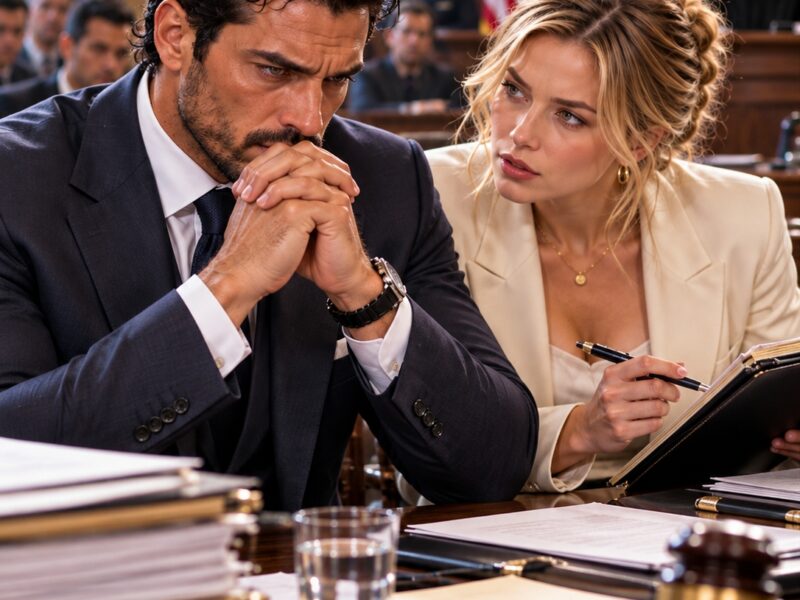
The Mafia Boss Was About to Lose Everything in Court — Until the Quiet Woman Beside Him Spoke
“Your Honor, that recording is not the original.”
For three weeks, the woman sitting two chairs to my left had spoken only when someone asked her to confirm a page number, repeat a name, or read back a line from the official record. Her voice had been so quiet that most people in the courtroom had stopped noticing it.
That morning, it stopped everyone.
Judge Miriam Keller’s pen was less than an inch above the order that would freeze my bank accounts, seize six warehouses, place liens on three legitimate companies, and authorize the government to take possession of nearly everything I had spent twenty-two years building along Chicago’s waterfront.
Six federal agents turned toward the woman.
Assistant U.S. Attorney Holden Crenshaw stopped smiling.
And I forgot, for one strange second, that I was supposed to be the most dangerous man in the room.
My name is Walter Vasquez.
Depending on who was telling the story, I was either a businessman who had dragged half of South Harbor out of bankruptcy or a criminal who had learned to hide illegal money behind trucking companies, import contracts, restaurants, and real estate.
Both descriptions contained pieces of the truth.
I had not come into that courtroom pretending to be innocent.
I had come because there were crimes I had committed, crimes I had allowed, and one crime the government was claiming I had ordered that I knew I had not.
That distinction mattered to me.
I was beginning to understand that it mattered even more to the quiet woman beside me.
Her name was Goldie Underhill.
She was thirty-nine, pale-skinned, brown-haired, usually dressed in plain dark slacks and cardigans that made her almost disappear against the walnut-paneled walls. She wore no jewelry except a small silver watch. During breaks, she drank tea from a scratched blue thermos and ate crackers from a plastic container while attorneys argued in hallways about millions of dollars.
Goldie was the court transcriptionist assigned to several pretrial proceedings connected to my case.
She had no reason to protect me.
I had never given her money.
Never threatened her.
Never spoken to her outside the courthouse except once, when she dropped a folder near the security elevator and I picked it up before one of my lawyers could.
She had looked surprised.
“Thank you, Mr. Vasquez.”
That was the entire conversation.
Now she was standing in federal court, accusing the government of relying on evidence that was not what it claimed to be.
Holden recovered first.
“Miss Underhill,” he said, rising slowly, “are you accusing the United States government of presenting fabricated evidence?”
Goldie’s fingers were pressed against the edge of her notebook.
“I’m saying Exhibit 42 was filed as an untouched original recording.”
“And?”
“And the record in front of me says it cannot be.”
The room seemed to shrink.
Judge Keller lowered her pen.
“That is a serious allegation.”
“Yes, Your Honor.”
“What is your basis?”
Goldie looked at me.
Only once.
Fear was there.
Not dramatic fear. Not the trembling kind people perform when they want you to notice their courage.
It was smaller and more convincing.
She knew exactly what she had just done.
She knew that if she was wrong, she could lose her career.
And if she was right, somebody with access to federal evidence had altered a recording central to a criminal forfeiture case.
She looked back at the judge.
“The seal number does not correspond to the original transfer receipt. And one sentence attributed to Mr. Vasquez does not match the contemporaneous notation I made when the source material was first reviewed.”
Holden’s head turned.
Across the aisle stood Blanche Blackwood, a private evidence-management contractor who had worked with the federal courthouse for almost seven years.
For the first time that morning, Blanche looked away.
I noticed because men like me survive by noticing the person who stops looking when everyone else begins.
Judge Keller folded her hands.
“Show me.”
Goldie approached the bench carrying a stenography notebook and a narrow ledger marked with blue, black, and red tabs.
Beside one line she had drawn a small broken square.
Underneath it were four handwritten words.
THE SEAL DOESN’T MATCH.
Holden moved closer.
“Your Honor, I object to allowing an administrative employee to insert herself into an evidentiary proceeding based on what appears to be a personal notation.”
Goldie didn’t look at him.
Judge Keller did.
“She is an officer performing an official court function, Mr. Crenshaw.”
“She is not a forensic examiner.”
“No,” Goldie said softly. “I’m the person who was asked to certify the transcript.”
That quiet answer did more damage than shouting could have.
Judge Keller turned toward my lead attorney, Nathan Pierce.
“Mr. Pierce, does the defense intend to challenge authenticity?”
Nathan started to rise.
But before he could answer, I heard my own voice.
“Yes.”
Every head turned toward me.
Nathan froze halfway out of his chair.
I continued.
“And I want her observation preserved exactly as she made it.”
Nathan leaned toward me.
“Walter.”
I ignored him.
I wasn’t promising anyone I was innocent.
That would have been insulting.
I knew how much dirty money had passed through my organization. I knew which inspectors had accepted envelopes. I knew which shipments had crossed the river under false manifests because somebody on my payroll had looked the other way.
There were nights from my past I had spent twenty years pretending not to remember.
But the government’s most damaging recording claimed I had personally authorized a shipment of stolen military electronics through Pier 14.
I had paid for warehouse access connected to that shipment.
That was true.
I had not authorized what was inside those containers.
Someone else had.
And the recording made those two things sound like one confession.
Judge Keller raised a hand as Holden began speaking.
“We will examine the chain of custody before I rule on the government’s forfeiture application. Miss Underhill, you will be sworn. No one touches Exhibit 42 without the clerk present.”
Goldie raised her right hand.
Her voice did not shake during the oath.
Her face had gone nearly colorless.
“Explain the broken square,” the judge said.
Goldie opened her notebook.
“It’s a mark I use when I cannot reconcile a source with a filed transcript.”
“Why?”
“Because people remember language incorrectly, Your Honor. Machines fail. Files get renamed. Speakers overlap. If I hear something during certification that doesn’t match the source notation, I flag it before I sign.”
“And you flagged this?”
“Three months ago.”
Holden stepped forward.
“The recording came from a sealed archive container.”
“Then the seal log should resolve the issue,” Goldie said.
“The contractor retrieved it under documented custody.”
“Then the custody record should resolve the issue too.”
I almost smiled.
Not because anything was funny.
Because Holden was beginning to understand what I had already seen.
The woman everyone had treated like furniture was not arguing with him.
She was inviting him to prove her wrong.
Judge Keller looked toward the clerk.
“Bring the transfer ledger and seal log.”
Holden’s mouth tightened.
Blanche Blackwood’s hand tightened around the metal handle of the evidence cart.
That was the moment I knew something was wrong.
Not with Goldie.
With Blanche.
The records officer returned ten minutes later carrying a gray archive box.
Goldie never touched Exhibit 42. She asked for the ledger first.
“The recording was originally entered into courthouse custody at 4:18 p.m. on October ninth,” she said.
Holden crossed his arms.
“That proves nothing.”
“I haven’t said it proves anything.”
She turned a page.
“There is a retrieval logged at 6:07 p.m. on October twelfth.”
Judge Keller looked up.
“By whom?”
Goldie’s finger stopped beside a name.
“Blanche Blackwood.”
Silence.
Blanche straightened.
“I review archived evidence. That is literally my job.”
Goldie nodded.
“Yes.”
Holden appeared relieved.
“Then there is no discrepancy.”
Goldie turned another page.
“The prosecution submitted its final evidentiary summary at 9:42 that morning. Ms. Blackwood testified yesterday that she retrieved the recording only after receiving the presentation request on October fifteenth.”
Blanche’s expression changed.
Barely.
But I saw it.
Goldie continued.
“The archive entry places her in the evidence basement three days earlier.”
Judge Keller looked at Blanche.
“Can you explain that?”
“I review dozens of items every week.”
“Do you remember this one?”
“No.”
Goldie lifted the original transfer receipt.
“The archive received a recording sealed under number 88417.”
Then she pointed toward the prosecution table.
“The exhibit being offered today is sealed under number 88431.”
I felt something cold move beneath my ribs.
Everyone looked at the evidence envelope.
Judge Keller’s voice hardened.
“Where is 88417?”
Blanche’s eyes finally met mine.
“I never opened the original container.”
Goldie lowered the receipt.
“The replacement notation carries your initials.”
“Those are not my initials.”
Holden stepped between them verbally before the room could turn.
“Anyone with internal access could have copied a signature.”
Blanche seized the opening.
“Exactly.”
Then she looked directly at Goldie.
“She had access.”
Goldie’s hand stopped.
Blanche pointed toward the notebook.
“Miss Underhill was assigned to transcript review. She had access to the schedule, the source notation, the evidence-room request list, and every administrative correction connected to this case.”
Holden looked from Blanche to Goldie.
And I saw the prosecution realize that the accusation could be turned.
“Your Honor,” Holden said, “if Miss Underhill participated in or approved the replacement entry, her testimony may be compromised.”
Goldie remained standing.
“I did approve a replacement notation.”
Nathan whispered beside me.
“Oh, hell.”
Holden’s face changed.
“You approved it?”
“Yes.”
A murmur moved through the courtroom.
Judge Keller lifted one hand.
“Quiet.”
Goldie looked at the ledger.
“I was instructed that the original recording had been damaged and the archive required a replacement entry before closeout.”
“By whom?”
Goldie hesitated.
And for the first time, I saw something in her expression that frightened me more than Blanche’s denial.
Shame.
“I received the instruction through the transcription supervisor’s office.”
“Who specifically?”
“I don’t know.”
Holden almost laughed.
“You signed a change affecting evidence in a federal proceeding without knowing who ordered it?”
Goldie took the blow without moving.
“Yes.”
“Why?”
“I had less than two minutes before archive closeout. I was told the replacement had already been verified by evidence control.”
“So you trusted someone else.”
“Yes.”
“And now you want this court to trust you.”
Goldie’s lips pressed together.
“No.”
Holden paused.
She looked toward Judge Keller.
“I want the court to verify me.”
Something shifted in the room.
I had spent most of my life around people who survived mistakes by hiding them.
Goldie had done the opposite.
She had just admitted the one fact that could destroy her credibility because it was true.
Judge Keller stared at her for several seconds.
Then she looked at the gray archive box.
“Is any source copy preserved?”
The records officer checked the inventory.
“There’s a secondary analog copy.”
Holden’s eyebrows rose.
Blanche turned sharply.
I noticed both reactions.
The officer removed a scratched black cassette case from beneath the transfer sleeves.
Goldie inhaled.
“That wasn’t listed on the electronic inventory.”
Judge Keller looked at the officer.
“Why not?”
“It predates the current scan. It appears to have remained in the physical archive.”
The clerk loaded the cassette.
Static filled the courtroom.
Then my voice came through the speakers.
You never know how ugly your own voice can sound until a room full of strangers listens to it while deciding whether you deserve to keep your freedom.
I heard myself discussing a warehouse payment.
A route.
A customs inspector.
A driver named Luis Marengo.
Then came the sentence.
“The payment was mine.”
Static.
A faint scrape.
“That order wasn’t.”
More static.
A second voice spoke in the background.
The words were hard to understand.
Then the recording moved on.
Holden leaned forward.
Judge Keller watched without expression.
Goldie raised her hand.
“Stop.”
The clerk paused the tape.
Holden snapped, “On what basis?”
Goldie opened her notebook.
“The filed transcript reads, ‘The payment was mine. I authorized the illegal transfer.’”
She looked toward the cassette player.
“That is not what he just said.”
Nobody moved.
Holden turned to the printed transcript.
Goldie continued.
“The source says, ‘The payment was mine. That order wasn’t.’”
Nathan was already flipping through our copy.
He found the page.
His eyes widened.
The filed exhibit merged those phrases into something else entirely.
The difference was seven words.
Seven words capable of costing me perhaps half a billion dollars.
Seven words capable of turning complicity into command.
Judge Keller leaned back.
“Play Exhibit 42.”
The clerk opened the disputed envelope under supervision.
The digital recording began.
My voice.
The warehouse payment.
The route.
The customs inspector.
Then:
“The payment was mine. I authorized the illegal transfer.”
No break.
No background voice.
No contradiction.
Nothing.
I felt my hands go cold.
I had listened to that recording with Nathan weeks earlier.
We had assumed I had been tired, drunk, careless, or simply forgotten saying it.
When you have spent years making morally rotten decisions, memory becomes an unreliable defense.
There had been too many rooms.
Too many meetings.
Too many orders.
Maybe I had said it.
That possibility had been eating me alive.
Now I heard the seam.
Not because my ears were trained.
Because Goldie had shown us where to listen.
Judge Keller ordered both recordings secured.
Holden argued that the analog copy could itself have been compromised.
Blanche claimed the replacement process was normal.
Nathan demanded immediate exclusion.
Goldie said almost nothing.
She sat down beside me, hands folded, as if she had not just tilted a federal courtroom off its axis.
I leaned slightly toward her.
“Why did you notice?”
She didn’t look at me.
“My father stuttered.”
I waited.
“When people wrote down what he said, they often cleaned it up. Sometimes they changed the meaning because they thought they were helping.”
Her eyes stayed on the judge.
“He taught me that a pause belongs to the speaker.”
I had no answer.
Before I could find one, three phones vibrated near the rear wall.
My men were under instructions not to use phones in court unless there was an emergency.
One lieutenant glanced down.
His face tightened.
Nathan noticed me looking.
“Don’t.”
I turned just enough to read the message on the screen before my lieutenant lowered it.
LEONARD’S PEOPLE MOVING ON SOUTH HARBOR.
Of course they were.
Leonard Esposito had spent twelve years waiting for me to show weakness.
South Harbor was the center of my operation. Six blocks of warehouses, trucking contracts, cold-storage facilities, repair docks, and legitimate businesses built over what had once been a graveyard of bankrupt shipping companies.
If the government froze my assets that morning, Leonard planned to step into the vacuum before sunset.
Court had not even ruled yet.
He was already moving.
The doors opened.
As if summoned by the thought itself, Leonard walked inside.
Charcoal suit.
Silver watch.
Two attorneys.
Four men behind him.
He wore the expression of a man arriving late to a funeral because he expected to inherit the house.
Judge Keller looked over her glasses.
“This is a federal hearing. If you have no standing, leave.”
One of Leonard’s attorneys lifted a folder.
“Our client is asserting creditor status against entities implicated in the forfeiture application.”
Nathan whispered, “That’s garbage.”
I knew.
Leonard knew.
The important thing was not whether he could win the claim.
It was whether people watching would believe I was already collapsing.
Leonard looked at me.
“Walter.”
I didn’t answer.
His gaze moved toward Goldie.
“So this is who’s saving you?”
Goldie’s shoulders tightened.
Leonard smiled.
“A frightened court reporter?”
Something old and violent rose inside me.
Twenty years earlier, Leonard would have left that courthouse with three men following him and regretted the sentence before dinner.
I felt my lieutenant watching from the rear wall.
Waiting.
That was the poison of power.
You don’t have to give the order every time.
Eventually people begin carrying your anger for you.
I took out the secure phone my attorney was permitted to hold during the proceeding.
Judge Keller’s clerk looked toward me.
Nathan whispered, “Walter, no.”
I dialed my operations chief.
He answered instantly.
“They’re at North Warehouse.”
“How many?”
“Enough.”
“Are our people armed?”
Silence.
That meant yes.
Leonard watched me across the courtroom.
I could almost see the story he wanted.
Shots fired at South Harbor.
Police responding.
Witnesses terrified.
Federal prosecutors arguing that a man capable of triggering a territorial war should not control hundreds of millions in assets.
Goldie looked at me.
Not afraid.
Waiting.
I remembered what she had said.
A pause belongs to the speaker.
So does a choice.
“Stand everyone down,” I said.
My operations chief thought he had misheard.
“Walter?”
“No weapons. No confrontation.”
“They’re taking the north warehouses.”
“I know.”
“We can stop them.”
“No.”
“That property is worth—”
“I know what it’s worth.”
I looked at Leonard.
“Give him the north warehouses.”
Nathan turned toward me.
“What?”
I continued into the phone.
“Loading contracts too. Pull every employee out safely. Document the inventory. Nobody touches Leonard’s people.”
“Walter—”
“That’s the order.”
I ended the call.
Leonard’s smile weakened.
“The north warehouses are yours,” I told him.
The courtroom became absolutely silent.
“Keep your people away from my employees and away from this courthouse.”
Leonard stared.
I had not defeated him.
I had paid millions of dollars to avoid becoming the man the prosecution needed me to become.
Something unreadable moved across Goldie’s face.
Maybe surprise.
Maybe disappointment that it had taken me twenty years to learn restraint.
Judge Keller ordered Leonard’s claim held outside the present evidentiary question and returned the hearing to the recordings.
That should have been the moment I stood beside Goldie.
Instead, I made the worst decision I would make that day.
Holden argued that because Goldie had signed the replacement notation, the defense’s challenge depended on a potentially compromised witness.
Nathan whispered that we needed distance.
Not because he believed she was guilty.
Because association could poison the authenticity argument.
I understood the strategy.
I also understood what it would cost.
And I chose the strategy.
“Your Honor,” I said, “the defense does not adopt Miss Underhill’s interpretation of every chain-of-custody entry.”
Goldie went still.
Nathan closed his eyes.
Holden rose immediately.
“The defense is distancing itself from its own witness.”
“I am distinguishing my defense from any unauthorized alteration.”
The sentence left my mouth cleanly.
That was the worst part.
Betrayal rarely sounds like betrayal when the person doing it has rehearsed enough reasons.
Goldie lowered her hand from the ledger.
She did not look at me.
Judge Keller ruled that Exhibit 42 would remain provisionally admissible until an independent comparison could be completed.
Then she addressed Goldie.
“Miss Underhill, there are probable grounds to examine whether your certification contributed to falsification of a custody record. You will surrender your original notebook for preservation and remain available pending further inquiry.”
Goldie nodded.
“Yes, Your Honor.”
A federal agent stepped forward.
I wanted to stand.
I didn’t.
I told myself that publicly defending her would make her look controlled by me.
I told myself Holden would claim I had influenced her testimony.
I told myself my silence was protecting her.
All of it sounded intelligent.
None of it changed what she saw.
When Goldie finally looked at me, there was no anger in her face.
That would have been easier.
There was recognition.
She had risked everything to stop a false record from becoming permanent.
And when her own safety became inconvenient, I had stepped sideways.
I had spent my entire adult life demanding loyalty.
Apparently I only admired it when it moved in my direction.
The records officer reached for Goldie’s notebook.
“Wait,” she said.
Everyone stopped.
She stood.
“I request immediate preservation under independent seal.”
Holden sighed.
“Miss Underhill—”
“My notebook contains contemporaneous shorthand and time marks. If my certification is being questioned, it should be sealed before anyone else handles it.”
Judge Keller studied her.
“You understand preservation may also preserve evidence against you.”
“Yes.”
“You are asking to lock in the record even if it harms you?”
“Yes.”
“Why?”
Goldie glanced at her notebook.
“Because if I changed something, they should be able to prove I changed it.”
Then she looked at Holden.
“And if someone else did, they should be able to prove that too.”
Judge Keller instructed the clerk to bring a tamper-evident sleeve.
Goldie placed the notebook inside herself.
The red seal crossed the edge.
She initialed it.
The clerk initialed it.
Judge Keller’s seal went over both.
No one could touch the notebook now without leaving evidence.
The judge called a recess and requested a neutral forensic examiner.
In the hallway, Nathan tried to speak to me.
I walked past him.
My lieutenant approached.
“Leonard’s moving into North.”
“Let him.”
“He’ll think you’re weak.”
“Let him think.”
“He may move farther.”
“Then tell me when he does.”
He looked toward the courtroom doors.
“What about her?”
I followed his eyes.
Goldie sat alone on a wooden bench near the marshals’ office, her blue thermos beside her.
Nobody from my team had approached her.
I had made certain of that without saying a word.
People around me understood distance too quickly.
I walked toward her.
The marshal looked up.
Goldie saw me coming.
“You shouldn’t be here,” she said.
“Probably not.”
“Your attorney won’t like it.”
“He currently doesn’t like several things.”
That almost earned a smile.
Almost.
I stopped several feet away.
“I’m sorry.”
She looked down the corridor.
“For what?”
“For doing exactly what I did.”
“That’s unusually specific.”
“I’ve learned apologies get dishonest when people add too many explanations.”
Now she looked at me.
“What would you have done if the recording was real?”
The question surprised me.
“Faced it.”
“Would you?”
“Yes.”
She studied my face.
I corrected myself.
“I’d like to believe I would.”
“That’s different.”
“Yes.”
A family passed at the far end of the corridor, shepherded by an attorney toward an elevator.
Goldie unscrewed her thermos.
“You know what bothers me about men like you?”
I nearly laughed.
“That list could take the afternoon.”
“You think power means never needing anyone.”
I said nothing.
“So when someone becomes important, you either own them, protect them, pay them, threaten them, or distance yourself from them.”
“That’s five options.”
“There are more.”
“Such as?”
“Trusting them.”
I looked through the courthouse window toward the gray Chicago sky.
“I don’t have much practice with that.”
“I noticed.”
The recess ended before I could answer.
The forensic examiner was a woman named Dr. Elise Morgan. Mid-fifties. Wire-frame glasses. Calm enough to make prosecutors nervous.
She placed a laptop, audio interface, and printed custody worksheet on the evidence table.
“I cannot determine anyone’s motives,” she told the court. “I can compare recordings, identify measurable discontinuities, inspect available metadata, and correlate those findings with time-marked transcription notes.”
Judge Keller nodded.
“Proceed.”
Goldie requested that the shorthand be examined first.
Holden objected.
Judge Keller overruled him.
The notebook was opened under observation.
Dr. Morgan photographed the relevant page.
Goldie’s notation contained time marks.
At 3:17:42, my statement: PAYMENT WAS MINE.
At 3:17:46, a pause mark.
At 3:17:48: THAT ORDER WASN’T.
A background interruption followed.
Dr. Morgan loaded the analog recording.
Then Exhibit 42.
Two waveforms appeared on the courtroom monitor.
They tracked almost perfectly.
Until the seventh word.
Dr. Morgan magnified the display.
“There is a discontinuity in ambient noise here.”
Holden leaned forward.
“What does that mean?”
“The background changes abruptly.”
“Could that result from compression?”
“It could.”
Holden nodded.
Then she continued.
“But there is also a phase discontinuity inconsistent with ordinary continuous speech.”
His nod stopped.
“Meaning?”
“The sentence appears assembled from separate audio segments.”
No one moved.
Dr. Morgan isolated the phrase.
“I authorized the illegal transfer.”
Then she searched the source recording.
After several minutes, she found portions of the words elsewhere.
“I authorized” came from a discussion twelve minutes later regarding overtime approval for a trucking supervisor.
“Illegal transfer” came from Holden’s own investigative interviewer asking me whether I knew about an illegal transfer.
My voice had been cut, repositioned, and assembled into a confession.
Nathan stared at the screen.
I felt sick.
Not relieved.
Sick.
Because whoever had created Exhibit 42 had not made a mistake.
They had manufactured intent.
Goldie leaned toward the monitor.
“That sentence is not mine.”
Dr. Morgan looked at her.
“What do you mean?”
“My shorthand never recorded it.”
Holden tried one final angle.
“The original source still shows Mr. Vasquez discussing payment associated with the transaction.”
Goldie nodded.
“Yes.”
Everyone looked at her.
She did not defend me.
“The payment was his. The recording supports that.”
Nathan shifted uneasily.
Goldie continued.
“But paying for warehouse access and authorizing the contents of a shipment are not the same statement.”
She pointed toward her notes.
“The source preserves the distinction. Exhibit 42 removes it.”
Judge Keller looked at me.
For years, people had lied to protect me.
Employees.
Lawyers.
Politicians.
Friends.
Men who called themselves brothers.
Goldie was the first person I could remember protecting the truth even when the truth still made me look bad.
Judge Keller excluded Exhibit 42.
The forfeiture order based primarily on that evidence was denied.
Holden’s face went rigid.
Nathan exhaled for what felt like the first time in an hour.
My accounts would not be frozen that day.
My warehouses would remain mine.
At least most of them.
I had lost North Harbor to Leonard by choice.
The government’s investigation continued.
The legitimate evidence continued.
The judge made that unmistakably clear.
“This ruling does not declare Mr. Vasquez innocent,” she said. “It declares one exhibit unreliable.”
I respected her more for saying it.
Then she looked toward Blanche Blackwood.
“Ms. Blackwood, surrender your courthouse access credentials pending investigation.”
Blanche did not move.
“Your Honor, I have done nothing wrong.”
“Then an investigation will establish that.”
A federal agent approached.
Blanche unclipped her badge.
As she handed it over, she looked at Goldie.
“You think this ends with me?”
Goldie’s expression changed.
Judge Keller heard it.
“So did I.”
The judge ordered Blanche escorted outside.
A few minutes later, Leonard’s attorneys withdrew his creditor claim.
He had never had documentation.
He had only expected fear to do the legal work for him.
Security escorted his group from the courtroom.
He looked at me before leaving.
“You gave me six warehouses for nothing.”
“No,” I said.
“I gave them to keep people alive.”
He smiled.
“That doesn’t sound like Walter Vasquez.”
“Maybe you haven’t been paying attention.”
His smile disappeared.
After court adjourned, I called South Harbor.
“Do not take the north warehouses back.”
My operations chief sounded stunned.
“Leonard’s people are already pulling out.”
“Let them.”
“He backed down.”
“I didn’t.”
“That property is ours.”
“It was.”
“Walter—”
“I gave my word.”
There was a long silence.
People often assume criminal organizations function because everyone is violent.
That isn’t true.
They function because promises have consequences.
If my word mattered only when keeping it profited me, it was not worth anything.
“Let them have North.”
I ended the call.
Goldie waited near the evidence table while a marshal arranged a protected exit.
I approached her.
This time she didn’t tell me to stop.
“I should have stood beside you,” I said.
She closed her notebook.
“You should have let me stand by myself without making me stand alone.”
The sentence hit exactly where it belonged.
“Yes.”
“If investigators ask me about you, I’ll answer them.”
“I know.”
“I mean everything.”
“I know.”
“The payments. The conversations. Whatever I heard.”
“Yes.”
She searched my face as though expecting the old Walter to appear.
The one who could make a witness disappear without ever using the word disappear.
I hated that she had reason to expect him.
“I won’t ask you to change a single word,” I said.
She nodded.
The marshal opened the protected stairwell.
Goldie stepped toward it, then stopped.
“You can walk with me as far as the door.”
So I did.
We crossed the corridor side by side.
She did not touch me.
There was no grand thank-you.
No embrace.
No promise that she believed there was something good buried inside me.
People who tell stories about men like me often want redemption to arrive cheaply.
One decent decision.
One woman’s faith.
One dramatic sacrifice.
Then everyone gets to forget the bodies beneath the foundation.
Goldie did not give me that gift.
At the door she said, “I don’t know what happens to you next.”
“Neither do I.”
“You could still go to prison.”
“Yes.”
“You could still lose most of what you built.”
“Yes.”
“And you understand that what happened today doesn’t erase anything?”
“Yes.”
She nodded.
“Good.”
Then she walked through the door.
The latch closed.
I stood there staring at the glass.
For the first time in decades, I did not know how to control what came next.
That should have frightened me more than it did.
Three days later, Blanche Blackwood disappeared.
Not disappeared the way people disappeared in the world I came from.
She missed a federal interview.
Her phone was found in a parking garage near O’Hare Airport.
Her car remained at her apartment.
By evening, Holden’s office had issued an alert.
Every detective who had ever investigated me assumed I was involved.
I understood why.
Nathan arrived at my house after midnight carrying coffee and a face full of bad news.
“Do not call anyone.”
“I wasn’t planning to.”
“Do not send anyone looking for her.”
“I wasn’t planning to.”
“Do not even say her name near anyone who might misunderstand your tone.”
I looked at him.
“How exactly should I breathe?”
“Quietly.”
He dropped a folder on the kitchen counter.
The government had reopened the chain-of-custody review for eleven cases Blanche had handled.
Not just mine.
Eleven.
Two involved organized crime.
Four involved financial fraud.
One involved a drug conspiracy.
Three were sealed.
The last concerned a union corruption investigation from six years earlier.
Nathan pointed at the list.
“This was bigger than your recording.”
I thought about Blanche’s final words.
You think this ends with me?
“Where’s Goldie?”
Nathan stared.
“You cannot contact her.”
“I asked where she is.”
“Protected location.”
“Is she safe?”
“As far as I know.”
That answer lasted until 2:13 the next afternoon.
A package arrived at Nathan’s office.
No return address.
Inside was a photocopy of a courthouse transfer form.
On the back someone had written four words.
ASK THE QUIET WOMAN WHY.
Nathan called federal investigators immediately.
They came to my office.
So did Holden.
He looked ten years older than he had in court.
“You recognize the handwriting?”
“No.”
“You expect me to believe that?”
“I stopped caring what you believe around 1998.”
Nathan kicked my ankle beneath the table.
Holden ignored me.
“Miss Underhill is now receiving protection.”
“What happened?”
“We received an attempted access alert against her personnel file.”
“From where?”
“We’re investigating.”
“Who knew where she was?”
Holden’s jaw moved.
“Not me.”
“Then find out.”
He stared.
“You are in no position to issue instructions.”
“No. But if somebody inside your system manufactured evidence and now wants her, perhaps pride should wait outside.”
The room went cold.
Holden leaned across the table.
“I have spent five years building a case against you.”
“I noticed.”
“You have intimidated witnesses, concealed income, bribed public officials—”
“Then convict me of what I did.”
He stopped.
I kept my voice low.
“But if you use manufactured evidence because it makes the story easier, you become part of the lie.”
For several seconds, neither of us spoke.
Finally Holden sat back.
“I didn’t alter the recording.”
“I believe you.”
That seemed to unsettle him more than accusation.
“Why?”
“Because when Goldie challenged it, you looked surprised.”
“I could have been acting.”
“You’re not that good.”
Nathan closed his eyes.
Holden almost smiled.
Almost.
Then he opened his file.
“There was another access attempt eleven minutes after Blanche entered the archive basement.”
He pushed a printout toward us.
“Whose badge?”
“No badge.”
“A manual supervisor override.”
Nathan leaned forward.
“Name?”
Holden looked at me.
“Martin Vale.”
I knew the name.
Not well.
Everyone in federal court knew him.
Vale had been the courthouse administrative director for seventeen years.
The man who approved contractor access.
Oversaw archival procedures.
Managed transcription services.
Signed technology procurement.
And sat behind Judge Keller during two early hearings in my case.
I remembered him because men like Vale rarely looked important.
That was the point.
Gray suit.
Gray hair.
Gray voice.
A person powerful enough to move through doors without anyone asking why.
Nathan asked, “Where is he?”
“At work.”
“You haven’t detained him?”
“We have an access record, not evidence of a crime.”
I looked toward Holden.
“What does Goldie say?”
“She refuses to speculate.”
Of course she did.
Holden continued.
“But she remembers Vale’s assistant delivering the instruction to approve the replacement notation.”
Nathan swore under his breath.
“And Blanche?”
“Still missing.”
That evening the news broke.
Not the evidence tampering.
My case.
Television stations showed the courthouse steps, my old arrest photograph, South Harbor warehouses, and grainy video of me leaving court beside Nathan.
CRIME BOSS SURVIVES MAJOR ASSET SEIZURE AFTER EVIDENCE FAILURE.
Survives.
That was the word.
As though court had been a gunfight.
As though truth had been an escape hatch.
I turned off the television.
My daughter called twenty minutes later.
Sofia was twenty-six and lived in Boston.
We had not been close since her mother died.
That sentence makes the distance sound accidental.
It wasn’t.
I had spent Sofia’s childhood believing money could compensate for absence.
Private school.
A car at sixteen.
College paid in full.
An apartment deposit.
Security whenever she traveled.
Everything except the one thing she asked for repeatedly.
A father who came home.
“Are you going to prison?” she asked.
“Possibly.”
Silence.
I deserved it.
“Did you do what they say?”
“Some of it.”
“Walter.”
She only called me Walter when she was angry.
“Did you order that shipment?”
“No.”
“Did you do other things?”
“Yes.”
More silence.
“Why are you telling me now?”
Because Goldie had stood in a courtroom and admitted a mistake when lying would have been safer.
Because a quiet woman had made every powerful person in that room look at themselves.
Because I was suddenly tired of editing my own life.
“I don’t want you hearing my version after a jury gives you theirs.”
Sofia began crying.
Softly.
I gripped the phone.
“I’m sorry.”
“For what?”
The question was harder than anything Holden had asked.
“For making you grow up around secrets.”
“That’s not all.”
“No.”
“For Mom?”
“Yes.”
“For missing graduation?”
“Yes.”
“For sending somebody to sit in the back like that counted?”
“Yes.”
“For making me scared every time a black SUV stopped outside our house?”
My throat tightened.
“Yes.”
She breathed.
“Then don’t tell me you’re sorry like it’s one sentence.”
I closed my eyes.
“You’re right.”
“I have to go.”
“Sofia.”
“What?”
“I love you.”
She didn’t answer immediately.
“I know.”
The call ended.
I sat alone in the kitchen for a long time.
The next morning, federal agents arrested Martin Vale.
Not for evidence tampering.
For obstruction.
He had attempted to delete access records from a backup server.
That was enough to bring him in.
Blanche was found that afternoon.
Alive.
She had checked into a motel near Milwaukee using her sister’s name.
She was terrified.
Not of me.
Of Vale.
When investigators interviewed her, the structure began collapsing.
Vale had operated a quiet business inside the courthouse for years.
Not selling verdicts.
That would have been too obvious.
He sold access.
Evidence schedules.
Sealed filing dates.
Information about which recordings existed and which did not.
In several cases, people outside the courthouse paid intermediaries for small alterations that could shift leverage.
A date changed.
A page removed.
A recording replaced.
A document delayed.
Sometimes the beneficiary was a defendant.
Sometimes a prosecutor’s source.
Sometimes a corporation.
Vale didn’t care.
Truth was inventory.
Blanche had discovered irregularities months earlier.
Instead of reporting them, she accepted money to keep silent.
Eventually silence became participation.
Then participation became dependency.
In my case, someone had paid Vale to turn the recording into a direct confession.
The surprising part was who.
Not Holden.
Not the government.
Leonard Esposito.
He had wanted my assets frozen.
A federal forfeiture would remove me from South Harbor without requiring him to start a war.
Vale had arranged the alteration.
Blanche had moved the evidence.
And Goldie, believing she was signing an administrative replacement caused by damaged media, had unknowingly provided the notation they needed.
Except she kept her original shorthand.
That tiny habit ruined everything.
The evidence against Leonard was not enough for immediate arrest.
Money had traveled through two shell companies.
Vale was negotiating.
Blanche wanted immunity.
Holden wanted everyone.
Nathan wanted me to celebrate.
I didn’t.
Because the legitimate part of the investigation remained.
The real source recording still contained evidence of crimes.
Maybe not the crime that would have taken everything in one stroke.
But enough.
Six weeks later, Holden requested a meeting.
Not at his office.
At Nathan’s.
He arrived without his trial team.
“I’m offering a resolution.”
Nathan’s face remained expressionless.
“For which counts?”
“Conspiracy to evade customs duties. Commercial bribery. Financial structuring. Two obstruction-related counts.”
I looked at the agreement.
Prison.
Forfeiture of specific assets.
Cooperation concerning public corruption.
No immunity for uncharged violent conduct.
No promise that everyone who worked for me would be spared.
“How long?” I asked.
“Guideline recommendation could be eleven to fourteen years.”
Nathan began arguing.
I raised my hand.
Holden looked at me.
“What happens if I refuse?”
“We proceed.”
“And the altered recording?”
“Never used.”
“Vale?”
“Separate prosecution.”
“Goldie?”
Holden’s face softened slightly.
“No charges.”
I looked down at the agreement again.
For most of my life, negotiation meant finding the other person’s weakness.
Holden expected that Walter.
Nathan expected that Walter.
Maybe part of me did too.
“What happens to the employee pension fund?”
Holden blinked.
“What?”
“The legitimate dock companies. Seven hundred and twelve employees. Their pension fund is held separately.”
Nathan looked at me.
Holden flipped pages.
“The government has no present claim against properly segregated employee retirement assets.”
“Put that in writing.”
“We can clarify it.”
“And the operating businesses?”
“Some would be sold.”
“To whom?”
“That isn’t normally negotiated in a criminal plea.”
“It is now.”
Holden stared.
I continued.
“If you liquidate them blindly, South Harbor loses jobs and Leonard buys the assets through proxies.”
Nathan slowly understood.
I wanted the criminal proceeds forfeited.
I wanted my personal fortune reduced.
But I wanted legitimate companies transferred through an independent trustee rather than destroyed.
Holden said, “You’re asking the government to preserve your empire.”
“No.”
I looked through the glass wall toward Chicago.
“I’m asking you to stop treating every person who works there like part of it.”
Negotiations took three weeks.
I agreed to plead guilty.
Not to crimes I hadn’t committed.
To the ones I had.
The government agreed that several legitimate operating companies could be placed under independent management pending sale, with employee protections incorporated into the process.
I forfeited houses.
Accounts.
Vehicles.
Commercial property.
I provided records of payments to inspectors and officials.
Three men I had considered friends were indicted.
Two never spoke to me again.
One sent word that I was dead to him.
I understood.
The Walter they had followed was dead in a way.
Not because I had become good.
Because I had stopped pretending that loyalty meant carrying another man’s guilt.
Two nights before my plea hearing, Goldie called.
I had not spoken to her since court.
“Mr. Vasquez?”
“Walter.”
A pause.
“Walter.”
“How are you?”
“Back at work.”
“They let you?”
“They investigated me.”
“That wasn’t what I asked.”
“I know.”
She sounded tired but calm.
“Vale’s attorney wants to argue my notation was unreliable.”
“Will you testify?”
“Yes.”
“Are you afraid?”
Another pause.
“Yes.”
Her honesty caught me.
“What do you do with that?”
“Go anyway.”
I smiled.
“You make it sound easy.”
“No. I make it sound short.”
I laughed.
It surprised both of us.
Then she said, “I heard about the plea.”
“News travels.”
“Are you doing it because you think it redeems you?”
“No.”
“Good.”
“You really know how to comfort a man.”
“I transcribe federal proceedings. Comfort isn’t in my job description.”
I walked to the window.
“I’m doing it because those charges are true.”
“That’s a start.”
“A start toward what?”
“I don’t know.”
That answer mattered more than any promise could have.
Before hanging up, she said, “Walter?”
“Yes?”
“The day in court, when you gave Leonard those warehouses…”
“Yes.”
“You knew he might keep them.”
“Yes.”
“Why did you do it?”
“I thought somebody would get killed if I didn’t.”
“And now?”
“Now I know somebody would have.”
Goldie was quiet.
“Keep learning the difference.”
The plea hearing happened on a rainy Thursday.
Sofia attended.
She sat in the second row.
Not beside my organization.
Not beside Nathan’s team.
Alone.
I entered guilty pleas to five counts.
Judge Keller asked whether anyone had threatened me.
“No.”
Whether anyone had promised me anything outside the agreement.
“No.”
Whether I understood that prison was likely.
“Yes.”
Then she asked the most difficult question.
“Are you pleading guilty because you are, in fact, guilty?”
I looked at Sofia.
Then at Holden.
Then at the empty transcription chair.
Goldie was testifying in another courtroom that morning.
“Yes, Your Honor.”
The word did not destroy me.
That surprised me.
For decades, I had treated admission like surrender.
Instead it felt strangely precise.
A fact placed where it belonged.
Months passed before sentencing.
Vale pleaded guilty.
Blanche cooperated and received a reduced sentence for her role.
Leonard was indicted on obstruction, bribery, and conspiracy charges after financial records tied his intermediary to Vale.
He sent me one message through an attorney.
YOU GAVE EVERYTHING AWAY.
I never answered.
He misunderstood.
I had spent half my life giving things away.
Time with my daughter.
Sleep.
Friendships.
My wife’s trust.
My name.
My ability to walk into a room without wondering who feared me.
All in exchange for control.
Prison was merely the first loss people could see.
At sentencing, Judge Keller gave me twelve years.
Nathan had hoped for nine.
Holden had recommended eleven.
The judge explained her reasons carefully.
The evidence tampering had harmed me, she said, but being harmed by misconduct did not erase the harm I had caused others.
She was right.
Sofia cried when the marshals approached.
I turned toward her.
“I’m sorry.”
She wiped her face.
“Make it longer this time.”
“What?”
“The apology.”
Despite everything, I smiled.
“I will.”
She stepped forward before the marshal could stop her and hugged me.
I had been shot once in my life.
Broken two ribs.
Lost men I loved.
Buried my wife.
Nothing had ever hurt like my daughter holding me when I finally had no money, influence, driver, armed guard, or restaurant full of people pretending I was untouchable.
“I’ll visit,” she whispered.
“You don’t owe me that.”
“I know.”
That was why it meant something.
I served the first eighteen months in a federal facility in Pennsylvania.
There are no kings in prison.
That is another myth.
There are only men waking up under fluorescent lights, standing in lines, waiting for counts, calling families who may or may not answer.
Some knew my name.
A few knew more than I wanted them to.
But a reputation becomes surprisingly useless when a guard tells you to mop a floor.
I learned.
Slowly.
Sofia visited every six or seven weeks.
We stopped trying to repair twenty years in two-hour conversations.
That helped.
Sometimes we talked about nothing.
Her job.
A terrible landlord.
Baseball.
Her mother’s old recipes.
Ordinary subjects became a kind of mercy.
Goldie wrote once.
No greeting beyond my name.
Walter,
Vale was sentenced today. The judge referenced the preserved record repeatedly.
I thought you would want to know.
G.U.
I read the note three times.
Then I wrote back.
Goldie,
I did.
Thank you.
Walter.
That became our pattern.
She wrote perhaps four times a year.
Never about my case in detail.
Never about personal feelings.
She told me when the courthouse replaced its archival system.
I told her when I was assigned to the prison library.
She told me she had finally replaced the scratched blue thermos.
I told her the new one was probably a mistake because people trust old objects for good reasons.
She wrote back:
That is an unexpectedly sentimental opinion from a convicted racketeer.
I laughed so loudly the man at the next table asked what was wrong with me.
Four years into my sentence, South Harbor looked different.
Sofia sent photographs.
One of my old trucking companies had been purchased by its management team with financing from a regional employee-ownership fund.
The cold-storage business had gone to a national operator but retained most workers.
Three properties were converted into mixed commercial space.
The north warehouses—the ones I had given Leonard—were tied up in litigation after his conviction.
Eventually the court-appointed receiver sold them.
Not to me.
Not to my people.
Good.
The city bought one parcel for riverfront redevelopment.
Another became a distribution center.
The world continued without Walter Vasquez controlling it.
That was perhaps the most useful lesson prison gave me.
Seven years after sentencing, my release date was moved up because of earned credits and program participation.
People on television love stories about powerful men falling.
They rarely show the paperwork involved in becoming ordinary again.
Identification.
Supervised release conditions.
Employment approval.
Housing plans.
Financial restrictions.
You don’t walk out and become free.
You learn how to be accountable in different rooms.
Sofia met me outside.
She was thirty-three.
I had more gray hair than black.
She hugged me and stepped back.
“You’re smaller.”
“Prison food.”
“No. Your ego.”
“That survived remarkably well.”
She laughed.
I had missed that sound.
She drove me to a small apartment outside Chicago.
No lake view.
No elevator requiring a private key.
No men waiting downstairs.
The refrigerator contained groceries she had bought.
There was a coffee maker on the counter.
A note taped to it said:
THIS ONE IS LEGAL.
I laughed until my eyes watered.
Three months later, I entered the Dirksen Federal Building for the first time since sentencing.
Not as a defendant.
Goldie Underhill was retiring from full-time court transcription.
Sofia had found the notice online.
“You should go,” she said.
“I don’t think she wants retired criminals at the reception.”
“Then stand near the cookies and behave.”
So I went.
The courthouse looked smaller.
That shocked me.
For years it had existed in memory as the place where everything nearly ended.
But buildings don’t grow around our fear.
We do.
The reception was held in a conference room on the twenty-third floor.
Judges.
Clerks.
Reporters.
Attorneys.
A few federal prosecutors.
Then I saw Goldie.
Her hair was shorter.
More gray threaded through it.
She was talking to Judge Keller.
A new blue thermos sat on the table beside her.
She noticed me.
For a second neither of us moved.
Then she walked over.
“Walter Vasquez.”
“Goldie Underhill.”
“You came.”
“Sofia said I had to.”
“Smart woman.”
“She gets that from her mother.”
Goldie smiled.
We stood there in the awkwardness of two people whose lives had once collided under the worst possible circumstances.
I nodded toward the thermos.
“You replaced it.”
“It leaked.”
“I told you old objects are trustworthy.”
“It was leaking tea into federal transcripts.”
“Minor administrative issue.”
She laughed.
Then her expression softened.
“How are you?”
It was the same question I had once asked her.
This time I understood how difficult an honest answer could be.
“Learning.”
“That’s vague.”
“You taught me.”
“I did not teach you vagueness.”
“I’m working at a freight compliance firm.”
Her eyebrows rose.
“Seriously?”
“Apparently a man with extensive experience violating shipping rules knows where companies accidentally violate shipping rules.”
“That is either poetic justice or an alarming hiring practice.”
“Both.”
“And Sofia?”
“Getting married in April.”
Goldie smiled.
“Will you be there?”
“I’ve been informed attendance is mandatory.”
“That sounds promising.”
“It is.”
Across the room, Judge Keller called Goldie’s name.
Before she turned away, I said, “There’s something I never told you.”
Goldie waited.
“The day you spoke up, I thought you saved me.”
Her expression became careful.
“You know that isn’t what happened.”
“I do now.”
She looked at me.
“I stopped one false piece of evidence.”
“Yes.”
“I didn’t erase the true evidence.”
“I know.”
“I didn’t save your businesses.”
“No.”
“I didn’t keep you out of prison.”
“No.”
“So what did I save?”
I looked through the conference-room windows toward the river.
South Harbor was visible in the distance.
Not mine anymore.
Maybe it had never truly been mine.
“You saved the difference between what I did and what somebody wanted the record to say I did.”
Goldie said nothing.
“I spent years thinking that difference was small,” I continued. “Because either way I was guilty of something.”
“It isn’t small.”
“I know.”
She glanced toward the courtroom doors.
“No one is only the worst true thing about them, Walter.”
I looked at her.
“But no one gets to replace the true thing with a better one either.”
There it was.
Goldie.
Still refusing both easy condemnation and easy forgiveness.
The truth or nothing.
Judge Keller raised her glass and began speaking about Goldie’s thirty-one years of service.
She talked about accuracy.
Patience.
Integrity.
The dignity of preserving people’s exact words in rooms where those words could change lives.
I stood near the back.
Where people like me perhaps belonged.
On a table near the wall sat a framed photocopy of one of Goldie’s shorthand pages.
Former colleagues had enlarged it as a retirement gift.
Most of the symbols meant nothing to me.
But near the bottom I recognized a mark.
A tiny broken square.
I stared at it.
Goldie saw me.
She came over after the speech.
“You still use that?”
“Sometimes.”
“What does it mean now?”
“The same thing it always meant.”
“Something doesn’t match.”
“Yes.”
I nodded.
“Useful symbol.”
“It has been.”
The reception continued around us.
People laughed.
Someone cut cake.
A young court reporter asked Goldie for advice.
She answered without hesitation.
“Never clean up the truth just because it sounds ugly.”
The young woman smiled.
I didn’t.
Because I knew exactly what that sentence cost.
Years earlier, I had walked into federal court believing power meant controlling the outcome.
I had owned warehouses.
Accounts.
Cars.
Restaurants.
Contracts.
Men.
Or at least I believed I owned them.
Then a woman I had barely noticed stood up beside me and said seven words that threatened everyone who had built their safety on a lie:
“That recording is not the original.”
At the time, I thought she was saving my empire.
I was wrong.
My empire did not need saving.
Some of it needed dismantling.
Some of it needed to survive without me.
And some of it deserved to disappear.
Goldie saved something smaller.
Which meant she saved something much more important.
She saved one pause.
One sentence.
One distinction.
“The payment was mine.”
“That order wasn’t.”
For most people, seven words are nothing.
For me, they were the distance between accountability and a lie.
And because Goldie refused to let anyone erase that distance, I eventually learned to stop erasing it in myself.
I was guilty.
But not of everything.
I had done terrible things.
But that did not entitle anyone to invent worse ones.
I had been betrayed by people I trusted.
But that did not make every betrayal of mine necessary.
I had spent decades demanding loyalty.
But loyalty without truth was only another form of corruption.
When I left the courthouse that afternoon, Goldie walked with me to the elevators.
No marshal waited this time.
No federal agents.
No attorneys arguing behind us.
Just two older people walking through a bright hallway.
At the elevator, she pressed the button.
“Do you miss it?” she asked.
“What?”
“The power.”
I thought before answering.
“Sometimes.”
She appreciated the answer.
“I miss the certainty more.”
“That I understand.”
The elevator arrived.
I stepped inside.
Goldie remained in the hallway.
“Walter.”
I held the door.
“Yes?”
“If Sofia lets you give a speech at her wedding, keep it short.”
I laughed.
“No promises.”
“I spent thirty-one years transcribing men like you. Trust me.”
The doors began closing.
“Goldie?”
She looked up.
“Thank you.”
She shook her head.
“You already thanked me.”
“Not for court.”
The doors paused.
“For not turning me into someone better than I was.”
Her expression softened.
“You’re welcome.”
The doors closed.
On the ride down, I watched the floor numbers change.
Twenty-three.
Twenty-two.
Twenty-one.
Years ago, I had believed that morning in Judge Keller’s courtroom was the day I almost lost everything.
The government had been ready to freeze my money.
Leonard was taking my territory.
My organization was preparing for war.
A prosecutor believed he had the confession that would end me.
And beside me sat a quiet woman nobody thought mattered.
I had been wrong about what “everything” meant.
Money could disappear.
Buildings could be sold.
Territory could change hands.
A reputation could collapse.
Even freedom could be taken for years and eventually returned in pieces.
But once a lie became the official record, once everyone agreed to remember words that had never been spoken, something harder to recover was lost.
Truth did not become important because it made me innocent.
It became important because guilt itself had to be truthful.
Goldie understood that before any of us.
That was why she spoke.
Not because she believed in Walter Vasquez.
Not because she admired me.
Not because she thought the powerful man beside her deserved one more chance.
She spoke because the record was wrong.
And for a woman who had spent three decades protecting other people’s exact words, that was reason enough.
The elevator reached the lobby.
Outside, Chicago moved beneath a gray afternoon sky.
Cars passed.
People hurried along Dearborn Street.
Nobody stopped to look at me.
Nobody moved aside.
Nobody whispered my name.
For the first time in my adult life, I was just another man leaving a courthouse.
I stepped onto the sidewalk.
And I discovered I could live with that.









