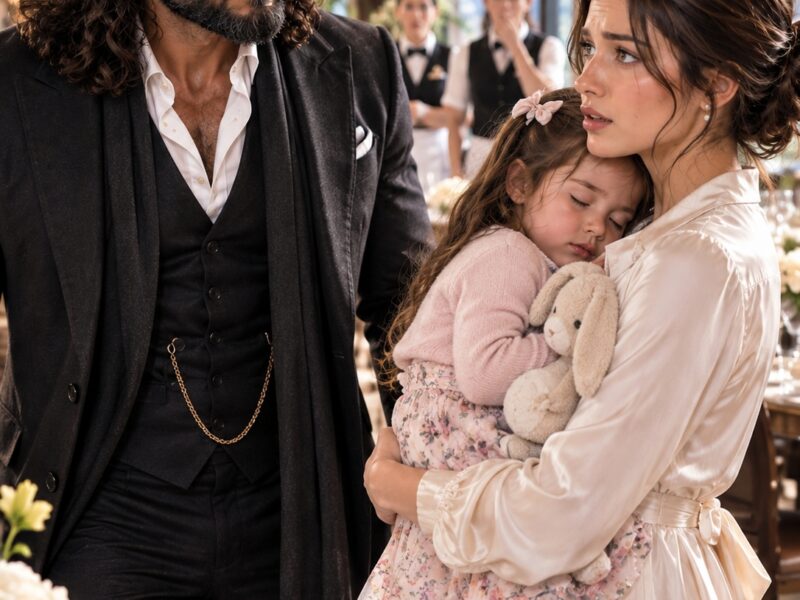
The Mafia Boss’s Daughter Fell Asleep in the Waitress’s Arms—His Reaction Reopened a Secret Buried Since His Wife’s Death
The five-year-old had refused to sleep in anyone’s arms since her mother died—until she climbed into a waitress’s lap during a storm and simply let go.
Her father, a man whose name could empty a room, crossed the restaurant in silence and ordered everyone not to wake her.
Then he heard the lullaby the waitress was humming, and the past he had buried eighteen months earlier opened its eyes.
The Rainy Table
Elena Hart remembered the weight of the child before she remembered the fear.
Thirty pounds, maybe a little less.
Warm cheek against her shoulder.
One small hand tangled in the collar of her black waitress uniform.
The child had gone limp with sleep so suddenly that Elena stopped breathing for fear of waking her.
It was a Thursday in November, and rain had been falling over Boston since lunch.
By seven-thirty, the windows of Lucia’s Italian Kitchen were silver with it.
The restaurant had eleven tables, a narrow wooden bar, and a kitchen too small for the number of opinions produced inside it. Garlic hung in the air. Bread warmed near the oven. The old radiator beside table three clicked every few minutes like it had something personal to say about winter.
Elena had been on her feet since nine that morning.
Third double shift of the week.
Her mother was at St. Anne’s Hospital with a lung infection that refused to clear. Insurance covered enough to keep Maria Hart alive and not enough to let Elena stop thinking about money.
So Elena worked.
Every shift Lucia gave her.
Every Sunday someone called out.
Every late close.
Lucia Bellini, seventy-two and built like a woman who had spent her life winning arguments in kitchens, had hired Elena four months earlier.
The first day, Lucia stared at her for an uncomfortable five seconds.
“You remind me of someone.”
Elena had smiled politely.
“Hopefully somebody who got good tips.”
Lucia had not laughed.
She had looked at Elena’s face with something almost like grief.
Then walked away.
Elena never asked again.
That Thursday, just before the dinner rush, Lucia caught her near the kitchen door.
“Back table stays empty.”
Elena glanced toward the far wall.
The table with the clearest view of both entrances.
“Reservation?”
“Private.”
“Celebrity?”
Lucia’s eyes sharpened.
“Private means private.”
At seven, three men entered through the rain.
Two remained near the front after taking off neither coat nor expression.
The third crossed to the reserved table.
He was tall.
Early forties.
Dark hair touched with gray at the temples.
Charcoal suit.
No visible hurry.
No visible nerves.
No visible interest in whether anyone recognized him.
The room recognized him anyway.
A couple at table four asked for the check before dessert.
The bartender straightened.
Lucia herself carried coffee to the back table, and Elena saw something she had never seen before.
Lucia’s hands shook.
Only slightly.
But they shook.
Elena leaned toward another server.
“Who is he?”
The server’s eyes widened.
“Don’t.”
“That’s not a name.”
“Exactly.”
Elena looked again.
The man sat with his back to the wall.
His phone buzzed.
He checked it once.
Spoke quietly.
The two men by the door watched the street rather than the room.
Elena had grown up in Boston.
She knew certain last names not because she had met the families but because adults lowered their voices around them.
Rinaldi.
Moretti.
Vale.
Names attached to docks, trucking contracts, construction unions, restaurants that somehow never failed, and stories nobody ever repeated in front of people wearing badges.
She decided she did not need to know which one had just ordered coffee.
At 7:42, the front door opened again.
A thin young woman stepped inside holding the hand of a little girl in an oversized red raincoat.
The child had dark hair in two braids and carried a stuffed rabbit with one ear missing.
She did not look around.
Did not skip.
Did not ask where they were sitting.
She walked directly to the man at the back table.
He stood.
The change in him was immediate.
Not softness exactly.
Attention.
The child pressed her face briefly against his sleeve.
He bent just enough to hear something she whispered.
Then the young woman guided the girl toward a small table near the kitchen.
“Nanny?”
Elena wondered aloud.
Lucia, passing with a tray, said:
“Something like that.”
The young woman’s phone rang.
She checked the screen.
Frowned.
“I need to take this.”
she told the child.
“Stay right here, Mia.”
The child nodded.
The woman stepped outside beneath the awning.
Rain swallowed her immediately.
Elena noticed Mia because no one else seemed to.
The men by the door watched outside.
The man at the back table was on his phone again.
Lucia had vanished into the kitchen.
Mia sat alone.
Small.
Still.
Staring at the tablecloth.
Elena had spent enough of childhood waiting in rooms designed for adults to recognize that posture.
She made hot chocolate.
Extra whipped cream.
One small spoon.
She carried it over.
Mia looked up.
Gray eyes.
Dark circles beneath them.
The kind of tiredness children were not supposed to know.
“Did you order this?”
Mia whispered.
“No.”
Elena placed it down.
“This restaurant has a very serious hot-chocolate problem.”
Mia stared.
“What problem?”
“We make too much.”
The corner of the child’s mouth moved.
Barely.
Elena sat the mug in front of her.
“If you don’t help, Lucia will make me drink it.”
Mia looked toward the kitchen.
“Who’s Lucia?”
“The scary lady with the pencil in her hair.”
Mia considered.
“She is scary.”
“She’ll be thrilled to hear that.”
Mia picked up the mug.
Elena went back to work.
Twice, she passed.
Twice, Mia remained alone.
The nanny was still outside.
Her call had become an argument.
Elena could see the woman pacing beneath the awning.
On Elena’s third pass, she caught herself humming.
An old lullaby.
Her grandmother used to sing it while braiding Elena’s hair.
Elena did not know the official title.
Only fragments.
Moon over the water.
Boat coming home.
Sleep before dawn.
The melody came automatically when Elena was tired.
Mia looked up.
Then slid out of her chair.
Elena stopped.
The child walked toward her.
No words.
Just two arms lifted.
Elena glanced at the back table.
The man was turned toward the window, still on the phone.
The bodyguards watched the street.
Elena crouched.
“You want up?”
Mia nodded.
Elena lifted her.
The child wrapped both arms around her neck.
Elena expected stiffness.
Instead, Mia melted into her shoulder.
Elena kept humming.
Walked slowly between empty spaces near the bar.
By the third pass, Mia’s grip loosened.
By the fourth, her breathing changed.
By the fifth, she was completely asleep.
Her stuffed rabbit dangled from two fingers.
That was when the restaurant went silent.
Elena turned.
The man in the charcoal suit stood five feet away.
She had not heard him approach.
Behind him, the men near the door had gone rigid.
One had a hand inside his coat.
Elena’s heart began pounding against the cheek of the sleeping child.
The man looked at Mia.
Then at Elena.
His face gave nothing away.
“Don’t move.”
The words were quiet.
Almost gentle.
Elena went cold anyway.
Every story she had ever heard about men like him entered her mind at once.
Her mother in a hospital bed.
Her apartment.
The unpaid electric bill.
The fact nobody knew exactly where she was tonight beyond work.
“I’m sorry.”
she began.
“She was alone and—”
The man lifted one hand.
Elena stopped.
“How long?”
“What?”
“How long has she been asleep?”
Elena blinked.
“A few minutes.”
“Five, maybe.”
He looked at his daughter.
And Elena understood suddenly that the child was his.
Same gray eyes.
Same stillness.
Only Mia’s had not yet learned to frighten people.
The man looked toward the bodyguard.
“Marco.”
“Yes, sir.”
“Take your hand out of your coat.”
Marco did.
The man pulled out a chair.
“Sit.”
Elena stared.
“Please.”
he added.
That surprised everyone.
Elena lowered herself carefully.
The man sat across from her.
His hands rested flat on the table.
“My daughter’s name is Mia.”
“I know.”
“She told the nanny.”
“No.”
“You heard it.”
“Yes.”
He nodded.
Then looked again at the sleeping child.
“She has not slept more than two hours at a time since her mother died.”
Elena’s throat tightened.
“When?”
“Eighteen months ago.”
He continued before she could say sorry.
“Doctors.”
“Therapists.”
“Medication.”
“Nothing lasts.”
“At night, sometimes I drive until she falls asleep.”
“Then I carry her upstairs.”
“She wakes within an hour.”
His jaw tightened.
“She does not let people hold her.”
“Not like this.”
Elena looked down.
Mia’s fingers had curled into the fabric at her shoulder.
“I didn’t do anything.”
The man’s eyes lifted.
“What were you humming?”
Elena hesitated.
“An old song.”
“From where?”
“My grandmother.”
“Calabria.”
His expression changed.
Completely.
“What village?”
“Santa Marina.”
Color left his face.
Elena noticed Lucia in the kitchen doorway.
One hand pressed over her mouth.
The man turned toward Marco.
“Turn off the music.”
Marco blinked.
“Sir?”
“No music.”
“Tell the kitchen to keep quiet.”
“Nobody drops a plate.”
“Nobody slams a door.”
Within a minute, Lucia’s became the quietest restaurant in Boston.
Cooks whispered.
Glasses were set down with both hands.
The rain became the loudest sound in the room.
The man stood.
Removed his coat.
Laid it carefully across Mia’s legs.
Then he looked at Elena.
“What’s your name?”
“Elena Hart.”
He nodded.
“Dante Rinaldi.”
Elena knew the name.
Everyone did.
And suddenly the little girl asleep in her arms felt heavier.
Not because of fear.
Because she understood whose child she was holding.
Dante looked at Mia.
Then back at Elena.
“My wife used to hum that song.”
Elena’s breath caught.
“She came from Santa Marina.”
The room seemed smaller.
Lucia looked away.
And Elena realized the old woman had known something long before tonight.
The Song His Wife Left Behind
Dante did not ask Elena to hand Mia over.
That was the first thing that confused her.
The second was that he stayed.
He sat across from Elena for forty minutes while his daughter slept.
No business call.
No impatience.
No demand.
A waiter brought Elena water with a straw because moving one arm risked waking Mia.
Dante noticed her work shoes.
Black.
Worn at the outer heel.
He noticed the red mark where the edge cut into her ankle.
Said nothing.
Elena noticed him noticing.
That irritated her.
People with money often observed poverty as though it were a minor weather condition.
Eventually, Mia stirred.
Her eyes opened.
She looked confused.
Then saw Elena.
Then Dante.
“Daddy.”
Dante leaned forward.
“I’m here.”
Mia looked at the coat over her legs.
“Your coat.”
“Yes.”
“I drooled.”
Dante looked toward Elena.
Elena fought a smile.
“It’s true.”
Mia frowned.
“I’m sorry.”
“I have other coats.”
Dante said.
“That is a very rich-person answer.”
Elena said before she could stop herself.
Marco made a sound that might have been a swallowed laugh.
Dante looked at Elena.
Then almost smiled.
Mia slid down from Elena’s lap.
But instead of going directly to Dante, she held Elena’s hand.
That surprised him.
It surprised Elena more.
The nanny finally returned.
Pale.
Wet.
Apologizing.
Her name was Beatrice Sloan.
Twenty-eight.
She looked terrified when she realized Mia had fallen asleep in a stranger’s arms.
Dante did not yell.
He asked:
“Where were you?”
“My sister called.”
“She’s in trouble.”
“I’m sorry.”
“What trouble?”
Beatrice looked toward Mia.
Dante saw.
“Marco.”
Marco took Mia toward the back.
Elena started to release her hand.
Mia tightened her grip.
“I want Elena.”
Dante looked at Elena.
Not commanding.
Asking.
Elena nodded.
They moved to a quieter side room.
Dante stayed behind with Beatrice.
Through the closed door, Elena heard almost nothing.
That bothered her more than shouting would have.
Ten minutes later, Beatrice left the restaurant crying.
Dante entered.
Elena stood.
“Is she fired?”
“Yes.”
Mia looked up.
“Why?”
Dante paused.
“She left you alone.”
Mia thought about that.
“She was on the phone.”
“Yes.”
“Maybe it was important.”
Dante’s face changed.
Elena saw the conflict.
Father versus boss.
“She should have told me first.”
Mia nodded.
Then leaned against Elena’s leg.
Dante looked at the clock.
“It’s late.”
Elena thought of her mother.
She had visiting hours until ten.
Already missed.
Guilt hit immediately.
“My mother.”
Dante looked at her.
“What?”
“I need to call the hospital.”
“Why?”
“She’s admitted.”
“What happened?”
Elena stiffened.
“That’s private.”
Dante’s expression shifted.
“You’re right.”
Again, unexpected.
Elena called.
Her mother was stable.
Sleeping.
The nurse promised to tell her Elena would come in the morning.
When Elena hung up, Dante said:
“Do you need a ride?”
“No.”
“Do you have a car?”
“No.”
“I’ll get the train.”
“It’s raining.”
“The train has a roof.”
Mia tugged Elena’s apron.
“Can she come with us?”
Dante looked at his daughter.
Then Elena.
“My house is not a place I bring strangers.”
“That sounds healthy.”
Elena said.
Marco looked away again.
Dante’s mouth moved.
Almost smile.
“Mia will wake if I move her.”
“She’s already awake.”
Mia yawned so widely it undermined the argument.
Dante crouched.
“You need bed.”
Mia shook her head.
“Elena.”
Dante looked toward the ceiling.
For a man accustomed to controlling rooms, he had no authority over five-year-old logic.
Elena knelt.
“How about this?”
“I walk you to the car.”
“You let your dad take you home.”
“And tomorrow Lucia can make you hot chocolate.”
Mia looked skeptical.
“You’ll be here?”
“Yes.”
“You promise?”
Elena hesitated.
Promises to children felt dangerous.
Then:
“I promise.”
Mia accepted.
Outside, rain had softened.
Dante’s car waited at the curb.
As he settled Mia inside, Elena saw his phone light.
A photograph.
Taken through the restaurant window.
Elena holding Mia.
One line beneath:
Beautiful picture. Weak position.
Dante became completely still.
Marco saw it.
His face hardened.
Elena noticed.
“What?”
Dante locked the screen.
“Nothing.”
“That was not nothing.”
He looked at her.
For a second, she saw calculation.
Then he remembered something.
Maybe what she had said.
Maybe his wife.
Maybe the fact he had just told Mia why Beatrice was dismissed.
He showed her the phone.
Elena read the message.
Every bit of warmth left her.
“Who sent that?”
“I don’t know yet.”
“You have enemies.”
“Yes.”
“Mia?”
“Yes.”
Elena looked at the child already half-asleep in the back seat.
“This is because I held her?”
“No.”
“It means someone is watching me.”
“And her.”
Dante’s jaw tightened.
“Yes.”
Elena stepped back.
“I’m going home.”
“Marco will take you.”
“No.”
“Elena.”
“You don’t get to tell me.”
Dante stopped.
His old instincts had appeared.
Command first.
Explanation later.
He corrected.
“I would prefer Marco drives you because someone photographed you with my daughter.”
“That is information.”
“Yes.”
“Not an order.”
“Yes.”
Elena looked at Marco.
Then at the rain.
“Fine.”
In the car, Marco drove without conversation.
Then at a red light:
“Boss doesn’t explain himself.”
Elena looked at him.
“He did tonight.”
“That is why I’m telling you.”
“Why?”
Marco glanced at the mirror.
“Be careful.”
“With him?”
“With what he changes when he cares.”
Elena sat with that.
The following morning, Lucia was waiting when Elena arrived.
No greeting.
No apron.
Just the old woman at the back table with two coffees.
“Sit.”
Elena sat.
“You knew Sophia Rinaldi.”
Lucia closed her eyes.
“Yes.”
“Dante’s wife.”
“Yes.”
“She worked here.”
Lucia looked at Elena.
“Seven years.”
“Before marriage.”
“After marriage sometimes, when she wanted to remember herself.”
“And the song?”
Lucia’s face softened.
“Her grandmother’s.”
“Same village as mine.”
“Yes.”
“You said I reminded you of someone.”
“I did.”
“Why?”
Lucia looked at Elena’s face.
“Because you carry tiredness the way she did.”
Elena almost laughed.
“That is not poetic.”
“It isn’t supposed to be.”
Lucia stirred coffee.
“Sophia came from nothing.”
“Dante came from too much.”
“They met here.”
“He arrived angry.”
“She spilled minestrone on his coat.”
Elena smiled despite herself.
“And lived?”
“Barely.”
Lucia smiled.
“He laughed.”
“I knew then.”
“Knew what?”
“That she would either ruin him or save him.”
“What happened?”
Lucia’s smile disappeared.
“Car accident.”
“Eighteen months ago.”
“Dante stopped coming.”
“Mia stopped talking much.”
Lucia looked toward the front window.
“Last night was the first time that child fell asleep outside her home since Sophia died.”
Elena’s throat tightened.
“That doesn’t make me special.”
“No.”
Lucia said.
“It makes the song important.”
Elena studied her.
“Why did Mia’s mother know my grandmother’s song?”
Lucia stared.
Then looked away.
“Santa Marina is small.”
“That is not an answer.”
“No.”
“And you are not ready for the answer.”
Elena hated that sentence.
Before she could push, Dante entered.
No guards visible.
Dark coat.
Tired face.
He looked first at Lucia.
Then Elena.
“I need to speak with both of you.”
Lucia went pale.
“What happened?”
Dante sat.
“Beatrice did not leave Mia alone by accident.”
Elena’s stomach dropped.
Dante continued.
“She received a call telling her to step outside for twelve minutes.”
“From whom?”
“She says she doesn’t know.”
“She was promised money.”
“And told it was a test I arranged.”
Lucia whispered:
“God.”
Dante looked at Elena.
“The photo was taken during those twelve minutes.”
“So someone wanted Mia visible.”
“Yes.”
“And wanted you to know they saw her.”
“Yes.”
Elena folded her arms.
“What does this have to do with me?”
Dante’s answer was immediate.
“Nothing yet.”
“Yet.”
He hated the word too.
“We are closing the restaurant tonight.”
Lucia slammed her palm on the table.
“No.”
Dante looked at her.
“Lucia.”
“No.”
“You don’t close my restaurant.”
“This is about safety.”
“It is always about safety with men like you.”
The room went still.
Lucia leaned closer.
“Sophia hated that word by the end.”
Dante’s face changed.
Elena saw it.
Pain.
Lucia continued.
“You called control protection.”
“You called silence protection.”
“You called locked gates protection.”
“And she died in a car with three guards behind her.”
Dante stood.
Not angry.
Shaken.
Elena said:
“Sit down.”
He looked at her.
She pointed.
“Sit.”
To everyone’s surprise, he did.
Elena looked between them.
“What are you two not telling me?”
Neither answered.
She stood.
“I’m done being the person in the room with partial information.”
Dante looked at Lucia.
Lucia looked at him.
Finally, Lucia reached into her blouse and pulled out a thin silver chain.
A small key hung from it.
She placed it on the table.
Dante stopped breathing.
“No.”
Lucia whispered:
“Sophia gave it to me three days before she died.”
Dante stared.
“She wore that every day.”
“I know.”
“You told me it was lost.”
“I lied.”
Elena looked at both of them.
“What does it open?”
Lucia’s eyes filled.
“The room behind the kitchen.”
The one Elena had never seen open.
Dante stood again.
This time no one stopped him.
The Room Behind The Kitchen
The key fit an old wooden door near the pantry.
Lucia’s hands shook too hard to turn it.
Elena did.
The room behind it was tiny.
A cot.
A narrow desk.
Shelves.
Dust.
Boxes.
A faded photograph taped near the window.
Sophia Rinaldi in a waitress uniform.
Laughing.
Mia’s eyes.
Elena’s posture.
Dante stood in the doorway like the room had physically struck him.
On the desk sat a stack of envelopes tied with blue ribbon.
Each labeled by year.
Mia — age 5
Mia — age 6
Mia — age 7
Through eighteen.
Dante whispered:
“What is this?”
Lucia wiped her face.
“She wrote letters.”
“Why?”
“She was afraid.”
Dante turned.
“Of me?”
“No.”
Lucia looked at him.
“Of what would happen if she died.”
The sentence hung.
Dante approached the letters.
Did not touch.
Lucia continued.
“Three weeks before the accident, Sophia came here.”
“She said something was wrong.”
“Someone in your organization was watching routes.”
“Changing drivers.”
“Moving meetings without telling her.”
“She thought Carlo was hiding something.”
Dante went still.
Carlo Bianchi.
His father’s oldest lieutenant.
Dante’s godfather in everything but church.
Twenty years at his side.
“That makes no sense.”
Lucia said:
“She thought so too.”
“That’s why she was frightened.”
Elena asked:
“Why didn’t she tell Dante?”
Lucia looked at him.
“She tried.”
Dante’s face emptied.
“No.”
“She said you told her Carlo had been loyal since before you could drive.”
“You told her she was grieving your father.”
“Overreacting.”
Dante closed his eyes.
Memory.
Not denial.
Worse.
Recognition.
Lucia whispered:
“She stopped trying.”
Dante looked at the letters.
“What else?”
Lucia pointed to a metal box.
Inside were copies.
Car maintenance invoices.
Security schedules.
A printed email.
Elena read.
Route change approved by C.B.
Another.
Vehicle switch — S. Rinaldi sedan.
Dante took it.
His face changed.
“Carlo selected her car that night.”
Lucia nodded.
“He said the original sedan needed inspection.”
Dante looked toward nothing.
“The accident report said brake failure.”
Elena felt cold.
Lucia whispered:
“Sophia believed someone was testing whether they could reach you through her.”
Dante sat on the cot.
For the first time, he looked older than forty-one.
“Why hide this?”
Lucia said:
“Because after she died, Carlo came here.”
Elena froze.
“What?”
“He asked what Sophia had left.”
“He said Dante was unstable.”
“He said enemies might use anything personal.”
“I lied.”
“I said there was nothing.”
Dante’s voice dropped.
“You protected this from me.”
Lucia stepped toward him.
“I protected it from everyone.”
“That included you.”
Silence.
Elena looked at the letters.
“What does this have to do with the message from last night?”
Dante stood.
“Maybe everything.”
His phone rang.
Marco.
Dante answered.
Listened.
His eyes moved toward Elena.
“What?”
she asked.
He ended the call.
“Carlo has disappeared.”
Lucia sat down.
Dante continued.
“He emptied two accounts.”
“Left his apartment.”
“His phone is off.”
Elena said:
“So the man Sophia suspected vanished the morning after someone photographed Mia.”
“Yes.”
Dante looked at the letter labeled Mia — age 5.
Then at Elena.
“I need to read that.”
Elena looked at Lucia.
Lucia nodded.
Dante opened the envelope.
His hands shook.
Sophia’s handwriting.
He read silently.
Then stopped.
Elena saw his throat move.
“What?”
Dante handed her the page.
Elena read aloud softly.
Mia, if you are five when you read this, I hope you still love hot chocolate. I hope your father has learned that being afraid of losing someone is not the same as loving them well. If I am gone, he will try to protect you from everything. Someone will have to teach him that a life without risk is not a life. Maybe it will be you.
Elena stopped.
Dante sat motionless.
At the bottom:
And if Lucia ever finds a girl who remembers the moon song from Santa Marina, trust her enough to ask why. My grandmother used to say the women in our village always find each other eventually.
Elena stared.
Dante looked at her.
Lucia began crying.
Elena whispered:
“My grandmother’s name was Teresa Falcone.”
Lucia covered her mouth.
Sophia’s maiden name had been Falcone.
Elena looked up.
“No.”
Lucia nodded.
“Teresa was Sophia’s aunt.”
Elena felt the room tilt.
“My grandmother had a sister?”
“Yes.”
“She never talked about her.”
“They stopped speaking when your grandmother left Italy.”
“Family fight.”
“Pride.”
“Years.”
Elena sat.
So Sophia was family.
Distant.
But blood.
The song had not been coincidence.
The resemblance had not been imagined.
Mia had fallen asleep in the arms of a woman carrying a piece of her mother’s childhood without knowing it.
Dante looked at Elena like the universe had become too deliberate to trust.
“This is impossible.”
Elena said:
“No.”
“It’s just very old family dysfunction.”
Lucia laughed through tears.
Dante almost did.
Then his phone rang again.
Marco.
This time worse.
“Boss.”
“What?”
“Carlo’s brother was found at Logan.”
“Trying to leave.”
“And Carlo?”
“No.”
“But his brother had forty thousand dollars.”
“And a burner phone.”
“Last incoming call was from a number tied to Vincent Marlowe.”
Dante went still.
Elena knew that name.
Boston waterfront.
Rival organization.
Newspaper investigations.
Dante looked toward Mia’s letter.
Then closed his eyes.
The threat had a shape now.
Not random.
Not new.
It began before Sophia died.
What Carlo Had Been Hiding
Dante moved Mia to a secure rental property outside the city.
Not the estate.
Too predictable.
Elena went only because Mia asked.
And because Elena chose to.
That distinction mattered.
“I am not your employee.”
she told Dante in the car.
“I know.”
“I am not your daughter’s replacement mother.”
“I know.”
“And if I want to leave—”
“You leave.”
“No guards stopping me.”
“No.”
“No secret background investigation.”
Dante looked guilty.
Elena caught it.
“You already did one.”
“Yes.”
“When?”
“This morning.”
She stared.
“Dante.”
“I needed to know whether Marlowe could use anything against you.”
“You do not get to call invasion ‘safety.’”
His jaw tightened.
“You’re right.”
“Destroy it.”
“I will.”
“And tell me what was in it first.”
That surprised him.
Elena folded her arms.
“If somebody knows more about my life than I do, I want the information.”
Dante nodded.
Her father disappeared when Elena was eight.
No criminal record.
No death certificate.
Her mother had told Elena he left.
Lucia had hinted before that Elena’s history was more complicated.
Dante’s background team found something.
Elena’s father, Anthony Hart, had worked at the Boston docks.
Union electrician.
One report placed him in a dispute involving Marlowe-controlled subcontractors eighteen years earlier.
Then he vanished.
Elena stared.
“My father is connected too?”
“Maybe.”
Dante said.
“Not proven.”
For once, the story did not become immediately neat.
They researched.
Carefully.
Legally where possible.
Old union files.
Property records.
Archived court dockets.
A retired dock supervisor named Henry Vaughn agreed to speak.
He remembered Anthony Hart.
“Good electrician.”
“Bad temper.”
“Worse sense of timing.”
Elena asked:
“What happened?”
Vaughn looked uncomfortable.
“Your father testified privately about payroll skimming.”
“Not against Dante.”
“Against Marlowe’s predecessor.”
“Then?”
“He left.”
“Witness protection?”
“No.”
“Nothing formal.”
“He took cash and disappeared because he believed someone would come after your mother and you.”
Elena went cold.
“So he abandoned us to protect us.”
Vaughn shook his head.
“No.”
“He was supposed to send for you.”
“He never did.”
“Why?”
“I don’t know.”
Dante sat beside Elena but did not touch her.
Vaughn continued.
“Carlo knew.”
Dante’s head snapped up.
“What?”
“Carlo Bianchi.”
“He was the intermediary who moved Anthony out.”
Dante stared.
Carlo again.
Different family.
Different decade.
Same man.
Elena whispered:
“So Carlo has been managing people around both our families for years.”
Vaughn nodded.
“Carlo always said he was cleaning up messes.”
Dante’s face hardened.
The first major reversal came that night.
Carlo was not merely a traitor who had suddenly sold information.
He had been operating as an independent broker for years.
Playing families against one another.
Moving witnesses.
Redirecting routes.
Taking money.
Selling access.
Maybe he had helped Marlowe reach Sophia.
Maybe he had manipulated Anthony Hart’s disappearance.
Maybe he had positioned himself as indispensable by creating the very crises he later solved.
The most trusted man in Dante’s organization may have built his loyalty on manufactured emergencies.
Dante did not smash anything.
He sat at the dining table.
Hands flat.
Elena recognized the restraint.
“What are you thinking?”
“That I built my adult life around a man who may have been profiting from every disaster I thought he helped me survive.”
Elena sat across.
“That would make anyone stupid.”
Dante looked up.
“I wasn’t stupid.”
“No.”
“You were loyal.”
“That can be worse.”
He almost smiled.
Then:
“You’re good at saying terrible things gently.”
“I work for tips.”
Mia entered in pajamas.
Stuffed rabbit dragging.
“Can Elena sleep in my room?”
Elena looked at Dante.
He looked at Mia.
“If she wants.”
Mia looked at Elena.
“Do you?”
Elena did.
That night, Mia slept eight hours.
Elena slept two.
At three in the morning, she found Dante in the kitchen.
No suit.
White shirt.
Sleeves rolled.
Coffee untouched.
“You don’t sleep.”
“Not tonight.”
Elena sat.
“You loved Sophia.”
“Yes.”
“You still do.”
“Yes.”
“Good.”
Dante looked at her.
“Good?”
“If you didn’t, this would be stranger.”
He stared at his coffee.
“I failed her.”
Elena said nothing.
Dante continued.
“She told me Carlo was behaving strangely.”
“I dismissed it.”
“Because he was family.”
“Because I thought grief made her suspicious.”
“Because I thought I knew my world better than she did.”
His jaw tightened.
“She died.”
Elena looked at him.
“You didn’t kill her.”
“No.”
“But I made her feel unheard before she died.”
“That part belongs to you.”
Dante nodded.
“You don’t soften anything.”
“No.”
“Why?”
“My mother spent twenty years softening my father’s absence.”
“He loves you.”
“He’s confused.”
“He’s ashamed.”
“He needs time.”
“Elena looked toward the hallway.”
“Soft lies become furniture.”
“You stop noticing you’re living around them.”
Dante absorbed that.
“What happened to your father?”
“I don’t know.”
“Would you want to?”
Elena thought.
“Not if the answer is designed to comfort me.”
“Only if it’s true.”
Dante nodded.
That was intimacy.
Not romance.
Not yet.
Truth shared in a kitchen at three in the morning because neither knew what else to do with it.
Two days later, Marco found Carlo.
Not captured.
Contacted.
Carlo called Dante himself.
“Let me explain.”
Dante put the phone on speaker.
Elena listened only because she chose to.
Carlo sounded exhausted.
“I did things to keep you alive.”
Dante’s voice went cold.
“Sophia.”
Silence.
“I didn’t know she would be in that car.”
“What did you know?”
“Vincent wanted you frightened.”
“He told me brakes would be tampered with enough to force a crash at low speed.”
“He promised no one would die.”
Elena closed her eyes.
Dante said:
“And you believed him.”
“I needed his money.”
“Why?”
“My brother.”
“Debt.”
“Threats.”
Dante looked at Elena.
Another pattern.
People calling coercion loyalty.
Carlo continued.
“I thought if I managed both sides, I could keep everybody alive.”
“You sold my route.”
“I changed it.”
“You chose Sophia’s car.”
“I didn’t know she was driving.”
“But after?”
Carlo started crying.
“I knew after.”
“And stayed.”
“Yes.”
“Why?”
“Because leaving would expose everything.”
“Because I was afraid.”
Dante whispered:
“That is not loyalty.”
“No.”
“It isn’t.”
Carlo finally said:
“Marlowe knows where you moved Mia.”
Everyone went still.
“How?”
“I told him before I ran.”
Elena’s blood turned cold.
Carlo rushed:
“I didn’t know what he planned.”
“I thought he would use it to force terms.”
“Dante, listen to me.”
“Marlowe wants the waterfront.”
“He wants you to step down.”
“He thinks Sophia made you weak.”
“He thinks Mia proves it.”
Dante closed his eyes.
“Where are you?”
“I can come in.”
“Not to me.”
Silence.
“To federal authorities.”
Carlo stopped.
Dante continued.
“You tell them everything.”
“Marlowe.”
“Sophia.”
Anthony Hart.
Payments.
Routes.
All of it.
Carlo whispered:
“You’ll lose everything.”
Dante looked toward the room where Mia slept.
“Maybe that is overdue.”
The call ended.
Elena stared.
“You mean that?”
“Yes.”
“What about your businesses?”
“The legitimate ones survive.”
“The others don’t.”
“And you?”
Dante looked at her.
“I answer for what I did.”
Elena felt something shift.
Not forgiveness.
Respect.
The kind that frightened her because it could become something else.
Then the security alarm sounded.
Mia screamed upstairs.
The next phase began.
The Worst Night
Marlowe’s people did not breach the property.
That would have been too obvious.
Instead, they cut the external power.
Disabled one camera feed.
Sent a false fire alert to the monitoring service.
Three small disruptions.
Designed to test.
Dante recognized it.
“They’re measuring response.”
Marco said.
“How fast we move Mia.”
“How many cars.”
“Which direction.”
Elena carried Mia downstairs.
The child shook.
“Is somebody coming?”
Dante crouched.
“No.”
Elena looked at him sharply.
He corrected.
“Somebody may be watching.”
“We are leaving because I want you somewhere harder to watch.”
Mia nodded.
She trusted accuracy.
They moved again.
This time to a discreet apartment owned by Sandra Lowell, Dante’s attorney.
Sandra was sixty-one, sharp, unimpressed by everyone, and had represented the legitimate side of Dante’s businesses for twelve years while repeatedly advising him that the illegitimate side was “a lawsuit wearing a suit.”
She liked Elena immediately.
“You tell him no.”
Sandra said.
“Often.”
“Excellent.”
Dante looked offended.
No one cared.
Sandra had already opened contact with federal prosecutors.
Carlo surrendered that night.
His testimony changed everything.
He admitted Sophia’s crash had been sabotage ordered by Marlowe.
He admitted Anthony Hart had not abandoned Elena willingly.
That revelation broke Elena.
Anthony had entered an informal protection arrangement after witnessing a murder tied to Marlowe’s docks.
Carlo moved him to New Hampshire.
Anthony planned to reunite with Elena and her mother within six months.
Then he was arrested under an alias after a bar fight.
Fear and shame compounded.
He served eighteen months.
After release, he learned Elena’s mother had told their daughter he was gone by choice.
He wrote.
Letters were returned.
Then he stopped.
Not because he did not care.
Because he convinced himself he had forfeited the right.
He was alive.
Living in Maine.
Elena stared at Sandra’s notes.
“My father is alive.”
Dante sat across the table.
“Yes.”
“Carlo knew.”
“Yes.”
“My mother knew he wrote?”
“We don’t know.”
Elena stood.
“I need air.”
She left.
No guards followed.
Dante wanted to.
Sandra stopped him.
“Sit.”
“She’s upset.”
“She knows.”
“She needs space.”
Dante sat.
He hated it.
That was growth.
Elena walked three blocks in cold rain.
Called her mother.
Hospital room.
Weak voice.
“Elena?”
“Dad is alive.”
Silence.
That silence answered too much.
“You knew.”
Her mother began crying.
“Elena—”
“You knew.”
“I knew he wrote once.”
“Once?”
“Maybe more.”
“Why?”
“I was angry.”
“He left us.”
“He was ashamed.”
“You told me he didn’t want me.”
“I wanted you to stop waiting.”
Elena closed her eyes.
Another soft lie.
Furniture.
“You don’t get to rewrite my father because you were hurt.”
“I know.”
“Do you?”
“Elena—”
“I love you.”
“But I need to hang up.”
She did.
Then stood in rain.
Dante appeared at the end of the block.
Not close.
He had followed eventually.
But stopped far enough away to let her decide.
Elena looked at him.
“Did Sandra send you?”
“No.”
“She told me not to come.”
“And?”
“I came to the corner.”
“Not farther.”
Elena almost laughed.
“That is technically disobedience.”
“Yes.”
She walked toward him.
Then stopped.
“My mother lied.”
“I know.”
“My father failed.”
“Yes.”
“Carlo manipulated everyone.”
“Yes.”
“Sophia died because men kept calling control protection.”
Dante’s face tightened.
“Yes.”
Elena began crying.
Not beautifully.
Not quietly.
Dante did not touch her.
He waited.
She stepped forward.
Pressed her forehead against his chest.
Only then did his arms close around her.
That was their first real embrace.
Not romantic.
Not yet.
But chosen.
Three minutes later, Elena pulled away.
“Do not make this symbolic.”
“I wouldn’t dare.”
“Good.”
Then Sandra called.
Marlowe had made contact.
He wanted a meeting.
No lawyers.
No federal agents.
No delays.
He claimed he had someone from Elena’s life.
Dante’s face changed.
“Who?”
Marlowe sent a photograph.
Elena’s mother’s hospital room.
Empty bed.
Elena stopped breathing.
What He Asked Her To Choose
The hospital confirmed Maria Hart had been transferred by ambulance.
Fake order.
Forged authorization.
A transport team that did not exist.
Security footage showed two men in legitimate-looking uniforms.
Marlowe had taken her.
Elena’s knees nearly failed.
Dante caught the chair, not her.
She noticed even then.
He remembered boundaries.
Marlowe called.
Dante put him on speaker.
“You have something of mine.”
Marlowe sounded almost amused.
Dante said:
“She is not yours.”
“Elena.”
Marlowe continued.
“The waterfront.”
“The union contracts.”
“The South Boston warehouses.”
“Your resignation.”
“Public.”
“Tomorrow morning.”
“And the ledger.”
Sandra went still.
The ledger contained decades of names.
Dante’s organization.
Marlowe’s contacts.
Officials.
Police.
Judges.
Businessmen.
Enough to dismantle both networks.
Dante said:
“In exchange?”
“Mrs. Hart goes home.”
“And Mia?”
Marlowe chuckled.
“Your daughter is safe.”
“For now.”
Elena’s hands curled.
Dante looked at her.
Not deciding.
Asking silently.
Marlowe said:
“Midnight.”
“Pier Nine.”
“Come alone.”
He hung up.
Sandra said immediately:
“No.”
Marco:
“Absolutely not.”
Dante looked at Elena.
“What do you want?”
Everyone stopped.
Elena stared.
“What?”
“What do you want?”
“This is your mother.”
“The ledger affects hundreds.”
“The decision cannot be mine alone.”
Sandra stepped in.
“It also cannot be Elena’s burden.”
Elena looked at the photograph.
Her mother’s empty hospital bed.
Then at Dante.
“What happens if you give him the ledger?”
“He gains leverage over every compromised official.”
“He consolidates control.”
“And if you resign?”
“My people fragment.”
“Some go legitimate.”
“Some join him.”
“Some disappear.”
“What if you cooperate with prosecutors before midnight?”
Sandra said:
“We can accelerate.”
“File formal disclosures.”
“Transfer legitimate entities into monitored management.”
“Put the ledger into federal custody.”
Dante looked at her.
“Then the ledger becomes useless to Marlowe.”
“Exactly.”
Elena understood.
“But my mother?”
Marco said:
“We locate her.”
Elena shook her head.
“No.”
“You don’t have time.”
Everyone looked at her.
She continued.
“Marlowe expects Dante to come.”
“He expects me to be emotional.”
“He expects federal agents to be outside.”
“He expects all of you.”
“What doesn’t he expect?”
Silence.
Elena looked at Sandra.
“Me.”
Dante said:
“No.”
Elena turned.
“Excuse me?”
“No.”
“You asked what I want.”
“I regret it.”
Sandra almost smiled.
Elena stepped closer.
“My mother was taken because of me.”
“No.”
“Because she is connected to you.”
“To Mia.”
“To this.”
“I am not sitting in a safe apartment while men negotiate my mother like cargo.”
Dante’s voice lowered.
“It is too dangerous.”
“There.”
Elena pointed.
“That word.”
“Danger.”
“Protection.”
“Control.”
“You promised to tell the truth.”
“The truth is that if you go, you could be hurt.”
“The truth is also that I may be useful.”
Dante’s face tightened.
“How?”
“Marlowe thinks waitresses are invisible.”
“Caretakers are invisible.”
“Daughters are emotional.”
“He underestimates people he doesn’t rank.”
Sandra leaned forward.
“She’s right.”
Dante looked betrayed.
Sandra shrugged.
“I’m your lawyer, not your mother.”
Elena continued.
“I go with you.”
“Not alone.”
“Not as bait.”
“As witness.”
“I wear a wire.”
“Federal agents are already involved.”
“We create a controlled surrender.”
“We make him say what he wants.”
“Why he took my mother.”
“What Carlo did.”
“What happened to Sophia.”
Marco nodded slowly.
“It could work.”
Dante glared.
Marco raised both hands.
“I said could.”
The plan formed.
Not a fantasy raid.
Federal prosecutors coordinated.
Local tactical support stayed outside the pier.
Elena’s role was limited.
Enter with Dante.
No separation.
No improvisation.
If anything changed, extraction.
Elena insisted on one thing.
“I speak first.”
Dante stared.
“Why?”
“Because he thinks this is your story.”
“It isn’t.”
Midnight.
Pier Nine.
Rain again.
Elena wore a plain black coat.
No waitress apron.
No disguise.
Dante walked beside her carrying a briefcase.
Inside was not the original ledger.
Copies.
Enough to appear real.
Original already in federal custody.
Marlowe waited inside a warehouse office overlooking the pier.
Two men.
Maria Hart sat in a chair.
Pale.
Oxygen cannula.
Alive.
Elena nearly ran.
Dante touched her wrist.
Not gripping.
Reminder.
Plan.
Marlowe smiled.
“Family reunions.”
Elena said:
“Let her go.”
He looked at her.
“You’re the waitress.”
“Yes.”
“The one the child likes.”
“Yes.”
“You caused quite a disruption.”
“No.”
She said.
“You did.”
Marlowe’s smile thinned.
Dante placed the briefcase on the table.
“You wanted terms.”
Marlowe looked at him.
“I wanted surrender.”
Dante nodded.
“Then say what surrender buys.”
“My mother.”
Elena said.
“His daughter.”
“Everyone connected?”
Marlowe looked amused.
“You negotiate now?”
“Yes.”
“Why?”
“Because men like you make mistakes around women you think don’t matter.”
Dante looked at her.
Not fear.
Pride.
Marlowe leaned back.
“Your mother goes home.”
“Mia remains untouched.”
“Dante resigns.”
“I take the docks.”
“The warehouses.”
“The union arrangements.”
“The political contacts.”
“And Carlo?”
Marlowe smiled.
“Carlo is already gone.”
Elena said:
“Did he kill Sophia?”
Marlowe’s eyes moved to Dante.
There.
Interest.
Dante said:
“Answer.”
Marlowe shrugged.
“Carlo helped.”
“Did you order it?”
“No.”
Elena felt disappointment.
Then Marlowe continued.
“I ordered Dante frightened.”
“His wife drove the wrong car.”
Dante went still.
Elena’s breath caught.
Marlowe smiled slightly.
“Bad luck.”
Dante’s voice dropped.
“You knew she might be driving.”
“I knew she used the car.”
“I knew Carlo said she sometimes changed vehicles.”
“I didn’t care enough to check.”
The wire captured every word.
Elena said:
“My father.”
Marlowe looked at her.
“What about him?”
“Anthony Hart.”
Something changed.
Recognition.
“You moved him.”
“Carlo moved him.”
“Because you threatened us.”
“I threatened lots of people.”
“Did you intend to harm my mother and me?”
Marlowe smiled.
“If Anthony had talked publicly, maybe.”
“There.”
Elena thought.
There you are.
Not a monster.
A man who had normalized enough damage that ordinary people became variables.
Marlowe stood.
“Enough questions.”
“Dante.”
“Your statement.”
Dante looked at him.
Then at Elena.
Then Maria.
“I’m stepping down.”
Marlowe relaxed.
Dante continued.
“But not to you.”
Confusion.
“I transferred legitimate holdings into independent management at nine tonight.”
“The criminal accounts are frozen under federal order.”
“The ledger entered federal custody at ten-twelve.”
Marlowe’s face changed.
Dante opened the briefcase.
Copies.
“You have nothing to inherit.”
Marlowe stepped backward.
One of his men moved.
Then stopped when red lights flashed beyond the warehouse windows.
No gunfire.
No heroic tackle.
Just inevitability arriving in vehicles.
Marlowe stared.
“You destroyed your own organization.”
Dante said:
“Yes.”
“For her?”
Marlowe looked at Elena.
Dante shook his head.
“For Mia.”
“For Sophia.”
“For myself.”
“And because it should have ended years ago.”
Federal agents entered.
Marlowe looked toward Elena.
“You think he becomes good because he surrendered?”
Elena answered:
“No.”
“He becomes accountable.”
“That’s harder.”
Marlowe’s smile vanished.
Agents took him.
Elena ran to her mother.
Maria whispered:
“You look terrible.”
Elena laughed and cried at once.
“You were kidnapped and you’re criticizing me?”
“I’m still your mother.”
Dante stood apart.
Waiting.
When Elena looked at him, he did not approach.
She nodded.
Then he did.
That mattered.
What Remained After Power
Marlowe’s case took months.
The recordings mattered.
Carlo’s testimony mattered.
Financial records mattered more.
Sophia’s death was reclassified from accident to homicide.
Marlowe faced federal and state charges tied to conspiracy, extortion, kidnapping, and the sabotage that killed her.
Carlo pleaded guilty to facilitation and obstruction.
His cooperation reduced his sentence but did not erase it.
Dante faced his own reckoning.
Money laundering.
Illegal contracting.
Coercive business practices.
Conspiracy.
He did not receive immunity.
He did not ask Elena to wait.
That was important.
“You don’t owe me a future.”
he told her before sentencing.
They sat in a courthouse conference room.
Mia was with Lucia.
Elena looked at him.
“You always turn guilt into a dramatic speech.”
“I’m trying to be responsible.”
“No.”
“You’re trying to decide for me again.”
Dante closed his eyes.
“Right.”
Elena leaned back.
“I don’t know what I want.”
“That is allowed.”
“Yes.”
“It is.”
He received a custodial sentence significantly reduced by cooperation, asset surrender, and assistance dismantling the Moretti organization.
Not symbolic.
Years.
Real consequences.
Mia cried.
Elena sat beside her.
Dante knelt before his daughter before marshals took him away.
“I did bad things.”
Mia shook her head.
“You’re my daddy.”
“Both can be true.”
Elena heard her own lesson coming back through him.
Mia whispered:
“Will you come home?”
“Yes.”
“When?”
“Not soon.”
“But yes.”
Mia hugged him.
Dante’s eyes found Elena.
No plea.
No request.
Just truth.
Then he went.
The first year was difficult.
Mia lived with Dante’s sister, Francesca, but spent weekends with Elena often.
Lucia remained involved.
Maria Hart recovered and moved into a smaller apartment near Elena.
Anthony Hart came back into Elena’s life slowly.
Not reunion magic.
Coffee.
Awkward apologies.
A man older than the father she remembered.
He admitted shame had become cowardice.
Elena did not forgive immediately.
She did not cut him off either.
They built something limited.
Then stronger.
Mia continued therapy.
Nightmares decreased.
Sleep improved.
The lullaby remained.
At seven, Mia finally asked:
“Was my mom scared before she died?”
Elena answered carefully.
“Probably.”
“Was Daddy?”
“Yes.”
“Is he still?”
“Yes.”
“Are you?”
Elena thought.
“Sometimes.”
Mia nodded.
“Okay.”
Children often accepted truth faster than adults.
Dante served enough time to come home changed but not erased.
Gray had spread through his hair.
The old suit remained gone.
The old estate had been sold.
Many legitimate businesses survived under independent boards.
Marco ran a security firm that operated legally and annoyingly according to compliance manuals.
Lucia retired.
Then immediately unretired twice a week because retirement “was badly managed.”
One rainy Thursday, three years after the restaurant night, Elena reopened Lucia’s under a new name.
Moon & Water.
Lucia hated it.
Then cried.
The restaurant had twelve tables now.
One belonged permanently to Mia near the kitchen.
A lamp.
Crayons.
Homework drawer.
Sophia’s letters stored upstairs in a fireproof box.
Elena owned the restaurant through a small-business loan and money she had saved.
No Dante bailout.
He offered once.
She refused.
He never offered again.
That restraint meant more than money.
Dante worked as an operations consultant for a legitimate freight company after release.
He did not use the Moretti name professionally.
People still recognized him.
Fewer lowered their voices.
That pleased Mia.
One evening, Elena closed late.
Mia, now eight, sat in the back booth drawing.
Dante washed dishes in the kitchen because the dishwasher had called out.
He was terrible at stacking plates.
Elena told him so.
“I ran waterfront logistics.”
“Apparently plates are harder.”
“They lack standardized containers.”
“Stop talking.”
Mia laughed.
Rain tapped against the windows.
Same weather.
Same room.
Different life.
At nine-thirty, Mia climbed into Elena’s side of the booth.
“Sleepy?”
Elena asked.
“No.”
Thirty seconds later, Mia’s head fell against her shoulder.
Elena smiled.
Started humming.
The moon song.
Dante came out of the kitchen.
Dish towel over one shoulder.
He stopped.
For one second, Elena saw the man from three years earlier.
Charcoal suit.
Silence.
Fear.
Then it disappeared.
He sat across from them.
Mia slept.
Elena looked at him.
“You okay?”
“Yes.”
“That sounded suspiciously quick.”
“I’m learning.”
He watched his daughter.
Then:
“I used to think that night changed everything because she slept.”
Elena nodded.
“It didn’t.”
“What did?”
“You told me to sit down and kept holding her even though you were afraid.”
Elena smiled.
“You did tell me not to move.”
“I regret the phrasing.”
“You should.”
He looked at her.
“And you stayed.”
Elena’s expression softened.
“Eventually.”
No declaration.
Their relationship had never needed a clean category.
Friendship.
Family.
Something romantic that grew carefully over years instead of weeks.
They had kissed once after his release.
Then stopped.
Not because there was nothing there.
Because both wanted whatever came next to be free of debt.
A year later, they kissed again.
That one stayed.
Mia stirred.
Opened one eye.
“Daddy.”
“I’m here.”
“Come closer.”
Dante moved beside them.
Mia shifted until her head rested partly against Elena and partly against him.
Three people squeezed into one booth.
Uncomfortable.
Real.
Elena looked toward the front windows.
Rain.
Streetlights.
Empty tables.
Years earlier, a five-year-old girl had trusted her body enough to sleep in a stranger’s arms.
Everyone had mistaken that moment for magic.
It was not.
Magic would have been easier.
What followed required evidence.
Confession.
Prison.
Therapy.
Boundaries.
Apologies.
Work.
Choice after choice after choice.
Mia’s breathing slowed.
Dante whispered:
“Do you remember the first night?”
Elena looked at him.
“Every second.”
“I was terrified.”
“I know.”
“You looked angry.”
“I was terrified professionally.”
She smiled.
Dante looked down at Mia.
“Sophia would have liked you.”
Elena’s throat tightened.
“You don’t know that.”
“No.”
He nodded.
“I don’t.”
“Thank you.”
That answer mattered.
No borrowed approval.
No dead woman used to bless the living.
Elena rested her cheek against Mia’s hair.
Dante watched.
Then quietly:
“Can I ask you something?”
Elena raised an eyebrow.
“That usually causes problems.”
“I know.”
“What?”
“Stay.”
Elena looked around the restaurant.
“At my own restaurant?”
Dante almost smiled.
“Not tonight.”
“In my life.”
No ring.
No money.
No mansion.
No leverage.
Just a question.
Elena looked at Mia sleeping between them.
Then at Dante.
“You finally learned to ask.”
“I had good teachers.”
Elena reached across the table.
Took his hand.
“I’m already here.”
Outside, rain ran silver down the windows.
Inside, nobody lowered their voice.
And Mia slept through everything.









