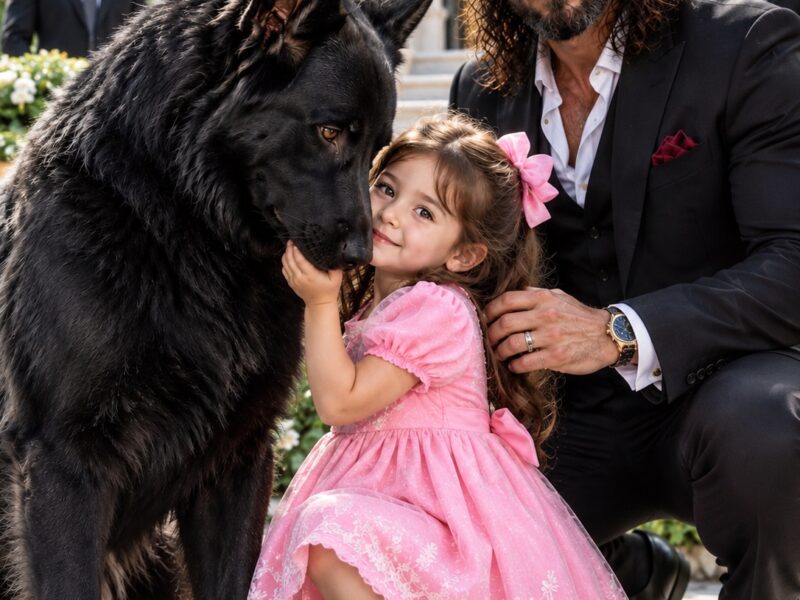
The Mafia Boss’s Dog Attacked Everyone Who Came Near Him—Until the Maid’s Little Girl Did Something
The dog had sent two professional trainers to the hospital.
Every grown man in the mansion knew to stay ten feet away from him.
Then my six-year-old daughter walked straight into his room and held out her hand.
I still remember the sound Bruno made before I saw him.
A growl so low it seemed to move through the marble floor before it reached the air.
Every man in that hallway stopped walking.
I stopped breathing.
My name is Rosa Alvarez, and by then I had spent three years cleaning the Cruz estate north of Chicago. Three years was long enough to learn which doors stayed closed, which questions never got asked, and how quickly conversations changed when Damian Cruz entered a room.
It was also long enough to understand that his dog was not a pet in the way normal people used that word.
Bruno was a black Cane Corso weighing somewhere around one hundred thirty pounds, with a chest as wide as a kitchen cabinet and a pale scar cutting through the fur above his left eye. He moved quietly for something that large, which made him worse. You usually heard the growl after he had already decided you were too close.
Two trainers had been brought in over the years. One left with eleven stitches in his forearm. The other refused to come back after Bruno pinned him against a fence without biting and held him there until Damian called him off.
The strange part was that Bruno did not attack randomly.
He could walk past kitchen staff without looking at them. He ignored gardeners, delivery trucks, even the elderly woman who came twice a week to arrange flowers in the west parlor.
He became dangerous when somebody moved too quickly toward Damian.
That was the line.
Everybody knew it.
Damian’s security men knew it. His business partners knew it. His own brother, Victor, would stop at the study door if Bruno was stretched beside Damian’s chair.
Nobody touched the boss without giving the dog time to understand what was happening.
Nobody except my daughter.
Sophia was never supposed to be in that hallway.
Her elementary school had dismissed everyone shortly after lunch because a pipe burst over the cafeteria ceiling. My usual sitter was in Milwaukee helping her sister with a newborn, and the backup daycare would not take a child without twenty-four hours’ notice.
Rent did not care.
Neither did the electric bill.
So I brought Sophia to work.
I put her in the laundry room near the kitchen with crackers, a coloring book, six markers, and enough warnings to frighten a much smarter child.
“Do not leave this room.”
“I know.”
“Sophia.”
“I know, Mama.”
“Not one step.”
She held up her small hand.
“Promise.”
Six-year-olds believe promises last forever.
Markers believe in gravity.
About an hour later, a purple marker rolled beneath the laundry-room door.
I was mopping the west hallway.
I heard the small door creak.
When I turned, Sophia was already walking after it.
“Sophia.”
She did not hear me.
The marker rolled across the polished marble, hit the baseboard, changed direction, and continued toward the study.
Toward Bruno.
My stomach dropped.
“Sophia, stop.”
She bent to pick up the marker.
It slipped between her fingers.
Rolled again.
Straight through the half-open study door.
I dropped the mop.
By the time I reached the corner, Sophia was standing in the doorway.
Damian Cruz sat behind his desk.
Dark suit.
White shirt.
One hand resting on a document.
Three men stood around the room discussing something involving container insurance and a port in Indiana.
Bruno lay beside Damian’s chair.
Then the dog lifted his head.
Every adult froze.
Bruno’s ears came forward.
His body changed first.
Muscles tightening beneath his coat.
Head low.
Eyes locked on Sophia.
One of the security men moved a hand toward the radio at his shoulder.
Another whispered, “Don’t.”
Damian pushed halfway out of his chair.
His right hand moved toward a drawer.
Later, I learned what he kept inside it.
At that moment I only knew my daughter was six feet from a dog grown men feared.
“Sophia.”
My voice came out wrong.
Thin.
Barely there.
She looked at Bruno.
Bruno stood.
I could not move.
People talk about terror as if it makes you run.
Sometimes it turns your bones into furniture.
The dog crossed the room.
Slowly.
One enormous paw.
Then another.
No growl.
No bark.
Nothing.
Sophia’s hands began trembling.
At least she finally understood enough to be afraid.
Bruno stopped directly in front of her.
His head was level with her chest.
She looked toward me.
“Mama?”
“Don’t move.”
Damian’s voice cut through mine.
“Rosa.”
I looked at him.
“Do not run toward her.”
Every part of me wanted to.
But Bruno knew me only as movement in the hallway. A body with a uniform. A person who stayed outside the invisible circle around his master.
If I ran, maybe he would decide I was the danger.
Sophia looked back at the dog.
Bruno took one step closer.
Then he did something nobody in that room understood.
He lowered his head.
Not to bite.
Not to threaten.
He pushed his enormous forehead beneath Sophia’s open hand.
My daughter stared.
The dog pressed harder.
Sophia’s fingers disappeared into the short black fur between his ears.
“Hi.”
Nobody breathed.
She scratched behind one ear.
Bruno closed his eyes.
“Hi, doggy.”
One of Damian’s men whispered something in Italian.
Another crossed himself.
I would have laughed if I had not been close to fainting.
Sophia crouched.
“No.”
I said it immediately.
But the child was already lowering herself to the floor.
Bruno sat beside her.
Then, with the slow exhaustion of something that had been carrying weight for too long, the dog laid his head across her knees.
Sophia smiled.
“You’re heavy.”
Bruno exhaled.
A long breath.
His entire body loosened.
Damian slowly sat back down.
His hand moved away from the desk drawer.
He was staring at Bruno.
Not at Sophia.
At the dog.
I had seen Damian Cruz expressionless while a contractor explained losing nearly four million dollars. I had watched him calmly fire a man twenty years older than him for lying over a small invoice. I had seen guests enter his study angry and leave careful.
I had never seen confusion on his face.
I saw it then.
And behind it, something worse.
Recognition without understanding.
“Rosa.”
His voice was quiet.
“Yes, sir.”
“Come get your daughter.”
I moved slowly.
Bruno watched me.
No growl.
Sophia wrapped one arm around his neck before I could stop her.
Every security man in the room tensed.
Bruno leaned into her.
I reached them and lifted Sophia.
The dog stood immediately.
A small sound came from him.
Not a growl.
A whine.
That sound disturbed Damian more than everything else.
Sophia stretched toward Bruno.
“Bye.”
Bruno followed two steps.
Damian said one word.
“Stay.”
The dog stopped.
But his eyes followed my daughter all the way to the doorway.
“I’m sorry.”
I was already calculating what unemployment looked like.
“I should never have brought her. Her school closed early. I had no one and—”
“Rosa.”
“Yes?”
“What is her name?”
I stared at him.
“Sophia.”
His gaze moved to the child in my arms.
“Sophia what?”
“Alvarez.”
He went still for half a second.
I noticed because when you work in someone’s house long enough, you notice the pauses they think nobody sees.
“How old?”
“Six.”
“When did she turn six?”
“July.”
Damian looked at Bruno again.
“Bring her tomorrow.”
I thought I had misunderstood.
“Sir?”
“Same time.”
My grip tightened around Sophia.
“Mr. Cruz, I don’t think—”
“That was not a punishment.”
His eyes returned to mine.
“And it was not a threat.”
The fact that he clarified made me more nervous.
“Then what is it?”
For a moment, Damian Cruz looked like a man who did not know the answer to his own question.
“I need to see if he does it again.”
That night I barely slept.
Sophia did.
Children have the unfair ability to survive the emotional destruction of adults by simply becoming tired.
She fell asleep with one arm beneath her pillow.
I sat at our small kitchen table and searched Cane Corsos on my phone until one in the morning.
Protective.
Territorial.
Highly trainable.
Strong memory.
Sensitive to human emotion.
None of it explained what I had seen.
The stories about Bruno were not gossip.
I had watched a locksmith drop his equipment and back away when the dog rushed a glass door because the man approached Damian’s car too quickly.
I had seen a new security guard lose all color in his face when Bruno appeared behind him on the terrace.
This animal measured threats for a living.
Yet Sophia had walked into his room, and he had rested his head in her lap.
At two fourteen, I got out of bed.
Sophia’s backpack sat near the door.
I opened the front pocket.
Purple marker.
Crackers.
A folded drawing.
She had drawn Bruno.
At least I assumed it was Bruno.
It looked like a black potato with legs.
Beside him stood a very small girl holding one enormous hand over the dog’s head.
Above them, in uneven first-grade letters, she had written:
HE WAS SAD.
I sat on the floor.
I do not know why that sentence bothered me.
Maybe because nobody in the mansion had ever described Bruno as sad.
Dangerous.
Vicious.
Unstable.
Protective.
Never sad.
The next afternoon I drove Sophia back to the estate.
My hands were tight on the steering wheel.
She was singing.
“Are we seeing Bruno?”
“For a few minutes.”
“Can I bring him something?”
“No food.”
“A picture.”
I looked at the drawing on her lap.
“Fine.”
We came through the main gate at 2:07.
Bruno was waiting on the front steps.
I nearly hit the brake too hard.
He sat beside one of the stone columns, perfectly still, his eyes fixed on our old Honda.
The moment Sophia opened her door, the dog stood.
A guard near the entrance stiffened.
Bruno walked down the steps.
“Stay beside me.”
I told Sophia.
She ignored the spirit of the instruction while technically obeying it.
She took my hand and pulled me forward.
Bruno reached her.
He did not sniff cautiously.
He pressed his head against her stomach.
His tail moved.
Slowly.
Left.
Right.
Against the stone.
Sophia laughed.
“You remember me.”
Damian stood inside the open doorway.
Arms crossed.
Face unreadable.
I looked at him.
He was not watching my daughter.
He was watching the dog.
“I need to ask you something.”
He said.
“Yes?”
“Has Sophia ever been around a dog this size?”
“No.”
“A Cane Corso?”
“I’m not sure she knew what one was yesterday.”
“Any large guard dog?”
“No.”
Damian’s jaw tightened.
“Sophia.”
She looked up.
“Yeah?”
I almost corrected her manners.
Damian did not seem to care.
“Have you seen Bruno somewhere before?”
She thought.
“No.”
“Does he remind you of another dog?”
Sophia scratched his neck.
“Doggy.”
Damian glanced at me.
I shrugged.
“She’s six.”
Sophia looked at Bruno’s scar.
“Ouch.”
She touched the fur near it.
I immediately reached for her wrist.
Bruno did nothing.
Sophia whispered:
“Who hurt you?”
The dog’s ears moved backward.
Damian’s expression changed.
She hugged Bruno’s head.
“It’s okay.”
Something sharp passed across Damian’s face.
He turned away.
“Victor.”
A man near the foyer looked up.
I knew Victor Cruz was Damian’s older half brother and handled parts of the family business that did not appear on company websites.
“Have the study cleared.”
Victor looked at Sophia.
Then Bruno.
“You’re serious.”
“Yes.”
“That dog put a trainer in the ER.”
“I remember.”
Victor lowered his voice.
“This is a child.”
Damian looked at him.
“That is why you will clear the room.”
Twenty minutes later, Sophia sat on the rug in the study drawing while Bruno lay against her hip.
I stayed by the door.
Damian worked behind his desk.
At least he pretended to.
He read the same page for fifteen minutes.
I knew because he never turned it.
When Sophia left, Bruno stayed at the window watching our car disappear.
That became our afternoon routine.
I hated how quickly it became normal.
For Sophia, it was normal immediately.
For everyone else, it remained something close to sacrilege.
Guards who had avoided Bruno for years watched a six-year-old put paper hats on his head.
The cook started saving pieces of plain chicken for Sophia to feed him only after permission from the dog’s veterinarian.
Daniel, Damian’s elderly house manager, once walked into the study and found Sophia asleep with her back against Bruno’s side.
He backed out without waking either one.
I heard him tell a guard:
“If you tell anyone I saw something adorable in this house, I will deny it.”
Bruno changed.
Not all at once.
He still watched strangers.
He still positioned himself between Damian and unfamiliar men.
But when Sophia was in the room, his body softened.
His eyes stopped moving constantly toward doors.
He slept.
Really slept.
Not the shallow, listening rest I had seen before.
Sometimes his paws twitched.
Sophia said he was dreaming about running.
Damian began watching them with an expression I could not name.
At first I thought it was curiosity.
Then one afternoon I saw his hand move toward a photograph lying facedown on his desk.
He touched its edge.
Did not lift it.
The next day, he did it again.
A week after Sophia first entered the study, Damian asked me to stay after my shift.
Sophia was in the garden with Bruno and one of the security men.
I stood in front of Damian’s desk.
“Sit.”
“I’m fine.”
“Rosa.”
I sat.
He poured bourbon into a glass.
Did not drink it.
Then he turned the photograph over.
A little girl stood on a wooden porch.
Seven, perhaps.
Dark hair.
Gap between her front teeth.
Green T-shirt.
Her arm was wrapped around a dog.
Bruno.
Younger.
Thinner.
No scar above his eye.
My stomach tightened.
“Who is she?”
Damian looked at the photograph.
“Camila Serrano.”
I knew the name Serrano.
Everybody who had lived around Chicago freight routes ten years ago knew it.
The Serranos had controlled trucking yards, gambling rooms, security contracts, and a piece of the lakefront unions before the Cruz organization pushed them out.
“Bruno was hers?”
“His name was Duke.”
Damian rotated the glass between his fingers.
“Camila grew up with him.”
“What happened to her?”
He looked at me.
Then away.
“There was a house in Calumet City.”
Four years earlier.
A Serrano property.
Damian had believed the building contained a ledger that could prove one of his shipping companies was being skimmed through fake subcontractors.
The conflict had been building for months.
Money disappeared.
Men threatened one another.
A truck was burned.
Damian finally sent three people to retrieve the ledger.
“I told them nobody was supposed to get hurt.”
He said.
I stayed silent.
“One of the men decided the records were safer destroyed.”
His voice flattened.
“He used accelerant.”
My skin went cold.
“The house caught?”
“Yes.”
“Were you there?”
“No.”
“But they were following your order.”
“Yes.”
The answer came without defense.
That mattered.
“A woman died.”
Damian continued.
“Camila died.”
My eyes moved to the photograph.
“The dog survived.”
“He was found two streets away.”
“Burned?”
“Smoke exposure. Cuts.”
Damian rubbed his thumb along the edge of the picture.
“He kept going back to the ruins.”
“For days.”
“One of my men finally trapped him.”
“Then what?”
“He brought him here.”
“Why?”
Damian’s expression became bitter.
“As a trophy.”
I felt sick.
“I fired him.”
“That didn’t undo it.”
“No.”
“Why did you keep Bruno?”
His jaw tightened.
“I told myself he was useful.”
“Security.”
“Protection.”
I waited.
“And?”
Damian looked at the photograph again.
“Getting rid of him felt like throwing away the last thing that proved the fire happened.”
The admission surprised me.
“You needed punishment.”
His eyes came to mine.
“Careful.”
I should have lowered my gaze.
I did not.
“You asked me to stay.”
“I did.”
“So I’m staying.”
Something passed through his face.
Not anger.
Respect, maybe.
Damian looked toward the open terrace door.
Sophia’s laughter drifted from the garden.
Bruno barked once.
A playful sound I had never heard from him before.
“For four years that dog has hated almost everyone who moves too quickly around me.”
Damian said.
“I thought it was loyalty.”
“Maybe part of it is.”
“No.”
His gaze hardened.
“I think he associates people approaching me with the men who came into Camila’s house.”
“He isn’t protecting me because he loves me.”
“He’s trying to prevent another loss.”
I looked toward the garden.
“He’s afraid.”
Damian leaned back.
“That dog has terrified half the city.”
“He can still be afraid.”
I said.
“Those things aren’t opposites.”
Damian went very quiet.
Then:
“Your daughter is the first person he has let touch him like that since the fire.”
I looked again at Camila’s photograph.
The girl did not resemble Sophia enough for anything strange.
Dark hair.
Brown skin.
Small nose.
Millions of children shared those things.
Still, an uncomfortable thought moved through me.
“Maybe Sophia doesn’t treat him like everyone else does.”
“How does everyone else treat him?”
“Like a weapon.”
Damian’s eyes narrowed.
“And she doesn’t?”
“She thinks he is a dog.”
I stood.
“That may be the entire mystery.”
For two days, I believed it was.
Then the black sedan arrived.
It stopped across from the main gate at 3:11 on Friday afternoon.
Tinted windows.
Illinois plate.
It remained there eleven minutes.
Bruno saw it before security did.
He was lying beside Sophia in the front sitting room while she read aloud from a book about planets.
The dog stood.
Every muscle changed.
A growl vibrated through his chest.
Sophia stopped reading.
“What?”
Bruno stared at the gate.
Damian entered from the hallway.
“What is it?”
I pointed toward the road.
The sedan pulled away.
Damian called security.
No visitor expected.
No delivery.
Plate came back to a rental company.
The next Monday, the car returned.
Wednesday.
Again.
Friday.
Again.
Always when Sophia was at the house.
I told myself that was coincidence.
Then I heard Victor arguing with Damian near the east garage.
I had been taking folded towels upstairs.
Their voices carried through the stone corridor.
“You are creating a problem.”
Victor said.
“I am investigating one.”
“You know what Reyes will think.”
“I know what he may think.”
“The girl was never confirmed.”
Silence.
Then Damian:
“Lower your voice.”
Victor saw me.
Everything stopped.
I continued walking.
That evening, Damian called me into the study.
Sophia was not there.
Bruno sat beside the window.
He looked toward me, then back outside.
Damian closed the door.
“There is something I did not tell you.”
I felt a cold pressure form behind my ribs.
“The fire.”
“Yes.”
He remained standing.
“There were two children believed to be inside that house.”
My fingers tightened around the back of a chair.
“Camila?”
“And her younger cousin.”
“How young?”
“Two.”
My mouth went dry.
“Did she die?”
“We never confirmed it.”
The room tilted by a degree.
Damian continued.
“One body was recovered and identified as Camila.”
“The second child was never found.”
“Name?”
“Sofia Reyes.”
My heart stopped.
Not Sophia.
Sofia.
Common name.
Different spelling.
Millions of girls.
Still.
Damian watched me carefully.
“When did you adopt your daughter?”
I stood.
“No.”
“Rosa—”
“No.”
My voice shook.
“You do not get to ask questions about my child because your dog likes her.”
“I agree.”
That stopped me.
Damian did not approach.
He did not order.
“I am not telling you she is that child.”
“Then what are you telling me?”
“That somebody else may believe she is.”
He slid a photograph across the desk.
The black sedan.
A man stepping out near a gas station.
Broad shoulders.
Gray at his temples.
Scar along his jaw.
“Esteban Reyes.”
The surname hit.
“Who is he?”
“Sofia Reyes’s maternal uncle.”
I stared.
“He has spent four years trying to learn what happened to her.”
“Why is he watching this house?”
“We don’t know.”
“You said he might believe Sophia is his niece.”
“Yes.”
“Why?”
Damian looked toward Bruno.
“Because my brother mentioned the dog’s behavior to someone he trusted.”
My eyes snapped to him.
“Victor told people about my daughter?”
“No.”
“He described Bruno allowing a child near him.”
“That was enough for an old contact to ask questions.”
I felt anger replace fear.
“You let your people gossip about her.”
Damian’s jaw tightened.
“You’re right.”
“That’s all?”
“No.”
His voice dropped.
“It should not have happened.”
I stared at him.
He continued.
“I need you to tell me something.”
“What?”
“How did Sophia come to you?”
I did not answer.
“Her father left when she was two?”
“That is what I put on employment paperwork.”
Damian became still.
“It isn’t true.”
“I did not say that.”
“You didn’t have to.”
Anger flared.
“You investigated me?”
“After the sedan appeared.”
“Yes.”
My face burned.
“You had no right.”
“No.”
Another answer without defense.
That made it harder to hate him properly.
“I checked only public records and your employment documents.”
“I stopped when I realized the birth certificate was amended.”
I stood.
“This conversation is over.”
Damian moved away from the door.
Not toward it.
Away.
Giving me space.
“Take Sophia home.”
“I am.”
“Do not come back tomorrow.”
I glared.
“You are firing me?”
“No.”
His eyes shifted toward the window.
“I want you away from my house until I know who is watching it.”
“I’ll decide where my daughter goes.”
“Fair.”
That word surprised me.
Damian took out a business card.
“Her name is Elise Morgan.”
“Family attorney.”
“Independent of my companies.”
“She can explain what rights you have if anyone claims biological relation.”
“I did not ask for your lawyer.”
“You’re right.”
He put the card on the desk rather than handing it to me.
“Then leave it.”
I did.
At home, I locked the door twice.
Sophia sat at our small table eating macaroni.
“Why no Bruno tomorrow?”
“He has things to do.”
“What things?”
“Dog things.”
She accepted that more easily than I expected.
Children accept bad explanations when they trust the person delivering them.
That thought nearly broke me.
I waited until Sophia slept.
Then I opened the metal box beneath my bed.
Inside were documents I almost never touched.
A faded hospital bracelet.
One small silver charm.
A photograph of my cousin Maribel.
And the letter she had given me four years earlier.
Maribel lived in East Chicago then.
She worked nights in a nursing home.
One morning she called me before sunrise.
“There’s a child.”
That was all.
I drove to her apartment.
A toddler sat on the couch wrapped in a yellow blanket.
Silent.
Thin.
Two years old, perhaps.
No shoes.
Smoke smell in her hair.
Maribel told me a woman had left the child with her overnight and never returned.
I demanded names.
She refused.
Two weeks later, Maribel died in a highway accident.
I contacted child welfare.
I told them everything I knew.
Nobody found biological parents.
The girl entered emergency foster care.
I applied.
Eight months later, she became my daughter.
Sophia Alvarez.
I had never hidden from authorities that she was adopted.
I had hidden it from the Cruz household because I considered it nobody’s business.
Now I held the silver charm in my palm.
Half a moon.
On the back were three scratched letters.
S.R.
I had always assumed they were the initials of whoever owned it before.
My hands began shaking.
The next morning, I called Elise Morgan.
Not Damian.
Her.
The distinction mattered.
I met her at a downtown law office.
No Cruz security.
No black cars outside.
Elise was forty-eight, Black, sharp-eyed, and direct enough that within ten minutes I trusted her more than I wanted to.
She reviewed Sophia’s adoption file.
“You are her legal mother.”
She said.
“That does not disappear because a biological relative appears.”
“What if they prove she is this missing child?”
“You remain her mother.”
“What if they want custody?”
“They can ask.”
“That is different from receiving it.”
I breathed for the first time in an hour.
Elise continued.
“If you want to investigate identity, we do it through documented channels.”
“No private test arranged by Mr. Cruz.”
I looked at her.
“Did he ask?”
“He said you should control the process.”
That surprised me.
“What would you recommend?”
“First, compare known non-genetic facts.”
“Age.”
“Medical history.”
“Police reports.”
“Anything recovered with the missing child.”
“Only if those align do we discuss DNA.”
I placed the silver charm on her desk.
Elise looked at it.
“Where did this come from?”
“With Sophia.”
Her expression changed.
“What?”
“It was sewn into the yellow blanket when she came to Maribel.”
Elise did not touch it with bare hands.
She opened a clean evidence envelope from a cabinet.
“You kept this four years?”
“Yes.”
“Good.”
“Why?”
“Because if it matters, provenance matters.”
The phrase reminded me of Damian.
Evidence before instinct.
I hated that.
The old fire report listed the missing toddler as Sofia Elena Reyes.
Initials S.E.R., not S.R.
The charm proved nothing.
Then Elise obtained a photograph from public court records tied to the Serrano estate.
A family picnic.
Camila.
Duke.
Adults.
And in the corner, a toddler in a yellow dress.
Around her neck:
A silver half-moon charm.
I sat staring at the image.
“Could be similar.”
Elise said.
“Yes.”
My voice sounded far away.
“It could.”
The age matched.
The date of the fire matched the week Maribel received Sophia.
A pediatric intake record from foster care described mild smoke irritation that had been attributed to Maribel’s apartment building, where neighbors smoked indoors.
One more detail matched.
A pale birthmark behind Sophia’s right shoulder.
The missing-child report described one.
Still not proof.
Enough to make DNA reasonable.
Elise arranged it through an accredited lab with court-chain documentation.
I signed the consent.
Not Damian.
Not Esteban.
Me.
Sophia swabbed her cheek and asked if the stick was medicine.
“No.”
“Then why?”
“To learn something about where you came from.”
She thought.
“Chicago.”
I almost cried.
The lab compared her sample with Esteban Reyes, who voluntarily provided his through his own attorney.
Four days later, Elise called.
“Rosa.”
I knew from her voice.
“No.”
“I’m sorry.”
“Don’t say sorry.”
She paused.
“The result supports a close biological relationship.”
“How close?”
“Consistent with maternal uncle and niece.”
I sat down on my kitchen floor.
Sophia was at school.
Thank God.
I pressed one hand against my mouth.
Not because she stopped being mine.
She did not.
Because somewhere, another family had been mourning my daughter for four years.
And somewhere inside the Cruz estate, a dog had recognized something none of us understood.
When Damian came to my apartment that evening, he waited outside.
He did not knock twice.
He did not call.
He waited until I opened the door.
“How did you know?”
“Elise told me only that you received results and might contact me.”
“She didn’t tell you what they said?”
“No.”
I believed him.
That bothered me too.
I stepped into the hallway and shut the door behind me.
“Sophia is Sofia Reyes.”
Damian closed his eyes.
The reaction was not surprise.
It was pain confirming itself.
“She was in that house.”
“Yes.”
He leaned against the opposite wall.
For the first time I had ever seen, Damian Cruz looked physically unsteady.
“You knew this might happen.”
“I hoped I was wrong.”
“You hoped?”
His eyes opened.
“What word would you prefer?”
“None.”
I folded my arms.
“She is six years old.”
“She has a school project due Friday.”
“She hates mushrooms.”
“She sleeps with the hallway light on when thunder gets loud.”
“She is not a debt between you and Esteban Reyes.”
“I know.”
“You do not get to turn her into peace negotiations.”
“I know.”
“You do not get to decide when he sees her.”
“I know.”
“You do not get to move us.”
“I know.”
I stopped.
Damian’s face was exhausted.
“I am not going to fight you for control of your daughter.”
He said.
“She is yours.”
“Biology changes history.”
“It does not erase motherhood.”
My throat tightened.
He continued.
“But Esteban knows enough now that silence is dangerous.”
“He has seen the dog.”
“He has seen you.”
“He knows there is a girl.”
“What do you want?”
“To tell him the truth.”
My hands curled.
“No.”
“Rosa—”
“No.”
“He watched your building yesterday.”
“Then call police.”
“I did.”
That surprised me.
“I gave the sedan information to Detective Lena Brooks.”
“She has an open surveillance complaint.”
“You involved police?”
“Yes.”
“You?”
His mouth almost moved.
“Try not to sound shocked.”
“I am.”
“Fair.”
Damian looked toward my door.
“I am not asking you to bring Sophia into a private meeting.”
“I am asking you to let attorneys tell Esteban the DNA is confirmed.”
“Then what?”
“He decides whether he wants contact.”
“And if he demands it?”
“Then he learns no.”
I studied him.
“You would tell him that?”
“Yes.”
“Even if it starts another war?”
Damian’s gaze went flat.
“No child will pay for that again.”
That sentence was the first thing he had said I wanted to believe without checking.
So I checked anyway.
Esteban’s attorney received the confirmation.
He requested a meeting.
Adults only.
Neutral location.
A conference room in a downtown law office with security handled by the building.
No Cruz guards inside.
No Reyes men inside.
Damian agreed.
Victor did not.
“This is insane.”
I heard him arguing before the meeting.
“He thinks you burned his family.”
“He thinks correctly enough.”
Damian said.
“You did not order children killed.”
“No.”
“You did not know they were there.”
“No.”
“Then stop talking like you murdered them.”
Damian looked at his brother.
“I ordered men into that house.”
“Afterward I helped bury how badly it went because exposure would have destroyed us.”
Victor’s jaw tightened.
“We survived.”
“A child disappeared.”
“And survived.”
Victor said.
“That matters.”
Damian became very still.
“Do you hear yourself?”
“What?”
“You just turned four years of a little girl’s life into evidence that our decision worked out.”
Victor looked away first.
The meeting lasted two hours.
Esteban Reyes was not what I expected.
I expected anger.
He had that.
But grief had changed him more than anger had.
He was fifty, broad-shouldered, gray beginning at his temples. The scar along his jaw looked older than the photograph.
He did not look at Damian when he entered.
He looked at me.
“You raised her.”
“Yes.”
“What does she call you?”
“Mom.”
His eyes filled.
He nodded once.
“Good.”
That one word undid something in me.
Esteban sat.
“I am not here to take her.”
I said nothing.
“Maybe I believed I was for the first hour after the attorney called.”
He looked ashamed.
“Then my wife asked me what kind of man finds a child alive and makes her lose another mother.”
I looked down.
“Thank her.”
“I will.”
Damian remained silent.
Esteban finally turned toward him.
“Tell me.”
Damian did.
Not the polished version.
Not the organizational version.
He told him about the ledger.
The order.
The man who chose fire.
The cover-up afterward.
The decision not to reopen questions about the second child because finding her might connect Damian directly to the operation.
Esteban listened.
At the end, he asked:
“Did you ever look?”
“No.”
“Not once?”
Damian’s face tightened.
“No.”
Esteban’s chair scraped backward.
For one second I thought he might cross the table.
He did not.
He walked to the window.
“You kept her dog.”
“Yes.”
“As what?”
Damian did not answer quickly.
“A reminder.”
Esteban laughed once.
Bitter.
“You called him Bruno.”
“My men did.”
“His name was Duke.”
“I know.”
“You knew?”
“I learned after.”
Esteban turned.
“Camila taught him to sit by holding a piece of cheese above his head.”
His voice cracked.
“Sofia used to crawl under him.”
“Would grab his ears.”
“Everybody thought he’d snap.”
“He never did.”
I closed my eyes.
Sophia rubbing Bruno’s ears.
Hi, doggy.
Esteban wiped his face.
“I want to meet her.”
I said:
“Not yet.”
His jaw tightened.
Then relaxed.
“Okay.”
No argument.
That mattered.
“You can send photographs through Elise.”
I said.
“One at a time.”
“No posting.”
“No showing people who are not immediate family.”
“No telling her story publicly.”
“Yes.”
“If she meets you later, it happens with a child therapist involved.”
Esteban nodded.
“And Bruno?”
I looked at Damian.
Damian answered.
“He stays with her when she wants him.”
Esteban stared.
“The dog belongs to you.”
“No.”
Damian said.
“He belongs to himself.”
“And if Rosa agrees, to Sophia.”
Something changed in Esteban’s expression.
Not forgiveness.
Nothing close.
But the first absence of hatred.
The real confrontation came after the meeting.
Victor waited in Damian’s study.
I was there because Damian had asked if I wanted to hear the decision about Bruno and security. I almost left when I saw Victor.
Then he said:
“You told Reyes everything?”
Damian removed his coat.
“Yes.”
“You admitted the cover-up?”
“Yes.”
Victor stared.
“That information can destroy us.”
“It can expose us.”
“Same thing.”
“No.”
Damian poured water.
“Different.”
Victor looked at me.
“This is family business.”
I almost stood.
Damian said:
“Rosa stays.”
Victor’s eyes hardened.
“Why?”
“Because the secret involved her daughter.”
That ended the argument about my presence.
Not the argument itself.
Victor walked toward the desk.
“We spent fifteen years pulling the company legitimate.”
“Do you understand what happens if prosecutors reopen that fire?”
“Yes.”
“Civil suits.”
“Yes.”
“Criminal exposure.”
“Yes.”
“Contracts.”
“Banks.”
“Employees.”
“I know.”
Victor slammed one hand against the desk.
“All because a dog put his head in a child’s lap?”
Damian’s face changed.
“No.”
The room went quiet.
“All because four years ago we decided our survival mattered more than knowing whether a child survived.”
Victor stared.
“You are rewriting history.”
“No.”
“I’m reading it without editing.”
“You think confession makes you noble?”
Damian looked tired.
“No.”
“It makes me late.”
Victor laughed bitterly.
“You sound like Rosa.”
Damian glanced toward me.
“Could do worse.”
I did not smile.
Damian continued:
“Elise is preparing a full disclosure package.”
“Of what?”
“The operation.”
“The fire.”
“The payments afterward.”
“Everything we have.”
Victor’s face drained.
“You cannot.”
“I can.”
“You will implicate yourself.”
“Yes.”
“You will implicate me.”
Damian stopped.
The silence sharpened.
Victor looked away.
There it was.
Not guilt for the fire.
Fear of accountability.
Damian’s voice lowered.
“What did you do?”
“Nothing.”
“Victor.”
“I moved money after.”
“To whom?”
“The family that owned the property.”
“Settlement.”
“Without attorneys?”
“They wanted quiet.”
“So did we.”
Damian stared at him.
“You knew there was an unidentified second child.”
Victor’s silence answered.
My stomach turned.
“You knew?”
I asked.
He looked at me.
“Not that she survived.”
“But you knew they had never found her.”
“Yes.”
“Why didn’t anyone search?”
“Police searched.”
“Why didn’t you?”
Victor’s face hardened defensively.
“Because every private investigator we sent risked connecting us to the fire.”
I could not speak.
Damian sat down.
Slowly.
His face had gone completely still.
“You told me both children were presumed dead.”
Victor looked at him.
“They were.”
“No.”
“One was missing.”
“Missing is not dead.”
“It was four years ago.”
Victor snapped.
“We were trying to keep you out of prison.”
Damian stared at his brother.
“And all this time I thought Bruno was the one who couldn’t let go.”
Victor stepped closer.
“Everything I did was to protect you.”
Damian’s eyes became cold.
“That sentence has buried enough people.”
Detective Brooks reopened the fire investigation six days later.
Damian provided records through counsel.
Victor did too after receiving his own attorney’s advice.
The man who had used accelerant had died two years earlier, but bank transfers and messages still existed.
Damian was not charged with setting the fire.
He did face an investigation into obstruction and concealment after the incident.
He did not ask me for sympathy.
I respected him more for that.
He paid no one to make it disappear.
That was harder than any dramatic act of violence would have been.
Cruz Shipping lost two contracts.
A lender froze an expansion project.
Old stories resurfaced.
Reporters waited outside the gate.
Damian’s photograph appeared beside words he had spent years trying to leave behind.
Organized crime.
Arson.
Missing child.
I stopped taking Sophia to the estate.
Not because Damian told me to.
Because I chose not to.
Bruno changed again.
Daniel told me he waited by the front window each afternoon.
Would not eat until evening.
I hated knowing that.
But Sophia’s safety came before a dog’s grief.
A behavioral veterinarian began working with Bruno.
No dominance training.
No punishment.
No people forcing themselves into his space.
Trauma, the veterinarian said, was not disobedience.
I thought Damian needed to hear that more than the dog did.
Sophia asked about Bruno every day.
“When can I see him?”
“Soon.”
“That means no.”
“It means I don’t know.”
She frowned.
Then accepted it.
Three weeks later, we met Bruno at a fenced private training field.
Not the estate.
Neutral ground.
Damian did not come.
That mattered too.
Bruno saw Sophia from thirty yards away.
He froze.
Then ran.
The trainer held the long line loose but ready.
Bruno stopped two feet from Sophia.
His whole body shook.
Sophia put both hands around his head.
“You took forever.”
Bruno leaned against her so hard she nearly fell.
I cried.
The trainer pretended not to see.
Afterward, Sophia sat in the grass with Bruno’s head in her lap.
I showed her a photograph.
Camila.
The porch.
Young Duke.
“This girl used to love Bruno very much.”
Sophia looked.
“She died?”
“Yes.”
“Is that why he sad?”
“Partly.”
She studied the picture.
“Do I know her?”
“You were little when she knew you.”
Sophia looked at me.
The questions had arrived earlier than I wanted.
We had a child therapist helping me find truthful, age-appropriate language.
“You had another family before me.”
I said.
“I know.”
She surprised me.
“You said adopted.”
“Yes.”
“These people?”
“Some of them.”
“Are they my family?”
“Yes.”
Her fingers moved through Bruno’s fur.
“Are you?”
My throat closed.
“Yes.”
She nodded.
“Okay.”
Just like that.
Adults want identity to behave like a courtroom.
One answer replacing another.
Children sometimes understand addition better.
Esteban met Sophia two months later.
A therapist was present.
So was I.
Damian was not.
Esteban brought no gifts.
Smart man.
He brought photographs.
Camila on a bicycle.
Sofia as a toddler eating watermelon.
Duke asleep beneath a high chair.
Sophia looked through them.
At one photograph, Bruno was sitting between two little girls.
She pointed.
“That me?”
“Yes.”
Esteban’s voice broke.
“That was you.”
Sophia stared longer.
Then asked:
“Why you cry?”
Esteban smiled through it.
“Because I missed you.”
She considered.
“You didn’t know where I was.”
“No.”
“That’s not your fault.”
Every adult in the room became still.
Esteban covered his face.
I looked away.
Sophia went back to the photographs.
No miracle.
No instant family.
She did not run into his arms.
She did not suddenly remember him.
Good.
Reality deserved more respect than that.
Contact grew slowly.
Monthly visits.
Then dinners.
Video calls with Esteban’s wife.
A cousin in Wisconsin who remembered Sofia as a baby.
I stayed Mom.
Always.
Nobody questioned it.
The hardest conversation I had with Damian came in January.
He was waiting outside the community center where Sophia attended an art class.
Not uninvited exactly.
He had called first.
I agreed to coffee.
We sat in a small diner where nobody recognized him until halfway through.
He looked thinner.
Less sleep.
More gray at the temples.
“How is she?”
“Good.”
“Bruno?”
“Better.”
“He sleeps through the night now.”
“That’s good.”
Silence.
Then Damian:
“I owe you an apology.”
I laughed quietly.
“Which one?”
He almost smiled.
“Several.”
“Pick one.”
“For investigating your life without asking.”
“Accepted.”
His eyes lifted.
“That easy?”
“No.”
“I accept it.”
“That doesn’t mean I forget it.”
He nodded.
“Fair.”
“What else?”
“For turning Sophia into evidence in my head before I remembered she was a child.”
That one mattered more.
“Accepted.”
“And?”
“For the fire.”
I looked at him.
“That apology is not mine.”
“I know.”
He stared at the coffee.
“I met Esteban yesterday.”
“How did that go?”
“He still hates me.”
“Reasonable.”
Damian smiled briefly.
“Very.”
“He agreed to the restitution structure.”
“What structure?”
“Independent fund.”
“For families harmed during the old territorial fights.”
“Not controlled by me.”
“Good.”
“I expected you to call it guilt money.”
“It is.”
He looked up.
I continued.
“That doesn’t make it useless.”
Damian sat with that.
“What are you doing with the old businesses?”
“Selling what can be sold legally.”
“Closing what can’t.”
“Independent board for the shipping company.”
“Victor?”
“He resigned.”
“Voluntarily?”
“Eventually.”
I almost laughed.
Damian looked through the diner window.
“Do you know what I realized?”
“What?”
“I spent years calling Bruno vicious.”
“Because that was easier than admitting he had a reason.”
I waited.
“And?”
“I did the same thing with everyone.”
“Enemies.”
“Employees.”
“My brother.”
“Myself.”
“Label something dangerous and you don’t have to ask what happened to it.”
I stirred my coffee.
“That sounds expensive.”
“It has been.”
Another silence.
“Rosa.”
“Yes?”
“Will you come back to the house?”
My body tightened automatically.
Damian saw it.
“Not as before.”
He added quickly.
“No.”
“What do you mean?”
“Daniel is retiring in June.”
“He wants someone to oversee household operations.”
I stared.
“You’re offering me his job?”
“I’m asking if you want to interview for it.”
That distinction surprised me.
“Interview?”
“With two outside candidates.”
“You could just give it to me.”
“Yes.”
“And you aren’t.”
“No.”
“Why?”
“Because you should know you earned it for reasons unrelated to your daughter.”
I looked down.
That was smarter than I wanted him to be.
“What if I say no?”
“Then I hire someone else.”
“And Sophia?”
“Can visit Bruno when you choose.”
“No condition.”
“No.”
I interviewed.
I hated every minute.
I prepared anyway.
Daniel asked questions as if he had never seen me handle three vendors, a kitchen emergency, and a leaking pipe before breakfast.
An outside property manager joined.
So did an accountant.
Two weeks later, they offered me the job.
I negotiated salary.
That was new.
Damian accepted my second number.
Also new.
I returned to the estate in June as household operations manager.
My uniform changed.
Not dramatically.
No cinematic transformation.
Just different responsibilities.
Different pay.
My name on vendor contracts.
My voice in schedule meetings.
Sophia came after school twice a week.
Bruno followed her everywhere.
He never again attacked someone simply for approaching Damian.
That did not happen because Sophia magically cured him.
The veterinarian worked for months.
Security protocols changed.
People stopped using the dog as an intimidation device.
Damian stopped allowing Bruno to sit beside him during business meetings.
A dog should not have to decide whether every handshake is war.
That mattered.
The first time Bruno allowed Victor to touch him again, it happened almost a year after the truth came out.
Victor crouched in the garden.
No one ordered the dog closer.
Bruno walked over.
Sniffed his hand.
Accepted one scratch beneath the chin.
Victor looked toward Damian.
“Progress?”
Damian said:
“His choice.”
Victor nodded.
“So was yours.”
The brothers were not repaired.
Maybe they never would be completely.
But they spoke.
That was something.
Damian eventually entered a plea agreement related to obstruction after the fire.
No dramatic courtroom collapse.
No miraculous immunity.
He paid penalties.
Provided testimony.
Accepted restrictions tied to several corporate roles.
For a man who had spent most of his life believing consequences were things he delivered to other people, receiving them changed him.
He never called it redemption.
I liked that.
Redemption is a word people use too early.
Sophia turned eight.
Then nine.
She remembered almost nothing from before I became her mother.
Sometimes fragments appeared.
A green porch.
A girl singing.
Smoke.
Mostly Bruno.
She remembered sleeping beside a dog.
The therapist told us memory at that age could be mixed with photographs and stories.
We did not force certainty.
One afternoon, Sophia asked Damian:
“Did you kill Camila?”
I nearly dropped a tray.
Damian became still.
She was nine by then.
Old enough to understand more.
Not everything.
He looked at me.
I did not rescue him.
Good questions deserved honest discomfort.
“No.”
He said.
“But men working for me caused the fire that killed her.”
Sophia looked at Bruno.
“And you told them?”
“I told them to go to the house.”
“I did not tell them to start a fire.”
“But I was responsible for sending them.”
She thought.
“Did you say sorry?”
“Yes.”
“To who?”
“Your uncle.”
“Camila’s mother’s family.”
“Your mom?”
“No.”
Sophia frowned.
“Camila.”
Damian’s face changed.
“I cannot.”
“She’s dead.”
“I know.”
Sophia looked at him for a long moment.
“Then maybe say it anyway.”
She went back to drawing.
Damian sat motionless.
That night, Daniel found him in the garden beside the old oak tree.
Talking quietly to nobody.
He never told me what Damian said.
He did not need to.
Two years after Sophia first wandered into the study, Bruno was old enough that stairs began bothering him.
We moved his bed to the first floor.
Sophia argued that he needed orthopedic foam.
Damian ordered something so expensive I made him return it.
“You run a multimillion-dollar company.”
I told him.
“You cannot read a dog-bed price tag?”
“It had medical support.”
“It had marketing.”
“We got the one recommended by the veterinarian.”
Bruno approved.
That was enough.
Esteban became part of Sophia’s life slowly.
Not Uncle Esteban at first.
Just Esteban.
Then one afternoon she called him Uncle without thinking.
He walked into the hallway and cried where she could not see.
I did see.
I pretended I didn’t.
Families deserve privacy even when their happiness is inconveniently visible.
The Cruz and Reyes organizations did not become friends.
That would have been ridiculous.
They stopped behaving like inherited hatred was a business plan.
Territory disputes went through lawyers.
Shipping conflicts went through regulators.
A jointly funded neighborhood program restored two abandoned warehouses into vocational training spaces.
Damian refused to put his name on the building.
Esteban refused too.
For once, pride helped.
Four years after Sophia met Bruno, she turned ten.
On her birthday, Damian gave her a framed copy of the old porch photograph.
Camila.
Sofia.
Duke.
Behind it, another photograph.
Taken the previous summer.
Sophia in the estate garden.
Bruno beside her.
Me behind them holding lemonade.
Esteban laughing at something outside the frame.
Damian visible near the porch steps.
Not centered.
Not posed.
Just there.
Sophia looked at both photographs.
“Same dog.”
“Yes.”
Damian said.
“Different people.”
She corrected.
“Some same.”
He smiled.
“Some same.”
Bruno died the following winter.
Peacefully.
Old age.
Sophia was with him.
So was I.
Damian sat on the floor near the dog’s bed, jacket forgotten on a chair.
Victor came later.
Esteban drove from Wisconsin.
No one talked much.
Bruno’s breathing slowed over an hour.
Sophia kept one hand between his ears.
The same place she touched the first day.
“You can sleep.”
She whispered.
“You don’t have to wait.”
Damian lowered his head.
I put one hand on Sophia’s back.
Bruno exhaled.
And did not breathe again.
Sophia cried.
Not quietly.
Not gracefully.
A child should not have to.
Damian cried too.
That surprised nobody anymore.
We buried Bruno beneath the oak tree behind the estate.
Not on Cruz property officially.
Damian had transferred that section into a small conservation trust years earlier.
Sophia chose the marker.
No titles.
No history.
Only:
DUKE “BRUNO”
HE WAITED.
Underneath, smaller:
AND THEN SHE CAME HOME.
Months passed.
The study changed after Bruno died.
For years, his bed had occupied the space beside Damian’s desk.
At first Damian left it there.
Then one morning I found him staring at the empty cushion.
“Move it?”
I asked.
“No.”
Another week.
Then:
“Rosa.”
“Yes?”
“Move it.”
We did.
The floor looked wrong afterward.
Too open.
Sophia brought a small wooden box.
Inside was the purple marker she had chased down the hallway years earlier.
I had somehow kept it.
She placed it on Damian’s shelf beside the old photograph.
He looked at her.
“What is that?”
“The reason I met Bruno.”
“That marker caused approximately six years of chaos.”
“Good marker.”
Damian laughed.
A real one.
The sound traveled into the hallway.
I thought about the first day.
The growl.
The frozen guards.
My daughter standing six feet from an animal everyone believed was waiting to attack.
We had all misunderstood what we were seeing.
Bruno was not waiting to attack.
He was waiting to recognize something safe.
Maybe Damian had been doing the same thing.
His entire life had been built around danger before it arrived.
Guard first.
Threaten first.
Control first.
Never let anyone close enough to become loss.
A dog taught him nothing.
A child did not magically repair him.
That would make too simple a story out of too much damage.
What happened was smaller.
And harder.
Sophia walked into a room without carrying everyone else’s assumptions.
Bruno responded.
The rest of us were forced to ask why.
That question opened another.
Then another.
Until the history hidden beneath the house had nowhere left to hide.
Years later, when Sophia was old enough to drive, she asked me whether I ever regretted letting her go back to the Cruz estate after that first day.
We were standing in my kitchen.
Not the old apartment.
My own small house in Evanston, bought after six years of saving.
Damian did not buy it.
He offered advice exactly once.
I rejected it.
He learned.
Sophia was seventeen.
Bruno had been gone seven years.
She had Camila’s eyes, Esteban once told me.
I never knew whether that was genetics or grief talking.
“No.”
I said.
“I regret not understanding sooner how much danger there was.”
“But not going back?”
“No.”
She leaned against the counter.
“Why?”
I thought about it.
“Because going back is not the same thing as surrendering control.”
“I went back after I had information.”
“Then boundaries.”
“Then choices.”
She smiled.
“You sound like Elise.”
“That woman charged by the hour.”
“I learned efficiently.”
Sophia laughed.
Then her expression changed.
“Do you think Bruno really knew me?”
I looked toward the framed photograph on the wall.
Sophia at six.
One small hand on the head of an enormous black dog.
Damian behind them, watching.
“I think dogs remember more through smell and feeling than we understand.”
“That is not an answer.”
“No.”
I smiled.
“It isn’t.”
She waited.
“I think he recognized something.”
“Maybe your scent.”
“Maybe the way you moved.”
“Maybe nothing that scientific.”
“But I do not think he thought you were Camila.”
“Or Sofia?”
“No.”
“I think he knew you were someone he had once felt safe around.”
Sophia looked down.
“That’s enough?”
“For a dog?”
“Yes.”
“For people too, sometimes.”
The following Sunday, we visited Damian.
He was fifty-one by then.
The newspapers no longer called him a mafia boss as often.
Mostly because the businesses tied to that title had either been sold, prosecuted, dissolved, or converted into something his lawyers could explain under oath.
People still lowered their voices around him.
Old habits outlive old empires.
Sophia walked into the study.
The door stood open.
It had been open for years.
She went to the shelf and touched the purple marker.
Damian looked up from his papers.
“You still planning to steal that?”
“It’s mine.”
“It is evidence.”
“Of what?”
“That you never listen to your mother.”
Sophia smiled.
“She told me not to leave the laundry room.”
“Exactly.”
“Best bad decision I ever made.”
Damian leaned back.
“Do not tell Rosa I agreed.”
“I heard you.”
I said from the doorway.
He closed his eyes.
Sophia laughed.
Behind his desk hung two photographs now.
Camila and Duke on the old porch.
Sophia and Bruno in the garden.
For years Damian had kept the first photograph facedown because looking at it meant remembering what he had done.
Now both faced outward.
Not because guilt had disappeared.
It should not.
Some guilt is simply memory with responsibility attached.
Damian looked toward them.
“You know what I used to think?”
Sophia sat across from him.
“What?”
“That Bruno attacked everyone because he loved me.”
She raised an eyebrow.
“Very narcissistic.”
“I was younger.”
“You were forty-something.”
“Cruel.”
I smiled.
Damian continued.
“I thought loyalty meant he would destroy anything that came near me.”
“What do you think now?”
He looked toward the open study door.
“I think he was trying to keep loss from happening twice.”
Sophia was quiet.
“And when you came in…”
Damian paused.
“…he realized something he thought was gone had found its way back.”
Sophia touched the purple marker between her fingers.
“I didn’t come back.”
“I didn’t remember.”
“No.”
Damian nodded.
“You came forward.”
“Different thing.”
Outside, afternoon sunlight moved across the hall where I had once dropped a mop because I believed my daughter was seconds away from being hurt.
No guards stood frozen now.
No warning growl moved beneath the doors.
Just the ordinary sounds of a house.
Daniel’s replacement arguing with a delivery driver.
Coffee being made downstairs.
Sophia asking Damian whether billionaires were legally required to own terrible art.
Damian telling her to leave his painting alone.
I stood there listening.
For a long time, I had thought the most extraordinary thing that happened in that house was a dangerous dog choosing not to attack a little girl.
It wasn’t.
The extraordinary thing came afterward.
Adults who had spent decades protecting lies decided, slowly and painfully, to stop.
A mother who had every reason to panic chose evidence before fear.
A grieving uncle chose relationship over possession.
A powerful man chose consequences over another cover-up.
And a dog everybody called broken got to spend the last years of his life without being used as anybody’s weapon.
Sophia looked past Damian toward me.
“You coming in?”
I stepped through the doorway.
“Yes.”
Damian moved a stack of files from the chair beside his desk.
The chair Bruno once guarded.
The chair nobody used.
I sat.
The afternoon continued.
Nothing exploded.
Nobody threatened anyone.
No secret waited behind another locked door.
On the shelf, the purple marker rested beneath two photographs.
And for once, every story in the room was allowed to face forward.









