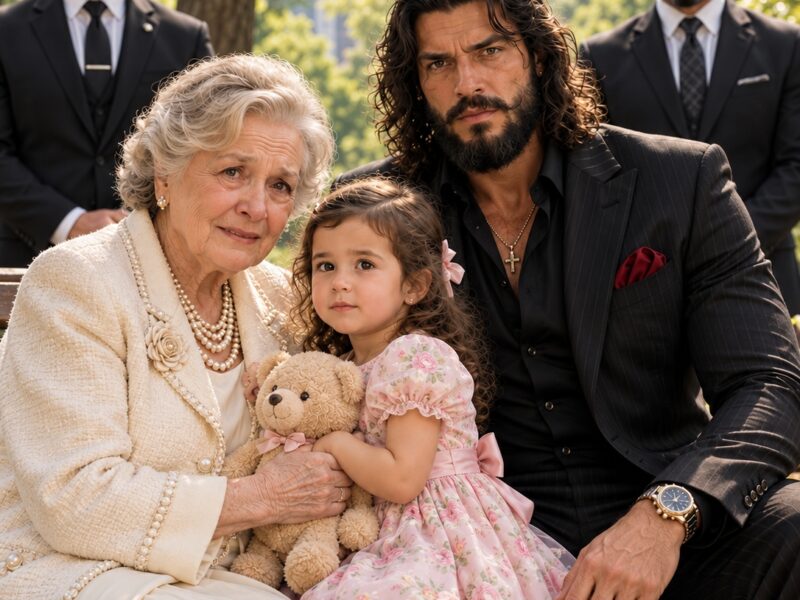
The Mafia Boss’s Mother Was Crying Alone—Then His Maid’s Little Girl Sat Beside Her
Vincent Moretti could make grown men lower their eyes without raising his voice.
That morning, his own mother walked out of his mansion without her coat because she could no longer recognize the boy she had raised inside the man he had become.
Then a four-year-old girl carrying a rabbit with one chewed ear sat beside her and did something no one in Boston had dared to do in years.
Elena Moretti had been crying for nineteen minutes before anyone came near her.
The bench in Fenwick Park was still wet from an overnight drizzle. Weak October sunlight caught on the gold band around her finger as she folded both hands tightly in her lap and stared at pigeons gathering near a trash can.
Three blocks away, behind iron gates and old trees, stood the Moretti estate.
Twenty minutes earlier, Elena had walked out of it without her coat.
The argument with her son had not been loud.
Arguments with Vincent rarely were.
That was part of what frightened people.
“Please,” Elena had said from the doorway of his study.
Vincent continued signing a contract.
“He has a seven-year-old daughter with a congenital heart condition.”
“I know.”
“She needs surgery.”
“I know that too.”
“Then act like you know.”
His pen stopped.
Vincent looked up.
At thirty-nine, he had his late father’s dark eyes and none of his easy warmth. His black shirt sleeves were rolled once at the forearms, and the October light from the tall windows sharpened the planes of a face newspapers described as controlled whenever they were being polite.
“Antonio stole eighteen thousand dollars.”
“He borrowed it.”
“He created a false vendor invoice and took money from a business under my protection.”
“To pay a hospital.”
“He still stole it.”
Elena crossed the room.
“He intended to replace it.”
“So does every desperate man after he’s caught.”
“He wasn’t caught.”
Vincent’s expression changed slightly.
“He disappeared.”
“Because he is terrified of you.”
“That is not a defense.”
“No.”
Elena held his gaze.
“It is an explanation.”
Vincent leaned back.
The old leather chair barely moved under him.
“You want me to tell two hundred men that rules change when the story behind breaking them is sad enough.”
“I want you to remember that rules were invented to protect people.”
“They were invented to prevent chaos.”
“Those are not opposites.”
Vincent looked away.
Elena knew that look.
She had seen it first when he was sixteen and his father had refused to let him quit football after a broken wrist.
Again when Vincent was twenty-nine and stood beside his father’s coffin without crying.
Again when, at thirty, he inherited an organization he had never admitted he wanted and spent the next decade turning grief into discipline so rigid nobody could find the frightened son inside it.
“Your father forgave people,” Elena said.
“My father trusted the man who arranged his murder.”
“That is not the same thing.”
“It was close enough.”
There it was.
The locked room.
Elena’s anger disappeared for half a second.
Grief took its place.
“Vincent.”
“No.”
His voice remained quiet.
“Antonio made a choice. Carlos Vega nearly lost his position because the missing money went through his books. If I excuse that because Antonio’s reason makes us uncomfortable, I tell every other man in the organization that desperation is a free pass.”
“I am not asking you to excuse it.”
“What are you asking?”
“Mercy.”
Vincent’s jaw tightened.
“My father had mercy.”
“Your father had judgment.”
“And where did that get him?”
Elena looked at her son for a long time.
Then she said the one thing she regretted before the sentence was finished.
“It did not turn him into you.”
Vincent became still.
Elena’s heart dropped.
But neither took the words back.
She turned.
Walked out of the study.
Past Daniel Russo, Vincent’s second-in-command, who immediately looked at the floor.
Past two security men at the front entrance.
Past the closet where her camel coat hung untouched.
Through the iron gate.
Three blocks to the park where she had once brought Vincent to chase pigeons when his shoes still fastened with Velcro.
Now she sat alone.
An older woman with damp hair, expensive shoes, and tears moving quietly down her face in a city where people had learned that anything connected to the Moretti name was best left alone. The source story likewise hinges on the feared boss’s mother crying on a park bench and a small child approaching her with an offered stuffed animal when every adult keeps their distance.
A jogger recognized Elena and crossed to the opposite path.
A man selling coffee from a cart suddenly found his register fascinating.
A woman walking a terrier slowed, then changed direction.
Nobody wanted to become part of Moretti business.
Nobody except Mia Bennett.
Mia was four.
Four-year-olds are famously bad at recognizing reputational danger.
She had been chasing a pigeon while her mother folded a picnic blanket twenty yards away. She wore yellow sneakers, denim overalls, and a pink sweater with one sleeve pushed higher than the other.
Under one arm she carried a stuffed rabbit named Walter.
Walter had once been white.
He was now the grayish color of something deeply loved and frequently dropped.
One ear had been chewed soft during Mia’s teething stage.
The other stood permanently sideways after an unfortunate trip through a washing machine.
Mia stopped when she saw Elena.
She stared.
Then walked directly toward her.
“Mia.”
Sophia Bennett’s voice came from the grass.
Mia kept walking.
Sophia turned.
Saw the woman on the bench.
And froze.
She had worked at the Moretti estate for two years.
Housekeeping.
Laundry.
Guest rooms.
Occasionally helping Elena with dinner arrangements when the regular staff was short.
Long enough to know Elena Moretti.
Long enough to know what happened to employees who made careless mistakes around powerful people.
Long enough to know that Vincent Moretti’s mother crying alone in a public park was absolutely none of Sophia Bennett’s business.
“Mia.”
Sharper this time.
Her daughter reached the bench.
Elena looked up.
Mia climbed beside her without asking.
Small legs swung six inches above the pavement.
Elena blinked.
Mia examined her face with the unembarrassed concentration children reserve for things adults pretend not to notice.
“You’re crying.”
Elena wiped beneath one eye.
“A little.”
“Why?”
Sophia reached them.
“Mia, sweetheart, come here.”
Mia ignored her mother.
Elena almost smiled.
“I had an argument.”
“Did you lose?”
The question caught Elena off guard.
“I’m not sure.”
Mia considered this.
Then held out Walter.
“You can have him.”
Elena looked at the rabbit.
Sophia’s heart nearly stopped.
“Mia.”
“She’s sad.”
“I know, baby, but—”
“She can borrow Walter.”
Elena slowly accepted the toy.
Walter’s flattened ear rested across her wrist.
“Isn’t he important?”
“He sleeps with me.”
“Then this is a serious loan.”
Mia nodded gravely.
“He helps when I have bad dreams.”
Something inside Elena loosened.
Not healed.
Just unclenched.
She laughed.
The sound came out mixed with a sob.
Mia seemed pleased.
Sophia stood three feet away, uncertain whether to apologize, retrieve the rabbit, remove her daughter, or vanish through the nearest hedge.
Then a black Mercedes stopped at the curb.
Sophia’s stomach dropped.
Rear door opened.
Vincent stepped out.
Daniel Russo came from the opposite side.
Another security man followed.
Vincent had been told his mother left the estate alone.
He had abandoned a meeting mid-sentence.
He expected anger.
Possibly tears.
He expected Elena to refuse his coat when he brought it.
He did not expect to find her laughing quietly with his maid’s daughter.
He stopped ten feet from the bench.
Daniel stopped behind him.
Nobody spoke.
Mia looked at Vincent.
Then at Daniel.
Then at the guard.
“Are you police?”
Daniel made a sound that might have been a cough.
Vincent stared at her.
“No.”
“Okay.”
That was apparently sufficient.
Elena looked up.
“Vincent.”
Her eyes were still damp.
But there was color in her face now.
He held her coat over one arm.
“You forgot this.”
“I noticed.”
“You could have called the driver.”
“I have legs.”
“I know.”
“And sometimes I use them.”
He exhaled through his nose.
Then noticed Walter.
“What is that?”
Mia answered.
“My rabbit.”
Vincent looked at her.
“You gave my mother your rabbit.”
“She was sad.”
Mia said it as if he had asked why people drank water when thirsty.
Vincent had negotiated with men who brought armed guards to lunch.
He had once sat through a four-hour federal deposition without changing his expression.
He had no idea what to say to a four-year-old who believed sorrow could be treated with a worn stuffed animal.
He crouched.
Daniel’s eyebrows rose.
Vincent ignored him.
“What’s his name?”
“Walter.”
“Walter.”
“Yes.”
Vincent looked at the rabbit.
“He looks experienced.”
“He’s brave.”
“I can tell.”
Mia leaned toward him.
“He bit the washing machine.”
Sophia covered her mouth.
Elena laughed again.
Vincent looked at his mother.
The sound did something unpleasantly precise to his chest.
He had not heard it in days.
Maybe weeks.
“Elena.”
Sophia finally found her voice.
“Mr. Moretti, I am so sorry. She wandered over before I realized who—”
“She didn’t do anything wrong.”
Vincent stood.
His tone was flat, but Sophia heard no anger.
Elena gave him a look.
“You could try saying it as if you mean it.”
Vincent looked at Mia.
Then Sophia.
“She did nothing wrong.”
Better.
Mia reached for Walter.
Then stopped.
“She needs him still.”
Vincent glanced at his mother.
“I think you may be right.”
Mia nodded.
Elena tucked Walter into the crook of her arm.
“Thank you.”
“You’re welcome.”
Vincent handed Elena her coat.
She did not put it on.
Of course.
“Mama.”
“What?”
“It is fifty-one degrees.”
“I survived winters before you were born.”
“You also complain about restaurants keeping air-conditioning at seventy.”
“Completely different.”
Daniel looked away to hide his smile.
Vincent crouched again beside Mia.
“Your mother works at my house.”
“I know.”
“Do you like it there?”
“It’s too big.”
Sophia’s face went white.
Vincent glanced at her.
“What?”
Mia continued.
“You could lose a whole person.”
Daniel coughed again.
Vincent almost smiled.
“Accurate.”
Elena touched his sleeve.
“Invite them tonight.”
Vincent looked at his mother.
“For what?”
“Dinner.”
“Mama.”
“I want company.”
“You have an entire household.”
“I want this company.”
She squeezed Walter.
Mia grinned.
Vincent looked at Sophia.
Sophia’s expression said she would prefer a root canal.
“Seven,” he said.
“Mr. Moretti, we don’t want to intrude.”
“My mother has decided you’re coming.”
Elena smiled.
“She knows him.”
Sophia swallowed.
“Seven.”
Vincent nodded.
Then his phone vibrated.
He checked the screen.
Daniel saw his expression change before anyone else did.
Message from Luca DeSantis, who ran security for the Moretti organization.
FOUND ANTONIO REYES.
The softness left Vincent’s face.
Elena noticed.
“What?”
“Nothing.”
Her eyes narrowed.
“Vincent.”
“Later.”
He looked at Daniel.
One glance.
Daniel understood.
They had found the man his mother had been crying about.
Vincent put the phone away.
Sophia watched him.
Something in her expression tightened.
He noticed.
That mattered later.
At seven twelve that evening, Sophia stood in the Moretti kitchen wearing the only navy dress she owned while Mia attempted to convince Karen Doyle, the housekeeper, that chocolate cake counted as dinner.
“It has eggs,” Mia argued.
Karen, sixty-one and impossible to manipulate, folded a napkin.
“So does meatloaf.”
“I don’t like meatloaf.”
“Then my argument improves.”
Elena entered carrying Walter.
Mia brightened.
“You kept him safe.”
“I promised.”
Sophia looked toward the doorway.
No Vincent.
Good.
Then felt guilty for the relief.
Elena touched her arm.
“Relax.”
“I’m trying.”
“You’re doing badly.”
“That obvious?”
“To mothers.”
They went into a small sitting room near the kitchen.
Not the formal salon.
Not the dining room where senators and union presidents reportedly found their schedules suddenly flexible.
This room contained books, old family photographs, mismatched lamps, and an upright piano nobody played anymore.
Mia sat on the rug with sugar cubes Elena had unwisely provided.
Sophia took tea.
Her hands shook slightly.
Elena noticed.
“Your daughter does not fear anyone.”
“She’s four.”
“Good age.”
“She also thinks every dog wants to be hugged.”
“Less good.”
For a few minutes they spoke about harmless things.
Preschool.
Elena’s herb garden.
Mia’s refusal to wear socks that matched.
Then Elena asked:
“You grew up near Alder Street, didn’t you?”
Sophia’s cup stopped halfway to her mouth.
“Yes.”
“The brick apartments behind Saint Anthony’s.”
“Yes.”
Elena studied her.
“I knew someone from there.”
Sophia set the cup down.
Her pulse had begun beating hard beneath her jaw.
“Antonio Reyes.”
Mia continued stacking sugar cubes.
Sophia stared at Elena.
“He worked maintenance here when he was young.”
Elena smiled faintly.
“Before Vincent’s father died. Antonio was twenty, maybe twenty-one. Terrible poker player.”
Sophia’s throat tightened.
“He still is.”
Elena’s smile disappeared.
“You know him.”
Sophia looked toward Mia.
Then the closed door.
“He’s my brother.”
Silence.
Elena inhaled.
Not dramatically.
Enough.
“I wondered.”
“How?”
“The face.”
Sophia looked down.
“Different fathers.”
“Same mother?”
“Yes.”
Elena leaned back.
“Does Vincent know?”
“No.”
Sophia’s answer came too quickly.
“I mean, I don’t think so.”
“You’ve worked here two years.”
“My married name is Bennett.”
“And security didn’t connect it.”
“My marriage records are sealed because of a domestic violence case involving Mia’s father.”
Elena’s face changed.
Sophia continued before sympathy could derail her.
“I never lied on my application. I listed Antonio as a half brother, but he hadn’t worked for this family in years. I didn’t know he had gotten mixed up with anyone connected to Vincent again.”
“He did.”
“I know now.”
Elena folded both hands around her teacup.
Mia’s sugar tower collapsed.
She sighed and rebuilt.
Sophia whispered:
“Antonio’s daughter is sick.”
“Lily.”
Sophia looked up.
“You know her name.”
“I asked.”
Of course Elena had.
“Seven,” Sophia said. “Tetralogy of Fallot. She had surgery when she was a baby, but there are complications now. Boston Children’s says she needs another operation and specialized follow-up.”
“Insurance?”
“Covers some.”
“How much is left?”
“More than Antonio will make in years.”
“Eighteen thousand?”
“That was the deposit.”
Elena looked away.
Sophia’s voice broke.
“He did something wrong.”
“Yes.”
“I know that.”
“I believe you.”
“I’m not asking anyone to pretend he didn’t.”
Elena met her eyes.
“Then what are you asking?”
Sophia took a breath.
“For him to still be alive when his daughter wakes up from surgery.”
Elena became very still.
Mia looked up.
“Mommy?”
Sophia immediately changed her face.
“Yes, baby?”
“You’re sad too.”
“I’m okay.”
Mia frowned.
Children know that lie early.
She retrieved Walter from Elena’s chair.
Walked to Sophia.
Placed him in her lap.
Elena closed her eyes briefly.
Same gesture.
Same small kindness.
“What did Antonio do exactly?” she asked.
Sophia stroked Walter’s worn ear.
“He worked nights dispatching for North Harbor Produce.”
Elena knew the business.
Legitimate company.
One of several warehouses operating under Moretti protection contracts.
“He accessed an emergency cash reserve through a false vendor invoice.”
“He knew how?”
“He handled expense routing.”
“He planned to repay it.”
“Yes.”
“How?”
“Weekend construction work. Tax refund. Anything.”
Elena’s expression remained sad.
“That could take years.”
“He was desperate.”
“Desperation explains.”
Sophia looked at her.
“It doesn’t erase.”
“No.”
Silence.
Then Elena said:
“Vincent gave the order to find him.”
Sophia went pale.
Mia watched her mother’s face.
“What does that mean?”
Elena answered carefully.
“It means your uncle is in trouble.”
Sophia’s eyes filled.
“What will Vincent do?”
“I don’t know.”
That frightened her more than any dramatic promise would have.
Down the hall, inside the study, Vincent sat with Luca DeSantis’s message open.
A photograph followed.
Antonio Reyes sat in a back room at a warehouse in Chelsea.
No blood.
No visible injury.
Wrists secured in front.
Face gray with fear.
Vincent had specifically ordered nobody to touch him until he decided.
Daniel stood near the desk.
“He came quietly.”
“Good.”
“He had nine hundred dollars in his pocket.”
“Running?”
“Probably.”
“Family?”
“Wife died two years ago. Daughter staying with neighbor.”
Vincent knew that.
Daniel continued.
“Surgery scheduled provisionally for next Friday if they can secure the hospital portion.”
Vincent looked up.
“You checked.”
“You told me to.”
“Anything else?”
Daniel hesitated.
“Antonio Reyes has a half sister.”
Vincent waited.
“Sophia Bennett.”
Silence.
“The maid.”
“Yes.”
Vincent leaned back.
Daniel placed a file on the desk.
“She never hid it legally. It was there. Different last name, sealed marriage records, nobody considered it material when she was hired.”
Vincent looked toward the hallway.
His mother.
Sophia.
The child with the rabbit.
A strange discomfort moved through him.
“When did we confirm?”
“This afternoon.”
“Before the park?”
“Yes.”
Vincent stared.
“So when my mother asked me to invite them—”
“She didn’t know.”
“You sure?”
“Yes.”
“Does Sophia?”
“Unclear.”
Vincent picked up his phone.
Luca had sent:
WHAT DO YOU WANT DONE?
Vincent did not answer.
Daniel watched him.
“What are you thinking?”
“That everyone in this house knows something different.”
“That is usually how trouble begins.”
Vincent looked toward the framed photograph on the edge of his desk.
His father, Michael Moretti, laughing on a fishing boat fifteen years earlier.
Alive.
Open.
Easy.
Dead three months after that photograph was taken because one of his closest captains had given a rival crew his schedule.
Vincent had learned the lesson everyone expected him to learn.
Trust killed.
Mercy exposed weakness.
Rules saved lives.
His mother claimed he had learned the wrong one.
He hated when she might be right.
A knock came.
Sophia stood in the doorway.
Pale.
Elena behind her.
Vincent looked at Daniel.
“Leave us.”
Daniel left.
Sophia walked inside.
Her hands were shaking.
She did not hide them.
“You know.”
Vincent did not pretend.
“Antonio is your brother.”
“Yes.”
“You should have told me.”
“I should have.”
“Why didn’t you?”
“I needed the job.”
“That’s not enough.”
“No.”
Sophia looked directly at him.
“I was afraid.”
Vincent’s face hardened.
“Of what?”
“You.”
The answer landed cleanly.
Elena closed the door behind them.
Sophia continued.
“I didn’t know whether working here while being related to someone who once did jobs around your family would make me suspicious.”
“It would have made you transparent.”
“Those are different things to people with power.”
Vincent stared.
Sophia swallowed.
“My brother made a terrible choice.”
“Yes.”
“He did not take that money to gamble.”
“I know.”
“He didn’t take it to disappear.”
“I know.”
“He took it because Lily needs surgery.”
“I know.”
Sophia’s eyes filled.
“Then you know everything except what it feels like to hear a seven-year-old ask whether her dad can come into the operating room with her because she doesn’t want to be brave alone.”
Vincent went still.
Elena watched him.
Sophia’s voice cracked.
“I’m not asking you to say what he did was fine.”
“Good.”
“I’m asking you not to make his daughter pay for it.”
Vincent stood.
Sophia took one involuntary step back.
He noticed.
Hated that he noticed.
“Do you believe I was going to kill him?”
Sophia said nothing.
Vincent almost laughed.
Not humor.
“That silence is insulting.”
“It’s honest.”
His jaw tightened.
Elena said:
“Vincent.”
He lifted one hand.
“No.”
To Sophia:
“I do not execute men over eighteen thousand dollars.”
“I didn’t know that.”
“You work in my house.”
“I make beds.”
The sentence stopped him.
“I do not sit in meetings. I don’t know which rumors are real. I know men go quiet when you walk into rooms.”
Her chin trembled.
“And I know my brother is somewhere with people who work for you.”
Vincent’s phone vibrated.
Luca.
Again.
He ignored it.
“What do you think should happen?”
Sophia blinked.
“What?”
“To Antonio.”
“I don’t get to decide.”
“Pretend you do.”
She looked toward Elena.
Then back.
“He pays it back.”
“How?”
“Work.”
“He already had work.”
“Better work.”
“Reward him?”
“No.”
Sophia’s fear changed into frustration.
“Give him a way to repair what he did without destroying the reason he did it.”
Vincent studied her.
“What about Carlos Vega?”
Sophia frowned.
“Who?”
“Manager at North Harbor. The false invoice ran through his authorization line. For thirty-six hours my people thought Carlos stole the money.”
Sophia went pale.
“He could have lost his job.”
“He could have lost more than that.”
“I didn’t know.”
“Antonio did.”
Sophia looked down.
That mattered.
Vincent continued.
“Your brother’s desperation did not happen in an empty room. It put another man under suspicion.”
“I understand.”
“Does Antonio?”
“I don’t know.”
“Then maybe we start there.”
He picked up the phone.
Called Luca.
“Bring him here.”
Sophia’s breath caught.
Elena stepped forward.
“Vincent.”
“Untied.”
Pause.
Vincent listened.
“No. No basement. Front door.”
Another pause.
“Because I said so.”
He ended the call.
Sophia stared.
“What are you going to do?”
Vincent looked at Walter still clutched in her hands.
“I haven’t decided.”
That answer was true.
It frightened him.
Forty minutes later, two dark SUVs came through the gate.
Sophia stood near the foyer windows.
Antonio stepped out of the second vehicle.
Hands free.
Face pale.
His jacket wrinkled.
Three days of fear embedded around his eyes.
Sophia ran.
“Antonio.”
He hugged her.
Hard.
Then saw Vincent at the top of the stairs.
The hug loosened.
Mia stood behind Elena on the landing in pajamas.
Walter returned to her arms.
Vincent descended slowly.
Nobody spoke.
Daniel.
Luca.
Two guards.
Karen near the kitchen door.
Elena halfway up the stairs.
A household holding its breath.
Vincent stopped six feet from Antonio.
“You took eighteen thousand dollars.”
Antonio nodded.
“Yes.”
“Say how.”
His face flushed.
“Fake vendor invoice.”
“Under whose authorization?”
“Carlos.”
“Did Carlos know?”
“No.”
“Did you understand suspicion would fall on him?”
Antonio’s eyes closed.
“Yes.”
Sophia looked at her brother.
Pain.
Disappointment.
Not blind defense.
Good.
Vincent continued.
“Why didn’t you ask?”
Antonio laughed once.
Bitter.
“Ask you?”
“Yes.”
“I’m a dispatcher.”
“So?”
“You are Vincent Moretti.”
“That’s not an explanation.”
Antonio looked around.
At the guards.
At Luca.
At the marble staircase.
“It feels like one.”
Vincent absorbed that.
Antonio continued.
“I tried bank loans. Two.”
“Denied.”
“Yes.”
“Hospital assistance?”
“Waiting list.”
“Charity care?”
“Partial.”
“What about me?”
Antonio stared.
“My father borrowed from your father once.”
Elena’s face changed.
Vincent waited.
“Back when I was nineteen.”
“What happened?”
“He missed a payment.”
Vincent knew parts of the story.
Antonio supplied the rest.
“Your father forgave the interest because my mother was sick.”
Elena smiled sadly.
Antonio looked at Vincent.
“Then your father died.”
Silence.
“After that, everyone said rules changed.”
Vincent felt something sharp move beneath his ribs.
“You believed I would punish you for asking.”
“Yes.”
“Enough to steal.”
Antonio looked ashamed.
“Yes.”
Vincent walked past him.
To the console table.
Opened a folder Daniel had placed there.
Medical documents.
Boston Children’s estimate.
Cardiology report.
Lily Reyes.
Seven years old.
Repeat pulmonary valve procedure and follow-up.
Vincent read.
Not because he doubted the child existed.
Because decisions mattered more when facts were handled carefully.
Elena came downstairs.
Mia followed.
Sophia whispered:
“Baby, stay with Mrs. Moretti.”
Mia ignored her.
Of course.
Vincent closed the file.
“Carlos Vega comes tomorrow.”
Antonio looked confused.
“You will apologize to him in person.”
“Yes.”
“You will explain exactly what you did.”
“Yes.”
“Then you will repay the eighteen thousand.”
Antonio’s shoulders dropped.
“Okay.”
“Not by borrowing.”
“Yes.”
“Not from anybody who charges interest in an alley.”
“Yes.”
Vincent looked at Daniel.
“North Harbor needs a legitimate compliance clerk.”
Daniel raised one eyebrow.
“It does.”
“Antonio will work there.”
Luca shifted.
Vincent heard.
Ignored.
Antonio stared.
“I don’t understand.”
“You know the system well enough to abuse it.”
Vincent’s voice sharpened.
“Now you learn it well enough to protect it.”
Antonio swallowed.
“Pay?”
“Normal salary.”
“Repayment?”
“Payroll deduction.”
“How long?”
“As long as it takes.”
Antonio’s knees seemed to soften.
Vincent continued before gratitude could arrive.
“Lily’s surgery is separate.”
Silence.
Sophia’s hand rose to her mouth.
Antonio looked at him.
“What?”
“There is a medical hardship fund attached to Moretti Community Foundation.”
Luca actually turned his head.
Vincent saw.
So did Elena.
Vincent continued.
“It has been mostly useless because my accountant likes plaques more than people.”
Daniel hid a smile.
“The foundation will pay what insurance and existing assistance do not.”
Antonio’s eyes filled.
“No.”
Vincent’s voice hardened.
“What?”
“I mean—”
Antonio looked down.
“I can’t let you buy me.”
The room changed.
Vincent studied him.
Good.
“Then don’t.”
He stepped closer.
“There is no loyalty requirement.”
Antonio looked up.
“No debt to me.”
Silence.
“No favors.”
Antonio’s breathing changed.
“The grant goes through the hospital after legal review. If you quit the job in six months, your daughter keeps her surgery.”
Elena’s eyes filled.
Vincent hated that.
Loved it too.
Didn’t know what to do with either.
Antonio whispered:
“Why?”
Vincent glanced toward Mia.
She sat on the bottom stair hugging Walter.
Watching every adult with enormous eyes.
“Because children should not be collateral.”
Luca shifted again.
This time Vincent turned.
“You disagree?”
Everyone looked at Luca.
Forty-six.
Broad-shouldered.
Twenty years in the organization.
His father had served Vincent’s father.
He looked uncomfortable being forced into honesty.
“I think people will talk.”
“They already do.”
“They’ll say Antonio stole from you and got a better job.”
Vincent nodded.
“That is possible.”
“Others will try.”
“Then they will discover context matters.”
Luca’s jaw tightened.
“Rules don’t work like that.”
Vincent looked at his mother.
Then back.
“Maybe that is the problem.”
Nobody spoke.
Luca said:
“Your father—”
“Do not use my father to win arguments with me.”
The temperature dropped.
Luca stopped.
Vincent continued, calmer:
“Antonio repays the money. He apologizes to the man he endangered. He accepts monitoring. He loses access to cash systems for five years.”
Antonio flinched.
Good.
Consequences.
“But I am not going to break a father’s hands because he tried to keep his daughter alive.”
Mia’s head tilted.
Sophia immediately said:
“No one is breaking anything, baby.”
Vincent closed his eyes.
“Elena.”
His mother covered a laugh.
The tension fractured just enough to breathe.
Antonio cried.
Quietly.
Embarrassed.
Vincent looked away and gave him the dignity of not watching.
The next morning, Carlos Vega came to the estate.
Vincent made Antonio tell him everything.
No excuses.
Carlos listened.
At fifty-three, he had spent twenty-six years working warehouses and had nearly lost a job he needed to keep his wife’s health insurance because Antonio used his authorization route.
When Antonio finished, Carlos said:
“You knew it would point at me.”
“Yes.”
“And did it anyway.”
“Yes.”
Carlos stared.
“My wife thought I’d stolen it.”
Antonio’s face crumpled.
“I’m sorry.”
Carlos looked at Vincent.
“You want me to forgive him?”
“No.”
That surprised both men.
Vincent sat behind his desk.
“I want you to decide what working beside him requires.”
Carlos thought.
“Different department.”
“Done.”
“No authorization access.”
“Already done.”
“He tells my wife.”
Antonio looked up.
Carlos’s voice shook.
“She deserves to hear from the man who made her believe I was a thief.”
Antonio nodded.
“I will.”
Carlos left.
Not reconciled.
But heard.
Vincent watched the door close.
Daniel, standing by the window, said:
“That was harder than hitting him.”
Vincent looked at him.
“Good.”
Daniel smiled faintly.
Elena’s victory lasted forty-eight hours.
Then the rumor reached the docks.
Moretti forgives thieves now.
It moved from warehouse break rooms to bars near the harbor.
From truck drivers to bookmakers.
Distorted with each telling.
Antonio stole twenty thousand.
No consequence.
His sister cried to Vincent’s mother.
A little girl changed the boss’s mind.
By Thursday, someone decided to test it.
A refrigerated truck carrying pharmaceuticals disappeared from a Moretti-contracted yard.
Not illegal goods.
Legitimate shipment.
Worth almost three hundred thousand dollars.
Luca entered Vincent’s office at eight that night.
“There.”
Vincent looked up.
“You look pleased.”
“I’m not.”
“You are a little.”
Luca ignored it.
“Truck vanished during shift change.”
“Inside help?”
“Probably.”
“Police?”
“Carrier reported it.”
Luca stared.
“We calling police now?”
“For stolen pharmaceuticals?”
“You know what I mean.”
Vincent did.
Old Vincent would have handled it privately.
Men pulled into rooms.
Threats.
Fear traveling faster than facts.
Instead:
“Get security footage.”
“We have it.”
“Badge logs.”
“Working.”
“Freeze contractor access.”
Luca’s jaw tightened.
“And when we find them?”
“They lose the contract.”
“That’s it?”
“If evidence supports criminal charges, police get it.”
Luca laughed.
“Jesus.”
Vincent leaned back.
“You want to beat somebody because a truck was stolen?”
“I want people to know there is still a cost.”
“There will be.”
“Fear works.”
Vincent looked at him.
“So does payroll.”
Luca frowned.
“What?”
“Whoever stole that truck had access.”
“Yes.”
“They expected to sell the load.”
“Yes.”
“Then hurt the thing they wanted.”
“Money.”
“Exactly.”
They found the truck in six hours.
Two subcontractors and a night supervisor.
Nobody touched them.
They were terminated.
Blacklisted from Moretti legitimate contracts.
Prosecuted through the carrier’s insurance investigation.
Their unpaid profit disappeared before it existed.
A week later, Luca returned.
“No one’s talking about softness anymore.”
Vincent signed a paper.
“What are they talking about?”
“That you’re boring.”
Vincent looked up.
Elena, seated near the fireplace, smiled.
“Your father would be devastated.”
Vincent almost smiled too.
Lily’s surgery happened the following Friday.
Vincent did not go.
He had no place there.
Sophia took the day off.
Mia stayed with Elena at the estate.
Antonio remained at the hospital.
At 2:17 p.m., Sophia texted Elena.
She’s out. Surgeon says it went well.
Elena cried.
Mia found her in the small library.
Walter immediately changed hands.
Again.
Elena laughed through tears.
“You are going to wear this poor rabbit out rescuing old women.”
“I can get another.”
“No.”
Elena hugged Walter.
“This one works.”
Vincent passed the open doorway.
Stopped.
Saw his mother crying.
Old reflex: fix.
“What happened?”
Elena showed him the message.
He read.
Nodded.
“Good.”
Mia stared up.
“That’s all?”
Vincent looked at her.
“What else?”
“You smile when good stuff happens.”
“I do.”
“No.”
Elena covered her mouth.
Vincent tried.
It looked terrible.
Mia frowned.
“Your face forgot.”
Daniel, behind him, turned away.
Vincent said:
“I am surrounded by disloyal people.”
Mia laughed.
That was better than the smile.
Over the next month, Elena watched changes in her son that no newspaper would ever report.
He still ran meetings the same way.
Still expected numbers to be correct.
Still frightened grown men by becoming quieter when displeased.
But he began asking different questions.
When a driver missed two shifts, Vincent asked why before assuming disrespect.
Kid hospitalized.
The company arranged paid leave.
When one bookmaker fell behind, Vincent discovered his wife had been diagnosed with breast cancer.
Instead of forgiving the balance blindly, he restructured it away from predatory interest and transferred the man into legitimate payroll.
Luca complained.
Vincent listened.
Sometimes Luca was right.
Mercy without structure could become favoritism.
So Vincent built structure.
The Moretti Community Foundation’s useless medical fund became a real emergency-assistance program.
Applications reviewed by an outside accountant, a social worker, and a lawyer.
No loyalty requirement.
No cash handouts.
Payments directly to hospitals, landlords, or licensed providers.
Daniel called it “bureaucratic compassion.”
Vincent said:
“That sounds insulting.”
“It is.”
“It also works.”
“Yes.”
The first month cost four hundred thousand dollars.
The second saved Vincent more than that when employee turnover dropped across three legitimate companies.
He did not mention that to his mother.
She found out anyway.
“You see?”
Elena said over Sunday dinner.
Vincent cut into his steak.
“No.”
“Mercy can be practical.”
“That ruins your moral argument.”
“I contain multitudes.”
Mia, invited because Elena now treated her as a permanent social appointment, whispered to Sophia:
“What does multi-toads mean?”
Sophia nearly choked.
The rabbit had acquired a place of honor on Elena’s bedroom bookshelf.
Mia had tried to take it home once.
Elena refused.
“You gave him to me.”
“I said borrow.”
“I am old. I may need him indefinitely.”
Mia thought.
“Okay.”
Then:
“You can leave him to me when you die.”
Sophia closed her eyes.
“Mia.”
Elena laughed until she cried again.
Vincent heard from the hallway.
This time he did not rush in.
He paused.
Listened.
Kept walking.
There was another conversation he had been avoiding.
His father.
Elena forced it three weeks after Lily came home.
Vincent was in his study late.
Michael Moretti’s photograph lay on the desk.
Elena entered without knocking.
He did not look up.
“You’re thinking about him.”
“Yes.”
“You’ve been angry at him for ten years.”
“I’m not angry.”
“Mothers know when sons lie.”
Vincent leaned back.
“He trusted Frank Salerno.”
“Yes.”
“Frank gave the Albano crew his route.”
“Yes.”
“Papa died because he thought loyalty could be earned by kindness.”
Elena’s face hardened.
“No.”
Vincent stared.
“Your father died because Frank was greedy and afraid.”
“Same result.”
“No.”
Elena sat.
“Michael forgave Frank’s brother a debt once.”
“I know.”
“Frank was grateful for eight years.”
“Then betrayed him.”
“Yes.”
“So—”
“Your father’s kindness did not cause Frank’s betrayal.”
Vincent looked away.
Elena continued.
“Frank betrayed him because the Albanos offered him enough money to imagine he could survive the consequences.”
“You cannot know that.”
“I was there.”
“So was I.”
“You were twenty-nine and bleeding inside from watching your father die.”
Vincent’s jaw tightened.
“You built a lesson because grief needed one.”
Silence.
“You decided mercy was weakness because it was easier than admitting sometimes terrible things happen even when we make good choices.”
That sentence found the locked room.
Vincent’s fingers curled.
“The other way gets people killed.”
“Everything gets people killed eventually.”
“Mama.”
“I’m sixty-eight. I’ve earned morbidity.”
He almost smiled.
Elena leaned forward.
“Your father was not foolish because he loved people.”
“He misjudged one.”
“Yes.”
“Exactly.”
“That is a failure of judgment.”
She held his gaze.
“Not of love.”
Vincent said nothing.
Elena continued.
“You have spent ten years punishing kindness for a betrayal it did not commit.”
The room became very quiet.
His phone buzzed.
Vincent ignored it.
That surprised Elena more than anything.
Months passed.
Antonio became good at compliance.
Better than good.
People who know how systems can be abused often become irritatingly effective at closing the holes.
He repaid $4,700 by spring.
Carlos Vega still did not invite him to dinner.
But one morning Carlos left a coffee on Antonio’s desk.
No note.
Progress sometimes looks like caffeine.
Lily recovered.
She returned to school part-time.
Her lips stayed pink when she laughed.
Sophia sent Elena a video.
Mia and Lily painting horses at the kitchen table.
Vincent watched it twice.
Pretended he had only watched once.
Sophia noticed.
Said nothing.
Her relationship with Vincent changed too.
Not romantic.
At least not in any rushed, ridiculous way.
Something slower.
Respect.
She stopped trembling when he entered a room.
He stopped speaking to her as if every interaction were an instruction.
One evening, Sophia brought payroll papers to his study because Karen had gone home sick.
Vincent looked up.
“You can leave them.”
She did.
Then stayed.
He noticed.
“What?”
“I want to ask you something.”
“Dangerous.”
“Why did you invite us that first night?”
“My mother told me to.”
“That isn’t the whole answer.”
Vincent leaned back.
“Mia made her laugh.”
“Yes.”
“I wanted to understand why.”
Sophia considered.
“Did you?”
“Children don’t calculate.”
“No.”
“That is apparently unsettling.”
She smiled.
Vincent looked toward the hallway.
“Mia gave away the thing she loved most because someone looked sad.”
“Yes.”
“She didn’t ask if my mother deserved it.”
“No.”
“Or whether she’d get it back.”
“No.”
He looked at Sophia.
“I had forgotten people do things like that.”
Sophia’s expression softened.
“They do.”
“Not in my business.”
“Maybe that is why you noticed.”
He absorbed that.
Then:
“Your daughter is terrifying.”
“She gets worse when tired.”
“Good to know.”
Sophia turned to leave.
Vincent said:
“Thank you.”
She stopped.
“For?”
“Raising her that way.”
Sophia looked back.
“Mia came out like that.”
“No.”
Vincent shook his head.
“Children learn where kindness is safe.”
That stayed with her.
Spring came late to Boston.
Fenwick Park turned green again.
Elena returned to the same bench.
Walter beside her.
This time she wore her coat.
Mia sat next to her throwing breadcrumbs toward pigeons and violating three posted rules about feeding wildlife.
Sophia stood nearby talking to Antonio.
Lily sat in a stroller-style recovery chair, more for fatigue than mobility, pink baseball cap low over her forehead.
She laughed when a pigeon walked onto Antonio’s shoe.
Her lips stayed pink.
Elena noticed.
So did Sophia.
They looked at each other.
No words necessary.
A black Mercedes pulled to the curb.
Mia groaned.
“He brought the fancy car.”
Vincent stepped out.
“No guards visible?” Sophia asked.
Daniel emerged from the other side.
“Never mind.”
Vincent carried four coffees and two hot chocolates.
Mia looked suspicious.
“Did you get mine right?”
“Chocolate. No whipped cream because you said whipped cream is air pretending to be food.”
Mia nodded.
“You remembered.”
Vincent handed Elena coffee.
She studied him.
“What?”
“Nothing.”
“I dislike that look.”
“You came to a park voluntarily.”
“I have a meeting nearby.”
Daniel said:
“No, you don’t.”
Vincent slowly turned.
Daniel drank his coffee.
Elena laughed.
Vincent sat.
The bench creaked.
For a few minutes, nobody spoke.
Pigeons moved around their shoes.
Cars hissed on damp pavement.
Mia explained to Lily that Walter technically belonged to Elena now, though ownership would revert “after natural causes.”
Sophia covered her face.
Vincent looked at his mother.
“I am sorry.”
Elena became still.
He did not look at her.
“For the study.”
She waited.
“For what I said.”
“You said many annoying things.”
“For making you think the boy you raised was gone.”
Elena’s eyes filled.
Vincent stared toward the pond.
“I thought being hard enough would keep me from making Papa’s mistakes.”
“Mmm.”
“I am beginning to think I simply made different ones.”
Elena reached for his hand.
Vincent let her.
No speech.
No transformation completed.
Just contact.
After a minute, Elena asked:
“What changed your mind?”
Vincent looked at Mia.
She was showing Lily how to break bread into small pieces for birds.
“She did.”
Mia looked up.
“What?”
“Nothing.”
“I heard my name.”
Vincent almost smiled.
Elena squeezed his hand.
“One child?”
“No.”
Vincent looked at his mother.
“One child reminded me of something.”
“What?”
“That fear is not the only thing people obey.”
Daniel stood behind them.
Quiet.
Listening.
Vincent continued:
“Antonio works harder than half the men I’ve threatened.”
Sophia looked over.
“Because you spared him?”
“No.”
Vincent shook his head.
“Because I gave him something he does not want to lose.”
Elena smiled.
“Your father knew that.”
“I know.”
That cost him something to say.
Good.
Real change should cost.
Six months after the park bench, Vincent made a decision that surprised everyone.
He shut down Moretti lending.
The predatory side.
Not the banks.
Not legitimate financing.
The informal loans where men signed nothing and still owed forever.
It had been profitable.
Very.
Luca fought him for two hours.
“You cut that, Albano takes it.”
“Then Albano can inherit the funerals.”
“That money funds protection.”
“Our legitimate companies fund protection.”
“Less.”
“Then we spend less.”
Luca stared.
“You are changing the whole structure because a toddler gave your mother a rabbit.”
Vincent thought about it.
“No.”
“Then why?”
“Because the toddler made it impossible to keep pretending I did not know what the structure was doing.”
Luca looked away.
That was different.
Months earlier, Luca might have left.
Now he stayed.
“Fine.”
Vincent raised an eyebrow.
“That easy?”
“No.”
Luca sat again.
“I have seventeen objections.”
“Of course.”
They worked until midnight.
That was reform in Vincent’s world.
Not purity.
Not absolution.
Spreadsheets.
Cut revenue.
Angry men.
Contracts rewritten.
People who depended on illegal income needing legitimate jobs or choosing to leave.
Some left.
Vincent let them.
Some joined rivals.
He prepared for that.
Not every act of mercy produced gratitude.
He learned that too.
One former collector tried to extort a Moretti-owned restaurant after being dismissed.
Vincent did not break his hands.
He had restaurant cameras preserved, filed a police report through counsel, and allowed the man to discover that consequences can wear a suit and carry a case number.
Daniel called it “deeply unsatisfying.”
Vincent said:
“You’re free to watch courtroom television.”
Elena laughed when she heard.
A year after the bench, Lily’s cardiologist reduced her restrictions.
Antonio had repaid almost half of what he stole.
Carlos Vega invited him to his daughter’s graduation barbecue.
No dramatic reconciliation.
Antonio brought potato salad.
Carlos complained it had too much mustard.
That was enough.
Sophia left full-time housekeeping.
Not because Vincent dismissed her.
Because the community foundation hired her as operations coordinator for the medical hardship program.
She resisted.
“I don’t have a degree.”
“You understand the applicants.”
“That is not a credential.”
“It is not the only credential.”
She stared.
“Did you create this job for me?”
“No.”
She narrowed her eyes.
Daniel, across the office, said:
“He did not.”
Vincent looked betrayed.
Daniel continued:
“Elena created it.”
Sophia smiled.
“Of course.”
Elena had recruited an outside director.
Applications were reviewed without Vincent.
That was Sophia’s condition.
She accepted.
Mia still came to the estate on Thursdays.
Not because Sophia worked there.
Because Elena refused to surrender her.
“Grandmother rights,” Elena claimed.
“You are not her grandmother.”
“Administrative detail.”
Mia started calling her Nonna anyway.
Vincent pretended not to react.
The first time Mia called him Uncle Vincent, he stopped walking.
Daniel nearly walked into him.
Mia said:
“Uncle Vincent?”
He looked down.
“Yes?”
“Can Walter sleep here?”
“He already lives here.”
“I mean my new rabbit.”
She held up a pristine white stuffed rabbit.
Both ears intact.
Vincent stared.
“No.”
“Why?”
“One rabbit has already destabilized this organization.”
Mia had no idea what that meant.
She accepted it as evidence of adult weirdness.
Three years after that first morning, Elena sat in Vincent’s study.
His father’s photograph remained on the desk.
The same one.
Fishing boat.
Sunlight.
Michael Moretti laughing.
Vincent no longer kept it facedown after difficult meetings.
That mattered.
Elena noticed.
“You finally stopped blaming him.”
“No.”
She raised an eyebrow.
“I stopped blaming the wrong part.”
“Better.”
Vincent poured coffee.
His father had once said power without mercy was only fear in a better suit.
Vincent had spent most of his adult life thinking that sounded poetic and impractical.
Now he understood the practical part.
Fear could make people obey.
It could not make them stay when a better offer appeared.
It could not make a desperate man ask for help before stealing.
It could not make an employee tell you bad news.
It could not make a four-year-old sit beside your mother when everyone else was too frightened to get close.
He said:
“I wish he had lived long enough for me to tell him I was wrong.”
Elena looked at the photograph.
“He probably knew.”
“That is irritating.”
“He was your father.”
“Still irritating.”
She smiled.
Then:
“You know what I remember most about that morning?”
“My cruelty?”
“Your coat.”
Vincent frowned.
“My coat?”
“You brought mine.”
“Oh.”
“You were furious with me.”
“Yes.”
“You still came looking.”
He looked down.
Elena continued.
“The boy was never completely gone.”
Vincent said nothing.
Sometimes mothers win arguments by waiting.
Outside, Mia’s voice carried from the hallway.
“NONNA!”
Elena stood.
“There is my employer.”
Vincent looked up.
“You encourage her.”
“Absolutely.”
Mia entered holding Walter.
Still gray.
Still one-eared.
Still somehow alive.
She climbed into Elena’s chair.
Then saw the photograph.
“Who’s that?”
Vincent looked at his father.
“My dad.”
Mia stared.
“He looks nicer than you.”
Elena made a strangled sound.
Vincent closed his eyes.
“He was.”
“Did he yell?”
“No.”
“Did he cry?”
Vincent opened his eyes.
“Sometimes.”
“Did you?”
“Mia.”
“What?”
Elena sat beside her.
Vincent looked at the child.
Three years older.
Still direct.
Still not afraid of him.
“Yes.”
Mia waited.
“When?”
Vincent glanced at his mother.
Elena understood.
“After my father died.”
Mia nodded.
“That makes sense.”
Nothing else.
No embarrassment.
No pity.
Just acceptance.
Vincent realized with a strange ache that adults spend years learning to hide things children consider ordinary.
Mia held Walter toward him.
“You can borrow him.”
Vincent stared.
Elena smiled.
“Careful.”
“He has power.”
Mia frowned.
“He’s a rabbit.”
Vincent took Walter.
The fur was warm from her hands.
He placed the rabbit on his desk beside his father’s photograph.
For one afternoon.
Nothing more.
At dinner, Sophia saw it.
Stopped.
“You finally got custody?”
“Temporary.”
“High risk.”
“You have no idea.”
She smiled.
Vincent looked at her.
Their relationship had become something neither named.
Friendship, perhaps.
Trust.
A kind of chosen family built in increments instead of declarations.
That was enough.
No romance was required to prove people mattered.
No marriage to convert respect into something legitimate.
Sophia had learned to enter Vincent’s study without fear.
Vincent had learned to ask before solving her problems.
Once, when Mia needed orthodontic work, he offered.
Sophia said no.
He accepted the first time.
She texted Elena later:
Therapy really is working.
Elena replied:
MIRACLES HAPPEN.
Vincent somehow found out.
He did not speak to either woman for three hours.
They considered it worth it.
The anniversary of Michael Moretti’s death came in late November.
Vincent usually spent it alone.
That year, Elena invited people to dinner.
Daniel.
Luca.
Sophia.
Mia.
Antonio and Lily.
Carlos Vega and his wife.
People who would never have shared a room under the old rules.
Vincent hated the idea.
Then allowed it.
Dinner was loud.
Mia spilled cranberry sauce.
Lily laughed too hard and had to stop to catch her breath, which still made Antonio’s face tighten even though doctors said she was fine.
Daniel argued with Luca about football.
Carlos complimented Antonio’s potato dish and immediately ruined it by saying:
“Still too much mustard.”
Antonio laughed.
Elena watched her son.
Vincent sat at the head of the table.
Old habit.
But he was listening.
Really listening.
When dinner ended, he stood.
Everyone went quiet automatically.
He hated that.
Some habits took longer.
“I’m not making a speech.”
Daniel murmured:
“Thank God.”
Vincent looked at him.
Daniel drank water.
Vincent continued.
“My father believed a family is not the same thing as people sharing blood.”
Elena’s throat tightened.
“He also believed loyalty was something you earned before you demanded it.”
Vincent looked toward Antonio.
“Some of us learned that late.”
Antonio lowered his eyes.
Vincent continued.
“Some of us learned it from unlikely teachers.”
Mia was eating whipped cream with her finger.
Sophia removed the bowl.
Vincent almost smiled.
“My mother reminded me of something I had spent years trying not to remember.”
Elena watched him.
“That fear can protect a door.”
Silence.
“It cannot make a house worth coming home to.”
Nobody moved.
Vincent looked embarrassed by his own sentence.
Good.
Daniel raised his glass.
“To Michael.”
Everyone followed.
Vincent looked at his father’s empty chair.
Then raised his own.
“To Michael.”
Afterward, Elena went upstairs.
Walter sat on her bookshelf.
Not expensive.
Not elegant.
Surrounded by porcelain, framed photographs, and jewelry boxes worth more than Sophia’s first car.
Elena picked him up.
His ear had become even softer.
She sat by the window.
Outside, snow had begun to fall over the Moretti grounds.
Vincent appeared in the doorway.
“You’re crying.”
“A little.”
He looked around.
“Should I call Mia?”
Elena laughed.
“Apparently that is the treatment.”
He came inside.
Sat beside her.
No arguments.
No rules.
No organization.
Just a son beside his mother.
Elena placed Walter between them.
Vincent touched the rabbit’s worn ear.
“You know she still thinks this is hers.”
“It is.”
“You refused to return it.”
“I am borrowing it indefinitely.”
“That is theft.”
“Call the boss.”
He looked at her.
She smiled.
Vincent laughed.
A real one.
The sound surprised both of them.
Elena leaned against his shoulder.
For a while they watched the snow.
Years earlier, Vincent had believed strength meant being the last person in the room who needed anything.
Now he understood how lonely that made a man.
His father had known.
His mother had known.
A four-year-old with yellow shoes and a ragged rabbit had known without needing the vocabulary.
When Elena cried alone on a park bench, an entire city had been afraid to sit beside her.
Mia had not asked who Elena was.
She had not asked what Elena’s son had done.
She had not measured risk, status, debt, loyalty, reputation, or consequence.
She had seen a crying woman.
And sat down.
That small act did not transform Vincent Moretti overnight.
It did something more believable.
It interrupted him.
Long enough to look at a rule he had mistaken for truth.
Long enough to hear his mother.
Long enough to see Antonio as a father who had done wrong instead of only a thief who had broken code.
Long enough to understand that mercy did not erase consequences.
Sometimes it made consequences useful.
The following spring, Fenwick Park installed new benches.
The cracked one disappeared.
Elena complained.
“That was my bench.”
Vincent looked at the polished replacement.
“It was broken.”
“It had history.”
“It had splinters.”
Mia climbed onto the new bench.
Walter under her arm.
“Sit.”
Elena sat.
Vincent remained standing.
Mia patted the space on her other side.
“You too.”
“I’m fine.”
“You’re being weird.”
Sophia laughed from the path.
Vincent stared.
Then sat.
Three Morettis by affection if not paperwork.
Elena on one side.
Mia on the other.
Walter in Mia’s lap.
A pigeon landed near Vincent’s shoe.
He looked down.
Mia handed him breadcrumbs.
“Throw.”
“I know how.”
“You don’t look like it.”
Vincent took the bread.
Tossed a piece.
The pigeon came closer.
Then another.
Elena watched her son.
No iron gates.
No men waiting for orders.
No phones in his hand.
Just weak spring sun and a child teaching him something he technically already knew.
Behind them, Sophia called:
“Mia, five more minutes.”
Mia shouted:
“Ten!”
“Five.”
“Seven!”
Sophia sighed.
“Six.”
Mia grinned.
“Deal.”
Vincent looked at her.
“You negotiate.”
“I learned.”
“From whom?”
Mia pointed at him.
Elena laughed.
Vincent shook his head.
The rabbit’s worn ear fluttered in the breeze.
And in a city that had once learned to fear the Moretti name before it learned anything else about the people carrying it, the story people repeated years later was not about a debt.
Not about a threat.
Not even about the mafia boss who changed some of his rules.
It was about an old woman crying on a park bench.
And the little girl who sat beside her because everyone else was too afraid.









