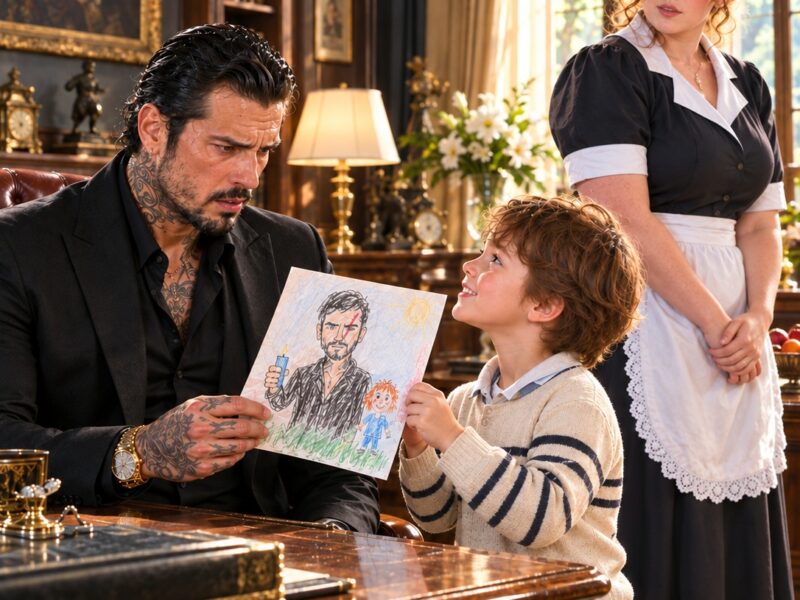
The Maid’s Boy Drew the Man Who “Visits Mommy at Night” — The Mafia Boss Recognized Him
Marcelo Greco knew the drawing mattered before the five-year-old finished explaining it.
Leo Bruno stood in front of the massive walnut desk with both hands wrapped around a sheet of construction paper, holding it with the solemn concentration of someone presenting evidence in court. There was blue crayon beneath one thumbnail, a smear of green across his left cheek, and the stubborn cowlick at the back of his dark hair that his mother could never flatten for more than ten minutes.
“Another report?” Marcelo asked.
Leo nodded.
“Very important.”
Marcelo leaned back in his chair.
For nearly four months, the boy had been bringing him what he called reports.
Mrs. Caruso from the kitchen was always drawn as a round woman with an enormous wooden spoon. Tomaso, Marcelo’s elderly driver, always wore a crooked cap. The gardener had hands roughly the size of dinner plates because, according to Leo, “he can pick up dirt better than everybody.”
Marcelo himself was always the tallest person on the page.
Always dressed in black.
And always kneeling.
The first time Marcelo noticed that last detail, he had asked the boy why.
Leo had stared at him as if the answer were obvious.
“So you can hear me.”
Marcelo had spent most of his forty-three years hearing other descriptions of himself.
Cold.
Calculating.
Dangerous.
Men in the city who owed him favors used kinder words than the men who owed him money, but none of them would have described Marcelo Greco as someone who got small enough to listen.
A five-year-old had decided otherwise after meeting him once.
Marcelo never corrected him.
Now he extended one hand.
“Let’s see.”
Leo placed the drawing on the desk.
“At least tell me you made my shoulders smaller this time.”
“That’s not you.”
Marcelo’s faint amusement disappeared.
The man in the picture stood beside a bed.
He was tall, though Leo’s sense of proportion made him almost as large as the bedroom itself. His arms were uneven, one leg bent strangely, and his hands were made from five blunt lines because Leo still believed fingers were a detail artists could add only when time allowed.
But the boy had worked very carefully on the face.
A thick black line cut through the man’s left eyebrow.
A scar.
In the man’s right hand was a rectangular shape shaded silver-gray with the side of a crayon.
Leo had added something to its center.
A tiny symbol.
Two curved arms beneath a vertical line.
An anchor.
Marcelo did not move.
His eyes remained on the paper long enough that Leo shifted his weight.
“Uncle Marcelo?”
Marcelo looked up.
His voice, when he spoke, was gentle.
That gentleness cost him more than the child could possibly know.
“Who is this?”
Leo leaned across the desk and tapped the scarred figure.
“The man who visits Mommy at night.”
The room changed.
Marcelo’s study had always been quiet, but this silence felt constructed, as if every wall had suddenly begun listening.
“At night?”
“Uh-huh.”
“How often?”
Leo shrugged.
“Sometimes.”
Marcelo folded his hands to hide how tightly his fingers wanted to close.
“Does your mother invite him?”
Leo thought.
“I don’t think so.”
“Why?”
“Because she looks scared after.”
There it was.
Not a conclusion.
Not proof.
A child noticing temperature.
Marcelo’s pulse slowed.
That was what happened when something frightened him enough.
His mind became colder.
“Does he come while you’re awake?”
“I’m supposed to be sleeping.”
“But you’ve seen him.”
Leo nodded.
“Twice.”
Marcelo looked back at the drawing.
“And the thing in his hand?”
Leo brightened.
“He makes fire.”
“A lighter.”
“Yes.”
He pointed proudly at the symbol.
“I got the little boat hook right.”
Marcelo’s fingers tightened against each other.
“It’s an anchor.”
“Oh.”
“Did the man tell you?”
“No.”
“Your mother?”
“No.”
“You saw it?”
Leo nodded again.
“He goes click.”
The boy mimed flicking a lighter open.
“Then fire. Then click.”
Marcelo heard the sound without hearing it.
Six years vanished.
He saw a different room, warmer than this one.
His younger brother Elio sitting on the edge of Marcelo’s desk with his feet on a chair, flipping a silver lighter across his knuckles because he knew the sound annoyed everyone.
Click.
Shut.
Click.
Shut.
An anchor engraved on one side.
Elio had commissioned the stupid thing the summer he bought a twenty-six-foot sailboat he barely knew how to handle.
Marcelo had mocked him.
Elio had smiled.
“Every sailor needs one useless object.”
“You’re not a sailor.”
“I own a boat.”
“You’ve been out twice.”
“Ownership is ninety percent of expertise.”
Three days after that conversation, Elio disappeared from the boat.
His body came out of Long Island Sound before sunrise.
The medical examiner called it accidental drowning complicated by a blow to the head, likely suffered when Elio fell against the side of the vessel.
The lighter was never recovered.
Marcelo had assumed it had gone into the water with him.
For six years, he had assumed wrong.
“Leo.”
The boy straightened.
“Does this man have anything else you remember?”
Leo looked at the drawing.
“He smells funny.”
Marcelo almost smiled despite himself.
“Funny how?”
“Like Uncle Tomaso’s garage.”
Gasoline.
Oil.
Metal.
Half the men around the estate might smell that way.
“Anything else?”
Leo hesitated.
“He talks quiet.”
“What does he say?”
“Mommy says I shouldn’t listen.”
“That wasn’t my question.”
The boy lowered his eyes.
Marcelo regretted the firmness immediately.
He came around the desk and crouched.
The tallest man in the room getting small.
“I’m not angry with you.”
Leo looked up.
“Promise?”
“Yes.”
“I heard him say Mommy has to forget.”
Marcelo’s stomach tightened.
“Forget what?”
“I don’t know.”
“Anything about doors?”
Leo frowned.
“Maybe.”
Marcelo waited.
Children did not need interrogation.
They needed enough quiet to find the memory themselves.
“He said she has to leave one open.”
Marcelo’s face stayed still.
“Which one?”
“I don’t know.”
“Did he ever talk about you?”
The child’s expression changed.
That was answer enough.
Marcelo kept his voice soft.
“What did he say?”
Leo rubbed the toe of one sneaker against the carpet.
“He said boys get lost.”
Every muscle along Marcelo’s back tightened.
“He said that to your mother?”
Leo nodded.
“Mommy told him not to talk about me.”
Marcelo closed his eyes for half a second.
When he opened them again, his anger had become useful.
“Listen to me.”
Leo did.
“This is a very good report.”
The boy’s shoulders relaxed slightly.
“Best one?”
“The best.”
“Really?”
“Really.”
Marcelo held his palm flat against the center of his chest.
“Now I want to teach you something.”
Leo copied him automatically.
“What?”
“This means stay still.”
“Why?”
“If you ever see the man in your drawing again and something feels wrong, you put your hand here.”
Leo pressed his palm harder against his sweater.
“You don’t run unless your mother tells you. You don’t go looking for anyone. You stay somewhere safe and wait for someone you trust.”
“For you?”
“If I’m there.”
“And Mommy.”
“Always Mommy.”
“Tomaso?”
“Yes.”
“Mrs. Caruso?”
“Yes.”
Leo thought about it.
“Not the scar man.”
Marcelo met his eyes.
“Never the scar man.”
The child nodded with the grave commitment of someone being entrusted with state secrets.
Marcelo folded the drawing.
Leo’s face fell.
“Don’t ruin it.”
“I’m not.”
Marcelo slid it into the top drawer.
“I’m keeping it safe.”
“Why?”
“Because important reports go somewhere safe.”
Leo smiled.
At the door, he turned back.
“Did I do good?”
Marcelo looked at the desk drawer.
At the paper inside.
At six years of unanswered questions suddenly reduced to black crayon and a silver anchor.
“You did something grown men have failed to do for a very long time.”
Leo blinked.
“What?”
Marcelo softened it.
“You noticed.”
The boy seemed satisfied.
Then he left.
Marcelo waited until the little footsteps disappeared down the corridor.
He stood.
Locked the study.
Opened the drawer again.
And looked at the face.
Leo was five.
His portraits were not photographs.
But there was only one man with access to the Greco estate who had carried a scar through his left eyebrow for longer than six years.
A man who had been in Marcelo’s life since Marcelo was twenty-one.
A man who had served Marcelo’s father before serving Marcelo.
A man who had stood beside him while they waited for the Coast Guard to find Elio.
A man who had placed a hand on Marcelo’s shoulder at the funeral.
A man who had spent six years telling him there was no one to blame.
Sergio Vasco.
Marcelo sat down slowly.
The possibility did not feel like discovery.
It felt like the floor giving way beneath a house he had believed was stone.
He did not call Sergio.
He did not call security.
Sergio was security.
That was the first problem.
The second problem was worse.
If Marcelo was right, then the man he had trusted to guard every weakness in the Greco organization had spent six years standing close enough to study them all.
Across the estate, Kiara Bruno was counting towels because counting stopped her hands from shaking.
Twelve bath sheets.
Eight hand towels.
Sixteen washcloths.
She knew the inventory by memory.
She counted anyway.
Three weeks earlier, she had believed the Greco estate was the safest place she and Leo had ever lived.
Not kind.
Not normal.
Safe.
There was a difference.
Kiara had learned that difference young.
Her own father had been charming when company visited and cruel when doors shut. Later, she married a man who was neither. Daniel Bruno had been gentle, hardworking, and infuriatingly optimistic.
He died when Leo was two.
A delivery truck struck his car on his way home from an overnight shift.
The insurance settlement paid the funeral and six months of rent.
Grief paid nothing after that.
Kiara took cleaning work.
Then hotel shifts.
Then private domestic jobs.
Two years earlier, the Greco estate hired her.
The salary was better.
The work was steady.
The live-in arrangement gave Leo a small room beside hers on late nights.
She knew what people whispered about Marcelo Greco.
Some called him a businessman.
Others chose words like boss and family with meanings that had nothing to do with relatives.
Kiara did not ask questions.
Questions were expensive.
She kept her head down.
She taught Leo the same thing.
When the men in dark suits arrived, they were quiet.
When voices sharpened in the dining room, they used the back hallway.
When a door was closed, they did not stand near it.
For two years, invisibility worked.
Then Kiara opened the wrong drawer.
It happened in Marcelo’s study three weeks before Leo delivered the drawing.
Marcelo was at a dinner in Manhattan.
Mrs. Caruso had gone home.
Kiara was finishing late.
A stack of papers sat crookedly beside an open desk drawer.
She lifted them to dust beneath.
One slid.
A thin black ledger fell partly open.
Kiara bent to replace it.
A photograph clipped to one page caught her attention.
Sergio Vasco.
She recognized the head of security instantly.
Numbers sat beside his photograph.
Dates.
Transfers.
Warehouse codes.
Kiara did not understand most of it.
One address caught her eye because Daniel had once worked near it.
A warehouse company investigated years earlier for stolen shipping containers.
Then she noticed another name.
A rival freight business Marcelo’s employees never discussed without lowering their voices.
Kiara had looked for perhaps five seconds.
Five seconds was enough.
She replaced the ledger.
Dusted the desk.
Left.
At 12:17 that night, Sergio entered her room.
Kiara remembered the time because the red digits of her clock glowed behind him.
Leo slept across the room.
Sergio closed the door without a sound.
He sat in the chair near Leo’s bed.
Kiara stood immediately.
“What are you doing here?”
“Lower your voice.”
It frightened her more than shouting would have.
His tone was gentle.
Men who needed anger to frighten people were easier to understand.
Sergio removed a silver lighter.
Click.
A small flame.
Click.
Darkness.
“You clean well.”
Kiara said nothing.
“You notice things.”
Her eyes moved to Leo.
Sergio smiled faintly.
“That’s useful in a housekeeper.”
Click.
Flame.
“Less useful in a woman raising a child alone.”
“Leave my son out of whatever this is.”
Sergio glanced at the sleeping boy.
“I haven’t put him in anything.”
He turned the lighter between two fingers.
“Children do that themselves. They wander.”
Kiara’s mouth went dry.
“They fall down stairs. Open the wrong door. Follow dogs into roads.”
“Stop.”
“You’re going to forget what you saw.”
“I didn’t see anything.”
“Excellent.”
He stood.
For one hopeful second, she thought he was leaving.
Then he stepped closer to Leo’s bed.
Kiara moved between them.
Sergio looked at her.
No smile now.
“Every so often, I may ask you to leave a service entrance unlocked.”
“No.”
The answer escaped before she could stop it.
His expression did not change.
“Think again.”
“I clean. That is all.”
“Yes.”
He lifted the lighter.
“Let’s keep it that way.”
He left.
Kiara stood beside Leo until sunrise.
Sergio returned five nights later.
This time he gave her a time.
1:40 a.m.
A lower service door.
She refused again.
He mentioned the playground Leo liked at the south side of the estate.
The next morning, Kiara found a photograph on her pillow.
Leo on the swing.
Taken from a distance.
She unlocked the door.
Two men carried three sealed crates through the house.
Kiara did not ask what they contained.
The third visit came six nights later.
Sergio needed a storage key.
By then Kiara understood exactly what he was doing.
Each favor made her more complicit.
If she went to Marcelo, Sergio could claim she had helped willingly.
If she ran, he knew where her sister lived.
If she stayed, he would continue.
He was not simply threatening her.
He was building a story in which she would become guilty enough that no powerful man would believe her.
That was why Leo’s drawing terrified her.
Her son had seen the face of the man she was trying hardest to make invisible.
And Leo had shown it to Marcelo.
“Mommy?”
Kiara looked up.
Leo stood at the linen room door.
She had counted the same towel four times.
“What is it?”
“Are you mad?”
“No.”
“You look mad.”
“I’m tired.”
He came closer.
“Did Uncle Marcelo like my report?”
Her hands went cold.
“What report?”
“The man.”
Kiara lowered the towels.
“What man?”
Leo drew a line through his eyebrow with one finger.
She could barely hear herself.
“You showed Mr. Greco?”
“Yes.”
“What did you draw?”
“The lighter.”
Her knees weakened.
“Leo.”
“He said it was my best one.”
Kiara grabbed his shoulders harder than she intended.
“What exactly did he say?”
The boy’s face changed.
She immediately loosened her grip.
“I’m sorry.”
Leo pressed his hand against his chest.
“He taught me this.”
Kiara frowned.
“What does that mean?”
“Protector sign.”
“What protector sign?”
“Stay still. Wait.”
“For what?”
“For someone safe.”
Kiara stared at him.
Marcelo understood.
At least enough to know Leo might be in danger.
She took her son’s hand.
“We’re going to speak to him.”
They made it two corridors.
Then Kiara saw Sergio standing outside Marcelo’s study.
He was speaking to a younger guard.
His back was turned.
Leo started forward.
Kiara pulled him behind a marble column.
He looked confused.
She pressed a finger to her lips.
Sergio finished the conversation and entered Marcelo’s office without knocking.
Kiara watched the door close.
Her stomach sank.
That was the trap.
Whatever Leo had shown Marcelo, Sergio had access to Marcelo in a way she never would.
If Marcelo trusted him, the drawing might have signed their death warrant.
Kiara took Leo downstairs instead.
Inside the study, Sergio placed a folder on Marcelo’s desk.
“South gate vehicle was a contractor.”
Marcelo nodded.
“Anything else?”
“No.”
Sergio remained standing.
Marcelo turned a page of a financial report.
The drawing was locked inside the drawer inches from his knee.
“You missed lunch,” Sergio said.
“Busy.”
“You all right?”
Marcelo looked up.
Twenty-two years of familiarity sat between them.
Sergio had taught Elio how to throw a curveball when they were teenagers.
He had broken a man’s nose protecting Marcelo during a nightclub fight.
He had carried Marcelo’s father’s coffin.
He had held Marcelo upright after Elio’s body was identified.
If the lighter belonged in Sergio’s pocket, betrayal had been sitting at Marcelo’s right hand for half his adult life.
“I’m fine.”
Sergio nodded.
At the door, Marcelo spoke.
“You still smoke?”
Sergio paused.
“Sometimes.”
“Thought you quit.”
“Bad habit.”
“What do you use?”
Sergio looked back.
“For what?”
“To light them.”
The pause lasted less than half a second.
Then a smile.
“Whatever’s around.”
He left.
Marcelo waited until the door shut.
Then he opened a hidden drawer beneath his desk and took out an old prepaid phone no one in the current security structure knew existed.
He called Tomaso.
The elderly driver answered with suspicion.
“Who is this?”
“It’s me.”
A pause.
“Mr. Marcelo?”
“I need you at the old greenhouse.”
“Now?”
“Yes.”
“Should I tell security?”
“No.”
Tomaso went silent.
“When?”
“Ten minutes.”
They met at the abandoned greenhouse along the eastern edge of the property.
Once, Marcelo’s mother grew roses there.
Now the glass was dusty and ivy climbed the brick base.
Tomaso entered wearing gardening gloves and carrying pruning shears so anyone watching from the house would assume an elderly man had finally lost his mind and decided to trim dead vines in October.
Marcelo closed the door.
“What happened?”
He handed him Leo’s picture.
Tomaso adjusted his glasses.
The old man’s expression changed almost immediately.
His finger touched the silver rectangle.
“Where did you get this?”
“The housekeeper’s son drew it.”
“That’s Mr. Elio’s lighter.”
Marcelo’s breath caught despite expecting the answer.
“You’re certain.”
“I filled that boy’s boat with fuel a hundred times.”
Tomaso looked closer.
“He flipped the thing until everybody around him wanted to drown him themselves.”
Not the best choice of words.
Tomaso realized it.
His eyes lowered.
Marcelo ignored it.
“The boy says the man carrying it visits his mother at night.”
Tomaso’s attention moved to the scar.
Color drained from his face.
Marcelo watched him.
“You recognize the man.”
Tomaso did not answer.
“Tomaso.”
“Yes.”
The word came out quietly.
“Sergio.”
Saying it aloud made the suspicion heavier.
Marcelo folded his arms.
“What haven’t you told me?”
Tomaso stared through the dirty greenhouse glass.
A long time passed.
“The morning Elio died.”
Marcelo’s jaw tightened.
“What about it?”
“Sergio came back to the marina before the Coast Guard.”
“I know.”
“He said he’d searched the eastern channel.”
“Yes.”
Tomaso swallowed.
“His sleeves were dry.”
Marcelo went still.
“What?”
“Completely dry.”
“You never told me.”
“No.”
“Why?”
Tomaso’s shame was immediate.
“Because your father trusted him. Because you trusted him. Because Sergio knew every man who worked that marina.”
Marcelo stepped forward.
“You watched me investigate for six years.”
“I know.”
“You watched me sit at my brother’s grave.”
“I know.”
“You watched Sergio stand beside me.”
Tomaso’s face crumpled.
“I know.”
Anger rose hot enough to make Marcelo’s vision sharpen.
Then he saw the man in front of him.
Seventy years old.
Terrified not of Marcelo, but of a cowardice he had carried for six years.
Fear had silenced him too.
Different cage.
Same silence.
Marcelo looked away.
“Who do you trust in this house?”
“With my life?”
“Yes.”
Tomaso named four men.
All older.
Drivers.
Maintenance staff.
People Sergio barely noticed because power had taught him to look upward, not down.
“No one in formal security?”
Tomaso shook his head.
“I don’t know anymore.”
“Neither do I.”
Marcelo took back the drawing.
“I need the old marina records. Fuel logs. Access logs. Anything from that week.”
“I can get them.”
“Quietly.”
“Yes.”
“And the old private ledgers.”
Tomaso’s eyes sharpened.
“The ones Elio was reviewing?”
Marcelo nodded.
“I thought you destroyed them.”
“I thought so too.”
He had found a partial copy in a bank archive years earlier and stored it in a safe no one else knew about.
“Say nothing to anyone.”
Tomaso looked toward the house.
“What about the woman?”
“I’m going to talk to her.”
“You think Sergio knows the child drew him?”
“I don’t know.”
“Then we should move them.”
Marcelo’s jaw tightened.
“If I move them through security, Sergio sees it.”
“And if you don’t?”
Marcelo looked at Leo’s paper.
“That’s what I have to solve before he does.”
Kiara solved it first.
That evening, after Leo fell asleep, she packed one suitcase.
Two changes of clothes for him.
Three for herself.
His inhaler.
Birth certificates.
The framed photograph of Daniel holding newborn Leo.
Three hundred forty dollars.
She had no plan beyond the bus station.
A bad plan was still movement.
She slid the suitcase beneath the bed.
At nine thirty, Mrs. Caruso knocked.
“Mr. Greco wants you upstairs.”
Kiara’s heart began pounding.
“Why?”
“He didn’t say.”
“Is Mr. Vasco with him?”
Mrs. Caruso frowned.
“No.”
Kiara looked at sleeping Leo.
“Can you stay with him?”
“Of course.”
Kiara walked to the study feeling every camera in the house.
Marcelo stood beside the windows.
He had removed his jacket.
The city lights beyond the property glowed faintly through a misty rain.
The drawing waited on his desk.
Kiara stopped.
Marcelo shut the door.
She immediately turned toward it.
He noticed.
“I’m not locking it.”
She faced him again.
“You know who that is.”
Not a question.
Kiara said nothing.
“Sergio has been coming to your room.”
Still nothing.
“Kiara.”
“If I say yes, what happens?”
Marcelo considered the question.
“I believe you.”
Her laugh was small and bitter.
“That wasn’t what I asked.”
He accepted that.
“If you say yes, I protect you and Leo while I find enough proof to remove him permanently from this house.”
“Remove?”
“Legally.”
She looked surprised.
Marcelo understood why.
His family name carried stories.
Some true.
Some exaggerated.
“I’m not asking you to help me make a body disappear.”
Kiara’s eyes hardened.
“I didn’t say you were.”
“You thought it.”
“I think a lot of things I don’t say in this house.”
Marcelo looked at her carefully.
“Tell me one.”
She stared.
Then something broke loose.
“Fine.”
Kiara stepped closer.
“You men built this place so everyone below you survives by guessing what you want.”
Marcelo said nothing.
“You don’t ask people to lie. You make truth expensive.”
That one landed.
Kiara continued.
“Sergio knew exactly how to use that.”
Marcelo’s expression tightened.
“What did he make you do?”
“Leave doors unlocked.”
“How many?”
“Two times.”
“Anything else?”
“A storage key.”
“What moved through the doors?”
“Crates.”
“How many?”
“Three the first time. Two the second.”
“Who carried them?”
“Men I don’t know.”
“You never saw inside?”
“No.”
“You understand how that looks.”
Her face changed.
“There.”
Marcelo frowned.
“That.”
“What?”
“The question behind the question.”
She folded her arms.
“You’re deciding whether I helped him.”
“I’m deciding what evidence he built against you.”
“That’s not how it sounded.”
“Then I asked badly.”
Kiara blinked.
She had not expected an apology disguised that plainly.
Marcelo walked around the desk.
“I checked old backup camera storage Sergio apparently did not know still existed.”
Her face drained.
“You saw me.”
“Yes.”
“Then you know.”
“I know you opened doors.”
“That’s all.”
“I also know you looked behind you every ten seconds.”
Kiara said nothing.
“And that one of Sergio’s men stood outside your son’s window twenty minutes before the first door opened.”
Her breath caught.
Marcelo continued.
“I believe you.”
Something in her face loosened, but only a little.
“He came into our room.”
Marcelo’s voice changed.
“Did he touch you?”
“No.”
A muscle in his jaw released.
Kiara saw it.
“Don’t look relieved.”
Marcelo looked at her again.
“He didn’t need to touch me.”
The sentence quieted the room.
Marcelo nodded.
“No.”
She stared.
“No, he didn’t.”
For the first time since entering, Kiara seemed uncertain what to do with his answer.
“He sat beside Leo’s bed.”
Marcelo’s eyes darkened.
“He used that lighter.”
“Every visit?”
“Almost.”
“What did he say about it?”
“Nothing.”
“Think.”
Kiara closed her eyes.
The click.
The little flame.
Sergio’s scar.
“First night, he said accidents happen.”
Marcelo went still.
“He looked at Leo and said boys get lost. Then…” She swallowed. “He said, ‘Ask my last employer’s brother about accidents. Oh, you can’t.’”
Marcelo’s face emptied.
Kiara saw that the words mattered.
“Whose lighter is it?”
He did not answer immediately.
“My brother’s.”
“The brother who drowned?”
“Yes.”
Kiara looked at the drawing.
“Oh, God.”
“Elio carried it everywhere.”
“And Sergio has it.”
“Yes.”
“You think Sergio killed him.”
Marcelo looked at her.
“I have thought Elio was murdered for six years.”
“And now?”
“Now I think I know who.”
Kiara sat because her knees no longer trusted her.
“And Sergio knows I saw the ledger.”
“Yes.”
“What was it?”
“Payments.”
“To whom?”
“A rival organization that has been trying to take control of certain freight routes for years.”
Kiara stared.
“So he’s stealing from you.”
“Possibly preparing to replace me.”
“And your brother found out.”
“That is what I intend to prove.”
She looked toward the door.
“We have to leave.”
“Not through the normal gates.”
“Then another way.”
“Sergio controls the current perimeter teams.”
“You’re Marcelo Greco.”
The words came sharper than she intended.
“You’re the man everyone is afraid of.”
Marcelo’s mouth hardened.
“Fear is exactly why I don’t know who belongs to me.”
Kiara stared.
He continued.
“When people fear the person at the top, they tell him what they think will keep them alive. Sergio has been deciding what reaches me for years.”
“So all those guards…”
“I don’t know which ones are loyal to my name and which are loyal to the man signing their overtime.”
For the first time, Kiara saw something beneath his authority.
Not helplessness.
Isolation.
“Then what do we do?”
“Tomaso is moving people I trust into place.”
“How many?”
“Four.”
“That’s your army?”
“They’re the four I trust.”
Kiara rubbed her palms against her skirt.
“I packed.”
“I know.”
Her eyes flashed.
“How?”
“Cash disappeared from your kitchen lockbox. You asked Mrs. Caruso whether the Port Authority buses run overnight. Leo’s medical file moved from your dresser to your work bag.”
“That is deeply unsettling.”
“I know.”
“No, I mean you knowing all that.”
“Fair.”
She almost smiled.
Almost.
Then the fear returned.
“If Sergio realizes Leo drew him—”
“He’ll move.”
“When?”
Marcelo looked toward the clock.
“Soon.”
“How soon?”
“I don’t know.”
Kiara stood.
“Then my child is not sleeping in that room tonight.”
“No.”
She froze.
Marcelo continued.
“You and Leo move to the small library near the north hall.”
“That’s closer to you.”
“Yes.”
“Which means Sergio notices.”
“Not if Mrs. Caruso takes Leo there for a movie while your room is being ‘treated for a plumbing leak.’”
Kiara stared.
“You already arranged that.”
“Yes.”
“You made a plan before talking to me.”
“Yes.”
She exhaled sharply.
“I hate that.”
“I expected you might.”
“You need to learn to ask.”
Marcelo’s expression did not change, but the sentence registered.
“All right.”
“All right what?”
“Next time I ask.”
“There had better not be a next time.”
“That would be preferable.”
Kiara looked toward Leo’s drawing.
“What about tonight?”
Marcelo met her eyes.
“Tonight, we stop letting Sergio choose the shape of the house.”
The move happened quietly.
Mrs. Caruso carried Leo to the north library wrapped in a blanket.
Kiara followed with a tray to make it look as though she was cleaning.
Tomaso sat in the service lounge twenty feet away pretending to read a newspaper.
Two older maintenance men worked near the stairwell far later than any maintenance job required.
Marcelo remained in his study with the lights on.
Sergio entered at ten.
“Late night?”
Marcelo did not look up.
“Quarterly books.”
“Anything interesting?”
“Not yet.”
Sergio smiled.
“Want coffee?”
“No.”
He lingered.
Marcelo felt the weight of Leo’s drawing inside the locked drawer.
“Something else?”
“No.”
Sergio left.
Marcelo waited five minutes.
Then looked at the secondary monitor hidden behind an old cabinet.
Tomaso had restored a discontinued surveillance circuit Sergio did not know still ran through parts of the house.
Marcelo watched Sergio walk downstairs.
Pause near Kiara’s empty corridor.
Look toward her bedroom.
Then continue.
At eleven twenty, Sergio returned to his security office.
At midnight, a car arrived at the west service entrance.
At twelve fifteen, it left.
At one, nothing.
Kiara sat on the floor beside the sofa where Leo slept.
She had not changed out of her work clothes.
Her shoes remained on.
Marcelo entered at one fifteen.
She looked up.
“Anything?”
“He checked your hallway.”
“Did he notice?”
“I don’t know.”
“That’s becoming your favorite answer.”
“It is an honest one.”
Kiara looked at Leo.
The boy slept with one hand curled beneath his cheek.
“Why did your brother want out?”
Marcelo leaned against a bookshelf.
“Out?”
“Of all this.”
He understood.
“Elio thought the family could become legitimate.”
“Could it?”
Marcelo almost laughed.
“I told him no.”
“That wasn’t my question.”
Marcelo looked at her.
“No one spoke to him like this.
Not anymore.
“Apparently you and Leo share a problem with accepting answers you didn’t ask for.”
“He gets it from me.”
“I noticed.”
Kiara waited.
Marcelo looked toward the dark window.
“I thought legitimacy was something men talked about after they had enough money to pretend they hadn’t cared where the first money came from.”
“And Elio?”
“He thought every generation gets to decide whether inheritance is a gift or an excuse.”
Kiara was quiet.
“That sounds irritating.”
“He was unbearable.”
“You loved him.”
Marcelo’s jaw tightened.
“Yes.”
“Then why didn’t you listen?”
The question was not cruel.
That made it worse.
“Because I was older.”
She frowned.
“What does that have to do with anything?”
“I thought it meant I knew more.”
“That also sounds irritating.”
Marcelo looked at her.
She shrugged.
“I’m tired. My filter is gone.”
To his surprise, he almost smiled.
Then the hidden radio in his pocket vibrated once.
Tomaso.
Marcelo checked the message.
Movement west wing.
His expression changed.
Kiara stood immediately.
“What?”
“Stay here.”
“No.”
“Kiara.”
“You said next time you ask.”
He stopped.
She had him.
“Will you stay here with Leo while I check?”
She looked toward her son.
“Yes.”
“Lock the door after me.”
Marcelo left.
The estate had gone unnaturally quiet.
He met Tomaso near the back staircase.
“Two men entered through the laundry access.”
“Whose men?”
“Not ours.”
“Where’s Sergio?”
“Security room empty.”
Marcelo’s pulse slowed.
“North hall.”
Tomaso’s face tightened.
“He knows?”
“Maybe.”
They moved.
At 1:37, the north library lights went out.
Kiara stood instantly.
Backup lights should have activated.
Nothing.
Her blood turned cold.
Leo woke.
“Mommy?”
She crossed to the sofa.
“Quiet game.”
His eyes widened.
“Is the scar man here?”
Kiara hated that he knew enough to ask.
“I don’t know.”
She lifted him.
The library had two exits.
One toward the north staircase.
One toward a narrow reading room connected to an old servant passage.
Marcelo had shown her the second route before leaving.
She carried Leo toward it.
The handle did not move.
Locked from the other side.
Someone had planned ahead.
Footsteps approached the main door.
Kiara backed away.
Leo’s arms tightened around her neck.
“Mommy.”
“I’ve got you.”
Another step.
She looked around.
Desk.
Bookshelves.
Fireplace.
Window too high above the stone terrace.
Then she saw a low storage cabinet built into the wall beneath the shelves.
Not ideal.
The only option.
She opened it.
“Leo.”
“No.”
“Baby, listen.”
His eyes filled.
“You remember the quiet game?”
He shook his head hard.
“I want you.”
“I’m right here.”
“You have to come too.”
The doorknob moved.
Kiara’s heart broke.
“I can’t fit.”
“Mommy—”
She set him inside.
“You are the smallest, quietest thing in this whole house.”
Leo pressed one hand over his mouth because she had taught him that during hide-and-seek.
Then his other hand moved.
Flat against his chest.
Marcelo’s signal.
Stay still.
Wait.
Kiara’s eyes burned.
“That’s right.”
She closed the cabinet.
The library door opened.
Two men entered.
Neither belonged to the estate staff.
Kiara stepped away from the cabinet.
One man moved toward her.
“Where’s the kid?”
She said nothing.
He grabbed her arm.
Kiara twisted.
“Don’t touch me.”
He caught her again.
The second man shut the door.
Then Sergio walked in.
Silver lighter turning between his fingers.
Click.
Flame.
Click.
He smiled.
“I knew something changed.”
Kiara’s fear became anger.
“You’re finished.”
“Maybe.”
His gaze moved around the room.
“Where’s Leo?”
“He’s with Mrs. Caruso.”
“No.”
Sergio shook his head.
“I checked.”
Of course he had.
“How much does Marcelo know?”
Kiara said nothing.
Sergio stepped closer.
“The drawing?”
Her face betrayed enough.
He exhaled slowly.
“Children.”
The lighter clicked.
“Always noticing the one thing adults miss.”
“Stay away from him.”
“I intend to.”
He nodded toward the men.
“Once we find him.”
Kiara’s stomach clenched.
“What are you going to do?”
“You packed already.”
She stared.
“The suitcase in your room.”
Sergio smiled.
“That was generous.”
Her blood chilled.
“A housekeeper who suddenly runs with her son after stealing from her employer?”
He shrugged.
“No one searches very hard.”
“You framed me.”
“You helped me.”
“You threatened my child.”
“Details.”
He looked toward the shelves.
“Where is he?”
Kiara remained silent.
Sergio’s smile disappeared.
He motioned.
One man searched behind the curtains.
Another opened the small bathroom.
The cabinet sat six feet away.
Inside, Leo held his palm against his chest.
He could hear voices.
His mother breathing.
The scary man clicking the fire thing.
He wanted to cry.
He wanted to run.
But Uncle Marcelo had told him what protectors did.
Stay still.
Wait.
Sergio took another step.
His gaze moved toward the cabinet.
Then a voice came from the doorway.
“Let her go.”
Everything stopped.
Marcelo stood there.
Tomaso beside him.
Behind them were three older men Sergio had passed for years without learning much about them.
No one had a gun visible.
That frightened Sergio more.
“Boss.”
Marcelo looked at the hand gripping Kiara’s arm.
“Let her go.”
Sergio recovered.
“There was a breach.”
Marcelo’s expression did not change.
“So you kidnapped my housekeeper.”
“I found unauthorized men near this wing.”
Marcelo looked at the two strangers.
“And you brought them inside.”
Sergio’s jaw tightened.
“Contractors.”
“Names?”
Silence.
Marcelo stepped into the room.
“Tomaso.”
The old driver held up a circuit key.
“Backup power was manually disabled from inside Mr. Vasco’s security office.”
Sergio’s gaze flicked toward him.
Marcelo saw it.
“Interesting.”
“You’re listening to a driver now?”
Marcelo almost smiled.
“I should have started sooner.”
He looked at Kiara.
“Are you hurt?”
“No.”
“Leo?”
Sergio’s attention sharpened.
Kiara answered carefully.
“Safe.”
Marcelo understood.
The boy was hidden.
He deliberately did not look around the room.
“Good.”
Sergio noticed that too.
“You know where he is.”
Marcelo faced him.
“I know where enough things are.”
His voice stayed calm.
“Elio’s lighter, for example.”
For the first time, Sergio lost control of his face.
Only for a second.
But twenty-two years made a second enough.
Marcelo continued.
“A five-year-old drew it.”
Sergio said nothing.
“Anchor included.”
The lighter stopped moving in his hand.
“Give it to me.”
Sergio laughed.
“You’re going to build a murder accusation around a child’s picture?”
Marcelo’s eyes sharpened.
“I didn’t say murder.”
Sergio realized the mistake.
Too late.
The room became perfectly still.
Marcelo stepped closer.
“I said give me the lighter.”
Sergio’s fingers closed around it.
“It proves nothing.”
“Again.”
Marcelo’s voice dropped.
“You keep defending things I haven’t accused you of yet.”
One of Sergio’s men glanced at him.
That glance contained fear.
Marcelo noticed.
“Tomaso?”
The old driver spoke.
“The morning Elio died, Sergio came back from the marina with dry sleeves.”
Sergio’s expression hardened.
“An old man remembering weather six years later.”
“I remember because it was raining too,” Tomaso said. “Everyone was wet except you.”
Marcelo continued.
“Fuel logs put your car at the marina.”
“I was searching.”
“Before anyone officially knew Elio was missing.”
Sergio stared at him.
That was new.
Marcelo had obtained the marina record only two hours earlier.
“And the ledger.”
Now Sergio’s face changed again.
“We found the copy Elio hid.”
“You don’t know what you’re reading.”
“The payments to Bellandi Freight?”
Silence.
“The warehouse transfers?”
Silence.
“The cash withdrawals beginning eight months before Elio died?”
Sergio’s eyes narrowed.
“You’ve been busy.”
“My brother was busier.”
Marcelo stopped directly in front of him.
“He found you.”
Sergio looked toward Kiara.
Then the cabinet.
Then Tomaso’s men.
He calculated.
Marcelo watched him do it.
For years, Sergio had survived by knowing which door remained open.
Tonight, none did.
Finally, he laughed softly.
“Elio found numbers.”
“He found enough that you killed him.”
Sergio’s jaw flexed.
Marcelo waited.
Silence became pressure.
Then Sergio said, “He was going to destroy everything.”
The words dropped into the room.
Kiara closed her eyes.
Tomaso’s face collapsed.
Marcelo felt something inside himself go utterly still.
“What did you do?”
Sergio’s voice lost its performance.
“He came to me because he trusted me.”
Marcelo’s hands curled.
“He wanted help reading the routes.”
“And?”
“We took the boat.”
“Elio’s boat.”
“Yes.”
“What happened?”
“He accused me.”
“Of stealing?”
“Of preparing.”
“For what?”
Sergio’s mouth twisted.
“For the day you failed.”
Marcelo stared.
“You and Elio inherited a machine men like me spent our lives building.”
“So you sold information.”
“I built leverage.”
“You stole from my family.”
“I paid myself.”
“You fed rivals our routes.”
“I ensured I had options.”
“And when Elio found out?”
“He wanted to tell you.”
Sergio shook his head as if still irritated by the memory.
“He thought you’d shut everything down. Sell the ports. Go clean.”
Marcelo almost heard Elio laughing.
“He was right.”
“No.”
Sergio’s voice sharpened.
“He was weak.”
Marcelo’s expression changed.
“Careful.”
“You want the truth?”
“I’ve waited six years.”
Sergio held up the lighter.
“Elio asked me for a cigarette.”
Marcelo’s chest tightened.
“He only smoked when nervous.”
“I know.”
Of course Sergio knew.
He had known them both.
“He handed me the lighter.”
Sergio turned it slowly.
“We argued.”
“You hit him.”
Sergio smiled without warmth.
“He hit me first.”
Marcelo did not believe him.
It did not matter.
“He went over the side.”
Tomaso made a sound.
Marcelo asked, “Was he alive?”
“Yes.”
“Could he swim?”
“Yes.”
“Then why did he drown?”
Sergio looked at him.
For one second, the room seemed to lean toward the answer.
“I had removed the ladder earlier.”
Kiara covered her mouth.
Tomaso turned away.
Marcelo saw black water.
His brother reaching for metal that was not there.
Sergio watching.
“You could have pulled him out.”
“Yes.”
“But you didn’t.”
“No.”
The answer finally existed.
Six years of suspicion collapsed into one syllable.
Marcelo breathed once.
“What did he say?”
Sergio’s expression changed.
“Who?”
“Elio.”
A pause.
“At the end.”
Sergio looked away.
Marcelo stepped closer.
“What did my brother say?”
Sergio swallowed.
“He said you would know.”
Marcelo’s face broke for perhaps half a second.
“He said, ‘Marcelo will know you did this.’”
Silence.
Sergio smiled faintly.
“He overestimated you.”
Marcelo hit him.
Once.
Hard enough to send Sergio into the wall.
Tomaso’s men moved, but Marcelo lifted one hand.
He stood there breathing.
Then stepped back.
“No.”
Sergio wiped blood from his mouth.
“There he is.”
“No.”
Marcelo’s voice steadied.
“There I was.”
Sergio laughed.
“You think handing me to police makes you respectable?”
Marcelo looked at him.
“No.”
“Half your old operation falls with me.”
“Then half falls.”
“You’ll lose routes.”
“Good.”
“People.”
“The ones who belong to you can go with you.”
“Money.”
Marcelo looked toward Kiara.
Then toward the cabinet he carefully refused to acknowledge.
“My brother wanted this family clean.”
His gaze returned to Sergio.
“I told him it was impossible.”
Marcelo’s mouth tightened.
“I was wrong.”
Sergio’s eyes hardened.
“You can’t erase what your father built.”
“No.”
“I’m not trying to erase it.”
Marcelo looked at Tomaso.
“Call the federal contact.”
Sergio froze.
“You’re turning me over?”
“Yes.”
“You don’t do that.”
“I do now.”
The two men with Sergio moved suddenly.
One shoved Kiara toward the wall.
The other lunged toward Tomaso.
Marcelo’s older men were ready.
No gunfire.
Marcelo had ordered every firearm removed from the residential wing that afternoon.
The first stranger hit the floor under the weight of two men.
The second made it three steps.
Sergio turned toward the cabinet.
Too quickly.
He had followed Marcelo’s earlier restraint and understood where the child might be.
“Boy first.”
Marcelo moved.
Sergio reached for the cabinet handle.
Marcelo caught his wrist.
The two men slammed into the shelves.
Books fell.
Sergio twisted.
Marcelo drove his shoulder into him.
Tomaso’s men seized Sergio from behind.
He fought once.
Then stopped when he understood it was finished.
Inside the cabinet, Leo made no sound.
Sergio looked at Marcelo.
“You’ll always be what your father made you.”
Marcelo’s breathing was hard.
“Maybe.”
He glanced toward Kiara.
“But my son—”
He stopped himself.
Not his son.
The correction mattered.
Leo was Kiara’s.
Marcelo tried again.
“That boy is going to grow up knowing he can tell the truth in this house.”
Sergio laughed.
“You think that makes you different?”
“No.”
Marcelo stepped back.
“What I do after tonight might.”
Tomaso’s men took Sergio away.
The two outsiders followed.
Only when the hallway became quiet did Marcelo turn toward the cabinet.
Kiara was already there.
Her hands shook too hard to work the latch.
Marcelo crouched beside her.
“I’ve got it.”
She nodded.
He opened the door.
Leo sat in the dark between folded blankets.
One hand covered his mouth.
The other remained flat over his heart.
Marcelo’s chest tightened painfully.
Leo lowered the hand from his mouth.
“I did it.”
His voice trembled.
Marcelo’s own almost did.
“You did.”
“I stayed still.”
“Yes.”
“I waited.”
Marcelo nodded.
“Exactly right.”
Leo’s face crumpled.
He reached out.
Marcelo lifted him.
For two seconds, the boy clung to his neck.
Then Kiara gathered Leo into her arms.
She folded around him on the floor.
No graceful tears.
No controlled emotion.
Her whole body shook.
“I’m sorry.”
“Mama.”
“I’m sorry, baby.”
“You said quiet game.”
“I know.”
“I won.”
Kiara made a sound between a laugh and a sob.
“Yes.”
Marcelo turned away.
He did not want her to see his face.
Six years earlier, he had arrived too late for his brother.
Tonight, the difference between another family disappearing and this child still breathing had been perhaps four seconds.
Four seconds purchased by a five-year-old who believed an important man’s signal meant someone would come.
“Uncle Marcelo?”
He turned.
Leo looked at him over Kiara’s shoulder.
“Did my report help?”
Marcelo crouched.
“It helped.”
“A lot?”
Marcelo looked at Kiara.
Then at the child.
“More than you need to understand right now.”
Leo considered that.
“Am I a protector?”
“Yes.”
“But Mommy protected me.”
“She did.”
“And you protected Mommy.”
“Yes.”
Leo frowned.
“So everybody’s a protector?”
Marcelo almost smiled.
“That’s the goal.”
The boy’s eyes began closing.
Adrenaline had burned through him.
Kiara carried him to the sofa.
Within minutes, he slept.
Marcelo remained near the doorway.
Kiara covered Leo with a blanket.
Then she turned.
“You knew Sergio might come.”
“Yes.”
“You let us stay here.”
Marcelo did not defend himself.
“Yes.”
“I hate you a little for that.”
“I understand.”
“I put my son in a cabinet.”
“I know.”
“You could have moved us farther.”
“The moment the outer security network changed, Sergio would have known.”
“I know the reason.”
She stepped closer.
“That doesn’t make me like it.”
“It shouldn’t.”
Kiara stared at him.
No justification.
No demand for gratitude.
That made anger harder.
“I thought you men always had to be right.”
“Usually.”
“That was almost a joke.”
“Don’t spread it around.”
Her mouth almost moved.
Then her eyes went to Leo.
“You promised he wasn’t bait.”
“He wasn’t.”
“You expected Sergio to move.”
“Yes.”
“And we were here.”
“I had Tomaso’s men in the corridor. I thought we would intercept him before he reached you.”
“But you didn’t.”
“No.”
Marcelo looked at the fallen books.
“I miscalculated.”
Kiara’s eyes filled again.
“Powerful men say that after other people pay.”
The sentence hit harder than the accusation before it.
Marcelo did not look away.
“You’re right.”
She stared.
“I don’t know what to do when you say that.”
“Neither do I.”
Silence.
Then Marcelo spoke.
“You and Leo can leave tomorrow.”
Kiara stiffened.
“I’m being fired?”
“No.”
“You said leave.”
“I will pay for any place you choose. New York, another state, another country if you want it.”
“That sounds like money solving guilt.”
“It probably is partly.”
At least he admitted it.
“But more importantly, it’s choice.”
Marcelo glanced at Leo.
“You haven’t had enough of that here.”
Kiara folded her arms.
“And if I stay?”
“Then you never work as my housekeeper again unless you specifically decide that’s what you want.”
She frowned.
“What would I do?”
“I don’t know.”
“That’s comforting.”
“I’m tired.”
“So am I.”
Another almost-smile passed between them.
Then Marcelo grew serious.
“Nothing is decided tonight.”
The federal investigation expanded rapidly because Sergio’s financial network had grown too large to hide once someone knew where to look.
The silver lighter was not enough to convict anyone of murder.
Leo’s drawing was certainly not.
But together they pointed toward the right questions.
Marina logs placed Sergio on Elio’s boat hours earlier than he had ever admitted.
Fuel receipts contradicted his statement about when he began searching.
The old medical report showed a head injury inconsistent with the original theory once investigators reconsidered it.
Tomaso gave a sworn statement about Sergio’s dry sleeves.
The black ledger revealed years of payments to rival operators.
One retired bookkeeper admitted Sergio had asked him to alter freight records days after Elio’s death.
Then one of the two men arrested at the estate made a deal.
He described Sergio’s plan to remove Kiara and Leo and stage the disappearance as a frightened employee fleeing after theft.
That was enough to turn suspicion into a case.
Sergio eventually began talking.
Not from remorse.
Because men like Sergio treated loyalty as an investment and cooperation as another form of self-preservation.
He confirmed what Marcelo already knew.
Elio discovered the skimming.
Sergio took him out on the water.
They argued.
Sergio struck him.
Elio fell.
Sergio had removed the swim ladder beforehand because he had planned for several outcomes.
Then he watched Marcelo’s younger brother die.
Afterward he took the lighter.
The prosecutor called it trophy behavior.
Marcelo called it exactly what it was.
Vanity.
Sergio had survived six years because he was intelligent.
He had nearly lost everything because he needed to keep proof that he had once defeated someone who trusted him.
Marcelo did not attend every hearing.
He attended the one where Sergio pleaded guilty to enough charges that he would likely die in prison.
Their eyes met across the courtroom.
Sergio looked older.
Smaller.
Marcelo felt no triumph.
Elio remained dead.
Justice was not resurrection.
It was simply the closing of one door.
The harder work came afterward.
Sergio’s books exposed operations Marcelo had spent years pretending he could manage without touching directly.
Protection money.
Cargo theft.
Bribed inspectors.
Businesses that looked legal only because the illegal money passed through too many hands before reaching them.
Marcelo’s attorneys advised caution.
His accountants advised even more caution.
Tomaso gave simpler advice.
“Your brother wanted it clean.”
Marcelo looked at the mountains of records.
“Yes.”
“You told him that was impossible.”
“I remember.”
Tomaso shrugged.
“So prove yourself wrong.”
Marcelo sold what could be sold.
Closed what could not.
Cooperated with investigations where cooperation cost him control.
Several old allies stopped answering calls.
A rival family attempted to take two freight routes.
Marcelo let them have one.
The legitimate shipping company lost almost thirty percent of its revenue that first year.
Financial magazines called it restructuring.
Old men in back rooms called it weakness.
Marcelo slept better.
Kiara stayed.
At first only because Leo developed a fever two days after Sergio’s arrest.
The pediatrician said it was viral.
Nothing serious.
Kiara had already repacked the suitcase.
She could not imagine dragging a sick child onto a bus.
Marcelo arranged for a doctor to come to the estate.
Kiara objected.
“I can take him to urgent care.”
“I know.”
“Then why did you call someone?”
“I thought it would be easier.”
“That isn’t automatically your decision.”
Marcelo paused.
Three months earlier, he would have responded with some version of I’m responsible for this house.
Instead he said, “Do you want me to cancel?”
Kiara stared.
Leo coughed from the bed.
“No.”
“All right.”
“Don’t look pleased with yourself.”
“I’m not.”
“You are.”
“I’m learning.”
“Slowly.”
The doctor came.
Leo recovered.
The suitcase remained under the bed.
One week became two.
Then a month.
Kiara finally unpacked it because living beside a packed bag made every morning feel temporary.
Marcelo never commented.
He did notice.
Three months after Sergio’s arrest, he called her into the study.
The room had changed.
The security camera was gone.
The inner desk drawer no longer locked.
Elio’s lighter sat inside a simple glass case on the bookshelf.
Not hidden.
Not worshiped.
Present.
Kiara noticed it immediately.
Marcelo slid a folder toward her.
“What is this?”
“An offer.”
Her body tightened.
He saw it.
“Bad phrasing.”
“Yes.”
“Open it.”
The first page read:
GRECO WORKERS RELIEF FOUNDATION
Kiara frowned.
She turned another page.
The proposal described an independent charitable organization providing emergency grants, medical assistance, legal referrals, temporary housing, and income support to dockworkers, truck drivers, restaurant employees, and their families after workplace accidents.
Kiara looked up.
“Why?”
“Because Elio talked about it.”
“When?”
“Years ago.”
Marcelo leaned back.
“He wanted a fund for families who lose income when someone gets hurt.”
“And you ignored him.”
“Yes.”
“You admit that easily now.”
“Practice.”
She continued reading.
The forms had been written by lawyers.
She made it halfway through the first application before frowning.
“This is terrible.”
Marcelo nodded.
“I paid a great deal of money for it.”
“That makes it more terrible.”
“What’s wrong?”
“Everything.”
She sat.
“Question three asks applicants whether they’ve ever been arrested.”
“Yes.”
“Why?”
“The attorneys said fraud risk.”
“A woman asking for grocery money because her husband fell off scaffolding should explain a ten-year-old misdemeanor before anyone asks how many children she’s feeding?”
Marcelo considered.
“That sounds worse when you say it.”
“It was already bad.”
She turned another page.
“This asks for three character references.”
“Yes.”
“That assumes poor people have time to collect letters proving they are respectable.”
Marcelo was silent.
Kiara looked at him.
“What?”
“This is why I called you.”
She stopped.
“No.”
“You haven’t heard the offer.”
“I know where this is going.”
“Do you?”
“You want me to review forms.”
“I want you to run the foundation.”
Kiara stared.
Then laughed.
Marcelo waited.
Her laugh faded.
“You’re serious.”
“Yes.”
“I clean houses.”
“You manage money.”
“My own.”
“You negotiated three hospital bills down by almost half.”
Her eyes widened.
“That was in my employment background?”
“Yes.”
“That is creepy.”
“Possibly.”
“Definitely.”
Marcelo gestured toward the folder.
“You know what these documents feel like to the person filling them out.”
“That does not make me qualified to run a foundation.”
“You can hire people who know what you don’t.”
“And what exactly do I know?”
Marcelo answered without hesitation.
“How power feels from the bottom.”
Kiara went quiet.
“I need someone who notices which questions humiliate people before helping them.”
She looked at the first page again.
Marcelo continued.
“You did that in ninety seconds.”
She sat back.
“What would it pay?”
He named a figure.
Kiara stared.
“No.”
“It’s market rate.”
“For what market? Royalty?”
“Nonprofit executive compensation.”
“You’re ridiculous.”
“Perhaps.”
She looked again at the folder.
“I want an attorney who represents me.”
“Agreed.”
“I want the board independent.”
“Agreed.”
“You don’t get to overrule decisions because your name is on it.”
Marcelo paused.
Kiara narrowed her eyes.
“That was the important one.”
“I know.”
“Then?”
He exhaled.
“Agreed.”
She almost smiled.
“I haven’t accepted.”
“I know.”
Leo appeared in the doorway holding crayons.
“Mommy, are you the boss now?”
Kiara looked at Marcelo.
He lifted both hands.
“I said nothing.”
She laughed.
Two weeks later, she accepted.
The first thing Kiara did as executive director was rewrite the application.
The line Applicant must demonstrate extraordinary hardship became:
Tell us what happened and what would help this month.
She removed the arrest-history question.
Reduced required documentation.
Created emergency approvals for families who could not wait thirty days for committees.
An accountant objected during the first board meeting.
“We need safeguards.”
Kiara looked at him.
“Safeguards against what?”
“Fraud.”
“Then verify income.”
“We need character indicators.”
“A hungry child is not a character test.”
Nobody argued after that.
Marcelo sat at the far end of the table.
He said nothing.
Afterward, Kiara confronted him.
“You could have backed me up.”
“You didn’t need me.”
She stopped.
“That was deliberate?”
“Yes.”
“If I speak after you, the room hears your idea with my voice.”
Kiara studied him.
“You really are learning.”
“Don’t tell anyone.”
Leo continued making reports.
The cook still had her spoon.
Tomaso gained a cane in the pictures even though he refused to use one.
The gardener’s hands remained enormous.
Marcelo remained in black.
And he remained kneeling.
One afternoon, nearly six months after the night in the library, Marcelo found Leo drawing beside the west windows.
“Another report?”
Leo nodded.
He was almost six now.
His front tooth was loose.
His hair remained impossible.
Marcelo looked over his shoulder.
Two figures stood on the page.
One tall.
One small.
Between them was a silver rectangle.
Marcelo’s chest tightened.
“The lighter?”
Leo looked offended.
“It’s a toolbox.”
“Obviously.”
“You need glasses.”
“Tomaso says the same thing.”
Leo pointed at the tall figure.
“That’s you.”
“I guessed.”
“And that’s me.”
“You made yourself taller.”
“I’m growing.”
“So I hear.”
Leo added a red line beside the small figure.
“I’m a protector now.”
Marcelo went quiet.
“You remember that?”
“Yes.”
“What does a protector do?”
Leo thought.
“Doesn’t let bad guys take Mommy.”
Marcelo’s mouth tightened.
“That happened once.”
“It still counts.”
“Yes.”
The child looked up.
“Do protectors have to fight?”
“No.”
“Do they have guns?”
“No.”
“But the guards have guns.”
“Some protectors do.”
Leo frowned.
“You said no.”
Marcelo sighed.
“Life is complicated.”
“That means grown-ups don’t know.”
The accuracy offended him.
Marcelo crouched.
“Want the real answer?”
Leo nodded.
“A protector notices when somebody smaller is scared.”
“And?”
“He listens.”
“And?”
“He believes them.”
Leo considered.
“Before what?”
Marcelo looked toward the hall where Kiara’s voice carried from a foundation call.
“Before asking whether they deserve to be believed.”
The boy nodded.
That answer fit somewhere in his world.
Kiara appeared in the doorway carrying a stack of files.
She no longer wore the pale gray uniform.
Dark trousers.
Cream blouse.
Hair loose at her shoulders.
Her identification badge read:
KIARA BRUNO
EXECUTIVE DIRECTOR
“Your three o’clock is waiting,” she told Marcelo.
“I don’t have a three o’clock.”
“You do now.”
“Who?”
“Three drivers whose workers’ compensation claims were denied.”
“That sounds like your meeting.”
“It was.”
She smiled.
“Now it’s ours.”
Marcelo looked at Leo.
“Your mother is abusing authority.”
Leo nodded seriously.
“She’s the boss.”
“Apparently.”
Kiara noticed the drawing.
Her expression softened.
“Another report?”
“The best one.”
Leo handed it to her.
She looked at the tall kneeling figure.
Then at Marcelo.
For a moment, the old fear moved through her face.
Not because she feared him.
Because she remembered another picture.
Scar.
Silver lighter.
Anchor.
A drawing that had nearly gotten them killed and eventually saved them.
Marcelo saw the memory.
“So do I,” he said quietly.
Kiara nodded.
They never turned Leo’s drawing into mythology around him.
Marcelo refused.
When investigators asked whether the boy had seen Sergio carrying the lighter, Kiara answered the questions needed for the case.
Nothing more.
When reporters later learned that “an observation from a household witness” helped reopen Elio’s murder, Marcelo’s attorney ensured Leo’s name stayed out of every article.
“He helped save us,” Kiara said once.
Marcelo shook his head.
“He was five.”
“That doesn’t change what happened.”
“No.”
He looked toward the boy asleep on the sofa.
“But he doesn’t need to grow up thinking people survived because he performed correctly.”
Kiara understood.
A child should not carry responsibility for adults simply because his innocence exposed what their fear missed.
So when Leo asked, Marcelo told him the truth he was old enough to own.
“You drew something important.”
“Did I catch Sergio?”
“You helped adults know where to look.”
“Because I got the anchor right.”
“Yes.”
Leo had been proud for ten minutes.
Then he asked for crackers.
That was exactly how Marcelo wanted it.
A year after Sergio’s arrest, Marcelo visited Elio’s grave alone.
He did not bring flowers.
Elio hated cut flowers.
“Dead things arranged to prove affection,” he once called them.
Marcelo brought the lighter.
He sat on the grass beside the headstone.
For a long time, he said nothing.
Then he placed the silver lighter against his brother’s name.
“We found him.”
Wind moved through the trees.
Marcelo felt ridiculous talking to granite.
He continued.
“You were right.”
That sentence had been hard enough when Elio was alive.
It was worse now.
“You wanted us out.”
Marcelo looked toward the cemetery road.
“I thought you were naive.”
His mouth tightened.
“You were braver.”
He stayed nearly an hour.
Before leaving, he picked up the lighter again.
He had considered burying it.
Then changed his mind.
The object belonged to the living now.
Not as a trophy.
A warning.
When Marcelo returned to the estate, Leo sat on the front steps waiting.
“You’re late.”
Marcelo stopped.
“For what?”
“My report.”
“Of course.”
Leo ran inside.
Kiara came through the doorway behind him.
“You okay?”
Marcelo nodded.
She knew where he had been.
She did not ask.
“Dinner’s in twenty minutes.”
“I’ll be there.”
“On time?”
“Possibly.”
“That means no.”
“Probably.”
Kiara shook her head and turned away.
“Kiara.”
She looked back.
Marcelo hesitated.
“Thank you.”
“For what?”
“For staying.”
Her expression changed.
“I almost didn’t.”
“I know.”
“I stayed because I wanted to.”
Marcelo nodded.
“That’s why I’m thanking you.”
Kiara studied him for a moment.
“Good answer.”
“I’m improving.”
“Slowly.”
He watched her walk away.
There was affection between them.
Deep enough that the staff noticed.
Complicated enough that neither of them named it.
Marcelo had spent too many years assuming protection gave him the right to decide what happened next.
Kiara had spent too many years having powerful people decide for her.
If their lives ever became something more, neither intended to let danger make the decision.
Leo shouted from the study.
“Uncle Marcelo!”
Marcelo followed.
The boy sat behind his desk.
Crayons covered the blotter.
“What happened here?”
“Work.”
“I see.”
Leo held up another drawing.
The paper showed two people.
One tall.
One smaller.
Both standing.
Marcelo frowned.
“I’m not kneeling.”
“No.”
“Why?”
Leo looked confused.
“You don’t have to.”
Marcelo went still.
The boy pointed at himself.
“I’m taller now.”
Something moved inside Marcelo.
There were moments in life that announced themselves violently.
Bodies pulled from water.
Doors opening at two in the morning.
A man admitting he watched your brother drown.
Then there were moments so small they could pass unnoticed.
A child’s crayon.
A hand against a chest.
A picture in which a man no longer needed to kneel because the boy beside him had grown.
Marcelo sat.
Leo handed him the drawing.
“You keep this.”
“I keep all of them.”
“I know.”
Marcelo looked toward the bookshelf.
The stack was there.
Mrs. Caruso with her spoon.
Tomaso with his cap.
The gardener with impossible hands.
Marcelo kneeling.
And buried deeper inside the protected folder, the scarred man carrying the silver lighter.
Evidence disguised as childhood.
Truth carried in crayon because every adult in that house had learned how dangerous noticing could be.
Leo had never learned that lesson.
Marcelo hoped he never would.
“What makes someone strong?” Leo asked.
Marcelo leaned back.
“Why?”
“Tomaso says you’re strong.”
“Tomaso exaggerates.”
“He said you used to be stronger.”
Marcelo frowned.
“I need to speak with Tomaso.”
Leo giggled.
“Answer.”
Marcelo thought.
“Strength is being able to hurt someone and choosing not to when there’s another way.”
Leo considered.
“What else?”
“Knowing when you’re wrong.”
“That doesn’t sound strong.”
“It will.”
“What else?”
Marcelo looked at the boy.
“Making it safe for people to tell you the truth.”
Leo picked up a green crayon.
“That sounds boring.”
“Most important things do when you’re six.”
“I’m almost seven.”
“My mistake.”
Kiara found the original drawing again one rainy evening.
The study was empty.
Leo was upstairs doing homework.
Marcelo was on a late call.
Kiara opened the protective folder because she had been searching for a foundation contract.
The paper stopped her.
The crude scar.
The silver block.
The tiny anchor.
Her body remembered before her mind did.
12:17 glowing on a clock.
The lighter clicking.
Sergio sitting beside her sleeping son.
Her own voice saying, Leave him out of this.
She stood perfectly still.
Marcelo entered quietly.
He saw the paper.
“You okay?”
“Yes.”
He did not believe her.
He also did not contradict her.
Kiara touched the folder’s edge.
“I used to think being invisible was the safest thing I could teach him.”
Marcelo came closer.
“And now?”
She looked toward the ceiling as though she could see through it to Leo’s room.
“Now I think I want him to know being seen isn’t dangerous when the people looking at you are good.”
Marcelo was quiet.
Kiara glanced at him.
“What?”
“Nothing.”
“That face is never nothing.”
“What face?”
“The one where you pretend feelings are a tax liability.”
Marcelo almost laughed.
“You have become very comfortable in my house.”
“Our foundation pays rent.”
“It does not.”
“Then consider it compensation for psychological damages.”
“You hired your own attorney.”
“I did.”
“Terrifying woman.”
“She likes me.”
“That is what frightens me.”
Kiara closed the folder.
“He really did save us.”
Marcelo shook his head.
“There you go again.”
“He did.”
“He helped.”
“Why does the wording matter so much?”
Marcelo looked toward the staircase.
“Because he shouldn’t grow up thinking adults survive only if he notices danger fast enough.”
Kiara stopped.
Marcelo’s voice softened.
“That night was our failure.”
“He was brave.”
“Yes.”
“We can tell him that.”
“Yes.”
“But we don’t make bravery his job.”
Kiara looked at him for a long time.
“That may be the smartest thing you’ve said.”
“I say many smart things.”
“No.”
“Occasionally.”
“Better.”
They went to dinner.
Leo had made place cards.
MOMMY.
LEO.
UNCLE MARSELO.
Marcelo picked his up.
“You spelled my name wrong.”
Leo looked offended.
“No.”
“There’s no S.”
“There is now.”
Kiara laughed.
Marcelo sat.
Dinner was pasta from Mrs. Caruso.
Leo spent twelve minutes explaining a classroom scandal involving a stolen glue stick.
Marcelo listened with the same concentration he once reserved for men negotiating millions.
Halfway through, Leo stopped talking.
“What?”
Both adults looked at him.
“Nothing,” Kiara said.
“You’re both staring.”
Marcelo returned to his plate.
“Continue your report.”
Leo did.
The house around them remained enormous.
Its history did not vanish because a criminal went to prison.
Elio was still dead.
Daniel Bruno remained a photograph in Leo’s room.
Marcelo’s own past contained decisions no foundation could retroactively clean.
Several men who once depended on the Greco organization lost money when Marcelo shut operations down.
Some consequences were deserved.
Some were messy.
Real change did not arrange itself neatly enough for everyone to feel innocent afterward.
Marcelo stopped needing innocence.
Responsibility was harder and more useful.
The following spring, the foundation opened a second office near the docks.
Kiara insisted on a storefront entrance instead of the polished suite Marcelo’s real estate people suggested.
“Why?”
“Because people asking for help should not need to ride twenty-six floors in a glass elevator beneath your family name.”
“It has excellent views.”
“That’s exactly the problem.”
Marcelo gave her the storefront.
Within six months, the foundation had helped forty-three families.
One afternoon, a dockworker named Samuel Ortiz came to thank Kiara because an emergency grant had kept his family in their apartment while he recovered from a crushed ankle.
He shook Marcelo’s hand afterward.
“I never thought I’d thank a Greco for anything.”
Marcelo glanced at Kiara.
“She did the work.”
Samuel nodded.
“I know.”
That answer pleased Marcelo more than public credit would have.
He was learning.
Slowly.
Leo turned seven.
His birthday party was held in the garden.
Kiara intended something small.
Tomaso invited half the retired staff.
Mrs. Caruso made food for fifty.
Marcelo hired a magician because Leo had seen one at school.
Kiara found the invoice.
“You paid him how much?”
“He came recommended.”
“He makes balloon dogs.”
“He also performs close-up card manipulation.”
“He costs more than I used to make in a week.”
Marcelo paused.
“I may have miscalculated.”
Kiara stared.
“Did you just admit you were wrong?”
“Do not make this an event.”
“It is already an event.”
Leo ran past wearing a cardboard crown.
“I’m seven!”
“Yes,” Marcelo said. “We’ve received the announcement.”
Later, after the cake, Leo disappeared into the small sunroom with his crayons.
Marcelo found him there.
“Working?”
“Yes.”
“Birthday overtime?”
“Important report.”
Leo drew for several minutes.
Then held it up.
Three figures.
Kiara.
Leo.
Marcelo.
Kiara carried a folder.
Leo held crayons.
Marcelo stood beside them.
Not kneeling this time.
Behind them was a house.
Marcelo studied it.
“What is this?”
“Our family.”
The word hit harder than he expected.
He looked toward the doorway.
Kiara stood there.
She had heard.
Leo continued.
“Mommy says families don’t all have to match.”
Kiara’s eyes filled.
Marcelo looked at her.
She looked away first.
Leo tapped his drawing.
“Uncle Marcelo goes here.”
“Why?”
“Because you listen.”
Kiara smiled.
“He’s still practicing.”
“Constantly.”
Their eyes met again.
Then Leo announced he wanted more cake.
The moment ended.
Family moments usually did not end with music.
They ended with someone asking for dessert.
That night, after everyone left, Marcelo remained in the study.
Rain tapped the windows.
Weather like that had once returned him instantly to Elio’s death.
Dark water.
A phone call.
A cold marina.
His brother’s body beneath a white sheet.
The memories still came.
They simply no longer owned the entire room.
Marcelo opened the glass case.
He took out Elio’s lighter.
The anchor caught the lamplight.
On the back, the engraving remained visible beneath years of wear.
E.G.
Below it:
THE SEA TAKES WHAT IT LOVES.
Marcelo had always hated the words.
Elio thought them romantic.
Marcelo once called them pretentious.
Now he understood something different.
Loving anything meant accepting you could not command how long it stayed.
His brother’s life had ended.
What Elio wanted did not have to.
A knock sounded.
Leo stood in the doorway in pajamas.
“What are you doing awake?”
“Mommy is working.”
“At eleven?”
“She says adults are ridiculous.”
“She is becoming dangerously observant.”
Leo entered.
He looked at the lighter.
“Is that the one?”
Marcelo paused.
“Yes.”
“The one I drew?”
“Yes.”
Leo came closer.
“Was the lighter bad?”
“No.”
“The man was.”
“Yes.”
“Did he hurt your brother?”
Marcelo looked at him.
Kiara and he had agreed Leo was old enough for a slightly larger version of the truth.
“Yes.”
“Did your brother die?”
“Yes.”
Leo’s face softened.
“I’m sorry.”
“Thank you.”
“Do you miss him?”
“Every day.”
“Even now?”
“Especially sometimes now.”
Leo thought.
“Does it still hurt?”
“Yes.”
The boy frowned.
“How come you’re not crying?”
Marcelo almost smiled.
Adults asked more complicated versions of that.
Children tended to locate the simplest truth.
“Sometimes hurt gets quiet.”
Leo nodded as if this made perfect sense.
Then he stepped forward and hugged Marcelo.
No permission.
No ceremony.
Five-year-olds had taught Marcelo that kindness often arrived before etiquette.
Seven-year-olds apparently agreed.
Marcelo’s hand settled against the boy’s back.
“Important people can be sad too,” Leo whispered.
“Who told you that?”
“Mommy.”
“Of course.”
Leo pulled away.
“You should sleep.”
“So should you.”
“I’m an adult.”
“That means you don’t know.”
Marcelo stared.
“I am definitely speaking to Tomaso about what he teaches you.”
Leo giggled.
“Good night, Uncle Marcelo.”
“Good night.”
After he left, Marcelo returned the lighter to the glass case.
Then he did something he once could not have imagined.
He left the study door open.
Months later, Kiara found Marcelo standing outside Leo’s bedroom.
The boy was asleep.
A drawing lay on the nightstand.
“What are you doing?”
“Nothing.”
“You’re staring at a sleeping child.”
“That sounds worse when you say it.”
“It should.”
Marcelo looked at her.
Kiara leaned against the frame.
“What happened?”
“He asked me something.”
“What?”
“If I’m his dad now.”
Her expression changed.
“What did you say?”
“The truth.”
“Which was?”
“That Daniel is his father.”
Kiara’s eyes softened.
“And?”
“That I love him.”
For a moment, neither spoke.
“You told him that?”
“Yes.”
“How did he react?”
“He asked if that meant I had to come to his school concert.”
Kiara laughed.
“That is exactly what it means.”
“I was afraid of that.”
Her laughter faded into something warmer.
“Marcelo.”
He looked at her.
“Thank you.”
“For what?”
“For not trying to replace anyone.”
Marcelo glanced toward Leo.
“I know what it feels like when someone disappears.”
His voice lowered.
“I’m not going to teach him that love requires replacing the people who came first.”
Kiara’s eyes filled.
She looked away.
Marcelo let her.
Some emotions deserved privacy even inside trust.
The school concert took place on a Thursday afternoon.
Marcelo canceled a meeting worth several million dollars.
His executive assistant nearly fainted.
Leo stood in the second row wearing a white shirt and singing approximately half the words.
Kiara sat beside Marcelo.
Tomaso sat beside her because Leo had personally invited him.
Mrs. Caruso was three seats down.
When Leo spotted them, his face brightened so completely that Marcelo forgot the missed meeting.
Afterward, Leo ran through the crowd.
“You came!”
Marcelo frowned.
“I said I would.”
“I know.”
“Then why are you surprised?”
Leo threw his arms around him.
“Because grown-ups say stuff.”
Marcelo absorbed that.
Then hugged him back.
On the drive home, he thought about the sentence.
Because grown-ups say stuff.
Promises, to a child, were not words.
They were repeated arrivals.
He understood why Elio had spent years trying to change the family.
A legacy was not what people said about you after you died.
It was what the smallest person in the room learned from watching what you did while alive.
Two years after Leo’s first drawing, the Greco organization looked nothing like it once had.
The legitimate companies survived.
The old freight business grew again without hidden cargo.
The restaurants remained.
Several properties were sold.
The foundation expanded.
Marcelo still carried influence.
People still treated his name carefully.
But the fear changed.
Less rumor.
More history.
Something fading rather than feeding itself.
One autumn morning, Marcelo passed the west corridor and heard crayons scraping paper.
He stopped.
Leo sat at the same low table where he had once drawn Sergio.
Nine years old now.
Longer legs.
Messier hair.
Still serious when drawing.
“Another report?”
Leo looked up.
“Maybe.”
Marcelo leaned against the doorway.
“What’s the subject?”
“You.”
“That sounds dangerous.”
“It is.”
Leo held up the paper.
Two figures stood beside each other.
One tall.
One smaller.
No one kneeling.
Marcelo pointed.
“That’s me?”
“Obviously.”
“And you.”
“Yes.”
Between them was something shaped like a suitcase.
Marcelo frowned.
“What is that?”
“A shield.”
“It looks like luggage.”
“I’m still working on it.”
“Good.”
Leo narrowed his eyes.
“Critics don’t get snacks.”
“I retract my statement.”
The boy returned to drawing.
After a moment, Marcelo spoke.
“Do you remember the first important report?”
“The scar man?”
“Yes.”
“A little.”
“What do you remember?”
Leo thought.
“Being scared.”
Marcelo’s chest tightened.
“And?”
“You came.”
That was all.
Not the hidden cabinet.
Not the threats.
Not Sergio’s confession.
You came.
Marcelo looked away for a moment.
Leo continued drawing.
“Mom says I don’t remember things right.”
“Memory does that.”
“Do you?”
“Remember?”
“Yes.”
Marcelo looked toward the glass case in the study beyond.
“Some of it.”
“Do you remember being scared?”
Marcelo smiled faintly.
“Yes.”
Leo looked surprised.
“You were scared?”
“Very.”
“You didn’t look like it.”
“That doesn’t mean much.”
The boy considered.
“I thought bosses aren’t scared.”
“Bad bosses often aren’t.”
“What?”
Marcelo walked over and sat across from him.
“Fear tells you something matters.”
“So being scared is good?”
“No.”
“Then?”
Marcelo thought.
“Courage is not getting rid of fear before you move.”
Leo waited.
“It’s deciding what matters more.”
The boy nodded slowly.
Then tapped the drawing.
“That’s why I put the shield between us.”
Marcelo stared at the badly drawn shape.
“You’re protecting me?”
“No.”
Leo rolled his eyes.
“We’re both behind it.”
Marcelo laughed.
From the hallway, Kiara called, “Dinner!”
Leo gathered his crayons.
Marcelo picked up the new drawing.
“You keeping it?”
“I keep all of them.”
“I know.”
They walked toward the dining room together.
On the bookshelf behind them sat Elio’s silver lighter.
Beside it rested the protected folder containing a child’s drawing of a scarred man.
Once, Marcelo had believed the most important objects in his house were contracts, ledgers, keys, and guns.
He knew better now.
Sometimes the thing that changed everything was a piece of paper colored by a child who did not understand fear well enough to edit what he had seen.
Sometimes the person who saved a house was the person everyone had trained themselves not to notice.
And sometimes the most powerful man in the room was not the one who stood tallest.
It was the one willing to kneel when someone small had something important to say.
That evening, dinner ran late.
Leo argued that vegetables should be optional after age nine.
Kiara refused.
Marcelo made the mistake of agreeing with Leo.
Kiara turned on him.
“You run companies. I run dinner.”
Leo grinned.
“She’s the boss.”
Marcelo looked at Kiara.
She raised one eyebrow.
He picked up his fork.
“Apparently.”
Outside, the old estate settled beneath a quiet autumn sky.
No footsteps moved secretly through the service corridor.
No silver lighter clicked beside a frightened woman’s bed.
No child needed to hide in a dark cabinet waiting for someone safe to come.
The study door remained open.
On Marcelo’s desk sat Leo’s newest picture.
Two figures standing together.
A crooked shield between them.
Nothing hidden.
Nothing waiting in the dark.
And for the first time in the Greco house’s long, complicated history, that was enough.









