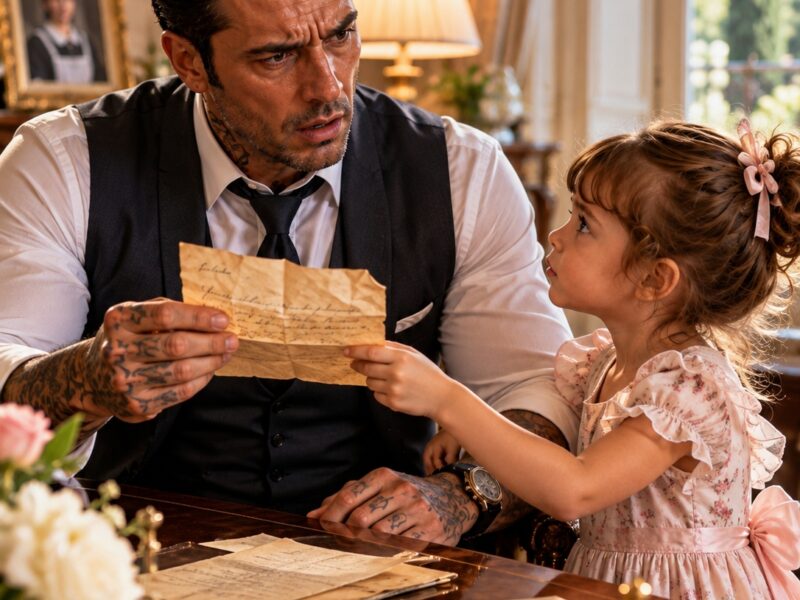
The Maid’s Final Letter Said, “He Is Your Son”—And the Ruthless Mafia Boss Realized the Child He Had Protected Was His Own
Three-year-old Lucas crossed Alessandro Moretti’s silent mansion in moon-print pajamas and placed a sealed letter into the hands of the man everyone else feared.
His mother had died the night before, leaving behind one instruction: if she did not come home, the letter must go to Alessandro and no one else.
When he finally opened it, the first sentence told him Rosa had lied about the boy for years—and the second sentence changed every room in the house.
“Mr. Moretti?”
The voice was so small Alessandro almost mistook it for the old house settling around him.
He turned from the tall windows of the east sitting room and found Lucas standing at the edge of the Persian rug in blue pajamas covered with tiny yellow moons. His chestnut hair had been flattened on one side by sleep, and he held his battered wooden horse beneath one arm as though even grief required him to keep one hand free for something familiar.
In the other hand was a cream-colored envelope.
Alessandro knew the handwriting immediately.
Rosa Mendes had worked in his home for almost two years and had written his name on enough laundry slips, staff inventories, and appointment notes that he would have recognized those careful letters upside down.
Alessandro Moretti.
Nothing else.
No Mr.
No Sir.
No address.
Just his name.
The envelope looked older than the morning. One corner had been reinforced with a strip of transparent tape, and the fold had been opened and flattened so many times that the paper fibers had gone soft.
Lucas stepped closer.
“Mommy Rosa said I had to give you this if she didn’t come home.”
The room seemed to become colder.
Less than twenty-four hours earlier, Alessandro had stood beside a grave in Queens while November rain gathered on the shoulders of his black coat. Rosa’s funeral had been small because she had lived small on purpose—one church friend, an elderly landlord, two women from the neighborhood, Elena from the Moretti house, Marco Bellini, and a child too young to understand why everyone kept lowering their voices around him.
Rosa had died after months of treatment she had hidden from nearly everyone.
Alessandro had brought Lucas back to the estate because there was nowhere else for the boy to go.
Or so he believed.
Three nights earlier, from a hospital bed, Rosa had told him there was something about Lucas he deserved to know.
Something she had been afraid to say while she was alive.
Then she had refused to explain.
“Only the letter,” she had whispered. “And only after Lucas gives it to you himself.”
At the time, Alessandro thought fever and exhaustion had made her sentimental.
Now he saw the envelope.
Lucas took another step.
“She said only you.”
His serious little face tightened with concentration.
“With my own hands.”
Alessandro held out his palm.
Lucas placed the envelope into it and immediately breathed out, as if the responsibility had been heavier than paper.
“I did it right?”
Alessandro looked at him.
Then at the envelope.
His hands had stayed steady while judges lied across conference tables, while federal agents searched warehouses he owned, while men who had eaten at his table decided loyalty was negotiable.
They were not steady now.
“You did it exactly right.”
Lucas nodded, satisfied.
Then he lowered himself onto the rug and began walking the wooden horse along the border pattern.
Task completed.
Alessandro slid one thumb beneath the flap.
The seal cracked.
He stopped.
Something about the old tape bothered him.
Rosa had not written this in the hospital.
She had carried it.
Hidden it.
Changed her mind about it.
Perhaps more than once.
Whatever was inside had frightened a dying woman more than death itself.
And she had trusted a three-year-old child to deliver it more than she had trusted any adult in Alessandro Moretti’s house.
He looked at Lucas.
The boy was making soft hoof sounds against the rug.
Whatever Rosa had hidden in that envelope had been waiting for him longer than Lucas had been old enough to speak.
Alessandro broke the seal.
Several pages unfolded across his hand.
The first line was simple.
Mr. Moretti, the first thing you need to know is that Lucas is not my son.
Alessandro read it twice.
The second line made the room disappear.
The second thing you need to know is that he is yours.
For several seconds, there was no sound except the clock above the mantel.
Then Lucas knocked the wooden horse against the rug and whispered something to it.
Alessandro lifted his eyes.
The child’s profile was turned away.
Chestnut hair.
Small straight nose.
Gray-blue eyes he had spent months trying to place.
A memory arrived so violently that he gripped the paper harder.
Isabella Mendes on the south terrace six years earlier.
Barefoot.
A glass of wine in her hand.
Laughing because Alessandro had pretended not to enjoy a summer storm.
Those same gray-blue eyes.
He returned to Rosa’s letter.
My sister Isabella was Lucas’s mother.
Alessandro stood so quickly the chair behind him struck the wall.
Lucas looked up.
“Mister?”
“I’m all right.”
He was not.
Isabella.
The woman who had once slept with her feet against his because she was always cold.
The woman who could walk into a room full of armed men and ask why nobody had thought to open a window.
The woman he had loved enough to frighten himself.
The woman who had left him three years earlier without explanation.
One suitcase.
No argument.
No accusation.
A single look at the front door.
Then absence.
For exactly three days Alessandro waited for her to call.
On the fourth, pride replaced fear.
He never searched for her.
He told himself that was dignity.
Marco never asked why a photograph of Isabella remained beneath the false bottom of Alessandro’s desk.
Rosa’s handwriting continued.
Isabella discovered she was pregnant eleven days after she left you.
He sat again.
His knees had become unreliable.
Lucas pushed the horse over a raised seam in the rug.
His world was still small enough that adults could fall apart ten feet away without changing the adventure of a toy.
Alessandro read.
Isabella had gone first to Boston.
She rented a room under their mother’s maiden name.
She intended to call him.
She even returned to New York once, sat at Penn Station for nearly an hour, and held Alessandro’s number written on the back of a coffee receipt.
Then she saw a man connected to Vincent Romano standing across the concourse.
The man did not approach.
He did not need to.
Weeks before Isabella left, she had overheard two men outside a Manhattan restaurant joking about Alessandro’s one true weakness.
At the time he had none.
Then one man said:
“If Moretti ever has a child, that’s when we finally own him.”
Isabella had dismissed it as ugly talk.
Until she learned she was pregnant.
Until she saw Vincent’s man at Penn Station.
Then she understood the child would not simply be Alessandro’s son.
He would be leverage.
A bargaining chip.
A surname people would try to use.
Alessandro’s jaw tightened.
Rosa did not excuse Isabella.
She explained her.
She knew you would protect her. That was exactly what frightened her.
Protection in Alessandro’s world meant armored cars.
Guards.
Changed routes.
Surveillance.
People questioned because they stood too close.
Threats answered by larger threats.
Anyone valuable enough to protect became valuable enough to target.
Isabella ran because she believed distance was safer than Alessandro’s love.
He stopped reading.
That sentence hurt more than her leaving ever had.
For three years, he had framed himself as the abandoned man.
The insulted man.
The man denied explanation.
Rosa had just placed another possibility in his hands.
Isabella had loved him enough to believe staying would endanger their child.
He looked across the room.
Lucas had abandoned the rug and was now studying the rain against the windows.
“Why does rain slide?”
Alessandro could barely speak.
“Gravity.”
Lucas considered this.
“Is gravity mean?”
“No.”
“It just does what it does.”
Lucas seemed satisfied.
Alessandro envied him.
He read on.
Isabella’s pregnancy had worsened a heart condition she had hidden since adolescence.
She hated being treated as fragile.
She refused to let Alessandro know.
Lucas was born during a February snowstorm in Boston.
Isabella lived long enough to hold him through his first fever.
Long enough to watch him crawl.
Long enough to see his first unsteady steps while gripping a sofa.
Not long enough to hear him say her name clearly.
Near the end, Rosa traveled to Boston.
Isabella put the baby into her sister’s arms.
She made Rosa promise two things.
Keep him alive.
And if there ever came a day when Alessandro could be trusted with the truth without the truth itself becoming a death sentence, let father and son find each other.
Rosa had obeyed the first promise immediately.
The second took nearly two years.
I did not take the job in your house by accident.
Alessandro stopped.
He remembered Rosa’s application.
A modest apartment in Astoria.
Cleaning jobs.
No debts.
No criminal history.
A quiet woman with a three-year-old boy she called her son.
Marco had investigated her for weeks.
Found nothing.
Because there had been nothing to find.
Rosa had not entered the Moretti estate to steal.
She had entered to judge him.
I needed to see you before I gave you him.
Alessandro read that sentence three times.
I needed to know whether Isabella had been afraid of the world around you or whether she should have been afraid of you too.
He lowered the letter.
Anger rose.
Hot.
Immediate.
At Rosa.
At Isabella.
At himself.
At the dead.
The dead were impossible to argue with.
They left explanations behind and escaped every rebuttal.
Lucas wandered closer.
“Are you mad?”
Alessandro looked at him.
“At the paper?”
“No.”
“You look mad.”
“I’m thinking.”
Lucas nodded.
Adults were often thinking when they looked unhappy.
He returned to the horse.
The letter continued.
Rosa had set rules for herself.
She would watch Alessandro when nobody expected him to perform kindness.
She would watch how he treated people who could do nothing for him.
She would watch what happened when Lucas made mistakes.
Most of all, she would see whether Alessandro treated the boy as an inconvenience, a possession, or a person.
Alessandro remembered the first morning Rosa brought Lucas to the estate.
She had appeared at his office door apologizing.
The woman who watched Lucas had been hospitalized.
Other childcare arrangements failed.
Could the boy stay in the kitchen until noon?
Alessandro had barely looked up from a shipping report.
“How old?”
“Three.”
“Is he likely to dismantle the house?”
Rosa had blinked.
“No, sir.”
“Then bring him.”
He forgot about it immediately.
The next morning Lucas appeared in a navy jacket slightly too large for him, holding the wooden horse.
Elena fed him warm milk.
Toast cut into triangles.
The child whispered to the toy and counted spoons.
At seven twenty, Alessandro passed the kitchen with Marco.
Lucas wandered into the hall.
Their eyes met.
Alessandro stopped.
Less than a second.
Marco noticed.
Lucas raised the horse.
“This is Horse.”
Alessandro looked at its worn paint.
“Efficient name.”
Lucas smiled.
Rosa had appeared instantly.
Tense.
Watching.
Alessandro remembered now that her expression had not been gratitude.
It had been measurement.
Over the following weeks Lucas returned.
First because of childcare problems.
Then because Rosa’s arrangements remained unstable.
Eventually nobody explained anymore.
The boy became part of the house’s rhythm.
He gave Alessandro a smooth gray stone.
“It’s lucky.”
“According to whom?”
“Me.”
Alessandro kept it beside his cufflinks.
Lucas taped a crooked drawing to his office door.
A house.
A sun.
A black figure with arms too long.
FOR MISTER.
The picture stayed.
Then came the yellow star sticker.
Alessandro had been meeting with construction executives.
Lucas slipped inside.
Waited for a pause.
Pressed a bright yellow sticker onto Alessandro’s white shirt cuff.
“What is this?”
“You’re working too much.”
“And this fixes it?”
“Yes.”
Lucas walked out.
Marco stared at the window because he was trying not to laugh.
The sticker remained through the meeting.
Alessandro later removed it carefully and put it in his desk.
Rosa had seen all of that.
She saw him alter routes through his own mansion so he could pass the kitchen at breakfast.
She saw him stop near the north staircase where Lucas studied a painting of a lion standing alone beneath a tree.
“He’s sad,” Lucas had said.
“He’s a lion.”
“He can still be sad.”
“He has the whole landscape.”
“Land can’t play.”
That sentence stayed with Alessandro for weeks.
So had the child.
Rosa’s letter returned him to the present.
You may not have known who he was, but some part of you already knew he mattered.
Alessandro folded the paper once.
Then unfolded it.
The final paragraphs were harder.
Rosa acknowledged what she had taken.
Three birthdays.
First word.
First steps.
The night a fever frightened them both.
The phase when Lucas called every dog a bear.
Moments that belonged partly to Alessandro whether he knew it or not.
I cannot give them back.
I can only tell you that I believed the cost of being wrong was his life.
Then:
Lucas knows me as Mommy because he was too young for anything else. Do not take that from him. Tell him about Isabella when he is old enough to understand. Let him love both of us without believing love has to choose sides.
Alessandro swallowed.
And if you decide you cannot keep him, do not send him away because you are angry with us. Make sure he knows the truth is not that he was unwanted. He was wanted so much that people made terrible choices trying to keep him safe.
The last lines blurred.
Not because Alessandro could not see.
Because his eyes had filled.
Forgive me if you can. Hate me if you must. Just do not make the boy pay for decisions the rest of us made before he could speak.
He lowered the letter.
Lucas was sitting cross-legged now, balancing the wooden horse on one knee.
“Mister?”
“Yes?”
“Can Horse have breakfast?”
“It is nearly nine.”
“He missed breakfast.”
“I see.”
“He worked.”
Alessandro stared at him.
“What kind of work?”
Lucas thought.
“Horse work.”
Of course.
Alessandro pressed two fingers against his mouth.
Then laughed.
It came out once.
Quiet.
Unexpected.
Lucas smiled.
“Horse can eat?”
“Yes.”
“What?”
“Whatever Horse eats.”
“Toast.”
“Then toast.”
Lucas got up.
He reached the doorway and stopped.
“You coming?”
Alessandro looked at Rosa’s letter.
Then at his son.
“Yes.”
It was the first time he followed Lucas into the kitchen.
Marco arrived before noon.
He entered Alessandro’s study carrying two folders.
Stopped when he saw the letter.
“You look terrible.”
“Thank you.”
“Should I come back?”
“No.”
Alessandro pointed to chair.
Marco sat.
“I need a paternity test.”
Marco did not react.
That was reaction enough.
Alessandro’s eyes narrowed.
“You suspected.”
Marco considered lying.
Then apparently valued his life.
“The eyes.”
“You noticed.”
“First morning.”
“And said nothing.”
“I had no evidence.”
“You always have opinions without evidence.”
“Usually you dislike those.”
Alessandro looked toward the study door.
Lucas’s laughter floated from somewhere down the hallway.
“You knew Isabella.”
“Yes.”
“Did he remind you of her?”
Marco nodded.
“Enough that it bothered me.”
“Why didn’t you tell me?”
“Because saying ‘the maid’s son has your former lover’s eyes’ would have sounded like a request for reassignment.”
Alessandro almost smiled.
Then the seriousness returned.
“No family channels.”
“No ordinary lab.”
“No one in the organization knows.”
Marco nodded.
“Understood.”
“And if it’s negative?”
Alessandro looked at the letter.
“Nothing changes until I decide it should.”
Marco studied him.
“And if it’s positive?”
Alessandro did not answer.
The test was handled privately.
A physician who had treated Moretti family members for twenty years collected Alessandro’s sample.
Lucas’s came from a toothbrush, with appropriate legal follow-up arranged later through counsel.
The identifiers were coded.
Results would take three days.
Those became the longest three days of Alessandro’s life.
He worked because work made hours move.
Meetings.
Hotels.
Construction permits.
Import disputes.
An arbitration over a waterfront lease.
Every document suddenly felt irrelevant.
He went home earlier than usual.
Lucas asked him to read a book about a goose who refused to sleep.
Alessandro read it twice because the first time Lucas insisted he had skipped a page.
He had not.
At bedtime, Lucas asked:
“Are you staying here?”
“For a while.”
“Why?”
“Because you asked.”
Lucas seemed pleased by the logic.
Alessandro remained until he slept.
The second night, he opened Rosa’s letter again.
Then took Isabella’s photograph from beneath the false bottom of his desk.
Her hand rested low across her abdomen.
He had never noticed.
The picture was taken shortly before she left.
He remembered one night in bed.
She asked:
“If you loved something that could be used against you, would you still keep it close?”
Alessandro answered without hesitation.
“I’d make sure nobody dared touch it.”
She had gone silent.
At the time, he thought the answer reassured her.
Now he realized it might have confirmed everything she feared.
Protection.
Guards.
Retaliation.
War.
Love turned into perimeter.
The test arrived on Friday afternoon.
Marco carried the envelope into the study.
Placed it down.
“You read it?”
“No.”
“You know?”
“No.”
Alessandro opened it.
The report contained pages of clinical language.
He found the conclusion.
Probability of paternity greater than 99.99 percent.
He read it again.
Then folded the paper once.
“He’s mine.”
Marco’s face softened.
“Yes.”
“Don’t call me boss right now.”
“I wasn’t going to.”
“You were thinking it.”
Marco stood.
“I’ll leave.”
Alessandro remained alone for another minute.
Then went to the kitchen.
Lucas was standing on a stool trying to reach a biscuit jar Elena had intentionally placed too high.
The wooden horse was wedged under one arm.
The operation had structural problems.
Alessandro lifted him down.
“I almost had it.”
“I saw.”
“Miss Elena says one.”
“Miss Elena is usually right.”
“Usually.”
“Do not repeat that.”
Lucas grinned.
Alessandro set him down but did not release him.
He crouched.
One hand on each small shoulder.
He had rehearsed sentences.
None survived contact with Lucas’s face.
“I should have known you sooner.”
Lucas frowned.
“You know me now.”
Alessandro swallowed.
“Yes.”
“So it’s okay.”
The mercy of children could be unbearable.
Alessandro pulled him close.
Lucas stiffened for one startled second.
Then wrapped both arms around Alessandro’s neck.
The wooden horse pressed painfully between them.
Alessandro did not move it.
Elena stood at the sink.
She turned her back and began drying a plate that had already been dry.
That night, Alessandro sat beside Lucas’s bed.
He explained only what a three-year-old could carry.
Rosa had loved him.
Isabella was the mother who brought him into the world.
Isabella had loved him too.
And Alessandro was his father.
Lucas listened with wide, serious eyes.
“My real father?”
Alessandro caught the dangerous word.
“Your father.”
“But Mommy Rosa was real.”
“Yes.”
“Isabella was real.”
“Yes.”
“Nobody gets erased.”
Lucas considered.
“So I have two mommies.”
“Yes.”
“But they’re both far.”
Alessandro’s throat tightened.
“Yes.”
Lucas looked down at the horse.
Then back up.
“And you’re here?”
“I’m here.”
Silence.
“Can I call you Papa?”
Alessandro stared at him.
Lucas’s face changed slightly, worried he had done something wrong.
Alessandro adjusted the blanket beneath his chin.
“If you want to.”
Lucas tested it quietly.
“Papa.”
The word landed somewhere below Alessandro’s ribs.
He had been called many things in forty years.
Most with fear.
Some with hatred.
A few with respect.
Nothing had changed him simply by being spoken.
Lucas tried again.
“Good night, Papa.”
Alessandro stayed until he slept.
Marco was waiting near the staircase when he came out.
He had clearly heard enough.
“Say whatever you’re going to say.”
“I was going to ask if you still want the security report tonight.”
“Coward.”
Marco’s mouth twitched.
“I’ve survived by knowing when not to become memorable.”
The next morning, Alessandro called the family attorney.
Not the organization’s criminal lawyer.
A family-law attorney in Manhattan whose firm handled guardianships, estates, and private paternity matters for wealthy clients.
Her name was Meredith Sloan.
She arrived at eleven carrying a legal pad and none of the fear people usually brought into Alessandro’s house.
“I’m told there is a child.”
“Yes.”
“And you have reason to believe you’re biological father.”
“Confirmed privately.”
“Good.”
“Bad.”
She sat.
“Depends what you do next.”
Alessandro disliked her immediately.
That was promising.
They discussed birth records.
Rosa’s informal guardianship.
Isabella’s death certificate.
Temporary custody.
The need to establish paternity formally without creating unnecessary public exposure.
Meredith said:
“You cannot legally make a child disappear.”
“I don’t want to.”
“Your security people might.”
“They won’t.”
“Good.”
She wrote.
“And the boy?”
“What about him?”
“Does he want to live here?”
“He’s three.”
“He still has preferences.”
The question annoyed Alessandro because he did not know the answer.
That evening, he asked.
They sat on the floor of Lucas’s temporary guest room.
“Do you like it here?”
“Yes.”
“Would you rather live somewhere else?”
Lucas looked alarmed.
“Am I bad?”
“No.”
“Then why?”
“I’m asking.”
Lucas thought.
“Horse likes it.”
“Horse is not the deciding vote.”
“He should be.”
“Noted.”
Lucas looked around.
“Mommy Rosa lived apartment.”
“Yes.”
“It was little.”
“This is big.”
“Yes.”
“Big is lonely.”
Alessandro went still.
Lucas continued arranging blocks.
“But not when everybody is here.”
“Who is everybody?”
“Miss Elena.”
“Marco.”
“You.”
“Horse.”
“Of course.”
Lucas nodded.
“I stay.”
The next day Alessandro told Meredith:
“He stays.”
She did not smile.
She simply wrote it down.
Fatherhood changed the estate in embarrassingly small ways.
Alessandro expected lawyers.
Schools.
Trusts.
Security plans.
Instead, Lucas introduced emergencies involving spoons.
Sock seams.
Bedtime.
Milk in the wrong cup.
One evening Alessandro said, “In a minute,” when Lucas asked for a story.
Exactly sixty seconds later, Lucas returned.
“You said minute.”
Alessandro checked his watch.
He had.
The boy had no concept of contracts and yet enforced them better than half the attorneys Alessandro knew.
Bedtime became a negotiation.
“One book.”
“Two.”
“One.”
“One first and then one.”
“That is two.”
Lucas considered.
“No.”
“It is.”
“But I said one first.”
Alessandro recognized tactics used by union representatives.
“You’re going to be expensive.”
Lucas chose two books.
Alessandro began ending meetings earlier.
Three senior men were once dismissed at eight twenty because Lucas expected a story about a bear who could not find his hat.
Nobody laughed until they reached the parking lot.
Marco heard about it anyway.
The haircut happened on a Sunday.
Lucas announced his hair was touching his eyes.
Elena offered to call barber.
“No.”
“Papa does it.”
Alessandro should have understood confidence was not competence.
Twenty minutes later, the left side was shorter than the right and the front looked as if two opposing governments had negotiated it.
Elena entered.
Stopped.
“What happened?”
“It needs refinement.”
“It needs prayer.”
Lucas looked in mirror.
“I like it.”
That made things worse.
Marco appeared in doorway.
Saw the haircut.
Laughed out loud.
Alessandro turned.
“Do you have somewhere else to be?”
Marco vanished.
The barber arrived.
There were limits to restoration.
For a week Lucas proudly told everyone:
“Papa did it.”
Alessandro discovered public accountability was unpleasant.
The first real test came in the east sitting room.
A porcelain horse stood on a shelf near the fireplace.
It had belonged to Alessandro’s mother, Adriana.
Not valuable by Moretti standards.
Priceless by memory.
Lucas knew not to touch it.
He also knew it was a horse.
At three, those truths did not carry equal weight.
Elena left the room for less than a minute.
Lucas dragged a footstool across the rug.
Climbed.
Reached.
The porcelain horse fell.
Four pieces.
The sound brought three adults running.
Lucas stood frozen.
His face drained.
Alessandro entered from adjoining study.
Saw fragments.
Saw child.
“Papa.”
Lucas’s eyes filled.
“I’m sorry.”
For one instant Alessandro saw his mother wrapping that figurine in newspaper when they moved houses.
Her hands.
Her voice.
Some things survive only if people are careful.
Then he noticed a small red line on Lucas’s palm.
“Your hand.”
Lucas hid it.
“I broke it.”
Alessandro crossed room.
Crouched.
Took his wrist gently.
“Did it cut you?”
“A little.”
“Elena, first-aid box.”
Lucas stared.
“Are you mad?”
“I’m not happy about the horse.”
His mouth trembled.
“But are you mad at me?”
Alessandro understood how easy it would be for a child to confuse broken property with broken love.
“No.”
Lucas searched his face.
“I am concerned that you climbed after being told not to.”
“We will discuss that.”
“But things break.”
He paused.
“You don’t become less mine because something broke.”
Lucas stared.
Then threw both arms around his neck.
Across room, Elena wiped one eye before pretending to search the first-aid box.
Alessandro had the horse restored.
The repair left a faint line across its body.
The specialist apologized.
Alessandro told him to leave it.
For most of his life, Alessandro believed damage should either be hidden perfectly or removed entirely.
Lucas was teaching him something else.
Repaired things did not need to pretend they had never broken.
The danger returned slowly.
Not with gunfire.
Not with a dead body.
With questions.
The Moretti family had an old rival named Vincent Romano.
The history between families was older than Alessandro.
Docks.
Contracts.
Warehouse access.
Union relationships.
Real-estate disputes.
Enough legitimate business layered over enough old criminal behavior that nobody could say where one ended and the other began.
Vincent had spent years probing edges of Alessandro’s organization.
A supplier disappeared from a project.
A shipment was delayed.
A contractor switched sides.
Nothing large enough to justify open conflict.
Marco called it measuring.
“He wants to know where the wall is thin.”
Alessandro had answered:
“Then don’t let him find it.”
At the time, Lucas was in hallway arguing with Elena about whether peas counted as vegetables if they rolled.
Marco looked toward sound.
“Everyone has something thin somewhere.”
Alessandro’s expression hardened.
“Careful.”
“I’m saying Vincent doesn’t need to know what matters to you.”
“He only needs to watch what you protect.”
Weeks later, someone did.
Alessandro took Lucas to a bookstore in Manhattan.
Quiet afternoon.
Marco nearby.
Two security men farther back.
Lucas chose four books based almost entirely on covers.
Outside, his shoelace came undone.
Alessandro crouched to tie it.
Lucas rested one hand casually on his shoulder.
Neither noticed man across street lift phone.
Marco did.
Not fast enough.
Three days later, one of the family attorneys received an inquiry from a records intermediary asking whether Lucas Mendes would soon be using another surname.
The question was disguised as administrative verification.
Marco traced it through a courier.
Then a court clerk.
Then a false name.
Thin trail.
But deliberate.
He came to Alessandro after midnight.
“Someone is asking about the boy.”
Alessandro closed architectural plans.
“Who?”
“I don’t know.”
“Then why are you here?”
“Because whoever it is knew exactly where to touch paper trail without asking for paternity record directly.”
Alessandro’s face changed.
“The lab?”
“Clean.”
“This came through legal filings.”
“How many people could connect him?”
“Very few if they didn’t already know what they were looking for.”
Marco removed a photograph.
Placed it on desk.
Alessandro tying Lucas’s shoe.
Taken from across street.
“Where did you get this?”
“A broker who sells information to both families.”
“Both meaning Vincent.”
“Yes.”
“He had a copy before us.”
Alessandro looked at child’s hand on his shoulder.
Rosa had been right.
Isabella had been right.
The truth itself could become a target.
Across Brooklyn, Vincent Romano studied the same photograph.
He was fifty-two.
Broad shoulders.
Silver at temples.
Patient in way men become when hatred matures for decades.
For thirty years Romanos had tried to take things from Morettis.
Warehouses.
Contracts.
Territory.
Employees.
None mattered because Alessandro could replace them.
The boy was different.
Vincent did not see weakness.
Weakness was unreliable.
He saw attachment.
Something irreplaceable.
That made it useful.
Vincent did not attack.
That frightened Marco more.
A construction supplier stopped answering calls.
Later he was found alive in a motel in New Jersey, frightened enough to abandon business.
A security camera near service road failed for eleven minutes.
No mechanical problem.
A dark sedan followed vehicle carrying Lucas and Elena after pediatric visit, then vanished when driver changed route.
No shots.
No demands.
Vincent was not hurting Alessandro yet.
He was teaching him Lucas could be reached.
Marco increased security.
Alessandro approved.
Then increased it again.
The estate became a fortress.
Rear garden required escorts.
Trips stopped.
Front gate stayed closed.
Lucas noticed.
One afternoon he stood at breakfast-room window.
“Can I go outside?”
“Not right now.”
“Why?”
“Because I said so.”
The old answer came too easily.
Lucas turned.
“Did I do something?”
Alessandro looked up.
“No.”
“Then why am I grounded?”
“You’re not grounded.”
“Grounded means you can’t go places.”
Elena became very interested in flowers.
Alessandro closed folder.
He crossed room.
“There are people outside who are angry with me.”
Lucas thought.
“Because you were bad?”
Question landed hard.
“Sometimes because of things I’ve done.”
“Sometimes because of things my family did before you were born.”
“Sometimes because people want what we have.”
“Do they want my toys?”
“No.”
“Horse?”
“No.”
Lucas relaxed.
Alessandro crouched.
“They might try to use you to make me do something.”
“Use me how?”
Alessandro stopped.
There was honesty.
Then there was giving a child fears too large to carry.
“That’s why the guards are here.”
“So nobody gets close enough to try.”
Lucas looked toward lawn.
“I liked it better before everybody knew I was your boy.”
Alessandro had no answer.
Neither did Marco later.
The message arrived next morning.
Plain envelope.
Delivered to a legitimate Moretti office.
Inside:
Photograph of Lucas asleep in rear seat of car.
Taken through glass.
On back:
Beautiful things make poor armor.
Alessandro stared.
Marco stood across desk.
“He was close enough to take this.”
“Yes.”
“Before increased detail.”
“Yes.”
Alessandro placed photograph down carefully.
“Move Lucas.”
Marco had expected resistance.
“Where?”
“My aunt’s property outside Palermo.”
“No public itinerary.”
“Different name.”
“You take him.”
“For how long?”
“Until Romano is finished.”
Marco did not ask what finished meant.
Preparations began.
But secrets worked differently once a child lived in house.
Lucas heard Elena mention packing warm clothes.
Then heard Marco say airport.
By dinner, he assembled fragments into wrong conclusion.
Alessandro found him on bedroom floor.
Small suitcase open.
Wooden horse already inside.
“What are you doing?”
“Packing.”
“Who told you?”
“Nobody.”
Lucas pushed shirt into case.
“You’re sending me away.”
Alessandro sat on edge of bed.
“No.”
“Because I broke Grandma’s horse?”
“No.”
“Because I don’t stay in kitchen?”
“No.”
“Because I’m Moretti now?”
Alessandro went still.
Lucas looked up.
“Maybe you liked me better when I was just Lucas.”
Alessandro took shirt from hands.
“Listen to me.”
“I am not sending you away because I want less of you.”
“I’m thinking about sending you somewhere because I want you alive.”
Word was harsher than intended.
Lucas’s face changed.
Alessandro softened voice.
“Your mother Isabella was afraid.”
“Of me?”
“Of people who might hurt you because of me.”
“So she went away from you.”
“Yes.”
“Did she stop loving you?”
Alessandro thought of Penn Station.
The phone call never made.
Years of anger.
“No.”
“I don’t believe she did.”
“Then why didn’t she tell you?”
“Because she thought leaving was safest way to protect you.”
Lucas frowned.
“But it made you sad.”
“Yes.”
“And her?”
“I think it made her sad too.”
Silence.
Then Lucas asked:
“Was she right?”
“About what?”
“That I’m safer far from you.”
Alessandro could have lied.
“Right now?”
“Maybe.”
Lucas’s eyes filled.
“I don’t want far.”
Alessandro pulled him close.
“Neither do I.”
He held boy until small body relaxed.
Marco stood silently in doorway.
Sicily remained plan.
Departure was delayed until route secure.
Vincent never gave them chance.
The breach came two mornings later disguised as an ordinary problem.
Smoke near electrical shed on western edge.
Alarm.
Two guards diverted.
Maintenance supervisor reported sparks.
A real enough problem.
Small enough not to trigger full lockdown.
That distinction was deliberate.
Years earlier an outside contractor had redesigned drainage and utility access near east wall.
One former employee now owed Vincent more money than he could repay.
He knew a service passage forgotten after renovations.
Several guards looked west.
Four men entered east.
Elena was walking Lucas toward enclosed garden.
He carried wooden horse.
Complained sky looked like rain.
Elena saw stranger first.
Wrong clothes.
Wrong posture.
She had spent nineteen years knowing who belonged.
“Lucas.”
Her voice changed.
“Run to kitchen.”
One man moved.
Elena pushed boy behind her.
Another appeared from hedge.
She screamed.
A man caught her arm.
She struck him with metal handle of umbrella.
Lucas screamed for Alessandro.
Another man lifted him.
Wooden horse fell.
Hit stone path.
Spun into wet grass.
Elena fought.
She was knocked down hard enough to stun her.
By time vision cleared, service gate was closing behind dark utility van.
Less than two minutes.
Alessandro was halfway down staircase when he heard Elena screaming Lucas’s name.
He reached garden before security team understood.
Elena sat against stone wall.
Cut near temple.
Furious at men trying to examine her.
“They took him.”
“Four men.”
“East passage.”
“Dark van.”
“I’m sorry.”
Alessandro knelt once.
“You tried.”
“Not enough.”
“You’re alive.”
“That matters.”
He stood.
Marco arrived.
No shouting followed.
No explosion of rage.
Alessandro’s face emptied.
Marco found that more frightening.
“Road cameras.”
“Airports.”
“Bridges.”
“Tolls.”
“Nobody fires at a vehicle unless we know Lucas isn’t inside.”
Marco was already issuing orders.
Alessandro walked toward path.
Something lay in grass.
Wooden horse.
One ear chipped slightly more than before.
He picked it up.
Closed his hand around it.
Phone call came nineteen minutes later.
Marco gave him secure mobile.
Vincent Romano’s voice was calm.
“You received my message.”
“If he is hurt—”
Vincent interrupted.
“Threats are what men say when they still believe they negotiate from strength.”
“Let me hear him.”
Pause.
Rustle.
Then:
“Papa?”
Alessandro closed eyes.
“I’m here.”
“I want to go home.”
“You will.”
Vincent returned.
“That depends on you.”
“Forty-eight hours.”
“You transfer control of Brooklyn terminals, West Fifty-Fourth hotel interests, and Red Hook construction contracts.”
“Then you come alone to exchange.”
“No Marco.”
“No guards.”
“No tricks.”
Alessandro’s voice stayed low.
“You think I believe you intend to trade him?”
“I think you finally acquired something more important than being suspicious.”
Call ended.
Marco looked at him.
“He plans to kill you at exchange.”
“Yes.”
“And may keep Lucas anyway.”
“Yes.”
Marco waited.
Alessandro stared at toy.
For most of his life enemies made him choose between money, territory, pride, and survival.
None frightened him.
None were irreplaceable.
Vincent finally understood.
“He doesn’t want empire.”
Marco looked up.
“He wants me to choose which part of my life dies first.”
The search produced too much information.
Traffic footage.
Stolen plates.
Toll records.
Warehouse leases.
Fuel purchases.
Bad tips.
Good tips.
Marco divided teams.
Alessandro stayed at center.
Wooden horse inside coat.
Elena, despite stitches, refused to leave map room.
She remembered sound.
“When van door opened, I heard a bell.”
“A bell?”
“Metal.”
“Two strikes.”
“Then another.”
She closed eyes.
“And smell.”
“Sweet.”
“Chemical.”
Marco wrote both.
A traffic camera caught van entering industrial corridor in Queens.
Another saw it emerge seven blocks later.
Twenty-six garages and loading properties in between.
Van later found abandoned near shuttered plumbing warehouse.
Wiped clean.
Near tire:
Reddish dust.
Fine gray powder.
Construction chemist identified old brick dust and insulation residue from industrial material no longer common.
Not address.
But eliminated newer buildings.
Metallic bell mattered when a night driver mentioned old rail spur where loose signal hardware rang as freight passed.
Sweet chemical smell suggested former printing or packaging facilities.
The map shrank.
Vincent sent false lead.
A source claimed child in disused refrigerated warehouse.
Marco distrusted it.
Could not ignore.
Team entered.
Found staged room.
Child-sized chair.
Yellow blanket.
Plastic cup of apple juice.
No Lucas.
The trap proved Vincent was controlling search.
They stopped chasing every rumor.
Verification first.
Then a more useful thread.
The subcontractor linked to service passage had also renovated an old packaging warehouse in Bronx industrial district.
Property changed owners repeatedly.
Final holding company shared accountant with trucking firm used by Vincent’s cousin.
Power usage had spiked day before.
Two prepaid phones connected nearby.
A delivery truck entered block before dawn.
Marco marked map.
“Could be another false site.”
“Can we confirm activity?”
“Not directly.”
“Plans?”
Old city plans showed service conduit connecting adjoining properties.
Emergency lighting.
Sealed internal access that may never have been fully demolished.
Marco’s team could approach through neighboring building.
Then argument began.
Alessandro wanted to enter front alone while teams positioned.
Marco refused.
“That was not a request.”
“Fire me after Lucas is home.”
“Careful.”
“I am being careful.”
“More than you.”
Alessandro turned.
“Vincent wants me.”
“So I go.”
“Eventually.”
“Not first.”
“If he sees someone—”
“I heard threat.”
Marco lowered voice.
“You’re still thinking like man you were before Lucas.”
Alessandro stared.
“You think highest form of loyalty is putting your body between danger and everybody else.”
“Is this when you lecture me?”
“Yes.”
“Because you have no right to die dramatically and call it love.”
Silence.
Marco continued.
“Before boy, if you wanted to walk into danger because it solved a problem, that was your decision.”
“Now there’s a three-year-old waiting to come home to someone.”
“He doesn’t need a dead father who proved he loved him.”
“He needs a living one who learned to plan.”
No one else could have said that and remained employed.
Marco knew.
Alessandro looked back at plans.
“What do you suggest?”
Marco exhaled.
“We give Vincent the exchange he expects.”
“You appear where ordered.”
“He watches you.”
“Meanwhile we verify Lucas and enter through route he isn’t watching.”
“Cut exterior power.”
“Disrupt emergency transfer briefly.”
“We don’t need darkness long.”
“How long?”
“Seconds.”
“That isn’t a plan.”
“It is if everyone knows what seconds are for.”
At 1:30 a.m., Vincent called.
“You have first transfer documents.”
“Yes.”
“Where is my son?”
“Alive.”
“Let me hear him.”
Lucas’s voice came through.
Quieter.
“Papa.”
“I’m here.”
“It’s dark.”
“I know.”
“Horse is gone.”
Alessandro touched shape inside coat.
“I found him.”
Lucas inhaled.
“You did?”
“He’s with me.”
“Bring him when you come.”
“I will.”
Vincent gave address.
The warehouse Marco had marked.
Three a.m.
South loading door.
Come alone.
No vehicles within six blocks.
No transmitters.
“If I see anyone else, you will spend rest of life remembering last sound your son made.”
Call ended.
Marco had heard speaker.
“Real location or stage.”
“Either way, use it.”
Alessandro took wooden horse from coat.
Placed it on desk.
“If I don’t come back—”
“No.”
“Listen.”
“We just had argument.”
“Different argument.”
Alessandro met his eyes.
“If I die, Lucas does not inherit this organization.”
“Not even clean version.”
“No soldiers calling him heir.”
“No one teaching him names of enemies.”
“No revenge.”
Marco’s jaw tightened.
“And where does he go?”
“My mother’s sister outside Palermo if necessary.”
“Or Elena if court allows and she wants him.”
“He gets music.”
“Books.”
“He can be terrible at sports.”
“I don’t care.”
“He gets to be a boy.”
Marco looked at toy.
“You tell him yourself when you get back.”
“Promise.”
“I promise.”
At 2:45, Alessandro arrived alone.
Dark coat.
White shirt.
No visible weapon.
Six blocks away, Marco waited inside utility van.
Teams positioned through adjoining properties.
A camera over loading door turned toward Alessandro.
He raised hands briefly.
Door unlocked.
Inside smelled of damp brick, old paper, and sweet residue of industrial adhesive.
Far above, loose rail hardware struck metal as freight passed.
Two notes.
Then another.
Elena had remembered.
Alessandro walked deeper.
Phone rang.
Vincent.
“Keep walking.”
“Where is Lucas?”
“Close.”
A screen flickered on.
Lucas appeared seated in small room.
Wrists free.
Door behind him locked.
He looked exhausted.
Alessandro’s heart struck once hard.
“Papa?”
“I’m here.”
Vincent spoke.
“No Marco.”
“No army.”
“No clever rescue.”
“Walk through door.”
Steel lock released.
Alessandro entered.
Large room.
Old equipment.
Office tables.
Shadows.
Lucas’s voice came from behind wall.
“Papa.”
“I’m here.”
Instinct told him to move toward sound.
He did not.
Marco’s words:
Survive long enough to think.
Alessandro took one slow breath.
“Lucas.”
“Yes?”
“Listen to my voice.”
“Okay.”
Door opened across room.
Vincent Romano entered.
A pistol rested at side, but not raised.
His confidence came from arrangement, not aim.
“There he is.”
“The man who finally knows what it feels like to have something he cannot replace.”
Alessandro said nothing.
Vincent stepped closer.
“My father lost docks because your father left him no choice.”
“My brother died because your people left him no choice.”
“For thirty years I’ve listened to Morettis call that strength.”
“And now?”
“Now you understand choices differently.”
He gestured toward camera.
“You read statement.”
“You transfer remaining interests.”
“You admit organization is finished.”
“Then maybe boy leaves.”
“Maybe?”
“You’re not in position to demand better language.”
“I’m in position to know you.”
Vincent’s expression sharpened.
“You were never going to release him while I lived.”
“And if you kill me before transfers clear, my people can reverse them.”
“You need me alive.”
Vincent laughed.
“There he is.”
“I thought fatherhood made you stupid.”
“It made me patient.”
Behind wall Lucas called:
“Papa?”
“I’m here.”
“Can I come out?”
“Not yet.”
Vincent looked toward wall.
“He trusts you.”
“Children do.”
“Dangerous habit.”
“Only when adults teach them it is.”
Vincent’s mouth tightened.
Alessandro needed him talking.
Every second mattered.
Marco’s hand rested on transfer switch six blocks away through service access.
Two men waited near sealed conduit.
Another team covered rear exit.
No action until Lucas’s exact position was confirmed.
Vincent slid paper across table.
“Read.”
Alessandro did not touch it.
“You know what Isabella did?”
Vincent frowned.
“Your dead woman?”
“She left because she heard men from your organization discussing what they’d do if I had a child.”
“Men talk.”
“She believed them.”
“Then she was smarter than you.”
Alessandro allowed insult.
“She hid for last year of her life because of war neither of us started.”
Vincent shrugged.
“She chose you.”
“Yes.”
“And boy carries your name.”
“Yes.”
“Then he inherits consequences.”
That was the sentence Alessandro had been waiting for.
Not because it surprised him.
Because it clarified everything.
Vincent did not see Lucas as child accidentally caught in feud.
He saw inheritance itself as guilt.
Blood justified blood.
Debt passed to someone too young to know it existed.
Alessandro had believed softer versions of same thing for much of his life.
Called it tradition.
Family responsibility.
Loyalty.
Standing there, hearing Vincent condemn a three-year-old for surname, he finally heard emptiness beneath ceremony.
“No.”
Vincent frowned.
“What?”
“He inherits nothing from this except whatever I can end before he understands it.”
Vincent laughed.
“You think you can walk away?”
“I think I can refuse to hand it to him.”
“Read.”
Alessandro picked up page.
Behind wall, chair scraped.
A memory surfaced.
A game from estate.
Lucas hiding beneath dining table.
Alessandro pretending not to find him.
When Alessandro said:
“Little lion down.”
Lucas would drop flat behind sofa and cover his head while laughing.
Meaningless game.
Until now.
Alessandro raised page.
“I, Alessandro Moretti, acting without coercion…”
He stopped.
Vincent lifted pistol slightly.
“Continue.”
Alessandro looked toward camera.
“Little lion down.”
Behind wall, Lucas obeyed because Papa had used game voice.
He slipped from chair and flattened beside wall.
Power died.
Darkness swallowed warehouse.
Vincent cursed.
Emergency lights flickered once.
Failed.
Alessandro moved.
No heroic charge.
No dramatic revenge.
Just seconds used for one purpose.
He knocked Vincent’s weapon hand aside and drove both of them behind heavy table.
A shot struck metal away from Lucas’s room.
From adjoining corridor came shouting.
Marco’s team entered through service access.
Another man inside Lucas’s room surrendered after officers approaching rear entrance were announced.
Marco had arranged anonymous call to law enforcement once Lucas’s location was confirmed.
That was part Alessandro originally hated.
It meant surrendering control of outcome.
Which was exactly why Marco insisted.
Vincent struggled.
The weapon slid away.
Alessandro pinned him long enough for others to restrain him.
Vincent looked up.
“You think courts make you clean?”
Alessandro was breathing hard.
“No.”
“Nothing makes me clean.”
Sirens approached.
He looked toward Lucas’s room.
“But he doesn’t have to become me.”
Marco opened the door.
Lucas appeared.
Pale.
Tired.
Then he saw Alessandro.
“Papa!”
He ran.
Alessandro dropped to one knee.
Lucas hit him hard enough to knock breath from his chest.
Alessandro held tighter.
“I’m here.”
“I did lion thing.”
“You did it perfectly.”
“I was scared.”
“So was I.”
Lucas pulled back.
Looked at Alessandro’s face.
“You have dirt.”
“Yes.”
“Miss Elena says wash hands.”
“She is usually right.”
Lucas looked around.
“Horse?”
Marco stepped closer.
He had wooden horse behind back.
Lucas gasped.
“Horse!”
Marco gave it to Alessandro.
Alessandro placed it into his son’s hands.
One carved ear chipped.
Paint worn.
Still itself.
Lucas pressed the toy against his chest.
Then against Alessandro’s.
As if both had been rescued.
By dawn, they were home.
Elena met them at entrance despite instructions to remain in bed after her injuries.
Lucas ran to her.
She held him and cried openly.
Alessandro stood a few feet away.
Too exhausted to hide what it did to him.
The estate did not become safe because Lucas returned.
Reality did not work that way.
Police investigations followed.
Vincent faced kidnapping, conspiracy, extortion, financial offenses, and related charges supported by evidence from warehouse and shell-company transfers.
Several Moretti operations also came under scrutiny.
Alessandro could not hand investigators only the crimes committed against him while pretending his own organization was pure.
That became final cost.
Lawyers warned him.
Cooperation would expose old structures.
Contracts.
Money.
People.
Some legitimate businesses would survive.
Others might not.
Marco asked:
“You sure?”
Alessandro looked toward upstairs where Lucas was sleeping.
“No.”
“Do it anyway.”
The dismantling took years, not weeks.
Some companies sold.
Others entered compliance agreements.
Several old associates left.
A few were charged for offenses unrelated to Lucas.
Alessandro stepped back from businesses that depended on intimidation or illegal leverage.
He kept hotels.
Construction.
Import companies that could survive audits.
He accepted oversight.
Lost money.
Lost prestige.
Lost men who had called loyalty a virtue only while it protected income.
For first time, he did not rebuild every loss.
He let some things die.
The legal process establishing Lucas’s parentage continued.
Rosa’s role was documented respectfully.
Isabella’s records were obtained from Massachusetts.
The court recognized Alessandro as father.
He did not change Lucas’s surname immediately.
That surprised Meredith Sloan.
“You don’t want him Moretti?”
“I want him Lucas.”
“That isn’t legal answer.”
“Then keep Mendes for now.”
“Why?”
“Because it was his mother’s name.”
“And Rosa’s.”
“Exactly.”
When Lucas was old enough, they would discuss.
No identity imposed because Alessandro needed proof of possession.
The boy’s bedroom became permanent.
Muted blue walls.
Simple bed because Lucas rejected expensive carved one.
“It looks angry.”
Decorator looked offended.
Alessandro bought the simpler bed.
On highest shelf sat wooden horse when not carried.
The repaired porcelain horse returned to sitting room.
Faint line remained visible.
Alessandro left it.
A scholarship fund was established in Isabella’s name for children who had lost a parent young.
Rosa’s name went on a hospice center in Queens through a legitimate charitable foundation.
No public Moretti branding.
Alessandro visited before opening.
He stood beneath small plaque.
Ran his fingers across letters.
Left before anyone could thank him.
Three months after warehouse, Lucas asked to visit cemetery.
They stood between Rosa’s grave and Isabella’s.
Lucas put wooden horse between headstones.
“Can he stay?”
“If you want.”
Lucas thought.
Then picked horse up.
“Maybe later.”
“He sleeps with me.”
Alessandro nodded.
“I think they’d understand.”
That night, back at mansion, Lucas sat on floor building a crooked house from plastic blocks.
Alessandro sat beside him.
Elena’s voice floated from corridor arguing with Marco about drinking coffee after eight.
Lucas put a small plastic lion near front door.
Alessandro handed him another block.
“That lion used to live alone.”
Lucas looked up.
“Not this one.”
“No?”
Lucas shook his head.
Moved lion closer to house.
“This one has family.”
Alessandro looked at uneven walls.
Wooden horse beside Lucas’s knee.
Child who entered his life carrying nothing Alessandro thought he wanted and everything he had been missing.
Outside, gates were still iron.
Past was still real.
Some damage had been repaired.
Some could only be carried.
Nothing Alessandro did would restore Isabella’s last year.
Nothing would return Rosa.
Nothing would give him Lucas’s first steps.
But the house no longer sounded empty.
Footsteps.
Books.
Elena complaining.
Marco laughing once before catching himself.
Lucas asking questions from another room.
For most of Alessandro’s life, silence had meant control.
Now silence meant something was missing.
Lucas placed the last block on roof.
It fell.
He frowned.
Alessandro reached to fix it.
Then stopped.
“Try again.”
Lucas did.
The block stayed.
He smiled.
Outside, dusk settled behind the estate walls.
Inside, the lion was no longer alone.









