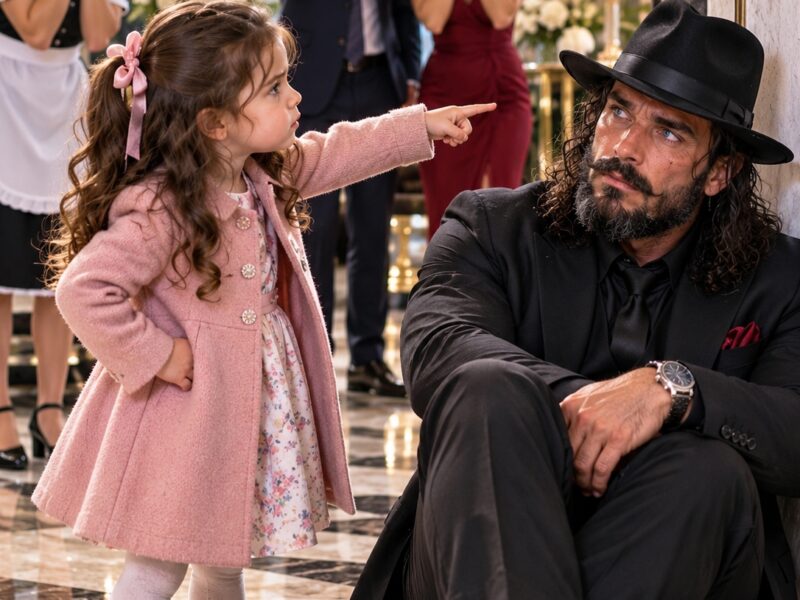
The Maid’s Little Daughter Put the Mafia Boss in Time-Out—Everyone Laughed, Until Her Stuffed Rabbit Exposed Why Her Father Never Came Home and Who Betrayed Him
The first person in twenty-seven years to order Anthony Valenti into a corner was four years old.
She was wearing yellow socks, holding a spoon sticky with oatmeal, and had absolutely no idea the man in front of her could make half of New York lower its voice.
“Time-out, mister,” Sophie Carter said.
Nobody in the kitchen moved.
Her mother dropped a lemon.
It hit the marble floor, rolled beneath the long oak table, and stopped against Anthony Valenti’s polished black shoe.
Emily Carter forgot how to breathe.
Six weeks earlier, she had arrived at the Valenti estate with two suitcases, one child, a stack of unpaid medical bills, and exactly thirty-eight dollars in her checking account after rent cleared.
Mrs. Franklin, the estate manager, had hired her after a twelve-minute interview.
“You clean the west wing, guest rooms, kitchen hall, and library corridor,” the older woman had said. “Sophie may stay in the family kitchen while you work. She does not go upstairs. She does not enter the office wing. And you do not ask questions about the cars.”
Emily had almost asked what cars.
Then she saw them.
Black sedans.
Black SUVs.
Black town cars.
Always polished.
Always arriving quietly.
Men stepped out wearing dark wool coats and expressions that suggested weather was the least dangerous thing outside.
The Valenti estate sat above the Hudson, forty minutes north of Manhattan, behind iron gates and enough old trees to hide a small country.
The house itself had belonged to a railroad executive before Anthony’s grandfather bought it in the seventies.
Gray stone.
Tall windows.
A kitchen larger than Emily’s last apartment.
A formal dining room nobody seemed to use.
People lowered their voices when Anthony entered.
They called him Mr. Valenti.
The older men called him Anthony only when the door was closed.
Everyone else called him the boss when they thought Sophie could not hear.
Sophie heard everything.
She simply misunderstood most of it.
To her, Anthony Valenti was not the head of a criminal organization wrapped inside shipping companies, construction firms, warehouses, restaurants, and legal businesses.
He was the tall man who drank coffee and forgot breakfast.
That was how the trouble started.
Sophie had created rules for the kitchen.
They were written in purple crayon on white printer paper and held to the refrigerator with a magnet shaped like a strawberry.
RULE 1: WASH HANDS.
RULE 2: NO SHOES ON COUCH.
RULE 3: EAT BREAKFAST.
RULE 4: SAY SORRY IF YOU ARE TOO LOUD.
The R in RULE faced backward.
Anthony had noticed the list.
He had never commented.
That Monday morning he came down the back staircase at 6:14 wearing a white shirt, dark trousers, and the expression of a man whose day had already disappointed him.
His phone was pressed to his ear.
“No,” he said.
Pause.
“I heard you.”
Another pause.
“I’m telling you the price is finished.”
His voice never rose.
It did not need to.
Emily stood at the kitchen counter slicing lemons for Mrs. Franklin’s tea.
Sophie sat at the island with oatmeal and blueberries.
Anthony crossed the room, took a mug of black coffee, ignored the eggs Emily had left under a warming cover, and walked toward the cream-colored sitting room beside the kitchen.
Then he did two things.
He put both shoes on the pale couch.
And kept speaking loudly enough that even Emily could hear the words Brooklyn terminal and not negotiable.
Sophie slid off her stool.
Emily saw the movement too late.
Her daughter marched into the sitting room.
Yellow socks.
Purple pajama pants under a small sweater because Emily had dressed her before sunrise.
Oatmeal spoon still in one fist.
She stopped in front of Anthony.
Her head barely reached his knee.
“Mister.”
Anthony continued talking.
Sophie tried again.
“Mister.”
Something about the tone made him stop.
He looked down.
The voice on his phone said:
“Anthony?”
Sophie pointed at him.
“That is rule number three.”
Anthony blinked.
Emily dropped the tray of lemons.
They scattered across the marble like yellow billiard balls.
Anthony looked toward her.
Emily stared back, horrified.
Then Sophie started counting on her fingers.
“You didn’t eat breakfast.”
One finger.
“You have shoes on the couch.”
Second.
“And you are loud.”
Third.
She frowned seriously.
“That is three rules.”
Anthony slowly lowered his phone.
At the doorway stood Owen Price, Anthony’s head of security.
Six feet four.
Built like a courthouse.
Owen had raised a cup of coffee halfway to his mouth.
It stopped there.
Beside him, another guard turned his face toward the wall.
Emily could see his shoulders beginning to shake.
“Sophie,” Emily whispered.
Her daughter ignored her.
“You need time-out.”
Anthony stared at the child.
Sophie pointed to the corner beside a tall fiddle-leaf fig.
“Sit.”
Emily crossed the room.
“Sweetheart, Mr. Valenti is working.”
“No, Mommy.”
Sophie looked deeply concerned about Emily’s failure to understand procedure.
“He broke three rules.”
Anthony’s mouth moved.
Emily could not tell whether he was angry.
That frightened her more.
Everyone in the house knew stories.
Not specific ones.
Nobody was stupid enough to provide details.
But Emily knew enough.
A union representative who had screamed at a Valenti contractor publicly became very apologetic three days later.
A businessman once arrived in a Bentley and left in a taxi.
A senator had visited twice after midnight and entered through the kitchen rather than the front door.
Anthony Valenti was not a man people corrected.
Sophie pointed again.
“Corner.”
Anthony looked toward Owen.
Owen suddenly became fascinated by his coffee.
The other guard had both hands over his mouth.
Anthony said into the phone:
“I’ll call you back.”
He ended the call.
Set the phone down.
Removed his shoes from the couch.
Emily’s heart stopped.
Anthony stood.
Walked past Sophie.
Past Emily.
Past Owen.
Then sat down on the floor in the corner.
Back against the wall.
Knees bent.
Hands resting loosely over them.
The man at the doorway made a sound like air escaping a tire.
Owen turned completely around.
His shoulders began shaking.
Anthony looked at him.
Owen coughed.
“Coffee went down wrong.”
“You haven’t swallowed any.”
“Preemptive.”
Anthony’s eyes narrowed.
Sophie nodded approvingly.
“Five minutes.”
She pointed toward the breakfast table.
“Then toast.”
Anthony looked at the purple crayon rules on the refrigerator.
Something changed in his face.
Very small.
Emily almost missed it.
Not anger.
Memory.
Sophie returned to her oatmeal.
Emily stood in the middle of the kitchen holding one surviving lemon.
Five minutes later Sophie climbed down again.
She walked to the corner.
“Did you think about it?”
Anthony looked up.
“Yes.”
“Are you sorry?”
He glanced at Owen.
Owen immediately looked at the ceiling.
Anthony said:
“I am sorry I put my shoes on the couch.”
“And?”
“I’m sorry I was loud.”
Sophie waited.
Anthony sighed.
“And I should eat breakfast.”
“Good.”
She held out her hand.
Anthony stared at the tiny palm.
Then took it.
Sophie pulled with absolutely no effect.
Anthony stood anyway.
She led him to the table.
Emily remained frozen.
Sophie pointed at the toast.
Anthony sat.
Owen finally lost control.
He laughed.
Not loudly at first.
Then harder.
One of the other men joined him.
Mrs. Franklin appeared from the pantry.
“What happened?”
Owen tried to answer.
Couldn’t.
Anthony spread butter across toast.
“Owen is experiencing a medical event.”
That made it worse.
Mrs. Franklin looked at Sophie.
Then Anthony.
Then the corner.
Her mouth twitched.
Emily waited for somebody to die.
Nobody did.
Anthony ate the toast.
When he finished, Sophie asked:
“Better?”
He looked at her.
For one second the severe face softened completely.
“Yes.”
“Good.”
She returned to her oatmeal.
Anthony stood.
As he passed Emily, he stopped.
She braced herself.
His voice was quiet.
“Nobody has put me in time-out since I was seven.”
Emily did not know what response could possibly save her employment.
“I’m sorry.”
“Don’t be.”
He glanced at Sophie.
“My sister would have liked her.”
Then he left.
Emily barely slept that night.
Sophie slept beautifully.
She always did.
Curled around a faded gray stuffed rabbit named Captain Button.
One ear had been repaired so many times it leaned permanently sideways.
The rabbit had belonged to Sophie since infancy.
Her father, Daniel, had bought it from a hospital gift shop the day Sophie was born.
Emily lay awake beside her daughter listening to rain tap the small staff-room window.
She expected a knock.
A dismissal.
A polite envelope.
Maybe something less polite.
Nothing came.
At 5:30 the next morning she entered the kitchen.
A plate waited on the island.
Toast.
Eggs.
Coffee.
Beside it lay a folded note.
Emily opened it.
Five minutes was fair.
Below that:
Please inform management that I ate breakfast.
No signature.
None necessary.
Owen appeared behind her.
“Destroy that.”
Emily turned.
“What?”
“The evidence.”
He pointed.
“If people find out the boss sat in a corner because a four-year-old told him to, the entire Hudson Valley will collapse.”
Emily almost smiled.
“Were you laughing yesterday?”
“No.”
“You were crying.”
“Allergies.”
“In November?”
“Severe.”
She laughed before she could stop herself.
Owen looked at her.
“That house hasn’t sounded like that in years.”
Her smile faded.
“What do you mean?”
He glanced toward the hallway.
“Nothing.”
Then:
“Keep the note.”
Over the next two weeks, Sophie developed what she considered an administrative role in Anthony’s life.
Every morning at approximately 6:15, she stood near the back staircase.
“Hands?”
“Washed.”
“Breakfast?”
“Pending.”
She frowned.
Anthony corrected himself.
“I would be honored to eat breakfast.”
“Good.”
She took two of his fingers and led him to the table.
His men became experts at pretending not to see.
Owen once hid behind a newspaper that was upside down.
Sophie noticed.
“You can’t read like that.”
Owen lowered it.
“Security technique.”
“No.”
“No?”
“It’s silly.”
Anthony sipped coffee.
“I agree.”
Owen stared at him.
“Sir.”
“Management has spoken.”
The house changed.
Not dramatically.
No sun suddenly appeared through dark clouds.
Anthony remained Anthony.
Meetings still stopped when he entered.
Men still waited outside his study.
Phone calls still became quiet when Emily walked past.
But small things appeared.
The cereal Sophie liked.
A stool near the kitchen sink because she insisted on washing her own hands.
A child-sized cup beside the adult glasses.
When she developed a fever, Dr. Morris arrived within twenty-five minutes.
Emily had not called him.
“Mrs. Franklin?”
“No.”
“Who?”
The doctor cleared his throat.
“Mr. Valenti.”
Emily found Anthony in the library later.
“You called a doctor for a hundred-degree fever?”
He looked up from paperwork.
“She has a heart history.”
Emily stopped.
Very few people knew that.
“How do you know?”
“Mrs. Franklin handles employee medical forms.”
“That doesn’t mean—”
He set down the pen.
“I overreacted.”
The admission disarmed her.
“Yes.”
“Is she all right?”
“Yes.”
Anthony nodded.
“Good.”
Emily remained standing.
“Thank you.”
He looked back at the page.
“You don’t owe me gratitude for making sure a child under my roof gets a doctor.”
The phrasing bothered her.
Not because it was wrong.
Because it sounded rehearsed.
As if he had said some version of it before.
That night at two, Emily came downstairs for water.
The kitchen light was on.
Anthony sat at the island.
No jacket.
Sleeves rolled.
A sewing kit open in front of him.
In his hands:
Captain Button.
Emily stopped.
The rabbit’s left ear had split open that afternoon.
Sophie cried for nearly forty minutes before finally falling asleep.
Anthony was trying to sew it.
Trying badly.
The needle disappeared through gray fabric and emerged nowhere useful.
He muttered something in Italian.
Emily leaned against the doorway.
“You want help?”
“No.”
“You’re holding the needle backward.”
“I’m aware.”
“You’re not.”
Anthony looked up.
“If you tell anyone about this, I’ll deny it.”
“The time-out story already ruined your reputation.”
“Exactly.”
Emily came closer.
She showed him how to pinch the seam.
He worked carefully.
His enormous hands looked absurd around the small rabbit.
“How did you learn?”
“My mother sewed.”
“Mine too.”
He tied the thread.
Trimmed it.
Then turned the rabbit over.
His fingers moved along the center seam.
Stopped.
Emily noticed.
“What?”
Anthony frowned.
“There’s something inside.”
“Stuffing?”
“No.”
He pressed again.
A hard shape.
Tiny.
Rectangular.
Emily shrugged.
“Daniel repaired it once.”
Anthony looked up.
“Your husband.”
“Yes.”
“Before he died?”
The word still hurt.
“About a week before.”
Anthony’s expression changed.
“When?”
“Three years ago.”
He looked at the rabbit again.
Then handed it back.
“Probably nothing.”
Emily took it.
Anthony watched the toy longer than necessary.
She would remember that later.
At the time, she only said:
“Thank you.”
“For what?”
“The ear.”
Anthony looked toward the dark hallway.
“My sister used to repair my things.”
“Older?”
“Nine years.”
“What happened to her?”
He went still.
The easy warmth disappeared.
“She died when I was nineteen.”
Emily immediately regretted asking.
“I’m sorry.”
Anthony shook his head.
“You didn’t know.”
Then he looked toward the purple rule sheet.
“She used to make rules too.”
Emily smiled faintly.
“What kind?”
“Mostly for me.”
“That sounds sensible.”
“It was oppressive.”
She laughed.
Anthony’s mouth almost smiled.
“She caught me stealing five dollars from our mother once.”
“What happened?”
“Made me sit on the bottom stair for an hour.”
“Sophie would approve.”
“She sat beside me the entire time.”
Emily looked at him.
Anthony’s voice softened.
“She told me a person learning to be good shouldn’t have to do it alone.”
For a moment, the feared man disappeared.
There was only a seven-year-old boy on a stair beside his sister.
Then the kitchen phone rang.
Anthony became himself again.
He left.
Emily carried Captain Button upstairs.
She did not notice Anthony watching the rabbit from the doorway.
Three days later everything changed.
It happened because Emily broke a rule.
Mrs. Franklin had told her never to clean Anthony’s study.
That afternoon, Emily walked past and saw papers scattered across the floor.
A window had been left open.
Wind had knocked over a stack.
She entered only to gather them.
That was what she told herself.
Near the desk lay a pale blue folder.
A name showed through the plastic tab.
CARTER, SOPHIE — COLUMBIA CHILDREN’S CARDIOLOGY
Emily stopped.
Her hands went cold.
She picked it up.
Opened it.
Bills.
Two years of them.
Cardiology.
Imaging.
Medication.
The procedure Sophie underwent at two years old after specialists discovered a congenital heart defect.
Emily remembered those months with cruel precision.
Daniel had been dead eight months.
She had been working two cleaning jobs.
Insurance covered some.
Not enough.
One morning a hospital administrator told her an anonymous charitable fund had agreed to pay the remaining balance.
$86,000.
Emily cried in a stairwell for twenty minutes.
The fund never contacted her.
No publicity.
No application.
She had assumed a hospital social worker had performed a miracle.
Now every page in Anthony Valenti’s folder carried the same stamp.
PAID IN FULL.
Dates.
Initials.
Authorizations.
All signed before Emily ever applied for work at his estate.
Behind her, a voice said:
“I told Owen to keep that door closed.”
Emily turned.
Anthony stood there.
Hands in his pockets.
No anger.
That was worse.
“You paid these.”
He said nothing.
“Anthony.”
“Yes.”
“Why?”
He entered.
Closed the door.
Emily held up the folder.
“You didn’t know me.”
“No.”
“You didn’t know Sophie.”
“No.”
“Then why?”
Anthony looked toward the rain crawling down the windows.
“Daniel worked for me.”
Emily stopped breathing.
“My Daniel?”
“Yes.”
“He drove freight.”
“For Valenti Coastal.”
“I know.”
“You owned it?”
“Indirectly.”
The room tilted.
Daniel had been a commercial driver.
Three years earlier, his truck left Route 9 during a steep descent north of Cold Spring.
Brake failure.
Police report.
Mechanical defect.
No criminal charges.
A terrible accident.
Emily whispered:
“What aren’t you saying?”
Anthony looked at her.
“The brakes did fail.”
Her throat tightened.
“But?”
“But not naturally.”
She stared.
“No.”
“I didn’t know at the time.”
“No.”
“Emily.”
“They told me—”
“I know.”
“You paid for his funeral.”
“Through the company.”
“They said liability was unclear.”
“It was.”
She laughed once.
Sharp.
Broken.
“You knew.”
“Not then.”
“When?”
“Six months afterward.”
Emily gripped the desk.
Anthony continued.
“One of my men said something when he was drunk.”
“I started looking.”
“Daniel had seen records connected to a shipment.”
“What shipment?”
“Cash moving through our harbor companies.”
“What does that mean?”
Anthony exhaled.
“It means someone inside my organization was stealing from me and selling access to another group.”
“And Daniel saw it.”
“Yes.”
“He died because of that?”
Anthony’s face tightened.
“I believe so.”
Emily’s eyes filled.
“Believe?”
“I could never prove who ordered it.”
“But you know.”
Silence.
That was answer enough.
“Who?”
Anthony looked away.
“Who?”
“Emily.”
She threw the folder.
It hit his chest and spilled pages across the floor.
“Do not say my name like you’re protecting me.”
Anthony did not move.
“My husband died.”
“I know.”
“My daughter almost died.”
“I know.”
“And you’ve been feeding her cereal?”
His face changed.
“That sounds cruel.”
“It is cruel.”
“The doctor.”
“The toast.”
“The stupid rabbit.”
“Was all of this guilt?”
Anthony looked at her.
“The medical bills were.”
She flinched.
He continued quickly.
“The job initially too.”
“Mrs. Franklin told me you needed work.”
“I told her to hire you.”
“But the rest…”
He looked toward the kitchen beyond the door.
“That started the morning Sophie sent me to the corner.”
Emily stared.
Anthony’s voice was quiet.
“I have had people afraid of me for most of my adult life.”
“Your daughter looked at me like I was a man who forgot breakfast.”
“She gave me five minutes and assumed I could do better afterward.”
He almost laughed.
“I had forgotten what that felt like.”
Emily hated that part of her understood him.
She hated it more.
“Who killed Daniel?”
Anthony’s face closed.
“Tell me.”
“I’m still proving it.”
“That means you have a name.”
“Yes.”
“Whose?”
Anthony said nothing.
Emily stepped backward.
There it was.
The wall.
The same one power always built before truth became expensive.
She walked out.
At the kitchen island Sophie colored a purple elephant.
Emily knelt.
“Baby.”
Sophie looked up.
“Put your shoes on.”
“Why?”
“We’re going to Aunt Rachel’s.”
“We don’t have Aunt Rachel.”
Emily swallowed.
“We do tonight.”
By eight-thirty, everything they owned was packed into two bags.
Sophie wore her red coat.
Captain Button was tucked beneath her arm.
Emily left through the service entrance because she could not face Anthony.
Rain covered the driveway.
She carried Sophie until her back hurt.
Halfway toward the gate, headlights came on behind the hedge.
A sedan rolled across the road.
Blocked them.
Emily stopped.
The driver stepped out.
Charles DeMarco.
Anthony’s oldest lieutenant.
Fifty-six.
Always courteous.
Always bringing Sophie peppermint candies.
Everyone called him Charlie.
Sophie called him Mr. Candy.
Tonight he wore a gray raincoat.
He smiled.
“Emily.”
Her arms tightened around Sophie.
“Where are you going?”
“A friend’s.”
“In this weather?”
“Yes.”
Charlie glanced at the luggage.
Then Captain Button.
His smile remained.
“Did you find something in Anthony’s study?”
Emily went cold.
“What?”
“Files.”
“Old bills.”
“Old stories.”
He stepped closer.
“People who find old stories start asking expensive questions.”
The rain suddenly sounded louder.
Emily stared.
Every instinct she had ignored woke at once.
The lollipops.
His interest in Sophie.
How often he appeared in the kitchen.
How easily he seemed to know whether Anthony was home.
Daniel’s sabotage.
Anthony’s silence.
“You killed him.”
Charlie sighed.
“No.”
“You cut his brakes.”
“I arranged for a delay.”
Her stomach turned.
“A delay?”
“He was supposed to miss a delivery window.”
“You expect me to believe that?”
“He had copied something.”
“What?”
“Records.”
Charlie looked toward the rabbit.
Emily followed his eyes.
Her blood went cold.
“You’re looking at Sophie.”
“I’m looking at the last object Daniel carried home from that hospital.”
Emily stepped backward.
Charlie smiled.
“He hid something.”
“You don’t know that.”
“I didn’t.”
He nodded toward Captain Button.
“Until Anthony started asking questions about that rabbit three nights ago.”
Emily stopped.
Anthony had found something.
The hard shape.
He lied when he said probably nothing.
Charlie continued.
“Daniel was careful.”
“Too careful.”
“I searched his truck.”
“His locker.”
“Your apartment when you were at the funeral.”
Emily could barely breathe.
“You were in my home?”
“I needed a copy.”
“What copy?”
Charlie’s smile vanished.
“Something Daniel should never have made.”
Sophie buried her face in Emily’s neck.
Emily said:
“She’s four.”
Charlie’s eyes moved toward the child.
“And she has become very important to Anthony.”
Emily felt sick.
“That matters.”
“Why?”
Charlie looked toward the estate.
“Because Anthony has spent three decades with nothing anyone could use against him.”
“No wife.”
“No children.”
“No parents.”
“His sister gone.”
Then he looked at Sophie.
“Now half the city knows he sits in corners when she tells him.”
His smile returned.
“Funny story.”
Emily understood.
Anthony’s kindness had become information.
Charlie continued:
“I want the harbor leases.”
“What?”
“Anthony signs them over.”
“Then you and Sophie disappear somewhere safe.”
“If he refuses—”
“You’ll hurt a child?”
His face hardened.
“I’ll do what is necessary.”
Something inside Emily changed.
She had spent most of her life apologizing before requesting anything.
At school.
At work.
In stores.
To doctors.
To landlords.
Sorry to bother you.
Sorry, could you repeat that?
Sorry, my daughter needs—
Not now.
Emily looked at Sophie.
Then at Charlie.
“You’ll have to go through me.”
His face softened almost sadly.
“Emily.”
“No.”
“You don’t understand.”
“I understand enough.”
“Step away from my guest.”
The voice came from behind them.
Quiet.
Charlie turned.
Anthony stood in the rain.
No coat.
White shirt soaked through.
Owen and two men several steps behind.
Anthony’s chest rose heavily.
He had run.
Emily had never seen him run.
“Anthony.”
Charlie’s smile returned.
“We were talking.”
“I heard.”
Anthony walked forward.
“Step away.”
Charlie did.
Slowly.
“Your guest?”
“Yes.”
“Interesting.”
Anthony stopped between Charlie and Emily.
Charlie looked at Sophie.
Then Anthony.
“You’ve changed.”
Anthony said nothing.
“A maid.”
“A child.”
“Breakfast rules.”
“Time-outs.”
Charlie laughed.
“Men are laughing at you.”
Anthony looked at him.
“I know.”
Charlie blinked.
That was not the expected answer.
Anthony continued.
“I heard Owen do it first.”
Owen stared at the rain.
“Professional betrayal.”
Anthony almost smiled.
Then the smile disappeared.
Charlie said:
“Your father would be ashamed.”
“My father is dead.”
“He built everything you have.”
“He also taught me fear was the same thing as loyalty.”
Anthony’s voice stayed calm.
“I’ve spent twenty years proving him right.”
He looked toward Sophie.
“Turns out he was wrong.”
Charlie’s face hardened.
“Give me the harbor.”
“No.”
“I can ruin you.”
“Yes.”
“I can bury your organization.”
“Probably.”
Charlie’s eyes narrowed.
“What happened to you?”
Anthony answered:
“A four-year-old made me sit quietly for five minutes.”
Even Emily almost laughed.
Charlie did not.
Anthony stepped closer.
“You killed Daniel Carter.”
Charlie’s face went blank.
“I arranged a mechanical failure.”
“You murdered my driver.”
“I removed a liability.”
Emily closed her eyes.
The confession.
Plain.
Anthony did not attack him.
That surprised Charlie.
Instead:
“Friday.”
“What?”
“Pier Nine warehouse.”
“Come alone.”
“I’ll bring the harbor documents.”
Charlie studied him.
“And the copy?”
Anthony looked toward Captain Button.
“If I have it, you’ll see it.”
Emily’s head snapped toward him.
Charlie smiled.
“Now you’re thinking.”
Anthony continued:
“If anything happens to Emily or Sophie before Friday, there is no deal.”
Charlie nodded.
Got into the car.
Drove away.
Only after his taillights disappeared did Anthony turn around.
Sophie lifted her head.
“Mister?”
Anthony crouched in the mud.
“Yes?”
“Are you in trouble?”
His hands were shaking.
Emily saw.
Anthony smiled at Sophie.
“A little.”
She considered.
“Did you break a rule?”
Anthony looked at Emily.
Then back.
“Yes.”
“Which one?”
“I kept a secret too long.”
“That’s not on the list.”
“No.”
“It should be.”
Anthony nodded.
“Yes.”
Inside, Sophie fell asleep on the kitchen sofa.
Owen covered her with a blanket.
Captain Button lay beside her.
Anthony picked up the rabbit.
Turned it over.
Emily watched.
“You found something.”
“Yes.”
“When?”
“The night I fixed his ear.”
“Why didn’t you tell me?”
“I wasn’t sure.”
“That’s the answer men use when they want time.”
Anthony accepted that.
He took a small seam ripper from the kitchen drawer.
Opened a section Daniel had stitched by hand.
Inside:
A tiny black flash drive.
Emily covered her mouth.
Anthony placed it on the island.
“No safe.”
“No bank box.”
“No office.”
Owen whispered:
“Smart.”
Emily looked at the sleeping child.
“He hid it in her toy.”
Anthony nodded.
“Because nobody searches a rabbit.”
Owen looked embarrassed.
“We searched a lot of things.”
“Exactly.”
Anthony inserted the drive into a laptop that had never been connected to the estate network.
Folders appeared.
Shipping manifests.
Account transfers.
Recorded conversations.
Photographs of documents.
Dates.
Charlie’s name.
Again.
Again.
Again.
Payments from the Moreland organization, a rival crime group based in New Jersey.
Charlie had been selling freight access.
Schedules.
Routes.
Storage locations.
For years.
Then a video file.
Daniel Carter sitting inside his truck cab.
Alive.
Tired.
Looking into a phone.
Emily pressed both hands over her mouth.
The date was two days before he died.
Daniel spoke.
“If you’re watching this, I was right to be scared.”
Emily made a sound she did not recognize.
Anthony reached toward her.
Stopped before touching.
Good.
Daniel continued.
“Charles DeMarco is selling Valenti routes to Moreland.”
“I copied everything I could.”
“He knows somebody saw him.”
“I don’t know if he knows it was me.”
Daniel looked toward the passenger seat.
Captain Button sat there.
New.
Gray.
Both ears intact.
Emily began crying.
Daniel looked back at the phone.
“Emily, if this somehow reaches you…”
He stopped.
Took a breath.
“I’m sorry.”
“I should have told you.”
“But I thought knowing would make you a target.”
“I was trying to protect you by making every decision myself.”
His eyes lowered.
“That’s not fair.”
Anthony closed his eyes.
Daniel continued.
“If Anthony Valenti sees this, I need you to know I did not sell you out.”
“I copied it because somebody had to stop Charlie.”
“And if I don’t come home…”
He looked toward the rabbit.
“Take care of my little girl.”
Emily folded over.
Three years of grief broke open all at once.
Not because she learned Daniel loved Sophie.
She knew that.
Because she heard his voice again.
Because the dead sometimes return as sound before memory prepares you.
Owen brought a dish towel.
Emily almost laughed through tears.
“Is that all you have?”
He looked at it.
“I panicked.”
She took it.
Anthony stood at the island.
Silent.
Emily eventually looked at him.
“What happens now?”
Anthony closed the laptop.
“The evidence ruins Charlie.”
“Good.”
“It also ruins me.”
She stared.
“What?”
“Daniel copied everything.”
“My accounts.”
“Payments.”
“Names.”
“Transactions I approved.”
“Things I inherited.”
“Things I continued.”
Emily looked at the drive.
“Then don’t use it.”
Anthony looked up.
“Give Charlie the harbor.”
“Send us somewhere.”
“Let it end.”
“And when he wants another thing?”
She said nothing.
“He killed Daniel because Daniel knew.”
Anthony’s voice softened.
“He threatened Sophie because I care about her.”
“He will never stop while power works for him.”
Emily’s eyes filled again.
“So what?”
Anthony looked toward the sleeping child.
“I stop making power work that way.”
Owen frowned.
“Boss.”
Anthony looked at him.
“Call Amelia Hart.”
Owen went still.
“The federal judge?”
“Yes.”
“She hates us.”
“Good.”
“Anthony.”
“She’ll believe evidence before loyalty.”
Owen stared.
“And what do I tell her?”
Anthony looked at the black drive.
“Everything.”
Friday evening, Charlie arrived at Pier Nine expecting a negotiation.
Anthony went alone.
Or appeared to.
A briefcase sat on a warehouse table.
Inside:
Executed transfer documents for three harbor companies.
Account-control forms.
Enough paper to convince a greedy man he had won.
Charlie smiled.
“Knew you’d remember who you are.”
Anthony stood across from him.
“No.”
“What?”
“I remembered too late.”
Charlie opened the folder.
Read.
Outside, rain struck corrugated metal.
Three blocks away, Owen sat in a gray van beside two federal agents and an assistant U.S. attorney.
Hours earlier, Judge Amelia Hart had received Daniel’s drive.
Along with it:
A signed statement from Anthony Valenti.
Not a deal for immunity.
Not yet.
A confession.
His own.
Charlie said:
“You look sad.”
“I’m tired.”
“You always were sentimental about drivers.”
Anthony almost laughed.
“Daniel would enjoy that.”
Charlie froze.
Small.
But enough.
Anthony continued.
“You searched his truck.”
“His home.”
“Everything.”
Charlie’s hand stopped over the papers.
“But you didn’t search the rabbit.”
Silence.
Charlie looked up.
Anthony watched understanding arrive.
“You found it.”
“Yes.”
Charlie stepped backward.
“Where?”
“Already gone.”
His face changed.
“Anthony.”
“Federal custody.”
Charlie’s hand moved toward his jacket.
Anthony did not.
“Don’t.”
Charlie stopped.
“Why?”
Anthony’s voice was calm.
“Because there are twelve agents outside and I would prefer Sophie not grow up hearing I died because I needed the final word.”
Charlie stared.
“You gave them your books?”
“Yes.”
“You’re insane.”
“No.”
“You’ll go to prison.”
“Possibly.”
“You destroy your own family for a maid?”
Anthony looked at him.
“There’s your mistake.”
“What?”
“This isn’t for Emily.”
He paused.
“Or Sophie.”
“Or Daniel.”
“It should have happened before any of them needed it.”
Sirens sounded outside.
Charlie looked toward the loading door.
Then at Anthony.
“You’ll lose everything.”
Anthony thought of the enormous estate.
Empty dining room.
Men trembling in meetings.
A child’s purple crayon list.
“Not everything.”
Federal agents entered.
No dramatic shootout.
No warehouse war.
Charlie looked at Anthony as handcuffs closed around his wrists.
“You got weak.”
Anthony shook his head.
“No.”
“For the first time, somebody small enough not to fear me showed me what weak looked like.”
Charlie laughed bitterly.
“A child?”
“Yes.”
Anthony looked toward the doors.
“She has excellent management skills.”
Charlie was prosecuted for racketeering, murder conspiracy, bribery, and Daniel Carter’s death.
The case took almost a year.
Trials usually do.
Truth was slower than revenge.
Less satisfying on television.
More permanent.
The Moreland network fractured under additional indictments.
Several corrupt port officials resigned.
Two went to prison.
One cooperated.
Owen testified.
So did Anthony.
Emily attended only when required.
She refused to let the courtroom become Sophie’s childhood.
Sophie knew only that her father had been brave.
That was enough at four.
At five, she learned there had been a bad man who caused the truck crash.
At eight, she learned more.
At twelve, she asked for the entire truth.
Emily gave it without turning Daniel into a saint or Anthony into one.
Daniel had made a mistake.
He tried to protect his family by keeping Emily uninformed.
He also gathered evidence because he believed silence was wrong.
Both things could be true.
Anthony pleaded guilty.
Not to Daniel’s death.
To financial crimes.
Conspiracy.
Illegal port payments.
Tax offenses.
Records he signed and businesses he knowingly continued because the old ways were profitable and questioning them might have weakened his position.
His lawyers negotiated.
His cooperation mattered.
So did restitution.
The harbor companies he had nearly given Charlie were sold under court supervision.
Part of the proceeds funded families of dockworkers and drivers harmed by the old network.
Anthony received twenty-six months.
Served twenty.
Emily was angry.
Not because he went.
Because Sophie loved him.
“You should have thought of consequences before she did.”
They stood in the courthouse hallway after sentencing.
Anthony accepted the sentence.
“Yes.”
Emily stared.
“You don’t get points for agreeing.”
“I know.”
“She’s going to ask where you are.”
“I know.”
“And what am I supposed to tell her?”
“The truth.”
“That you went to prison?”
“Yes.”
Her eyes filled.
“For what?”
Anthony swallowed.
“For breaking rules.”
That stopped her.
He continued.
“Real ones.”
Emily looked away.
Anthony said:
“Do not tell her I’m good because I confessed.”
“I’m not.”
“Good.”
“Do not tell her I did it for her.”
“I won’t.”
“I did what I should have done.”
Emily nodded.
“That is the first intelligent thing you’ve said today.”
Anthony almost smiled.
Sophie visited him twice.
Child-friendly room.
No drama.
No glass wall.
Emily resisted the first visit.
Then Sophie asked:
“Did Mister forget us?”
Emily changed her mind.
When Anthony entered wearing plain institutional clothes, Sophie stared.
He looked smaller.
Not physically.
Context changes size.
Sophie put both hands on her hips.
“You left.”
“Yes.”
“Mommy said you broke serious rules.”
“Yes.”
“How many?”
Anthony glanced at Emily.
“A lot.”
Sophie frowned.
“That’s bad.”
“Yes.”
“Are you sorry?”
“Yes.”
“Do you mean it?”
Anthony’s eyes filled.
“I’m trying to.”
She considered that.
Then pulled a folded paper from her pocket.
Purple crayon.
New rules.
RULE 5: SAY THANK YOU.
RULE 6: NO LYING.
RULE 7: COME BACK.
Anthony stared.
Sophie pointed to the third.
“That one is important.”
His voice failed.
Emily looked away.
Anthony finally said:
“I’ll do everything I’m allowed to do.”
“That’s not yes.”
He smiled through tears.
“No.”
“It’s the truth.”
Sophie nodded.
“Good.”
Then:
“Captain Button says hi.”
Anthony laughed.
The rabbit had been repaired again.
The section where Daniel hid the drive had been carefully restitched by Emily.
Not because she wanted to erase what happened.
Because Sophie’s toy deserved to remain a toy.
Anthony returned home twenty months later.
The estate was gone.
Sold.
He had instructed his attorneys to sell it before sentencing.
Emily thought that was melodramatic.
Owen disagreed.
“The place had twenty-one bedrooms and nobody slept.”
Fair.
Anthony bought a modest house outside White Plains.
Four bedrooms.
One office.
A kitchen that looked ridiculous around him because he had never learned where anyone kept measuring cups.
Owen worked legitimate corporate security for a hospital network.
Mrs. Franklin retired.
Emily finished a bookkeeping certificate.
Then a degree.
She eventually became operations manager for a pediatric medical foundation.
Not Anthony’s.
Important.
The organization helped families navigate treatment bills.
Sophie’s old medical file sat in Emily’s desk for years.
Not because she worshipped the debt.
Because she remembered what it felt like to believe money might decide whether her child received treatment.
She built policies around that feeling.
Anthony donated once.
Anonymous.
Emily found out.
She called him.
“You did it again.”
“What?”
“Anonymous money.”
“It was unrestricted.”
“That is not the point.”
“I thought anonymity removed control.”
“It removes your name.”
“Yes.”
“Not your habit.”
Anthony went quiet.
Emily continued.
“You see a problem and reach for money before asking whether anyone invited you.”
“That sounds accurate.”
“I hate when therapy makes you agreeable.”
“Dr. Rosen says it improves my relationships.”
“She sounds exhausting.”
“She is.”
Anthony withdrew the donation.
Later the foundation board independently requested support through a public grant process.
He funded exactly what they approved.
No more.
Learning was rarely cinematic.
It often looked like paperwork done correctly.
Sophie grew.
At six she stopped calling him Mister.
For three weeks.
Then started again because she thought Anthony sounded “too regular.”
At nine she asked:
“Were you really scary?”
Anthony said:
“Yes.”
“How scary?”
Emily answered from the kitchen:
“Enough.”
Sophie looked at him.
“Why?”
Anthony thought.
“Because I believed if people feared me, they would not leave.”
Sophie frowned.
“That doesn’t make sense.”
“No.”
“They’d want to leave more.”
Anthony stared.
Emily laughed from the kitchen.
“There it is.”
“What?”
“Children saving you therapy money.”
At eleven, Sophie finally learned why Anthony had paid her hospital bills.
She found the original blue folder while Emily was reorganizing documents.
“You knew Daddy?”
Anthony happened to be there.
Emily did not soften the facts.
“Your dad worked for Anthony’s company.”
“And Anthony’s people did bad things?”
“Yes.”
“Did Anthony do the thing to Dad?”
“No.”
“Did he know?”
“Not until after.”
Sophie looked at Anthony.
“What did you do when you knew?”
“Not enough.”
She stared.
That answer mattered.
“What does that mean?”
“I tried to help you quietly.”
“Why quietly?”
“Because helping you was easier than admitting what my world had cost your family.”
Sophie’s face tightened.
“That’s cowardly.”
Anthony nodded.
“Yes.”
Emily watched him.
Years earlier, that word would have been dangerous in the wrong room.
Now it came from a child and stayed where it belonged.
Sophie asked:
“Are you still cowardly?”
Anthony thought.
“Sometimes.”
“Do you know when?”
“More often.”
She nodded.
“Good.”
Then went upstairs.
Anthony exhaled.
Emily smiled.
“You survived.”
“Barely.”
“Time-out?”
“Please don’t give her ideas.”
Sophie shouted from upstairs:
“I heard that!”
Emily laughed.
Anthony covered his face.
Over the years, his relationship with Emily changed.
Slowly.
There was no magical gratitude romance.
Emily had buried a husband because of a world Anthony helped maintain.
That fact mattered.
Anthony never pretended paying medical bills bought moral credit.
Emily never pretended his later choices erased Daniel.
They became friends first.
Odd friends.
She called when her car made a strange sound because Anthony knew a mechanic.
He called when he had to buy a birthday gift for Sophie because he was terrible at twelve-year-old girls.
“Books.”
“She has books.”
“More books.”
“That seems inefficient.”
“Do not buy jewelry.”
“I wasn’t.”
“You were.”
“I was considering a watch.”
“She is twelve.”
“Time is age-neutral.”
Emily hung up.
He bought books.
Sophie loved them.
When she turned thirteen, Anthony attended her school play.
Sat in the back.
No security entourage.
One plain sedan.
She played a tree.
A very convincing tree.
Afterward:
“You were excellent.”
“I had three lines.”
“You delivered them clearly.”
“I was literally a tree.”
“A disciplined tree.”
She rolled her eyes.
Emily watched them.
Something inside her softened.
Not because Anthony had become a replacement father.
He hadn’t.
Daniel remained Daniel.
Photographs.
Stories.
The ridiculous dance he did while washing dishes.
The way he sang badly in the car.
Sophie knew him through memory borrowed from Emily until she could build her own image.
Anthony did not compete.
That was one of the reasons Emily eventually trusted him.
When Sophie was fifteen, she asked Anthony:
“Did you love my mom?”
Emily nearly dropped a bowl.
Anthony looked horrified.
“What kind of question is that?”
“A normal one.”
“Not during dinner.”
“That’s when people answer.”
Emily said:
“Sophie.”
She shrugged.
Anthony looked at Emily.
Emily looked back.
No escape.
He answered:
“Yes.”
Sophie nodded.
“For how long?”
Anthony said:
“Long enough to know that loving someone doesn’t create a claim.”
Sophie stared.
“That sounds rehearsed.”
“Therapy.”
“Thought so.”
Emily laughed.
Later she found Anthony outside.
“You meant that?”
“Yes.”
“You never told me.”
“You never asked.”
“I’m asking now.”
Anthony looked at her.
“I loved you before I knew whether it would ever be appropriate to say so.”
Emily’s chest tightened.
“When?”
He almost smiled.
“The lemon incident.”
She laughed.
“No.”
“Not exactly.”
“Good.”
He looked toward the window where Sophie moved through the kitchen.
“The night I found Daniel’s drive, I watched you fall apart and still ask whether Sophie was asleep before you let yourself cry.”
Emily looked down.
“That wasn’t strength.”
“I know.”
“It was habit.”
“I know that too.”
His voice softened.
“I think that’s when I understood caring about you meant not making myself another thing you had to manage.”
Silence.
Emily asked:
“And now?”
Anthony looked at her.
“Now I would like to take you to dinner.”
She smiled despite herself.
“That was smoother than expected.”
“I practiced in the car.”
“I knew it.”
They went.
No bodyguards at the table.
No restaurant Anthony owned.
Emily chose.
Small Italian place.
Bad parking.
Anthony circled three times.
“You ran ports.”
“Parking is structurally different.”
“You’re nervous.”
“No.”
“You’ve driven past the same mailbox twice.”
Anthony pulled over.
“Fine.”
“Yes.”
“I’m nervous.”
Emily smiled.
Good.
They dated for three years before marrying.
Sophie was eighteen.
She gave a toast.
Dangerous choice.
She stood in front of sixty guests holding a glass of sparkling cider because she hated champagne.
“My mom taught me that family is not who solves everything for you.”
Emily looked at Anthony.
Sophie continued.
“My dad taught me that sometimes brave people are scared and still leave evidence.”
Her voice trembled.
Emily’s eyes filled.
“And Anthony taught me…”
She looked at him.
He braced.
“…that even terrifying men can follow instructions when properly supervised.”
The room laughed.
Anthony covered his face.
Owen laughed loudest.
Sophie pointed at him.
“You laughed the first time too.”
“I deny everything.”
“There were witnesses.”
Anthony shook his head.
Sophie smiled.
“Anyway.”
Her voice softened.
“A long time ago, Anthony told me his sister used to sit with him when he was in trouble because people learning to be good shouldn’t have to do it alone.”
Anthony froze.
Emily looked at Sophie.
Sophie continued.
“I think Mom did that.”
“Not by fixing him.”
“Not by forgiving everything.”
“Not by pretending he was somebody else.”
“She just kept telling the truth while he learned how to live with hearing it.”
Anthony’s eyes filled.
Sophie raised the glass.
“So here’s to rules.”
“Real ones.”
“The kind everyone has to follow.”
Even bosses.
Especially bosses.”
Everyone laughed.
Anthony did too.
After the wedding, Emily found him alone for a moment near the garden.
“You okay?”
“No.”
She smiled.
“Good answer.”
He looked toward the reception.
“Sophie knows too much.”
“She always did.”
“Apparently.”
Emily took his hand.
Not because he had paid bills.
Not because he had gone to prison.
Not because remorse deserved reward.
Because she wanted to.
That distinction had taken years to become clean.
Anthony understood it.
He squeezed once.
No more.
At twenty-three, Sophie graduated from law school.
She did not become a prosecutor.
Anthony looked relieved.
She became an attorney for families dealing with workplace injury and wage theft.
Anthony looked less relieved.
“Do you plan to sue every industry I ever touched?”
“Only the ones behaving badly.”
“That is most industries.”
“Correct.”
Emily smiled.
Daniel would have loved her.
They said that often.
Not sadly every time.
Grief changes texture.
It never leaves.
Anthony grew older.
Silver became white.
His knees objected to stairs.
His criminal reputation faded faster than he expected.
Young people knew the Valenti name mostly from business articles about restructuring and federal cases from decades earlier.
Owen retired twice.
Failed both times.
Mrs. Franklin reached ninety and continued complaining that nobody polished silver correctly.
Sophie had a daughter of her own.
Maya.
Four years old.
Anthony considered this extremely dangerous.
One Sunday morning, the family met at a café near the courthouse after Sophie finished a client meeting.
Anthony arrived first.
He sat at a corner table.
Coffee untouched.
His coat folded over the chair beside him.
Emily entered with Sophie and Maya.
Maya ran ahead.
Then stopped.
She stared at Anthony’s chair.
He had one polished shoe resting on the empty seat.
Emily saw it.
Sophie saw it.
Nobody said anything.
Maya planted both hands on her hips.
Anthony looked at her.
“What?”
“Mister.”
He went completely still.
Emily pressed her lips together.
Sophie turned away.
Maya pointed at his shoe.
“No shoes on chair.”
Anthony slowly lowered it.
“Sorry.”
“And you didn’t eat.”
He looked at the coffee.
“No.”
Maya considered.
“Time-out.”
The café went quiet around their table only because Sophie made a choking noise.
Anthony looked at Emily.
“No.”
Emily smiled sweetly.
“Rules are rules.”
Sophie lost control.
She laughed.
Hard.
Anthony looked betrayed.
“You taught her?”
“I absolutely did not.”
Maya pointed toward the corner beside the coat rack.
“Sit.”
Anthony sighed.
Then stood.
The waiter froze.
Two older men at the next table stopped arguing over baseball.
A woman near the window covered her mouth.
Anthony Valenti—once one of the most feared men in New York—walked across the café and sat on the floor beside the coat rack.
Knees up.
Hands folded.
Exactly as he had thirty years earlier.
Maya nodded.
“Five minutes.”
Someone laughed.
Anthony looked over.
A stranger.
Not one of his men.
Not afraid.
Just amused.
Another person laughed.
Then Sophie.
Emily.
Even the waiter.
Within seconds half the café was laughing.
Not at Anthony.
With him.
He realized that.
His shoulders loosened.
Then he began laughing too.
Helplessly.
Tears gathering in his eyes.
Maya walked over.
Sat beside him.
Anthony wiped his face.
“You don’t have to stay.”
“I know.”
She took his large old hand between both of hers.
“I’m staying.”
Anthony looked at her.
“Why?”
Maya frowned like the answer should have been obvious.
“Because you’re learning.”
Emily stopped breathing.
Sophie’s face changed.
Neither of them had taught her that sentence.
Anthony looked across the café at Emily.
For a moment he was seven again.
Bottom stair.
His sister Anna beside him.
Then four-year-old Sophie in yellow socks.
Then Sophie at eighteen raising a glass.
Then Maya.
Time folding.
Anthony whispered:
“Somebody once told me a person learning to be good shouldn’t have to do it alone.”
Maya nodded.
“That person was smart.”
“She was.”
“Is she here?”
Anthony looked toward the bright café window.
“No.”
“But I think she’d like you.”
Maya smiled.
Five minutes later she stood.
“Time’s up.”
Anthony started to rise.
She pointed.
“Breakfast.”
“Yes, ma’am.”
He followed her to the table.
Emily watched him.
Decades earlier, she had entered his house believing safety meant becoming invisible.
Anthony had lived there believing strength meant never allowing anyone close enough to correct him.
A four-year-old child had understood something neither adult did.
Rules only matter when they apply to everyone.
Apologies matter only when behavior follows them.
Love does not erase consequences.
Forgiveness is not the same as forgetting.
And power means very little if the people beside you are too frightened to tell you when you are wrong.
Captain Button remained in a glass-front cabinet in Sophie’s office.
Not as evidence anymore.
The federal case was long closed.
Daniel’s original drive belonged in government archives.
The rabbit belonged to Sophie.
One ear crooked.
A small repaired seam along the back.
Sometimes clients asked why a successful attorney kept an old stuffed rabbit beside legal books.
Sophie usually said:
“My dad gave him to me.”
That was true.
If they asked about the stitching, she smiled.
“Long story.”
Also true.
Anthony never asked her to tell it.
He understood by then that not every truth belonged to the most powerful person in the room.
Some belonged to the person who had carried it.
Some belonged to the dead.
Some belonged to children until they were old enough to decide what to do with it.
And some belonged to a kitchen on a rainy morning, where a little girl with oatmeal on her sleeve pointed at the corner and accidentally changed the rest of a man’s life.
Anthony Valenti had spent decades believing the world divided people into those who gave orders and those who obeyed them.
Sophie Carter taught him a third possibility.
The person brave enough to say:
That rule applies to you too.









