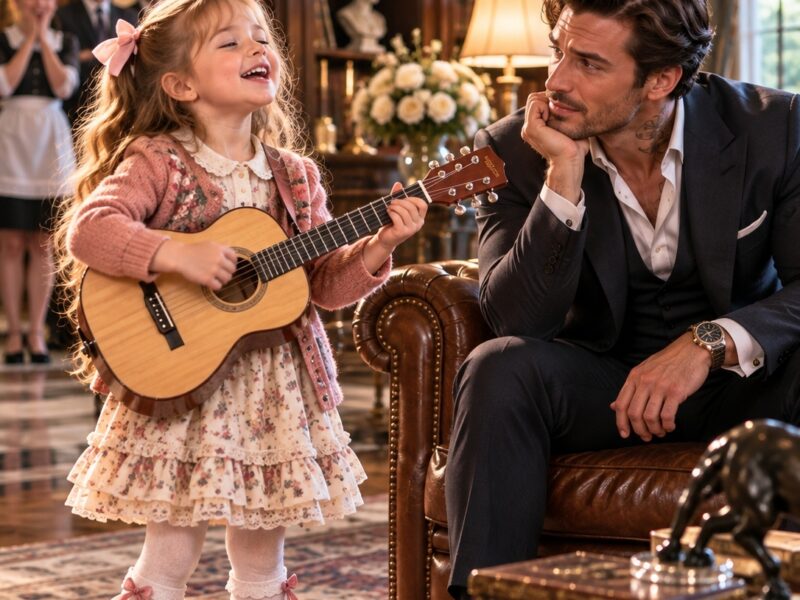
The Maid’s Little Girl Asked to Sing for the Mafia Boss—Then One Song Broke a Twenty-Seven-Year Silence and Uncovered the Lie His Family Had Buried
Her widowed mother expected to be fired when the most feared man in the house quietly nodded and let the child begin.
But the melody Sophie chose would eventually open a locked room, expose a betrayal hidden since Dante was eight, and force him to decide whether loyalty meant protecting his family’s secrets—or finally telling the truth.
“Uncle Dante, can I sing you a song?”
The voice was small, bright, and entirely unafraid.
Dante Moretti’s fountain pen stopped halfway through his signature.
For one long second, nothing else in the library moved. Not the brass pendulum of the grandfather clock. Not the gray winter light stretched across the Persian carpet. Not Luca Ferraro, Dante’s operations chief, who stood just beyond the half-open door with one hand frozen around a leather folder.
The room had not heard a child ask permission for joy in a very long time.
Sophie Rossi stood in the middle of it wearing a yellow dress printed with white daisies, white tights, and two black shoes that did not quite match. Her blond curls were held back on one side by a plastic daisy clip that had slipped loose.
A pink ukulele rested against her stomach.
In her other hand, she held a silver toy microphone that looked as though it had come free with breakfast cereal.
Dante stared at her.
She stared back.
He was thirty-five, dressed in black trousers and a black shirt with the sleeves buttoned at the wrist, his dark hair cut short, his face carrying the controlled fatigue of a man who had spent the morning settling disputes other people had been too frightened to bring into daylight.
People usually lowered their voices around him.
Sophie lifted hers.
“I know three whole songs.”
Dante said nothing.
“And half of another one.”
Still nothing.
“The half one is about a beetle.”
Luca looked down.
Rosa, the longtime housekeeper, had appeared farther down the corridor. She pressed her fingers to her lips.
Everyone who had worked inside the Moretti estate longer than a year knew the rule.
It was written nowhere.
It needed no writing.
No piano.
No records.
No humming in the upstairs corridors.
No singing.
Not inside these walls.
Not since 1999.
Sophie did not know that.
She shifted the ukulele.
“The first one is about a goldfish who gets lost.”
Dante’s throat tightened.
Somewhere beneath the calm surface of the room, an eight-year-old boy opened his eyes.
He remembered another voice.
Warm.
Low.
Sometimes in Italian while onions softened in butter.
Sometimes in English while small fingers were guided through piano scales.
Sometimes without words at all.
His mother, Isabella, had filled the Moretti house with music until the autumn she left.
Afterward, his father removed every instrument.
Burned every record.
Locked the music room.
And said one sentence Dante had carried for twenty-seven years.
No one sings in this house again.
Sophie waited.
Dante looked toward the hallway.
Rosa’s face had gone pale.
Luca’s expression said this was not a decision anyone else intended to make for him.
Dante returned his eyes to Sophie.
The child’s hand tightened around the cheap microphone.
Not because she was frightened.
Because she was ready.
Finally, Dante set his pen down.
Slowly.
He nodded once.
Sophie’s whole face lit.
She dropped cross-legged onto the carpet before he could change his mind.
The pink ukulele landed across her knees.
She twisted two tuning pegs with great confidence and catastrophic musical judgment.
Dante almost spoke.
Then stopped himself.
Sophie cleared her throat.
“This is called ‘The Goldfish Who Forgot His House.’”
“Original?”
Dante asked before realizing he had spoken.
Sophie nodded.
“I wrote it yesterday.”
“That explains why I haven’t heard it.”
She considered this.
“Probably.”
Luca looked away so nobody would see him smile.
Then Sophie began.
The first chord was wrong.
The second was worse.
Her voice wandered above and below the melody with the fearless inaccuracy only children could achieve without embarrassment.
The song told the story of a goldfish who left his bowl looking for the ocean, became frightened by a drainpipe, met a lonely duck, and eventually realized his family had been looking for him the entire time.
Dante did not move.
At first he heard only Sophie.
Then, against his will, memory joined her.
His mother in the old kitchen.
Flour on one cheek.
Her hand on his shoulder.
A melody she used to hum whenever storms rolled in from the harbor.
He had spent twenty-seven years making certain he never remembered the sound correctly.
Now memory returned with cruel precision.
He felt his fingers tighten against the desk.
Sophie reached the final line.
The goldfish found his bowl.
He was welcomed home.
She struck one last crooked chord.
Silence.
Her eyebrows rose expectantly.
“Well?”
Dante looked at her.
He had negotiated contracts worth millions with less difficulty than answering a five-year-old seeking applause.
“It needs work.”
Luca closed his eyes.
Sophie nodded seriously.
“I know.”
Dante blinked.
“The fish gets home too fast.”
He almost smiled.
Behind the library door, rapid footsteps sounded.
“Sophie?”
A woman’s voice.
Fear underneath.
Then louder.
“Sophie!”
The child turned.
“Mama!”
Anna Rossi appeared in the doorway wearing a white kitchen jacket and a dark apron dusted with flour.
She stopped so suddenly one hand struck the rosewood frame.
Her face emptied.
She saw Sophie.
The ukulele.
Dante.
Rosa.
Luca.
And understood enough to be terrified without understanding anything fully.
“Oh God.”
Anna crossed the room quickly.
“Sophie, stand up.”
“But—”
“Now.”
The child scrambled to her feet.
Anna turned to Dante.
“Mr. Moretti, I am so sorry.”
Her voice shook but did not collapse.
“I turned around for four minutes.”
“She was coloring beside the pastry station.”
“I should never have brought her, but childcare canceled this morning and the agency told me—”
Dante lifted one hand.
Anna stopped.
Not because the gesture was threatening.
Because people around Dante stopped when he asked.
“She sang.”
Anna’s face became whiter.
“I know.”
“How?”
“I heard the last part from the hallway.”
Sophie held up her microphone.
“He said yes.”
Anna stared at Dante.
Dante stared back.
“She asked.”
“I allowed it.”
Anna looked toward Rosa, perhaps searching for evidence this was some incomprehensible trap.
Rosa only watched Dante.
Anna gathered Sophie against her side.
“I will take her home.”
“You hired me through the catering agency for today.”
“They can send someone else.”
“I won’t charge for the hours.”
Dante stood.
Anna’s shoulders stiffened.
He came around the desk.
Stopped several feet away.
Not close enough to crowd her.
“She can stay.”
Anna looked at him as if he had spoken in another language.
“I’m sorry?”
“She can stay until your shift ends.”
Sophie smiled.
Anna did not.
“That isn’t necessary.”
“No.”
Dante glanced toward the child.
“It isn’t.”
Something in his answer unsettled Anna more than an order might have.
She knew who he was.
Everyone in Boston knew some version.
Some versions said real estate.
Some shipping.
Some private lending.
Some used the word syndicate only after checking who was listening.
Anna had accepted the private catering assignment because it paid double her ordinary Saturday rate.
She had told herself she could work six hours inside a dangerous man’s house without becoming part of his life.
She had been wrong for approximately four minutes.
Sophie tugged her sleeve.
“Mama, can I finish the beetle song?”
“No.”
Sophie looked at Dante.
Anna immediately said:
“Do not ask him.”
Dante’s mouth shifted.
Very slightly.
“Finish it another day.”
Sophie brightened.
Anna caught the implication.
“Another day?”
Dante looked at her.
“Next Saturday.”
“I am not scheduled next Saturday.”
“You are now.”
Anna straightened.
“I work through an agency.”
“Then the agency will be paid.”
“That isn’t the point.”
Dante studied her.
“What is?”
Anna looked at her daughter.
Then at him.
“The point is that I don’t understand why a man who keeps half this house afraid to breathe wants my five-year-old to return with a toy ukulele.”
Luca’s head moved sharply.
Rosa stared at Anna with something between horror and admiration.
Dante said nothing for several seconds.
Then:
“Neither do I.”
That answer saved him.
Not completely.
But enough that Anna did not leave immediately.
She returned Sophie to the kitchen.
Finished the pastries.
Worked the rest of her shift while wondering what kind of man admitted uncertainty without surrendering authority.
At six-thirty, Rosa handed Anna an envelope.
“Your payment.”
Anna looked inside on the bus.
Two thousand dollars.
She nearly missed her stop.
Her ordinary event rate would have been eight hundred.
Inside the envelope was a typed receipt.
Private musical consultation: $1,200.
Anna laughed once.
Not because it was funny.
Because the alternative was crying.
Their apartment in South Boston had two bedrooms, one radiator that knocked at precisely 11:47 every night, and a kitchen window that never closed completely.
Anna set the envelope on the table.
Sophie stood on a blue step stool beside the sink, wiping her ukulele with a damp paper towel.
“Don’t wash the strings.”
“I’m cleaning.”
“You are drowning it.”
Sophie stopped.
Then turned.
“When do we go back?”
“Back where?”
“Uncle Dante’s.”
Anna closed her eyes.
“We are not calling him Uncle Dante.”
“Why?”
“Because he is not your uncle.”
“He said I could come back.”
“That is another subject.”
Sophie climbed down.
Her little face became serious.
“He looked sad.”
Anna looked at her.
“That doesn’t mean we go singing for strange men.”
“He’s not strange.”
“He has a house.”
“That is not the same thing.”
Sophie considered this logic.
Then climbed into the chair opposite Anna.
Her feet swung beneath the table.
Anna looked at the money again.
Rent.
Heating balance.
New winter boots.
Groceries.
A repaired muffler on the old Honda.
Too much relief arriving from one afternoon made her suspicious.
Kindness could become obligation faster than poor people were allowed to admit.
Sophie touched the envelope.
“Is that from singing?”
“Partly.”
“Am I rich?”
“No.”
“Oh.”
Anna almost smiled.
Then remembered Marco.
Sophie’s father had been dead three years.
He had managed a restaurant in the North End.
A kitchen fire started after closing.
Marco went back inside twice to help workers out.
He did not return the third time.
Sophie had been two.
For seven months she asked every morning when Papa was coming home.
Then one day she did not ask.
That had been worse.
Anna worked afterward because grief did not negotiate with rent.
Bakery mornings.
Hotel kitchen evenings.
Private events weekends.
Five hours sleep on good nights.
The pink ukulele cost nineteen dollars at a yard sale.
Sophie’s coat came from another mother whose daughter outgrew it.
Anna had never imagined a child’s bad song would earn more than a month of her own labor.
That was precisely why she distrusted the money.
Saturday came anyway.
Anna changed her mind seven times.
She finally drove to the Moretti estate because declining without explanation felt worse than appearing once and setting boundaries clearly.
Sophie wore a blue dress.
She had brushed her own hair.
Badly.
“Do I look professional?”
“For what?”
“My concert.”
At three exactly, Rosa led them into the library.
Dante’s desk was cleared.
No contracts.
No phones.
No folders.
Only a glass of water and folded napkin.
Anna noticed.
Dante noticed her noticing.
Neither commented.
Sophie walked onto the carpet with enormous dignity.
“Good afternoon, Uncle Dante.”
Anna inhaled.
Dante said:
“Good afternoon, Miss Sophie.”
Sophie announced the program.
Goldfish revision.
A cloud afraid of thunder.
A song about Anna baking.
Bonus beetle if time allowed.
Then she performed.
Badly.
Joyfully.
Dante listened.
Not pretending.
Not checking his phone.
During the second song, he asked why the cloud borrowed an umbrella when clouds were technically responsible for rain.
Sophie told him not to interrupt art.
Anna covered her mouth.
Dante leaned back.
“My mistake.”
The cloud song ended.
The baking song began.
Sophie sang about flour in Anna’s hair.
Burned cookies.
Coffee.
A mother who “makes bread when she’s worried.”
Anna’s eyes filled unexpectedly.
Dante looked at her.
Only once.
No pity.
Something closer to recognition.
The right corner of his mouth softened.
Rosa happened past the open door.
She stopped.
Thirty-eight years in the house.
She had seen Dante as a child, teenager, grieving son, ruthless young heir, reluctant head of a family business.
She had not seen that expression since Isabella Moretti was alive.
The beetle song ended.
Dante rose.
He gave Sophie a small white box.
“French macarons.”
“For the artist.”
Sophie gasped.
Anna looked at him.
Dante looked back.
“No money.”
he said before she could ask.
“Just cookies.”
She nodded.
Progress.
On the drive home Anna reached into Sophie’s coat pocket searching for a mitten.
Found folded paper.
Receipt.
Music consultant: $500.
Anna pulled over.
The following Saturday she arrived holding the receipt.
“No.”
Dante was in the library wearing a dark gray sweater rather than black.
Sophie had already placed the ukulele on the carpet.
Dante looked at Anna.
“No?”
“No secret payments.”
“It was compensation.”
“She is five.”
“She provided a service.”
“She sang about a beetle losing one shoe.”
“A memorable service.”
Anna crossed her arms.
“You cannot make us dependent on this house.”
His expression changed.
“I have not asked you to depend on anything.”
“Money asks things even when people don’t.”
Dante considered.
Then nodded.
“All right.”
Anna had expected resistance.
“What?”
“No more payments.”
“That easy?”
“No.”
His mouth shifted.
“But you are correct.”
That disarmed her.
Sophie interrupted.
“The E string is sick.”
She held up the ukulele solemnly.
Dante took it.
Anna watched.
His fingers moved naturally.
Not experimentally.
He plucked one string.
Adjusted the peg.
Second.
Third.
Fourth.
Less than a minute.
Perfectly tuned.
Sophie stared.
“You know music.”
Dante froze.
Anna saw it happen.
His body remained in the room.
His face did not.
Memory moved behind his eyes.
Sophie waited.
Finally:
“Someone taught me.”
“Who?”
Anna nearly intervened.
Sophie surprised them both.
She did not press.
Instead, she took the ukulele.
“Do you remember any songs?”
Dante looked toward the window.
“Some.”
“Sing one.”
“No.”
“Why?”
“Because I said no.”
Sophie thought.
“Okay.”
No offense.
No manipulation.
Children could accept boundaries more cleanly than adults.
She strummed.
Then began a melody Dante knew before the first line.
He went still.
It was the song his mother used to sing on rainy mornings.
Simple.
Old.
A song about sunlight.
Sophie knew only the first verse.
When she finished:
“Again.”
Dante said.
Sophie looked up.
He cleared his throat.
“Please.”
She sang it again.
Afterward, Rosa came to collect Sophie for cookies.
Anna remained by the door.
Dante stood beside his desk.
“You played.”
she said.
“A long time ago.”
“Your mother?”
His eyes sharpened.
Anna regretted guessing.
Then he answered.
“Yes.”
Silence.
“Is that why music is banned?”
Dante looked at her.
“How do you know there is a ban?”
“Everyone in this house reacts to Sophie singing like she’s carrying fireworks through a church.”
He almost smiled.
“There was a room upstairs.”
“Music room.”
“My mother played.”
“She left when I was eight.”
“My father removed everything.”
“Locked the room.”
“No music since.”
Anna absorbed it.
“She died?”
“I assume.”
“You assume?”
Dante’s face closed.
“She left.”
“My father told me she chose another man.”
“She never came back.”
Anna knew enough grief to recognize the places people built walls instead of answers.
She did not push.
They went downstairs later.
For the first time Dante sat at the staff kitchen table.
Rosa almost dropped a tea cup.
Anna told him about Marco.
Not everything.
Enough.
“He died helping people.”
Dante said.
“Yes.”
“You’re angry with him.”
Anna looked up.
“That’s a strange thing to say.”
“Is it wrong?”
She looked at the tea.
“No.”
The answer surprised even her.
“I love him.”
“I miss him.”
“And sometimes I am furious he went back inside.”
“I know that is unfair.”
“Grief is rarely fair.”
Dante spoke so quietly she almost missed it.
Anna looked at him.
There.
The first true intimacy.
Not touch.
Recognition.
The next three Saturdays became routine.
Sophie at three.
Tea at four.
Dante gradually stopped scheduling meetings during that hour.
Luca stopped posting a guard directly outside the library.
Young Enzo began humming in service corridors.
Nobody corrected him.
The house changed in tiny ways before anyone admitted change had occurred.
Then Vittorio Moretti returned from Palermo two days early.
Dante’s father was seventy-two.
Narrow shoulders.
Ash-gray hair.
An old man who still entered rooms expecting architecture to remember him.
He reached the foyer at 2:58 on a Saturday.
He heard singing.
Stopped.
The butler froze.
Vittorio turned toward the sound.
His face lost color.
He followed the melody.
Library door half open.
Sophie sat in Dante’s desk chair because she had decided performing from “the important chair” improved acoustics.
Dante stood nearby.
She was turning “Twinkle, Twinkle, Little Star” into something she called jazz.
Vittorio pushed the door open.
The sound that came out of him was not a word.
Sophie stopped.
Her lip trembled.
Vittorio pointed.
“Stop.”
She began to cry.
Dante moved between them.
“Papa.”
“Get that instrument out of this house.”
Anna ran in from the kitchen.
She gathered Sophie.
“I’m sorry.”
Vittorio looked at Anna.
“You work here?”
“Through the catering agency.”
“Not anymore.”
Dante’s voice became low.
“No.”
Vittorio turned.
“What?”
“She has done nothing wrong.”
“The child broke the only rule that mattered.”
“The child did not know your rule.”
“You knew.”
“Yes.”
“And you let her.”
“Yes.”
The hallway filled silently.
Staff.
Rosa.
Luca.
No one entered fully.
Everyone listened.
Vittorio stepped closer.
“Twenty-seven years.”
“Yes.”
“Twenty-seven years this house has had peace.”
Dante looked toward Sophie crying against Anna’s shoulder.
“Silence is not always peace.”
Vittorio flinched as though struck by the sentence.
“Do not speak to me about what you do not understand.”
Dante’s jaw tightened.
“I understand that you punished an entire house because one woman left.”
Vittorio’s face hardened.
“I protected you.”
“From what?”
“From remembering.”
Dante said:
“I remembered anyway.”
The old man looked toward the pink ukulele.
Something like panic crossed his face.
“Take them out.”
“Papa.”
“Now.”
Anna shifted Sophie higher.
“I’ll go.”
Dante looked at her.
“No.”
She met his eyes.
“This is your family.”
“My daughter is frightened.”
“I’m leaving.”
Dante’s expression softened.
“You’re right.”
He turned to Vittorio.
“But she is not fired.”
Vittorio’s voice sharpened.
“You challenge me over a caterer?”
“No.”
Dante said.
“I challenge you over a child who did nothing except sing.”
The corridor went utterly still.
Vittorio’s breathing became uneven.
Then he said something quieter.
Something worse.
“You sound like her.”
Dante’s face changed.
“My mother?”
“Don’t.”
“You brought her into this.”
“I said don’t.”
“Then tell me what happened.”
Vittorio looked around.
The staff.
The listening house.
Public shame frightened him more than anger.
“Not here.”
Dante nodded.
“Fine.”
He took the ukulele himself.
Escorted Anna and Sophie to the front door.
Sophie’s crying had faded into exhausted hiccups.
Outside, light snow had begun.
Dante crouched before her.
“I am sorry.”
“You didn’t yell.”
“No.”
“Grandpa did.”
Dante closed his eyes briefly.
“Yes.”
“Is he really your dad?”
“Unfortunately, yes.”
Sophie almost smiled.
Dante gave her the ukulele.
“Your concert was good.”
“I didn’t finish.”
“Next time.”
Anna looked at him.
“Will there be one?”
Dante stood.
“If you want there to be.”
Not if he ordered.
Not if his money decided.
If she wanted.
Anna heard the difference.
That night, Richard Bellini watched the Moretti household fracture from the second-floor landing.
Richard was sixty.
Chief financial manager for twenty-two years.
Gray suits.
Soft voice.
Perfect memory for accounts.
People trusted him because he never appeared ambitious.
That was his skill.
For four years Richard had been stealing.
Not spectacularly.
Carefully.
Fictitious landscaping.
Repairs to houses no longer owned.
Maintenance invoices inflated by five or ten percent.
Payments routed through shell vendors.
$1.9 million accumulated slowly enough to look like inefficiency.
He knew audits eventually came.
He had planned for a scapegoat.
Now one had entered the house.
Widow.
Caterer.
No family influence.
No attorney.
Already disliked by Vittorio.
Richard opened a blank invoice pad.
Began writing.
Three days later Rosa opened the master vault.
The pearl necklace was gone.
Forty-two South Sea pearls.
Family heirloom.
Appraised above six hundred thousand dollars.
Vittorio touched the clasp every morning because the necklace had belonged to his mother.
Rosa called him first.
By noon Richard appeared carrying a folder.
“Signore, I did not want to bring this.”
Vittorio opened it.
Pawnshop receipt.
Chelsea.
Saturday afternoon.
Forty-two pearl necklace.
Two thousand dollars.
Signature:
Anna Rossi.
Vittorio stared.
“Call the police.”
Richard hesitated theatrically.
“Perhaps Dante—”
“Now.”
At eight that evening, two Boston detectives knocked at Anna’s apartment.
She had just begun reading Sophie a story.
The word theft made no sense at first.
Then pearl necklace.
Moretti estate.
Pawn receipt.
Sophie began screaming when she understood police wanted Anna to come with them.
“Mama.”
“Mama.”
Anna knelt.
“Look at me.”
Sophie cried harder.
“I’m coming back.”
“When?”
“Soon.”
“Promise?”
Anna’s chest broke.
“I promise.”
She called Rosa.
Rosa came.
The detectives allowed it.
Anna went voluntarily.
Dante learned at 11:52.
He reached the station before midnight.
Anna sat in an interview room.
Gray cardigan.
Jeans.
Hands folded.
No tears left.
When Dante entered, she looked up.
“I didn’t do it.”
“I know.”
She stared.
He repeated:
“I know.”
“Why?”
“The vault requires a combination.”
“Four people know it.”
“My father.”
“Rosa.”
“Luca.”
“Me.”
“You do not.”
Anna’s shoulders dropped.
“Then why am I here?”
“Because someone wants you here.”
Dante arranged counsel and bail.
He did not intimidate detectives.
Did not threaten anyone.
The evidence had to survive daylight.
That mattered now.
In the car afterward Anna said:
“I swear on Marco.”
“You don’t need to.”
“On Sophie.”
“Stop.”
She looked at him.
“Do not use your daughter’s life to persuade me of something arithmetic already proves.”
Anna’s eyes filled.
“You really believe me.”
“Yes.”
No hesitation.
The second intimacy arrived there.
Not romance.
Trust offered before proof was convenient.
Dante drove her home.
Sophie slept on the sofa clutching the ukulele.
Rosa sat beside her.
Dante watched Anna lower herself to the floor and touch her daughter’s hair.
He left before gratitude could become a conversation.
At 2:17, he woke Luca.
“Every property account ledger.”
“Five years.”
“Richard’s office.”
“Quietly.”
By sunrise, boxes filled the study.
At 8:30 Dante found the first discrepancy.
Vacant-lot vendor.
Twenty-eight thousand.
Then four more.
By noon:
Nearly two million.
Four years of skimming.
Anna had worked the estate three months.
The timing alone destroyed the theory that she was responsible for the larger fraud.
It did not yet prove Richard framed her.
Dante needed older ledgers.
Paper records from before digitization.
Stored in the family archive.
The archive occupied the old music room.
At four that afternoon, Dante stood before the locked door.
Brass key in his hand.
Twenty-seven years.
He turned it.
The hinges sighed.
Dust.
Old wood.
A faint trace of something impossible.
His mother’s perfume.
He remained on the threshold.
The room had been gutted.
No piano.
No guitars.
No mandolin.
Metal cabinets.
Boxes.
Bare bulb hanging beneath a plaster medallion painted with roses.
Isabella had chosen those roses.
Dante entered.
Found burgundy account books.
He stacked them.
Turned to leave.
Something dark behind the lowest shelf caught his eye.
A line where no line should be.
Dante knelt.
Reached behind.
Wood.
Mahogany box.
Tarnished clasp.
No lock.
He opened it.
Letters.
Thirty-seven envelopes.
All addressed to him.
Different return addresses.
Boston.
New Haven.
Providence.
Hartford.
Each postmarked.
Each sealed.
Each unopened.
Dante’s breath disappeared.
He recognized the handwriting.
His mother.
He turned the first envelope.
Certified-mail receipt.
Signed:
Vittorio Moretti.
Second.
Same.
Third.
Same.
Every one.
Dante sat on the dusty floor.
The room moved around him.
He opened the first letter.
Eight weeks after Isabella left.
My Dante, I was wrong. I do not ask forgiveness. I am coming home on December twentieth. Please ask your father to open the gate.
Second:
The gate did not open. I understand. I will try again.
Third:
His ninth birthday.
She baked a cake in a rented kitchen.
Nine candles.
Ate one slice alone.
Later letters described cheap apartments.
Bookshop work.
A rescued cat.
Illness.
Church basements.
Rain.
Waiting at the Moretti gate.
She never asked for money.
Only permission to see him.
Years passed through paper.
At fourteen:
I brought something for you. Your father would not accept it.
At twenty-four:
I stood outside during the ice storm. Rosa saw me. I asked only to see your bedroom light.
Final letter.
Eleven years earlier.
Hartford Hospital.
Public ward.
Bed seventeen.
Two weeks to live.
If you come, I will know you by your eyes. If you cannot, I will know you anyway. I have always known you. Forgive your father if you can. Forgive me first. Mama.
Dante made a sound that did not resemble speech.
He had not cried since childhood.
He cried now.
Alone.
On the floor of a room where music had been forbidden because his father had been terrified memory might become mercy.
When he could stand, he found Rosa.
She saw the box.
Sat down.
“Oh God.”
“How many times did she come?”
Rosa began crying before answering.
“Three.”
“Tell me.”
“When you were nine.”
“Easter.”
“She waited at the gate.”
“Your father ordered us not to tell you.”
“I kept you upstairs.”
“I told you we were playing hide-and-seek.”
Dante remembered.
Linen closet.
Proud he stayed quiet for an hour.
He closed his eyes.
“Second?”
“You were fourteen.”
“She brought a parcel.”
“Your father destroyed it.”
“Third?”
Rosa shook.
“Ice storm.”
“She was very thin.”
“Coughing.”
“She asked to stand in the driveway one minute.”
“Just to see your bedroom window.”
“Your father came outside himself.”
“He sent her away.”
Dante’s hands tightened.
Rosa reached into the inside pocket of her uniform.
Removed a small square photograph.
Three-year-old Dante asleep under a white blanket.
“I carried this eleven years.”
“She put it in my apron.”
“She said, ‘Keep this for him.’”
Dante held the photograph.
For the first time, the central story of his life rearranged itself.
His mother had left.
True.
She had regretted it.
True.
She tried to return.
True.
His father prevented it.
True.
The lie had never been that she made a terrible choice.
The lie was that she never tried to make another one.
That changed everything.
Dante placed the photograph inside his shirt pocket.
Then went upstairs.
Grief could wait.
Anna’s name could not.
He called an independent forensic accountant.
A handwriting expert.
Outside counsel unaffiliated with Richard.
Then Luca.
They built evidence methodically.
Older ledgers confirmed the skimming pattern.
Shell vendors traced toward accounts connected indirectly to Richard.
One inactive property became bait.
Cape Cod house.
False sale.
Broker commission routed through a controlled account already linked to one of the suspicious vendors.
Richard processed the transaction.
Two hundred ten thousand dollars moved exactly where investigators expected.
Still not enough for the pearl theft.
Then Dante remembered a security problem seven months earlier.
A corridor camera had been added near the vault.
Richard did not know.
Dante pulled archived footage.
Saturday.
2:14 p.m.
Sophie singing two floors below.
Richard entered the vault corridor.
Opened the door using a written combination.
Removed the pearls.
Put them inside his jacket.
Closed the vault.
Walked away.
No ambiguity.
Dante watched twice.
Then called police and counsel.
Only afterward did he summon Richard.
Nine the next morning.
Richard entered with a leather portfolio.
“Dante, about Anna—”
Dante turned the monitor.
Pressed play.
Richard watched himself.
His face changed.
First disbelief.
Then collapse.
The portfolio slipped from his hand.
No threats were necessary.
Evidence had already taken power away.
Richard confessed with counsel present later that day.
Property fraud.
Shell vendors.
Pearls.
Forged pawnshop receipt.
A man paid to imitate Anna’s signature.
Why?
Richard had expected Vittorio to embrace the easiest explanation.
He had been correct.
That was the ugliest part.
The district attorney’s office dismissed the case against Anna and issued formal documentation that the evidence had been fabricated.
Dante drove the letter to Beacon Hill himself.
Cold rain.
No sleep.
Faded bruise of exhaustion beneath his eyes.
Pink ukulele in one hand.
Envelope in the other.
Sophie opened the door before Anna.
“Uncle Dante!”
She wrapped herself around his leg.
He nearly dropped both.
“You came.”
“I came.”
Anna appeared from the kitchen.
Saw the envelope.
Dante entered.
“It’s over.”
“All charges dismissed.”
“The receipt was forged.”
“The real thief confessed.”
“Your name is cleared.”
Anna put both hands over her mouth.
The sound that escaped was thin.
Airless.
Six days of held breath leaving at once.
Dante looked away to give her privacy.
Sophie remained attached to his leg.
When Anna recovered enough to speak:
“Who?”
“Richard Bellini.”
“The accountant?”
“Yes.”
“Why me?”
“You were new.”
“Poor.”
“Unprotected.”
“My father already disliked your presence.”
Anna looked down.
“So I looked believable.”
Dante met her eyes.
“Yes.”
That truth hurt.
But lying would hurt more.
“I’m sorry.”
“You didn’t accuse me.”
“My family did.”
“You’re not your family.”
Dante went still.
Anna continued:
“At least you don’t have to be.”
The sentence stayed with him.
He placed a second envelope on the table.
Anna’s expression immediately hardened.
“What is that?”
“Not money.”
“Good.”
“Employment offer.”
She stared.
“Director of culinary operations.”
“Estate.”
“Full benefits.”
“Fixed salary.”
“Four-day schedule.”
“Reports to the property-management company, not my father.”
Anna did not touch it.
“Did I earn that?”
“Yes.”
“How?”
“The kitchen staff already follows your event systems.”
“Rosa says waste dropped eighteen percent when you began planning the private dinners.”
“You negotiated vendors better than the agency did.”
“You’re doing the work without the title.”
Anna finally opened the envelope.
She read.
Ninety-six thousand dollars.
Health insurance.
Pension.
Paid leave.
Her hand shook.
“This is too much.”
“It is market salary.”
“We checked.”
“You checked?”
“Independent HR consultant.”
Anna stared.
Dante added:
“You do not answer today.”
“Take two weeks.”
“If you decline, the exoneration remains.”
“The apartment remains available through the end of the lease we already signed.”
“No obligation.”
Anna looked at him.
“You are trying very hard to prove nothing has strings.”
“Yes.”
“Why?”
“Because you were right to worry.”
That became the third intimacy.
Accountability.
Not rescue.
Sophie released his leg.
“Did you bring my ukulele?”
“Yes.”
“Can we go back to your house?”
Anna and Dante looked at each other.
That question belonged to more than Sophie.
Dante answered carefully.
“Not until I fix something first.”
He returned to the estate.
Placed the mahogany box on the library desk.
His childhood photograph on top.
Asked Rosa to send Vittorio in.
The old man entered.
Saw the letters.
Stopped.
“Where?”
“Where you hid them.”
Vittorio’s face collapsed by degrees.
Dante opened the box fully.
“Thirty-seven.”
His father gripped the chair.
“She came back.”
Vittorio said nothing.
“Eight weeks after she left.”
“She came to the gate.”
“When I was nine.”
“Fourteen.”
“Twenty-four.”
“She wrote every month.”
“Then every few months.”
“Then monthly again.”
“You signed for the certified mail.”
Vittorio lowered himself into a chair.
Dante did not shout.
That frightened the old man more.
“You told me she never tried.”
“She left.”
Vittorio whispered.
“Yes.”
“She betrayed us.”
“Yes.”
“She humiliated me.”
“Yes.”
Dante’s voice remained controlled.
“And then she tried to undo what she could.”
“You prevented me from knowing.”
Vittorio looked at the letters.
“I was protecting you.”
“No.”
“You were protecting your version of what happened.”
“She would have left again.”
“You did not know that.”
“I knew her.”
“No.”
Dante’s eyes hardened.
“You knew your pain.”
“Not her future.”
Vittorio’s hand trembled.
“I could not let her return and take you.”
“She asked for one minute.”
“You sent her into an ice storm.”
“She died four months later.”
Vittorio closed his eyes.
Dante continued.
“She asked to see my window.”
“You denied even that.”
“She died believing I refused her.”
The old man’s breath broke.
“I was afraid.”
Dante said nothing.
Vittorio looked smaller than Dante had ever seen him.
“After she left…”
“I waited for the door every night.”
“You were eight.”
“You asked when she was coming home.”
“I had no answer.”
“When she wrote, I thought…”
He stopped.
“What?”
“I thought if you knew, you would choose her.”
Dante stared.
“You made the choice for me.”
“Yes.”
“You took that choice every month for eleven years.”
Vittorio began to cry.
Dante had never seen it.
Not at funerals.
Not when business partners disappeared from his life.
Not even when Isabella left.
Now the old man bent forward and covered his face.
“I turned every song into her.”
he said.
“Every melody.”
“Every instrument.”
“If I heard one, I saw her walking away.”
“So I killed the music before it could bring her back.”
Dante looked at his father.
For the first time, he saw not authority.
Fear.
Untreated for decades.
Turned into rules.
Rules turned into family culture.
Culture mistaken for loyalty.
Dante placed the first letter before him.
“Read them.”
“All?”
“All.”
“And when you finish, we decide whether you remain in this house.”
Vittorio looked up.
Shock.
Dante’s voice did not change.
“You humiliated Anna.”
“Terrified Sophie.”
“You were willing to believe the easiest accusation because it confirmed what you already wanted to believe.”
“You are my father.”
“That no longer gives you the right to make everybody else small.”
Vittorio swallowed.
“What do you want from me?”
“Nothing tonight.”
“Read.”
Dante left him there.
Two weeks passed.
Vittorio read every letter.
In order.
He ate alone.
Walked the gardens.
Asked Rosa questions she had waited three decades to hear.
What was Isabella wearing the first time?
Did she look well?
Did she ask about Dante’s school?
Did she cry?
Rosa answered.
Not kindly.
Not cruelly.
Accurately.
That was what the house needed.
Anna used her two weeks too.
She met the HR consultant.
Reviewed the contract with a legal-aid attorney recommended not by Dante but by an independent women’s employment network.
Negotiated.
The salary stayed.
The schedule changed.
Four days instead of five.
She retained the South Boston apartment.
No compulsory residence.
No private gifts tied to employment.
Sophie could accompany her only on designated family-event days.
Dante accepted every revision.
Anna signed.
Not because he rescued her.
Because the job was real.
Her terms were real.
Her choice was real.
The first Saturday after she returned, Sophie stood outside the Moretti gates clutching the ukulele.
Anna looked at her.
“Nervous?”
“No.”
“You’re chewing your lip.”
“I’m thinking.”
“About?”
“Whether Grandpa Moretti is still mad.”
Anna crouched.
“Mr. Moretti.”
“He’s Uncle Dante’s dad.”
“That does not make him Grandpa.”
“Yet.”
Anna stared.
Children were terrifying negotiators.
Rosa opened the gate herself.
Inside, the house felt different.
Not warm exactly.
But less defended.
Dante met them near the foyer.
Sophie immediately held up the ukulele.
“Concert?”
“Different room.”
He led them toward the winter garden.
The conservatory had been closed for years.
Rosa had cleaned it.
Seven chairs.
Candles.
Old lemon trees against glass.
Half dead.
Still alive.
Vittorio sat in the front row.
Dark gray suit.
Hands shaking.
Sophie stopped.
Dante crouched beside her.
“You do not have to sing.”
She looked at Vittorio.
Then at Anna.
“Does he want me to?”
Dante stood.
“That is his question to answer.”
Vittorio’s voice cracked.
“Yes.”
Sophie approached.
No fear.
She climbed onto a small wooden platform.
Adjusted the ukulele.
“This song is for Uncle Dante’s mama.”
Vittorio’s hand rose to his throat.
Sophie began.
A simple melody.
The same one Dante’s mother once sang.
Dante stood behind the last chair.
Anna beside him.
Vittorio closed his eyes.
The first lines reached him.
Memory did what fear had prevented for twenty-seven years.
Kitchen.
Blue cotton dress.
Flour.
Lemon oil.
Isabella laughing.
Not leaving.
Existing.
A whole person rather than the single terrible choice he had reduced her to.
His eyes opened.
Filled.
Sophie finished.
Silence.
Then Vittorio lifted his hands.
Clapped once.
Weakly.
Again.
Again.
The sound strengthened.
An old man applauding a five-year-old girl with tears on his face.
Nobody laughed.
Anna cried quietly.
Dante did not look away from his father.
Music had returned.
Not as forgiveness.
Not yet.
As truth.
Spring arrived months later.
The lemon trees in the conservatory produced small white blossoms.
A piano tuner from Newbury Street spent six hours bringing a new baby grand into tune in the main hall.
Dante bought it only after Anna asked:
“Are you replacing your mother’s piano?”
“No.”
“Then what?”
“Buying one for the house that exists now.”
She approved that answer.
Two guitars appeared in the library.
Sophie’s pink ukulele received its own stand.
Vittorio did not restore his authority.
That consequence mattered.
Dante restructured the estate businesses.
Independent accountants replaced Richard’s office.
Dual approvals for property payments.
External audits.
No family member could authorize a large transfer alone.
Richard’s financial misconduct moved through courts.
Some funds were recovered.
Some were not.
He faced criminal and civil consequences.
There was no secret punishment.
No disappearance.
The Morettis had spent enough generations confusing private power with justice.
Dante intended to stop.
Certain freight relationships were terminated.
Questionable partnerships sold.
Businesses that could not survive proper books were closed.
Luca asked him once:
“Are you trying to become respectable?”
Dante looked at him.
“No.”
“What then?”
“Accountable.”
Luca considered.
“Sounds more expensive.”
“It is.”
“Worth it?”
Dante glanced toward the library where Sophie’s ukulele sat.
“Yes.”
Anna’s life changed more slowly.
Her first paycheck as culinary director was large enough to make her sit inside the Honda for ten minutes before driving home.
She paid bills.
Started an emergency fund.
Bought herself shoes.
Not expensive ones.
New.
Sophie attended the same preschool.
Same neighborhood.
Same friends.
Anna refused to let money become a reason to uproot a child whose life already had enough changes.
Dante respected that.
He did not send a driver unless Anna requested one.
That took practice.
Once, when snow began heavily, a black SUV appeared outside Anna’s building.
She called him.
“Did you send that?”
“Yes.”
“Did I ask?”
“No.”
“Send it home.”
“Roads are bad.”
“I have winter tires.”
“Anna.”
“Dante.”
Silence.
Then:
“Fine.”
Ten minutes later he called.
“Roads have been closed near Beacon Hill.”
Anna checked.
He was right.
She sighed.
“Send it back.”
Dante said:
“I will enjoy this quietly.”
“Do that.”
The first openly affectionate moment came in the kitchen.
Sophie had gone upstairs with Rosa.
Anna was testing a new orange-almond cake.
Dante entered without warning.
“Everyone keeps feeding you.”
“It is my house.”
“That has never stopped you from looking underfed.”
He leaned against the counter.
Anna handed him a spoon.
“Taste.”
He did.
“Too sweet.”
She stared.
“Leave.”
“You asked.”
“Wrong answer.”
Dante took another bite.
“Better.”
“You’re impossible.”
“So I’ve heard.”
Anna laughed.
Not politely.
Not nervously.
She leaned one hand on the counter.
Dante watched her.
Something changed.
He stepped closer.
Stopped.
“May I?”
Anna knew.
Her heart moved too quickly.
“No.”
Dante nodded immediately.
Stepped back.
That mattered.
Anna exhaled.
“Not yet.”
“Understood.”
He picked up his coffee.
No wounded pride.
No punishment.
No coldness.
The second intimate moment came weeks later after Sophie’s school recital.
Dante attended.
Sat in the back.
No security visible.
Sophie sang with fourteen children.
Forgot one line.
Recovered.
Anna cried more than necessary.
Outside afterward, they walked toward the parking lot.
Dante said:
“She looked terrified.”
“She was.”
“She sang anyway.”
“That is courage.”
He looked at Anna.
She looked back.
This time, she reached for his hand.
Briefly.
Three steps.
Then released it.
Enough.
The third came at Isabella’s grave.
Dante had finally located it in Hartford.
Simple stone.
No family crest.
He asked Anna to go.
Not Sophie.
Anna stood beside him in cold April rain.
Dante placed the childhood photograph beneath the edge of the stone for a moment, then returned it to his pocket.
“I spent twenty-seven years angry at someone who spent eleven of them trying to come back.”
Anna said:
“You were a child.”
“I became an adult.”
“You were still living inside a child’s information.”
He looked at her.
“You defend people too easily.”
“No.”
“I distinguish responsibility.”
“Your mother left.”
“That hurt you.”
“Your father lied.”
“That hurt you differently.”
“Both can be true.”
Dante looked at the grave.
“I don’t know whether I forgive her.”
“You don’t have to know today.”
He nodded.
After a long silence:
“I think I love you.”
Anna closed her eyes.
There it was.
No ballroom.
No danger.
No rescue.
Wet cemetery grass.
Umbrella rattling in wind.
She answered carefully.
“I think I am getting there.”
Dante looked at her.
“You do not have to say it back.”
“I know.”
“That is why I said what I said.”
He smiled.
Small.
Real.
“That may be the kindest rejection I have received.”
“It isn’t rejection.”
“No?”
“No.”
Anna took his hand.
“Patience.”
“I’ve been told I need some.”
“By me.”
“Repeatedly.”
They walked back to the car together.
Vittorio changed more slowly.
He apologized to Anna.
Not immediately.
Three months after the winter-garden concert.
In the kitchen.
Rosa present.
No audience beyond those who mattered.
“I believed what was easy to believe.”
he said.
“I let what I thought of your place in this house determine what I thought you were capable of.”
“That was wrong.”
Anna listened.
He continued.
“I frightened your daughter.”
“That was worse.”
“Yes.”
“I cannot undo either.”
“No.”
Anna said.
“You cannot.”
Vittorio nodded.
“I am sorry.”
She did not absolve him.
“Thank you for saying it.”
That was enough.
Sophie, meanwhile, solved the emotional problem with less ceremony.
One Sunday she entered the sunroom holding the toy microphone.
Vittorio sat with coffee.
She placed it in his hand.
“Your turn.”
He stared.
“No.”
“Yes.”
“I do not sing.”
“That’s because you don’t practice.”
Dante nearly choked on coffee.
Sophie climbed into her chair.
Dante took the ukulele.
Strummed a simple chord.
Vittorio looked at him.
Dante waited.
No pressure.
Sophie began.
Vittorio’s lips moved eventually.
His voice was terrible.
Cracked.
Low.
Half a note behind.
Sophie kept singing.
No one corrected him.
No one laughed.
Rosa stood in the doorway crying.
Anna watched Dante.
Dante watched his father.
The song ended.
Nobody applauded.
Some moments became smaller if people tried to mark them too loudly.
A year passed.
Then another.
Dante proposed to Anna after eighteen months together.
He did not use a diamond first.
He used a question.
They were washing dishes at Anna’s apartment after Sophie’s seventh birthday.
Sophie asleep on the sofa under a blanket.
Vittorio gone home early.
Rosa had left cake.
Dante dried a plate badly.
Anna took it from him.
“You missed half.”
“I am delegating.”
“You are failing.”
He put down the towel.
“Anna.”
She turned.
He looked nervous.
That alone told her.
“Would you want to marry me?”
No ring.
No speech.
No mention of money.
Anna leaned against the counter.
“Want?”
“Yes.”
“Not need?”
“No.”
“Not because Sophie loves you?”
“No.”
“Not because you think Marco needs replacing?”
“Never.”
She watched him.
“What would change?”
“Whatever we decide.”
“You keep your work.”
“Your apartment if you want.”
“Your name.”
“Your own accounts.”
“I am asking for partnership.”
“Not surrender.”
Anna smiled.
“You practiced.”
“For months.”
“Good.”
She stepped closer.
“Yes.”
Dante exhaled.
Then:
“I bought a ring.”
“I assumed.”
“It is in the car.”
“Why?”
“In case you said yes.”
“And if I said no?”
“I would have returned it.”
Anna laughed.
“Liar.”
“Yes.”
Their wedding was small.
Sophie sang.
Of course she did.
Vittorio sat in the front row.
Isabella’s photograph rested inside Dante’s jacket.
Not displayed.
Not turned into public symbolism.
Private memory did not need performance.
The house changed over the following years in ways visitors noticed without understanding.
Music in kitchens.
A piano in the main hall.
A radio in the laundry room.
Staff allowed to hum.
Children invited to family lunches.
The library door open.
Dante still conducted serious business.
Still had enemies.
Still knew his family name carried a history no marriage could erase.
But he dismantled what could not be defended openly.
Businesses became simpler.
Books cleaner.
Power smaller.
Life larger.
Luca became chief operating officer of the legitimate freight group.
He complained constantly about regulatory audits.
Dante told him that was the sound of adulthood.
Anna expanded the culinary operation into a catering division that employed single parents with predictable shifts.
She refused to call it charity.
“It’s scheduling.”
she said.
“People work better when they know who picks up their children.”
Dante invested.
Then stayed out of her way.
Sophie grew.
At nine, she abandoned ukulele temporarily for piano.
At ten, violin.
Everyone regretted violin month one.
At eleven, she returned to singing.
Her voice changed from childish brightness into something surprisingly rich.
Dante never told her she reminded him of Isabella until Sophie was old enough to understand that resemblance could be a gift without becoming a burden.
One winter evening, years after that first library concert, Sophie stood in the old music room.
It was a music room again.
Not a shrine.
Not museum.
Working room.
Piano.
Guitars.
Music stands.
Schoolbooks.
A dented water bottle.
Sophie’s backpack on the floor.
Vittorio sat near the window.
Older now.
Much weaker.
Dante tuned a guitar.
Anna leaned in the doorway.
Sophie looked around.
“Was this really locked for twenty-seven years?”
Dante nodded.
“Why?”
Vittorio answered before he could.
“Because I was afraid.”
Sophie looked at him.
“Of songs?”
“Of what they reminded me of.”
She considered.
“That seems exhausting.”
Vittorio smiled.
“It was.”
Sophie sat beside him.
“Do you miss her?”
“My grandmother?”
Vittorio looked toward the piano.
“Every day.”
“Even when you were angry?”
“Especially then.”
Sophie took his hand.
“Mom says people can be mad and love someone at the same time.”
“Your mother is annoyingly wise.”
Anna called from the doorway:
“I can hear you.”
Vittorio smiled.
“That was intentional.”
Dante laughed.
The room filled with a sound it had once been built to hold.
Years later, when Vittorio died peacefully after a short illness, the funeral was quiet.
No grand mythology.
No rewriting.
Dante spoke honestly.
“My father loved deeply and badly.”
“He confused protection with control.”
“He made choices that hurt people he loved.”
“He also lived long enough to admit some of those choices.”
“That does not erase what happened.”
“It means the final chapter was not the first one repeated.”
Sophie sang after the service.
Not the old sunshine song.
Something she had written herself.
About doors.
Weather.
Windows left open.
Anna stood beside Dante.
Their fingers linked.
Rosa cried into a handkerchief.
Luca stared at the ceiling like the ceiling had become emotional.
The Moretti house returned to normal afterward.
A different normal.
One Sunday in early spring, Sophie—now twelve—was searching for a missing school folder in the library.
She opened a desk drawer.
Found the old silver toy microphone.
Cheap plastic.
Foam head cracked.
She laughed.
“Mom!”
Anna called from the hall.
“What?”
“Look.”
Dante entered behind her.
Sophie held up the microphone.
“Oh no.”
Anna smiled.
“You terrorized an entire criminal dynasty with that thing.”
Sophie stared.
“I did not.”
“You absolutely did.”
Dante took the microphone.
Turned it in his hand.
Seven years disappeared.
Yellow dress.
Pink ukulele.
A contract unfinished.
A child asking:
Can I sing?
He looked toward the fireplace.
The grandfather clock still stood there.
The velvet curtains had been replaced.
The Persian carpet remained.
On the wall where nothing musical once existed hung Isabella’s restored classical guitar.
Not because the house needed to worship the past.
Because pretending it had never existed had caused enough damage.
Sophie opened her music folder.
“I have a new song.”
Dante looked at her.
“Original?”
“Yes.”
“Any lost fish?”
“No.”
“Beetles?”
“No.”
“Clouds with umbrellas?”
“I was five.”
“Those were sophisticated themes.”
Sophie rolled her eyes.
Anna entered carrying coffee.
“Play it.”
Sophie sat on the carpet.
Exactly where she had sat the first afternoon.
Cross-legged.
Guitar now instead of ukulele.
She tuned carefully.
Dante sat behind the walnut desk.
Anna took the leather chair beside the window.
For a moment, the image aligned with memory.
Then it changed.
Because Anna was there.
Because the door was open.
Because voices moved freely in the hall.
Because nobody was waiting to punish sound.
Sophie looked up.
“Ready?”
Dante nodded.
She began.
Her voice was no longer small.
But it was still bright.
Still unafraid.
Halfway through, a young staff member passed the library and paused to listen.
Then another.
No one told them to move.
The song ended.
Dante remained quiet.
Sophie frowned.
“Well?”
He looked at her.
“It needs work.”
She laughed.
“You’ve been saying that since I was five.”
“Still true.”
“What needs work?”
“The ending.”
She narrowed her eyes.
“What’s wrong with it?”
Dante looked toward Anna.
Anna knew before he spoke.
“It sounds like the person in the song is waiting for somebody else to open the door.”
Sophie looked down at the lyrics.
“And?”
“Sometimes you open it yourself.”
She considered.
Then took a pencil.
Crossed out the final line.
Wrote another.
Anna leaned toward Dante.
“What did you just do?”
“Editorial consultation.”
“You are impossible.”
“I learned from Sophie.”
Sophie looked up.
“Listen.”
She sang the new ending.
This time, the person in the song did not wait outside.
She knocked.
Then entered.
Dante felt something loosen inside him.
A final thread.
Not grief disappearing.
Not childhood repaired.
Nothing so simple.
Just the past losing its authority over the next choice.
Outside, Boston rain tapped softly against the windows.
Someone in the kitchen turned on a radio.
A housekeeper sang along badly.
Rosa, eighty now and retired but incapable of staying away, shouted from downstairs:
“You are flat!”
The house erupted in laughter.
Sophie looked at Dante.
“Should I sing another?”
He remembered the room twenty-seven years silent.
His father’s rule.
His mother’s letters.
Anna in a police interview room.
Richard’s false receipt.
Vittorio crying over unopened envelopes.
A five-year-old with a nineteen-dollar ukulele.
All the lives changed because one child did not know what she was forbidden to ask.
Dante leaned back.
The unfinished contract from that first afternoon had long since vanished.
The music remained.
“Yes.”
he said.
“Sing.”
And this time, no one in the house went silent.









