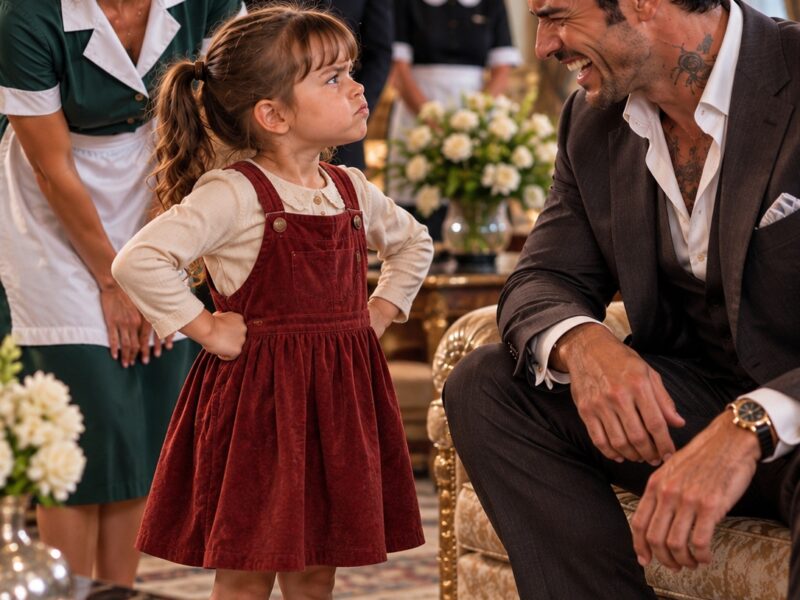
The Maid’s Toddler Copied the Mafia Boss’s Angry Face—Then His Unexpected Reaction Exposed a Secret Her Mother Had Been Living Beside for Years
Sophia Alvarez nearly dropped Vincent Castellano’s coffee when she found her three-year-old daughter standing in his forbidden study, arms folded, perfectly imitating the expression that terrified grown men.
Everyone expected Vincent to punish the maid who had broken the estate’s strictest rule, but instead the feared boss crouched to the child’s level and copied her right back.
Then Vincent asked Mia’s age, and the smile vanished from his face—as if the little girl had just reminded him of someone Sophia had spent two years trying to bury. Văn bản đã dán (1)
The coffee cup was already trembling in Sophia Alvarez’s hand before she reached the study corridor.
She had been awake since five-thirty, had eaten half a piece of toast standing over the kitchen sink, and had received the babysitter’s cancellation text while tying her hair into the plain knot required by Castellano household staff.
By six-fifteen, she had exhausted every acceptable option.
Her sister was working a double shift.
The daycare would not accept an unscheduled arrival.
Missing work meant losing a day’s wages she had already mentally divided between rent, groceries, and an electric bill she had not yet opened because sometimes unopened envelopes felt temporarily less expensive.
So Sophia chose the option desperate people choose when all responsible choices have disappeared.
She brought Mia to work.
There was one rule every employee at the Castellano estate learned before the first paycheck cleared: family did not enter the property without authorization.
The rule was not posted.
Nothing important in that house was.
People learned boundaries by watching what happened when somebody crossed them.
Sophia had worked there eight months.
Long enough to know which doors required a knock, which corridors belonged to security, which visitors were never addressed by name, and which questions could cost more than curiosity was worth.
At six-forty, she settled Mia in a small staff sitting room beside the laundry corridor.
Coloring book.
Two juice boxes.
Crackers in a plastic bag.
Stuffed rabbit.
A promise of ice cream if she stayed there until lunch.
Mia nodded solemnly.
Sophia knew that expression.
It was the face her daughter used when planning to disobey politely.
“Stay in this room.”
“I stay.”
“You do not go looking for me.”
“I don’t.”
“You do not explore.”
Mia hugged the rabbit.
“No explore.”
Sophia kissed the top of her head.
“Good girl.”
Mia waited until her mother had almost reached the doorway.
“Chocolate?”
“If you stay here.”
“With sprinkles?”
“If you stay here.”
“Rainbow sprinkles?”
Sophia sighed.
“Extortion at three.”
Mia smiled.
For the first two hours, everything went well enough to make Sophia believe she might escape consequences.
She changed linens in two guest suites, checked the breakfast room, corrected a supply order, polished the silver service tray, and carried Vincent Castellano’s coffee toward his private study shortly after nine.
Then she passed the staff sitting room.
The door stood open.
Sophia stopped.
Mia’s coloring book lay face down on the carpet.
One pink crayon had rolled beneath a chair.
The stuffed rabbit was gone.
“Mia?”
Softly first.
No answer.
She checked the laundry room.
Pantry.
Back stairwell.
Downstairs bathroom.
The narrow alcove near the service entrance where Mia liked hiding during games at home.
Nothing.
Her palms went cold.
The Castellano estate suddenly seemed twice its usual size.
Every corridor led somewhere she did not want a three-year-old to discover.
There were antiques worth more than Sophia’s apartment building.
There were offices containing documents people guarded with their bodies.
There were men who arrived in tinted cars, disappeared behind closed doors, and left without ever removing their coats.
Broken furniture stopped being the frightening possibility.
Sophia began imagining guards finding Mia first.
Then she heard her daughter’s voice.
“Why do you look mad?”
Sophia froze.
The voice came from behind the walnut doors at the end of the west corridor.
Vincent Castellano’s study.
Nobody entered without invitation.
Not cleaners.
Not security.
Not even Renzo Marchetti, Vincent’s chief assistant, unless summoned or carrying something urgent enough to justify the risk.
The study door stood open less than an inch.
Sophia approached.
Inside, Renzo was reading figures from a tablet.
Two security men stood near the windows.
Vincent sat behind his desk in a charcoal suit, one hand beside a stack of documents.
And Mia stood in the middle of the Persian rug.
Tiny.
Yellow dress.
Mismatched socks.
Rabbit under one arm.
Every adult in the room was looking at her.
Mia looked only at Vincent.
“You look mad,” she repeated.
Vincent’s voice remained quiet.
“I’m not angry.”
Mia tilted her head.
“Your face is.”
One guard lowered his eyes.
Renzo became suspiciously interested in his tablet.
Sophia knew exactly what was coming.
“No,” she whispered.
Too late.
Mia pulled her eyebrows together.
Pressed her lips into a flat line.
Folded both little arms across her chest.
Lifted her chin.
Then she reproduced Vincent Castellano’s famously cold stare with such absolute seriousness that for one impossible second the three-year-old looked like a miniature crime boss deciding whether someone deserved mercy.
The room went silent.
“Mia.”
Sophia’s voice barely existed.
Vincent did not move.
He studied the child.
Then slowly pushed his chair back.
Renzo’s eyes flicked toward Sophia.
Vincent came around the desk.
Stopped in front of Mia.
Sophia prepared herself to be fired.
Instead, Vincent crouched.
His expensive trousers creased at the knees.
He lowered himself until their eyes were level.
Then Vincent Castellano folded his arms.
Pulled his eyebrows together.
Pressed his mouth flat.
And copied Mia’s face.
Perfectly.
Mia stared.
Renzo stared harder.
One guard turned away.
Three seconds passed.
Mia burst into laughter.
Bright, uncontrolled, completely disrespectful laughter filled the room feared by half the city.
Vincent held the expression another second.
Then the corner of his mouth betrayed him.
A tiny movement.
Almost nothing.
Sophia had worked beneath his roof eight months and had never seen him smile.
Mia pointed.
“You did my face.”
“It appears contagious.”
“Do it again.”
“I have work.”
“Again.”
Renzo made a noise suspiciously similar to a cough.
Vincent looked toward him.
Renzo immediately raised his tablet.
“Quarterly numbers, sir.”
Sophia remembered the coffee tray.
“Mr. Castellano, I am so sorry. My sitter canceled, and I had no one else, and I thought she would stay downstairs. I know the rule. This is completely my fault.”
Vincent looked at her for the first time.
“How old is she?”
The ordinary question unsettled Sophia more than anger would have.
“Three.”
Vincent’s gaze returned to Mia.
Something changed.
The amusement disappeared.
Not into irritation.
Into recognition.
“Three,” he repeated.
“Yes.”
For several seconds he stared at Mia’s face.
Her stubborn chin.
Dark brown eyes.
The little crease between her eyebrows.
Then Vincent stood.
The wall returned.
“She can stay until you finish the east wing.”
Sophia blinked.
“Sir?”
“In here.”
Renzo lowered his tablet.
“Vincent, you have the Moretti call in seventeen minutes.”
“I’m aware.”
“And the contracts from Newark—”
“Renzo.”
“Yes.”
Mia had already settled cross-legged onto the rug.
Vincent returned behind his desk.
“She stays where I can see her.”
Sophia should have questioned it.
Instead she thanked him twice and fled before reality reconsidered.
For the next hour she worked faster than she ever had.
Every few minutes she invented a reason to pass the study.
The door remained open.
First time: Mia drawing circles on an old envelope.
Second: stacking three brass paperweights near Vincent’s desk while he conducted a low, precise phone call.
His left hand rested near the edge so the tower could not fall on her foot.
Third: the tower collapsed.
Mia gasped.
Vincent paused mid-sentence, nudged the roundest paperweight back toward her, and continued discussing numbers apparently worth several million dollars.
The sight disturbed Sophia because people normally adjusted themselves around Vincent Castellano.
Voices lowered.
Shoulders straightened.
Words became careful.
Mia had entered without permission, insulted his face, invaded his carpet, stolen office supplies, and somehow Vincent was adjusting himself around her.
When Sophia finally returned, Mia lay on her stomach drawing.
Vincent wore reading glasses Sophia had never seen.
The guards were outside.
Renzo had disappeared.
For a moment the room looked almost ordinary.
“Mia, sweetheart. We’re leaving.”
“I’m busy.”
Vincent glanced over his glasses.
“She has been quieter than most adults who use that chair.”
Sophia could not tell whether he was joking.
That was another danger of Vincent Castellano.
Mia gathered her papers.
At the doorway she turned.
“Bye, Angry Face.”
Sophia prepared for death.
Vincent lifted his eyes.
“Goodbye, Trespasser.”
Mia grinned.
Sophia spent lunch attempting to explain why powerful employers should not receive nicknames based on facial expressions.
Mia disagreed.
By late afternoon, the incident should have faded.
It did not.
Sophia returned to the empty study to retrieve a coffee cup.
On Vincent’s desk sat a new metal tin.
Colored pencils.
Twenty-four shades.
Children’s quality.
Sophia knew every object on that desk because she dusted it herself.
The tin had not existed that morning.
She leaned closer.
A shadow moved in the doorway.
Sophia startled.
Vincent.
“I didn’t hear you.”
“Most people don’t.”
His eyes touched the pencils.
Then her.
Neither mentioned them.
Sophia took two steps.
“Sophia.”
She stopped.
He had never used her first name.
“Sir?”
“Does your daughter always make that face?”
Sophia almost smiled.
“Only when she thinks someone is being too serious.”
Something distant entered his expression.
The same thing she had seen when he asked Mia’s age.
“I see.”
He stepped aside.
Sophia walked into the corridor carrying the empty cup and a new uneasiness.
Something had happened in that study beyond a child making a dangerous man laugh.
She simply did not know yet that Vincent had seen that exact stubborn expression before.
On the face of Sophia’s dead husband.
Daniel Alvarez had been gone two years.
Sophia still measured parts of her life around the absence.
Before Daniel died.
After Daniel died.
Before the hospital called.
After she understood the voice on the phone was not going to tell her he had merely been injured.
He had been a construction foreman.
Thirty-four.
Healthy.
Annoyingly cheerful at six in the morning.
Bad singer.
Excellent father.
He died when scaffolding failed on a downtown development site.
Investigators called it catastrophic structural collapse resulting from improperly secured components.
Sophia had read the official report until the words became meaningless.
She packed his work clothes into boxes.
Kept one brown jacket.
Kept his old watch.
Kept a coffee mug with a cracked handle because grief often attached itself to objects too cheap to justify saving.
She never remembered Daniel mentioning Vincent Castellano.
That mattered later.
At the time, Vincent’s strange reaction to Mia remained merely one more mystery in a house full of them.
The next sitter cancellation came nine days later.
Sophia stared at her phone ten minutes before calling the estate.
She expected Renzo.
Vincent answered.
“Sophia.”
Her name in his voice still startled her.
“Mr. Castellano. I’m sorry. My sitter canceled again. I can’t come in.”
“Why?”
Sophia looked at Mia feeding cereal to her stuffed rabbit.
“Because I have Mia.”
Pause.
“Bring her.”
Sophia thought she had misheard.
“Sir?”
“You said the problem is that you have your daughter.”
“Yes.”
“Then bring your daughter.”
“The household rule—”
“I know the rule.”
“But—”
“I own the rule.”
Silence.
Then:
“Renzo moved the breakable objects from the lower shelves.”
The call ended.
Forty minutes later Mia marched through the estate entrance carrying a pink backpack.
Nobody stopped her.
That became an arrangement no one formally acknowledged.
Vincent never said she could come whenever childcare failed.
Sophia never asked whether the exception was permanent.
But when Mia arrived, the study door opened.
Then books appeared.
Not leather-bound collector volumes.
Picture books.
Trucks.
Animals.
Planets.
A bear refusing bedtime.
Sophia discovered a bookstore receipt inside one and nearly laughed imagining Vincent Castellano standing beneath a sign marked AGES 3–5 comparing dinosaurs.
Next came a wooden puzzle.
A folded blanket.
A small basket containing Mia’s preferred crackers despite Sophia never telling anyone which brand they were.
“Thank Mr. Castellano.”
Mia looked at Vincent.
“Thank you, Angry Face.”
Vincent glanced at Sophia.
“She needs work.”
“I’m trying.”
He pretended the child’s corner had nothing to do with him.
If Mia fell asleep, meetings moved.
If she wandered near the fireplace, a safety screen appeared the next morning.
When she complained one purple crayon was too short, three boxes arrived.
One afternoon she mentioned liking strawberries.
For a week, fresh strawberries appeared daily.
On Friday Mia stared suspiciously at the bowl.
“I don’t like strawberries.”
Vincent looked up.
“You liked them Tuesday.”
“Friday me is different.”
Renzo turned away quickly.
Vincent stared at the fruit like it had participated in betrayal.
Sophia laughed before she could stop herself.
Vincent looked at her.
The laughter died.
Not because he was angry.
Because something about his expression made her suddenly aware they were standing on opposite sides of a desk smiling about her daughter.
A dangerous kind of normal.
Weeks passed.
Mia drew the household.
Sophia had long brown hair.
Renzo had enormous glasses he did not own.
One guard resembled a potato.
Vincent occupied half the paper.
Black suit.
Large desk.
Two thick purple lines across his forehead.
“What are those?”
he asked.
“Your angry mustache.”
Renzo choked on coffee.
Vincent slowly turned.
“Something wrong?”
“Wrong pipe.”
“Your coffee has not touched your mouth.”
Renzo stared into the cup.
“Remarkable beverage.”
Mia pointed.
“It’s your mustache upstairs.”
Vincent studied the picture as though reviewing a contract.
“The proportions are questionable.”
“That means you like it.”
“That means the proportions are questionable.”
Sophia later found the drawing carefully folded inside Vincent’s top desk drawer.
She pretended she had not.
The estate itself grew less playful.
Security increased.
Two extra guards walked the grounds after dark.
Cars arrived near midnight.
Renzo carried a second phone.
A black sedan began parking beyond the gates for twenty-minute intervals.
Once.
Then again.
Sophia asked Marta, the senior housekeeper.
“Something happening?”
“Something is always happening.”
“That car has been here twice.”
“Then pretend you didn’t see it.”
“Comforting.”
“Comfort is not included in employee benefits.”
Marta folded a tablecloth.
Then lowered her voice.
“When Mr. Castellano adds security, there is a reason. When he does not explain the reason, there is another reason. Go home after your shift. Lock your door.”
The warning stayed with Sophia.
A few nights later she worked late preparing a guest room.
Mia slept downstairs near Marta.
Sophia passed Vincent’s study and saw him alone beside the bookshelves.
Several volumes had been removed.
Vincent stared into a narrow recess.
Something small rested in his hand.
Floorboard creaked.
He turned.
His expression vanished.
The object disappeared into the recess.
Books returned.
“You’re still here.”
“Guest room.”
Sophia pointed vaguely.
“Renzo said someone might arrive.”
“They’re not.”
Too quick.
She turned away.
Then Mia came running from the stairs in socks.
“Mommy!”
She saw Vincent.
“Angry Face!”
The tension in his shoulders changed instantly.
Mia marched inside.
Made the scowl.
Vincent stared.
This time he did not copy it.
He looked shaken.
His eyes moved slowly across her chin and eyes.
Then toward Sophia.
Not employer to employee.
Not even man to woman.
As though looking through Sophia toward somewhere years behind them.
“What?”
she asked.
Vincent blinked.
“Nothing.”
Next morning, one law book behind Vincent’s desk sat crooked.
Sophia noticed because cleaning made you intimate with objects people considered invisible.
The book shifted easily.
Behind it:
A faded photograph corner.
She left it alone.
Monday.
Tuesday.
Wednesday.
Thursday.
Each day the crooked book drew her eye.
There were innocent explanations.
Old partner.
Relative.
Building project.
Past employee.
Vincent had lived a complete life before Sophia entered his house carrying coffee and desperation.
So had she.
Her life included a dead husband whose daughter still occasionally asked whether Daddy could see her from wherever dead people lived.
Sophia understood closed doors.
She decided not to open this one.
On Friday, the heavy law volume slipped while she dusted.
She caught it.
Another book shifted.
The photograph fell.
Face up.
A younger Vincent stood before a construction project.
No charcoal suit.
No tie.
Sleeves rolled.
Smiling.
Beside him stood another man wearing work boots and a hard hat.
Arm over Vincent’s shoulder.
Smiling with the uneven tooth he always tried hiding.
Slight bend in his nose from high school baseball.
Small scar beside the left eyebrow.
Daniel.
Sophia’s knees weakened.
Her dead husband stood beside Vincent Castellano like touching the most feared man in the city required no courage at all.
She lifted the photograph.
On the back:
RIVERSIDE SITE
Date before Mia’s birth.
Daniel had worked construction six years.
He talked about bad supervisors, missing materials, careless crews, inspections, concrete, schedules.
Never Vincent.
Never Castellano.
Not when Castellano development signs appeared downtown.
Not when Vincent appeared briefly on business news.
Not even when Sophia later applied for housekeeping work inside Vincent’s own home.
“Sophia.”
She spun.
Vincent stood inside the doorway.
Alone.
His eyes fell to the photograph.
Color left his face.
First time she had seen him look truly afraid.
“Where did you find that?”
“Behind the books.”
He said nothing.
Sophia held it up.
“Why is my husband in this picture?”
His jaw tightened.
“Sophia—”
“No.”
She surprised herself.
“Do not say my name and stop there.”
Vincent looked toward the open door.
Closed it.
The click woke every nerve in her body.
“Open it.”
He looked at her.
“The door.”
“No one is keeping you here.”
“Then open it.”
He did.
Immediately.
That frightened her more.
“Daniel worked for me.”
“I know he worked construction.”
“Not simply construction.”
“What does that mean?”
“He supervised several Castellano projects.”
“Riverside was one.”
“Later the downtown project.”
Sophia stared.
“The site where he died belonged to you.”
“Yes.”
“And somehow you never mentioned that?”
“You’re right.”
“Stop agreeing like this is an invoice error.”
Anger arrived because anger was easier to stand inside than grief.
She placed the photograph down.
“How well did you know him?”
Vincent looked at her.
“Well.”
“That is not an answer.”
“Almost six years.”
Sophia’s stomach tightened.
“We were married for five.”
“I know.”
The room tilted.
“You know.”
Vincent closed his eyes briefly.
Tiny movement.
Enough.
“You knew who I was when I applied.”
“Yes.”
“Before I came through the gates?”
“Yes.”
“Did you hire me because of Daniel?”
“In part.”
“In part?”
“You were qualified.”
“Do not insult me.”
“I’m not.”
“Then tell me the truth.”
Vincent moved around the desk but stopped well short of her.
“After Daniel died, I made sure you and Mia were all right.”
Sophia went cold.
“You watched us?”
“Not personally.”
“That doesn’t improve it.”
“I know.”
“How?”
“Insurance status. Employment. Whether the settlement was paid.”
“You knew it was delayed?”
“Yes.”
“You knew I worked two temporary jobs?”
“Yes.”
“How?”
“Renzo monitored records connected to former employees and families.”
“Why?”
Vincent looked at Daniel’s photograph.
“Because he was not simply an employee.”
“What was he?”
Pause.
“Someone I trusted.”
The words should have softened something.
They did not.
“You let me come here every morning believing you were a stranger.”
“Yes.”
“You watched me struggle.”
“I did not think of it that way.”
“What did you think it was?”
“Responsibility.”
“For what?”
No answer.
Sophia stepped closer.
“Was my salary charity?”
“No.”
“Guilt?”
Silence.
“Vincent.”
First time she used his name.
He noticed.
“Partly.”
Something broke.
“You had no right.”
“I know.”
“Stop saying that.”
Her voice cracked.
“You had no right to construct this quiet arrangement around me.”
“You let me think I earned employment from a stranger.”
“You did earn it.”
“But you were not a stranger.”
“No.”
“You knew my husband.”
“Yes.”
“You knew my daughter’s father.”
“Yes.”
“And every time Mia came in here making that face, you knew whose expression you were looking at.”
His face changed.
“Yes.”
Sophia thought about crayons.
Books.
Strawberries.
Fireplace screen.
The paperweights.
“Is that why you let her stay?”
“Partly.”
“Because you felt sorry for us.”
“No.”
“Then why?”
“Because Daniel was my friend.”
Not foreman.
Friend.
Vincent faced the window.
“Your husband spoke to me exactly the way he spoke to laborers.”
“He told me when schedules were stupid.”
“He refused instructions he believed were unsafe.”
“Once he told me a timeline I approved had been written by a man who had clearly never lifted anything heavier than a fountain pen.”
Despite herself, Sophia almost smiled.
Daniel.
Vincent continued.
“He embarrassed executives because he cared more about workers going home than job titles.”
“He documented everything.”
Sophia’s attention sharpened.
“What?”
“Safety violations.”
“Inspection discrepancies.”
“Material substitutions.”
“Payments that did not make sense.”
“What are you telling me?”
“Some subcontractors on Castellano projects were connected to the Bellandi organization.”
Sophia felt the room grow colder.
“Legitimate companies on paper.”
“In reality?”
“Cheap materials.”
“Paid inspectors.”
“Falsified safety records.”
“Daniel noticed patterns.”
“Did you know?”
“Not initially.”
“And after?”
“I asked him to keep records.”
Sophia stared.
“You asked my husband to investigate criminals?”
“I asked him to document fraud.”
“He had a pregnant wife.”
“I know.”
“Did he understand the danger?”
Vincent hesitated.
Enough.
“Oh my God.”
“He did not tell you because—”
“I was his wife.”
“You were pregnant.”
Sophia laughed bitterly.
“Every man in my life apparently decided I was safest when nobody told me anything.”
Vincent took the accusation.
No defense.
Outside, Mia laughed with Marta.
Ordinary sound.
Sophia’s memories began rearranging.
Daniel checking windows.
Late paperwork.
Calls he dismissed.
Receipts he saved.
“Why didn’t he quit?”
“I told him he could.”
“And?”
“He said men on those sites had families too.”
Sophia closed her eyes.
Of course.
Stubborn goodness disguised as irritation.
She opened them.
“There’s more.”
Vincent did not answer.
“I can see it.”
His expression went still.
“No more deciding what I can handle.”
He looked at Daniel’s photograph.
“The scaffold did not fail accidentally.”
Sophia stopped breathing.
The official report called it structural failure.
Improperly secured components.
Catastrophic load shift.
Clean terminology for a man never coming home.
“What happened?”
Vincent’s voice changed.
“The Bellandi subcontractors had been replacing approved materials and altering inspection records.”
“Daniel found evidence.”
“He brought it to me.”
“And you let the project continue.”
“Yes.”
“Why?”
“Because we did not yet have enough proof to terminate every involved contract without collapsing several projects.”
Sophia stared.
“Money.”
“Contracts.”
“Thousands of jobs.”
“And Daniel’s life became another cost.”
Vincent flinched.
“Yes.”
The honesty hurt more than defense.
“Tell me the day.”
Vincent looked toward the window.
“Look at me.”
He did.
“Daniel called the night before.”
“He found scaffold inspection logs that did not match the physical structure.”
“Bolts recorded as replaced were still old.”
“Load calculations changed.”
“An inspector’s signature appeared on a day the inspector was elsewhere.”
“Why did he stay?”
“I told him to leave.”
“He said the records would disappear by morning.”
Sophia could hear Daniel saying it.
Irritated.
Bad coffee.
Someone making simple responsibility unnecessarily complicated.
“You went there?”
“Seven the next morning.”
“He wanted to show me the scaffold before the crew used it.”
“One support connection had been deliberately altered.”
Sophia’s stomach turned.
“Someone wanted it to collapse.”
“We believed so.”
“For Daniel?”
Vincent hesitated.
“For me.”
Sophia stared.
“Why you?”
“I had begun freezing payments.”
“Ordering outside inspections.”
“They knew someone inside Castellano was collecting evidence.”
“They knew I would visit.”
“So the scaffold was meant for you.”
“Possibly.”
“And Daniel died instead.”
Vincent did not answer.
Rain from two years earlier returned inside Sophia’s memory.
Hospital.
Hard hat on a chair.
Words she hated.
“What exactly happened?”
“The support shifted.”
“Daniel heard it before I did.”
“He pushed me.”
“I hit the concrete below.”
“He remained on the platform.”
Vincent’s voice cracked once.
Barely.
“The upper section came down.”
“He saved you.”
“Yes.”
“Did he know?”
“I don’t know.”
The answer escaped without control.
“I’ve asked myself every day.”
Sophia sat because her legs stopped cooperating.
“And you let the investigation call it accidental.”
“His documentation vanished.”
“Locker empty.”
“Server records replaced.”
“Witnesses changed statements.”
“And you never told me.”
“I believed whoever did it might think Daniel kept copies.”
“I did not know whether they would come after you.”
“So you kept my name out.”
“Yes.”
“You protected your company.”
“Yes.”
“Your reputation.”
“Yes.”
“Your war with Bellandi.”
“Yes.”
“And somewhere inside that, you decided you were protecting me.”
“Yes.”
Sophia hated that he would not give her an easier villain.
He had failed.
Profoundly.
But not simply.
“I told myself if you and Mia stayed safe, at least Daniel’s death would not create another disaster.”
“So I was a disaster you managed.”
Vincent looked up sharply.
“No.”
“It sounds like it.”
“At first…”
He stopped.
“Maybe I treated the situation like something I could control.”
“Then Mia walked into my office and looked at me exactly the way Daniel did whenever he thought I was an idiot.”
A painful laugh escaped Sophia.
Vincent almost smiled.
“Daniel never feared me.”
“He argued constantly.”
“He believed I was wrong more often than I preferred.”
“And when Mia made that face?”
“I recognized him before understanding why.”
Sophia looked down at the photograph.
“And still you didn’t tell me.”
“No.”
“Why?”
“Because the longer I waited, the more telling you required admitting everything I had failed to do.”
“That is not protection.”
“I know.”
This time she did not tell him to stop saying it.
She left.
Downstairs, Mia built blocks.
Sophia knelt and pulled her close.
“Mommy, squishing.”
“Sorry.”
She loosened her arms.
Vincent appeared at the corridor end.
Did not approach.
Good.
Sophia left with Mia.
In the car, her daughter talked about purple dinosaurs.
Sophia heard almost nothing.
Daniel’s old words returned.
A joke made months before he died.
If anything ever happens to me, don’t throw away my work stuff until you look through it.
At the time Sophia had yelled at him for saying such things.
Then forgotten because remembering after his death hurt.
That night she opened the closet.
Daniel’s brown work jacket.
Old cardboard boxes.
And behind winter blankets:
A black metal lockbox.
Untouched for two years.
Sophia knelt.
The keyhole had fresh scratches around it.
Someone else had already tried to open Daniel’s secret.
She backed away.
Checked Mia.
Locked windows.
Front door.
Then called the man she was still furious with.
Vincent answered before the second ring.
“Sophia.”
“You said Bellandi never knew whether Daniel kept copies at home.”
Silence.
“What happened?”
“I found his lockbox.”
“Do not open it.”
“Someone already tried.”
Another silence.
Colder.
“Take Mia and leave.”
“Where?”
“Public space.”
“Lobby.”
“Store.”
“Your car.”
“Anywhere with people and cameras.”
“Vincent—”
“Sophia, please.”
First time she heard that word from him.
She moved.
Ten minutes later Vincent’s SUV reached her building.
Renzo followed him inside.
They photographed everything before touching anything.
Nothing valuable missing.
Cash untouched.
Laptop.
Jewelry.
Television.
Only Daniel’s work things disturbed.
Jacket shifted.
Documents moved.
Lockbox scratched.
“They knew what they wanted,” Renzo said.
“Or roughly where,” Vincent replied.
Sophia held Mia.
“What do we do?”
Vincent answered immediately.
“You come to the estate.”
“No.”
He blinked.
“Sophia.”
“No.”
“Someone entered your home.”
“I understand.”
“Then—”
“Every time you are frightened, you turn protection into an order.”
Renzo looked intensely at the doorframe.
Vincent’s mouth tightened.
“This is not theoretical.”
“Neither is what I just learned about two years of my life.”
He took a breath.
Stopped himself.
“What do you want?”
The question surprised Sophia.
“Options.”
Vincent nodded.
“Hotel under another name. Too many employees and entrances.”
“Family. Exposes them.”
“Stay here with private security. Anyone watching knows exactly where you are.”
“Estate. Controlled access, cameras, vetted staff, room for you and Mia.”
“I believe it is safest.”
“But?”
He paused.
“It’s your decision.”
First time he offered protection without authority wrapped around it.
Sophia hated that the estate remained the best answer.
“Temporary.”
“Temporary.”
“Daniel’s box stays sealed.”
“Yes.”
“No moving it without me.”
“Yes.”
“No opening it behind my back.”
“Yes.”
Renzo glanced up.
“I believe that is the longest anyone has negotiated with him and retained employment.”
Vincent turned.
Renzo raised his camera.
“Doorframe.”
Detective Elena Salazar arrived later.
Former police investigator now consulting on financial and workplace crime.
She remembered Daniel.
He had contacted her before his death.
Again Sophia discovered someone else had known pieces of her husband she did not.
Salazar crouched near the lockbox.
“Do not force it.”
“If original documents are inside, preserve chain of custody.”
“Someone tried opening it?”
“The marks matter too.”
Then she looked at Sophia.
“You and your daughter need somewhere safer.”
“Vincent’s estate.”
Salazar glanced at him.
“I dislike recommending a fortified compound controlled by this man.”
Vincent’s eyebrow moved.
“Thank you.”
“But yes.”
They moved before midnight.
Mia treated it as a sleepover.
Sophia saw something different.
Extra cameras.
Changed guards.
New codes.
Deliveries rerouted.
Vincent stood over a security map.
“This is what you do when scared?”
“I reduce variables.”
“People aren’t variables.”
“Doors are.”
“You know what I mean.”
He looked at her.
“Daniel wasn’t a variable.”
The words hurt him.
Sophia let them.
“No.”
Vincent said.
“He wasn’t.”
“Neither am I.”
“No.”
“Neither is Mia.”
Long silence.
“All right.”
Not surrender.
Learning.
Renzo entered.
Apartment access logs linked the search to corporate records accessed after a civil attorney reopened an old Riverside safety claim.
Someone had searched Daniel’s employee history.
Then Sophia’s.
The apartment break-in was no random intimidation.
It was a search.
Next morning, Mia wandered into Vincent’s study wearing Daniel’s old brown work jacket.
It reached her ankles.
“Look.”
She raised both arms.
“I’m Daddy.”
The room went quiet.
Sophia crouched.
“That was Daddy’s jacket.”
“I know.”
Mia spun.
The old lining pulled.
Rip.
Something metallic struck the floor.
Small brass key.
Bounced once.
Stopped beside Vincent’s shoe.
Nobody moved.
Sophia looked at the torn inner seam.
Daniel had cut a hidden pocket and resewn it by hand.
Vincent bent.
Picked up the key.
“He hid it where you wouldn’t throw it away.”
Sophia’s throat tightened.
“He knew me.”
Renzo brought the sealed lockbox.
Salazar had not arrived.
Nobody opened it.
Vincent handed Sophia the key.
Did not keep it.
That mattered.
Then every monitor went black.
Less than two minutes.
When they returned, one perimeter access request showed an authorized temporary security code.
The employee attached to it had vanished.
Vincent stared at the screens.
“They weren’t trying to enter.”
Sophia understood.
“They were testing us.”
“Yes.”
That night Mia mentioned something casually while arranging stuffed animals.
“The umbrella man didn’t come today.”
Sophia froze.
“What umbrella man?”
“The shiny one.”
“Where?”
“Fence.”
“How many times?”
Mia held two fingers.
“What color?”
“Silver.”
Sophia went barefoot down the hall.
Vincent saw her face and stood instantly.
“Someone has been watching this house.”
Security footage confirmed it.
A distant figure beneath a metallic umbrella.
Twice.
Beyond the property line.
Observing routines.
Vincent increased security.
Sophia pushed back.
“Mia cannot spend every hour surrounded by guards.”
“I need her alive.”
“So do I.”
“She needs cartoons.”
“Naps.”
“Bad drawings.”
“A normal childhood.”
Vincent checked a window.
“You have looked at that window four times.”
“Five.”
Despite herself Sophia nearly smiled.
“This is exactly the problem.”
“You believe if you watch everything hard enough, nothing bad happens.”
Vincent looked away.
“Watching helps.”
“Daniel was watching the scaffold.”
The words landed.
She did not withdraw them.
“Tell me what protection looks like without control,” Vincent said.
The question was sincere.
Sophia answered.
“Information before decisions.”
“Ask.”
“Accept that I may choose differently.”
“That is inefficient.”
“People are inefficient.”
“I’ve noticed.”
The next day Detective Salazar discovered the missing guard’s background had been manufactured specifically to survive screening.
“Not a vetting failure,” she said.
“Placement.”
Six weeks inside the estate.
Learning codes.
Routines.
Deliveries.
Camera gaps.
Vincent blamed himself.
Sophia found him exhausted in the library.
“You should sleep.”
“So should you.”
“I have a toddler. Sleep became fictional three years ago.”
Almost a smile.
“I should have seen him.”
“How?”
“A detail.”
“Inconsistency.”
“Hindsight.”
“Hindsight is useful.”
“Only if you learn instead of punish yourself.”
Vincent looked irritated.
“You are giving me advice about guilt?”
“I have seniority.”
He leaned against the map cabinet.
“After Daniel died, I decided the problem was too much outside my control.”
“So I reduced everything.”
“Fewer people.”
“More security.”
“More distance.”
“Did it work?”
Vincent looked toward Mia laughing down the corridor.
“No.”
“People aren’t doors.”
“I know.”
It was the closest he had come to admitting the philosophy beneath his entire life had failed.
The following morning seemed normal.
That should have frightened Sophia.
Mia sat in her study corner drawing something she claimed was a horse.
Sophia needed six minutes to sign a delivery invoice downstairs.
“Stay.”
“Five minutes?”
“Six.”
“Six is a lot.”
“I’ll try to be faster than three.”
Mia accepted.
Service corridor busy.
Kitchen crates.
Maintenance technician.
Cartwheel squeaking.
Door propped open.
Ordinary details.
Danger borrowed ordinary details because otherwise people noticed.
Sophia returned upstairs.
Drawing on rug.
Rabbit beside it.
No Mia.
At first she checked behind the sofa.
Washroom.
Window alcove.
Then louder.
“Mia!”
Vincent stood.
“Where is she?”
“She was here.”
Renzo moved before anyone ordered him.
Vincent pressed the security alarm.
“Lock the estate.”
“No exits.”
“No entrances.”
“Cameras.”
Sophia’s legs numbed.
“She can’t be far.”
Vincent caught her shoulders.
“Look at me.”
She did.
“We will find her.”
“You don’t know that.”
“No.”
His honesty stopped her.
“I don’t.”
“But I’ll act as though it is true until evidence says otherwise.”
Security footage showed a ninety-four-second freeze in the service corridor.
Temporary maintenance credentials.
Gray jacket.
Sophia remembered the technician.
A guard shouted.
They ran downstairs.
Near the service door lay half a yellow pencil.
Mia’s horse pencil.
Sophia picked it up.
Something inside collapsed.
Vehicles leaving:
Catering van.
Maintenance truck.
Bellweather service vehicle.
The inspection had been scheduled from the missing planted guard’s account.
Vincent ordered tracking.
Police alerted through Salazar.
Then Vincent’s phone rang.
Unknown.
Speaker.
“Castellano.”
A calm male voice answered.
“It’s been a long time.”
Vincent’s face emptied.
“Marco.”
Marco Bellandi.
Older generation of the rival network Vincent had been investigating through Daniel’s records.
“You have something belonging to my family.”
Vincent looked at Sophia.
“You took a child.”
“I corrected an imbalance.”
“If she’s hurt—”
“She isn’t.”
“Return her.”
“You were always impatient when the price became personal.”
Vincent’s hand tightened.
“What do you want?”
“Daniel’s box.”
Sophia’s fingers closed around the broken pencil.
“You don’t know what’s inside,” Vincent said.
“Neither do you.”
“Then why risk kidnapping a child?”
“Men have gone to prison over less than uncertainty.”
A faint sound.
Mia crying.
One small sob.
Sophia stopped breathing.
Vincent closed his eyes.
Opened them.
“Let me speak to her.”
“Not yet.”
“Bring the box.”
“Instructions follow.”
“No copies.”
“No heroics.”
“Police are involved.”
“I assumed so.”
Call ended.
Vincent stood inside the safest house he knew while Mia existed somewhere beyond every wall he had built.
He looked at Sophia.
“He’ll call again.”
“And when he does?”
“We give him what he thinks he wants.”
“We bring Mia home.”
Marco called twenty-three minutes later.
Pier 17.
Abandoned shipping warehouse.
Eleven p.m.
Vincent and Sophia required.
No visible police.
Salazar refused to let Vincent turn it into private retaliation.
“He expects you angry,” she said.
“He expects you to think walking into danger personally makes you noble.”
Vincent stared.
“Men like you.”
Renzo muttered:
“She has known you one day.”
Salazar spread maps.
Police outside obvious surveillance radius.
Traffic monitoring.
No move until Mia physically safe.
Vincent looked at Sophia.
“You stay with Salazar.”
“No.”
“Marco wants you because you’re leverage.”
“He already has my leverage.”
“Sophia—”
The command appeared.
Stopped.
Vincent looked at the broken yellow pencil.
Took a breath.
“I think going inside puts you in unnecessary danger.”
“It does.”
“I think you should stay.”
“If I don’t appear, Marco may move Mia.”
Salazar nodded.
“She’s right.”
Vincent exhaled.
“Fine.”
Sophia stared.
“That still sounds like permission.”
His jaw tightened.
Then:
“I understand your decision.”
Five words.
Cost him more than an apology.
The lockbox remained sealed.
Uncertainty itself became part of the plan.
The warehouse smelled of rust and river water.
Vincent drove.
Sophia sat beside him with Daniel’s brass key in her pocket.
No visible weapon.
No convoy.
Salazar’s people far back.
At the warehouse entrance they were searched.
Daniel’s box looked impossibly heavy in Vincent’s hands.
Then Sophia saw Mia.
Folding chair.
Hair tangled.
Rabbit clutched to her chest.
A woman beside her.
Mia’s eyes filled.
“Mommy!”
Sophia moved.
A man blocked her.
Vincent stopped her before she collided.
“Wait.”
Marco Bellandi emerged.
Silver at temples.
Clean dark coat.
No theatrical cruelty.
That made him worse.
“Sophia. I regret the circumstances.”
“You kidnapped my daughter.”
“I acquired leverage.”
Vincent’s voice became ice.
“Call her that again.”
Marco smiled.
“There he is.”
His eyes moved to the lockbox.
“Daniel’s?”
“Yes,” Sophia said.
“Unopened?”
“Yes.”
Marco appeared genuinely surprised.
“Two years?”
“It belonged to my husband.”
“Grief makes excellent storage.”
Sophia wanted to strike him.
Instead:
“Give me Mia.”
“Box first.”
Vincent stepped forward.
“Take it.”
Marco hesitated.
“No negotiation?”
“No.”
“You don’t know what’s inside.”
“Neither do you.”
“It could destroy your company.”
“Then it destroys my company.”
“Could destroy you.”
Vincent looked toward Mia.
“Then it destroys me.”
Marco’s expression tightened.
“Two years ago you’d have burned half the city before handing over evidence against yourself.”
“Two years ago Daniel was alive.”
“Daniel made choices.”
“So did I.”
Vincent extended the box.
“Mine cost him more.”
Marco accepted it.
“Key.”
Sophia reached inside her coat.
“Mia first.”
“You brought the box.”
“I need contents.”
“Then release my daughter.”
Three seconds.
Marco nodded.
The man beside Mia released her.
She ran.
Vincent moved sideways, caught her, placed his own body between the child and every other man in the building.
Not holding her like a trophy.
Using himself as a wall.
Only after Mia was safely behind Vincent did Sophia cross forward.
She put the key in Marco’s palm.
He inserted it.
Turned.
Lifted the lid barely half an inch.
Crash at loading dock.
Shout.
A man ran.
Headlights swept broken windows.
The planted security operative had tried to escape after spotting movement outside.
Salazar’s officers intercepted him.
Marco looked up.
“Police?”
“You kidnapped a three-year-old,” Sophia said. “What did you expect?”
One of Marco’s men moved under his coat.
Vincent pushed Mia toward Sophia.
Officers entered.
No cinematic shootout.
No lone man defeating six people.
Commands.
Boots.
A metal cart overturning.
One man struck Vincent across the shoulder with a heavy flashlight while attempting to flee.
Vincent hit a steel column.
Stayed upright long enough to block the passage.
Then officers took over.
Salazar walked directly to Marco.
“Put down the box.”
“You have no idea what it contains.”
“At this moment it is evidence connected to the kidnapping of a child.”
“You think arresting me ends anything?”
“You can save your speech for counsel.”
Marco looked toward Vincent, who held his injured shoulder.
“Sentiment made you careless.”
Vincent looked at Mia in Sophia’s arms.
“Maybe.”
Pause.
“Worth it.”
Marco placed the box down.
Outside, river wind cut through the loading yard.
Paramedics checked Mia.
No serious harm.
Bruise on wrist.
Exhaustion.
Fear.
The woman assigned to watch her had given her water and refused suggestions to restrain her.
Not enough to excuse complicity.
Enough to matter.
Vincent sat on the ambulance step arguing with a medic.
“You need imaging.”
“You said probably bruised.”
“Probably isn’t diagnosis.”
“Then diagnose faster.”
“You are difficult.”
“I’ve been told.”
Mia escaped Sophia’s arms and walked toward him wrapped in a blanket.
Vincent stopped arguing instantly.
“Hey.”
Mia stood between his knees.
Studied his bruised, exhausted face.
Then pulled her eyebrows together.
Flattened her lips.
Lifted her chin.
The angry face.
Vincent stared.
Copied it.
Mia giggled.
Sophia laughed through tears.
Vincent laughed too.
Not the tiny smile from the study.
A tired, shaken laugh from a man realizing the child he feared losing was standing in front of him making fun of his face again.
Daniel’s lockbox remained sealed.
They opened it three days later under Salazar’s supervision.
Sophia turned the key.
Inside:
Folders.
Notebooks.
Inspection reports.
Photographs.
Purchase orders.
Flash drive.
Two sealed letters.
Daniel’s handwriting everywhere.
The same uneven block letters Sophia remembered from grocery lists now marked safety failures.
Inspector signatures on impossible dates.
Approved steel replaced by cheaper grades.
Harnesses billed but never delivered.
Broken supports left in service.
Workers transferred after complaints.
One notebook tracked incidents across sites.
Another followed companies connected through accountants.
The third focused on Daniel’s final project.
Near the last pages:
Upper scaffold altered after hours. No maintenance authorization. Need to show V before crew goes up.
Salazar read it twice.
“This doesn’t prove who altered it.”
“But it proves Daniel identified unauthorized work before the collapse.”
“And Vincent was scheduled there.”
Sophia looked at Vincent.
“Marco was trying to kill you.”
“Maybe.”
“Or frighten me.”
“Or destroy Daniel’s evidence.”
Salazar tapped earlier documents.
“The important part is overlap.”
“These sites were already dangerous.”
“That provided camouflage.”
“If someone wanted one deliberate failure to resemble negligence, they did not need to invent negligence.”
“It already existed everywhere.”
Sophia felt cold.
For two years she had tried choosing one explanation.
Accident.
Murder.
Corruption.
Revenge.
The truth was all of them.
Bellandi companies normalized shortcuts for profit.
Vincent delayed terminating contracts because projects, jobs, financing, and penalties stood in the balance.
Then someone exploited an already unsafe system to create a collapse that looked ordinary.
Daniel noticed.
Daniel documented.
Daniel died inside ambiguity everyone else helped create.
“They didn’t need a perfect crime,” Sophia said.
“No,” Salazar replied.
“They needed everyone to already expect things to fail.”
Then came the envelopes.
One:
SOPHIA
One:
V
Daniel’s letter to Sophia did not sound like farewell.
That made it harder.
He apologized for hiding details.
Said he convinced himself knowing less would keep Sophia and Mia safe.
Then admitted she probably would have called that logic stupid and won the argument.
Sophia laughed through tears.
Exactly Daniel.
In the final paragraph he asked her not to make his death the center of their lives.
Use the records if they could protect workers.
Then live.
Take Mia somewhere warm.
Teach her to swim.
Force vegetables on her despite protests.
Tell her Daddy loved her.
But do not make her responsible for carrying a father she barely remembered.
Sophia lowered the letter.
Could not speak.
Salazar handed Vincent the second.
He read.
Stopped halfway.
“What?”
Sophia asked.
Vincent’s voice roughened.
“He said if I’m reading this, I probably waited too long.”
Renzo closed his eyes.
Vincent continued.
“He said I was very good at protecting businesses and very bad at protecting people whenever protecting people required losing something.”
Sophia laughed once through tears.
That sounded like Daniel.
Then the last line.
Vincent stared at it.
“If I want to make anything right, stop calculating the price of doing the right thing after somebody else has already paid it.”
The box did not absolve Vincent.
That mattered.
Emails showed Castellano compliance teams had warned management months earlier.
Vincent had ordered reviews.
Frozen some payments.
But he had also allowed work to continue while reviews remained unresolved because immediate shutdown meant enormous losses.
He had not ordered sabotage.
Had not known someone would target the scaffold.
But he had known enough to act sooner.
Salazar warned his attorneys would advise limited disclosure.
Renzo warned of lawsuits, contract cancellations, regulatory investigations.
Vincent listened.
Then looked at Daniel’s letter.
“Give them everything.”
Renzo stared.
“Everything?”
“Compliance reports.”
“Emails.”
“Payments.”
“Contracts.”
“Board minutes.”
“If my name is attached, include it.”
“You could lose entire divisions.”
“Then I lose them.”
“Innocent employees could lose jobs.”
“Then we build protections during restructuring instead of using their jobs as an excuse to hide what happened.”
Salazar studied him.
“Tomorrow lawyers will tell you exactly what honesty costs.”
Vincent looked at Daniel’s photograph, still half hidden behind law books.
“That’s exactly what he warned me about.”
By sunset investigators had copies.
Weeks became months.
Subcontractors lost contracts.
Inspectors faced charges.
Injured workers reopened claims.
Castellano Construction paid penalties and settlements.
Independent safety oversight entered active projects.
Two divisions closed.
Investors called Vincent reckless.
One afternoon Renzo showed him the six-month financial loss.
Vincent read the figure.
Signed.
“Still cheaper than a funeral.”
Nobody answered.
Daniel’s name slowly changed in the public record.
No longer simply the foreman killed in a scaffold collapse.
Workers came forward.
One remembered Daniel buying replacement harnesses with his own money.
Another remembered him refusing to allow crews onto unsafe platforms.
A third remembered Daniel saying:
“Paper remembers better than bosses do.”
At a public workplace-safety hearing, Daniel Alvarez was identified as the foreman whose personal records connected years of concealed violations.
Sophia did not bring Mia.
She preserved her father differently.
Pancakes with too much syrup.
Terrible singing.
The baseball nose.
The way he laughed when nervous.
His stubborn refusal to leave problems alone simply because they belonged to someone else.
Daniel had asked not to become the center of Mia’s life merely because he was gone.
Sophia finally understood.
She stopped preserving only the tragedy.
She let him become funny again.
Sophia did not remain a housekeeper.
That decision was hers.
During the investigations, she repeatedly sat beside workers and families handed technical documents while their lives fell apart.
She understood that feeling.
A report full of language everybody else seemed to understand.
A room where powerful people appeared to know more than you did.
When Castellano Construction created an independent worker-support office as part of restructuring, Sophia told Vincent she intended to apply.
“You’re asking me for a job?”
“No.”
“I’m telling you I’m applying.”
A tiny smile.
“Understood.”
She made Renzo interview her.
Properly.
She became a coordinator helping families navigate injury claims, emergency leave, and safety complaints.
Later she helped build a policy allowing workers to report hazards without direct supervisor approval.
The office was not named after Daniel.
Sophia refused.
She did not want him turned into decoration while other people repeated the behavior he fought.
One sentence from his notebook hung near the entrance:
If a man says the job is unsafe, listen before asking what the delay will cost.
Vincent objected to the grammar.
Sophia told him Daniel would have objected to Vincent objecting.
The debate ended.
Mia recovered in the way children do—not by forgetting but by refusing to organize their entire lives around fear.
For several weeks she woke asking about the umbrella man.
Then less often.
Eventually service vans stopped frightening her.
She resumed fighting vegetables.
Sophia considered that medical proof of recovery.
Vincent’s study changed.
Toy basket became low bookshelf.
Blanket became a small chair.
A child-sized table appeared.
Vincent denied choosing its color despite it matching the curtains.
Renzo’s tablet accumulated stickers because Mia believed serious objects required decoration.
Once Sophia entered during a video meeting and found Vincent wearing a paper crown.
Three executives appeared onscreen.
Nobody mentioned it.
Sophia respected their survival instincts.
The estate did not become harmless.
Vincent remained powerful.
Difficult.
Sometimes frightening.
Men still arrived in expensive cars and measured words.
But the house no longer seemed organized entirely around the belief that fear and order were identical.
Crayons appeared beside contracts.
Fingerprints remained on glass a little longer.
Mia learned which guard smuggled cookies.
Safety, Sophia realized, did not always look like more locks.
Sometimes it looked like nobody needing to whisper.
The relationship between Sophia and Vincent changed more slowly than everyone around them expected.
Neither wanted gratitude mistaken for affection.
Vincent had failed Daniel.
Then helped save Mia.
Both facts existed.
Sophia had been furious with him.
Then trusted him in a warehouse.
Both facts existed too.
Their first genuinely intimate evening happened almost eight months after Mia’s kidnapping.
No danger.
No investigation.
No emergency.
A broken coffee machine in the worker-support office forced Sophia into the executive kitchen after hours.
Vincent stood there attempting to make espresso.
“You own six restaurants.”
“None are currently inside this kitchen.”
“You’re losing to a machine.”
“It is badly designed.”
“It has one button.”
“The button is judgmental.”
Sophia laughed.
Vincent looked at her.
“What?”
“Nothing.”
“You’re staring.”
“You laugh more now.”
She stopped.
“So do you.”
“Your daughter destroyed my reputation.”
“She improved it.”
“Debatable.”
He handed her coffee.
Too bitter.
She drank anyway.
Second scene came when Mia started preschool.
Sophia became unexpectedly emotional in the parking lot after drop-off.
Vincent happened to be there because he had insisted on coming after Mia invited him.
The child ran inside without looking back.
Sophia stared through the fence.
“She didn’t even wave.”
Vincent stood beside her.
“That seems healthy.”
“I know.”
“You sound offended.”
“I’m allowed irrational feelings.”
“I’m taking notes.”
She looked at him.
“Do not turn my parenting into data.”
“I wouldn’t dare.”
Then he quietly offered his hand.
Sophia looked at it.
Took it.
No kiss.
No dramatic confession.
Just a frightening man standing outside preschool while a mother adjusted to her child needing her slightly less.
Third scene arrived on the anniversary of Daniel’s death.
Sophia visited the cemetery alone.
Or intended to.
She found Vincent waiting near the gate.
Not beside Daniel’s grave.
At the gate.
Distance.
Choice.
“I can leave.”
he said.
Sophia looked at the flowers in his hands.
“Those for him?”
“Yes.”
“You remembered he hated lilies.”
Vincent glanced at the wildflowers.
“Mia told me.”
Sophia walked toward the grave.
Vincent followed only after she nodded.
They stayed quietly.
No apology speech.
No request for forgiveness.
At the end Sophia said:
“He would be furious with both of us.”
“Almost certainly.”
“He’d probably say this entire thing could have been avoided if rich people listened the first time.”
“That sounds accurate.”
Sophia smiled.
Then kissed Vincent on the cheek.
Small.
Unexpected.
He froze.
“You look terrified.”
“I’m assessing variables.”
“People aren’t variables.”
“I have been corrected.”
Their first real kiss came weeks later.
Sophia initiated it.
She made sure of that.
Vincent stopped before touching her.
“Are you sure?”
“Yes.”
“About what?”
“Kissing you.”
“I wanted specificity.”
“You’re impossible.”
“Occupational requirement.”
She kissed him.
No debt.
No rescue.
No promises about forever.
When they separated, Sophia said:
“This changes nothing about what happened.”
“I know.”
“It does not erase Daniel.”
“I would never ask it to.”
“And Mia is not something you inherit because you care about me.”
“I know.”
She searched his face.
“Good.”
Then kissed him again.
They built slowly.
Separate homes first.
Sophia kept her job independent of Vincent’s personal authority.
When she later accepted a director role in the worker-support program, the board—not Vincent—approved the promotion.
She insisted.
Vincent complained privately that governance had become inconvenient.
Sophia reminded him inconvenience had saved his company from repeating the past.
Mia grew.
At five, she asked why Vincent never smiled in old photographs.
“At that age,” Vincent said, “I believed smiling weakened negotiations.”
“That’s silly.”
“Yes.”
Sophia stared.
He shrugged.
“She’s persuasive.”
At six Mia asked whether Daniel would have liked Vincent.
Sophia answered carefully.
“Your daddy did like him.”
“Then why was he mad at him?”
“People can love each other and still fail each other.”
Mia thought.
“That’s complicated.”
“Yes.”
“Can I have cookies?”
Sophia laughed.
“No.”
“See? You failed me.”
Vincent covered his mouth.
Years passed.
The criminal cases ended unevenly.
Marco Bellandi received a lengthy sentence after convictions connected to kidnapping, conspiracy, fraud, and obstruction tied to the construction network.
Several subcontracting executives pleaded guilty.
Others cooperated.
Some civil cases settled.
Not every family received what Sophia believed they deserved.
Not every question about the scaffold sabotage could be proven to courtroom certainty.
She learned that truth and legal proof overlap imperfectly.
Vincent continued restructuring his companies.
He lost money.
Control.
Some partners.
He gained something less measurable.
People around him began telling him bad news earlier.
That was perhaps the most important change.
One afternoon a junior project manager entered his office and said:
“This schedule is unsafe.”
Years before, Vincent would have asked what delay would cost.
Now he asked:
“What makes you think so?”
The man explained.
Work paused.
Inspection found a real problem.
Nothing dramatic happened.
Nobody died.
No headlines.
Sophia considered that the best possible ending to Daniel’s lesson.
Eventually, Vincent and Sophia married.
Not because marriage completed the story.
It came after years of ordinary decisions.
A courthouse ceremony.
Mia wore a yellow dress because she insisted it matched the first one she wore into Vincent’s study.
Renzo served as witness.
Detective Salazar attended and told Vincent she was there to ensure compliance.
He did not laugh.
Sophia did.
Mia asked whether Vincent was her dad now.
Sophia knelt.
“He can be one of the people who loves you.”
“But Daddy Daniel is still Daddy.”
“Always.”
Mia looked at Vincent.
“Okay.”
Then:
“You can be Bonus Angry Face.”
Vincent closed his eyes.
Renzo laughed loud enough to be asked to leave the clerk’s office.
They did not move permanently into the original estate.
Sophia wanted a home that had not been designed around guards and secrets.
They chose a smaller house closer to Mia’s school.
Vincent kept the estate for business and family gatherings.
His study remained.
Daniel’s photograph stayed openly on the shelf.
Beside it, over time, came school photographs.
Mia missing front teeth.
Mia holding a science-fair ribbon.
Mia wearing soccer cleats.
Mia scowling deliberately in nearly every picture because she knew it irritated him.
On the tenth anniversary of the morning she first entered his study, Sophia found Vincent standing beside the old desk.
Mia was thirteen now.
She had come after school carrying a backpack heavy enough to qualify as luggage.
Sophia entered with coffee.
Mia looked at Vincent.
He was reading a report.
Forehead creased.
She folded her arms.
Raised her chin.
Made the face.
Vincent did not notice.
Sophia smiled.
“Mia.”
“Shh.”
The girl exaggerated.
Brows down.
Mouth flat.
Vincent finally looked up.
Then slowly copied her.
Sophia laughed.
Renzo happened to be passing the doorway.
He stopped.
“No.”
“What?” Mia asked.
“I have watched this joke for ten years.”
“It is tradition.”
“It is harassment.”
Vincent said:
“Both can be true.”
Mia looked at the old photograph of Daniel.
“He did this face too?”
Vincent leaned back.
“Constantly.”
“When?”
“Whenever he thought I was about to do something stupid.”
“How often was that?”
Sophia answered first.
“Apparently constantly.”
Vincent looked betrayed.
Mia laughed.
Then she became quieter.
“Mom told me more about the accident.”
Vincent’s expression changed.
He did not look away.
“How much?”
“Enough.”
She put her backpack down.
“You made bad decisions.”
“Yes.”
“Daddy saved you.”
“Yes.”
“And then you helped Mom and me.”
“Yes.”
Mia frowned.
“People are annoying.”
Vincent almost smiled.
“Frequently.”
“Are you sorry?”
“Every day.”
“Does that fix it?”
“No.”
She nodded.
Apparently satisfied by the honesty.
Then:
“Okay.”
No absolution.
Children sometimes understood accountability more simply than adults.
You did something wrong.
You admit it.
You repair what can be repaired.
You do not demand that repair erase the wrong.
Sophia leaned against the desk.
Late afternoon light entered through the windows.
The room had once terrified her.
First morning she stood at that doorway with coffee shaking in her hand, convinced one mistake could destroy her life.
Now Daniel’s photograph stood openly between company awards.
Mia’s old crayon drawing—angry mustache and all—had been framed by Renzo as a joke and somehow never removed.
A purple pencil lay beside Vincent’s contracts.
No cap.
There were still decisions on the desk affecting thousands of employees.
Still money.
Still power.
Still consequences.
But power no longer required the room to be afraid of itself.
Mia dropped into the chair opposite Vincent.
“I need money.”
He looked suspicious.
“For?”
“School fundraiser.”
“How much?”
“Twenty dollars.”
“What am I buying?”
“Nothing.”
“That is poor business.”
“You’re donating.”
“To what?”
“Library.”
Vincent took out his wallet.
“How much does twenty buy?”
“Books.”
“How many?”
“I don’t know.”
“That seems administratively weak.”
Mia made the face.
Vincent made it back.
Sophia laughed.
Ten years earlier Mia’s imitation had terrified Sophia because she assumed the most dangerous thing her daughter could do was disrespect a powerful man.
She had been wrong.
The dangerous thing was making him recognize a person he had failed.
Daniel’s stubbornness.
His refusal to be impressed.
His insistence that people mattered before schedules.
Mia had carried those things into Vincent’s office without knowing their history.
A child had done what investigators, executives, guilt, and fear could not.
She made Vincent look directly at what he had spent years hiding from.
Sophia looked at Daniel’s photograph.
For a long time she had measured every new happiness against what had been lost.
As though loving the life in front of her somehow betrayed the life that came before it.
Daniel had answered that fear before she knew she would have it.
Keep living long enough that my death becomes part of the story, not the center.
Mia waved twenty dollars.
“Mom.”
“Yes?”
“Can we get ice cream?”
Sophia laughed.
“You still owe me from the first day.”
Mia frowned.
“I was three.”
“You remember?”
“No.”
“Then how do you know?”
“Because you always tell the story.”
Vincent stood and reached for his coat.
“What kind?”
Mia looked offended.
“Chocolate.”
“With rainbow sprinkles?”
She stared.
“How did you know?”
Sophia looked at him.
Vincent shrugged.
“I listen.”
They walked toward the door.
Mia stopped beneath the frame and looked back.
At the study.
At Daniel’s photograph.
At the ridiculous framed drawing.
Then at Vincent.
Her eyebrows lowered.
Her mouth flattened.
Her chin lifted.
Vincent immediately copied her.
Sophia laughed first.
Mia followed.
Even Renzo, somewhere down the corridor, started laughing before he saw what had happened.
And this time, nobody in the room was afraid.









