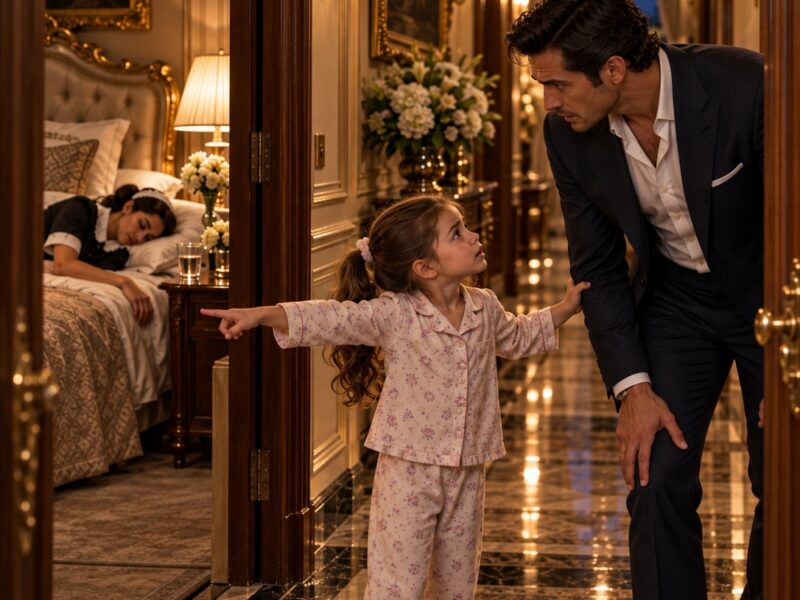
The Maid’s Toddler Knocked on the Mafia Boss’s Door Crying—“Mommy Won’t Wake Up”—Then Her Mother’s Warning Exposed the Betrayal Hidden Inside His Own House
A barefoot three-year-old knocked on Adrien Vale’s bedroom door after midnight, clutching a stuffed rabbit and whispering four words that stopped the most feared man in Denver cold.
Her mother lay unconscious on a kitchen floor inside a mansion guarded by cameras, coded doors, and men Adrien had trusted with his life.
But when the maid woke, the warning she had hidden in her fist forced Adrien to ask a question more dangerous than who attacked her: who inside his own house had helped them do it?
Three Knocks After Midnight
The rain hit the windows hard enough to sound like handfuls of gravel when three soft knocks came from the bottom half of Adrien Vale’s bedroom door.
Adrien looked up from the file in his hand.
Nobody knocked on that door after midnight.
Not without clearance.
Not unless something had already gone wrong.
He sat in darkness except for the blue light of a muted television and the distant white flashes of lightning above the foothills west of Denver. A glass of whiskey rested untouched on the table beside him. Twenty minutes earlier, one of his transport crews had missed a routine check-in, not enough to justify panic but enough that sleep had become unrealistic.
Then came the knock again.
Three taps.
Uneven.
Low.
Not the firm code used by security.
Not Victor Hale’s habit of knocking once and entering before anyone answered.
Adrien opened the drawer beside his bed and took out the handgun stored inside.
He crossed the room without switching on a light.
Another tap came.
Then two more.
The sound was so low he almost wondered whether it came from an animal.
Adrien unlocked the door.
A little girl stood in the hallway.
Bare feet.
Pale blue pajamas.
Dark curls stuck to wet cheeks.
A stuffed rabbit hung from one small fist by a single ear.
Adrien recognized her.
Mia Torres.
Three years old.
Daughter of Elena Torres, the woman who supervised the residential staff at Vale House.
Mia looked up at him with eyes that had gone beyond crying.
The terror had become quieter than tears.
“Mr. Adrien?”
Adrien shifted the handgun behind his right leg where she could not see it.
“What happened?”
Her mouth trembled.
“Mommy won’t wake up.”
Four words.
Adrien had heard men beg for their lives with more imagination.
He had watched entire rooms go silent when he entered.
He had survived betrayal, grand juries, rival organizations, and one attempt on his life he still refused to discuss.
Nothing had ever frozen him the way those four words did.
He crouched immediately.
“Where is she?”
Mia lifted one shaking hand and pointed toward the service staircase.
Adrien put the gun on the console inside his room, picked her up, and felt both arms lock around his neck.
She weighed almost nothing.
That frightened him more than it should have.
“Show me.”
“Home.”
He ran.
Elena’s apartment sat inside the west residential wing, where senior household employees lived in private quarters connected to the main estate by a service corridor.
The door stood open.
That was wrong.
Elena locked everything.
Not because she was fearful.
Because she was a mother.
The apartment was quiet except for the storm pressing rain against the glass.
A small lamp burned above the kitchen sink.
A cartoon cup full of crayons sat on the table.
Two tiny sneakers rested neatly together beneath the sofa.
Then Adrien saw Elena.
She lay on the kitchen floor beside the table.
One arm trapped under her body.
The other stretched toward the hallway as though she had tried to crawl.
A broken drinking glass glittered near her hand.
For one terrible second, Adrien thought she was dead.
Mia made a broken little sound against his shoulder.
Adrien set her carefully on a dining chair.
“Elena.”
No response.
He dropped to his knees and pressed two fingers to her neck.
Pulse.
Weak.
But there.
“Caleb!”
Footsteps answered almost immediately.
Caleb Rourke appeared in the doorway with two security officers behind him.
Forty-six.
Close-cropped dark hair beginning to gray.
Broad shoulders.
Calm movements.
Seven years as Adrien’s head of security.
The man who had designed every modern layer protecting Vale House.
He took in the scene in less than a second.
“Doctor?”
“Now.”
One officer reached for his radio.
Another stepped toward Mia.
“Come with me, sweetheart.”
Mia recoiled so violently that the chair scraped across the tile.
“No!”
She jumped down and ran straight back to Adrien, wrapping both arms around his leg.
The guard stopped.
Adrien lifted her again.
“She stays with me.”
Caleb nodded.
Then Adrien said:
“Seal the estate.”
Caleb’s eyes narrowed slightly.
“The wing?”
“The entire estate.”
“You think whoever did this is still inside?”
Adrien looked down at Elena lying unconscious inside a home nobody was supposed to enter without credentials.
“I think until I know otherwise, everyone is inside.”
Dr. Samuel Mercer arrived twelve minutes later wearing trousers beneath a raincoat thrown over what was unmistakably a sleep shirt.
He had treated the Vale family long enough to understand that questions came second when Adrien called after midnight.
Mercer examined Elena’s breathing, pupils, heart rate, blood pressure, scalp, and neck.
“No major head trauma.”
he said.
“She could have fainted.”
Then he moved Elena’s hair away from the back of her neck.
His fingers stopped.
“Adrien.”
Just below Elena’s hairline was a fresh red puncture mark.
Mercer leaned closer.
“Needle.”
The room changed.
Adrien’s eyes moved toward Caleb.
“Medication?”
Mercer shook his head.
“Not self-administered there.”
He opened his bag and prepared blood tubes.
“I need toxicology.”
“Could whatever did this kill her?”
Adrien kept his voice low because Mia was watching.
Mercer looked at the child, then back at him.
“Anything strong enough to drop an adult this fast can be dangerous if the dose is wrong.”
Adrien stood.
“Camera footage.”
Caleb said:
“Already pulling it.”
“Apartment access log.”
“Started.”
“Service halls.”
“Yes.”
“Every external gate.”
“Yes.”
“Everybody on the property.”
Caleb paused.
Then:
“Understood.”
Mercer and two staff members carefully rolled Elena onto a portable stretcher.
Her left hand dragged across the floor.
Something white showed between her fingers.
“Stop.”
Everyone froze.
Adrien knelt.
Elena’s fist was clenched tightly despite unconsciousness.
He opened her fingers carefully.
Inside was a narrow strip of paper damp with sweat.
Folded twice.
No name.
No address.
Three words written in hurried black marker.
DON’T TRUST SECURITY.
Adrien folded the note into his palm before Caleb could read it.
Caleb stepped closer.
“What did she have?”
Adrien looked at the man who had guarded his home for seven years.
The man he had trusted with routes, schedules, access codes, family names, emergency plans.
“Nothing useful.”
It was the first lie he had ever told Caleb Rourke.
And the ease of it frightened him.
The House That Lied
Mercer moved Elena upstairs to the south guest suite.
Adrien refused to send her immediately to a public hospital.
Not because he distrusted medicine.
Because whoever had attacked Elena already knew where she lived, when she would be alone, and how to move inside Vale House without appearing on the normal security system.
A marked ambulance leaving the estate at two in the morning would announce too much.
Mercer agreed to stabilize her privately while sending blood samples through a trusted laboratory used by the family’s legitimate medical foundation.
Mia refused to leave Adrien.
She sat on a sofa outside the guest room wrapped in a wool blanket, rabbit in her lap, fighting sleep with the furious determination of a child who believed closing her eyes might allow another person to vanish.
“Mommy stays?”
she asked.
“Your mother stays right there.”
“You stay?”
Adrien glanced at the closed guest-room door.
Then down at her.
“Yes.”
“Promise?”
He had broken promises to dangerous men without losing sleep.
Promising something to Mia felt different.
“Promise.”
She studied him for several seconds.
Then her head fell against his side.
Adrien remained there until Rosa Alvarez, a sixty-year-old housekeeper Mia trusted, arrived and gently took over.
Rosa had worked for his mother before Adrien inherited the estate.
She asked no unnecessary questions.
Only:
“Is Elena alive?”
“Yes.”
“Then I sit here.”
Good.
Adrien went downstairs.
The main security room glowed with eight monitors and too much fluorescent light.
Caleb stood between two analysts.
Rain streaked the live exterior feeds.
He replayed Elena’s corridor.
“8:26 p.m.”
On screen, Elena entered carrying grocery bags while Mia walked beside her wearing a yellow raincoat.
“Kitchen delivery at 9:12.”
“Handled at outer service entrance.”
“Two cleaners passed at 9:43.”
“After that?”
Caleb advanced the footage.
Empty corridor.
Minutes became hours.
No one approached Elena’s door.
At 1:13 a.m., the apartment opened.
Mia emerged alone.
Barefoot.
Rabbit dragging against the floor.
She closed the door behind her.
Walked down the corridor.
“That’s all?”
Adrien asked.
“Everything.”
“Sensor logs?”
“Elena’s door opened when she entered.”
“It did not open again until Mia left.”
“So nobody entered.”
“According to the system.”
“And nobody left.”
“Correct.”
“Yet Elena was injected.”
Caleb’s jaw tightened.
“I understand the contradiction.”
“Deletion?”
“No deletion events.”
“Could footage be looped?”
Caleb hesitated.
Less than a second.
Adrien noticed.
“Yes.”
“Remotely?”
“Not cleanly.”
“The system fingerprints remote injections.”
“Locally?”
Caleb exhaled.
“Possible.”
“Where?”
“West relay cluster.”
“Who can access it?”
“My senior team.”
“Two network technicians.”
“Me.”
“Victor has some legacy access although I doubt he remembers half of it.”
Adrien stared at the empty corridor on the monitor.
The system had not failed.
It had provided a complete, confident lie.
That was worse.
Adrien thought of Mia pointing toward the hallway when he carried her from Elena’s apartment.
Not toward the door.
Toward the wall.
He left the security room.
Caleb followed.
“Where are we going?”
“West wing.”
The corridor looked exactly as it had earlier.
Polished wood.
Soft lights.
Linen cabinet.
Landscape painting Adrien’s mother chose twenty years ago because she said the service halls looked too institutional.
Adrien stopped where Mia had pointed.
“What’s behind this wall?”
Caleb looked at the painting.
“Storage, I think.”
“You think?”
“This section predates the renovation.”
Adrien opened the linen cabinet.
Towels.
Sheets.
Extra toiletries.
At the bottom, behind two baskets, a faint draft touched his fingers.
Caleb crouched.
“There shouldn’t be airflow.”
Adrien pressed the wood.
Nothing.
Different corner.
Click.
The entire rear panel shifted outward.
Caleb went still.
Adrien pulled.
Darkness.
A narrow passage ran inside the wall, wide enough for one adult to move sideways.
Dust covered most of the floor.
Not all.
Recent marks cut through it.
One partial boot print.
A smear along plaster.
A black synthetic thread caught on a screw.
Caleb stared.
“I didn’t know this existed.”
“That sentence is becoming expensive.”
The passage ran toward Elena’s apartment.
A second access panel opened behind built-in pantry shelving.
Someone could enter her kitchen without touching the apartment door.
Without passing the hallway camera.
Without triggering the sensor Caleb trusted enough to say nobody had entered.
Near the frame, Caleb found a small electronic device wired into modern network cable.
His expression changed.
“Video repeater.”
Adrien looked at it.
“Meaning?”
“Someone could inject prerecorded footage into the corridor feed while moving through the passage.”
“For how long?”
“As long as they controlled the local relay.”
“Could your analysts detect it?”
“If the person knew exactly what logs to suppress?”
Caleb looked toward the kitchen.
“Not immediately.”
Adrien thought about the folded note in his pocket.
DON’T TRUST SECURITY.
“What else is inside these walls?”
he asked.
Caleb shook his head.
“I don’t know.”
“Who would?”
“Victor might.”
Victor Hale had served Adrien’s father before Caleb entered the organization.
Sixty-three.
Old-school.
Patient.
More comfortable with secrets than technology.
One of the few men who could tell Adrien he was wrong without checking whether someone nearby had a body bag.
Adrien called him.
Victor arrived before four wearing a charcoal overcoat over a white shirt buttoned incorrectly in his hurry.
Adrien showed him the passage.
Victor’s reaction came too slowly.
“You knew.”
“I knew some existed.”
“How many?”
“I don’t know.”
“You lived here for thirty years.”
“That is why I know enough to say I don’t know.”
Adrien’s eyes hardened.
“Explain.”
Victor removed his glasses.
“Your grandfather expanded the original servant routes during a period when the family expected attacks.”
“Your father changed them again.”
“Emergency exits.”
“Observation corridors.”
“Ways to move people privately.”
“Secret passages.”
“That is the dramatic term.”
“A woman was drugged through one.”
Adrien said.
“Drama seems earned.”
Victor’s face hardened.
“Elena?”
“Alive.”
“Barely.”
Adrien did not mention her note.
“How many routes?”
“The honest answer is worse than the comfortable one.”
“Try me.”
“I never knew them all.”
Adrien stared.
“Why?”
“Gabriel believed a complete map became a liability the moment it existed.”
“He gave contractors pieces.”
“Security other pieces.”
“Victor?”
“Different people held different routes.”
“So no one could betray everything.”
Adrien looked toward the open wall.
“Someone almost killed Elena because nobody understood everything.”
Victor did not defend Gabriel.
Good.
“Where are the old plans?”
“Official property archive.”
“Those won’t include this.”
“No.”
“Unofficial?”
Victor looked toward the ceiling as if Gabriel Vale might still be enjoying the inconvenience.
“There may be a survey ledger in basement records.”
“Find it.”
While Victor searched, Adrien returned upstairs.
Mia had woken.
She sat upright under the blanket staring at Elena’s closed door.
“You said Mommy is there.”
“She is.”
“I want see.”
Rosa tried gently.
“Sweetheart, your mommy is sleeping.”
Mia’s face tightened.
Adrien understood.
Adults had carried Elena away.
Doors had closed.
To a three-year-old, those things could mean disappearance.
He picked her up.
Inside the guest room, Mercer looked ready to object.
Then he saw Mia’s expression.
He remained quiet.
Adrien placed her on the edge of the bed.
Mia stared at Elena.
“Mommy?”
Nothing.
She reached out and touched Elena’s wrist with two fingers, copying Adrien from the kitchen floor.
“Heart?”
Adrien swallowed.
“Still working.”
“She wake?”
Mercer crouched nearby.
“That is what we expect.”
Mia studied him.
“You doctor?”
“I am.”
“Good doctor?”
Mercer glanced at Adrien.
“On my better days.”
Mia accepted that.
She kissed Elena’s hand.
Only then did she allow Rosa to carry her out.
Before leaving, she looked at Adrien.
“You stay.”
He nodded.
“I stay.”
Mercer waited until the door closed.
“Preliminary tox screen.”
Adrien looked at him.
“Fast-acting sedative.”
“Exact compound unknown.”
“Concentration?”
“Higher than needed for simple restraint.”
“How dangerous?”
Mercer lowered his voice.
“If someone wanted her asleep for an hour, there were safer doses.”
“Possibility one: they didn’t know her weight.”
“Possibility two: they didn’t care.”
“Possibility three?”
“They accepted the chance she would not wake.”
Adrien looked at Elena.
This had not been a warning designed carefully.
Someone had been willing to lose the witness.
Victor found the ledger shortly after four.
Handwritten.
Measurements.
Symbols.
Routes.
They returned to the hidden passage.
It branched farther north.
One path ended near an old junction labeled Relay 2.
Inside a rusted panel they found recent wiring.
Fresh insulation.
A newer junction box.
One empty slot exactly the size of the repeater Caleb removed.
A printed service label remained.
Adrien photographed it.
A sound came behind them.
Adrien turned.
Caleb stood at the bend.
Flashlight.
No weapon drawn.
“So much for waiting for my technicians.”
“You were busy.”
Caleb looked at Victor.
“You knew these passages existed.”
“Some.”
“That would have been useful three hours ago.”
“Three hours ago I was asleep.”
“A luxury nobody has anymore.”
Adrien showed Caleb the serial label.
Professional focus replaced irritation.
“Same manufacturer.”
“Can you trace it?”
“Already tracing the first one.”
His radio sounded.
He listened.
Then looked up.
“I think I just did.”
The purchase order belonged to Jonah Pike.
Thirty-one.
Systems technician.
Four years at Vale House.
Four repeaters bought eight months earlier.
Purpose:
Network continuity testing.
No current assignment required them.
Jonah had also accessed the west maintenance room twice in the previous week after midnight.
No work order existed.
Adrien asked:
“Where is he now?”
Caleb’s jaw tightened.
“That’s the problem.”
“Jonah isn’t here.”
The estate had been locked down at 1:47.
Jonah’s badge showed him crossing the north staff exit at 1:26.
No vehicle left through the main gates.
The north exit opened toward maintenance buildings and tree line.
Teams began searching.
Adrien looked at the neatly converging evidence.
Repeater.
Access.
Credentials.
Missing technician.
Too perfect.
“Somebody wants us chasing Jonah.”
Caleb stared.
“Or Jonah did it.”
“Maybe.”
“You don’t believe the obvious answer.”
“I believe obvious answers should survive questions.”
One analyst found the first break.
Hallway footage remained perfectly unchanged for eleven minutes and fourteen seconds.
But environmental sensors registered two brief voltage fluctuations during that interval.
The lighting changed physically.
The recorded image did not.
Loop confirmed.
Local relay.
The same area Jonah serviced.
Evidence grew stronger.
Adrien’s unease grew with it.
Because Elena had not written Jonah.
She had written security.
And Jonah Pike was maintenance.
The Maid Who Had Been Watching Them
Elena woke just after sunrise.
Her first word was:
“Mia.”
Adrien moved closer.
“She’s safe.”
Elena tried to sit.
Mercer stopped her.
“Unless you want your daughter to watch you hit the floor, stay down.”
Elena ignored him and looked at Adrien.
“Where?”
“Across the hall with Rosa.”
“She saw you twenty minutes ago.”
Elena relaxed slightly.
Then asked:
“Did you tell security?”
Mercer’s eyes moved between them.
Adrien closed the door.
“No.”
Elena exhaled.
That was the most frightening answer she could have given.
“You found the note.”
“Yes.”
“You understood?”
“I understood enough to lie to Caleb.”
“Good.”
“Now you explain.”
Mercer said:
“She needs rest.”
Elena answered:
“I need him to hear me while the man who tried to kill me still thinks he succeeded.”
Mercer stopped arguing.
Adrien pulled a chair closer.
“Start before last night.”
Elena stared at the ceiling.
“About a month ago, I started noticing delivery records that didn’t match what actually happened.”
“Give me an example.”
“Produce truck logged at ten.”
“It arrived at noon.”
“Laundry pickup listed Tuesday.”
“No truck came.”
“Maintenance request closed while I was standing in the room they supposedly repaired.”
“Why notice?”
Elena looked at him.
“Because I sign residential invoices.”
Right.
Her job.
The work powerful people noticed only when it failed.
“At first I thought staff were careless.”
“Then?”
“The mistakes happened more often on nights your larger convoys left.”
Adrien’s expression changed.
“How often?”
“Maybe one in four.”
“Sometimes one in five.”
“If several vehicles left after dark, the next morning one or two household records had changed.”
“Delivery.”
“Maintenance.”
“Gate entry.”
“Something small.”
“What did you do?”
“Nothing.”
“At first.”
“Then one night the west kitchen camera went offline twelve minutes during a linen delivery.”
“Security report said it never went offline.”
“You told Caleb?”
“Yes.”
“What happened?”
“He said he’d look into it.”
“The next morning, the entry was gone.”
“Corrected?”
“Gone.”
Elena’s fingers tightened around the blanket.
“That was when I stopped reporting things.”
Adrien felt the accusation even though her tone held none.
“You could have come to me.”
“When?”
The question was quiet.
That made it harder.
“Between the armed men outside your office?”
“Through Caleb’s assistant?”
“During dinners where staff are supposed to disappear?”
“I manage your residence.”
“I do not have private access to you.”
Adrien said nothing.
He had built a world where information moved upward through controlled channels.
Then assumed the absence of reports meant the channels worked.
Elena continued.
“I started writing discrepancies down.”
“Paper?”
“Digital records kept changing.”
“Where are the notes?”
“Not here.”
“Where?”
“No.”
Adrien almost smiled.
Almost.
“You don’t trust me.”
“I trust you more than I trust this house.”
That was not the same.
Fair.
“What else?”
“Three weeks ago, I heard two men in the service corridor.”
“One wore security.”
“How do you know?”
“The radio.”
“What about it?”
“Security radios double-chirp before transmission.”
“Household radios chirp once.”
Adrien had never noticed.
Elena had.
“What were they saying?”
“Something about timing a departure with one of your trucks.”
“I heard ‘duplicate manifest.’”
“Faces?”
“No.”
“One was security uniform.”
“The other coat.”
“Next morning?”
“I checked convoy records.”
“One legitimate truck left at 11:40.”
“A maintenance van left eight minutes later.”
“Household gate ledger showed no maintenance departure.”
“Did you tell anyone?”
“No.”
“Why not?”
Elena finally looked angry.
“I have a three-year-old daughter, Adrien.”
Not Mr. Vale.
Adrien.
The familiarity landed differently now.
“I work in a house full of armed men whose purpose is to make problems disappear before you ever see them.”
“I had no proof.”
“I was not going to accuse the department controlling every camera between my child and the front gate.”
Adrien nodded slowly.
She continued.
“I needed something real.”
“So I copied vehicle numbers.”
“Dates.”
“Names of staff whose credentials appeared on days I knew they were off.”
“Then last night I found proof someone was using my account.”
“Your password?”
“I thought so.”
“Then I compared sessions.”
“Entries were made under my credential while I was logged in somewhere else.”
“Cloned.”
“Yes.”
“What did the false records cover?”
“West service movement.”
“Door entries.”
“Supplies.”
“And one maintenance request.”
“For?”
“Wall relay in my corridor.”
Adrien leaned forward.
“We found it.”
Elena’s face went pale.
“And the passage.”
Her eyes moved toward the wall.
“Then you understand.”
“Not enough.”
“Tell me last night.”
Elena closed her eyes.
“Mia was asleep.”
“I had gathered everything.”
“I planned to bring it to you.”
“Why then?”
“Because someone had started following me.”
Adrien’s body went still.
“Where?”
“Inside the estate.”
“Twice I heard footsteps stop when I stopped.”
“Yesterday morning the staff records closet had scratches around the lock.”
“Last night one entry vanished while I was literally looking at it.”
“I realized somebody knew someone was checking.”
“So you wrote the note.”
“Yes.”
“I made tea because my hands were shaking.”
“I wrote three words.”
“Then?”
“I heard something in the pantry.”
“I thought a shelf shifted.”
“When I stood, the cabinet opened.”
Her breathing changed.
Mercer stepped closer.
Elena lifted one hand.
“I’m okay.”
“Man?”
“Dark clothes.”
“Face covered.”
“Height?”
“Tall.”
“Not as tall as you.”
“Build?”
“Medium.”
“Maybe broad shoulders.”
“Did he speak?”
“Into a radio.”
“What did he say?”
“He grabbed me.”
“I felt something at my neck.”
“My body went weak almost immediately.”
“Then his radio sounded.”
“Someone asked if it was done.”
“He said almost.”
“Anything else?”
Elena looked directly at Adrien.
“There was another voice.”
“I couldn’t understand the beginning.”
“But I heard the end.”
“What?”
“He still thinks this house belongs to him.”
The sentence changed the room.
Someone was not merely stealing routes or money.
Someone believed Adrien was temporary.
An obstacle.
A man occupying something another person believed should belong to him.
“What happened next?”
“The attacker said he’d take care of you.”
“I tried to reach Mia.”
“Then the floor.”
Her eyes filled.
“I thought she would wake alone.”
“She did.”
Adrien said quietly.
“And she came to me.”
Elena looked at him.
“That may be why I’m alive.”
“Probably.”
Then the fear sharpened in her.
“If they know I survived—”
“They will.”
“So Mia and I aren’t safe here.”
Adrien almost answered automatically:
You are.
Then stopped.
“That’s not the same as saying there is nowhere safer.”
“No.”
Elena watched him.
It mattered that he admitted uncertainty.
A few minutes later, Mia came in.
The moment she saw Elena awake, she launched herself forward.
Rosa barely caught her before she jumped onto the bed.
Elena laughed through tears.
Adrien left before they saw how much the sound affected him.
Caleb waited outside.
“Jonah’s been found.”
“Alive?”
“Yes.”
“Old irrigation shed.”
Jonah was muddy, frightened, and furious.
He said before Adrien sat:
“I didn’t hurt her.”
Adrien placed the repeater photograph on the table.
“You bought four.”
“For continuity testing.”
“One was wired into Elena’s wall.”
“I didn’t put it there.”
“Your credential opened the relay.”
“Somebody used it.”
“Why did you run?”
Jonah reached into his laptop bag.
Photograph.
Older woman leaving a church in Raleigh.
“Mom.”
On the back:
IF THEY ASK ABOUT WEST RELAYS, YOU HAVE TEN MINUTES TO DISAPPEAR OR SHE DOES.
“Why hide instead of leave?”
Jonah swallowed.
“North-gate camera tracked me before I crossed the activation zone.”
“I knew someone was watching live.”
“If I drove onto the road, they’d know where I went.”
“So I hid.”
The laptop contained everything Jonah had saved.
Maintenance directives.
Loop tests.
Blind zones.
Credential simulations.
He had kept them because something felt wrong.
“Technicians survive by saving the paperwork powerful people tell us is routine.”
Adrien almost smiled.
Elena would like him.
Each directive included a signing token.
Jonah opened the archive.
One name appeared beneath the first west-camera loop authorization.
Victor Hale.
Adrien stared.
The evidence did not feel like proof.
It felt like someone had chosen the name most capable of breaking him.
He went to Victor alone.
Old library.
Victor saw the printout.
Color left his face.
“You believe this?”
“I believe it exists.”
“That certificate should have been retired.”
“Should have been.”
Victor looked toward the fire.
“I used it.”
Adrien stopped.
“When?”
“After Gabriel died.”
“For what?”
“Watching.”
“Your own organization.”
“Certain rooms.”
“Certain meetings.”
“Certain movements.”
“Without telling me.”
“Yes.”
“Why?”
“Because within forty-eight hours of your father’s funeral three families tested whether you could hold what he left.”
“I needed information that did not depend on departments they might compromise.”
“So you created a secret system.”
“Your father created it.”
“I maintained it.”
“And afterward?”
Victor’s mouth tightened.
“Occasionally.”
“You watched my house.”
“Yes.”
“Without permission.”
“Yes.”
“Why?”
Victor looked at him.
“I believed you needed information more than you needed another reason to distrust everyone.”
Adrien felt the parallel instantly.
“So you decided what I needed.”
“Yes.”
Victor did not hide.
That almost made it worse.
“I did not attack Elena.”
“I did not authorize a loop in her corridor.”
“But I cannot say my access was impossible to misuse because I failed to shut it down.”
“Who could clone your certificate?”
“Senior network administrators.”
“Possibly Caleb.”
“Jonah during migration.”
“Possibly someone with physical access years ago.”
Victor had an alibi for the authorization night.
A memorial dinner.
Photographs.
Dozens of witnesses.
The order had required local validation.
Someone inside Vale House had used Victor’s identity.
Then Mia found a black crayon.
“Birdman.”
Every adult stopped.
Adrien crouched.
“What bird?”
Mia drew something like an uneven wing.
“On him.”
“Who?”
“The man Mommy room.”
Elena’s face tightened.
“You saw him?”
“Little.”
Mia tapped the upper left side of her pajama shirt.
“Bird there.”
Adrien went downstairs.
Caleb opened the badge archive.
Old unit symbols appeared.
Then a black raven.
Angular wings.
“That.”
Adrien said.
Caleb stared.
“Raven Unit.”
“What is it?”
“Rapid internal response.”
“High clearance.”
“I created it after the Serrano incident.”
“How many?”
“Four active.”
“Names.”
“Me.”
“Daniel Croft.”
“Evan Shaw.”
“Lucas Trent.”
“Legacy cards?”
“Two retired.”
“Who can access old certificates?”
Caleb’s answer came slower.
“Me.”
“Daniel in emergencies.”
“Senior network staff.”
“Victor.”
“Jonah temporarily.”
Circle tightening.
“Restrict all four Raven credentials.”
Caleb looked at him.
“Including mine.”
“Yes.”
Pause.
“Understood.”
Fifteen minutes later an alarm sounded.
Jonah’s holding room camera failed.
The guard outside was injured but conscious.
Jonah lay beside an overturned chair, bruising around his throat.
Alive.
Someone had entered with a valid Raven credential.
Caleb checked the access log.
His own name appeared.
“That wasn’t me.”
Adrien watched his face.
“I was in the security room.”
“Three witnesses.”
“You saw me part of the time.”
Adrien said:
“Then your credential was cloned.”
“Or the system is deeper compromised.”
Caleb turned to his men.
“Freeze every Raven credential.”
Adrien interrupted.
“No.”
Caleb looked at him.
“Every restricted door now requires verbal confirmation from Victor and me.”
Something hard moved behind Caleb’s eyes.
“You think I’m involved.”
“I think Elena wrote don’t trust security.”
“Jonah was nearly killed in a room security selected.”
“And the door opened under your name.”
“At this point trust is not something I give because history asks nicely.”
Caleb held his gaze.
Then nodded.
“Fair.”
The answer should have reassured Adrien.
It did not.
The Man Who Built the Locks
Adrien told Elena she and Mia were leaving the estate.
Elena, still pale enough that Mercer objected to her standing, said:
“No.”
Adrien stared.
“That was not a request.”
“Then it was a bad order.”
Mercer became deeply interested in reorganizing his medical bag.
Elena continued.
“Someone knows my face.”
“Mia’s face.”
“Where I sleep.”
“How to enter your walls.”
“Where exactly are you sending us that becomes safer?”
“A property nobody associates with this house.”
“Security knows.”
“A separate team.”
“Who selects them?”
Adrien hesitated.
Elena nodded.
“Exactly.”
“Staying here means staying near whoever attacked you.”
“Leaving means traveling through systems they may control.”
“At least here I know the halls.”
“The staff.”
“The routines.”
“Where cameras are supposed to be.”
“You almost died here.”
“Yes.”
“And now I understand why walls aren’t safety.”
Her words mirrored his own thoughts too closely to dismiss.
Then Elena said:
“There is more.”
Her paper records were hidden in a cleaning supply room.
“Where nobody important looks.”
She removed them from beneath mop heads taped under a storage bin.
Dates.
Vehicle numbers.
Door codes.
Initials.
Service records.
Circles.
Squares.
“What are the circles?”
Adrien asked.
“Large convoy departures.”
“Squares?”
“Service vehicles moving within twenty minutes of them.”
“There are dozens.”
“That’s the point.”
Elena laid out three months.
“At first, I thought someone used your convoys to hide vehicles leaving.”
“Then I realized sometimes the service vehicles never leave.”
“They cross from one estate sector to another and emerge with different load records.”
“What sector?”
“Old west storage.”
Officially nearly empty.
Security interruptions often occurred there.
The convoy drew guards toward the main gate.
Noise.
Lights.
Radio traffic.
Nobody watched the back roads.
Elena showed an R beside several dates.
“Record changed.”
“By who?”
“I don’t know.”
Then she produced a black key card.
Raven insignia.
Found near the old storage corridor.
The attacker was not improvising.
This had been running months.
Adrien decided on a controlled leak.
Three people.
Three destinations.
Victor was told Elena’s records would move to the basement archive after midnight.
Marcus Lyle, finance chief, heard they would go to outside counsel downtown.
Caleb was told a secure eastern guest house would receive them before ten.
Observers watched all locations.
Only the eastern guest house drew strangers.
Two vehicles.
Four men.
No lights.
Professional movement.
The lie given Caleb.
Still not proof.
His communications could be monitored.
One subordinate could leak.
Adrien called security.
“Where’s Caleb?”
Daniel Croft answered.
“Thought he was with you.”
“When did he leave?”
“Ten minutes.”
No gate exit.
No vehicle.
No radio response.
Then an old cream-colored wall phone rang.
Nobody used it anymore.
Adrien lifted the receiver.
Electronic tone.
Three clicks.
Every security light in the corridor turned red.
Heavy locks engaged through the estate one after another.
Steel fire partitions slammed closed.
Elevators died.
Cell repeaters cut.
The building locked inward.
Mia cried out.
Adrien ran to Elena’s suite.
Elena was already on her feet with one arm around Mia.
Mercer protested.
Nobody listened.
The internal speakers crackled.
Caleb’s voice.
“Adrien.”
Everyone froze.
“I know you’re in the south wing.”
“I know Victor is with you.”
“I know Elena never left.”
Adrien looked at Elena.
She did not flinch.
“This does not need to become worse.”
Caleb continued.
“I control the house.”
“The perimeter.”
“Communications.”
“Enough men.”
“Send Elena to the west junction alone.”
“Then I open the south stairwell.”
Victor said quietly:
“He has people.”
“Yes.”
“Not all.”
Caleb’s voice returned.
“You’re probably asking why.”
“The part I always disliked about you, Adrien, is that you think betrayal starts with money.”
“It doesn’t.”
“Sometimes it begins with watching someone inherit everything you spent your life learning how to hold together.”
Motive.
Resentment shaped into responsibility.
“Your father understood power.”
Caleb said.
“He understood people test weakness.”
“He understood fear has to be maintained.”
“You inherited his name and started believing ownership meant competence.”
“I spent seven years keeping this place alive while you softened it.”
“Forgiving mistakes.”
“Replacing fear with contracts.”
“Letting people question orders.”
Victor muttered:
“There it is.”
Elena looked at him.
“What?”
“A man turning resentment into philosophy.”
Caleb continued.
“The duplicate convoys.”
“New revenue.”
“New alliances.”
“They were insurance.”
“For the day your decisions weakened the Vale structure beyond repair.”
“When that happened, something would remain.”
“You built a second organization inside mine.”
Adrien said to the silent speaker even though he knew Caleb might not hear.
Caleb answered anyway, as though anticipating it.
“I built something that could survive you.”
Elena’s expression shifted.
Pattern aligning.
“The man I saw near west storage.”
Adrien turned.
“What?”
“I couldn’t see his face.”
“But his left shoulder sat slightly lower.”
Victor looked at her.
“Caleb’s old injury.”
Adrien knew.
Knife wound years before.
“What about the attacker?”
Elena closed her eyes.
“He grabbed me from behind.”
“His left arm hesitated.”
“I thought I imagined it.”
“Mia.”
Adrien crouched.
“The man near Mommy.”
“Did he say anything?”
She stared at the rabbit.
“Little.”
“What?”
“Don’t cry.”
Elena went still.
“To you?”
Mia nodded.
“Did he know your name?”
Another nod.
Caleb had seen her awake.
And left her alive.
Why?
Because he judged her irrelevant.
A three-year-old could not matter to operations.
Could not testify meaningfully.
Could not understand.
Could not threaten him.
His arrogance had created their cleanest witness.
The digital house belonged to Caleb.
But Vale House was older than his system.
Victor remembered analog lines.
Elena knew service routes.
Rosa knew manual fire doors.
Maintenance workers knew shafts.
Kitchen staff knew dumbwaiters.
Gardeners carried battery radios because storms killed cell service.
Adrien realized he had spent the entire night asking security how the house worked.
Wrong question.
The people who cleaned, repaired, stocked, and moved through the house knew more physical truth than the men watching monitors.
“Stop using Caleb’s system.”
Adrien said.
Victor glanced around.
“That removes ninety percent of the house.”
“Then we use the ten percent he never bothered to understand.”
The first step was an old analog communication line.
The second was a service hatch behind a wardrobe Elena knew because housekeeping used it twice a year.
The passage narrowed behind the walls.
Adrien refused to take Mia through unless necessary.
Then boots moved beyond the sealed corridor.
No choice.
Victor went first.
Elena followed.
Adrien carried Mia.
Halfway down a service ladder, Caleb’s voice came through an old speaker.
“You cannot save everybody by refusing to choose.”
Mia buried her face in Adrien’s neck.
“You want Elena alive?”
“Bring her to west control.”
“You want the child safe?”
“Stop moving through passages where one mistake kills her.”
Adrien’s grip tightened.
Caleb could not see them.
He was guessing.
That did not make the fear smaller.
At the lower level they reached an old phone line.
Victor stripped wires.
Connected them to a dead internal circuit.
Static.
Then voices.
Caleb’s people reporting positions.
“North intersection secure.”
“West stairs controlled.”
“Staff encountered?”
“Contain.”
“No unnecessary casualties.”
Then:
“What about Torres?”
Pause.
“Bring the woman alive.”
“She has records.”
“The child?”
“The child doesn’t matter.”
Elena closed her eyes.
Adrien did not.
That sentence was Caleb’s clearest mistake.
He did not know Mia recognized the raven.
Did not know she remembered his voice.
Did not know the witness he dismissed was the one person with no reason to lie.
Elena whispered:
“He doesn’t know what she saw.”
“Then he never finds out.”
Victor listened again.
“He’s concentrating people near west control.”
Elena looked toward the dark service corridor.
“That’s probably not the real command room.”
“Why?”
“Every bad record I found passed near old storage.”
“Camera interruptions.”
“Service routes.”
“He built something behind a place everyone forgot.”
Victor opened the survey ledger.
Old wine inventory office.
Removed from modern plans.
Ventilation link.
Manual hatch.
Elena had been near it once during mold inspection.
“That’s where he is.”
she said.
Adrien looked at her.
“You’re guessing.”
“No.”
“I’m using your word.”
“Pattern.”
That almost made him smile.
The Room Nobody Important Knew Existed
They needed movement east.
A distraction.
Jonah, awake but barely able to speak, knew a mechanical fire-release override.
It could open three partitions for ninety seconds before the central system reasserted itself.
Enough.
Rosa spread a rumor through household channels that Elena and Mia were being moved toward the east loading court.
Victor used an old radio frequency Caleb could intercept and ordered men toward the same route.
Mia clung to Elena.
“This is another quiet game.”
Elena told her.
“You stay with Rosa.”
“You do exactly what she says.”
Mia looked at Adrien.
“You come later?”
“Yes.”
“Promise?”
The word hit harder the second time.
“Promise.”
Mia handed him the stuffed rabbit.
“You keep him.”
“Why?”
“So you come back.”
Adrien tucked it inside his jacket.
“Deal.”
Rosa and Mercer took Mia only as far as a manual-latch nursery storage room.
Not the loading court.
Elena insisted on guiding Adrien and Victor west.
“You are not coming.”
Adrien said.
“I know the route.”
“Describe it.”
“The wall splits behind plaster.”
“One side looks like a dead end.”
“Victor didn’t understand my drawing.”
Victor looked offended.
“Your cartography was emotional.”
Elena folded her arms.
“If Caleb wants me alive, being with you is safer than waiting somewhere he can eventually reach.”
Adrien hated the logic.
It remained logic.
They moved.
The passage narrowed.
At one junction, solid brick blocked them.
Elena pressed a warped panel.
It moved.
Victor looked at her.
“You were right.”
“Try not to sound shocked.”
Behind a ventilation grille, monitors glowed.
Portable network racks.
Radios.
Vehicle manifests.
Cash ledgers.
Shipping codes Adrien did not recognize.
A command center inside his own estate.
Two Raven officers were present.
Neither Caleb.
Victor quietly opened the panel.
The first man never had time to shout.
Adrien intercepted the second before he reached his radio.
No gunfire.
No blood.
Both restrained.
Alive.
Evidence mattered.
Adrien studied the monitors.
Most Raven units had shifted east.
Rosa’s group appeared briefly on a hallway feed.
Then disappeared toward the nursery corridor.
Good.
Elena opened a storage drawer.
Inside:
Duplicate manifests.
Access tokens.
Employee credential copies.
Financial routes.
A second phone.
“These are enough.”
she whispered.
“Enough for what?”
“To prove the thing I saw wasn’t random.”
Adrien looked at her.
Months earlier she had been a woman managing linens, invoices, schedules.
Now she stood inside the hidden nerve center of a conspiracy that existed because men in power assumed she saw nothing.
The side door opened.
Caleb entered.
For the first time since Adrien had known him, surprise showed openly.
His eyes moved from Victor to Elena to Adrien.
Then the disabled Raven officers.
Then the monitors.
“How?”
Elena answered.
“Cleaning schedule.”
Disbelief crossed Caleb’s face.
Of course.
His attention had always gone upward.
Executives.
Guards.
Partners.
Threats.
Never cleaners.
Never staff.
Never toddlers.
“You brought her here.”
he said.
Adrien replied:
“She brought us.”
Caleb’s hand hovered near his weapon.
“You think finding this room changes anything?”
“No.”
Adrien placed a transmitter on the table.
“Showing people what you built changes it.”
Victor had already sent selected documents through an outside analog route to three partners Caleb relied on.
Duplicate manifests.
Unauthorized transfers.
Cloned credentials.
Enough.
Caleb’s jaw tightened.
“You just weakened your own organization.”
“Probably.”
“You still don’t understand.”
He stepped forward.
“The Vale name means certainty.”
“People need to believe orders come from one place.”
“Your father understood.”
“You turned conscience into management.”
“You thought transparency made you sophisticated.”
“It made you vulnerable.”
Adrien looked around the room.
“You built a second machine because you wanted credit for keeping the first alive.”
“I built something that survives weak leadership.”
“No.”
“You built something that survives only if everyone remains blind.”
Caleb gave a short laugh.
“That is power.”
“That is fear of being checked.”
Caleb looked at Elena.
“She hid evidence from you.”
Then Victor.
“He lied to you for years.”
Then toward Jonah’s archived files.
“Your technicians kept secret copies.”
“Your household staff built a communication network behind your back in less than an hour.”
“And you think this proves your leadership?”
“Yes.”
Adrien said.
Caleb almost smiled.
“You don’t hear how weak that sounds?”
“No.”
“I hear people making choices you didn’t control.”
That was the part Caleb could not accept.
His radio sounded.
One outside partner withdrew support.
Another demanded explanation of unauthorized Vale codes.
A third suspended routes.
Caleb stared at the radio.
His hidden power depended on enough people believing it carried Adrien’s authority.
The belief was breaking.
He drew his weapon.
Victor and Adrien were already aimed.
Elena stood behind the table.
Pale.
Steady.
For several seconds nobody moved.
Caleb lowered his gun first.
Calculation.
Not surrender.
“You still lose.”
he said.
From inside his jacket he removed a black phone.
“A package is outside the estate.”
“Documents.”
“Accounts.”
“Routes.”
“Enough to make every enemy believe this entire network was yours.”
“Dead-man release.”
Victor said.
“Insurance.”
“How long?”
Adrien asked.
“Not long.”
Confidence returned slightly.
“You can keep me here and watch everything Gabriel built burn.”
“Or use your remaining access window to stop the release.”
“You don’t have time for both.”
A monitor behind him erupted with movement.
Raven men converging toward the nursery corridor.
Rosa’s decoy had been detected.
Mia.
Caleb followed Adrien’s eyes.
“There.”
“Now you understand leadership.”
“Choosing what survives.”
He believed the choice was empire or people.
Adrien touched the stuffed rabbit inside his jacket.
Forty years of leverage.
Territory.
Accounts.
Reputation.
Or a three-year-old waiting behind a manual door because Adrien had promised to come back.
For the first time all night, the answer was simple.
“I choose Mia.”
No speech.
No calculation.
Adrien turned toward the door.
“Victor.”
“Send everything you have proving Caleb’s network.”
“Even if the rest leaks?”
“Even if the rest leaks.”
Caleb actually laughed.
“You’re throwing away forty years for a housekeeper and a child.”
Adrien stopped.
Looked back.
“No.”
“I’m refusing to become you.”
He left.
Elena followed.
Behind them, Victor ordered Caleb down and secured him.
They moved through the service corridor toward the nursery.
Radio fragments echoed.
Some Raven officers had stopped following orders.
Others remained committed.
Rosa’s group had been pushed from the main nursery hall.
Mercer barricaded a manual service door.
Two men waited outside.
Adrien and Elena emerged behind them through a linen-cart access panel.
One surrendered when he realized Caleb no longer controlled the radios.
The second turned toward the nursery door.
Adrien disarmed him without firing.
The corridor went quiet.
Adrien knocked twice.
“Adrien.”
Furniture scraped.
Mercer opened the door a few inches.
Mia slipped through before anyone could stop her.
She hit Adrien’s knees hard enough to almost knock him backward.
“You came back.”
He pulled the rabbit from inside his jacket.
“I had collateral.”
Mia grabbed it.
Then him.
Elena dropped to the floor and wrapped both arms around her daughter.
Adrien looked away for a second.
He needed to.
Victor’s voice came over the radio.
“Caleb secured.”
“His package started transmitting.”
“Can you stop it?”
“Not cleanly.”
“Then don’t waste time protecting what we should have cleaned up years ago.”
Silence.
Then:
“Gabriel would hate that answer.”
“I know.”
Adrien looked at Elena holding Mia.
“I’m starting to think that may be the point.”
What Survived After the Locks Opened
The release did not destroy the Vale organization.
It damaged it.
That was different.
Two allied groups suspended business immediately.
Another froze accounts.
One transport partner demanded independent documentation before resuming contracts.
Several old arrangements disappeared overnight because everyone involved suddenly remembered legal counsel.
Adrien lost money.
Routes.
Influence.
Men who once returned calls immediately began making him wait.
For the first time since Gabriel Vale died, the organization became smaller.
Adrien expected panic.
Instead, he felt something close to relief.
Some operations Caleb had exploited depended on arrangements Adrien should have questioned years earlier.
He shut them down.
Not because regulators forced him.
Because rebuilding the exact machine that allowed Caleb to hide inside it would have been stupidity disguised as tradition.
Legal shipping interests were separated more cleanly.
Real-estate companies gained independent accounting.
Security budgets became auditable.
Emergency directives required multiple authenticated approvals.
Victor complained.
Repeatedly.
Adrien learned to enjoy that.
Caleb was removed from the estate under guard from men outside his own command.
Adrien did not give him the ending he expected.
No private execution.
No basement revenge.
That would have allowed Caleb to reduce the entire betrayal to the language he understood best.
Instead, every partner he courted received evidence.
Every Raven officer was interviewed separately.
Every cloned credential mapped.
Every hidden account exposed.
Authorities became involved where crimes crossed into areas Adrien could not bury without proving Caleb right about him.
Caleb had spent years believing his value came from being the only man who understood the structure.
Once the structure became visible, his advantage disappeared.
Jonah survived.
His mother was moved temporarily while the threat against her was investigated.
He returned months later under a redesigned technology chain where emergency changes required at least two approvals from different departments.
The ordinary security officers who refused unlawful Raven orders stayed.
Those who knowingly participated left and faced consequences based on evidence.
Not loyalty tests.
Evidence.
Victor remained.
But their relationship changed.
One evening, months later, he stood beside Adrien while contractors opened another hidden communications cavity behind the study.
Victor sighed.
“Your father believed complete maps could be stolen.”
“Incomplete maps nearly killed Elena.”
“That is not technically what happened.”
Adrien looked at him.
“I am learning to dislike the word technically.”
Victor considered.
“That may be healthy.”
They never returned to effortless trust.
Something better replaced it.
Victor told Adrien when he disagreed.
Adrien asked what Victor had withheld instead of assuming silence meant loyalty.
Trust became visible work.
Elena recovered more slowly than survival stories usually admitted.
Headaches.
Fatigue.
A sudden metallic clatter from the kitchen could make her turn toward the pantry before thought caught up.
For weeks she could not sit with her back to a service door.
Mia developed a habit of waking at night and checking whether Elena was breathing.
Mercer said both reactions were normal after trauma.
Elena replied:
“Normal is an ugly word when applied to fear.”
She did not return to work simply because her body improved.
Adrien did not ask.
One afternoon, nearly six weeks later, Elena came to the library carrying a yellow legal pad.
“If Mia and I stay connected to this property, there are conditions.”
Adrien gestured toward the chair.
“Go on.”
“She does not grow up believing armed men in hallways are ordinary.”
“Agreed.”
“She does not memorize badge colors before she can read chapter books.”
“Agreed.”
“We do not live in the staff wing.”
“Agreed.”
Elena looked annoyed.
“You are making this suspiciously easy.”
“You almost died because the old system made silence safer than honesty.”
“I don’t need another demonstration.”
She looked down.
“If I return to work, I don’t return as a housekeeper who notices danger and then has to decide whether speaking gets her fired.”
“What role do you want?”
“That is not exactly what I’m asking.”
Adrien waited.
Elena continued.
“Anyone responsible for this house should have a way to report a problem outside the chain they are questioning.”
“Household.”
“Security.”
“Finance.”
“Maintenance.”
“Anyone.”
“You want an internal reporting structure.”
“I want people not to have to choose between staying quiet and accusing their boss.”
Adrien nodded.
“Done.”
Elena narrowed her eyes.
“You say done too quickly.”
“I have had an educational month.”
Then she turned the page.
“Mia wants a garden.”
Adrien blinked.
“That is in the same list?”
“She says your flowers look too serious.”
“Your daughter has attacked my landscaping repeatedly.”
“She has strong opinions.”
“So I have noticed.”
A small house on the southern edge of the property was renovated.
Not staff housing.
Not a gift tied to gratitude.
A separate residence included in Elena’s employment arrangement only if she chose to return.
She insisted the benefit be properly documented.
Adrien tried to argue once.
Elena looked at him.
He stopped.
She eventually returned as director of residential operations and internal reporting.
Her authority included reviewing records overlapping household, logistics, and security.
Not because Adrien rescued her.
Because she had already demonstrated she understood the estate better than many men paid ten times her old salary.
Rosa received a raise.
Then told Adrien she preferred extra vacation.
He gave her both.
Mia became the easiest way to measure whether anything had truly changed.
At first she entered the mansion only while holding Elena’s hand.
Then she walked beside her.
Then ahead.
Eventually she ran.
She learned which cook would give her strawberries before dinner.
Which gardener let her water plants even after rain.
Which floorboard outside Victor’s office squeaked loudly enough to betray every attempted surprise.
She also stopped studying security guards.
One afternoon, Adrien watched her pass three without looking at a single badge.
He said nothing.
Some victories became smaller when named.
Something else changed too.
Elena and Adrien.
Not quickly.
There was too much imbalance between them for speed to be romantic.
Adrien owned the property where she worked.
Held power over people around her.
Had a reputation built partly on things Elena did not admire.
She refused to pretend those facts disappeared because he had saved her life.
Adrien respected that.
Mostly.
Their first real argument after her return came over her working late.
“You’re still recovering.”
he said.
Elena looked up from a stack of service reports.
“That sounds almost like a medical opinion.”
“Mercer agrees.”
“Mercer also believes black coffee is a personality disorder.”
“He’s right about that.”
“You do not get to send me home because you’re worried.”
Adrien stopped.
“Fine.”
“Fine?”
“You’re right.”
She stared.
“That was suspiciously easy.”
“I am capable of learning.”
“Slowly.”
“You nearly died.”
“That does not make you my owner.”
The word hit.
Adrien nodded.
“No.”
“It doesn’t.”
Then:
“What help can I offer without deciding for you?”
Elena’s expression changed.
Because that was a better question.
“Take half these reports.”
He did.
They worked at the same table until midnight.
That was the first intimate moment between them.
No touching.
No confession.
Just work shared instead of assigned.
The second came weeks later when Mia caught a stomach virus.
Nothing dangerous.
But Elena panicked when the child slept too deeply.
Adrien found her sitting beside Mia’s bed in the small southern house at three in the morning.
“You know she’s okay.”
he said.
“I know.”
“Mercer checked.”
“I know.”
“You’re still counting breaths.”
Elena looked ashamed.
Adrien sat in the chair across the room.
Not beside her.
“After my father died, I checked every lock in this house three times a night.”
Elena looked up.
“You?”
“Yes.”
“For how long?”
“A year.”
“Why?”
“Because if I found one open door, I could believe the next disaster had a cause.”
“And if all were locked?”
“I checked again.”
Elena almost smiled.
“You were terrible at grief.”
“I remain gifted.”
She laughed quietly.
Mia shifted.
Both adults froze.
Then the child rolled over and continued sleeping.
Elena closed her eyes.
Adrien remained until dawn.
Not because she asked.
Because she did not ask him to leave.
The third intimate moment came during a staff dinner.
Not a grand family event.
Ordinary.
Mia spilled juice on Adrien’s white shirt and stared in horror.
Elena covered her mouth.
Adrien looked down.
Mia whispered:
“Sorry.”
He said:
“This shirt had become arrogant.”
Mia giggled.
Elena laughed hard enough to turn away.
Adrien watched her.
Not the polished woman who supervised dozens of people.
Not the patient mother.
The woman underneath all that discipline.
Later, while employees cleared plates, Elena found him on the terrace.
“You did that on purpose.”
“What?”
“Made her laugh before she could be embarrassed.”
“She is three.”
“She gets embarrassed.”
“She is your daughter.”
“That was almost rude.”
“Almost.”
Silence.
Then Elena said:
“Thank you.”
Adrien looked at her.
“For what?”
“For not making her feel like a mistake because she spilled something.”
The simplicity hurt.
“Who did that to you?”
Elena smiled without humor.
“Enough people.”
He did not ask more.
That restraint mattered.
Months passed.
The relationship grew through ordinary trust.
Adrien did not buy Elena expensive things.
She would have returned them.
He learned her coffee.
She pretended not to notice.
She learned he skipped meals during stressful weeks.
He denied it until she started placing food beside his files without comment.
Mia began calling him Mr. Adrien less formally.
Sometimes just Adrien.
Once, half asleep, she said Ari.
Victor heard and nearly died of amusement.
Adrien threatened him with administrative meetings until he stopped.
Elena and Adrien did not kiss until nearly a year after the attack.
It happened after a court hearing connected to Caleb’s case.
Elena had testified about the altered logs.
Calmly.
Clearly.
Outside, snow fell over Denver.
Adrien waited at the courthouse steps.
No entourage.
He knew better.
Elena came out holding her coat closed.
“You waited.”
“Yes.”
“You did not have to.”
“I know.”
She looked at him.
For a long moment neither spoke.
Then Elena said:
“I hated you when I first started working here.”
Adrien blinked.
“That seems harsh.”
“You never knew my name for three months.”
“That seems fair.”
“I knew yours the first day.”
“Most people do.”
“Exactly.”
He looked down.
“Elena.”
“Yes?”
“I know your name now.”
Her eyes softened.
“That is an extremely low romantic standard.”
“I’m working upward.”
She smiled.
Adrien lifted one hand.
Stopped before touching her.
“May I?”
Elena looked at him.
Then nodded.
“Yes.”
He kissed her.
Carefully.
No ownership.
No promise of rescue.
A choice.
When they separated, Elena said:
“If you make this strange at work tomorrow, I will resign.”
Adrien almost laughed.
“Understood.”
“And Mia decides how much of this she knows.”
“Of course.”
“And this does not make me—”
“Mine?”
Elena went still.
Adrien shook his head.
“No.”
“I know better.”
That was why she kissed him again.
The Knock That Meant Something Else
Caleb’s legal consequences took time.
Years of covert financial arrangements did not fit neatly into one criminal case.
Some allegations became federal.
Others state-level.
Some activity could not be separated cleanly from older Vale operations without implicating people far beyond Caleb.
Adrien cooperated selectively through attorneys.
Not heroically.
Not magically redeemed.
Accountability remained complicated.
Several Vale businesses entered formal compliance oversight.
Adrien paid penalties through corporate settlements.
He shut down two operations that could not survive daylight.
Victor called it dismantling history.
Adrien called it refusing to leave Mia the same house he inherited.
Caleb eventually accepted a plea involving conspiracy, financial fraud, unauthorized access, and the assault-related scheme against Elena and Jonah.
He received a substantial prison sentence.
Adrien did not attend sentencing.
Elena did.
Why?
“Because I want him to see that the woman he thought was invisible has a name.”
She read a victim statement.
Not revenge.
Not theater.
She described Mia waking alone.
Described fear becoming part of a child’s bedtime.
Described how systems designed to protect people can become dangerous when one person controls whether concerns are believed.
Caleb listened.
For once, he had no system to edit.
Afterward Elena came home exhausted.
Adrien did not ask how she felt immediately.
He made dinner.
Badly.
She entered the kitchen.
Looked at the pan.
“What is that?”
“Chicken.”
“It looks litigious.”
“That phrase makes no sense.”
“It makes more sense than what you’ve done to poultry.”
They ordered food.
Healing was rarely dramatic.
Mia started preschool.
Made friends.
Developed a deep moral objection to naps.
Brought home finger paintings that Adrien displayed in his office beside documents worth millions.
Victor complained that the wall had lost dignity.
Mia informed him the horse painting was “business.”
Victor accepted defeat.
Elena eventually moved from the small south house into a townhouse in Denver that she bought herself.
That surprised Adrien.
He tried not to look disappointed.
Failed.
Elena noticed.
“I need something outside your property.”
“I understand.”
“You sound like you understand at gunpoint.”
“I am improving.”
“Mia and I need a home that doesn’t exist because you employ me.”
Adrien nodded.
“I understand.”
This time he meant it.
He helped with nothing until asked.
When Elena needed a contractor recommendation, he gave three names.
Not one company owned by him.
When she needed help moving a sofa, Adrien arrived with exactly one vehicle and no crew.
Mia supervised.
“This side.”
“Other side.”
“No.”
“Mr. Adrien, you’re doing it wrong.”
Adrien looked at Elena.
“She inherited management.”
“From me.”
“Clearly.”
They built a relationship outside his walls.
Dinner in ordinary restaurants.
School events.
Walks in parks where nobody lowered their voice at Adrien’s name because nobody knew him.
He discovered Elena liked old jazz and hated cilantro.
She discovered he read architectural magazines secretly.
“You wanted to design buildings?”
“Once.”
“And became this.”
“Career paths are complicated.”
She laughed.
Two years after the attack, Adrien asked Elena whether she wanted to marry him.
Not at a restaurant.
Not with a ring hidden in dessert.
At her kitchen table after Mia had gone to bed.
“I don’t want an answer tonight.”
he said.
Elena stared.
“Then why ask tonight?”
“Because I want you to know I’m thinking long-term and I do not want silence to make that decision for you.”
She looked at him for a long time.
“You have become disturbingly healthy about communication.”
“I resent that.”
“No, you don’t.”
“No.”
He smiled.
“I don’t.”
Elena said yes three weeks later.
Not because he was powerful.
Because he had learned where power ended.
They married quietly.
Mia carried flowers.
Rosa cried.
Victor denied crying.
Mercer openly cried and blamed allergies.
They did not move into Vale House permanently.
That was Elena’s condition.
The estate remained part workplace, part history, part burden.
Their primary home became the townhouse until they later bought a larger house outside the old property.
Adrien kept an office at Vale House.
Mia kept a garden there.
The house changed.
Security remained.
But no employee had unchecked access.
No department investigated itself.
Anonymous reporting went directly to independent counsel.
Critical logs mirrored outside the security chain.
Legacy credentials were revoked.
Passages mapped.
Unnecessary ones sealed.
The ones kept for fire safety were documented.
The culture changed slower than the technology.
But it changed.
Employees started speaking earlier.
A cook reported suspicious vendor behavior before it became fraud.
A junior security officer challenged a supervisor’s access request without losing his job.
Rosa once told Adrien:
“People are less afraid of being wrong.”
Adrien understood that was one of the best things anyone had ever said about his house.
Then, on a spring night nearly three years after Mia first knocked, another storm rolled over the hills.
Not as violent.
Enough thunder to wake old memories.
Adrien was at Vale House finishing work late.
Elena and Mia had visited for dinner.
They were supposed to have gone home with Rosa because Elena had an early meeting.
Adrien sat in his old bedroom reading a report.
Rain tapped the windows.
Then:
Three soft knocks.
Low on the door.
His entire body tightened before reason caught up.
He crossed the room too fast.
Opened it.
Mia stood there.
Six years old now.
Pajamas under a raincoat.
Dry hair.
No tears.
Annoyed.
“Mia.”
“What happened?”
“Nothing.”
“Where is your mother?”
“Downstairs.”
“Then why are you here?”
Mia held up one empty hand.
“Rabbit.”
Adrien stared.
“What about Rabbit?”
“I forgot him.”
“You crossed the courtyard during a storm because you forgot a stuffed rabbit?”
“Rosa brought me.”
Of course.
He found the rabbit wedged between two chairs near the fireplace.
Mia hugged it.
Turned to leave.
Then stopped.
“You thought something bad happened.”
Not a question.
Adrien leaned against the doorway.
“The last time you knocked on this door during a storm, something bad had happened.”
Mia considered.
Then she lifted her hand.
Knocked three times on the open door.
Tap.
Tap.
Tap.
“Now something good happened.”
Adrien looked at her.
“What?”
She held up the rabbit.
“Found him.”
He smiled.
Mia started down the hall.
Then turned again.
“Adrien?”
“Yes?”
“Mom says you’re coming home after this.”
“I am.”
“She said no sleeping here because you have work.”
“That sounds controlling.”
“She said you’d say that.”
Adrien laughed.
Mia disappeared around the corner.
He remained in the doorway listening to her footsteps.
The first night Mia knocked, he believed safety meant architecture.
Thicker walls.
Better cameras.
Stronger locks.
More armed men.
Enough control that nothing could enter his world without permission.
Caleb had believed the same thing more completely.
That belief had turned the house into a weapon.
A wall could hide a passage.
A camera could lie.
A credential could be copied.
A trusted man could decide that protecting a system gave him ownership of the people inside it.
No architecture could remove every danger.
No amount of money could guarantee that nobody would betray you.
A home could do something simpler.
Harder.
It could make truth safer than silence.
It could make questioning power possible.
It could give a housekeeper a direct path to speak.
It could let a technician say an order felt wrong.
It could allow a child to cross a hallway without memorizing uniforms.
And when fear reached the door, it could make certain someone opened it.
Adrien looked once at the table where a handgun had rested years earlier when he first opened the door to Mia.
There was no weapon there now.
Only a folder.
A coffee cup.
A crayon Mia had left after dinner.
Black.
He picked it up.
Remembered Birdman.
A three-year-old had seen what an empire missed.
Not because she understood crime.
Because she noticed.
Elena had done the same.
She noticed deliveries.
Times.
Voices.
Records.
The ordinary details powerful people dismissed.
In the end, the people who saved Vale House were not the men with guns.
They were the people who knew when laundry arrived.
Which hallway light flickered.
Which door stuck in rain.
Which radio chirped twice.
Which promise mattered to a child.
Adrien switched off the bedroom light.
Walked toward the hallway.
Somewhere downstairs, Mia laughed.
Elena told her to stop running.
Victor complained about noise.
Rosa told Victor nobody asked him.
Ordinary chaos.
Years earlier, Adrien thought silence meant control.
Now he knew better.
A safe house was not the one where nobody could get in.
It was the one where nobody was afraid to knock.









