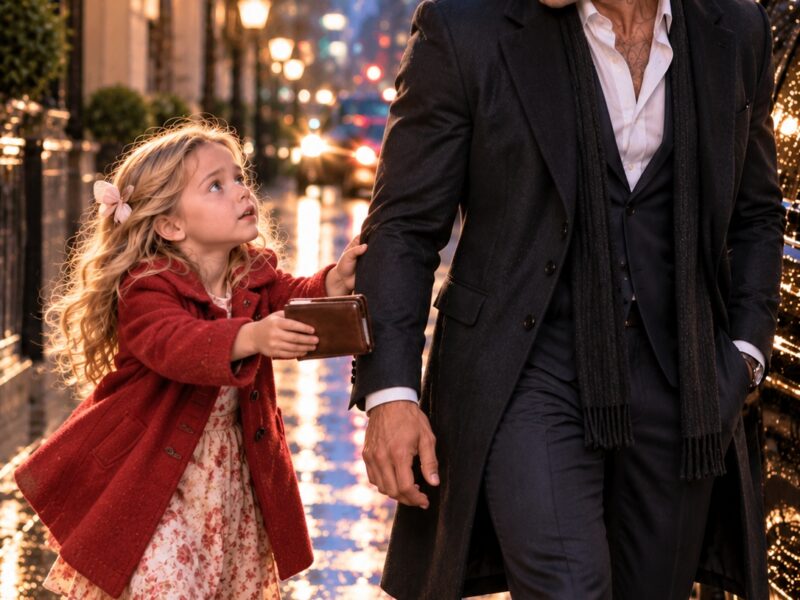
The Poor Little Girl Returned a Mafia Boss’s Wallet—Then He Discovered Why Men Were Watching Her Bakery and What Her Dead Mother Had Hidden
“Mister, did you drop this?”
Sebastian Rourke stopped three steps from the black sedan waiting at the curb.
Chicago wind pushed dead leaves along the sidewalk and carried the smell of diesel, wet pavement, and bread from a bakery somewhere down the block.
Behind Sebastian, two men in dark coats stopped with him.
Neither reached inside his jacket.
Neither needed to.
The six-year-old girl running toward them looked dangerous only to herself.
Her red coat was too large.
One sleeve covered half her mitten.
Her cheeks had gone pink from the cold, and strands of dark brown hair had escaped beneath a knitted hat decorated with one crooked white pom-pom.
She held a brown leather wallet in both hands.
Sebastian stared at it.
Then touched the inside of his overcoat.
Empty.
The girl stopped several feet away.
“You dropped it.”
Sebastian looked at her carefully.
“Did you open it?”
She considered whether that mattered.
“A little.”
One of Sebastian’s men glanced sideways.
The girl continued.
“There’s money.”
“How much?”
She shrugged.
“A lot.”
Sebastian almost smiled.
“Anything else?”
“A necklace.”
His expression changed.
Not a necklace.
A rosary.
His mother’s olivewood rosary.
He had carried it every November since she died.
Not because he was religious.
Because grief makes rituals out of objects people once touched.
Sebastian crouched.
“May I have it?”
The girl placed the wallet in his palm.
Her mitten smelled faintly of cinnamon.
He opened it.
Money.
Cards.
Rosary.
Everything there.
The cash totaled a little over eleven thousand dollars.
He had been carrying it because the dinner he had just left involved the kind of men who still preferred paper money when discussing things nobody wanted appearing in accounting software.
Sebastian removed a hundred-dollar bill.
“For you.”
The girl stared.
“No.”
He blinked.
“Why not?”
“My mom says you don’t get paid for giving back things that aren’t yours.”
The sentence landed somewhere inconvenient.
Sebastian folded the bill once.
“Your mother sounds strict.”
“She is.”
A woman came running toward them.
Early thirties.
Brown braid loose beneath a gray hat.
Flour on one sleeve of her coat.
She reached the child and caught her shoulders.
“Ellie.”
“I gave it back.”
“I can see that.”
The woman looked at Sebastian.
Recognition did not appear immediately.
That surprised him.
Most adults in certain parts of Chicago recognized his face before they recognized the weather.
“I’m sorry,” she said. “She saw it fall and ran before I could stop her.”
Sebastian stood.
“She did the right thing.”
“I know.”
The woman looked at Ellie.
“Still doesn’t mean you run into the street.”
“I looked.”
“You’re six.”
“That doesn’t mean my eyes don’t work.”
Sebastian’s mouth moved again.
The woman noticed.
So did the men behind him.
Neither reacted.
Sebastian asked:
“What’s your name?”
“Ellie Bennett.”
He looked at the woman.
“Maya Bennett.”
“Aunt Maya,” Ellie corrected.
Maya gave the child a look.
Sebastian nodded.
“Thank you, Ellie Bennett.”
“You’re welcome.”
She took Maya’s hand.
They walked away.
Red coat bobbing through gray afternoon.
Sebastian watched longer than necessary.
His security chief, Theodore Grant, came closer.
“You know them?”
“No.”
“Want me to?”
Sebastian looked at him.
Theo understood.
“No.”
They got into the sedan.
Across the street, inside a parked delivery van, a man lowered a camera.
He had photographed Sebastian Rourke kneeling to a child.
That picture reached Calvin Marlowe before Sebastian reached his office.
Calvin had spent eleven years trying to understand what Sebastian Rourke valued.
Money?
No.
Territory?
Temporarily.
Loyalty?
Until betrayed.
Family?
Most of them were dead.
Women?
Never long enough to matter.
Reputation?
Useful, but not sacred.
Calvin enlarged the photograph.
Sebastian on one knee.
The child in red.
Something unguarded in his face.
Calvin smiled.
“Find the girl.”
His lieutenant hesitated.
“Why?”
“Because Sebastian Rourke has spent fifteen years convincing everyone he has nothing that can be taken from him.”
Calvin tapped the screen.
“I want to know whether that just changed.”
Across the river, Sebastian sat alone in his office.
The wallet rested beneath a brass lamp.
He removed the rosary.
Twenty-four olivewood beads.
A small silver crucifix.
The wood had been worn smooth beneath his mother’s thumb.
She used to pray with it at the kitchen table when Sebastian was a boy.
Not for miracles.
For patience, she said.
Because miracles were unreliable.
Patience was practice.
Sebastian rubbed one bead between his fingers.
Someone knocked.
Theo entered.
“How was Marlowe’s envoy?”
“Predictable.”
“He wants South Harbor.”
“He wants half the lake if people stop telling him no.”
“Response?”
“No.”
Theo nodded.
“Then we prepare.”
Sebastian set down the rosary.
Theo started toward the door.
Sebastian said:
“The girl.”
Theo stopped.
“What about her?”
Sebastian almost said nothing.
Instead:
“Make sure nobody followed her.”
Theo studied him.
“Quietly?”
“Very.”
“No contact?”
“No.”
Theo nodded.
Twenty-four hours later, the answer came back.
Someone had followed them.
Not Sebastian’s people.
Calvin’s.
The girl lived in Pilsen with her aunt.
The aunt owned a small bakery called Bennett & Rose, though only one Bennett remained alive.
Maya Bennett opened at five-thirty each morning.
Bread.
Coffee.
Sweet rolls.
Three round tables.
One old cash register.
A chalkboard over the ovens written in handwriting belonging to Maya’s dead sister.
Bread Is Patience You Can Eat.
Ellie’s parents had died three years earlier.
Car accident.
Lake Shore Drive.
Hit-and-run.
The child had been staying with Maya that night.
Sebastian read the file twice.
Then the surveillance report.
Calvin’s watcher had photographed the bakery.
The apartment.
Ellie’s school.
His jaw tightened.
Theo stood across his desk.
“We can pull their watcher.”
“Then Calvin sends another.”
“We can send a warning.”
“He sends someone quieter.”
Theo knew Sebastian was right.
“You want protection on them.”
“I want Calvin to lose interest.”
“That may no longer be possible.”
Sebastian looked at the photograph.
Ellie eating a piece of bread with butter spread all the way to her fingers.
Theo said:
“You don’t owe them anything.”
“No.”
“You don’t know them.”
“No.”
“Then?”
Sebastian leaned back.
“Calvin believes she matters.”
Theo waited.
Sebastian continued.
“The second he believes that, walking away does not protect her.”
It simply leaves her alone with a problem I accidentally created.”
Theo exhaled.
“That sounds uncomfortably responsible.”
“I dislike it too.”
“Orders?”
“A safe location.”
“Not company property.”
“Not anywhere Marlowe can reach through our books.”
Theo raised an eyebrow.
“You have something like that?”
“Yes.”
“Since when?”
Sebastian did not answer.
Theo understood the answer was old.
Probably painful.
He left.
That evening, Maya found the first message.
She had opened the bakery before dawn.
Ellie sat near the back with crayons while Maya kneaded dough.
The bell chimed.
A man entered.
Long coat.
Dark gloves.
Nothing memorable.
That made him memorable.
“One round loaf.”
Maya wrapped it.
He paid with a twenty.
“Keep the change.”
Then left.
Maya waited until he passed the window.
On the table nearest the door, beneath the paper change wrapper, lay a folded note.
She opened it.
Her home address.
Nothing else.
Her fingers tightened.
Ellie looked up.
“Auntie?”
Maya folded the paper.
“Finish your drawing.”
“Why?”
“Because I want to see it.”
Ellie smiled.
Maya did not.
At two, she closed early.
That night she checked the apartment windows twice.
Then three times.
At six the next morning she reopened the bakery.
Fear could close a business faster than fire.
Maya had spent three years refusing to let grief do that.
The bell rang at 6:07.
She did not look up immediately.
“Someone told me this bakery has the best cinnamon bread in Chicago.”
She knew the voice.
Sebastian Rourke stood inside the door.
No suit.
Gray sweater.
Dark jacket.
Still expensive.
Just less obviously so.
Maya put down the tray.
“We’re out.”
“That is unfortunate.”
“Mr. Rourke.”
His eyes sharpened slightly.
“You know who I am.”
“I searched.”
“That usually produces poor reading.”
“It produced enough.”
She crossed her arms.
“Organized crime.”
“Federal investigations.”
“A brother killed seven years ago.”
“Several businesses the newspapers cannot decide are legitimate.”
Sebastian said:
“Fair summary.”
“I want you to leave.”
“I know.”
He placed both hands visibly on the counter.
“There is a black sedan at the corner.”
Maya went still.
“Fake Illinois plates.”
“One man inside.”
“He bought bread yesterday.”
Her face changed.
Sebastian continued.
“He left your address.”
Maya’s jaw tightened.
“How do you know?”
“My people saw him.”
“Why are your people watching my bakery?”
“To see whether his people were.”
“That is not comforting.”
“I did not expect it to be.”
Ellie’s voice came from behind the curtain.
“Wallet man?”
Maya turned.
Ellie emerged holding a red crayon.
Her face lit.
Sebastian smiled.
Small.
Unpracticed.
“You remembered.”
“You had the necklace.”
“Rosary.”
“What’s that?”
“A kind of prayer necklace.”
“Did you lose it again?”
“No.”
“Good.”
Maya put one hand on Ellie’s shoulder.
“Back room.”
“But—”
“Please.”
Ellie went.
Maya looked at Sebastian.
“What do they want?”
“I don’t know yet.”
“That isn’t enough.”
“I know.”
“Why us?”
Sebastian’s silence answered badly.
Maya’s expression sharpened.
“Because she returned your wallet.”
“Yes.”
She laughed once.
No humor.
“My sister spent six years teaching that child to be honest.”
“Now honesty gets her followed?”
“I’m trying to stop that.”
“By bringing more men?”
“No.”
Sebastian removed a plain white card.
One number.
No name.
He set it down.
“Do not sleep at your apartment tonight.”
Maya stared.
“If you change your mind, call.”
“You think I should trust you?”
“No.”
That surprised her.
Sebastian continued.
“I think you should trust the fact that the man outside knows where your child sleeps.”
Then he left.
Maya did not call.
At 3:11 the following morning, the apartment window shattered.
A brick hit the wall.
A framed photograph dropped.
Glass spread across the floor.
Maya was awake before the second sound.
She ran to Ellie.
The girl sat upright.
Eyes huge.
“Auntie.”
Maya lifted her.
“Bathroom.”
She carried Ellie down the short hall.
Locked the door.
Only then did she see the newspaper wrapped around the brick.
Black marker.
GIVE US THE GIRL AND THIS ENDS.
Maya’s hands began shaking.
She reached into her pajama pocket.
No phone.
Kitchen.
Outside.
She closed her eyes.
Then remembered the card.
She had put it inside her phone case after the bakery.
The phone lay on the bathroom sink.
She dialed.
One ring.
“Rourke.”
Her voice broke.
“Mr. Rourke.”
He changed instantly.
“Where are you?”
“Bathroom.”
“Ellie?”
“With me.”
“Stay there.”
“Don’t open the door.”
“I’m twenty minutes away.”
“How—”
The line disconnected.
Nineteen minutes later, someone knocked.
Three times.
“Maya.”
Sebastian.
She opened.
He stood in the hallway wearing the same gray sweater from the bakery under a black coat.
Theo and two men were behind him.
No one rushed toward her.
Sebastian looked past Maya.
Brick.
Window.
Photograph of a woman smiling in a bakery apron.
Ellie’s face against Maya’s shoulder.
Something settled in his expression.
“Five minutes.”
Maya stared.
“What?”
“Pack what you can carry.”
“Where?”
“Somewhere Calvin Marlowe does not know exists.”
“How do I know you’re not the reason this is happening?”
“You don’t.”
That was the second honest answer she had not expected.
Sebastian continued.
“You can stay.”
“I will still put men outside.”
“You can call police.”
“I will not stop you.”
“You can come with me.”
“Those are your choices.”
Maya looked at the broken photograph.
Then the message on the brick.
She packed.
Clothes.
Medication.
Ellie’s stuffed rabbit.
The photograph of her sister, broken glass still in the frame.
Sebastian carried Ellie downstairs.
The little girl whispered:
“You came back.”
He almost stopped.
“Yes.”
In the SUV, Chicago moved past in streaks of orange light.
Maya held Ellie tightly.
“Where are we going?”
“A farm outside Geneva.”
“Your farm?”
“Technically, a holding company’s.”
“That sounds reassuring.”
Sebastian almost smiled.
“You own a hidden farmhouse.”
“Yes.”
“Why?”
He looked through the windshield.
“I bought it after my brother died.”
“For what?”
“I thought someday I might want somewhere my name did not enter before me.”
Maya heard the loneliness inside the sentence.
She did not comment.
The farmhouse sat beyond a dirt road.
Two stories.
White porch.
Bare apple tree.
Old barn.
No visible neighbors.
Ellie woke when the tires hit gravel.
She pressed her face to the window.
“Auntie.”
“What?”
“There’s a porch.”
Maya almost laughed.
“Yes.”
“A big porch.”
“Yes.”
“And a tree.”
Sebastian unlocked the door.
The house smelled like cedar and cold rooms.
Ellie ran inside.
Children are strange that way.
The world can break a window behind them and still become interesting again because another staircase exists ahead.
Maya watched her niece run.
Then laughed once.
Small.
Surprised.
Sebastian turned away.
She noticed.
“Why did you do that?”
“What?”
“Look away.”
“It seemed private.”
That answer stayed with her.
Theo arrived before sunrise with groceries and a security system.
Motion sensors.
Cameras.
Emergency button.
Rules.
Maya hated every rule.
Memorized all of them.
Three nights later, Sebastian told Ellie a bedtime story because Maya had accidentally chosen one ending in death.
“The Little Match Girl is terrible,” Ellie announced.
“It is literature.”
“It is sad.”
“Those things overlap.”
Ellie pointed at Sebastian.
“You tell one.”
He stared.
“I don’t know stories.”
“Make one.”
Sebastian sat.
“Once there was a fox.”
Ellie waited.
“He lived alone.”
“Why?”
“He was good at it.”
“That’s not a reason.”
Sebastian glanced at Maya.
She covered a smile.
He continued.
“The fox thought it was.”
He built the story slowly.
Snow.
Forest.
Footprints.
A small house.
A fox who kept telling himself he followed the footprints because he was curious.
Not because loneliness had finally become heavier than caution.
Ellie fell asleep before the fox reached the door.
Maya stood in the hall.
“You made that up?”
“Yes.”
“The fox is subtle.”
“I regret agreeing to this.”
She smiled.
For the first time, Sebastian smiled back without seeming surprised by it.
The fourth morning was quiet.
Coffee.
Toast.
Ellie outside with a rescue dog Theo had brought.
She named him Waffles.
Sebastian sat at the kitchen table reading reports.
Maya poured coffee.
“Did you ever have family?”
He looked up.
“A brother.”
“What happened?”
“Killed.”
She stopped.
“I’m sorry.”
“Seven years.”
“That doesn’t change the sentence.”
“No.”
He looked out toward Ellie.
“And you?”
“My sister.”
“Ellie’s mother.”
“Yes.”
“Claire.”
He knew the name from his file.
Maya ignored that.
“She raised me.”
“Seven years older.”
“Mom worked nights.”
“Claire taught me bread.”
“School.”
“Everything.”
“She married Aaron Bennett.”
“Math teacher.”
“Quiet.”
“Good man.”
Sebastian set down his coffee.
“They died together?”
Maya nodded.
“October eleventh.”
“Three years ago.”
His hand stopped.
“What?”
“Nothing.”
She watched him.
“Sebastian.”
First name.
He noticed.
“What happened exactly?”
Maya’s eyes narrowed.
“Hit-and-run.”
“Where?”
“Lake Shore Drive.”
“What time?”
“About ten-forty.”
“What car?”
She went still.
“Why?”
“What car?”
“A black BMW.”
His face changed.
Very little.
Enough.
“Sebastian.”
He stood.
“I need to make a call.”
“No.”
Maya stepped between him and the door.
“What do you know?”
“I don’t know yet.”
“There it is again.”
“What?”
“That wall.”
He looked at her.
“You ask questions until the answer belongs to you.”
“Then suddenly everyone else is safer not knowing.”
Sebastian closed his eyes briefly.
“I remember that night.”
Maya’s throat tightened.
“Why?”
“My mother was admitted to Northwestern.”
“So?”
“I cancelled dinner.”
“What dinner?”
He looked toward Ellie in the yard.
“Give me three hours.”
“No.”
“Maya.”
“No.”
Her voice lowered.
“You are asking me to let you privately investigate the night my sister died.”
His face tightened.
“You’re right.”
Good.
He pulled out his phone.
Put it on speaker.
Called Theo.
“Bring every record from October eleventh three years ago.”
Theo went silent.
Then:
“Boss?”
“Everything.”
“Moretti side, Marlowe side, police chatter, private surveillance.”
“Maya Bennett is listening.”
Another pause.
“Understood.”
Sebastian hung up.
Maya’s eyes filled unexpectedly.
“Thank you.”
He looked uncomfortable.
“For what?”
“Not deciding again.”
That afternoon the truth arrived.
In an old barn.
Documents spread beneath a work light.
Sebastian.
Maya.
Theo.
Ellie inside with Waffles and cartoons.
Theo explained.
Three years earlier, Sebastian had been scheduled to dine with attorney Samuel Greer at an Italian restaurant near the river.
Calvin Marlowe had been tracking Greer because the attorney possessed information about a port bribery investigation.
Calvin’s men expected a black BMW 7 Series.
Tinted windows.
One male passenger.
Southbound Lake Shore Drive.
Sebastian cancelled.
Greer left early in a different car.
Claire and Aaron Bennett had anniversary dinner next door.
They drove a black BMW.
Same year.
Same trim.
Same tint.
Rain started.
The surveillance team identified the car from behind.
Wrong car.
Wrong people.
They forced it off the road.
By the time the men realized, Claire was dying.
Aaron survived two days.
The shooter reported a mistake.
Calvin buried it.
Then buried the shooter months later in another crime.
Maya sat perfectly still.
Sebastian said nothing.
Finally she whispered:
“They were supposed to kill you.”
“No.”
Theo answered carefully.
“They thought Samuel Greer was inside.”
Sebastian looked at the floor.
“The operation existed because of my war with Calvin.”
Maya looked at him.
“That is not the same as ordering it.”
“They crossed our world.”
“Because of yours.”
“Yes.”
He did not defend himself.
That mattered.
Maya stood.
Walked outside.
Sebastian followed only to the porch.
Did not step closer.
Maya stared across the frost.
“I spent three years thinking maybe Claire looked down.”
“What?”
“At the radio.”
“Maybe Aaron was speeding.”
“Maybe if I had kept Ellie that night like I sometimes did, they would have left earlier.”
Sebastian’s throat tightened.
Maya continued.
“I built a religion out of maybe.”
She finally looked at him.
“I’m not adding you to it.”
He stared.
“What?”
“You did not order it.”
“You did not know.”
“No.”
“You’re still part of the reason that world existed.”
“Yes.”
“That’s enough responsibility.”
“You don’t need to steal guilt that belongs to Calvin just because you know how to carry it.”
Sebastian had no answer.
Maya said:
“What I care about is what happens now.”
He looked toward the kitchen window.
Ellie was feeding Waffles toast beneath the table.
“Now I end it.”
The next morning, the bakery burned.
No one was inside.
Calvin’s men used an accelerant at the back door.
Fire crews arrived too late.
The ovens.
Tables.
Claire’s chalkboard.
Recipe cards.
Photographs.
Gone.
Sebastian told Maya on the porch.
She did not cry at first.
“That was all I had left of her.”
The sentence hurt more than shouting would have.
“The smell in the morning.”
“The round loaves.”
“Her handwriting above the mixer.”
Sebastian touched her shoulder.
First time.
Brief.
“I’ll rebuild it.”
She shook her head.
“You can rebuild walls.”
“Not her.”
“No.”
He swallowed.
“But the next bakery can be yours.”
Maya cried then.
Quietly.
Ellie came outside.
“Why are you crying?”
Maya knelt.
“I miss your mom.”
Ellie hugged her.
“I miss her too.”
Sebastian went inside.
Called Theo.
“No more defensive posture.”
Theo went silent.
“Meaning?”
“Every financial channel Marlowe uses.”
“Every corrupt contract.”
“Every political payment we can prove.”
“Every port lease.”
“Every federal lead.”
“Open all of it.”
Theo said:
“That exposes us too.”
“I know.”
“You understand what you’re saying.”
“Yes.”
“We cannot burn Calvin without smoke coming back.”
“I know.”
Theo exhaled.
“You want war.”
“No.”
Sebastian looked toward Maya through the window.
“I want evidence.”
That surprised Theo.
Sebastian continued.
“If I attack him the old way, Ellie grows up in the same city that killed her parents.”
“I’m done calling that protection.”
Theo was quiet.
Then:
“Understood.”
For the next week, Sebastian dismantled Calvin without firing a shot.
He gave federal attorneys evidence through outside counsel.
Port kickbacks.
Shell companies.
Judges.
Union bribes.
Warehouse laundering.
Calvin’s network depended on secrecy.
Sebastian gave secrecy away.
His own records went with it.
Not everything incriminated him equally.
Enough did.
Theo warned him.
“You may be charged.”
“Yes.”
“Prison.”
“Possible.”
“Maya knows?”
“Yes.”
“She didn’t ask you to do this.”
“No.”
“Then why?”
Sebastian looked at the brown wallet on his desk.
“Because a six-year-old returned money she could have kept.”
Theo stared.
Sebastian continued.
“And I have spent twenty years keeping things that were never mine.”
“Routes.”
“Fear.”
“Silence.”
“Other people’s choices.”
He put his mother’s rosary into the wallet.
“It seems overdue.”
But Calvin was not finished.
An email arrived.
Drone footage.
Farmhouse.
Apple tree.
Ellie running with Waffles.
Maya hanging towels.
Then the camera zoomed.
Ellie’s face filled the screen.
Black.
Text.
NAVY PIER. SUNDAY. MIDNIGHT. BRING THE GIRL OR I TAKE HER MYSELF.
Sebastian closed the laptop.
Not slammed.
Closed.
Then he called Theo.
“He found us.”
Theo cursed quietly.
“How?”
“Find out.”
The leak came from Rafael Quinn.
Outer perimeter guard.
Twenty-nine.
No criminal history.
Family connected to Sebastian’s father.
His sister had a gambling debt at a Marlowe room.
Sixty thousand dollars.
The debt disappeared two weeks earlier.
Rafael had not volunteered information.
He had been squeezed through family.
Sebastian did not have him beaten.
That surprised everyone.
Instead, he had Theo feed Rafael false information.
Sebastian planned to move Ellie by boat from Belmont Harbor Sunday night.
Red coat.
Small crew.
Calvin took the bait.
Then Sebastian told Maya.
Everything.
She listened.
No secrets.
No “for your protection.”
“We’ll use a mannequin,” he said.
“Ellie stays here.”
Maya hated it.
Said so.
Then agreed because knowing made agreement possible.
Ellie overheard enough.
She came downstairs in socks.
“Uncle Sebastian.”
He turned.
She had begun calling him that three days earlier.
Nobody had corrected her.
“Please come back.”
Sebastian crouched.
“I will.”
She took off her mother’s silver locket.
“Bring this back too.”
He stared.
Initials.
C.B.
Claire Bennett.
He accepted it.
“I will.”
Saturday at 3:00 a.m., the alarm screamed.
The betrayal was not Rafael.
Theo had missed someone.
Luis Moreno, the safe-house cook.
Calm.
Kind.
No debts.
No payments from Calvin.
But Calvin’s men had taken Luis’s mother in Texas.
A photograph.
A threat.
Unlock the back door or she disappears.
Luis cried for an hour.
Then opened it.
Four men entered.
The motion sensor caught them twelve seconds later.
Sebastian woke on the sofa.
Moved upstairs.
Maya lifted Ellie.
Ran for the cellar.
A masked man reached the hallway first.
Maya put herself between him and Ellie.
There was a struggle.
A shot struck Maya high in the shoulder.
She stayed standing long enough to push Ellie backward.
Sebastian came up the stairs.
He fired once.
The man dropped.
Two others retreated.
The fourth reached Ellie.
Seven seconds.
That was all.
He grabbed her.
Out the window onto the porch roof.
Down to the yard.
Black van.
Gone.
Sebastian reached the broken window too late.
The van disappeared beyond the trees.
Maya sank against the wall.
Sebastian caught her.
“Look at me.”
Her face was white.
“Ellie.”
“I know.”
“Find her.”
“I will.”
“Promise me.”
“I promise.”
Medical staff arrived.
Maya was taken to a private hospital.
Alive.
Stable.
Sebastian stood in the destroyed hallway.
One red mitten lay near the broken window.
His hands shook.
Theo called.
“We may have a tracker.”
Sebastian froze.
“What?”
“Locket.”
“I put a passive GPS chip inside the casing after the drone footage.”
Sebastian’s expression hardened.
“You did what?”
“I didn’t trust the perimeter.”
“You didn’t tell me.”
“I know.”
“Maya?”
“No.”
Wrong.
Theo knew it.
Sebastian closed his eyes.
Then:
“Later.”
He opened the tracking app.
Red dot.
Moving east.
Then south.
Industrial district.
Calumet.
The dot stopped at an abandoned freight warehouse.
Sebastian called a federal agent.
Not his soldiers.
That shocked Theo more than anything else that night.
“Federal?”
“Yes.”
“Boss.”
“If we go in shooting, Calvin dies and twenty men spend the next decade inventing stories.”
“If agents go in with warrants and live recordings, his network dies with him.”
“And Ellie?”
“I’m going in first.”
“Absolutely not.”
Sebastian looked at the red mitten.
“I promised.”
The warehouse smelled of rust and old oil.
Sebastian entered with a wire beneath his shirt.
Agents outside.
Theo two blocks away.
Calvin stood beneath one hanging light.
Two guards.
Ellie tied to a wooden chair.
No gag.
Red coat.
Face pale.
Still watching.
Sebastian did not look at her twice.
He could not afford to show Calvin what one look did to him.
Calvin smiled.
“The Iceman.”
“Let her go.”
“You gave prosecutors my accounts.”
“Yes.”
“Your own too.”
“Yes.”
“You’ll go to prison.”
“Maybe.”
“For her?”
“No.”
Calvin laughed.
“Don’t lie.”
Sebastian’s voice remained quiet.
“I did it because men like us keep creating children like her.”
Calvin’s smile faded.
“What?”
“Her parents.”
Sebastian watched him carefully.
“October eleventh.”
“Three years ago.”
“Lake Shore Drive.”
Calvin’s face changed.
Only slightly.
Enough.
Sebastian continued.
“Your crew hit the wrong BMW.”
Calvin stared at Ellie.
Sebastian saw the calculation.
“You killed Claire and Aaron Bennett.”
Calvin’s mouth opened.
Closed.
He had not known the names.
That was worse.
Ellie heard.
Her face changed.
Sebastian almost broke.
Calvin recovered.
“Collateral happens.”
The words entered Sebastian’s wire.
Outside, federal agents heard them.
So did Theo.
Sebastian said:
“She was three.”
Calvin shrugged.
That was the end of him.
Not because Sebastian attacked.
Because the sentence was recorded.
Conspiracy.
Kidnapping.
Extortion.
Admissions connected to an unsolved double homicide.
Sebastian kept him talking.
Calvin boasted.
About ports.
About bribed officers.
About making people disappear from systems.
Then:
“You know the funniest part?”
Sebastian waited.
“She ran after you with that wallet.”
“Yes.”
“If she had kept walking…”
Calvin smiled.
“None of this happens.”
Sebastian looked at Ellie.
“No.”
His voice softened.
“That’s where you’re wrong.”
Ellie was working at the rope.
A red crayon had been in her coat pocket.
She scraped the fiber.
Slowly.
Carefully.
One wrist loosened.
Sebastian saw.
Did not react.
Calvin raised his hand.
One guard moved toward Ellie.
Sebastian said:
“Stop.”
The guard paused.
“Why?”
Calvin asked.
Sebastian looked at him.
“Because this is over.”
Doors opened.
Federal agents entered from three sides.
Commands filled the warehouse.
Calvin froze.
His men dropped their weapons.
One tried to run.
Agents stopped him.
No gunfight.
No dramatic execution.
Calvin stared at Sebastian.
“You brought the government into my house.”
Sebastian looked around.
“This isn’t your house.”
Agents cuffed him.
Ellie twisted her hand free.
Then the other.
She ran.
Sebastian dropped to one knee.
She hit him hard enough to nearly knock him backward.
Her arms went around his neck.
“You came.”
“Yes.”
She was crying now.
“You came.”
“I said I would.”
She touched his chest.
“Locket.”
Sebastian reached beneath his shirt.
Pulled it out.
Ellie took it.
Pressed it to her lips.
Then looked at Calvin being escorted away.
“Was he the man?”
Sebastian’s throat tightened.
“One of them.”
“He hurt Mom?”
“Yes.”
Her face crumpled.
Sebastian held her.
“No more tonight.”
“But—”
“No more.”
He looked into her eyes.
“You get the truth.”
“You don’t have to get all of it while you’re scared.”
She nodded.
The distinction mattered.
Maya woke after surgery asking the same question.
“Ellie?”
Theo answered:
“Safe.”
She cried.
Sebastian arrived with Ellie forty minutes later.
The child ran to her bedside.
Maya reached with her uninjured arm.
Held her.
Sebastian remained near the doorway.
Maya looked over Ellie’s head.
“You found her.”
“Yes.”
“You used federal agents.”
“Yes.”
Her eyebrows rose.
“That must have hurt.”
“Deeply.”
She laughed weakly.
Then winced.
Sebastian came closer.
Maya looked at him.
“The tracker.”
He went still.
“Theo told me.”
“I’m angry.”
“I know.”
“Don’t say that like it fixes it.”
“It doesn’t.”
“You did not consent either.”
“No.”
“Good.”
He almost smiled.
Maya continued.
“If we are going to survive people who make decisions for us, we cannot become people who make decisions for each other.”
Sebastian looked at Theo.
Theo stared at the floor.
“Understood,” Sebastian said.
Months of prosecutions followed.
Calvin Marlowe was indicted on racketeering, kidnapping, extortion, bribery and conspiracy tied to Claire and Aaron Bennett’s deaths.
The men responsible for the original crash were identified through old payment records.
One was dead.
One cooperated.
One went to trial.
The case did not become emotionally tidy because the government used clean folders.
Maya attended sentencing.
Ellie did not.
She was seven by then.
She knew Calvin had ordered men who caused her parents’ deaths.
She did not know every detail.
Maya told her:
“You get more when you want more.”
Ellie asked:
“Will it hurt?”
“Yes.”
“Then not yet.”
Good answer.
Sebastian was charged too.
Tax offenses.
Bribery.
Financial conspiracy.
Illegal payments connected to port operations he inherited and continued.
His attorneys could have fought for years.
He pleaded to what was true.
That surprised prosecutors.
It stunned several men who had spent twenty years believing Sebastian Rourke would burn the city before admitting fault.
His cooperation reduced the sentence.
So did dismantling several illegal operations and transferring legitimate businesses into independently supervised structures.
He still went to prison.
Eleven months.
Before he surrendered, he went to Maya’s temporary apartment.
She had moved out of the farmhouse after the kidnapping.
Her choice.
He respected it.
Ellie opened the door.
“You’re going away.”
“Yes.”
“Because Calvin?”
“No.”
“Because of things I did before you met me.”
She frowned.
“Bad things?”
“Yes.”
“How bad?”
“Bad enough.”
“Did you hurt people?”
Sebastian did not hide behind language.
“Yes.”
Ellie’s eyes filled.
“Why?”
“Because I thought fear solved problems.”
“Did it?”
“For a while.”
“And then?”
He looked at Maya.
“Then it created more.”
Ellie thought.
“Will you come back?”
“If I’m allowed.”
“That sounds like jail.”
“Yes.”
She sighed.
“Adults are exhausting.”
Maya almost laughed.
Ellie went to her room.
Returned with something wrapped in a dish towel.
The wallet.
Sebastian stared.
“You left it here?”
“You gave it to Aunt Maya when the police took your office things.”
Right.
Evidence review.
Maya had kept his personal property.
Ellie held it out.
“You should take it.”
Sebastian opened it.
His mother’s rosary.
Still there.
He looked at Ellie.
“The first time you gave this back, you wouldn’t take a reward.”
“I remember.”
“Why?”
“Honesty doesn’t need money.”
He nodded.
“You were right.”
She smiled faintly.
“Usually.”
He laughed.
Prison changed Sebastian less dramatically than newspapers claimed.
He read.
Worked.
Met with attorneys.
Participated in financial compliance classes he privately considered humiliating.
That was probably why they were useful.
Ellie wrote letters.
Mostly drawings.
Maya wrote twice.
The first:
Bakery insurance finally paid.
The second:
Ellie wants to know whether prison food has cinnamon rolls. I told her I would ask.
Sebastian replied:
It has objects claiming to be cinnamon rolls. Please do not let her see one.
Maya laughed reading it.
She missed him.
That annoyed her.
Missing someone whose world had damaged yours is not romantic.
It is complicated.
Maya refused to simplify it.
Sebastian returned to Chicago eleven months later.
Theo picked him up.
No convoy.
One SUV.
“You look terrible.”
“Thank you.”
“Prison?”
“Your conversation.”
Theo laughed.
They drove west.
Not downtown.
“Where?”
“Geneva.”
Sebastian looked over.
Theo continued.
“Someone opened a bakery.”
The farmhouse barn had been renovated.
Wide windows.
Six tables.
Brick oven.
Green-painted sign.
CLAIRE’S LOAF.
Sebastian stopped outside.
Maya stood behind the counter.
Hair in a braid.
Flour on her forearms.
Ellie saw him first.
She ran.
Sebastian barely had time to put down his bag.
“Uncle Sebastian!”
He caught her.
Lifted her.
She was heavier.
Older.
Missing one front tooth.
“You grew.”
“You got skinny.”
“Prison review?”
“Bad.”
Maya came around the counter.
Stopped several feet away.
“Hello.”
“Hello.”
Ellie looked between them.
“This is weird.”
Maya sighed.
“Go help Theo.”
“Doing what?”
“Anything elsewhere.”
Ellie left.
Sebastian looked at the bakery.
“You rebuilt it.”
“I did.”
“I thought you might.”
“How?”
“You don’t know how to stay broken.”
Maya looked at him.
“That sounded dangerously close to poetry.”
“Prison library.”
She smiled.
Then:
“I used insurance.”
“Good.”
“Settlement money.”
“Good.”
“Not yours.”
“I assumed.”
“Good.”
They stood quietly.
Sebastian said:
“I owe you something.”
“What?”
“An apology without strategy attached.”
Maya folded her arms.
He continued.
“I brought danger.”
“I made decisions for you.”
“Even when I thought I was protecting you.”
“I let men like Calvin remain part of the system because confronting all of it threatened what I had.”
“Maya…”
“I am sorry.”
She watched him.
No excuse.
Good.
“I believe you.”
Not forgiveness.
Not absolution.
Belief.
Enough.
Their relationship did not become romantic that day.
That would have been insulting.
Sebastian rented a house ten miles away.
Worked with his legitimate companies.
Visited the bakery when invited.
Helped Ellie with homework badly.
Learned to make pasta properly.
Discovered Waffles preferred Maya to everyone.
Therapy came later.
Court-required initially.
Voluntary afterward.
Sebastian complained.
Maya said:
“Go.”
He went.
A year passed.
Ellie asked:
“Are you my uncle?”
Sebastian looked at Maya.
Maya looked back.
“Unofficially,” she said.
Ellie frowned.
“What does that mean?”
Sebastian answered:
“It means nobody filled out paperwork.”
“Oh.”
She thought.
“Can we?”
Maya nearly dropped a tray.
Sebastian did not answer quickly.
Good.
He did not seize emotional moments anymore.
Maya knelt.
“You already had a dad.”
“I know.”
“A good one.”
“I know.”
“Sebastian would not replace him.”
“I know.”
Ellie looked at Sebastian.
“I can have Dad and Uncle Sebastian.”
“Yes,” Maya said.
“Then paperwork.”
She walked away.
Sebastian stared.
Maya laughed.
“You look terrified.”
“I am.”
“Good.”
Formal guardianship followed later.
Not adoption.
Not yet.
A legal arrangement allowing Sebastian to act for Ellie if Maya became incapacitated.
Maya insisted on independent counsel.
Sebastian paid her lawyer only after the lawyer structured payment so Maya retained control.
They learned.
Their first date happened eighteen months after his release.
Maya asked.
That shocked him.
“You’re taking me to dinner.”
“I am?”
“Yes.”
“Why?”
“Because I’m tired of waiting for you to ask while pretending it is respectful.”
Sebastian blinked.
“I thought—”
“I know.”
She smiled.
“That’s the problem.”
He laughed.
Dinner.
Not his restaurant.
Her choice.
Small Italian place.
No private room.
No armed men at the table.
Theo sat in a car three blocks away because Maya had agreed to that level of security and no more.
Sebastian looked nervous.
“You negotiated port strikes with less anxiety,” Maya said.
“Yes.”
“Why?”
“Those men didn’t care whether I was interesting.”
She laughed.
They dated slowly.
Ellie disapproved of slowness.
“You’re old.”
Sebastian was forty-two.
“That is unkind.”
“You waste time.”
Maya nearly choked on coffee.
Three years after the wallet, Sebastian asked Maya to marry him.
Not at a gala.
Not in a restaurant.
Under the apple tree behind the bakery.
Ellie was somewhere nearby.
They both knew.
Sebastian said:
“I’m not asking because you need protection.”
“Good.”
“I’m not asking because Ellie loves me.”
“Good.”
“I’m not asking because I owe your family.”
“Very good.”
He smiled.
“I’m asking because when I tell you the truth, I want to remain in the room after.”
Maya’s eyes filled.
“And because you are the first person in my adult life who taught me that being accountable does not mean being owned.”
She looked at him.
“That’s dangerously healthy.”
“Therapy.”
“Obviously.”
He held out a simple ring.
No giant diamond.
Maya had once said large stones looked like furniture.
“Marry me?”
She waited long enough to punish him.
“Yes.”
Ellie jumped from behind the apple tree.
“I knew it.”
Maya laughed.
“You were spying.”
“I was supervising.”
Sebastian covered his face.
Their wedding was small.
Bakery closed for the day.
Theo.
Employees.
Maya’s mother flew in.
A photograph of Claire and Aaron sat near the bread table.
Ellie carried her mother’s silver locket.
Sebastian kept his mother’s rosary in his pocket.
No one pretended the dead had been replaced.
Families can expand without erasing.
Five years later, Ellie asked for the complete story.
She was eleven.
Maya resisted.
Sebastian did not push.
Ellie did.
“I know pieces.”
“I want all of it.”
They sat at the kitchen table.
Maya told her.
Not graphic.
Not sanitized.
Her parents were driving home.
Men connected to Calvin mistook their car for another.
They caused the crash.
They covered it up.
Sebastian’s war with Calvin created the conditions but Sebastian did not order it.
Calvin later targeted Ellie because he believed Sebastian cared about her.
Sebastian helped expose the organization.
He also admitted crimes of his own and served time.
Ellie listened.
Then looked at Sebastian.
“Did you ever think if I didn’t return the wallet, Mom and Dad would still be dead but none of the other stuff would happen?”
“Yes.”
“All the time?”
“For a while.”
“And?”
Sebastian looked at her.
“Then I realized the other stuff was already happening.”
“Calvin already knew what he had done.”
“I already knew what kind of man I had become.”
“You didn’t create the problem by being honest.”
“You exposed it.”
Ellie looked down.
“That sounds like something you practiced.”
“It is.”
“Therapy?”
“Unfortunately.”
She smiled.
Then:
“I’m glad I gave it back.”
Sebastian swallowed.
“Me too.”
At seventeen, Ellie worked summers at the bakery.
She hated getting up at four-thirty.
Maya called it character building.
Ellie called it abuse of labor law.
She planned to study journalism.
Sebastian found that alarming.
“You could study chemistry.”
“I hate chemistry.”
“Architecture?”
“No.”
“Hospitality?”
“Why are you afraid of journalism?”
“I have a past.”
“Exactly.”
Maya laughed so hard she had to sit down.
Ellie eventually became an investigative reporter.
Not crime exclusively.
Labor.
Corruption.
Financial abuse.
Public contracting.
She kept the old brown wallet in a box at home.
Not because it belonged to Sebastian.
He had given it to her when she turned eighteen.
“You returned it once,” he said.
“Now it’s yours.”
The cash was long gone.
The rosary remained with Sebastian.
The wallet held something else.
The hundred-dollar bill he had first tried to give her.
He had kept it for twelve years.
Unspent.
Ellie framed it with a handwritten card:
Honesty is not for sale.
She put it in her office.
People asked.
She usually smiled.
“Long story.”
At sixty, Sebastian no longer looked like the man who had knelt on a South Loop sidewalk.
Silver hair.
Old shoulder injury from another life.
Glasses for reading documents he pretended he could still see.
He retained legitimate logistics and real estate companies.
Theo retired three times.
Failed each time.
Maya still baked.
By then Claire’s Loaf had four locations.
She refused national expansion.
“Bread does not need private equity.”
Sebastian had learned not to argue.
One November afternoon, they attended a fundraiser in Chicago.
Cold.
Windy.
Ellie brought her eight-year-old daughter, Rose.
Afterward, the family walked toward the car.
Sebastian reached into his coat.
Paused.
Wallet gone.
He looked down.
“Maya.”
“What?”
“I lost it.”
She stared.
“The rosary?”
“No.”
“Wallet.”
“Again?”
“I’m aging.”
“You’ve been careless since forty.”
Rose’s voice came from behind them.
“Grandpa.”
Sebastian turned.
The child stood beneath a streetlamp.
Brown leather wallet in both hands.
Same one.
Ellie had borrowed it earlier for an event display and slipped it into Sebastian’s coat afterward.
Rose must have seen it fall.
“Did you drop this?”
Everything stopped.
Maya looked at Ellie.
Ellie covered her mouth.
Sebastian stood completely still.
Chicago wind pushed leaves along the curb.
Cars hissed over wet pavement.
Memory collapsed time.
Red coat.
Small mitten.
A child who had no reason to choose honesty except somebody good had taught her.
Rose held out the wallet.
Sebastian crouched.
Slowly now.
Knees complaining.
“Did you open it?”
“A little.”
Maya laughed.
Rose continued.
“There’s money.”
“How much?”
“A lot.”
Sebastian smiled.
“Anything else?”
“A wooden necklace.”
“Rosary.”
“What’s that?”
Sebastian looked at Ellie.
Her eyes were wet.
“A story.”
Rose frowned.
“That’s not a necklace.”
“No.”
He took the wallet.
Reached inside.
Removed a hundred-dollar bill.
Rose immediately shook her head.
Sebastian laughed.
“Your mother taught you.”
“Yes.”
“What?”
Rose crossed her arms.
“You don’t get paid for giving back stuff that isn’t yours.”
Maya began crying.
Quietly.
Ellie too.
Rose looked alarmed.
“Why is everybody sad?”
“We’re not,” Ellie said.
“We’re just remembering.”
Sebastian put the money away.
“Thank you, Rose Bennett.”
“You’re welcome.”
She took his hand.
They walked toward the car.
Sebastian looked down at the child beside him.
Then back at Maya and Ellie.
Decades earlier he had believed a lost wallet contained money and a rosary.
He had been wrong.
It contained a road.
A bakery.
A little girl.
A dead couple whose truth deserved daylight.
A woman who taught him guilt was not the same as responsibility.
A prison cell.
An apple tree.
A family table.
A second chance he had not earned in one moment but had spent years trying to become worthy of.
Ellie had not saved Sebastian by returning the wallet.
Children should not have to save grown men.
She had simply given him one honest moment.
He had decided, eventually, to answer it honestly.
That distinction mattered.
Because kindness is not magic.
It does not erase consequences.
It does not transform dangerous men because a child smiles at them.
What kindness can do is expose the part of a person that still knows another life is possible.
The rest requires choices.
Sebastian made bad ones before Ellie.
Good ones after.
Sometimes bad ones again.
Then better ones.
He apologized.
Listened.
Lost things.
Gave up power.
Accepted punishment.
Stayed.
Built.
That was why the ending mattered more than the beginning.
Not because a poor little girl returned a rich man’s wallet.
Because twenty years later, when another child handed that same wallet back to him, Sebastian Rourke understood exactly what he had been given the first time.
Not his money.
Not his mother’s rosary.
A chance to decide what kind of man would take them back.









