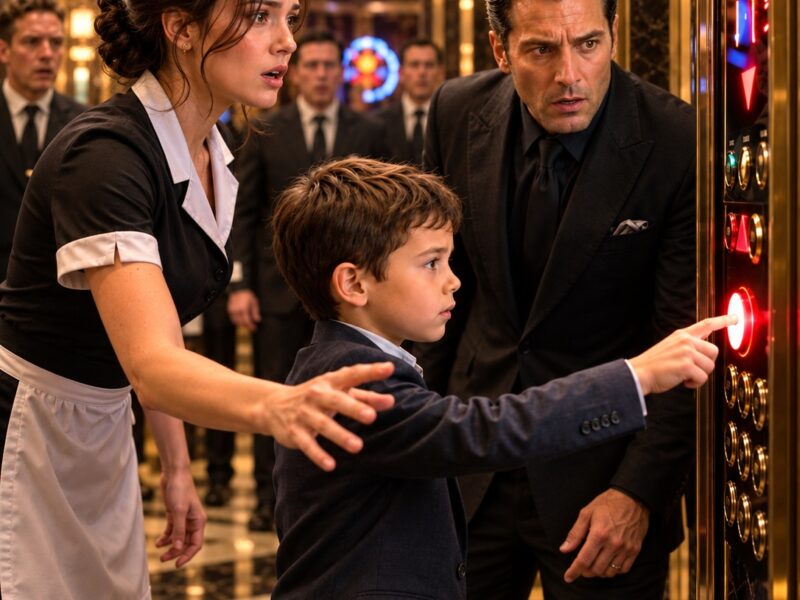
The Single Mom’s Son Pressed One Button — And Saved the Mafia Boss From His Own Men
At 3:17 in the morning, six-year-old Evan Collins broke a glass panel with a fire extinguisher and pressed the only button his mother had spent three years teaching him never to touch.
Forty-three floors above him, the private elevator carrying Roman Black stopped so hard that one of Roman’s bodyguards hit the wall.
The lights flashed red.
The polished steel doors stayed closed.
And somewhere inside the elevator shaft, something heavy snapped past them in the dark.
Roman grabbed the rail.
“What the hell was that?”
His head of security reached for the emergency phone.
The second guard looked toward the ceiling.
Neither man knew that the boy who had just stopped the elevator was already crying.
Not because he thought he had done something heroic.
Because he knew he had broken a rule.
Two floors beneath the casino, in an old mechanical control room most employees did not know existed, Evan stood frozen beside the shattered safety glass.
The yellow emergency recall button remained depressed beneath his palm.
His mother, Meera, wrapped both arms around him.
“It’s okay.”
He shook his head violently.
“I broke it.”
“You did exactly what Mr. Ortega told you.”
“I broke the glass.”
“I know.”
“He said only if something was falling.”
Meera looked toward the dead control lights.
Her own hands were shaking.
“You thought something was falling.”
Evan swallowed.
“I heard it.”
Footsteps rushed through the corridor outside.
Fast.
Too fast for an emergency maintenance crew.
Meera stood.
She moved Evan behind her.
The door opened.
Trent Lawson, the Black Crown Casino Hotel’s night manager, entered first.
Two men followed him.
Neither wore hotel uniforms.
Trent’s face tightened when he saw the broken panel.
“What did you do?”
Meera planted herself between him and her son.
“What happened to the executive elevator?”
“That is not your concern.”
“My son just triggered an emergency recall.”
“Yes.”
Trent stepped forward.
“And now he needs to come with us.”
Evan grabbed the back of Meera’s shirt.
“Why?”
“For questioning.”
“He’s six.”
“He interfered with a secured mechanical system.”
“He used an emergency safety control.”
“Without authorization.”
Meera’s fear became anger.
“He stopped an elevator because he heard something wrong.”
Trent looked at the child.
Then laughed once.
Not because anything was funny.
Because adults often laughed when they wanted a child’s certainty to feel ridiculous.
“Your kid hears problems in walls.”
“Yes.”
“He draws elevators on hotel receipts.”
“Yes.”
“He has been sitting in restricted service corridors for weeks.”
“Because I work nights and childcare costs more than my rent.”
Trent’s mouth hardened.
“That isn’t the hotel’s responsibility.”
“No.”
Meera took one step toward him.
“But what happens to my son is mine.”
One of the two unfamiliar men shifted.
“Enough.”
He reached toward Evan.
Meera slapped his hand away.
The corridor went still.
Trent looked almost impressed by her stupidity.
“You have no idea who you just touched.”
“No.”
Meera’s voice shook.
“But I know who you’re not touching.”
Another voice came from the corridor.
“Trent.”
Everyone stopped.
Roman Black stood at the far end of the hall.
His suit jacket hung open.
One sleeve had been torn near the shoulder during the elevator stop.
Two security men stood behind him.
Roman looked first at Trent.
Then the two strangers.
Then at Meera.
Finally at Evan.
“You pressed the recall?”
Evan did not answer.
Meera felt his fingers tighten in her shirt.
Roman walked closer.
The Black Crown belonged to him.
The casino.
The hotel.
The three restaurants attached to the west tower.
Half the parking structure.
Several businesses whose names were clean enough for public documents.
And other operations nobody printed on menus.
At thirty-nine, Roman Black was the kind of man people called businessman in newspapers and something else when doors were closed.
Meera had worked at his hotel three years.
She had never spoken to him.
Not once.
Now he was standing ten feet away from her son.
Trent cleared his throat.
“Mr. Black, the boy accessed an emergency panel and caused the shutdown.”
Roman looked at him.
“He caused the shutdown?”
“Yes.”
Roman turned toward Evan.
“That true?”
Evan finally spoke.
“The elevator was lying.”
Trent rolled his eyes.
Roman did not.
“What does that mean?”
Evan looked toward the floor.
Meera crouched beside him.
“You can tell him.”
“I don’t want people mad.”
Roman heard that.
Something in his face changed.
“No one is mad at you.”
Trent opened his mouth.
Roman looked at him once.
Trent closed it.
Evan pointed toward the wall separating the control room from the older elevator shafts.
“The sound was wrong.”
“What sound?”
“When the motor pulls.”
Roman waited.
Evan continued carefully.
“The hotel says green.”
He mimed a light with his fingers.
“But green is supposed to sound one way.”
Roman looked toward his security chief.
Vincent Hale had just arrived from the elevator extraction team.
“Felix.”
Vincent understood immediately.
“On his way.”
Roman returned his attention to Evan.
“What did you hear?”
“A hum after the lift started.”
“There’s always a hum.”
“Not there.”
The boy touched his chest.
“The low one.”
Roman frowned.
Evan seemed frustrated that adults required so many words for things that sounded obvious to him.
“When something pulls too much.”
His voice dropped.
“Then it goes quiet before it shouldn’t.”
Roman felt the back of his neck tighten.
“What made you press the recall button?”
“Mr. Ortega showed me.”
Trent snapped, “Felix had no business showing a child anything inside a control room.”
Roman looked at him.
“He showed him how to operate a safety recall.”
“That’s still—”
“Trent.”
Roman’s voice became very quiet.
“You have explained enough.”
Trent stopped.
Roman turned toward the two men standing behind him.
“Who are they?”
Trent hesitated.
“Private technical security.”
“Whose?”
No answer.
Roman’s eyes hardened.
“Mine?”
Trent swallowed.
“No.”
Roman looked toward Vincent.
“Separate them.”
The two men moved.
Roman’s guards were faster.
Nobody drew a weapon.
Nobody needed to.
Within seconds the strangers had their hands against opposite walls.
Trent’s face lost color.
Roman looked at Meera.
“Take your son upstairs.”
She did not move.
Roman’s eyebrows tightened.
Meera surprised herself.
“No.”
Vincent looked at her as if she had temporarily forgotten who she was addressing.
Roman said, “No?”
“You don’t know who did this yet.”
“No.”
“And Trent wanted my son alone.”
Roman looked toward Trent.
“Yes.”
“I’m not going upstairs with a guard I don’t know.”
A silence followed.
Roman had spent most of his adult life being obeyed before he finished sentences.
This exhausted housekeeper was refusing him in a basement hallway at three twenty-two in the morning.
“Fair.”
Vincent looked at Roman.
Roman ignored him.
“You choose who takes you.”
Meera scanned the people nearby.
Her eyes stopped on an older man hurrying down the corridor in maintenance coveralls.
Felix Ortega.
Sixty-two.
Gray mustache.
Bad left knee.
The only senior employee who regularly spoke to housekeeping staff like their names mattered.
“Felix.”
Roman nodded.
“Felix goes with you.”
Evan whispered, “I want Mommy.”
“She goes too.”
Meera looked at Roman.
“Where?”
“Residential security suite.”
“Is it controlled by Trent?”
“No.”
“Who has access?”
“Me.”
“Anyone else?”
“Vincent.”
Meera looked at Vincent.
Then at Felix.
“Okay.”
Roman noticed the difference.
She did not trust titles.
She trusted information.
That would matter later.
Forty minutes earlier, Evan had been sitting in a plastic chair beside the east service elevator drawing a rectangle on the back of a hotel receipt.
To anyone else, it looked like random lines.
To Evan, it was the section of the building he could hear.
The main shaft.
Counterweight.
Service car.
The newer VIP bank farther west.
He added small marks where sounds changed.
His mother had stopped asking why.
At first Meera thought he drew machines because his father had.
Jason Collins repaired HVAC systems and industrial controls before dying in a highway accident when Evan was three.
For nearly a year afterward, Evan drew nothing but vents.
Then elevators.
Then generators.
Then automatic doors.
Meera’s sister told her it was how he grieved.
A school counselor said it was a focused interest.
One teacher called it obsessive.
Meera preferred Evan’s explanation.
“They make rules.”
“What rules?”
“Machines.”
“What happens if they break them?”
“You listen.”
That answer stayed with her.
Meera had become good at listening too.
Not to machinery.
To her son.
There had been a period when doctors tested his hearing because he complained about noises nobody else noticed.
His hearing was normal.
Perhaps better than average in certain frequencies.
But nothing supernatural.
He simply paid attention.
Felix Ortega figured that out first.
Three months earlier, Evan had told Felix the east service elevator “clicked twice before floor seven.”
Felix checked.
A worn relay was bouncing before engagement.
Not dangerous.
Worth replacing.
After that, Felix occasionally explained harmless pieces of the system while Meera worked nearby.
Never live wiring.
Never open machinery.
Only what a kid could safely know.
The emergency recall button was one of those things.
Old yellow housing.
Behind safety glass.
Felix pointed at it once.
“This is not a toy.”
Evan nodded seriously.
“This is for something very wrong.”
“How wrong?”
“Falling wrong.”
Felix tapped the glass.
“If a car isn’t behaving and a grown-up can’t get to the main controls, this tells the old system to call the elevator home and lock safety brakes.”
“Can I press it?”
“No.”
“What if something’s falling?”
Felix considered.
“If no grown-up is here and someone’s going to get hurt?”
Evan nodded.
“Then you do what safety buttons are made for.”
That was the whole lesson.
No secret code.
No miracle.
Just one old mechanic deciding a child who noticed machinery should know the difference between curiosity and emergency.
Weeks later, Silas Monroe had Felix removed from active systems work.
Modernization, he called it.
Felix accepted a reduced consulting role because his pension depended on the Black Crown.
Roman barely noticed.
That failure would cost him later.
At 1:46 a.m. on the night of the audit, the east service elevator stopped between floors.
Trent blamed Evan almost immediately.
“You were near it.”
“I sit near it.”
“You draw the internal system.”
“I draw what Mr. Ortega showed me.”
“Same thing.”
“No.”
Meera stepped between them.
“My son did not touch that elevator.”
Trent held up one of Evan’s receipts.
The drawing showed shaft dimensions, a counterweight line, and a maintenance panel.
“This is not normal.”
Meera’s face hardened.
“He’s six.”
“That’s my point.”
“No.”
Her voice lowered.
“That is exactly not your point.”
Three housekeeping employees watched.
Two casino guests wandered accidentally into the service hall.
Trent noticed the audience and became more authoritative.
“This is the third technical incident in a month involving areas where your child is present.”
“The first was a door sensor he said was buzzing.”
“It was.”
“And maintenance replaced it.”
Trent’s jaw tightened.
“The second was a fan motor.”
“Which was overheating.”
“That doesn’t give him the right to wander through restricted property.”
“He doesn’t.”
Meera looked at Evan.
“He sits where I put him because I cannot afford childcare after midnight.”
One guest whispered to the other.
Evan heard.
Strange kid.
He looked at the elevator instead.
The main display showed OUT OF SERVICE.
The VIP elevators beyond the open service door showed green.
Normal.
Safe.
Evan frowned.
He tilted his head.
The lobby floor carried vibration differently than the service hall.
He could hear a faint low hum through the concrete.
Wrong.
“The other elevator is lying.”
Trent stared at him.
“What?”
Evan pointed toward the VIP bank.
“It says green.”
“So?”
“It doesn’t sound green.”
One of the guests laughed.
Then Roman Black stepped into the corridor.
That was the first time Meera saw him really look at Evan.
Not through him.
At him.
Roman asked the question no one else had asked.
“What should green sound like?”
Evan blinked.
Then answered.
“Boring.”
Roman almost smiled.
“Boring?”
“The same every time.”
Roman looked at the VIP elevators.
“And now?”
“Like something is waiting.”
That sentence made Felix, who had just arrived, stop walking.
Roman noticed.
“What?”
Felix took Evan’s drawing from Trent.
Studied it.
“He’s got the old underlying safety layer here.”
Roman frowned.
“The one from before renovation?”
“Yes.”
“It still runs?”
“Parts.”
Silas Monroe arrived then.
Roman’s underboss.
Eleven years at Roman’s side.
The man who had dragged Roman out of a burning nightclub after an ambush eight years earlier.
The man Roman trusted when everyone else needed to prove themselves twice.
Silas glanced at the boy.
Then the drawing.
Then Felix.
“Why is Ortega here?”
Felix looked at him.
“Because maintenance called me.”
“You were reassigned.”
“So I heard.”
Silas looked toward Roman.
“We don’t need retired systems interfering with current protocols.”
Felix’s mouth twitched.
“Old system just outlived another new one.”
Roman raised one hand.
Enough.
“Take the VIP bank offline.”
Silas frowned.
“Roman, the service lift issue is unrelated.”
“Then inspection proves that.”
“Your audit team arrives in two hours.”
“They can wait.”
Silas looked irritated.
Only slightly.
Roman knew him too well to miss it.
Forty minutes later the VIP inspection returned clean.
No visible mechanical fault.
Current control logs showed nominal status.
Silas relaxed.
Roman did not.
“What about the executive lift?”
“Separate shaft,” Silas said.
“Separate controller.”
“Same safety infrastructure?”
Felix answered.
“Old emergency layer connects beneath both.”
Silas looked at him.
“Which has nothing to do with active executive controls.”
Felix shrugged.
“Unless it does.”
Roman glanced between them.
He ordered the executive lift held pending inspection.
Silas did not argue.
That almost reassured him.
Almost.
At 2:58 a.m., Roman was in the audit documents room when Silas entered carrying three signature pages.
“Counsel needs these upstairs.”
“They can come down.”
“They’re with the auditors.”
“The auditors aren’t here.”
“Pre-audit counsel.”
Roman looked at him.
Silas smiled.
“Technically.”
Roman signed two pages.
The third required a witness.
“Vincent?”
“Forty-seventh floor reviewing cage access.”
Silas checked his watch.
“Use the executive lift. Counsel can witness upstairs.”
Roman hesitated.
“Thought I held it.”
“June cleared it twenty minutes ago.”
That was true on the screen.
Silas had brought proof before Roman asked.
That detail stayed in Roman’s mind.
Not enough to stop him.
Enough to remember later.
Roman entered the executive lift with two security men.
Silas did not join.
“Coming?”
“I’ll follow. Trent needs me.”
The doors closed.
In the control room, June Park watched Roman’s lift engage.
Green.
Then for half a second the status icon flickered amber.
She leaned closer.
Gone.
Green again.
Hours earlier she had seen something similar.
A command signature appeared and vanished before the system wrote a permanent event log.
She looked toward Silas.
He stood ten feet away.
Watching her.
June looked back at her screen.
Fear had many forms.
Hers looked like professionalism.
Probably a display refresh.
Probably nothing.
At 3:15, the elevator began climbing.
Evan heard the stressed cable through a concrete service wall.
Then the hum vanished too early.
He stood.
“Mom.”
Meera pushed the cart around the corner.
“What?”
“Same lie.”
Her body tightened.
“What?”
“The executive one.”
She had spent six years believing her son when other people laughed.
Not because he was always right.
He was not.
Last month he was convinced their refrigerator compressor had “a tired bearing.”
It turned out to be a spoon vibrating in a drawer.
Meera believed him in a different way.
She believed observations deserved checking.
“What do you need?”
“Old room.”
“The one Felix showed you?”
“Yes.”
Meera looked toward Trent at the desk.
He was watching them.
“Stay here.”
“No.”
“Evan.”
“The button is there.”
Meera made a decision.
She pushed her linen cart sideways.
It blocked Trent’s path for perhaps five seconds.
Enough.
She grabbed Evan’s hand.
They ran.
That was how Roman Black ended up trapped safely between floors instead of arriving at the sixty-second floor in a lift whose primary braking command had been partially disabled.
The first technical inspection after the emergency recall found something the original check had missed.
A software override.
Not on the main elevator control.
Buried one layer beneath.
Someone had changed the diagnostic response so the executive lift displayed green despite one safety sensor returning an invalid state.
Roman stood in the residential security suite at 4:02 a.m. listening to Felix explain.
Meera and Evan sat at a small table across the room.
Evan was drawing.
Roman had ordered food.
Evan ignored it.
“Could the car have fallen?” Roman asked.
Felix shook his head.
“Not movie-style.”
Roman waited.
“The primary cables were intact.”
“Then what would happen?”
Felix rubbed his jaw.
“If the load sensor and brake sequencing were manipulated the way I’m beginning to think…”
He glanced at June.
She had finally come upstairs voluntarily.
“…the car could overshoot leveling or enter an unsafe run condition.”
“Could someone die?”
Felix’s answer was careful.
“Yes.”
Roman looked at Evan.
Not hero.
Not savior.
Witness.
A boy who heard stress before adults saw it.
“Why did the recall stop it?”
“Because the old safety layer is independent enough to trigger mechanical braking even if the new interface lies.”
Roman looked at Silas.
He had been brought into the room under guard but not restrained.
Not yet.
Silas shook his head.
“This is getting ridiculous.”
“No,” June said.
Everyone looked at her.
She swallowed.
Her voice came out quiet.
“The system didn’t fail.”
Roman turned.
June stared at the table rather than Silas.
“Someone told it to report safe.”
Silas’s face went still.
Roman said, “Explain.”
“The executive controller generated an amber fault before Mr. Black entered.”
“You saw it?”
“Yes.”
“Why didn’t you say anything?”
June finally looked at him.
“Because it disappeared.”
“That’s not an answer.”
She flinched.
Roman recognized himself becoming the kind of man who made people hide useful information.
He lowered his voice.
“Tell me what happened.”
June breathed.
“I saw a manual diagnostic override signature.”
“Whose?”
“I couldn’t see the full credential.”
Silas interrupted.
“Then you saw nothing.”
June looked at him.
That was the moment Roman understood she was afraid specifically of Silas.
Not the job.
Not embarrassment.
Him.
Roman said, “Keep going.”
June swallowed.
“I looked at Mr. Monroe.”
Silas laughed once.
“Why?”
“Because he was standing beside the control desk.”
“I stand everywhere in this building.”
“You looked at my screen.”
“You’re inventing meaning after the incident.”
June’s hands tightened.
“Maybe.”
Silas spread his palms.
“There. She admits it.”
Roman watched June.
Adults who lied for advantage tended to resist the word maybe.
June seemed almost relieved to use it.
Roman remembered something Evan had said.
The elevator is lying.
Not Silas did it.
A distinction.
“Backup logs,” Roman said.
Felix nodded.
“Old bunker.”
Silas looked at him sharply.
Roman caught it.
“Bunker?”
Felix pointed toward Evan’s drawing.
The boy had drawn a second room beneath the main control level.
“Original installation server.”
“Still active?”
“Should be.”
“Connected to the main network?”
“No.”
“Can logs be edited remotely?”
“Not through current controls.”
Roman looked at Silas.
The older man’s expression remained composed.
Barely.
“Then we go down.”
Meera stood.
“My son stays here.”
Evan looked up.
“Mom.”
“No.”
“I know which terminal.”
“Felix knows the room.”
Felix frowned.
“Maybe.”
Evan pointed at the drawing.
“Third from the left.”
“How do you know?”
“You showed me through the window last month.”
Felix remembered.
He had pointed out the old boards while explaining why the legacy system still mattered.
Meera closed her eyes.
Roman did not pressure her.
Finally she looked at Evan.
“You stay beside me.”
He nodded.
“The whole time.”
Another nod.
Roman noticed she negotiated safety with her child instead of simply ordering courage from him.
Something about that bothered him.
He could not yet say why.
The service bunker looked like a museum no one meant to preserve.
Old steel cabinets.
CRT monitors.
Dusty keyboards.
Indicator lights that had been glowing through three generations of casino remodels.
Felix found the third terminal.
It still held local event buffers.
Vincent connected an isolated drive.
“Do not put this on the network.”
Felix approved.
June stood beside him.
Roman remained near the door.
Silas was kept outside with two guards.
Not arrested.
Contained.
Vincent searched the log around 3:14 a.m.
There.
Executive lift control request.
Manual diagnostic override.
Credential.
SMONROE-ADMIN
No one spoke.
Roman stared.
Vincent opened the authorization history.
Silas Monroe.
Senior operations authority.
Roman closed his eyes once.
That was not enough.
Credentials could be stolen.
Spoofed.
Shared.
“IP source?”
June checked.
“Local control desk terminal four.”
“That’s where Silas was?”
“Yes.”
Silas shouted from the hallway.
“This proves someone used my access.”
Roman did not respond.
He looked at June.
“Camera?”
“Control desk camera covers the whole room.”
Vincent pulled archived footage.
Silas stood near terminal four at 10:47 p.m.
He did not sit.
One hand rested against the console.
The camera angle could not show the keyboard.
A technician passed.
June was visible at another desk.
Silas remained there forty seconds.
Then left.
Again.
Opportunity.
Not proof of keystrokes.
Roman felt anger rising.
He forced it down.
“What else?”
Vincent searched the backup database.
Deleted routing instructions.
Financial records.
Access patterns.
The upcoming 4:00 a.m. audit had been scheduled two weeks earlier.
Two weeks earlier, an executive lift diagnostic bypass was staged as a dormant command.
Roman looked at the timestamp.
“Prepared.”
Felix nodded.
“Looks that way.”
The elevator incident was not panic.
It was planning.
Then the financial logs opened.
Accounts routed through hotel vendor contracts.
Ghost maintenance companies.
Security consulting fees.
Payments diverted into holding entities no current casino audit file acknowledged.
June whispered, “Oh, God.”
Vincent looked at Roman.
“The audit would have found this.”
Roman said nothing.
Silas called through the doorway.
“Roman.”
The voice carried eleven years.
Loyalty.
Blood.
Rescue.
Secrets.
Roman went out.
The guards stepped aside.
Silas looked tired.
Not guilty.
That would have been easier.
“You think I tried to kill you.”
“I think your credentials altered my elevator two weeks before an audit that would expose accounts tied to your authority.”
“Credentials.”
“Yes.”
“Not me.”
“Correct.”
Silas blinked.
He had expected accusation.
Roman continued.
“I think you were at the terminal.”
“Yes.”
“I think you pushed me toward the executive lift after I ordered the VIP bank shut down.”
“That was practical.”
“I think you told June the system was clear.”
“It was.”
“I think you told Trent to keep Evan away from elevators.”
Silas’s face changed.
Tiny.
Enough.
Roman took out his phone.
Vincent had recovered messages from Trent’s device.
One from Silas.
Get the boy away from the elevator areas before he starts another maintenance circus.
Another twenty minutes later:
Keep him off lower service levels tonight.
Silas shrugged.
“The child was a liability.”
Roman stared.
“That word again.”
“What?”
“Trent used it too.”
“Because he was.”
Meera heard from inside the bunker.
Her face hardened.
Silas continued.
“You have an audit at four. Systems failing. Housekeeping kids roaming control corridors. You think I wouldn’t manage that?”
Roman’s voice became quiet.
“You knew what he noticed.”
Silas said nothing.
“You knew he said the elevators sounded wrong.”
“So did half the staff.”
“You removed Felix three months ago.”
“He was outdated.”
“You moved legacy systems under Trent.”
“Modernization.”
“You had access to diagnostic overrides.”
“So did others.”
“You directed me into the lift.”
“I’ve directed you into elevators ten thousand times.”
Roman looked at him.
“That one is true.”
Silas stepped closer.
The guards tensed.
“Roman.”
His voice softened.
“I pulled you out of that club eight years ago.”
“I remember.”
“I took a bullet in my shoulder for you.”
“I remember.”
“I buried men who came after your mother.”
“I remember.”
Silas’s eyes burned.
“And now a housekeeper, a frightened technician, and some strange little boy hear a noise and I become the enemy?”
Roman’s expression changed.
“Do not call him strange.”
Silas laughed bitterly.
“There.”
“What?”
“That.”
Silas pointed toward the bunker.
“You’ve gotten soft.”
Roman said nothing.
“You stop for every sad story now.”
“No.”
“You built this place by knowing some people matter more than others.”
Meera heard.
Evan did too.
Roman looked toward the child.
Evan was not watching him.
He was drawing.
Silas continued.
“Do you know what the audit was going to do?”
“Expose theft.”
“Expose structure.”
“You stole.”
“I moved money.”
“To yourself.”
“To operations you didn’t want to know about.”
Roman’s jaw tightened.
Silas pressed.
“Everyone loves clean books until clean books make the business weak.”
“So you tried to kill me?”
“I did not.”
“Then who entered the override?”
Silas stared.
Roman waited.
Silence widened.
Finally Silas said, “You were going to hand half this organization to accountants.”
“Still not an answer.”
“You were going legitimate.”
“There it is.”
Roman felt oddly calm.
Silas looked toward Vincent.
“Tell him.”
Vincent did not move.
Silas laughed.
“You all think legitimacy saves you?”
Roman stepped closer.
“Did you alter the elevator?”
Silas looked at him for a long time.
Then said, “I made sure you wouldn’t reach the audit.”
Meera stopped breathing.
Roman’s expression did not change.
“How?”
“If the elevator malfunctioned, you miss the audit.”
“You expected an injury.”
“I expected chaos.”
“Not death?”
Silas’s jaw tightened.
“I wasn’t trying to drop you sixty floors.”
Felix called from inside.
“The override disabled a brake verification.”
Silas looked toward him.
“You don’t know what I configured.”
Felix’s eyes went cold.
“I know what you risked.”
Roman asked, “Did you know I could die?”
Silas did not answer.
That was answer enough.
“You thought the safety system would catch.”
Silas said nothing.
“The old system you tried to retire.”
Still nothing.
Roman looked toward the bunker.
Then back.
“If Evan had not pressed recall?”
Silas’s mouth tightened.
“The main brakes probably would have caught.”
“Probably.”
“You’ve survived worse.”
Roman almost smiled.
“That is the sentence men use when they decide someone else’s life is an acceptable variable.”
Silas looked furious now.
“I built this with you.”
“No.”
Roman’s voice stayed controlled.
“You built part of it beside me.”
“Same thing.”
“It isn’t.”
“You owe me.”
“There.”
Roman nodded.
“That is the part I missed.”
Silas stared.
“You thought loyalty was ownership.”
Roman looked at Vincent.
“Secure him.”
Silas laughed.
“You’ll tear this place apart.”
“Maybe.”
“The captains won’t accept it.”
“Then they can leave.”
“You’ll lose money.”
“Yes.”
“You’ll lose territory.”
“Probably.”
Silas’s smile disappeared.
“You’ll lose fear.”
Roman looked toward Evan.
The boy was drawing the yellow button now.
“You say that like it’s an asset.”
Silas was taken upstairs.
Not beaten.
Not disappeared.
Roman could have done either.
Everyone around him knew it.
Instead he froze accounts.
Preserved logs.
Contacted outside counsel before dawn.
The financial audit still happened.
Roman insisted.
At 4:12 a.m., three auditors entered a conference room guarded by people Vincent selected personally.
Roman sat at the head of the table.
His jacket remained torn.
He had not changed.
He placed the legacy system logs on the table.
“The audit scope expands.”
The lead auditor looked at him.
“To?”
“Everything under Silas Monroe’s authority.”
“That could take weeks.”
“Take them.”
“Some records may implicate—”
“Me?”
The auditor paused.
Roman nodded.
“Then include me.”
That answer traveled through the Black Crown faster than any threat would have.
At 5:30, Trent was removed from hotel authority pending investigation.
He had helped isolate Evan after the recall.
He had brought two private contractors into a restricted corridor.
He claimed Silas told him they were internal investigators.
That might be true.
Roman refused to decide before checking.
The contractors turned out to work for a security firm tied to one of Silas’s shell companies.
Their instructions were found on an encrypted phone.
Secure boy. Remove device access. Control statement.
Not kill.
Not kidnap.
Contain.
That distinction mattered legally.
It did not comfort Meera.
At sunrise, Roman asked to speak with her.
She stood in the residential suite doorway.
Evan was asleep on the sofa with his head against Felix’s jacket.
“No.”
Roman blinked.
“I haven’t asked yet.”
“I know.”
“What do you think I’m asking?”
“To wake him up and explain everything.”
Roman looked toward Evan.
“No.”
Meera waited.
“I want to know what he needs when he wakes.”
That surprised her.
“Breakfast.”
“Done.”
“Paper.”
“Done.”
“His own pencils.”
“I can send someone to—”
“No.”
Roman stopped.
“He’ll think someone touched his stuff.”
“All right.”
“I’ll get them.”
Roman nodded.
“And?”
Meera looked at him.
“He needs nobody calling him a hero.”
Roman frowned.
“He saved my life.”
“No.”
Her answer came sharp.
Roman stared.
Meera continued.
“He pressed a safety button because he believed an elevator was unsafe.”
“Yes.”
“Adults investigated it.”
“Yes.”
“Felix taught him what the button did.”
“Yes.”
“The old system actually stopped the car.”
“Yes.”
“My six-year-old does not need to grow up thinking your survival depended on him being right enough.”
Roman said nothing.
“If you call him the kid who saved the mafia boss, people will turn him into a story.”
Meera’s voice softened.
“He’s already had teachers treat him like a problem because he pays attention differently.”
Roman looked toward the sleeping boy.
“So what do I tell him?”
“That he did what he was taught.”
“That seems small.”
“He’s six.”
Roman absorbed that.
Meera continued.
“Small is allowed.”
For the first time that night, Roman looked tired.
“Okay.”
Meera almost smiled.
“Okay?”
“Yes.”
“You really do just say yes when you agree.”
“I find it efficient.”
“That’s terrifying.”
“People tell me.”
Evan woke at 7:08.
His first question was:
“Did the elevator break?”
Roman was sitting across the room.
Felix answered.
“The car’s safe.”
Evan looked at him.
“The low hum?”
“Real.”
“The quiet part?”
“Also real.”
Evan sat up.
“Was I wrong about anything?”
Felix considered.
“Yes.”
Evan frowned.
“You thought the cable itself was failing.”
“It wasn’t?”
“No.”
Felix sat beside him.
“The machine was being told to ignore one of its safety checks.”
Evan thought about that.
“So the elevator wasn’t lying.”
Roman watched.
Felix smiled faintly.
“No.”
“A person lied to the elevator.”
“That’s closer.”
Evan nodded.
Roman understood why Meera protected the distinction.
Truth did not become more meaningful by making the child perfect.
Evan had misidentified the mechanism.
His observation still mattered.
“What about the button?” Evan asked.
Felix pointed toward him.
“That you got right.”
“I broke the glass.”
“Safety glass.”
“I’m still in trouble?”
“No.”
Evan looked toward Roman.
Roman answered.
“No.”
“Because you own it?”
“Yes.”
Evan seemed to like that logic.
“Can I have the broken button cover?”
Meera immediately said, “No.”
Roman almost laughed.
“Your mother wins.”
Evan looked disappointed.
Later that morning, Roman walked into the Black Crown lobby with Meera and Evan beside him.
Trent waited near the reception desk.
Half the night staff stood nearby because Roman had asked department heads to remain after shift change.
Meera disliked public scenes.
Roman knew that.
He kept it short.
“Mr. Lawson.”
Trent straightened.
Roman looked at Evan.
Then back.
“Repeat what you called him.”
Trent went pale.
“Mr. Black—”
“Repeat it.”
Trent looked around.
Then at Evan.
“A liability.”
Roman waited.
“And?”
Trent swallowed.
“I said he was strange.”
Evan stared at him.
Not angry.
Just listening.
Roman said, “Now correct the record.”
Trent’s face flushed.
“I was wrong.”
He looked at Meera.
“I should not have spoken about your son that way.”
Meera did not rescue him with it’s okay.
It was not.
Trent looked at Evan.
“I’m sorry.”
Evan asked, “Do I still sit by the laundry elevator?”
The question nearly broke the tension.
Trent looked at Roman.
Roman looked at Meera.
Meera said, “Not anymore.”
Evan’s face fell.
Roman raised an eyebrow.
“Why?”
“Because I’m finding childcare.”
Roman looked around the lobby.
At housekeepers.
Dealers ending overnight shifts.
Kitchen staff.
Security.
Dozens of people who kept a twenty-four-hour business functioning while most policies were written by people who worked nine to five.
“How many night employees have dependent-care issues?”
Nobody answered.
Roman looked at the housekeeping supervisor.
She hesitated.
“Several.”
“Several is not a number.”
“Twenty-six that I know of.”
The restaurant manager added, “More if you count school closures.”
Security said twelve.
Cage operations said nine.
Roman looked at Meera.
“You brought Evan because childcare costs too much.”
“I brought him because my neighbor who watches him was sick.”
“You could afford backup care?”
“No.”
“Does the Black Crown offer overnight childcare?”
She stared at him.
“You own the building.”
Roman almost smiled.
“Point taken.”
He looked toward an unused mezzanine floor above the east convention wing.
Forty thousand square feet.
Empty for years while consultants debated what kind of premium lounge wealthy people did not actually need.
“What would help?”
Meera frowned.
“Right now?”
“Yes.”
“You want me to design employee policy at eight in the morning after being awake all night?”
“Yes.”
“That is a terrible management practice.”
A few employees looked down to hide smiles.
Roman accepted the hit.
“What would help tomorrow?”
“Safe overnight childcare.”
“What else?”
Meera thought.
“Emergency dependent-care backup.”
Roman waited.
“Real break rooms for night shift.”
Another pause.
“Transportation for workers leaving at four in the morning.”
The casino transportation director shifted.
Roman looked at him.
“You heard her.”
“Yes, sir.”
Meera added, “And don’t call it charity.”
Roman looked back.
“What?”
“If you build something, don’t put pictures of single mothers on a wall and call it generosity.”
Her voice stayed calm.
“Night workers keep your casino open. Childcare is infrastructure.”
Roman stared at her.
Vincent whispered, “She’s going to get expensive.”
Roman almost smiled.
“Good.”
Meera heard.
“So we agree?”
“We evaluate.”
She frowned.
“That means no.”
“It means I do not build a childcare center because I had a frightening night and then discover nobody asked workers what hours they need.”
That stopped her.
Roman continued.
“You tell me what the system requires. HR verifies demand. Legal handles licensing. Then we build.”
Meera slowly nodded.
“That’s better.”
“I occasionally manage to be competent.”
Felix coughed theatrically.
Roman looked at him.
“No pension jokes before breakfast.”
The investigation into Silas lasted four months.
It revealed exactly what Roman feared.
And less.
Silas had diverted money.
Used vendor contracts.
Maintained off-book security operations.
He had also kept Roman alive more than once.
Both truths remained true.
That was harder than having a villain.
Roman’s organization had rewarded men who solved problems quietly.
Silas simply took that permission farther each year.
At first, he moved money to operations Roman did not want documented.
Then to operations Roman did not know existed.
Then to himself.
When Roman announced the external audit, Silas believed financial exposure would destroy everything.
He built the elevator event as a temporary incapacitation plan.
Roman injured.
Audit postponed.
Leadership authority shifting to Silas long enough to remove records.
He claimed he never intended Roman’s death.
Forensic engineers could not establish certainty.
The altered brake verification created real risk.
Maybe Silas expected safety systems to catch the lift.
Maybe he accepted the possibility they would not.
Prosecutors would decide what charge that supported.
Roman resisted the old temptation to decide punishment first.
He gave them the logs.
The financial records.
The messages.
Silas’s own statements.
Then he stepped away.
Vincent found him one night standing alone inside the executive elevator.
It had been repaired, recertified, and independently inspected.
“You planning to go somewhere?”
“No.”
Vincent stepped inside.
The doors stayed open.
Roman looked at the floor indicator.
“I trusted him.”
“Yes.”
“He saved my life.”
“Yes.”
“Then tried to risk it.”
“Yes.”
Roman looked at Vincent.
“You’re not helping.”
“You didn’t ask me to.”
Fair.
Roman pressed no button.
“Do you think I made him?”
Vincent frowned.
“What?”
“This place.”
Roman looked around the polished elevator.
“The way we ran things.”
“You made part of it.”
Roman almost laughed.
Meera had said something similar.
People like Roman spent years surrounding themselves with men who would do unpleasant things, then acted surprised when those men developed private ideas about necessity.
“He thought fear was the asset.”
Vincent nodded.
“So did we.”
Roman looked at him.
“And now?”
Vincent considered.
“I think fear gets fast results.”
“That wasn’t the question.”
“I think fast results are sometimes expensive.”
Roman smiled faintly.
“Very philosophical.”
“I’m getting old.”
They stepped out.
The executive lift returned to service the following week.
Evan refused to ride it.
Roman did not ask him to.
Three months later, Evan walked into the Black Crown’s new overnight childcare center for the first time.
It occupied half of the formerly empty mezzanine.
No marble.
No gold.
Meera insisted.
Durable flooring.
Quiet nap rooms.
Two classrooms.
A small reading area.
A secure indoor play space.
A separate room where older children could do homework while parents worked late.
Licensed childcare professionals.
Sliding-scale support for employees.
Emergency drop-in care for unexpected school closures.
Transportation links with the overnight shuttle system.
The project cost less than one premium high-roller renovation Roman canceled.
That bothered him.
Not the money.
How long it had taken someone like him to realize which expense actually kept the building running.
There was no ribbon-cutting.
No press.
Meera demanded that too.
“You’re making public relations cry.”
“They’ll survive.”
“They say there should be a launch.”
“The workers know it’s open.”
“That is apparently enough.”
“It should be.”
Roman looked through the glass.
Evan sat at a table with other children.
Not alone in a service corridor.
He was drawing an elevator.
Of course.
“What does this place need next?”
Meera looked at him.
“I thought we finished.”
“Nothing is finished.”
She laughed.
Then pointed toward a storage wall.
“More cubbies.”
“You have eighty.”
“Children own things.”
Roman nodded solemnly.
“A terrible flaw.”
“And the night nurses want a partnership for backup care.”
“We don’t employ nurses.”
“They work at the hospital next door.”
Roman looked at her.
“So?”
“Your center has capacity after midnight.”
He smiled.
“You’re expanding my problem.”
“I’m improving your asset utilization.”
Roman stared.
“That sounds suspiciously like business school.”
“I clean hotel rooms. We know what unused space looks like.”
Six weeks later, Meera accepted a new role.
Not executive director.
Not charity mascot.
Night Operations Employee Services Manager.
A terrible title she immediately shortened to Night Services.
Roman offered the job only after an outside compensation review.
She accepted only after negotiating childcare oversight away from hotel HR and into a mixed employee-management board.
Vincent said watching them negotiate was worse than organized crime.
Roman agreed.
Evan entered first grade.
His teacher called Meera two months later.
Her stomach dropped automatically.
Parents like Meera learned to fear school calls.
“Is Evan okay?”
“Yes.”
The teacher hesitated.
“He corrected the building custodian.”
Meera closed her eyes.
“About?”
“The ventilation timer.”
“Was he right?”
A pause.
“Apparently.”
Meera laughed.
The teacher did too.
Then added, “I wanted to ask how you handle it.”
“Handle what?”
“His attention.”
Meera softened.
“You mean when he notices things nobody asked him to notice?”
“Yes.”
“Ask whether it matters.”
“And if it doesn’t?”
“Tell him why.”
She thought of Trent.
“Don’t call him weird.”
The teacher was quiet.
“I won’t.”
That mattered more than being right about a timer.
At the Black Crown, Roman changed systems slowly.
Any safety override required two-person verification.
Legacy backup logs were preserved independently.
Whistleblower reports could bypass managers.
No senior executive could control both operational access and compliance review.
Night workers gained transportation options.
Felix returned as an independent safety adviser.
June Park became deputy systems integrity director after initially refusing because she believed Roman was rewarding guilt.
“You spoke.”
“Late.”
“You still spoke.”
“I should have said something the first time.”
“Yes.”
She looked surprised by the answer.
Roman continued.
“So design a system where the next twenty-six-year-old technician doesn’t have to decide whether her career survives telling the truth.”
June accepted.
Trent did not keep his management role.
The investigation found no evidence he knew Silas intended the elevator sabotage.
It did find a pattern of ignoring safety concerns from lower-level staff and discouraging maintenance escalation because breakdown reports affected his performance bonuses.
Roman could have fired him publicly.
Instead Trent was removed from management and offered retraining in a non-supervisory operations position.
Trent resigned.
Meera asked Roman why he had offered anything.
“Because being arrogant is not automatically criminal.”
“He called my son a problem.”
“I know.”
“You’re becoming annoyingly fair.”
Roman looked offended.
“I have a reputation.”
“It’s in danger.”
Their relationship changed too.
Not into a romance.
Neither needed that story.
Meera had buried one husband.
Roman had spent most of his life treating intimacy as a vulnerability enemies could purchase.
What grew between them was stranger and steadier.
Trust.
She told him when policies were nonsense.
He listened more often.
He told her when she was trying to solve three departments by herself.
She ignored him frequently.
Evan simply called him Mr. Black.
One evening, nearly a year after the elevator incident, Roman found Evan in the old control room with Felix.
The safety glass had been replaced.
A new label sat beneath it:
EMERGENCY RECALL — AUTHORIZED SAFETY USE ONLY
Evan touched the edge.
“Different glass.”
“Better,” Felix said.
“Breaks easier?”
“Safer.”
Evan frowned.
“That sounds backward.”
Felix laughed.
Roman leaned against the doorway.
“What are you drawing?”
Evan turned the paper.
An elevator.
Doors open.
Three stick figures inside.
One had long hair.
One wore a suit.
One was smaller.
Above them were arrows.
Roman pointed.
“What’s that?”
“Going up.”
“Profound.”
Evan ignored the sarcasm.
“The old system saved you.”
Roman nodded.
“Partly.”
“Mom says I didn’t save you.”
Roman looked at him.
“What do you think?”
Evan shrugged.
“I pushed it.”
“Yes.”
“The brake stopped it.”
“Yes.”
“Felix taught me.”
“Yes.”
“Mom believed me.”
“Yes.”
“June saw the bad code.”
“Yes.”
“Then everybody did it.”
Roman felt something loosen.
“Your mother is smart.”
“I know.”
The boy folded the drawing.
Then asked, “Were you scared?”
Roman almost gave the automatic answer.
No.
He stopped.
“Yes.”
“In the elevator?”
“Yes.”
“After?”
“More.”
Evan frowned.
“Why?”
“Because the elevator was simpler.”
That confused him.
Roman tried again.
“Machines break for reasons.”
“People too.”
The answer surprised him.
“Yes.”
“Did Mr. Silas break?”
Roman considered.
“I think he started deciding rules didn’t apply to him.”
Evan thought about that.
“That’s not breaking.”
“No?”
“That’s choosing.”
Roman stared at him.
Six-year-olds had an irritating habit of stripping adult excuses down to their bones.
“Maybe.”
Evan looked at the button.
“Can people fix choosing?”
Roman smiled faintly.
“Sometimes.”
“How?”
“Make a different choice.”
The boy nodded.
Simple.
Roman wished it were.
Two years after the incident, the Black Crown looked almost unchanged to guests.
Lights.
Tables.
Money.
Champagne.
Security.
The mythology remained useful.
What changed was underneath.
Systems.
Reporting.
People.
The sort of changes newspapers rarely photographed.
The annual employee survey showed overnight turnover dropping.
Safety reports increased for six months.
Roman’s board worried.
Then incidents decreased.
June explained why.
“More reports doesn’t mean more danger.”
Roman looked at the chart.
“It means people stopped hiding small danger.”
Exactly.
Meera attended the board meeting.
One director frowned.
“Why is employee childcare in the risk report?”
She answered before Roman.
“Because when people miss shifts unexpectedly, supervisors improvise.”
“And?”
“Improvised staffing causes fatigue, shortcuts, mistakes.”
The director looked toward Roman.
Roman leaned back.
“Ask her.”
“I did.”
“No.”
Roman pointed at Meera.
“You looked at me after.”
The director flushed.
Meera almost smiled.
Roman remembered the service corridor.
A night manager dismissing a housekeeper.
A boy staring at an elevator.
Power taught people where to look for answers.
Roman had begun forcing them to look differently.
On the third anniversary, no one held a ceremony.
Evan was nine.
Meera still worked nights three days a week, though now from an office more often than a cart.
Felix had finally retired.
Officially.
Nobody believed it.
June ran systems integrity.
Vincent had more gray hair and blamed Roman.
Silas was convicted of financial crimes, conspiracy, computer tampering, and attempted assault connected to the elevator sabotage.
Not attempted murder.
Prosecutors could not prove he intended Roman to die.
Roman accepted that.
Intent mattered.
So did risk.
Silas received a long sentence.
Roman never visited.
Once, a letter arrived.
You let a kid and a maid dismantle what we built.
Roman read it.
Then turned it over.
Wrote:
No. Evidence did.
He never mailed it.
The response was for himself.
One winter night Roman entered the childcare floor after midnight.
Almost empty.
Two toddlers asleep.
A nurse’s daughter doing math homework.
Evan sat near the window building a small motor from a kit.
“Still awake?”
“It’s Friday.”
“Excellent defense.”
Roman sat opposite him.
Evan looked up.
“You use the executive elevator now.”
“Yes.”
“Does it sound right?”
“As far as I know.”
“That’s not the same.”
“No.”
Roman smiled.
“It isn’t.”
Evan returned to the motor.
“You should listen.”
“To the elevator?”
“To people who know elevators.”
Roman laughed.
“Also good advice.”
Meera entered carrying two cups of coffee.
She handed one to Roman.
“You’re corrupting my son’s bedtime.”
“He was awake.”
“You own the building. Somehow that becomes your excuse for everything.”
Roman took a sip.
“Terrible coffee.”
“You’re drinking employee coffee.”
“Ah.”
“Survive.”
He did.
They watched Evan work.
A small screwdriver.
Copper coil.
Battery.
Nothing dramatic.
Meera said, “He wants engineering camp.”
Roman looked at her.
“And?”
“It costs too much.”
He immediately said, “I’ll pay.”
“No.”
Roman sighed.
“You say no before I finish.”
“Because you always finish with money.”
“Money is extremely efficient.”
“Application scholarship.”
“What?”
“The camp has scholarships.”
“So apply.”
“We did.”
“And if he doesn’t get one?”
Meera looked at him.
“Then we talk.”
Roman nodded.
She noticed.
“You’re learning.”
“Slowly.”
The scholarship came through.
Roman sent no donation to the camp until the following year.
Meera checked.
He was offended.
“You audited me?”
“I know you.”
At twelve, Evan stopped drawing elevator diagrams every day.
He moved to robotics.
At fourteen, circuitry.
At sixteen, he interned with the Black Crown systems team under a rule Meera wrote personally:
No executive intervention in hiring.
Roman complained.
Meera ignored him.
Evan earned the internship anyway.
On his first day, June Park handed him a badge.
“Your mother says I’m allowed to fire you.”
Evan smiled.
“She probably wants to.”
“If you touch anything you’re not authorized to touch—”
“I know.”
June pointed toward the old control room.
“That includes nostalgia.”
Evan laughed.
The yellow emergency recall button remained behind glass.
No plaque.
No engraved story.
Roman refused.
A safety control did not need mythology.
Years later, the Black Crown renovated the old service level.
Architects wanted to remove the legacy panel.
Evan, now studying systems engineering, reviewed the plan.
“Keep the recall.”
The architect frowned.
“It’s redundant.”
“Good.”
“What?”
“Safety should be redundant.”
Roman, sitting at the other end of the table, almost smiled.
The architect said, “Modern systems already include three layers.”
Evan nodded.
“Then this makes four.”
“It complicates maintenance.”
“Document it.”
The architect looked at Roman.
Roman raised both hands.
“Do not ask me.”
Evan looked amused.
Roman added, “I’ve learned that.”
The panel stayed.
On the tenth anniversary of the incident, a reporter asked Roman about the story during an interview on casino modernization.
“Is it true a housekeeper’s son saved your life by pressing one button?”
Roman paused.
The old headline had survived.
People liked simple stories.
A strange boy.
A magic button.
A mafia boss redeemed.
Reality had been much less cooperative.
Roman answered carefully.
“A six-year-old noticed something adults dismissed.”
The reporter leaned forward.
“So yes?”
“He pressed a safety recall.”
“And that saved you?”
“It contributed.”
“Contributed?”
Roman nodded.
“His mother believed him. A retired engineer had taught him what the button was for. A technician eventually told the truth about an override. An old backup system preserved logs. Investigators proved who altered the elevator.”
The reporter smiled.
“That’s less cinematic.”
“It’s more accurate.”
“Do you still speak to the boy?”
Roman looked toward the glass wall of the conference room.
Evan, now sixteen, was arguing with June over sensor architecture.
“Yes.”
“Did he change your life?”
Roman considered.
“No.”
The reporter looked surprised.
Roman continued.
“He made it impossible to ignore a problem already in front of me.”
“What problem?”
“I had built a place where the wrong people were comfortable speaking and the right people were afraid to.”
The reporter stopped writing for a moment.
Roman looked toward the lobby below.
Thousands of guests.
Hundreds of employees.
Systems humming underneath everything.
“The elevator was not the only thing giving me false green lights.”
That quote appeared in the article.
Meera texted him:
That was almost profound.
Roman replied:
Almost?
Don’t get comfortable.
A year later, Evan graduated high school.
Meera cried through the entire ceremony.
Roman attended from the back.
No VIP row.
No security spectacle.
Evan found him outside afterward.
“You came.”
Roman looked offended.
“You sent an invitation.”
“I sent one to everyone.”
“An invitation remains an invitation.”
Evan smiled.
Then held out a folded piece of paper.
Roman opened it.
An old drawing.
The executive lift shaft.
Dashed line.
Backup layer.
Yellow button.
The original.
Roman recognized the hotel receipt.
“You kept this?”
“Mom did.”
“Why give it to me?”
Evan shrugged.
“I don’t need it.”
Roman looked at him.
“And I do?”
“Maybe.”
Roman almost asked why.
Then understood.
Not as a trophy.
A reminder.
Look beneath green lights.
Ask who benefits from the system saying everything is fine.
Listen before something has to break.
Roman folded the receipt carefully.
“What are you studying?”
“Electrical engineering.”
“Predictable.”
“Systems safety.”
Roman looked at him.
“More predictable.”
Evan grinned.
Meera joined them.
“Do not recruit him.”
“I haven’t spoken.”
“You’re thinking.”
“Apparently I have a face.”
Evan laughed.
Roman looked at both of them.
Years earlier, Meera pushed a housekeeping cart through halls nobody important noticed.
Evan sat beside an elevator because his mother had nowhere safer to put him.
Trent called him a liability.
Silas called him strange.
Roman had almost walked into an engineered accident because every official system around him said green.
The child did not defeat Silas.
He did something smaller.
He noticed that safe did not sound safe.
Then he pressed the one button a careful old mechanic had told him existed for the day something was falling.
Everything after that required adults to decide whether they were willing to listen.
Roman looked at Evan.
“Thank you.”
Evan frowned.
“For the drawing?”
“No.”
The boy waited.
Roman chose his words carefully.
“For saying something when nobody wanted to hear it.”
Evan shrugged.
“The elevator was loud.”
Roman smiled.
“Of course.”
Meera touched her son’s shoulder.
“Come on.”
They walked toward the parking lot.
Roman remained under the casino lights.
His phone buzzed.
Vincent.
Board problem.
Roman answered.
“What?”
“We have a systems vendor insisting their new security platform doesn’t need independent audit logs.”
Roman looked through the glass toward the old east service elevators.
They still hummed.
Same rhythm.
Boring.
Good.
“Then we don’t buy it.”
Vincent laughed.
“I thought you’d say that.”
Roman slipped Evan’s old drawing into his inside pocket.
Above the service corridor, the casino flashed and spun and sold people the illusion that luck controlled everything.
Below it, machines kept running because someone maintained them.
Workers finished night shifts because somewhere upstairs their children slept safely.
Reports moved outside managerial chains.
Backup logs stayed beyond the reach of anyone powerful enough to want them gone.
And behind one clear panel in an old control room, a yellow button waited.
Nobody called it a monument.
It was only a button.
That was the point.
The first time Evan pressed it, Roman Black had believed power meant being the person everyone listened to.
Years later, he understood something much harder.
Sometimes power meant being quiet long enough to hear the one person everyone else had already decided did not matter.









