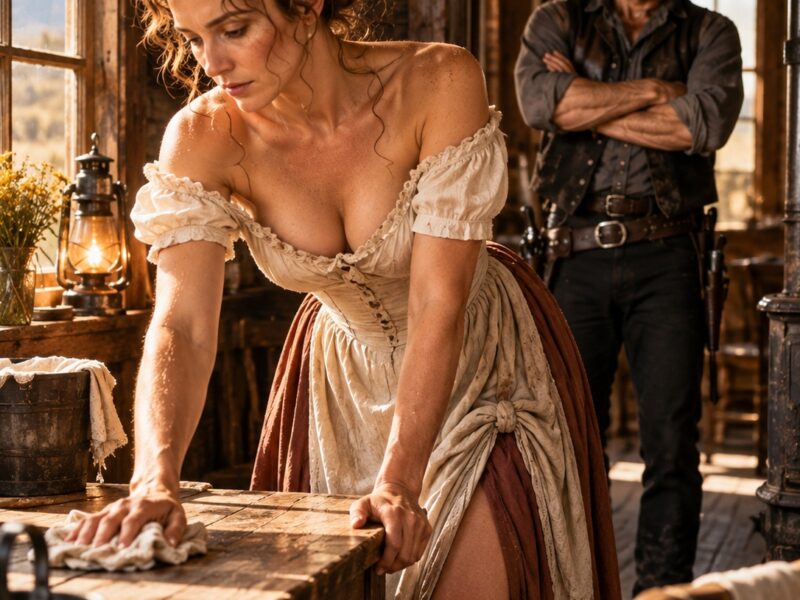
The Town Forced the “Old Maid” Onto a Lonely Rancher to Humiliate Them Both—But Nobody Knew He Had Loved Her for Seventeen Years
The whole town laughed when thirty-six-year-old Clara Whitfield was sent to Ethan Cole’s Wyoming ranch as if an unmarried woman were unwanted property that needed somewhere useful to go.
They expected Ethan to send her back humiliated, never realizing someone had already sabotaged his ranch—and Clara had overheard why his land suddenly mattered so much.
What nobody in Cold Creek knew was that Ethan had loved Clara for seventeen years, and the lie that separated them was still shaping both their lives.
The Woman They Sent Away
Ethan Cole saw the wagon long before it reached his gate, a dark shape rolling through pale Wyoming dust beneath a sun bright enough to flatten the whole valley into gold and brown. He stood beside the barn with a hammer in one hand and a length of broken fence wire at his boots, watching the driver guide two tired horses toward a ranch that had acquired more problems in six months than in the previous six years.
Then he saw the woman sitting beside the driver.
The hammer slipped from his hand.
“Clara.”
For one impossible second, Ethan thought the heat had taken something buried in his memory and placed it on the road. Then Clara Whitfield lifted one hand to keep her brown traveling hat from blowing away, and seventeen years collapsed into the movement because he knew the exact angle of that wrist.
He knew the chestnut hair pinned beneath the hat. He knew the straight way she held her shoulders whenever she was frightened and determined to let nobody see it. He knew the faint line between her brows that appeared when someone had irritated her past the point of politeness.
Seventeen years had changed both of them.
Not enough.
The wagon stopped in front of the ranch house.
Clara climbed down without waiting for the driver’s hand. She wore a plain blue traveling dress dusty at the hem, practical boots, and an expression so composed Ethan immediately understood that whatever had brought her here had not been her idea.
One worn leather case came down after her.
Nothing else.
Ethan walked toward her.
“What are you doing here?”
Clara looked directly at him.
“Apparently saving you from yourself.”
The wagon driver coughed into his fist.
Ethan did not look away from Clara.
“Who sent you?”
“You already know.”
Of course he did.
Walter Briggs.
Mayor of Cold Creek.
President of the town bank.
Largest cattle buyer within fifty miles.
A man who had never offered kindness without first calculating what it would return.
For three months Briggs had announced to anyone willing to listen that Ethan could no longer manage eight hundred acres alone. Ethan’s older brother, Jacob, had died during the winter influenza outbreak. Two ranch hands had left for railroad wages. A February storm took nearly half the north fence. Someone poisoned a water trough in April, costing Ethan three cattle before he caught it.
Then Briggs offered to buy the southern pasture.
Ethan refused.
One week later the town became fascinated with Ethan’s unmarried condition.
Clara removed a folded piece of paper from her leather bag.
“The Ladies’ Improvement Committee has decided you require a housekeeper.”
“I require the Ladies’ Improvement Committee to discover hobbies.”
“That was approximately my response.”
“Then why are you here?”
Clara’s mouth tightened.
“Because they chose me.”
Ethan glanced at the driver.
The man studied the horizon as if Wyoming had suddenly produced scenery worth memorizing.
Clara continued quietly.
“Mrs. Briggs announced it after church yesterday. She said a lonely rancher needed a woman in his house, and an unmarried woman of my age ought to be grateful for useful employment.”
Something hot moved through Ethan.
“They said that in church?”
“Outside it.”
“Everyone was still close enough to hear.”
“They said worse afterward.”
Clara’s voice held no embarrassment.
That made Ethan angrier.
For fourteen years Clara had cared for her mother through arthritis, then a stroke, then the long decline that followed. While other women married, gave birth, buried babies, built households, complained about husbands, and grew older inside families the town understood, Clara ran her father’s old dry-goods shop, altered dresses after closing, and spent nights helping her mother from bed to chair.
When Margaret Whitfield died the previous autumn, people stopped calling Clara devoted.
They started calling her an old maid.
As though loyalty had stolen her worth.
Ethan had wanted to break more than one man’s jaw over it.
He had not.
Clara did not know what she had once meant to him.
At least he had always believed she did not.
“Get back in the wagon.”
Her eyes flashed.
“No.”
“I’m not letting Briggs use you to humiliate me.”
“You think this is about your humiliation?”
“I think he planned it.”
“So do I.”
That stopped him.
Clara stepped closer and lowered her voice.
“Walter Briggs wants your southern pasture.”
“I’m aware.”
“I heard him speaking to two railroad representatives behind his office three nights ago.”
Ethan’s expression changed.
“What railroad representatives?”
“I don’t know their names.”
“They had survey maps.”
A cold feeling settled beneath Ethan’s ribs.
No railroad company had publicly announced a route through Cold Creek.
“One of them said the line cannot cross the valley unless Briggs controls your land.”
Ethan looked toward the southern ridge.
“Why didn’t you tell Sheriff Nolan?”
Clara gave him a look.
“Because Sheriff Nolan owes Briggs six hundred dollars.”
That made too much sense.
“How did you overhear them?”
“They thought I was sewing in the back room of my shop.”
Bitterness touched the words.
“Men rarely notice an unmarried seamstress.”
Ethan noticed everything about her.
He said none of it.
“When Mrs. Briggs volunteered me for this job the next morning, I realized something.”
“What?”
“They wanted me here.”
Ethan’s eyes narrowed.
“Why?”
“I don’t know yet.”
The wagon creaked behind them.
Ethan turned.
The driver was already leaving.
“Hold on.”
The man raised one apologetic hand and kept going.
Clara watched him disappear into the dust.
“Well.”
“That solves one problem.”
Ethan stared.
“You planned that?”
“I paid him an extra dollar.”
Despite himself, Ethan almost smiled.
“You always were stubborn.”
Her expression changed.
Softened.
“You remember?”
The question was too quiet.
Ethan remembered everything.
That was the problem.
He remembered nineteen-year-old Clara beneath the cottonwoods after the summer dance. He remembered her laughing because he could rope a steer but could not skip a stone. He remembered her hand in his when the dance hall grew too hot and they slipped outside.
He remembered almost kissing her.
Almost.
He remembered waking the next morning with courage he had not possessed the night before and walking to Whitfield’s store.
Her father met him outside.
Clara wanted nothing more to do with him.
She regretted the evening.
She thought Ethan had taken liberties.
Two weeks later Ethan left for Montana.
When he eventually returned, Clara was still unmarried.
So was he.
Neither mentioned that summer again.
Ethan picked up her leather case.
“You stay tonight.”
“Tonight?”
“Until I understand Briggs.”
“And tomorrow?”
“Tomorrow we decide.”
“No.”
He stopped.
Clara stood in the road behind him.
“If I stay, I stay because we agree to work together.”
“I am not going to disappear into your kitchen while you decide whether I am useful enough to keep.”
Old fire.
Same Clara.
“What do you want?”
“Pay me what you would pay a ranch hand.”
Ethan raised an eyebrow.
“I thought the committee sent me a housekeeper.”
“The committee can choke on its own pie.”
Ethan laughed.
The sound surprised both of them.
For a moment Clara looked nineteen.
Then reality returned.
“Twenty dollars a month.”
“Twenty-five.”
“Twenty-two.”
“Twenty-five.”
“You haven’t changed.”
“Neither have you.”
Ethan held out his hand.
“Twenty-five.”
Clara placed hers in it.
The moment their skin touched, Ethan stopped breathing normally.
Seventeen years disappeared.
Her hand was warmer than he remembered.
Neither released immediately.
Clara noticed.
So did Ethan.
He pulled away first.
Inside the ranch house, Clara moved through the rooms slowly. The place was cleaner than she expected but painfully spare: one coat beside the door, one plate drying near the sink, one chair angled toward the stove as though the house itself had given up expecting company.
She touched the kitchen table.
“You kept this.”
Ethan stopped.
“What?”
“The table.”
Clara traced an old knife mark near one corner.
“Your mother bought it from my father.”
“You remember that?”
“I remember many things about this house.”
Something in her voice made hope dangerous.
She opened his pantry.
“Beans.”
“Beef.”
“Coffee.”
“This explains your personality.”
Ethan leaned against the doorway.
“You planning to insult me every day?”
“If necessary.”
Then her humor vanished.
“There’s something else.”
She returned to the leather case.
Removed an old envelope.
Ethan’s name was written across the front.
Young handwriting.
Uneven.
His heart began pounding before his mind understood why.
“Where did you get that?”
“My mother had it.”
Clara held the envelope with both hands.
“I wrote it seventeen years ago.”
Ethan stopped breathing.
“The morning after the summer dance.”
He looked from the letter to her face.
“My father told me you never wanted to see me again.”
Clara’s eyes filled with something he could not name.
“My father told me the same thing about you.”
The room went painfully still.
“My mother found this among his papers before she died.”
Clara looked down at the unopened envelope.
“I wrote asking you to meet me beneath the cottonwoods.”
Seventeen years shifted beneath Ethan’s feet.
He reached toward the letter.
A horse screamed outside.
Both turned.
Three riders had stopped beyond the fence.
One carried a kerosene can.
And in the center sat Walter Briggs.
The old letter remained between Clara’s fingers.
Briggs smiled toward the house.
Then called:
“Cole, send Miss Whitfield outside.”
Ethan’s hand curled at his side.
Clara came to stand beside him.
And before Ethan even stepped onto the porch, he understood the town had not sent Clara here because they thought nobody wanted her.
Someone had sent her because Walter Briggs knew exactly how much Ethan had once wanted her.
The Letter That Never Arrived
Walter Briggs sat high in the saddle as if the road belonged to him.
His gray coat remained almost dustless despite the ride. The two men beside him looked less respectable: one carried a rifle across his lap, the other balanced the kerosene can against his thigh.
Ethan stepped onto the porch.
Clara followed.
“Send her down.”
Briggs said again.
“She is not yours to order.”
“That woman came to this ranch because my wife arranged employment.”
Clara moved beside Ethan.
“No.”
Briggs’s eyes shifted.
“I came because I chose to.”
Something changed in his expression.
“You should be careful, Miss Whitfield.”
Clara’s spine straightened.
“I have spent half my life being careful around men who think politeness makes threats invisible.”
Ethan looked at her.
Briggs did too.
For one second, the mayor’s mask thinned.
Then he smiled.
“Southern pasture.”
Ethan said nothing.
“Sign it over by tomorrow evening.”
“And if I don’t?”
The man holding kerosene lifted the can.
Briggs shrugged.
“Dry year.”
“Ranches burn.”
Ethan’s voice dropped.
“You’re threatening my property in front of witnesses.”
Briggs laughed.
“What witnesses?”
He turned his horse.
Before leaving, he glanced at Clara.
“Tomorrow.”
The riders disappeared toward the ridge.
Clara waited.
Then:
“He wanted me outside.”
“Yes.”
“Why?”
“I don’t know.”
Ethan stepped down and checked the fence line.
Clara followed.
“You think he’d hurt me?”
“I think Briggs hurts anything standing between him and money.”
“You’re angry.”
“I’m thinking.”
“You always look angry when you think.”
Ethan stopped.
“You remember that?”
Clara’s expression softened.
“I remember more than I should.”
The old letter was still in her hand.
Ethan looked at it.
“You said your father hid it.”
“Yes.”
“What did it say?”
“I don’t know whether I can read it now.”
“You carried it seventeen years.”
“My mother carried it.”
“You brought it here.”
Clara looked at him.
“Yes.”
“Why?”
Her fingers tightened.
“Because I wanted to know if losing you was actually my choice.”
The words struck deeper than Ethan expected.
“It wasn’t.”
Clara’s breath caught.
“I went to your father’s store the next morning.”
“What?”
“I asked for you.”
Her face went pale.
“What did he say?”
“That you were ashamed of what happened beneath the cottonwoods.”
“That you wanted me gone.”
Clara shook her head.
“No.”
“He told me you planned to go east.”
“To marry someone richer.”
Ethan stared.
“He told me you laughed about me with the ranch boys.”
Clara’s eyes shone.
“He said you thought I was foolish because I believed you cared.”
Ethan turned away.
Both men were dead.
His father buried six years.
Hers twelve.
There was nobody left to confront.
No apology could return seventeen summers.
Clara whispered:
“I waited.”
Ethan turned.
“What?”
“Three nights.”
“Where?”
“You know where.”
Cottonwoods.
“Until midnight.”
Ethan stared at her.
“I was halfway to Montana by then.”
Clara covered her mouth.
Seventeen years stood between them like a graveyard.
“I would have come.”
Ethan said.
Tears gathered in her eyes.
“I know that now.”
A crash sounded from the barn.
Horse kicking.
Ethan ran.
The smell reached him before the doorway.
Lamp oil.
Clara followed.
A thin glossy trail crossed the floor toward dry hay.
“Ethan.”
A burning rag smoldered near the wall.
He stamped it out.
Outside the rear door, fresh hoofprints cut through the dirt.
“Someone came while Briggs was talking.”
Clara said.
“They planned this.”
Ethan started toward the saddle rack.
Clara caught his arm.
“Where are you going?”
“Town.”
“To do what?”
“Have a conversation.”
“With a rifle?”
“An honest conversation.”
“No.”
He stared at her.
“Clara.”
“This is what Briggs wants.”
“He threatens my ranch and I do nothing?”
“You ride into town angry.”
“You threaten him.”
“Nolan arrests you.”
“While you’re sitting in a cell, somebody presents papers claiming the ranch cannot operate.”
“Briggs gets leverage.”
Ethan’s anger slowed.
Not disappeared.
Changed.
“You think this is a trap.”
“I think everything since the committee meeting has been a trap.”
Ethan looked toward the southern hills.
“Then we stop doing what he predicts.”
That night neither slept.
They moved hay.
Checked sheds.
Placed water buckets.
Ethan loaded rifles.
Clara made coffee.
At eleven, they sat opposite one another at the old kitchen table.
The letter lay between them.
“Read it.”
Ethan said.
Clara hesitated.
“You sure?”
“No.”
A faint smile.
She broke the old seal.
The paper had yellowed.
Her hands trembled.
“Ethan.”
she began.
“Meet me beneath the cottonwoods tonight.”
“I don’t care what Father says.”
“I don’t care what people in town think.”
“I only care whether what you said last night was true.”
Her voice stopped.
Ethan stared.
“What did I say?”
Clara looked at him.
“You said if I asked you to stay, you would.”
His throat tightened.
“I remember.”
She continued.
“If you meant it, come before the church bell strikes nine.”
“I will wait.”
“If you do not come, I will understand.”
Clara lowered the paper.
“I didn’t understand.”
Ethan leaned forward.
“I meant every word.”
She looked at him.
“Then why didn’t you marry?”
He gave a humorless laugh.
“You need to ask?”
Her lips parted.
“There was one woman I wanted.”
Clara went still.
“And I spent seventeen years believing she hated me.”
The clock ticked.
Outside, a horse shifted.
Clara looked down because she could no longer hold his eyes.
A sound came from the porch.
Three knocks.
Ethan stood.
Reached for the rifle.
“Who?”
A young man answered:
“Daniel Pike.”
Clara frowned.
“I know him.”
Daniel was twenty, maybe twenty-one, and worked nights at the telegraph office.
He entered breathing hard.
“You need to leave.”
Ethan lowered the rifle slightly.
“Why?”
“Briggs hired men from Red Bluff.”
“How many?”
“Eight.”
“When?”
“Before dawn.”
Ethan’s expression hardened.
“What does he want with me dead?”
Daniel looked at Clara.
“He doesn’t.”
That changed the room.
“What does that mean?”
Daniel removed a folded telegraph copy.
“I saw this yesterday.”
Ethan read.
PROPERTY OWNER UNLIKELY TO SIGN. FEMALE LEVERAGE ARRIVES THURSDAY. APPLY PRESSURE. HOLD HER IF NECESSARY.
Clara went white.
Daniel continued.
“Briggs didn’t send you because he thought Ethan needed help.”
“He sent you because he knew.”
Ethan’s eyes narrowed.
“Knew what?”
Daniel looked between them.
“That you two loved each other once.”
Silence.
Then Daniel produced a second telegram bearing a railroad company seal.
Ethan read the first lines.
His blood chilled.
A confidential geological survey had found a major silver-bearing formation beneath the southern pasture.
Potentially worth a fortune.
Clara read over his shoulder.
“So the railroad is secondary.”
“Yes.”
Ethan said.
“This is about the land beneath it.”
Outside, multiple horses approached.
Daniel’s face drained.
“They’re early.”
Ethan extinguished the lamp.
Darkness swallowed the kitchen.
Riders spread across the field.
A stranger called:
“Ethan Cole.”
“One minute.”
“Send the woman outside.”
Clara touched Ethan’s arm.
He looked at her.
“No.”
she whispered.
“They want me because they think you’ll trade the pasture for me.”
“You are not going outside.”
“I know.”
She lifted the railroad telegram.
“But now we know what they’re afraid of.”
“What?”
“The truth.”
A shot shattered the front window.
Glass struck the floor.
Daniel dropped behind the table.
Ethan pulled Clara down.
Another shot hit the wall.
Then the first burning bottle came through the broken window.
Fire spread across the boards.
Ethan threw a blanket over it while Clara grabbed the water bucket before he even spoke.
Steam filled the room.
“They’re coming around back.”
Daniel said.
Ethan moved.
Clara caught his sleeve.
“Don’t.”
“They’ll burn the barn.”
“They want you angry.”
Smoke crawled across the ceiling.
Ethan forced himself to stop.
“What do we do?”
Clara held up the telegram.
“We survive long enough to put this in the right hands.”
Daniel looked at her.
“The telegraph office?”
“You can reach it.”
“Not by the road.”
Clara turned toward the dark north window.
“Creek trail.”
Ethan looked at her.
“How do you know that trail?”
She met his eyes.
“I used to walk it.”
Of course.
It passed the cottonwoods.
The place she had waited seventeen years earlier.
A second burning bottle struck the porch.
Ethan made the decision.
“Daniel takes the wire.”
Clara understood.
“We keep them looking south.”
“You ride north.”
Daniel swallowed.
“Who do I send it to?”
“Railroad headquarters in Cheyenne.”
Clara said.
“And the territorial marshal.”
“Not Nolan.”
Ethan added.
Outside:
“Thirty seconds!”
Ethan checked the rifle.
“You ready?”
Clara lifted the revolver he had given her.
“No.”
He almost smiled.
“Good.”
“Neither am I.”
For seventeen years other men had controlled the truth between them.
Neither intended to let that happen again.
What Walter Briggs Was Really Buying
Ethan fired first.
High.
Deliberately above the riders.
Clara fired through another window.
The men outside answered with noise and confusion.
While every eye shifted toward the south side of the house, Daniel slipped from the pantry and disappeared into darkness.
Hooves began north.
One rider noticed.
“Someone’s running!”
Ethan saw him move away from the group.
He fired into the dirt directly before the horse.
The animal reared.
The rider lost enough time.
Daniel vanished beyond the hill.
“For now.”
Clara breathed.
The porch burned hotter.
Smoke pushed beneath the door.
“We can’t remain inside.”
Ethan said.
“Root cellar.”
Clara answered.
“There’s another exit.”
He stared.
“What?”
“Your mother showed me when we were children.”
“You know more about my ranch than I do.”
“Apparently.”
They opened the cellar hatch.
Earth.
Potatoes.
Dust.
Old timbers.
A narrow storm passage ran toward the garden.
Ethan had forgotten it.
They crawled.
Above them came the crash of the front door breaking.
“They’re inside.”
Clara stopped.
Ethan touched her ankle.
“Keep moving.”
At the passage exit Ethan pushed away an old board.
Two men remained outside.
One watched the house.
One moved toward the barn.
“Cottonwoods.”
Clara whispered.
“If we reach them, they lose sight.”
Ethan looked at her.
Everything kept dragging them toward those trees.
They crawled out behind the garden wall.
Moved past the chicken shed.
Then ran.
A shout.
Something struck the dirt near Clara’s boot.
Ethan turned.
Fired away from the man, forcing him behind a fence post.
“Run.”
They entered the cottonwoods.
Branches tore at Ethan’s coat.
Clara stumbled.
He caught her elbow.
Then they were beneath the same trees.
The largest one still leaned toward the creek.
Clara pressed her back against its trunk.
Breathing hard.
“I waited there.”
Ethan followed her gaze.
“I know.”
“You know?”
“When I came back from Montana, I came here.”
“When?”
“First week.”
Her eyes lifted.
“I sat until sunrise trying to understand what I’d done wrong.”
Tears filled Clara’s eyes.
“You did nothing wrong.”
Hooves sounded.
Ethan raised the rifle.
“Later.”
Clara nodded.
They moved deeper.
For nearly an hour the riders searched the creek road without finding them.
Then a different sound reached the trees.
Organized movement.
Many horses.
Lantern light.
Territorial marshal badges.
Railroad guards.
Daniel had made it.
Clara touched Ethan’s hand.
“It’s over.”
“Not yet.”
They returned to the ranch together.
Three attackers were already restrained.
Two surrendered near the barn.
Others fled.
Walter Briggs had been caught in a wagon less than a mile away.
His face was red with fury.
“You can’t prove anything.”
Daniel stood beside a railroad representative holding copied telegraph records.
“I copied every message you sent.”
Briggs turned toward him.
“You little fool.”
The marshal pushed Briggs toward the wagon.
“Save that for the judge.”
Briggs saw Clara.
“You ruined everything.”
Clara stepped closer.
“No.”
Her voice remained calm.
“You did that yourself.”
By sunrise, Briggs was gone.
The house remained.
Barely.
One porch section burned.
Two windows broken.
Smoke blackened a kitchen wall.
But the ranch stood.
So did Ethan and Clara.
The railroad official approached.
“Mr. Cole.”
“The company had no knowledge Briggs was using threats.”
Ethan folded his arms.
“We still want the valley route.”
Clara looked at him.
Ethan said:
“Then you negotiate with both of us.”
The official frowned.
“Both?”
Ethan turned slightly toward Clara.
Her eyes widened.
“Come back in a week.”
After everyone left, morning light spread over damaged wood.
Clara looked at the work.
“We’ve got plenty to do.”
Ethan smiled faintly.
“I’ve heard that somewhere.”
She looked at him.
“You still want me here?”
He laughed softly.
“Clara.”
“I wanted you here seventeen years ago.”
Her expression changed.
“I was too young to fight harder for the truth.”
“So was I.”
“No.”
Ethan shook his head.
“We were lied to.”
Clara looked toward the cottonwoods.
“All those years.”
“I know.”
Ethan reached inside his coat.
The old letter had survived smoke, crawling, and the night.
He held it toward her.
“I want to answer it.”
“Seventeen years late?”
“Better than eighteen.”
Her eyes filled.
He took her hand.
“Yes.”
She blinked.
“Yes what?”
“Yes.”
“If you had asked me to stay, I would have.”
Clara’s lips trembled.
“And now?”
“Now I’m not leaving because somebody else told me what you meant.”
She rested her forehead against his chest.
For the first time since her arrival, the steel left her shoulders.
Ethan wrapped his arms around her.
They stood there beside a burned porch and a house that smelled like smoke.
But the story was not over.
Because Walter Briggs had not created seventeen lost years.
He had merely learned how to exploit them.
Someone else had started the lie.
And the evidence was still inside Clara’s letter.
The Fathers Who Decided for Them
That afternoon Clara found something Ethan had missed.
She sat at the kitchen table flattening the smoke-warped letter beneath a heavy Bible when she noticed faint pencil writing on the back.
Not hers.
Numbers.
A date.
Initials.
J.W. / T.C. — 7:30 / north lot
Ethan leaned over.
“Your father’s handwriting?”
“Yes.”
“You’re certain?”
“I spent twenty years reading his inventory ledgers.”
“What does J.W. mean?”
“I don’t know.”
“T.C.?”
Clara’s face changed.
“Thomas Cole.”
Ethan’s father.
Silence.
Both fathers.
Same page.
Clara slowly turned the envelope over.
A small stain marked one corner.
“I thought my father acted alone.”
Ethan sat opposite her.
“So did I.”
They searched the ranch house first.
Thomas Cole’s old papers had been boxed after his death.
Tax receipts.
Cattle records.
Property deeds.
A notebook from the summer Ethan left.
One entry occurred the morning after the dance.
Whitfield. Settled. Boy leaves Friday. Better for both.
Ethan read it twice.
His anger was colder this time.
“Settled.”
Clara sat beside him.
“What did that mean?”
They found the answer in Cold Creek’s county archive.
Not immediately.
Briggs’s arrest had shaken the town.
Some people who mocked Clara days earlier now brought pies to the damaged ranch.
Clara accepted none.
Ethan ate one.
She accused him of weakness.
The county clerk, Ruth Delaney, was fifty-eight and had disliked Briggs for twenty years.
When Clara showed her the initials, Ruth frowned.
“J.W.”
“Joseph Whitfield.”
“T.C.”
“Thomas Cole.”
“Yes.”
“What happened in seventeen years ago?”
Ruth looked toward the courthouse windows.
Then pulled an old mortgage ledger.
Joseph Whitfield had owed Thomas Cole fourteen hundred dollars.
A large debt.
Store failing.
Clara’s mother already ill.
Thomas had planned to expand Ethan’s inheritance by acquiring the Whitfield property if Joseph defaulted.
Instead:
Debt marked satisfied.
Same week Ethan left Montana.
Ethan stared.
“My father forgave fourteen hundred dollars?”
Ruth corrected.
“No.”
“Somebody paid it.”
“Who?”
She turned the page.
W. Briggs & Co.
Clara’s breath stopped.
Walter Briggs.
Even then.
Seventeen years earlier.
“Why?”
Ethan asked.
Ruth looked at them.
“That I cannot tell you.”
But another record could.
Cold Creek’s first rail speculation did not begin this year.
A proposed freight spur had been discussed almost two decades earlier.
Thomas Cole opposed it.
Joseph Whitfield owned a small parcel the company wanted for access.
Briggs acted as local agent.
The project failed.
But Briggs learned something.
The Cole southern pasture sat above mineral traces even then.
Not proven silver.
Enough to create interest.
Ethan’s father wanted control of Whitfield’s parcel.
Whitfield wanted his debt erased.
Briggs wanted both young people separated because a marriage between Ethan and Clara might combine property interests Briggs hoped to acquire separately.
The fathers agreed.
Not because they hated their children.
That made it worse.
They believed they were being practical.
Thomas thought Clara’s family debt would burden Ethan.
Joseph believed Ethan’s rough ranch future would trap Clara.
Briggs offered the solution.
Pay Joseph’s debt.
Convince Clara Ethan had mocked her.
Convince Ethan Clara regretted him.
Send Ethan to Montana.
Keep both estates separate.
Years later Briggs bought the Whitfield parcel cheaply after Joseph died.
Now he needed Ethan’s southern pasture to complete the mineral tract.
Clara sat in Ruth’s office holding the ledger.
“They decided.”
Ethan looked at her.
“Yes.”
“Everybody decided.”
“Our fathers.”
“Briggs.”
“The town.”
“Seventeen years.”
Her voice broke.
“They kept deciding what was best.”
Ethan wanted to say something comforting.
Instead:
“We let them.”
Clara looked at him sharply.
Then slowly nodded.
That truth hurt differently.
They had been nineteen.
Manipulated.
But afterward?
Ethan returned.
Never asked Clara directly.
Clara stayed.
Never asked him.
Pride filled the space where truth should have gone.
“I saw you in town.”
Clara whispered.
“When?”
“After you came back.”
“You were outside the feed store.”
“I thought you looked through me.”
“I thought you wanted me to.”
“I was waiting for you to speak.”
“I was waiting for you.”
She laughed through tears.
“We were idiots.”
“Remarkably.”
The first true intimacy between them happened there.
Not a kiss.
Not a declaration.
Ethan reached across the archive table.
Clara took his hand.
No one forced it.
No committee.
No parent.
No bargain.
They sat together while afternoon light moved across records documenting seventeen years stolen partly by others and partly by silence.
Ruth eventually cleared her throat.
“I need to close.”
Neither moved immediately.
Outside, the town watched them leave together.
This time Clara did not care.
The Price of Being Useful
Walter Briggs faced conspiracy, attempted arson, extortion, and land-fraud charges.
His men began cooperating before the first hearing.
Sheriff Nolan resigned once state investigators examined his debts.
The railroad company publicly denied involvement in Briggs’s intimidation and opened negotiations over access through the valley.
Cold Creek changed its opinion of Clara at remarkable speed.
That annoyed her.
Mrs. Briggs appeared at the ranch five days after Walter’s arrest carrying a pie.
Clara met her on the porch.
“I came to apologize.”
“Why?”
Mrs. Briggs blinked.
“For what happened.”
“What happened?”
“For sending you here.”
Clara folded her arms.
“That is not the part requiring apology.”
The woman flushed.
“I only thought—”
“Yes.”
Clara interrupted.
“You did.”
“You thought a thirty-six-year-old unmarried woman should be grateful to be assigned to a man’s house.”
“You announced it publicly.”
“You let people laugh.”
Mrs. Briggs’s eyes lowered.
“I was cruel.”
“Yes.”
No easy rescue.
Mrs. Briggs took a breath.
“I am sorry.”
Clara studied her.
Then accepted the pie.
Not forgiveness.
Acknowledgment.
Progress sometimes looked disappointingly ordinary.
Ethan hired two ranch hands once his finances stabilized.
Clara remained.
Not as housekeeper.
She handled ranch accounts because she discovered Ethan’s bookkeeping system consisted of envelopes labeled things like probably paid.
“This is criminal.”
she told him.
“Technically?”
“Morally.”
He leaned against the desk.
“You staying?”
Clara glanced over.
“For work?”
“For supper.”
Her cheeks warmed.
“Yes.”
That was their second intimate scene.
Supper became evenings on the porch.
They discussed years they had missed.
Clara had received two marriage proposals.
Turned both down.
Not entirely because of Ethan.
“One chewed loudly.”
she explained.
“A legitimate concern.”
“The other believed women should not read newspapers.”
“Hang him.”
“He died of pneumonia.”
“Efficient.”
Ethan admitted he had nearly married a widow in Montana.
“What happened?”
“She realized I was still arguing with someone who wasn’t there.”
“Me?”
“You.”
Clara looked away.
That night he walked her to the guest room.
Stopped.
“Clara.”
She turned.
Ethan’s voice lost its humor.
“I do not want to spend the rest of this doing things because seventeen years makes us feel owed.”
Her eyes softened.
“Good.”
“I don’t know you the way I did.”
“No.”
“You don’t know me.”
“No.”
“I’d like to.”
Clara smiled.
“That was almost graceful.”
“I’ll recover.”
No kiss.
Yet.
Two weeks later, the railroad returned.
They offered Ethan a substantial sum for a permanent easement across the southern edge.
Enough money to transform the ranch.
Ethan refused the first figure.
The representative asked:
“What would satisfy you?”
Ethan looked at Clara.
She had spent three nights reading comparable land agreements Ruth located through territorial records.
Clara answered.
“Not a sale.”
“Easement only.”
“Limited width.”
“Water access protected.”
“Livestock crossings at company expense.”
“Annual payment adjustment.”
“And mineral rights remain entirely with the landowners.”
The official stared.
“Mrs. Cole?”
Clara’s face hardened.
“Miss Whitfield.”
Ethan hid a smile.
Afterward:
“You enjoyed that.”
“I enjoyed him assuming I was decoration.”
“You are frightening.”
“I’m useful.”
The word shifted the mood.
Clara looked away.
The town had used useful as a consolation prize for being unmarried.
Useful woman.
Useful spinster.
Useful pair of hands.
Ethan understood.
“You are more than useful.”
Clara said nothing.
He continued.
“You were more than useful before Briggs put you in a wagon.”
“You were more than useful when you cared for your mother.”
“You were more than useful when nobody here bothered to see it.”
Her eyes filled.
“Ethan.”
“I should have said it years ago.”
“You couldn’t.”
“I could have said something.”
She looked at him for a long moment.
Then kissed him.
Not dramatically.
One step forward.
Her hand touched his cheek.
Ethan went completely still.
Seventeen years of imagining the moment made the real thing surprisingly gentle.
When she moved back, he looked stunned.
Clara smiled.
“You appear unwell.”
“I may need another attempt.”
She laughed.
He kissed her then.
Slowly.
Chosen.
That was their third intimate scene.
And because life rarely permits happiness without paperwork, the next morning a man from Cheyenne arrived with documents proving Ethan might not legally own the southern pasture at all.
The Deed Nobody Expected
The man was Samuel Price, attorney for a land consortium that had quietly purchased Walter Briggs’s outstanding business interests after his arrest.
He wore a black suit too fine for Cold Creek dust and carried a leather folio.
“The original Cole deed contains a conditional transfer.”
Ethan frowned.
“My father owned that land forty years.”
“Possession is not necessarily title.”
Clara sat beside Ethan at the table.
“Show us.”
Price unfolded a certified copy.
The southern pasture had originally belonged to an elderly widow named Abigail Mercer.
Thomas Cole purchased it thirty-one years earlier.
But the deed contained a reversion clause.
If the property were sold for mineral extraction rather than agricultural use before 1905, ownership could revert to Mercer’s descendants.
Briggs knew.
That was why he wanted Ethan to sell the land to him first.
Once Briggs owned it as “pasture,” he could later structure mineral development through leases and attempt to defeat the clause.
“What does your consortium want?”
Clara asked.
Price smiled politely.
“To settle.”
Meaning:
Money.
Control.
They offered Ethan a buyout.
Large.
Enough to rebuild every fence.
Hire ten men.
Live comfortably.
Ethan looked at Clara.
“Your opinion?”
Price blinked.
Ethan repeated:
“Her opinion matters.”
Clara read.
The consortium’s argument was not airtight.
The clause had uncertain enforceability.
Mercer descendants might exist.
A court fight could take years.
Railroad plans would freeze.
Silver development would freeze.
Cold Creek would turn on Ethan.
Again.
Price knew it.
“You have forty-eight hours.”
he said.
After he left, Ethan threw his hat onto the table.
“Everybody wants this dirt.”
Clara reread the deed.
“Maybe the dirt gets an opinion.”
He stared.
“Meaning?”
“Find the Mercer descendants.”
“What?”
“If they exist, talk to them.”
“Why would they help?”
“Maybe they don’t.”
“But we stop negotiating with ghosts.”
That became Clara’s goal.
Not Ethan rescuing her.
Not romance solving the problem.
Her.
She traveled to Cheyenne with Ruth.
County records.
Church registers.
Marriage notices.
Obituaries.
Two days became four.
Ethan stayed at the ranch.
He hated it.
Not because he thought Clara incapable.
Because waiting exposed the old fear.
She could leave.
Choose another life.
Discover seventeen years had produced nostalgia, not compatibility.
He did not send men after her.
Did not ride to Cheyenne.
He waited.
Clara returned on the fifth evening.
Dusty.
Exhausted.
Triumphant.
“I found her.”
“Who?”
“Abigail Mercer’s granddaughter.”
“Alive?”
“Very.”
“Where?”
“Laramie.”
“Age seventy-two.”
“Name Beatrice Shaw.”
“And?”
Clara dropped into a chair.
“She thinks everybody involved is an idiot.”
Ethan smiled.
“I like her.”
“She is coming tomorrow.”
Beatrice arrived by train.
Small woman.
White hair.
Cane.
Sharp eyes.
She studied Ethan.
Then Clara.
“You married?”
“No.”
Clara said.
Beatrice looked at Ethan.
“Why?”
“Long story.”
“I’m old.”
“Try me.”
Clara laughed.
Beatrice eventually agreed the reversion clause had never been intended to prevent responsible mining. Her grandmother feared speculators destroying agricultural land and abandoning it.
She would release the claim under conditions.
Independent environmental survey.
Water protections.
Royalty trust for affected families.
No forced sale.
Clara negotiated the terms.
Ethan watched.
There was no greater proof of love than letting someone competent stand in their own competence without interrupting.
By sunset, the title problem had a path.
Then Beatrice said something nobody expected.
“Walter Briggs visited me last year.”
The room changed.
“He offered money for a release.”
“I refused.”
“Why?”
“He lied about who owned the property.”
“He told me Ethan Cole planned to strip-mine everything.”
Ethan’s jaw tightened.
“What else?”
“He had another man with him.”
“Who?”
Beatrice frowned.
“Older.”
“Gray beard.”
“Called himself Thomas Whitfield.”
Clara went still.
“My father’s name was Joseph.”
Beatrice nodded.
“Then not him.”
Clara’s mind moved.
“Thomas Whitfield was my uncle.”
Her father’s older brother.
Presumed dead after leaving Wyoming twenty-five years earlier.
Except perhaps not.
The family lie had another layer.
Seventeen Years Was Not the Whole Secret
Thomas Whitfield returned to Cold Creek three days later.
Not because they found him.
Because news of the Mercer claim reached him.
He walked into Clara’s former shop at dusk.
Sixty-two.
Lean.
Gray.
One hand damaged from an old railroad accident.
Clara stared.
“You’re alive.”
Thomas removed his hat.
“Apparently.”
“My father said you died in Nevada.”
“I let him.”
“Why?”
“Because I was a coward.”
Not the answer she expected.
Thomas had worked early railroad surveys.
He discovered mineral traces under the Cole valley decades earlier.
He told Briggs.
Briggs began acquiring nearby land.
Joseph Whitfield invested money he did not have.
Lost.
That created the debt to Thomas Cole.
“So Briggs paid Father’s debt because Father helped separate Ethan and me?”
Thomas’s face tightened.
“Partly.”
“Partly?”
“He also needed you unmarried.”
Ethan stepped closer.
“Why?”
Thomas looked at Clara.
“Because Joseph’s property would pass entirely to Clara if she remained unmarried until thirty.”
Clara stared.
“What property?”
“Mineral shares.”
Her father had owned a small percentage in an early exploration company.
Worthless then.
Potentially valuable if a deposit was confirmed.
Joseph feared a husband could control Clara’s assets under poorly drafted agreements.
So he created a trust.
Clara never knew.
When she turned thirty unmarried, the shares became hers.
But Walter Briggs, serving as trustee after Joseph’s death, never disclosed them.
He had been diverting distributions and voting rights for six years.
Clara sat down.
The room felt unreal.
“They called me an old maid.”
Thomas looked ashamed.
“And being unmarried is exactly why I own something Briggs stole.”
“Yes.”
Ethan’s anger sharpened.
“Can we prove it?”
Thomas pulled records from his coat.
Original trust papers.
Letters.
Corporate ledger copies.
He had kept them because Briggs eventually cheated him too.
“Why wait until now?”
Clara asked.
Thomas looked at her.
“Because exposing Briggs exposes me.”
“I helped him.”
“I told myself business was business.”
“I watched Joseph manipulate you.”
“I knew the lie about Ethan.”
Clara’s face changed.
“You knew?”
“Yes.”
“And said nothing.”
“Yes.”
Seventeen years.
Another adult.
Another silence.
Clara stood.
Thomas expected anger.
Maybe screaming.
She did neither.
“You leave.”
“Clara.”
“You have given me evidence.”
“I’m grateful for that.”
“You are still not entitled to my forgiveness because guilt finally became uncomfortable.”
Thomas bowed his head.
“Fair.”
He left.
Ethan did not tell Clara she should forgive him.
That mattered.
Instead he asked:
“What do you want to do?”
She looked at the papers.
“Take Briggs apart legally.”
Ethan almost smiled.
“That sounded personal.”
“It is.”
Clara hired counsel in Cheyenne using money borrowed against the trust shares once the court froze Briggs’s control.
Civil fraud.
Breach of fiduciary duty.
Conversion.
Accounting claims.
The railroad company cooperated because it wanted clean title.
Briggs’s political reputation collapsed completely.
His wife filed for separate financial protection once investigators found her household assets had been pledged without consent.
Sheriff Nolan testified.
Daniel provided telegram copies.
Thomas provided historical documents.
Clara did not become rich overnight.
Courts move slowly.
But for the first time, her future no longer depended on being useful to somebody else.
That changed her relationship with Ethan too.
One evening he found her packing.
His heart stopped.
“Where are you going?”
Clara looked up.
“Cheyenne.”
“Why?”
“Lawyer meeting.”
“You’re taking everything.”
“I own three dresses.”
“They apparently require a military campaign.”
She smiled.
Then understood his face.
“Ethan.”
He looked away.
Old fear.
Leaving.
Again.
Clara crossed the room.
“I am coming back.”
“You don’t have to.”
“I know.”
“If you discover you want something different—”
“I know.”
He finally looked at her.
“I don’t want you staying because we lost seventeen years.”
“I am not.”
“Because the town pushed us together.”
“No.”
“Because the ranch needs you.”
“Ethan.”
“What?”
She took his face in both hands.
“I am staying because I am thirty-six years old and finally nobody is deciding for me.”
“And I choose you.”
The sentence undid him.
Not I always loved you.
Not destiny.
Choice.
Now.
That was better.
The Night the Town Had to Choose
Briggs’s criminal trial began in Cheyenne in November.
Cold Creek divided.
Some people insisted Walter had “done good for the town.”
Bank loans.
Cattle purchases.
Road repairs.
Church roof donations.
Power rarely survives by doing only harm.
Briggs’s defense attorney built exactly that argument.
Walter feared outside corporations would take Cold Creek.
He wanted local control.
He believed Ethan was financially unstable.
He arranged pressure but supposedly never ordered arson.
He described his actions as aggressive negotiation.
Plausible enough that Clara understood why juries exist.
Then Briggs’s attorney attacked her.
“Miss Whitfield, you resented my client’s wife for arranging employment at Mr. Cole’s ranch.”
“I resented being publicly humiliated.”
“You benefited from it.”
“I found evidence of fraud.”
“You rekindled a romantic relationship.”
“Yes.”
“Mr. Cole stands to gain significantly from the mineral deposit.”
“Yes.”
“And so do you.”
Clara looked at the jury.
“Yes.”
No shame.
The lawyer wanted defensiveness.
She gave fact.
“Isn’t it true your testimony is motivated by money and personal resentment?”
Clara considered.
“I resent Mr. Briggs.”
The courtroom shifted.
The attorney smiled.
“Thank you.”
“I’m not finished.”
Judge allowed it.
Clara continued.
“I resent a man who used my marital status as a public insult while secretly withholding property entrusted to him precisely because of that status.”
“I resent being treated like a piece to move between men.”
“But resentment does not create telegrams.”
“It does not alter trust ledgers.”
“It does not hire riders.”
“It does not place kerosene behind Ethan Cole’s barn.”
“The evidence exists whether I am angry or not.”
The defense attorney stopped smiling.
That testimony became the emotional climax Clara earned herself.
Not Ethan defending her.
Clara speaking.
The jury convicted Briggs on fraud, conspiracy, attempted arson, and coercion-related charges. Sentencing came later.
His banking interests entered receivership.
Victims filed claims.
The town did not cheer.
Reality rarely gives perfectly unified crowds.
Some people still defended him.
Others pretended they never had.
Cold Creek’s Ladies’ Improvement Committee sent Clara a formal apology.
She returned it with edits.
Ethan laughed for five minutes.
“What did you change?”
“‘Misunderstanding’ to ‘humiliation.’”
“‘Unfortunate’ to ‘deliberate.’”
“And removed three uses of ‘if.’”
“You are terrifying.”
“Accuracy is kindness.”
Winter arrived.
The ranch survived.
The mineral project proceeded slowly under a lease, not sale.
Water protections stayed.
Beatrice’s trust received royalties.
Clara recovered her shares.
She used the first distribution to reopen the Whitfield shop under a new name:
Whitfield & Cole Mercantile and Accounts
Ethan objected.
“You put my name second in conversation but first on nothing.”
“Correct.”
He loved it.
They did not marry immediately.
That surprised the town.
Good.
Clara moved between the ranch and her own rooms above the mercantile for four months.
They courted like people who understood missing years did not entitle them to rush new ones.
Dinners.
Sunday rides.
Arguments.
Ethan hated paperwork.
Clara hated his habit of saying fine when absolutely not fine.
He learned to say when he was afraid.
She learned not to interpret every offer of help as an attempt at control.
One March afternoon, they returned to the cottonwoods.
No fire.
No riders.
No hidden telegram.
Wind moved through new leaves.
Ethan carried the old letter.
“I have something.”
Clara smiled.
“That phrase has caused trouble before.”
He handed her a new envelope.
Her name.
Inside:
A letter.
Not a proposal.
An answer.
Clara,
You asked me seventeen years ago whether I meant it when I said I would stay if you asked. I did.
But I do not want to answer only for the boy I was.
The man I am now knows you are stubborn, impatient with foolishness, better at accounts than any banker in this territory, incapable of making coffee without turning it into tar, and likely to reorganize my entire life if I leave papers unattended.
He loves you too.
Clara stopped reading.
Looked at him.
“You hate my coffee?”
“Deeply.”
She laughed through tears.
Then finished.
If you want a life with me, I want it because we choose each other now—not because we should have chosen each other then.
No ring.
No kneeling.
No pressure.
Clara folded the letter.
“Good.”
Ethan blinked.
“Good?”
“You finally learned how to ask.”
She kissed him.
Then:
“Yes.”
He smiled.
“Yes what?”
“Yes, I want the life.”
“Marriage?”
“Eventually.”
Ethan stared.
She laughed.
“Six months.”
“Negotiable?”
“No.”
“You truly are a terrible woman.”
“The town warned you.”
Six months later they married beneath the cottonwoods.
Not inside the Cold Creek church.
Clara said the trees had waited long enough.
Daniel Pike stood beside Ethan.
Ruth Delaney beside Clara.
Beatrice Shaw attended wearing a purple hat and insulting the cake.
Mrs. Briggs came quietly and sat in the back.
Clara had not invited Walter’s name into the day.
No fathers stood between them.
No hidden letters.
No committee.
When the officiant asked whether Clara came freely, she answered loudly enough for everyone to hear.
“Yes.”
Ethan smiled.
When asked the same, he said:
“Seventeen years late, but yes.”
People laughed.
Clara rolled her eyes.
Then kissed him before the officiant finished.
Seventeen Years Wrong
Marriage did not turn the ranch into a fairy tale.
The first winter pipe froze.
Three cattle escaped.
Ethan lost money on a feed contract because he ignored Clara’s warning.
She reminded him with unnecessary frequency.
They argued about expanding the mercantile.
They argued about where to store mining royalty records.
They argued about whether Ethan’s boots belonged under the kitchen table.
“They do not.”
“They’re boots.”
“That is not an argument.”
“It contains a noun and verb.”
“It contains stupidity.”
He moved them.
Eventually.
Clara never stopped working because she married.
That mattered.
She managed the mercantile and ranch accounts.
Later hired a young widow, Abigail Reed, who was excellent with numbers and terrified of speaking in meetings.
Clara put her at the table anyway.
When somebody referred to Abigail as “just the widow from Sheridan,” Clara’s look ended the sentence.
Years later, people began calling Clara formidable.
She preferred it to old maid.
Ethan secretly preferred both because the town eventually learned neither could shame her.
The southern pasture remained green above silver-bearing rock.
Mining occurred only in limited areas under carefully negotiated terms.
The ranch stayed a ranch.
That had been Beatrice’s condition.
And Clara’s.
Daniel eventually became telegraph supervisor.
Ruth retired.
Thomas Whitfield wrote Clara twice.
She answered the second letter.
Not with forgiveness.
With acknowledgment.
I received your explanation. I hope you spend whatever years remain becoming the kind of man who would have told the truth sooner.
That was enough.
Walter Briggs served his sentence and never returned to public office.
His name stayed on an old bank building until a storm damaged the sign.
Nobody replaced it.
Seventeen years after Clara first arrived on Ethan’s ranch in that wagon—not seventeen years after the dance, but seventeen after their second beginning—they sat on the rebuilt porch during late summer.
Clara was fifty-three.
Silver touched Ethan’s temples.
Two foster boys they eventually took in as teenagers were grown and working ranches of their own. They had not needed biological children to make the house full.
The kitchen table remained.
Still scarred.
Still too heavy.
Clara refused to replace it.
Sunset spread across Wyoming.
Cattle moved in the valley.
Farther south, the rail line glinted.
Clara leaned against Ethan.
“You remember what Mrs. Briggs called me?”
Ethan groaned.
“Must we?”
“The old maid nobody wanted.”
“I remember wanting to ride into town and commit a crime.”
“You frequently romanticize poor judgment.”
“I was in love.”
“You were violent in your imagination.”
“Only my imagination.”
“Mostly.”
He smiled.
Clara looked toward the road where the wagon had appeared decades earlier.
“They laughed.”
“Yes.”
“I thought coming here would be the most humiliating thing that ever happened to me.”
Ethan took her hand.
“Was it?”
“No.”
“What was?”
Clara considered.
“Realizing how many years I spent believing other people’s version of my own life.”
Ethan nodded.
“That one hurt.”
She looked at him.
“And you?”
“What?”
“What was yours?”
“Watching the wagon arrive.”
“That was humiliating?”
“No.”
“Terrifying.”
“Why?”
“Because I knew immediately I still loved you.”
Clara smiled.
“You didn’t know me anymore.”
“I know.”
“That was foolish.”
“Yes.”
“Romantic?”
“Unfortunately.”
She laughed.
Ethan lifted her hand.
The same hand he had shaken for twenty-five dollars a month.
The same hand that held the hidden letter.
The same hand that carried evidence into court.
The same hand that signed her own property agreements.
He kissed her knuckles.
“Everyone said nobody wanted you.”
Clara looked toward the fading sun.
“They were wrong.”
Ethan smiled.
“How wrong?”
She asked.
He looked at the woman the town once sent to him as a joke.
The woman who had saved his ranch not by becoming his servant but by refusing to behave like anyone’s property.
The woman he lost because other people spoke for them.
The woman he kept because, the second time, neither let anyone else choose.
“Seventeen years wrong.”
Clara rested her head against his shoulder.
For once, neither looked back.









