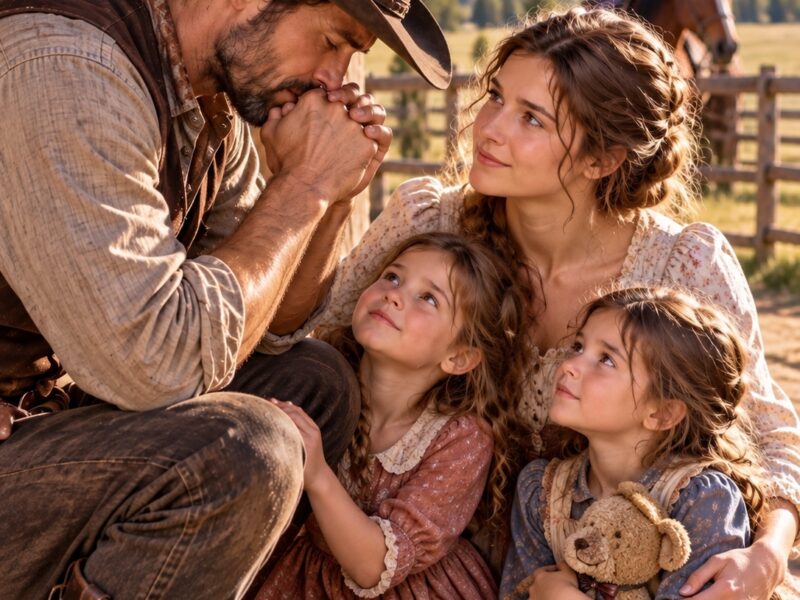
The Widowed Cowboy Prayed for a Wife—Then a Desperate Mother Revealed Why Her Two Daughters Might Be Taken Away Before Winter
Garrick Pruitt had prayed that morning for a wife, but by sunset he was kneeling on his porch asking two frightened little girls if they wanted to stay.
Their mother had come only for advice because the job that could save her from debt required leaving one daughter in one house and the other somewhere else.
Then Winona told Garrick the secret she had hidden from the girls—and he realized offering them shelter would be easy compared with proving she was free to choose him.
“Would you two girls care to stay here with your mother?”
The question escaped Garrick Pruitt before wisdom had time to catch it.
Six-year-old Clara brightened instantly on the porch step, clutching the patched cloth dog she called Barnaby against her chest. Mary, two years older and already practiced at recognizing danger before her little sister did, looked first at Garrick and then at her mother.
Winona Hill went completely still.
Beyond the porch rail, Garrick’s brown gelding stood blowing steam into the October air beneath a sky the color of old tin. Snow had already settled along the high Collegiate Peaks west of Buena Vista, Colorado, and the lower ranch grass had gone pale enough to remind every sensible person that winter was not coming someday.
It was coming now.
Winona’s fingers closed around Mary’s shoulder.
“Mr. Pruitt.”
The quietness in her voice warned him faster than anger would have.
“The girls have not heard what I told you.”
Garrick’s stomach dropped.
“You ought not have asked them that.”
She was right.
Worse, he had known better.
An hour earlier Winona had arrived in a rented light wagon asking for advice because the hotel in Buena Vista had offered her steady kitchen work through winter.
Sixteen dollars a month.
More than she could earn selling bread, eggs, sewing, and occasional washing.
Enough to begin clearing the forty-one dollars still hanging over her dead husband’s account at Mortimer Scott’s store.
There was one problem.
The hotel would house Winona.
Only Winona.
Mary could sleep temporarily with an older cousin outside town. Clara had been offered a cot with a church widow nearly three miles in the opposite direction.
The girls had never spent a night apart.
Winona had not told them.
She had been trying to decide whether poverty was finally going to force her to.
And Garrick Pruitt—thirty-nine years old, widowed four winters, owner of a ranch with an empty cookhouse and too many silent rooms—had listened to all of that and then asked the children the question their mother had not yet allowed herself to answer.
He lowered his clasped hands.
“Girls.”
Mary’s wary eyes found his.
Clara hugged Barnaby tighter.
“I got ahead of myself.”
Garrick leaned down far enough to meet them properly instead of speaking over their heads.
“Your mother decides where you live. I can offer something. That doesn’t mean I choose for her.”
Mary nodded slowly.
Clara frowned.
“Can Mama say yes?”
“Yes.”
“And no?”
Garrick looked at Winona.
“Yes.”
“Either one.”
Winona’s shoulders eased by less than an inch.
Garrick stood.
“You were right.”
“I’m sorry.”
Her expression softened, but only slightly.
“They remember promises.”
“I know.”
“Especially when they like the person making them.”
That landed harder than rebuke.
Clara had spent most of spring introducing him to Barnaby whenever Winona delivered eggs to ranch crews. Mary had once corrected Garrick’s bread count at the wagon and informed him with solemn dignity that five loaves remained five even if a rancher was in a hurry.
He liked both girls.
That did not make them his.
And whatever he had prayed for that morning did not make their mother an answer delivered by Providence.
Winona looked toward his horse.
“You’d best tend that gelding before he decides the fence tastes better than the grass.”
It was dismissal offered kindly.
Garrick accepted it.
He loosened the cinch, led the gelding to the trough, and let the animal drink without rushing him.
When Ned Avery emerged from the barn carrying feed, the young ranch hand nodded toward the tired horse.
“You taking him back to the north fence?”
“No.”
“We still need the wire checked.”
“Use the bay.”
Ned shrugged.
“This one can make another ride.”
“He already made the first.”
Garrick stripped off the saddle.
“He earned his oats.”
Ned went for the bay.
Garrick stood a moment with one hand on the gelding’s warm shoulder and thought bitterly that apparently he understood giving a horse the right to stop more easily than he understood giving a woman the right to decide her own future.
When he returned to the porch, Winona waited alone.
The girls sat in the wagon whispering over Barnaby.
“I’ve been asking the wrong question,” Garrick said.
Winona lifted her eyes.
“You came for counsel, and I started handing out solutions.”
“I’m sorry.”
She rubbed her thumb along the seam of one glove.
“What question should you have asked?”
“What do you need?”
Winona looked toward the separate cookhouse fifty yards from the main cabin.
“That depends on what you’re offering.”
“Work.”
“Actual work?”
“Yes.”
“Not charity.”
“No.”
Her gaze sharpened.
“Show me tomorrow.”
So he did.
Winona returned the next morning with both daughters and two pine travel boxes strapped behind the wagon seat.
“Those boxes do not mean we’re moving in,” she told him before her boots touched the ground.
“I understood.”
“You looked at them.”
“I have eyes.”
“That has caused trouble already.”
Garrick almost smiled.
“Fair.”
He showed her the cookhouse first.
A good iron stove.
Flour chest.
Long worktable.
Pantry.
Two small sleeping rooms reached through their own back door rather than through Garrick’s cabin.
Winona tested every latch.
Opened both windows.
Ran her fingers along the lower sill checking for damp.
“Where do horses cross?”
“Main yard.”
“Children?”
“Garden side.”
He walked her around the building.
A low fence enclosed the kitchen garden. Beyond it, a footpath led behind the corral rather than through it.
Mary inspected the beds.
Clara placed Barnaby on one mattress.
“He’ll need a blanket.”
Garrick considered the cloth dog.
“He looks hardy.”
“He gets cold.”
“Then we’ll find one.”
Winona turned sharply.
Garrick corrected himself.
“If your mother approves.”
Clara looked at Winona.
“Mama?”
Winona sighed.
“One scrap blanket.”
Garrick nodded.
“Barnaby negotiates well.”
The child smiled.
Winona did not.
Not yet.
She returned to the cookhouse.
“Tell me straight.”
Garrick waited.
“Do you need a cook, or did three people on your porch look too pitiful to send away?”
“I need a cook.”
“How badly?”
“Ned and Hoke can heat beans without injuring anybody.”
“That is not an answer.”
“I have winter feed going up.”
“Two men working days.”
“They come in hungry.”
“I’m losing hours doing meals badly.”
“What pay?”
“Twelve dollars a month.”
Winona’s expression barely moved.
“The hotel offered sixteen.”
“I reckon it did.”
“Board?”
“Meals.”
“These rooms.”
“Firewood.”
“You provide flour and meat for ranch meals.”
“Yes.”
“My own baking stores stay mine.”
“Yes.”
“If I sell eggs or pies beyond what the crew eats?”
“Yours.”
“If I leave?”
“I pay every cent earned.”
“No complaint?”
“I may complain privately.”
Her mouth almost twitched.
“But you may leave.”
“Yes.”
Winona walked into the smaller sleeping room.
The pine boxes remained outside.
That mattered.
She looked through the window toward Mary and Clara.
“They’ve never slept apart.”
Garrick stayed quiet.
“I found places.”
“One each.”
“She paused.”
“Mary with my husband’s cousin.”
“Clara with Mrs. Brewster from church.”
“Good women.”
“I know.”
“That is why I asked them.”
Her voice lowered.
“I keep telling the girls we’ll manage.”
“Because that’s what mothers tell children.”
“Maybe.”
“But I don’t know how to tell Mary that managing could mean going to sleep somewhere Clara cannot call for her.”
Garrick’s instinct was to say they could stay here.
He swallowed it.
Winona noticed.
“That looked painful.”
“It was.”
“What did you nearly say?”
“That I wouldn’t split them.”
She looked at him.
“That is not yours to promise.”
“I know.”
“Good.”
She turned toward the yard.
“I owe Scott forty-one dollars.”
Garrick knew the account but had never mentioned it.
“Failed wheat year?”
“And medicine before Samuel died.”
“He carried debt longer than I knew.”
“Scott has been patient.”
“Patient means he will take payment but extend nothing else.”
“The hotel wage would clear it faster.”
“And cost you the winter with the girls.”
“Yes.”
Garrick leaned against the doorway.
“Mrs. Celia Gibson might have washing work in town.”
Winona looked at him.
“You know her?”
“Everyone knows Celia.”
“I wrote asking about a room.”
She removed a sealed note from her reticule.
“I haven’t sent it.”
“Supply wagon leaves tomorrow.”
“I can send it.”
She held the letter longer than necessary.
“You won’t read it.”
“No.”
“Not even to know whether she mentions me?”
“No.”
She gave him the letter.
“Please.”
He put it inside his coat.
“Tomorrow.”
Winona nodded.
Then looked toward the boxes.
“One box inside.”
Garrick said nothing.
“Two weeks.”
she continued.
“I’ll work two weeks.”
“Three dollars each Saturday.”
“My girls stay in those rooms.”
“Yes.”
“No one enters without knocking.”
“Yes.”
“No one searches our things.”
“Yes.”
“My hens can come.”
“How many?”
“Six.”
“That sounds like an invasion.”
“They are quieter than Clara.”
“I heard that.”
Clara called from outside.
Winona closed her eyes.
Garrick laughed.
A minute later she called both girls to the doorway.
“We’re going to try the ranch for two weeks.”
Mary stared.
“Together?”
“Together.”
Clara’s face lit.
“Does that mean you said yes?”
Winona looked directly at Garrick before answering.
“Yes.”
“For two weeks.”
Clara buried her smile inside Barnaby’s stitched head.
Garrick looked away.
He wanted to feel joy.
Instead he reminded himself exactly what Winona had said.
Two weeks.
Work.
Not rescue.
Not family.
Not a prayer answered.
Not yet.
The first morning Winona cooked, Garrick discovered he had been running his kitchen badly for years and calling it efficiency.
He came in expecting yesterday’s bread and coffee swallowed standing at the stove.
Instead the table held hot biscuits.
Eggs.
Coffee.
Stewed apples.
No one sat yet.
“The men will be late if we wait,” Garrick said.
“They are watering the last team.”
“Breakfast has always been early.”
“Cold breakfast has always been early.”
He looked at her.
Winona checked the oven.
“They’ll come hungry either way.”
“Ned arrived three minutes later.”
Hoke followed.
Nobody reached the pasture late.
Garrick sat because everyone else did.
It felt strange.
He had eaten standing for four years because sitting alone at a table made absence too visible.
Mary placed spoons.
Clara stayed carefully beyond the stove line her mother had drawn.
“These biscuits are better than the depot ones,” Clara announced.
Hoke answered through a mouthful.
“Girl speaks truth.”
Winona laughed.
Garrick caught himself enjoying the sound before remembering enjoyment did not require permission.
Over the following days, the cookhouse began acquiring evidence that three people lived there.
Mary arranged smooth river stones along a windowsill.
Clara left Barnaby everywhere.
Six hens moved into a small pen near the garden and immediately behaved as if they owned the ranch.
Garrick began passing the cookhouse after afternoon rounds even when the barn stood in the opposite direction.
Sometimes there was a reason.
Broken hinge.
Firewood.
Egg count.
Sometimes he invented one.
Winona always seemed to know.
She never embarrassed him about it.
One evening after the men went to their bunks and the girls slept, Winona crossed to Garrick’s porch with a shawl around her shoulders.
He stood immediately.
“Stove?”
“No.”
“Pump?”
“No.”
“Girls?”
“Sleeping.”
Garrick waited.
“Could you sit with me?”
He stared.
“Without fixing anything.”
“That seems suspicious.”
“It may be.”
He sat on the porch bench.
Winona joined him, leaving a respectful space.
For several minutes she asked about cattle.
He told her three steers had decided willow bark tasted better than pasture grass.
“Do they know you bought them feed?”
“They reject economic reasoning.”
She smiled.
“I used to like hearing a man’s day over supper.”
The smile faded.
“I had forgotten.”
Garrick did not turn that sentence toward himself.
He wanted to.
Instead:
“I can tell you tomorrow’s if it isn’t troublesome.”
“I’d like that.”
They talked about winter.
Mary’s arithmetic.
Clara’s conviction that Barnaby required his own pillow.
The way early frost changed the creek edges.
At the path Winona paused.
“Good night.”
“Good night.”
Garrick watched her return to the cookhouse.
For the first time in four years, he realized he was not merely missing the idea of being married.
He was beginning to look forward to Winona.
That difference frightened him.
A week into the arrangement, Winona asked Garrick to take her and the girls into Buena Vista.
“I need to speak with Scott.”
“I can.”
“I do not need you to speak for me.”
“I said I can take you.”
Her gaze softened.
“Thank you.”
She handed him a short supply list.
“I’d rather the hands not hear the amount I owe.”
“They won’t.”
“Ned asks questions.”
“Ned likes breathing.”
Winona almost laughed.
Before sunrise, Garrick assigned Ned the noon feeding and added a quarter dollar to his pay.
He chose two rested horses for the wagon.
Frost silvered the grass.
The four-mile road took more than an hour because frozen ruts turned slick where the sun had not reached them.
“You’ll pay for this trip all week,” Winona said.
“Ned has noon.”
“Which means you paid him.”
“A quarter.”
“He’ll ask more once he discovers competence.”
“That is my fear.”
She laughed.
Then grew quiet.
“Thank you for coming.”
Garrick kept his eyes on the road.
“You asked.”
“I said I would.”
At Scott’s Mercantile, Garrick made his first mistake before five minutes passed.
He laid both supply lists on the counter.
“Ranch salt on mine.”
“And Mrs. Hill’s flour.”
Winona covered her list with one hand.
“No.”
The clerk’s pencil stopped.
Garrick looked at her.
“That part is mine.”
Heat climbed his neck.
He had promised not to speak for her.
Then casually put her groceries under his account because it saved one transaction.
“Separate orders,” he corrected.
“Mrs. Hill pays hers.”
Winona counted coins.
Asked Scott directly about reducing Samuel’s old balance.
Seven dollars, if she could manage it next Saturday.
Scott agreed.
Cash only for anything new.
Garrick paid the ranch order and waited outside.
On the boardwalk Winona joined him.
“You meant to save time.”
“Yes.”
“My husband kept everything under one account.”
Garrick listened.
“After Samuel died, I scarcely knew which purchases were household, which were his farm credit, which were mine.”
“I won’t start that again.”
“You shouldn’t.”
“You corrected yourself.”
“You told me.”
“That’s why I’m comfortable going back with you.”
Garrick lifted her parcel into the wagon.
The words stayed with him all the way home.
Trust, he realized, did not mean she believed he would never make a mistake.
It meant she believed she could correct him without paying for it.
That night Winona found him on the porch holding Martha’s Bible.
His late wife’s name had been written inside the cover in brown ink.
Winona stopped.
“Bad time?”
“No.”
He closed it.
“Sit.”
She did.
He spoke of Martha without describing the illness that took her.
Four winters.
He still sometimes reached for a second coffee cup.
Still occasionally woke thinking he heard her in the kitchen.
“I loved her,” he said.
“I know.”
“She would hate that I turned this place into a machine after she died.”
“You kept it running.”
“That is not the same as living.”
Winona looked at the dark yard.
Garrick rubbed his thumb along the Bible’s worn edge.
“The morning you first drove up…”
He hesitated.
“I had prayed here.”
“For what?”
“A wife.”
Winona turned.
Garrick almost wished he could take the admission back.
“I asked God whether I might have a wife again someday.”
“Then you arrived.”
“And I saw three people on my porch and behaved like Heaven had signed paperwork on your behalf.”
A soft breath of laughter escaped her.
“That explains your face.”
“What face?”
“You looked half relieved and half terrified when you asked the girls.”
“I was mostly foolish.”
“You corrected it.”
“After you corrected me.”
“That counts.”
Silence.
Horse shifting in the barn.
Creek running under cottonwoods.
Then Winona said:
“People have offered to take my girls.”
Garrick looked over.
“Every offer started with what suited them.”
“One could keep Mary.”
“Another had room for Clara.”
“Someone said I should be grateful because widows cannot be proud.”
Her hand tightened around her shawl.
“I told everyone I would manage.”
“Eventually I stopped asking what managing meant to me.”
Garrick asked:
“What do you want?”
Winona stared toward the cookhouse light.
“To earn my bread.”
“To have both girls close enough that I can hear them at night.”
“To sit down occasionally without somebody needing me for one hour.”
“That isn’t too much.”
“It feels like it.”
“There’s more.”
She looked at him.
“Sometimes…”
She swallowed.
“I miss being spoken to as a woman.”
“Not only a mother.”
“Not only a widow.”
“I’m ashamed to say it.”
“No.”
Garrick’s voice came firmer than intended.
“There is nothing shameful about wanting company.”
“I miss being a husband.”
He looked down at his hands.
“I don’t know whether I’d be good at it again.”
“You were married once.”
“That does not mean I learned everything correctly.”
“Are you afraid?”
“Some.”
“Of what?”
“I know how to keep cattle through a blizzard.”
“I know how much hay should be stacked before November.”
“I know when a horse needs rest.”
“I have forgotten how to live with somebody who has the right to tell me no.”
Winona smiled.
“You’ll have occasions to practice.”
He wanted her hand.
Did not take it.
That restraint mattered more than he knew.
Three days later Celia Gibson’s reply arrived.
Garrick handed Winona the sealed letter.
She opened it after dishes.
“Room available.”
“Above the washhouse.”
“Large enough for three.”
“Some bread and laundry work.”
“I could take additional cooking.”
Garrick felt disappointment immediately.
Then relief because she had another real option.
“Will you inspect it?”
“Yes.”
“Good.”
She studied him.
“You mean that.”
“I do.”
“You can remain here through the trial either way.”
“If you choose town, I’ll help move your boxes.”
“Same wages to the final day.”
Winona folded the letter carefully.
“I know.”
“That’s what makes it possible to think about staying here for reasons other than necessity.”
Garrick’s heart kicked.
He did not ask which reasons.
Wanting an answer did not give him the right to manufacture one.
On Saturday Winona paid seven dollars against Scott’s account.
Garrick stood near the store entrance while she put the coins down.
“Thirty-four remaining,” Scott said.
“I cannot extend more.”
“I understand.”
Scott glanced at Garrick.
“Pruitt standing behind the balance?”
Garrick almost answered automatically.
Winona spoke first.
“No.”
“Mr. Pruitt employs me.”
“The debt is mine.”
“I’ll settle it.”
Scott recorded the payment.
Outside, Garrick carried her coffee parcel.
“I was glad you were there,” Winona said.
“More glad you let me finish.”
“He asked you.”
“You knew what to say.”
On the drive back, Mary and Clara slept beneath blankets.
Winona looked over the pale fields.
“Thirty-four.”
“Yes.”
“Still a lot.”
“Less than forty-one.”
She smiled.
“That sounds like something I would tell the girls.”
“Maybe I’m learning.”
That evening Garrick approached the cookhouse carrying an empty bucket purely because he needed an excuse.
Before knocking, he heard Mary ask:
“Are Clara and I going to different houses?”
Garrick stopped.
Inside, Winona answered.
“No.”
“I found work where we can stay together.”
“We may remain here for some time.”
“We may take Mrs. Gibson’s room.”
“But wherever I go, both of you come with me.”
Clara asked:
“Barnaby too?”
Mary sighed.
“He sleeps with you.”
“He doesn’t require a separate room.”
Garrick backed away.
That promise belonged to their mother.
He would not interrupt it.
Winona found him near the woodpile a minute later.
“You came for water?”
He looked at the empty bucket.
“There is water under your bench, isn’t there?”
“Yes.”
“I suspected.”
She smiled.
“You may come inside anyway.”
“No work waiting.”
Garrick left the bucket outside.
Inside, Clara explained Barnaby’s town trip.
Mary showed sums.
Winona sat instead of serving everyone.
When Garrick stood to leave, she followed him to the door.
“They like you.”
“I like them.”
“They feel safe here.”
“They are welcome.”
“I know.”
She glanced behind her.
“And I was glad you stayed tonight.”
Mary called:
“Mama, next page.”
Winona smiled.
“When she reads, she watches my face to make sure I’m listening.”
“I used to tell her later.”
“Tonight I heard all of it.”
Garrick had too.
Nothing productive had happened for nearly an hour.
It had been one of the best hours he could remember.
Two days later Winona borrowed Garrick’s wagon to inspect Celia’s room.
Garrick checked the harness.
Then stepped back.
He did not accompany her.
She knew how to drive.
He had cattle.
Trust should survive distance.
Near sundown he rode home and automatically lifted his fingers toward the cookhouse.
No one stood there.
His hand stayed at the brim too long.
He had begun expecting Winona’s greeting.
The realization scared him.
If she chose town, he would help carry her boxes.
He had given his word.
Winona returned before full dark.
The girls described narrow stairs and a street-facing window.
“It would do,” Winona said.
“Celia was fair.”
“Work?”
“Enough to begin.”
“I left one dollar to hold it through November first.”
“Then it is yours if you want it.”
“Yes.”
Garrick forced himself to say:
“I’m glad.”
Winona watched him.
Next evening she met him at the fence before he reached the barn.
“Walk after you tend your horse?”
He tried making the answer ordinary.
“Yes.”
Her smile made that difficult.
They walked near the garden where they could still see the cookhouse window.
Mary read aloud inside.
Winona said:
“You look worn thin.”
“I look distinguished.”
“You look tired.”
“Ned exaggerates.”
“Hoke said the same.”
“Conspiracy.”
She laughed.
Then:
“The cattle are settled.”
“Sit with me.”
The work truly was finished.
Garrick sat on the low garden wall.
“For years I thought the ranch would collapse if I stopped moving.”
“Has it?”
“Not yet.”
“Ned may abuse the power.”
Winona laughed again.
Her hand rested near his.
Garrick wanted to take it.
Instead, listened.
“I like having you here when the work is done,” she said.
He turned.
“I wanted you to know.”
“I like being here.”
“If you take Celia’s room, I’d still like to call on you.”
“Properly.”
“If you permit it.”
Winona met his eyes.
“Ask me after we settle next month’s work.”
Garrick frowned slightly.
“I don’t want either of us wondering which arrangement we’re discussing.”
Understanding moved through him.
Employment first.
Courtship separately.
No roof purchased with affection.
No wages blurred into obligation.
“Then I’ll ask after.”
Winona nodded.
“Good.”
By the third week, Winona knew the town room could support them.
Barely.
But truly.
That mattered.
Her choice could now be free.
Garrick offered another month of cooking under the same terms.
She accepted.
Celia kept the room available until November first.
Garrick did not mention courting.
Then one clear afternoon Winona waited beside the fence while he unsaddled.
“I went to town again.”
Garrick listened.
“I could move there.”
“I know.”
“I can keep both girls.”
“Yes.”
“The debt would take longer.”
“Yes.”
“But we would manage.”
“Yes.”
Winona gathered her shawl.
“So if I stay here through November, I want it understood that I am staying because the work suits me.”
“Not because I am hoping you’ll give us a home.”
“That is exactly how it should be.”
She looked over the pasture.
Then back.
“Now I want to ask something unrelated to wages.”
Garrick’s heartbeat changed.
“Were you serious about calling on me?”
There had never been a question he wanted more.
He stepped closer.
Not too close.
“I want to court you.”
“I’d like to hear your day when I’m not paying you to cook.”
“I’d like Sunday walks.”
“I’d like to know what makes you laugh when you’re not worried about money.”
“And if you live in town, I still want to come.”
Winona held his gaze.
“That is what I needed.”
“And your answer?”
“I’d be glad.”
Her voice trembled once.
“I liked you before I came here.”
“I was afraid I would need the roof so badly I’d never know whether my yes belonged to me.”
“Now?”
“Now I know.”
Garrick reached his hand forward.
Stopped.
Winona placed hers into it.
Rough spots from work.
Warm fingers.
“I prayed for a wife that morning.”
he said.
“I still hope to be a husband again.”
“But it is you I look for when I ride home.”
“Not a woman filling Martha’s chair.”
“You.”
Winona stepped closer.
“You have my affection.”
“The rest can take its time.”
Garrick bent toward her.
Stopped before the final distance.
Winona caught his vest.
Kissed him.
Simple.
Warm.
No witness except the pasture and the fading light.
When they separated, Garrick rested his forehead gently against hers.
“Sunday?”
“Come calling after dinner.”
“The girls nearby.”
“Yes.”
“Sunday.”
The next morning Mary asked Garrick whether she could carry grain to the hens.
“Yes, of—”
Winona emerged with the bread bowl.
“I’d rather you ask me before assigning the girls chores.”
The correction stung.
Garrick felt it.
Then recognized why.
“You’re right.”
He turned to Mary.
“Ask your mother what she needs.”
“I have enough workers without stealing hers.”
Mary accepted this far more easily than his pride did.
Later Winona found Garrick beside the coop.
“I didn’t mean to scold you in front of her.”
“You didn’t.”
“You told me something I needed to hear.”
“I’ll ask.”
She smiled.
That afternoon they solved another small disagreement.
Then another.
Nothing dramatic.
No shouting.
No sulking.
Garrick began to understand marriage might be less about finding someone who never disrupted your plans and more about becoming the kind of man who could survive having plans questioned.
By late October the first hard frost coated the yard.
Winona committed to November.
Her debt continued shrinking.
Celia’s room remained available if she chose it.
Garrick called on Sundays.
Walks.
Coffee.
Conversation.
No one asked Mary or Clara to call him anything except Mr. Pruitt.
He told Winona:
“I have not earned another name.”
“I appreciate that.”
One evening Winona set the cookhouse table for four.
After the hands ate, Garrick came from the barn.
She stood in the doorway.
“We saved you a place.”
Mary brought arithmetic.
Clara sat with Barnaby, whose torn cloth ear had been resewn.
Garrick carried the hot pot.
Winona reached automatically for the bread knife.
Then stopped.
Years of habit told her to serve everyone before sitting.
Garrick pulled out the chair beside his.
“Bread can wait.”
“Sit?”
Winona looked at him.
Then sat before the food cooled.
Mary asked whether Sunday walks continued after frost.
“If the path is dry.”
Clara held up Barnaby.
“He comes.”
“If somebody carries him.”
Garrick picked up the stuffed dog.
“I’ll carry him.”
Winona laughed.
After supper, Garrick dried plates while Winona washed.
The girls went into their room to read.
Garrick asked about winter arrangements for the hens.
Winona explained what she wanted.
He offered straw.
She accepted.
Not as marriage.
Not as charity.
As household cooperation.
The distinction had become natural.
Then she said:
“I’m glad I said yes to the work.”
Garrick looked over.
“And glad I said yes to courtship.”
She dried her hands.
“Those are two different answers.”
“I know.”
Winona took his hand.
Outside, wind pressed against the cookhouse wall.
A winter remained ahead.
Debt remained.
Courtship had barely begun.
Nothing was guaranteed.
That was what made the room feel honest.
Winona had not chosen Garrick because she had nowhere else to go.
She had somewhere else.
And stayed anyway.
Weeks later snow covered the pasture.
The girls began sleeping later because winter mornings made their blankets persuasive.
Garrick discovered Clara hated mittens.
Mary liked numbers enough that he began showing her simple ranch accounts—with Winona’s permission.
Courtship settled into daily life.
Some evenings Winona came to the porch.
Some evenings Garrick sat in the cookhouse.
On Sundays he arrived formally even though his cabin stood fifty yards away.
Clara found this absurd.
“Why do you knock when you live there?”
“Because I’m calling on your mother.”
“You saw her breakfast.”
“That is irrelevant.”
Mary understood more.
“It means he’s asking.”
Garrick looked at her.
“Yes.”
Winona heard from the stove.
She smiled.
November brought an unexpected letter from Samuel Hill’s older brother.
Thomas had heard Winona was working on a ranch.
He offered to take Mary permanently.
Schooling.
Better prospects.
No charge.
His wife, childless, wanted company.
The letter praised practicality.
It made Winona furious.
She folded it carefully.
Too carefully.
Garrick arrived after evening chores and saw her face.
“What happened?”
She handed him the letter.
He read.
“What do you want to do?”
Not: I won’t allow it.
Not: Tell him no.
Winona looked up.
“Burn it.”
Garrick handed it back.
“Your letter.”
She stared.
Then laughed unexpectedly.
“Right.”
She fed it to the stove herself.
“That felt good.”
“I suspected.”
Later she became quieter.
“There was a time I might have accepted.”
“Before?”
“Before I knew another way existed.”
“Thomas is not cruel.”
“No.”
“That makes refusing harder.”
Winona looked toward the girls’ room.
“People believe a widow should accept the best material arrangement anyone offers.”
“Even if it splits her family.”
“Yes.”
Garrick leaned against the table.
“What does best mean to you?”
“Tonight?”
“Yes.”
“Mary arguing over fractions.”
“Clara losing Barnaby under blankets.”
“Work that pays.”
“A man who asks before he rearranges us.”
Garrick’s throat tightened.
“That sounds inconvenient.”
“It is.”
She smiled.
“I like it.”
The first real conflict between Garrick and Winona came during December.
A blizzard moved faster than predicted from the west.
Ned rode in from the southern pasture reporting a weak section of fence.
Garrick prepared to leave with two men.
Winona saw him saddling.
“Where?”
“South line.”
“In that?”
“If cattle push through before dark, we lose them.”
“How long?”
“Two hours.”
“The snow will close the wagon track.”
“I know the land.”
“That does not make you warmer.”
Garrick tightened the cinch.
“I’ve ridden worse.”
Winona’s face hardened.
“Martha probably heard that sentence.”
He went still.
The words struck deeper than she intended.
“I’m not Martha.”
“No.”
“But I’m asking whether you need to go personally.”
“My ranch.”
“Your men are already going.”
“They answer to me.”
“That doesn’t mean your body must be attached to every order.”
Garrick looked toward the storm.
Winona stepped closer.
“You said you spent four years believing everything failed if you stopped moving.”
“Are you still proving it?”
Anger rose.
Not at her.
At being seen.
“I know what I’m doing.”
“I know.”
“That is why I’m asking.”
For one ugly second, Garrick wanted to ride simply because turning back felt like losing authority.
He recognized the impulse.
That recognition embarrassed him.
He removed his foot from the stirrup.
“Ned.”
The ranch hand looked over.
“You and Hoke take the east loop only.”
“Do not go beyond the cottonwoods if visibility drops.”
“Yes, sir.”
“I’ll stay.”
Ned rode.
Winona said nothing.
Garrick walked the horse back to the barn.
Inside he began unsaddling with movements too sharp.
Winona followed only as far as the doorway.
“You’re angry.”
“Yes.”
“With me?”
“Some.”
“Good.”
He looked at her.
She continued.
“You’re allowed.”
“That does not mean I was wrong.”
“No.”
“It also doesn’t mean I was right.”
Garrick exhaled.
“I hate that sentence.”
“I know.”
“Come inside before you freeze.”
They spent the afternoon checking stock from the nearer sheds instead.
The weak fence held.
At dark Ned returned.
Visibility had collapsed exactly where Winona predicted.
Garrick poured coffee for all of them.
Later he told her:
“I might have made it.”
“I know.”
“That isn’t the point, is it?”
“No.”
He looked toward the window.
“I’ve treated surviving risk like proof the risk was wise.”
Winona touched his sleeve.
“You’re learning.”
“Slowly.”
“You’re a rancher.”
“Everything takes longer in hard ground.”
Christmas came modestly.
Mary received a slate.
Clara received a new blanket for Barnaby sewn from red scraps.
Winona found a pair of lined gloves beneath her chair.
No note.
She looked at Garrick.
“Those are too expensive.”
“They were on sale.”
“You are a bad liar.”
“They were reasonably priced.”
“How reasonable?”
“Enough.”
She narrowed her eyes.
Garrick raised both hands.
“You may return them.”
Winona tried them on.
Perfect fit.
“That does not mean I approve.”
“Of course.”
She kept them.
For Garrick, Winona had repaired the leather cover of Martha’s Bible.
Not replaced it.
Repaired.
The old marks remained.
He ran his fingers across the stitching.
“Thank you.”
“I thought you might want it kept.”
“I do.”
Martha remained present in their courtship in ways neither found threatening.
Sometimes Garrick told stories.
Sometimes he did not.
Winona never competed with a dead woman.
Samuel existed too.
Mary remembered him more clearly than Clara did.
One evening Clara asked Garrick:
“If Mama marries somebody, does Papa stop being Papa?”
Winona froze.
Garrick answered before looking at her.
“No.”
“Why?”
“Because people don’t lose their place just because someone else joins the table.”
Clara considered.
“Like Barnaby and my new doll.”
Garrick looked at the stitched dog.
“In a very serious theological sense, yes.”
Mary laughed.
Winona’s eyes filled.
Later she said:
“Thank you.”
“For comparing fathers to toys?”
“For not making me answer while I was trying not to cry.”
January became harder.
The store debt had fallen below twenty dollars.
Then one of Winona’s hens died.
Flour prices rose.
A ranch contract Garrick expected was delayed.
He told Winona immediately.
“I can still pay your full wage.”
“I didn’t ask.”
“I want you to know.”
“Good.”
She adjusted by taking two pie orders from town.
Garrick offered use of his wagon.
“Rent?”
He stared.
“For the wagon?”
“You pay feed.”
“I am not charging you wagon rent.”
“Then I’ll replace whatever oats the mare uses.”
“Winona.”
“That is my offer.”
He sighed.
“Half the oats.”
“All.”
“Three quarters.”
She smiled.
“Done.”
Their disagreements became almost affectionate, though neither treated money lightly.
In February, Garrick received a letter from Martha’s sister.
She had heard rumors.
“A widow with children.”
“Working on the ranch.”
“Improper appearances.”
She suggested Garrick should either marry quickly or dismiss Winona to protect both reputations.
He showed Winona the letter.
Her face went pale.
Not because she cared about gossip.
Because she understood how gossip harmed women differently.
“What will you do?”
Garrick asked.
“Me?”
“It concerns you.”
She read it again.
“If I leave because someone disapproves, then they decide where I live.”
“Yes.”
“If we marry because someone disapproves, they decide that too.”
“Yes.”
“So we do neither.”
Garrick smiled.
“I hoped you’d say that.”
“You already knew.”
“I suspected.”
“Then why ask?”
“Practice.”
She laughed.
The town gossip arrived anyway.
At Scott’s Mercantile, a woman Winona barely knew remarked loudly:
“Some widows recover faster than others.”
Mary heard.
Winona’s face changed.
Garrick stood near sacks of grain.
Every part of him wanted to intervene.
Then he remembered.
Winona turned.
“Mrs. Bell.”
The woman stiffened.
“I buried my husband two years ago.”
“I work for my wages.”
“Mr. Pruitt courts me openly.”
“If any part of that offends you, you are welcome to carry the offense home.”
Silence.
Mrs. Bell’s cheeks reddened.
Winona collected her receipt.
Outside Garrick handed her the parcel.
“I was ready.”
“I know.”
“Were you?”
“Yes.”
“That looked satisfying.”
“It was.”
Mary walked beside them.
“Mama was scary.”
Clara nodded.
“Scarier than Mr. Pruitt.”
Garrick said:
“An important lesson.”
By March, Winona paid Scott the final dollar.
She stood at the counter and watched him write PAID across Samuel Hill’s old account.
Her hands trembled.
Scott tore the receipt from the book.
“You’re clear.”
Winona stared at the paper.
No cheering.
No dramatic relief.
Just one thin receipt holding two years of weight.
Outside, she leaned against the wagon.
Garrick waited.
“I thought I’d feel different.”
“How?”
“Lighter.”
“You look tired.”
She laughed once.
“I am.”
Then she cried.
Quietly.
Garrick did not touch her until she reached for him.
That mattered.
She pressed her forehead against his coat.
“It’s done.”
“Yes.”
“I did it.”
“You did.”
Not we.
Not I helped.
You.
When she stepped back, Mary and Clara were watching from the wagon.
Mary understood.
Clara did not.
“What happened?”
Winona wiped her face.
“We don’t owe Mr. Scott any money anymore.”
Clara brightened.
“Can we buy candy?”
Everyone laughed.
Even Scott inside heard it.
Spring returned slowly.
Mud first.
Then green.
The ranch changed.
Not because Winona decorated it.
Because people used it differently.
Garrick sat at meals.
Mary read near the porch.
Clara followed chickens.
Winona sold bread twice weekly.
Garrick hired another seasonal man because he finally admitted his own labor was not infinitely expandable.
One April evening, Garrick and Winona walked to the cottonwoods.
He carried no ring.
He had decided rings could wait until after the answer.
“Celia wrote.”
Winona said.
“Room still available?”
“No.”
“Her nephew needs it.”
Garrick looked at her.
“Does that worry you?”
Winona considered.
“Six months ago, yes.”
“Now?”
“I know I can leave if I need to.”
“I have money saved.”
“Work references.”
“Scott’s receipt.”
“My hens, though they are terrible assets.”
“Very poor liquidity.”
She smiled.
“The choice feels different because I am no longer choosing between you and disaster.”
Garrick stopped.
Winona stopped too.
He had rehearsed words.
All disappeared.
“Marry me.”
Too blunt.
He closed his eyes.
“That was poorly done.”
Winona laughed.
“You think?”
“Let me try again.”
She waited.
Garrick took off his hat.
“I love you.”
“I love Mary and Clara.”
“I want mornings with your bread and evenings when you tell me I am being foolish.”
“I want Sundays.”
“Arguments.”
“Your hens.”
“Barnaby, though he contributes nothing.”
“He contributes morale.”
“Fine.”
Garrick looked into her eyes.
“I want a life with you.”
“But I do not want your yes because this ranch is safer than whatever waits outside.”
“You already proved you can live without me.”
“I am asking whether you want to live with me.”
Winona’s eyes filled.
“You have improved.”
“I had severe instruction.”
“Answer?”
Garrick’s voice shook.
“Please.”
Winona stepped closer.
“Yes.”
Garrick exhaled as if he had been holding breath since October.
Then Winona put one finger against his chest.
“Conditions.”
“Of course.”
“The girls remain mine to parent unless we agree otherwise.”
“Yes.”
“My earnings from baking remain mine.”
“Yes.”
“Household money we decide together.”
“Yes.”
“If you begin making decisions because you think being husband means being commander—”
“You tell me.”
“I will.”
“I know.”
She smiled.
“And I want a door on the cookhouse kept even if we move into your cabin.”
Garrick blinked.
“Why?”
“Because I want a place where I can bake without every ranch hand walking through.”
“Reasonable.”
“Also the hens come.”
He sighed.
“I knew marriage required sacrifice.”
Winona laughed and kissed him.
They told the girls after supper.
No grand announcement.
No demand for joy.
Garrick sat across from them.
“Your mother and I want to marry.”
Mary looked at Winona.
“You want to?”
“Yes.”
Then at Garrick.
“Do we have to call you Papa?”
“No.”
“Ever?”
“Only if you want.”
Clara hugged Barnaby.
“Will we live here?”
“If your mother agrees.”
Winona nodded.
“Yes.”
Clara thought carefully.
“Can Barnaby sleep in the big house?”
Garrick said:
“He has endured enough uncertainty.”
That earned him his first hug from Clara.
Mary took longer.
Later she found Garrick by the barn.
“My papa used to whistle.”
Garrick waited.
“I remember.”
“Clara doesn’t.”
“That must be hard.”
Mary looked at the ground.
“If Mama marries you, people might think we forgot him.”
“I won’t.”
She looked up.
“Promise?”
“I promise to remember that he existed.”
“I cannot promise I’ll know everything.”
“You may have to tell me.”
Mary nodded.
“That’s okay.”
The wedding took place in May at the small church in Buena Vista.
Nothing extravagant.
Winona wore a gray-blue dress she already owned, altered at the sleeves.
Mary carried wildflowers.
Clara carried Barnaby until the minister asked her to stand still.
Ned served as witness.
Hoke cried openly and blamed dust.
Garrick wore the same brown boots he wore everywhere because new ones hurt.
At the vows, he looked at Winona and thought of that October porch.
His first question had been wrong.
He had asked children before their mother.
Promised shelter before listening.
Confused longing with permission.
Now when the minister asked Winona whether she took Garrick as husband, Garrick waited for her answer with the humility of a man who finally understood waiting.
“I do.”
Her voice belonged entirely to her.
That was what made it beautiful.
Marriage did not turn them into different people overnight.
Two weeks later Garrick forgot to ask before promising Mary she could ride the gentle bay.
Winona corrected him.
He apologized.
In July Winona spent more from the household account on flour than Garrick expected.
He asked sharply.
She showed him three paid pie orders.
He apologized again.
In August they argued about hiring help.
In September they argued about Clara climbing the corral fence.
They learned that love did not remove friction.
It made repair worth practicing.
The girls slowly changed their language.
Clara called Garrick “Garrick” first.
Then “Mr. Garrick.”
One winter morning, nearly two years after the porch question, she shouted from the barn:
“Pa, Barnaby fell in the hay!”
Garrick froze.
Clara froze too.
Neither mentioned it.
He climbed into the hayloft and rescued the cloth dog.
Mary never used Papa.
She called him Garrick.
He never asked for more.
At sixteen, when a school form required listing a father or guardian, Mary wrote:
Samuel Hill — father, deceased.
Garrick Pruitt — stepfather.
Then beneath it in smaller writing:
The man who stayed.
He saw the form accidentally.
Went outside so nobody watched him cry.
Years passed.
The ranch prospered unevenly, as ranches did.
Good summers.
Bad winters.
Cattle prices rose.
Then fell.
Winona expanded her baking until town families ordered pies before holidays.
She eventually stopped cooking for ranch crews full time and hired another woman, paying her directly from household accounts she kept with Garrick.
Mary became a teacher.
Clara married a blacksmith who was terrified of Winona for the first year.
Barnaby survived long enough to lose both original ears.
The cookhouse remained.
Its back room became Winona’s baking room.
The door stayed.
So did the old porch bench.
On an October evening many years after the first question, Garrick sat there with Martha’s repaired Bible beside him.
His hair had gone gray at the temples.
His hands remained rough.
Winona came from the garden carrying a basket of late apples.
“You’re sitting.”
“I have been instructed.”
“By whom?”
“My wife.”
“Sounds formidable.”
“Terrifying.”
She sat beside him.
Their grandchildren ran somewhere near the barn.
A small girl’s laughter carried over the yard.
Garrick looked toward it.
“Do you remember the first thing I asked your girls?”
Winona groaned.
“I have spent years trying to forget.”
“I was an idiot.”
“You were lonely.”
“That does not prevent idiocy.”
“No.”
She placed one apple in his hand.
“Do you remember what you asked me later?”
“What do you want?”
“That was better.”
Garrick turned the apple.
“I prayed for a wife that morning.”
“I know.”
“For years I thought that prayer was answered when you drove into the yard.”
Winona looked at him.
“It wasn’t?”
“Not exactly.”
He smiled.
“I think the answer was learning you were not sent here to answer anything for me.”
“You chose.”
“I chose.”
“The girls chose.”
“I only got lucky enough that eventually you chose this place too.”
Winona rested her head against his shoulder.
“The work helped.”
“Romantic.”
“The cookhouse helped.”
“More romantic.”
“The hens were decisive.”
“I knew it.”
She laughed.
Across the yard, Clara—grown now, visiting with children of her own—called that supper was ready.
Garrick started to rise automatically.
Winona caught his sleeve.
“Wait.”
“For what?”
“Nothing.”
She looked toward the sunset.
“Sit another minute.”
Years earlier, Garrick would have stood because there was always another gate, another horse, another job.
Now he sat.
Inside, there was a table large enough for everyone.
No child was being sent away.
No debt waited at Scott’s.
No promise had been made over Winona’s head.
The woman beside him had chosen the work.
Chosen the courtship.
Chosen the marriage.
And even after all those years, Garrick understood that love was not the day he asked them to stay.
It was every day afterward that he remembered they were free to leave.
Winona took his hand.
This time, he held it.
Because she had asked him to stay.









