My Billionaire Father Left Me a Worthless Canyon—Then I Found the Door He Died to Keep Hidden

Three days after my father burned to death inside his Porsche, his lawyer offered me $20,000 to sell the only thing he had left me.
A canyon.
Sixty acres of scorched Arizona rock with no roads, no water rights, no mineral rights, no agricultural value, and—according to the smiling attorney sitting across from me—absolutely no reason for anyone on earth to want it.
There was already a pen on the contract.
That should have been my first warning.
My second was the way Harrison Gable watched my hand when I reached for it.
Not my face.
Not the contract.
My hand.
As if the movement of my fingers toward that pen mattered more to him than the death of the man whose ashes sat between us.
And my third warning was something my father had written to me three weeks before somebody cut his brakes.
At the time, I didn’t know his brakes had been cut.
I didn’t know his wife wanted me dead.
I didn’t know there was a house hidden inside a mountain.
I didn’t know that beneath the land everyone called worthless was something men would kill for.
All I knew was that my father had sent me a postcard after nearly five years of silence.
Two sentences.
The skyscrapers are monuments to ego, Josie.
The real foundation of our legacy is in the stone.
I had almost thrown it away.
Now Harrison Gable was waiting for me to sign away sixty acres of stone.
So I pulled my hand back.
And for the first time that afternoon, the lawyer stopped smiling.
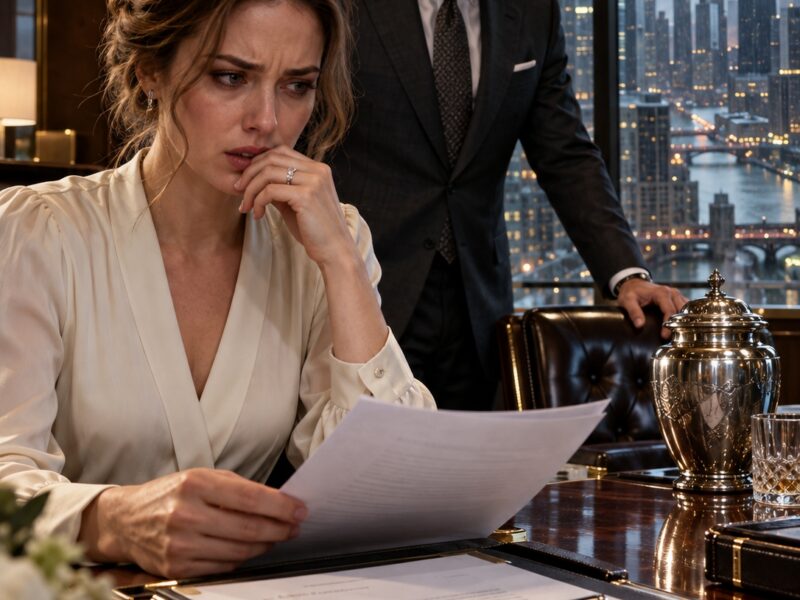
The mahogany boardroom of Gable and Associates felt less like a law office than a mausoleum.
Maybe it was the silence.
Maybe it was the rain sliding down the floor-to-ceiling windows behind Harrison.
Or maybe it was the silver urn sitting in the center of the conference table, polished so perfectly that I could see a warped reflection of my own face in it.
Arthur Mercer.
My father.
Reduced to twelve pounds of ash inside brushed silver.
A man who had spent forty years putting his name on skylines had ended up small enough to fit between a pitcher of water and a stack of legal documents.
I couldn’t stop looking at the urn.
Across from me sat Evelyn Croft Mercer, my father’s third wife.
She was three years younger than I was.
That fact had always made conversations interesting.
She wore black, naturally. Black silk dress. Black heels. Black coat folded over the back of her chair. A diamond bracelet flashed every time she lifted a monogrammed handkerchief to her eyes.
The handkerchief remained dry.
So did her eyes.
Harrison Gable sat beside her in a charcoal suit and wire-rimmed glasses.
He had represented my father’s companies for more than fifteen years. He was one of those men who had perfected the appearance of kindness without ever developing the emotion itself.
His smile had always reminded me of a shark deciding whether something in the water was injured enough to be worth the effort.
“Shall we continue?” he asked.
Evelyn gave a delicate nod.
I said nothing.
Harrison lowered his eyes to the will.
“To my wife, Evelyn Croft Mercer, I leave the primary residence in Aspen, the portfolio of holdings in the Mercer Trust, and the remaining liquid assets across all offshore accounts.”
Evelyn finally lowered the handkerchief.
Not dramatically.
Just enough.
I saw the satisfaction before she hid it.
I expected to feel angry.
Instead I felt something worse.
Nothing.
My father and I had been estranged for almost five years. By the end, Arthur Mercer had become a man I barely recognized.
He stopped attending charity galas.
Stopped giving interviews.
Stopped coming to Chicago.
He resigned from boards he had spent decades fighting to control. He sold properties nobody expected him to sell. He disappeared for weeks at a time and refused to tell anyone where he had been.
Whenever I asked what was happening, he gave me the same answer.
“I’m working on something.”
“What?”
“You’ll understand eventually.”
I hated that sentence.
Eventually.
It was the favorite word of people who believed time excused secrecy.
Our last real argument had happened in his Aspen kitchen.
I had accused him of choosing some mysterious project over his daughter.
He accused me of wanting explanations I had not earned.
I told him he was becoming paranoid.
He stared at me for a long time.
Then he said quietly, “I hope you’re right.”
I didn’t understand what he meant.
Five years later, he was dead.
Harrison turned another page.
“And to my only daughter, Josephine Mercer…”
He paused.
Evelyn looked toward me.
Something changed at the corner of Harrison’s mouth.
“…I leave Parcel 44.”
Silence.
I waited.
Harrison continued staring at me.
“That’s it?”
“That is the designated inheritance.”
“What is Parcel 44?”
Evelyn actually leaned forward.
“Yes,” she said. “What on earth is that?”
Harrison removed his glasses, polished them slowly, then put them back on.
“A sixty-acre tract of land in the remote northern reaches of Arizona, near the Vermilion Cliffs.”
I blinked.
“Arizona?”
“Yes.”
“I live in Chicago.”
“I am aware.”
“What kind of land?”
Harrison hesitated just long enough for me to notice.
“A canyon.”
I stared at him.
“My father left me a canyon.”
“Essentially.”
Evelyn’s mouth twitched.
I looked at her.
She immediately raised the handkerchief.
Harrison continued.
“The parcel is unzoned and effectively unbuildable. There are no recognized agricultural rights, water rights, or commercially registered mineral rights. Access is extremely difficult. No public road reaches the property.”
“So he left me a ditch in the desert.”
“A rather deep ditch,” Harrison said.
Evelyn made a small sound that might have been a cough.
I looked back at the urn.
For one ugly second, I wondered if this had been Arthur’s final punishment.
Evelyn received Aspen.
The investments.
The offshore accounts.
I received sixty acres of sun-baked rock.
Maybe that was what five years of silence had been worth to him.
Harrison slid a document across the table.
“Fortunately, there is an uncomplicated solution.”
I looked down.
PURCHASE AND TRANSFER AGREEMENT.
Twenty thousand dollars.
I looked up.
“What is this?”
“The firm is prepared to purchase Parcel 44 from you.”
“Your law firm buys canyons?”
“We occasionally acquire distressed or burdensome assets connected to client estates.”
“Twenty thousand dollars.”
“Cash equivalent. Immediate transfer.”
My studio was drowning.
Harrison didn’t know that.
At least, I didn’t think he did.
Restoring historic buildings in Chicago sounded romantic until you saw the invoices. I had two clients delaying payment, an equipment lease coming due, and enough outstanding studio debt to make checking my banking app feel like opening a medical diagnosis.
Twenty thousand dollars wouldn’t make me rich.
It would let me breathe.
Harrison rotated the contract toward me.
A silver pen rested neatly above the signature line.
“You could leave here today with the matter resolved.”
I looked at the number again.
$20,000.
A fresh start.
No Arizona taxes.
No worthless canyon.
No final insult from a dead father who had already hurt me enough while he was alive.
I reached for the pen.
Then I remembered the postcard.
It had arrived at my Chicago apartment three weeks before Arthur died.
No return address.
His handwriting.
Two sentences.
The skyscrapers are monuments to ego, Josie.
The real foundation of our legacy is in the stone.
I had read it twice and shoved it into a kitchen drawer.
Typical Arthur.
Cryptic even when trying to reconnect.
But sitting there now, I noticed Harrison wasn’t looking at me.
He was staring at my fingers.
His shoulders had shifted forward.
Barely.
His jaw was tight.
And suddenly the contract didn’t look like a favor.
It looked like a countdown.
I let my fingers touch the pen.
Harrison inhaled.
Then I pulled my hand away.
“No.”
His expression broke.
Only for half a second.
But I saw it.
“Josephine.”
“I said no.”
“Perhaps you’re allowing grief to complicate a straightforward financial decision.”
“If the land is worthless, why do you care?”
“I don’t care.”
“Then why is the contract already prepared?”
Evelyn looked at Harrison.
He didn’t look at her.
That interested me.
Harrison folded his hands.
“Arthur’s affairs were extensive. We prepared numerous contingencies.”
“For a worthless canyon?”
“Josephine—”
“And why twenty thousand?”
“A courtesy.”
“That’s generous.”
“We’re trying to save you unnecessary trouble.”
I pushed my chair back.
The legs scraped sharply across the floor.
Harrison’s eyes hardened.
“Your father purchased that property decades ago. It generates nothing except tax liability.”
I picked up the deed.
“Then you won’t miss it.”
“Be reasonable.”
I stopped.
That word.
Not careful.
Not practical.
Reasonable.
The word men used when they wanted a woman to distrust the alarm going off inside her own body.
I tucked the deed into my bag.
“It’s the only thing my father left me.”
“Josephine.”
“I think I’d like to see it.”
For the first time, Evelyn spoke without pretending to grieve.
“Why?”
I turned toward her.
She recovered immediately.
“I mean… why put yourself through that? Arthur clearly wasn’t well toward the end.”
There was something strange in her voice.
Not concern.
Fear.
Tiny.
Almost invisible.
But fear.
I looked from Evelyn to Harrison.
Then at the silver urn between them.
“I’ll let you know what I find.”
Nobody followed me out.
They didn’t have to.
Two days later, I was driving a rented Jeep Wrangler into a part of northern Arizona that looked like God had abandoned it halfway through construction.
The pavement disappeared first.
Then cell service.
Then the road itself.
Red rock towers rose against a sky so blue it almost looked artificial. Heat shimmered above cracked earth. Dust poured behind the Jeep in long rust-colored clouds.
I had spent the previous night in a motel whose air conditioner sounded like it was trying to die.
I hadn’t slept much.
Instead I’d spread topographical maps across the bed and studied Parcel 44.
The entire property was consumed by something locals called Echo Canyon.
There were no maintained trails.
No road access.
No recent survey.
The county clerk I’d called had gone silent after looking up the parcel.
“Nobody’s asked me about that place in years,” he’d said.
“How many?”
“Maybe thirty.”
“Who owns land around it?”
“Mostly federal holdings and conservation parcels.”
“What did my father use it for?”
Another pause.
“Ma’am, according to what I’m looking at, nobody uses it for anything.”
That should have reassured me.
It didn’t.
Near noon, my dashboard GPS lost signal.
The dirt track ended at a rusted wire fence riddled with bullet holes.
I killed the engine.
The sudden silence was enormous.
No traffic.
No planes.
No voices.
Just wind moving over stone.
I checked the coordinates on the deed, filled my water bottles, shouldered my canvas backpack, and started walking.
Two hours later, I hated my father all over again.
My boots slid on shale.
My throat felt lined with sandpaper.
Sweat dried almost immediately against my skin.
Every ridge promised a destination and revealed another mile of baked emptiness.
By the time I reached the plateau, I was ready to admit Harrison had been right.
Arthur had lost his mind.
He had left me nothing.
Then I saw Echo Canyon.
I stopped breathing.
The earth simply disappeared.
A violent wound split the plateau open, plunging four hundred feet into shadow. Sheer Navajo sandstone walls dropped through layers of rust, gold and ochre.
It was magnificent.
And completely useless.
I sat on a boulder near the edge and drank.
For the first time since the funeral, grief arrived without anger protecting me from it.
“Damn you, Dad.”
My voice disappeared into the canyon.
I pressed my palms against my eyes.
“You could have just called me.”
The wind answered.
I don’t know how long I sat there.
Eventually I reached into my pocket and pulled out Arthur’s postcard.
I had brought it because it was the only clue I had.
The photograph on the front was a generic vintage image of the Grand Canyon.
I turned it over.
The skyscrapers are monuments to ego, Josie.
The real foundation of our legacy is in the stone.
“Very helpful.”
I almost put it away.
Then sunlight struck the glossy surface at an angle.
I saw marks.
Tiny indentations.
I held the card closer.
They weren’t scratches.
They were impressions, as though Arthur had placed the postcard over another sheet of paper and written hard enough to leave grooves beneath.
My pulse changed.
I pulled a soft graphite pencil from the sketching kit I carried for restoration surveys.
I laid the postcard across my knee.
Then I rubbed the graphite sideways over the surface.
Gray spread across the paper.
White lines began emerging.
Numbers.
I stopped.
Coordinates.
I checked them against the deed.
They weren’t boundary markers.
They pointed somewhere inside Echo Canyon.
I stared down into the gorge.
The shadow at the bottom suddenly looked different.
Not empty.
Waiting.
“Dad…”
A cold sensation moved across my skin despite the heat.
He hadn’t left me land.
He had left me directions.
The descent took almost an hour.
Goat paths narrowed to ledges barely wider than my boots. Loose stones vanished into the canyon below without making a sound for several seconds.
The deeper I went, the colder the air became.
By the time I reached the canyon floor, sunlight had narrowed to a strip high overhead.
I followed the coordinates north.
One mile.
Then another.
Finally the GPS told me I had arrived.
I looked up.
A three-hundred-foot wall of sandstone towered above me.
Nothing else.
“No.”
I checked again.
Exact coordinates.
I turned in a circle.
Rock.
Sand.
Dry brush.
More rock.
“There’s nothing here.”
My voice came back to me.
Nothing here.
I laughed once.
It sounded almost hysterical.
I had crossed the country, rejected twenty thousand dollars, hiked through a desert and nearly broken my neck because a dead man had pressed coordinates into a postcard.
I kicked a loose stone.
It bounced toward a patch of scrub.
And that was when the part of me my father had actually understood noticed something my grief had missed.
A line.
Sixty feet above me.
Perfectly vertical.
I narrowed my eyes.
Architecture teaches you to recognize human arrogance.
Nature curves.
Nature fractures.
Nature erodes.
Nature does not care about ninety-degree angles.
But human beings do.
I climbed.
The sandstone tore skin from my palms.
Twice I nearly slipped.
Then the illusion began to fail.
What had looked like solid cliff was not solid cliff at all.
Sections of molded concrete and fiberglass had been textured and painted to match the Navajo sandstone.
Behind them stood steel.
I pulled myself onto a hidden ledge.
And there it was.
A reinforced steel door built directly into the mountain.
I forgot the pain in my hands.
The door belonged in a military installation.
Or a bank vault.
A digital keypad sat beside it beneath a film of red dust.
I brushed the dust away.
A green LED blinked.
Six digits.
“Of course.”
I tried my birthday.
Red.
ACCESS DENIED.
Arthur’s birthday.
Red again.
I leaned against the stone.
Think.
The real foundation of our legacy is in the stone.
Foundation.
My father had built Mercer Tower in 1988.
The project that made him.
I had heard the story a thousand times as a child.
Not the opening date.
Not the ribbon cutting.
The foundation.
Arthur used to brag that he remembered the day the first concrete pour began better than he remembered either of his first two wedding anniversaries.
I entered the date.
For one second, nothing happened.
Then the keypad turned green.
A mechanical clunk came from somewhere inside the mountain.
Then another.
Then six more.
The door released with a pneumatic hiss.
I stepped backward.
Cool air escaped through the opening.
Not stale air.
Climate-controlled air.
It smelled faintly of cedar.
And leather.
I pulled the door open.
Found a breaker panel.
Flipped the main switch.
Warm recessed lights illuminated one row at a time.
I stood frozen.
It wasn’t a bunker.
It was a home.
No.
It was a masterpiece.
Polished concrete floors extended into a huge living space carved directly into a natural cavern.
Mid-century furniture.
Leather sofas.
A live-edge walnut dining table.
An industrial kitchen.
Bookshelves.
Artwork.
A glass-enclosed fireplace.
And across the far side of the cavern, an enormous reinforced glass wall looked down into another hidden gorge where black water moved far below.
The house was suspended inside the mountain.
Invisible from the desert.
Invisible from the canyon.
Invisible from the world.
I whispered the only words I had.
“Dad… what did you do?”
The answer was waiting in his study.
I found it after passing a library, a stocked pantry, a server room and equipment that suggested the entire structure could operate independently for months.
Geothermal power.
Water filtration.
Backup generators.
Arthur hadn’t built a vacation house.
He had built somewhere to disappear.
His study overlooked the underground river.
An oak desk stood before the glass.
On it were blueprints.
A leather journal.
And a loaded Glock 19.
I stopped at the gun.
That frightened me more than the hidden house.
My father hated guns.
At least the father I remembered did.
I opened the journal.
Most entries were technical.
Construction problems.
Drilling depths.
Power systems.
Then I reached the final page.
The date was two days before his death.
The first sentence was short.
They know about the vein.
I read it twice.
Then continued.
Harrison and members of the board had discovered the dummy corporations Arthur used to acquire the surrounding land.
They believed he had become paranoid.
They believed the mountain house was a doomsday bunker.
But during drilling for the geothermal system, Arthur’s contractors had hit something beneath Parcel 44.
A mineral deposit.
Rhodium.
Palladium.
The assay reports, according to Arthur, suggested an untouched deposit so enormous that extracting it recklessly could destabilize global markets.
Trillions of dollars.
My hands began shaking.
Then I reached the final lines.
Arthur had hidden the core samples, geological reports, mineral documents and financial records in a vault.
And beneath that—
If anything happens to me, it wasn’t an accident.
My throat closed.
Then the next sentence.
Josie, if you’re reading this, trust no one.
And the last one.
Harrison will kill to get this land.
The room became impossibly quiet.
I saw the Porsche again.
Burning against the Pacific Coast Highway.
Police lights.
Metal twisted against a barrier.
Evelyn collapsing beautifully into Harrison’s arms.
Harrison telling me the brakes had failed.
A tragic mechanical malfunction.
Nobody could have known.
Then I saw him pushing the contract toward me.
Twenty thousand dollars.
A pen waiting above the line.
My father had not died because he drove too fast.
Someone had killed him.
And Harrison Gable had tried to buy the reason from me for $20,000.
A sound came through the mountain.
Thump.
Thump.
Thump.
At first I thought it was machinery.
Then it grew louder.
Rhythmic.
Rotors.
I ran to the entrance and looked through the camouflaged viewport.
A black helicopter descended through a cloud of red dust.
My stomach dropped.
Three men jumped out.
Black tactical clothing.
Canvas equipment bags.
Rifles.
Then the fourth man emerged.
Italian suit.
Wire-rimmed glasses.
Harrison Gable.
He shielded his eyes against the dust.
Then he lifted one arm.
And pointed directly toward the hidden ledge.
They knew.
Worse—
they knew I knew.
The first grinding sound against the outer door snapped me out of shock.
Sparks flashed beyond the viewport.
They were cutting the hinges.
I backed into the living room.
The beautiful house transformed around me.
The glass.
The furniture.
The warm lighting.
A minute earlier it had been my father’s impossible secret.
Now it was a tomb with excellent interior design.
I ran to the study.
Arthur’s blueprints were still open.
The Glock remained on the desk.
I stared at it.
Then picked it up.
The weight made my stomach turn.
I checked the magazine.
Loaded.
I had fired handguns a few times years earlier with an ex-boyfriend.
Paper targets.
Ear protection.
Coffee afterward.
Nothing about those afternoons had prepared me for knowing the next target might breathe.
Outside, metal screamed.
I forced myself to look at the blueprints.
Arthur had taught me to read plans before I could drive.
One of his favorite sayings returned with painful clarity.
A cornered animal is a dead animal, Josie. Always engineer an exit you don’t tell the client about.
“Okay, Dad.”
My voice trembled.
“Show me.”
I traced the service systems.
Kitchen.
Generators.
Server room.
Geothermal intake.
Then I found it.
VENT 04.
A maintenance shaft running from behind the server room down into the subterranean river gorge.
An escape route.
But first I needed the evidence.
I searched the study wall according to the plans.
Behind a framed photograph of me at eleven years old, I found a shallow indentation.
I pressed it.
A section of bookshelf swung outward.
Titanium safe.
Same keypad.
Same code.
The locks withdrew.
Inside were sealed core samples.
Assay reports.
Property documents.
A USB drive.
Financial records.
I shoved everything into my backpack.
Then the mountain exploded.
The blast threw me against the desk.
Dust rained from the cavern ceiling.
The glass wall shuddered.
C4.
The outer door was gone.
A man’s voice echoed through the house.
“Move in!”
Another voice followed.
Calm.
Educated.
Familiar.
“Keep her alive.”
Harrison.
“She has to sign the transfer documents before we arrange the hiking accident.”
Something inside me changed.
Fear remained.
But it had company now.
Rage.
They had killed my father.
Now they intended to kill me and write a believable ending afterward.
I slipped into the server room.
Flashlight beams swept across the living area.
Two armed men entered first.
Harrison followed with a suppressed pistol.
The sight of him carrying it was almost absurd.
Same suit.
Same glasses.
Same lawyer who had spoken softly about tax burdens.
Different contract.
I grabbed the main power lever.
Pulled.
Darkness swallowed the mountain.
“Night vision!” someone shouted.
I moved.
The maintenance hatch was exactly where the blueprint promised.
I twisted the wheel.
It resisted.
Behind me, footsteps approached.
I pulled harder.
Metal shrieked.
Cold damp air rose from below.
“She’s in the server room!”
Gunfire tore through the wall.
Computer equipment exploded beside my head.
I threw myself into the shaft.
My boots found an iron rung.
Then another.
I pulled the hatch above me.
A second later, the server-room door crashed open.
I climbed downward.
Fifty feet.
Darkness above.
Darkness below.
My backpack dragged at my shoulders.
Water thundered somewhere beneath me.
Then my boot found stone.
I stepped onto a narrow ledge and turned on the tiny flashlight attached to my key ring.
The underground river churned below.
Above me, the glass underside of Arthur’s hidden house glowed red beneath emergency lighting.
Then my flashlight caught something tied to an iron piton.
A motorized Zodiac raft.
Despite everything, I laughed.
One broken sound.
“Dad.”
He really had planned for everything.
Then a radio crackled beside me.
I froze.
“Harrison, status report. Have you secured the girl?”
A woman’s voice.
Elegant.
Impatient.
Familiar.
My blood turned cold.
Harrison answered.
“Not yet, Evie. She found the maintenance shaft.”
Evie.
No.
I picked up the radio.
Evelyn’s voice returned.
“Don’t be incompetent, Harrison. The board is breathing down my neck. I need those mineral rights transferred.”
I stopped breathing.
“And I need Arthur’s brat gone tonight.”
My knees weakened.
Then she said the sentence that destroyed whatever remained of the world I had known.
“We didn’t cut the brakes on Arthur’s Porsche just to let his daughter walk away with three trillion dollars.”
A tear moved down my dusty cheek.
Evelyn.
The grieving widow.
The dry handkerchief.
The black dress.
The woman who had stood beside my father’s ashes.
She had killed him.
And Harrison hadn’t been the mastermind.
He had been her partner.
Sparks showered from the shaft above.
They were coming.
The hatch gave way.
A man leaned into the opening.
“I see her!”
A red laser appeared on my chest.
I jumped into the raft.
My hand closed around the Glock.
The mercenary was armored.
Shooting him wasn’t the answer.
But architecture wasn’t about attacking what was strongest.
It was about understanding what carried the load.
My flashlight crossed a steel pipe running along the cavern wall.
Yellow warning markings.
Geothermal feed.
High pressure.
I remembered the blueprint.
Raised the pistol.
Fired.
The first round struck stone.
The second sparked against metal.
The third hit.
The pipe ruptured.
Steam exploded through the cavern.
The mercenary screamed.
The laser vanished.
“Fire!” Harrison shouted.
Bullets struck the water.
I yanked the starter cord on the Zodiac.
Nothing.
Again.
The motor coughed.
“Come on.”
Again.
It roared alive.
I cut the mooring line and shoved the throttle forward.
The current grabbed me.
The raft disappeared into the mountain.
I don’t know how long the underground river carried me.
Minutes became meaningless.
The flashlight gave me only a narrow tunnel of visibility.
Rock appeared without warning.
Water slammed the raft sideways.
Cold spray soaked me.
Once, the motor struck something beneath the surface and nearly threw me overboard.
I held onto the throttle with one hand and my father’s evidence with the other.
I thought about Arthur.
Not billionaire Arthur Mercer.
Not the man from magazine covers.
My father.
The man who had taught me to hold a ruler straight.
Who made pancakes shaped like buildings when I was seven.
Who once drove three hours because I called him from college crying after my first serious breakup.
The same man I had spent five years resenting.
Why hadn’t he told me?
Why had he let silence become the final language between us?
Maybe he had been trying to protect me.
Maybe that was what the postcard was.
Not an apology.
Not exactly.
A contingency.
A father who had run out of safe ways to say I need you to trust me.
The engine began sputtering.
“No.”
The river accelerated.
The fuel gauge hovered near empty.
“Please.”
Then I saw something ahead.
Gray-blue light.
At first I thought I was imagining it.
Then the cavern widened.
The water calmed.
The light grew brighter.
I killed the dying motor.
The current carried me forward.
Stone opened.
And suddenly the darkness disappeared.
Morning sunlight hit my face.
I emerged from the mountain onto a quiet tributary of the Colorado River.
Red cliffs rose around me.
Birds moved above the water.
The sky was pale gold.
Nothing in the landscape suggested that somewhere behind me men were hunting me through a fortress carved into stone.
I let the backpack fall into my lap.
Then I collapsed beside it.
For the first time since Arthur died, I cried without trying to stop.
Not because of the money.
Not because I had survived.
Because my father had known he might die.
And the last structure he had designed wasn’t built to save himself.
It had been built with a way out for me.
Three days later, I returned to the boardroom at Gable and Associates.
Same mahogany table.
Same Chicago skyline.
Same silver urn.
Everything else had changed.
Harrison Gable sat at the head of the table.
Handcuffed.
His face had lost the smooth confidence I remembered.
Two federal agents stood behind him.
Evelyn was across the room, screaming at another agent while he read her Miranda rights.
“This is insane!”
Nobody answered.
“Do you know who I am?”
An agent calmly finished reading.
Evelyn saw me.
The screaming stopped.
For a moment we simply looked at each other.
No handkerchief now.
No grieving widow.
No performance.
“You,” she whispered.
I didn’t answer.
Her face twisted.
“Do you have any idea what you almost destroyed?”
Harrison closed his eyes.
“Evelyn, stop talking.”
She turned on him.
“Shut up.”
“Evelyn.”
“You were supposed to handle her.”
One of the agents glanced toward his partner.
Harrison looked as though he wanted the floor to open beneath him.
I almost smiled.
Almost.
Instead I walked toward the windows.
Chicago spread beneath us.
Glass.
Steel.
Concrete.
Buildings my father had financed.
Buildings he had designed.
Buildings bearing his name.
For most of my childhood, I believed those towers were Arthur Mercer’s legacy.
The tallest structures.
The biggest deals.
The photographs in newspapers.
The fortune.
I finally understood his postcard.
The skyscrapers really were monuments to ego.
The important things had been buried.
A federal agent approached me.
“Miss Mercer.”
I turned.
“The financial records from the USB drive corroborate the offshore transfers we recovered from Gable’s accounts.”
Harrison stared at the table.
The agent continued.
“We also found documentation tied to the contract on your father’s life.”
I looked at the urn.
“So it’s enough?”
“It’s more than enough.”
“And Evelyn?”
“The communications connect her directly to the planning and payment structure.”
Across the room, Evelyn was suddenly very quiet.
“They’re both going away for a long time,” the agent said.
I nodded.
I had imagined that sentence would feel like victory.
It didn’t.
Justice wasn’t resurrection.
Handcuffs didn’t restore five lost years.
Prison couldn’t give me one final conversation with my father.
The agent glanced at the assay reports.
“There’s another issue.”
“Parcel 44.”
He nodded.
“The geological information is extraordinary. Multiple agencies will want independent verification, and there will be regulatory questions I can’t begin to answer for you.”
I looked toward the city again.
“But assuming those reports hold…”
He paused.
“You’re sitting on one of the most valuable mineral deposits ever documented.”
Money.
That was what had killed Arthur.
Or, more precisely, what other people believed money gave them permission to do.
I touched the silver urn.
It was cold.
“What are you going to do?” the agent asked.
I thought about Echo Canyon.
The sun over red stone.
The hidden door.
The impossible house suspended inside the mountain.
The underground river.
I thought about a loaded gun on my father’s desk.
A journal written by a frightened man.
A raft waiting in darkness for a daughter who might never come.
Then I remembered being eleven.
Arthur and I were sitting at his drafting table.
I had drawn a ridiculous house with three towers and no stairs.
He studied it seriously.
“What’s wrong with it?” I asked.
“Nothing.”
“You’re making that face.”
“What face?”
“The architect face.”
He laughed.
Then he pointed at my drawing.
“You designed what people will see.”
“Isn’t that the point?”
“No.”
He turned the paper over and drew several lines beneath my house.
Footings.
Supports.
A foundation.
“This is the point.”
“But nobody sees that.”
“Exactly.”
I hadn’t understood him then.
Maybe he hadn’t understood himself yet either.
Now, standing beside his ashes, I finally did.
“I’m an architect,” I told the agent.
He waited.
“I’m going to build on my father’s foundation.”
Behind me, Evelyn laughed bitterly.
“How touching.”
I turned.
She stared at me between two federal agents.
“Arthur chose you in the end,” she said. “Do you know that?”
I said nothing.
Her smile became cruel.
“He didn’t trust anyone. Not me. Not Harrison. Not his board. But he still believed his daughter would solve his little puzzle.”
Harrison looked up sharply.
“Evelyn.”
She ignored him.
“Do you know what the funniest part is, Josephine?”
I waited.
“He spent years protecting that canyon from everyone.”
Her eyes moved toward the urn.
“And in the end, it still killed him.”
The agents led her toward the door.
Her heels struck the marble floor.
Click.
Click.
Click.
Then she was gone.
Harrison followed.
He stopped beside me.
For a second I saw the man from the first meeting again.
The expensive suit.
The practiced smile.
The lawyer who believed everything had a price if the number was presented politely enough.
“You should have taken the twenty thousand,” he said.
I looked at him.
“No, Harrison.”
I touched my father’s urn.
“You should have let me.”
Something passed through his expression.
Not remorse.
Recognition.
He finally understood the mistake.
If he hadn’t pushed so hard, I might have sold.
If he hadn’t watched my hand.
If he hadn’t been so desperate.
If he had simply allowed me to believe Parcel 44 was worthless, I might never have crossed Arizona.
Never rubbed graphite over a postcard.
Never found the coordinates.
Never found the door.
Never opened the journal.
Never heard Evelyn confess over the radio.
His greed had exposed the secret he had murdered to protect.
The agent led him away.
The boardroom doors closed.
Silence returned.
I stood alone with Arthur.
Outside, morning light moved across Chicago.
For years, I had thought estrangement meant our story had ended before his death.
I had believed the worst thing between a parent and child was anger.
It wasn’t.
It was unfinished love.
Anger at least gives you something to hold.
Unfinished love leaves you reaching for conversations that can never happen.
I lifted the urn.
It was heavier than it looked.
“I was wrong about you,” I whispered.
Then I stopped.
That wasn’t entirely true.
Arthur had lied.
He had shut me out.
He had allowed paranoia and fear to hollow out our relationship.
Protecting me didn’t erase that.
Death didn’t turn him into a saint.
And discovering why he’d done those things didn’t magically heal them.
Maybe that was the cruelest part.
I finally understood my father at the exact moment understanding could no longer save us.
I carried the urn from the boardroom.
Months later, I returned to Echo Canyon.
Alone.
No helicopter.
No tactical team.
No Harrison.
No Evelyn.
Just wind.
The legal battles surrounding Parcel 44 had barely begun. Regulators, geologists, environmental specialists and attorneys had filled my life with meetings.
Everyone wanted to know the same thing.
How much was beneath the canyon?
How much could be extracted?
How much was it worth?
I had stopped answering that question.
Worth had become a dangerous word.
I hiked to the plateau near sunset.
The desert turned copper.
From above, nobody could see the hidden entrance.
Nobody would know a glass house existed inside the mountain.
That was the strange genius of Arthur’s final project.
His whole life had been about constructing things people couldn’t ignore.
His last masterpiece had been designed not to be seen at all.
I sat on the same boulder where I had discovered the coordinates.
The postcard was still in my pocket.
Its edges were worn now.
I read the words one more time.
The skyscrapers are monuments to ego, Josie.
The real foundation of our legacy is in the stone.
Then I turned it over.
The graphite coordinates were fading.
I smiled.
For years, I had wanted one final explanation from my father.
Something clean.
Something that would tell me whether he loved me, whether he regretted losing me, whether he had thought about calling during those five silent years.
He had left me no such answer.
Instead, he left me a canyon.
A hidden house.
A fortune I wasn’t sure anyone should possess.
And an escape route.
Maybe that was Arthur Mercer’s version of saying what he had never learned to say out loud.
The sun slipped behind the cliffs.
Shadow filled Echo Canyon from the bottom upward.
I stood.
For a moment, I imagined I could hear his voice beside me.
Not the billionaire.
Not the paranoid old man from his final years.
Just Dad at a drafting table, tapping the underside of a childish drawing with his pencil.
You designed what people will see.
This is the point.
I looked down at the stone beneath my boots.
Then toward the distant city lights beginning to appear beyond the desert.
Arthur had spent his life building upward.
I would decide what happened beneath.
And for the first time since his death, that didn’t feel like an inheritance.
It felt like a choice.
I folded the postcard carefully and placed it back in my pocket.
Then I walked away from the edge as darkness settled over the canyon.
Behind me, hidden somewhere inside millions of tons of ancient stone, my father’s last house remained silent.
And beneath it rested enough wealth to change the world.
But that evening, as the wind erased my footprints from the dust, I understood something Harrison, Evelyn, and perhaps even Arthur had learned too late.
The most dangerous thing buried in Echo Canyon had never been the metal.
It was what people were willing to become once they knew it was there.









