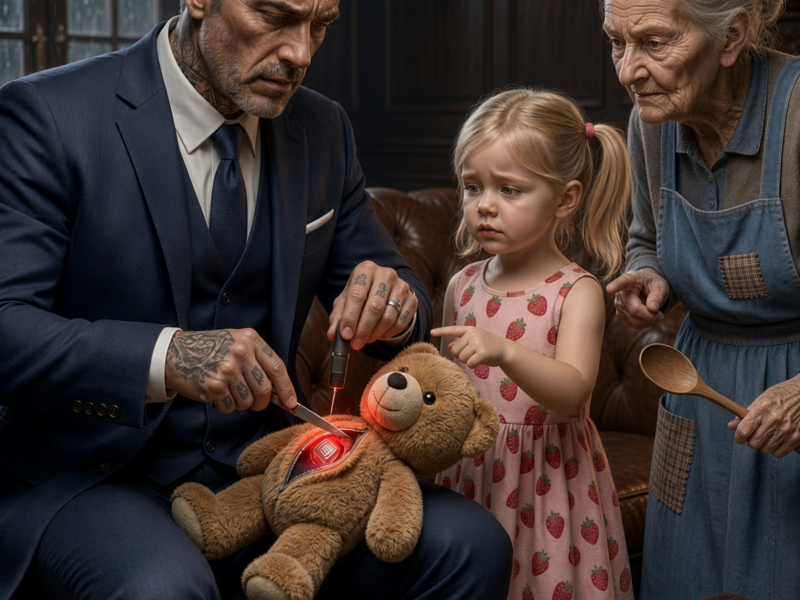
“There’s Something Inside Whale,” the Little Girl Told the Mob Boss—Then He Found a Wiretap and Realized the Betrayal Had Followed Her Into His House
Five-year-old Junie Lind held out her battered stuffed whale and whispered, “Mr. Baron, there’s something hard inside him that wasn’t there before.”
Niko Baron cut one careful stitch, reached into the toy, and pulled out a listening device small enough to hide beneath his thumbnail.
But the microphone had not been planted by his enemies—and when Niko learned who had sewn it into a frightened child’s only comfort, he understood that the woman under his protection had been betrayed long before she entered his house.
The car rolled down the Massachusetts coast road at two in the morning with its headlights off for the final half mile.
Rain came sideways off the Atlantic, needling the windows hard enough to make five-year-old Junie Lind stir against her mother’s chest.
Tessa tightened both arms around her.
Junie did not wake.
She only buried her face deeper into the borrowed gray raincoat Tessa had been wearing since Portland and curled one hand around the flipper of a stuffed whale whose faded blue fabric had gone soft from years of sleeping beside her.
“Last chance,” Dean Whitaker said from the front passenger seat.
He did not turn around.
“Say the word, and we go back.”
Tessa stared through the dark windshield at twelve-foot iron gates rising ahead of them.
“Back where?”
“Another federal location.”
“You said that about Quincy.”
Whitaker’s shoulders tightened.
“Quincy was compromised.”
“Three days after you put us there.”
“Tessa.”
“Two men came through a window in the middle of the night.”
Her voice stayed quiet because Junie was sleeping.
“That safe house had a deputy marshal assigned to it. He died because somebody knew where we were.”
Whitaker looked back then.
He was forty-six, an FBI agent with thinning brown hair, tired blue eyes, and the habit of sounding reasonable even when the thing he wanted was outrageous.
“We’re trying to keep you alive until trial.”
“And somebody inside your system keeps telling Ray Doyle where I am.”
“We don’t know that.”
“I do.”
“You suspect it.”
“I count money for a living, Dean. If the same loss happens through three different accounts, eventually you stop calling it coincidence.”
The car stopped before the gate.
Beyond it stood a stone house above the black Atlantic, too large to look welcoming and too old to look impressed by weather.
Whitaker exhaled.
“The man who owns that house hates Doyle.”
“I know.”
“He hates him enough to protect you.”
“He also runs half the waterfront you’ve spent twenty years investigating.”
“Yes.”
Tessa laughed once without humor.
“And this is your safe option.”
“It is tonight.”
He reached into the inside pocket of his coat.
When his hand came back, a black rectangle rested on his palm.
No larger than a matchbox.
Tessa looked at it.
“No.”
“You haven’t heard me.”
“I know what it is.”
“A short-range transmitter.”
“No.”
“You keep it beneath your clothes.”
“No.”
“We’ve lost visibility on you twice.”
“You told me this was protection.”
“It is.”
“You’re asking me to spy on the man you’re sending me to for protection.”
Whitaker’s face did not change.
“I’m asking you to document what you hear.”
“That’s called spying when normal people do it.”
“Tessa, this man is Nicolas Baron.”
“I’m aware.”
“He has laundering cases older than your daughter.”
“And yet you trust him more than your own witness-security system.”
“I trust his hatred.”
The honesty made her look at him.
Whitaker lowered his voice.
“Ray Doyle killed Baron’s younger brother six years ago. Baron has never forgotten it. He offered his home because you can put Doyle away.”
“And what does he want?”
“Nothing on paper.”
“That wasn’t my question.”
Whitaker gave the device another inch toward her.
“What he wants is Doyle convicted.”
“That is also what you want.”
“Yes.”
“And after Doyle?”
He did not answer.
Tessa looked down at Junie.
Eight months earlier, Tessa had been a forensic accountant at Doyle Maritime, a respectable shipping company with ugly numbers beneath its respectable books.
She had known there were shell vendors.
Ghost invoices.
Container fees that appeared and disappeared.
She had told herself the same thing for six years.
You are an accountant.
Not a detective.
Not police.
Not a hero.
Then one March afternoon she carried a folder into the executive floor and heard Ray Doyle talking behind a half-closed office door.
“Marcus Hale is becoming a problem.”
Marcus Hale was a port inspector.
Two days later, he was dead.
Tessa went to the FBI.
Not bravely.
She had sat in her car outside the field office for twenty-three minutes, shaking so hard she spilled coffee over both hands.
Then she went inside anyway.
Now the trial was twenty-one days away.
Three safe locations had failed.
And the safest place left belonged to a man the government would happily prosecute next.
Whitaker held the transmitter patiently.
“Voluntary.”
he said.
Tessa looked at him.
“If I refuse?”
“We still take you inside.”
“And afterward?”
“I find somewhere else.”
“How long?”
“I don’t know.”
The gate began to open.
Tessa took the device.
Not because she trusted him.
Because uncertainty had become more frightening than guilt.
She slipped it beneath her sweater.
“Mom?”
Junie’s eyes opened.
“We’re here.”
“Where?”
“Somewhere safe.”
Junie blinked toward the gates.
“Are there whales?”
Tessa looked at the toy.
“Only yours.”
The car passed through.
A large man waited under the gatehouse light.
He wore a dark peacoat and no hat despite the rain.
He leaned toward the driver.
“Lind?”
“Yes.”
The driver nodded.
The man’s eyes moved to Tessa, then Junie.
“Dom Ferraro.”
he said.
“Mr. Baron is expecting you.”
Tessa got out.
Rain hit instantly.
Dom opened Junie’s door and held a large umbrella without speaking.
Whitaker came around the car.
Junie, still half asleep, lifted Whale.
“He’s wet.”
Whitaker crouched.
“Poor guy.”
The seam along Whale’s belly had opened slightly.
White stuffing showed.
Whitaker held out a hand.
“Want me to fix him?”
Junie looked at her mother.
Tessa nodded.
Whitaker produced a small travel sewing kit from the glove compartment.
“That’s oddly prepared.”
Tessa said.
“You spend enough time moving witnesses with children, you carry strange things.”
He stitched Whale quickly beneath the gatehouse light.
Junie inspected the seam.
“Too tight.”
Whitaker smiled.
“Professional criticism accepted.”
He handed the toy back.
Junie hugged it.
Tessa did not think about that moment again.
Not until it nearly destroyed everything.
The main house rose above the sea like a dark ship anchored to rock.
Three stories.
Gray stone.
Long windows facing water.
The eastern wing was separated from the main structure by a glass-covered passage.
Most of its windows were lit.
A man waited in the doorway.
Tessa had expected size.
Violence usually made people imagine size.
Instead Nicolas Baron was lean, perhaps fifty-one, with silver beginning at his temples and wire-framed glasses that made him look more like a professor than a mob boss.
A navy cardigan covered white shirt.
A wooden cane rested beneath one hand.
“Miss Lind.”
His voice was quiet.
“Come inside before your daughter decides we’re monsters who make children stand in storms.”
Junie stared at him.
“Are you?”
Niko’s eyebrows rose.
Tessa closed eyes briefly.
“Junie.”
“What?”
“I asked.”
Niko looked at the child.
“Not intentionally.”
Junie considered that answer.
“Okay.”
Inside smelled of cedar, coffee, old books, and salt coming through stone walls.
A fire burned in sitting room.
An elderly woman in a flowered apron waited beside sandwiches and tea.
“Mrs. Pace.”
Niko said.
“She will be the only person besides Dom permitted into this wing unless I tell you otherwise.”
Mrs. Pace smiled at Junie.
“I made grilled cheese.”
Junie immediately trusted her more than anyone else.
Niko looked at Tessa.
“Three rules.”
She heard Whitaker’s device against her ribs.
“One, you do not leave this wing without me or Dom.”
“Two, no personal phones.”
“There’s a landline in the kitchen routed through a protected exchange for emergencies.”
“Three…”
He paused.
The fire cracked behind him.
“In this house, nobody lies to me.”
The transmitter suddenly felt hot.
Tessa kept face still.
“I don’t lie unless I have to.”
Niko’s mouth moved slightly.
“That is much better than saying you never lie.”
His eyes rested on hers for one second too long.
“Good night, Miss Lind.”
Tessa slept badly.
At three in the morning, Junie’s breathing softened beside her.
Rain eased.
The sea remained.
A vast slow grinding outside glass.
Tessa reached beneath sweater and pressed the tiny recessed button on transmitter.
A pinprick of green appeared.
“Test.”
she whispered.
“This is Lind.”
“I’m inside.”
No answer.
That was design.
Whitaker would hear.
She pressed button off.
In another part of the house, behind a locked door she had not yet seen, Niko Baron sat alone at a desk with a receiver he had purchased six months earlier from a private security specialist who owed him money.
He heard the words.
This is Lind.
I’m inside.
He closed his eyes.
Not surprised.
Only disappointed that his first instinct about her had been correct.
Then a second sound came through the speaker.
A child murmuring in sleep.
“Whale.”
Niko opened his eyes again.
He listened until room went quiet.
At breakfast, nobody mentioned lies.
Mrs. Pace made pancakes.
Junie stacked blueberries into a face.
Niko appeared halfway through wearing gray cardigan.
Junie pointed fork.
“You changed.”
Niko looked down at himself.
“I did.”
“You have lots of those.”
“Cardigans?”
“Yes.”
“I’m old.”
“You’re not that old.”
“Thank you.”
“My mom is thirty-four.”
Niko glanced at Tessa.
“That information will be useful if I ever need to make her angry.”
Tessa laughed before she could stop.
It was first real laugh she had made since Quincy.
The sound surprised all three adults.
Junie did not notice.
She was studying pancake.
After breakfast, Dom escorted them to beach below house.
The Atlantic had turned steel blue after storm.
Seaweed lay in black ropes along stones.
Junie discovered sea glass.
One green piece.
Then white.
Then cloudy blue.
She held each to light.
Niko came down carrying an old coffee tin.
“Put them in here.”
“Why?”
“So you don’t fill your mother’s pockets with rocks.”
“They’re not rocks.”
“I stand corrected.”
He explained sea glass.
Broken bottles.
Years in water.
Edges worn smooth.
Junie listened like he was explaining stars.
“What’s rarest?”
“Red.”
“Why?”
“Old red glass needed gold in production.”
“That sounds expensive.”
“It was.”
“I’m finding red.”
Niko smiled.
“Then we’ll retire.”
Tessa watched him.
Whitaker’s files described Nicolas Baron as suspected head of criminal network connected to unions, warehouses, freight yards, gambling rooms, and financial fronts.
The man on beach limped while explaining colored glass to five-year-old.
Both could be true.
That was more unsettling than if one had been false.
For six days, life paused.
No school.
No office.
No apartment.
No sirens.
Tessa woke to gulls and coffee.
Junie collected glass and drew boats.
Mrs. Pace told stories about growing up in Somerville with seven sisters and one bathroom.
Dom remained suspicious.
Niko disappeared for hours at time into main house.
At ten each night, Tessa activated transmitter.
She reported.
“Study is west of main stairs.”
“Three regular guards on property.”
“Dom manages access.”
“Boat house at bottom of lawn.”
She omitted small things.
That Niko liked his eggs overdone.
That he read maritime histories at breakfast.
That he rubbed left hip after stairs.
That he had once repaired Junie’s broken toy truck with glue and waited fifteen minutes holding axle until it set.
None seemed operationally relevant.
She told herself omission was not disloyalty.
Only privacy.
On fourth afternoon, Junie found boat house.
It smelled of varnish and old rope.
A 1938 Chris-Craft runabout sat half restored beneath skylight, mahogany ribs exposed like bones.
Niko stood beside it with hand plane.
“You build boats?”
Tessa asked.
“One boat.”
“How long?”
“Twelve years.”
“That’s not restoration.”
“That’s avoidance.”
She looked at him.
He returned to wood.
Junie climbed crate.
“She needs sanding.”
Niko stopped planing.
“Yes.”
“Where’s sandpaper?”
Tessa opened mouth.
Niko pointed.
“Drawer.”
Twenty minutes later, Junie wore oversized canvas apron.
Niko showed her how to move sanding block with grain.
“Why?”
she asked.
“Because wood remembers direction.”
“That doesn’t make sense.”
“Most important things don’t at first.”
Junie narrowed eyes.
“You say old-man stuff.”
Niko glanced at Tessa.
“She’s cruel.”
“She’s honest.”
“Worse.”
Junie sanded.
Then without warning asked:
“Are you a bad man?”
The boat house went still.
Tessa stepped forward.
“Junie.”
Niko raised one hand.
“It’s all right.”
He crouched slowly, balancing with cane until eye level.
“Who told you that?”
“Nobody.”
“Why ask?”
“Dom has people at gate.”
“True.”
“And men whisper when you come.”
“Also true.”
“Mom says people who need big gates are scared or bad.”
Tessa stared.
“I said that once.”
Niko looked amused.
“Which am I?”
Junie asked.
“No.”
Niko answered.
“I mean which are you?”
He considered.
“Some days scared.”
“Some days bad.”
Junie nodded as though classification satisfactory.
“Today?”
“Today I’m sanding supervisor.”
She returned to work.
Tessa’s hand rested unconsciously over transmitter beneath sweater.
Niko saw.
Not device.
Gesture.
His expression altered.
He said nothing.
That night, Junie woke at three.
“Mom.”
“What?”
“There’s something in Whale.”
Tessa opened eyes.
“What?”
Junie sat up clutching stuffed animal.
“He has a bump.”
“He’s stuffed.”
“No.”
She pushed Whale toward Tessa.
“Here.”
Tessa felt along seam.
Something small.
Hard.
Near belly.
She frowned.
“Probably stuffing clumped.”
“No.”
Junie sounded certain.
“He wasn’t hard there before.”
“How do you know?”
“I sleep on him.”
Tessa smiled faintly.
“Fair.”
“Can we fix?”
“Tomorrow.”
Junie lay back.
Within minutes slept.
Tessa did not.
She remembered Whitaker at gate.
Let me fix Whale.
Thread.
Tight stitch.
Her stomach tightened.
She sat up.
Touched transmitter on own ribs.
Then Whale.
Two devices?
Impossible.
She waited until dawn.
At seven, Junie carried toy downstairs.
Niko was pouring coffee.
“Mr. Baron.”
“Yes?”
“There’s something in Whale.”
Niko looked at Tessa.
She shook head slightly, warning she did not know.
Junie held toy out.
“It moves.”
Niko took it.
Pressed seam.
His face did not change.
But hand stopped.
“Dom.”
One word.
Dom entered from hall immediately.
Niko held Whale.
“Bring me sewing scissors.”
Tessa stood.
“What is it?”
Niko did not answer.
Mrs. Pace took Junie gently.
“Come help me choose jam.”
“I want to see.”
“You can see after.”
“But Whale—”
“He’ll be fine.”
Junie allowed herself to be led three steps away but twisted backward.
Niko cut one stitch.
Then another.
He slipped two fingers into seam.
Pulled out black capsule smaller than thumbnail.
Tiny perforation.
Coiled wire.
Tessa’s mouth went dry.
Dom’s face changed first.
“Microphone.”
Tessa stared.
“No.”
Dom looked at her.
“You brought this into house.”
“I didn’t know.”
“You expect—”
“Dom.”
Niko’s voice remained calm.
Dom stopped.
Niko turned device between fingers.
“Federal issue?”
Dom leaned.
“Could be.”
“I’ve seen similar.”
Niko looked at Tessa.
She felt other transmitter taped beneath sweater.
There was no point pretending.
She removed it.
Placed matchbox device on counter.
Dom swore softly.
Junie looked from kitchen.
“Mom?”
Tessa forced smile.
“Whale had a button inside.”
“Can I have him back?”
“In a minute.”
Niko looked between two devices.
One voluntarily carried.
One secretly sewn into child’s toy.
Different betrayals.
Different meanings.
“How long?”
he asked.
Tessa’s voice cracked.
“Since first night.”
“You knew about this one.”
He tapped matchbox.
“Yes.”
“Not Whale.”
“No.”
“Who repaired toy?”
Silence.
“Dean Whitaker.”
Niko’s eyes sharpened.
“When?”
“At gate.”
Dom turned away, furious.
“I’ll call—”
“No.”
Niko said.
He looked at tiny microphone.
“Put it back.”
Dom stared.
“Boss.”
“Put it back.”
“You’re kidding.”
“No.”
“Why?”
“Because man who planted it thinks it is still there.”
Niko handed device back.
“And because he did not trust his own witness.”
He looked at Tessa.
“That matters.”
Tessa could barely speak.
“You knew about mine?”
“From first night.”
She went cold.
“What?”
“East wing was swept before arrival.”
“We found signal.”
“Why let me stay?”
Niko looked toward Junie in kitchen, where Mrs. Pace was making dramatic argument about strawberry jam.
“Because the device was on you.”
He lowered voice.
“And because the second microphone was in child.”
“That tells me Whitaker is not only watching me.”
“He is watching you.”
Tessa stared.
Every whispered report.
Every frightened lie.
Niko had heard.
“How?”
“Receiver.”
“You listened?”
“Yes.”
“For six days?”
“Yes.”
Anger rose hot.
“You let me sit at your table.”
“Yes.”
“You let my daughter—”
“Yes.”
“You knew I was informing on you.”
“I knew you were trying.”
Dom muttered:
“Badly.”
Niko gave him look.
Tessa’s humiliation sharpened.
“I should leave.”
“No.”
“You should want me gone.”
“I want to know why an FBI agent hid second device in your daughter’s toy without telling you.”
“That is not protection.”
It landed.
Tessa looked at Whale.
Junie’s only object from old life.
Given by father? No, in adaptation perhaps from hospital gift from her grandmother. Need maybe later. We can establish now: Whale had belonged since infancy, one of few things carried through moves. The violation felt intimate.
“Why would he do that?”
she whispered.
Niko answered:
“Because he expected you might stop cooperating.”
“And he wanted a microphone you couldn’t remove.”
Dom said.
The kitchen seemed suddenly smaller.
Tessa thought of Quincy.
Safe-house address leaked.
Deputy Ortiz dead.
Whitaker’s apologetic face.
We’re trying.
She looked at Niko.
“You think he sold us?”
“No.”
“That is different accusation.”
“But I think somebody in federal protection apparatus did.”
“And Whitaker knows he cannot control it.”
“So he controlled you instead.”
That hurt because plausible.
Niko resewed Whale himself.
His hands were neat.
Patient.
When Junie got toy back, she hugged it.
“Is he fixed?”
“Yes.”
“What was inside?”
“A listening part.”
“For music?”
Niko looked at Tessa.
“No.”
“Something like that.”
Junie frowned.
“Whale doesn’t listen.”
Niko smiled faintly.
“No.”
“He keeps secrets.”
“That night, Tessa did not activate her transmitter.”
At 10:07, green light stayed dark.
At 10:20, it buzzed.
She had not known it could receive.
Whitaker’s voice came thin through device.
“Tessa.”
She sat frozen.
“Do not speak if Junie’s awake.”
“Press once if you hear.”
She pressed.
“Good.”
“Signal from Whale dropped for fourteen minutes this morning.”
Her blood turned cold.
They were monitoring separately.
“We had interference.”
Whitaker continued.
“If Baron found anything, you need to tell me.”
Tessa pressed nothing.
“Tessa.”
“Once if clear.”
She turned device off.
Niko sat in study wearing headphones.
He had heard every word.
Now certainty replaced suspicion.
The FBI knew exact signal behavior of toy.
Whitaker was aware.
At breakfast, Niko said nothing.
Neither did Tessa.
They began playing chess after Junie slept.
It happened accidentally.
Niko had board by fire.
“You play?”
“Badly.”
“Good.”
“I’m tired of humiliation.”
He beat her in nineteen moves.
She demanded another game.
He beat her in twenty-six.
Third night she lasted forty.
“Progress.”
he said.
“Arrogance.”
she replied.
Between moves, they talked.
Not about case.
His brother Paul.
Her ex-husband Evan, Junie’s father, who had left two years after child birth because fear made him cruel and absence made him easier. He paid child support irregularly, lived in Denver, and believed witness protection was “Tessa’s drama.”
Niko listened.
“Do you hate him?”
“No.”
“That sounds worse.”
“It is.”
They played.
He told her Paul had been loud where Niko was quiet.
Funny where Niko was careful.
Paul could enter funeral and leave with three invitations to dinner.
Niko entered weddings and made people check exits.
“Doyle killed him?”
Tessa asked.
Niko moved bishop.
“Yes.”
“How do you know?”
“Because Ray told a man who told wrong woman.”
“Not admissible.”
“I’m not trying case.”
“Do you want revenge?”
Niko looked at board.
“Yes.”
She appreciated lack of saintliness.
“But?”
“But Marcus Hale had eleven-year-old daughter.”
“You researched him.”
“I read obituary.”
“Same thing in your world.”
He looked at her.
“Doyle has spent thirty years arranging fear so everybody thinks they are alone.”
“He frightens unions.”
“Inspectors.”
“Accountants.”
“Witnesses.”
“You.”
Niko moved queen.
“Check.”
“What does that have to do with helping me?”
“Maybe I’m tired of letting him choose who gets to be afraid.”
Tessa stared at board.
She lost three moves later.
The next morning, Dom confronted her in corridor.
He was not subtle.
“I don’t trust you.”
“I know.”
“He does.”
“I’m not sure he does.”
“That’s worse.”
Tessa folded laundry towel.
“Why?”
“Because when Niko trusts somebody, he can account for it.”
“When he doesn’t and still lets them close, means he wants to believe something.”
Dom’s jaw tightened.
“I’ve known him thirty years.”
“I watched his father die.”
“I carried Paul into ambulance.”
“He doesn’t get people twice.”
Tessa met his eyes.
“I’m not trying to hurt him.”
“Everybody says that right before they explain why they did.”
He walked away.
That sentence stayed.
On twelfth day, Niko left study door open.
An inch.
No more.
Tessa noticed immediately.
She carried basket.
Stopped.
Door always locked.
Niko did not forget.
He wanted her to enter.
Test.
She should walk.
Instead she set basket down.
Went inside.
Black ledger lay under lamp.
Open.
Cash flows.
Front companies.
Names.
Dock payments.
Her entire professional brain switched on.
She read.
Fenway Marine Supply.
Revere Cold Storage.
North Atlantic Hauling.
Numbers.
Too perfect.
Within minutes, she knew.
Forgery.
Sums too clean.
No corrections.
No human mess.
She touched margin.
“It’s not real.”
Niko stood doorway.
She did not turn.
“Took you six minutes.”
he said.
“I’m disappointed.”
“You made it?”
“Over three years.”
“Beautiful work.”
“Thank you.”
“Why?”
He entered.
“Because government expects ledger.”
“So I made one.”
“And left it for me.”
“Yes.”
“So I’d give it to Whitaker.”
“Yes.”
Tessa looked.
“You are using me.”
He gave small tired smile.
“Now you know how it feels.”
Fair.
Painful.
“What do you want me to tell him?”
“That is up to you.”
“You’ve been listening.”
“Yes.”
“And you know he wants this.”
“Yes.”
She looked at false ledger.
Then at man.
“I’ll tell him I found nothing.”
Niko’s expression changed.
Not relief.
Surprise.
“Why?”
“Because this is bait.”
“I don’t know who it’s meant to catch.”
“And because Whitaker put a microphone in my child’s toy.”
“That does not make me good.”
“I know.”
“Good.”
he said softly.
“Never confuse those things.”
That night she reported:
“Study contained maritime books.”
“Locked drawer.”
“No ledgers.”
Whitaker paused.
“You sure?”
“Yes.”
Across house Niko listened.
Tessa knew now.
That made lie different.
A lie told in front of man it protected.
After silence, Whitaker’s voice emerged through receiver.
“Change in plan.”
Tessa stiffened.
“Trial remains 24th.”
“When you step down, task force moves on Baron.”
“We have probable cause from observations.”
Tessa’s stomach turned.
“And Junie?”
Silence too long.
“Tessa.”
“What about my daughter?”
“DCF may take temporary custody during operational transition.”
“No.”
“Probably days.”
“No.”
“We can’t leave child in active mob residence.”
“You told me she stayed with me.”
“Until trial.”
“You never said after.”
“I’m saying now.”
“You lied.”
“I managed risk.”
“You used her.”
“Tessa—”
She tore transmitter from ribs.
Held it in fist.
“You used my daughter to get me in this house.”
“Don’t do anything emotional.”
She nearly laughed.
That phrase.
The universal request of men whose plans depended on women remaining manageable.
“Good night, Dean.”
She turned it off.
In study, Niko removed headphones.
He had heard all.
He sat a long time.
Then called attorney Abraham Feldman.
“I need meeting with Elena Ruiz.”
“The U.S. Attorney?”
“Yes.”
“You’ve lost mind?”
“Possibly.”
“What are you offering?”
“Everything.”
Silence.
“Nico.”
“You heard me.”
“Why?”
Niko looked at Whale’s signal receiver.
“Because somebody put a microphone in a five-year-old’s toy.”
Attorney said nothing.
“Call her.”
The next morning, Niko asked Tessa to walk cliff path.
Cold sun.
Hard wind.
Junie searched glass with Mrs. Pace.
At end of property, rusted gate opened toward old cliff stairs.
Niko put hand on bar.
“If you leave through here tonight, there is skiff.”
“Passports.”
“Cash.”
“Phone contact in Nova Scotia.”
Tessa stared.
“You prepared escape.”
“Yes.”
“For me.”
“For you and Junie.”
“You’re letting me run from trial?”
“I’m offering choice.”
“You lose Doyle.”
“Yes.”
“Marcus Hale gets no justice.”
Niko looked sea.
“Yes.”
“Why would you do that?”
“Because government intends to take your daughter as cost of its strategy.”
“And you should not have to choose between testimony and being her mother.”
Tessa’s eyes filled.
“You heard.”
“Everything.”
“How long?”
“Since first night.”
She turned away.
Humiliation returned.
He gave space.
After while:
“Why didn’t you expose me?”
“At first I wanted information.”
“Then?”
“You were very bad spy.”
She laughed through tears.
“Dom says same.”
“He is rarely wrong.”
Niko continued.
“You never gave Whitaker anything useful.”
“You omitted vulnerabilities.”
“You lied about ledger.”
“And when you discovered second mic, your first concern was Junie.”
“That told me enough.”
“They’re going to take her.”
“Not if Ruiz agrees.”
Tessa looked.
“What?”
“I have offered cooperation.”
“What kind?”
“The real books.”
She went still.
“You have real books.”
“Yes.”
“Where?”
“Come.”
Boat house.
Niko opened hidden panel beneath stern.
Inside lay ugly black ledger.
Cracked spine.
Coffee stain.
Rubber band brittle.
Tessa opened.
Human numbers.
Corrections.
Margins.
Initials.
Names.
Doyle.
Federal marshal Cole Puit.
She froze.
“Puit.”
“Yes.”
“Deputy marshal?”
“Supervisor on protection rotation.”
Payments from Doyle-linked company going back seven years.
August payment.
Then notation around Quincy relocation.
Tessa looked up.
“He leaked safe houses.”
“Likely.”
“You knew?”
“Suspected after attack.”
“This proves.”
“It helps.”
Another entry.
Marcus Hale.
Doyle requested Niko “cover” problem.
Niko refused.
Recorded threat afterward.
Tessa looked.
“You had this before Marcus died.”
“Yes.”
“You could’ve gone federal.”
“Yes.”
“You didn’t.”
“No.”
“Why?”
Niko’s face remained still.
“Cowardice dressed as code.”
Tessa stared.
“I told myself men like me don’t talk.”
“I told myself writing it down was enough.”
“It wasn’t.”
“What will this cost you?”
“Prison.”
“How long?”
“My lawyer thinks with cooperation perhaps four to eight years.”
“You’re fifty-one.”
“I know arithmetic.”
“Why now?”
He touched boat.
“Junie asked whether I was bad man.”
“I gave complicated answer because I wanted to sound wise.”
“The truth is simpler.”
“I have spent thirty years choosing whatever protected my side.”
“And somehow cost always went to somebody else.”
He looked at her.
“Marcus.”
“Paul.”
“You.”
“A dead deputy in Quincy.”
“I would like to pay once.”
Tessa’s throat tightened.
“I can’t make that choice for you.”
“You aren’t.”
“I already did.”
The emotional center shifted.
Not romance.
Not salvation.
Accountability.
That night, Tessa removed transmitter permanently.
She brought it to study.
Set on blotter.
“I’m done lying.”
Niko removed glasses.
“Then tell me properly.”
She did.
Everything.
March.
Doyle.
Whitaker.
Fear.
Every report.
When finished, Niko told her microphone inside Whale had been reinserted so bureau still believed it active.
Tessa went pale.
“Then Junie has carried it all week.”
“No.”
Niko corrected.
“We put a dummy back after first day.”
“The real mic is here.”
He opened drawer.
“Dom insisted.”
Tessa exhaled.
Relief.
Then laughed.
“You lied.”
“True things in wrong order.”
“That’s lying.”
“Accountants are so rigid.”
For first time, room felt almost safe.
Then Niko told her deal.
U.S. Attorney Elena Ruiz agreed provisionally:
Junie would be transferred before raid to Tessa’s mother in Portland, Maine, with federal agents outside local marshal chain.
Tessa would testify against Doyle.
Niko would surrender ledger and testify.
No unilateral raid before evidence handoff.
Whitaker would be removed from operational control pending review of unauthorized child surveillance.
Cole Puit investigated quietly.
Tessa stared.
“You did all that in two calls?”
“Three.”
“Money?”
“Lawyers.”
“That’s money with vocabulary.”
Niko smiled.
“Fair.”
“What do you get?”
“Chance to walk into court rather than be dragged.”
“That’s all?”
“Not all.”
“Junie safe.”
Tessa looked at him.
There was intimacy in that answer.
Not possession.
Not promise.
Choice.
Dom hated deal.
He and Niko argued behind closed door.
Tessa heard:
“You give them books, they bury you.”
“Maybe.”
“You owe them nothing.”
“I owe other people.”
“Since when?”
“Too late.”
“You’re in love with her.”
Silence.
Then Niko:
“No.”
Dom:
“Worse.”
“What?”
“You want to deserve her.”
Niko’s answer came quieter.
“I want to deserve myself.”
Tessa stepped away before hearing more.
Romance, if there was one, remained unnamed.
Junie continued sanding boat.
She named it Sea Glass.
“Because broken things get smooth.”
Niko accepted.
She found red shard.
Rarest.
Held it out.
“For boat.”
Niko crouched.
“You found this?”
“Yes.”
“Don’t lose.”
“I’ll return when she’s done.”
He placed red glass in breast pocket.
Tessa watched from doorway.
Something inside her moved.
Not love yet.
Trust.
Maybe beginning.
The next day, Whitaker arrived angry at gate.
He knew transmitter removed.
Dom refused entry until eight.
Tessa walked lawn with Junie.
Whitaker called across bars.
“You took it off.”
“Yes.”
“You know what you’ve done?”
“Yes.”
“You’ve compromised eight months of work.”
“You put microphone in my daughter’s toy.”
His face changed.
That was confession without words.
“Precaution.”
he said.
“Against me?”
“Against uncertainty.”
“Same thing.”
“Tessa, Baron is manipulating you.”
“He probably is.”
Niko, from porch, almost smiled.
Tessa continued.
“I’ll testify.”
“I’ll tell jury exactly what Doyle said.”
“That was deal.”
“But I’m not your device anymore.”
Whitaker lowered voice.
“You think Baron is better?”
“No.”
“That is why you’re dangerous right now.”
“You need somebody to become good before you accept they can do one right thing.”
“People are more complicated.”
Whitaker looked toward Niko.
“He killed people.”
Niko answered himself.
“Yes.”
No evasion.
Whitaker stared.
Niko came down steps.
“And I’m going to testify to crimes I committed and crimes I witnessed.”
Whitaker’s anger turned to shock.
Ruiz’s sealed agreement arrived that afternoon.
The case had transformed.
Then came worst news.
Puit was assigned to witness transport on trial morning.
Required marshal service coordination had not yet removed him because investigation remained secret.
If tipped off too early, he could warn Doyle and run.
Ruiz devised plan.
Junie moved to Portland five days before trial.
Tessa’s mother took her.
Two agents from different district protected.
Niko watched Junie leave from terrace.
She hugged Mrs. Pace.
Dom.
Then Niko.
He stiffened.
Children hugged without asking permission.
“You’ll finish Sea Glass?”
“Yes.”
“Promise?”
He looked at Tessa.
Then Junie.
“I promise to try.”
Junie frowned.
“That’s not same.”
“No.”
“But it’s honest.”
She accepted.
“Okay.”
Tessa went with daughter first night in Portland? For trial security, maybe returns. She stayed one night then returned under Ruiz plan.
Leaving Junie tore.
But grandmother familiar and secure.
Niko did not tell Tessa “she’ll be fine.”
He said:
“You’ll call at eight.”
Specific.
Again intimacy in precision.
At boat house, Niko worked feverishly.
Sea Glass had become escape route to courthouse.
Doyle would watch roads.
Puit knew official convoy.
No one expected seventy-year-old? Actually Niko 51 and boat. The plan plausible enough: boat to Boston courthouse pier under Coast Guard coordination secretly. Need no gunfight. We must avoid graphic violence/weapons. So climax should be tense pursuit but no shooting. Perhaps Puit follows in marshal launch, tries to force boarding; Coast Guard intercepts and arrests. Better.
Trial morning.
5:20.
Fog.
Sea Glass launched for first time in twelve years.
Niko at wheel.
Tessa passenger.
Dom came? Could stay behind to avoid violence and legal. Maybe Dom joins to navigate.
They cast off.
Boat creaked.
Engine uncertain.
Then caught.
Sea Glass moved into black water.
Niko smiled like young man.
“You’ve never taken her out?”
“Never.”
“You built boat for twelve years and never launched?”
“I’m excellent at postponing.”
Tessa laughed despite fear.
Fog thick.
Buoys.
Cold spray.
Niko’s hip hurt standing.
Tessa took wheel briefly while he checked engine.
He taught.
“Keep red buoy on right inbound.”
“Unless different system?”
“This is America.”
“Accountant asks.”
“Good.”
That scene gives intimacy.
At 6:07, official marshal convoy arrived house.
Puit learned witness gone.
Saw wet slip.
Called Doyle.
Ruiz had warrant ready with internal affairs / inspector general. Need arrest before he can act? To maintain tension, maybe Puit heads to harbor trying to locate boat, but cannot legally pursue without radioing. He steals dispatch? Could be too much. Let’s make he used service launch under pretext to intercept “unauthorized relocation.” Coast Guard informed by Ruiz.
At harbor, gray marshal launch emerges.
Puit orders boat stop over loudhailer.
Niko refuses because Ruiz instructed only respond to Coast Guard call sign.
Tessa checks sealed phrase.
Puit names her.
That confirms.
He says federal vessel.
Niko says “Who is asking?”
Puit.
Niko accelerates.
Not reckless, but enough to maintain distance.
A white Coast Guard response boat approaches.
Ruiz coordination.
Puit attempts to radio ahead, but internal affairs officer on Coast Guard board orders him stand down.
He tries to ram? Too violent. Better Puit blocks route to force halt. Sea Glass swerves, scrapes old piling, taking water. Great physical danger but no weapon.
Mahogany splinters.
Boat leaks.
Tessa pumps.
Coast Guard comes alongside.
Puit arrested on other launch by federal investigators.
Sea Glass sinking from collision. Niko reluctantly abandons.
This mirrors source boat loss.
At courthouse pier, Niko hands Tessa red sea glass.
“If boat done?”
“It floated.”
“Forty minutes?”
“Thirty-eight.”
“Close enough.”
She goes court.
Doyle sees her.
Trial.
Need maybe climax at 85-92%, then aftermath.
Let’s continue in final prose, enough length.
But user asked full story 8-10k. Need ensure. Current answer maybe ~5000 words so far. We need another 3000-4000. Continue substantially.
At trial, Tessa testifies. Cross-examination attacks relationship with Niko and misconduct. She admits. Niko testifies. Doyle convicted. Whitaker disciplined maybe suspended, not villain full. Puit plea.
Niko sentenced four years. Tessa visits? Slow romance needs 2-3 intimacy scenes before admission. We have chess, boat launch, precise trust. Need actual romantic line maybe later, after sentencing? Could have no romance if title doesn’t promise romance. User says if any. We can keep emotional bond but perhaps no romance. Yet likely story benefits relationship. But title doesn’t promise. We can develop subtle affection, not necessary romantic. However source ending hints maybe waiting woman. Let’s make understated slow-burn romance realized only after prison. Need 2-3 scenes. First chess. Second boat wheel. Third courthouse holding corridor maybe hand touch. Then after release, admission. Great.
Let’s continue.
Sea Glass struck piling when Puit blocked. Need no graphic. Coast Guard rescue.
At courthouse, Tessa testifies two days.
Niko also. Doyle convicted.
Niko plea/sentencing 4 years. Tessa holds Junie. They exchange no grand love. She says “I’ll write.” He says “Don’t make promises you can’t keep.” She says “Tuesday, first letter.” Nice.
During 4 years, letters monthly maybe every Tuesday? Too much. Tessa works attorney general financial crimes after case, Junie school. Niko prison woodworking, builds model boat. Dom visits. Mrs Pace.
Romance not dependency; they write about ordinary things. After 18 months, Tessa admits she misses chess. Niko says “I miss losing to Junie at arithmetic.” No love until release.
Final release mirrored gate at 2am? Could have daytime. Junie returns red sea glass and says boat restoration has begun from wreck recovered by Dom. Niko says now boat to finish.
Ending line maybe “This time, there was nothing hidden inside Whale.” Mirror title. But more resonant: Junie holds repaired Whale, now seam open? Maybe after four years, Niko asks “Anything in Whale?” Junie says “Only stuffing.” Final line: “For the first time, that was enough.” Nice.
At five-twenty on the morning of November twenty-fourth, the boat house lamps were the only lights burning at Ledge House.
Fog pressed against the windows in pale sheets.
Sea Glass rested in the cradle where she had spent twelve years becoming a boat.
The last coat of varnish caught the yellow light and turned the mahogany almost black. Across her stern, in careful gold lettering Mrs. Pace had insisted on helping him paint, were the two words Junie had chosen.
SEA GLASS.
Niko stood beside the hull with one hand on the rail.
Tessa came down the ramp wearing a gray raincoat and an orange life vest over it.
“You’re saying goodbye.”
Niko glanced at her.
“I’m checking the varnish.”
“You’ve checked it six times.”
“Seven.”
Dom appeared from behind the engine compartment.
“Eight.”
Niko ignored him.
Tessa looked at the boat.
“She’s beautiful.”
“She’s unfinished.”
“You’ve spent twelve years on her.”
“A boat is never finished.”
“Convenient philosophy.”
“It has served me well.”
Dom lowered Sea Glass into the water.
The winch groaned.
The hull touched black harbor water for the first time with almost no sound.
Niko stopped breathing.
Tessa noticed.
“Are you all right?”
“No.”
That was all he said.
The engine coughed twice.
Then caught.
A low, smooth vibration filled the shed.
Niko’s face changed.
Not dramatically.
Just enough that for a second Tessa could imagine the younger man who had started restoring a ruined boat before grief, power, and an old hip injury had settled into him.
Dom untied the stern line.
“Once we leave the point, there’s no changing this.”
Niko climbed aboard.
“There was a great deal of changing before this.”
Tessa followed.
The boat rocked.
She gripped rail.
Niko looked at her hand.
“You afraid of boats?”
“I’m an accountant.”
“That was not my question.”
“Yes.”
“Good.”
“Why good?”
“Fear keeps people from pretending the sea belongs to them.”
He took wheel.
Dom pushed them away from dock.
Sea Glass slipped out beneath the raised boat-house door and into the Atlantic darkness.
Behind them, Ledge House disappeared almost immediately.
The fog swallowed everything.
No horizon.
No shore.
Only a circle of pale water illuminated by running lights.
Tessa tucked blanket around knees.
Her phone, supplied by Ruiz, remained in waterproof pouch.
Junie had called at eight the night before from Portland.
“Is Sea Glass done?”
Niko had been standing beside Tessa when she answered.
Tessa looked at him.
He nodded.
“She floats tomorrow.”
Junie squealed.
“Tell him not to scratch her.”
Niko had leaned toward phone.
“I’ll make every effort.”
“That means yes?”
“It means I’m old enough to know better than to promise impossible things.”
Junie had groaned.
Now, as fog curled around polished bow, Tessa remembered.
Niko looked focused.
Both hands on wheel.
Cane left behind.
His bad leg braced wide.
“You’re limping worse.”
“I’m standing on a moving floor.”
“You’re avoiding.”
“Yes.”
“Does it hurt?”
“Yes.”
“Thank you.”
“For?”
“Answering.”
He glanced at her.
“You’ve become demanding.”
“I spent eight months doing what federal agents told me.”
“I’m trying something new.”
“Does it suit you?”
“Extremely.”
Niko smiled.
They followed channel slowly.
Buoy after buoy appeared like ghosts.
Red.
Green.
Bell ringing somewhere invisible.
Dom stood bow with flashlight but rarely used it.
At six-oh-five, Ruiz called.
Tessa answered.
“Official convoy just reached house.”
“What did Puit do?”
“Asked where you were before he asked why.”
Tessa felt cold despite coat.
“He knows.”
“He suspects.”
“Difference?”
“About thirty minutes.”
Ruiz’s voice remained calm.
“Coast Guard has our coordination order.”
“They’ll meet you near Long Island Head.”
“If any vessel tells you to stop before then, ask for authentication phrase.”
“What phrase?”
“Blue harbor.”
Tessa looked at Niko.
He nodded.
Ruiz continued.
“Do not improvise.”
Niko said loudly:
“She means me.”
“I heard that.”
Ruiz replied.
“Mr. Baron, for once in your life, follow instructions.”
“I intend to.”
Dom snorted.
Ruiz added:
“Mr. Ferraro, make him.”
“I’ve been trying thirty years.”
Call ended.
Niko looked offended.
“Disloyal household.”
Tessa smiled.
Then fog thinned.
Boston appeared gradually.
First light.
Then towers.
Then harbor cranes.
The city looked clean from water.
Almost innocent.
Niko pushed throttle forward.
Sea Glass lifted.
The boat changed beneath them.
No longer an old project.
Alive.
Mahogany bow rose.
White wake opened behind.
Tessa laughed before she could stop.
Niko looked over.
“What?”
“I understand now.”
“What?”
“Why you spent twelve years.”
He turned back toward water.
“Don’t say things like that before sentencing.”
“It encourages sentiment.”
“Exactly.”
For fifteen minutes, they ran fast.
Then Dom said:
“Boat behind us.”
Tessa turned.
A gray launch emerged from fog.
Blue stripe.
Official markings.
Marshal Service.
Her stomach dropped.
A loudspeaker crackled.
“Sea Glass, reduce speed.”
Niko did not.
Voice came again.
“Federal vessel.”
“Stop engines and prepare for boarding.”
Tessa picked up radio.
“Identify.”
“Deputy U.S. Marshal Cole Puit.”
Dom looked at her.
Niko’s face became still.
Tessa keyed microphone.
“Authentication phrase?”
Silence.
Then Puit:
“Ms. Lind, this is not a game.”
Niko said quietly:
“No phrase.”
Tessa repeated.
“Authentication phrase.”
Puit’s voice hardened.
“You are a protected federal witness currently being transported by a criminal subject.”
“Reduce speed.”
“Prepare for lawful transfer.”
Niko looked at her.
“Your choice.”
She understood what he meant.
He would stop if she asked.
Everything about Niko’s old world was built on men deciding for other people.
He would not do that now.
Tessa took microphone.
“No.”
Puit answered immediately.
“What?”
“My movement is authorized by the U.S. Attorney’s Office.”
“Provide verification.”
“You know exactly who authorized it.”
“Tessa, listen to me.”
First name.
Not witness.
Not Ms. Lind.
Old manipulation.
“You’re frightened.”
“You’re compromised.”
“Baron is using you.”
Tessa looked at Niko.
He stared ahead.
Did not react.
She said:
“Then ask Elena Ruiz.”
Silence.
Puit disconnected.
Dom cursed.
“He’s speeding up.”
The marshal launch gained quickly.
Twin engines.
Sea Glass had one.
Niko’s jaw tightened.
“We don’t outrun.”
“We only need to reach Coast Guard.”
“How far?”
“Five minutes.”
Tessa looked at wake.
“Can she do five?”
Niko touched throttle.
“She waited twelve years.”
“She can do five.”
The launch came within fifty yards.
Its bow wave rolled outward.
Puit swung across their stern.
Too close.
Sea Glass rocked sharply.
Tessa grabbed windshield frame.
Dom shouted:
“He’s trying to force us off plane.”
Niko reduced throttle half-inch.
“Brace.”
Puit crossed again.
This time wake hit broadside.
Sea Glass rolled hard.
A coffee thermos slid across deck and cracked against rail.
Tessa dropped to seat.
“Niko!”
“I have her.”
Another loudspeaker command.
“Stop immediately.”
Niko muttered:
“No, you don’t.”
Ahead, through thinning fog, white-and-orange Coast Guard response boat appeared.
Tessa nearly cried.
“There.”
Dom waved jacket overhead.
Coast Guard altered course.
Puit saw it too.
Marshal launch surged.
He tried to move between Sea Glass and Coast Guard.
The gray bow cut across water.
Niko had seconds.
Left meant wake and open harbor.
Right meant old timber piling at edge of construction barge.
He chose right.
Sea Glass turned.
Too tight.
Her stern clipped piling.
Sound was terrible.
Not explosive.
Wood splitting.
A long cracking tear.
Niko’s face went white.
Water rushed over aft deck.
Dom dropped down.
“Pump!”
Tessa found switch.
Electric bilge pump hummed.
Not enough.
Cold water spread around shoes.
Niko kept wheel steady.
Coast Guard boat pulled alongside.
A federal investigator stood beside crewman.
“Baron!”
“Cut power!”
This time phrase came through loudspeaker.
“Blue harbor!”
Niko closed throttle.
Sea Glass settled.
Stern dropped lower.
Marshal launch slowed twenty yards away.
Puit stood on deck.
Face furious.
Two Coast Guard officers boarded his vessel.
Behind them, an Inspector General investigator displayed credentials.
Puit backed up.
“What is this?”
The answer disappeared beneath engine noise.
No gunfire.
No fight.
Just men who had spent years respecting his badge suddenly placing him under arrest.
Tessa watched until Coast Guard blocked view.
Then turned.
Water was at Niko’s ankles.
Sea Glass was sinking.
“Niko.”
He looked down.
Boat rocked heavily.
Dom grabbed emergency line.
“Boss.”
“No.”
“Niko.”
“I can patch.”
“With what?”
Niko did not answer.
His hands remained on wheel.
Tessa saw grief before he hid it.
Twelve years.
Junie sanding plank.
Red sea glass.
Paul.
A life held together by a project that never had to end because it never had to leave shed.
Tessa stepped closer.
“Niko.”
He looked at her.
“She did what she had to do.”
He swallowed.
“She got us here.”
Water rose.
Dom said softly:
“Boss.”
Niko closed eyes.
Then released wheel.
Coast Guard pulled alongside.
Tessa crossed first.
Dom next.
Niko remained.
One hand on rail.
Tessa held out hers.
“Come on.”
He looked at Sea Glass.
Then at her.
“A boat is never finished.”
“You said that.”
“So stop trying to finish her.”
His mouth trembled.
Barely.
He took her hand.
Crossed.
Sea Glass settled behind them.
Stern first.
Bow lifting.
Gold letters disappeared.
Then windshield.
Then polished deck.
For several seconds only tip of bow remained.
Then sea closed over it.
A ring of bubbles spread.
Niko stared.
Tessa stood beside him.
Did not say she was sorry.
Some losses were too complete for comfort.
The Coast Guard boat turned toward Fan Pier.
Niko reached into breast pocket.
Pulled out red sea glass.
Junie’s piece.
Still there.
He handed it to Tessa.
“She wanted it back when boat was done.”
Tessa closed fingers around it.
“She’s going to say it isn’t done.”
“She’ll be right.”
The courthouse rose ahead.
Niko looked at it.
“For once, I wish child were less intelligent.”
At pier, Elena Ruiz waited with three agents and two Assistant U.S. Attorneys.
No cameras yet.
Media had not been told route.
Ruiz stepped forward as Tessa climbed out.
“You okay?”
“Yes.”
“Niko?”
He looked once at harbor.
Then:
“Yes.”
Ruiz handed him document.
“Mr. Baron, pursuant to cooperation agreement, you are surrendering voluntarily.”
“I understand.”
“You have counsel upstairs.”
“I know.”
“No cuffs until after testimony unless court orders.”
Niko nodded.
Dom, shoulder bruised from collision but otherwise fine, climbed out last.
He looked toward arrested marshal vessel being escorted separately.
“That him?”
Ruiz nodded.
“Puit is being detained pending charges.”
“And Whitaker?”
“On administrative leave.”
Tessa stared.
“Did he know Puit was leak?”
Ruiz hesitated.
“We don’t believe so.”
“Then what did he know?”
“That safeguards were failing.”
“That internal breach likely existed.”
“And he kept moving us.”
“Yes.”
“Why?”
“Because trial date mattered.”
The honesty cut.
Ruiz continued.
“He also placed unauthorized secondary microphone in Junie’s toy.”
“That is under investigation.”
“He says he did it because he was afraid you’d be kidnapped or coerced and remove primary transmitter.”
Tessa laughed bitterly.
“He trusted technology more than me.”
“Yes.”
Ruiz looked at her.
“That was his failure.”
“Not yours.”
Tessa held red glass.
“Is he going to prison?”
“We don’t know.”
“Policy violations aren’t automatically crimes.”
“But he will answer for decisions.”
That mattered.
Not villain.
Not innocent.
Accountability in correct proportion.
Ruiz turned toward courthouse.
“Doyle arrived.”
“How?”
“Smiling.”
Niko said:
“He does that.”
Tessa looked.
“You know?”
“Ray smiles when afraid.”
“How can you tell?”
“He becomes polite.”
They entered courthouse through secure side door.
Tessa changed out wet coat in witness room.
Someone brought navy blazer.
Her hair still damp.
Red sea glass remained in pocket.
At nine-thirty, bailiff called name.
“Tessa Lind.”
She stood.
Niko sat at far end of hallway with lawyer Abe Feldman.
He did not tell her good luck.
He did not tell her be brave.
He said:
“Read numbers.”
She smiled.
“That I can do.”
Courtroom full.
Reporters.
Victims’ families.
Dock workers.
Agents.
At defense table Ray Doyle wore gray suit and blue tie.
He turned when Tessa entered.
Smiled.
Gentle.
Almost paternal.
Same smile company picnic when he had bought Junie ice cream.
“Tessa.”
he mouthed.
She looked away.
Swore oath.
Ruiz began with employment.
Six years Doyle Maritime.
Forensic accounting.
Container reconciliation.
Vendor auditing.
Then March afternoon.
“What did you hear?”
Tessa’s mouth went dry.
She looked at jury.
Not Doyle.
“Ray Doyle said, ‘Marcus Hale is becoming a problem. He’s been counting our containers.’”
“And what happened next?”
“Another man asked when.”
“Mr. Doyle said, ‘Before weekend.’”
“Did you understand meaning at time?”
“No.”
“What happened to Mr. Hale?”
“He was found dead two days later.”
A woman in gallery lowered head.
Beside her, twelve-year-old girl sat in black dress.
Marcus Hale’s daughter.
Niko had described obituary.
Real child more devastating than words.
Tessa continued.
FBI.
Safe houses.
Quincy.
Attack.
No graphic detail.
A location compromised.
Deputy killed.
Then Ledge House.
Defense attorney Hallam objected repeatedly to Baron material.
Judge ruled limited relevance allowed due evidence chain.
Ruiz introduced ledger.
Ugly black book.
Tessa touched cracked cover.
“Did you examine this?”
“Yes.”
“In professional capacity?”
“Yes.”
“What did you find?”
“Internal consistency with contemporaneous accounting practices, corrections, payment references corroborated by bank records, vendor data, and dates.”
“Could it be fabricated?”
“Anything can be fabricated.”
Hallam smiled.
Ruiz asked:
“Does it look fabricated?”
“No.”
“Why?”
Tessa opened page.
“Because lies are usually cleaner.”
Jury looked up.
She explained.
Real books contained mistakes.
Cross-outs.
Coffee.
Changed pens.
Human fatigue.
Forgers build symmetry.
Life does not.
Ledger linked Doyle to shell payments, Puit, other intermediaries.
Not alone enough.
Combined with bank records, testimony, communications.
Strong.
Cross-examination came next day.
Hallam was elegant.
Soft voice.
No theatrics.
“Ms. Lind, you lived for approximately three weeks under protection of Nicolas Baron.”
“Yes.”
“A man you knew to be organized-crime leader.”
“Yes.”
“You ate his food.”
“Yes.”
“You played chess with him.”
“Yes.”
“You allowed daughter to spend time with him.”
“Under supervision.”
“You became fond of Mr. Baron.”
Silence.
Tessa could have dodged.
“I did.”
Hallam paused.
Useful answer but too quick.
“You care about him.”
“Yes.”
“And Mr. Baron provided government evidence that could reduce his own sentence.”
“Yes.”
“You understand cooperation incentives.”
“Very well.”
“Then jury should believe a mob boss because you like him?”
“No.”
“They should believe corroborated evidence.”
“Did you remove FBI transmitter?”
“Yes.”
“Did you lie to your case agent about what you found in Mr. Baron’s study?”
“Yes.”
A murmur.
Hallam walked slowly.
“So you betrayed FBI.”
“I stopped giving them information after I learned agent hid microphone in my five-year-old daughter’s toy.”
Hallam stopped.
Judge looked over glasses.
Hallam recovered.
“But primary transmitter was voluntary.”
“Yes.”
“And you removed it.”
“Yes.”
“After becoming emotionally attached to criminal target.”
Tessa looked at him.
“I removed it after discovering government had treated my child as surveillance equipment.”
“You were angry.”
“Yes.”
“Compromised.”
“Yes.”
Hallam had not expected.
Tessa continued.
“I was compromised by fear from first day I walked into FBI office.”
“Then compromised by gratitude to people protecting us.”
“Then anger when I learned how government handled us.”
“None changes what I heard Ray Doyle say in March.”
“None changes numbers in bank records.”
“None changes payments to Deputy Puit.”
Hallam opened mouth.
Tessa finished:
“You can distrust me personally.”
“That is why there is evidence.”
Silence.
Hallam returned table.
“No further questions.”
Niko took stand that afternoon.
Dark suit.
Cane.
No cardigan.
Tessa had never seen him look less like mob boss.
Maybe because everybody knew now.
No reason to perform.
Ruiz asked:
“Mr. Baron, have you committed crimes?”
“Yes.”
“Money laundering?”
“Yes.”
“Extortion?”
“Yes.”
“Illegal gambling?”
“Yes.”
“Conspiracy?”
“Yes.”
“Did you maintain ledger?”
“Yes.”
“Why?”
“Because I did not trust other criminals.”
A few jurors nearly smiled.
Ruiz did not.
“Why keep record implicating yourself?”
“Insurance.”
“Against whom?”
“Everyone.”
“Did Ray Doyle ask you in March to assist with Marcus Hale?”
“Yes.”
“What did he say?”
“That inspector was becoming problem.”
“That he wanted me to make it disappear.”
“What did you do?”
“Refused.”
“Did you contact law enforcement?”
“No.”
“Why?”
“Because I was coward.”
Hallam objected.
“Characterization.”
Judge:
“Overruled.”
Niko continued.
“I called it code.”
“Loyalty.”
“Rules.”
“But I knew what likely happen.”
“And I chose silence.”
Ruiz asked:
“Why are you speaking now?”
Niko looked toward gallery.
Found Hale’s daughter.
Then Tessa.
“I met child who asked if I was bad man.”
A faint ripple.
Niko said:
“I gave her complicated answer.”
“The truth is I had spent most of my life asking whether something was necessary instead of whether it was right.”
“I would like to stop doing that before I run out of time.”
Hallam attacked him harder.
“You expect reduced sentence.”
“Yes.”
“You negotiated.”
“Yes.”
“You are saving yourself.”
“In part.”
“You hate my client.”
“Yes.”
“You blame him for brother’s death.”
“Yes.”
“You want revenge.”
“Yes.”
Each admission stole weapon.
Hallam’s voice sharpened.
“Why should anyone believe you?”
Niko looked at jury.
“They shouldn’t.”
Hallam paused.
Niko nodded toward ledger.
“They should believe book.”
Courtroom silent.
Doyle stopped smiling.
Trial continued another week.
Experts.
Bank records.
Port records.
Puit cooperation after plea agreement.
He admitted selling location information to Doyle associates in exchange for money.
Quincy.
Two earlier witness sites.
Not Niko’s.
Puit had learned about Ledge House after official coordination and leaked sea departure once he inferred it.
Whitaker testified under immunity limited to policy violations.
He admitted installing unauthorized microphone in Whale.
“I thought witness might be coerced.”
Ruiz asked:
“Did Ms. Lind consent?”
“No.”
“Did her daughter?”
“No.”
“Was device approved?”
“No.”
“Why do it?”
Whitaker looked exhausted.
“Because people had died.”
“I was desperate.”
“Did desperation make it right?”
“No.”
Tessa heard from gallery.
That mattered more than punishment.
Not absolution.
Truth.
Jury deliberated six hours.
Doyle convicted on racketeering conspiracy, obstruction, financial crimes, and charges related to Hale’s death supported by additional evidence.
No cheering.
Hale’s widow cried.
Daughter did not.
Tessa stood outside courthouse afterward.
Niko beside her under federal supervision.
Cold wind off harbor.
Somewhere below water Sea Glass rested broken.
“You did it.”
Tessa said.
“We did part.”
“Do you feel better?”
“No.”
“Good.”
He looked at her.
“Why do people keep saying that?”
“Because regret that disappears too easily isn’t worth much.”
Niko considered.
“You’ve been talking to therapists.”
“Yes.”
“I dislike them already.”
“You haven’t met mine.”
“Still.”
She smiled.
Sentencing came February.
Government recommended substantial reduction.
Guidelines complicated.
Niko’s offenses spanned decades.
Judge acknowledged cooperation but refused fairy-tale redemption.
“Mr. Baron, your assistance was extraordinary.”
“Your criminal history is also extraordinary.”
Niko stood.
Cane.
Thinner.
“Understood.”
“Do you wish to speak?”
“Yes.”
He turned slightly toward gallery.
Dom sat second row.
Mrs. Pace beside him with thermos in handbag despite courthouse rules.
Tessa at aisle.
Junie on her lap, now six, holding repaired Whale.
Niko faced judge.
“I spent long time believing taking care of people close to me justified harm to people farther away.”
“It did not.”
“I am not asking court to call late honesty virtue.”
“It is simply overdue.”
Judge imposed forty-eight months federal custody, restitution, forfeiture, supervised release.
Four years.
Dom covered face.
Mrs. Pace gripped his wrist.
Tessa felt Junie go very still.
Niko turned before marshals led him away.
Junie raised Whale.
“Mr. Baron!”
Bailiff frowned.
Judge looked up.
Niko stopped.
Junie said:
“You still owe me boat.”
For first time all morning, Niko smiled.
“Yes.”
“I do.”
Then he left.
Tessa wrote first letter Tuesday.
Exactly as promised.
Not romantic.
Junie says your sentencing outfit was boring. Mrs. Pace says prison coffee will kill you before old age. Dom says nothing printable. I went back to work.
Niko replied:
Tell Junie dark suit is appropriate when receiving forty-eight months. Tell Mrs. Pace prison coffee has already confessed. Tell Dom I know.
Letters continued.
Weekly became biweekly.
Then monthly when life got busy.
That was healthy.
Tessa moved with Junie to Portland temporarily, then Boston after government relocation ended and Doyle threat diminished.
She took position in Massachusetts Attorney General financial-crimes division.
First office small.
No ocean view.
Fluorescent lights.
She loved it.
Junie started kindergarten properly.
Then first grade.
She told teachers Whale was “federal evidence once.”
Tessa begged her stop.
She did not.
Niko worked prison woodshop.
Sent Junie drawing of boats.
No contraband gifts.
No dramatic favors.
He served time.
Dom visited monthly.
Mrs. Pace quarterly because drive tired her.
Tessa visited after first year.
Glass partition? Low-security federal visiting room, tables. Let’s make ordinary visiting room.
Niko entered in khaki.
Hair whiter.
No cane; facility allowed medical cane, but he left? Better carried cane.
He sat.
For moment neither knew words.
Tessa said:
“You look terrible.”
“Thank you.”
“You?”
“Better.”
“You always say wrong thing.”
“I was told honesty important.”
They laughed.
That was fourth intimacy.
Ordinary recognition after consequence.
Niko asked about Junie.
Tessa showed school picture.
Missing front tooth.
Yellow sweater.
Whale under arm though school photo usually no toy, but teacher allowed.
“She still has it.”
“Apparently indestructible.”
“Unlike boats.”
He looked down.
Tessa regretted.
“Sorry.”
“No.”
“Don’t.”
“Dom says wreck found.”
She stared.
“What?”
“Divers located Sea Glass after harbor construction survey.”
“Most hull damaged.”
“Stern partly intact.”
“Name?”
“Still there.”
Niko looked away.
“Dom wants recover pieces.”
“Are you letting him?”
“I told him wood should stay where it is.”
“Meaning?”
“I haven’t decided.”
Tessa smiled.
“You haven’t changed completely.”
“God forbid.”
Second year, letters deepened.
Niko wrote less about past.
More about present.
Wood shop.
Young inmate named Malik who could build chair but not read blueprint.
Niko taught fractions.
Tessa wrote about cases without confidential details.
Junie’s obsession with astronomy.
Her first school fight after another child called mother criminal informant.
“She punched him?”
Niko wrote.
Do not answer that in writing.
Tessa replied:
She did not. She explained he was statistically unlikely to understand the case given his reading level. Teacher considered worse.
Niko laughed aloud in mailroom.
Third year, Tessa began dating briefly.
An assistant district attorney named Aaron.
Kind.
Stable.
Divorced.
Niko heard because she told.
His reply:
Good.
Nothing else.
That annoyed her.
She wrote:
That’s all?
He replied:
What would you like? A threat from prison? It seems inefficient.
She laughed.
Relationship with Aaron ended after six months because neither felt enough.
Not because Niko.
Important.
Tessa spent three weeks not writing.
Then letter arrived:
I hope silence means busy, not hurt.
She answered:
Both.
He did not ask more.
Fourth year, Junie turned nine.
She wanted go visit.
Tessa agreed.
Niko saw child across visiting room.
Stopped.
Junie was taller.
Braided hair.
Yellow raincoat despite clear day.
She carried jar of sea glass.
“Look.”
She poured pieces onto table.
Green.
White.
Blue.
Brown.
One missing.
Red.
Niko noticed.
“Where is red?”
“Safe.”
“Good.”
Junie leaned forward.
“Dom says they pulled Sea Glass out.”
Niko looked at Tessa.
She lifted hands.
“I didn’t tell.”
“Dom did.”
Junie continued.
“He found boat man in Gloucester.”
“Boat man?”
“Restorer.”
“He says sides can be saved.”
“Bottom mostly gone.”
“Stern cracked.”
“Name still there.”
Niko swallowed.
“And?”
“He says six years.”
Niko stared at her.
“Six.”
“I’m good at sanding.”
He laughed.
Actually laughed.
People at other tables turned.
Niko covered mouth.
“Of course you are.”
Release date arrived gray March morning.
Chain-link gate.
Not iron estate gates.
No Atlantic.
Parking lot.
Dom in battered blue Buick.
Mrs. Pace in passenger seat holding thermos.
Tessa stood near curb in gray coat.
Junie beside her.
Nine.
Yellow raincoat.
Whale tucked beneath arm.
Gate rolled.
Niko came out carrying clear plastic bag of belongings.
Gray cardigan hung loose.
Hair white.
Cane.
He stopped.
For a long second nobody moved.
Junie walked first.
Then ran.
Stopped one yard from him.
Remembering perhaps that adults leaving prison might not want to be tackled.
She held something out.
Red sea glass.
“I kept it.”
Niko stared.
“You said return when boat was done.”
“She isn’t.”
“No.”
“But she’s back.”
His fingers closed around red shard.
Junie said:
“Six years.”
“I heard.”
“I’ll help.”
“With grain.”
“Always.”
Niko looked over her shoulder.
Tessa.
Four years had put silver in one side of hair.
Different woman.
Not frightened bookkeeper under government coat.
She walked toward him.
“Hello, Niko.”
“Miss Lind.”
“Don’t.”
“Tessa.”
Better.
They stood.
No kiss.
Not yet.
Too many years.
Too many projections.
He looked toward car.
“Mrs. Pace?”
“She threatened prison administration.”
“For what?”
“Not releasing you before coffee cooled.”
Niko nodded.
“That sounds right.”
Dom got out.
Tried handshake.
Failed.
Pulled Niko into hug.
Both pretended not emotional.
Mrs. Pace arrived carrying thermos like weapon.
“You got thin.”
“Hello to you too.”
“I brought sandwiches.”
“Of course.”
They drove to Gloucester.
Not home.
There was no Ledge House anymore.
Federal forfeiture had taken portions of criminal assets; estate sold.
Niko retained legal modest house through family trust verified clean.
But first he wanted boat yard.
Sea Glass rested beneath blue tarp.
Smaller than memory.
Damaged.
A section of hull replaced temporary braces.
Gold letters scarred but legible.
Niko touched stern.
Closed eyes.
Junie stood beside.
“She looks awful.”
“Yes.”
“Good project.”
He looked at her.
“Yes.”
“A great deal.”
Tessa heard old phrase.
Wind off harbor.
Same smell.
Cedar.
Salt.
Varnish.
Broken wood.
Boat restorer explained.
Five to seven years.
Expensive but possible.
Niko asked:
“Can I work?”
Man shrugged.
“You pay, you sand.”
Junie raised hand.
“Me too.”
“With supervision.”
She groaned.
Tessa smiled.
Months after release, Niko and Tessa did not pretend four years of letters equaled relationship.
They met.
Coffee.
Walks.
Chess.
Junie sometimes there.
Sometimes not.
Niko worked legitimate marine restoration yard part-time.
Federal supervised release restricted associations.
Dom technically old criminal associate; counsel secured permitted contact due longtime friendship and no current criminal activity? Could be complicated. Dom had exited. Let’s keep lawful: Dom had retired and was not under restrictions or had approval.
Niko attended therapy reluctantly.
“Tessa made you?”
Mrs. Pace asked.
“No.”
“Then why?”
“Apparently I have patterns.”
“You have entire wallpaper.”
He rolled eyes.
First kiss happened six months after release.
Boat yard.
Evening.
Junie at sleepover.
Niko sanded plank.
Tessa watched.
“Your technique improved.”
“I was taught by child.”
“She’s excellent.”
They stood close.
Neither moved.
Niko said:
“I don’t know how to do this.”
“Good.”
He smiled.
“There it is again.”
“What?”
“People saying good when I confess incompetence.”
“Means you won’t pretend.”
He looked at her.
“Tessa.”
“Yes?”
“May I kiss you?”
She considered long enough to make him nervous.
Then:
“Yes.”
It was not desperate.
Not reward.
Not redemption.
A careful kiss between two adults who had already seen each other lie, betray, choose, pay, and return.
When they separated, Niko rested forehead near hers.
“I waited four years to do that.”
“You waited longer.”
“How?”
“You knew me three weeks before prison.”
“Accountants.”
“Always correcting.”
“Someone has to.”
They did not marry quickly.
Or ever, at first.
Tessa kept apartment.
Niko kept small house.
Junie moved between routines naturally.
Elena? Wait wrong story, no, Junie’s father absent. Need maybe Evan? We established ex-husband Evan in Denver. Could perhaps re-enter? To be realistic, he may have parental rights. Witness relocation and child. We should address: Evan was absent but legal parent. He had been informed? Important. We earlier said father not dead; source had mother and child perhaps? We adapted with ex-husband. Need avoid inconsistency. Actually early in our adaptation, Tessa said ex-husband Evan left. So federal witness protection with child would require custody consent/court order. We didn’t cover. Could now mention during witness protection family court granted temporary relocation due credible threat and Evan signed because disengaged. Later he began contact. Let’s integrate recovery.
During case, Evan had signed temporary relocation papers through counsel without appearing.
After danger ended, he requested supervised video calls.
Not villain.
Cowardly, distant.
Junie chose gradually.
Niko never tried replace.
That matters.
At age ten, Junie visited Evan in Denver with Tessa accompanying first time.
Niko remained Boston.
No jealousy.
He told Junie:
“You have room for more than one adult who owes you better.”
She thought.
“That sounds old-man.”
“It is.”
By twelve, she called Niko Nico.
Not Dad.
No need.
One Christmas, however, school asked emergency contacts.
She listed Tessa.
Evan.
Niko.
In that order.
Niko saw only because Junie asked him phone number.
“Third?”
he said.
She rolled eyes.
“It’s not ranking.”
He smiled.
He remembered another story? No.
Keep.
Whale survived.
Mrs. Pace replaced button eye when Junie eleven.
Seam remained slightly crooked from Whitaker stitch.
They considered opening and restuffing.
Junie refused.
“It’s history.”
At fourteen, she wrote school essay about privacy.
Not details case.
About how adults sometimes call intrusion protection.
Tessa cried reading.
Niko said essay needed commas.
Junie stopped speaking to him forty minutes.
Sea Glass restoration took six years and three months.
Niko was sixty-one when she touched water again.
Junie fifteen.
Tall.
Good hands with sanding block.
Tessa forty-four.
Dom gray.
Mrs. Pace gone by then, died peacefully at eighty-three with thermos beside hospital chair because she distrusted hospital coffee until end.
They painted tiny flowered apron beneath cockpit rail in her memory.
No ceremony beyond that.
Launch morning bright.
No fog.
No pursuit.
No courthouse.
Niko stood at wheel.
Junie held red shard.
“You ready?”
he asked.
“No.”
“Correct answer.”
Tessa boarded last.
She touched polished rail.
“You going to tell me she’s unfinished?”
“Obviously.”
Engine started.
Sea Glass moved into harbor.
Not fast.
Not dramatic.
The restored hull cut clean water.
At open bay, Niko handed wheel to Junie.
She looked stunned.
“Really?”
“You’ve been criticizing technique since five.”
“Fair.”
He stepped aside.
Junie took helm.
Tessa stood near stern.
Whale sat on bench, faded blue, one button eye, crooked seam.
Niko glanced at toy.
“So.”
Junie looked.
“What?”
“Anything inside Whale?”
She picked him up.
Squeezed belly.
Then grinned.
“Only stuffing.”
Niko looked at Tessa.
Tessa smiled.
Sea Glass turned toward morning light.
For the first time, that was enough.









