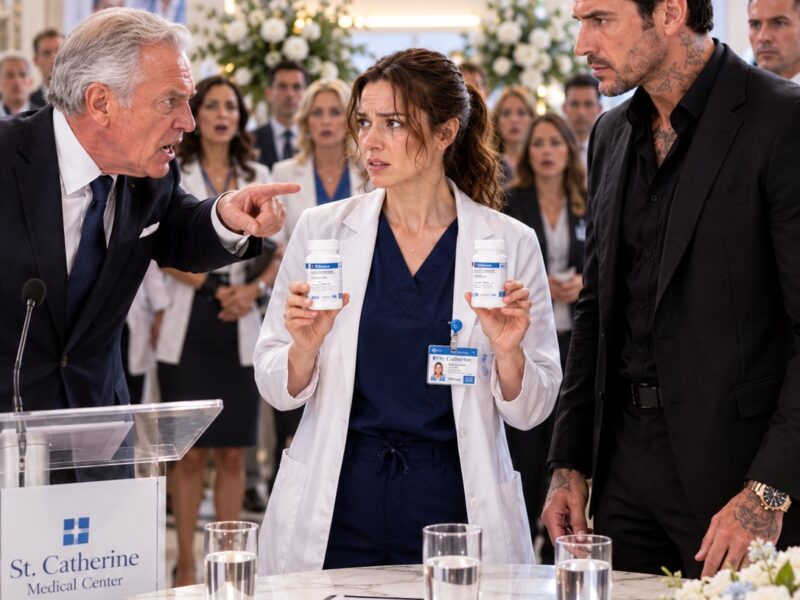
They Called Her Paranoid—Then the Mafia Boss Saw the Two Bottles in Her Hands
The first person to laugh at Leah Morgan was the hospital president.
The second was the chief financial officer.
By the time the laughter reached the donor tables beneath the chandeliers of St. Catherine Medical Center’s glass atrium, Leah had already decided there was a good chance she would lose her job before dessert.
She just had not decided whether she cared.
“Miss Morgan,” President Henry Caldwell said into the microphone, wearing the patient smile of a man accustomed to having uncomfortable employees escorted out of expensive rooms. “This is neither the time nor the place.”
Leah stood at the edge of the stage in a plain navy dress, her hospital identification badge still clipped at her waist because she had come directly from the pharmacy downstairs.
In each hand, she held a medication bottle.
Identical white plastic.
Identical blue-and-silver label.
Same manufacturer.
Same dosage.
Nearly identical lot numbers.
Around her sat pharmaceutical executives, surgeons, hospital trustees, city officials, and donors who had paid five thousand dollars a plate to celebrate St. Catherine’s new pharmaceutical purchasing agreement.
The agreement had supposedly saved the hospital eighteen million dollars in one year.
Leah knew exactly how.
“Then tell me when the right time is,” she said.
The laughter stopped.
Caldwell’s smile disappeared.
At the nearest table, Dr. Adrian Vale leaned back in his chair.
Vale was St. Catherine’s executive vice president, forty-six, silver beginning at his temples, immaculate in a charcoal tuxedo. He had the polished face of a man who had spent twenty years mastering the difference between appearing compassionate and actually being inconvenienced by suffering.
He had negotiated the new pharmaceutical contract himself.
“Leah,” he said gently, as though addressing a confused patient, “we have discussed your concerns.”
“No.”
Her voice stayed level.
“You told me to stop documenting them.”
Something shifted in the room.
A surgeon near the stage looked down.
Someone at the donor tables stopped lifting a wineglass.
Leah also noticed the man seated three tables away.
He had not laughed.
He had not whispered.
Unlike everyone else, he was not looking at the bottles.
He was looking at her.
Nicholas Bellini sat with one hand resting beside an untouched glass of whiskey.
Thirty-nine.
Black Italian suit.
Dark hair swept neatly back.
A face too controlled to be handsome in any gentle way.
Men like Nicholas did not require introductions in Chicago.
The Bellini name had been spoken in union halls, private clubs, construction offices, courtrooms, police stations, and neighborhoods where people understood that respectable businesses sometimes had less respectable foundations.
No conviction had ever touched Nicholas himself.
His legitimate companies owned freight terminals, warehouses, security firms, restaurants, commercial real estate, and one of the largest private logistics networks in Illinois.
When cameras were present, people called him a businessman.
When they thought nobody important was listening, they used a different word.
Mafia.
Leah knew Bellini Logistics handled a significant portion of St. Catherine’s medical freight.
If she was wrong, she might lose her job.
If she was right, Nicholas Bellini might lose millions.
Possibly much more.
Vale stood.
“This young woman is a pharmacy technician. Conscientious, certainly. But she does not understand international procurement.”
Leah looked directly at him.
“I understand a batch code.”
Then she walked to the presentation table.
Her knees felt weak.
She refused to let anyone see.
Leah placed both bottles beneath the overhead document camera.
Their enlarged labels filled the enormous screen behind her.
“Bottle one arrived eleven months ago through our previous supplier.”
She rotated it.
“Bottle two arrived Monday through Northstar Medical Distribution under the new contract.”
She turned the second.
“To anyone looking quickly, they are identical.”
Caldwell crossed his arms.
Leah pointed.
“There.”
Nothing happened.
For a terrible half second, she thought the detail would remain invisible even magnified thirty feet high.
Then a pharmacist in the front row stood.
He moved closer.
Leah continued.
“The fourth character of the microprinted batch identifier should be laser etched.”
She pointed again.
“On the new bottle, it’s thermal ink.”
Vale’s expression changed.
Almost nothing.
A fraction of a second.
Leah saw it.
So did Nicholas Bellini.
“The expiration-date font is also wrong by less than half a millimeter. And the security varnish should reflect violet under ultraviolet light. The manufacturer changed it sixteen months ago.”
The atrium became silent.
Caldwell stared at the screen.
“That does not prove counterfeit medication.”
“No.”
Leah reached into her purse.
Her fingers were beginning to shake.
She placed a folded laboratory report beneath the camera.
“But this does.”
Vale rose fully.
“Where did you get that?”
Leah ignored him.
“The older vial contains the labeled concentration.”
She flattened the page.
“The discounted shipment contains fifty-eight percent.”
A chair scraped backward.
Someone whispered something that sounded like Jesus.
Leah curled her fingers against the edge of the table to hide the trembling.
“These medications are being administered to patients upstairs.”
Caldwell’s face drained of color.
Vale recovered first.
“You illegally removed hospital property for private testing.”
“I reported the discrepancy three times internally.”
“You violated procedure.”
“Patients may have received counterfeit drugs.”
“Allegedly.”
Leah stared at him.
“You’re more worried about the word allegedly than the patients.”
That was when Nicholas Bellini stood.
He did it slowly.
Yet every conversation trying to begin in the room stopped.
Nicholas buttoned his jacket.
Then looked toward the man seated behind him.
“Mateo.”
Mateo Ricci rose immediately.
“Freeze every Bellini medical shipment in Illinois.”
Vale turned.
“Nicholas.”
“Every truck. Every warehouse. Every subcontractor.”
“You understand what that could cost?”
Nicholas finally looked at him.
“I understand exactly what it will cost.”
His voice was quiet.
That made it worse.
“No medical freight moves until those bottles are independently authenticated.”
Caldwell stepped down from the stage.
“You cannot unilaterally paralyze a hospital supply chain.”
Nicholas looked at Leah.
She had expected anger.
Instead she saw something colder.
And, strangely, something almost frightened.
“Miss Morgan.”
“How many suspect shipments have you seen?”
Vale interrupted.
“She has no authority to—”
Nicholas did not raise his voice.
“Do not answer questions directed at someone else.”
Vale stopped.
Nicholas’s gaze remained on Leah.
“How many?”
She swallowed.
“Seven.”
A murmur moved through the room.
“Four medications. Same supplier. Same type of packaging discrepancy.”
“You documented them?”
“Yes.”
“Where?”
Leah hesitated.
Vale noticed.
So did Nicholas.
For the first time that evening, Leah saw real danger enter his expression.
“Somewhere safe.”
Nicholas studied her.
Then nodded once.
“Good.”
The lights went out.
Darkness swallowed the atrium.
Someone screamed.
A second later, glass shattered.
Nicholas crossed the distance between them before Leah understood what was happening.
His arm locked around her waist.
He pulled her behind the marble presentation podium as something struck the stage above them.
Guests scattered.
Security guards shouted.
Emergency lights flashed red along the walls.
Then Leah heard it.
Three sharp cracks from beyond the glass doors.
Gunshots.
Nicholas covered her with his body.
One hand pressed against the back of her head.
“Stay down.”
Her heart slammed against her ribs.
“Were they shooting at me?”
Nicholas looked over the edge of the podium.
His face had become completely expressionless.
“Yes.”
“How can you possibly know that?”
Another impact cracked against marble.
Nicholas looked down at her.
“Because nobody started shooting until you put those bottles on the screen.”
Three hours later, Leah stood inside Nicholas Bellini’s penthouse forty floors above Chicago and told him she wanted to leave.
Rain dragged silver lines down the windows.
Two security men remained outside the private elevator.
Her phone sat dismantled on a marble counter after Mateo’s team found unauthorized tracking software buried inside what appeared to be a hospital scheduling application.
Leah folded her arms.
“I’m not staying here.”
Nicholas removed his suit jacket.
There was blood on one white cuff.
Not his.
One of his security guards had been injured during the evacuation.
“You are until we know who tried to kill you.”
“You don’t get to decide that.”
“I already did.”
Her anger sharpened.
“That may work on people who are afraid of you.”
Nicholas looked at her.
“You are afraid of me.”
Leah hated that he was right.
She hated even more that he seemed to respect her for refusing to let fear settle the argument.
“I’m afraid of men who believe power makes consent optional.”
His jaw tightened.
For several seconds, neither spoke.
Then Nicholas gestured toward the elevator.
“You may leave.”
Leah blinked.
“But if you do, Mateo goes with you. Another vehicle follows. Your apartment is cleared before you enter, and no one approaches you without being checked.”
“That isn’t leaving.”
“It is the version currently available.”
“You are unbelievable.”
“I have been called worse.”
“I’m sure.”
Something almost touched his mouth.
Almost.
Then it disappeared.
Nicholas poured water into a glass and offered it.
Leah did not take it.
“I need my records.”
“Where are they?”
“My apartment.”
“I’ll retrieve them.”
“No.”
“Miss Morgan—”
“Leah.”
His eyes settled on hers.
It was the first time she had given him permission to use her first name.
Something quiet passed between them.
“Nicholas,” she said deliberately, testing his name in return. “If you want my help, nobody touches my evidence without me.”
He leaned against the counter.
“And if I tell you this is no longer merely your investigation?”
“Then I remind you protecting Bellini Logistics is not the same as protecting patients.”
His gaze sharpened.
“You believe I don’t understand that?”
“I believe powerful men become very talented at confusing their interests with everyone else’s.”
The penthouse became dangerously still.
Mateo, standing several yards away, developed an intense interest in the skyline.
Nicholas walked closer.
Not threateningly.
That would almost have been easier.
He stopped two feet away.
“Do you speak to hospital executives like this?”
“Yes.”
“That explains tonight.”
“Does everyone around you agree with you?”
“No.”
“Do they tell you when you’re wrong?”
Nicholas paused.
“Rarely.”
“That explains a lot too.”
This time Leah saw it.
The faintest shadow of amusement.
Gone immediately.
Then Nicholas said, “We retrieve your records together.”
Leah’s apartment door was open when they arrived.
Nothing had been stolen.
That was worse.
Every drawer had been emptied.
Books scattered.
Mattress cut open.
Family photographs broken across the floor.
And on her kitchen table stood one counterfeit medication bottle.
Leah froze.
Nicholas stepped in front of her.
“Do not touch anything.”
She stared around him.
Beside the bottle was a photograph.
Her mother.
Walking outside the rehabilitation clinic where she worked three days a week.
Leah stopped breathing.
“No.”
Nicholas lifted the photograph by one corner.
Someone had written an address on the back.
Her mother’s address.
“I need to call her.”
“She is already being moved.”
Leah looked at him sharply.
“What?”
“I told Mateo to send security the moment we found the tracker on your phone.”
“You sent strangers to my mother?”
“To protect her.”
“You had no right.”
“No.”
The immediate agreement stopped her.
Nicholas looked at the photograph.
“I didn’t.”
He raised his eyes.
“But I would rather have you hate me tonight than identify her body tomorrow.”
Leah’s anger collapsed beneath something colder.
She sat on the edge of her ruined couch.
For the first time since the gala, her control cracked.
Nicholas stood in front of her.
Helpless.
She would later understand how few people had ever seen him that way.
His hand lifted.
Almost touched her cheek.
Stopped.
His fingers curled slowly.
He lowered them.
“My sister was twenty-four.”
Leah looked up.
Nicholas stared toward the dark window.
“She had leukemia.”
The words seemed physically difficult.
“My father imported a treatment through a private clinic. We were told it would improve her odds.”
Leah understood before he finished.
“The medicine was counterfeit.”
“Yes.”
Long silence.
“She might have died anyway.”
Nicholas’s voice went flat.
“That is what every doctor told us afterward. They meant it kindly.”
“It didn’t help.”
“No.”
Something hard moved behind his eyes.
“So when you stood beneath those chandeliers with those bottles, I wasn’t thinking about contracts.”
Leah watched him.
“What were you thinking about?”
His gaze returned to her.
“My sister vomiting blood while somebody somewhere counted the profit.”
The room changed.
“That will not happen again on one of my trucks.”
Leah did not trust Nicholas that night.
Not fully.
But she began understanding the distance between the man Chicago feared and the wound hidden beneath his perfect control.
For the next nine days, they became nearly inseparable.
Not by choice.
At least that was what Leah told herself.
Bellini Security traced the counterfeit medication to Northstar Medical Distribution, which was owned by a Delaware holding company, which was owned by another corporation registered in Nevada, which had paid “inspection consulting fees” to a company partially controlled by Adrian Vale’s brother-in-law.
Leah spent twelve-hour days inside a secure Bellini warehouse comparing packaging against authenticated manufacturer samples.
Nicholas sat through every briefing.
On day one, he knew almost nothing about pharmaceutical verification.
By day four, he could identify the difference between a legitimate holographic seal and a printed imitation.
Leah found that irritatingly attractive.
She also learned Nicholas drank coffee black, slept approximately four hours a night, and never raised his voice when furious.
He remembered the name of every warehouse worker affected by the shutdown.
Nicholas learned Leah hummed while concentrating.
That she called her mother every evening at eight.
That she skipped meals when anxious.
That she refused to let his employees carry boxes merely because he was in the room.
On the third evening, a turkey sandwich appeared beside Leah’s paperwork.
She looked at Nicholas.
“What is this?”
“Food.”
“I know what food is.”
“Then we are making progress.”
“Did you order it?”
“No.”
She stared.
Mateo coughed nearby.
Leah looked toward him.
Mateo examined his tablet.
“Nobody in this building lies convincingly.”
Nicholas’s eyes narrowed.
Leah ate the sandwich.
She did not thank him.
The next evening another appeared.
Neither mentioned the arrangement again.
One rainy night, Leah emerged from the warehouse after midnight and found Nicholas beside a black SUV.
“You’re still here?”
“Yes.”
“Why?”
“I’m taking you home.”
“You employ drivers.”
“Yes.”
“Then why are you driving me?”
His eyes held hers.
Rain dotted the shoulders of his coat.
“I did not say it was logical.”
Her pulse stumbled.
She looked away first.
That became the pattern.
His hand appearing at the small of her back without quite touching.
His eyes finding her across crowded rooms.
Nicholas positioning himself between her and unfamiliar people before he seemed conscious of doing it.
Leah recognizing the tightening of his jaw whenever another man stood too close.
Attraction arrived like something leaking beneath a locked door.
Both noticed.
Neither admitted it.
Then Dr. Evan Mercer appeared.
Evan was a federal pharmaceutical investigator brought into the case after Leah insisted Nicholas’s private investigation required outside oversight.
Nicholas disliked him immediately.
Leah noticed within seven minutes.
“You look annoyed.”
“I am.”
“Because he’s federal?”
“Yes.”
“No.”
Nicholas glanced toward her.
“He asked about your companies.”
“Yes.”
“No.”
His expression cooled.
“What answer are you looking for?”
Leah looked across the warehouse.
Evan was standing beside a loading table, smiling as he asked a pharmacist about chain-of-custody forms.
“He looks at me too much.”
Nicholas said nothing.
Leah slowly turned.
Then laughed.
His expression darkened.
“That amuses you?”
“Terribly.”
“Why?”
“Because Nicholas Bellini, feared by half of Chicago, is jealous of a federal investigator wearing orthopedic shoes.”
“I’m not jealous.”
“Of course not.”
“I dislike his shoes.”
That was the first time Leah saw Nicholas smile.
Really smile.
Small.
Private.
Devastating.
Then the warehouse lights died.
His smile vanished.
An alarm sounded from the loading dock.
Security rushed toward the doors.
Nicholas moved Leah immediately behind a reinforced partition.
“Stay here.”
“No.”
His eyes flashed.
“Leah.”
“People are still in there.”
“And there are trained security officers handling it.”
That stopped her.
Barely.
“Fine.”
Nicholas looked almost surprised.
“I am capable of listening occasionally.”
“Stay capable.”
The disruption lasted four minutes.
Nobody fired a weapon.
Nobody was hurt.
But someone had deliberately triggered the building’s emergency shutdown while a false fire alarm pulled most security toward the east loading bay.
In those four minutes, somebody accessed the pharmaceutical evidence room.
Nothing was taken.
One item was added.
Six Bellini inspection certificates.
Digitally signed with Nicholas’s executive credentials.
Evan Mercer stared at them.
“If federal agents find these first, Bellini becomes part of the counterfeit chain.”
Nicholas showed almost no reaction.
Leah felt enough for both of them.
“These signatures are forged.”
“Probably,” Evan said.
“Probably?”
“We prove things. We don’t assume.”
Nicholas looked at him.
For once, Leah appreciated the federal investigator’s personality.
“Who had access to your digital authorization?”
Evan asked.
Nicholas said nothing.
Leah noticed.
“Nicholas.”
His gaze moved to her.
“Who?”
Long pause.
“Marco Santoro.”
“Who is Marco?”
“Director of medical freight compliance.”
“How long?”
“Eleven years.”
Something cold entered Leah’s stomach.
“You trust him.”
“I did.”
“That wasn’t what I asked.”
Nicholas looked away.
There.
The thing she had feared.
Power protecting itself.
“You knew Marco could access your authorization, and you didn’t tell us.”
“I had no evidence Marco was involved.”
“You had information relevant to the investigation.”
“I withheld one vulnerability until I knew who was leaking our work.”
“You manipulated what I knew.”
“To keep you alive.”
“No.”
Leah stepped backward.
“You do not get to use that sentence every time you decide for me.”
Nicholas’s face hardened.
“Someone attempted to kill you at the gala.”
“That does not make me yours.”
The words landed harder than intended.
Nicholas went completely still.
“I know that.”
“Do you?”
“Yes.”
His voice lowered.
“You think I do not understand the difference between wanting something and having a right to it?”
Leah could not answer.
Nicholas took one step closer.
“I want you in my home because I know the security there.”
Her heartbeat became painful.
“I want every person who frightened you removed from this city. I want Mercer to stop smiling at you.”
Despite herself, Leah almost reacted.
Nicholas continued.
“I want you to stop entering rooms before I know who is inside them.”
Silence.
“I want many things I have absolutely no right to demand.”
Leah stared at him.
The anger remained.
But the honesty cut through it.
“Then why didn’t you tell me about Marco?”
Nicholas’s expression changed.
“Because I was afraid.”
That surprised her more than anything else.
“Nicholas Bellini is afraid?”
“Frequently.”
“Of what?”
“You.”
Her breath caught.
He did not smile.
“I was afraid you would see those certificates and decide I was exactly what everyone already told you I was.”
Leah looked down.
Then up again.
“You do not earn trust by controlling what someone is allowed to know.”
“No.”
“Then earn it.”
Nicholas nodded once.
“Fine.”
From that moment forward, he gave her everything relevant to the case.
Every legitimate shipping ledger.
Every internal inspection failure.
Every accusation of bribery tied to medical freight.
Every compromised manager.
Even records that created legal problems for Bellini companies.
It was not romantic.
It was better.
Trust without leverage.
The breakthrough came from a bottle that should never have existed.
At 2:13 one morning, Leah sat barefoot on the rug in Nicholas’s study, surrounded by manifests.
Nicholas had fallen asleep in an armchair ten feet away.
For once, no conscious control held every muscle of his face in place.
He looked younger.
Almost peaceful.
Leah watched him longer than she should have.
Then saw the route code.
She sat upright.
“No.”
Nicholas woke instantly.
“What?”
“Three counterfeit batches were supposedly inspected at Warehouse Seven.”
“Yes.”
“The temperature logs.”
Nicholas moved beside her.
Leah pointed.
“Warehouse Seven’s refrigeration system was offline for renovation during the exact dates these biologics supposedly passed inspection there.”
He stared.
“These bottles were never there.”
Within twenty minutes, the route began unfolding.
Northstar imported the products into Illinois under legitimate research classifications.
The finished counterfeit medications were packaged later.
Inside Chicago.
The Bellini inspection records were fake because the medication had never traveled through the warehouses Nicholas supposedly approved.
The forged certificates had been planted to point investigators at Bellini.
Nicholas looked at the destination list.
“St. Catherine Annex Four.”
Leah frowned.
“That building closed years ago.”
“Five.”
They did not drive there alone.
Evan would have arrested both of them personally.
Instead, federal investigators obtained a warrant using the audit trail.
Nicholas hated waiting.
Leah made him.
“You said evidence.”
“I remember.”
“You look like you want to bite through that table.”
“I am considering alternatives.”
At dawn, agents entered Annex Four.
They found an illegal pharmaceutical packaging line.
Thousands of empty bottles.
Labels.
Tamper seals.
Medication from hospitals across three states.
And digital records connecting Northstar, Marco Santoro, and companies controlled by Adrian Vale’s family.
Marco was arrested before noon.
Vale was taken from his office at St. Catherine while hospital employees watched.
President Caldwell resigned before the evening news.
Leah expected relief.
Instead she felt sick.
Because the files contained patient numbers.
Real people.
People who had been given under-strength medication.
Cancer treatments.
Immune therapies.
Cardiac drugs.
Some would never know whether a bad outcome came from disease or from someone’s greed.
Leah sat in Nicholas’s study that evening.
Neither spoke for several minutes.
Finally—
“Your sister.”
Nicholas looked toward her.
“This is what happened to her.”
“Yes.”
Leah swallowed.
“I kept imagining this ending with proof.”
“Proof is rarely the end.”
“No.”
She stared at her hands.
“It just tells you exactly how bad reality was.”
Nicholas moved closer.
Stopped.
“Can I?”
Leah knew what he meant.
She nodded.
He sat beside her.
Nothing more.
No arm around her.
No forced comfort.
For ten minutes, they simply sat.
Leah eventually leaned against him first.
Nicholas closed his eyes.
She felt it.
The tension leaving his body one careful inch at a time.
The criminal case expanded quickly.
Vale had not considered himself a villain.
That was what disturbed Leah most.
During questioning, he insisted St. Catherine could no longer sustain legitimate drug prices.
Northstar supplied medications at deep discounts.
He claimed most batches were “clinically adequate.”
Fifty-eight percent concentration.
Sometimes sixty-three.
Sometimes seventy-one.
Margins.
Savings.
Access.
Words that converted people into numbers.
Federal prosecutors disagreed.
So did patients.
Nicholas cooperated with the investigation into Bellini medical freight.
Not without consequences.
Several Bellini managers had accepted bribes from Marco without knowing the larger scheme.
Others clearly knew something was wrong and chose not to ask.
Nicholas fired some.
Turned records over on others.
Closed an entire freight subsidiary.
Bellini Logistics lost more than sixty million dollars in contracts.
Mateo walked into Nicholas’s office holding the final cancellation report.
“This will hurt.”
Nicholas signed it.
“It should.”
Mateo watched him.
“You sound like Leah.”
“That is deeply insulting.”
Leah, sitting on the opposite sofa, looked up.
“I heard that.”
“Good.”
Mateo smiled and left.
For a while, it seemed like the danger was over.
Then Leah’s hospital login appeared in the evidence.
Not because she had done anything.
Because somebody wanted investigators to think she had.
The Northstar files showed three unauthorized inventory adjustments created under Leah’s employee number.
One corresponded to medication she had already flagged.
Another was entered while she had been standing at the fundraiser.
The third had been made at 3:12 in the morning.
Evan placed the printouts on the table.
Leah stared.
“They are framing me.”
“Yes.”
“Why?”
Nicholas answered before Evan.
“To undermine the witness.”
Leah’s stomach turned.
Her credibility was the entire case’s first domino.
If defense attorneys could argue she had manipulated inventory, removed bottles, and created false discrepancies, every early report became less useful.
The hospital placed her on administrative leave.
Again, executives spoke carefully.
No accusation.
Pending review.
Protecting all parties.
Leah listened to every polished sentence.
Then went home and cried in her kitchen.
Nicholas arrived twenty minutes later.
She had not called him.
That angered her.
“How did you know?”
“Evan told Mateo.”
“And Mateo told you.”
“Yes.”
She wiped her face.
“I don’t need you to fix this.”
“I know.”
“Do you?”
Nicholas stopped.
Leah pointed toward a chair.
“Sit.”
He sat.
“Do not call Caldwell.”
“He resigned.”
“Do not call his replacement.”
“Fine.”
“Do not threaten hospital counsel.”
Nicholas’s expression became offended.
“I rarely threaten attorneys.”
“You terrify them by existing.”
“That is not actionable.”
Leah almost laughed.
Almost.
Then her face crumpled again.
“My whole career is twelve years of being careful.”
Nicholas said nothing.
“I scan twice. I count twice. I document things nobody else notices because if pharmacy makes a mistake, somebody can die.”
Her voice broke.
“And now the reason they can make me look guilty is because I noticed too much.”
Nicholas’s hands tightened on his knees.
Still he did not interrupt.
“I worked so hard to be the person people trust when something feels wrong.”
Leah looked at him.
“What if they don’t anymore?”
Nicholas waited.
Then asked, “Do you want sympathy or a solution?”
Leah stared.
A wet laugh escaped.
“Where did you learn that?”
“I listen occasionally.”
“Sympathy.”
He nodded.
Then opened his arms.
Not moving toward her.
Leah crossed the space herself.
He held her while she cried.
No promises.
No revenge.
Only presence.
The next morning, Leah asked for an independent forensic review of her hospital credentials.
The hospital agreed.
She provided her phone.
Laptop.
Badge history.
Apartment router logs.
Her work token.
Nicholas offered Bellini security specialists.
Leah refused.
He accepted it.
The hospital hired an outside digital-forensics company.
Five days later, they found the first fracture.
Leah’s employee account had authenticated from a hospital workstation on the fourth floor while her badge was recorded entering the pharmacy two levels below.
Someone had cloned access.
The workstation belonged to executive administration.
More specifically, to Vale’s suite.
The second forged transaction was entered while Leah was speaking on stage.
Security footage showed Vale’s assistant leaving the gala for eleven minutes.
The third had been backdated.
Leah was cleared.
Completely.
No dramatic apology came.
Only a letter from hospital counsel.
Ms. Morgan’s credentials were compromised without her knowledge or authorization.
Leah printed it.
Then put it in a drawer.
Nicholas found her at the kitchen table.
“You’re not celebrating.”
“I thought I would.”
“What do you feel?”
“Tired.”
He sat.
Leah looked at him.
“They believe me again.”
Nicholas shook his head.
“No.”
Her eyebrows pulled together.
“You made them prove you.”
The sentence stopped her.
He continued.
“You did not ask anyone for faith.”
His voice softened.
“You demanded evidence.”
Leah smiled faintly.
“That was annoyingly good.”
“I have occasional moments.”
“You absolutely practiced that.”
“I did not.”
“You did.”
“Possibly once.”
She laughed.
And for the first time in weeks, the laughter did not hurt.
The case went to court eleven months later.
Vale and Marco both faced federal charges.
Northstar’s owners took plea agreements.
Several hospital administrators were charged with obstruction and procurement fraud.
Caldwell avoided prison but paid fines and lost every leadership position attached to the scandal.
Nicholas testified about Bellini’s medical-freight vulnerabilities.
Reporters called it unprecedented.
People in his old world called it betrayal.
Nicholas called it Tuesday.
That did not mean it cost nothing.
Two Bellini relatives stopped speaking to him.
Three senior employees left.
One legitimate business partner canceled a major development project.
Nicholas absorbed each loss without asking Leah to tell him it was worth it.
She appreciated that.
One evening, after a twelve-hour deposition, Leah found him sitting alone in his office.
Tie loosened.
Whiskey untouched.
“You okay?”
“No.”
Leah nodded.
“Good answer.”
Nicholas looked at her.
“My father built part of this company.”
“I know.”
“My sister loved him.”
Leah waited.
“He also taught men like Marco that loyalty mattered more than scrutiny.”
Nicholas rubbed one hand across his jaw.
“I spent years believing my job was to protect what he built.”
“And now?”
Nicholas looked through the window toward Chicago.
“My job is deciding what deserves to survive him.”
Leah sat beside him.
“That sounds miserable.”
“It is.”
“Want sympathy or a solution?”
His eyes moved toward her.
“Coffee.”
“That was not an option.”
“It is now.”
She smiled.
“I’ll make coffee.”
He caught her hand gently.
Leah stopped.
Nicholas looked at their joined hands.
Then at her.
“Thank you.”
“For coffee?”
“For making me look.”
Her smile faded.
“Nicholas—”
“I’m serious.”
He stood.
Leah’s pulse changed.
There had been months of almost.
Eyes holding too long.
Hands stopping before touching.
Late-night drives neither could logically explain.
Attraction had survived fear, arguments, and investigations.
But Nicholas had never crossed the line without invitation.
He came closer.
Stopped.
“May I?”
Leah looked at him.
This man had once told her she would remain in his penthouse because he had decided.
Now he was standing a foot away asking permission to kiss her.
Something inside her softened.
“Yes.”
Nicholas kissed her slowly.
Not hesitantly.
Carefully.
Leah’s hand moved to his chest.
The restraint between them lasted another second.
Then broke.
His hand settled at her waist.
No pulling.
Leah closed the distance herself.
When they separated, Nicholas rested his forehead briefly against hers.
“That was a terrible idea.”
“Yes.”
“Complicated.”
“Yes.”
She looked at him.
“You still terrifyingly enjoy agreement.”
“Very much.”
Leah smiled.
Then became serious.
“This doesn’t mean you get to protect me by lying.”
“No.”
“Or decide where I live.”
“No.”
“Or send armed people to my mother.”
His expression tightened.
“That one may require discussion.”
“Nicholas.”
“No.”
She stared.
He almost smiled.
“I meant no, I will not do it without asking.”
“Good save.”
“I am adapting.”
“Painfully.”
“Extremely.”
They began dating without announcing it.
That lasted six days.
A photograph appeared online of Nicholas holding an umbrella over Leah outside a federal courthouse.
The headline called her BELLINI’S MYSTERY WOMAN.
Her mother called within ten minutes.
“So.”
Leah closed her eyes.
“Mom.”
“He’s handsome.”
“That is not the issue.”
“I know who he is.”
“That is more the issue.”
Her mother became quiet.
“Are you safe?”
Leah looked toward Nicholas, who was pretending not to listen from across her apartment.
“Yes.”
“Are you free?”
That question was better.
Leah smiled.
“Yes.”
“Then the rest is your problem.”
“Thanks.”
“You’re welcome.”
Nicholas looked at her after the call.
“Your mother dislikes me.”
“She said you’re handsome.”
His eyebrows rose.
“Unexpected.”
“She also asked whether I was free.”
His expression became serious.
“What did you say?”
“Yes.”
Something in Nicholas changed.
Very small.
But Leah noticed.
Six months passed.
St. Catherine created an independent medication-integrity department.
Leah was offered the deputy director position.
Not because Nicholas demanded it.
She made sure of that.
The offer came through an outside committee.
Salary.
Authority to halt suspect medication.
Independent reporting to the board.
Leah accepted.
Nicholas sent flowers.
Normal flowers.
Not a thousand roses.
Not a car.
Not a hospital wing.
Leah called.
“These are suspiciously appropriate.”
“I had assistance.”
“Mateo?”
“My aunt.”
“That explains everything.”
“I disliked the process.”
“Growth hurts.”
“Yes.”
The department’s first major project was rebuilding St. Catherine’s vendor-authentication system.
Leah insisted Bellini Logistics participate only through independent audits.
Nicholas agreed.
Mostly.
“You want strangers inspecting my warehouses.”
“Yes.”
“I have inspectors.”
“You had Marco.”
Silence.
“Point taken.”
“Write that down.”
“I will not.”
Bellini Medical Freight survived.
Barely.
Nicholas voluntarily surrendered several exclusive contracts and rebuilt the division around third-party pharmaceutical verification.
The business became smaller.
Less profitable.
More difficult to manipulate.
Business magazines called it corporate reform.
Leah knew the truth was less elegant.
A man had learned that controlling a system was not the same thing as understanding it.
One rainy October evening, Leah finished late at the hospital.
She expected Nicholas’s driver.
Instead she found Nicholas beneath the awning.
No umbrella.
Black coat.
Rain gathering in his dark hair.
A black SUV waited at the curb.
Two discreet guards stood far enough away to pretend they were not watching.
Leah stopped.
“You know cars have roofs.”
“Yes.”
“And drivers.”
“Yes.”
“Then why are you standing outside?”
Nicholas looked at her.
Months had not made him harmless.
People still stepped aside when he entered rooms.
His name still carried fear.
He remained obsessive.
Difficult.
Capable of becoming controlling when frightened.
But now he recognized those instincts before automatically treating them as virtues.
“I wanted to see you sooner.”
Leah’s heart performed the same ridiculous stumble it had the first night he drove her home.
“You saw me this morning.”
“Too long.”
“That sounds unhealthy.”
“It probably is.”
She walked into the rain toward him.
Nicholas opened his coat slightly, covering her shoulders.
“You are getting me wet.”
“You came outside.”
“You could have waited under the awning.”
“You could have stayed there.”
Neither moved.
Rain whispered against the pavement.
City lights reflected gold along the street.
Nicholas reached into his pocket.
Leah narrowed her eyes immediately.
“No.”
He stopped.
“I have not done anything.”
“That is a ring box.”
“It might not be.”
“It is absolutely a ring box.”
Nicholas Bellini, a man who could negotiate with politicians without blinking, actually looked uncertain.
Leah’s expression softened.
“You’re nervous.”
“No.”
“You are.”
“I have negotiated under less hostile conditions.”
She laughed.
Nicholas took her hand.
“I am not asking tonight.”
Leah blinked.
“Then why do you have it?”
“Because six months ago I would have decided when you were ready.”
His thumb brushed over her knuckles.
“I’m trying something different.”
“What?”
“Patience.”
Leah smiled.
“That sounds painful.”
“Extremely.”
He returned the box to his pocket.
“When you are ready, tell me.”
Leah studied him beneath the rain.
Then kissed his cheek.
Nicholas frowned.
“What was that?”
“Patience.”
His arm circled her waist.
“You are enjoying this.”
“Extremely.”
For once, Nicholas laughed.
Not the controlled shadow of a smile she had first stolen from him over Evan Mercer’s orthopedic shoes.
A real laugh.
Warm.
Surprised.
Almost unfamiliar coming from him.
Leah listened beneath the Chicago rain and remembered two identical bottles on a ballroom table.
Something microscopic had been wrong with one of them.
A font.
A varnish.
A tiny mark almost everybody dismissed.
That detail exposed Northstar.
Vale.
Marco.
Corrupt hospital executives.
It almost destroyed Bellini Medical Freight.
It forced Nicholas to look directly at systems he had inherited without questioning closely enough.
And somewhere inside all of that, Leah discovered something else almost everyone had overlooked.
There were two versions of Nicholas too.
The man Chicago knew.
Cold.
Dangerous.
Controlled.
And the man who froze millions of dollars in shipments because one pharmacy technician said something was wrong.
The man who learned counterfeit-label patterns because a dead sister had taught him what a fake bottle could cost.
The man who sat beside Leah when her career was threatened instead of trying to buy her way out.
The man who slowly learned protecting her did not mean owning her decisions.
The man who could command an organization and still stand in the rain waiting for one woman to choose him.
Leah slipped her hand into his.
“Take me home.”
Nicholas looked down at their joined fingers.
His expression softened only for her.
“Always.”
Behind them, St. Catherine glowed against the storm.
The hospital was different now.
Not perfect.
No institution became perfect because one scandal ended.
But pharmacy technicians could report directly to medication integrity without executive approval.
Random batch testing happened monthly.
Shipping vendors were independently verified.
Patient-assistance funds helped hospitals refuse suspiciously cheap medications instead of pretending budget pressure excused blindness.
Nicholas’s sister’s name appeared on one of those programs.
Sophia Bellini Medication Access Fund.
Nicholas had resisted using her name.
Leah convinced him.
“She deserves to be remembered for more than how she died.”
That argument he could not defeat.
A year after the fundraiser, the hospital hosted another donor dinner.
Leah almost declined.
Then she decided she wanted to see the room again.
The glass atrium looked exactly the same.
Same chandeliers.
Same polished floors.
Different people in several important chairs.
Leah stood beside the stage wearing another navy dress.
No bottles in her hands this time.
Nicholas waited near the back.
He had offered to sit at a front table.
Leah told him absolutely not.
“This is my hospital.”
“I donated to the integrity center.”
“You donated anonymously.”
“I regret that decision.”
“Good.”
During the ceremony, the new hospital president invited Leah to speak.
She stood at the same podium where people had laughed at her.
For one second she remembered Caldwell’s smile.
Vale’s gentle contempt.
The room treating her as an inconvenient employee who did not understand the adults’ work.
Then she saw a young pharmacy technician standing near the doors.
Twenty-three, maybe.
Hospital badge clipped to her waist.
Listening.
Leah changed the speech she had prepared.
“Most dangerous failures don’t begin with dramatic mistakes,” she said.
The room quieted.
“They begin with tiny inconsistencies everyone is too busy, too important, or too comfortable to examine.”
Nicholas watched.
“A number that does not match. A label that looks almost right. An employee who says something feels wrong.”
Leah paused.
“The correct response is not to ask whether that employee has enough authority to notice.”
She looked across the atrium.
“The correct response is to look.”
Nicholas lowered his eyes briefly.
He knew that sentence belonged partly to him.
After the applause, Leah stepped down.
The young technician approached.
“Ms. Morgan?”
“Yes?”
“I found something last week.”
Leah stopped.
“What?”
“A refrigerated shipment was outside range for nineteen minutes. They said it was probably fine.”
Leah smiled.
“Probably isn’t a measurement.”
The technician smiled nervously.
“No.”
“Bring me the log tomorrow.”
“I already have it.”
She pulled a folder from her bag.
Leah laughed.
“Good.”
Across the atrium, Nicholas watched.
Mateo stood beside him.
“You’re smiling.”
“I am not.”
“You are.”
Nicholas looked at him.
“Be careful.”
Mateo grinned.
“There he is.”
Leah joined them twenty minutes later.
“Ready?”
Nicholas asked.
“Almost.”
She reached into her purse.
Then handed him two small objects.
Nicholas looked down.
Two empty medication bottles.
The original evidence bottles.
Released after trial.
He stared.
“You kept them.”
“Of course.”
“Why bring them tonight?”
Leah looked around the atrium.
“Because last year everyone saw two identical bottles.”
“They weren’t identical.”
She smiled.
“Exactly.”
Nicholas turned one slowly in his hand.
The fake security varnish no longer mattered.
No patient would receive medication from that lot again.
Vale was in prison.
Marco had testified and received a reduced sentence.
Northstar no longer existed.
But the bottle remained small.
Ordinary.
Dangerous only because people trusted what the label told them.
Nicholas looked at Leah.
“You were right.”
She raised an eyebrow.
“You have said that before.”
“I thought you enjoyed hearing it.”
“I do.”
“Then I am providing a service.”
Leah took the bottle from him.
“You are impossible.”
“I have been informed.”
They walked toward the elevator.
When the doors opened, Leah stepped inside.
Nicholas followed.
For several seconds, neither spoke.
Then Leah glanced toward his coat pocket.
“You still have it?”
Nicholas did not pretend not to understand.
“Yes.”
“The ring.”
“Yes.”
She watched the floor numbers change.
“You really are waiting.”
His expression became serious.
“Yes.”
Leah considered the man beside her.
Once, waiting would have felt impossible to him.
Waiting meant surrendering control.
Leaving the next move with someone else.
Now he stood with both hands at his sides.
No persuasion.
No elaborate speech.
No assumption.
Leah smiled.
“Nicholas.”
“Yes?”
“I’m ready.”
For perhaps the first time since she had known him, Nicholas Bellini looked completely stunned.
She laughed.
“Wow.”
“What?”
“I finally found something that shuts you up.”
His expression shifted.
“Are you certain?”
There it was.
Still asking.
Leah reached into his coat herself.
Found the small box.
Placed it in his palm.
“Yes.”
Nicholas opened it.
The ring was elegant.
Simple by his standards.
Probably still criminally expensive by anyone else’s.
Leah looked at him.
“You’re not kneeling in the elevator.”
“I had not planned to.”
“Good.”
“You have many rules.”
“You like them.”
“Occasionally.”
Nicholas took her hand.
“Leah Morgan.”
She smiled.
“Yes, Nicholas Bellini?”
His voice softened.
“Will you marry me?”
Leah thought of the first night in his penthouse.
You are staying.
The man who believed protection meant deciding.
Then the months afterward.
Ask.
Listen.
Wait.
Learn.
She gave him her left hand.
“Yes.”
Nicholas slid the ring onto her finger.
Then looked at it for a second longer than necessary.
Leah noticed.
“What?”
“Nothing.”
“That is rarely true.”
His mouth curved.
“I’m remembering two bottles.”
“So am I.”
“You stood in a room full of people who thought you were paranoid.”
“They thought I was annoying.”
“You are.”
She narrowed her eyes.
Nicholas continued before she could respond.
“And you were right.”
The elevator doors opened.
Leah did not step out immediately.
Neither did Nicholas.
She looked at him.
“Do you know what actually saved everyone?”
“The laboratory test.”
“No.”
“The bottles.”
“No.”
“Your terrifying personality?”
“That seems plausible.”
Leah laughed.
Then shook her head.
“Someone finally listened.”
Nicholas became quiet.
There it was.
The truth beneath everything.
Leah had spent months believing courage was what mattered most.
Sometimes it was.
But courage without someone willing to examine uncomfortable evidence became only a person shouting into a room determined not to hear.
Nicholas had been powerful enough to stop every shipment.
Leah had been observant enough to give him a reason.
Neither would have been enough alone.
She stepped through the elevator doors.
Nicholas followed.
Not ahead of her.
Not pulling her after him.
Beside her.
Behind them, the doors slid shut.
Leah glanced once at the ring on her hand.
Then at the two empty medication bottles still inside her purse.
One authentic.
One counterfeit.
Almost identical.
A tiny difference had once cost lives because powerful people had decided noticing it was paranoia.
Now an entire hospital system existed because one woman had refused to stop noticing.
And the most feared man in Chicago had learned something just as difficult.
Power was not proving you were always right.
Sometimes power meant becoming quiet enough to hear the person everyone else had already decided was wrong.









