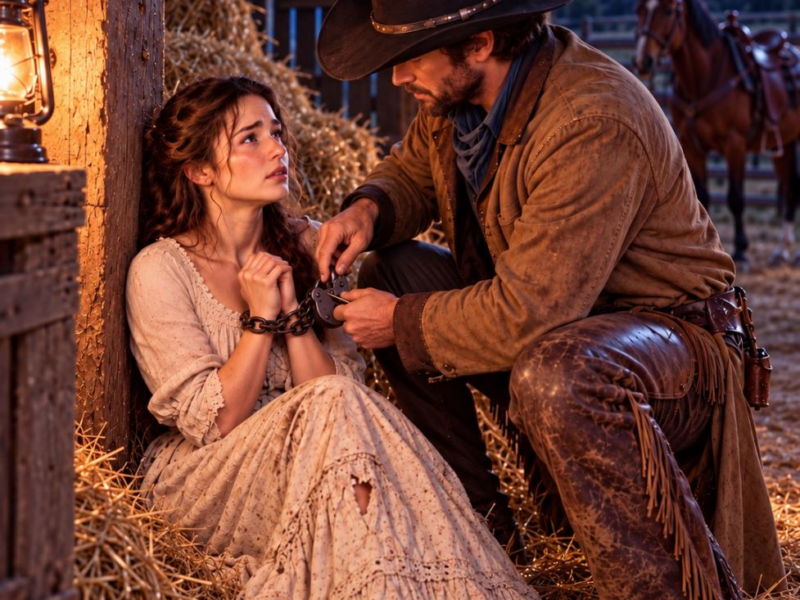
They Chained Her to a Barn Post at Midnight—Until a Widowed Cowboy Cut Her Free and Offered a Home She Was Terrified to Trust
At midnight, Floyd Brown found Bertha Ogden chained to an oak post in an empty barn, her boots missing and the iron pulled tight enough that she could not stand.
The ranch owner had ordered her confined after Bertha refused to surrender the cow she had bought with her own wages—and the men who obeyed were still sleeping less than fifty yards away.
Floyd possessed the key, but freeing her would cost him his job; what neither of them knew was that the chain was only the first thing Bertha would have to escape.
“The chain comes off tonight.”
Bertha Ogden lifted her head so quickly that the links rasped against the oak post behind her.
Floyd Brown was kneeling in the straw with a lantern hanging from an iron hook beside his shoulder, the yellow light catching the weathered seams of his coat and the silver beginning at his temples. One of his hands steadied the padlock below Bertha’s collarbone. The other held the stable key he had used for two summers to open feed stores, tack rooms, and pasture gates.
Never a human being.
“After that,” he said quietly, “you tell me where you want to go.”
Bertha stared at him.
Her hands were free, but the chain crossing her upper chest ran back through an iron ring bolted to the post. It had been shortened until she could sit only with her back bent. Her cream work dress was stained from the barn floor, one side of the hem torn, and one bootless foot had gone numb beneath her.
“Did Olive send you?”
“No.”
“To make me say Bess belongs to her?”
“No.”
Outside the barn, Floyd’s bay gelding waited at the hitch rail beneath a full August moon. Beyond him, the Douglas bunkhouse was dark except for one low lamp someone had neglected to extinguish.
Bertha glanced toward it.
“Her men are there.”
“Asleep when I came through.”
“They wake light.”
“I know.”
“You work for her.”
Floyd pushed the key into the lock.
“I did when I rode in tonight.”
The metal resisted.
He shifted his grip.
Bertha watched his hands with the careful attention of someone expecting pain to follow kindness.
Floyd noticed.
He stopped.
“I’m going to turn this.”
She swallowed.
“All right.”
“If it catches your dress, tell me.”
“All right.”
“If I touch you where you don’t want me to, tell me that too.”
Her eyes moved to his.
For half a second, suspicion gave way to surprise.
Then she nodded.
The key turned with a hard little click.
The padlock opened.
Bertha drew in a breath so sharp Floyd heard it over the horse shifting outside.
He removed the chain without pulling at her dress, lifted the weight clear of her shoulders, then laid the links in the straw.
Afterward he backed away.
Not far.
Far enough.
Bertha remained against the post.
She looked down at the open lock.
Then at Floyd.
He could almost see the question moving through her.
What comes next?
Floyd put the key back on his work ring.
“There’s a road to Buena Vista.”
She did not answer.
“I can take you there at first light.”
Still nothing.
“My place is three miles down the creek.”
Bertha’s eyes narrowed slightly.
“There’s a spare room.”
“Whose?”
“Mine.”
Her face closed.
Floyd understood what she had heard.
“A room with a door that bars from your side.”
That made her look at him again.
“I sleep in the main cabin.”
“Your room is off the kitchen.”
“You can stay tonight.”
“Tomorrow you tell me whether you’re leaving.”
“You don’t owe me work.”
“You don’t owe me cooking.”
“You don’t owe me an answer about anything except whether you’re ready to get out of this barn.”
The links lay between them like a shed skin.
Bertha slowly planted both palms on the straw and pushed herself upright.
Her knees shook.
Floyd did not offer his hand.
She stood anyway.
“My boots are by the harness bench.”
“I’ll fetch them.”
“Set them down.”
He did.
Toes toward her.
Then turned his back while she put them on.
Behind him, leather scraped over straw.
He heard Bertha stand again.
“Your place.”
Floyd looked over his shoulder.
“For tonight?”
“For tonight.”
That was the first choice anyone had let her make since Olive Douglas ordered the chain fastened around her.
Floyd picked up the iron.
He folded it into an empty feed sack with the padlock.
Bertha frowned.
“Why keep it?”
“If Olive tells the county deputy you imagined this, I’d rather not argue with empty hands.”
Her face changed.
Not gratitude.
Something more cautious.
Respect, perhaps.
“Good.”
He tied the sack securely behind his saddle.
Then held the bay steady while Bertha mounted from the left side herself.
She gathered her skirts without assistance.
Floyd checked the cinch.
“You ride?”
“Better than you cook.”
He looked up.
“You’ve seen me cook?”
“I’ve seen what you carry in your lunch tin.”
Despite everything, the corner of her mouth moved.
Floyd felt something inside him loosen.
“Cruel.”
“I’ve had a difficult evening.”
“Fair.”
He took the reins and walked.
Bertha stayed mounted.
The road followed the creek beneath cottonwoods pale in moonlight.
Loose shale shifted beneath Floyd’s boots.
Neither spoke for nearly a mile.
At a stand of willows, Floyd stopped so the bay could breathe.
“You holding up?”
“Yes.”
Her fingers had been tight around the saddle horn.
Now one hand rested on the reins.
“She had no right.”
Floyd looked back toward the Douglas barn roof, already reduced to a black shape behind trees.
“No.”
“I told her I was leaving.”
“That was enough.”
“She said I had a contract.”
“A work contract doesn’t make you livestock.”
“She thinks it does.”
“That will be her problem tomorrow.”
Bertha studied his profile.
“And yours.”
“I expect so.”
“You’ll lose the fence work.”
“Probably.”
“Thirty dollars through October.”
He looked back.
“You know my wages better than I do.”
“Everyone knows everyone’s wages when the valley is small and people are bored.”
“What else do they know?”
“That Floyd Brown is thirty-nine.”
“Widowed.”
“Owns forty acres too rocky for anyone sensible to envy.”
“And refuses to marry because no woman wants to compete with a dead one.”
Floyd stopped walking.
Bertha immediately looked uncomfortable.
“I shouldn’t have said that.”
“No.”
“I heard it in town.”
“I know where you heard it.”
“Mrs. Bell?”
“Mrs. Bell considers silence a character defect.”
Bertha looked down.
Floyd resumed walking.
“My wife’s been dead five years.”
“I’m sorry.”
“So am I.”
Neither said more.
By the time they reached his homestead, dawn had begun whitening the eastern horizon.
The property was plain.
Squared log cabin.
Small barn.
Stone springhouse cut into the creek bank.
A one-room cottage beyond it, unused but sound.
Floyd tied the bay to the porch rail and opened the cabin door.
He lit a lamp.
The kitchen held a table for two even though only one chair showed regular use.
Copper kettle.
Tin cups.
Hooks on the wall.
Everything orderly enough to suggest a man fighting loneliness by controlling objects.
“This way.”
He opened the spare room.
Clean bed.
Pitcher of water.
Wash basin.
One window.
A wooden bar leaned beside the door.
“That drops into the brackets.”
Bertha stepped inside.
She tested the bar.
Once.
Twice.
Floyd waited in the kitchen without watching.
When she emerged, she looked along the shelves.
“Everything has a place.”
Floyd hung his black hat.
“Everything but the fellow who puts it there.”
A tiny movement touched her mouth.
“You don’t need to rise when I do.”
“Sleep.”
“I’ll be in the barn before sunup.”
Bertha’s gaze went toward the bedroom.
Floyd picked up the lamp.
“Good night.”
“Mr. Brown.”
He turned.
“Thank you for opening the lock.”
Floyd looked at her.
“You shouldn’t have needed me to.”
Then he left.
Outside, he unsaddled the bay.
Watered him.
Rubbed him down.
Locked the feed sack containing the chain inside his tack chest.
As Floyd crossed the yard toward his bunk cottage, he heard the bedroom bar settle into place inside the cabin.
He stopped.
Then smiled to himself.
He was glad she had used it.
At dawn, Floyd pumped water for his old sorrel mare.
Bertha came outside with her hair braided, her dress brushed clean, and the torn hem pinned.
She kept several steps between them.
Floyd noticed.
Did not shorten the distance.
“Olive owes me wages.”
“All right.”
“And she has my cow.”
He stopped the pump handle.
“Bess?”
“You know her?”
“Red roan.”
“White star.”
“Mean left teat.”
Bertha almost smiled.
“She’s not mean. She objects to clumsy hands.”
“Then Ned should never milk her.”
“Netty Smith saw me buy her two years ago.”
“How much?”
“Twenty-eight dollars.”
“That was good money.”
“She was a heifer.”
“Olive says the cow belongs to Douglas.”
“Olive lies.”
Floyd waited.
Bertha folded her arms.
“I had a receipt.”
“Had?”
“She took it from my tin box yesterday.”
“When?”
“I was out checking the heifers.”
“I came back and told her I was done milking until she gave it back.”
“She said I had stolen a ledger page proving the cow was hers.”
“Did you?”
“No.”
“I’ve never touched her ledger.”
“What happened then?”
Bertha rubbed the shoulder where the chain had rested.
“She told the teamsters to keep me in the barn until I became sensible.”
Floyd’s jaw tightened.
“The chain was her idea?”
“She brought the padlock.”
He stared toward the creek.
For two summers he had ridden Douglas cattle.
He knew Olive Douglas liked winning.
He had seen her humiliate hired men over broken harness leather, cheat drifters of half a day’s pay, and threaten to blacklist workers who quit before winter contracts ended.
He had never imagined iron around a woman.
That failure of imagination now felt shameful.
“I was supposed to ride her upper fence today.”
Bertha looked at him.
“You’ll lose the contract.”
“Yes.”
“Thirty dollars.”
“You keep saying that.”
“It is a month’s wages for some men.”
“I know.”
“You could have left the chain on me.”
Floyd faced her.
“No.”
She held his gaze.
The answer settled between them.
Floyd continued.
“I’m riding back.”
Bertha stiffened.
“For what?”
“Your clothes.”
“My dairy things.”
“Whatever the bay can carry.”
“The churn needs a wagon.”
“We’ll come back for it.”
“You don’t need to.”
“I know.”
She studied him.
“That bothers you.”
“What?”
“Doing something you don’t need to do.”
Floyd considered.
“Yes.”
“Why?”
“Because need is easy.”
“What comes after is harder.”
Bertha’s eyes softened, then guarded again.
He nodded toward the cabin.
“You can stay in the room while you arrange work.”
“Once you’re earning, a quarter a week covers your share of flour and salt.”
“The bed isn’t wages.”
“I’m not cooking for you.”
“I didn’t ask.”
“Or washing your clothes.”
“I own soap.”
“Or becoming grateful enough that you forget to knock.”
That landed.
Floyd nodded.
“You have my word.”
“My satchel is under the women’s bunk.”
“Three empty cedar firkins in the washhouse.”
“Milk pail too.”
“Anything else?”
“Wood churn.”
“Too big for saddle.”
“I know.”
Floyd reached for his hat.
Bertha stopped him.
“I want Netty to hear first.”
“Before Olive tells everyone I stole Bess.”
“We can ride tomorrow.”
“After I sleep tonight.”
“Tomorrow.”
Floyd repeated.
She had decided the day.
He liked that.
At nine, Floyd rode through the Douglas gate.
Olive stood between the house and dairy shed in a black shawl despite the warming morning.
Two young teamsters watched from the rail.
“You took her.”
Olive said.
“I removed the chain.”
“She was contracted through November.”
“She left.”
“If you’re keeping her, forget the upper fence.”
“Then find another rider.”
Olive’s mouth tightened.
“The cow stays.”
“Netty Smith can help settle ownership.”
“She has eaten my hay.”
“Charge legitimate hay against wages if you want.”
“You’ll regret involving yourself.”
Floyd dismounted.
He took the stable key from his work ring.
Placed it on the hitch rail.
“You’ll hear about the chain from the county deputy.”
Olive’s eyes narrowed.
“I kept the iron.”
One teamster stepped into Floyd’s path.
Floyd looked at him.
“You’re young enough to walk away from last night and call it one ugly thing you never repeat.”
The boy’s face reddened.
Floyd’s voice stayed even.
“Don’t make two.”
The young man moved.
Floyd collected Bertha’s satchel.
Two skirts.
Work blouses.
Sewing roll.
Firkins.
Milk pail.
A folded shawl.
He tied everything carefully behind the saddle.
Olive called from the porch.
“She won’t sell cheese anywhere in this valley.”
“All stores buy from me.”
Floyd mounted.
“Stores buy what people will eat.”
He rode out.
The lost contract hurt.
He did not pretend otherwise.
Thirty dollars mattered.
His south meadow needed another cutting.
Winter oats were not cheap.
One barn wall needed chinking.
Doing right did not become virtuous because it was free.
When Floyd returned, he carried Bertha’s satchel into the kitchen and automatically put it on the high shelf where he kept his own travel bag.
Bertha came from the bedroom.
Stopped.
Her eyes went to the shelf.
Then to the place beside her door.
Floyd understood.
“I moved it without asking.”
He took it down.
Held it.
“Where?”
“Beside my door.”
He placed it exactly there.
“I’ve lived alone too long.”
“That isn’t always an excuse.”
“No.”
“I’ll ask.”
She crouched and opened the satchel.
Only after touching the sewing roll did her shoulders relax.
“I need to know where my things are.”
“You will.”
That evening Floyd cooked potatoes and salt pork.
Bertha washed only her own dish.
Floyd washed his.
Neither commented.
Before supper he tapped the bedroom frame.
Waited.
Bertha opened the door herself.
That mattered too.
The next morning they rode north toward Netty Smith’s dairy.
Bertha used Floyd’s sorrel mare.
Floyd rode the bay.
He let Bertha choose the road.
Netty Smith was fifty-six, broad-shouldered, capable, and incapable of wasting language.
She emerged from the stone dairy wiping both hands on her apron.
“I heard.”
Bertha dismounted without help.
“Olive took my receipt.”
“I saw you buy Bess.”
“Every dollar.”
Netty’s jaw tightened.
“I’ll say it before the deputy.”
Bertha’s eyes closed briefly.
Relief.
“What do you want now?”
Netty asked.
“My cow.”
“My wages.”
“And work.”
“Not Douglas.”
Netty looked toward her dairy.
“I can use hands twice a week.”
“Cheese orders are running ahead of me.”
“I pay by what you make.”
“No board yet.”
“I have a room at Floyd’s for now.”
Bertha answered before Floyd could speak.
Good.
That was hers to explain.
Netty nodded.
“Come Tuesday.”
“And when frost sets in, I may have the back dairy room available.”
“You don’t decide today.”
Bertha listened closely.
Another door.
Floyd noticed.
He was glad.
On the ride home, Bertha looked lighter.
Not happy.
Purposeful.
That distinction mattered.
Over the next ten days, Floyd’s property acquired unfamiliar sounds.
Bertha rode to Netty’s twice weekly.
Other mornings she washed firkins and repaired dairy cloth.
She kept an exact account of every cent.
Floyd spent his days cutting meadow hay by hand because the Douglas wages were gone.
His boot sole split.
His back ached.
He said nothing.
Bertha noticed anyway.
“That boot is barely a boot.”
“It has sentimental attachment to my foot.”
“Cobbler.”
“After next job.”
“And winter feed?”
“Covered.”
“Tobacco?”
“An unnecessary luxury invented to punish a man’s lungs and purse.”
“You are out.”
“Completely unrelated.”
She smiled.
Then became serious.
“I can pay more board.”
“No.”
“I’m earning.”
“We agreed a quarter.”
“You lost work because of me.”
“I lost work because I quit.”
“Because of me.”
“No.”
Floyd looked directly at her.
“Because I decided chaining a woman was worth losing a contract over.”
“That decision belongs to me.”
Bertha said nothing.
After her first full cheese shipment, she came home with four silver dollars.
At the water trough she counted two quarters into Floyd’s palm.
“Two weeks.”
“Correct.”
“The rest goes toward Bess.”
“Good.”
Bertha closed her purse.
“I earned it.”
“You did.”
The words came out simply.
They meant more to her than he knew.
Floyd had begun watching the road on dairy days.
He disliked himself for it.
Then stopped pretending.
One evening while the sorrel drank, he said:
“I like hearing about your work at supper.”
Bertha glanced toward him.
“You like quiet.”
“I thought I did.”
She smiled.
The following day Netty accompanied them to the county deputy.
Floyd brought the chain.
Open lock.
Feed sack.
Nothing cleaned.
The deputy placed the iron on his desk.
Bertha told the story.
Her voice caught once.
Netty waited.
Then confirmed the cow purchase.
The deputy made notes.
“I’ll go to Douglas tomorrow.”
“If Mrs. Douglas returns the cow voluntarily, that settles property possession for now.”
“Unlawful confinement is separate.”
“So are unpaid wages.”
“No promises on speed.”
Bertha nodded.
Outside she stood beside the sorrel.
“You could have told it faster.”
“I only found you.”
“The rest was yours.”
She took a breath.
“I wanted you there.”
Floyd looked at her.
“I’m glad you asked.”
That evening her satchel remained tied beside the bedroom door.
Still packed.
Floyd had noticed every day.
Never mentioned it.
At the pump he finally said:
“Netty may have a room soon.”
“Yes.”
“You could be nearer work.”
“Yes.”
Bertha looked toward her satchel through the open cabin door.
“At Douglas I kept it packed for months.”
“Why?”
“I thought eventually wages would come.”
“Then I’d leave.”
“Then I learned I wasn’t allowed.”
Floyd felt a sharp impulse.
Tell her not to pack.
Tell her she could stay.
Tell her the room looked right with her things in it.
He said none of that.
A woman who had been chained for trying to leave should not hear a man make shelter sound like obligation.
Bertha touched the bench.
“Sit with me?”
“The chores are done.”
He sat.
They talked about nothing important.
That was new.
Clouds.
Cheese.
The sorrel’s dislike of bridges.
A hawk nest near the upper pasture.
When the lamp lowered, Bertha went inside because she chose to.
Floyd listened for the bedroom door.
Then went to put up the horses.
The next morning, the deputy waited at Douglas when Floyd and Bertha arrived with a wagon.
Bess stood inside the corral.
Broad red roan.
White star.
Full udder.
She lifted her head at Bertha’s voice.
Bertha gripped the wagon seat.
“Mrs. Douglas agreed to return the cow.”
the deputy said.
“Doesn’t settle confinement.”
“Or wages.”
Olive stood on the porch.
“You can take the beast.”
“Don’t ask me for work again.”
“I won’t.”
Bertha climbed down.
Walked into the yard alone.
Bess gave a low rumble and pushed her nose against Bertha’s shoulder.
Bertha pressed her face to the cow’s neck.
Floyd looked away.
Some reunions did not need witnesses.
Then Bertha untied Bess.
Led her through the gate.
No man took the rope.
At the wagon she pointed toward the washhouse.
“My churn.”
Olive gave one tight nod.
Floyd loaded it where Bertha directed.
Then followed behind as Bertha walked Bess home.
At the creek crossing, Bess drank.
Bertha stroked the white star.
“She’s mine again.”
“She is.”
“I didn’t think they’d let me take her.”
Floyd had wanted for two days to promise they would.
He was glad he hadn’t.
Promising for Olive or the law would only have turned hope into another form of control.
Bertha looked toward the springhouse.
“I need somewhere to milk where no one decides when my cow moves.”
Floyd nodded.
“Look at the ground.”
“You tell me where.”
The springhouse sat above a cold-water channel.
Behind it stood an unused one-room cottage.
Stove.
Separate door.
Enough land for a small pen.
Bertha studied it.
“Netty offered the dairy room.”
“That’s good.”
“You’d be close to work.”
“Yes.”
“Would you rather I take it?”
Floyd took his time.
“No.”
Her eyes lifted.
“I’d miss you.”
He added:
“But missing you isn’t enough reason for you to live in my spare room.”
Bertha’s expression changed.
“I’m not obliged to stay there.”
“I know.”
She looked again at the cottage.
“What if I rented this?”
Floyd blinked.
“Cottage and springhouse.”
“I could make cheese here.”
“Sell through Netty.”
“Keep Bess.”
“What rent?”
He considered.
“Five dollars monthly.”
“Bess’s hay separate.”
“Both buildings yours to use.”
“No entering without permission.”
She smiled faintly.
“You remembered.”
“I learn slowly.”
“But eventually.”
“Usually.”
“I want to inspect it tomorrow.”
“Before deciding.”
“Of course.”
That night Floyd lay awake longer than he wanted to admit.
He hoped she chose the cottage.
He also knew the choice meant she would move out of his cabin.
Funny how doing the right thing could feel simultaneously like progress and loss.
The next afternoon Bertha inspected every latch.
Chimney.
Window.
Floor.
Springhouse water channel.
She marked where she wanted shelves.
“The north wall.”
“Cedar?”
“Yes.”
“Table here.”
“Churn by the cottage hearth.”
Floyd handed her a pencil.
“Mark the shelf lengths.”
“I’ll cut exactly that.”
They wrote a rental agreement at the kitchen table.
Simple.
Five dollars.
Hay separate.
Keys hers.
Floyd retained no right to enter the cottage or dairy except emergency or permission.
Bertha read every line.
Signed.
Floyd signed.
She placed her copy inside the satchel.
Then moved.
Floyd carried bedding only after asking where it went.
Bertha pointed.
“Bed.”
“Firkins on that shelf.”
“Pail beside door.”
He obeyed.
When everything was inside, Bertha stood alone in the middle of the cottage.
One hand on the milk pail.
Her room.
Her work.
Her cow outside.
Her key.
Floyd stayed on the porch.
Bertha looked at him.
“Thank you.”
“For what?”
“For asking where things belong.”
Then she shut the door.
Not in his face.
Simply because it was hers to shut.
Over the following weeks, Bertha transformed the springhouse.
Whitewash.
Clean table.
Small screw press bought from earnings.
Cheese wheels on cedar racks.
Butter sent through Netty’s wagon.
Floyd replaced roof shakes.
Cut shelves.
Then went back to hay.
He did not linger unless invited.
Once he heard Bertha humming.
The sound stopped him halfway up the path.
He had forgotten what it was like to hear someone sing badly on his land.
Martha had sung badly.
Very badly.
He smiled.
Then felt guilty.
Then irritated by the guilt.
The dead did not require silence as proof of love.
That evening Bertha called:
“Come by when your horse is turned out.”
“I have fresh cheese.”
“And?”
“I wouldn’t mind company.”
Floyd changed his shirt.
Then hated himself for changing his shirt.
Then decided he had spent nineteen years covered in horse dust and could survive one clean collar.
Bertha offered him cheese.
He tasted seriously.
“Good.”
“That is not useful.”
“Needs no more salt.”
“Better.”
“I’d eat another piece.”
“Much better.”
They talked about market day.
Hay.
Then neither left when the practical topics ended.
That became the beginning.
Not romance.
Not yet.
Company.
Morning meetings at the trough became habit.
Floyd brought the bay.
Bertha brought Bess.
Sometimes feed.
Sometimes weather.
Sometimes nothing.
One September morning the bay crowded Bess at the water.
“Your horse has no manners.”
“He’s been drinking here longer.”
“That is not law.”
Floyd pulled him back.
“Apparently Bess retained counsel.”
Bertha smiled.
Then nudged Floyd’s shoulder with hers.
Small.
Deliberate.
His body went still.
Bertha watched Bess drink.
“Netty offered me the room again.”
Floyd held the bay’s lead.
“It is a good offer.”
“I told her no.”
He looked at her.
“I’m staying here.”
“Why?”
“I have my own cow.”
“My own work.”
“My own key.”
“I pay what we agreed.”
Then she looked straight at him.
“I could have gone.”
“I wanted you to know that.”
The words hit harder than flirtation.
She had another door.
She had chosen this one.
For weeks Floyd had wanted to ask for something beyond shared supper and trough conversations.
He had waited deliberately.
Not because he lacked courage.
Because courage after rescue could become pressure if badly timed.
Now he tied the bay clear of Bess.
Turned toward her.
“Bertha.”
“Yes?”
“I’d like to come courting.”
Her eyes brightened.
“I don’t mean carrying wood.”
“Or checking roof shakes.”
“I mean because it’s you.”
Bertha secured Bess.
Then returned.
Took Floyd’s hand in both of hers.
“I’d like that.”
He exhaled.
“Sunday?”
“After milk is set.”
“Not before.”
“Yes, ma’am.”
“If you’re early, you wait.”
“I can do that.”
Floyd raised one rough hand toward her cheek.
Stopped.
Close.
Not touching.
Bertha stepped into it.
Placed her palm against his coat.
Lifted her face.
She crossed the last distance.
The kiss was warm and brief.
Then not quite so brief.
Floyd’s arm went around her waist only when her hand tightened in his coat.
The bay snorted.
Bertha laughed against his collar.
“He’s drinking everything.”
“Jealous animal.”
“Move him.”
“Yes, ma’am.”
She squeezed his hand.
They led their animals to separate pens.
Floyd spent the rest of the day stacking hay and forgetting numbers.
Sunday he arrived early.
He waited.
Bertha finished pressing cheese at eleven forty-three.
She came outside wearing blue.
“You waited.”
“You were working.”
“You could have knocked.”
“You said after.”
Bertha studied him.
“I didn’t say you weren’t wanted.”
“I know the difference.”
Something tender entered her face.
They walked to the cottonwoods.
Talked of parents.
Floyd’s wife Martha.
Bertha’s childhood in Missouri.
Her first dairy work at fourteen.
The man she almost married at twenty-three.
“What happened?”
Floyd asked.
“He liked obedient women.”
“You are not one.”
“No.”
“Tragedy avoided.”
She laughed.
Floyd spoke about Martha.
He had married at twenty-eight.
She died after a winter fever.
No children.
“Did you love her?”
“Yes.”
“Still?”
Floyd thought.
“Yes.”
Bertha nodded.
“That doesn’t trouble me.”
“Why?”
“Because I don’t want a man who stops loving people when they die.”
Floyd looked at her.
“You say difficult things casually.”
“I make cheese.”
“I have powerful wrists.”
He laughed.
First intimate scene.
Walking.
Not rescue.
Not obligation.
History exchanged without competing with it.
A few days later Floyd left kindling at Bertha’s porch.
Reached instinctively for the latch.
Stopped.
Called instead.
“I brought pine.”
“Four o’clock.”
she answered from the springhouse.
“It’s ten.”
“Then you have horses.”
Floyd smiled.
At four he returned.
Clean shirt again.
Bertha noticed.
“Courting shirt?”
“One of two.”
“Extravagant.”
They shared bread and butter.
After work talk ended, Bertha looked out the window.
“You could have come in this morning.”
“You said four.”
“I didn’t say you weren’t wanted.”
“I know.”
He held one hand palm up on the table.
She placed hers into it.
Second intimate scene.
Silence without fear.
By October, Bertha’s satchel no longer waited packed beside a door.
It hung open on a peg.
That detail meant more to Floyd than he admitted.
Then something changed.
Netty arrived one afternoon carrying a folded newspaper and bad news.
“Olive filed a civil claim over Bess.”
Bertha went still.
“She says the receipt was fabricated after the fact.”
Netty threw the paper on the table.
“Lies.”
“Does she have proof?”
“Ledger entry.”
“Cow listed among Douglas stock.”
Bertha frowned.
“She wrote that after I bought Bess.”
“Can you prove timing?”
Bertha looked at Netty.
“No.”
Floyd stood outside the springhouse, hearing only enough to understand trouble.
He entered only when Bertha called.
“What?”
She handed the notice.
Olive sought either return of Bess or thirty-two dollars in value plus feed costs.
The local justice had scheduled a hearing.
Floyd’s instinct surged.
“I’ll pay it.”
Bertha’s face changed immediately.
“No.”
“I mean if—”
“No.”
“Bertha.”
“You’re trying to turn my cow into something you can purchase.”
“I’m trying to keep Olive from taking her.”
“Then help me prove she cannot.”
Floyd stopped.
Correct.
He nodded.
“What do you need?”
Netty answered.
“Witnesses.”
“Old records.”
“Anyone who knew the heifer before the sale.”
Bertha began thinking.
“Harper freight ledger.”
Floyd frowned.
“What?”
“I paid Olive partly from cash I earned through Harper’s cream shipments.”
“I withdrew twelve dollars the same week.”
“The freight clerk recorded payments.”
Netty nodded.
“Maybe.”
“That proves money existed.”
“Not Bess.”
Bertha continued.
“Blacksmith.”
“Why?”
“Olive had Bess dehorned two days before selling.”
“She complained about paying.”
“Ezra Cole may remember who was present.”
The investigation belonged to Bertha.
Floyd drove where she asked.
Waited outside where she did not need him.
Spoke only to facts he knew.
Ezra remembered.
The freight clerk found an old entry.
Netty found a notation in her own butter account: “Bertha—Bess purchase, $28—good red heifer.”
Not formal receipt.
Still evidence.
Then the first real twist arrived.
The Douglas ledger had been altered.
The ink shade on Bess’s entry differed from surrounding lines.
Floyd spotted it.
Did not say anything until the clerk at the general store, who also served as a part-time notary, examined it.
“Newer ink.”
Olive’s attorney objected.
The justice said:
“We will hear testimony.”
The hearing drew half the valley.
Olive wore black.
Bertha wore blue.
Floyd sat behind her, not beside her.
Netty sat beside.
Olive argued Bertha was a disgruntled employee who stole property after abandoning her contract.
Her lawyer mentioned Floyd.
“Mr. Brown provided lodging immediately.”
“Suggesting prearrangement.”
Murmurs.
Bertha stiffened.
Floyd’s jaw tightened.
Then Olive said:
“She traded affection for shelter.”
The room went silent.
Bertha stood before anyone told her to.
“No.”
The justice looked over his glasses.
“Mrs. Ogden.”
“She may accuse me of theft.”
“She may accuse me of breaking contract.”
“She does not get to make my character payment for losing control of me.”
Olive smiled thinly.
“You slept in his house.”
“For nine nights.”
“In a barred room.”
“From my side.”
“I paid board.”
“I moved to a rented cottage.”
“I work.”
“I pay rent.”
“And whether Mr. Brown courts me has nothing to do with whether Bess is mine.”
The justice nodded.
“Correct.”
Then Bertha produced evidence.
Netty’s notebook.
Freight withdrawal.
Ezra’s testimony.
Ink discrepancy.
Olive’s claim collapsed.
Bess remained Bertha’s.
The unlawful confinement complaint continued separately.
Olive received a fine and civil liability for wages after the county attorney declined more serious prosecution without stronger testimony from the teamsters.
Bertha was disappointed.
Not destroyed.
Justice was partial.
Real life often was.
Outside, Floyd waited.
Bertha came down the courthouse steps.
“Cow?”
“Mine.”
“Wages?”
“Ordered paid.”
“Chain?”
“Fine.”
“Not enough.”
“No.”
He stood near.
Did not touch.
Bertha looked at him.
“Ask.”
“What?”
“You look like you want to.”
“Can I hold you?”
Her face softened.
“Yes.”
Floyd put his arms around her.
She shook.
Not sobbing.
Release.
Third intimate scene.
Choice spoken aloud.
The midpoint secret arrived two weeks later.
One of the Douglas teamsters came to Floyd’s ranch at dusk.
Young man.
Eli Mercer.
The one Floyd warned the morning after the barn.
He removed his hat.
“I need to speak to Bertha.”
Floyd looked toward the cottage.
“You ask her.”
Eli swallowed.
“Mrs. Ogden?”
Bertha came outside.
Saw him.
Stopped.
Eli looked ashamed.
“I put the chain on.”
Bertha’s face hardened.
“I know.”
“I was told you stole.”
“You heard me saying I hadn’t.”
“Yes.”
Silence.
“What do you want?”
“I quit Douglas.”
“That is your business.”
“I found something.”
He handed her an envelope.
Inside was her original cow receipt.
Bertha stared.
“Where?”
“Olive’s desk.”
“I saw her put it in a drawer that night.”
“I stole it yesterday.”
Floyd said:
“That creates another problem.”
Eli nodded.
“I know.”
Bertha looked at the receipt.
Her hands trembled.
“Why now?”
Eli’s face reddened.
“Because at the hearing she said you traded yourself for lodging.”
“And because I kept remembering how you looked at us in the barn.”
“I told myself I had only followed an order.”
“My father used to say a coward always finds someone above him to blame.”
Floyd said nothing.
Bertha asked:
“Will you tell the deputy where you found it?”
“Yes.”
“And admit you put the chain on me?”
Eli swallowed.
“Yes.”
That changed the case.
Olive had knowingly concealed proof and ordered confinement to force Bertha to relinquish property.
Still not melodrama.
But stronger.
The county attorney reopened charges involving unlawful restraint and evidence concealment.
Olive’s business relationships began fraying.
Stores did not boycott because Floyd threatened them.
They reconsidered because Olive’s reputation for reliable dealing cracked.
The threat she made—Bertha would never sell cheese—began reversing.
People bought from Bertha partly because her cheese was good.
Partly because people enjoyed choosing against a bully once doing so became socially safe.
Bertha disliked sympathy sales.
Netty understood.
“Then make them come back because it tastes better.”
They did.
Autumn deepened.
Bertha’s business grew.
Floyd’s finances improved too.
He picked up cattle work with a ranch south of town.
His boots got new soles.
He smoked again once, then decided he had enjoyed complaining about not affording tobacco more than tobacco itself.
Courting continued.
Sundays.
Evening cheese.
Trough conversations.
Then Floyd made a mistake.
A real one.
He arranged for a carpenter to expand Bertha’s springhouse shelves without asking.
He thought it practical.
She had run out of curing space.
The carpenter arrived while she was working.
Bertha came outside furious.
“Who sent you?”
“Mr. Brown.”
She marched uphill.
Floyd was repairing fence.
Saw her face.
Stopped.
“What happened?”
“You hired Owen.”
“For shelves.”
“I know what shelves are.”
“You need more.”
“I decide when I spend on improvements.”
“I’m paying.”
“That is worse.”
Floyd’s stomach dropped.
“Bertha—”
“You think because you aren’t moving my satchel anymore, you learned.”
“I was trying—”
“To help.”
“Yes.”
“So was Olive.”
The comparison hit brutally.
Bertha regretted it immediately.
Floyd’s face closed.
“That’s not fair.”
“No.”
“It isn’t.”
She breathed.
“But this is my business.”
“I’m sorry.”
He looked toward the springhouse.
“I saw a problem.”
“And solved it.”
“Yes.”
“Without me.”
“Yes.”
Floyd removed his gloves.
“I’ll send Owen away.”
“You’ll pay his half-day.”
“I will.”
“And next time?”
“I ask.”
Bertha nodded.
Then softer:
“I know you aren’t Olive.”
“I know.”
“Sometimes my body does not know as quickly as my head.”
Floyd looked at her.
“That makes sense.”
She exhaled.
“I shouldn’t have said her name at you.”
“You were angry.”
“So were you.”
“Yes.”
“Still?”
“Some.”
“Good.”
He almost smiled.
They repaired it.
Not instantly.
Not romantically.
They spoke again that evening.
That scene mattered more than a kiss.
Winter arrived.
Bertha rented the cottage through January.
Then February.
Her business expanded enough to buy milk from a neighbor.
Floyd helped only when hired or invited.
Sometimes Bertha paid him for hauling.
He objected once.
She said:
“Then hire someone else to carry your hay for free.”
He accepted payment.
Christmas was quiet.
Bertha gave Floyd a knitted scarf.
He gave her a set of small dairy knives.
She laughed.
“Nothing says courtship like curd cutting.”
“I considered perfume.”
“You would have chosen badly.”
“Probably.”
She kissed him by the kitchen stove.
Floyd spent Christmas night alone in his cabin by choice.
That was important.
They were courting.
Not married.
Not pretending.
In January, a letter arrived for Bertha.
From Pueblo.
Her younger brother, Thomas.
They had not spoken in six years.
Floyd saw Bertha read it twice.
Fold it.
Put it away.
Did not ask.
Three days later she brought it to him.
“Thomas heard about Olive.”
“How?”
“News travels farther than kindness.”
“He wants me to come south.”
“To live with him.”
“What do you want?”
Bertha stared at the creek.
“I don’t know.”
Floyd’s stomach tightened.
There it was.
The test he had always known would come.
Another real door.
Thomas owned a small livery business.
Offered a room.
Work managing accounts.
Safer than ranch life.
Family.
Floyd wanted to say no.
Wanted to list reasons.
Wanted to remind her of Bess.
Cheese business.
Them.
Instead:
“You should visit.”
Bertha looked at him.
“You mean that?”
“No.”
She nearly smiled.
“But I think you should.”
“If you need to know.”
Bertha studied his face.
“I thought you might ask me not to.”
“I want to.”
“Why don’t you?”
“Because wanting you to stay and making staying harder to choose are different things.”
Her eyes filled.
“That sounded painful.”
“It was.”
Bertha traveled to Pueblo for two weeks.
Bess stayed with Netty.
Floyd’s property became quiet.
He hated it.
He did not send letters every day.
One.
Simple.
The bay misses Bess. I am less dignified about the matter.
Bertha returned on a stagecoach during a February thaw.
Floyd waited at the depot because she had asked.
She stepped down.
Saw him.
Smiled.
Floyd’s whole body relaxed.
“How was Thomas?”
“Still convinced older brothers know everything.”
“Universal disease.”
“Room?”
“Fine.”
“Work?”
“Good.”
“Then…”
Floyd waited.
Bertha touched his sleeve.
“I’m coming back to the cottage.”
“Why?”
She looked at him.
“My life is here.”
He almost kissed her in front of the entire depot.
Stopped.
“Can I?”
Bertha smiled.
“Yes.”
He kissed her.
Town gossip had something to do for a week.
The next months deepened rather than accelerated.
Bertha expanded cheese sales.
Floyd replanted meadow.
Eli Mercer began working for Netty, where Netty kept him too busy to become self-important.
Olive Douglas’s case reached judgment in spring.
She received a short county jail sentence suspended partly due to age and lack of prior conviction, a substantial fine, wage restitution, and probation requiring she not retaliate against Bertha or Eli.
Some people thought it too little.
Others too much.
Bertha thought:
“It is something.”
That was enough.
Then Olive came to see her.
Unexpectedly.
No entourage.
No black shawl.
Older than Bertha remembered.
She stopped outside the springhouse.
Floyd was repairing a gate uphill.
He saw her.
Started down.
Bertha raised one hand.
Stay.
Floyd stopped.
Olive looked around.
“You built all this from one cow.”
“Bess helped.”
“You think you won.”
Bertha’s expression cooled.
“This is not about winning.”
“Everything is.”
“That’s why you ended alone.”
Olive flinched.
Bertha almost regretted it.
Almost.
Olive looked toward Floyd.
“He’ll own you eventually.”
Bertha said:
“No.”
Olive laughed.
“All men—”
“No.”
“Some ask.”
“Some learn.”
“Some get corrected.”
“And some women leave when they choose.”
Olive’s mouth tightened.
Then something unexpected:
“I was married at sixteen.”
Bertha said nothing.
“He controlled every dollar.”
“Every road.”
“Every letter.”
“When he died, I swore no one would ever control me again.”
“So you controlled everyone else.”
Olive looked at her.
“Yes.”
Not apology.
Recognition.
Bertha folded her arms.
“That explains you.”
“It does not excuse you.”
“No.”
Olive nodded.
Then left.
Floyd came down only after her wagon disappeared.
“You all right?”
“Yes.”
“What did she want?”
“I’m not entirely sure.”
Bertha looked toward the road.
“Maybe to prove she still understood herself.”
“Did she?”
“A little.”
Floyd did not ask more.
That night Bertha told him anyway.
By summer, Floyd began thinking of marriage.
He did not pray for a wife.
He prayed for courage to ask without turning the question into pressure.
Then delayed another month.
Bertha noticed.
“You’re strange.”
“I’ve always been strange.”
“Stranger.”
“Heat.”
“It is June.”
“Early heat.”
She narrowed her eyes.
Floyd changed subject.
He wanted her business stable first.
Wanted her to know she could refuse and remain safely on the property.
Then understood he was manufacturing conditions again.
Control disguised as patience.
So one evening by the trough, after Bess drank and the bay waited, Floyd spoke.
“Bertha.”
She looked over.
“I want to marry you.”
Silence.
Floyd’s heart beat painfully.
He continued.
“You don’t have to move into my cabin.”
“You don’t have to stop renting the cottage.”
“Your dairy stays yours.”
“Bess remains yours.”
“Your money remains yours.”
“If you say no, your lease remains exactly what it is.”
“If you say yes, I still knock.”
Bertha stared.
Floyd swallowed.
“I love you.”
“I think I’ve loved you since before I understood I was watching the road for the sorrel.”
“Maybe before.”
“I don’t need an answer tonight.”
Bertha stepped closer.
“Good.”
Floyd’s face fell.
She smiled.
“Because I have conditions.”
He exhaled.
“Of course.”
“I keep the springhouse.”
“Yes.”
“Even if I sleep in the cabin.”
“Yes.”
“Household money gets written down.”
“Yes.”
“You do not promise my time to neighbors.”
“Yes.”
“You do not decide I’m too tired to work.”
He grimaced.
“I might suggest.”
“You may suggest.”
“You may refuse.”
“Good.”
“And if I start setting your things where they belong?”
“They belong where I put them.”
“Yes.”
Bertha took his hand.
“Then my answer is yes.”
Floyd stared.
“Tonight?”
“Yes.”
“You said—”
“I said I did not need tonight.”
“You do.”
She laughed.
He kissed her.
Marriage happened in September.
Small church in Buena Vista.
Netty stood with Bertha.
Eli brought Bess’s milk early so Netty could attend.
Floyd wore a new coat.
Bertha wore blue.
Before the ceremony, Floyd waited outside.
Nervous.
Netty found him.
“You look sick.”
“I feel worse.”
“She is coming.”
“I know.”
“That’s not what you’re afraid of.”
“No.”
“What?”
Floyd looked toward the church door.
“Being the man who forgets she can leave.”
Netty studied him.
“Then remember.”
Simple.
Inside, when Bertha said yes, Floyd heard the word for what it was.
Not payment.
Not gratitude.
Not rescue.
Choice.
They returned to the ranch separately.
Bertha rode the sorrel.
Floyd rode the bay.
People joked.
Bertha preferred it.
“I arrived in chains once.”
she told him quietly.
“I intend to arrive at my marriage on my own horse.”
Floyd’s eyes filled.
“Good.”
Marriage was imperfect.
Within a month Floyd moved her flour bin without asking.
She moved his saddle soap to prove a point.
They argued.
Then laughed.
In winter Bertha overworked and became ill with fever.
Floyd tried ordering bed rest.
She glared weakly.
“Ask.”
He closed his eyes.
“Would you please stay in bed?”
“Yes.”
He smiled.
“Thank you.”
Years passed.
Bertha’s dairy became known throughout Chaffee County.
Floyd expanded pasture modestly.
Never became rich.
They became comfortable.
The springhouse shelves multiplied.
Bess aged.
Her daughter Rose became Bertha’s next milk cow.
Then another generation.
The original chain remained locked in Floyd’s tack chest for years.
Bertha knew.
Never asked him to destroy it.
One autumn she found Floyd holding it.
“What are you doing?”
“Thinking.”
“Dangerous.”
He smiled.
“Should we throw it away?”
Bertha looked at the links.
For years she hated remembering.
Now the iron seemed smaller.
Ordinary.
“That depends.”
“On?”
“Why you kept it.”
“Evidence first.”
“And after?”
Floyd looked at her.
“To remember the night.”
Bertha shook her head.
“Remember me without that.”
Floyd understood.
They carried the chain to the blacksmith.
Not to melt it dramatically into jewelry.
Nothing sentimental.
They traded the scrap iron toward hinges for new springhouse doors.
Bertha liked that better.
“Useful.”
she said.
Years later, Netty died.
Bertha cried harder than she expected.
Floyd sat beside her.
Did not try fixing grief.
Olive Douglas died too.
The valley remembered her differently depending on who told the story.
Bertha never corrected every version.
She had learned that owning your story did not require controlling everyone else’s mouth.
Eli married.
Had daughters.
When his oldest turned sixteen, he brought her to Bertha’s dairy for work.
Bertha asked:
“Does she want the job?”
Eli blinked.
“Yes.”
Bertha looked at the girl.
“Do you?”
“Yes, ma’am.”
“Good.”
Only then did she hire her.
Floyd heard and smiled.
Lessons moved quietly.
The lowest point in their marriage came fifteen years after the barn.
A drought.
Two poor seasons.
Floyd’s cattle herd shrank.
Bertha’s milk production dropped.
They mortgaged part of the southern acreage.
Floyd hid one bank letter for three days.
Not because he planned betrayal.
Because he was afraid.
Bertha found it beneath the account book.
“What is this?”
Floyd’s face went pale.
“I was going to tell you.”
“When?”
“After I figured a solution.”
“That is not telling.”
“I didn’t want you worried.”
Silence.
Then Bertha’s face changed into something Floyd had not seen in years.
The barn.
The satchel.
The shelf.
All the old injuries.
“You decided what I could handle.”
Floyd closed his eyes.
“Yes.”
“I did.”
Bertha walked outside.
Floyd did not follow immediately.
He gave her distance.
Then after an hour, he found her near the springhouse.
“May I sit?”
She nodded.
He sat on the ground.
“I was scared.”
“So was Olive.”
The old comparison.
This time not unfair.
Floyd accepted it.
“I know.”
Bertha looked at him.
“That is why fear does not excuse deciding for someone.”
“I know.”
“What do we owe?”
Floyd told her.
Everything.
Numbers.
Interest.
Deadline.
Bertha listened.
Then they solved it together.
Sold three cattle early.
Reduced dairy deliveries.
Leased a meadow.
Hard year.
They survived.
Not because Floyd protected Bertha from the truth.
Because they shared it.
That crisis became their final major test.
Afterward Floyd never hid a letter again.
At sixty-eight, Bertha’s hands stiffened.
She stopped churning herself.
Hired help.
Complained daily.
Floyd’s knees objected to mounting.
He switched to a smaller horse.
They grew old without becoming gentle caricatures.
Bertha still corrected him.
Floyd still forgot to ask sometimes.
They still chose repair.
One summer evening, a young woman arrived at their ranch with a bruised suitcase and no husband.
Not physically harmed.
But turned out by relatives after refusing an arranged engagement.
She asked Bertha for work.
Floyd listened from the porch.
Bertha asked:
“What do you want?”
The young woman began explaining what everyone else wanted.
Bertha stopped her.
“No.”
“You.”
“What do you want?”
The woman cried.
Bertha waited.
Then offered dairy work.
Paid.
Room in the old cottage.
Door bar on the inside.
Floyd heard the details and looked toward the springhouse hinges bought partly from the old chain.
Later he said:
“You sounded familiar.”
Bertha smiled.
“Did I?”
“Very bossy.”
“Careful.”
“You married me willingly.”
“Some days I reconsider.”
He laughed.
One August night, nearly forty years after Floyd found Bertha in the Douglas barn, moonlight lay silver over the yard.
They sat near the same kind of hour.
Midnight.
Could not sleep.
A storm had passed.
The air smelled wet.
Bertha rested a shawl around her shoulders.
Floyd’s hair was white.
His hands still looked like working hands.
“You remember the first thing you said?”
Bertha asked.
“The chain comes off tonight.”
“No.”
He frowned.
“After that.”
Floyd smiled slowly.
“Then you tell me where you want to go.”
Bertha leaned against him.
“That was the part.”
“What?”
“You opened the lock.”
“But you didn’t tell me where to go afterward.”
Floyd looked toward the cottage.
The springhouse.
The barns.
Land changed by decades of ordinary choices.
“I wanted you here.”
“I know.”
“Very badly.”
“I know.”
“You could have gone.”
“Yes.”
“Pueblo.”
“Yes.”
“Netty’s.”
“Yes.”
“Anywhere.”
Bertha looked at him.
“That’s why staying meant something.”
From the far cottage came laughter.
The young dairy worker Floyd and Bertha had hired was playing cards with another woman from town.
No one whispered.
No locked doors from the outside.
No employer deciding where women belonged after dark.
Bertha watched the light through the window.
“Funny.”
“What?”
“The first night I thought your house was safe because the bedroom door barred.”
“And now?”
“Now I think it was safe because you were pleased when I used the bar.”
Floyd took her hand.
“Still am.”
Bertha’s fingers closed around his.
The old oak post existed miles away on land Olive’s heirs eventually sold.
The chain was long gone.
But Bertha remembered the lantern.
The straw.
The key.
Most of all, she remembered the man kneeling in front of her who had enough strength to open the lock and enough restraint not to decide what freedom had to look like afterward.
Floyd kissed her knuckles.
“You know what I’d change?”
“The cooking?”
“That too.”
“The boots?”
“Those were criminal.”
“What?”
“I wish I’d understood sooner that offering a home was not the brave part.”
Bertha smiled.
“What was?”
“Waiting to see whether you wanted it.”
She leaned her head against his shoulder.
Beyond the porch, the creek moved softly through darkness.
The barn doors stood open for air.
Inside the cottage, someone laughed again.
Floyd and Bertha stayed where they were.
No chain.
No bargain.
No debt.
Only a place she had chosen.
And a man who had learned to keep the door open.









