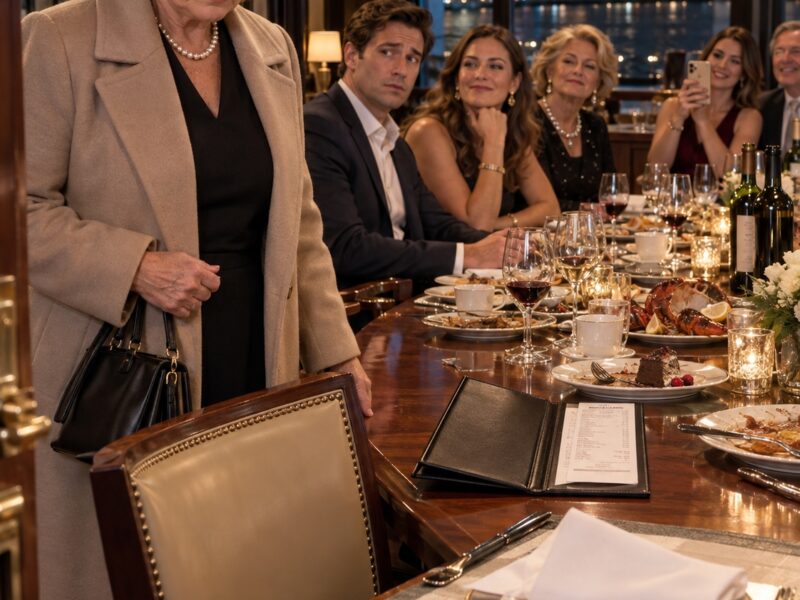
They Finished Dinner Before I Arrived—Then Handed Me the $2,487 Bill. I Tore It in Half, and the Bank Called Me the Next Morning
I arrived seven minutes early.
They had already eaten everything.
And in the middle of the table, beneath eleven empty wineglasses and a bowl of cracked lobster shells, sat a $2,487 bill with my name written across the top.
I should tell you something before I tell you what I did.
I am not a dramatic woman.
I spent thirty-eight years working in medical billing, and there is no profession on earth better designed to cure a person of dramatic instincts.
Insurance companies do not care that you are furious.
Hospitals do not correct a claim because you raise your voice.
Dates matter.
Codes matter.
Records matter.
So when I walked into the private dining room at Carrington’s River House at 8:23 on a Saturday night, seven minutes before the reservation time printed on the invitation, I did not immediately assume my family had done something deliberately cruel.
At first, I thought there had been a misunderstanding.
Then I saw my chair.
It was empty.
Untouched.
A folded white napkin had been placed in the center of the seat like somebody had arranged it for a photograph.
There was no plate.
No water glass.
No used silverware.
Nothing that suggested anyone had expected me to eat.
The rest of the table looked like a storm had passed through.
Eleven place settings used.
Four wine bottles empty.
Two serving platters scraped down to sauce.
A silver bowl full of lobster shells.
Dessert plates carrying the remains of chocolate cake and crème brûlée.
And that bill.
$2,487.
My name was handwritten at the top.
MARGARET HOLLOWAY.
Underlined twice.
I stood in the doorway long enough to count the chairs.
Twelve.
Eleven people.
One empty place.
Mine.
Nobody noticed me at first.
My son Daniel sat halfway down the table laughing at something his wife’s brother had said.
Daniel was thirty-nine, a public high school history teacher, a good father, and the kind of man who could explain the causes of the War of 1812 for forty minutes and still forget where he put his own car keys.
I loved him.
That becomes important later.
His wife, Tara, noticed me first.
Tara Holloway had been my daughter-in-law for ten years.
Beautiful woman.
Blonde hair cut at the chin.
Quick smile.
Excellent posture.
The sort of person who remembered servers’ names before ordering and somehow made that seem generous rather than strategic.
For years I had genuinely liked her.
Maybe that is why what happened next took several seconds to register.
Tara smiled.
Not apologetically.
Not nervously.
Delighted.
“Oh, Mom.”
Everyone looked.
Daniel turned.
So did Tara’s mother, Linda Garrett, who was sitting beside him.
Tara’s younger sister Paige already had her phone in her hand.
I remember that because the speed with which she lifted it told me filming had not been an afterthought.
Tara pointed toward the bill.
“We saved the important part for you.”
A few people laughed.
I walked farther into the room.
“What important part?”
Tara tapped the leather folder with one manicured fingernail.
“The wallet part.”
Then she laughed.
“Come on. You know why we invited you.”
The room went quiet for perhaps half a second.
Then Linda laughed.
Paige laughed.
Two cousins laughed.
A family friend named Rebecca laughed into her wine.
And Daniel—
My son—
laughed too.
Not loudly.
Not cruelly.
Almost reflexively.
As though this joke had been said before and he had forgotten that tonight I was standing inside it.
That was the moment.
Not Tara’s sentence.
Daniel’s laugh.
Something inside me changed temperature.
I looked at him.
He looked back.
For one brief second, I waited for him to see me.
Really see me.
To notice the empty plate.
The fan-folded napkin.
The finished meal.
The number on the bill.
The way Paige’s phone was pointed directly at my face.
He didn’t.
“Mom,” he said, still smiling slightly, “they’re kidding.”
People say that when cruelty has already landed and nobody wants responsibility for carrying it.
I walked to the table.
Picked up the bill.
Read every line.
Two lobster towers.
Three bottles of Bordeaux.
One bottle of champagne.
Steaks.
Sea bass.
Side dishes.
Desserts.
A private-room service fee.
Twenty percent gratuity already added.
$2,487.
I looked at Tara.
“You ate already.”
Her smile faltered a little.
“We thought you were running late.”
“I’m seven minutes early.”
Someone at the far end stopped moving.
Tara glanced at Daniel.
He looked at his watch.
That was the first moment I saw uncertainty.
Linda recovered faster.
“Well, Margaret, everyone was starving.”
“Of course.”
My voice sounded calm even to me.
Paige’s phone remained raised.
That mattered too.
I looked at the bill again.
Then I tore it in half.
Cleanly.
Right along the fold.
Nobody laughed.
I placed both halves beside Tara’s wineglass.
Then I opened my handbag.
Inside was Paul’s wallet.
My husband had been dead seven years by then.
He had carried that brown leather wallet for thirty-two years before giving it to me on our fifteenth anniversary because, as he put it, “A woman who understands money better than everybody else should at least have a wallet with some dignity.”
He had our wedding date stamped inside.
Nothing else.
No initials.
No name.
Just a date.
I had carried it since he died mostly because grief turns ordinary objects into routines you are afraid to stop.
I took it out.
Tara’s eyes followed it.
So did Daniel’s.
I snapped the brass clasp shut.
“You’re right about one thing,” I said.
Tara waited.
“I brought my wallet.”
Then I put it back in my purse.
“But I’m taking it home.”
I set the anniversary gift I had brought for Daniel and Tara on the table.
A silver frame holding their wedding photograph.
Ten years married.
Both smiling.
Daniel looked at it.
“Mom.”
I turned toward the door.
“Wait.”
I stopped.
For half a second, I hoped.
That is the humiliating part.
Even then, I hoped my son might stand.
He didn’t.
“What are we supposed to do with the bill?”
I looked at him.
It was one of those sentences that changes meaning the instant it leaves somebody’s mouth.
Daniel heard it too.
His face shifted.
But it was already said.
“I imagine,” I answered, “the eleven people who ate dinner can solve that.”
Then I left.
No slammed door.
No clever parting line.
No speech about respect.
I walked through the restaurant, thanked the hostess automatically, and reached the staircase before the owner stopped me.
Her name was Elena Novak.
I knew that later.
That night she was simply a woman in her late fifties wearing a dark suit and watching me with an expression that contained far too much understanding for a stranger.
She did not ask whether I was all right.
People with life experience usually know better.
She only said:
“Mrs. Holloway?”
“Yes?”
“Drive carefully.”
I nodded.
“Thank you.”
Then she gave me a small nod back.
Not pity.
Recognition.
I went home.
Made tea.
Did not drink it.
At ten-thirty, Daniel called.
I let it ring.
At ten-forty-one, Tara called.
I let that ring too.
At eleven, Paige posted a video online.
I did not know that yet.
I slept.
The phone rang at 9:14 the next morning.
Unknown number.
I almost ignored it.
Then habit won.
“Margaret Holloway.”
“Mrs. Holloway, my name is Naomi Brooks. I’m calling from First Commonwealth Bank’s fraud department.”
I sat straighter.
“What happened?”
“I need to verify an account application submitted in your name last night.”
Cold moved through my hands.
“What account?”
“A Platinum Signature card.”
“I don’t have one.”
“That is why I’m calling.”
Naomi’s voice was precise.
Professional.
Comfortingly unhurried.
“The application was submitted at 9:14 p.m. yesterday.”
I looked toward the kitchen clock.
“Approved?”
“Yes.”
“Limit?”
“Twelve thousand dollars.”
My tea from breakfast sat untouched beside me.
“What was charged?”
Naomi paused.
“One transaction.”
I already knew.
Not the details.
The shape.
“Go ahead.”
“Two thousand four hundred eighty-seven dollars.”
I closed my eyes.
“Merchant?”
“Carrington’s River House.”
There are moments when your mind protects you by becoming very practical.
Mine did.
“What time was the charge?”
“9:22.”
Eight minutes after the application.
Roughly the time I had been standing in the private-room doorway counting empty wine bottles.
I looked down at my hands.
Someone had opened a credit card in my name.
Used it to pay for the dinner.
Then left the restaurant bill on the table with my name written across it as though I were expected to believe no one had paid yet.
It was not simply humiliation.
The humiliation was camouflage.
“Mrs. Holloway?”
“I’m here.”
Naomi continued.
“The mailing address is also inconsistent with your existing records.”
“Read it.”
She did.
I recognized it immediately.
Daniel and Tara’s house.
My son’s house.
I wrote it down anyway.
“Anything else?”
“Yes.”
Naomi hesitated.
“Your first name on the application is misspelled.”
“How?”
“Margarette.”
Two t’s.
One extra e.
I stopped writing.
For years, one institution had spelled my name exactly that way.
Briarwood Regional Medical Center.
I had been treated there five years earlier for a minor hip procedure.
At check-in, a young woman had entered my name incorrectly.
I corrected her.
She fixed the insurance claim.
The patient portal never changed.
Every subsequent appointment still showed:
MARGARETTE HOLLOWAY.
The employee who entered it?
Tara.
Before she became my daughter-in-law, she had been a medical assistant.
By the time of my surgery she worked patient intake.
Naomi asked:
“Does that spelling mean anything to you?”
I did not answer immediately.
“Mrs. Holloway?”
“Yes.”
“It means something.”
“What?”
“My daughter-in-law works at Briarwood.”
Naomi became quieter.
“Does she have access to your patient record?”
“I don’t know.”
“Has she ever had access to personal identifying information?”
“She has my Social Security number in the hospital system.”
Another pause.
“Mrs. Holloway, I need you not to confront anyone yet.”
“I wasn’t planning to.”
That surprised her.
“Most people do.”
“I spent thirty-eight years resolving disputed medical accounts.”
“Oh.”
Something in her tone changed.
“You understand documentation.”
“Better than confrontation.”
“Good.”
She walked me through everything.
Freeze the new account.
Dispute the charge.
Place a fraud alert.
Pull all three credit reports.
File an identity-theft report.
Do not warn anyone.
Preserve messages.
Preserve paperwork.
Write times down.
I asked her to repeat one section.
She did.
Before hanging up, Naomi said:
“One more thing.”
“Yes?”
“This application wasn’t improvised in a restaurant bathroom.”
I went still.
“Why do you say that?”
“It used a full historical address file, previous employer, approximate retirement income, Social Security number, date of birth, and security questions.”
My throat tightened.
“Whoever submitted it had prepared.”
I looked at the torn bill I had brought home.
I had taken it without thinking.
One half still carried my underlined name.
The joke at dinner suddenly felt very different.
Forty minutes later, Daniel called.
This time I answered.
“Mom.”
“Daniel.”
“Thank God.”
He sounded relieved.
“I just heard something happened with the bank.”
Interesting.
I had not told him.
“Who told you?”
“Tara.”
Of course.
“She said maybe the card got flagged because the dinner was expensive.”
I waited.
Daniel filled the silence.
“You gave her that card, right?”
“What card?”
“The one for the kids.”
I gripped my pen.
“What kids?”
“Mom.”
He laughed nervously.
“The emergency card.”
I said nothing.
“She told me you gave it to her months ago.”
I wrote that sentence exactly.
“What for?”
“Diapers at first.”
His children were eight and five.
Nobody had needed diapers in years.
Daniel corrected quickly.
“I mean back when Lily was little. Then pediatrician co-pays. School stuff. You know.”
“No.”
He went quiet.
“You didn’t?”
“No.”
“Tara said—”
“I know what Tara said.”
Daniel’s breathing changed.
“Mom, are you sure?”
I almost laughed.
Instead:
“I am certain whether I opened a credit card.”
“That’s not what I meant.”
“I know.”
Silence.
Then:
“Maybe she misunderstood.”
“Perhaps.”
The word felt dishonest even while I said it.
Daniel continued:
“The dinner got out of control last night.”
“Yes.”
“I’m sorry about the joke.”
“What part?”
“Tara shouldn’t have said that.”
“You laughed.”
He stopped.
“That wasn’t—”
“Don’t.”
My voice remained low.
He went silent.
I continued.
“Do not apologize yet.”
“What?”
“You don’t know what you’re apologizing for.”
“Mom—”
“We’ll talk.”
“When?”
“When I know what happened.”
I ended the call.
Then I pulled my credit reports.
The bank card was there.
But it was not first.
Five months earlier, somebody had opened a retail account in my name with a furniture company called Westfield Home.
Balance:
$6,340.
My stomach turned.
I knew exactly what the money bought.
In June, I had attended my granddaughter Lily’s fifth birthday at Daniel and Tara’s house.
Their living room had been newly furnished.
Gray sectional.
Matching chair.
Dining table.
Sideboard.
I remember sitting on the sofa while Lily bounced beside me in a princess dress.
“This is beautiful,” I had told Tara.
She had smiled.
“We got ridiculously lucky.”
“How?”
“Warehouse sale.”
She leaned closer.
“Almost half off.”
I had congratulated her.
Had eaten birthday cake at the dining table.
Had praised furniture purchased using an account opened under my name.
The payments had been current for four months.
No missed balance.
No collection notice.
Quiet theft.
Managed carefully enough to look like good credit.
The third item appeared beneath it.
A $15,000 personal-loan application.
Denied.
Two months earlier.
Same mailing address.
Daniel’s house.
Same misspelling.
Margarette.
I called Helen Cross.
Helen had been my attorney and closest friend for thirty-six years.
We met when she was a twenty-seven-year-old paralegal sent to deliver a demand letter to my first office.
Instead of handing me the envelope and leaving, she argued with me for twenty minutes about the insurance policy at issue.
I thought she was arrogant.
She thought I was wrong.
We were both partly right.
Friendship followed.
She went to law school at night.
I watched her children during exams.
She reviewed my company contracts when I could not afford proper counsel.
Our husbands died within three years of one another.
There are friendships built on affection.
Ours was built on repeatedly discovering the other person was useful when life became ugly.
Helen answered on the second ring.
“You sound wrong.”
“I am.”
I told her.
Dinner.
Bill.
Credit card.
Furniture account.
Loan application.
She did not interrupt once.
When I finished, Helen said:
“Do not call your son again today.”
“I wasn’t going to.”
“Good.”
“Do I call Tara?”
“No.”
“Good.”
“Pull every financial record you have.”
“I already did.”
“Of course you did.”
She sighed.
“Margaret, this isn’t a family argument.”
“I know.”
“This is identity theft.”
“I know.”
“And if she used medical records—”
“I know.”
Helen became quiet.
“You sound calm.”
“I’m not.”
“I know.”
That was why I called her.
She told me to come the next morning.
I spent the rest of Sunday printing.
Credit reports.
Bank notices.
Old statements.
Emails.
The dinner invitation.
The video Paige had posted.
That was how I found out about the video.
My neighbor Denise texted me.
Please tell me you’ve seen this before I say something rude online.
I clicked.
Ninety seconds.
Paige had cut away everything before I picked up the bill.
No empty chair.
No “you’re the wallet.”
No laughter.
The video began with me holding the folder.
Then tearing the bill.
Then putting it down.
Then leaving.
Caption:
When your mother-in-law ruins your sister’s 10th anniversary because nobody let her control the dinner.
Thirty-two thousand views.
Then sixty.
By evening, one hundred twenty thousand.
Comments called me bitter.
Cheap.
Jealous.
Controlling.
A rich boomer punishing young parents.
I watched exactly once.
Then saved a copy.
Screenshots too.
Documentation.
Always documentation.
At Helen’s office Monday morning, she looked through everything.
Then asked:
“How much money do they think you have?”
“Not much.”
Helen looked up.
“Define not much.”
“Daniel thinks I live on retirement income and proceeds from the business sale.”
“He doesn’t know the sale amount?”
“No.”
Helen leaned back.
“Still?”
“No.”
She stared at me.
I understood.
I had never told my son I sold Holloway Claims Management for $4.7 million.
Paul knew.
Helen knew.
My accountant knew.
Nobody else.
I lived in the same modest house Paul and I bought thirty years earlier.
Drove a nine-year-old Lexus.
Used grocery coupons because habit does not disappear when necessity does.
Daniel knew I was comfortable.
That was all.
“Why didn’t you tell him?” Helen asked.
“I never saw a reason.”
“That’s partly true.”
I looked at her.
She waited.
Helen had known me too long.
“Fine.”
I folded my hands.
“I wanted to know he loved me without numbers attached.”
“He’s your son.”
“Children can still become interested in numbers.”
“Did he?”
“I don’t think so.”
Helen tapped the Westfield report.
“But someone did.”
Then she circled the loan application.
“The income estimate here is low.”
“How low?”
“They assumed you receive about forty-eight thousand a year.”
“Closer to my pension income.”
“Exactly.”
She looked at me.
“They do not know the real assets.”
That should have relieved me.
It did not.
It meant whoever was stealing believed they were taking from a woman living on a modest retirement and still considered that acceptable.
Helen said:
“Next step.”
“Hospital.”
“Yes.”
I submitted a formal access-audit request to Briarwood Regional.
Under federal privacy rules, I was entitled to know who had viewed my record.
The privacy officer called four days later.
Her name was Keisha Monroe.
Her voice sounded tired before she told me why.
“Mrs. Holloway, your chart was accessed four times in the past year by the same employee.”
I closed my eyes.
“Was I assigned to that employee?”
“No.”
“Was there any legitimate clinical purpose?”
“Not that we can identify.”
“Name?”
Keisha hesitated.
“I’m required to let the written report—”
“Tara Holloway.”
Silence.
“I can’t confirm verbally.”
“You just did.”
Another silence.
“I’m sorry.”
“When?”
Keisha read the dates.
One lined up with the furniture account.
One with the loan application.
One with a different financial inquiry.
The final access:
9:06 p.m.
The night of the dinner.
Eight minutes before the credit-card application.
Tara had looked up my patient record from the restaurant.
Eight minutes later, somebody opened the card.
Sixteen minutes later, the card paid the bill.
Then they waited for me to walk into the room and handed me a receipt disguised as an obligation.
I said:
“Can you preserve all login data?”
“Already done.”
“Device records?”
“Under investigation.”
“Location?”
“I can’t promise we have enough for precise geolocation.”
“Fair.”
Keisha paused.
“Mrs. Holloway.”
“Yes?”
“This is not a normal snooping case.”
“I understand.”
“No.”
Her voice became softer.
“I mean, most of what we investigate is somebody looking up a neighbor or celebrity.”
She exhaled.
“This has financial timing.”
“Yes.”
“We are referring it externally.”
“Thank you.”
Tara was placed on administrative leave the next day.
That was when the family stopped pretending nothing serious had happened.
Daniel came to my house alone.
He stood on my front porch looking ten years younger and twenty years more tired.
“Can I come in?”
“Yes.”
We sat at the kitchen table.
Paul’s chair remained empty.
Daniel looked at it.
Then at me.
“Tara says you’re trying to destroy her.”
“I haven’t spoken to Tara.”
“She says the hospital only investigated because you complained.”
“That is how investigations often begin.”
“Mom.”
“What?”
He rubbed his face.
“She’s scared.”
“So am I.”
That stopped him.
He looked at me.
I continued.
“Someone opened accounts in my name.”
“I know.”
“Someone used my medical information.”
“I know.”
“Do you know how they got my Social Security number?”
Daniel looked away.
There.
“What?”
He swallowed.
“Tara asked me once.”
“When?”
“Last year.”
“Why?”
“She said she was updating emergency contacts and insurance paperwork for the kids.”
“She needed my Social Security number for your children’s emergency contacts?”
His face changed.
“No.”
“Did you give it to her?”
His eyes filled.
“Yes.”
I sat back.
The pain surprised me.
Not because Daniel had knowingly participated in fraud.
I did not believe he had.
Because he had treated my private information as something his wife could request without needing to understand why.
“When did you stop asking questions?”
He whispered:
“I don’t know.”
That answer mattered more than a lie would have.
Daniel looked at me.
“She told me you’d given her a card.”
“I know.”
“I believed her.”
“I know.”
“I didn’t think—”
“That is the problem.”
He flinched.
I immediately regretted how sharp it sounded.
Not the truth.
The delivery.
Daniel looked toward the window.
“Tara grew up scared about money.”
“I know.”
“Linda was always behind on something.”
“I know that too.”
“She said having you in the family made her feel safe.”
I almost laughed.
“Me.”
“Financially.”
“Yes.”
He realized.
“Mom.”
“Keep going.”
Daniel’s eyes lowered.
“She started saying things like… you always offer anyway.”
“I do.”
“That you liked helping.”
“I did.”
“That you had more than you needed.”
“I do.”
“That you wanted the kids taken care of.”
“I do.”
Every answer made him look worse.
Not because the statements were false.
Because they had been converted into permission.
Daniel covered his face.
“I didn’t know about accounts.”
“I believe you.”
His head lifted.
“You do?”
“Yes.”
“Why?”
“Because you’re a terrible liar.”
Despite everything, his mouth moved.
Then stopped.
“I laughed that night.”
“Yes.”
“I keep thinking about that.”
“You should.”
He nodded.
“I know.”
The next week, Helen found the fourth financial item.
A store card closed twelve months earlier after being paid off.
Balance had peaked at $1,920.
Same address.
Same misspelled name.
The money purchased children’s clothing.
Not luxury.
School uniforms.
Shoes.
Winter coats.
That complicated my anger.
Stealing for cocaine would have been simpler.
Stealing for children’s shoes was still stealing.
Motive changes context.
Not consent.
Helen said:
“You need to prepare yourself for that argument.”
“What argument?”
“She’ll say necessity.”
“She’ll be partly right.”
Helen looked at me.
I continued.
“They are teachers and hospital staff with two children and debt.”
“And?”
“She will say I could afford it.”
“You can.”
“She will say the kids benefited.”
“They did.”
“She will say she meant to repay.”
“She might.”
I looked at Helen.
“None of that changes my name being on the account.”
“Exactly.”
That was the distinction I held onto.
Then Linda entered the story.
Not newly.
Historically.
I should explain Linda Garrett.
Tara’s mother.
For sixteen years, she had told a story about me.
I had once been her employer.
She worked at Holloway Claims Management from 2007 to 2012.
Good employee at first.
Smart.
Fast.
Excellent with difficult claimants.
Then I fired her.
According to Linda, she had been terminated because she “spoke truth to power.”
Her phrase.
I had supposedly disliked being challenged.
Resented younger employees with strong opinions.
Punished her because she refused to flatter me.
I never corrected the story.
Not at family dinners.
Not when Tara repeated it.
Not when Daniel once asked why Linda seemed uncomfortable around me.
I told him:
“Work relationships get complicated.”
Why?
Because the real reason Linda lost her job was worse.
In 2012, an internal audit showed Linda had accessed the medical records of her ex-husband’s new wife seventeen times.
No business purpose.
No assigned account.
She was looking for leverage in a custody dispute.
A diagnosis.
Prescription.
Anything.
When I confronted her, Linda did not deny it.
“She took my husband,” she said.
Her ex-husband had remarried two years after the divorce.
The new wife had taken nothing.
But pain is creative.
Linda believed information could restore balance.
I fired her.
Quietly.
Too quietly.
I gave her severance.
I did not report the full violation to the hospital client because I believed protecting her reputation would help her recover.
I did not tell Daniel.
I certainly did not tell Tara.
For sixteen years, Linda was free to describe herself as the employee punished by an arrogant boss.
I thought silence was mercy.
I was beginning to understand that mercy without accountability can become raw material for someone else’s mythology.
Three weeks after Tara’s suspension, Linda posted a video.
Front porch.
Phone camera.
Carefully sad expression.
She talked about how I had “controlled the family with money for years.”
How I “punished anyone who challenged me.”
How the current fraud investigation was “a grandmother’s revenge over an anniversary misunderstanding.”
Then came the sentence that made me replay the video.
“Margaret has been holding an old grudge against me for sixteen years.”
Old grudge.
She knew exactly which history she was invoking.
Just not the truth.
The video received two hundred thousand views.
Paige’s first video had already passed half a million.
At the grocery store, a woman recognized me.
That was worse than the internet.
She stood beside cereal with a toddler in her cart and said quietly:
“I saw the video.”
I braced.
Then she added:
“My mother-in-law gets treated like the family ATM too.”
I looked at her.
“I don’t know what happened in your family,” she said, “but nobody sets a place for somebody they respect and leaves it untouched while they eat without her.”
I thanked her.
Went home.
Cried for the first time.
Not because of Linda.
Not Tara.
Not the credit.
The napkin.
That stupid folded napkin.
It had been waiting before I arrived.
That meant the humiliation was not spontaneous.
Someone had planned the empty seat.
Helen came over that evening.
I showed her the videos.
She watched both.
Then said:
“Do not respond.”
“I wasn’t going to.”
“Good.”
She pointed toward Linda’s face frozen on the screen.
“She is rehearsing.”
“For what?”
“The version she eventually tells you.”
I looked at Helen.
“She’s testing which lines earn sympathy before she has to say them to someone who knows the facts.”
I turned off the phone.
“Let her.”
Helen smiled slightly.
“There you are.”
Then Tara threatened the grandchildren.
Not directly at first.
Wednesday waffles simply stopped.
Every Wednesday for four years, my grandchildren Owen and Maisie had breakfast at my house.
Owen was eight.
Serious.
Loved measuring pancake batter.
Maisie was five.
Believed chocolate chips counted as breakfast fruit if one did not overthink categories.
The tradition started when Tara returned to work after Owen’s birth.
One morning became every Wednesday.
Through flu seasons.
School changes.
Kitchen renovation.
Paul’s death.
Waffles stayed.
Then one Wednesday Daniel texted:
Things are complicated right now. We’re keeping the kids home this week.
I understood.
The second Wednesday, same thing.
The third, nothing.
At seven-thirty, I had the waffle iron hot anyway.
Habit.
Two plates.
Two glasses of milk.
Empty kitchen.
I turned the iron off.
That was the closest I came to withdrawing the fraud complaint.
Not because I doubted myself.
Because love makes leverage effective even when you understand exactly what is happening.
Then Tara called.
I let it go to voicemail.
Best decision I made that month.
Her voice was no longer warm.
“You have no idea what you’re doing to us.”
She sounded furious.
“I’ve been suspended from a job I’ve had six years because you turned one card into a federal case.”
She breathed.
“If you keep pushing this, Owen and Maisie are done going to your house.”
My hands went cold.
“I will speak to a lawyer about whether this whole thing proves you’ve become unstable.”
Then:
“You need to decide whether being right is more important than seeing your grandchildren.”
The message ended.
I saved it.
Played it for Helen the next morning.
She listened twice.
Then looked at me.
“She just made your grandchildren bargaining chips in a financial dispute.”
“Yes.”
“On a recording.”
“Yes.”
Helen set the phone down.
“She can restrict visits.”
That hurt.
“But?”
“If this ever becomes a family court issue, parents using access to children as leverage rarely look as clever as they think they do.”
I looked toward the window.
“I don’t want court.”
“I know.”
“I want waffles.”
Helen’s expression softened.
“I know.”
The restaurant owner called two days later.
Elena Novak.
“Mrs. Holloway.”
“Yes.”
“I owe you information.”
She explained the bank had charged back the $2,487 because the card was fraudulent.
Her restaurant had absorbed the loss plus processing fees.
“I’m not asking you to pay.”
“I know.”
“How?”
“Because if you were calling for money, you would have started with the amount.”
She laughed once.
“Fair.”
Then she told me what happened.
Their waiter that night, a twenty-three-year-old nursing student named Michael, remembered Tara telling him the card reader would not accept her chip.
So Tara read a credit-card number from her phone.
Sixteen digits.
Expiration.
Security code.
Michael typed the numbers manually into the terminal.
The restaurant’s card reader had worked normally all night.
Tara never possessed a physical card.
Because the card had been opened minutes earlier.
She had the digital number.
Nothing more.
Elena said:
“Michael felt strange about it.”
“Why didn’t he stop?”
“He’s twenty-three.”
Fair.
“People older than him with more power were telling him everything was fine.”
Fair again.
Then Elena said something I did not forget.
“I saw your untouched place setting before you came in.”
I closed my eyes.
“I knew something was wrong.”
“The napkin.”
“Yes.”
She paused.
“Nobody folds a napkin that beautifully for someone they actually want to eat with.”
I thanked her.
The next break came from Ruth Garrett.
Linda’s younger sister.
She had been at the anniversary dinner.
Sixty-seven.
Retired school librarian.
Quiet woman.
The only person who had not laughed.
Ruth called me one evening.
“I need to tell you something.”
“All right.”
“I should have told you before.”
She sounded exhausted.
“I’ve spent my whole life in this family thinking silence meant neutrality.”
I said nothing.
“I don’t think that anymore.”
Then Ruth sent me screenshots.
Family group chat.
I had not known the chat existed.
Actually, I had once been in it.
They removed me eleven months earlier.
No announcement.
No argument.
One day my name simply stopped being there.
That fact hurt strangely.
More than the sofa.
Less than Daniel laughing.
But close.
The screenshots went back months.
The first one Helen and I studied concerned the furniture account.
Linda had written:
Put the sofa on one account and the table on another. Smaller balances don’t trip alerts as fast.
Tara:
What if she checks?
Linda:
Margaret checks insurance claims. Not her own credit. She trusts everybody.
I read that twice.
Then:
She has money. She likes helping anyway.
Another message.
The night of the anniversary dinner.
9:24 p.m.
Tara:
Done. Wallet opens. 😂
Paige reacted with a laughing emoji.
Linda with a heart.
Daniel—
Thumbs-up.
I stared at the symbol.
Tiny blue thumb.
My son.
Timestamped before I arrived.
I called him.
Not immediately.
The next morning.
“Daniel.”
“Mom.”
“Did you know about the group chat message?”
Silence.
“Which one?”
I read it.
Another silence.
Then:
“I don’t remember that.”
“Your reaction is under it.”
“Mom, I react to things without thinking.”
“That is exactly what frightens me.”
He began to cry.
Quietly.
“I swear to you, I didn’t know what ‘done’ meant.”
“I believe that.”
“You do?”
“Yes.”
That did not comfort him.
Good.
“I thought they were making another joke about you paying.”
“Another.”
He stopped.
“Mom.”
“How many?”
“I don’t know.”
“How long has my money been a joke?”
“I don’t know.”
I could hear him breathing.
Then he said:
“I think a while.”
There are apologies that arrive before people understand the harm.
I did not want one.
“Don’t say sorry yet.”
“I am sorry.”
“I know.”
“No, I—”
“Daniel.”
He stopped.
“Figure out exactly what you’re sorry for.”
I hung up.
Then I made a decision.
I did not sue Tara personally.
I did not post a response online.
I did not contact local television, even after two stations called requesting interviews.
I invited everyone back to Carrington’s.
Same room.
Same table.
Saturday.
Seven p.m.
My message said:
I’d like to make things right. Dinner at Carrington’s. Private room.
Linda replied first.
Gladly.
Tara:
Thank you.
Paige sent a heart.
The family group chat became excited.
Ruth forwarded those screenshots too.
Tara:
She’s caving.
Linda:
Be gracious. Let her apologize without making it harder.
Paige:
Please tell me we’re getting lobster again.
Daniel sent nothing.
Saturday arrived.
I got there thirty minutes early.
Elena had already arranged the room.
Same brass sconces.
Same window over the river.
Same long table.
Different seating.
I placed no card with my name anywhere.
Helen waited at a table in the public dining room outside.
Not hidden.
Available.
Elena stood nearby.
Michael was working that night too.
I told him he was under no obligation to speak.
He said he wanted to.
At 6:55, they began arriving.
Tara wore white.
That detail remains almost funny.
Not because white means innocence.
Because she looked dressed for reconciliation.
Pressed dress.
Pearl earrings.
Hair smooth.
Linda wore navy and kissed my cheek when she entered.
“I’m glad you’ve come around.”
I smiled.
“So am I.”
Paige carried her phone.
Of course.
Ruth came last.
She met my eyes.
Gave one small nod.
Daniel entered alone.
No Tara beside him.
That interested me.
Everyone sat.
Tara took the chair at the head of the table.
My old chair.
I let her.
Elena entered with menus.
“Before anyone orders,” I said, “separate checks.”
The room changed.
Tara looked up.
“What?”
“Eleven separate checks.”
Linda laughed uncertainly.
“Margaret.”
“Elena?”
The restaurant owner nodded.
“Already arranged.”
Nobody touched a menu.
I placed a plain manila folder on the table.
The exact kind I had carried into billing audits for decades.
Tara’s face changed.
Just slightly.
“I said I wanted to make things right.”
Linda smiled again.
“Exactly.”
“I did not say I was apologizing.”
Silence.
I opened the folder.
First:
The bank fraud letter.
Application time.
9:14 p.m.
Approval.
9:18.
Charge.
9:22.
$2,487.
Tara went pale.
I placed my old hospital wristband beside it.
MARGARETTE HOLLOWAY.
Same misspelling.
Then Briarwood’s privacy report.
Four unauthorized accesses.
Three aligned with fraudulent applications.
The fourth at 9:06 p.m. on the night of the dinner.
Tara’s hands started shaking.
Paige lowered her phone.
I placed the Westfield furniture account next.
$6,340.
Then the denied $15,000 loan.
Then the closed clothing account.
Linda spoke.
“Margaret, we understand there have been financial misunderstandings.”
I looked at her.
“No.”
Her mouth closed.
“You understand there have been crimes.”
Tara began crying.
Not quietly.
“Please.”
I waited.
“I was going to pay it back.”
I nodded.
“The sofa?”
“Yes.”
“The dining table?”
“Yes.”
“The children’s clothes?”
“Yes.”
“The anniversary dinner?”
Her crying worsened.
“We were under pressure.”
Daniel looked at her.
“Pressure?”
She turned.
“Your salary doesn’t cover everything.”
His face changed.
“Tara.”
“You know that.”
“No.”
His voice went strangely calm.
“I know we have debt.”
“Yes.”
“I know we’ve struggled.”
“Yes.”
“I did not know my mother was paying bills she didn’t know existed.”
Tara looked at me.
“You have millions.”
The room froze.
Daniel turned.
“What?”
Tara realized.
Too late.
I did not move.
Daniel looked at me.
“Millions?”
I remained focused on Tara.
“How do you know?”
Her mouth opened.
Closed.
Linda looked away.
Helen’s warning returned.
Let people talk.
Tara wiped her face.
“Mom said your company sold for a lot.”
Linda snapped:
“I never knew the amount.”
“Then how many millions?”
Silence.
I answered.
“Four point seven.”
Every face at the table changed.
Daniel stared.
“You never told me.”
“No.”
“Why?”
I looked at my son.
“Because I wanted to know whether my family could love me without budgeting around me.”
The words hurt me as I said them.
Daniel looked down.
Tara whispered:
“You could afford the furniture.”
“Yes.”
“You could afford that dinner.”
“Yes.”
“You could afford all of it.”
“Yes.”
Her voice rose.
“Then why are you doing this?”
There it was.
The real question.
Not:
Was it wrong?
Not:
How did I hurt you?
Why object when the loss was affordable?
I leaned forward.
“Because you did not ask.”
She stared.
“I would probably have bought the kids’ winter coats.”
Her face changed.
“I might have helped with furniture if Daniel told me you were struggling.”
Daniel closed his eyes.
“I would have paid for dinner if I had agreed before anyone ordered.”
I pointed toward the documents.
“What I will not finance is the belief that access to me is the same thing as consent.”
Nobody spoke.
Then Elena entered.
Tara looked up.
Elena said calmly:
“My restaurant is still owed $2,512 after processing fees.”
Tara stared.
“The bank reversed the fraudulent charge.”
Michael stood behind her.
Elena continued:
“My employee remembers the transaction.”
Michael spoke.
“You read the number from your phone.”
Tara shook her head.
“The reader wasn’t working.”
Michael looked almost apologetic.
“It worked for every other table.”
Silence.
Linda leaned back.
“This is humiliation.”
“No,” I said.
She looked at me.
“This is accounting.”
Her face hardened.
“I knew you’d do this.”
“Do what?”
“Punish us.”
“Us.”
I took out Ruth’s screenshots.
Ruth closed her eyes.
Linda looked toward her sister.
The room shifted before I read anything.
“You.”
Linda’s voice sharpened.
Ruth said:
“Yes.”
“Why?”
Ruth’s hands trembled.
“Because I was tired of telling myself watching didn’t count.”
Linda stared.
I placed the first screenshot down.
Put the sofa on a separate account. Smaller balances don’t trip alerts as fast.
Linda’s face changed.
The second.
She trusts everybody.
The third.
Done. Wallet opens.
Then Daniel’s thumbs-up.
My son looked at it.
For perhaps fifteen seconds, he did not breathe properly.
Then he said:
“I don’t remember.”
I believed him.
That was the tragedy.
“I know.”
Daniel looked at me.
“I did that.”
“Yes.”
“I saw that message.”
“Yes.”
“And I—”
He covered his mouth.
Tara reached for him.
Daniel moved his arm away.
Not dramatically.
Enough.
Linda found her voice again.
“This is because of me.”
I looked at her.
“Partly.”
“I told everyone.”
“You did.”
“I told them what you did sixteen years ago.”
“Yes.”
“You fired me because I challenged you.”
“No.”
The room became silent.
Linda’s face tightened.
“Don’t rewrite history.”
“I protected your version for sixteen years.”
“What are you talking about?”
I had imagined this moment many times in the previous weeks.
In every version, I felt anger.
When it arrived, I felt tired.
“I fired you because you accessed Donna Garrett’s medical record seventeen times.”
Tara stopped crying.
Daniel looked up.
Paige’s face emptied.
Linda went completely still.
I continued.
“Your ex-husband’s second wife.”
“Margaret.”
“You searched for diagnoses.”
“Stop.”
“Prescriptions.”
“Stop.”
“Anything you could use in your custody dispute.”
Tara stared at her mother.
“Is that true?”
Linda looked at her daughter.
“It was complicated.”
I almost laughed.
There are certain words families use when truth becomes inconvenient.
Complicated is one.
Linda turned back to me.
“You promised nobody would know.”
“Yes.”
“I protected your reputation.”
Her voice shook with fury.
“You cannot use that now.”
“I am not using it.”
I looked around the table.
“I am correcting a lie you used for sixteen years to explain why taking from me was morally acceptable.”
Tara looked at Linda.
“You did the same thing?”
Linda flinched.
“No.”
“You accessed medical records.”
“That was different.”
“How?”
“She took your father.”
Tara’s face changed.
Something broke.
Not loyalty.
A story.
I watched my daughter-in-law understand that the behavior she had normalized as cleverness, efficiency, and necessity had been modeled for her before she ever stole one dollar.
Understanding did not excuse her.
It made the tragedy larger.
Tara whispered:
“You told me Margaret destroyed your career because she hated strong women.”
Linda looked away.
“I was angry.”
“For sixteen years?”
Linda said nothing.
Paige’s phone remained face down.
Ruth was crying silently.
Daniel looked toward the torn landscape of papers.
Then he took out his wallet.
“What are you doing?” Tara asked.
He looked at Elena.
“How much?”
“$2,512.”
Daniel removed his debit card.
Tara grabbed his wrist.
“Daniel.”
He looked at her.
“I ate the dinner.”
“That’s not the point.”
“It is one point.”
He handed Elena the card.
She hesitated.
“You don’t have to personally cover—”
“I laughed.”
Elena stopped.
Daniel’s voice cracked.
“My mother walked in and I laughed.”
I closed my eyes.
He continued.
“I can’t fix the other things tonight.”
He looked at me.
“But I can pay for the food I ate.”
Elena processed the payment.
Tara stared at her husband as though something important had moved outside her control.
It had.
The rest of dinner never happened.
Nobody ordered.
One cousin left.
Then another.
Paige picked up her phone once.
Ruth placed her hand over it.
“No.”
Paige stared.
Ruth held her gaze.
“No more.”
Paige lowered it.
Linda stood.
“You got what you wanted.”
I looked at her.
“What do you think I wanted?”
“To humiliate us.”
“No.”
“What then?”
I considered.
“The end of your version.”
She left.
Tara remained.
Daniel too.
Her white dress had a small wine stain near the cuff.
She looked at the documents.
“I didn’t wake up planning to become this person.”
I believed that too.
“Most people don’t.”
She cried.
“I was scared.”
“I know.”
“We were behind on the mortgage.”
“You could have asked.”
“I was ashamed.”
“You could have asked ashamed.”
She looked at me.
“My mother kept saying you wouldn’t miss it.”
“And eventually that became permission.”
“Yes.”
Daniel stared at her.
“When did you first use Mom’s information?”
Tara whispered:
“Two years ago.”
He closed his eyes.
“Before the furniture.”
“Yes.”
“What?”
“School clothes.”
His eyes opened.
“For our children.”
“Yes.”
He stood.
The chair scraped.
“I need to leave.”
Tara panicked.
“Daniel.”
“I am not leaving the kids.”
“That’s not what I—”
“I’m leaving this room.”
He looked at me.
Then at Tara.
“I don’t trust myself to know what I think yet.”
That was the smartest sentence anyone in our family had said in months.
He left.
Tara stayed another five minutes.
Then gathered nothing.
Not the papers.
Not excuses.
She simply stood and said:
“I am sorry.”
For the first time, I believed she meant the sentence.
I did not forgive her.
Those are separate events.
Legal consequences followed.
Not because I demanded them.
Because institutions have processes once evidence enters them.
Tara lost her job at Briarwood.
The privacy investigation established deliberate unauthorized access.
The bank and furniture lender submitted records.
The district attorney charged her with two counts connected to identity fraud.
The rejected loan became part of the pattern but not a separate successful theft.
Her case resolved six months later through a plea.
One felony reduced under the agreement.
Three years of probation.
Restitution.
Mandatory financial counseling.
No employment involving protected health information during probation.
Linda was investigated but not charged.
The messages showed coaching.
They did not prove she knowingly participated in every application.
That distinction frustrated people who wanted cleaner justice.
I did not.
By then, I had spent long enough around billing disputes to know proof and suspicion are different currencies.
I refused to spend one as though it were the other.
Paige deleted the video.
Not immediately.
Only after court filings became public and strangers started posting the missing context beneath her original caption.
She lost followers.
She posted:
There was more going on privately than I understood. I regret sharing a family moment without full context.
Not an apology to me.
A reputation repair.
I did not answer.
Linda’s video disappeared too.
She stopped attending the church we had both gone to for years.
Joined another congregation two towns away.
I heard she told some people I had destroyed Tara to punish her.
Maybe she still believes it.
People protect old stories because rewriting them requires admitting how long they were wrong.
Ruth and Linda stopped speaking.
I felt responsible.
Ruth told me I wasn’t.
“I lost her years ago.”
We were having coffee.
“She just didn’t know I knew.”
That was a sad sentence.
I didn’t improve it.
The Wednesday waffles returned three weeks after the confrontation.
Daniel brought the kids.
No warning.
I opened the door and found Owen standing beside him holding the syrup bottle he insisted belonged at my house.
Maisie ran past both of them.
“Grandma, I’m starving.”
I looked at Daniel.
He looked exhausted.
“Thank you for taking them.”
That was all.
No apology speech.
No request for forgiveness.
I let them in.
For forty-five minutes, my kitchen became itself again.
Owen argued about batter consistency.
Maisie ate chocolate chips.
Daniel sat at the table and drank coffee.
When the children went to wash their hands, he said:
“I moved out.”
I waited.
“Tara and I are separating.”
“I’m sorry.”
“Are you?”
“Yes.”
He looked surprised.
“She did something terrible.”
“Yes.”
“I still love her.”
“I know.”
“I’m angry.”
“Yes.”
“And I feel guilty being angry because she’s terrified.”
I set down the mixing bowl.
“Daniel.”
He looked at me.
“You are allowed to love someone and still require consequences.”
His eyes filled.
“I think I learned the opposite somewhere.”
“Probably from me.”
That startled him.
“What?”
I sat.
“For years, I helped.”
“Mortgage shortfalls.”
“Daycare.”
“Cars.”
“Vacations once.”
He tried to protest.
I raised a hand.
“I never asked whether helping made you stronger.”
He looked down.
“I liked being useful.”
That admission had taken me months.
“Your father used to warn me.”
“Dad?”
“Yes.”
“What did he say?”
“That if I solved every problem before you felt it, you’d eventually believe solutions appeared naturally.”
Daniel almost smiled.
“That sounds like him.”
“He was annoyingly correct.”
We sat quietly.
Then Daniel said:
“I need to say something.”
“All right.”
“The thumbs-up.”
I waited.
“I really didn’t remember doing it.”
“I believe you.”
“That feels worse.”
“Yes.”
He stared at the table.
“I think I did a hundred little things like that.”
“What things?”
“Letting jokes go.”
“Not asking why Tara suddenly bought something expensive.”
“Assuming if money appeared, somebody else had figured it out.”
“Letting Linda make you the villain because correcting her seemed exhausting.”
He swallowed.
“I didn’t do one huge thing.”
“No.”
“I just stopped looking.”
I thought about that.
Then:
“That’s usually how people arrive somewhere they never meant to go.”
He cried.
I did too.
Quietly.
Owen came running in.
“Why are you both sad?”
Daniel wiped his face.
“Adult stuff.”
Owen considered.
“Can I have another waffle?”
And that was the end of our emotional breakthrough for the morning.
Children are useful that way.
Months later, Daniel invited me to speak to his tenth-grade history class.
Local entrepreneurship.
He wanted someone who had built a company.
I said yes before he could finish asking.
I stood in front of twenty-eight teenagers and told them about Holloway Claims Management.
Not the sale.
The beginning.
One computer.
Sunroom office.
Medical bills stacked in milk crates.
Paul building shelves from leftover signboard lumber.
My first employee.
My first payroll.
The client who paid sixty days late and nearly ended everything.
Daniel stood at the back.
Watching.
Afterward, in the parking lot, he said:
“I don’t think I knew any of that.”
“You were a kid.”
“I was thirty before you sold it.”
“Still a kid sometimes.”
He smiled.
Then:
“Why didn’t you tell me the sale amount?”
There it was.
I considered giving the polished answer.
Then chose the real one.
“I was afraid money would change how you saw me.”
Daniel looked wounded.
“Mom.”
“I know.”
“You thought I’d use you.”
“No.”
I shook my head.
“I thought if I told everyone the number, I would never know whether expectations belonged to need or entitlement.”
“And you were right.”
“Not about you entirely.”
He looked at me.
“You laughed.”
He nodded.
“I did.”
“Then you came back.”
His eyes filled.
“I’m trying.”
“I know.”
That became our relationship.
Not repaired all at once.
Repetition.
Small calls.
Gutters.
School events.
Wednesday waffles.
Truth in portions each of us could actually digest.
Tara and Daniel eventually divorced.
Not viciously.
Not gently either.
Custody became complicated.
I refused to testify about Tara’s character unless required.
Helen agreed.
“The criminal record exists.”
“Yes.”
“The court can read.”
“Yes.”
“You don’t need to turn pain into a hobby.”
Exactly.
Tara completed probation.
Found work with a small landscaping company doing scheduling.
No patient records.
No credit access.
She moved into a modest apartment.
She sent me one handwritten letter a year after the confrontation.
I expected excuses.
There were none.
Margaret,
I used to think the worst thing about being poor was not having enough money. I understand now that the fear of becoming poor again can make a person do things that create a different kind of poverty.
I stopped reading.
Then continued.
I stole from you because I had slowly converted your generosity into a resource I believed our family owned. My mother encouraged that. Daniel’s passivity made it easier. None of those things made me do it.
That sentence mattered.
I also used the children after you reported me. That is the part I am most ashamed of because even at my worst I knew how much they loved Wednesdays with you.
I cried.
I do not expect forgiveness. I am writing because I finally understand that an apology is not a request for another person to relieve you of guilt.
She signed it.
Tara.
I waited three weeks.
Then wrote back:
Thank you for saying it without asking me to make it easier.
Nothing more.
We are not close.
I am still the children’s grandmother.
She is still their mother.
That relationship requires civility.
Sometimes civility is a greater achievement than reunion.
Linda never apologized.
Not once.
I heard from Ruth that Linda still describes the story as “what happened when Margaret decided to destroy us.”
I stopped correcting people who repeated it.
Documentation had done enough.
Banks.
Court.
Hospital.
Restitution.
Paper carries truth farther than argument.
The $4.7 million remained mostly invested.
I created college trusts for Owen and Maisie.
Helen structured them so neither parent could borrow against them.
Neither child will know the balances until eighteen.
I did not tell Daniel.
That probably sounds strange after everything.
Maybe secretive.
But there is a difference between hiding money to test love and protecting a gift until the recipient can actually receive it.
At least I believe there is.
Helen tells me to keep examining the distinction.
That is why I pay her.
Ruth comes to Thanksgiving now.
So does my neighbor Denise.
Helen brings pie.
Daniel brings the kids.
The table is smaller.
No Linda.
No Paige.
Usually no Tara, although one year she came for dessert because Daniel’s custody schedule made that easiest for the children.
It was awkward.
Then Maisie spilled cranberry sauce on herself and everyone stopped pretending adults were the most important problem in the room.
That helped.
Carrington’s became part of my life in an unexpected way.
Elena and I became friends.
Real ones.
I go in on slow Tuesdays.
She brings coffee.
We never sit in the private room unless it is booked.
Once I asked why.
She said:
“Too much history.”
Fair.
A year after the first dinner, Daniel took me there.
Just us.
Same lobster.
Different table.
Halfway through the meal he looked toward the private-room hallway.
“I think about the napkin.”
“So do I.”
“I keep asking myself when it started looking normal.”
“What?”
“Treating you like that.”
I waited.
“I can’t find one moment.”
“There probably wasn’t one.”
Daniel nodded.
“That scares me.”
“It should.”
He looked at me.
“What do you think happened?”
I considered.
“Generosity became predictable.”
“And?”
“Predictability became expectation.”
He lowered his eyes.
“And expectation became entitlement.”
“Yes.”
Elena stopped by our table.
“Everything all right?”
Daniel looked at me.
Then at her.
“Yes.”
He smiled faintly.
“We’re paying separately.”
Elena laughed.
“I like him better now.”
“So do I.”
Daniel groaned.
That dinner cost me eighty-four dollars.
I paid my half.
Happily.
Paul’s wallet sits in the top drawer of my nightstand.
I stopped carrying it.
Not because Tara’s joke ruined it.
Nothing she did could reach backward and damage what Paul meant when he gave it to me.
I stopped because I realized the wallet had become a symbol I was asking to do too much work.
Love was not inside it.
Neither was dignity.
Paul was not a clasp and worn leather.
He was thirty-eight years of asking what I learned at work.
A hand at my back when the company nearly failed.
Badly painted kitchen cabinets.
Sunday newspapers.
The man who told me once, when I apologized for spending money on something unnecessary:
“Margaret, money is useful only until it starts making decisions for you.”
I used to think he meant spending.
Now I think he meant everything.
The family had let my money make decisions.
Who paid.
Who was invited.
Who mattered.
What could be taken without asking.
What behavior should be tolerated because I “had enough.”
For years I helped create some of that by never making my generosity visible as a choice.
I just paid.
Quietly.
Repeatedly.
Mortgage once.
Summer camp.
Car repair.
Emergency dental bill.
Family vacation deposit when Tara and Daniel were short.
Nothing large enough to seem dangerous.
All given freely.
Until somehow “freely” disappeared from everyone else’s understanding.
That is the part I regret.
Not helping.
I regret never making the boundary visible.
Because unspoken generosity can eventually teach people the wrong lesson.
That you will always say yes.
That asking is optional.
That gratitude is unnecessary.
That availability equals consent.
The night of the $2,487 dinner was not the night my family changed.
It was the night I finally saw how much it already had.
The empty chair told me first.
Not the joke.
Not even Daniel laughing.
The chair.
A place had been technically reserved for me.
My name was there.
The napkin was beautiful.
Everything looked proper.
Except nobody expected me to eat.
That is what being used often looks like before you recognize it.
You are still included.
Your place remains visible.
People still call you Mom.
Grandma.
Family.
They still invite you.
They simply stop remembering that your presence is supposed to matter beyond what you bring with you.
I am seventy now.
Owen is nine.
Maisie is six.
Wednesday waffles continue.
Daniel knocks now even though he still has a key.
I noticed that.
Did not mention it.
Tara picks the children up occasionally.
We speak politely.
Last month she waited at the kitchen counter while Maisie finished syrup.
She looked at the waffle iron.
“I missed these.”
I did not know whether she meant the waffles or the years.
“Me too.”
That was all.
Sometimes that is enough truth for one room.
My money is still mine.
Most of it will eventually belong to causes Paul and I cared about.
Some to Daniel.
Some to the children.
None according to promises made before I understood the difference between providing and disappearing inside provision.
Helen has helped me rewrite everything.
When I die, nobody will have to guess.
No fighting.
No secret account.
No vague expectation.
Records.
Paul would approve.
Last week I found one half of the old Carrington’s bill in a drawer.
I had forgotten I kept it.
My name still written at the top.
Underlined twice.
$2,487.
For a moment I considered throwing it away.
Then I put it inside a folder with the final fraud-resolution letter.
Not as a trophy.
Evidence.
Of what happened.
And of where something stopped happening.
That is how I think about the night now.
Not the night I humiliated my family.
Not the night they humiliated me.
The night an expectation ended.
They finished dinner before I arrived.
They handed me the bill.
They called me the wallet.
I tore it in half and walked out.
The next morning, a bank investigator told me the bill had already been paid using my own stolen identity.
And for months afterward, documents kept showing me the same truth in different forms.
A sofa.
A loan application.
A hospital access log.
A group chat.
A thumbs-up from my son.
An empty chair with a folded napkin.
Each one said:
We assumed she would absorb it.
Eventually I stopped.
Not because I stopped loving them.
Because love that requires you to cooperate with your own disappearance is not generosity anymore.
It is surrender.
And there is a difference between being the person a family can depend on and being the person a family has decided to spend.
I wish I had learned that sooner.
But I learned it before the next bill arrived.
That has to count for something.









