They Left 30 Bottle Lambs at Her Gate in a Storm — By Shearing Time Her Field Was Full
At 2:17 in the morning, someone abandoned thirty freezing bottle lambs against Nora Vale’s gate and disappeared into the storm.
By sunrise, every one of them was still alive—and the county expert was already telling her she couldn’t possibly keep them.
What none of them knew was that Nora’s dead grandmother had left behind forty years of notes, a spring hidden under rock, and a lesson the whole valley was about to learn the hard way.
Nora Vale was awake before the lambs arrived.
That mattered later, because people would tell the story as though she had been dragged from sleep by some providential sound in the night. She had not. She had been sitting at her kitchen table since 1:53 a.m., wearing wool socks and one of her grandmother’s old flannel shirts, watching the needle of a brass barometer fall in a way she did not like.
Outside, February sleet tapped against the windows of her forty-acre farm in western Virginia. The weather app on her phone still called it “winter precipitation,” but the barometer had dropped sharply in six hours, and the old woman who had raised Nora would have dismissed the app with one sentence.
The sky tells you late. Pressure tells you early.
So Nora had already moved her three mature ewes into the rear section of the barn, filled every water trough, checked the generator, stacked towels near the wood stove, and hung an oil lantern beside the barn door in case the power failed.
At 2:17, she heard the sound.
It was not a knock.
It was thin, uneven bleating, dozens of small voices overlapping beneath the sleet.
Nora froze with one hand around her coffee cup. Then she was moving before she had properly decided to move, pulling on insulated coveralls over her pajamas, jamming her feet into mud boots and stepping into weather sharp enough to steal her breath.
The beam of her flashlight found them at the bottom of the lane.
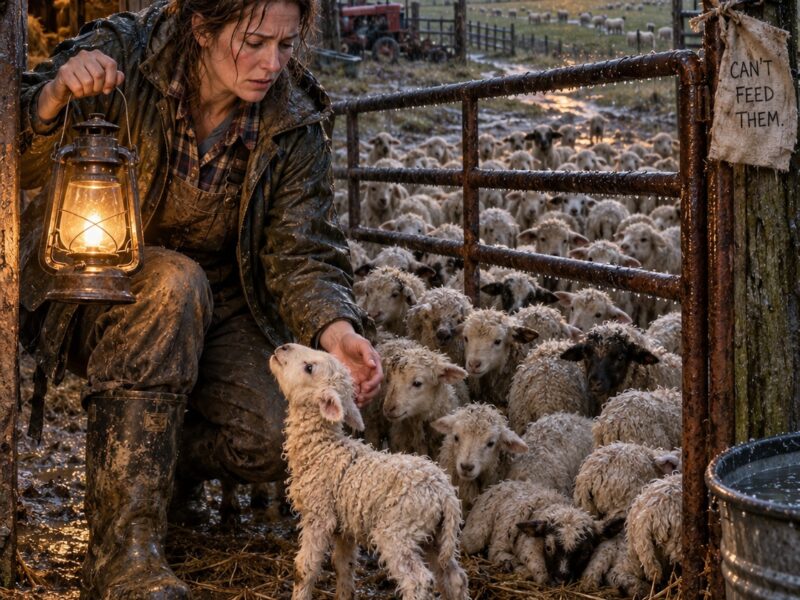
Thirty lambs were crushed against the iron gate.
They were wet, trembling and packed so tightly together that, for the first second, Nora could not tell where one body ended and another began. Some were standing. Several were kneeling. Two had gone almost entirely still.
“No,” Nora whispered.
She opened the gate.
A strip of blue plastic twine had been looped around the post. Hanging from it was a square cut from an old grain sack, soaked through at the edges.
Three words had been written across it in blue marker.
CAN’T FEED THEM.
Nora stared at the message while sleet collected in her hair.
Then one of the lambs made a weak sound against her boot.
Whatever questions existed could wait.
She carried the first one to the barn.
By 2:31, Nora had transformed the center aisle into an emergency ward. She separated the weakest four, dried them with towels warmed beside the stove and worked slowly enough not to shock bodies already too cold. She measured temperatures, checked gums and breathing, and followed procedures she had first learned as a girl, long before she understood why her grandmother made her repeat them until she could perform them half asleep.
The smallest lamb was a ewe with a torn yellow ear tag.
Her head kept falling sideways.
“Stay with me,” Nora murmured.
She hated herself the moment she said it.
Talking to sick animals was how you started pretending you could negotiate with outcomes.
She warmed the lamb gradually, worked electrolyte solution into her carefully when she could swallow, and wrapped her inside a towel against her own chest while the other lambs cried around them.
At 3:46, the power flickered.
At 4:12, the smallest lamb finally lifted her head.
Nora did not smile.
She wrote #17 — responsive on a legal pad and moved to the next one.
The work went on until daylight began turning the barn windows gray.
At 6:40, twenty-six lambs were standing.
At 6:53, twenty-nine were standing.
The thirtieth—the little ewe Nora had labeled Seventeen—remained beneath a heat lamp, breathing steadily but refusing to rise.
Nora sat on an overturned bucket beside her.
“Come on,” she said softly.
Seventeen blinked.
Nora rested two fingers beneath her jaw.
“You don’t have to be impressive. You just have to keep going.”
At 7:06, the lamb struggled upright.
She stood for perhaps four seconds before collapsing back into the straw.
Nora closed her eyes.
Four seconds were enough.
She opened the black notebook on the shelf by the barn door and wrote one line beneath the date.
30 arrived. 30 alive at first light.
She underlined it once.
Then she walked inside to make coffee.
At 8:03, a white county truck rolled into her driveway.
Nora watched it from the kitchen window.
“Of course,” she said.
The man climbing out was Dale Sherwin, director of the Tri-County Agricultural Extension Office. Dale was fifty-six, tall, lean, carefully polite and famous for speaking to people in a tone that made disagreement sound slightly immature.
His insulated coveralls looked brand new.
Nora opened the door before he knocked.
“That was fast.”
Dale paused.
“Morning, Nora.”
“Eight in the morning after thirty lambs appear at two.”
“I heard at the gas station.”
“The gas station opened eleven minutes ago.”
His expression changed almost invisibly.
Nora noticed.
She noticed most things.
Dale removed his cap. “Can I come in?”
She stepped aside.
He smelled faintly of aftershave and cold air. Nora poured him coffee without asking how he took it because she already knew—black, no sugar—and carried both mugs to the barn.
The lambs erupted when she entered.
Dale stopped.
For several seconds, the careful expression fell away and something more honest replaced it.
“Good God.”
“Thirty.”
“I can see that.”
“Four critical when they arrived.”
“And now?”
“Thirty alive.”
He looked at her.
“All thirty?”
“So far.”
Dale walked down the aisle, studying the pens.
Then his professional face returned.
“Nora, I’m going to say something you probably don’t want to hear.”
“You usually do.”
“This is too many.”
She sipped her coffee.
He continued. “The county has a livestock rescue coordinator. There are foster operations with equipment designed for this. Group feeders. Heated nursery space. Volunteers.”
“I have space.”
“You have forty acres, three adult ewes and no staff.”
“I have hands.”
“Two.”
She looked at him over the mug.
Dale sighed.
“Thirty bottle lambs means four to six feedings a day initially. Milk costs. Veterinary costs. Parasite management. Fencing. Hay. Labor. Then you’re carrying them through summer if you plan to shear.”
“I know what bottle lambs require.”
“I know you do.”
“Then we’re finished.”
“We’re not, actually.”
There it was—the head tilt.
Dale leaned one shoulder against the stall door.
“I’m not questioning whether you’re capable. I’m questioning whether being capable obligates you to exhaust yourself proving it.”
Nora’s jaw tightened.
He had almost made the argument sound kind.
Almost.
“My grandmother raised more than thirty.”
“Your grandmother had a different operation.”
“My grandmother had this operation.”
“She also lived in a different economy.”
Nora set her coffee down.
“Dale.”
“Yes?”
“I have the notebook.”
He stared at her.
For the first time that morning, he did not have a prepared response.
“The notebook?”
“Elsie’s.”
He gave a small breath through his nose.
“Nora, with respect, your grandmother’s records aren’t a substitute for modern management.”
“No.”
She picked up the mug again.
“They’re the reason I know when modern management is telling me something useful.”
The smallest lamb bleated from the warming pen.
Dale looked toward the sound.
Then Nora saw something else.
His eyes dropped briefly to the torn yellow ear tag.
Too briefly.
“You recognize that?” she asked.
His face went still.
“Recognize what?”
Nora reached down and turned Seventeen’s ear carefully.
Only part of the tag remained.
Two faded letters were visible.
PI—
Dale stepped back.
“No.”
The answer came too quickly.
Nora looked at him for another second.
He put his cap back on.
“I’ll leave the rescue coordinator’s number.”
“Don’t.”
“Nora.”
“If I need help, I’ll call.”
Dale studied her the way people study a locked door when deciding whether pushing harder will help.
Finally, he nodded.
“All right.”
He walked toward the truck, then stopped.
“If any start crashing, call Caroline Mays. Not the county line. Her direct number.”
“I know Dr. Mays.”
“Of course you do.”
He left.
Nora stood beneath the barn overhang and watched the white truck disappear down the wet road.
Then she returned to Seventeen.
The lamb was asleep.
Nora took the torn tag between two fingers and cleaned the mud from it.
There was more lettering on the reverse side.
A farm name.
Most of it had been ripped away.
But enough remained to read.
PIKE WO—
Nora knew exactly one sheep operation in the county whose name began that way.
Pike Wool & Lamb.
And three months earlier, Dale Sherwin had stood in the feed store telling anyone who would listen that Pike Wool & Lamb was “under financial pressure but being monitored.”
Nora stared at the tag.
Then at the road.
By nine that morning, she knew two things.
Someone had abandoned thirty lambs at her gate.
And Dale Sherwin knew more about it than he had told her.
She did not call him.
Not yet.
Instead, Nora went into the farmhouse and opened the drawer beside the refrigerator.
The notebook was where it had always been.
Black-and-white cardboard cover. Cloth tape reinforcing the spine. Forty-two years of weather, breeding records, feed ratios, pasture maps, illnesses, births, deaths and plainspoken observations written by Elsie Vale, who had owned the property from 1959 until the day she died.
Nora carried it to the barn.
The first page had one sentence written across the top.
IF YOU ARE TOO PROUD TO WATCH CLOSELY, SELL THE SHEEP.
Nora had been twelve when she first read it.
She had laughed.
Her grandmother had not.
Elsie Vale had never confused affection with softness. She could sit beside a dying ewe for three hours and still sell a healthy ram without ceremony the following week. She believed animals deserved attention, competence and calm—not human fantasies about what they owed you in return.
Nora turned to March 1974.
She knew the entry almost by heart.
Bottle lambs remember the hand that stayed.
Below it, in smaller writing:
Strong lamb follows flock. Weak lamb watches the person. You learn more from the one that makes you look twice.
Nora sat on the bucket.
Thirty lambs called from the pen.
“Fine,” she said.
She closed the book.
“You win.”
She began the second feeding.
For the first six days, Nora slept in ninety-minute pieces.
She fed the lambs six times daily, weighed the weakest ones every morning and recorded appetite, temperature and something her grandmother had simply called the look.
The look was not scientific language.
It was also, Nora had learned, extraordinarily useful.
A lamb that still complained about being handled had energy to spend. A lamb that followed movement with its eyes had not withdrawn from the world. The dangerous ones were often the quiet ones—not sleeping, not resting, but fading in a way that inexperienced people mistook for calm.
Seventeen developed the look on the third night.
Nora found her standing alone beneath the heat lamp while the others crowded near the feeder.
Her ears drooped.
The lamb watched Nora but did not move toward her.
“No.”
Nora lifted her immediately.
By midnight, Seventeen had diarrhea and was dehydrating fast.
At 12:14 a.m., Nora called Dr. Caroline Mays.
The veterinarian answered on the fourth ring.
“How bad?”
“Temperature down. Weak suck. Scours started in the last hour.”
“Breathing?”
“Clear.”
“Gums?”
“Pale but not white.”
“Weight?”
“Eleven-point-six.”
A pause.
“You’ve been tracking?”
“Yes.”
“Of course you have.”
Caroline gave instructions, then added, “If she declines, bring her in.”
“The road is icing.”
“I know.”
Nora looked through the barn window.
Sleet shone in the security light.
“I’ll manage her here.”
“Nora.”
“I know when to call it.”
Caroline was silent.
Then, softly, “That isn’t what I was going to say.”
Nora waited.
“You don’t have to save thirty out of thirty for this to count.”
Nora’s fingers tightened around the phone.
“I didn’t say I did.”
“You didn’t have to.”
Caroline hung up twenty minutes later.
Nora sat with Seventeen until dawn.
The lamb survived.
At 5:40 a.m., she drank from the bottle with enough irritation to pull the nipple sideways.
Nora laughed once.
It surprised her so much that she looked around the empty barn as though someone else had made the sound.
By the second week, people began arriving.
The valley had decided Nora’s farm was a story.
A cattleman named Amos Kerr stopped his truck by the fence and watched her carry bottles into the pen.
“You planning on sleeping again this year?”
“Eventually.”
“I’ve seen folks burn themselves out on fewer.”
“I’ve seen folks talk themselves tired on less.”
Amos smiled despite himself.
“If it gets too much, co-op would take some.”
“I know.”
“Fair price, probably.”
“Probably.”
He remained at the fence.
Nora kept working.
Finally he said, “You always were Elsie’s granddaughter.”
Nora looked up.
“Is that a compliment?”
“I’m still deciding.”
He drove away.
Three days later, Ruth Coleman from St. Mark’s Church arrived with two cases of commercial milk replacer and a university pamphlet titled MANAGING LARGE GROUPS OF ARTIFICIALLY REARED LAMBS.
Ruth was not condescending.
That made her harder to resist.
“I know you didn’t ask,” she said, setting the boxes inside the barn. “But sometimes people don’t ask because asking is exhausting.”
Nora softened.
“Thank you.”
“You’ll use it?”
“I’ll keep it.”
Ruth looked at her.
“That was not my question.”
“No.”
Ruth laughed.
“What are you feeding?”
Nora showed her the ratios from Elsie’s notebook.
Whole milk supplemented according to condition, careful electrolyte timing, gradual transitions, no sudden changes simply because something new came in a colorful bag.
Ruth studied the page.
“Your grandmother tracked eighty-one lambs?”
“Across three seasons.”
“She really wrote ‘commercial replacer adequate, coats disappointing’?”
“Yes.”
“That woman had opinions.”
“That woman had data.”
Ruth touched the notebook respectfully.
“Same thing, if you collect enough of it.”
The next morning, a boy appeared at the gate.
He was seventeen, thin, dark-haired and carrying nothing.
Nora found him standing outside the barn.
“You lost?”
“No, ma’am.”
“Then why are you standing there?”
“I heard you have thirty bottle lambs.”
“That rumor improves every time it travels.”
He glanced past her.
“They’re loud.”
“That part’s accurate.”
“My name’s Tomas Rivera.”
“I know your aunt.”
He nodded.
His aunt Elena worked nights at the nursing home in Mill Gap.
Tomas lived with her because his mother had been in and out of treatment for years, a fact the valley knew but polite people pretended not to.
“What do you want, Tomas?”
He considered the question.
“To help.”
“Why?”
“I like sheep.”
“That is not a qualification.”
“No, ma’am.”
She waited.
He did not fill the silence.
That interested her.
Nora handed him a bottle.
“Blue collar. Pen three. Don’t chase him. Let him come.”
Tomas took the bottle.
He entered the pen, crouched and waited.
The lamb approached within fifteen seconds.
Nora watched without appearing to watch.
Animals did not tell you whether someone was good.
They did tell you whether someone knew how to be quiet.
Tomas returned the next morning.
Nora did not ask him to.
He came the morning after that too.
By the end of the week, she put his name in her payroll notebook.
“I can volunteer,” he said.
“No.”
“I don’t mind.”
“I do.”
He looked confused.
“If you work, you get paid.”
“My aunt says you probably don’t have extra money.”
“Your aunt should run her own books.”
A smile threatened at the corner of his mouth.
Nora named an hourly rate.
Tomas nodded.
“That’s fine.”
“No negotiation?”
“You said the number like it wasn’t negotiable.”
“Good.”
He became part of the mornings.
They worked mostly without talking.
Nora liked him for that.
One Saturday, while they weighed the lambs, Tomas lifted Seventeen onto the scale.
“She’s mean now.”
“She’s alive enough to be mean.”
“She bit my jacket.”
“You were in the way.”
He looked down at the torn ear tag.
“What does Pike mean?”
Nora’s hand stopped over the notebook.
“Why?”
“That tag.”
“You know Pike Wool?”
“My aunt used to clean for Mrs. Pike.”
Nora kept writing.
“What have you heard?”
“Their bank took most of the equipment.”
“When?”
“January.”
Nora looked up.
Tomas shifted.
“Aunt Elena said Mrs. Pike was trying to sell the breeding flock. Her husband died last year. Heart attack.”
Nora had known Walt Pike had died.
She had not known how bad things had become afterward.
“What happened to their lambs?”
Tomas shrugged.
“Don’t know.”
Nora closed the notebook.
“Tomas.”
“Yes?”
“Did your aunt tell you where these came from?”
“No.”
He hesitated.
“But she looked weird when I said I was working here.”
That evening, Nora drove to Elena Rivera’s house.
Elena answered wearing nursing-home scrubs, exhausted eyes and an expression that confirmed Nora’s suspicion before either woman spoke.
“You know.”
Elena stepped onto the porch and closed the door behind her.
“Nora—”
“Were they Pike’s?”
Elena looked toward the street.
“Yes.”
Nora felt anger move through her slowly.
Not hot.
Worse.
“Who left them?”
“I don’t know exactly.”
“That is not an answer.”
“It’s the answer I have.”
“Did Dale know?”
Elena closed her eyes.
“Nora.”
“Did he?”
“Yes.”
The cold seemed suddenly cleaner.
Nora folded her arms.
“Tell me.”
Elena leaned against the porch rail.
“Erin Pike called the extension office when the feed account got frozen. She had thirty bottle lambs that weren’t ready to sell. Dale was trying to place them.”
“And?”
“The county rescue said they were full.”
“So someone dumped them at my gate.”
“I heard a transport was supposed to take them to a farm in Rockbridge.”
“Supposed to.”
“Yes.”
“What happened?”
“I don’t know.”
“You expect me to believe that?”
Elena’s face hardened.
“You came here asking what I know. Don’t punish me because it isn’t enough.”
Nora went quiet.
Elena continued.
“I know Erin was ashamed. I know she had two days left before the bank locked the main barn. I know she was trying to keep those lambs alive while deciding which bills not to pay.”
“That doesn’t explain my gate.”
“No.”
“Did Dale choose me?”
“I don’t know.”
Nora stared at the wet porch boards.
“Why didn’t he tell me?”
“That,” Elena said, “you should ask Dale.”
Nora drove home angrier than she had arrived.
But there were thirty lambs waiting for evening feed.
Anger had to stand outside.
Work came first.
March brought mud.
Then wind.
Then three deceptive warm days followed by a freeze that turned every trough edge white overnight.
The lambs grew.
Not dramatically.
Steadily.
Nora distrusted dramatic growth.
Her grandmother had too.
Fast gain makes people happy before it makes them careless, one entry read.
By the middle of March, the lambs had learned the feeding schedule so thoroughly that Nora could hear them begin calling when she was still crossing the yard.
Tomas started naming them.
Nora objected.
“Numbers work.”
“Numbers are depressing.”
“They don’t know.”
“I do.”
“That sounds like your problem.”
He pointed at Seventeen.
“I’m calling her Cricket.”
“She does not look like a Cricket.”
“What does a Cricket look like?”
Nora opened her mouth.
Nothing came.
Tomas smiled.
“Cricket.”
Nora continued pretending the lamb was Seventeen for another nine days.
Then Dr. Mays visited for routine checks.
“How’s Cricket doing?”
Nora slowly turned toward Tomas.
He studied the ceiling.
Caroline laughed.
That was how the name stayed.
By April, the crisis stage had passed.
That should have brought relief.
Instead, it brought opinions.
People who had predicted disaster began telling Nora she had done surprisingly well.
The word surprisingly arrived in many forms.
“You pulled it off.”
“They look better than I expected.”
“Guess those old methods still work.”
“Now you can move them while prices are decent.”
The assumption beneath every compliment was the same.
The emergency was over.
Now a sensible person would sell.
At thirty-eight, Nora had learned that communities often tolerate stubbornness only until stubbornness succeeds. Then they become anxious for success to end before it threatens the rules everyone else has agreed to live by.
Dale Sherwin returned on April 11.
He found Nora repairing a section of interior fence.
“The county can still help you place animals.”
She drove a staple into the post.
“Good morning to you too.”
He exhaled.
“I deserve that.”
“Yes.”
“I should have told you where they came from.”
“Yes.”
“I was trying to protect Erin’s privacy.”
Nora turned.
“You were also protecting the county.”
Dale did not answer.
“That transport never reached Rockbridge, did it?”
“No.”
“Why?”
“The receiving farm backed out when they learned how many required bottles.”
“And then?”
“The driver called me.”
“At two in the morning?”
“Two-oh-six.”
Nora stared at him.
“Before they were at my gate.”
“Yes.”
Her hand tightened around the hammer.
“What did you tell him?”
“I told him not to abandon livestock.”
“That is not what I asked.”
Dale looked toward the field.
“He said he was already in your valley.”
“And?”
“I said you had experience.”
The silence changed.
Nora’s voice became very quiet.
“You sent him here.”
“I said you had experience. I did not tell him to leave them.”
“You gave him my name.”
“Yes.”
“You gave him my road.”
Dale’s jaw flexed.
“Yes.”
“And then you arrived at eight in the morning and explained why I couldn’t manage them.”
“I came because I knew what had happened.”
“You came to clean it up.”
“I came to offer options.”
“After someone made the decision for me.”
Dale rubbed his forehead.
“You’re right.”
The answer stopped her.
No defense.
No head tilt.
No explanation.
Just two words.
“You’re right.”
Nora looked away.
Dale continued.
“I mishandled it.”
“You did.”
“The driver was panicking. Erin was panicking. The rescue was full. The receiving farm changed its mind. I thought about your grandmother.”
“My grandmother is dead.”
“I know.”
“Then you should have thought about me.”
Dale absorbed that.
Finally he said, “I’m sorry.”
Nora drove another staple into the fence.
She wanted the apology to make the anger disappear.
It did not.
But it changed its shape.
“Who was the driver?”
“Marcus Bell.”
“I know Marcus.”
“He hasn’t slept properly since that night.”
“That sounds inconvenient.”
Dale winced.
Nora immediately regretted the sentence.
Not because it was false.
Because it was easy.
She had never wanted to become the kind of person who used accuracy as permission for cruelty.
“Tell him I’m not ready to talk to him.”
“I will.”
Dale looked across the pasture.
The lambs were running in a clumsy line behind Tomas.
“They look good.”
Nora said nothing.
“Better than good.”
“Careful. That almost sounded surprised.”
Dale gave a tired smile.
“Fair.”
Before leaving, he mentioned Gerald Croft.
Croft owned five hundred acres east of Mill Gap and had recently received a county-supported grant for what Dale called a “next-generation small-ruminant efficiency demonstration.”
Climate-controlled nursery sections.
Automated mixing.
Digital weight sensors.
Water monitoring.
Performance software.
“Gerald’s hosting a co-op presentation Thursday,” Dale said.
“I’ll be busy.”
“You might find it useful.”
“I already know computers can weigh sheep.”
“Nora.”
“I also know sheep don’t read reports.”
He shook his head.
“One day, you’ll admit modern equipment isn’t personally insulting you.”
“One day, you’ll admit old equipment isn’t personally insulting you.”
For the first time, Dale laughed.
Tomas attended Croft’s presentation with his aunt.
He reported on it the next morning while cleaning water buckets.
“He said small operations survive on sentiment.”
Nora kept writing.
“He said that?”
“Something like that.”
“Then don’t quote him unless you remember exactly.”
Tomas thought.
“He said, ‘Sentiment can keep a small farm open longer than the numbers justify.’”
Nora’s pencil stopped.
“Better.”
“That bother you?”
“No.”
It bothered her.
Not because Gerald Croft was entirely wrong.
Some farms did continue long after economics had become impossible.
Nora had seen families mortgage houses, destroy marriages and call the wreckage tradition.
But Gerald’s mistake was the same mistake she saw in Dale sometimes.
He believed whatever could not be easily measured was probably emotional.
Nora’s grandmother had measured almost everything.
Rainfall.
Weight gain.
Lamb mortality.
Pasture recovery.
Wool length.
Mineral intake.
Water flow.
Elsie Vale had also spent forty years noticing things that did not fit neatly into a county spreadsheet.
A lamb’s ear position.
The smell of soil before a dry summer.
Whether moss changed color on the north side of the rock shelf.
Whether sheep entered a paddock hungry or merely habitual.
Whether a field recovered from grazing in twenty-six days or thirty-eight.
Sentiment had nothing to do with it.
Attention did.
By May, Nora’s lambs had become difficult to recognize as the wet, shaking creatures from February.
Their first fleeces were dense and even.
Cricket was no longer the smallest.
She remained the loudest.
When Nora entered the field, Cricket came directly to the fence and waited.
Tomas noticed.
“She remembers.”
“She remembers bottles.”
“She remembers you.”
“She remembers food.”
“Same thing to a sheep.”
Nora looked at him.
“You are seventeen. Do not become philosophical.”
“I turned eighteen last week.”
“That’s worse.”
He grinned.
The good months did not last.
June went dry.
At first, nobody cared.
Farmers in that valley had been trained by generations to distrust panic.
A week without rain was weather.
Two was inconvenient.
Three meant people began looking at hay fields differently.
By July 10, the creek crossing Croft’s eastern property had fallen low enough to expose pale stones that had not been visible in years.
By July 18, the county issued voluntary water restrictions.
By July 27, nobody called them voluntary in conversation anymore.
Nora walked her northwest boundary every morning.
Her spring still ran.
It emerged beneath a low shelf of limestone where roots from an old sycamore twisted through the bank. In 1963, Elsie Vale had cleared a catchment there and run a gravity line downhill to a tank above the barn.
No electric pump.
No digital controls.
No remote monitor.
Water moved because elevation told it to.
Every April and October, Nora cleaned the intake with a piece of stiff wire.
Nobody had ever seen her do it.
Nobody had ever praised it.
That was one of the reasons it worked.
Unimpressive jobs tended to survive fashionable neglect.
The pasture survived too.
Nora divided her forty acres into six primary paddocks, moving sheep before they grazed plants down to the crown and resting sections longer than neighbors considered necessary.
By August, the surrounding valley was brown.
Nora’s fields were not lush.
But they were alive.
From the county road, Vale Ridge looked like someone had turned the saturation slightly higher than the land around it.
Cars slowed.
Tomas noticed one morning while they checked hooves.
“It’s green here.”
Nora nodded.
“Why?”
“Roots.”
“That’s it?”
“That’s most of it.”
He waited.
Nora sighed.
“You rest grass long enough, it spends energy downward instead of desperately rebuilding what you keep taking off the top. Deeper roots reach moisture longer.”
Tomas looked across the field.
“So the secret is leaving it alone?”
“The secret is knowing when leaving something alone is work.”
He smiled.
“That sounds like something from the notebook.”
“It probably is.”
Croft’s system did not have the same summer.
The well serving his automated barns had been designed around normal seasonal groundwater.
The season had no interest in normal.
By mid-August, Croft was trucking water twice a week.
The climate-control units consumed more than expected in the heat.
Feed-mixing equipment required additional water.
The software recorded every shortage beautifully.
Red columns filled the daily reports.
One afternoon, Gerald Croft arrived at Nora’s farm.
He drove a black pickup that probably cost more than her tractor.
He was in his early fifties, broad-shouldered, silver at the temples and accustomed to rooms adjusting around him.
Nora met him at the gate.
“Gerald.”
“Nora.”
They had known each other their entire adult lives without ever becoming friends.
He looked over her shoulder.
“Field looks good.”
“It’s holding.”
“How much flow are you getting from the northwest spring?”
Nora’s expression did not change.
“Enough.”
“For what?”
“My farm.”
Gerald smiled thinly.
“I’m not trying to steal your water.”
“Good.”
“I’m asking numbers.”
“I know.”
“Dale says it never went dry in ’88.”
“Dale talks a lot.”
“So I hear.”
Gerald rested both hands on the gate.
“I might want to buy twelve acres along your north boundary.”
“No.”
“You haven’t heard an offer.”
“I heard what you want.”
“Nora.”
“No.”
“Two hundred thousand.”
Her stomach tightened.
He saw it.
Of course he did.
The north twelve acres were worth nowhere near that amount as ordinary grazing land.
But Nora had a mortgage balance, equipment repairs and a winter hay bill already projected higher than last year’s.
Two hundred thousand dollars could erase every debt she carried.
Gerald knew that too.
“You’re buying the spring.”
“I’m buying land.”
“With the spring.”
“Yes.”
“No.”
He studied her.
“Two-fifty.”
“No.”
“You’re emotionally attached.”
There it was.
Nora felt something inside her go very still.
“No, Gerald. I’m hydrologically attached.”
His mouth twitched.
“I can design around it.”
“Then do that.”
“You’re carrying over thirty animals on forty acres.”
“Thirty-three, currently.”
“And winter?”
“Planned.”
“Hay prices?”
“Planned.”
“You can’t expand forever.”
“I have not said I intend to.”
Gerald looked toward the lambs.
Cricket stood at the fence.
He frowned.
“Those Pike animals?”
Nora’s attention sharpened.
“You know them?”
“Everybody knows.”
“You knew in February?”
A second too long passed.
Gerald glanced back at her.
“I knew Erin was trying to place lambs.”
“Did Dale ask you?”
“Yes.”
“And?”
“I said no.”
“Why?”
“My demonstration contract had intake specifications. Age range, weaning targets, baseline weights. Bottle lambs would have destroyed the data.”
Nora stared at him.
He did not sound ashamed.
He sounded factual.
Somehow that irritated her more.
“So they weren’t efficient enough.”
“They weren’t appropriate for that program.”
“They were six weeks old.”
“And I had obligations.”
“You always do.”
Gerald’s eyes hardened.
“This is why people don’t like talking business with you.”
“No. People don’t like talking business with me because I remember what they said after the meeting ends.”
He pushed off the gate.
“Offer stands.”
“It shouldn’t.”
“Winter has a way of changing arithmetic.”
“So does drought.”
Gerald left.
Nora stood by the gate long after his truck disappeared.
Then she walked to the barn, opened her bookkeeping software and stared at the numbers until they stopped being abstract.
Two hundred and fifty thousand dollars.
Enough to breathe.
Enough to replace the north fence.
Enough to pay the mortgage.
Enough to upgrade equipment.
Enough to hire Tomas full-time if he wanted it.
She closed the laptop.
Then she opened her grandmother’s notebook.
The 1988 drought entry covered four pages.
Rainfall totals.
Pasture days.
Spring flow.
Hay reserves.
At the end, Elsie had written:
Never sell the thing that keeps the rest alive because you are tired of paying for the rest.
Nora sat back.
“Convenient,” she muttered.
The dead could be irritatingly confident because they no longer had bills.
Still, the north twelve acres remained hers.
September arrived hot enough to feel vindictive.
Nora cut spending everywhere she could.
She delayed replacing the truck.
She repaired barn siding herself.
She sold two older ewes that no longer fit the breeding plan.
She accepted no money from Tomas when he offered to let her reduce his hours without reducing the work.
“If I can’t pay you, you don’t work.”
“That makes no sense.”
“It makes excellent sense.”
“I’m here anyway.”
“Then stand outside the fence and admire the sheep.”
He stared at her.
“You’re impossible.”
“Correct.”
A week later, one of Nora’s longtime wool buyers visited.
Claire Bennett owned a small mill outside Charlottesville specializing in traceable American wool.
She ran both hands through Cricket’s fleece.
“How many like this?”
“Most.”
“Most?”
Nora brought her records.
Claire studied weights, growth and fleece notes.
“If this quality holds through November, I’ll commit to the first clip.”
Nora kept her face neutral.
“At what price?”
Claire named a number.
It was significantly above the co-op rate.
“Conditional on skirted quality.”
“Of course.”
“And length.”
“Yes.”
“And consistency.”
Nora looked across the field.
“That won’t be the problem.”
Claire smiled.
“You sound like Elsie.”
“That has been used both kindly and otherwise.”
“I meant it commercially.”
“The highest form of affection.”
The advance deposit arrived two days later.
It was not enough to solve everything.
It was enough to change Nora’s breathing.
Then the weather changed.
The drought broke on October 3.
It did not end politely.
Rain began Thursday evening and continued through Friday, then Saturday, then Sunday.
The baked ground rejected it at first.
Water ran over soil instead of sinking in.
Creeks rose fast.
At 3:20 Sunday afternoon, Tomas called Nora from his truck.
“Croft’s east fence is gone.”
Nora stood under the barn overhang.
“What?”
“Creek took it. I’m on County Eight.”
“How high?”
“Bad.”
“Go home.”
“I can help.”
“You can help by not becoming another problem.”
“Nora—”
“Go home, Tomas.”
She ended the call.
At 4:06, Dale called.
Croft’s lower barn was flooding.
At 4:23, a county emergency crew lost access from the eastern road.
At 4:51, Nora heard trucks on her lane.
Gerald Croft climbed out of the first one soaked to the skin.
There was no expensive coat.
No calm authority.
Just mud.
“We need high ground.”
Nora looked past him.
Two livestock trailers waited at the gate.
“How many?”
“Nine in this trailer. Twelve in the next.”
“Your north barn?”
“Full.”
“What happened?”
“The generator room flooded.”
Nora’s face changed.
“Animals?”
Gerald looked away.
That was answer enough.
“How many?”
His throat worked.
“Eleven.”
Rain struck the metal barn roof.
Nora closed her eyes for half a second.
Then she opened the gate.
“Upper paddock. Not the third. Ground’s softer there.”
Gerald stared at her.
“Nora—”
“Move.”
For the next two hours, her farm filled.
Croft’s surviving sheep entered the upper field.
County workers parked trucks along her lane.
Dr. Mays arrived to examine exhausted animals.
Tomas appeared despite being told to go home.
Nora saw him carrying panels toward the temporary pen.
“I told you—”
“My aunt dropped me.”
“This is not better.”
“No, but I’m already here.”
She pointed toward the barn.
“Dry gloves.”
He nodded.
That was all.
At dusk, Nora stood at the fence and counted.
Her original three ewes.
Thirty bottle lambs.
Twenty-one displaced Croft animals.
The field had never held that many sheep in Nora’s lifetime.
Cricket approached the fence and pressed her nose between the rails.
Nora touched her forehead.
“You started this.”
Behind her, Gerald said, “No.”
Nora turned.
He stood several feet away.
“I did.”
Rain ran from his hair.
“What?”
“I refused Pike’s lambs.”
“We discussed that.”
“No.”
His voice was different now.
“We didn’t.”
He looked toward the field.
“Dale called me twice that night.”
Nora became still.
“The night they came?”
“Yes.”
“He said the rescue had refused them.”
“Yes.”
“And?”
“He asked if I could hold them for forty-eight hours.”
Nora felt cold despite her raincoat.
“You said no.”
Gerald nodded.
“I had empty space.”
The words landed harder than she expected.
“How much?”
“An entire nursery section.”
Nora stared at him.
“Why?”
“Because the grant inspection was scheduled that week.”
She said nothing.
Gerald continued because silence had left him nowhere to hide.
“I was afraid thirty underweight bottle lambs would be photographed inside a project designed to demonstrate efficiency. I didn’t want questions about mortality risk contaminating the first report.”
“Contaminating.”
“I know how it sounds.”
“It sounds exactly like what it was.”
“Yes.”
That answer angered her more than defense would have.
“You had heat.”
“Yes.”
“Group feeders.”
“Yes.”
“Staff.”
“Yes.”
“And you refused them because they would make your numbers ugly.”
Gerald’s face tightened.
“Yes.”
Nora turned away.
For several seconds, the only sound was rain and sheep calling from the field.
Then Gerald said, “Eleven died today.”
She looked back at him.
He was not asking for forgiveness.
That was the only reason she listened.
“The software flagged the flood risk in July,” he said. “Recommended moving the generator above the lower level.”
“Why didn’t you?”
“Downtime.”
Nora understood.
“Benchmarks.”
“Yes.”
“You thought you could manage around it.”
“Yes.”
The word broke slightly.
Gerald looked toward the trailers.
“I keep thinking about that report. Red warning box. I forwarded it to Dale. Told him we’d address it after the summer evaluation.”
Nora folded her arms tightly.
Gerald’s eyes were wet, though in the rain it would have been impossible to prove why.
“I spent my whole life believing more information meant fewer mistakes.”
Nora said nothing.
“It doesn’t.”
“No.”
“What does?”
“Paying attention before information becomes permission to ignore what you already know.”
Gerald breathed out.
“That sounds like your grandmother.”
“It probably is.”
He almost smiled.
Then he looked back at the field.
“I’m sorry about Pike’s lambs.”
Nora’s jaw tightened.
“Do not apologize because eleven animals died and you feel humbled.”
He looked at her.
“Then when?”
“When you know what you’re apologizing for.”
She walked away.
Three days later, the water dropped.
Croft moved his sheep home.
Nine days later, he returned alone in his old farm pickup.
Nora was splitting wood beside the barn.
He closed the gate behind him.
She kept swinging the maul.
“I heard your spring ran through the whole drought,” he said.
“Yes.”
“The shelf on the northwest corner?”
“Yes.”
“I have rock like that on my east section.”
Nora set another log upright.
“And?”
“I want to learn how yours works.”
She swung.
The wood split cleanly.
Gerald waited.
“I can pay you.”
“No.”
“Consulting rate.”
“No.”
“For your time.”
“No.”
He exhaled.
“What do you want?”
Nora put the maul down.
“Come Saturday.”
His eyebrows rose.
“Saturday?”
“Seven.”
“All right.”
“Bring a shovel.”
He almost smiled.
“Anything else?”
“Clothes you can ruin.”
Saturday morning, Gerald arrived at 6:52.
He brought a shovel.
He also brought Caleb Moore, a twenty-five-year-old worker from his operation who spoke little and watched carefully.
Tomas was already there.
The four of them walked to the northwest corner.
Nora showed them the spring.
There was nothing visually impressive about it.
A dark opening beneath limestone.
A shallow catchment.
Old pipe.
A tank on the slope.
Gerald stared.
“That’s it?”
Nora handed him the wire.
“That sentence is how maintenance gets skipped.”
She showed them how sediment accumulated after major rainfall.
How roots could shift around the intake.
How the line needed enough fall to move water without a pump.
How the tank overflow told you more than a digital gauge when you knew what normal looked like.
Gerald crouched beside the rock.
“How did Elsie find this?”
Nora opened the notebook.
“1963.”
She handed it to him.
Gerald read silently.
The entry described a dry July, sheep repeatedly gathering near the northwest shelf and damp moss remaining green beneath stones when the surrounding ground had hardened.
Elsie had dug by hand.
Not because anyone had told her water was there.
Because the sheep kept telling her something was different.
Gerald finished reading.
He handed the notebook back with both hands.
“How much do I owe you?”
“Nothing.”
“Nora.”
“Maintain yours.”
“That’s all?”
“That’s the difficult part.”
Gerald nodded.
“I will.”
After he left, Tomas remained beside the spring.
“He didn’t say sorry again.”
“No.”
“Does that bother you?”
Nora considered it.
A year earlier, she might have answered immediately.
Now she watched the thin, constant thread of water move through the catchment.
“It used to.”
Tomas looked at her.
“What changed?”
“I started caring more about whether people changed behavior than whether they found the right words for me.”
He nodded slowly.
“Is that in the notebook?”
“No.”
She picked up the wire.
“That one cost me extra.”
Two weeks before shearing, Marcus Bell came to the farm.
Nora recognized his delivery truck before he climbed out.
He was sixty-three, heavy through the middle, with a white beard and the permanent stoop of someone who had spent thirty years moving feed sacks.
He stopped outside the gate.
Nora walked down.
Marcus removed his cap.
“Dale said you’d talk to me eventually.”
“I said I wasn’t ready before.”
“I know.”
“Are you ready?”
His eyes filled immediately.
That made the question feel cruel.
Nora opened the gate.
They sat on the porch.
Marcus kept his cap in both hands.
“I left them.”
Nora waited.
“Erin Pike was with me.”
That surprised her.
“Erin?”
“She rode in the truck.”
“Why didn’t she come to me?”
Marcus looked down.
“Shame.”
Nora said nothing.
“The bank gave her until morning. We’d been loading animals all day. The county placement fell through. Croft said no. Rescue said no. Dale was calling everyone.”
“And my farm?”
“Erin said your grandmother once took six lambs from Walt when a ewe disease went through his barn. Nineteen eighty-nine, maybe.”
Nora remembered the entry.
Six orphaned lambs.
March.
Cold.
Three bottles before breakfast.
“Erin knew Elsie was dead.”
“Yes.”
“So why me?”
Marcus looked toward the field.
“Because Erin said if anybody raised by Elsie still lived here, the lambs had a chance.”
Nora’s anger returned.
But it returned mixed with something harder to hold.
“You could have knocked.”
Marcus nodded.
“I should’ve.”
“You could have called.”
“I should’ve.”
“You could have waited.”
“Yes.”
“Instead you tied thirty animals to my gate in sleet.”
“Yes.”
His voice cracked.
“I was afraid you’d say no.”
Nora stared at him.
There it was.
Not a logistical explanation.
Not bureaucracy.
Not an accident.
Fear.
Ugly, ordinary fear.
Marcus continued.
“And if you said no, I had nowhere else.”
“That didn’t give you the right to make the answer for me.”
“No.”
“Do you understand that?”
“Yes.”
“Really?”
He looked directly at her.
“No.”
Nora frowned.
Marcus swallowed.
“I understand it now. That night, I understood thirty lambs freezing in my truck and nowhere to go. I made you responsible because I couldn’t stand being responsible anymore.”
That was the first honest thing he had said that Nora could not argue with.
She looked toward the field.
Cricket was at the fence.
Of course she was.
“Where is Erin?”
“North Carolina. Sister took her in.”
“Did she lose everything?”
“Most.”
Nora rubbed her palms together.
“Tell her they lived.”
Marcus closed his eyes.
“All?”
“All thirty.”
A sound escaped him.
Half laugh.
Half grief.
“Every one?”
“Yes.”
He covered his face.
Nora watched him.
She had imagined this conversation many times.
In none of those versions had the man at her gate cried.
That was the trouble with anger when the truth finally arrived.
Truth rarely had the decency to be simple enough to hate.
Shearing began November 19.
Dennis Cole drove in before sunrise with equipment that had been repaired so many times no original manufacturer could reasonably claim responsibility for it.
He had shorn for Elsie in the 1990s.
He was seventy now and moved with surprising speed.
“You kept thirty?”
“All thirty.”
Dennis looked toward the field.
“Foolish.”
“That’s what everybody said.”
“Didn’t say bad.”
He plugged in the clippers.
“Bring me the first one.”
Cricket came in third.
Tomas held her while Dennis worked.
The fleece rolled away in one dense piece.
Nora reached into it.
The fiber was even.
Good length.
Strong crimp.
Clean.
Dennis ran his thumb through the staple.
Then he looked at Nora.
“Consistent.”
One word.
Nora wrote it down.
Across two days, thirty first fleeces came off.
The field changed visually with every group returned to pasture.
Animals that had looked round and wool-heavy became narrower, cleaner versions of themselves.
By the end of the second day, bags of skirted fleece filled one side of the barn.
Nora weighed every lot.
Four-point-one pounds.
Four-point-four.
Four-point-two.
Four-point-six.
Cricket: four-point-three.
Tomas read the final scale.
“One twenty-nine.”
Nora checked.
“Again.”
He reset it.
They recalculated.
“One hundred twenty-nine pounds.”
Nora stood still.
Her projected high estimate had been one hundred fifteen.
Dennis looked over.
“Problem?”
“No.”
Nora stared at the number.
“No problem.”
Claire Bennett came the next morning.
So did two other fiber buyers.
They examined length, cleanliness and uniformity.
For three hours, people discussed the lambs’ wool in language that had nothing to do with charity.
No one called the animals rescues.
No one used the word miracle.
They talked price.
Yield.
Micron range.
Staple strength.
Processing.
Repeat supply.
Nora preferred it that way.
By noon, every pound was sold.
When she finished the season’s accounts, the profit was not enormous.
It was real.
After milk, hay, veterinary costs, minerals, fencing materials, shearing fees and Tomas’s wages, the number left at the bottom of the page was modest.
Nora stared at it for several seconds.
Then she smiled.
Not because the money was impressive.
Because everybody had said the equation could not close.
It had closed.
Barely.
Honestly.
On Friday morning, she handed Tomas an envelope.
He opened it.
“This is too much.”
“It’s two weeks’ wages.”
“I know.”
“Then your arithmetic works.”
“Why?”
“You earned it.”
He stared at the money.
Then at her.
“Thank you.”
“You’re welcome.”
Neither said more.
Eight ewe lambs stayed.
Nora selected them using Elsie’s criteria.
Feet.
Jaw.
Frame.
Fleece.
Temperament.
Health history.
And one criterion Nora added herself.
Whether they came to the fence when she approached.
All eight did.
Cricket was among them.
Tomas did not comment.
He did not need to.
In December, Dale returned.
Fresh coveralls.
Same white truck.
Same careful posture.
He stood in the barn while Nora replaced a hinge.
“The extension office is assembling a case study on the drought.”
“Congratulations.”
“And flood outcomes.”
“Less congratulatory.”
He accepted that.
“We’d like your numbers.”
“Which ones?”
“Water flow. Rotation schedule. Stocking rates. Fleece yield if you’re comfortable sharing.”
Nora tightened the bolt.
“Why?”
“To document successful resilience practices.”
“That phrase hurt you to say?”
“A little.”
She smiled.
Dale continued.
“I’d also like photographs of Elsie’s gravity system.”
“It’s my gravity system.”
“Right.”
“It was hers. Now it’s mine.”
“Right.”
“It is not a museum piece.”
“I didn’t say—”
“You were going to call it a legacy system.”
Dale closed his mouth.
Nora pointed the wrench at him.
“It’s not legacy infrastructure if it’s currently supplying water.”
He sighed.
“Fine.”
“Fine.”
“Current gravity-fed livestock water infrastructure based on a 1963 design.”
“Better.”
“You enjoy this too much.”
“I enjoy accuracy.”
Dale looked through the barn door.
Eight retained ewe lambs stood near the fence.
“You were right.”
Nora went back to the hinge.
“No.”
He frowned.
“No?”
“The spring was right. My grandmother was right about rotation. Claire was right about the fiber market. You were right that thirty bottle lambs were financially dangerous.”
Dale watched her.
“And Gerald?”
“Gerald was right that sentiment can bankrupt a farm.”
She tightened the last bolt.
“He was wrong about where sentiment ends and knowledge begins.”
Dale was quiet.
Then he said, “What were you right about?”
Nora looked toward Cricket.
“That they deserved one night before anybody turned them into a calculation.”
Dale nodded.
No head tilt.
Just a nod.
“I’ll send the figures,” Nora said.
“Thank you.”
“And Dale?”
He stopped.
“The next time somebody is desperate enough to abandon livestock, call the person whose gate you’re considering before you give anyone directions.”
His face tightened.
“I will.”
“Good.”
He left.
Spring came early the following year.
Tomas arrived one morning in March with a question.
Nora could tell it was serious because he had been working for twenty minutes without speaking, which was unusual even for him.
Finally he put down a mineral bucket.
“Is there ever going to be enough work here for two people?”
Nora looked up.
He was eighteen now.
Still thin.
Still patient.
But something in him had settled during the year.
“What do you mean?”
“I mean eventually.”
“You planning to quit school?”
“No.”
“Good answer.”
“I’m finishing.”
“Also good.”
“But after.”
Nora wiped her hands on her jeans.
“You want farming?”
“I want this.”
She studied him.
“That is not the same thing.”
“I know.”
“Farming is taxes and broken pumps and lambing at two in the morning and arguing over twelve cents a pound with somebody wearing a clean shirt.”
“I know.”
“No, you don’t.”
He nodded.
“Then show me.”
Nora looked toward the barn.
On the shelf beside the barometer sat Elsie’s notebook.
Beside it sat Nora’s.
Two records.
Two hands.
Two different kinds of years.
“Yes,” she said.
Tomas blinked.
“Yes?”
“There could be enough.”
“When?”
“Not yet.”
He laughed.
“That sounds like you.”
“Keep coming.”
“I was planning to.”
Nora took Elsie’s notebook from the shelf and handed it to him.
“I’ll show you the rest.”
Tomas looked at the thickness.
“How much is the rest?”
“Long enough.”
Fifteen years later, people in the valley still told the story about the February storm.
The details changed depending on who was telling it.
Some said the temperature had been ten below zero.
It had not.
Some said Nora found forty lambs.
She had not.
Some said every lamb became part of her breeding flock.
Most did not.
Stories liked exaggeration.
Records did not.
Nora kept the records.
Vale Ridge eventually grew to lease another twenty-six acres, but Nora never sold the north field.
The gravity line still ran from the limestone shelf.
Gerald Croft built two smaller gravity-fed backup systems on his property and moved every generator above flood elevation.
His automated equipment stayed.
So did his software.
What changed was the belief that technology could replace observation.
Dale Sherwin retired.
His final county bulletin included a photograph of Nora’s catchment system.
He did not call it historical.
Nora noticed.
Marcus Bell returned every November for five years.
The first year, he watched the shearing from outside the pen.
The second, he helped carry wool bags.
By the third, nobody remembered to treat him like a visitor.
Erin Pike came once.
She arrived on a cold morning in a blue rental car.
Nora knew who she was before she introduced herself.
Erin stood at the fence and cried when Cricket walked over.
“That’s one of them?”
“The weakest one.”
“You named her?”
“Tomas did.”
Erin laughed through tears.
“I thought you’d hate me.”
Nora looked toward the pasture.
“I did for a little while.”
Erin flinched.
Nora continued.
“Then feeding time came.”
That was the closest either woman came to forgiveness.
It was enough.
Tomas never left.
Not really.
He studied agricultural systems at the community college, worked other jobs when the farm could not yet support two full incomes and returned every morning he could.
Eventually, Vale Ridge paid him year-round.
Eventually, the checks became larger.
Eventually, the accounting software listed him not as labor but as partner.
Twice a year, they opened the barn to anyone who wanted to learn.
Young farmers came.
Retired farmers came.
County employees came.
People with twenty acres came.
People with eight hundred came.
Nora charged enough to cover lunch.
Tomas objected every year.
“You could charge three times this.”
“I could.”
“People would pay.”
“I know.”
“So why don’t you?”
Nora looked around the barn at forty people eating soup from paper bowls.
“Because I want the person who needs it most to be able to afford it.”
Tomas smiled.
“That sounds sentimental.”
“Get out.”
The workshop always ended at the barn door.
The old brass barometer still hung there.
So did the lantern.
Elsie Vale’s original notebook was no longer kept in the barn because Tomas had finally convinced Nora that seventy-year-old paper and sheep humidity were a poor combination.
But one sentence from it had been painted beside the door.
THE WEAK LAMB TEACHES YOU MORE THAN THE STRONG ONE EVER WILL.
One autumn afternoon, after everyone had gone, Nora noticed another line beneath it.
Smaller letters.
Different handwriting.
Tomas’s.
SO DOES THE DRY SUMMER. PAY ATTENTION.
She stood looking at it.
Tomas approached carrying two empty coffee urns.
“You mad?”
“No.”
“You’re staring.”
“I do that.”
“Should I take it off?”
Nora looked through the open barn door.
The late-afternoon field was full.
Sheep moved through tall autumn light.
Eight bloodlines descended from those abandoned bottle lambs now ran through the flock, Cricket’s among them.
At the far fence, several young ewes had stopped grazing.
They were watching Nora.
Waiting.
The way Elsie had said hand-raised lambs always did.
Nora touched the edge of the barn door.
“No,” she said.
“Leave it.”
Tomas nodded and carried the urns inside.
Nora remained there another moment.
Thirty lambs had arrived at her gate because frightened people had run out of choices.
A county official had mistaken capability for consent.
A wealthy farmer had mistaken efficiency for knowledge.
Nora herself had nearly mistaken stubbornness for strength more than once.
The lambs had corrected all of them.
Not by teaching some grand lesson about kindness.
Life on a farm was too complicated for that.
They taught something less comforting and more useful.
Attention comes before certainty.
Care without discipline fails.
Numbers without observation lie.
And sometimes the thing everyone calls too small, too old, too inefficient or too weak survives because someone was paying attention before the rest of the world understood there was anything worth seeing.
The evening cooled.
Nora closed the gate.
Across the field, the sheep lifted their heads.
Then eight of them began walking toward her.
She waited.









