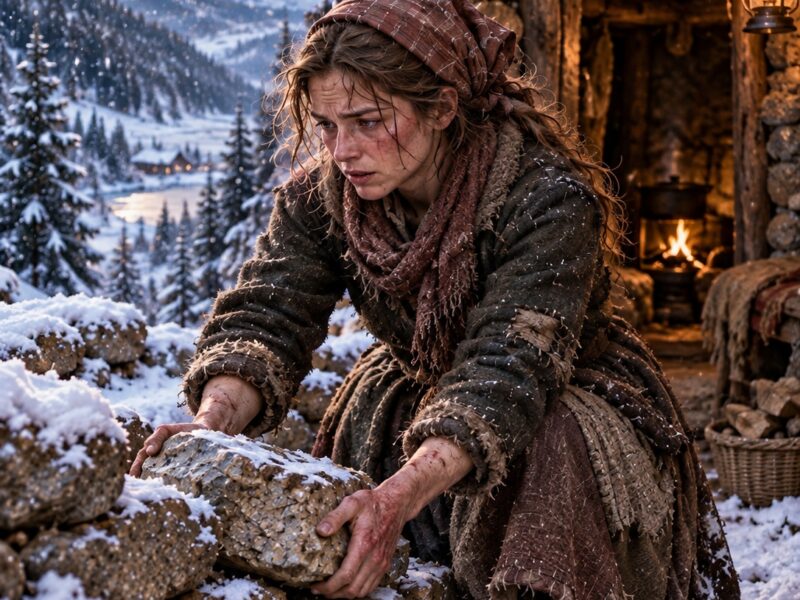
Thrown Out With Nothing, Mary Built a Home Inside a Montana Mountain—Then Winter Buried the Entrance and Forced Her to Find a Way Out No One Had Seen
Mary Caldwell watched a creditor lead her dead father’s horse out of the barn while she stood in the kitchen holding a court order that said the farm no longer belonged to her.
With snow already falling, eleven matches in her pocket, and nowhere in town willing to shelter a woman carrying another man’s debt, she followed one underlined line in her father’s notebook toward an abandoned prospect tunnel.
By January, Mary had turned that hole in the mountain into a home—until a three-day storm erased the entrance, smothered the chimney draft, and left her breathing air that was getting thinner by the hour.
The first thing they took was her father’s horse.
Mary Caldwell stood in the kitchen doorway while Amos Pike’s hired man led Buck across the yard, the old gelding resisting just enough to make his shoes scrape the frozen ground. Snow had begun as scattered white grains, almost too light to call weather, but it settled on Buck’s dark mane and did not melt.
“Please don’t take him.”
Amos Pike looked down at the paper in his hand rather than at Mary.
“The order covers livestock.”
“He’s twenty.”
“Then his sale price will reflect that.”
“He belonged to my father.”
“So did the mortgage.”
Mary’s fingers tightened around the edge of the table.
Amos was not a cruel-looking man. That made him harder to hate. He wore a brown wool coat shiny at the elbows, spectacles fogged from the warmth of the kitchen, and the exhausted expression of somebody who had repeated the same unpleasant facts too many times to believe repeating them more gently would change anything.
Her father, Caleb Caldwell, had been dead thirteen months.
Pneumonia.
Three weeks from first cough to burial.
Mary had spent the year afterward attempting arithmetic that never balanced. Eggs. Sewing. Fence repair. Mending tack for neighboring ranchers who left the work at her gate because some of their wives disliked an unmarried woman coming to the house.
The farm still demanded taxes.
The lender still demanded interest.
Winter still demanded feed.
She had paid some.
Not enough.
Amos set the foreclosure order on the table.
“You had notices.”
“I answered them.”
“You asked for extensions.”
“Yes.”
“I gave you two.”
“My father borrowed eighty dollars.”
“With accumulated interest, livestock lien, tax advances, and court fees—”
“I know the number.”
She did.
One hundred eighty-seven dollars and forty cents.
A fortune to Mary.
A bookkeeping inconvenience to Amos Pike, who owned half the notes between Helena and Cedar Creek and had begun purchasing distressed farms because a new stage route was expected through the valley within two years.
Mary looked toward the barn.
“Give me one more day.”
Amos finally met her eyes.
“For what?”
“To sell the chickens myself. To speak to Tom Mercer. To—”
“The sheriff’s order took effect this morning.”
“You could wait.”
“Yes.”
That single word surprised her.
Amos folded his gloves.
“I could.”
“Then do it.”
His expression hardened, not with anger but with something closer to self-defense.
“If I delay every legal order because the debtor has a sorrowful reason, I stop being a lender and become a charity.”
“My father always paid you.”
“Until he didn’t.”
“He died.”
“I am aware.”
The sentence fell harder than he intended.
Mary saw him regret it.
He did not take it back.
She looked at the staircase.
“My father’s tool chest.”
Amos shook his head.
“It is inventory.”
“The tools were his before the loan.”
“Everything listed on the property schedule transfers.”
“I need them to work.”
“You may take what you can carry on your person.”
“That is what the court officer instructed.”
Mary stared.
“You expect me to walk out into snow with whatever fits on my back.”
Amos looked toward the window.
“I expected you to arrange lodging in town.”
“With whom?”
He did not answer.
That was the problem with people who believed systems were neutral.
They imagined somewhere, beyond the document, another door must exist.
Mary went upstairs.
She packed quickly because anger was warmer than panic.
One wool blanket.
Two shirts.
Extra stockings.
A small utility knife her father had used for rope and kindling.
Eleven matches in a waxed paper twist.
Half a flask of lamp oil.
An old tin cup.
Two pieces of salted venison.
A coil of thin rope.
A cloth packet of flour.
Her father’s notebook.
She found an oil lamp beneath the bed and wrapped it in one of the shirts.
Downstairs, while Amos spoke quietly with the court officer, Mary slipped into the shed.
A loose board behind the feed bin came away with one tug.
Her father had hidden a hunting tin there.
Dried beans.
Salt.
Cracked corn.
A small hammer.
She almost laughed.
Even dead, Caleb Caldwell had managed to stash something where a creditor’s inventory would miss it.
The cast-iron pot came next.
Heavy.
Ridiculously heavy.
Mary tied it beneath her pack anyway.
Then she slid a small hand axe through the rope loop at her side.
When she returned to the kitchen, Amos looked at the load.
“You cannot carry that eight miles.”
Mary looked at him.
“You just told me I could take what I could carry.”
He stopped.
Fair was fair.
She opened Caleb’s notebook while standing beside the cold stove.
The last pages contained weather observations, trapping notes, trail markings, and brief records from the years when he had prospected before settling the farm.
One sentence had been underlined twice.
Old Prospect Tunnel above Cedar Creek. Dry past first chamber. Weak east draft. Eight miles into mountain.
Mary had read it the night before.
Now it was no longer history.
It was an address.
She put the notebook inside her coat.
Amos cleared his throat.
“Mary.”
She turned.
“I can speak to Mrs. Danner at the boardinghouse.”
“No.”
“She might give you a week.”
“I asked her Monday.”
Amos looked away.
Mary understood.
Everyone had assumed somebody else would help.
“Then Tom Mercer.”
“Tom has six children and two apprentices sleeping above the forge.”
“I know.”
Silence.
The man holding the order suddenly seemed less powerful.
Just implicated.
Mary stepped onto the porch.
Buck was gone.
The barn door stood open.
Snow had begun gathering along the fence rails.
She looked once at the house where she had been born, where her mother had died when Mary was nine, where Caleb had taught her to sharpen blades and repair harness and measure a board twice because lumber did not grow back after a bad cut.
Amos stood behind her.
“I am sorry.”
Mary adjusted the pack straps.
“No, Mr. Pike.”
She looked at the court paper in his hand.
“You are finished.”
Then she stepped into the snow.
Behind her, the door closed.
Before nightfall, either she would find the tunnel or the cold would find her first.
The climb took longer than eight miles felt on paper.
The road from the Caldwell farm followed Cedar Creek for three miles, then dissolved into an old logging trail that climbed north through pine and exposed granite. Fresh snow covered the soft autumn mud and turned every step uncertain.
The pot struck Mary’s lower back.
Her pack straps cut into her shoulders.
Twice she stopped and stared at the cast iron hanging beneath the blanket.
Leave it.
The thought became almost persuasive.
Then she remembered Caleb saying, years earlier while carrying a ridiculous coil of rope across a ridge, “In mountains, you regret what you throw away faster than what you carry.”
Mary had been fourteen.
She had told him that sounded like something a man said after packing too much.
He laughed.
“You’ll see.”
Now she hated that he had been right.
By late afternoon the snow thickened.
She found Cedar Creek half hidden beneath willow branches and followed it uphill.
Caleb had described a pale rock face split by a black seam.
Mary found three pale rock faces.
None had an opening.
Light drained rapidly from the valley.
Her fingers hurt inside her gloves.
Fear finally became physical—a tightness beneath her ribs that made breathing shallow.
“Think.”
She said it aloud.
Her voice sounded small among the trees.
Caleb’s notebook.
She opened it beneath her coat.
Above bend where creek divides around twin boulder. Fifty paces northwest. Spruce leaning downslope.
Mary backtracked.
There.
Twin boulder.
One channel of water on either side.
She counted.
Forty.
Forty-five.
Fifty.
The leaning spruce had fallen.
Its trunk lay buried beneath snow.
Behind it, brush covered something black.
Mary pushed through.
The tunnel entrance opened low in the mountain.
Partially collapsed.
Loose stone and frozen dirt blocked nearly half the mouth.
She struck a match.
The flame revealed a narrow first chamber.
Uneven floor.
Animal tracks.
Darkness beyond.
Water marks on one wall.
It was not a cabin.
Not even a proper mine.
It was a hole.
Mary almost cried from relief.
She crawled over the fallen stone and dragged her belongings after.
Dry.
Caleb had been right about that too.
The deeper floor contained no standing water.
She gathered twigs from beneath the overhang outside.
First match failed.
Damp sulfur.
Second caught, then died in wet bark.
Third produced flame.
Mary bent close, feeding it splinters.
Fire grew.
For perhaps forty seconds she felt safe.
Then smoke rolled into her face.
She coughed violently.
The tunnel ceiling trapped it.
The flame became a problem more dangerous than cold.
Mary grabbed the cast-iron pot.
Turned it upside down over the small fire.
Darkness returned.
She sat beside the smothered embers.
Eight matches remained.
Outside, night had arrived.
Inside the mountain, Mary understood she had found shelter from snow and nowhere safe to make heat.
She slept without fire.
If what came in broken pieces could be called sleep.
Pine boughs beneath the blanket.
Pack beneath her head.
Every sound enlarged by darkness.
A pebble shifting.
Wind near the entrance.
Something scratching far deeper inside.
Twice Mary sat upright with the knife in her hand.
Nothing came.
Before dawn she was shivering so badly her teeth hurt.
When gray light reached the entrance, Mary did not allow herself to think about town.
She studied the tunnel.
Problems were easier when separated.
Smoke.
Wind.
Cold floor.
Food.
Water.
Exit.
The wall behind the first chamber rose toward a natural crack in the rock.
Mary tore a strip from one of Caleb’s blank notebook pages, lit it, and watched the smoke.
It drifted upward.
Not strongly.
Enough.
She built a crude hearth beneath the crack.
Stone base.
Mud around the sides.
A narrow channel angled toward the fissure.
Then she lit four dry pine curls.
Smoke rose.
Paused.
Pulled upward.
Mary added a branch.
The little fire held.
Relief came carefully this time.
Then a gust entered the tunnel mouth and stripped the warmth from the room.
Mary laughed once.
Not because anything was funny.
Because the mountain had answered one solution with another problem.
Over the next two days she rebuilt the entrance.
Not closed.
Closing would kill ventilation.
She stacked stones into two short walls forming an angled passage, then packed gaps with mud and pine needles.
Wind could no longer run straight to the hearth.
The chamber remained cold.
But not murderous.
She raised her bed from the stone using flat branches across two rows of rocks.
Built a shelf.
Cut wooden pegs into natural cracks.
Dug a shallow drainage trench near the entrance.
Then she organized everything.
Food in one corner.
Lamp and matches in another.
Tools nearest the hearth.
Caleb’s notebook wrapped inside the spare shirt.
Eight matches.
That number occupied her mind more than hunger.
She learned to preserve embers.
At night she banked coals beneath ash.
Morning, dry bark.
Blow gently.
Wait.
First morning, flame.
Second morning, flame.
Third morning, nothing.
Cold gray ash.
Mary stared.
Used one match.
Seven.
From then on, she gathered tinder before she gathered food.
Fire first.
Everything else second.
Food became arithmetic next.
Flour.
Beans.
Corn.
Salted meat.
If she ate normally, perhaps three weeks.
Winter would last months.
Mary set snares near Cedar Creek.
Caleb had shown her when she was young.
His loops looked effortless.
Hers looked like insults made from rope.
First morning, empty.
Second, sprung.
Third, tracks nearby and nothing caught.
Fourth morning, a rabbit.
Mary knelt beside it for a long moment.
Taking life had always been abstract when her father brought meat home.
Now survival required ownership of every uncomfortable step.
She cooked half.
Smoked half over low heat.
That night, for the first time, she stopped asking whether she could return to town tomorrow.
She began planning for January.
Cedar Creek froze before November ended.
Mary woke one morning to silence where water had been.
The entire bend had sealed beneath white ice.
She struck it with the hand axe.
Blade bounced.
She tried again.
Nothing.
She melted snow.
A pot filled to the rim produced less water than seemed fair and consumed wood she needed for heat.
Every drink had become fuel.
Mary walked downstream until she found a place where water pressed near the surface beneath a bend.
The ice there was thinner.
She broke through.
Covered the opening with branches.
Each morning she returned and broke the skin of new ice before it grew thick.
Then she made her first serious mistake.
A bright afternoon in early December brought blue sky and no wind.
Deer tracks crossed the creek.
Mary followed them.
Half a mile.
Then more.
She found browse marks near a slope and began imagining meat enough for weeks.
Snow began so quietly she did not notice.
Ten minutes later, the trail behind her disappeared.
Mary turned.
Nothing looked familiar.
Pines.
Stone.
White.
Her own tracks fading.
Panic told her to move quickly.
Caleb’s voice from memory told her the opposite.
Lost people made distance faster than decisions.
Stop.
Mary stopped.
Closed her eyes.
Cedar Creek lay below the tunnel.
Water always moved downhill.
She went downward carefully until she heard faint water beneath ice.
Then followed the creek upstream.
A split granite boulder appeared.
She nearly hugged it.
The tunnel came into view twenty minutes later.
Mary reached the entrance with shaking hands.
Inside, she sat beside the hearth until her breathing slowed.
Then she took the axe and went back outside.
She cut a long pine pole.
Drove it high into the slope above the tunnel.
Tied a strip of dark wool near the top.
Then added cloth markers between the creek and shelter.
Rope between two nearby trees.
That night she opened Caleb’s notebook.
Below his last entry she wrote:
Memory is not a map.
From then on, every routine had a reason.
Fire vent checked before breakfast.
Food inspected.
Creek hole opened.
Wood gathered.
Snares checked.
Return before dark.
Boots dried.
Gloves hung.
Matches counted.
Seven.
Routine made days manageable.
It did not make them safe.
One evening Mary returned carrying wood and found flour scattered across the floor.
A mouse disappeared between stones.
Then another.
Her food sack had been chewed through.
Nearly one-third of the flour contaminated.
Mary stared at the white mess.
A blizzard could be feared.
Hunger could be measured.
Tiny teeth had destroyed days of food while she was ten minutes away.
She sat on the raised bed and cried for the first time since leaving the farm.
Not long.
Crying wasted heat too.
Afterward she rebuilt storage.
Food hung from ropes.
Beans divided into two tins.
Corn sealed in cloth inside a wooden box she made from old mining boards.
Flour moved above ground.
Nothing remained in one place.
One loss would never again become total loss.
She drew ration lines in the notebook.
December 9.
December 12.
December 17.
Some days she ate twice.
Bad days once.
Worst nights hot water with a little salt.
She learned hunger had stages.
First complaint.
Then anger.
Then quiet.
Quiet was the dangerous one.
Weeks later, while expanding firewood storage behind the hearth, Mary noticed cold air touching her cheek.
Not from entrance.
Behind her.
She held a lamp near a pile of collapsed stone.
Flame leaned.
There was a draft.
Mary removed one rock.
Then another.
A narrow passage appeared.
Low.
Dry.
Natural stone reinforced long ago with old timbers.
She widened it enough to crawl.
A second chamber opened behind the first.
Smaller.
Almost completely dry.
Old miners had used it for storage.
Mary smiled.
“Thank you.”
To whom, she did not know.
Men dead forty years.
Caleb.
The mountain.
She moved half her food there.
Half her wood.
Spare tinder.
One blanket corner.
Redundancy became religion.
But even after clearing the chamber, the cold draft continued from a seam at its rear wall.
Mary placed her palm there.
Air moved from somewhere uphill.
She wrote it down.
Draft behind second chamber. Source unknown.
That detail saved her life later.
January began with false mercy.
Three warm days.
Icicles dripped.
Snow softened on southern slopes.
Cedar Creek became noisy beneath thinning ice.
Mary stood outside without gloves for nearly an hour.
Birds appeared.
She let herself imagine spring.
That was her second serious mistake.
She gathered less wood.
Spent one afternoon repairing clothes.
Another planning what she would do when she returned to town.
She would not go back to the farm.
That surprised her.
For months she had pictured recovering it somehow.
Finding money.
Challenging Pike.
Walking through her father’s door again.
Now the image felt like another kind of tunnel.
Built from memory rather than rock.
The house had mattered because Caleb lived there.
Caleb was not there anymore.
On the fourth morning, the sky turned gray.
Wind shifted east.
Mary froze.
Caleb’s line.
Weak east draft.
Autumn knowledge.
Not winter.
The east wind struck the mountain with enough force to shake snow from branches.
By noon, flakes erased the creek.
Mary carried every dry branch she could manage inside.
Checked food.
Filled the pot with water.
Secured entrance cloth.
Storm continued through night.
Then next day.
Then next.
Mary stopped leaving shelter.
Snow climbed around the entrance.
Each morning she used a board to push a narrow trench outward.
Every evening wind refilled it.
On the third night, exhausted from digging, Mary slept in the second chamber where the air felt calmer.
She woke to silence.
No wind.
No scratching snow.
Nothing.
The silence frightened her immediately.
Mary took the lamp.
Walked toward the entrance.
No gray daylight.
The opening was black.
She pressed against the wooden barrier.
Nothing moved.
Harder.
A fraction.
Then stopped.
She pushed the knife through a gap.
Packed snow.
Solid.
Overnight, drifting snow had buried the entire mouth of the tunnel.
Mary sat back on her heels.
Trapped.
Her first thought was food.
Enough for perhaps seventeen careful days.
Second thought, water.
Snow could be melted.
Third, firewood.
Ten days if rationed.
Then she noticed smoke.
Lower than usual.
The hearth flame burned weak and yellow.
Mary looked upward.
The vent crack above the hearth exited somewhere on the slope near the buried entrance.
The same drift sealing her door was choking the smoke outlet.
Being trapped was no longer the most immediate problem.
Breathing was.
Mary reduced the fire to a tiny bed of coals.
Opened every gap between chambers.
Returned to the entrance.
She dug.
Cast-iron pot.
Hands.
Board.
Every scoop of snow had to be brought inward because there was nowhere outside to throw it.
The tunnel floor became wet.
Slippery.
Her knuckles split.
After two hours, she had moved perhaps three feet of snow and gained almost nothing.
The drift might be eight feet.
Ten.
More.
She stopped.
Continuing straight outward could exhaust her before she reached air.
Mary sat against the wall.
Smoke pressed lower.
Her head had begun to ache.
Then cold air touched her cheek.
The second chamber.
Unknown draft.
She carried the lamp deeper.
Moved food aside.
Put her fingers against the seam behind the stones.
Air.
Still there.
Faint but cleaner.
She removed one rock.
It shifted.
Another.
Behind them lay darkness.
Mary widened the gap.
An old shaft angled upward.
Not horizontal.
Ventilation passage.
Possibly.
If it reached surface, it could save her.
If it ended under solid rock, she would spend strength, oil, and breathable air on nothing.
Mary checked the match tin.
Seven remained.
The number had become almost absurd.
Seven tiny wooden sticks against a mountain.
Her fingers were stiff.
The hearth flame shrank.
Mary looked at Caleb’s notebook.
Then at the pot she had nearly abandoned the first day.
She made her choice.
She carried the cast-iron pot into the second chamber.
And began digging upward into darkness.
The shaft barely fit her shoulders.
Hammer loosened frozen dirt.
Knife cut roots.
Axe chipped old wood.
Pot dragged debris backward.
Progress came in inches.
Higher meant colder air.
Cold became hope.
Then the ceiling collapsed.
Snow and dirt poured down.
The lamp disappeared.
Mary twisted backward.
Something struck her shoulder.
Darkness swallowed everything.
For several seconds she could not move.
Panic rose.
Not emotional panic.
Animal panic.
Push.
Thrash.
Breathe.
Mary forced herself still.
Both arms free.
One leg pinned lightly.
She cleared dirt with her hands.
Backed down.
Reached the chamber.
Found lamp beneath loose soil.
Her shoulder burned.
Three fingertips had gone numb.
She sat.
“No.”
The word came from her before she knew what it meant.
No more.
No more digging.
No more problems.
No more cold.
No more deciding alone.
No one knew where she was.
Amos Pike believed she had gone south.
Tom Mercer probably assumed relatives took her.
There were no relatives.
No rescue party.
No door opening from the other side.
Mary leaned her head against stone.
Then she looked at Mabel—
No.
Caleb’s notebook.
She almost laughed at herself.
Fatigue had begun mixing memories.
She opened it.
A page near the middle contained a sketch of mine supports.
Her father had drawn triangular bracing with notes.
Short timber close together in weak ground. Never trust unsupported fill.
Mary stared.
The mountain had not changed its rules because she was tired.
She had simply ignored one.
So she rested.
Ate smoked rabbit.
Drank water.
Waited until her hands stopped shaking.
Then relit the lamp.
One match.
Six remained.
This time she cut short braces from stored wood.
Placed them every few feet.
Worked slower.
Hours passed.
The shaft narrowed.
Mary struck something hard.
Her heart dropped.
Rock.
Solid.
End.
She scraped.
The object shifted.
Wood.
A pole.
She cleared around it.
Rough knife marks.
Dark cloth frozen near the top.
Her marker.
The pole she had driven above the tunnel after getting lost.
Mary closed her eyes.
It did not save her.
But it told her she had dug toward the surface.
Correct direction.
Perhaps only several feet remained.
Perhaps fifteen.
Mary continued.
Arms numb.
Knees bruised.
One scoop.
One brace.
One breath.
Then a crack appeared.
Not in rock.
Light.
A thin blade entered above her.
Mary froze.
Cold air poured through.
Real air.
She pushed upward.
Snow broke.
Her hand emerged into daylight.
Wind struck her skin.
She laughed and cried at once.
Then widened the hole until head, shoulders, body followed.
Mary crawled onto the slope.
Waist-deep snow.
Blue-gray sky.
Pines bent beneath storm weight.
Below, the original tunnel entrance had vanished completely under a drift taller than a man.
She stood there breathing.
Just breathing.
Nothing had ever felt so rich.
Then practical thought returned.
Town?
Impossible.
Roads gone.
Snow deep enough to kill her before Cedar Creek.
So Mary climbed back down through the shaft.
She had not escaped winter.
She had made another door.
Over the next four days, she turned that door into something survivable.
Widened shaft.
Cut steps.
Reinforced walls.
Built a small hood of branches over the upper opening to keep loose snow from falling directly in.
Ventilation improved dramatically.
Fire burned cleaner.
Water became easier because snow could be brought directly through upper entrance.
Wood remained difficult.
But possible.
The crisis had changed Mary.
Earlier, every new problem had felt like accusation.
Why had she not predicted this?
Why had she made mistakes?
Why was survival so hard?
Now she asked different questions.
What fails next?
What can be duplicated?
What cannot be allowed to exist in only one place?
She stored wood in two chambers.
Food in three containers.
Matches in a sealed tin high from damp.
Tinder in two separate bundles.
Two water vessels instead of one.
Second route marked.
Third potential vent investigated.
She stopped treating preparation as fear.
Preparation was respect.
For weather.
For chance.
For human limits.
February became lean.
Snares yielded less.
Mary lost weight.
Her cheeks hollowed.
One morning she stood too quickly and the chamber tilted.
She sat.
Waited.
Ate corn she had been saving.
Pride had nearly killed her before.
She would not let rationing become another form of pride.
Midmonth, she discovered tracks near the upper entrance.
Large.
Deer.
Mary followed only as far as her rope markers allowed.
No farther.
She found a patch where deer had scraped snow aside to reach dry grass.
There were edible roots nearby.
Small gain.
Enough.
On another day she found rabbit sign.
Enough.
Winter did not suddenly become generous.
It simply stopped being absolute.
Back in town, Amos Pike sold the Caldwell farm.
A rancher named Harlan Voss bought it as part of a larger parcel.
The sale covered Mary’s debt.
Barely.
Amos kept the ledger page.
He told himself that was the end of the matter.
Then Tom Mercer came into his office.
Tom was the town blacksmith, forty-eight, shoulders like a barn beam, father of six, and one of the few men who had repaired equipment for Mary without speaking to her as though widowhood made her stupid.
“Where is she?”
Amos looked up.
“Who?”
Tom stared.
“Mary Caldwell.”
“I assumed she went to family.”
“She has none.”
Amos’s stomach tightened.
“You knew that?”
“Everyone knew that.”
“I did not.”
“Because you never asked.”
Amos set down the pen.
“She left with supplies.”
“In October.”
“It has been three months.”
Tom leaned both hands on the desk.
“You threw a woman out before snow.”
“I executed a lawful order.”
Tom’s jaw tightened.
“That sentence better keep you warm.”
Amos stood.
“I offered to speak to the boardinghouse.”
“She’d already been refused.”
“I didn’t know.”
“That seems to be doing a lot of work for you.”
Amos flushed.
“What do you expect me to do now?”
Tom looked toward the window.
Snow moving past glass.
“Start by admitting you don’t know whether she’s alive.”
The sentence remained after Tom left.
That evening Amos opened the foreclosure file.
Read every notice.
Mary’s handwritten responses were clipped inside.
One line:
I have nowhere to go before winter. Please delay until April.
Amos had written beneath it:
Denied. Security value declining.
Three words.
Security value declining.
The farm was an asset.
Mary was a circumstance.
He had treated one as measurable and therefore more real.
He could not undo the sale.
He could do something now.
Amos hired two men to ask along the stage route whether Mary had passed south.
No.
Helena boardinghouses.
No.
Church missions.
No.
By February, rumors spread.
Some said Mary froze.
Others said she had fallen into Cedar Creek.
Tom refused to discuss it.
“She’s either alive or she isn’t.”
he told people.
“Your guesses help neither.”
No search could safely reach high country through deep winter.
That fact became Amos Pike’s private punishment.
March brought longer light.
Mary noticed first not from temperature but from the angle.
Sun reached farther into upper shaft.
Icicles formed around its mouth.
Cedar Creek grew louder.
She did not trust it.
False spring had almost killed her once.
Mary waited.
Five days.
Seven.
Snow settled.
Trail markers reappeared.
Southern slopes showed brown earth.
Birds returned.
Only after a full week with no hard storm did she begin packing.
She did not simply leave.
That surprised her.
She repaired the hearth.
Cleared the original vent.
Strengthened upper shaft supports.
Stacked wood in both chambers.
Left beans.
Matches.
A little salt.
The blanket she could spare.
She placed the cast-iron pot beside the hearth.
Her hand remained on its handle.
Months earlier she had nearly thrown it beside the trail.
That heavy useless thing had moved snow when her hands failed.
Carried debris.
Melted water.
Smothered the first dangerous fire.
Some burdens became tools only after enough time.
Mary left it.
Then opened Caleb’s notebook.
On a blank page she wrote:
Two exits. Hearth draws through upper crack unless heavy east drift. Second chamber dry. Creek opening safest at bend. Keep food off floor. Never trust one door.
Below that:
If you use what is here, leave something for whoever comes next.
She stood.
Shouldered her lighter pack.
Walked out through the upper entrance.
For the first time in months, the valley below was visible.
Mary descended slowly.
Every turn looked smaller than memory.
Cedar Creek.
Split boulder.
Fallen spruce.
Trail.
At noon she reached the old road.
Wheel ruts.
Horse droppings.
Evidence of other people felt almost unnatural.
By late afternoon, Mary saw smoke from town chimneys.
A boy carrying feed spotted her first.
Stopped.
Dropped the sack.
“Miss Caldwell?”
Mary kept walking.
People began coming out of buildings.
Shopkeeper.
Women from the hotel.
Stable hand.
Faces.
So many faces.
Tom Mercer stepped from the forge holding tongs.
The tool fell from his hand.
“Mary.”
She stopped.
Tom crossed the street.
He looked at her coat.
Patched twice.
Hands cracked.
Face thinner.
Alive.
“Where in God’s name have you been?”
“In the mountain.”
Tom stared.
“What?”
“Prospect tunnel above Cedar Creek.”
“All winter?”
“Yes.”
He sat abruptly on the edge of the water trough.
Mary almost smiled.
“You all right?”
Tom looked up.
“You’re asking me?”
“I’ve had a long walk.”
He stood.
“Come inside.”
Mary hesitated.
Not because she distrusted Tom.
Because entering someone else’s warm room suddenly felt more frightening than stone.
He saw it.
“No questions until you eat.”
That was the right thing to say.
Inside the forge house, Tom’s wife Ellen gave Mary stew.
Did not stare while she ate.
The children were ordered to leave her alone and then observed from behind doorframes.
Mary slept fourteen hours.
Next morning Amos Pike appeared.
He removed his hat before entering.
Mary sat beside the stove.
Tom stood near the door.
Amos looked at Mary.
“I believed you had gone south.”
“I know.”
“I should have asked.”
“Yes.”
He swallowed.
“I sold the farm.”
“I assumed.”
“The debt is satisfied.”
“Was there anything left?”
Amos’s face tightened.
“Seven dollars and eleven cents after fees.”
He placed coins and a receipt on the table.
Mary looked.
Did not reach.
“My father borrowed eighty.”
“Yes.”
“You took the house, barn, horse, tools, livestock, land.”
“Yes.”
“And I get seven dollars.”
“The sale price—”
Mary raised one hand.
“No.”
Amos stopped.
“I understand the numbers.”
“What I don’t understand is why numbers made everyone believe the outcome was decent.”
Tom looked toward the floor.
Amos’s face reddened.
“The law—”
“Allowed it.”
Mary nodded.
“I know.”
“I’m not asking whether it was legal.”
Amos remained silent.
Mary finally took the seven dollars.
Not forgiveness.
Not surrender.
It was hers.
“What will you do?”
Amos asked.
Mary looked toward Tom’s forge.
“Work.”
Tom glanced at her.
“I need a handle repairer.”
Mary shook her head.
“No favors.”
“Good.”
Tom said.
“I hate favors.”
“Wages are seventy-five cents a day.”
“Dollar after you prove you’re faster than Eli.”
From the forge, his apprentice shouted:
“I heard that.”
Mary almost laughed.
“When do I start?”
“After breakfast.”
She started that morning.
Tool handles.
Sharpening.
Small metal fittings.
Axle grease.
Harness rivets.
Her hands remembered.
Caleb had taught her more than she realized.
Within weeks, customers asked specifically for Mary.
Not because she had survived winter.
Because she was good.
That distinction mattered.
The town wanted the survival story.
People asked about wolves.
There had been none.
Asked whether she nearly starved.
Yes, but not dramatically.
Asked if she prayed every night.
Some nights.
Other nights she cursed mice.
Truth disappointed people who preferred legends.
Mary stopped telling much.
Spring became summer.
Her wages became savings.
She rented one room above the bakery.
Bought boots.
Then a used tool roll.
Then a second blanket.
The first object she purchased that had no survival purpose was a blue ceramic cup.
It cost twelve cents.
She drank coffee from it every morning.
Amos Pike continued seeing her.
Town too small not to.
He did not force conversation.
Months later, he came into the forge carrying a broken gate hinge.
Mary examined it.
“Replace.”
“Can it be repaired?”
“Not worth labor.”
Amos nodded.
Then:
“I changed foreclosure practice.”
Mary looked up.
“What?”
“Winter evictions.”
“Delayed when dependent occupancy and weather risk make removal unsafe.”
Mary stared.
“Because of me?”
“Because I was wrong.”
Mary went back to the hinge.
“That helps the next person.”
“Yes.”
“Then good.”
Amos waited.
Perhaps he wanted absolution.
Mary did not offer it.
He left with the replacement hinge.
Two years passed before Mary bought land.
Not the Caldwell farm.
A smaller parcel outside town.
Southern slope.
Good drainage.
Three acres of meadow.
A workshop.
Tiny house.
Deed:
MARY CALDWELL.
No co-owner.
No lender.
She paid cash.
Tom stood beside her at the county office when she signed.
“Your father would be proud.”
Mary looked at the ink.
“I hope so.”
“You don’t sound certain.”
“I spent too long trying to live inside what he left me.”
She capped the pen.
“I think he’d rather I build something.”
Mary returned to the prospect tunnel that autumn.
First snowfall had not yet come.
The climb felt shorter without fear.
She found the upper entrance partly collapsed from summer rain.
Repaired it.
Cleared the original doorway.
Checked hearth.
Stored fresh wood.
Replaced spoiled beans.
Added matches.
A blanket.
Dried meat.
Then she made a sign from pine board.
Carved letters slowly.
Hung it inside the second chamber.
IF YOU FOUND THIS PLACE, USE WHAT YOU NEED. LEAVE SOMETHING FOR THE NEXT PERSON.
Every autumn afterward, Mary climbed back.
People eventually knew.
Hunters used the tunnel during storms.
A mail rider once spent two nights there after losing his horse.
A teenage boy running from a violent household slept there three days before walking into town and accepting help.
Each person left something.
Coffee.
Nails.
Candles.
A tin cup.
Dry socks.
A small Bible.
A deck of cards.
The mountain home became less Mary’s and more everyone’s.
Years later, a winter storm trapped a stagecoach above Cedar Creek.
Three passengers found Mary’s marker cloth.
Reached the tunnel.
Survived two nights.
When they returned to town, one man told the newspaper Mary Caldwell had built “a fortress in the mountain.”
Mary read the article.
Shook her head.
“It was a hole.”
Tom, older now, laughed.
“You have a gift for ruining headlines.”
“It was a useful hole.”
“Better.”
Mary never married.
Not because she rejected love.
Life simply took another shape.
She had friends.
Work.
Land.
Children who came through the shop asking her to sharpen skates or fix sled runners.
People trusted her judgment.
That was enough.
Amos Pike died years later.
His son brought Mary an envelope.
Inside was the original foreclosure order.
Amos had written something on the back.
The law told me what I could take. It did not tell me what I should.
Mary read it.
Folded it.
Placed it inside Caleb’s notebook.
Not because it repaired the past.
Because truth belonged with truth.
Her father’s notebook grew thick with her own additions.
Weather.
Ventilation.
Food storage.
Trail markers.
Names of people who had used the tunnel.
One entry every autumn.
Then, almost thirty years after her first winter there, Mary climbed the trail with a younger woman named Annie Mercer, Tom’s granddaughter.
Mary’s knees hurt now.
Annie carried most of the supplies.
At the creek, Annie pointed uphill.
“How did you do this alone?”
Mary frowned.
“Poorly.”
“I mean survive.”
“Also poorly.”
Annie laughed.
Mary stopped beside the split boulder.
Looked toward the mountain.
“I made mistakes.”
“Lots.”
“Lost food.”
“Got lost.”
“Nearly smoked myself out.”
“Trusted warm weather.”
“Dug the wrong way first.”
Annie’s smile faded.
“But you got out.”
“Yes.”
“How?”
Mary continued uphill.
“Stopped needing the first plan to work.”
They reached the tunnel.
Original entrance had widened over the years.
Upper shaft supported with proper timber now.
Inside were shelves.
Blankets.
Supplies.
The old cast-iron pot still beside the hearth.
Annie touched it.
“This the one?”
“Yes.”
“You carried this eight miles?”
“I was younger and stupider.”
“You kept it.”
“It became useful.”
Mary sat in the old wooden chair someone had carried up years earlier.
Not Caleb’s.
Just a chair.
She looked at the wall sign.
Letters faded.
Annie had brought fresh paint.
Together they restored the words.
USE WHAT YOU NEED. LEAVE SOMETHING FOR THE NEXT PERSON.
Snow began before they descended.
Light.
Soft.
Mary stood at the entrance.
For an instant she was twenty-eight again, pack cutting her shoulders, house behind her, future reduced to eleven matches and a line in a notebook.
Then Annie called:
“Mary?”
“I’m coming.”
She stepped outside.
Below, the valley stretched wide.
Roads now wider.
Telephone poles.
More houses.
The world had changed.
The mountain had not.
Mary looked once at the upper exit.
Then the lower.
Two doors.
Always two.
She smiled.
All those years ago, winter had buried the only way out she knew.
So she made another one.









