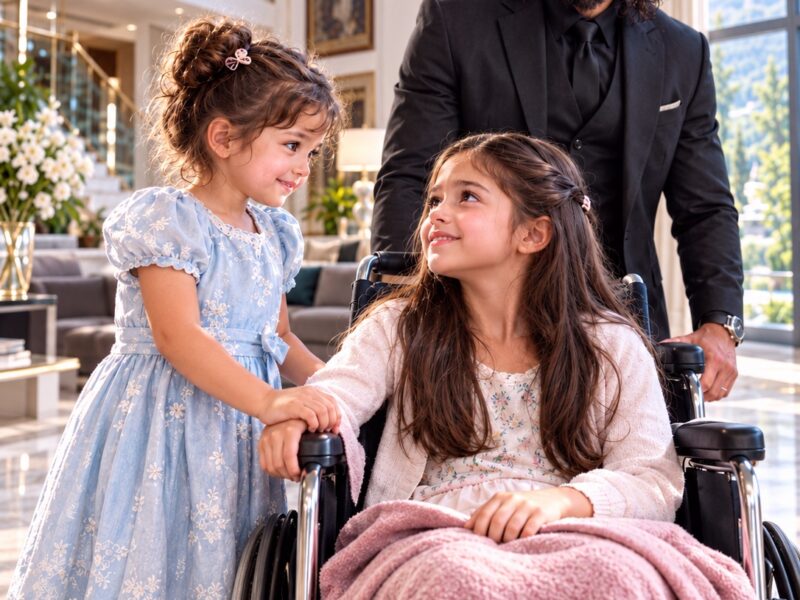
“Trust Me, You Can Walk Again,” the Maid’s Toddler Told the Mafia Boss’s Daughter—Then Everything Changed
The wheelchair squeaked every time Alina Moretti moved.
She hated that sound.
She hated the polished marble that made it echo, hated the silver rims her father had ordered because someone told him they looked less medical, and hated most of all that five months earlier she had run barefoot down this exact hallway while her brother chased her with a stolen dinner roll.
Now Matteo was dead.
And Alina had stopped trying to stand.
Rain pressed against the windows of the Moretti estate in Alpine, New Jersey, turning the trees beyond the iron fence into dark smudges.
Alina sat beside the east-wing window with a blanket over her knees.
Her physical therapist had left forty minutes earlier.
Another failed session.
Another hour of straps, commands, electrodes, encouragement, and careful adult faces trying not to look disappointed.
Her father appeared in the doorway.
Marco Moretti removed his black overcoat but not the expression he wore outside the house.
Men in New York whispered his name.
Some called him a businessman.
Some called him something else.
Alina only knew he was Papa, and that since Matteo’s funeral he had learned how to look at his children’s photographs without blinking.
“Try once more.”
She did not turn.
“No.”
“Alina.”
“I said no.”
Marco entered.
The room smelled faintly of antiseptic gel and the lavender lotion Isabella rubbed into their daughter’s legs each night.
A resistance band lay abandoned on the rug.
Beside it, one purple sneaker.
Its match remained inside a shopping bag because Alina had refused to let anyone take it out.
“The therapist said you had more sensation today.”
“The therapist says something good every time because you pay her.”
Marco’s jaw tightened.
“She doesn’t need my money to lie to you.”
“Everybody needs your money.”
That one landed.
Alina saw it in the way his hand stopped on the wheelchair handle.
He recovered quickly.
“What did Dr. Keller actually say?”
“That my spinal cord wasn’t completely severed.”
“I know.”
“That there are pathways.”
“I know.”
“That doesn’t mean they work.”
“I know.”
She finally looked at him.
“Then stop acting like I’m not trying hard enough.”
Marco’s expression changed.
“I have never said that.”
“You don’t have to.”
She pointed toward her legs.
“You look at them like they’re an enemy you can intimidate.”
For a moment he said nothing.
Five months earlier, Marco Moretti’s stare could make grown men reconsider entire business arrangements.
It could not make his daughter’s feet move.
He knelt.
Alina still noticed whenever he did it.
Marco Moretti did not kneel.
Not in church.
Not in photographs.
Not in front of men twice his age who carried weapons because they thought that made them powerful.
But he knelt in front of his ten-year-old daughter whenever he needed her to look him in the face.
“We will find a way.”
Alina’s eyes filled.
“You keep saying that.”
“Because I mean it.”
“Matteo said he’d teach me to drive when I turned sixteen.”
Marco stopped breathing.
Alina’s voice cracked.
“People mean things and then they die anyway.”
The rain seemed louder.
Marco looked down.
He could have answered as a father.
Instead grief arrived first and left him with nothing.
Alina turned toward the window again.
“Please go.”
He stood slowly.
At the door he paused.
“I’m sorry.”
“For what?”
He looked at her.
“All the things I still don’t know how to fix.”
Then he left.
Alina waited until his footsteps disappeared.
Only then did she cry.
Not loudly.
She pressed both fists against her eyes because she hated crying almost as much as she hated the wheelchair.
A small voice came from behind her.
“Why are you doing that?”
Alina jerked.
Sophia Reyes stood in the doorway.
Three years old.
Maybe three and a half.
No one in the house seemed certain because Sophia herself insisted birthdays only counted if there was chocolate cake.
Dark curls framed her face.
One sock was pink.
The other had yellow ducks.
She carried a piece of printer paper covered in purple crayon.
“You’re supposed to knock.”
Sophia looked at the open door.
“I did.”
“No, you didn’t.”
“I knocked little.”
“That isn’t a thing.”
Sophia considered.
Then shrugged and walked in.
Alina wiped her face quickly.
“What do you want?”
“I made you.”
Sophia held up the paper.
It took Alina several seconds to understand the drawing.
Two stick figures beneath a violent yellow sun.
One tiny.
One taller.
The taller figure had purple shoes and two straight purple legs.
Alina stared.
“That’s me?”
Sophia nodded.
“You’re walking.”
The words hit harder than they should have.
Alina looked away.
“I don’t walk.”
“You used to.”
Her head snapped back.
“How do you know?”
“Your mama showed my mama pictures.”
Alina swallowed.
Sophia climbed onto the window seat beside her.
“You had long hair.”
“I still have hair.”
“It was more long.”
Alina almost smiled.
Then Sophia touched the purple shoe in the drawing.
“I’m gonna get purple shoes.”
“Good for you.”
“You can get them too.”
Alina’s smile vanished.
“Sophia.”
The little girl looked up.
“I can’t walk.”
“You can.”
Something hot moved through Alina.
Not hope.
Anger.
“You don’t understand.”
Sophia did not flinch.
“The doctors did tests.”
Silence.
“They put wires on me.”
Sophia frowned.
“They put me in machines.”
“They made me try to stand until my arms shook.”
“They told my parents maybe, maybe not, maybe one day.”
Alina’s voice rose.
“And everybody hears maybe and pretends it means yes.”
Sophia climbed down.
Alina expected her to leave.
Instead the child came closer and placed both small hands around Alina’s cold fingers.
“Trust me.”
Alina stared at her.
Sophia squeezed.
“You can walk again.”
The certainty in her voice was ridiculous.
Almost offensive.
Three-year-olds believed chairs became forts and crackers tasted different depending on shape.
Alina should have laughed.
She should have pulled away.
Instead she asked, “How do you know?”
Sophia thought.
“My daddy said people have to get back up.”
Alina’s throat tightened.
“Where’s your dad?”
Sophia’s face became quieter.
“He died.”
Alina stopped.
Sophia added, as if explaining something practical:
“Mama says he can’t come home.”
Something inside Alina’s anger shifted.
“I’m sorry.”
Sophia shrugged.
“He said get up.”
“He said it when I fall down.”
She tapped Alina’s hand.
“So get up.”
Alina almost laughed.
“I can’t.”
“Not now.”
Sophia said it as though Alina were being unnecessarily difficult.
“Later.”
Then she placed the drawing on Alina’s blanket.
“You keep.”
Before Alina could answer, Carmen Reyes appeared.
“Sophia.”
The child turned.
Carmen stood in the doorway in her gray housekeeping uniform, dark hair tied back, worry across her face.
“I said ten minutes.”
Sophia pointed at Alina.
“She sad.”
Carmen looked at the girl in the wheelchair.
Her expression softened.
“I’m sorry, Miss Alina.”
“She shouldn’t bother you.”
“She didn’t.”
Alina looked down at the drawing.
“She’s annoying.”
Sophia smiled.
Carmen nearly did too.
“Come on.”
Sophia took her mother’s hand.
At the door she turned.
“Purple shoes.”
Alina rolled her eyes.
“Go.”
Sophia went.
That night Alina tried to move her toes.
She told herself Sophia had nothing to do with it.
She simply could not sleep.
The house had gone quiet at midnight.
Her mother had kissed her good night.
Her father’s study door remained closed downstairs.
Black SUVs still idled behind the gates even though nobody expected visitors.
Alina pulled the blanket away from her feet.
She stared.
Nothing.
“Move.”
Nothing.
She remembered Dr. Keller telling her nerves sometimes recovered in ways nobody could predict.
She remembered Matteo telling her she would be the worst driver in New Jersey.
She remembered Sophia’s absurd little face.
Trust me.
Alina concentrated until her temples hurt.
The smallest toe on her left foot twitched.
She froze.
No.
Muscle spasm.
She had experienced dozens.
She waited.
Then tried again.
Nothing.
Her heartbeat slowed.
Of course.
She closed her eyes.
Tried once more.
The toe moved.
Tiny.
Barely visible.
But this time it happened when she told it to.
Alina stared at her foot.
Fear came before happiness.
Hope had become dangerous.
She had learned that in five months.
Hope entered a room smiling.
Disappointment followed behind carrying a chair.
She pulled the blanket back over her legs.
She told no one.
Downstairs, Marco’s phone rang.
Not his personal phone.
The other one.
Isabella heard it from their bedroom.
She sat up.
Marco was already moving.
He walked into the study and closed the door before answering.
“Talk.”
Vincent Caruso’s voice came through.
“We found the SUV.”
Marco’s hand stopped above the desk.
Vincent had run security for the Moretti family for twelve years and had been Marco’s friend longer.
“What SUV?”
“The one from the crash.”
Marco’s voice changed.
Five months earlier, the police had classified the collision that killed Matteo and injured Alina as a weather-related hit-and-run complicated by limited camera coverage.
Marco had never believed that.
His family had been followed twice in the weeks before.
A Moretti-owned vehicle had been vandalized.
One driver reported seeing the same dark SUV near the children’s school.
Then the crash.
“Where?”
“Scrapped outside Newark.”
“How do you know it’s the same vehicle?”
“Partial traffic-camera match.”
“Damage pattern.”
“Old service records.”
Marco gripped the desk.
“Registered to who?”
“Not a person.”
“A leasing company.”
Marco waited.
Vincent exhaled.
“It traces through two corporations.”
“The last one shares an accountant with Salvatore Imports.”
Marco’s jaw tightened.
The Salvatori family.
Competitors.
Enemies.
A name spoken carefully around children.
“You’re sure?”
“Enough to keep digging.”
“Not enough for what you’re thinking.”
Marco said nothing.
Vincent continued.
“Marco.”
“My son died.”
“I know.”
“My daughter may never walk normally again.”
“I know.”
“And you’re telling me the vehicle points to them.”
“I’m telling you evidence points to a shell company connected to them.”
“That sentence matters.”
Marco closed his eyes.
Vincent had always been irritating when he was right.
“Send me everything.”
“I already did.”
Marco ended the call.
On his desk stood a photograph taken two summers earlier.
Matteo at fourteen.
Alina at nine.
Isabella laughing behind them.
Marco picked it up.
His son had been taller than his mother by then and unbearably proud of it.
Five months.
Marco had survived five months by believing grief required discipline.
A funeral.
Security.
Doctors.
Rehabilitation.
Work.
No revenge.
Not until certainty.
Now certainty was beginning to acquire a license plate.
He stared at Matteo’s face.
Then his eyes shifted to Alina.
He did not call anyone back.
He did not order retaliation.
Instead he went upstairs.
Sophia was still in Alina’s room.
Carmen must have been finishing the kitchen.
Marco stopped outside the partly open door.
Sophia was telling a story about a wolf who could not blow down a brick house because “he had bad lungs.”
Alina laughed.
A real laugh.
Marco put one hand against the wall.
He had not heard that sound in months.
He stayed in the hallway.
Inside, Sophia said, “Again?”
“No.”
“Yes.”
“You tell terrible stories.”
“You laugh.”
“That doesn’t mean they’re good.”
“Yes it does.”
Marco closed his eyes.
For ten minutes he forgot the SUV.
Forgot Salvatori.
Forgot what men expected from him when someone hurt his family.
He listened to two girls argue about a wolf.
Downstairs, Carmen folded towels.
Isabella found her there.
“Your daughter is upstairs.”
Carmen immediately straightened.
“I’m sorry.”
“I told her ten minutes.”
“Relax.”
Carmen stopped.
Isabella Moretti rarely used that word with staff.
She entered.
“Alina laughed.”
Carmen looked down.
“Sophia can be relentless.”
“I’ve noticed.”
Isabella leaned against the counter.
“She keeps telling Alina she’ll walk.”
Carmen’s hands stopped over a towel.
“I’ve told her not to make promises.”
“Where does she get it?”
Carmen looked toward the ceiling.
“Her father.”
Isabella waited.
Carmen rarely discussed Daniel.
“He used to tell her, ‘Get back up, mija.’”
“She was barely two.”
“She’d fall.”
“Cry.”
“He’d pick her up and say it again.”
Carmen folded the towel unnecessarily.
“He believed quitting and resting were different things.”
Isabella’s expression softened.
“I didn’t know your husband.”
“No.”
“He died before you started here?”
“Five months before.”
Isabella frowned.
“I thought it was almost a year.”
Carmen’s face changed.
“It was eleven months ago.”
“You started here six months ago.”
“Yes.”
“How?”
“Car accident.”
The answer was too quick.
Isabella recognized it.
She did not push.
“I’m sorry.”
“Thank you.”
Carmen resumed folding.
Then added quietly:
“He was a driver.”
“For?”
Carmen hesitated.
“A company that did contract work.”
She looked away.
“He didn’t tell me much.”
That was true.
And not true.
Daniel Reyes had come home different during the final month of his life.
Quieter.
Checking the street from their apartment window.
Changing routes.
Once, Carmen found him burning a piece of paper over the kitchen sink.
“What are you doing?”
“Nothing.”
“That’s paper.”
“I can see that.”
“What’s on it?”
“Something that shouldn’t be here.”
She thought he was protecting a client.
Maybe himself.
He died three weeks later when his car went off an industrial access road during heavy rain.
Police said speed.
Carmen knew Daniel did not speed in rain.
He had once pulled over for twenty minutes because windshield wipers made him nervous.
She asked questions.
Nobody answered.
Widows with limited money learned quickly how expensive certainty could become.
Isabella said, “Carmen?”
She blinked.
“Sorry.”
“You went somewhere.”
“Just tired.”
Isabella nodded.
Neither woman knew that Marco was about to reopen Daniel’s death without knowing it.
The next evening Alina moved two toes.
Then three.
She kept practicing alone.
No one could take hope away if no one knew she had it.
For seven nights she worked after midnight.
She learned that movement was not dramatic.
No miracle.
No leg suddenly lifting.
A twitch.
A contraction.
A few millimeters.
Sometimes nothing.
Sometimes one toe moved when she wanted another.
She cried twice.
Stopped three times.
Started again four.
Sophia caught her on the eighth day.
The toddler pushed open the bedroom door without knocking.
Alina was leaning forward in her chair, both hands gripping the seat, sweat at her temples.
Her left big toe lifted.
Sophia gasped.
Alina jerked the blanket over her feet.
“Get out.”
“You did it.”
“No.”
“I saw.”
“It’s nothing.”
Sophia came closer.
“You moved.”
“A toe.”
“So?”
“So it doesn’t mean I can walk.”
Sophia climbed onto the window bench.
“The first step is little.”
“Who told you that?”
“My daddy.”
Alina looked at her.
Sophia spoke matter-of-factly.
“He said first steps are small because big steps make you fall on your face.”
Alina laughed despite herself.
“That sounds made up.”
“He said it.”
“Your dad was weird.”
“Yes.”
Sophia smiled proudly.
Alina slowly uncovered her feet.
“Watch.”
She concentrated.
Nothing.
Her face tightened.
Sophia waited.
No encouragement.
No noise.
Alina tried again.
The big toe moved.
Sophia clapped both hands over her mouth.
“Again.”
Alina did.
This time the second toe shifted too.
Sophia slid down.
“Can I touch?”
“Why?”
“I wanna feel.”
Alina almost said no.
Then nodded.
Sophia placed one warm hand against her ankle.
Alina concentrated.
A muscle tightened beneath the skin.
Sophia’s eyes widened.
“You’re waking up.”
Alina swallowed.
“No.”
“What?”
“My legs.”
“Doctors call it nerve recovery.”
Sophia looked unimpressed.
“I call waking.”
Alina smiled.
“Fine.”
That evening, Alina told Isabella.
Not Marco.
Not yet.
She made her mother close the bedroom door.
“Don’t scream.”
Isabella stared.
“What?”
“Promise.”
“I promise.”
“Also don’t cry.”
“I can’t promise that.”
Alina rolled her eyes.
Then moved her toes.
Isabella’s hand flew to her mouth.
She cried immediately.
“You promised.”
“I explicitly did not.”
Alina began laughing.
Isabella knelt.
“Again.”
Alina moved them.
Isabella touched her daughter’s foot.
Warm skin.
Living muscle.
Five months of medical vocabulary disappeared.
She kissed Alina’s knee.
Then stood.
“We need Dr. Keller.”
“Not Papa.”
“Why?”
“Because if it stops, he’ll look like Matteo died again.”
Isabella froze.
Alina looked away.
“I can’t do that to him.”
“Oh, sweetheart.”
“I want the doctor first.”
Isabella nodded.
“Doctor first.”
Dr. Keller came at eight the next morning.
She examined reflexes.
Sensation.
Voluntary movement.
Then she sat back.
“This matters.”
Alina watched her suspiciously.
“How much?”
“It means some motor signaling is getting through.”
“Does that mean walking?”
“It means we have more reason to work.”
Alina’s mouth tightened.
“That sounds like doctor language.”
“It is.”
Dr. Keller smiled.
“I will not promise you walking.”
“I will promise this is different from a random spasm.”
Alina exhaled.
“What now?”
“We change the program.”
“More therapy?”
“Yes.”
“Great.”
“Body-weight support training.”
“Electrical stimulation.”
“Pool work.”
“Different therapist.”
Alina looked at her mother.
“Why different?”
“Because your last therapist focused on adaptation after you stopped progressing.”
Dr. Keller met her eyes.
“Your situation changed.”
“So our plan changes.”
Alina stared.
For the first time, hope did not sound like encouragement.
It sounded like a protocol.
That helped.
Marco found out after lunch.
Isabella told him in his study.
He stood so quickly his chair hit the wall.
“Show me.”
“Marco.”
“Show me.”
He reached Alina’s room nearly running.
Then stopped in the doorway.
He remembered himself.
“Can I come in?”
Alina looked surprised.
“Yes.”
He entered.
“Your mother said—”
“I know.”
“Sit.”
Marco sat on the floor.
Alina moved her toes.
Nothing happened for five seconds.
Then one curled.
Marco stared.
Another shifted.
His eyes filled.
Alina immediately looked away.
“Don’t.”
“I’m not doing anything.”
“You’re crying.”
“That is medically unverified.”
She laughed.
The sound broke him worse.
Marco leaned forward and rested his forehead against her blanket.
His shoulders shook once.
Alina touched his hair.
“Papa.”
“I’m okay.”
“No, you’re not.”
He lifted his head.
“Neither are you.”
“No.”
She smiled.
“Maybe we can be not okay and still do therapy.”
Marco laughed through tears.
“Deal.”
That night he called Vincent.
“I want everything.”
Vincent went quiet.
“On Salvatori?”
“Yes.”
“Evidence.”
“Not rumors.”
“Not street talk.”
“Paper.”
Vincent exhaled.
“That is not what I expected.”
“What did you expect?”
“Something loud.”
Marco looked toward the ceiling above his study.
“My daughter moved her toes.”
Silence.
Vincent understood.
“Then let’s keep you alive long enough to see where that goes.”
Two days later, Marco received a text from an unknown number.
Four words.
WE KNOW ABOUT THE MAID.
He read it three times.
His hands went cold.
Vincent arrived eighteen minutes later.
Marco placed the phone on the desk.
Vincent read.
His face changed.
“What do they mean?”
“I don’t know.”
“Carmen?”
“Obviously.”
“Why?”
Marco stared at the message.
Then memory moved.
Daniel Reyes.
The name had once appeared on a driver rotation.
Not Marco’s permanent driver.
Contract pool.
Reliable.
Quiet.
Eleven months earlier, Vincent had mentioned one driver dying.
Marco barely remembered.
His own son was alive then.
His daughter ran.
The world had contained other emergencies.
“Daniel.”
Vincent looked up.
“What?”
“Carmen’s husband.”
“Reyes.”
“Yes.”
“He drove contract routes for us.”
Vincent’s expression hardened.
“I’ll check.”
The truth took forty-eight hours.
Vincent returned carrying one thin folder.
Marco hated thin folders.
They often meant there was one fact too important to hide behind paper.
Daniel Reyes had been approached by a Salvatori intermediary fourteen months earlier.
Not to kill anyone.
Not to steal.
Information.
Vehicle rotations.
School routes.
Days Marco traveled without his family.
Daniel refused.
The intermediary contacted him twice more.
Then Daniel reported the approach to a mid-level Moretti security supervisor.
The supervisor filed a memo.
It never reached Marco.
Three weeks later Daniel died when his car struck a concrete barrier on an access road.
Police called it loss of control.
But a private tow-company photograph showed damage on the rear quarter panel inconsistent with the barrier impact.
Another vehicle had likely struck him first.
Marco stared.
“Why didn’t we know?”
Vincent’s jaw tightened.
“The supervisor who filed the memo left six months later.”
“Why?”
“He said family reasons.”
“Name?”
“Paul D’Angelo.”
“Where is he?”
“Arizona.”
Marco looked up.
“Alive?”
“Yes.”
“Call him.”
Vincent did.
Paul answered after three attempts.
He sounded frightened the moment Marco’s name was mentioned.
Vincent put the call on speaker.
Paul admitted he had buried the report.
“Why?”
Marco asked.
Silence.
“Why?”
Paul exhaled.
“I was paid.”
Vincent’s face hardened.
“By Salvatori?”
“No.”
That stopped both men.
“Then who?”
Paul swallowed audibly.
“Someone on our side.”
Marco sat back.
The room became colder.
“Name.”
“I never met him.”
“Payments came through a consulting company.”
“I thought it was just route information.”
“I didn’t know anybody would get hurt.”
Marco’s voice dropped.
“Daniel Reyes died.”
“I know.”
“My son died.”
“I know.”
“My daughter was injured.”
Paul began crying.
Marco felt nothing for him.
“Send Vincent every record you still have.”
“I deleted—”
“Every record.”
“Bank deposits.”
“Messages.”
“Numbers.”
“Anything.”
Paul whispered, “Okay.”
The line disconnected.
Vincent stared at Marco.
“An inside leak.”
Marco said nothing.
That was worse than Salvatori.
Enemies were simple.
Betrayal required re-reading every room you had ever felt safe inside.
The consultant company traced to an accountant who had worked for both families.
The money trail stopped there.
But Daniel’s file contained something else.
A voice memo recovered from an old cloud backup Carmen had never known existed.
Vincent played it only after asking Marco whether he should call her first.
Marco said, “Yes.”
Carmen came to the study after dinner.
Sophia stayed upstairs with Alina.
Carmen sat stiffly on the edge of the chair.
Marco did not soften the truth.
He had learned too much about what happened when powerful men decided other adults could not handle information.
“Daniel did not die in a simple accident.”
Carmen stopped breathing.
Marco continued.
“He was approached for information about my family.”
“He refused.”
“He reported it.”
“The report was buried.”
Her hands tightened around each other.
“No.”
“I’m sorry.”
“No.”
She shook her head.
“He would have told me.”
Marco said nothing.
Carmen stood.
“He would have told me.”
Her voice rose.
“We had a child.”
“He knew better.”
Vincent moved slightly.
Carmen looked at him.
“What aren’t you saying?”
Vincent placed a phone on the desk.
“We recovered something.”
“What?”
“A cloud backup.”
“Daniel recorded a memo.”
Carmen stared.
“Play it.”
Marco hesitated.
“Play it.”
Vincent pressed the screen.
Daniel’s voice entered the study.
Eleven months dead.
Alive for forty-three seconds.
“Carmen, if you’re hearing this, I probably waited too long to explain.”
Carmen’s face collapsed.
Daniel continued.
“Some men asked me questions about work.”
“Routes.”
“Cars.”
“Kids’ school schedules.”
“I said no.”
“I reported it.”
“I don’t want you involved.”
“If anything happens, take Sophia and stay away from anybody who says this was random.”
Carmen made a sound.
Marco looked down.
The recording continued.
“I’m sorry.”
“I thought keeping you out meant keeping you safe.”
“That might be stupid.”
“You’ll tell me it was stupid.”
A tiny laugh.
Then:
“Tell Sophia her papa got back up.”
The recording ended.
Carmen sat motionless.
A dish clock ticked in the hall.
Marco had attended funerals where people screamed less painfully than Carmen breathed.
Finally she whispered:
“He knew.”
“Yes.”
“And he went to work.”
“Yes.”
“Because he thought he could protect us by not telling me.”
“Yes.”
She looked at Marco.
Anger arrived through grief.
“And you people let him.”
Marco took it.
“We failed him.”
“Don’t say we.”
Carmen stood.
“You didn’t even know his name.”
Marco’s throat tightened.
“No.”
“I didn’t.”
“My husband died because he refused to sell your children’s routes.”
“Yes.”
“And I cleaned your house afterward.”
Marco closed his eyes.
“Yes.”
Carmen laughed once.
Hollow.
“I folded your daughter’s blankets.”
“I washed your dead son’s room after the funeral.”
“You looked at me every morning and had no idea.”
“No.”
She wiped her face.
Marco said, “I owe you—”
“Don’t.”
He stopped.
Carmen pointed at him.
“Do not turn my husband into a debt you can pay.”
Marco went still.
“I’m not asking for a house.”
“Money.”
“A fund.”
“A car.”
“I want the truth.”
“All of it.”
“And I want my daughter nowhere near whatever comes next.”
Marco nodded.
“You have that.”
“Do I?”
Her eyes sharpened.
“You run this world.”
“You don’t stand outside it.”
That was the sentence nobody in his family had said.
Not Isabella.
Not Vincent.
Certainly not the men who depended on him.
Marco looked at Daniel’s silent phone.
“No.”
He said quietly.
“I don’t.”
Carmen wiped her cheeks.
“What happens now?”
“I find who leaked those routes.”
“And I protect the children.”
“No war?”
Vincent looked at Marco too.
Marco’s jaw tightened.
“Not tonight.”
Carmen stared.
“That was not my question.”
Marco met her eyes.
“No.”
“Not if I can stop it another way.”
She nodded once.
“That is the first useful thing you’ve said.”
Upstairs, Sophia pushed open Alina’s door.
There were more guards outside now.
Five black vehicles.
Men along the fence.
Sophia climbed onto the window bench.
“My mama crying.”
Alina’s stomach tightened.
“Why?”
“I don’t know.”
Sophia looked outside.
“Your papa angry?”
“He usually is.”
“No.”
Sophia frowned.
“Big angry.”
Alina looked toward the driveway.
She had learned to recognize house moods.
The night of Matteo’s death had sounded like this.
Footsteps.
Low voices.
Doors closing softly.
She reached for Sophia’s hand.
“Stay here.”
“Okay.”
“Don’t go downstairs.”
“Okay.”
Sophia swung her legs.
“You practice?”
Alina looked at her.
“Now?”
“Yes.”
“There are armed men outside.”
Sophia considered.
“They’re not in here.”
Alina laughed.
“You’re insane.”
“What that?”
“Never mind.”
Alina locked the wheelchair brakes.
Physical therapy had become harder since movement returned.
Hope increased the amount of work adults believed she could survive.
Her thighs now contracted.
Her left knee extended several degrees.
With braces and parallel bars, she had stood for eleven seconds.
Yesterday she managed twenty.
She hated every second.
Then wanted more the moment it ended.
Alina placed both feet flat.
Sophia slid from the bench.
“You need Mama?”
“No.”
“Papa?”
“No.”
“Doctor?”
“No.”
“You need me?”
Alina smiled faintly.
“Apparently.”
She pushed down on the wheelchair arms.
Her legs activated.
Shook.
She rose three inches.
Dropped.
Sophia said nothing.
Alina tried again.
Higher.
Her knees trembled violently.
She stood.
Not straight.
Not graceful.
But upright.
Sophia gasped.
“Don’t.”
“What?”
“Don’t yell.”
Sophia covered her mouth.
Alina held for four seconds.
Five.
Seven.
Then sat hard.
Her whole body shook.
Sophia whispered, “Again.”
“You are a terrible friend.”
“Again.”
Alina tried.
That was how Marco found them.
He had come upstairs after Carmen left because he needed to see his daughter before making any decision about Salvatori.
He reached the open doorway.
Stopped.
Alina stood with both hands gripping the wheelchair arms.
Sophia’s tiny hand pressed against Alina’s wrist as if three-year-old strength could matter.
Alina lifted her right foot.
One inch.
Moved it forward.
Set it down.
A step.
Barely six inches.
Her left knee buckled.
She collapsed into the chair.
Sophia shouted:
“You walked.”
Alina burst out laughing.
Marco pressed one hand over his mouth.
Alina saw him.
“Papa.”
He could not speak.
She stared.
“Are you crying again?”
Marco nodded.
No denial this time.
“Yes.”
Alina smiled.
“I walked.”
He crossed the room.
Knelt.
Put both arms around her carefully.
“You walked.”
Sophia joined the hug without permission.
Marco laughed against Alina’s hair.
For one minute three people stayed on the floor beside a wheelchair while the house prepared for something darker downstairs.
That minute changed Marco’s decision.
At two in the morning Isabella found him in the study.
A glass of whiskey sat untouched.
Documents covered the desk.
Vehicle records.
Daniel’s memo transcript.
The shell-company trail.
The anonymous threat.
She closed the door.
“You’re going after them.”
Marco did not answer.
“That means yes.”
“They killed Matteo.”
“We believe they did.”
“They killed Daniel.”
“The evidence points there.”
“They threatened Carmen.”
“Yes.”
Isabella came closer.
“What do you want?”
“Justice.”
“No.”
She shook her head.
“What do you want?”
He looked at her.
She continued.
“Do you want them afraid?”
“Dead?”
“Gone?”
“Do you want our son back?”
His face tightened.
“Careful.”
“I have been careful for five months.”
Her voice broke.
“I buried my child too.”
Marco looked away.
Isabella placed both palms on the desk.
“I know who you are.”
“I knew when I married you.”
“I knew what the Moretti name meant.”
“I made peace with things I should probably be ashamed of making peace with.”
Her eyes filled.
“But tonight our daughter took a step.”
“One.”
“She may take another tomorrow.”
“Or she may fall.”
“She needs her father here for both.”
Marco stared at the whiskey.
“They will keep coming.”
“Then stop them.”
“But don’t give them the war they’re trying to provoke.”
“What do you suggest?”
“Use what you have.”
“Records.”
“Lawyers.”
“The people who are tired of paying for this.”
“Force a ceasefire.”
“Turn evidence over where it protects the children.”
Marco gave a bitter laugh.
“You want a man like me to trust the system.”
“No.”
“I want you to use every system instead of only the one that kills people.”
Silence.
Marco looked toward Matteo’s photograph.
His son would have been fifteen next month.
Then he thought of Alina’s six-inch step.
Daniel’s recording.
Sophia’s hand against Alina’s wrist.
Marco picked up the whiskey.
Isabella watched.
He poured it into the sink.
“I’ll call Vincent.”
The strategy took weeks.
Not one dramatic meeting.
Not one threat.
Paperwork.
Attorneys.
Intermediaries.
Financial pressure.
Two respected men from outside both families agreed to mediate.
Marco provided evidence that the Salvatori-connected shell company controlled the crash SUV.
He also made clear he possessed enough records regarding Daniel’s death and the route-information scheme to create legal problems neither family could contain.
Salvatore’s side denied ordering the Moretti crash.
That claim initially sounded convenient.
Then additional evidence supported part of it.
The vehicle had belonged to a Salvatori associate named Nicky Vella.
Vella had been tasked with tracking Moretti movements.
The crash occurred when he followed the wrong vehicle too closely in rain and tried to force it to pull over.
He claimed he had not been ordered to kill Matteo or Alina.
That distinction did not save him morally.
But it changed the shape of the truth.
Daniel’s death was different.
The evidence suggested retaliation.
Vella’s crew believed Daniel had reported their recruitment attempt.
They forced his vehicle off the access road.
Marco listened to the intermediary deliver that information.
His face did not move.
Inside, something terrible asked to be released.
He thought of Carmen.
Do not turn my husband into a debt you can pay.
He asked only one question.
“Will Salvatore surrender Vella to law enforcement if warrants are issued?”
The intermediary stared.
“That is not how this has traditionally been handled.”
Marco’s voice stayed cold.
“Tradition buried my son.”
The room went quiet.
Eventually, police received evidence through attorneys.
Not street retaliation.
Evidence.
Financial records.
Vehicle documents.
Archived communications.
Vella disappeared for three days.
Then surrendered through counsel.
The Salvatore leadership agreed to cease all contact with the Moretti household, employees, schools, and businesses unrelated to existing contractual disputes.
Marco conceded two contested commercial territories.
Vincent hated that.
“You’re giving away money.”
Marco looked toward the rehabilitation room.
Alina was inside walking between parallel bars.
“I have enough.”
The conflict did not vanish.
Men like Marco did not erase decades with signatures.
But the immediate threat receded.
The house began sleeping again.
Carmen did not thank Marco.
He respected that.
Instead, months later, she came to his study carrying Daniel’s old employee file.
“I want his pension corrected.”
Marco looked up.
“What?”
“He died while working contract routes connected to your organization.”
“The company classified him as temporary.”
“He should have qualified for survivor benefits.”
Marco opened the file.
She was right.
He reached for the phone.
Carmen raised one hand.
“Not a gift.”
“No.”
“A correction.”
“Yes.”
“Retroactive.”
“With interest.”
“Don’t get excited.”
Marco almost smiled.
“Occupational habit.”
They corrected it.
Carmen received what Daniel should have earned.
Nothing secret.
Nothing charitable.
Nothing requiring gratitude.
Marco also offered to create an education trust for Sophia.
Carmen refused.
He did not argue.
Six months later she reconsidered one condition.
“It has to be in Daniel’s name.”
Marco nodded.
“And not because we’re poor.”
“No.”
“Because he protected your children.”
“Yes.”
She looked at him.
“And Sophia gets to choose what she studies.”
“Even poetry.”
Carmen frowned.
“Why would you say that like it’s illegal?”
“Financially suspicious.”
She almost laughed.
The trust became the Daniel Reyes Education Fund.
Not enormous.
Enough.
Carmen stayed employed by the Moretti household for another year.
Then she left by choice.
She opened a small residential housekeeping and property-management company with two other women.
Marco invested nothing.
Carmen had insisted.
Isabella became her first outside client instead.
“Market rate.”
Carmen said.
“Obviously.”
Isabella replied.
Sophia continued visiting Alina.
By then everyone had stopped pretending she needed a reason.
Alina’s recovery was not a straight line.
The first dramatic step did not become ten steps the next morning.
The next morning she could barely stand.
She screamed at Dr. Keller.
Threw a resistance band.
Refused lunch.
Sophia found her under a blanket.
“Bad day?”
“Go away.”
Sophia sat on the floor.
“You always come in.”
“Yes.”
“I hate you.”
“No.”
“You’re very confident.”
“Yes.”
Alina laughed despite herself.
Two days later she managed three assisted steps.
A week later, none.
Then five.
Then seven.
She learned to use forearm crutches.
Hated them.
Decorated them with purple tape anyway.
Her legs regained strength unevenly.
Left better than right.
Her gait remained awkward.
Dr. Keller reminded everyone that recovery could plateau.
Alina stopped asking whether she would walk “normally.”
She started asking what she could do next.
At eleven months, she crossed the upstairs hallway without a wheelchair.
Twenty-three steps.
Marco walked behind her.
Not touching.
Isabella stood at the other end crying openly.
Sophia waited beside her wearing purple sneakers.
Real ones.
Alina reached them.
Breathing hard.
Sophia looked down.
“You got purple shoes.”
Alina had forgotten.
She laughed.
“You planned this.”
“No.”
“You absolutely did.”
Sophia hugged her.
Marco turned away for a moment.
Matteo should have seen this.
That thought never stopped hurting.
Healing had not removed grief.
It had simply made room beside it.
The wheelchair remained in Alina’s room for another four months.
Nobody hid it.
Nobody declared victory.
She used it on difficult days.
At airports.
Long appointments.
Once after overdoing therapy because she wanted to prove something.
Then one spring morning Alina told Marco she wanted it moved.
“Where?”
“Storage.”
He looked at her carefully.
“Are you sure?”
“Yes.”
“What if you need it?”
“Then we get it.”
Marco nodded.
No ceremony.
Vincent carried it downstairs.
Sophia followed.
“Can I sit?”
“No.”
“Why?”
“It’s not a toy.”
Vincent looked at Marco.
Marco shrugged.
“She outranks me.”
They stored it.
A year after the crash, the Moretti family held a quiet dinner.
No associates.
No security men at the table.
No business.
Isabella.
Marco.
Alina.
Carmen.
Sophia.
Vincent, because Matteo had called him Uncle Vinny since he could speak.
One empty chair remained near the window.
Nobody sat there.
Matteo’s place.
Alina entered using a single cane.
Sophia immediately frowned.
“You said no cane.”
“I said sometimes no cane.”
“That’s cheating.”
“Recovery is not a contest.”
“You say that when losing.”
Alina laughed.
Marco watched from the head of the table.
One year earlier, this room remained closed because Isabella could not bear the empty chair.
Tonight Matteo’s photograph stood beside a candle.
No one avoided his name.
Carmen sat as a guest.
That mattered.
Sophia’s original crayon drawing had been framed.
Purple shoes.
Yellow sun.
A girl walking.
Marco raised his glass.
He had prepared a speech.
Then abandoned it.
“To Matteo.”
Everyone lifted their glasses.
Alina’s hand shook slightly.
“To Daniel.”
Carmen closed her eyes.
Marco looked at Sophia.
“And to stubborn children.”
Sophia raised her juice.
“I’m not stubborn.”
Everyone laughed.
Later, Alina found Marco alone in his study.
He was holding Matteo’s school photograph.
She entered quietly.
No wheelchair squeak.
Marco looked up.
He still noticed the silence where that sound used to be.
“You okay?”
Alina asked.
“No.”
She nodded.
“Me neither.”
He smiled faintly.
She crossed the room with the cane.
Stopped beside him.
“I miss him more now.”
Marco’s face changed.
“I thought walking again would make me less sad.”
He put the photograph down.
“It doesn’t work like that.”
“I know.”
She looked toward Matteo’s face.
“I keep thinking he should be making fun of how slow I walk.”
Marco laughed through tears.
“He would.”
“He’d walk backward in front of me.”
“Absolutely.”
“And fall.”
“Almost certainly.”
Alina rested her head against her father’s shoulder.
“Papa?”
“Yes?”
“Were you going to kill them?”
Marco went still.
Children heard more than adults believed.
“Once.”
She looked at him.
“Why didn’t you?”
Marco thought.
He could give her the respectable answer.
Because violence is wrong.
Because the law mattered.
Because he changed.
None would be fully true.
“I saw you take a step.”
Alina waited.
“That’s why?”
“That day I realized I could spend the rest of my life punishing the people who helped break this family.”
“Or I could stay long enough to watch you rebuild it.”
Her eyes filled.
Marco touched her cheek.
“I chose selfishly.”
She smiled.
“That doesn’t sound selfish.”
“You have not seen what rehabilitation costs.”
She laughed.
Then became serious.
“Matteo would like Sophia.”
“He would teach her crimes.”
“She already enters rooms without knocking.”
“Exactly.”
They sat quietly.
Outside, rain began.
Alina listened.
For months rain had sounded like tires losing grip.
Like glass.
Like her brother’s final breath beside her.
Tonight it sounded like rain.
Nothing more.
That surprised her.
“Papa.”
“Yes?”
“I’m going downstairs without the cane.”
Marco immediately frowned.
“No.”
She stared.
“You literally just gave a speech about rebuilding.”
“Rebuilding has railings.”
“You’re impossible.”
“I’m alive.”
“Unfortunately.”
He laughed.
They reached the staircase.
Alina handed him the cane.
“You stay behind me.”
“I’m beside you.”
“Behind.”
“Alina.”
“Trust me.”
Marco stopped.
The words.
Sophia’s words.
A year earlier.
Alina smiled.
“You can let me walk.”
He looked at her feet.
Then her face.
Then stepped back.
Alina placed one hand on the railing.
First step.
Slow.
Second.
Her right leg trembled.
She paused.
Marco’s hands lifted instinctively.
She looked over.
“Don’t.”
He lowered them.
Third.
Fourth.
Halfway down, Isabella appeared below.
Carmen behind her.
Sophia between them wearing pajamas and carrying a stuffed rabbit.
“What are you doing?”
Sophia whispered.
Alina grinned.
“Walking.”
Sophia’s whole face brightened.
“I told you.”
Alina laughed so hard she had to stop.
“Do not make me fall because you need credit.”
“I told you.”
“Yes.”
“You said I was annoying.”
“You are.”
Sophia waited at the bottom.
Alina took the final step.
Her knees shook.
She reached the floor.
Sophia hugged her around the waist.
Alina looked over the toddler’s curls toward her father.
Marco remained halfway up the stairs.
He had not rushed down.
Had not caught her.
Had not protected her from the possibility of falling.
For him, that was its own kind of recovery.
Months became years.
The Moretti name never became simple.
Marco still had enemies.
Still lived with decisions he could not clean by becoming a better father.
He began moving more of the family’s legitimate businesses outside the old structure that had governed his life.
Freight.
Construction.
Restaurants.
Real estate.
Slowly.
Imperfectly.
There were consequences.
Old allies called him weak.
Some relationships ended.
Money was lost.
The house required less security over time.
Two black vehicles became one.
Then none idled overnight unless there was an actual reason.
Marco learned that constant danger could become an addiction too.
Isabella learned to sleep with the bedroom curtains open.
Carmen’s company grew.
She hired twelve people within four years.
She gave employees paid sick days because she remembered what it felt like to choose between fever and rent.
The Daniel Reyes Education Fund stayed untouched until Sophia started high school.
She wanted to become a physical therapist.
Marco heard and laughed.
“Of course.”
Carmen looked at him.
“Don’t start.”
“I said nothing.”
“You made a face.”
“I have a face.”
Alina, now fifteen, walked into the kitchen without a cane.
Her gait still carried a slight hitch when she was tired.
She no longer hid it.
“What face?”
“The rich-person-paying-for-college face.”
Marco looked offended.
“The trust is legally established.”
“Exactly.”
Sophia rolled her eyes.
“You two are exhausting.”
Alina sat beside her.
“You did this to yourself.”
“How?”
“You told me to walk.”
Sophia smiled.
“I was three.”
“Four.”
“Three.”
“You were almost four.”
“Still counts.”
Carmen shook her head.
“You both remember this wrong.”
Marco looked toward the framed crayon picture still hanging in the hallway.
Purple shoes.
Yellow sun.
The paper faded at the edges.
Nobody had moved it.
On the fifth anniversary of Matteo’s death, Alina went to the cemetery with Marco alone.
She carried no cane.
No flowers at first.
Then she stopped near the entrance where wild daisies grew beside the maintenance fence.
She picked two.
Marco watched.
“One for Matteo?”
“Yes.”
“The other?”
“Daniel.”
Marco swallowed.
Daniel Reyes was buried across town.
They drove there afterward.
Carmen had already been.
Fresh flowers stood beside the stone.
Alina placed the daisy down.
Marco read Daniel’s name.
He had never met him properly.
Not in any way that counted.
Yet Daniel’s refusal to betray a family more powerful than his own had altered all their lives.
Marco no longer thought of that as loyalty owed to him.
He thought of it as a choice Daniel made because he had standards Marco should have respected sooner.
On the drive home, Alina asked:
“Do you think Sophia really made me walk?”
Marco smiled.
“No.”
She looked offended.
“She’ll kill you.”
“I think doctors helped.”
“Therapy helped.”
“Your spinal cord healed enough to make movement possible.”
“You did the work.”
He paused.
“And Sophia made you believe trying again might not be stupid.”
Alina looked out the window.
“That sounds right.”
Marco continued.
“Sometimes the person who changes your life does not do the impossible.”
“They just get you to attempt the possible one more time.”
Alina groaned.
“That sounds like something you practiced.”
“I did not.”
“You absolutely did.”
He smiled.
Rain began lightly against the windshield.
Neither of them flinched.
At home, Sophia waited on the front steps.
Now eight.
Purple sneakers.
Too much hair.
Still incapable of respecting closed doors.
She ran toward the car.
Alina stepped out.
Sophia pointed immediately.
“You’re limping.”
“I walked a lot.”
“Stretch.”
“You are not my therapist yet.”
“I’m practicing.”
Marco walked past them toward the house.
Behind him he heard Sophia say:
“Trust me.”
Alina answered:
“Oh, no.”
“You know what happens when I say that.”
Marco stopped at the door.
He looked back.
The two girls were laughing in the driveway.
Five years earlier, the same space had held idling cars and armed men scanning for danger.
Now there was one bicycle on the lawn.
A chalk drawing near the steps.
A backpack dropped carelessly beside the fountain.
The house no longer sounded like something holding its breath.
Marco entered.
On the hallway wall, Sophia’s old drawing remained beneath glass.
A ten-year-old girl in purple shoes.
Walking beneath a yellow sun.
The child who drew it had not understood spinal injuries.
Had not known recovery statistics.
Had not known mafia families or revenge or betrayal or how adults turned fear into systems large enough to trap everyone inside them.
She had only seen another child who had stopped trying.
And said what children sometimes say because nobody has taught them yet which hopes are considered reasonable.
Trust me.
You can walk again.
Alina had eventually learned the more complicated truth.
Sophia had been wrong about one thing.
Trust alone had not made her walk.
It had taken medicine.
Time.
Pain.
Muscle.
Setbacks.
Fear.
Hundreds of hours in rooms that smelled like rubber mats and disinfectant.
But Sophia had been right about the part that mattered first.
Alina could try again.
And sometimes, before recovery becomes visible to anyone else, that is where everything changes.









