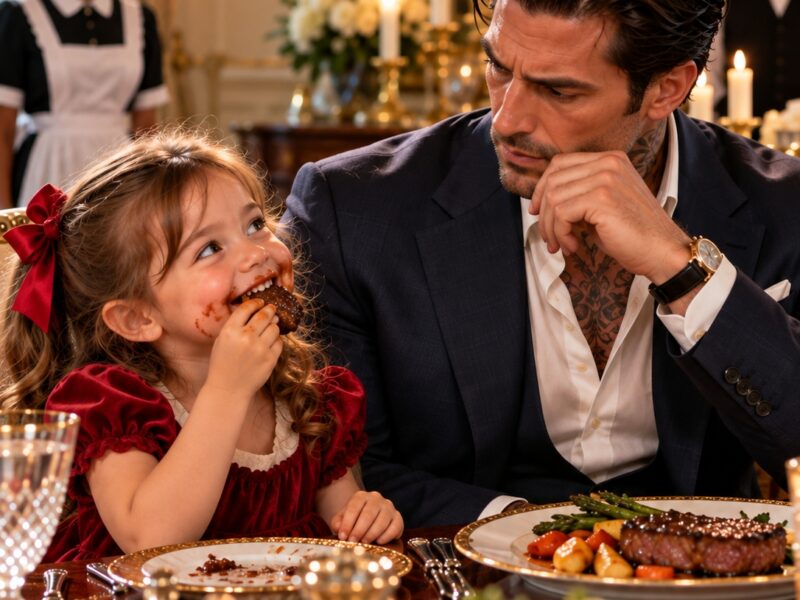
“Why Do You Always Eat Alone?” the Maid’s Toddler Asked the Mafia Boss—Then She Ate From His Plate, and a Buried Betrayal Finally Surfaced
“Why do you always eat alone?”
Three-year-old Lily Ellis climbed into the chair beside the most feared man on Long Island before a single guard found the courage to stop her.
Twenty-three minutes later, after stealing one roasted potato from his plate, she collapsed in her mother’s arms—and Gabriel Ventresca understood that whatever had made the child sick had never been meant for her.
The grandfather clock in the east hall struck nine just as Gabriel lifted his knife.
The sound traveled through the Ventresca estate in eight slow iron notes, each one disappearing into marble corridors, high ceilings, and rooms large enough to hold families that no longer existed.
Outside, October wind pushed salt air in from Long Island Sound. Beyond the windows stood twelve acres of private grounds, an eight-foot stone wall, electronic gates, rotating cameras, and guards who knew the difference between an unfamiliar car and an unfamiliar bird landing on the wrong section of fence.
Inside all that security, Gabriel ate dinner alone.
He had done so almost every night for three years.
There were fourteen chairs at the dining table.
Thirteen were empty.
The table had belonged to his grandfather, then his father, and now to Gabriel. Its dark walnut surface was polished every morning whether anyone used it or not, and the family crest carved into each chair had grown smooth beneath generations of hands.
Gabriel sat at the head.
Thirty-nine years old.
Six foot three.
Black hair brushed back from a face that rarely revealed what he had not deliberately chosen to reveal.
A pale scar ran from beneath his left ear toward his jaw.
People who knew the story did not ask about it.
People who did not know him well enough to know the story did not ask Gabriel Ventresca anything personal.
He cut into the rosemary chicken on his plate.
At the far end of the room, the door moved.
Barely.
Gabriel did not lift his head.
His security chief, Paul Marino, stood in the corridor beyond it. Gabriel could see Paul’s reflection in the dark window beside the fireplace.
Paul’s posture changed.
That was enough to tell Gabriel something unusual had entered the hallway.
Then came a sound no threat assessment had prepared either man for.
Small bare feet.
Gabriel looked up.
A little girl stood inside the doorway.
She could not have been more than three.
Brown curls framed a round face. Her white cotton nightgown was too long and brushed the tops of her feet. Beneath one arm she carried a gray stuffed rabbit with one flattened ear.
Gabriel knew who she was.
Lily Ellis.
Daughter of Mara Ellis, one of the estate’s newest housemaids.
Mara had been hired six weeks earlier through an agency Gabriel’s household manager used for live-in staff. Her file had crossed Gabriel’s desk because every adult who lived behind his walls crossed his desk.
Twenty-nine.
Widowed.
One daughter.
No debt beyond a small hospital balance and a used-car loan.
No criminal history.
No suspicious associations.
Nothing that should have interested him.
Yet her daughter was now walking toward his table as if the estate belonged equally to both of them.
Paul moved.
Gabriel lifted one finger.
Paul stopped.
Lily did not notice either man.
She stared at the empty chairs.
Then at Gabriel.
Then she walked toward the seat immediately to his right.
It was enormous beside her.
She placed the stuffed rabbit on the floor and attempted to climb.
Her first try failed.
She slid down.
Her second try failed with more dignity but the same result.
By the third attempt, Gabriel had stopped eating.
Lily managed one knee on the velvet seat, lost her balance, and landed softly on the rug.
She sat there.
Frowned at the chair.
Picked up her rabbit.
Then tried again.
Gabriel placed his knife down.
He stood.
Paul’s eyes widened in the doorway.
Gabriel walked around the corner of the table.
Lily looked up.
He bent.
His hands closed carefully around the child’s sides.
She weighed almost nothing.
He lifted her onto the chair.
Lily settled herself with complete satisfaction.
“Thank you.”
Gabriel returned to his seat.
“You’re welcome.”
Her bare legs swung beneath the table.
For several seconds she inspected the silverware.
Then the crystal.
Then Gabriel.
His plate.
His face.
The empty chairs.
Finally she asked, “Why do you always eat alone?”
The question struck more cleanly than an insult could have.
Gabriel’s hand stopped around his glass.
Paul looked toward the floor.
No one in the Ventresca organization had ever asked that question.
People knew why Gabriel ate alone.
Or thought they did.
Because his father had been murdered during dinner.
Because intimacy created access.
Because sitting beside the head of the family was not a casual privilege.
Because Gabriel trusted nobody with enough information to become indispensable.
But the child had not asked why nobody ate with him.
She had asked why he chose to eat alone.
Gabriel looked at her.
“Who told you I always do?”
Lily pointed at the corridor.
“I see.”
“You see me?”
She nodded.
“Mommy says don’t come here.”
“That sounds like good advice.”
“She says you’re the boss.”
“I am.”
“What do you boss?”
Gabriel almost smiled.
“Many things.”
“Do you boss dinner?”
“Usually.”
Lily considered.
Then placed the stuffed rabbit on the table.
“This is Benny.”
Gabriel looked at the worn toy.
One button eye was brown.
The other black.
“I see.”
“He can sit with you.”
“I’m fine.”
Lily’s expression became sympathetic in the devastating way only small children managed.
“That’s what Mommy says when she’s sad.”
Gabriel went still.
The child reached toward his plate.
Before he could react, she stole one roasted potato from beside the chicken.
She blew on it.
Bit it.
Gabriel stared.
Paul inhaled through his nose.
Lily chewed.
“Good.”
“You took that from my plate.”
“Yes.”
“Why?”
“Mine is in my room.”
“You had dinner?”
“Yes.”
“Then why are you eating mine?”
She shrugged.
“Yours looked better.”
Gabriel looked toward Paul.
Paul had turned his face away.
Probably hiding a smile.
Gabriel returned his attention to Lily.
“You are very comfortable committing theft.”
She did not understand the word.
But she understood tone.
Her eyes widened.
“I can give it back.”
Gabriel looked at the half-chewed potato.
“No.”
She ate the rest.
Then pushed Benny closer to his elbow.
“So you’re not lonely.”
For the first time in years, Gabriel did not know what to say.
A woman’s hurried footsteps sounded in the corridor.
Mara Ellis appeared in the doorway.
She stopped so violently one hand caught the frame.
Her face drained.
“Lily.”
The child turned.
“Mommy.”
Mara looked at Gabriel.
Then at Lily.
Then at the chair.
Then at Gabriel’s plate.
Fear moved visibly through her body.
“I am so sorry, Mr. Ventresca.”
Gabriel said nothing.
Mara hurried toward the table.
“I put her to bed. I had to finish in the laundry room, and Rosa was supposed to check—Lily, sweetheart, get down.”
“She can’t.”
Mara froze.
Gabriel nodded toward the chair.
“Too high.”
Mara stared at him.
The absurdity of the situation seemed to reach her only after the fear.
Gabriel stood.
He lifted Lily down.
The child immediately grabbed Benny.
Mara reached for her.
Lily went willingly.
Then her body sagged.
At first Mara thought the child had simply relaxed.
Then Lily’s head fell heavily against her shoulder.
“Mia?”
Wrong name.
Panic had reached for the name Mara’s sister used to call her.
“Lily?”
The child’s eyelids fluttered.
Her lips had lost color.
Gabriel saw it immediately.
“What’s wrong?”
Mara touched Lily’s cheek.
“Baby?”
Lily took a shallow breath.
Then another.
Her small fingers released Benny.
The rabbit fell to the carpet.
Mara’s face changed.
“No.”
Gabriel crossed the distance between them.
“Paul.”
His voice was quiet.
Paul was already moving.
“Get Dr. Hart.”
Mara held Lily tighter.
“What happened?”
“I don’t know.”
“Lily?”
The little girl’s eyes opened but did not focus.
Her breath came too quickly.
Gabriel took her from Mara.
She resisted instinctively.
“My daughter—”
“Stay with me.”
Something in his voice cut through panic.
Not command.
Structure.
Gabriel carried Lily through the corridor.
Mara followed.
Staff stepped back from the walls as they passed.
Nobody asked questions.
The medical suite occupied the ground floor of the east wing.
Dr. Nathaniel Hart arrived less than four minutes later.
At seventy-one, Nathaniel had treated three generations of Ventrescas.
He had delivered Gabriel during a summer storm when flooded roads kept the family from reaching the hospital.
He had stitched Gabriel’s face after a knife fight at seventeen.
He had declared Gabriel’s father dead at St. Catherine’s Hospital three years ago.
Everyone called him Uncle Nathan.
Tonight he entered carrying his black medical bag.
“What happened?”
Gabriel laid Lily on the examination table.
“She ate from my plate.”
Mara looked at him.
Nathaniel’s hand paused on the latch of his bag.
Only a fraction of a second.
Gabriel saw it.
“What did she eat?” the doctor asked.
“One potato.”
“What was on the plate?”
“Chicken. Potatoes. Olive oil. Herbs.”
Nathaniel opened the bag.
“Does she have allergies?”
Mara shook her head.
“None we know of.”
Nathaniel worked quickly.
Pulse.
Breathing.
Pupils.
Blood pressure.
Then he prepared medication.
Gabriel watched his hands.
Very steady.
Too steady.
“This doesn’t look like a normal food allergy,” Mara whispered.
Nathaniel did not look at her.
“Small children can react suddenly.”
“To what?”
“We’ll know more later.”
He administered the medication and asked for oxygen.
Within minutes Lily’s breathing eased.
Color returned slowly.
Mara collapsed into the chair beside the examination table.
She took Lily’s hand and pressed it to her mouth.
Gabriel remained by the door.
Nathaniel closed his bag.
“She should be watched overnight.”
Mara nodded rapidly.
“I’ll stay.”
“Of course.”
Nathaniel turned toward Gabriel.
“Send someone to identify everything she ate today.”
Gabriel’s eyes stayed on him.
“Everything?”
“Yes.”
“She ate one potato from my plate.”
“I heard you.”
“My kitchen prepares food for eighty people.”
Nathaniel’s expression stayed patient.
“Then we begin with the plate.”
Gabriel said nothing.
Something cold had started moving through him.
Not fear.
Recognition.
Nathaniel had walked into the room expecting a medical emergency.
That was not strange.
He was a doctor.
But he had not asked what symptoms Lily showed before opening the hidden compartment of his bag and reaching for exactly the medication that helped her.
Perhaps experience explained that.
Perhaps.
Gabriel had survived too long by respecting perhaps.
He looked toward Mara.
She was crying silently now.
Lily slept.
“Paul.”
His security chief stepped forward.
“Close the kitchen.”
Nathaniel frowned.
“Gabriel.”
“Nobody removes food.”
“It was probably accidental contamination.”
“Then closing the kitchen harms no one.”
Nathaniel’s eyes studied him.
Something unreadable passed between them.
“Of course.”
Gabriel bent and picked Benny off the medical-room floor.
He placed the rabbit beside Lily’s hand.
The child’s fingers closed around one ear even in sleep.
Gabriel watched.
Then turned to Paul.
“My plate goes to the private lab in Queens.”
Nathaniel spoke before Paul could answer.
“A laboratory?”
Gabriel looked at him.
“Yes.”
“For one mild episode?”
Gabriel’s voice went quieter.
“She is three.”
Nathaniel stopped.
Gabriel continued.
“And she ate food meant for me.”
The room changed.
Mara looked up.
Nathaniel did not.
Paul understood first.
“You think the food was targeted.”
“I think nothing yet.”
Gabriel’s eyes remained on the old doctor.
“I prefer evidence.”
Nathaniel gave a small nod.
“Good.”
Then he smiled.
Warm.
Familiar.
Almost paternal.
“That sounds like your father.”
Gabriel felt something inside him harden.
He did not know why.
By dawn, Lily was awake.
Weak.
Confused.
But smiling.
Mara sat on the edge of the guest bed where Gabriel had ordered them moved temporarily.
The servants’ cottages suddenly felt too far from the medical wing.
Lily touched her rabbit.
“Mr. Gabriel?”
Mara stiffened.
Gabriel stood in the doorway.
“What?”
“Did you eat the bad potato too?”
“No.”
“Good.”
Gabriel walked closer.
“Do you remember taking it?”
“Yes.”
“You’re not supposed to steal food.”
Her eyes widened.
Mara immediately said, “Lily—”
Gabriel raised one hand.
Then looked at the child.
“You’re also not supposed to nearly stop breathing.”
Lily’s expression became serious.
“I’m sorry.”
Something pulled beneath his ribs.
He sat in the chair beside the bed.
“You have nothing to apologize for.”
“But Mommy’s crying.”
Mara wiped her cheek quickly.
“I’m okay.”
Lily looked at Gabriel.
“Are you mad?”
“No.”
“Mommy says your face looks mad even when you’re not.”
Mara closed her eyes.
Gabriel looked at her.
She went pale.
He returned his attention to Lily.
“Your mother is observant.”
The child yawned.
“Can Benny stay at dinner next time?”
Mara’s head snapped up.
“There will not—”
Gabriel answered first.
“Yes.”
Both mother and daughter looked at him.
Gabriel stood.
“One condition.”
Lily waited.
“No stealing from my plate.”
She thought.
“Can you give me some?”
“Yes.”
“Okay.”
Mara stared.
Gabriel left before she could speak.
At eleven that morning, Paul placed a sealed toxicology report on Gabriel’s desk.
Gabriel read it once.
Then again.
A contaminant had been found in the finishing oil on his food.
Trace quantity.
Designed, according to the analyst, to accumulate slowly in an adult body rather than cause immediate dramatic symptoms.
In a small child, one concentrated exposure could create a dangerous acute reaction.
Gabriel set the paper down.
Paul stood across from him.
“How long?”
“We sent samples from the private pantry.”
“And?”
“The bottle currently in use tested positive.”
Gabriel’s jaw tightened.
“Previous bottle?”
“Disposed of last week.”
“Symptoms?”
Paul looked at the report.
“In an adult? Fatigue. Joint pain. Headaches. Sleep problems. Abnormal bloodwork.”
Gabriel stared at him.
Paul stopped.
Gabriel had experienced every one of those symptoms.
For six weeks.
Nothing severe.
Nothing alarming enough to interfere with work.
He had blamed meetings.
Stress.
Lack of sleep.
Nathaniel Hart had examined him twice.
Both times the doctor had told him he was overworked.
Both times he recommended vitamins.
Rest.
Less coffee.
Gabriel slowly leaned back.
“Who has access to the oil?”
Paul had already prepared the list.
“Chef. Two sous-chefs. Purchasing manager. Alberto. Dr. Hart.”
Gabriel looked up.
“Why Nathaniel?”
“He supplies some of your nutritional supplements.”
Gabriel said nothing.
“Apparently he told the chef he wanted the private oil used because it was easier on your stomach.”
“When?”
“Two months ago.”
Cold moved through Gabriel’s body.
Paul continued carefully.
“Chef thought the request came from you.”
“It did not.”
Silence.
Paul lowered his voice.
“What do you want me to do?”
Gabriel looked toward the closed study door.
On the other side were people who had called Nathaniel Hart uncle longer than Gabriel had been alive.
The man vaccinated children.
Delivered babies.
Sat beside dying grandmothers.
Treated guards without charging their families.
If Gabriel accused him and was wrong, he would fracture the entire estate.
If Gabriel said nothing and was right—
He looked at the report.
“Nothing.”
Paul frowned.
“Nothing?”
“Not yet.”
“Gabriel.”
“I want to know why.”
“You know enough to remove him.”
“No.”
Gabriel’s eyes hardened.
“I know enough to suspect him.”
“That child almost died.”
The sentence hit.
Gabriel looked away.
Paul continued.
“That was meant for you.”
“I am aware.”
“And if she had eaten more?”
Gabriel’s jaw locked.
“Do not finish that sentence.”
Paul nodded.
But he did not apologize.
Gabriel respected him for it.
“Find everything,” Gabriel said. “Thirty years. Nathaniel Hart. Family. Finances. Medical work. Every connection.”
Paul hesitated.
“He delivered you.”
“I know.”
“He loved your father.”
“So did several men who betrayed him.”
Paul left.
Gabriel remained at the desk.
His gaze moved to the dining room through the open double doors.
Fourteen chairs.
Thirteen empty.
The question returned.
Why do you always eat alone?
He had believed solitude protected him.
Yet somebody had poisoned the plate of the only person at the table.
Him.
Isolation had not prevented betrayal.
It had only ensured that if he collapsed, nobody would have tasted the danger first.
Except Lily had.
The thought made him sick.
That evening Mara came to his study.
She knocked once.
Gabriel looked up.
“Yes?”
She entered.
No uniform.
Plain gray sweater.
Hair loose around tired shoulders.
“I want to leave.”
Gabriel had expected it.
Still, something tightened.
“Tonight?”
“Tomorrow.”
“Why tomorrow?”
“Lily should sleep.”
He nodded.
“I’ll arrange transportation.”
“I can drive.”
“Your car is at the cottages.”
“I know.”
Gabriel studied her.
“Where will you go?”
“My cousin has a couch in Yonkers.”
“With a three-year-old.”
“Yes.”
“How long?”
Mara’s mouth tightened.
“That’s my problem.”
Gabriel immediately recognized the error in his question.
Control disguised as concern.
“Fair.”
She looked surprised.
He continued.
“You’ll be paid through the month.”
“I don’t want money I haven’t earned.”
“You were harmed under my roof.”
“My daughter ate from your plate because I failed to keep her out of the main house.”
Gabriel’s expression changed.
“No.”
Mara looked at him.
“You did not poison my food.”
Her face drained slightly.
So she had suspected.
Gabriel continued.
“What happened to Lily was not caused by you.”
“Then someone tried to poison you.”
It was not a question.
“Yes.”
Mara looked toward the hallway.
“And you don’t know who.”
“Not yet.”
Fear moved across her face.
“That’s why we leave.”
“I understand.”
“You’re not going to stop me?”
“No.”
She stared.
“Mr. Ventresca—”
“If you want to leave, you leave.”
“People say nobody leaves you.”
“People say many things.”
Mara held his gaze.
Gabriel added, “Some are true. This one isn’t.”
She nodded slowly.
Then turned.
“Mara.”
She stopped.
He had never used her first name.
“If you leave tomorrow, Paul will drive behind you until you reach wherever you’re staying.”
“I said I can drive.”
“You can.”
“Then why—”
“Because someone willing to poison me may decide the witness who ate from my plate is inconvenient.”
Mara’s face went white.
Gabriel’s voice softened.
“You won’t see the car unless you look for it.”
“That’s not comforting.”
“It wasn’t meant to be.”
She looked at him for a long time.
“Good night.”
“Good night.”
She left.
Ten minutes later, Gabriel heard laughter in the corridor.
Lily.
He stood.
Walked to the doorway.
The child sat on the rug outside the study, arranging wooden blocks in a line.
Mara was nowhere visible.
Gabriel looked down.
“What are you doing?”
Lily held up one block.
“House.”
“That looks like a rectangle.”
“It’s a house.”
“Of course.”
She put another beside it.
“Benny lives here.”
“Why are you outside my study?”
“Mommy packing.”
Gabriel crouched.
“You’re leaving tomorrow.”
Lily nodded.
“Mommy says we need somewhere quieter.”
Gabriel almost laughed.
“This is one of the quietest houses in New York.”
Lily considered.
“Not inside Mommy.”
The answer silenced him.
Children again.
Always walking around adult defenses by simply failing to understand where the doors were.
“You want to leave?”
Lily shrugged.
“I like the fountain.”
“Anything else?”
“You.”
Gabriel looked at her.
She continued building.
“You’re sad.”
“I am not.”
“You eat alone.”
The logic was apparently conclusive.
Gabriel sat on the floor opposite her.
For several minutes neither spoke.
Lily put a block near him.
“That’s your house.”
“You made mine smaller.”
“You’re one person.”
He looked at the tiny block.
Then at her.
“That is efficient.”
She smiled.
Mara found them fifteen minutes later.
She stopped.
Gabriel Ventresca.
One of the most feared men in New York.
Sitting cross-legged on a marble floor.
Holding a wooden roof while a toddler explained zoning.
Mara did not know whether to laugh or panic.
Gabriel stood immediately.
Lily protested.
“We’re not done.”
“Yes, we are.”
“No.”
Mara said, “Lily.”
The child sighed dramatically.
Gabriel handed her the roof.
She walked toward Mara.
Halfway there, she turned.
“Mr. Gabriel?”
“Yes?”
“If you eat alone tomorrow, Benny can stay.”
She offered the rabbit.
Mara’s expression broke.
Gabriel looked at the toy.
Then at the child.
“No.”
Lily frowned.
“You need him.”
“So do you.”
She thought about this.
Then carried Benny back to her mother.
Gabriel watched them leave.
The next morning Mara did not.
At seven thirty, Paul called Gabriel into the security room.
“We have a problem.”
“What?”
He turned one monitor.
Footage from the front gate.
A gray sedan had parked across the road at four twelve in the morning.
Stayed eighteen minutes.
Left.
“No plate visible.”
“Who noticed?”
“Outer patrol.”
Gabriel stared.
“Connection?”
“Unknown.”
Another monitor.
The service entrance.
At six forty-eight, someone had tried Mara’s cottage door.
Black coat.
Hat.
Face mostly hidden.
The person saw the new camera and walked away.
Gabriel’s face hardened.
“Mara?”
“In the guest wing with Lily.”
“She knows?”
“No.”
“Keep it that way.”
Paul looked at him.
“You’re not letting her leave.”
“I’m not stopping her.”
“That sounds like the same thing.”
Gabriel turned.
“I’m giving her information.”
He found Mara packing a suitcase.
Lily sat on the bed.
Benny tucked beneath her chin.
Gabriel remained in the doorway.
“Mara.”
She looked up.
“We need to talk.”
Her shoulders tightened.
He told her about the car.
The figure at the cottage.
Everything.
No dramatization.
No reassurance he could not guarantee.
When he finished, Mara sat down.
Lily watched both adults.
“So we can’t leave.”
“You can.”
Mara looked at him sharply.
Gabriel continued.
“But I believe the risk is higher outside the estate until I know who is watching.”
“Then I don’t really have a choice.”
“You do.”
“No.”
Her voice rose.
Lily looked at her.
Mara lowered it again.
“You have walls. Guards. Cars. Men with guns.”
Gabriel’s expression changed.
She continued.
“My choices are not equal to yours.”
He accepted that.
“You’re right.”
That answer stopped her.
Gabriel walked farther into the room.
“You can stay here without working.”
Mara stared.
“What?”
“Until this is resolved.”
“I’m not accepting charity.”
“It isn’t charity.”
“What would you call it?”
“Responsibility.”
“I didn’t ask for your responsibility.”
“No.”
Gabriel’s jaw tightened.
“But someone targeted food served in my house.”
He looked at Lily.
“And your daughter nearly paid for it.”
Silence.
“I cannot undo that.”
His voice grew quieter.
“I can make sure staying here does not require you to scrub floors while wondering whether your child is safe.”
Mara looked away.
Gabriel continued.
“You remain an employee only if you want to. Otherwise you are a guest.”
“And afterward?”
“You leave if you want.”
“No debt?”
“No.”
“No favors?”
“No.”
“No expectation that I—”
“No.”
Gabriel’s answer was immediate.
Mara looked at him.
He added, “You owe me nothing.”
Lily raised her hand.
Both adults looked at her.
“Can we stay by the fountain?”
Mara almost laughed.
Gabriel did.
Barely.
“Yes.”
Mara heard it.
The sound changed something small.
Not trust.
Not yet.
But perhaps the possibility of it.
They stayed.
The investigation widened.
Paul discovered Nathaniel Hart’s finances were clean.
Too clean.
No suspicious transfers.
No unexplained debts.
No sudden wealth.
The doctor owned a modest home in Queens and drove the same Volvo for eleven years.
He donated to three charities.
Paid taxes early.
Maintained no offshore accounts.
Then Paul found the first crack.
Nathaniel’s son.
Andrew Hart.
Twenty-six when he died.
Medical-school dropout.
Bodyguard.
Killed three years earlier.
Same restaurant.
Same night as Gabriel’s father.
Gabriel read the file.
Andrew had joined Anthony Ventresca’s personal security detail eight months before the shooting.
Nathaniel had begged him not to.
Andrew refused.
Gabriel remembered him only vaguely.
Young.
Funny.
Too idealistic for the work.
At the funeral, Gabriel had seen Nathaniel standing alone beside his son’s grave.
Why had Gabriel not approached?
Because Gabriel had been burying his father the same week.
Because the organization sent money.
Flowers.
A plaque.
Because grief had become administration.
Paul placed another photograph on the desk.
“Andrew had a cousin.”
Gabriel looked.
“On his mother’s side?”
“No. Nathaniel’s.”
The man in the photograph wore a dark coat.
Pinned to the lapel was a small silver emblem.
Serpent twisted around a narrow blade.
Gabriel’s eyes narrowed.
“The Viper Circle.”
“Old rival crew.”
“Disbanded.”
“Mostly.”
Paul opened another file.
“Nathaniel’s cousin, Alessandro Hart, was a patched member. Killed by your father’s people twenty-one years ago.”
Gabriel stared.
“So Nathaniel lost family to both sides.”
“Yes.”
“And stayed with us.”
“For almost three decades.”
“Why?”
Paul looked at him.
“Maybe because grief and loyalty can occupy the same room.”
Gabriel closed the file.
Later that day, Lily developed a mild cold.
Mara resisted taking her to Nathaniel.
Gabriel understood.
They used an outside pediatrician instead.
But Lily said something afterward.
Something small.
“Doctor Nathan has the snake.”
Mara looked at her.
“What snake?”
“The shiny one.”
Gabriel, sitting across the breakfast room, turned slowly.
“What shiny one?”
Lily pointed toward her own chest.
“Circle.”
Mara frowned.
“When?”
“When I was sick before.”
Gabriel leaned forward.
“Lily.”
She looked at him.
“Tell me exactly.”
The toddler’s story arrived in pieces.
Nathaniel reaching up.
Something falling from his coat.
Silver.
Snake.
He picked it up quickly.
Then smiled.
“A funny smile.”
Gabriel’s stomach tightened.
Paul brought an old surveillance photograph from the Viper Circle file.
Lily looked at the emblem.
“That.”
Mara went pale.
Gabriel’s face became still.
That evening, he searched his father’s private archives himself.
Anthony Ventresca had kept paper.
Not because he distrusted computers.
Because paper burned cleanly.
Gabriel found ledgers.
Letters.
Handwritten notes.
Then, inside a sealed folder labeled with the restaurant shooting, one page changed everything.
Anthony had received warning the morning before his death.
Possible leak.
Possible attack.
He ordered Andrew Hart off the dinner detail.
Andrew wrote his refusal beneath the order.
One sentence.
If I leave, another man takes my place. He has a family too.
Gabriel read it three times.
His father had not sent Andrew to die.
He tried to remove him.
Andrew chose to stay.
Nathaniel never knew.
Or had been told something else.
Gabriel sat alone beneath the study lamp.
For the first time, he understood the shape of the old doctor’s hatred.
Not simple revenge.
Misplaced grief fermented inside loyalty until the two became indistinguishable.
Nathaniel had served the family while blaming them.
Delivered babies.
Buried friends.
Smiled at Gabriel.
And slowly poisoned him.
Gabriel could have ordered Nathaniel taken that night.
He did not.
Paul argued.
Mara argued harder when she discovered the truth.
“You know it’s him.”
“I know enough.”
“He nearly killed Lily.”
Gabriel’s face tightened.
“I know.”
“Then why is he still walking into this house?”
“Because I need to know whether he acted alone.”
Mara stared.
“And if he gets another chance?”
“He won’t.”
“You cannot guarantee that.”
“No.”
The admission surprised her.
Gabriel continued.
“But if I take him now and someone else helped him, that person disappears.”
“And you’re willing to risk yourself.”
“Yes.”
“That’s your choice.”
Mara’s voice sharpened.
“You do not get to risk my daughter again.”
Silence.
Gabriel nodded.
“You’re right.”
He called Paul.
“Mara and Lily move to the north guest wing tonight.”
Paul understood.
“Guard?”
“Two outside. Nobody enters without Mara’s permission.”
Mara crossed her arms.
“Not yours?”
Gabriel looked at her.
“Yours.”
That mattered.
Three days later, Gabriel began pretending to be ill.
He canceled meetings.
Ate less.
Paused on stairs.
Allowed staff to see him rubbing his wrists.
Nathaniel was summoned.
The doctor examined him.
Concern appeared perfectly.
Too perfectly.
“Fatigue?”
“Yes.”
“Joint pain?”
“Yes.”
“Headaches?”
“Worse.”
Nathaniel listened to his chest.
Gabriel watched his face.
Inside the physician, something relaxed.
Not joy.
Vindication.
“There may be an autoimmune process.”
“You mentioned that before.”
“Yes.”
Nathaniel wrote a prescription.
“You need complete rest.”
Gabriel let his eyelids lower.
“How long?”
“Days.”
“Then?”
“We see.”
The old doctor touched Gabriel’s shoulder.
“Your father never knew when to stop either.”
Gabriel looked at him.
Nathaniel smiled.
“Rest, dear boy.”
The phrase made Gabriel’s blood turn cold.
That night, Paul placed four trusted men behind curtains and connecting doors in Gabriel’s bedroom.
No one on household staff knew.
Mara knew only that something would happen.
She hated it.
Lily was asleep beside her.
“You could stop.”
Gabriel stood outside the north guest room.
“So could he.”
“You’re waiting for a man to try to kill you.”
“Yes.”
“That sounds insane when said aloud.”
“Most plans do.”
Mara looked at him.
“This isn’t funny.”
“I know.”
Her eyes filled with anger.
“You walked into our lives as the dangerous one.”
Gabriel said nothing.
“I thought you were what I needed to keep Lily away from.”
“And now?”
“Now I don’t know.”
She swallowed.
“That might be worse.”
Gabriel looked past her.
Lily slept beneath the blanket.
Benny under her arm.
“I will not let him near her.”
Mara’s voice dropped.
“You already did.”
That hurt.
Gabriel accepted it.
“You’re right.”
She watched him.
He continued.
“Keep the door locked tonight.”
Then he walked away.
At two eighteen in the morning, Nathaniel Hart entered Gabriel’s bedroom.
The hallway guards let him through.
He carried his black bag.
Gabriel lay beneath the covers.
Breathing slowly.
Nathaniel stood beside the bed for a long time.
Then opened the bag.
He removed a prepared syringe.
Not the first.
Not the last.
Gabriel watched through nearly closed eyes.
Nathaniel’s hand trembled.
That surprised him.
The old doctor whispered:
“I am sorry, Andrew.”
Gabriel opened his eyes.
Every light came on.
Nathaniel froze.
Paul stepped from the dressing room.
Two men appeared behind the curtains.
Another blocked the hall.
Nathaniel dropped the syringe.
Gabriel sat up.
Clear-eyed.
Healthy.
“Sit down, Doctor.”
Nathaniel’s face became paper white.
For several seconds neither moved.
Then Nathaniel ran.
Not toward the stairs.
Toward the north wing.
Gabriel understood instantly.
“Mara.”
He was out of bed before Paul shouted.
They caught Nathaniel in the corridor outside the guest suite.
Mara had opened the door because she heard running.
Lily was awake in her arms.
Nathaniel stopped.
Cornered.
His eyes moved from Gabriel to Paul.
Then to Lily.
Something desperate changed.
He reached for the child.
Mara turned.
Gabriel crossed the distance.
“Don’t.”
Nathaniel stopped.
He had no weapon.
No syringe.
Only two empty hands.
Yet Mara held Lily tighter.
The old doctor looked at the toddler.
His face collapsed.
“I didn’t mean for her.”
Mara’s voice shook.
“But you did.”
“No.”
“You poisoned the plate she ate from.”
“I never knew she would—”
“You knew a child lived here.”
Nathaniel closed his eyes.
Gabriel spoke.
“Medical room.”
Nathaniel looked at him.
“What?”
“We talk there.”
Paul stepped forward.
Gabriel raised his hand.
“No cuffs.”
Paul stared.
“Gabriel.”
“No cuffs.”
Nathaniel laughed bitterly.
“Still pretending to be merciful.”
Gabriel’s gaze hardened.
“No.”
“I’m making sure you listen.”
In the medical room, Nathaniel sat on the same stool where he had treated Lily.
Gabriel stood six feet away.
Mara remained outside with Paul.
She had refused to leave entirely.
Nathaniel looked at the examination bench.
“Andrew hated this room.”
Gabriel said nothing.
“He broke his arm when he was nine.”
Nathaniel smiled faintly.
“Wouldn’t stop crying until your father gave him a coin.”
“My father?”
“He liked Andrew.”
Nathaniel’s smile disappeared.
“Until he didn’t.”
Gabriel reached into his jacket.
He removed Anthony’s note.
Placed it on the counter.
Nathaniel did not touch it.
“What is that?”
“The day before the restaurant shooting.”
Nathaniel stared.
Gabriel continued.
“My father received warning of an attack.”
“No.”
“He ordered Andrew off the detail.”
Nathaniel’s jaw tightened.
“No.”
“Read.”
“I know what happened.”
“No.”
Gabriel’s voice became quiet.
“You know what grief allowed you to believe.”
Nathaniel stood.
“My son died protecting your father.”
“Yes.”
“Your father built the world that killed him.”
“Yes.”
The agreement startled him.
Gabriel did not defend Anthony.
Nathaniel continued.
“You think one note changes that?”
“No.”
“Then what are we doing?”
Gabriel looked at him.
“Separating guilt.”
Silence.
“My father created dangerous loyalties.”
Gabriel pointed at the paper.
“But he did not order your son to that dinner.”
Nathaniel’s eyes moved to the note.
Slowly he picked it up.
Read Anthony’s handwriting.
Then Andrew’s.
If I leave, another man takes my place. He has a family too.
Nathaniel’s fingers began shaking.
“No.”
Gabriel said nothing.
Nathaniel read again.
“No.”
His voice cracked.
“My son told me Anthony refused to release him.”
“Someone told you that?”
Nathaniel stopped.
Gabriel caught it.
“Who?”
Nathaniel looked away.
“Who told you?”
“Alessandro.”
“Your cousin.”
“He had sources.”
“He was Viper Circle.”
“He was blood.”
Gabriel’s expression hardened.
“And because he was blood, you believed him.”
Nathaniel’s eyes filled.
“He told me Andrew begged to leave.”
“Andrew wrote the opposite.”
Nathaniel sat.
His shoulders folded.
“He was twenty-six.”
Gabriel remained still.
“He should have been in medical school.”
“Yes.”
“He could have had children.”
“Yes.”
“He could have been fifty now.”
Gabriel’s throat tightened.
“Yes.”
Nathaniel looked up.
“And your father still built the room where he died.”
“Yes.”
Again, Gabriel refused absolution.
That seemed to hurt Nathaniel more.
“You want me to forgive him?”
“No.”
“Then what?”
Gabriel looked toward the closed door.
Beyond it stood a mother holding her daughter.
“I want you to understand that your grief nearly made Mara bury Lily.”
Nathaniel flinched.
Gabriel stepped closer.
“You buried one child.”
His voice stayed low.
“And you decided another mother’s child was acceptable collateral because she was sitting at my table.”
“I never meant—”
“Intentions did not carry her body down the hallway.”
Nathaniel’s face crumpled.
“Look at the bench.”
He did.
“That is where you saved her.”
Gabriel continued.
“You knew exactly how because you knew exactly what she had ingested.”
Nathaniel covered his face.
For the first time, the old doctor cried.
Not quietly.
Not elegantly.
His shoulders shook.
Words broke apart.
“I wanted him to lose you.”
Gabriel understood.
“Who?”
“My son.”
Nathaniel looked up.
“I wanted your father to lose you.”
“But he died first.”
“Yes.”
“And you continued anyway.”
“Yes.”
“Why?”
Nathaniel’s voice became raw.
“Because you sat in his chair.”
There it was.
Not justice.
Substitution.
Gabriel had become Anthony because grief needed a living target.
Nathaniel looked toward the door.
“Is the little girl all right?”
“Yes.”
“Will Mara let me—”
“No.”
Nathaniel closed his eyes.
Gabriel continued.
“You don’t get that.”
A knock sounded.
Detective Sarah Connors stood outside.
Gabriel had called her hours earlier.
Nathaniel looked at him.
“Police?”
“Yes.”
“You’re handing me to them.”
“Yes.”
A strange laugh escaped the old man.
“Your father would never have done that.”
Gabriel looked at him.
“I know.”
Nathaniel was arrested before sunrise.
The investigation found the rest.
The old rival connection.
The private ingredients.
The doctor’s notebook documenting Gabriel’s symptoms.
The chef’s testimony that Nathaniel had claimed the special oil was a physician-approved dietary supplement.
The chef had never known.
He nearly resigned from guilt.
Gabriel refused the resignation.
“You were lied to.”
“I should have asked.”
“Yes.”
The chef looked up.
Gabriel continued.
“So next time ask.”
There would be a next time.
That was punishment enough.
The criminal case forced Gabriel to expose parts of the Ventresca world he had protected for years.
He cooperated selectively at first.
Then less selectively.
Records led investigators into businesses Gabriel already knew should have been closed.
Gambling.
Extortion.
Drug distribution his father had considered untouchable family territory.
Paul watched Gabriel sign the first dissolution order.
“You know what this costs.”
“Yes.”
“Some men will leave.”
“Yes.”
“Some may come after you.”
Gabriel looked toward the lawn.
Lily was chasing Benny after Mara had thrown the stuffed rabbit onto a blanket as part of a game only a toddler understood.
“Then I deal with that.”
Paul studied him.
“This because of the kid?”
“No.”
Gabriel signed another page.
“She simply made it harder to lie to myself.”
The estate changed slowly.
Fewer armed men in hallways.
More legitimate security.
Less whispering.
Certain doors that had always remained locked became ordinary offices.
The dining table stayed.
Gabriel still ate there.
But not always alone.
The first invitation came awkwardly.
Mara was carrying linens past the dining room.
Gabriel called her name.
She stopped.
“Yes?”
“Lily asked whether she can have dinner here.”
Mara looked toward the child, who was hiding poorly behind the door.
“She asked you?”
“Yes.”
“When?”
“Every day for a week.”
Mara almost smiled.
“Why didn’t you tell me?”
“I assumed she would lose interest.”
Lily stepped out.
“I didn’t.”
Gabriel sighed.
“Clearly.”
Mara hesitated.
“You know she ate from your plate last time.”
“I remember.”
“You almost killed your entire kitchen afterward.”
“I investigated my entire kitchen.”
“Your chef still looks nervous when he sees potatoes.”
“He’ll recover.”
Mara smiled.
A small one.
Then became serious.
“If she eats here, I stay.”
Gabriel nodded.
“At the table.”
Mara blinked.
“I meant in the room.”
“I know.”
“That isn’t appropriate.”
“Why?”
“I work here.”
“Not anymore.”
Her expression changed.
After Nathaniel’s arrest, Gabriel had continued paying Mara but had never again assigned her household work.
She helped when she chose.
Mostly because sitting still made her uncomfortable.
Gabriel had offered her a formal administrative position coordinating staff housing and benefits.
She had not accepted yet.
“You cannot solve every awkward situation by changing my job.”
Gabriel looked at her.
“I am beginning to understand that.”
“Are you?”
“Painfully.”
Mara stared.
Then laughed.
The sound surprised both of them.
“Fine.”
“Fine?”
“Dinner.”
Lily ran into the room.
“Tonight?”
Mara looked at Gabriel.
He looked at Lily.
“Apparently.”
Three places were set.
Gabriel at the head.
Lily on his right with a cushion beneath her.
Mara across from them.
Benny occupied a fourth chair until Mara insisted stuffed animals did not require porcelain.
Lily objected.
Gabriel sided with Lily.
Mara accused him of undermining parental authority.
Gabriel replied that Benny was technically his guest.
Dinner was roast chicken.
Potatoes.
Green beans.
Every ingredient had been checked three times.
Mara noticed.
She did not mention it.
Halfway through, Lily’s hand drifted toward Gabriel’s plate.
He caught her fingers gently.
“No.”
She frowned.
“Better.”
“No.”
He cut one potato from his plate.
Placed it on a clean side dish.
Then slid it toward her.
“From here.”
Lily accepted.
Mara hid a smile behind her water glass.
Gabriel noticed.
“Something funny?”
“No.”
“You’re smiling.”
“I’m allowed.”
“Of course.”
“You sounded surprised.”
“I am adjusting.”
Lily looked down the table.
Thirteen chairs.
Only eleven empty tonight.
“You don’t eat alone.”
Gabriel stopped.
The same question.
Different form.
Mara looked at him.
Lily waited.
“No.”
Gabriel’s voice softened.
“I suppose I don’t.”
Weeks became months.
Mara accepted the staff-benefits position.
Not because Gabriel insisted.
Because she discovered the estate employed forty-eight people and had no proper childcare program, no emergency fund, and no written policy for widowed employees.
“How does a place this large not have any of that?”
Gabriel looked over the proposal.
“Because nobody asked.”
“That’s a terrible answer.”
“Yes.”
She blinked.
“You agree too quickly now.”
“I’m experimenting with humility.”
“It doesn’t suit you.”
“So I’ve noticed.”
Mara built the program anyway.
Gabriel funded it.
Then stepped back.
The first emergency grant went to a gardener whose wife needed surgery.
The second paid temporary housing for a driver whose apartment burned.
The third covered childcare for a cook whose mother died.
No favors attached.
No repayment.
Mara insisted.
Gabriel agreed.
Nathaniel Hart pleaded guilty.
He did not go to trial.
The evidence was overwhelming.
Before sentencing, he requested to see Gabriel.
Gabriel refused twice.
Accepted the third time.
They met behind glass.
Nathaniel looked smaller.
No white coat.
No authority.
Just an old man in institutional clothing.
“You look healthy,” he said.
“I am.”
“I heard the child is well.”
“She is.”
Silence.
Nathaniel looked down.
“I wrote Mara a letter.”
Gabriel’s expression hardened.
“I know.”
“She returned it.”
“She had that right.”
“I wanted to apologize.”
“Apology does not create obligation.”
Nathaniel nodded.
“I know.”
Another silence.
Then he said, “I was wrong about your father.”
Gabriel shook his head.
“No.”
Nathaniel looked up.
“You weren’t entirely wrong.”
“My father built the conditions that killed Andrew.”
Nathaniel’s eyes filled.
Gabriel continued.
“But he did not make Andrew choose.”
“No.”
“And you did not make Lily choose my potato.”
Nathaniel flinched.
“Yet she almost died because of you.”
“Yes.”
Two truths.
Neither canceled the other.
Nathaniel pressed both hands together.
“What happens to me now?”
Gabriel looked through the glass.
“For once, that isn’t my decision.”
Nathaniel stared.
Then nodded slowly.
Perhaps that was the final thing Gabriel could give him.
Not revenge.
Consequence.
Outside the prison, Mara waited in the car.
Gabriel had not asked her to.
She came anyway.
“How was it?”
“Unpleasant.”
“Useful?”
“I don’t know.”
“Good.”
Gabriel looked at her.
“Good?”
“You don’t have to turn everything into a lesson before it’s finished hurting.”
He studied her.
“You say things I dislike.”
“Frequently.”
“That appears intentional.”
“Sometimes.”
They drove home.
Home.
The word had begun changing meaning.
One year after Lily first walked into the dining room, Gabriel canceled the anniversary meeting his father had always held in October.
Paul noticed.
“Tradition.”
“Bad one.”
“What are you doing instead?”
Gabriel looked at his calendar.
“Dinner.”
“With who?”
He stared.
Paul smiled.
“Never mind.”
The dinner was smaller than Lily wanted.
She had proposed “everybody.”
Mara vetoed.
They invited Paul.
Chef Antonio.
House manager Rosa.
Two guards.
Three staff families.
Children ran beneath the table.
Someone spilled juice.
One chair scratched the floor.
Gabriel heard the sound.
A year earlier, he might have looked toward it.
He didn’t.
Lily sat beside him.
Now four.
Still stealing potatoes.
Benny’s flattened ear had been repaired twice.
After dessert, Lily climbed onto Gabriel’s lap without asking.
Mara saw.
Started to intervene.
Gabriel shook his head.
Lily leaned against his chest.
“Are you still the boss?”
“Yes.”
“Of dinner?”
“Less than before.”
“Mommy is boss of dinner.”
“That appears true.”
Mara laughed.
Gabriel looked around.
Noise.
Glasses.
Children.
Adults arguing mildly.
A guard telling a story too loudly.
Nothing controlled.
Nothing perfectly secure.
Something inside him relaxed.
Later that night, after the guests left, Mara stood beside the dining room door.
Gabriel was clearing a plate.
She stared.
“What?”
“You’re carrying dishes.”
“I have hands.”
“I’ve never seen you use them for dishes.”
“That seems judgmental.”
She entered.
Helped stack plates.
For a while, silence.
Not the old silence.
This one did not demand anything.
Mara said, “Lily asked me something.”
“That sounds dangerous.”
“She asked if you’re family.”
Gabriel stopped.
“What did you say?”
“That family is a big word.”
“Coward.”
Mara looked at him.
Gabriel almost smiled.
“What did she say?”
“She said, ‘Okay, but is he?’”
“And?”
“I told her she could decide what you are to her.”
Gabriel looked down at the plate.
“What did she decide?”
Mara’s expression softened.
“She said you’re the person who eats her potatoes.”
“That is inaccurate.”
“She has her narrative.”
Gabriel laughed quietly.
Mara watched him.
“You’re different.”
“No.”
“Yes.”
“Less efficient perhaps.”
“Definitely.”
He looked at her.
“You stayed.”
Mara’s smile disappeared.
Not badly.
Seriously.
“Yes.”
“Why?”
“You gave us the choice.”
Gabriel waited.
“And?”
“You kept giving it.”
That was the answer.
Not the walls.
Not the money.
Not protection.
Choice repeated often enough to become trust.
Another winter passed.
Mara moved out of the servants’ cottage.
Not into Gabriel’s wing.
Into a small guesthouse at the edge of the property with her own lease.
Her name on it.
Rent she insisted on paying.
Gabriel argued once.
Lost.
Lily started preschool.
Gabriel attended the first parent event by accident.
At least that was what he claimed.
Mara found him standing near finger paintings in a charcoal suit while four-year-olds ran around his shoes.
“You had a meeting.”
“Canceled.”
“For this?”
“No.”
“Gabriel.”
“Yes.”
“You canceled for this.”
He looked toward Lily.
“She said there was a rabbit project.”
Mara laughed.
“Terrifying.”
“It appears to involve glue.”
“More dangerous than Queens.”
“Easily.”
Their relationship changed quietly.
No declaration.
No debt disguised as romance.
No gratitude mistaken for intimacy.
Coffee after Lily slept.
Arguments over staff policies.
Walks through the garden.
One evening Gabriel told Mara about Milan.
The life he had expected.
Finance.
A small apartment.
A woman named Isabelle he had cut off after his father died.
“You loved her?”
“I thought I did.”
“That answer sounds expensive.”
“It was.”
“Why did you leave?”
“I thought anyone close to me became a target.”
“And now?”
Gabriel looked toward the guesthouse window where Lily slept.
“Now I think people close to me were targets whether I loved them properly or not.”
Mara said nothing.
Gabriel continued.
“I confused distance with safety.”
“So did I.”
He looked at her.
“After David died, I stopped letting people help.”
“Why?”
“Because needing people felt like agreeing they were allowed to disappear.”
Gabriel understood that too well.
They sat on the bench beside the fountain.
Shoulders almost touching.
Neither moved closer.
Not yet.
Spring arrived.
Then summer.
The criminal operations shrank further.
Gabriel converted several warehouses fully into legitimate logistics facilities.
Closed the last illegal bookmaking operation his father had considered tradition.
Older associates complained.
One told him Anthony would be ashamed.
Gabriel replied:
“My father is dead.”
The man stopped.
Gabriel added:
“The people living with what we built are not.”
No one argued after that.
A second year passed.
Lily turned five.
At her birthday party, Gabriel gave her a bicycle.
Mara stared at it.
“That looks expensive.”
“It has two wheels.”
“It has a handcrafted leather seat.”
“The shop said it lasts longer.”
“It has her initials painted on the frame.”
“Identification is responsible.”
Mara folded her arms.
“You’re impossible.”
Lily ran toward them wearing a paper crown.
“Mr. Gabriel!”
“Yes?”
“Benny needs a bicycle.”
Gabriel looked at Mara.
She pointed a warning finger.
“No.”
He returned his eyes to Lily.
“Your mother has spoken.”
Lily sighed.
“She bosses you.”
“Increasingly.”
The child climbed onto the new bicycle.
Gabriel held the back.
Mara watched.
“Let go,” Lily said.
“Not yet.”
“I can do it.”
“Possibly.”
“Gabriel.”
Mara’s voice.
He looked at her.
She tilted her head.
Choice.
He remembered.
Gabriel loosened his grip.
Lily pedaled.
Wobbled.
He stepped forward instinctively.
Stopped.
She corrected herself.
Kept going.
Mara came beside him.
“You looked physically ill.”
“I disliked that.”
“Good.”
“You enjoy my discomfort.”
“Only educational discomfort.”
They watched Lily circle the lawn.
Gabriel said quietly, “Dinner tonight?”
Mara smiled.
“We have dinner most nights.”
“No.”
She looked at him.
He swallowed.
That almost amused her.
Gabriel Ventresca negotiated million-dollar contracts without blinking.
This question made him pause.
“Dinner.”
“Without Lily?”
“Yes.”
Mara smiled slowly.
“A date?”
“Yes.”
“You could have said that.”
“I just did.”
“Painfully.”
“Is that a yes?”
“It is.”
Their first date was not at a private restaurant.
Mara chose a small place in Port Washington.
Crowded.
Ordinary.
Gabriel hated the seating arrangement.
His back was partly exposed to the room.
Mara noticed.
“Want to move?”
He looked around.
“No.”
“You’re uncomfortable.”
“Yes.”
“Why stay?”
Gabriel took a breath.
“Practicing.”
Mara understood.
She reached across the table.
Not dramatically.
Only fingertips over his hand.
Gabriel looked down.
No one in the restaurant cared who he was.
Nobody lowered their voice.
Nobody knew.
He turned his hand and held hers.
Three years earlier, he would have called that vulnerability.
Tonight it felt more like being alive.
Their relationship moved slowly.
Deliberately.
Lily remained the center of Mara’s choices.
Gabriel never argued.
When Lily asked whether Gabriel was going to become her father, Mara nearly dropped a coffee cup.
Gabriel answered first.
“No.”
The child frowned.
Mara looked at him.
Gabriel continued.
“You already have a father.”
Lily looked at Benny.
“Daddy David.”
“Yes.”
“He’s dead.”
“Yes.”
“Then what are you?”
Gabriel thought.
“Whatever you want me to be.”
Lily considered for almost a full minute.
“Mr. Gabriel.”
He nodded.
“That works.”
Two months later, she changed it.
“Gabe.”
Mara nearly laughed herself out of the chair.
Gabriel accepted the demotion.
Years after Nathaniel’s arrest, people still told the story incorrectly.
They said a maid’s toddler saved a mafia boss by accidentally eating poisoned food.
Gabriel always hated that version.
Lily did not save him because she became sick.
That was horror, not salvation.
What changed him had happened before the poisoning.
A barefoot child walked into a room designed to keep everyone away.
She saw fourteen chairs and one person.
She asked the simplest question imaginable.
Why do you always eat alone?
Everything after that only forced Gabriel to keep answering.
He had eaten alone because he thought love created targets.
Because his father’s murder taught him trust was an exposed nerve.
Because men around him praised isolation as discipline.
Because nobody powerful enough to enter his dining room had been foolish enough to challenge the habit.
A three-year-old did not know the rules.
So she ignored them.
On the fourth anniversary of that first dinner, Gabriel entered the dining room at seven.
Three places were already set.
Mara sat across from him.
Lily sat on his right.
Benny occupied a ridiculous miniature chair the chef had commissioned as a joke.
Gabriel stopped.
“What is that?”
Lily looked innocent.
“Benny has status.”
Mara hid her smile.
“Paul approved it.”
“Paul is fired.”
“He said you’d say that.”
Gabriel sat.
Dinner was chicken.
Potatoes.
No special oil.
No private ingredients.
No food prepared differently for Gabriel than for everyone else.
That policy had changed permanently.
Halfway through the meal, Lily looked at his plate.
Gabriel saw the hand move.
He caught her wrist gently.
“No.”
“But yours looks better.”
“It is the same.”
“Yours is bigger.”
“That is because I’m larger.”
“That’s not fair.”
“Life contains challenges.”
Mara looked at him.
“Give her one.”
Gabriel sighed.
He cut a potato.
Placed it on the side plate.
Slid it toward Lily.
“For you.”
She ate.
Then looked down the long table.
Several of the old empty chairs had disappeared from the room.
Gabriel removed them years earlier because he was tired of decorating loneliness.
Only six remained now.
Enough for family.
Enough for guests.
Enough without pretending absence was tradition.
Lily tilted her head.
Same way she had when she was three.
“Gabe?”
“Yes?”
“You don’t eat alone anymore.”
Gabriel became quiet.
Mara looked at him.
Lily waited.
Finally Gabriel smiled.
A real one.
The kind nobody in the old Ventresca organization would have recognized.
“No,” he said.
“I don’t.”
Lily returned to her potato as though the matter had been settled.
For her, perhaps it had.
Gabriel looked across the table at Mara.
She lifted her glass.
Not a toast.
Just acknowledgment.
He understood anyway.
Outside, Long Island Sound moved beneath a dark autumn sky.
The security gates still stood.
The cameras still turned.
Gabriel was not naïve enough to believe love erased danger.
He had simply stopped allowing danger to define every shape love was permitted to take.
The old estate remained powerful.
But it was no longer silent.
Children ran in halls.
Staff ate together once a week in the main kitchen.
Doors occasionally slammed.
The piano was played badly.
Someone laughed during business hours.
Gabriel learned none of those sounds meant weakness.
Sometimes they meant people were no longer afraid.
Nathaniel Hart remained in prison.
Gabriel never forgave what he had done in the easy, sentimental way outsiders might have preferred.
Forgiveness did not require forgetting a child gasping for air.
But neither did Gabriel allow Nathaniel’s betrayal to become another excuse for isolation.
That, he eventually understood, would have allowed the old doctor to poison more than his body.
He would have poisoned the rest of Gabriel’s life.
And Gabriel refused.
So on ordinary nights, he sat at a smaller table.
Mara sometimes argued with him about work.
Lily sometimes stole potatoes.
Benny sometimes occupied a chair no stuffed rabbit deserved.
Nothing about it resembled the power Gabriel inherited.
That was precisely why he valued it.
Years earlier, his father had taught him that the safest man was the one with no exposed weakness.
Gabriel believed him.
Until a child with bare feet walked into his dining room and exposed the flaw in the lesson.
A man with nothing he loves may be difficult to threaten.
He is also very easy to leave alone.
Gabriel had survived three years that way.
It had looked like strength from the outside.
From a three-year-old’s chair, it had looked like sadness.
And somehow, she had been the one who saw clearly.









