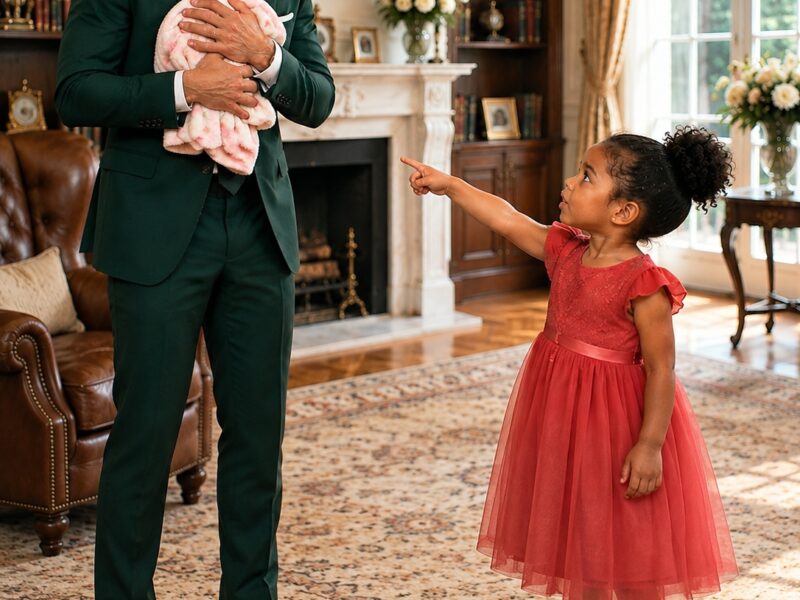
“Why Do You Keep My Blanket?” the Maid’s Toddler Asked — The Billionaire Couldn’t Speak
“Why do you keep my blanket?”
Grant Hail froze behind the desk.
The pink-and-white patchwork square was pressed against his chest so tightly that his knuckles had gone white. A minute earlier, he had been alone in the study with rain tapping the tall windows and the smell of cold coffee lingering beside his laptop.
Now a three-year-old girl stood in the doorway.
Mia Cruz pointed one small finger at the fabric.
“That’s mine.”
Grant opened his mouth.
Nothing came out.
Mia’s dark curls were damp from the November rain. One yellow rain boot was half unlaced. She looked mildly offended rather than frightened, as if the billionaire in front of her had simply forgotten the ordinary rules governing blankets.
“Mama says it’s mine,” she added.
Grant stared down at the uneven row of faded pink stitches beneath his thumb.
He knew those stitches.
He knew the tiny embroidered ivy leaf near one corner.
Most of all, he knew the small mistake hidden beneath the white border, where Sophia had sewn the same square twice because she had been eight months pregnant and too tired to notice.
His wife had laughed when he pointed it out.
“It makes it ours,” she had said.
That had been three years ago.
Before the emergency delivery.
Before Sophia died.
Before their daughter survived four days.
Before Grant stood in a hospital room holding a baby who weighed less than the leather briefcase he carried to work.
Before he came home alone and ordered every crib sheet, bottle, dress, stuffed animal, and blanket removed from the nursery because breathing in that room had become physically impossible.
The blanket in his hands was not supposed to be here.
He had watched six cardboard boxes leave the estate.
He had signed the donation paperwork without reading where they were going.
He had never asked.
Yet here was a stranger’s toddler claiming Sophia’s blanket as her own.
Mia took one careful step inside.
“Mr. Hail?”
Grant looked at her.
“Where did you get this?”
Her face tightened.
“My bed.”
“Before your bed.”
She blinked.
“Home.”
Grant’s voice came out rougher than he intended.
“Who gave it to you?”
Mia’s lower lip moved.
“I don’t know.”
Grant saw fear appear.
Not much.
Enough.
He immediately loosened his grip on the blanket.
“I’m sorry.”
That seemed to surprise her more than the question.
He held the fabric toward her.
“Here.”
Mia did not move.
“You’re sad.”
Grant swallowed.
“No.”
She tilted her head.
“My mommy says grown-ups say no when they mean yes.”
Despite himself, a sound almost escaped him.
Not laughter.
Something near it.
Mia approached.
She took one corner of the blanket but did not pull.
Instead she looked at his face.
“Why do you keep it?”
Grant glanced down.
He could have told her the truth.
Because my wife made it.
Because it was supposed to keep a child warm who barely lived long enough to leave the hospital.
Because I spent three years convincing myself that throwing every reminder out of this house was the same thing as surviving.
But Mia was three.
So Grant said the only thing he could manage.
“I remembered it.”
Mia considered this.
Then she climbed onto the leather chair opposite his desk without asking permission.
“Sometimes I remember Daddy.”
Grant went still.
She spread the blanket across her knees.
“He had loud shoes.”
“What?”
“My daddy.”
She pointed toward the marble hall.
“Clomp, clomp, clomp.”
Grant looked toward the doorway.
“Where is your father?”
Mia’s answer was immediate.
“He died.”
The sentence came without drama.
Children did not always understand which truths adults preferred wrapped in softer words.
Grant lowered himself into his chair.
“I’m sorry.”
Mia shrugged in the way only a toddler could make devastating.
“Mommy is sorry too.”
Then Elena Cruz appeared.
“Mia?”
She stopped dead in the doorway.
Her face moved from relief to alarm when she saw the blanket.
“Mr. Hail.”
Grant stood.
Elena’s eyes dropped to the fabric.
“Mia, sweetheart, I told you not to come in here.”
“She was looking for this.”
Grant’s voice remained quiet.
Elena’s posture changed.
For eight weeks, she had worked at the Hail Estate through a staffing agency, managing cleaning schedules, deliveries, and the small army required to keep a twelve-bedroom Greenwich mansion looking inhabited when only one person actually lived there.
Grant knew almost nothing about her.
Thirty-one.
Widowed.
One child.
Excellent references.
Never late.
That was about it.
Now she looked afraid.
“Is there a problem?”
Grant touched the blanket.
“Where did she get this?”
Elena blinked.
“The blanket?”
“Yes.”
“I’ve had it since she was born.”
“Where did you buy it?”
“I didn’t.”
Her confusion deepened.
“It came from a family shelter.”
Grant’s fingers went cold.
“What shelter?”
Elena hesitated.
“Willow Creek.”
“In Bridgeport.”
Grant knew the name.
Not from memory.
From a single line on a tax receipt he had signed three years earlier.
He stared at her.
Elena noticed.
“What is it?”
“This belonged to my daughter.”
Silence.
Rain hissed against the glass.
Mia looked between them.
Elena slowly sat in the nearest chair.
“I’m sorry?”
“My wife made it.”
Grant’s voice shook now.
He did not hide it quickly enough.
“For our baby.”
Elena’s hand rose to her mouth.
“Oh my God.”
Mia hugged the blanket.
Grant saw the motion.
Something ugly and possessive moved through him.
Mine.
Ivy’s.
Sophia’s.
Then another thought arrived.
Mia had probably slept beneath that blanket for three years.
She had dragged it through car seats.
Spilled milk on it.
Held it when she missed her father.
The fabric Grant had treated as a relic had been doing exactly what Sophia created it to do.
Keeping a child warm.
Elena stood abruptly.
“We’ll return it.”
Mia looked up.
“No.”
“It’s not ours, baby.”
“It is.”
“Mia.”
The child’s face crumpled.
Grant lifted one hand.
“Wait.”
Elena stopped.
He looked at Mia.
She had clutched the blanket to her chest.
He remembered Ivy beneath hospital lights, wrapped in sterile white cloth because the patchwork blanket had still been at home waiting for a baby everyone believed would eventually come home.
Grant had never seen Ivy under it.
Not once.
His throat tightened.
“Mia.”
She looked at him.
“Can I see one corner?”
Suspiciously, she held out six inches.
Grant crouched.
He rubbed the faded gingham between his thumb and forefinger.
There was the crooked stitch.
Sophia’s.
His eyes burned.
Elena whispered, “Mr. Hail.”
Grant inhaled.
Then released the fabric.
“You can keep it tonight.”
Elena frowned.
“Tonight?”
“I need to understand how it got from this house to that shelter.”
“And how you ended up here.”
The second sentence sounded worse aloud.
Elena’s face closed.
“You think I knew.”
“I didn’t say that.”
“You didn’t have to.”
“I’m asking a question.”
“No.”
Elena’s voice stayed controlled.
“You’re asking two questions as if they might have the same answer.”
Grant stood.
“That is fair.”
She looked surprised.
He continued.
“I’m not accusing you.”
“Not yet.”
There was no bitterness in her voice.
That bothered him more.
Grant looked at the blanket.
“Do you have any paperwork from the shelter?”
“Maybe.”
“Three years ago I was seven months pregnant and sleeping in my cousin’s living room after my husband died.”
“I wasn’t organizing receipts for future billionaires.”
The sentence landed cleanly.
Grant lowered his gaze.
“I deserved that.”
Mia climbed from the chair.
She took Elena’s hand.
“Home?”
“Yes, baby.”
Elena turned to Grant.
“I’ll look.”
“That is all I’m asking.”
She nodded.
Then left.
Mia stopped at the doorway.
She held up the blanket.
“You can remember it tomorrow.”
Grant could not answer before she disappeared down the hall.
He stood alone in the study.
A cold cup of coffee.
A dark laptop.
Rain on glass.
And a question he had spent three years avoiding.
Where had Ivy’s things gone?
The nursery remained locked at the end of the second-floor hall.
Grant reached it at 11:26 that night.
He had not stood in front of the door in almost three years.
The brass knob reflected his face in a warped circle.
He had personally changed the code after Sophia’s death.
No staff access.
No cleaning.
No maintenance unless required.
Owen Pratt, the estate manager, inspected the exterior once a month and nothing more.
Grant entered the code.
The lock clicked.
He did not move.
His body reacted before memory.
Tight chest.
Cold palms.
The smell appeared before he opened the door.
Dust.
Cedar.
Something faintly sweet from the drawer sachets Sophia had chosen.
Grant pushed.
Moonlight crossed the carpet.
The room had remained almost untouched.
Yellow crib.
Paper-star mobile.
White rocking chair.
A bookshelf waiting for books Ivy never got old enough to hear.
Grant stepped inside.
His knees weakened.
Sophia had sat in that rocking chair sewing the blanket.
She used to complain that the pattern never lined up correctly.
Grant used to answer email while pretending to listen.
He hated that memory.
On top of the dresser sat a framed photograph.
Sophia pregnant.
One hand beneath her stomach.
Smiling directly at whoever held the camera.
Grant had taken it.
He picked up the frame.
Dust coated his thumb.
He put it down.
In the closet, boxes remained.
But not the baby supplies.
Those were gone.
He found one manila envelope labeled DONATION.
Inside sat a single carbon-copy receipt.
Willow Creek Family Shelter.
Six boxes.
Infant clothing and linens.
Delivered by Margaret Doyle.
January 23.
Grant stared at the name.
Margaret had worked for his family for twenty-two years.
Housekeeper first.
Then household manager.
She retired eighteen months after Sophia’s death.
She had been the person Grant asked to empty the nursery.
He remembered the conversation only in pieces.
“I cannot come home if that room is still waiting.”
Margaret crying.
Grant refusing to look at her.
“Take everything.”
“Grant—”
“Everything.”
He closed the envelope.
His phone vibrated.
Preston.
Grant almost ignored it.
Then answered.
His cousin’s voice came through immediately.
“You’re still awake.”
“So are you.”
“I’m your attorney.”
“Tragic.”
Preston exhaled.
“I need the signature on the Hail Family Trust restructuring before Tuesday.”
Grant looked around the nursery.
“Tomorrow.”
“You said that yesterday.”
“I had other things happen.”
“What things?”
Grant hesitated.
That was enough.
Preston had known him his entire life.
“What happened?”
“Nothing.”
“Grant.”
His voice softened.
“You sound like you did after the hospital.”
Grant’s jaw tightened.
“I said nothing.”
He ended the call.
The next morning Preston Hail arrived at the estate at 8:10.
He did not need an invitation.
Family and lawyers rarely did.
At forty-four, Preston had silver at his temples, immaculate suits, and the permanent expression of a man accustomed to being the calmest person in any room.
For three years, Grant had relied on that calm.
Preston handled the estate.
Family trusts.
Probate.
Press issues.
The sale of Sophia’s art collection when Grant could not enter the gallery.
He had been useful.
More than useful.
He had been necessary.
Until recently, Grant had never wondered whether necessity could become habit.
Preston placed a leather folio on the breakfast table.
“Trust amendment.”
Grant poured coffee.
“Later.”
“You invited me here three years ago because you didn’t want to make these decisions.”
“I remember.”
“Then let me do the job.”
Grant sat.
“A blanket came back.”
Preston stared.
“What?”
“Sophia’s blanket.”
“The patchwork one.”
Color left Preston’s face.
Grant noticed.
“You remember it.”
“Of course.”
Preston looked toward the door.
“How?”
“The new housekeeper’s daughter has had it since infancy.”
Silence.
Grant continued.
“Apparently it came through Willow Creek Shelter.”
“And now this woman works here.”
“Yes.”
Preston leaned back slowly.
“That is not a coincidence I would ignore.”
Grant watched him.
“I haven’t.”
“You ran her background?”
“The agency did.”
“That is not the same thing.”
“No.”
Preston’s mouth tightened.
“Grant.”
“You are vulnerable where Sophia and Ivy are concerned.”
“That is not criticism.”
“It is reality.”
Grant stared into his coffee.
Preston continued.
“People research wealthy families.”
“They learn details.”
“They create proximity.”
“You know that.”
“Elena has never asked me for anything.”
“Neither do good con artists on week eight.”
Grant’s eyes lifted.
“Careful.”
Preston held both palms up.
“I am protecting you.”
The phrase should have comforted him.
It had for years.
Today it felt different.
“Do not contact her.”
Preston frowned.
“Grant.”
“Not yet.”
“I want facts before anyone scares her.”
Preston studied him.
Then nodded.
“Fine.”
He did not mean it.
Grant learned that two days later.
Elena stood in the kitchen slicing strawberries for Mia.
The smell of toast and coffee filled the room.
Owen Pratt entered carrying a sealed envelope.
He looked uncomfortable.
“Ms. Cruz.”
Elena looked up.
“Yes?”
“I’m required to tell you the family office has requested an expanded review of your employment file.”
The knife stopped.
“Why?”
Owen glanced toward Mia, who was coloring at the table beneath the patchwork blanket.
“Mr. Preston Hail considers it a routine estate-security matter.”
Elena’s face changed.
“Routine.”
“That’s the word he used.”
Owen lowered his voice.
“For what it’s worth, I told him your work here has been excellent.”
Elena set down the knife.
“Does Grant know?”
Owen hesitated.
That was answer enough.
Elena wiped her hands.
“Thank you for telling me.”
Owen left.
Mia held up her drawing.
“Look.”
A purple house.
Three windows.
Two people.
A dog that resembled a potato.
Elena smiled because her daughter was watching.
“Beautiful.”
Then she went into the pantry and pressed both hands against the counter until they stopped shaking.
She needed the job.
That was the humiliating center of it.
Not the mansion.
Not Grant Hail.
Not the blanket.
Money.
Her rent was eleven days overdue.
The final medical bill from Carlos’s ICU had gone to collections.
The transmission in her ten-year-old Honda made a noise every time she turned left.
She had exactly $1,840 in savings.
Enough to be terrified, not enough to feel safe.
Three years earlier, Carlos had fallen from scaffolding at a warehouse construction site.
Elena had been thirty-four weeks pregnant.
He survived thirty-eight hours.
Mia arrived three weeks later.
The winter blurred into grief, hospital bills, an emergency housing program, and a volunteer at Willow Creek handing Elena a cardboard box filled with newborn clothes.
Inside was a pink-and-white blanket.
Mia slept beneath it her first night home.
Elena never knew the name Ivy.
She certainly did not know Grant Hail.
Now an accident of charity had been recast as motive.
That afternoon, she packed Mia’s crayons early.
Grant found them near the side entrance.
“You’re leaving?”
Elena zipped the backpack.
“I finished the east rooms.”
“I meant permanently.”
She looked at him.
“You tell me.”
His expression hardened.
“What happened?”
“Ask your cousin.”
Grant went still.
Elena lifted Mia’s coat from a hook.
“He ordered another background check.”
Grant’s face changed.
“I told him not to.”
“Yes.”
“He seems very impressed by your instructions.”
Mia watched.
Grant lowered his voice.
“I’m sorry.”
“I don’t need an apology.”
Elena put Mia’s arm into a sleeve.
“I need to know whether I can work here without waking up one morning and discovering your family has decided a blanket makes me a criminal.”
“You can.”
“You cannot promise that if you don’t control them.”
That landed.
Grant glanced toward the blanket wrapped around Mia’s shoulders.
“I’m going to handle Preston.”
Elena looked tired.
“Please don’t handle me while you’re doing it.”
“I won’t.”
“You say that very quickly.”
He waited.
Elena finished fastening Mia’s coat.
Then said quietly, “I did look.”
“For what?”
“Paperwork.”
Grant stopped.
“I found an intake card from Willow Creek.”
She opened her purse.
A faded folded copy.
FAMILY SUPPLY DISTRIBUTION.
ELENA CRUZ.
Newborn female.
Blanket / clothing / bottles.
January 31.
Grant stared.
“That’s nine days after our boxes arrived.”
“Yes.”
Elena folded it.
“So whatever happened, I did not steal anything from your house.”
“I know.”
“You believe that?”
“Yes.”
“Why?”
Grant looked at her.
“Because you brought me evidence when you could have thrown it away.”
That answer changed something.
Only slightly.
Elena put the card back.
“I’ll come tomorrow.”
Grant nodded.
“If Preston speaks to you—”
“I can speak for myself.”
He stopped.
“Right.”
She took Mia’s hand.
At the door, the child looked at Grant.
“You sad again?”
“No.”
Mia frowned.
Grant sighed.
“Yes.”
She nodded approvingly.
“Better.”
Then left.
Grant called Preston before their car reached the gates.
“You ran the review.”
“I did.”
“I told you not to.”
“You asked me not to contact her.”
“I didn’t.”
Grant’s voice became quiet.
“Do not play language games with me.”
Preston paused.
“I found something.”
“What?”
“The shelter.”
“I already know.”
“No.”
“Not the fact she received assistance.”
Preston sounded almost triumphant.
“The specific timing.”
“Your boxes arrive.”
“Nine days later, she receives infant goods.”
“Three years later, she appears in your house with the blanket.”
Grant looked through the kitchen window at Elena’s taillights disappearing down the drive.
“That proves the blanket was distributed legally.”
“It proves opportunity.”
“For what?”
“To learn where it came from.”
Grant laughed once.
“You think a pregnant widow receiving donated baby clothes asked the shelter to identify the billionaire donor?”
“You don’t know she didn’t.”
“Do you?”
Silence.
Grant continued.
“Send me everything you found.”
“Grant—”
“Everything.”
The email arrived twenty minutes later.
Twelve pages.
Agency employment history.
References.
Old addresses.
Civil records.
Willow Creek assistance.
Grant printed it.
Page seven contained the shelter notation.
Recipient: Elena Cruz.
Items: newborn linens, winter clothing, feeding supplies.
Donor source: PRIVATE FAMILY DONATION.
The original source was redacted.
Grant stared.
“Private family donation” could mean anything.
Preston had not fabricated that.
Not yet.
Grant needed more.
The following evening, Mia fell asleep in the library while Elena finished inventory.
She lay curled in an armchair beneath the patchwork blanket.
Grant found her when he came home early.
He stopped in the doorway.
Sophia’s work surrounded another child.
The pink squares were more faded than he remembered.
One corner had been repaired with blue thread.
Mia’s fist held it beneath her chin.
Grant felt grief arrive.
Then something else.
Gratitude.
He did not like how closely the two resembled each other.
He sat in the opposite chair.
Mia woke ten minutes later.
She blinked.
“Mr. Hail.”
“Hi.”
She touched the blanket.
“You keep looking.”
“I know.”
“Why?”
Grant looked at the floor.
“My daughter was named Ivy.”
Mia waited.
“She was a baby.”
“Like me?”
“You were a baby once.”
“I know.”
Grant almost smiled.
“She was much smaller.”
“Where she go?”
He swallowed.
“She died.”
Mia considered the word.
Then touched the blanket.
“Was this hers?”
“Yes.”
“She lost it?”
Grant looked at her.
“No.”
“I gave it away.”
“Why?”
The question hurt more coming from someone incapable of judgment.
“Because looking at it made me sad.”
Mia frowned.
“Doesn’t it still make you sad?”
“Yes.”
“Then giving away didn’t work.”
Grant stared.
A three-year-old had dismantled three years of avoidance in nine words.
“No.”
He whispered.
“It didn’t.”
Mia scooted sideways.
She placed one corner of the blanket in his lap.
“You can hold some.”
Grant’s fingers closed around it.
His vision blurred.
“I share.”
He looked away.
“Thank you.”
Mia leaned against the chair.
“Don’t cry on my blanket.”
A laugh escaped him.
A real one.
Elena heard it from the hall.
She stopped before entering.
For eight weeks, she had never heard Grant Hail laugh.
Not once.
She remained unseen while Mia and Grant sat holding opposite corners of a blanket sewn for a dead child and somehow claimed by a living one.
Then the front door opened.
Preston’s voice carried from the foyer.
“Grant?”
Elena’s stomach tightened.
Preston reached the library.
He stopped.
Mia.
The blanket.
Grant’s wet eyes.
His expression hardened.
“We need to talk.”
“Not now.”
“Yes.”
Preston looked at Elena.
“Now.”
Grant handed the corner back to Mia.
“I’ll be right back.”
In the study, Preston closed the door.
Elena did not intend to listen.
She was gathering Mia’s crayons from a side table when voices sharpened through old wood.
“This is exactly what I was worried about.”
Preston.
Grant answered too quietly.
Preston continued.
“You’re attaching meaning to a coincidence.”
“I am investigating it.”
“You’re sitting on the floor sharing your dead daughter’s blanket with an employee’s child.”
“I wasn’t on the floor.”
“Grant.”
A pause.
Then:
“She is using the child.”
Elena froze.
Grant’s voice rose.
“Do not say that again.”
“You cannot seriously believe a woman happens to receive Ivy’s blanket, happens to answer an agency position at your estate, happens to bring the child carrying it into your house, and none of it is deliberate.”
“You still have no evidence she knew.”
“I have more than I had yesterday.”
Elena’s pulse jumped.
“What?”
Grant demanded.
Preston’s next words came clearly.
“Willow Creek’s archived ledger names Hail Estate.”
Silence.
Elena closed her eyes.
Grant spoke.
“The copy you sent me didn’t.”
“It was a later document.”
“You had another document.”
“Yes.”
“And you didn’t send it.”
“I wanted to verify it first.”
“Send it now.”
“Grant, listen to me.”
“No.”
A chair scraped.
“You listen.”
“I have spent three years letting you decide what I could handle.”
“What I should sell.”
“Who should call me.”
“When I should travel.”
“What rooms in my own house should stay closed.”
“I let you because making decisions felt worse than obeying someone I trusted.”
Elena stopped breathing.
Grant continued.
“But you do not get to decide she is guilty because innocence would make my life emotionally inconvenient for you.”
Preston’s voice turned cold.
“This is not about convenience.”
“It is about stability.”
“You were barely functioning after Sophia died.”
“I know.”
“And now you’re unraveling over fabric.”
Grant answered more quietly.
“Maybe I needed to.”
Elena gathered Mia.
She left before hearing the rest.
She drove home gripping the wheel with both hands.
At a red light, Mia stirred in the back seat.
“Mommy?”
“Yes?”
“Mr. Hail sad?”
“Yes.”
“Because Ivy?”
Elena swallowed.
“Yes.”
Mia hugged the blanket.
“I can share.”
Elena looked at her daughter in the mirror.
“That is kind.”
Then Mia asked:
“Why that man mad?”
Elena had no simple answer.
“Sometimes grown-ups get scared when things change.”
“Like me doctor?”
“Something like that.”
The next morning Elena almost resigned.
She typed the email.
Read it twice.
Did not send.
Not because she trusted Preston.
She did not.
Because Grant’s voice through the study door had changed something.
For once, someone with more power than she had used it to stop an accusation instead of making one.
She decided to wait one day.
Grant used that day well.
Margaret Doyle lived forty minutes away in a white Cape Cod house with a garden she had apparently spent retirement attacking with professional intensity.
She answered Grant’s knock wearing gardening gloves.
For a moment neither spoke.
Then her face softened.
“Oh, Grant.”
He had not seen her in nearly two years.
“I need to ask about the nursery.”
Margaret removed her gloves.
“You finally went inside.”
“Yes.”
She opened the door wider.
“Then you’d better come in.”
Her kitchen smelled of cinnamon tea and tomato vines from baskets near the back door.
Grant placed a photograph of the blanket on the table.
Margaret sat slowly.
“Sophia’s.”
“You remember.”
“I watched her sew half of it.”
Margaret touched the photograph.
“She swore at that border.”
Grant almost smiled.
“She did.”
“Why?”
“The blanket came back.”
Margaret looked up.
He explained Elena.
Mia.
Willow Creek.
Preston’s suspicions.
Margaret became still.
“Preston thinks Elena stole this?”
“He thinks she may have targeted me.”
Margaret’s expression changed from surprise to anger.
“That pompous little—”
She stopped.
“You grew up together.”
“You may finish.”
“I’ll save it.”
She stood.
“Wait.”
Margaret left the kitchen and returned carrying an old metal cashbox.
Inside were folders.
Donation receipts.
Volunteer rosters.
Shelter newsletters.
Grant stared.
“You kept records.”
“I managed your household for twenty-two years.”
“I kept receipts for toilet paper until 2018.”
She pulled out a yellowed form.
WILLOW CREEK FAMILY SHELTER.
January 23.
Six boxes.
Hail residence.
Margaret Doyle.
Grant’s eyes moved down.
Handwritten:
Request: priority to Cruz family / expectant mother / urgent need.
Initials: M.D.
Grant looked up.
“You knew Elena.”
Margaret nodded.
“Before she knew you existed.”
“How?”
“I volunteered at Willow Creek on Wednesdays.”
She sat again.
“I met Elena about a month before Ivy was born.”
“She was thirty-three weeks pregnant.”
“Her husband had just died.”
Grant’s throat tightened.
Margaret continued.
“She came in because her cousin’s apartment had been condemned after a pipe burst.”
“She had nowhere to keep the baby supplies she’d collected.”
“She cried because she’d lost the stroller in the flood and felt guilty for crying about a stroller after burying her husband.”
Margaret looked toward the window.
“I remember thinking grief makes people apologize for the strangest things.”
Grant said nothing.
“When Sophia and Ivy died…”
Margaret’s voice caught.
“You told me to clear the nursery.”
“I drove six boxes to Willow Creek.”
“I could not bear the thought of strangers taking pieces randomly.”
“So I asked Rosa, the director, whether one family could get first access.”
“Elena.”
“Yes.”
“Did she know where the items came from?”
“No.”
“Did she know your name?”
“I don’t think so.”
“Did you arrange her job here?”
Margaret actually laughed.
“No.”
“Grant, I retired.”
“I do not secretly assign housekeepers from my vegetable garden.”
He almost smiled.
Then he saw another paper.
“What is that?”
Agency intake.
Recent.
ELENA CRUZ — placed Hail Estate.
Grant frowned.
Margaret followed his gaze.
“I requested a copy after Owen mentioned her name.”
“Why?”
“I recognized it.”
“Did you tell Preston?”
“Yes.”
Grant went still.
“When?”
“Last week.”
“What did you tell him?”
“The truth.”
“That I knew Elena through Willow Creek years ago.”
“That the blanket was legally donated.”
“That her employment placement came through the agency.”
“Nothing else.”
Grant’s jaw tightened.
Preston already knew.
Not suspected.
Knew.
“What did he say?”
Margaret frowned.
“He asked whether you knew.”
“I said no.”
“He told me not to contact you until he decided what was appropriate.”
Grant’s eyes lifted.
Margaret saw the change.
“Oh.”
“Yes.”
“He didn’t tell you.”
“No.”
Margaret removed her glasses.
“That is not protection.”
“No.”
Her voice hardened.
“That is management.”
Grant looked down at the donation form.
“This entire thing…”
He touched the handwritten note.
“…was intentional.”
“Partly.”
Margaret corrected him.
“I intentionally asked for the boxes to reach Elena.”
“I did not intentionally send Elena into your house three years later.”
“Those two facts meeting again?”
She shrugged.
“That part belongs to whatever explanation helps you sleep.”
Grant stared at her.
Margaret leaned forward.
“And before you turn this into some grand sign that means you are obligated to Elena or Mia, don’t.”
“I wasn’t.”
“You have Hail blood.”
“You were considering it.”
He almost objected.
Then didn’t.
Margaret smiled sadly.
“The blanket is not an instruction.”
“It is a blanket.”
“Sophia made it to keep a baby warm.”
“That is all.”
“Sometimes all is enough.”
Grant folded the donation record carefully.
“I need copies.”
“I have a copier.”
“Of course you do.”
“I told you.”
“Toilet paper.”
She stood.
Before leaving the kitchen, Grant stopped.
“Margaret.”
“Yes?”
“Why didn’t you tell me?”
Her face softened.
“Because you couldn’t hear it then.”
“That isn’t your decision.”
“No.”
She nodded.
“And I was wrong to make it for you.”
Grant stared.
Margaret continued.
“But Preston learned the wrong lesson from those years.”
“What lesson?”
“That because you needed people to decide for you once, you should never be allowed to decide for yourself again.”
That sentence followed Grant all the way home.
He did not confront Preston immediately.
Nora Bennett made sure of that.
She was Grant’s personal attorney, separate from Preston’s family-office role, and had represented him in business matters since he was twenty-eight.
She had black-framed glasses and a habit of eating almonds when conversations became uncomfortable.
Grant placed the shelter record, agency-placement record, and Preston’s abbreviated background report on her conference table.
Nora read silently.
Then ate an almond.
“Interesting.”
“He knew.”
“Yes.”
“He had proof the blanket was donated.”
“Yes.”
“He still let Elena believe he considered her a thief.”
“Yes.”
Grant’s jaw tightened.
Nora lifted one finger.
“No homicide.”
“I wasn’t—”
“Your face suggested options.”
“He is my cousin.”
“Families commit homicide too.”
“Nora.”
She opened another folder.
“What exactly is Preston responsible for?”
“Estate legal.”
“Family trusts.”
“The Hollow Ridge sale proposal.”
Nora looked up.
“You’re selling the house?”
“I was.”
“Were?”
Grant stared out at Manhattan.
“I don’t know.”
Nora nodded.
“And when was the trust restructuring scheduled?”
“Tuesday.”
“What changes?”
“Sale proceeds move into the Hail Family Charitable Trust.”
“Trustee?”
“Preston and me.”
“Management fees to whose firm?”
Grant looked back.
Nora already knew.
“Preston’s.”
“That does not automatically mean corruption.”
“I know.”
“But it gives him a practical reason to dislike anything that makes you emotionally reengage with the property.”
Grant was quiet.
Nora tapped the shelter page.
“We are not accusing anyone of stealing millions because he behaved badly toward a housekeeper.”
“What are we doing?”
“Folders.”
He almost laughed.
“Of course.”
“Documentation first.”
She pushed the almonds toward him.
“Feelings after snacks.”
Grant took one.
The next pull came sooner than expected.
Preston fired Elena.
Or tried to.
She was folding towels in the upstairs linen room when Owen appeared.
“Ms. Cruz.”
His face told her before the words did.
“Mr. Preston Hail would like to see you in the study.”
Elena’s stomach tightened.
“Grant?”
“Not home.”
She looked toward Mia, asleep in a portable cot beneath the patchwork blanket.
“Owen.”
“Yes?”
“If I leave her here, will you stay until I come back?”
“I will.”
“Thank you.”
Preston sat behind Grant’s desk.
That detail angered her immediately.
Not his chair.
Not his room.
Grant’s.
A folder lay open.
“Sit.”
Elena remained standing.
“What is this about?”
Preston folded his hands.
“Your employment.”
Her pulse jumped.
He slid a page across.
Shelter ledger.
Elena’s name.
Date.
Donation distribution.
“You received infant goods through Willow Creek three years ago.”
“Yes.”
“You knew that.”
“Obviously.”
“You failed to disclose any connection to the Hail family.”
“I had no connection.”
“This blanket came from this estate.”
“I learned that this week.”
Preston watched her.
“Elena.”
He used her first name now.
“Grant’s wife made that blanket for the daughter he buried.”
“My daughter has slept beneath it for almost three years.”
“I understand.”
“No.”
Elena’s voice hardened.
“I don’t think you do.”
Preston’s expression remained calm.
“I think you found yourself in possession of a valuable family item.”
“It’s fabric.”
“It is emotionally valuable.”
“That is worse.”
Elena stared at him.
“You think I carried a blanket around for three years waiting for a chance to manipulate a billionaire?”
“When you say it that way, it sounds unlikely.”
“When I say it any way, it sounds insane.”
Preston’s jaw tightened.
“This is not personal.”
“It became personal when you investigated my dead husband.”
“I reviewed your file.”
“Without telling the man who employs me.”
“I represent the family.”
“You are not my employer.”
Preston closed the folder.
“Effective today, I’m recommending your termination due to a breakdown in household trust.”
Elena’s mouth went dry.
“Recommending?”
“The estate committee has authority over staffing.”
“Grant hired me.”
“Through an estate entity.”
“You’re making a distinction because you need one.”
Preston’s eyes cooled.
“You’re intelligent.”
“That makes this easier.”
“For whom?”
He slid another paper.
Termination notice.
Her hand shook despite her effort.
No income.
No childcare flexibility.
No health plan.
No landlord tolerance.
No safety.
Preston said, “You’ll receive four weeks’ severance.”
“That’s not the issue.”
“Then what is?”
“My daughter.”
His face remained still.
“She will adjust.”
Elena stared.
Something inside her stopped being afraid.
“You keep talking about children as if they are furniture adults move when a room becomes inconvenient.”
Preston’s expression sharpened.
“That is inappropriate.”
“So is sitting behind your cousin’s desk firing his employee while he’s not home.”
The door opened.
Grant stood there.
No coat.
Tie loosened.
His gaze moved from Elena’s pale face to the paper.
Then Preston.
“What are you doing?”
Preston remained calm.
“Handling a personnel matter.”
“In my study.”
“Grant—”
Grant crossed the room.
He took the termination notice.
Read two lines.
His face became frighteningly blank.
“You fired her.”
“I exercised estate authority.”
“You don’t have unilateral staffing authority.”
“Under the trust—”
“The trust amendment is unsigned.”
Preston stopped.
Grant looked at Elena.
“Were you given a reason?”
“Yes.”
“What?”
“The blanket.”
Grant turned back.
“Get out of my chair.”
Preston stared.
Grant repeated.
“Get out of my chair.”
Preston stood.
“Do not let embarrassment turn this into a spectacle.”
Grant folded the termination notice.
“This document is void.”
“You cannot simply—”
“I just did.”
“Grant.”
Preston’s voice softened.
“Think.”
“I have.”
“You are grieving.”
“Yes.”
“You are not objective.”
“Neither are you.”
Preston’s expression changed.
Grant placed Margaret’s shelter document on the desk.
Then the agency record.
Then Preston’s own abbreviated background report.
Preston looked down.
Elena did too.
Grant said, “Read first.”
Silence.
“Then defend yourself.”
Preston’s throat moved.
Elena looked at Grant.
He continued.
“You knew Margaret directed our donation to Elena before Mia was born.”
“You knew Elena did not steal anything.”
“You knew the agency placement three years later was independent.”
“And you withheld those facts while presenting her as suspicious.”
Preston’s composure slipped.
“I was trying to protect you from attaching meaning to coincidence.”
“That is not your decision.”
“I watched you nearly die after Sophia.”
Grant flinched.
Preston pressed on.
“You did not eat.”
“You barely spoke.”
“You signed whatever I put in front of you because the alternative was getting out of bed.”
“And now a child walks in carrying Ivy’s blanket and suddenly you’re reopening rooms, delaying the trust transfer, calling Margaret, involving outside counsel.”
“There it is.”
Grant’s voice became very quiet.
Preston froze.
“The trust.”
“This is not about fees.”
“I didn’t say it was.”
“You’re implying—”
“No.”
Grant stepped closer.
“I think you sincerely believe stability means nothing changes unless you approve it.”
“I think you got very comfortable being necessary.”
Preston’s face flushed.
“I kept this family functioning.”
“You did.”
Grant nodded.
“That does not make you its owner.”
Silence.
Elena watched two men with the same family eyes confront three years of decisions that had never involved her and yet somehow now threatened her ability to pay rent.
She stepped forward.
“Stop.”
Both men looked at her.
“This is not a family therapy session.”
Her voice shook.
“I need to know whether I have a job.”
Grant answered immediately.
“Yes.”
Elena shook her head.
“No.”
He stared.
“No?”
“I’m resigning.”
Grant’s face changed.
Preston went silent.
Elena continued.
“I cannot work in a house where one member of the family can erase my employment while another promises he’ll fix it.”
“Elena—”
“You told me I could work here safely.”
“You meant it.”
“I believe you.”
“That isn’t enough.”
Grant stopped.
She looked at Preston.
“And I’m not staying so you can spend the next six months wondering whether every decent thing your cousin does for my daughter is some con I planned.”
Preston looked away first.
Grant’s voice softened.
“What do you need?”
“A clean reference.”
“You have it.”
“My final pay.”
“Obviously.”
“No money beyond what I earned.”
Grant’s instinct arrived visibly.
She saw it.
“Do not rescue me.”
He closed his mouth.
Elena almost smiled sadly.
“That.”
“That is exactly what I mean.”
Mia began crying down the hall.
Elena turned.
Grant said, “Go.”
She left.
The sound of her footsteps faded.
Grant looked at Preston.
“You will resign as my personal attorney by Friday.”
Preston stared.
“Grant.”
“Nora will review the estate trusts.”
“You will remain co-trustee only until replacement procedures are complete.”
“This is insane.”
“No.”
Grant looked toward the door Elena had used.
“I think insanity was believing a frozen house meant I was stable.”
Preston left without another word.
The next morning Grant drove to Willow Creek Family Shelter.
Not in a chauffeured car.
No assistant.
No press.
The brick building sat between a pharmacy and an old church in Bridgeport.
Inside smelled of coffee, donated laundry detergent, and crayons.
Rosa Martin, the director, was fifty-eight and wore a cardigan covered in tiny embroidered bees.
She listened while Grant explained.
Then disappeared into storage.
Twenty minutes later she returned with a battered ledger.
“Three years ago.”
She turned pages.
“Here.”
January 23.
Hail residence.
Six boxes.
Margaret Doyle.
Then January 31.
Elena Cruz.
Priority family.
Newborn supplies.
Grant’s fingers tightened.
“There.”
He whispered.
Rosa followed his gaze.
“Yes.”
“All legal.”
“All documented.”
“Did Elena know who donated it?”
“No.”
“We rarely told recipients donor names unless donors requested it.”
“She volunteered here later?”
Rosa smiled.
“You know that too?”
“No.”
“I’m asking.”
“She did.”
“About a year later.”
“For five months.”
“Why?”
Rosa shrugged.
“She said strangers helped her through the worst winter of her life.”
“She wanted to be one of the strangers for somebody else.”
Grant looked down.
That detail hurt.
Preston had background-checked Elena deeply enough to know she received aid.
Had he learned she later volunteered?
Grant asked Rosa for certified copies.
She agreed.
Then paused.
“There is something else.”
“What?”
“I remember that blanket.”
He looked up.
Rosa leaned back.
“Most donations blur together.”
“But that one had a hand-stitched ivy leaf.”
“Margaret cried when she gave it to us.”
“She asked me to make sure it went to Elena.”
Grant swallowed.
“She chose her.”
“Yes.”
“Why?”
“Because Margaret had met her here weeks before.”
“She saw Elena pregnant and alone.”
“She thought your family’s things could do some good.”
Rosa closed the ledger.
“I didn’t know any of you would ever meet.”
Grant stared at the faded handwriting.
No conspiracy.
No theft.
No cosmic instruction.
Just one grieving woman taking something another grieving family could not bear to keep and placing it where it would be useful.
The blanket had not returned because fate demanded Grant replace Ivy.
It returned because lives sometimes crossed twice.
That was somehow more moving than magic.
Grant drove to Elena’s apartment.
She lived above a hardware store in Stamford.
He parked beside a rusted pickup.
He carried no flowers.
No check.
No offer letter.
Only a folder.
Elena opened the door before he knocked.
“Mia is sleeping.”
“I’ll be quiet.”
“I didn’t invite you in.”
Grant stopped.
“Right.”
He remained in the hallway.
Elena crossed her arms.
“What do you want?”
“To give you this.”
He held out the folder.
She did not take it immediately.
“What is it?”
“Willow Creek records.”
“Margaret’s statement.”
“Agency-placement documents.”
“Everything.”
Elena took it.
“Why?”
“Because Preston turned your history into suspicion.”
“You deserve the complete version.”
She opened the first page.
Read.
Her arms slowly lowered.
Grant continued.
“Margaret knew you.”
“Before Mia was born.”
Elena looked up.
“What?”
“She volunteered at Willow Creek.”
“She met you after Carlos died.”
“Then Sophia and Ivy died.”
“When I told her to donate everything, she asked the shelter to prioritize your family.”
Elena pressed one hand to her mouth.
“She chose us?”
“Yes.”
Her eyes filled.
Grant’s voice softened.
“You never knew.”
“No.”
“She never contacted you later.”
“No.”
“She did not arrange your job.”
“No.”
“That part was chance.”
Elena sat on the small bench beside her door.
Grant remained standing.
“The blanket…”
Her voice broke.
“Mia slept under it the first night I brought her home.”
Grant closed his eyes briefly.
Elena laughed through tears.
“She screamed for hours.”
“She was three weeks early.”
“I had no idea what I was doing.”
“My mother was in Florida.”
“Carlos was dead.”
“I was terrified.”
“A shelter worker wrapped her in that blanket.”
“And she stopped crying.”
Grant’s throat tightened.
“She always slept with it after that.”
Elena looked at the folder.
“Your wife made the thing that got my daughter through nights when I thought I couldn’t.”
Grant looked away.
He did not trust himself to answer.
From inside the apartment came small footsteps.
Mia appeared.
Hair flattened on one side from sleep.
Blanket dragging behind her.
She saw Grant.
“You came.”
“Yes.”
She looked at Elena’s wet face.
“Mommy sad?”
“A little.”
Mia looked at Grant.
“You sad too?”
“Yes.”
She considered both adults.
Then walked toward Grant.
She held up the blanket.
“You can keep it.”
He knelt.
“No.”
Mia frowned.
“You want it.”
“I do.”
He touched the edge.
“But wanting something doesn’t always mean you should take it.”
She looked confused.
Grant tried again.
“Your mom says it’s yours.”
“Was Ivy’s.”
“Yes.”
“Then mine.”
“Yes.”
“She share?”
Grant’s eyes burned.
“I think she already did.”
Mia pushed one corner into his hand.
“You hold some.”
Grant laughed once.
Then covered his eyes.
Elena watched his shoulders shake.
No dramatic sob.
No speech.
Just a man on a cracked apartment hallway floor holding six inches of fabric his wife had sewn for the daughter he buried.
Mia touched his hair.
“Don’t cry on it.”
He laughed through the tears.
“I’ll try.”
Elena looked away because some grief deserved a little privacy even in hallways.
When Grant stood, she said, “I’m still not coming back.”
He nodded.
“I know.”
She looked surprised.
“No argument?”
“I’m trying not to confuse loving an outcome with being entitled to it.”
“Therapy?”
“Nora.”
“Who’s Nora?”
“My lawyer.”
“That is the most billionaire answer possible.”
He smiled.
“I have a therapist appointment Tuesday.”
Elena actually laughed.
“Better.”
Grant helped her secure an independent reference through Owen and the staffing agency.
No hidden payment.
No private debt payoff.
No apartment upgrade.
He hated how little that felt like doing.
That was useful information about himself.
Elena found another job within five weeks.
Not housekeeping.
Owen had quietly told her she was doing estate-management work far above her title.
She applied to a residential property company.
Assistant operations manager.
Health insurance.
Daycare subsidy.
Regular hours.
She called Grant after accepting.
Not because she owed him.
Because she wanted him to know.
“I got it.”
He smiled at his desk.
“The facilities job?”
“Yes.”
“Salary?”
“That is rude.”
“Sorry.”
“More than the estate.”
“Excellent.”
“Do not sound so pleased about losing an employee.”
“You resigned.”
“True.”
Silence.
Then Elena said, “Mia asks about you.”
Grant’s chest tightened.
“What does she ask?”
“Whether castles get lonely again.”
He looked around his study.
“Yes.”
“Apparently.”
Elena laughed softly.
“She wants to visit.”
Grant did not answer too quickly.
“Would that be okay with you?”
Another small silence.
“Yes.”
So Mia returned.
Not as staff’s child.
As a guest.
The first visit happened on a Saturday.
She wore red sneakers and carried the blanket.
Grant opened the front door himself.
Mia looked past him.
“Still big.”
“The house?”
“Yes.”
“Unfortunately.”
She walked in.
“Where Ivy room?”
Grant froze.
Elena crouched.
“Mia.”
“It’s okay.”
He looked toward the stairs.
The nursery door remained closed.
Not locked anymore.
He had unlocked it after Preston left.
He had not entered since.
Mia tugged Elena’s hand.
“Can see?”
Grant’s first instinct was no.
Sharp.
Absolute.
Then he looked at the blanket.
“Maybe.”
They climbed together.
Grant opened the door.
Daylight crossed the yellow rug.
Dust no longer covered everything; Owen had asked permission before cleaning after the lock was removed.
The crib remained.
Rocking chair.
Paper stars.
Mia entered slowly.
No running.
No touching.
Children sometimes understood sacred space better than adults.
She stood beside the rocking chair.
“Ivy tiny?”
“Yes.”
Grant’s voice shook.
“How tiny?”
He held his hands apart.
Mia’s eyes widened.
“Smaller me.”
“Much.”
Elena stood behind them.
Grant walked to the crib.
He had not touched it in three years.
His hand closed around the rail.
“She had dark hair.”
“Like me?”
“A little.”
“Did she cry?”
“Yes.”
He smiled through pain.
“She was very good at it.”
Mia nodded.
“Babies loud.”
“Yes.”
Then she put the blanket on the crib mattress.
Grant stopped breathing.
Mia smoothed it.
“For Ivy.”
“No.”
The word came too quickly.
Mia looked up.
Grant crouched.
“That’s yours now.”
“You sure?”
He glanced at Elena.
Then the crib.
Then Sophia’s faded stitches.
“Yes.”
“Why?”
Grant thought carefully.
“Because the worst thing I ever did with the things I loved was decide they had to disappear for me to survive.”
Mia stared.
Elena’s eyes filled.
Grant simplified.
“Blankets should keep people warm.”
Mia considered.
Then grabbed it again.
“Okay.”
She wrapped it around her shoulders like a cape.
Grant laughed.
The nursery door stayed open after that.
Not all the time.
But no longer forbidden.
Grant began therapy Tuesday.
Dr. Evelyn Shaw had an office in Rye with two ugly chairs and no patience for carefully engineered answers.
“Why did you lock the nursery?”
“Because my wife and daughter died.”
“That explains grief.”
“Not the lock.”
Grant frowned.
“What do you want me to say?”
“The truth.”
He hated her immediately.
He returned the next week.
Over months, he talked about Sophia.
Ivy.
His guilt that Sophia died from complications no amount of money could fix.
His anger that Ivy lived long enough for hope to become specific.
His shame that he had ordered everything donated because seeing baby clothes felt like physical punishment.
He talked about Preston.
“How did he become so powerful in your personal life?”
“I let him.”
“Why?”
“He was competent.”
“That is not the full answer.”
Grant stared.
“Because he could decide things without feeling them.”
There.
That one cost him.
Dr. Shaw nodded.
“And now?”
“Now I’m not sure I want a life optimized around feeling nothing.”
“Good.”
“That doesn’t feel good.”
“No one promised good.”
At the estate, Nora completed the governance review.
Preston had not stolen money.
Grant felt relief.
Then shame for having wondered.
What Preston had done was subtler.
For three years he had expanded his authority through temporary permissions Grant barely remembered granting.
Household staffing approvals.
Press access.
Estate transactions.
Medical communication during Grant’s worst months.
The proposed trust restructuring would have made some of those powers permanent.
Legal.
Defensible.
And unnecessary.
Nora placed the summary before Grant.
“He did not rob you.”
“I know.”
“He overreached.”
“Yes.”
“He probably thinks every overreach was protection.”
Grant stared out the window.
“That almost makes it harder.”
“Usually does.”
“What happens?”
“You decide.”
Grant laughed without humor.
“Very helpful.”
Nora ate an almond.
“You hired me for law.”
“Not parenting.”
“He’s older than me.”
“Emotionally, this appears debatable.”
Grant met Preston at a private club in Manhattan.
Neutral ground.
Preston arrived exactly on time.
He looked tired.
“You replaced me.”
“As counsel.”
“Yes.”
“As co-trustee.”
“The transition starts next month.”
Preston’s jaw tightened.
“I spent three years cleaning up your life.”
Grant nodded.
“Yes.”
Preston looked surprised.
“You did.”
Grant continued.
“When I couldn’t speak to reporters, you did.”
“When I couldn’t look at probate documents, you did.”
“When I wanted the nursery emptied, you made sure Margaret could do it without me seeing.”
“You helped me.”
Preston’s face softened slightly.
“Then why?”
“Because helping me became your identity.”
“And my dependence became part of how you measured whether things were stable.”
Preston looked away.
“You think that woman told you this.”
“Elena told me almost nothing about you.”
“Convenient.”
Grant’s voice stayed calm.
“No.”
“What she did was refuse to let either of us make her life a piece of our family argument.”
“That was useful.”
Preston rubbed his jaw.
“I thought she was exploiting you.”
“You had records proving she wasn’t.”
“I had records proving she got the blanket legally.”
“That didn’t prove the job was unrelated.”
“The agency record did.”
“I didn’t trust it.”
“Why?”
“Because coincidence is dangerous when grieving people need meaning.”
Grant sat back.
“You were afraid I would turn Mia into Ivy.”
“Yes.”
The answer came immediately.
Grant stopped.
Preston’s eyes finally showed something other than defensiveness.
“I watched you hold that baby in the hospital.”
“I watched you refuse to leave after she died.”
“I watched you sit beside Sophia while machines kept her alive.”
“Then I watched you come home and become someone I barely recognized.”
Preston’s voice broke once.
“You almost followed them, Grant.”
“Not physically.”
“Maybe.”
“But everything else?”
“Yes.”
“I was terrified.”
Grant looked down.
That mattered.
It did not excuse the rest.
Preston continued.
“When Mia showed up with the blanket, I thought grief had found a new disguise.”
“I thought if I removed her quickly enough, you’d stabilize.”
Grant looked at him.
“You threatened a widow’s livelihood because you were afraid of my feelings.”
Preston shut his eyes.
“When you say it like that—”
“That is how it happened.”
Silence.
Grant continued.
“I don’t need you to be a villain.”
Preston looked up.
“You were wrong.”
“You used authority you didn’t have.”
“You withheld information.”
“You tried to control a decision by making sure I saw only the evidence that supported your conclusion.”
“That ends.”
Preston nodded slowly.
“What about us?”
Grant had not expected the question.
“Family?”
“Yes.”
“I don’t know.”
Preston absorbed that.
Grant continued.
“I’m not cutting you out.”
“But trust does not reset because your motive was fear.”
Preston almost smiled sadly.
“That sounds like therapy.”
“It is expensive.”
“You can afford it.”
For the first time, both men laughed.
Not forgiveness.
A crack.
Enough.
Winter arrived.
Mia’s blanket remained in circulation.
Dragged through Grant’s library.
Wrapped around her during movie nights.
Folded on Elena’s sofa.
Once accidentally left at the estate.
Grant found it after they left.
He stood with it in the study where Mia had first asked why he kept it.
Old instinct told him to hold it.
Keep it overnight.
Maybe put it somewhere safe.
Then he called Elena.
“You forgot something.”
“What?”
“The blanket.”
A dramatic pause.
“Oh no.”
“What?”
“Mia is already asleep.”
Grant looked at the fabric.
“You want me to drive it over?”
Elena laughed.
“It’s ten thirty.”
“She needs it.”
“She needs to learn there are nights when laundry happens.”
Grant frowned.
“That sounds cruel.”
“She has six stuffed animals.”
“None sewn by Sophia.”
Silence.
He immediately regretted the sentence.
Elena’s voice softened.
“Keep it safe tonight.”
Grant sat in the study.
The blanket on his lap.
This time the grief came without panic.
He noticed its new repairs.
A yellow stitch where Mia had torn it on a toy.
A coffee-colored mark near one edge.
Faded pink.
Softened fabric.
The blanket no longer looked like Sophia’s unfinished future.
It looked used.
That was the point.
At 7:10 the next morning, Mia arrived wearing pajamas under her coat because Elena was dropping her off before work.
She ran into the study.
“My blanket.”
Grant held it out.
Mia stopped.
Then asked the title question again.
“Why do you keep my blanket?”
Grant looked at her.
This time he could speak.
“Because you forgot it.”
She narrowed her eyes.
“Did you hug it?”
Grant looked offended.
“No.”
Elena stood at the door.
“He absolutely hugged it.”
Grant stared.
“You have no evidence.”
Mia laughed.
“Mr. Hail hugged blanket.”
Grant folded it and gave it back.
“Defamation.”
Elena smiled.
The sound filled the room differently than silence ever had.
Spring brought change quietly.
Elena was promoted.
Operations manager.
She supervised four residential properties and handled contractors who underestimated her exactly once.
Grant learned this because she called after winning a dispute with a roofing company.
“You sound happy.”
“I made a man named Chad read his own warranty aloud.”
Grant smiled.
“Romantic.”
“That was not an invitation.”
“I know.”
Their friendship grew after the employment relationship ended.
That mattered to Elena.
It mattered even more to Grant once he understood why.
Coffee first.
Lunch.
Mia’s preschool art show.
Dinner sometimes.
Grant never appeared unannounced.
Never used money as an argument.
When Elena needed a new car after the Honda finally died, he offered advice once.
She bought a used Subaru with financing through her credit union.
Grant hated the interest rate.
He survived.
“Growth.”
Nora said.
“Painful.”
Grant answered.
“Good.”
“Why good?”
“You people keep telling me discomfort builds character.”
“I said documentation builds cases.”
“Different department.”
A year passed before Grant kissed Elena.
Rain had followed them home from dinner.
Mia was asleep at Elena’s mother’s apartment.
They stood beneath the awning outside Elena’s building.
Grant said, “Can I ask something without making it complicated?”
“That depends entirely on the question.”
“I want to kiss you.”
Elena stared.
“That was not a question.”
He closed his eyes.
“May I?”
She smiled.
“Yes.”
The kiss was brief.
No dramatic music.
Cars hissed over wet pavement.
Someone upstairs dropped something heavy.
Elena stepped back.
“This cannot turn Mia into a bridge between us.”
“I know.”
“If we do this, it’s because you like me.”
“Not because you miss Sophia.”
“I know.”
“And I’m not a replacement for anyone.”
“I know.”
She narrowed her eyes.
“You say that very confidently.”
Grant thought.
“Then let me say it differently.”
He looked at her.
“I am afraid of getting this wrong.”
Elena’s expression softened.
“Better.”
They moved slowly.
Therapy continued.
Preston apologized to Elena six months later.
In person.
No excuses.
He came to her office.
She made him wait nine minutes because she was actually busy.
“I misused my authority.”
He said.
“I treated your financial vulnerability like evidence of character.”
“I tried to make decisions about you instead of speaking to you.”
“I was wrong.”
Elena listened.
Then said, “Thank you.”
He looked surprised.
“That’s all?”
“You want punishment?”
“No.”
“I want forgiveness, eventually.”
“That is not something you schedule.”
Preston almost smiled.
“Grant said the same thing.”
“You’re both exhausting.”
A year after that, Preston returned to family dinners occasionally.
Not estate management.
Not legal authority.
Family.
Those were different jobs now.
Margaret came often.
Mia called her Grandma Margaret without consulting anyone.
Margaret accepted the promotion immediately.
Grant did not sell Hollow Ridge.
He also did not preserve it like a mausoleum.
The dining room reopened.
The first dinner there had eight people.
Elena.
Mia.
Margaret.
Owen and his wife.
Nora.
Preston, after his apology.
Grant.
The table built for eighteen looked ridiculous.
Mia crawled beneath it halfway through dessert.
Grant laughed.
Sophia would have hated the centerpiece.
That thought no longer ruined the evening.
He let it join.
Two years after the blanket returned, Grant finally changed the nursery.
Not into another child’s room.
Not fully.
He and Elena discussed it for weeks.
Mia had never slept there.
She had her own room at Elena’s apartment and, eventually, a guest room at Hollow Ridge.
The nursery became a memory room and small family library.
The crib remained in one corner.
The rocking chair stayed.
Sophia’s photograph stayed.
Ivy’s hospital bracelet went into a shadow box.
The rest of the room filled with books.
Morning light.
A small writing desk.
Nothing erased.
Nothing frozen.
Mia helped choose the rug.
Purple.
Grant hated it.
She won.
One afternoon, she brought the blanket into the room.
She was five now.
Tall enough that it no longer dragged behind her.
She placed it over the rocking chair.
Grant stopped in the doorway.
“What are you doing?”
“Sharing.”
“With who?”
“Ivy.”
Grant’s throat tightened.
Mia looked at him.
“Just for today.”
He nodded.
“Okay.”
She climbed into his lap.
He was getting used to that.
Not enough to take it for granted.
“Do you remember her?”
Mia asked.
“Yes.”
“Lots?”
“Some things.”
“Everything?”
“No.”
She frowned.
“Does that make you sad?”
“Sometimes.”
Mia leaned against him.
“Mom says forgetting little things doesn’t mean you forgot the person.”
Grant smiled.
“Your mother steals lines from Margaret.”
“She says Margaret talks too much.”
From the hall, Margaret shouted, “I heard that.”
Mia laughed.
The blanket stayed on the rocking chair until evening.
Then Mia took it home.
Exactly where it belonged.
Grant and Elena did not marry quickly.
They dated for two years.
Mia learned to stop calling him Mr. Hail only after Grant finally objected.
“What should I call you?”
“Grant.”
She made a face.
“That’s grown-up.”
“It is my name.”
“I’ll think.”
For six months she called him G.
Grant pretended to hate it.
When Elena eventually moved into Hollow Ridge, it happened because her lease ended, her commute had become absurd, and all three of them had spent months talking through practical questions.
Not because Grant bought a bigger house.
Not because Elena needed rescue.
She kept her career.
Her retirement accounts.
Her own checking account.
They signed a cohabitation agreement Nora described as “the least romantic evidence of healthy decision-making I have ever drafted.”
Grant framed that sentence.
Elena made him take it down.
The proposal came much later.
In the kitchen.
No gala.
No reporters.
No diamond large enough to require an armed escort.
Grant placed a small ring box beside Elena’s coffee.
Mia saw it first.
“What’s that?”
Grant covered it with his hand.
“Nothing.”
“That’s lying.”
Elena looked over.
“Oh.”
Grant glared at Mia.
“You have ruined timing.”
“Open it.”
Elena laughed.
Grant breathed.
Then opened the box.
“I had a speech.”
“Of course you did.”
“I’m not going to use it.”
Elena’s eyes filled.
“That may be the strongest evidence of personal growth yet.”
Grant smiled.
“I spent years believing grief was something I could control by deciding what stayed and what left.”
“I was wrong.”
“Then I spent a while believing love meant holding on tighter.”
“That was wrong too.”
He looked at her.
“I don’t want to keep you.”
“I want to choose you while you remain entirely free to choose me back.”
Elena pressed her lips together.
Mia whispered loudly:
“Say yes.”
Elena laughed through tears.
“Yes.”
Mia threw the blanket over all three of them.
Grant disappeared beneath pink-and-white fabric.
“Why is this always involved?”
Mia answered:
“Because it started it.”
Grant pulled the blanket down.
“No.”
He looked at Elena.
“It didn’t.”
Elena understood.
The blanket had not created them.
It had only forced Grant to look at what already existed beyond the locked rooms he had built.
Kindness.
Chance.
Grief.
People who carried their own histories without asking him to solve them.
Their wedding was small.
Margaret cried.
Nora complained that Grant’s vows contained no limitation-of-liability language.
Preston sat in the second row and kept his opinions to himself, an achievement everyone privately admired.
There was one empty chair beside the garden aisle.
Sophia and Ivy’s names were written on a small card there.
Another chair held a photograph of Carlos.
No one pretended love became more legitimate by erasing the people who came before it.
Mia carried the rings.
The blanket stayed upstairs.
That was Elena’s rule.
“It is not formalwear.”
Mia objected.
She survived.
Years later, Grant still remembered the first question more clearly than almost anything Preston said, anything Nora documented, or anything written in the Willow Creek ledger.
Why do you keep my blanket?
At first, he thought the answer had to be about ownership.
Sophia made it.
Ivy’s initials were sewn into it.
His family purchased the fabric.
His house donated it.
His grief recognized it.
Therefore some part of him believed he had a claim.
He eventually understood the better answer.
He didn’t.
The blanket belonged wherever it was doing what Sophia made it to do.
One cold November evening, Mia—now eight—came home from school soaked from an unexpected downpour.
She threw her backpack beside the door.
“I hate weather.”
Grant looked up from the kitchen table.
“A bold position.”
“My socks are wet.”
“A genuine emergency.”
Elena called from upstairs.
“Shoes off.”
Mia ignored her and ran toward her room.
Five minutes later she returned wrapped in the patchwork blanket.
It was smaller now.
Or she was bigger.
Grant could not tell which realization hurt more.
She sat beside him.
“You’re staring.”
“I’m not.”
“You do that.”
“What?”
“The sad-happy face.”
Grant smiled.
“Apparently.”
Mia touched the embroidered ivy leaf.
“You want to hold it?”
He thought about it.
Then shook his head.
“No.”
“Why?”
“Because you’re cold.”
She stared.
Then grinned.
“Good answer.”
Elena came downstairs carrying tea.
Outside, rain tapped against the windows of a house that no longer sounded empty.
Grant’s phone vibrated.
He turned it facedown.
No crisis.
No test.
No need to see who would stay if they thought he was not watching.
Mia leaned against his arm beneath the blanket.
Elena placed a warm mug in front of him.
The nursery door upstairs was open.
Ivy’s photograph stood inside.
Sophia’s crooked stitches were downstairs keeping another little girl warm.
Nothing had been replaced.
Nothing had been returned to the way it was.
That was the point.
Grant took a sip of tea.
Mia yawned.
Then asked, “Do you still remember when you stole my blanket?”
Grant looked offended.
“I did not steal it.”
“You kept it.”
“For one night.”
“You hugged it.”
“There remains no evidence of that.”
Elena smiled into her tea.
“I saw you.”
Grant looked between them.
“Conspiracy.”
Mia laughed.
Years earlier, that sound in Hollow Ridge would have seemed like an intrusion.
Now it was simply evening.
Grant looked at the faded blanket once more.
Then he stopped looking.
He already knew where it belonged.









