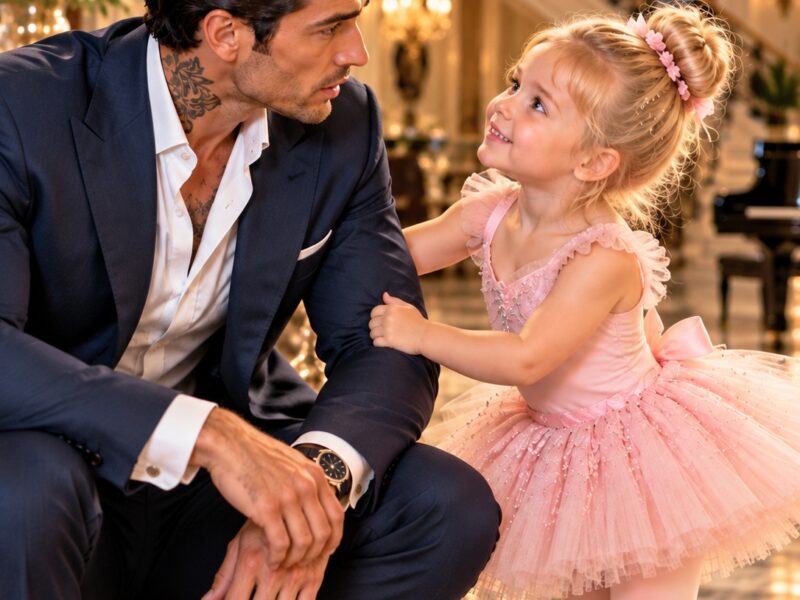
“Will You Watch Me Dance?” the Maid’s Little Girl Asked the Mafia Boss—Then Her Ballet Teacher Revealed the Secret That Had Haunted His House for Five Years
Five-year-old Sophie Alvarez danced barefoot across Dante Moretti’s marble foyer and asked the one question no adult in his Chicago estate had dared ask him in years: “Will you watch me?”
Her widowed mother rushed in to apologize, but Dante silenced her with one raised hand—and the little girl’s clumsy turn awakened something everyone in that house thought grief had buried permanently.
Weeks later, when Sophie invited him to her first real recital, Dante discovered that the woman teaching her to dance carried the face, the song, and the secret of the wife he had believed abandoned him five years earlier.
“Will you watch me dance?”
Dante Moretti stopped in the middle of a phone call worth several million dollars.
The question came from the center of his foyer, beneath the chandelier his grandfather had imported from Venice seventy years earlier. Standing barefoot on cold marble was a little girl in a faded pink tutu, one arm raised above her head, the other stretched sideways with the solemn concentration of someone performing at Lincoln Center instead of in front of a staircase.
She could not have been more than five.
Her dark curls were tied with a pink ribbon that had already slipped halfway loose.
Her feet were bare.
One knee had a small purple bruise.
Dante still held his phone against his ear.
On the other end, someone was saying, “Mr. Moretti? The South Shore contract—”
Dante lowered the phone.
The child waited.
He knew who she was.
Sophie Alvarez.
Daughter of Maria Alvarez, his head housekeeper.
Maria had worked at the estate for three years, and in those three years Dante had learned that she polished silver personally before formal dinners, never tolerated fingerprints on the west-library windows, and raised her daughter in the small staff apartment over the carriage house.
He knew Sophie existed in the same way he knew the furnace had been replaced last February.
Factually.
At a distance.
Until now.
“Will I watch you do what?”
Sophie’s eyebrows rose.
“Dance.”
“I heard that part.”
“Then why did you ask?”
From somewhere behind Dante came a choking sound.
His security chief, Gabriel Russo, had converted a laugh into a cough.
Dante turned his head.
Gabriel looked at the ceiling.
Sophie did not seem frightened by either man.
“Miss Elena on my video says you have to look at one place when you turn.”
“Who is Miss Elena?”
“The lady on Mama’s phone.”
“Of course.”
Sophie reset her feet.
Dante glanced toward the east corridor.
“Where is your mother?”
“She’s folding tablecloths.”
“And she knows you’re here?”
Sophie considered the wording carefully.
“She knows I’m in the house.”
That answer was so legally precise Dante almost smiled.
Footsteps came fast from the service hallway.
“¡Sofía!”
Maria Alvarez appeared with an apron half tied around her waist.
She stopped so abruptly her hand caught the doorframe.
Her eyes traveled from her daughter to Dante.
Color left her face.
“Mr. Moretti, I am so sorry.”
Sophie looked over her shoulder.
“Mama, I asked first.”
“I can see that.”
“I didn’t touch anything.”
“That is not the point.”
Maria moved toward her.
Dante lifted one hand.
Maria stopped.
The gesture was small.
Everyone in the Moretti organization understood it immediately.
Even Sophie.
Dante looked at the child.
“Go ahead.”
Maria stared at him.
“Sir?”
“I said let her dance.”
Sophie’s whole face changed.
Not just a smile.
Light.
She rose onto the balls of her feet and began.
It was not good ballet.
Dante knew almost nothing about ballet, but even he knew that.
Her elbows were too stiff.
Her turnout disappeared every time she got excited.
One turn nearly sent her into a marble pedestal holding a Roman bust that had survived three Moretti generations and would apparently end its life because of a five-year-old in a thrift-store tutu.
Gabriel shifted forward.
Dante lifted one finger without looking back.
Sophie recovered.
She finished with both heels together and arms curved badly over her head.
Then she attempted a curtsy.
One foot slipped.
She caught herself.
Dante looked at her flushed face.
“Well?”
she asked.
He had negotiated labor contracts, property transfers, criminal investigations, political favors, and settlements in rooms where a wrong sentence could cost people fortunes.
No answer had ever felt more dangerous.
“You were very good.”
Sophie narrowed her eyes.
“Very good or beautiful?”
Maria closed her eyes.
Dante looked at the child.
“Beautiful.”
That satisfied her.
Sophie curtsied again.
This one was worse.
She ran back to her mother, pink skirt bouncing around her knees.
Maria placed both hands on Sophie’s shoulders.
“Thank Mr. Moretti.”
“Thank you for watching me.”
Dante nodded.
“You’re welcome.”
Maria guided her toward the service corridor.
At the doorway, Sophie twisted around.
“Tomorrow?”
Dante stared.
“Tomorrow what?”
“Will you watch again?”
Maria whispered, “Sophie.”
Dante should have said no.
He had meetings.
He had men waiting.
He had spent five years making sure there was never enough softness in his schedule for memory to get inside.
Instead, he heard himself say:
“If I’m here.”
Sophie grinned.
“I’ll check.”
She disappeared down the corridor.
For several seconds, the foyer remained quiet.
Then Gabriel said carefully:
“The South Shore contract.”
Dante lifted his phone.
The man on the other end was still waiting.
But as Dante walked toward his study, the sound of small bare feet seemed to follow him across the marble.
And from the upper landing, unseen by everyone below, Victor Romano watched Dante leave with an expression that had nothing to do with amusement.
For the next nine days, Sophie checked.
At exactly five-fifteen each afternoon, she appeared in the long corridor outside Dante’s study.
Sometimes in the faded tutu.
Sometimes in leggings and a school sweater.
Once in striped socks because Maria had hidden the tutu to wash it.
Dante never invited her.
He simply stopped closing his study door.
It became an arrangement neither of them admitted existed.
At five-fifteen, Sophie practiced.
At five-seventeen, Dante usually looked up.
At five-twenty, she attempted something increasingly ambitious.
At five-twenty-two, she looked toward his study and pretended she had not.
Dante pretended not to notice.
Everyone else noticed.
The cooks noticed.
The gardeners noticed.
Gabriel noticed.
Maria noticed most of all.
One Thursday evening, she found Sophie practicing tendus against the edge of her bed.
“Sofía.”
“Yes, Mama?”
“You cannot keep bothering Mr. Moretti.”
“I don’t bother him.”
“You go outside his office every day.”
“He leaves the door open.”
“That does not mean he wants you there.”
Sophie thought about that.
“He looks.”
Maria sat beside her.
“Mr. Moretti is kind to you.”
“He’s sad.”
Maria’s expression changed.
“Who told you that?”
“Nobody.”
Sophie pulled her stuffed gray rabbit into her lap.
“He looks like you did after Papa died.”
Maria went still.
Three years earlier her husband, Daniel Alvarez, had died from a sudden cardiac condition at thirty-six.
There had been no mysterious enemies.
No conspiracy.
No betrayal.
Just an ordinary terrible morning.
Maria had gone to wake him for work and discovered life had already changed.
Sophie remembered more than Maria wished she did.
“Sad people don’t always want company,” Maria said.
“I know.”
“They sometimes want quiet.”
“I’m quiet when I dance.”
Maria almost laughed.
“You are many wonderful things.”
“Quiet is not one of them.”
Sophie frowned at rabbit.
Then said, “Maybe he forgot something.”
“What?”
“How to be happy.”
Maria looked toward the wall separating their staff apartment from the main house.
“Sophie…”
“I’m just reminding him.”
Maria kissed her forehead.
“Do not make somebody else’s sadness your job.”
Sophie considered this seriously.
“All right.”
Then, after a pause:
“Can it be my hobby?”
Maria laughed despite herself.
Two floors above them, Victor Romano stood alone in the upstairs hall.
He had not meant to hear.
He had been walking toward the library when Sophie’s voice traveled through the partly open service door.
He stopped.
Not because of the child.
Because of Dante.
For thirty-one years Victor had known Dante Moretti.
They had learned to swim in the same lake.
Broken the same window at twelve.
Buried Dante’s father on the same winter morning.
Victor was not blood.
But Dante’s father had brought him into the Moretti household at nine years old after Victor’s mother died and his father disappeared into prison.
“You are family now,” Carlo Moretti had told him.
Victor had spent most of his life discovering that “family” had several definitions.
Some came with inheritance.
Others came with gratitude.
Five years ago, Victor had watched a woman teach Dante another definition.
Isabella Moretti.
Dante’s wife.
Long dark hair.
Soft Sicilian accent when tired.
A small mole beneath her right eye.
She was the only person Victor had ever seen make Dante forget to monitor a room.
Then she disappeared.
And Dante changed.
Victor had worked very hard to make sure both things stayed that way.
Now a five-year-old housekeeper’s daughter was standing outside Dante’s study every afternoon and reopening a door Victor had spent five years welding shut.
Children were dangerous that way.
They did not understand architecture.
They simply pushed.
On the second Friday, Sophie came home from kindergarten holding a folded paper.
She ran past Maria in the kitchen.
Past Gabriel in the hall.
Past a startled accountant leaving Dante’s study.
“Uncle Dante!”
Dante looked up from a shipping report.
Sophie stopped in front of his desk.
She was still wearing her school jumper and red cardigan.
Her backpack hung open.
One shoelace dragged behind her.
“I got in.”
Dante set down his pen.
“Into what?”
“The Academy.”
She shoved paper toward him.
“What academy?”
“The ballet one.”
Dante took letter.
Lakeview Children’s Conservatory of Dance.
Introductory scholarship placement.
Saturday program.
Instructor: Bella Conti.
“Miss Anna at school sent my video.”
Maria appeared at doorway, breathing hard.
“She did it with my permission.”
Sophie bounced once.
“Real mirrors.”
“A real bar.”
“A real teacher.”
Maria corrected automatically.
“Barre.”
“That too.”
Dante read tuition line.
Scholarship covered classes.
Not shoes.
Not recital costume.
Not registration.
Sophie looked at him.
“My first class is tomorrow.”
“Good.”
“You’re supposed to say congratulations.”
Dante raised his eyes.
“Congratulations.”
She smiled.
Then spotted photograph on his desk.
It was face down.
She reached.
Dante’s hand moved instantly.
Not harshly.
Fast enough to make her stop.
“No.”
Sophie froze.
Dante’s voice softened.
“That is private.”
She pulled hand back.
“Sorry.”
He watched her face.
Five-year-old disappointment lasted three seconds.
Then:
“Do you know how ballet shoes tie?”
“No.”
“Mama doesn’t either.”
“I suspect someone at ballet school does.”
“That’s probably why it’s a school.”
Dante leaned back.
“That would be my theory.”
Sophie nodded approvingly.
“You’re smart.”
She ran out.
Maria remained.
“Mr. Moretti.”
“Yes?”
“Thank you for being patient.”
“With what?”
“My daughter.”
Dante looked at open doorway.
“She isn’t difficult.”
Maria smiled faintly.
“She is five.”
“Same thing?”
“Some days.”
She started to leave.
Dante said:
“Maria.”
She turned.
“The costs not covered by scholarship.”
Her expression changed.
“No.”
He had expected gratitude.
The refusal surprised him.
“Excuse me?”
“She earned scholarship.”
“I understand.”
“She will have slippers.”
“I will buy them.”
“You do not need to.”
“I know.”
Maria shook her head.
“Then please don’t.”
There was no disrespect in her voice.
Only boundary.
Dante studied her.
Most people accepted things from him before he finished offering.
Maria did not.
“Why?”
“Because Sophie must understand that kindness is not the same as being owed.”
Dante leaned back.
“And accepting help?”
“Is not weakness.”
“But she already receives your attention.”
“That is different.”
“How?”
Maria thought.
“Because you are giving time.”
“Not buying a place in her life.”
The sentence landed harder than she intended.
She saw it.
“I’m sorry.”
Dante looked down at report.
“No.”
“You’re right.”
Maria left.
That evening Dante called the academy.
Not to pay tuition.
To ask whether recital tickets would be public.
Four weeks later, Sophie’s first real performance was scheduled for a Saturday night.
She asked Dante at dinner.
Maria had been invited to eat at main table because storm delayed staff transport and Sophie had decided that meant “everyone was already here anyway.”
Dante tolerated logic.
Sophie ate mashed potatoes with serious concentration.
Then:
“Uncle Dante.”
He knew tone.
“What do you want?”
“I don’t want anything.”
Maria coughed.
Sophie corrected:
“I want one thing.”
Dante waited.
“My recital is December twelfth.”
“I know.”
“You know?”
“You’ve mentioned it fourteen times.”
“Miss Bella says people who love dancers come.”
The room changed.
Maria’s fork stopped.
Sophie did not notice.
“My mama is coming.”
“Mrs. Perez from school is coming.”
“Maybe Mr. Gabriel.”
Gabriel, at far end, nearly dropped water glass.
“And you.”
Dante looked at child.
Sophie smiled hopefully.
“Will you watch me dance?”
There it was again.
The same question.
But this time it carried date.
Seat.
Expectation.
A future moment Dante would have to choose to arrive at.
He had not attended a theater, wedding, school, christening, or concert in five years.
Not since Isabella vanished.
Crowds irritated him.
Music made old rooms open.
Children made them worse.
He said the first thing that protected him.
“I’m busy that evening.”
Sophie’s smile disappeared.
She did not cry.
That would have been easier.
She lowered eyes to plate.
“Oh.”
Maria looked at Dante.
Not accusing.
That somehow felt worse.
Sophie pushed one pea with fork.
“That’s okay.”
Dante heard lie.
A tiny one.
The kind children learn because adults reward them for making pain convenient.
He said nothing.
After dinner Sophie did not practice outside study.
Next day either.
By third day, Dante found himself looking at open doorway at five-fifteen.
Empty corridor.
At five-twenty he signed wrong line on contract.
At five-thirty he stopped pretending.
“Gabriel.”
Security chief looked up from chair.
“Boss?”
“Where is she?”
Gabriel did not need ask who.
“Upstairs.”
“Why?”
“She practices there now.”
“Why?”
Gabriel looked at him.
Dante’s stare sharpened.
“Say it.”
“You told her you weren’t going.”
Dante looked back at papers.
“That doesn’t answer.”
“She doesn’t want to bother you.”
That did.
At six, Dante crossed staircase.
Sophie was asleep on third step.
Pink slippers clutched to chest.
Stuffed rabbit under cheek.
She had apparently tried to wait for Maria and lost fight with gravity.
Dante stood above her.
He could call Maria.
He did not.
He bent and lifted child.
She weighed almost nothing.
Sophie murmured.
Her face turned into lapel of his jacket.
Dante froze.
Not because she was heavy.
Because five years earlier Isabella used to fall asleep against him on long car rides, forehead against same place.
He carried Sophie to east-wing room.
Maria met him at door.
Stopped.
Dante said quietly:
“She fell asleep.”
“I see.”
He laid Sophie on bed.
Placed rabbit beside her.
Pink shoes on chair.
Maria pulled blanket over daughter.
Dante walked toward door.
“Mr. Moretti.”
He stopped.
“She didn’t ask you because she thinks you owe her.”
“I know.”
“She asked because when you watch, she thinks she matters.”
Dante stared at floor.
Maria immediately regretted sentence.
“I should not—”
“No.”
He looked at sleeping child.
“Did you buy her ticket?”
“To recital?”
“Yes.”
“Yes.”
“Buy another.”
Maria blinked.
“For who?”
“For me.”
She stared.
Dante left before gratitude could become conversation.
Next morning he drove Sophie to school.
Halfway there he said:
“I’m coming.”
Sophie turned.
“To school?”
“No.”
“To recital.”
Her mouth opened.
Nothing came out.
Dante looked away.
Then Sophie unbuckled seatbelt.
“Sophie.”
Too late.
She launched across leather and wrapped both arms around his neck.
Dante’s hand lifted awkwardly, then settled on her braid.
“Thank you.”
She kissed his cheek.
“Thank you.”
“Seatbelt.”
“Thank you.”
“Sophie.”
“Okay.”
She returned to seat.
Buckled.
For rest of drive she smiled at windshield.
At school door she turned.
“You won’t forget?”
“No.”
“Promise?”
Dante looked at her.
“I promise.”
That same afternoon, news reached Victor.
He was alone in small side office when gate guard mentioned recital.
“Mr. Moretti’s attending?”
Victor asked casually.
“Yes.”
“The little girl’s ballet.”
“He told driver.”
Victor nodded.
“Thank you.”
Guard left.
Victor waited until door closed.
Then sat.
For nearly a minute his face emptied.
He took second phone from inside jacket.
The number connected.
“It’s time.”
Voice on other end answered in Italian.
Victor’s gaze moved toward window.
“The child is bringing him exactly where I need him.”
Three weeks passed.
Sophie practiced obsessively.
A storage room became rehearsal space after Dante ordered old wine crates moved.
Maria protested.
“It is too much.”
Dante replied:
“It was unused.”
“It has a new floor.”
“The old one was unsafe.”
“It has mirrors.”
“Walls need something.”
“It has a barre.”
“I’m told dancers use them.”
Maria stared.
“You have been researching ballet.”
“No.”
She looked toward stack of printed flooring specifications on his desk.
“Of course.”
He turned page.
Maria smiled and left.
Sophie’s teacher became recurring name at dinner.
Miss Bella.
Miss Bella says knees must track over toes.
Miss Bella says dancers do not complain about repetition.
Miss Bella says ribbons go under ankle.
Miss Bella drinks green tea.
Miss Bella knows song.
Dante barely listened until Sophie hummed three notes.
His spoon stopped.
“What is that?”
“Miss Bella sings it.”
“Sing again.”
Sophie did.
Off key.
Three-note Sicilian lullaby.
Dante’s throat tightened.
Isabella had sung same melody while brushing hair.
Her grandmother’s song.
A village outside Palermo.
Dante forced his hand to move.
“A lot of Sicilian families know it.”
“Miss Bella says her grandma did.”
Dante looked at Sophie.
“What does Miss Bella look like?”
Maria glanced up.
Sophie shrugged.
“Pretty.”
“That narrows it.”
“Brown hair.”
“Long?”
“Here.”
She touched shoulder.
“Eyes?”
“Brown.”
“Anything else?”
Sophie thought.
“She has a dot.”
“A dot?”
“Here.”
She touched just beneath right eye.
Dante stopped breathing for half second.
Isabella had a mole beneath right eye.
Small.
Dark.
It lifted when she smiled.
He set spoon down.
“What is Miss Bella’s last name?”
“Conti.”
Dante knew acceptance letter.
Bella Conti.
No connection.
Still.
That night he opened safe.
A photograph torn in half lay inside envelope.
Wedding photograph.
One half showed Dante, younger.
Other half showed Isabella.
Except Isabella’s face had been rubbed into pale blur by Dante’s thumb on night she disappeared.
He had planned to burn photograph.
Could not.
He tore it instead.
Then spent hours rubbing her face until he could no longer see woman who had abandoned him.
He laid halves side by side under green lamp.
Five years earlier, Isabella had vanished.
Letter.
Ring.
Money gone from joint accounts.
Two pages in her handwriting:
I cannot live this life anymore.
Do not look for me.
Dante had believed it because bank statements proved intention.
Victor had found him before sunrise.
Sat with him.
Said:
“She chose.”
“You cannot force someone to stay.”
Dante remembered Victor taking photograph from fireplace.
“You don’t need to destroy everything.”
Dante had taken it back.
Now, five years later, he stared at blurred right half.
A song.
A mole.
A teacher called Bella.
Could be nothing.
Coincidence is often only a pattern grief wants.
He called Elias Hart.
Not family.
A lawyer and investigator Dante trusted because Elias trusted documents more than people.
“I need employment file.”
“Who?”
“Bella Conti.”
“Lakeview Children’s Conservatory.”
“All public records.”
“Why?”
“I don’t know yet.”
“Good answer.”
Then Dante called Victor into study.
Victor arrived fifteen minutes later.
Gray sweater.
No tie.
Calm.
Dante left photograph halves on desk deliberately.
Victor entered.
His eyes crossed desk.
They did not stop.
That was what made Dante notice.
Most people looked at photographs.
Especially torn wedding photographs.
Victor’s gaze avoided them with precision.
Dante said:
“Theater security.”
Victor nodded.
“I walked building.”
“Rear alley.”
“One stage entrance.”
“Fire exits?”
“Four.”
“Can they be locked from outside?”
“No.”
Victor answered too fast.
“Inside?”
“Technically.”
Dante watched.
“I want no doors chained.”
“Of course.”
“Why would you say chained?”
Victor paused.
Because Dante had not.
“I didn’t.”
“You almost did.”
Victor smiled.
“You’re tired.”
“Maybe.”
They stared.
Victor asked:
“Something wrong?”
Dante picked up fountain pen.
“No.”
The lie tasted unfamiliar.
Victor left.
Dante waited one minute.
Then called Elias.
“Add Victor.”
Elias was silent.
“To what?”
“To investigation.”
“Dante.”
“Yes.”
“You sure?”
“No.”
“Do it anyway.”
Across Chicago, Bella Conti stared at recital guest list.
Sophie Alvarez.
Guest:
Dante Moretti.
Her hand began trembling.
She sat in empty dance studio.
Mirrors reflected one woman four times.
Thirty-eight now.
Not thirty-three.
Hair shorter.
Body leaner.
Face same.
Except years.
Her legal name was Bella Conti.
Before that:
Isabella Moretti.
She had not seen husband in five years.
Had not heard his voice.
Had not searched his name after first six months because searching became addiction she could not survive.
Now his name sat beside name of little girl she loved teaching.
Bella closed studio door.
Went to bathroom.
Washed hands three times.
The habit had begun after she disappeared.
Something to remind body it remained hers.
At home she sat in dark apartment above laundromat.
The truth came back.
Sunday.
Peonies.
Dante in Detroit.
Voices in back study.
Victor and man Isabella did not know.
Warehouse numbers.
Shipping routes.
Payments.
Enough to tell Victor was selling Moretti information to rival Bianco group.
She took photos with silver camera.
Forty-seven images.
One document.
Three audio fragments.
Victor discovered her within hours.
He approached in conservatory.
Not with rage.
With sorrow.
That made it worse.
“Why did you go into study?”
“I left glasses.”
“You photographed documents.”
Isabella denied.
Victor showed camera still.
Then opened coat.
Small handgun visible.
He did not point it in final adaptation? User asked no weapons. We should avoid. Let’s instead use direct credible threat without weapon. Need no weapons. Victor can show photo of Dante entering car and threaten staged accident. Good. Let’s do that instead.
Victor placed photograph on table.
Dante leaving hotel.
Timestamp.
Another image:
Dante’s sister leaving school pickup.
Another:
his elderly uncle at church.
Victor said:
“You have two choices.”
Isabella stared.
“You disappear tonight.”
“Or?”
“Dante dies tomorrow.”
She looked at him.
Victor’s voice stayed gentle.
“The Bianco family will be blamed.”
“His cousins retaliate.”
“War begins.”
“His sisters become targets.”
“You know how this works.”
“You can tell Dante.”
“He’ll confront me.”
“And then he dies first.”
Isabella whispered:
“He trusts you.”
Victor’s face changed.
“That’s why this works.”
He gave instructions.
Empty joint accounts enough to make abandonment believable.
Write letter.
Leave ring.
Leave city.
Never contact Dante.
“You take evidence?”
“I know where copies are.”
He didn’t.
Memory card taped to Isabella’s thigh survived.
She left at 11:40.
Stood outside estate gate.
Looked back once.
Five years.
Milwaukee.
Rogers Park.
Lakeview.
Different names.
Eventually dance studio.
Bella Conti.
She kept evidence on encrypted drive.
She never turned it in because fear had become architecture.
Victor had convinced her he watched law enforcement contacts.
At first maybe true.
Later maybe not.
She didn’t know.
She lived as if true.
Then Sophie arrived at dance class.
Serious little face.
Faded pink tutu.
Big hope.
Bella liked her immediately.
Sophie said:
“I dance because my uncle forgets to smile.”
Bella asked:
“Your uncle?”
Sophie nodded.
“Uncle Dante.”
Bella’s heart stopped.
She had assumed nickname.
Then recital list proved.
Now she had choice again.
Disappear.
Or stay.
She went to safe.
Silver USB.
Letters she never sent.
Fake passport.
Escape money.
She touched passport.
Then thought of Sophie crying quietly when unable to point feet.
Thought of Sophie’s joy after first clean turn.
If Bella vanished, another adult would disappear from child’s life without explanation.
She could not do that.
Not again.
She called an attorney.
Not Dante.
Not family.
A former legal-aid lawyer named Naomi Feld whom she found through domestic-coercion referral years earlier but never contacted.
“I have evidence of organized financial crimes.”
“And a threat from five years ago.”
Naomi listened.
“Are you in immediate danger?”
“I don’t know.”
“That’s not acceptable.”
“I know.”
“You need law enforcement.”
“I was told they were compromised.”
“By the man threatening you?”
“Yes.”
“People who isolate victims often claim every exit is controlled.”
Bella closed eyes.
Naomi continued:
“We do this carefully.”
“Not dramatically.”
“No calling husband first.”
“No confronting Victor.”
“We preserve evidence.”
“We verify independently.”
Bella looked at guest list.
“The recital is Saturday.”
“Can you cancel?”
Bella thought of Sophie.
“No.”
“Can you avoid being seen?”
“Yes.”
“For now.”
Naomi sighed.
“Then we build around that.”
Meanwhile Elias returned preliminary file to Dante.
“Bella Conti didn’t exist before 2021.”
“What do you mean?”
“No payroll history.”
“No credit.”
“No school record.”
“No address.”
“Social Security?”
“Legitimate number issued earlier under another identity but name changed through sealed court process.”
“Can you access original?”
“Not legally without order.”
Dante stared.
“Photo?”
Elias sent security still from academy’s public promotional video.
Dante opened.
Woman adjusting child’s shoulder.
Profile.
Mole.
Chin.
Smile.
His world stopped.
“Dante?”
He could not speak.
“Dante.”
“That’s her.”
Elias went silent.
“Who?”
“My wife.”
Night before recital, Sophie brought white costume into study.
“Miss Bella made it.”
Dante touched embroidery.
Tiny flowers.
Underside knots doubled, tucked.
Isabella’s grandmother had taught same stitch.
She once explained:
“Front tells people you can sew.”
“Back tells them whether you cared.”
Dante turned dress over.
Sophie looked.
“Pretty?”
“Yes.”
“Miss Bella stayed four nights.”
Dante’s hand trembled.
“Did she?”
“Yes.”
“She says handmade things remember people.”
Dante looked at child.
“Go to your mother.”
Sophie’s face fell.
“Did I do bad?”
“No.”
His voice softened.
“No.”
“I need to work.”
She nodded.
At door:
“Tomorrow.”
“I remember.”
She left.
Dante called Elias.
“I want Victor monitored.”
“Already.”
“I want theater checked independently from him.”
“Done.”
“And Bella?”
“Do not approach.”
Dante closed eyes.
“Why?”
“Because if she is who you think and she stayed hidden five years, she had reason.”
That hurt.
“She left me.”
“Maybe.”
“You just told me—”
“I told you identity.”
“Not motive.”
Dante hated him.
Again, trust grew.
Recital morning Sophie woke at six.
Maria found her sitting beside white costume.
“Can’t eat.”
“You must.”
“My stomach is dancing.”
Maria kissed curls.
“Then feed it.”
At breakfast Dante appeared.
He had not eaten at main table in years.
Maria nearly dropped coffee.
Dante sat across Sophie.
Butter toast.
Set it plate.
“Eat half.”
She obeyed.
Then he gave small box.
Inside silver ballerina hair clip.
Sophie gasped.
“For luck.”
She ran around table and hugged him.
This time Dante hugged back without hesitation.
Maria turned away crying.
At nine-thirty cars left estate.
Victor drove Dante.
Unusual.
Dante watched rearview mirror.
Victor never met eyes.
Phone vibrated.
Elias:
Bella confirmed. Isabella Moretti. Naomi Feld representing her. Evidence being preserved. Do not confront Victor alone. Theater rear-door plan inconsistent with fire code. Call when isolated.
Dante read twice.
Victor hummed Italian folk song.
Theater glowed warm.
Mothers.
Children.
Flowers.
Sophie disappeared backstage.
Maria cried immediately.
Dante sat second row.
Victor remained rear.
At 6:30 Dante excused himself.
Outside he called Elias.
“Talk.”
“Naomi contacted prosecutor independently this morning.”
“Isabella has evidence.”
“Victor threatened her five years ago.”
“Evidence supports payments to Bianco intermediaries.”
“Police and federal agents are not all compromised.”
“Her fear kept her isolated.”
Dante leaned against brick.
“Why didn’t she call me?”
“Because Victor convinced her you would confront him.”
Dante closed eyes.
“He was right.”
“What?”
“Five years ago, I would have.”
There.
His own flaw.
Loyalty before evidence.
Rage before process.
Victor had known him.
Elias said:
“Stay outside.”
“No.”
“Dante.”
“Sophie is inside.”
“So is Isabella.”
“And Maria.”
“Law enforcement can evacuate.”
“What about Victor?”
“Do not handle him yourself.”
Dante looked toward theater doors.
“For once.”
he said.
“I’m going to try.”
He called prosecutor contact through Naomi.
Confirmed surveillance teams nearby.
Fire marshal alerted due chaining concern.
Police instructed not to rush auditorium unless immediate danger.
Dante returned lobby.
At same time Sophie wandered backstage looking for bathroom.
Heard Victor.
Door cracked.
Victor speaking to another man.
“When house lights drop, chain alley.”
“Intermission, nobody leaves.”
“And Dante?”
“Keep him inside.”
“The woman?”
“Same.”
“What about kid?”
Pause.
“Only if necessary.”
Sophie went cold.
She did not understand conspiracy.
She understood Uncle Dante.
Miss Bella.
No one leaves.
She remembered Maria’s rule:
When afraid, find person you trust.
She ran.
Across backstage.
Past usher.
Into lobby.
Dante just lowered phone.
Sophie hit him at full speed.
“Uncle Dante!”
He knelt.
She grabbed coat.
“Uncle Victor said you and Miss Bella are not going to leave theater.”
Dante’s face became still.
“Tell me exactly.”
Sophie repeated.
House lights.
Alley.
Chain.
No one leaves.
Victor’s voice.
Another man.
Dante did not interrupt.
When finished, he touched her hair clip.
“You did exactly right.”
“Are you scared?”
“Yes.”
She stared because adults rarely admitted.
“But fear tells me to pay attention.”
He stood.
A plainclothes female officer approached under prearranged signal.
Dante introduced simply:
“This is Ms. Cole.”
“She is going to take you to your mother.”
Sophie grabbed his hand.
“No.”
“Sophie.”
“You come.”
“I need to get Miss Bella.”
“I can help.”
“No.”
Her face crumpled.
Dante crouched again.
“Listen carefully.”
“Brave does not mean staying where danger is.”
“You already did brave part.”
“You told.”
“Now you leave.”
Sophie looked.
Then nodded.
Ms. Cole led her.
Dante texted Maria to follow usher instruction immediately.
Staff initiated quiet pre-show technical delay and evacuated several backstage children through east exit under fire-code pretext.
Audience remained briefly because evacuation all at once might alert conspirators; then fire alarm inspection announcement began moving rows calmly.
Victor noticed.
Too late.
At rear corridor, actual Chicago police tactical officers—not Dante’s men—intercepted man carrying chain.
No gunfire.
No dramatic violence.
Victor walked toward backstage and found Dante waiting with Naomi Feld and Detective Aaron Pierce.
Victor stopped.
His smile appeared.
“Dante.”
Dante looked at him.
“Don’t.”
Victor’s eyes moved to detective.
Then Naomi.
Understanding.
“You brought police into family matter.”
“No.”
“Isabella did.”
Victor’s face changed.
There.
First crack.
“You found her.”
“She found way out.”
Victor laughed quietly.
“You think she left because of me?”
Dante held gaze.
“I know.”
Victor’s mouth tightened.
“Five years.”
“You hated her.”
“I hated myself.”
“Convenient.”
“I’m not asking forgiveness from you.”
Detective Pierce stepped forward.
“Victor Romano, we need you to place your hands where we can see them.”
Victor did not.
He looked at Dante.
“You believe her?”
Dante answered:
“I believe evidence.”
The sentence was everything Victor had counted on Dante never learning.
Police arrested Victor without struggle.
His associate arrested by alley.
No chained doors.
No trapped audience.
No child saw violence.
And backstage, Isabella stood in gray wrap dress with both hands pressed to table when Dante entered instructor room.
She saw him first through mirror.
Five years vanished badly.
Not romantically.
Painfully.
Her face drained.
Dante stopped at doorway.
No embrace.
No running.
No music.
Only:
“Why?”
Isabella closed eyes.
“Because he said you would die.”
Dante’s jaw tightened.
“Tell me.”
She did.
Everything.
Back study.
Photos.
Threat.
Letter dictated by text.
Accounts emptied because Victor told her to make departure believable.
Money mostly untouched in escrow under attorney’s control.
Ring.
Bus.
Milwaukee.
Names.
Fear.
Dante listened.
Then held USB.
“I thought you chose to leave.”
“I know.”
“I hated you.”
“I know.”
“I hated myself more.”
She looked at him.
“I know that too.”
“You watched?”
“For first night.”
“Outside gate until dawn.”
“I saw smoke.”
Dante looked away.
“I burned letter.”
“I thought you might.”
“I rubbed your face out of photograph.”
Isabella covered mouth.
No melodrama.
Only breath breaking.
Dante said:
“I cannot fix five years in ten minutes.”
“No.”
“I also cannot pretend they didn’t happen.”
“No.”
“But I need you to know something.”
She waited.
“I believe you.”
Isabella’s knees weakened.
She sat.
Dante did not touch until she reached for his hand.
Then he held.
Only hand.
Nothing more.
Outside, recital canceled.
Children disappointed.
Parents confused.
Sophie furious for approximately twelve minutes until Maria explained building safety issue.
Then she asked one question.
“Did Uncle Dante find Miss Bella?”
Maria looked toward corridor.
“Yes.”
Sophie smiled.
“Good.”
Investigation expanded.
Victor’s crimes were larger than one threat.
Bribery.
Fraud.
Sale of shipping intelligence.
Extortion.
Conspiracy to stage rival-family conflict.
Isabella’s evidence authenticated independently.
Payments matched records.
Photographs matched office layouts.
Audio metadata consistent.
Victor’s own later messages corroborated.
Dante also faced uncomfortable reality.
His companies were not clean.
Some revenue came from illegal gambling partnerships and coercive commercial practices.
When investigators asked cooperation, Dante’s attorneys advised limits.
Dante looked at Isabella’s USB.
Then at Elena? Wait Isabella is wife. Keep.
He decided:
“No immunity for me.”
Attorney stared.
“You understand what you’re saying?”
“Yes.”
“You could face charges.”
“Yes.”
“Why?”
Dante thought of Sophie.
Brave means tell. Then leave danger.
“Because I have spent too much life deciding rules apply after me.”
He disclosed.
Some charges followed.
Not homicide.
Not violent acts in current story.
Financial conspiracy.
Unlawful commercial coercion.
Tax offenses.
Dante negotiated plea.
His cooperation against Victor and others reduced sentence.
Did not erase.
Eighteen months federal custody.
Victor received substantially longer sentence after convictions on extortion, obstruction, conspiracy, fraud, and related charges, with separate prosecution for threats against Isabella.
Bianco intermediaries charged where evidence supported.
No private dungeon.
No family execution.
No revenge disappearance.
That mattered to Isabella.
When Dante told her he would plead, she said:
“You don’t have to prove anything to me by destroying yourself.”
“I’m not.”
“Then what are you doing?”
“Paying what is mine.”
She looked at him.
“Five years ago you would not have said that.”
“Five years ago I would have found Victor before police.”
“And?”
Dante’s eyes hardened.
“I don’t like answer.”
“Then I’m glad you changed.”
Romance did not resume because truth returned.
Trust needed ordinary time.
Sunday dinners began.
Isabella in her apartment at first.
Dante came alone.
Maria and Sophie sometimes joined.
First Sunday they ate pasta too salty because Dante insisted he could cook.
He could not.
Sophie announced:
“This tastes like ocean.”
Isabella laughed so suddenly she nearly dropped fork.
Dante stared.
Not because joke.
Because he had not heard Isabella laugh in five years.
She noticed.
Smile faded.
He looked down.
“Sorry.”
“For what?”
“Staring.”
“You used to stare.”
“I used to be allowed.”
Silence.
Then Isabella said:
“You can look.”
Small permission.
Not all.
Enough.
Second intimacy came weeks later when Sophie fell asleep at table after dance class.
Dante carried her to couch.
Isabella tucked blanket.
Their hands touched over Sophie’s hair.
Neither moved for second.
Then Isabella pulled back.
Dante did not chase contact.
Third came after his sentencing.
Outside courthouse.
Snow beginning.
Dante said:
“I report in six weeks.”
“I know.”
“I don’t want you waiting.”
Isabella looked annoyed.
“You still think you decide what other people should do with time.”
He blinked.
She continued:
“I am not promising marriage.”
“Or moving back.”
“Or pretending prison is romantic.”
“It isn’t.”
“I’m promising Sunday letters.”
“If I choose.”
Dante nodded.
“If you choose.”
She took his hand.
“I choose.”
Sophie visited once during sentence with Maria and Isabella.
Dante sat across institutional table.
No black suit.
No watch.
Sophie stared.
“You look weird.”
Isabella whispered:
“Sophie.”
“What?”
Dante smiled.
“She’s right.”
Sophie pulled folded drawing.
Three stick figures.
One dancer.
One man.
One woman.
Big crooked sun.
“Who?”
Dante asked.
“That’s me.”
“I guessed.”
“That’s Miss Bella.”
Dante looked at Isabella.
“And this?”
“You.”
“You made my head very square.”
“You have serious head.”
Dante laughed.
Guard looked over.
Sophie leaned closer.
“When you come back, I have new dance.”
“I’ll watch.”
“Promise?”
Dante hesitated only a second.
“Yes.”
He returned after sixteen months with credit and compliance.
No empire waiting.
Legitimate Moretti logistics businesses had independent management.
Dante retained minority interests where lawful.
Estate partly sold to satisfy restitution and taxes.
He kept smaller house.
He did not mourn marble.
Maria no longer worked as live-in housekeeper.
She took management position with hospitality company on standard salary and benefits.
Sophie stayed at same academy.
Isabella kept teaching under real name.
She legally restored Isabella Conti Moretti, then later changed to Isabella Conti because she wanted a name chosen, not hidden or inherited.
Dante did not object.
That impressed her more than if he had bought building.
Six months after release, spring came.
Dante built no grand theater.
Sophie wanted outdoor practice platform.
He asked Maria first.
Then Isabella.
Then Sophie.
“What do you need?”
“A barre.”
“How long?”
“Twelve feet.”
“Anything else?”
“Not slippery.”
“Reasonable.”
“White curtains.”
“That sounds decorative, not necessary.”
“It is necessary for art.”
Dante accepted defeat.
Small platform went in garden of remaining family property.
Two chairs.
One tea table.
First Sunday performance:
Sophie, now seven, wore white dress Isabella had altered twice.
Maria stood behind.
Isabella sat one chair.
Dante another.
Their knees touched under table.
Neither moved away.
Sophie danced without music.
Birds.
Wind.
Fountain.
Two wrong turns.
One perfect leap.
One improvised arm because she forgot choreography.
She finished.
Curtsied.
Ran down steps.
Stopped before Dante.
“Uncle Dante.”
“Yes?”
“Will you watch me dance?”
He looked at Isabella.
She was smiling.
Mole beneath right eye lifted.
Same.
Different.
Alive.
Dante looked back at Sophie.
“I am watching.”
“No.”
Sophie frowned.
“The whole thing.”
“The mistakes too.”
Dante understood.
Not performance.
Presence.
He reached out.
Lifted her onto lap.
“Especially the mistakes.”
Sophie considered.
“That’s weird.”
“Probably.”
“Was I beautiful?”
Dante smiled.
“Yes.”
“Very?”
“Very.”
She leaned against him.
Isabella’s hand moved across table.
Rested over his.
No ring.
No promise beyond moment.
No money fixing five years.
No power reversing harm.
Just three people in spring light.
And Maria behind them wiping tears with apron because apparently some habits survived everything.
Sophie lifted head.
“Again?”
Dante looked at small stage.
“You just finished.”
“I can do better.”
Isabella laughed.
“She gets that from you.”
Dante looked offended.
“I know when to stop.”
Both women looked at him.
Even Maria laughed.
Sophie jumped down.
Returned stage.
Took position.
The same little girl who once danced barefoot on cold marble now stood in shoes that fit.
She lifted chin.
Raised one arm.
Looked directly at Dante.
This time she did not ask whether he would watch.
She already knew.
And Dante Moretti did not look away.









