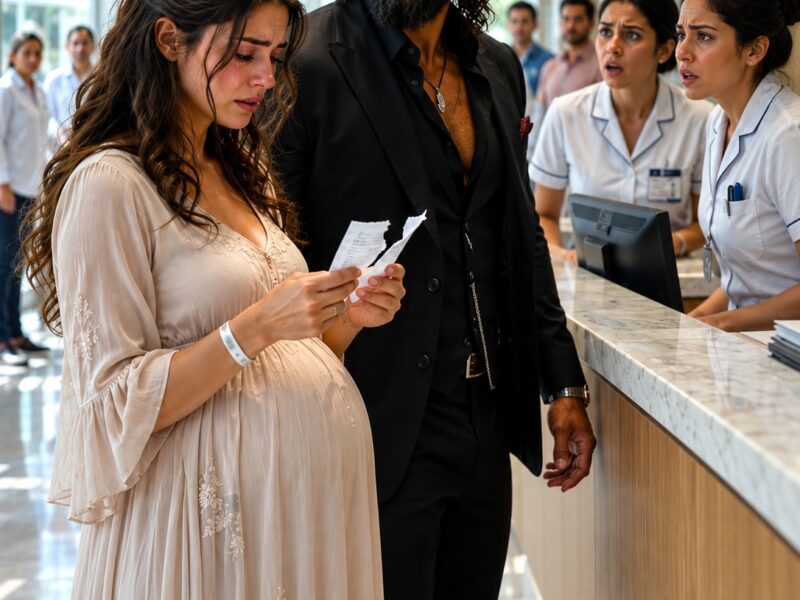
“You Don’t Belong Here,” the Nurses Told the Pregnant Woman—Until a Feared Chicago Mafia Boss Walked In and Recognized the Name on Her Torn Appointment Slip
The appointment slip tore more quietly than Elena Vasquez expected.
That was what she would remember later.
Not the polished marble beneath her scuffed shoes. Not the discreet piano music drifting through the lobby of St. Augustine Women’s Hospital. Not even the faces turning toward her as the senior receptionist ripped the paper once, then again, and let four white pieces fall between Elena’s swollen feet.
Just the soft sound of paper surrendering.
“There,” Nurse Caldwell said. “Now you can stop wasting everyone’s time.”
Elena stood frozen in front of the reception desk.
At twenty-seven and thirty-one weeks pregnant, standing for more than a few minutes had become an argument between her lower back and gravity. She had spent forty-five minutes on two buses getting there, wearing the only clean coat she owned and shoes that pinched because pregnancy had changed even the shape of her feet.
She had also spent three months waiting for that appointment.
“I don’t understand.”
Her voice sounded smaller than she wanted.
Nurse Caldwell folded her arms.
“You’re asking to see Dr. Evelyn Morrison.”
“Yes.”
“The Dr. Morrison.”
Elena looked down at the paper pieces scattered across the floor.
“That’s what the appointment said.”
The younger nurse beside Caldwell gave a short laugh through her nose.
“Do you know what a private maternal-fetal specialist costs?”
Elena’s face grew hot.
“I have insurance.”
“Partial insurance,” Caldwell corrected after glancing at the screen. “With a significant patient responsibility.”
“I know.”
“Do you?”
Elena gripped the strap of her faded purse.
She had saved almost six hundred dollars.
Not much by St. Augustine standards, apparently.
A fortune by hers.
The pregnancy had become complicated at twenty-four weeks when an urgent-care doctor heard something irregular during a routine fetal heartbeat check. He had referred Elena to a specialist, but every office she called had waiting lists.
Dr. Morrison had been the first physician willing to take her.
Elena had counted the days.
Now Nurse Caldwell looked at Elena’s thrift-store coat, then at the worn purse against her hip, as if those things had answered a question nobody had asked.
“This hospital has procedures.”
“I followed them.”
“Miss…”
She checked the screen.
“Vasquez.”
“Yes.”
“There are county facilities for patients in your situation.”
Elena stared at her.
“My situation?”
The younger nurse looked uncomfortable for half a second.
Caldwell did not.
“You know what I mean.”
“No,” Elena said quietly. “I don’t think I do.”
The lobby became noticeably quieter.
An older couple sitting beneath an abstract painting had stopped talking.
A man in an expensive wool coat lowered his newspaper.
Caldwell sighed.
“Please don’t turn this into something it isn’t.”
Elena felt the baby shift hard beneath her ribs.
She pressed one palm against her stomach.
“I came for a medical appointment.”
“And we cannot verify that this appointment was properly authorized.”
“You had the ticket.”
“Anyone can print something.”
“You just tore it up.”
The younger nurse glanced at Caldwell.
That part bothered her.
Good.
At least someone still possessed nerves.
Elena bent awkwardly.
Her belly made the simple act of reaching the floor difficult, and for several humiliating seconds she struggled to collect the pieces.
Nobody behind the desk helped.
One fragment had slid beneath the toe of Nurse Caldwell’s shoe.
Elena looked up.
“Excuse me.”
Caldwell followed her gaze.
Then moved her foot with visible reluctance.
Elena picked up the final piece.
“You don’t belong here,” Caldwell said.
There it was.
Not hidden behind billing language anymore.
Not buried beneath procedure.
Plain.
Sharp.
Public.
“This isn’t a charity clinic.”
Elena slowly straightened.
Her back hurt.
Her throat hurt more.
“I never asked for charity.”
“Then perhaps you should go somewhere you can afford.”
The younger nurse whispered, “Dana.”
Caldwell ignored her.
Elena placed the torn appointment pieces into her purse.
She refused to cry.
She had learned that skill young.
Her mother had taught her without ever intending to.
When rent was overdue, Maria Vasquez smiled.
When the electricity disappeared for two winter nights, she lit candles and called it camping.
When she was dying from ovarian cancer and Elena was fifteen years old, Maria apologized for leaving her daughter alone only once.
After that, she spent every remaining day teaching Elena how not to fall apart.
Elena could still hear her.
Never let humiliation decide who you become.
She turned toward the exit.
The automatic glass doors opened.
A black sedan stopped outside.
Then another.
Then three more.
Elena slowed.
So did everyone else.
The cars were identical except for their license plates—long, dark vehicles with tinted windows reflecting the gray Chicago afternoon.
The first man out wore a navy suit and an earpiece.
Then another appeared.
And another.
They moved without speaking, placing themselves near the entrance with the calm precision of people who had rehearsed danger.
Someone behind Elena whispered a name.
“Russo.”
The word moved through the lobby faster than any alarm.
Elena had heard it before.
Everyone in Chicago had.
Lorenzo Russo owned restaurants, warehouses, transportation companies, two boutique hotels and enough commercial real estate to make newspapers call him a businessman.
Newspapers had other words available.
They simply preferred staying in business.
The center car door opened.
Lorenzo Russo stepped onto the curb.
He was taller than Elena expected.
Mid-forties, perhaps. Dark hair touched with silver at the temples. Charcoal suit. Black overcoat. No visible hurry.
Men who expected doors to open did not rush toward them.
The hospital doors slid apart.
Lorenzo entered.
Nurse Caldwell immediately straightened.
The younger nurse’s face lost color.
A hospital administrator appeared from nowhere.
“Mr. Russo. We weren’t expecting you until—”
Lorenzo stopped walking.
His eyes had found Elena.
She was still standing halfway between the reception desk and the exit, one hand beneath her stomach and the other holding the strap of her purse.
He looked at her.
Not casually.
Not the way strangers look at strangers.
He stared.
Something changed behind his face.
The administrator spoke again.
“Mr. Russo?”
Lorenzo did not answer.
He walked toward Elena.
His security men remained near the doors.
With each step, the lobby seemed to become quieter.
Elena wished she had already left.
She had no emotional room left for powerful men.
Lorenzo stopped several feet away.
His gaze moved first to her face.
Then her belly.
Then her purse, where one corner of the torn appointment slip protruded from the zipper.
“What happened?”
His voice was lower than Elena expected.
She glanced around.
“Nothing.”
Lorenzo looked toward the nurses.
Then back at Elena.
“You’re crying.”
She touched her cheek.
Damn it.
One tear had escaped anyway.
“I’m fine.”
Lorenzo studied her.
“No,” he said. “You’re trying very hard to look fine.”
The sentence struck too close.
Elena looked away.
“I was leaving.”
“Why?”
“I don’t think this concerns you.”
A strange sound came from somewhere behind him.
Almost a cough.
One of his men was apparently trying not to react to somebody speaking to Lorenzo Russo that way.
But Lorenzo only nodded.
“That’s fair.”
He stepped aside.
Elena should have walked past him.
Instead, Nurse Caldwell called from the desk.
“Mr. Russo, there was simply an issue with documentation.”
Elena stopped.
Lorenzo’s head turned.
“What issue?”
Caldwell swallowed.
“This patient presented an appointment slip we couldn’t authenticate.”
“She had an appointment?”
“We weren’t sure.”
Lorenzo looked at Elena.
“May I see it?”
She hesitated.
Then removed the pieces.
His expression changed when he saw them.
“Who did this?”
Nobody answered.
Lorenzo looked toward the desk.
The younger nurse stared at her hands.
Caldwell lifted her chin.
“I did.”
“Why?”
“It appeared suspicious.”
“Paper?”
“The circumstances.”
“What circumstances?”
Caldwell’s confidence wavered.
“She didn’t appear to understand the financial requirements associated with Dr. Morrison’s services.”
Elena felt every eye in the lobby return to her coat.
Her shoes.
Her purse.
Her shame.
Lorenzo noticed.
His face became colder.
“What does poverty look like, Nurse?”
Caldwell blinked.
“I didn’t say she was poor.”
“You didn’t need to.”
The administrator stepped forward.
“Mr. Russo, perhaps we can discuss this privately.”
“No.”
One word.
The administrator stopped.
Lorenzo took one torn fragment between two fingers.
“You destroyed a patient’s medical appointment.”
“We thought—”
“You evaluated her clothes.”
Caldwell’s face flushed.
“That’s not fair.”
“No?”
His voice never rose.
That seemed to frighten her more.
Elena looked at him with growing confusion.
This man did not know her.
Yet he was angry in a way that seemed almost personal.
Lorenzo turned back to Elena.
“What kind of appointment?”
“High-risk pregnancy.”
The coldness disappeared from his expression.
“When are you due?”
“About nine weeks.”
“Why Dr. Morrison?”
Elena shifted her weight.
“They heard an irregular heartbeat at urgent care. It might be nothing. They said it could also be a placental problem.”
Lorenzo’s jaw tightened.
“How long have you waited?”
“Three months.”
He closed his eyes for half a second.
When he opened them, he looked toward the administrator.
“Find Dr. Morrison.”
“She’s in surgery.”
“Then find whoever controls her schedule.”
“Mr. Russo—”
“Today.”
Elena immediately shook her head.
“No.”
Everyone looked at her.
She hated that.
Lorenzo did too, judging by the way his attention returned to her.
“I’m not asking you to buy me an appointment.”
“I didn’t offer to.”
“You were about to.”
“No.”
“You have the face.”
For the first time, the corner of Lorenzo’s mouth moved.
“What face?”
“The one powerful men make before they solve things nobody asked them to solve.”
One of his guards definitely coughed that time.
Lorenzo glanced toward him.
The man suddenly became fascinated by a potted plant.
Then Lorenzo looked at Elena again.
“I’m asking the hospital to honor the appointment you already had.”
“That’s different.”
“Yes.”
She considered.
“Okay.”
Lorenzo handed the torn pieces to the administrator.
“Verify it.”
The administrator hurried behind the desk.
Less than thirty seconds later, his expression changed.
“It’s legitimate.”
Caldwell went pale.
The administrator looked at Elena.
“Ms. Vasquez, I’m very sorry.”
Elena did not answer.
Apologies made quickly in front of powerful people were difficult to trust.
Then Lorenzo heard the name.
His head turned slowly.
“What did you say?”
The administrator looked confused.
“Ms. Vasquez?”
Lorenzo stared at Elena.
“Your last name is Vasquez?”
“Yes.”
Something in his face disappeared.
Color.
Distance.
Control.
He took one small step toward her.
“What is your first name?”
“Elena.”
His eyes searched her face.
“Elena Vasquez.”
She became uneasy.
“Yes.”
“How old are you?”
“That’s none of your business.”
He almost smiled again.
Then something like grief erased it.
“Twenty-seven?”
Elena’s stomach tightened.
“How did you know that?”
Lorenzo did not answer.
Instead:
“Your mother.”
Her breath stopped.
“What about her?”
“What was her name?”
The lobby no longer existed.
Not to Elena.
Not to Lorenzo.
“Maria.”
He whispered it before she finished.
“Maria Vasquez.”
Elena stepped backward.
“How do you know my mother?”
Lorenzo stared at her as though twenty-eight years had just entered the room.
“She had dark hair.”
Elena said nothing.
“Always tied it back when she worked.”
Her fingers tightened around the purse strap.
“She sang when she was nervous.”
No.
“And when someone was frightened, she sang the same Spanish lullaby.”
Elena’s heart slammed against her ribs.
Nobody knew that.
Nobody.
Maria had sung those songs while washing dishes, folding laundry, sitting beside Elena during thunderstorms.
Songs from her own mother in El Salvador.
“How do you know that?”
Lorenzo’s voice changed.
The feared businessman vanished from it.
What remained sounded almost young.
“Because your mother saved my life.”
Silence.
Elena stared.
Lorenzo looked toward the waiting area.
“Is there somewhere we can sit?”
She should have refused.
Instead, perhaps because her knees had started trembling, she nodded.
The administrator immediately offered a private family consultation room.
Elena nearly laughed at how quickly the hospital could produce kindness once Lorenzo Russo asked for it.
Inside, Lorenzo dismissed everyone except one guard, then reconsidered.
“Outside.”
The guard nodded.
The door closed.
Elena remained standing.
“Explain.”
Lorenzo took off his coat.
He did not sit until she did.
“Twenty-eight years ago, I was sixteen.”
Elena frowned.
“You said my mother saved your life.”
“She did.”
“How?”
“I had been stabbed.”
She stared at him.
Lorenzo spoke without drama.
“I was running with people who believed survival and violence were the same thing. One night I chose the wrong alley behind St. Catherine’s shelter.”
“My mother worked there.”
“She lived there.”
Elena shook her head immediately.
“No.”
“She was a resident.”
“She had an apartment.”
“Later.”
Elena felt suddenly cold.
Lorenzo continued.
“Maria was twenty-one. Pregnant.”
His eyes lowered toward Elena’s stomach.
“With you.”
“No.”
“She found me behind a dumpster in January.”
The room seemed too warm.
“She should have called the police and walked away.”
“Why didn’t she?”
“Because that was your mother.”
Elena looked down.
That, at least, sounded right.
Lorenzo continued.
“She dragged me inside through the laundry entrance because she was afraid the men looking for me would follow an ambulance.”
“You were already involved with…”
“Yes.”
He did not hide from it.
“I wasn’t a boss. I wasn’t anyone important. I was an angry kid sleeping in places I shouldn’t have been, trying to become dangerous enough that nobody could hurt me.”
“And she helped you.”
“For nineteen days.”
Elena pictured Maria at twenty-one.
Pregnant.
Homeless.
Hiding something.
Still helping a bleeding stranger.
“She fed me soup.”
A faint smile touched Lorenzo’s face.
“She insulted me constantly.”
That sounded even more like Maria.
“What did she call you?”
“Stupid.”
Elena laughed before she could stop herself.
Lorenzo smiled.
“She said if I was determined to ruin my life, I could at least stop bleeding on the shelter towels.”
Elena covered her mouth.
Her mother would absolutely have said that.
The laughter became tears without warning.
She wiped them angrily.
“Why didn’t she ever tell me?”
Lorenzo looked down at his hands.
“Because of what I became.”
The answer was blunt.
Elena waited.
“When I healed, I left. I found relatives I had avoided. I entered the family business I had sworn I wanted nothing to do with.”
“The Russo family.”
“Yes.”
“Crime.”
“Yes.”
He looked directly at her.
“I won’t insult you by pretending otherwise.”
That honesty frightened her more than denial might have.
Lorenzo continued.
“Before I left St. Catherine’s, Maria asked me for one promise.”
Elena’s heartbeat changed.
“What?”
“If her daughter ever needed help, I would make sure she wasn’t alone.”
Elena looked at him.
“You knew about me?”
“Yes.”
“All these years?”
“Yes.”
Her confusion hardened into anger.
“Where were you?”
Lorenzo’s expression changed.
“I was there.”
The words landed badly.
“What does that mean?”
He hesitated.
Wrong move.
Elena leaned forward.
“What does that mean?”
“The scholarship you received after your mother died.”
Her face emptied.
“No.”
“I arranged it anonymously.”
She stared.
“The rent assistance when you had pneumonia three years ago.”
Elena stood.
“No.”
“The office building where you work nights—”
“Stop.”
Lorenzo stopped.
Elena’s hands were trembling.
“You watched me?”
“I made sure you were safe.”
“That isn’t the same thing.”
“I know.”
“No, apparently you don’t.”
She stepped away from the chair.
“That scholarship was the first thing I thought I earned after my mother died.”
“You did earn it.”
“You paid for it.”
“I funded it. Your grades earned it.”
“You don’t get to redefine what that felt like.”
Lorenzo absorbed the sentence.
She continued.
“The rent assistance?”
“You were two weeks from eviction.”
“And somehow you knew.”
“Yes.”
“How?”
“I had someone check on you.”
“For twelve years?”
“Yes.”
Elena laughed once.
There was no humor in it.
“My mother asked you to help me if I needed it.”
“Yes.”
“She did not ask you to turn my life into a surveillance file.”
Lorenzo looked down.
“No.”
The admission caught her off guard.
He continued.
“I convinced myself there was no difference.”
“There is.”
“I understand that now.”
“Convenient.”
“Yes.”
No defense.
Again.
It made staying angry harder.
She hated that too.
A knock interrupted them.
Dr. Morrison entered.
She was a compact woman in her fifties with silver-streaked hair and the energy of someone whose schedule had been attacked personally.
“Elena Vasquez?”
Elena nodded.
“I’m Evelyn Morrison.”
She glanced at Lorenzo.
“And you are leaving my consultation room.”
Lorenzo actually looked surprised.
Dr. Morrison pointed toward the hallway.
“This is my patient.”
For one beautiful second, Elena watched one of Chicago’s most feared men get ordered outside by a five-foot-four obstetrician.
He stood.
“Elena.”
“I’ll call if I need you.”
The sentence came automatically.
Then Elena paused.
She had never had his number.
Lorenzo understood.
He took out a plain white card.
No title.
Just a number.
He placed it on the table.
“Only if you choose.”
Then he left.
Dr. Morrison looked toward the closed door.
“Interesting friend.”
“He isn’t my friend.”
“Even more interesting.”
Despite everything, Elena smiled.
The examination lasted almost an hour.
The irregularity was real.
Not catastrophic.
But serious enough.
Dr. Morrison showed Elena the ultrasound image.
“There’s reduced blood flow through part of the placenta.”
Elena’s mouth went dry.
“Is my baby okay?”
“Right now, yes.”
“Right now?”
“We monitor closely.”
“How closely?”
“Weekly.”
Elena laughed weakly.
“I can’t afford weekly specialist visits.”
Dr. Morrison’s face tightened.
“We’ll deal with finances separately.”
“That usually means someone says something comforting before handing me a bill.”
The doctor almost smiled.
“I dislike billing too.”
She turned serious.
“You need less physical strain.”
“I clean offices.”
“How many hours?”
“Six at night. Sometimes eight.”
Dr. Morrison stared.
“At thirty-one weeks?”
“I need rent.”
“You need this baby receiving enough blood and oxygen.”
Elena looked at the ultrasound.
A small profile.
One fist near the face.
Her daughter.
Fear moved differently when it had a face.
“What do I do?”
“We start with monitoring. Today.”
Elena nodded.
Then:
“Is there any chance stress caused this?”
“No. Don’t blame yourself.”
“I wasn’t.”
Dr. Morrison raised an eyebrow.
“Good.”
Elena liked her immediately.
Outside, Lorenzo was waiting alone.
No guards hovering.
That surprised her.
He stood when she emerged.
“Well?”
Elena hesitated.
Then remembered.
Her information.
Her choice.
“I need monitoring.”
“That’s all?”
“That’s all I’m telling you.”
Lorenzo nodded.
“Understood.”
She almost walked away.
Then his phone vibrated.
He glanced at the screen.
His expression changed so quickly Elena noticed.
“What?”
“Nothing.”
“Don’t do that.”
His eyes lifted.
“Do what?”
“You just spent an hour admitting you decided what I needed to know for twelve years.”
Lorenzo looked at the phone.
Then at her.
“Someone searched your name this morning.”
Elena went still.
“Who?”
“We don’t know yet.”
“Why would anyone—”
“Because my people checked on you three months ago.”
Her stomach tightened.
“You said that already.”
“One of my men may have been followed.”
The air felt suddenly thinner.
“Followed by whom?”
Lorenzo did not answer quickly enough.
Elena’s fear became anger again.
“Who?”
“A man connected to Antonio Marchetti.”
She knew the name.
Anyone who watched Chicago news did.
Real estate.
Construction.
Nightclubs.
Federal investigations that never quite became indictments.
Another businessman whose biography had missing pages.
“Why would Antonio Marchetti care about me?”
Lorenzo’s eyes held hers.
“I don’t know.”
His phone buzzed again.
He read the message.
Then swore quietly.
Elena had never heard a man make one word sound so dangerous.
“What?”
Lorenzo typed something.
“Marcus found your birth certificate.”
“My birth certificate?”
“The sealed original.”
“My mother never put my father’s name on it.”
“Not the public copy.”
Elena’s heart began pounding.
“Lorenzo.”
He looked at her.
The hesitation was gone.
“Your mother did know who your father was.”
Elena felt the floor shift.
“Who?”
“Antonio Marchetti.”
For several seconds, Elena heard nothing.
The hospital continued around her.
Elevators chimed.
Shoes crossed tile.
A machine beeped somewhere behind a wall.
But her mind had gone silent.
“No.”
Lorenzo stepped closer.
She immediately moved back.
He stopped.
Good.
“No.”
“I’m sorry.”
“You’re wrong.”
“I wish I were.”
“My mother said he left.”
“I think she lied to protect you.”
“From my father?”
Lorenzo’s expression answered before his mouth did.
Elena pressed one hand to her belly.
“Why?”
“I need to confirm things.”
“You already know.”
“Elena—”
“You already know.”
Lorenzo’s jaw tightened.
“Antonio had another woman before Maria.”
“So?”
“She became pregnant.”
Elena waited.
“The woman disappeared.”
Her skin went cold.
“What happened?”
“Officially, a car accident.”
“And unofficially?”
“Nobody found enough of the car to prove there had been one.”
Elena stared at him.
“That sounds like a story your family tells about another family.”
“It might be.”
That surprised her.
“You don’t know?”
“No.”
“Then don’t tell me like it’s fact.”
Lorenzo nodded once.
“You’re right.”
Again.
That strange willingness to be corrected.
It complicated him.
Elena hated complications.
A security man approached.
“Sir.”
Lorenzo turned.
“What?”
“Three Marchetti vehicles just entered the block.”
Everything inside Lorenzo changed.
The man who had sat talking about soup and lullabies vanished.
“Where?”
“East entrance.”
Elena’s pulse exploded.
“Is he here?”
Lorenzo looked at her.
“I think so.”
“What does he want?”
“I don’t know.”
“Stop saying that.”
“It’s the truth.”
The lobby doors opened.
Three dark vehicles stopped outside.
Not as many as Lorenzo’s convoy.
Enough.
Men emerged.
Then Antonio Marchetti stepped from the middle car.
Elena knew immediately.
Not because they looked alike.
They didn’t, exactly.
But something about the angle of his face felt familiar in a way that made her stomach turn.
Perhaps she had seen it in mirrors without knowing.
Antonio was in his late fifties.
Broad.
Gray at the temples.
Immaculate dark coat.
He walked through the automatic doors like a man returning to property he considered his.
His gaze found Elena instantly.
Not Lorenzo.
Her.
He smiled.
“Elena.”
She felt no recognition.
Only intrusion.
Antonio approached.
Lorenzo moved half a step between them.
“Neutral ground.”
Antonio laughed.
“This is a hospital.”
“Exactly.”
“Move.”
“No.”
Antonio looked around him.
“You’ve been hiding my daughter for twenty-seven years.”
“I was sixteen when she was born.”
“Then your people.”
“My people had nothing to do with Maria leaving you.”
Antonio’s gaze flicked toward Elena.
“Did he tell you that?”
“She told me you left.”
For the first time, Antonio looked hurt.
Or performed hurt well.
“She said that?”
“Yes.”
“She ran.”
Elena swallowed.
Antonio stepped closer.
Lorenzo did not move.
“She disappeared six months before you were born.”
“Why?”
“Because she was frightened.”
“Of you?”
Antonio’s face tightened.
“Of my world.”
“That is not the same answer.”
Something like surprise appeared in his expression.
Lorenzo almost smiled.
Antonio noticed.
“Stay out of this.”
Lorenzo’s face went cold.
“You made it my business years ago.”
“No. Maria did.”
Elena looked between them.
“Stop.”
Both men turned.
It irritated her that they looked equally surprised.
“I am standing right here.”
Antonio softened immediately.
Too immediately.
“Elena.”
“No.”
His expression changed.
“I spent twenty-seven years without a father. You don’t get to walk into a hospital and start using my name like you earned it.”
Antonio stared.
Then nodded slowly.
“That’s fair.”
The phrase sounded wrong from him.
Learned rather than felt.
Still, he continued.
“I looked for you.”
Elena’s breath caught.
“What?”
“Every year.”
He reached into his coat.
Lorenzo’s men shifted.
Antonio stopped.
“It’s a photograph.”
Elena nodded cautiously.
He removed an old picture.
Maria.
Young.
Pregnant.
Standing beside a lake.
Elena’s throat tightened.
Her mother was smiling.
Not the tired smile Elena remembered from childhood.
Something lighter.
Antonio stood beside her.
His hand rested against Maria’s stomach.
They looked happy.
“Where did you get that?”
“I took it.”
Elena stared.
“I loved her.”
Lorenzo’s jaw tightened.
Elena noticed.
Antonio did too.
“You don’t believe me,” Antonio said.
“I don’t know you.”
“Exactly.”
His voice softened.
“Give me a chance.”
Elena looked at the photograph again.
Her mother’s face threatened to break her open.
“Why did she run?”
Antonio exhaled.
“Because I wanted my child raised as a Marchetti.”
“That sounds normal.”
“Not the way he means it,” Lorenzo said.
Antonio glared.
Elena looked at Lorenzo.
“I didn’t ask you.”
He fell silent.
Good.
Antonio continued.
“I wanted security. Education. Family.”
“And my mother?”
“I wanted her too.”
“As what?”
His expression changed.
“What does that mean?”
“A wife?”
“Yes.”
“Did she want that?”
Silence.
Elena knew.
Her stomach turned.
“You didn’t ask.”
“I assumed.”
There it was.
The first honest thing Antonio had said.
“She hated being told what to do.”
Elena almost laughed through her fear.
“That sounds familiar.”
Antonio’s eyes softened.
“You are like her.”
“I hope so.”
Something tightened low in Elena’s abdomen.
She inhaled.
Ignored it.
Antonio glanced at her belly.
“When are you due?”
“That is private.”
“I’m the grandfather.”
“No.”
He blinked.
“You are biologically related to my child.”
“Elena—”
“That is not the same as being family.”
Antonio’s face hardened.
Lorenzo watched her.
There was pride in his expression.
She almost resented that too.
Another tightening came.
Stronger.
Elena pressed one hand against her stomach.
Lorenzo noticed immediately.
“What?”
“Nothing.”
Dr. Morrison had appeared near the elevators.
She took one look at Elena.
“That isn’t nothing.”
Elena breathed through the pressure.
“I’m fine.”
Dr. Morrison walked closer.
“You’re thirty-one weeks pregnant with placental blood-flow concerns. You do not get to say ‘I’m fine’ while turning white.”
Lorenzo looked vindicated.
Elena glared.
“Don’t.”
He closed his mouth.
Dr. Morrison put one hand lightly on Elena’s arm.
“Come with me.”
Antonio stepped forward.
“Is something wrong?”
The doctor looked at both men.
“Who are you?”
“Her father.”
“No, he isn’t,” Elena said.
Antonio flinched.
Dr. Morrison glanced toward Lorenzo.
“And you?”
“Complicated.”
“Excellent. Both complications stay here.”
Elena almost loved her.
Another contraction seized her.
This one hurt.
Her breath left.
Dr. Morrison caught her elbow.
“Wheelchair.”
A nurse hurried forward.
Not Caldwell.
A different woman.
Kind eyes.
Elena sat.
The world narrowed.
“What’s happening?”
“Could be Braxton Hicks.”
The doctor began moving her toward the elevator.
“Could be preterm labor.”
Elena’s fear exploded.
“No.”
“We don’t know yet.”
“My baby—”
“Is exactly where she needs to be right now.”
The elevator opened.
Elena looked back.
Lorenzo and Antonio stood in the lobby.
Two feared men.
Two private armies.
Two lifetimes of secrets.
Neither one could follow.
For the first time that day, Elena felt something close to relief.
The contractions were real.
But they were early.
Dr. Morrison admitted her.
Medication slowed them.
The baby’s heart rate stabilized.
By evening, the immediate danger had eased.
Elena lay beneath a thin hospital blanket listening to rain against the window.
A knock came.
“Come in.”
Lorenzo entered alone.
No suit jacket now.
No entourage.
He carried a paper cup.
“You look terrible.”
He raised an eyebrow.
“I was going to say you look better.”
“I’m pregnant and hospitalized. I’m allowed honesty.”
He placed the cup on the table.
“Tea.”
“I didn’t ask for tea.”
“I know.”
She stared.
Lorenzo sighed.
“Would you like me to take it away?”
Elena considered.
“No.”
He sat.
For several seconds, neither spoke.
Then Elena asked, “How long did my mother know you?”
“Nineteen days.”
“And she changed your entire life?”
“Yes.”
“You expect me to believe that?”
“No.”
He looked toward the rain.
“But it happened.”
Elena studied him.
“Why did you become this?”
“This?”
“You know.”
He smiled faintly.
“A mafia boss?”
“Yes.”
“My father found me.”
“You had a father?”
“Technically.”
“What does that mean?”
“He believed children existed to continue family business.”
Elena looked at him.
“That sounds familiar.”
“Yes.”
Lorenzo leaned back.
“Maria was the first adult who asked me what I wanted.”
Elena’s throat tightened.
“What did you tell her?”
“That I wanted to matter.”
“And now?”
He looked at the room.
“The city is full of people who know my name.”
“That wasn’t the question.”
Lorenzo met her eyes.
A long silence.
Then:
“I don’t know.”
The admission was so simple Elena almost missed how difficult it probably was for him.
She picked up the tea.
It smelled like chamomile.
“My mother liked this.”
“I know.”
“Of course you do.”
He looked ashamed.
Elena sighed.
“I’m still angry.”
“You should be.”
“I hate when you agree with me.”
“That seems unfair.”
“It is.”
For a second, both smiled.
Then Lorenzo became serious.
“Antonio is still downstairs.”
Elena’s smile disappeared.
“Why?”
“He wants to see you.”
“No.”
“I told him that.”
She looked sharply at him.
“You told him?”
“Yes.”
“That was my answer to give.”
He closed his eyes briefly.
“You’re right.”
“Stop doing that.”
“Agreeing?”
“Learning in real time. It’s exhausting.”
A laugh escaped him.
Quiet.
Then Elena said, “Tell him I will speak to him tomorrow.”
Lorenzo nodded.
“But you tell him.”
“Yes.”
“Exactly those words.”
“Yes.”
“And no threats.”
His mouth tightened.
“Elena.”
“No threats.”
“Fine.”
She watched him stand.
At the door, he paused.
“Maria left something.”
Elena’s pulse jumped.
“What?”
“I don’t know.”
“You’re lying.”
“No.”
He looked back.
“She once told me that if Antonio ever found you, I should take you to St. Catherine’s.”
“Why?”
“She said there was something there you would need.”
Elena pushed herself higher in the bed.
“You waited until now to tell me?”
“I had forgotten.”
“That doesn’t sound like you.”
“It was twenty-eight years ago.”
She stared.
Lorenzo rubbed one hand over his face.
“She said, ‘If he finds her, take her where I found you.’”
Elena’s heartbeat quickened.
“What did she leave?”
“I don’t know.”
He opened the door.
“But I think we need to find out.”
The next afternoon, Elena discharged herself against Lorenzo’s preference and Dr. Morrison’s irritation.
She promised bed rest.
Regular monitoring.
No work.
Minimal stress.
Then she looked at the two rival crime bosses waiting outside the hospital and almost laughed at the final instruction.
Antonio approached first.
“How are you?”
“Still pregnant.”
His mouth almost smiled.
“That’s good.”
“Yes.”
Elena looked between the men.
“I’m going to St. Catherine’s.”
Antonio’s expression changed.
“Why?”
“My mother left something.”
“How do you know?”
“Lorenzo remembered.”
Antonio looked at him.
For the first time, actual fear appeared in his face.
Elena noticed.
“What?”
Antonio shook his head.
“Nothing.”
“No.”
She stepped closer.
“You know something.”
“I know Maria.”
“Knew.”
His face tightened.
“Yes.”
“Then what would she have left?”
Antonio looked away.
Elena’s blood ran cold.
“Evidence.”
He said nothing.
Lorenzo’s posture changed.
“Evidence of what?”
Antonio looked at him.
“You think Maria ran because she was frightened of me.”
“She was.”
“Yes.”
The answer shocked them both.
Antonio exhaled.
“But not only because of me.”
St. Catherine’s shelter still operated on the South Side.
The building had changed.
The laundry entrance had not.
An eighty-two-year-old nun named Sister Agnes remembered Maria.
She remembered Lorenzo too.
“Terrible boy.”
Lorenzo stared.
Elena smiled.
“I’ve heard.”
Sister Agnes led them to an archive room.
Antonio remained outside at Elena’s insistence.
Lorenzo offered to stay too.
Elena surprised herself.
“You can come.”
He nodded.
Sister Agnes retrieved an old metal box from a cabinet.
“Maria gave this to me six months before she left the shelter.”
Elena touched the lid.
“She said if a man named Lorenzo Russo ever came asking about her daughter, I should give it to him.”
Lorenzo looked at Elena.
Neither spoke.
Inside were photographs.
Letters.
A cassette tape.
And one sealed envelope.
For Elena.
Her hands shook.
She opened it.
The first line broke her heart.
My beautiful girl, if you are reading this, then the life I tried to keep away from you has finally found the door.
Elena stopped.
Lorenzo looked away, giving her privacy.
She continued.
Maria wrote about Antonio.
Not as a monster.
That surprised Elena.
She wrote about loving him.
About being young enough to confuse intensity with devotion.
About his generosity.
His humor.
The way he once drove three hours because she mentioned craving peaches.
Then she wrote about control.
How Antonio chose her clothes for formal dinners.
How he decided which friends were safe.
How pregnancy transformed his protectiveness into ownership.
He loves deeply, Maria had written. But he was raised to believe love gives a man rights over the person he loves.
Elena’s eyes burned.
Then came the real reason Maria fled.
She had found financial ledgers while doing bookkeeping for one of Antonio’s clubs.
Payments.
Judges.
Police officers.
Businesses.
But one name mattered more.
Teresa Romano.
The pregnant woman Lorenzo had mentioned.
Maria discovered Teresa had not died in a random accident.
Antonio’s lieutenant had arranged it after Teresa threatened to take her unborn child and cooperate with federal investigators.
Maria did not know whether Antonio ordered it.
But she knew he covered it up.
That was the night I understood that even if Antonio never raised a hand to me, his world could swallow our daughter and call it protection.
Elena lowered the letter.
Her stomach hurt.
Not a contraction.
Something worse.
Recognition.
The final paragraph was addressed almost directly to Lorenzo.
If the boy from the alley became the man I hope he became, tell him this: protect Elena only until she can protect herself. Do not make her your debt. Do not decide her life because you are frightened. Men like Antonio confuse control with love. Lorenzo must not.
Elena stopped reading.
Lorenzo’s face had gone white.
“She knew.”
His voice was barely audible.
“She knew exactly what I would become.”
Elena looked at him.
“Did you?”
He shook his head.
“No.”
Outside, Antonio was waiting beside the cars.
Elena walked toward him alone.
Lorenzo remained at the shelter entrance.
Antonio saw the letter.
His shoulders dropped.
“She told you.”
“Yes.”
“How much?”
“Enough.”
Elena stopped several feet away.
“Did you order Teresa’s death?”
Antonio’s face tightened.
“No.”
“Did you know who did?”
A long silence.
“Yes.”
“Did you protect him?”
Another silence.
“Yes.”
Elena’s eyes filled.
“Why?”
“He was my brother.”
“And Teresa?”
“She was threatening everyone.”
“She was pregnant.”
“I know.”
“You covered up the death of a pregnant woman.”
Antonio looked older suddenly.
“I was thirty-one.”
“That is not an answer.”
“No.”
He swallowed.
“I was a coward.”
The word surprised her.
Antonio looked toward the street.
“My brother said Teresa would destroy the family. I told him to handle the situation.”
Elena went cold.
“You told him.”
“I did not tell him to kill her.”
“But you didn’t ask questions afterward.”
“No.”
“And my mother found out.”
“Yes.”
Elena looked at the man whose blood she carried.
“Did you love her?”
“With everything I had.”
“That wasn’t enough.”
He closed his eyes.
“No.”
For the first time, Antonio Marchetti looked defeated without anybody defeating him.
Elena returned to her apartment three days later.
Not Lorenzo’s house.
Not Antonio’s estate.
Hers.
Dr. Morrison hated the stairs, so Elena’s landlord temporarily moved her into a ground-floor unit.
The night cleaning job had to stop.
That created a problem.
Rent.
Food.
Medical bills.
Lorenzo offered money once.
Elena said no.
He never offered again.
Instead, a woman from St. Catherine’s called.
Maria had apparently established a tiny emergency fund before she died.
It contained almost nothing.
Enough for two months of rent.
Elena accepted it.
That money felt different.
It came from her mother.
Antonio sent flowers.
Elena returned them.
He sent no more.
Lorenzo called every third day.
Never more.
“How are you?”
“Pregnant.”
“Still?”
“Shockingly.”
“Eating?”
“You are dangerously close to becoming annoying.”
“I’ll call Sunday.”
He always did.
One evening, Elena asked:
“Why don’t you come over?”
Silence.
“Are you there?”
“Yes.”
“You sound surprised.”
“I am.”
“Bring dinner.”
“What kind?”
“Anything that doesn’t cost more than my refrigerator.”
Lorenzo arrived carrying pizza.
No convoy.
One car.
One driver who remained outside.
Elena approved.
He stared at her apartment.
“What?”
“Nothing.”
“You’re doing the face.”
“What face?”
“Powerful man trying not to criticize poor-person furniture.”
Lorenzo looked offended.
“I like the furniture.”
“The couch came from the alley.”
“I withdraw my statement.”
She laughed.
It felt good.
Too good.
They ate pizza at the small kitchen table.
Lorenzo looked completely wrong there.
Expensive watch.
Italian wool.
Paper plate.
Elena enjoyed the contrast.
Eventually she asked, “What was my mother like at twenty-one?”
Lorenzo answered without hesitation.
“Terrifying.”
Elena smiled.
“Seriously.”
“So am I.”
He leaned back.
“She was afraid all the time.”
That answer surprised Elena.
“She never looked afraid to me.”
“That was the trick.”
He looked toward the dark window.
“She was hiding from Antonio. Pregnant. Homeless. But whenever somebody else needed help, she became brave enough for two people.”
Elena’s throat tightened.
“That sounds exhausting.”
“It probably was.”
Lorenzo looked at her.
“You do the same thing.”
She became still.
“I’m trying not to.”
“Good.”
There was no romance in the room.
Not exactly.
Something more complicated.
Chosen family perhaps.
A debt turning slowly into friendship.
Elena liked that better.
At thirty-five weeks, trouble returned.
Someone broke into her former apartment upstairs.
Nothing valuable was taken.
The intruder searched drawers.
Closets.
Boxes.
Lorenzo wanted to move Elena immediately.
Antonio wanted her brought to his estate.
Elena wanted to scream.
Instead, she called both men to St. Catherine’s.
Sister Agnes gave them a conference room.
Elena sat at the head of the table.
Lorenzo on one side.
Antonio on the other.
Both looked unhappy.
Excellent.
“We are establishing rules.”
Antonio opened his mouth.
Elena held up one finger.
“No.”
He closed it.
Lorenzo almost smiled.
She pointed at him too.
“You’re not better.”
His smile vanished.
“Rule one. Nobody moves me anywhere without my agreement.”
“Elena—” Antonio began.
She stared.
He stopped.
“Rule two. Nobody follows me without my knowledge.”
Lorenzo shifted.
“No.”
Elena looked at him.
“No?”
“You are currently being targeted.”
“Then I need security.”
He relaxed slightly.
“Security I know about.”
Lorenzo nodded.
“Fair.”
“And I choose who.”
Less happy.
Still:
“Fine.”
Elena looked at Antonio.
“Rule three. My child is not an heir.”
His jaw tightened.
“Elena.”
“She is not an asset, succession plan or family bargaining chip.”
“She is a Marchetti.”
“She will have my last name.”
Antonio stared.
Elena did not move.
Eventually:
“Understood.”
“Rule four.”
She placed Maria’s letter on the table.
“If either of your organizations brings violence near my child, I take her somewhere neither of you knows.”
Both men reacted.
Good.
Antonio leaned forward.
“You think you can disappear from me?”
“My mother did.”
That silenced him.
Lorenzo studied the letter.
“What do you want us to do?”
There.
The correct question.
Elena exhaled.
“A truce.”
Antonio laughed once.
Lorenzo did not.
Elena continued.
“You two have been fighting over shipping territory since before I understood multiplication.”
“This is not about you,” Antonio said.
“It became about me when men searched my apartment.”
Neither answered.
“So for one year after my daughter is born, no escalation. No retaliation connected to me. No using me as justification for anything.”
Antonio looked at Lorenzo.
Lorenzo looked back.
The room felt suddenly colder.
Elena waited.
Finally Lorenzo said, “Agreed.”
Antonio stared at him.
“You’re serious.”
“Yes.”
Antonio looked at Elena.
“Why should I trust him?”
“You don’t.”
She folded her hands over her belly.
“You trust me enough to know that if either of you breaks it, you lose access to my daughter.”
Antonio’s expression changed.
The threat that mattered.
Not money.
Not territory.
Relationship.
After almost a minute, he nodded.
“One year.”
“One year.”
Lorenzo extended his hand.
Antonio looked at it like it might be diseased.
Then shook.
Elena almost laughed.
Two men whose names frightened Chicago had just been disciplined by a pregnant woman in a church shelter.
Maria would have loved it.
At thirty-seven weeks, Elena woke at 2:14 in the morning because her sheets were wet.
She stared down.
“Oh.”
Then the first contraction hit.
“Oh.”
She called Dr. Morrison.
Then Lorenzo.
Not Antonio.
She hesitated.
Then called him too.
Choice.
Not obligation.
Antonio arrived first.
By seven minutes.
He had apparently been awake.
Lorenzo arrived nine minutes later carrying Elena’s hospital bag because she had forgotten it in the hallway.
Neither man was allowed in the delivery room.
Elena had decided that weeks earlier.
Antonio protested.
Dr. Morrison threatened to remove him from the hospital.
He stopped.
Labor lasted eleven hours.
At one point Elena believed she could not continue.
Then she heard Maria’s voice from twenty years of memory.
Never let pain make decisions for you.
Elena pushed.
Her daughter entered the world screaming.
Perfect.
Furious.
Alive.
Dr. Morrison placed the baby against Elena’s chest.
Elena cried.
Not because she was frightened.
Not because she was poor.
Not because anybody had rescued her.
Because this tiny person belonged to herself before she belonged to anyone else.
“What’s her name?” the doctor asked.
Elena touched the baby’s cheek.
“Maria Elena Vasquez.”
Later, Lorenzo entered first.
He stopped near the door.
He looked at the baby.
Then at Elena.
His eyes filled immediately.
He turned away.
Elena smiled.
“You’re crying.”
“No.”
“You are.”
“I have allergies.”
“In December?”
“Severe.”
She laughed.
“Come here.”
He approached.
“Wash your hands.”
“Yes, ma’am.”
He did.
Elena placed Maria in his arms.
Lorenzo froze.
“You’ve held babies before.”
“No.”
“That cannot be true.”
“It is.”
He looked terrified.
Elena smiled.
“Interesting.”
“What?”
“Finally found something that scares you.”
Maria wrapped one tiny hand around his finger.
Lorenzo’s face broke.
Not dramatically.
Quietly.
The man who had built an empire around control stood in a hospital room holding the granddaughter of the woman who had once hidden him from death.
“You look like her,” he whispered.
Elena knew he meant Maria senior.
“Good.”
Antonio entered later.
Elena did not hand him the baby immediately.
He noticed.
“You don’t trust me.”
“No.”
The truth hurt him.
Good truths sometimes did.
“Do you think you ever will?”
“I don’t know.”
He nodded.
Elena studied him.
“That answer has to be enough.”
“It is.”
She looked at Maria.
Then back at him.
“Sit.”
Antonio obeyed.
Elena almost smiled.
She placed the baby in his arms.
He stared down.
His hands trembled.
“Maria.”
“Yes.”
His eyes closed.
“I don’t deserve that name.”
“It isn’t for you.”
He nodded.
A tear fell onto his sleeve.
He did not wipe it away.
The nurses who had humiliated Elena were no longer at the reception desk when she left St. Augustine four days later.
The younger nurse had submitted a written statement describing what happened.
Nurse Caldwell had been suspended during the investigation and later terminated for falsifying notes after the incident.
The hospital administrator asked Elena to meet.
She almost refused.
Then decided she wanted to hear what the institution had to say when Lorenzo Russo was not in the room.
The administrator apologized.
Not just for the torn paper.
For the assumptions.
For the fact that several employees had watched and done nothing.
“We failed you.”
Elena studied him.
“Yes.”
He looked surprised.
Perhaps he expected her to make forgiveness easier.
She did not.
“We’re revising training and patient-access procedures.”
“That’s good.”
“We’d also like to waive your remaining balance.”
Elena hesitated.
“Why?”
“Because of what happened.”
“Would you waive it if Lorenzo Russo had never walked through the door?”
The administrator had no answer.
That was the answer.
Elena declined.
Instead, she asked for a payment plan.
Not because she believed suffering made debt noble.
Because she did not want the hospital buying closure cheaply.
Three months later, something unexpected happened.
Dr. Morrison called.
“I have a job for you.”
Elena laughed.
“I clean offices.”
“You did.”
“What job?”
“Patient navigator.”
“I don’t know what that is.”
“Exactly why you’d be good at it.”
The hospital had created a program to help low-income and high-risk pregnant patients navigate insurance, appointments and referrals.
Elena stared at the phone.
“You want me working at St. Augustine?”
“I want you making sure nobody else gets told they don’t belong.”
That landed.
“What about childcare?”
“We have a center.”
“Hours?”
“Reasonable.”
“Salary?”
Dr. Morrison named it.
Elena nearly dropped the phone.
“When do I start?”
Six months after Maria was born, Elena stood behind a desk twenty feet from where her appointment ticket had been torn.
She wore hospital identification around her neck.
Not expensive clothes.
Not designer shoes.
Nothing that transformed her into someone more deserving than she had been before.
That mattered.
A young woman approached the desk one morning.
Pregnant.
Nervous.
Holding paperwork like it might explode.
Her coat was too thin for winter.
“Hi,” Elena said.
The woman swallowed.
“I think I’m in the wrong place.”
Elena smiled.
“What makes you think that?”
“They said specialist clinic.”
“This is specialist clinic.”
“I have Medicaid.”
“That’s insurance.”
The woman looked toward the polished lobby.
“I just…”
Elena understood.
“You belong here.”
The words came easily.
The woman’s shoulders dropped.
Elena helped her.
Later that afternoon, Lorenzo arrived.
Alone.
Mostly.
His driver waited outside.
He carried a ridiculous stuffed bear for Maria.
Elena stared at it.
“That thing is larger than my daughter.”
“She’ll grow.”
“Not into a bear.”
He smiled.
Antonio came on Sundays.
Never unannounced.
That rule mattered.
Sometimes he held Maria and told stories about Elena’s mother.
Some were beautiful.
Some made Elena angry.
She allowed both.
Relationships did not require rewriting history.
The truce held.
Not because Lorenzo and Antonio became friends.
They did not.
At Maria’s first birthday, they spent twenty minutes arguing over who bought the safer car seat.
Elena nearly threw both men outside.
But violence around her stopped.
The surveillance stopped.
The unasked-for interventions stopped.
Mostly.
Lorenzo still occasionally knew things he should not.
Elena would raise an eyebrow.
He would apologize.
Progress.
One year after the hospital incident, Elena visited Maria’s grave.
She brought flowers.
Baby Maria sat in a stroller beside her, chewing a fabric giraffe.
Elena placed the old letter against the headstone.
“I found them.”
Wind moved through the cemetery trees.
“Both of them.”
She laughed softly.
“You could have warned me.”
The baby squealed.
Elena looked down.
“No, Grandma was dramatic enough already.”
She touched the stone.
“For years I thought you left me nothing.”
Her eyes burned.
“But you left me choices.”
Behind her, footsteps approached.
Lorenzo stopped several yards away.
Antonio remained even farther back.
They had come separately.
Elena had invited both.
She looked at the two men.
“Come here.”
They did.
Lorenzo placed white roses on the grave.
Antonio brought peaches.
Elena stared.
He looked embarrassed.
“She loved them.”
“I know.”
For a while, nobody spoke.
Then Antonio said, “She would hate what I became.”
Lorenzo looked at him.
“She would hate parts.”
Antonio almost laughed.
“That sounds like Maria.”
Elena looked at both men.
“You know what she would hate most?”
They waited.
“This.”
She gestured between them.
“Standing around defining yourselves by the worst things you’ve done.”
Neither answered.
Elena pushed Maria’s stroller.
Her daughter laughed at something in the sunlight.
“Come on.”
“Where?” Antonio asked.
“Lunch.”
Lorenzo looked suspicious.
“Together?”
“Yes.”
Antonio grimaced.
“Why?”
“Because I’m hungry.”
The two men looked at each other.
Elena kept walking.
Eventually, they followed.
Years later, people would tell the hospital story wrong.
They would say two cruel nurses humiliated a poor pregnant girl until a feared mafia boss walked in and saved her.
That version was cleaner.
More cinematic.
It made Lorenzo the hero.
Elena never told it that way.
Lorenzo had defended her.
That mattered.
He had restored an appointment other people tried to take away.
That mattered too.
But he had also spent years making choices for her because he believed protection gave him permission.
Antonio had loved Maria.
That was true.
He had also helped build the cage she escaped.
That was true too.
Maria had been frightened.
Poor.
Pregnant.
Alone.
And still she had saved a wounded sixteen-year-old boy in an alley.
Not because she knew he would become powerful.
Because he was bleeding.
That choice traveled forward through twenty-eight years.
It reached a hospital lobby.
A torn piece of paper.
A granddaughter.
Two men who had confused love with control.
And a woman who finally understood that being protected was not the same thing as being owned.
On Maria’s fifth birthday, Lorenzo arrived at Elena’s townhouse carrying another absurdly large stuffed animal.
Elena opened the door.
“No.”
“It’s a giraffe.”
“I have eyes.”
“Maria likes giraffes.”
“She likes normal-sized giraffes.”
Maria came running.
“Uncle Lorenzo!”
He smiled.
Elena stepped aside.
Antonio was already in the kitchen attempting pancakes.
Badly.
Lorenzo smelled smoke.
“What is he doing?”
“Destroying breakfast.”
“I can cook.”
“No, you cannot.”
“I own restaurants.”
“That is completely different.”
Maria grabbed Lorenzo’s hand.
“Grandpa burned one.”
“I heard.”
Antonio shouted from the kitchen, “I can hear both of you.”
Elena laughed.
The house filled with noise.
Ordinary noise.
Pancakes.
A cartoon playing too loudly.
Maria asking questions nobody could answer.
Antonio complaining about Lorenzo stealing maple syrup.
Lorenzo claiming syrup had no loyalty.
Nothing about the scene made sense compared with where they had begun.
That was why Elena loved it.
Not because blood had magically healed everything.
It had not.
Not because dangerous men became harmless.
They did not.
But they had learned boundaries.
They had learned that Elena’s door opened because she chose to open it.
That Maria’s life belonged first to Maria.
And that love asked before entering.
Later that afternoon, Elena found the original appointment slip inside an old box.
Four pieces.
She had taped them together years earlier.
Maria climbed onto the bed.
“What’s that?”
Elena looked at the paper.
“The reason you almost gave your mother a heart attack before you were born.”
Maria’s eyes widened.
“I did?”
“Repeatedly.”
“Was I bad?”
Elena smiled.
“No.”
She pulled her daughter closer.
“You were early.”
Maria studied the torn page.
“Why is it broken?”
A simple question.
Elena considered how to answer it.
“Somebody thought I didn’t belong somewhere.”
Maria frowned.
“Why?”
Elena kissed the top of her head.
“They looked at me and decided things before they knew me.”
“That’s mean.”
“Yes.”
“What did you do?”
Elena looked toward the kitchen.
Lorenzo and Antonio were arguing again.
Same volume.
Less danger.
She smiled.
“I stayed.”
Maria thought about that.
“Then what happened?”
“A man walked in.”
“The scary one?”
Elena laughed.
“You mean Uncle Lorenzo?”
“Yes.”
“He wasn’t scary to me.”
That wasn’t completely true.
But it had become true.
“He helped.”
Maria leaned closer.
“Did he save you?”
Elena looked at her daughter.
That question contained the entire difference.
“No.”
Maria blinked.
“No?”
“He reminded some people that they were wrong.”
Elena touched the torn appointment slip.
“But I saved myself.”
“How?”
“By deciding what happened next.”
Maria considered that with the grave seriousness of a five-year-old.
“Can I have pancakes?”
Elena laughed.
“Yes.”
They returned downstairs.
Lorenzo was washing dishes because Antonio had declared dishwashing beneath the cook.
Antonio was losing that argument badly.
Elena stood in the doorway for a moment.
Her mother had once believed kindness could change the direction of a life.
She had been right.
But Elena had learned something Maria never lived long enough to tell her.
Kindness was not weakness.
Protection was not ownership.
Blood was not destiny.
And belonging was not something a nurse, a crime boss, a father or an institution had the right to grant.
It was something nobody should have been able to take away in the first place.
Elena crossed the kitchen.
Maria reached for her hand.
And for the first time in generations, nobody in that strange family needed fear to keep anyone from leaving.
They stayed because they were free to go.
That was the difference.
That was everything.









