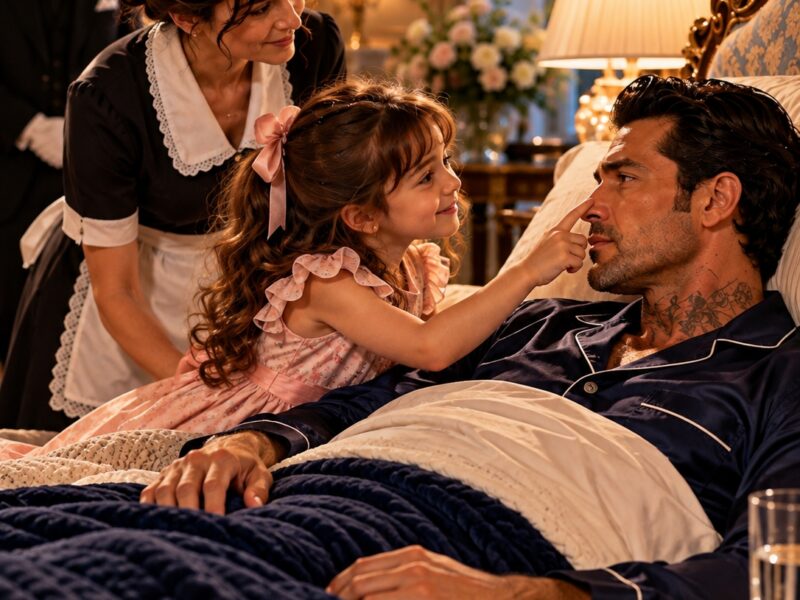
“Your Eyes Just Moved, Uncle,” the Maid’s Toddler Whispered—The Mafia Boss Froze, Then Realized Someone in His Own House Had Been Keeping His Brother Silent
For nineteen days, Matteo Moretti had lain unresponsive in a private medical room while specialists warned his younger brother not to mistake reflexes for hope.
Then the housekeeper’s three-year-old daughter wandered to his bedside, stared at his face, and whispered that his eyes had moved when everyone else insisted nothing had changed.
But when the child noticed Matteo reacted differently whenever one trusted doctor came near, Dante Moretti began wondering whether his brother had been unable to wake—or whether someone had been making sure he could not.
I remember the room first by its smell.
Antiseptic. Clean linen. Warm plastic from the medical equipment. Beneath all of it was something I could not name then, something stale and nervous that seemed to live inside the walls after too many frightened people had spent too many hours pretending they were calm.
My daughter Mia was three years old when she walked into that room.
She was not supposed to be there.
The east wing of the Moretti estate had been off-limits to nearly everyone since Matteo Moretti was brought home from the hospital. Nurses crossed the corridor in soft shoes. Medical suppliers entered through a service door and signed two different logs. Even senior security staff waited outside unless Dante personally called them in.
I knew the rule.
Mia did not care about rules she could not see.
I had been changing linens in a guest suite when she vanished from the carpet beside my housekeeping cart. One minute she was coloring a purple cat because, according to her, “gray is boring.” The next, the crayons were still there and my daughter was not.
I heard her shoes before I saw her.
Small rubber soles against marble.
Too far down the corridor.
“Mia.”
I kept my voice low because people in that house learned quickly not to shout unless something was actually on fire.
She stopped outside Matteo’s room.
The door stood partly open.
Inside, Dante Moretti sat in the chair he had occupied almost every night for nineteen days.
Everyone in New York who knew his name had some version of Dante in their head. To business reporters, he was the heir to a web of freight companies, restaurants, private investment firms, and property holdings. To detectives, prosecutors, union officials, and certain men who met after midnight, he was something harder to describe in public.
To me, he was the employer whose house I cleaned.
A man whose presence could shorten conversations without him saying a word.
But beside his brother’s bed, he looked less frightening than tired.
His jacket was folded over another chair. His white shirt was open at the collar. Dark stubble covered his jaw. One hand rested near Matteo’s blanket without quite touching it.
Dr. Raymond Castellano stood beside the infusion pumps.
Vittorio Santoro, the older family adviser who had known both brothers since childhood, stood near the window speaking quietly into his phone.
A nurse checked the monitor.
And my child walked straight inside.
“Mia.”
I hurried after her.
Every adult turned.
Heat climbed my neck.
“Mr. Moretti, I’m sorry. She slipped away. I’ll take her—”
Dante lifted one hand.
“Leave her.”
I stopped.
Mia approached the bed.
Matteo looked asleep.
That was the cruel thing about severe brain injury. Nothing about his face explained how far away he might be. No expression told us whether he heard voices, felt touch, understood time, or existed somewhere behind closed eyes waiting for his body to answer.
Mia stared at him.
“Is he sick?”
“Yes,” I whispered.
“Very?”
Dante answered this time.
“Yes.”
She studied him again.
“Can he hear?”
Nobody responded immediately.
Dante looked at his brother.
“We don’t know.”
Mia took one more step.
“You talk to him?”
Dante’s face changed slightly.
“Sometimes.”
“Maybe he likes it.”
No one smiled.
But Dante looked down.
Mia placed both hands behind her back because I had taught her never to touch hospital equipment.
She stared at Matteo’s face.
Five seconds.
Maybe ten.
Then she leaned forward.
“Mommy.”
“What?”
She pointed.
“His eyes moved.”
Dante’s chair scraped sharply across the floor.
“What did you say?”
Mia blinked at him.
“His eyes moved.”
Dr. Castellano stepped closer.
The nurse checked Matteo’s pupils and then the monitor.
Dante moved to the bedside.
“Matteo.”
His voice sounded different.
Not powerful.
Afraid.
“Can you hear me?”
Nothing happened.
Dr. Castellano gently touched Dante’s arm.
“Eye movement can happen without conscious awareness, especially after prolonged reduced consciousness.”
“You didn’t see it?”
“No.”
The nurse shook her head too.
Dante looked at Mia.
“Did he move before you spoke?”
She shrugged.
“He moved.”
Dr. Castellano turned toward the infusion pump.
Mia’s expression changed.
She tugged my sleeve.
I crouched beside her.
“What?”
Her whisper carried farther than she intended.
“He did it again when the doctor came close.”
Dr. Castellano’s hand stopped.
Only for a second.
Then he adjusted the pump as if nothing had happened.
“Children notice everything,” he said pleasantly. “They also connect events that may not be related.”
It was a reasonable explanation.
That was the problem.
Almost everything that followed began with something reasonable.
I took Mia’s hand.
Dante watched the doctor.
Vittorio ended his phone call and crossed the room.
“Dante.”
His voice was calm, almost fatherly.
“Don’t do this to yourself.”
Dante looked at him.
“Do what?”
“Build hope around every twitch.”
Vittorio glanced toward Matteo.
“If there is meaningful change, Raymond will see it. The neurologists will see it.”
Dr. Castellano gave a small nod.
Dante closed his eyes briefly.
Then sat down.
“You’re right.”
He said it, but his body had changed.
He was no longer simply waiting.
He was watching.
I led Mia toward the door.
Before we stepped into the corridor, she looked back.
Matteo lay still beneath the white sheet.
Dr. Castellano stood beside the infusion pump.
Vittorio’s hand rested on Dante’s shoulder.
Nothing in that room looked different.
Mia squeezed my fingers.
“Mommy?”
“Yes?”
“I think Uncle Matteo knows when that doctor is there.”
I looked down at her.
She had already turned her attention to a picture hanging on the hallway wall.
For her, the observation was finished.
For me, it had only begun.
My name is Alina Reyes.
At the time, I had worked at the Moretti estate for three years.
The house sat behind iron gates on a private road north of New York City, surrounded by stone walls, cameras, old trees, and the kind of landscaping that looked effortless because somebody worked very hard to make it look that way.
I cleaned bedrooms.
Polished wood.
Managed linens.
Helped Mrs. Bell, the head housekeeper, track supplies.
And because childcare in Westchester cost almost as much as my rent, I sometimes brought Mia to work.
Mrs. Bell pretended not to approve.
Then kept apple juice and crayons in the staff kitchen for her.
Most people in that house treated my daughter like a small weather event.
She arrived.
Asked questions.
Moved through rooms too quickly.
Eventually passed.
Even Dante tolerated her more than I expected.
He did not kneel down and perform cheerfulness the way adults sometimes do with children.
He simply never treated her like an inconvenience.
Once, before Matteo’s injury, Mia dropped a cup of juice near the breakfast room.
I apologized so quickly I almost tripped over my own words.
Matteo Moretti crouched beside me with a towel.
“She’s three.”
he said.
“That is not usually an age known for liquid management.”
Mia stared at him.
“I’m almost four.”
“You should put that on your résumé.”
That was Matteo.
Older than Dante by four years.
Less intimidating.
More likely to remember a cook’s birthday or ask a driver whether his son had gotten into college.
The brothers looked alike enough to be unmistakably family.
Same dark hair.
Same gray eyes.
Different temperature.
Dante entered a room and people measured risk.
Matteo entered one and people remembered they were people.
Then came the ambush.
We did not know much at first.
Only that the brothers’ convoy had been returning from a meeting.
A vehicle blocked the road.
There was chaos.
Matteo was seriously injured while trying to reach Dante.
He survived emergency surgery.
Then swelling.
Then more surgery.
For several days, survival itself felt like good news.
After that, survival became waiting.
When Dante brought Matteo home, the east wing changed.
A bedroom became a private critical-care suite.
Backup power.
Monitors.
Oxygen equipment.
Infusion pumps.
Nursing coverage around the clock.
Dante did not trust hospitals after the attack.
He said home allowed him to control access.
At the time, nobody questioned whether control itself might become dangerous.
Dr. Castellano coordinated everything.
He had treated the Moretti family for more than twelve years.
He knew their history.
Medication reactions.
Old injuries.
Family secrets.
He was the person everyone trusted because trust had accumulated so gradually nobody remembered deciding to give it.
Vittorio Santoro occupied another kind of trust.
He was sixty-three.
Silver hair.
Perfect suits.
Patient voice.
After the Moretti brothers’ father died, Vittorio became adviser, mediator, uncle without blood.
He taught Dante to drive.
Sat beside Matteo in the emergency room when Matteo broke his arm at fifteen.
Negotiated contracts.
Settled disputes.
Remembered anniversaries.
When people spoke about loyalty inside the Moretti organization, they usually meant men like Vittorio.
The morning after Mia saw Matteo’s eyes move, I considered calling in sick.
Instead Dante asked to see me before my shift.
He waited near the breakfast room.
Not the study.
That made me more nervous.
Mia stood beside me staring at a bowl of oranges.
Dante looked as if he had not slept.
“I want to ask you something.”
“Yes, sir.”
“Would you be comfortable letting Mia sit with Matteo again today?”
I stared.
He noticed.
“Not as treatment.”
“Not as a test.”
“She sits.”
“She talks if she wants.”
“No one asks her to make him respond.”
I looked at Mia.
Then back.
“She’s three.”
“I know.”
“If she gets frightened, we leave.”
“Immediately.”
“And I stay.”
“Yes.”
I hesitated.
Then said what mattered.
“She is not something you use because doctors don’t have answers.”
Dante’s expression tightened.
Not anger.
Shame.
“You’re right.”
He paused.
“I just don’t want to ignore something because the person who noticed it is small.”
That answer changed mine.
“All right.”
We entered Matteo’s room shortly after nine.
Morning sunlight softened the medical equipment.
A nurse named Clare was working.
Vittorio stood near the window with coffee.
Dr. Castellano was not there yet.
Vittorio smiled when Mia entered.
“Our little detective.”
His tone was affectionate.
I disliked the phrase anyway.
Mia climbed into the chair beside Matteo.
She immediately began telling him about a yellow butterfly she had seen outside our apartment.
“It had a black spot,” she explained. “Maybe it was tired.”
Dante stood at the foot of the bed.
Trying not to stare.
Clare checked the monitor.
Five minutes passed.
Then ten.
Nothing.
Relief almost came.
Maybe yesterday had been a reflex.
Maybe Mia had caught random movement and my exhausted brain had turned it into meaning.
Then Mia placed her fingers against the blanket near Matteo’s wrist.
“I want a cat.”
she informed him.
“Mommy says no because our apartment is small, but the cat is smaller.”
Matteo inhaled.
Deeper.
Longer exhale.
Clare looked at the monitor.
Dante noticed.
Mia kept talking.
“A gray cat.”
His right index finger flexed.
I saw it.
Not enough to know why.
Enough to know it happened.
Dante stepped forward.
“Matteo.”
Clare raised a hand.
“Slow.”
She leaned closer.
“Matteo, if you can hear me, open your eyes.”
Nothing.
“Move your right hand.”
Nothing.
The finger remained still.
Vittorio stepped away from the window.
“This is exactly what Raymond warned you about.”
Dante looked at him.
“You think I don’t understand reflexes?”
“I think you want your brother back.”
Vittorio’s voice stayed gentle.
“That would make any man see patterns.”
Then Matteo’s heart rate increased.
Not dramatically.
Three beats.
Five.
Clare looked up.
Vittorio noticed.
“What?”
“Minor fluctuation.”
He moved closer to the bed.
The number rose again.
Mia tilted her head.
“He doesn’t like that.”
Everyone turned.
“What doesn’t he like?”
I asked.
She pointed loosely toward Vittorio.
“The talking.”
Vittorio laughed.
“Then Matteo remains a man of excellent judgment.”
Only Mia laughed.
Dante did not.
Footsteps sounded outside.
Dr. Castellano entered with another man.
The stranger carried a tablet instead of a medical bag.
Dante introduced him.
“Dr. Aaron Patel.”
Neurologist.
Independent.
That word mattered.
Patel was not connected to the Moretti family.
Not their usual hospital.
Not Dr. Castellano’s practice.
Dante had brought him from a university medical center in Manhattan.
Vittorio’s eyes narrowed for a fraction of a second.
Then relaxed.
Patel washed his hands.
Reviewed the chart.
Asked Clare questions.
He examined Matteo’s pupils, reflexes, muscle tone, eye movement, breathing pattern, response to stimulation.
Then stopped at the medication record.
“When was the last sedative adjustment?”
“Early this morning.”
Dr. Castellano answered.
“Reason?”
“Agitation overnight.”
Patel pointed.
“This is a nursing note.”
“Yes.”
“I’m asking about the physician order.”
“I gave it verbally.”
“When did you sign?”
A pause.
“A few hours later.”
Patel nodded.
No accusation.
Nothing dramatic.
But Dante heard it.
So did Vittorio.
After the examination, Patel stepped into the corridor with Dante.
I remained inside with Mia.
The door stayed partly open.
“I don’t see consistent command-following.”
Patel said.
Dante’s face hardened.
Patel continued.
“That does not mean there is no awareness.”
Dante looked up.
“Medication load matters.”
“Sedation can suppress responses.”
“Especially if doses are changing.”
Dante glanced at Castellano.
“So Mia could have seen something.”
“Yes.”
Patel said.
“She also could have seen reflexive movement.”
“Both remain possible.”
It was a careful answer.
Dante seemed grateful anyway.
Before Patel left, Dante gave Clare a new instruction.
“I want to be notified before medication changes.”
Dr. Castellano said:
“That’s reasonable.”
Vittorio did not.
“You hired Raymond because you trusted him.”
“I still do.”
“Then let him practice medicine.”
“I’m asking to be informed.”
Vittorio looked at him.
“You haven’t slept properly in weeks.”
“I know.”
“Grief turns details into evidence.”
Dante’s eyes cooled.
“And sometimes details are evidence.”
Nobody answered.
Mia tugged my sleeve.
“Why does Mr. Dante need so many people walking around his own house?”
I wished the marble floor would open.
Dante heard.
“They keep me out of trouble.”
Mia looked at two security men in the corridor.
“That’s a lot of helpers.”
Dante’s mouth almost moved.
“It is.”
“You must be really good at finding trouble.”
Clare covered a laugh.
Even Dr. Castellano smiled.
Dante actually laughed.
Short.
Rusty.
Unexpected.
Then Mia said:
“Mommy says you’re scary.”
Every adult froze.
I closed my eyes.
Dante looked at me.
I had no defense.
He laughed again.
“Your mother is probably right.”
For several minutes, the room felt human.
Then Vittorio left to take a phone call.
Castellano went downstairs to check something with pharmacy staff.
Mia returned to Matteo’s bedside.
She hummed.
The same little tune I sang while washing dishes.
Then she took Matteo’s hand.
“Your hand is cold.”
she said.
“Mine gets cold too.”
Dante stood by the window.
Mia continued.
“When you wake up, you should get a bigger blanket.”
I almost corrected her.
Not when.
If.
Before I could, Mia startled.
“Mommy.”
“What?”
“He did it.”
Dante was already moving.
“What?”
“He squeezed me.”
Clare entered quickly.
“Don’t move your hand.”
Mia froze.
Clare leaned toward Matteo.
“Matteo, if you can hear me, squeeze again.”
Nothing.
Dante’s face tightened.
“Matteo.”
Nothing.
Vittorio had returned to the doorway.
“Dante.”
he warned gently.
“Don’t.”
Then Matteo’s entire hand closed weakly around Mia’s fingers.
Not a twitch.
Not one finger.
A grip.
Two seconds.
Release.
The room changed.
Mia smiled.
“He said hi.”
No one corrected her.
Dante bent over the bed.
“Matteo.”
His voice cracked.
“Again.”
Nothing.
“Please.”
Still nothing.
But Clare looked shaken.
“That was stronger than a simple finger twitch.”
she said.
“I cannot call it command-following from one event.”
“But we document it.”
“Yes.”
Dr. Castellano returned carrying his black medical bag.
“What happened?”
Clare explained.
His face stayed professional.
Only his jaw changed.
“Could remain reflexive.”
Dante turned.
“Everything could remain reflexive.”
“For now.”
“How long is ‘for now’?”
“Until responses become reproducible.”
Dante looked at his brother.
“Then we keep watching.”
Later that afternoon I passed the east wing and heard voices inside.
Vittorio.
Dante.
“You brought another neurologist without telling Raymond.”
“I wanted another opinion.”
“You’re asking nurses to report directly to you.”
“He squeezed her hand.”
“Maybe.”
“You saw it.”
“I saw movement.”
Dante’s voice lowered.
“You are working very hard to make sure I do not believe my own eyes.”
Silence.
Then Vittorio:
“I am trying to keep you from breaking when this becomes nothing.”
The words sounded loving.
That was what bothered me.
Everything Vittorio said sounded like care.
Everything Castellano said sounded like medicine.
Each explanation worked by itself.
Together, they began to feel rehearsed by the universe.
When Castellano left Matteo’s room minutes later, he walked quickly toward the medical office.
Vittorio followed.
Not immediately.
Ten seconds later.
He stopped at the end of the hall and watched the doctor enter.
Then took out his phone.
Typed something.
I told myself there were innocent reasons.
By then, that sentence was becoming a habit.
The next morning Dante requested every medication record since Matteo came home.
Orders.
Nursing notes.
Pharmacy deliveries.
Changes made outside regular schedules.
Clare carried two binders into his study.
A pharmacy coordinator followed.
Then Leon Ward, one of Dante’s senior security men.
By lunch, the entire house understood something had shifted.
They were no longer only asking whether Matteo would wake.
They were asking why he had not.
I carried coffee into the library while Dante reviewed charts with Clare and another nurse.
Vittorio sat near the fireplace.
Patient.
Concerned.
Dante tapped a page.
“This increase.”
Clare leaned over.
“He was restless.”
“Heart rate up.”
“Muscle tension.”
“Dr. Castellano authorized an additional dose.”
Dante tapped another.
“And this?”
“Similar.”
“Verbal order?”
“Yes.”
“Three verbal adjustments in eight days.”
The second nurse, Thomas, spoke carefully.
“That can happen in home critical care.”
“Physician is on call.”
“Signs afterward.”
“How long afterward?”
Dante asked.
“Sometimes same night.”
“Sometimes morning.”
Dante turned the chart.
“Dr. Patel examined him yesterday.”
“Dose was lower before the examination.”
“Increased afterward.”
He pointed.
“Dr. Lynn last week.”
“Same.”
“Dr. Green before that.”
“Same.”
Clare frowned.
She had not noticed the pattern.
Neither had Thomas.
Vittorio sighed.
“You are looking for patterns because you want one.”
Dante looked at him.
“I haven’t said what I want.”
“You want proof that Matteo is trapped under medication rather than injured.”
“No.”
Dante said.
“I want the clinical reason.”
Vittorio leaned forward.
“Then ask Raymond.”
“I will.”
“Good.”
He softened.
“Because grief becomes dangerous when it teaches you suspicion.”
Dante’s expression barely changed.
“You seem very certain suspicion is the danger.”
Vittorio went still.
Only for a heartbeat.
Then smiled sadly.
“I’m certain exhaustion is.”
Dante changed the protocol that afternoon.
No non-emergency medication adjustment without a written order entered before administration.
Second-clinician verification.
Notification to Dante.
Castellano accepted the rules.
Outwardly.
He became meticulous.
Explained everything.
Signed immediately.
Invited review.
That should have reassured me.
Instead, twice I caught him looking at Mia when he thought nobody noticed.
Not angry.
Not suspicious.
Afraid.
Like she was a candle too near a curtain.
The next day, around five, I was collecting towels from the east wing when I heard Castellano inside the medical supply office.
Phone call.
Low voice.
The door not quite closed.
I would like to say I stopped because I was brave.
I stopped because I heard:
“He’s responding sooner than expected.”
My body froze.
Silence.
Then:
“No. I told you. I’m not increasing it again.”
Another pause.
“It’s becoming harder to justify.”
I tightened my grip around the towels.
“Moretti is reviewing the records.”
My heartbeat became painful.
Castellano listened.
“You said this was temporary.”
Longer silence.
Then something changed in his voice.
“Don’t say her name.”
I moved closer to the wall.
“You told me she would be safe.”
I understood nothing.
And too much.
Castellano spoke again.
“I can’t keep doing this.”
Pause.
“He’s not gone.”
“He’s responding.”
Another pause.
“No.”
His voice broke.
“I will not increase it again.”
Something struck the desk.
Then:
“Don’t make me choose between my patient and my daughter.”
A towel slipped from my arms.
It landed softly.
To me it sounded like thunder.
I grabbed it.
Walked away.
Did not run.
I spent the next three hours trying to build an innocent explanation.
Different patient.
Family issue.
Harmless medication.
Coincidence.
Each possibility broke against the same words.
Moretti is reviewing the records.
He is responding.
Do not make me choose between my patient and my daughter.
That night, Mia colored a cat purple on our kitchen floor.
I stared at nothing long enough that she looked up.
“Are you mad?”
“No.”
“Scared?”
I almost lied.
“Yes.”
She returned to her drawing.
I asked:
“If you heard something you weren’t supposed to hear, would you tell?”
“What thing?”
“Something that could get someone in trouble.”
She thought.
“Is it a secret?”
“Maybe.”
“Did they say it was?”
“No.”
She colored.
Then:
“Could somebody get hurt?”
My throat tightened.
“Maybe.”
Mia looked up.
“Then you tell.”
“Even if telling gets you in trouble?”
She frowned.
“If somebody gets hurt, trouble is already there.”
Three-year-old logic.
Embarrassingly clean.
The next morning I went to Dante’s study.
One of his guards stopped me.
“I need to speak with Mr. Moretti.”
“About?”
“Private.”
“Urgent?”
I heard myself say:
“Yes.”
Less than a minute later, I stood in front of Dante’s desk.
He looked up from a tablet.
“What happened?”
I told him exactly what I heard.
No conclusion.
No theory.
Only words.
He listened without interrupting.
When I finished, he set the tablet down.
“Say the daughter part again.”
I did.
“Exact words?”
“As close as I can remember.”
“Did he name who he was speaking to?”
“No.”
“Matteo?”
“He said ‘he.’”
Dante stood.
Locked the study door.
The quiet click frightened me more than shouting.
He turned.
No rage.
Focus.
“You repeat this to no one.”
I nodded.
“Not Clare.”
“Not Mrs. Bell.”
“Not Mia.”
“She doesn’t know.”
“Good.”
He reopened Matteo’s medication file.
“I need you to do one thing.”
“What?”
“Everything exactly as normal.”
I stared.
“If Castellano thinks anything has changed, he may change too.”
I asked:
“Do you think he’s hurting Matteo?”
Dante looked at the screen.
“I think I don’t know enough yet.”
He swiped to another page.
“That’s different.”
Then he surprised me.
“If Raymond is being forced, confronting him could endanger whoever he’s afraid for.”
“If he’s lying, confronting him gives him time to hide.”
“Either way, anger helps me less than certainty.”
Until that moment I thought Dante Moretti’s power came from being dangerous.
That morning I learned patience frightened people too.
The investigation began invisibly.
Duplicate pharmacy invoices.
Security logs.
Controlled-medication inventory.
Camera timestamps.
Visitor records.
Independent chart review by Dr. Patel.
Nothing illegal.
Nothing theatrical.
No locked basement.
No threats.
Dante understood that if something had happened medically, facts had to survive outside his house.
That mattered.
By afternoon, a pattern emerged.
Matteo had received additional sedation after several episodes described as restlessness, elevated heart rate, muscle activity, or possible purposeful movement.
Each order fell within medically recognizable dosing ranges.
That was the subtlety.
Nobody had needed to poison him.
Nobody had needed an obviously dangerous amount.
If the goal was to suppress responsiveness, one could hide behind decisions that remained individually defensible.
Dr. Patel confirmed the ambiguity.
“Sedation is sometimes necessary.”
he told Dante over a secure call.
“Agitation can raise metabolic demand and interfere with recovery.”
“So the chart proves nothing?”
“Not by itself.”
“What does it prove?”
“That frequent medication changes can make neurological assessment more difficult.”
“In other words?”
“In other words, if someone were trying to suppress signs of awareness without producing obvious toxicity, the chart would not necessarily expose intent.”
Dante ended the call.
Sat alone for several minutes.
Then asked Leon:
“Castellano’s daughter.”
Leon investigated quietly.
Sophia Castellano.
Twenty-two.
Architecture student in Boston.
No criminal history.
No financial scandal.
No obvious threat.
Then street-camera review showed the same dark sedan near her apartment four times.
A man watching from across the street.
No approach.
No confrontation.
None needed.
If a father understood someone could reach his child, the message had already been delivered.
Dante ordered discreet protection.
“No contact.”
he said.
“If Raymond thinks she is being watched, we do not make the protection visible.”
That evening Vittorio entered the study while I happened to be delivering coffee.
Dante told him only that Patel was reviewing medication irregularities.
Nothing about my overheard call.
Nothing about Sophia.
Vittorio looked over the papers.
“If Raymond has been raising sedation after outside specialists leave, then yes, somebody needs to examine it.”
The room went silent.
Dante had not told him that.
Neither had I.
Vittorio saw the change in Dante’s face.
“You said Patel was reviewing medication.”
“I assumed that was what you meant.”
Smooth.
Possible.
Maybe even true.
Dante said:
“That’s part of it.”
Vittorio placed the chart down.
“Let me help.”
“I’ll tell you.”
For the first time, irritation crossed Vittorio’s face.
He covered it quickly.
“You don’t have to suspect everyone alone.”
Dante looked at the hand Vittorio placed on his shoulder.
“I’m not suspecting everyone.”
“Good.”
Vittorio smiled faintly.
“Because once you start seeing betrayal everywhere, you eventually create it.”
He left ten minutes later.
Dante waited until the door closed.
Then:
“Leon.”
“Yes.”
“Vittorio gets nothing.”
Leon did not ask why.
Neither did I.
The controlled neurological assessment began the next morning.
No unnecessary sedation changes.
Two independent clinicians.
Continuous monitoring.
Every intervention documented.
Castellano agreed.
His relief surprised me.
Later I understood.
A guilty man might fear oversight.
A trapped man might welcome being relieved of choices he no longer wanted to make.
For several hours, Matteo did almost nothing.
Patel tested him.
Nothing consistent.
Hope began sinking.
Near noon Dante asked whether Mia could enter.
I repeated the rules.
“She sits.”
“She talks if she wants.”
“Nobody tells her what to make him do.”
“Agreed.”
Mia climbed into the chair.
Looked around.
“Why does everybody look like somebody broke the TV?”
No answer.
She hummed.
Then began talking about a pigeon that had tried stealing her muffin.
Five minutes.
Matteo’s eyelids fluttered.
Patel moved closer.
“Matteo.”
He waited.
“If you can hear me, blink twice.”
Nothing.
Dante’s shoulders tightened.
Ten seconds.
Then Matteo blinked.
Once.
Pause.
Twice.
Clare inhaled sharply.
Patel raised a hand.
“Repeat.”
Thirty seconds passed.
“Open your eyes and hold them open.”
His lids lifted slightly.
Trembled.
Closed.
“Good.”
Patel waited.
“If you hear me, move your eyes toward my voice.”
For several seconds, nothing.
Then beneath half-open lids, Matteo’s gaze shifted.
Toward Patel.
Clare covered her mouth.
Castellano stared at the floor.
Dante stepped forward.
“Can I ask?”
“Simple.”
Patel said.
“One response for yes.”
Dante knelt.
All the authority left him.
“Matteo.”
His voice roughened.
“Can you hear us?”
Silence.
Then two slow blinks.
Dante gripped the mattress.
“Have you been able to hear us for a long time?”
Patel almost stopped him.
Then waited.
Matteo’s eyelids lowered.
Opened.
Lowered.
Opened.
Two.
Dante bowed his head.
For three weeks he had sat beside his brother.
Talking to a man he was told might never know he was there.
Matteo had heard at least some of it.
Patel continued carefully.
Confirmation questions.
Name.
Location.
Simple commands.
Not every response came.
Fatigue complicated everything.
But enough did.
Finally Patel stepped back.
“There is purposeful behavior.”
He did not say recovery.
No promises.
Only purposeful behavior.
It was enough to change the house.
Matteo’s return happened in fragments.
Two blinks for yes.
One for no.
Long rests.
Occasional eye tracking.
Tiny movements.
The next day Patel moved cautiously toward the attack.
“Was it random?”
One blink.
No.
“Did the people who attacked know the route?”
Two.
Yes.
“Did someone inside provide information?”
Two.
Dante’s hand tightened.
“Was Dr. Castellano involved in planning it?”
One blink.
No.
Castellano closed his eyes.
A strange kind of relief.
Patel continued.
“Did Dr. Castellano knowingly do something after the attack that made it harder for you to show awareness?”
Matteo’s breathing changed.
Eyes closed.
He tired.
Patel waited.
When they opened:
Two blinks.
Yes.
Dante walked to the window.
“Was he trying to kill you?”
Patel looked sharply at him.
But Matteo answered.
One.
No.
That answer disturbed Dante more than yes would have.
An enemy was easy to understand.
A doctor keeping a patient suppressed without wanting him dead implied leverage.
Fear.
Something layered.
“Was someone forcing him?”
Two.
“Connected to the attack?”
Two.
“Do you know who?”
Two.
Dante leaned forward.
Patel stopped.
“He’s exhausted.”
“One question.”
“No.”
“He knows who betrayed us.”
“And he’ll know in an hour.”
Dante stared.
Then saw Matteo’s eyes close involuntarily.
Stepped back.
“All right.”
Vittorio came to the east wing that afternoon.
Dante told him Matteo was responding.
Vittorio froze.
A fraction.
Then embraced him.
“That’s wonderful.”
He asked:
“Responding how?”
“Enough that Patel wants more tests.”
“Has he spoken?”
“No.”
“Does he remember the attack?”
Dante looked directly at him.
“We don’t know.”
Vittorio nodded.
“Don’t push him.”
“He has waited three weeks.”
“Whatever happened on the road can wait until he is stronger.”
Kind.
Sensible.
After Vittorio left, Dante watched the closed door.
“He didn’t ask whether Matteo recognized me.”
I frowned.
“What?”
“He asked whether he remembers the attack.”
That evening Patel narrowed the betrayer through categories.
Inside organization?
Yes.
Security?
No.
Transportation?
No.
Leadership access?
Yes.
Known more than five years?
Yes.
Ten?
Yes.
Older than Dante?
Yes.
Older than Matteo?
Yes.
Known their father?
Matteo’s breathing accelerated.
Patel stopped immediately.
Dante did not need a name yet.
The circle had become painfully small.
That night I found Dante alone in the corridor.
“When I was twelve,” he said, not looking at me, “Vittorio taught me to drive.”
I stayed quiet.
“My father had no patience.”
“Vittorio did.”
“When Matteo broke his arm, Vittorio slept at the hospital because our mother couldn’t stop crying.”
Dante gave a small, humorless breath.
“You know the worst thing about suspicion?”
I shook my head.
“It makes good memories feel like proof you were stupid.”
I wanted to reassure him.
There was nothing useful to say.
The proof arrived the next morning.
Castellano returned early.
Tie crooked.
Face gray.
He tried entering Matteo’s room.
Dante stopped him.
“Why are you here?”
“I’m his doctor.”
“That was true yesterday too.”
“I heard he’s more responsive.”
Dante’s eyes narrowed.
“Who told you?”
Castellano did not answer.
Dante stepped aside.
“Go in.”
Matteo’s eyes were open.
Castellano approached.
“Matteo.”
Two blinks after he asked whether Matteo heard him.
Castellano’s shoulders dropped.
Dante stood behind him.
“He told us you didn’t arrange the attack.”
Castellano gripped the bed rail.
“He told us somebody forced you.”
The doctor whispered:
“You shouldn’t have let him wake this far without moving her.”
Dante went still.
“Moving who?”
Castellano turned.
“My daughter.”
Fear stripped twenty years from his face.
“You need to get Sophia out before he knows.”
“Who?”
“Close the door.”
Leon did.
Castellano set down his medical bag.
“Three days after Matteo came home, I received photographs.”
“Sophia leaving class.”
“Buying coffee.”
“Eating with friends.”
“One through her bedroom window.”
Clare turned away.
“They knew her schedule.”
“They knew her roommate.”
“They knew where she worked Saturdays.”
“They told me Matteo was showing more activity.”
Dante’s face hardened.
“How?”
“Someone was getting updates.”
“What did they ask?”
Castellano looked at Matteo.
“Keep him deeply sedated.”
“Not dead.”
“Not enough to cause obvious injury.”
“Just enough that every specialist could still attribute his condition to the original trauma.”
Dante stared.
“And you did.”
“Yes.”
“How many times?”
“Seven.”
Castellano swallowed.
“Maybe eight.”
“The rest were medically indicated.”
“You altered what specialists were seeing.”
“Yes.”
“You stood beside me while I asked whether my brother heard me.”
Castellano lowered his eyes.
“Yes.”
Dante stepped closer.
Anger finally broke through.
Not shouting.
Worse.
“You decided your fear mattered more than his life.”
Castellano looked at Matteo.
“I told myself I was buying time.”
“That I wasn’t hurting him.”
“That the medication was reversible.”
“That Sophia stayed alive.”
Dr. Patel’s voice hardened.
“Sedation is not morally neutral because a dose is medically recognizable.”
“I know.”
“You knew then.”
Castellano said nothing.
Dante asked:
“When did you know who arranged the attack?”
“Not immediately.”
“When?”
“First week.”
“Why?”
“The caller knew the replacement route.”
Dante’s jaw tightened.
“Who changed the route?”
Castellano looked toward the floor.
“Only a few people had access.”
“Not to the replacement.”
Silence.
Dante understood.
“Do you have proof?”
“Messages.”
“Burner phone.”
“Copies.”
“Why keep them?”
“Because I was afraid.”
Dante gave a humorless breath.
“You keep using fear like a defense.”
“It isn’t.”
Castellano looked at him.
“It is an explanation.”
That stopped Dante.
Castellano continued.
“I should have told you.”
“But the people threatening Sophia knew things only someone close to you could know.”
“I didn’t know how high it went.”
“Every day I waited made the next day easier.”
He looked toward Matteo.
“Each time he responded, one more dose felt like a delay instead of a betrayal.”
Matteo’s eyes rested on him.
No forgiveness.
Something worse.
Understanding.
Dante noticed.
“Raymond.”
Castellano looked up.
“You will never treat my brother again.”
“I know.”
“You give Leon every device, message, account, number, and document.”
“Yes.”
“You do not contact Sophia until I confirm she is safe.”
The doctor’s face tightened.
Dante continued.
“I will protect her.”
“Not because you deserve it.”
“Because she did not make your choices.”
Castellano cried.
Quietly.
Then Dante looked at me.
“Alina.”
My stomach dropped.
“Take Mia.”
“Go.”
“What happened?”
“Something I should have prevented.”
He lowered his voice.
“Vittorio knows Mia was the first person to notice Matteo responding.”
“If he learns Matteo identified him, he may decide everyone connected to that change is a problem.”
“You think he would hurt a child?”
Dante answered too fast.
“I don’t know what he would do anymore.”
That frightened me more than yes.
Leon arranged a safe house.
Not my apartment.
Not family.
A small ordinary house in a quiet suburb.
Before we left, Dante crouched beside Mia.
“You did something good.”
She looked serious.
“Did I make Uncle Matteo better?”
“No.”
Dante softened.
“Doctors are helping him get better.”
“You helped us notice he was trying.”
Mia considered.
Then pulled a purple crayon from her pocket.
“For your trouble.”
Dante looked at it.
Then at me.
He closed his hand around it.
“Thank you.”
Before I entered the car, Dante handed me a folded paper.
One ordinary word written inside.
“Memorize it.”
I did.
“If anyone comes to move you, ask for that word.”
“Even your men?”
“Especially my men.”
“Who knows it?”
“You.”
“Me.”
“Leon.”
He looked up toward Matteo’s window.
“And my brother, if he remembers.”
He tore the paper.
“If they don’t know it, you do not open the door.”
The car pulled away.
For three years, I had believed survival in the Moretti world meant staying invisible.
Now Mia had seen something.
I had heard something.
Matteo had finally communicated.
And behind us, Vittorio Santoro still did not know the family he had betrayed was finally listening.
The safe house looked disappointingly normal.
Pale siding.
Small lawn.
Garage door needing paint.
That was the point.
Leon stayed with us.
Two other security men rotated.
Mia thought it was a sleepover.
I let her.
At night I watched every car through the curtain.
Leon told me to stop.
“If they know where we are, watching the street does not save you.”
“Comforting.”
“Not meant to be.”
Hours passed.
Sophia was moved safely.
Castellano cooperated.
Vittorio remained at the estate.
Dante had not confronted him.
“Why?”
I asked.
Leon looked at his phone.
“Men who believe they are safe make mistakes.”
Near midnight headlights crossed the wall.
The men in the house reacted before I understood why.
One car.
Stopped nearby.
A knock.
Three taps.
A voice.
“Leon.”
“It’s Marcus.”
“Dante sent me.”
Leon did not open the door.
Marcus was known to Raphael, one of the guards.
That almost made it worse.
“We need to move them.”
the voice said.
“Location compromised.”
Leon answered through the wood.
“Password.”
Pause.
“What?”
“The word.”
Another pause.
“Leon, stop playing games.”
“Say it.”
“Dante didn’t give me a word.”
Leon turned toward me.
His face emptied.
He pointed upstairs.
I took Mia.
Locked us inside a bedroom.
Downstairs came another hard knock.
Then raised voices.
Movement.
A brief struggle outside.
No gunfire.
No long fight.
Minutes later Leon called:
“Alina.”
“It’s clear.”
He came upstairs.
A split lip.
Nothing more.
“What happened?”
“Two men came with Marcus.”
“Connected to Vittorio.”
“Are they alive?”
“Yes.”
“One ran.”
“Two are being held.”
Mia stared at Leon’s lip.
“Did you fall?”
He glanced at me.
“Something like that.”
She accepted it.
I did not.
“How did they know?”
Leon’s expression changed.
“Only four people knew this address.”
“That makes tonight useful.”
By sunrise, the safe house no longer felt like shelter.
It felt like evidence.
One captured phone contained deleted message fragments.
woman and child
safe address
move them before brother talks
A number tied indirectly to one of Vittorio’s logistics managers.
Another used by an old security unit Vittorio controlled.
Not perfect proof by itself.
But corroboration.
Matteo’s fragmented memory.
Castellano’s messages.
My overheard call.
Medication records.
Now an active attempt to reach witnesses after Matteo began communicating.
At seven-thirty, Dante arrived.
He gave the password through the door.
That tiny fact almost made me laugh.
Mia ran toward him.
“Mr. Dante.”
“Leon fell.”
Dante glanced at Leon.
“Did he?”
“He says so.”
“Leon falls frequently.”
She nodded.
Dante crouched.
“Breakfast?”
“Toast.”
“Good.”
Leon took her into the kitchen.
Dante and I sat.
He looked older.
Wrinkled shirt.
No sleep.
“Vittorio knows enough.”
“Did you confront him?”
“At four.”
“What happened?”
“He denied everything.”
“Until Leon sent the phone data.”
“And then?”
Dante leaned back.
“He stopped pretending.”
No dramatic confession.
No screaming.
Vittorio explained himself like a difficult business decision.
Dante had become too cautious.
Too interested in legitimate enterprise.
Too willing to listen to Matteo’s argument that endless retaliation was destroying the family’s future.
Vittorio believed a rival group could be managed through a private arrangement.
A controlled ambush would frighten Dante.
Weaken him.
Push him back toward old instincts.
Matteo—whom Vittorio blamed for Dante’s changing priorities—was not supposed to survive.
“He called it correction.”
Dante said.
I felt sick.
“And Matteo?”
“Necessary.”
That word changed Dante’s face.
Not rage.
Grief.
“I asked Vittorio whether he believed any of it.”
“What did he say?”
“That my father would understand.”
“Do you believe Vittorio believes that?”
“Yes.”
Dante looked toward the kitchen where Mia asked Leon for more jam.
“That may be worse.”
“What happens to him?”
Dante was quiet.
Then:
“He will never make another decision for my family.”
I waited.
“Is he alive?”
Dante looked at me.
Did not answer.
I did not ask again.
Some silences conceal wrongdoing.
Some protect boundaries.
I could not always know which.
What I did know was that Vittorio’s authority ended.
Documents went to lawyers.
Financial misconduct tied to rival organizations was separated from crimes that could be investigated.
People who had acted under him lost access.
Several legitimate Moretti companies were reorganized under independent management.
Dante did not solve everything through fear.
Matteo had nearly died because too much power moved through too few trusted hands.
The structure changed.
No one person approved routes.
Medical decisions required second review in family emergencies.
Sensitive schedules were compartmentalized.
Dante stopped calling unquestioned loyalty a virtue.
Castellano turned over the burner phone.
Sophia remained protected.
The doctor also reported himself through counsel to the relevant medical institutions and licensing authorities.
His career consequences did not belong to Dante.
That mattered too.
He had committed serious professional misconduct.
Fear explained it.
Fear did not erase it.
Matteo’s recovery came slowly.
No miraculous awakening.
No sitting upright to deliver a perfect confession.
Weeks of rehabilitation.
Learning to hold his head up longer.
Tracking conversation.
Speaking single words.
Then sentences that broke apart halfway through because exhaustion stole them.
Standing between parallel bars.
Taking three steps.
Then five.
Some mornings he remembered everything.
Other evenings he could not find an ordinary word.
Progress was not dramatic enough for people who wanted miracles.
It was beautiful to anyone who had watched him lie still.
The first full question Matteo managed after waking properly was not about Vittorio.
Not about the attack.
Not about business.
Dante told me at the safe house.
“He asked, ‘Where’s the little girl?’”
I laughed.
Then cried.
Months later, early spring softened the estate.
I had left my housekeeping job by then.
Dante helped make sure the transition was financially possible, but I refused the first version of what he offered.
He placed a folder on his desk.
House deed.
Education account for Mia.
I closed it.
“No.”
“Why?”
“Too much.”
“Compared to what?”
“You don’t owe me a house.”
“Maybe not.”
Dante looked toward the window.
“But you shouldn’t spend the rest of your life wondering whether somebody connected to mine will knock on your door.”
“We didn’t do this for money.”
“I know.”
“That’s why I’m offering something without asking for anything back.”
I still resisted.
Then remembered pride did not pay rent.
We negotiated.
That was important.
Not a mansion.
Not a fortune.
A modest house near Mia’s preschool purchased through a legitimate settlement and security relocation arrangement after lawyers documented the reason.
The education account became smaller than Dante first proposed.
Enough to matter.
Not enough to own our future.
I found work managing a bakery.
Ordinary work.
Flour on my sleeves.
Five a.m. deliveries.
Employees arguing over schedules.
Customers complaining about croissants.
I had once believed ordinary meant small.
After the Moretti estate, ordinary felt luxurious.
We returned one spring afternoon for Matteo’s birthday.
He sat beneath a tree in the garden.
Cane against his chair.
Thinner.
One shoulder stiff.
Alive.
Mia ran toward him.
Then stopped.
Suddenly shy.
Matteo leaned forward.
“You got taller.”
“A little.”
“That seems unfair.”
He smiled.
“I’ve been working very hard just to stand.”
“You were sleeping a lot.”
Matteo laughed.
Winced.
“True.”
He held out his hand.
She took it.
Dante stood several yards away pretending to read his phone.
I knew him well enough by then to understand he was hiding emotion behind business.
Matteo looked at Mia.
“I wanted to thank you.”
“For what?”
“For noticing me.”
She looked at me as if this required explanation.
Matteo continued.
“Everyone thought I wasn’t really there.”
“You knew.”
Mia shrugged.
“Your eyes moved.”
“That’s what they tell me.”
“So I told Mommy.”
Matteo squeezed her fingers.
“And that helped save my life.”
Mia shook her head.
“The doctors did.”
Matteo smiled.
“They helped.”
“And Dante?”
“He helped too.”
She considered.
“I just said what I saw.”
Something softened in Matteo’s face.
“That was the part everybody else had forgotten to do.”
I thought about that sentence for years.
Because it would be easy to tell the story wrong.
Mia did not diagnose him.
She did not wake him with magical child intuition.
She did not solve a conspiracy.
She noticed movement.
Then spoke.
Everything after required adults to make choices.
Clare had to admit the chart looked strange.
Patel had to insist on controlled assessment.
Dante had to question people he loved.
Castellano had to stop obeying fear long enough to confess.
Matteo had to pull language through a body that had been physically injured and chemically silenced.
I had to speak after hearing something I could easily have explained away.
Mia was not the solution.
She was the interruption.
Sometimes truth needs that first.
Dante changed afterward.
Not into a harmless man.
That would have been dishonest.
People do not wake after betrayal and become entirely different.
His changes were narrower.
More believable.
He stopped confusing years of service with permanent innocence.
He began asking for explanations without treating questions as disloyalty.
He allowed people around him to disagree before decisions hardened.
Matteo eventually returned to some business meetings.
Twenty minutes at first.
Then longer.
He argued with Dante.
Often.
From what I heard, more than before.
But the arguments ended without exile.
Without silence.
Their relationship became less orderly.
And healthier.
Dr. Castellano never returned to the estate.
I later learned he cooperated fully with outside investigations and faced serious professional consequences.
Sophia remained safe.
That mattered to me.
I did not forgive him.
Neither did Matteo.
Understanding was not forgiveness.
A father can love his daughter enough to become a coward.
That does not make the patient he betrays less harmed.
Vittorio disappeared from the Moretti organization completely.
His office emptied.
His photograph removed.
People who once stood when he entered a room spoke his name in the past tense.
I never learned every legal or personal detail.
Eventually I stopped wanting to.
Closure is not always knowing every ending.
Sometimes it is knowing a person no longer controls what happens next.
One afternoon, months after Matteo’s garden visit, I returned to Dante’s study while Mia played outside.
A photograph sat beside a stack of documents.
Matteo in the medical bed.
Eyes closed.
Mia beside him.
Her hand near his.
I did not remember anyone taking it.
“Clare.”
Dante said from the doorway.
“Before we knew.”
“Why keep it?”
Dante stood beside me.
Looked at the photograph.
“Because everybody in that picture looked powerless.”
He paused.
“None of them were.”
Then he changed the subject.
That was Dante’s way.
He could enter a feeling if no one asked him to remain there.
Years passed.
Mia remembered less than I expected.
She remembered Matteo.
The garden.
The purple crayon she gave Dante.
She remembered thinking his house had too many guards.
She did not remember Dr. Castellano’s hand stopping over the pump.
She did not remember the safe-house password.
She did not remember how frightened I was.
I never told her every detail.
Maybe someday.
What I wanted her to keep was not innocence.
Life takes that on its own.
I wanted her to keep the instinct to notice without first asking whether she was important enough to speak.
Because adults notice too.
That is what I learned.
We see the pause that lasts one second too long.
A number that does not fit.
A doctor changing medication after a specialist leaves.
A trusted adviser asking a question he should not know to ask.
We notice.
Then we explain.
We explain because truth can cost a job.
A friendship.
A reputation.
A family.
We explain because the person in front of us has credentials.
History.
Authority.
Twenty years of loyalty.
Most explanations are reasonable.
Sometimes they are even right.
But every once in a while, a reasonable explanation becomes the place where something terrible hides.
The deepest danger inside the Moretti house was not that enemies existed.
Everyone knew enemies existed.
The danger was that trusted people had earned the privilege of not being questioned.
Vittorio did not need to break through gates.
He had keys.
He did not need to steal schedules.
People told him.
He did not need to force Dante to believe him.
Dante had believed him since childhood.
Castellano held a different kind of authority.
Medical authority.
When he adjusted a pump, nurses saw a physician practicing medicine.
When he explained a response as reflexive, everyone heard expertise.
Trust changed how suspicious facts looked.
That is why betrayal often seems obvious only afterward.
In retrospect, the signs form a line.
While living through them, they arrive separately.
Mixed between normal days.
Kindness.
Shared history.
Competence.
Real loyalty.
Because that was another difficult truth.
Vittorio’s past kindness had not all been fake.
He had truly sat beside a frightened mother in a hospital.
He really taught Dante to drive.
He really cared about the family.
And later he convinced himself harming Matteo would preserve something larger.
Human beings are capable of contradictions that simple villains are not.
Castellano cared about Matteo.
He also betrayed him.
Vittorio loved the Moretti family.
He also tried to control its future by deciding one brother was expendable.
The familiar person had been real.
The betrayal was real too.
That realization changed Dante more than discovering an enemy ever could.
An enemy confirms your judgment.
A trusted betrayer makes you question the instrument you use to judge people.
Afterward, Dante once told me:
“The easiest people to trust are the ones who agree before you finish speaking.”
I asked why.
“Because eventually you stop checking whether they’re right.”
He did not mention Vittorio.
He did not need to.
One warm Saturday years later, Mia and I returned to the estate for lunch.
She was seven then.
Matteo walked without a cane most days.
Dante had more gray at his temples.
The house was still enormous.
Still guarded.
But it felt different.
Fewer doors remained closed simply because tradition said they should.
Mia ran ahead toward the garden.
Matteo called:
“Slow down.”
She ignored him.
He looked at me.
“She listens exactly as well as she did at three.”
“Worse.”
Dante came out behind us.
Mia stopped suddenly.
Turned to Matteo.
“Uncle Matteo?”
He smiled.
“Yes?”
She stared at his face with exaggerated concentration.
Everyone stopped.
Then she said:
“Your eyes moved.”
Matteo laughed.
Dante actually groaned.
I covered my face.
Mia grinned.
She knew the story now.
Only the safe version.
The little girl who noticed a sleeping man move.
Matteo reached out and pulled her into a careful hug.
“My eyes do that often these days.”
“Good.”
she said.
Then ran toward the garden.
Dante watched her go.
For a moment nobody spoke.
The afternoon was bright.
No medical monitors.
No infusion pumps.
No careful whispers.
Just wind moving through the leaves.
Matteo looked at his brother.
“You still have the crayon?”
Dante frowned.
“What crayon?”
“The purple one.”
“I have no idea what you’re talking about.”
Matteo looked at me.
“He keeps it in his desk.”
Dante gave him a cold stare.
Matteo smiled.
Some relationships survive betrayal by becoming more guarded.
Theirs survived by becoming more honest.
I looked toward Mia.
She was kneeling beside a flower bed, telling a gardener something he clearly had not asked to know.
Years earlier, in a dark medical room, every adult around Matteo had possessed a reason to doubt what they saw.
A physician had training.
An adviser had history.
A brother had grief.
A housekeeper had fear.
Only Mia had nothing to protect except the truth as she understood it.
She saw his eyes move.
So she said they moved.
And sometimes that is where everything begins.









