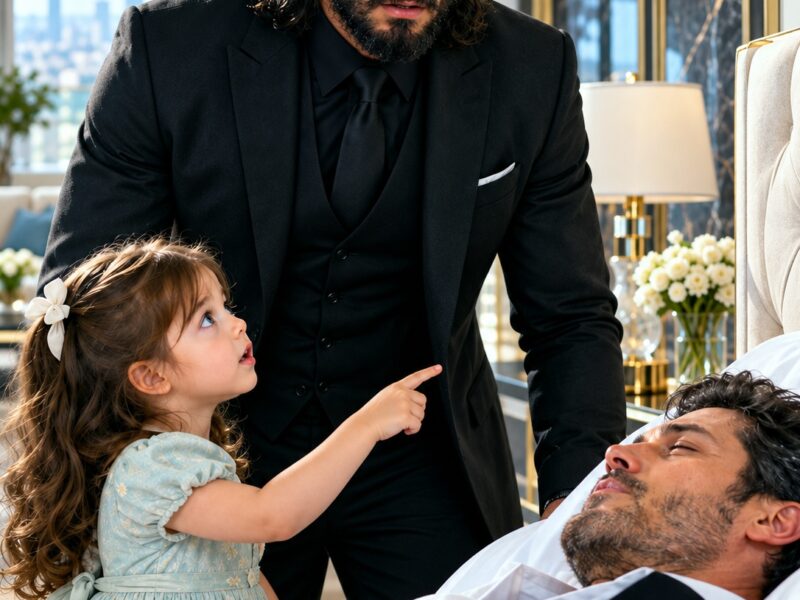
“Your Eyes Just Moved, Uncle,” the Maid’s Toddler Whispered—The Mafia Boss Froze
At 7:14 on a gray Thursday evening, three-year-old Mia Ruiz leaned over a hospital bed inside the east wing of the Moretti estate and whispered six words that made Dante Moretti forget how to breathe.
“Your eyes just moved, Uncle.”
The heart monitor kept beeping.
Rain tapped the tall windows.
The nurse beside the medication cart looked up so quickly that a capped syringe rolled against the tray.
Dante’s chair scraped backward.
“What?”
Mia did not understand why every adult in the room had suddenly become frightened.
She stood on the tips of her pink sneakers beside the bed, one small hand resting on the mattress.
The man lying there did not move.
Matteo Moretti looked almost peaceful if you ignored the shaved patch near his temple, the fading bruises along his jaw, the feeding tube taped beneath his nose, and the thin line running into his arm.
Three weeks earlier, he had taken two bullets while shielding his younger brother during an ambush on a quiet road outside Newark.
One round tore through his shoulder.
The other caused a head injury when he fell against the pavement.
He had undergone emergency surgery.
He had survived.
He had not meaningfully awakened.
At least that was what Dante had been told.
Mia blinked slowly.
“Like this.”
Dante was already at the bedside.
“Matteo.”
Nothing.
His voice sharpened.
“Matteo, look at me.”
The nurse stepped forward.
“Mr. Moretti—”
“Wait.”
Dante bent until his face was inches from his brother’s.
Matteo’s eyelids remained still.
Then Mia tugged on Dante’s sleeve.
“No.”
He looked down.
She pointed to herself.
“He looked at me.”
The room changed.
Elina Ruiz stood frozen in the doorway, one hand still wrapped around the linen basket she had nearly dropped when she discovered where her daughter had wandered.
“Mia.”
Her voice shook.
“Come here.”
Dante did not look away from the bed.
“Let her stay.”
Elina’s stomach tightened.
Nobody in the Moretti house ignored Dante casually.
Nobody argued with him in rooms where decisions were made.
But Mia was three.
Three-year-olds existed outside organizational charts.
She looked at Dante.
“Mr. Moretti, she shouldn’t be in here.”
“I know.”
“She touches everything.”
“I noticed.”
“She doesn’t understand—”
“I know.”
For the first time, he looked at Elina.
His face was exhausted.
Not irritated.
Not threatening.
Desperate.
“Please.”
That word frightened Elina more than an order would have.
Dante Moretti did not ask housekeepers for favors.
Elina placed the basket down.
“Mia stays beside me.”
Dante nodded.
Mia immediately ignored the spirit of the arrangement by walking closer to Matteo.
Elina caught her hand.
“Beside me.”
Mia frowned.
“But Uncle moved.”
“He is not your uncle.”
Mia looked confused.
“Mr. Sleeping?”
Dante made a sound that might have been a laugh if his life had been different.
The nurse did not.
Her name was Nina Patel, and unlike most people working in the Moretti estate, she was not impressed by reputations.
She had spent nine years in neurocritical care before accepting private nursing work.
She checked Matteo’s pupils.
Vitals.
Response to voice.
Pressure along the nail bed.
No purposeful movement.
“Pupils are reactive,” Nina said.
“They have been.”
Dante’s jaw tightened.
“So she imagined it.”
Nina looked at Mia.
“I didn’t say that.”
“What are you saying?”
“That one eye movement is not enough to tell us what it was.”
Dante stared.
Nina continued.
“People with severe brain injuries can have reflexive movement. They can also have periods of awareness that are easy to miss.”
Dante’s face changed.
“Easy to miss?”
“Yes.”
“Three specialists have examined him.”
“Yes.”
“And you’re telling me a toddler may have seen something they didn’t.”
“I’m telling you specialists don’t stand beside him twelve hours a day.”
Nina nodded toward Mia.
“And children stare.”
Mia nodded enthusiastically.
“I stare.”
Elina closed her eyes.
Dante pulled the chair closer to the bed.
“Matteo.”
He took his brother’s hand.
“If you can hear me, squeeze.”
Nothing.
Dante waited.
Five seconds.
Ten.
Twenty.
Nothing.
The hope that had flashed through his expression went somewhere darker.
He released Matteo’s hand.
Mia climbed onto the empty chair beside the bed before Elina could stop her.
“Mia.”
“I’m sitting.”
“That is not the issue.”
Mia looked at Matteo.
“Do it again.”
Dante almost smiled.
Nina did not stop her.
The room settled.
Monitor.
Rain.
Breathing.
Mia swung one foot.
Then stopped.
Matteo’s left eyelid fluttered.
Once.
Tiny.
Gone.
Mia gasped.
“There.”
Dante stood.
Nina stepped to the bed.
“Matteo?”
No response.
She reached for a penlight.
Before she touched him, the door opened.
Dr. Raymond Castellano entered carrying a leather medical bag.
He had been the Moretti family physician for twelve years.
Silver at his temples.
Expensive glasses.
A voice designed to sound calm in rooms where people were not.
“What happened?”
Dante turned.
“He moved.”
Castellano looked at Nina.
“What kind?”
“Possible eye tracking.”
“Possible?”
Mia spoke.
“He looked at me.”
Castellano’s gaze landed on her.
Only for a second.
That second bothered Elina.
The doctor looked at the child before he looked at the patient.
Then he smiled.
A professional smile.
“Children are observant.”
Mia nodded.
“They are.”
Elina almost laughed.
Castellano opened his bag.
“Let’s not build expectations from an eyelid flutter.”
Dante’s eyes hardened.
“It was twice.”
“Then let’s examine him.”
He did.
More thoroughly than Elina understood.
Pupils.
Reflexes.
Pain response.
Sound.
No reproducible command following.
Castellano straightened.
“No meaningful change.”
Dante stared at his brother.
Mia looked angry.
“He did it.”
Castellano softened his tone.
“I’m sure you saw something.”
“I saw his eyes.”
“Yes.”
“Moving.”
“Yes.”
“Then why you say no?”
Nobody answered immediately.
Dante looked at the doctor.
Good question.
Castellano gave Mia the smile adults used when they wanted to move past children without saying they were wrong.
“Bodies can move without people choosing the movement.”
Mia considered.
“Like hiccups?”
“Yes.”
She nodded.
Then pointed at Matteo.
“He didn’t hiccup.”
Nina looked down.
Dante almost laughed again.
Castellano did not.
“Mr. Moretti,” he said, “may I speak with you outside?”
“No.”
A beat.
“Dante.”
“Here.”
Castellano lowered his voice.
“Hope is valuable, but false hope can be cruel.”
Dante’s expression went flat.
“I am familiar with cruelty.”
Castellano stopped.
Elina took Mia’s hand.
“We should go.”
This time Dante nodded.
As they reached the door, Mia looked back.
“Bye, Uncle.”
Elina sighed.
“He is still not your uncle.”
Mia waved anyway.
Matteo’s eyelids did not move.
But the moment Elina stepped into the corridor, she heard Dante behind her.
“Tomorrow.”
She turned.
He stood in the doorway.
“Would you bring her back tomorrow?”
Elina stared.
“My daughter is not a medical test.”
“No.”
The answer came immediately.
“I know.”
“Then why?”
Dante looked past her toward Mia.
“Because for three weeks everyone in that room has looked at machines.”
His voice lowered.
“She looked at him.”
Elina wanted to say no.
She wanted to take her child back to their apartment in Newark, resign in the morning, and stop living inside a house where men arrived at midnight and conversations died when she entered rooms.
Instead she asked, “Will Dr. Castellano be there?”
Dante glanced toward the room.
“Yes.”
“Then Nina stays too.”
Dante looked at her.
“Nina stays.”
“And I stay.”
“Obviously.”
“Nothing is done to Mia. No questions that scare her. No treating her like she has some special gift.”
Dante’s mouth tightened.
“I don’t believe in gifts.”
“Good.”
“I believe in observations.”
Elina looked at him.
That was somehow worse.
“Twenty minutes.”
“Agreed.”
Mia tugged her hand.
“Can Uncle have my yellow crayon tomorrow?”
Dante looked down at her.
“Why?”
“You don’t have colors.”
For the first time in three weeks, Dante Moretti smiled.
Barely.
But Elina saw it.
So did Castellano.
And when Elina glanced back at the doctor, his expression was not relief.
It was calculation.
That night, Dante did not leave Matteo’s room.
He almost never did anymore.
The estate’s east wing had once been designed for guests who required privacy from photographers and business rivals.
Now one bedroom had become a private medical suite.
Portable imaging equipment had come and gone.
Monitors glowed through the night.
Nurses rotated every twelve hours.
Castellano supervised everything.
Dante sat in the same leather chair beside the bed.
His brother had always hated that chair.
Too formal.
“Looks like something a funeral director owns,” Matteo had said the day the room was furnished.
Dante looked at him now.
“You always hated this chair.”
Nothing.
Dante leaned forward.
“Move your eyes.”
Nothing.
“You hear me?”
The monitor answered.
Dante rubbed both hands over his face.
He was forty-two years old.
He controlled Moretti Maritime, two warehousing companies, several legitimate construction partnerships, and a criminal organization whose name never appeared on incorporation documents.
None of that mattered beside a bed.
Power became embarrassing around medical equipment.
Machines did not fear reputations.
Cells did not negotiate.
Swelling did not accept payment.
Three weeks earlier, Dante and Matteo had left a late meeting near Jersey City.
Their route changed at the last minute.
Only six people knew.
A black SUV blocked the road.
Two masked men opened fire.
Matteo saw the first muzzle flash before Dante did.
He shoved Dante down.
The first bullet struck Matteo’s shoulder.
The second shot missed.
Matteo hit the pavement.
His head struck the curb.
The attackers fled when Dante’s security car returned fire.
Matteo stopped responding in the ambulance.
Dante had replayed the moment so many times it no longer felt like memory.
It felt like punishment.
Castellano told him the brain injury was severe.
Unpredictable.
Matteo might wake.
Might not.
His imaging showed damage but nothing that made recovery impossible.
Days became a week.
Then two.
Then three.
Each day the language got softer.
We need time.
The brain is complicated.
There’s no way to know.
Dante hated phrases with no enemy inside them.
He had spent his adult life solving problems by identifying the person responsible.
Illness was intolerably impersonal.
Now a three-year-old claimed Matteo’s eyes had moved.
Dante looked toward the IV pump.
Then the chart.
He did not understand half of it.
For the first time, that irritated him.
The door opened quietly.
Marco DeLuca entered.
Fifty-one.
Dante’s security chief.
His oldest friend after Matteo.
“Anything?”
“No.”
Marco stood near the wall.
“Castellano says—”
“I know what Castellano says.”
Marco waited.
Dante looked at him.
“You think the kid imagined it.”
“I think she’s three.”
“So?”
“So three-year-olds also believe dogs understand taxes.”
Dante almost smiled.
Almost.
“Matteo looked at her.”
Marco said nothing.
Dante continued.
“You know what’s strange?”
“A lot of things.”
“Everyone keeps telling me what he did not do.”
Marco frowned.
“Meaning?”
“No one says, ‘Let’s find out if he did.’”
“You have specialists.”
“I have specialists Castellano selected.”
Marco’s posture changed slightly.
“You’re suspicious of Raymond?”
“I’m suspicious of everyone.”
“That’s normal for you.”
“Not enough, apparently.”
Marco looked at Matteo.
The ambush had bothered him too.
Six people knew the route.
Two were in the vehicle.
Dante.
Matteo.
Marco had known.
Castellano did not.
Vittorio Bellini, the family consigliere, had known because he scheduled the meeting.
Two operations captains knew enough to prepare alternate vehicles.
All had been investigated.
Nothing.
Marco said, “You want an independent neurologist.”
Dante looked at him.
“I want someone Castellano does not choose.”
“Done.”
“And no one knows until they arrive.”
Marco nodded.
“That includes Vittorio?”
Dante hesitated.
Vittorio Bellini had known Dante since he was nine.
Had advised his father.
Had arranged Matteo’s law-school tuition before Matteo abandoned law for the family business.
Had held Dante’s mother upright at her husband’s funeral.
The question felt obscene.
“Yes.”
Marco did not react.
“Done.”
The next morning, Mia arrived carrying a yellow crayon.
She also carried a stuffed rabbit missing one ear.
Elina carried suspicion.
“Twenty minutes.”
Dante nodded.
Castellano was already in the room.
Nina checked Matteo’s vitals.
Mia climbed onto the chair.
“Hi, Uncle.”
Castellano corrected her.
“Mr. Moretti.”
Mia looked at him.
“No.”
Dante turned away to hide the smile.
Mia took Matteo’s hand.
“You want yellow?”
No response.
She put the crayon gently into his palm.
It rolled away.
She picked it up.
“You need fingers.”
Elina whispered, “Mia.”
“What?”
“Just talk.”
Mia thought.
Then began describing breakfast.
Toast.
Strawberries.
One strawberry had “a bad side.”
Dante listened.
Nina charted.
Castellano checked his watch.
Mia moved closer.
Matteo’s fingers twitched.
Nina saw it.
Dante saw Nina see it.
No one spoke.
Mia looked down.
“He wants it.”
The yellow crayon rested between Matteo’s index finger and thumb where she had placed it.
His fingers curled.
Slowly.
Weakly.
Not enough to hold.
Enough to move.
Dante was beside the bed instantly.
“Matteo.”
Nina stepped closer.
“Don’t overload him.”
Castellano said, “Could be flexor reflex.”
Mia frowned.
“He squeezed.”
Nina looked at the doctor.
“It was sustained for almost two seconds.”
“Still can be reflexive.”
Dante turned.
“What would count for you?”
Castellano’s face remained calm.
“Reproducible command following.”
Dante looked down.
“Matteo, squeeze again.”
Nothing.
Castellano waited.
There.
Dante felt it.
A tiny easing in the doctor’s shoulders.
Relief.
Why would a doctor be relieved when a patient failed to respond?
Dante stored the question.
Mia continued talking.
Five minutes later, Matteo’s eyelids fluttered.
Then again.
His eyes opened one millimeter.
Closed.
Nina stepped back.
“Okay.”
Castellano’s head snapped toward her.
“What?”
“That was more organized.”
“Or spontaneous.”
Nina looked at him.
“Maybe.”
Castellano reached for the medication chart.
“We should increase his evening sedative if these episodes are agitation.”
Dante turned slowly.
“Agitation?”
“Autonomic arousal can appear—”
“He opened his eyes.”
“Yes.”
“And your answer is more sedative.”
Castellano’s expression tightened.
“His brain needs rest.”
Dante looked toward Nina.
She did not speak.
That silence told him something.
Elina felt the tension and stood.
“We’re done.”
Dante looked at her.
“Right.”
Mia protested.
“But Uncle—”
“Twenty minutes.”
Mia sighed.
She put the yellow crayon on the bedside table.
“For later.”
They left.
Castellano began reviewing the pump.
Dante watched his hands.
Steady.
Professional.
Too fast.
That afternoon, Dr. Rebecca Sloan arrived at the estate.
Nobody except Marco and Dante knew she was coming.
She was a neurologist from a Manhattan academic hospital, specializing in disorders of consciousness after severe brain injury.
Castellano found her in Matteo’s room at 4:20.
His face changed.
“Rebecca.”
She looked up.
“Raymond.”
“You didn’t tell me you were consulting.”
Dante answered.
“I did not know I required permission.”
Castellano recovered.
“Of course not. I simply wish I had prepared the records.”
Sloan held up the chart.
“I have them.”
Castellano looked toward Nina.
Nina’s expression remained neutral.
Dante said, “Examine him.”
Sloan spent nearly an hour.
Not one quick test.
Repeated commands.
Visual tracking.
Response to familiar voices.
Pain localization.
Auditory stimulation.
She changed the angle of the blinds.
Used a mirror.
Asked Dante to speak from different sides.
Matteo did almost nothing.
Then Sloan held up a red pen and moved it slowly from left to right.
Matteo’s eyes followed.
Barely.
But they followed.
Once.
Again.
Sloan stopped.
Dante’s heart hammered.
“What?”
She did not answer immediately.
She repeated the test.
Then asked Nina to do it.
Matteo tracked again.
Sloan looked at Dante.
“This is not coma.”
Castellano’s face went still.
“What are you saying?”
“At minimum, he is showing signs consistent with a minimally conscious state.”
Dante stared.
“Meaning?”
“He may have intermittent awareness.”
“How long?”
“We cannot know.”
Dante looked at Castellano.
The doctor answered before being asked.
“Minimally conscious states can be difficult to distinguish.”
Sloan nodded.
“That’s true.”
Dante looked back.
“So he could hear me.”
Sloan chose her words.
“Possibly.”
The room seemed to tilt.
Three weeks.
Every night.
Dante talking beside him.
Apologizing.
Threatening the men who did it.
Promising things he could not guarantee.
Matteo might have heard.
Sloan continued.
“There is another issue.”
She held up the medication sheet.
“Why is he still receiving lorazepam twice daily?”
Castellano stepped closer.
“For episodic agitation.”
“What agitation?”
“Increased heart rate. Motor activity.”
Sloan looked at Nina.
“Have you witnessed agitation?”
Nina shook her head.
“No purposeful agitation.”
Castellano said, “Not during her shifts.”
Sloan kept reading.
“This dose could suppress arousal and make neurologic assessment less reliable.”
Dante turned toward Castellano.
The doctor’s face stayed composed.
“It is within accepted use.”
“That was not her question.”
Castellano looked at him.
Dante’s voice lowered.
“Why are you giving my brother medication that makes it harder to know whether he is waking up?”
Castellano’s eyes hardened.
“Because unmanaged agitation after traumatic brain injury can be dangerous.”
Sloan said, “Then document the episodes.”
Silence.
She turned another page.
“I don’t see the episodes documented.”
Castellano looked at her.
“I have been managing this patient continuously.”
“And I’m reviewing the record you created.”
Dante’s jaw tightened.
Sloan raised a hand.
“We don’t decide intent from a chart.”
Good.
Dante needed that sentence.
He did not like needing it.
“What do we do?”
“Taper unnecessary sedating medication. Structured assessments. Continuous observation. Imaging update. EEG.”
Castellano said, “Moving him would be risky.”
“We can bring the equipment.”
Dante looked at Marco.
“Do it.”
Castellano opened his mouth.
Dante stopped him.
“You remain his physician for now.”
For now.
The words landed.
That evening, Elina returned to collect a forgotten sweater from the east hall.
She heard Castellano before she saw him.
The medical supply room door stood open two inches.
His voice was low.
“…starting to respond more.”
Elina stopped.
“I know.”
Pause.
“No.”
His tone sharpened.
“I said no. I am not increasing it again.”
Elina’s heartbeat changed.
Another pause.
“The girl noticed before anyone.”
Silence.
“I can’t keep saying reflexes if Sloan keeps testing him.”
Elina stepped backward.
Her heel nearly struck a brass umbrella stand.
She caught herself.
Castellano continued.
“No, listen to me. This has gone far enough.”
Elina left.
Slowly.
Then faster.
She took the staff stairs two at a time.
At the landing, she stopped and pressed one hand over her mouth.
Mia was downstairs with Mrs. Alvarez.
Safe.
The rational thing would have been to say nothing until she understood.
Elina had survived inside the Moretti house by knowing the value of silence.
Silence kept jobs.
Silence kept people away from questions that did not belong to them.
Silence kept a single mother with rent due and a child needing preschool from becoming unemployed over adult secrets.
But the sentence would not leave her.
I am not increasing it again.
What?
Medication?
Sedation?
Something worse?
Elina did not sleep.
The next morning, she asked Mrs. Alvarez to take Mia to the park.
Then she walked into Dante Moretti’s study without an appointment.
Marco caught her at the door.
“Elina.”
“I need to see him.”
“About?”
“Dr. Castellano.”
Marco’s face changed.
The door opened.
Dante stood behind it.
“Come in.”
Elina’s mouth went dry.
She entered.
The study smelled like coffee and rain.
Dante closed the door.
“What happened?”
She told him.
Every word she remembered.
Not what she thought it meant.
What she heard.
Dante interrupted once.
“What exact phrase?”
“‘I am not increasing it again.’”
“Then?”
“‘The girl noticed before anyone.’”
Dante looked at Marco.
Marco had become very still.
Dante asked, “Did he say who was on the phone?”
“No.”
“Name?”
“No.”
“Anything about Matteo?”
“He said Sloan keeps testing him.”
Silence.
Dante sat.
Not because he was calm.
Because something in him had become dangerous enough that standing seemed unwise.
“My brother gets shot protecting me.”
His voice sounded almost conversational.
“Then the doctor managing him gives medication that suppresses consciousness.”
Marco said, “We don’t know why.”
Dante looked at him.
Marco continued.
“We know enough to investigate. Not enough to accuse.”
Dante’s hands flattened on the desk.
He breathed.
Once.
Twice.
Elina watched the fight happen inside him.
The old instinct.
Find the person.
Apply pressure until truth appeared.
Then something else.
Mia saying the eyes moved.
Sloan saying a chart did not prove intent.
Elina repeating what she heard instead of what she feared.
Dante looked at Marco.
“Get the pump audit.”
“Already requested.”
“Phone records?”
“Need legal route if we want usable evidence.”
Dante hated that sentence.
“Do it legally.”
Marco’s eyebrows lifted slightly.
Dante saw.
“Don’t.”
“I didn’t say anything.”
“You thought it.”
“Yes.”
“Do it legally.”
Marco nodded.
Dante looked at Elina.
“You did the right thing.”
She almost laughed.
“I don’t know that.”
“You told me what you heard.”
“Yes.”
“Not what you wanted it to mean.”
“No.”
“That is rare in this house.”
The words were not a compliment to the house.
“Where is Mia?”
“With Mrs. Alvarez.”
“Good.”
Elina hesitated.
“Mr. Moretti.”
“Yes?”
“If this becomes dangerous, I take her home.”
Dante stared at her.
Then nodded.
“You decide.”
That mattered.
Later, it would matter much more.
The medication pump audit arrived by noon.
The log showed something the handwritten chart did not.
Three additional doses of lorazepam had been entered manually over the previous ten days under Castellano’s physician credentials.
Two occurred hours after episodes of increased eye movement or hand activity documented by Nina.
One occurred the night before Dr. Sloan arrived.
Marco placed the printout on Dante’s desk.
Evidence item one.
Not proof of conspiracy.
Proof of a question.
Dante read the times.
“Who administered?”
“Castellano.”
“Could it be medically reasonable?”
“Sloan says possibly, but the documentation does not support the reason.”
“Phone.”
Marco placed a second sheet down.
Evidence item two.
Castellano had called the same prepaid number seven times in two weeks.
Each call occurred shortly after documented changes in Matteo’s neurologic status.
The number itself was not registered to a name.
But cell-site data obtained through counsel’s investigator placed the phone near Moretti offices twice.
And once at Vittorio Bellini’s private club.
Dante stopped reading.
The room went quiet.
Marco said nothing.
He did not need to.
Vittorio.
The man who had helped raise them.
The man who sat at their father’s deathbed.
The man who taught Dante how to read contracts before he was old enough to drive.
The man who knew the route the night of the ambush.
Dante closed the folder.
“No.”
Marco’s voice remained even.
“No what?”
“No conclusions.”
Marco almost smiled.
“You’re learning.”
“Do not enjoy this.”
“Trying not to.”
Dante looked toward the window.
“Bring Vittorio here.”
“Now?”
“No.”
He looked at the audit logs again.
“If he’s involved, calling him now tells him we know something.”
Marco nodded.
“What instead?”
Dante looked at him.
“We let him think Matteo is getting worse.”
Marco’s expression sharpened.
“And Castellano?”
“We let him think we believe him.”
That evening, Dante dismissed Dr. Sloan publicly.
Not actually.
She moved to a guesthouse under another name and continued reviewing Matteo’s care through Nina.
Castellano was told the outside consultation had been “unhelpful.”
He relaxed.
Not much.
Enough.
Matteo’s sedating medication was quietly tapered under Sloan’s instructions, but the medication chart available to Castellano showed the prior schedule.
Nina altered nothing illegal.
She kept two records.
The actual administered doses were documented in a secure system controlled by outside counsel.
The visible bedside copy reflected scheduled orders, not actual administration.
For twenty-four hours, nothing happened.
Then Mia returned.
Elina almost refused.
Dante did not argue.
He simply said, “You decide.”
That was why she agreed.
Not because he was powerful.
Because he had finally stopped using power to make every decision.
Mia entered Matteo’s room carrying the yellow crayon.
“Uncle.”
Elina sighed.
“We gave up?”
Dante looked at her.
“Apparently.”
Mia climbed onto the chair.
Nina sat nearby.
Dr. Sloan watched remotely through a secured monitor.
Dante remained at the foot of the bed.
Mia took Matteo’s hand.
“You have to wake up.”
No response.
“Your brother is grumpy.”
Dante looked offended.
Elina covered her mouth.
Mia continued.
“He needs you.”
Matteo’s fingers moved.
Dante’s eyes widened.
Mia squeezed back.
“Do it again.”
Matteo squeezed.
Weak.
Purposeful.
Nina whispered, “Again.”
She touched Matteo’s shoulder.
“Matteo, squeeze if you can hear me.”
Nothing.
She waited.
“Matteo, squeeze Mia’s hand.”
His fingers tightened.
Dante turned away.
For three seconds.
Only three.
Then he faced the bed again.
His eyes were wet.
“Elina.”
She looked at him.
He nodded toward Mia.
“She saw him.”
It was not worship.
Not miracle.
Not a child with special powers.
Just truth.
Mia had looked without assuming nothing was there.
Within an hour, Sloan arrived.
This time no one told Castellano.
Structured testing showed repeated visual tracking.
Command following.
A purposeful finger movement.
Matteo was not fully awake.
But he was there.
Dante sat beside him.
“Matteo.”
The eyelids fluttered.
“Can you hear me?”
A pause.
Then one slow blink.
Sloan leaned forward.
“Matteo, blink twice for yes.”
One.
Two.
Dante’s face crumpled.
Marco looked away.
Elina pulled Mia close.
Dante whispered, “Have you heard me all this time?”
Two blinks.
His brother had heard him.
Three weeks.
Dante lowered his head.
When he spoke, the words came rough.
“I’m sorry.”
Matteo’s eyes moved.
Not enough to answer.
Enough to see him.
The door opened.
Castellano entered.
He stopped.
Everyone looked at him.
Matteo’s eyes moved toward the doctor.
Then his heart rate increased.
Nina noticed.
Sloan noticed.
Dante noticed.
Castellano put his bag down slowly.
“What is she doing here?”
Dante stood.
“Helping my brother wake up.”
Castellano looked toward the monitor.
Then Matteo.
His face drained.
Dante did not raise his voice.
“Raymond.”
The doctor looked at him.
“Sit.”
Castellano sat.
Dante placed the pump audit on the table.
Then the phone record.
The doctor stared.
His hands began to shake.
“What is this?”
“You tell me.”
Castellano swallowed.
“The medication was clinically—”
“Stop.”
Dante’s voice remained quiet.
“You called a prepaid number every time my brother showed signs of waking.”
Castellano looked toward the door.
Marco stood there.
No threat.
No need.
“Who were you calling?”
No answer.
Dante’s jaw tightened.
“Do not make me ask differently.”
Sloan spoke.
“Dante.”
One word.
Reminder.
Evidence.
Not force.
Dante breathed.
Then sat across from Castellano.
“Who?”
The doctor closed his eyes.
“Vittorio.”
Elina felt her stomach drop.
Dante did not move.
Marco did.
One small shift.
Nothing more.
“Why?”
Castellano looked toward Matteo.
“He told me the ambush went wrong.”
Silence.
Dante’s voice became almost inaudible.
“Say that again.”
“He said Matteo was supposed to die on the road.”
Nina covered her mouth.
Dante’s hands clenched.
Castellano continued quickly.
“You were supposed to be injured.”
“What?”
“Not killed.”
Dante laughed once.
Empty.
“That comforts me.”
“Vittorio wanted the board scared.”
“What board?”
“The shipping board. The captains. Everyone.”
Dante’s face hardened.
Castellano swallowed.
“He said you were moving too much legitimate business away from the old operations. Matteo was pushing you.”
That was true.
Matteo had spent two years arguing for legal expansion.
Fewer street operations.
More ports.
Warehousing.
Construction.
Money that did not require men with guns to remain loyal.
Vittorio called it surrender.
Dante called it evolution.
The arguments had become louder.
Castellano continued.
“Vittorio said if Matteo was gone and you were hurt, the old structure would take over during recovery.”
“And then?”
“He would keep control.”
Dante stared.
“Why sedate Matteo?”
“Because he started showing awareness after the first week.”
“You knew.”
“Yes.”
“You knew he could hear.”
Castellano’s eyes filled.
“I suspected.”
“And you kept him under.”
The doctor looked sick.
“Vittorio threatened my daughter.”
Dante said nothing.
“She lives in Boston. Two kids.”
Castellano’s voice broke.
“He knew their school.”
Elina felt cold.
“He said if Matteo woke enough to speak before he had time to clean things up, my daughter would disappear.”
Dante looked at him.
“So you chose mine.”
Castellano flinched.
“Yes.”
The truth sat there.
Ugly because it was understandable.
Not excusable.
Understandable.
Dante looked toward Matteo.
His brother’s eyes were open.
Barely.
Watching.
“I should destroy you.”
Castellano nodded.
“I know.”
Dante’s hands trembled.
Then he looked at Mia.
Three years old.
Holding the yellow crayon.
Not understanding words like conspiracy or betrayal.
Only knowing the man in the bed had moved.
Dante looked back at Castellano.
“You will cooperate.”
The doctor blinked.
“What?”
“You will give counsel every message. Every instruction. Every dose Vittorio told you to give.”
“Yes.”
“You will testify.”
Castellano’s face changed.
“He’ll kill my daughter.”
“No.”
Dante stood.
“Your daughter goes into protection through people who are not mine.”
Castellano stared.
“Police?”
“Federal investigators if they’ll take the case.”
Marco looked at Dante.
That was the second surprise of the day.
Dante continued.
“You will lose your license if the board decides you should.”
Castellano closed his eyes.
“You may go to prison.”
The doctor nodded.
“But I am not touching your family.”
Castellano began to cry.
Not gratitude.
Relief and shame tangled together.
Dante looked away.
“Marco.”
“Yeah.”
“Get him out.”
When the door closed, Dante sat beside Matteo.
“You heard all of that?”
Two blinks.
Dante laughed through tears.
“You always hated Vittorio.”
Matteo’s eyes moved.
One blink.
No.
Dante frowned.
Sloan said, “Use yes or no.”
Dante leaned closer.
“You trusted him?”
Two blinks.
Dante closed his eyes.
Of course.
That hurt worse.
Matteo slept for most of the next day.
Not sedated.
Exhausted.
Recovery would not be a dramatic awakening.
Sloan warned them.
He could improve.
Plateau.
Regress.
Communication might come before movement.
Memory could be incomplete.
Dante listened.
Really listened.
For the first time in weeks, he stopped asking for guarantees.
By the third day, Matteo could track reliably.
By the fifth, he whispered water.
By the sixth, he said Dante’s name.
On the seventh, he said another.
“Vittorio.”
Dante sat beside him.
“I know.”
Matteo’s eyes sharpened.
“No.”
His voice was a rasp.
“You don’t.”
Dante leaned closer.
“What?”
“He knew route.”
“Yes.”
Matteo swallowed.
“He changed it.”
Dante went still.
“What?”
“The alternate route.”
Dante looked at Marco.
Marco’s expression changed.
The ambush had not simply known their route.
Vittorio had created it.
Matteo continued.
“Meeting… fake.”
Dante felt the room narrow.
“Which meeting?”
“Port counsel.”
There had been no urgent counsel meeting.
Vittorio had invented the reason they left early.
He had not merely leaked information.
He had engineered the movement.
Matteo closed his eyes.
Dante touched his arm.
“Rest.”
Matteo opened them again.
“Don’t.”
“What?”
“Go angry.”
Dante almost smiled.
His brother knew him.
“Too late.”
“No.”
Matteo’s weak fingers moved.
Dante took his hand.
“Evidence.”
One word.
Matteo had spent years trying to pull Dante away from instinctive retaliation.
Even half-conscious, he was still doing it.
“Evidence,” Dante repeated.
Matteo closed his eyes.
Agreement.
Vittorio arrived at the estate that evening.
By invitation.
He wore a navy suit and carried no visible concern.
Seventy-one years old.
Elegant.
Silver hair.
The kind of man who never hurried because other people arranged time around him.
Dante met him in the library.
Marco stood near the window.
Daniel Hart, outside counsel, sat at the far end of the table.
No one else.
Vittorio smiled.
“You look better.”
“I slept.”
“Good.”
“How’s Matteo?”
“Worse.”
The lie came easily.
That bothered Dante.
Vittorio sighed.
“I’m sorry.”
Dante watched him.
Did he mean it?
Maybe.
People could love someone and still betray them.
That was becoming an unpleasant theme.
Vittorio poured himself water.
“You asked to see me.”
“Yes.”
Dante slid one document across the table.
Not the medical audit.
A shipping proposal.
Legal expansion.
The plan Matteo had been pushing before the ambush.
Vittorio’s face tightened.
“This again.”
“Yes.”
“Now?”
“Yes.”
“Your brother is dying and you want to restructure?”
Dante looked at him.
“If Matteo dies, I’m finishing what he started.”
Vittorio stared.
There.
Fear.
Small.
Real.
Dante had found the thing beneath the loyalty.
Vittorio said, “This dismantles the old revenue channels.”
“Some.”
“It weakens the captains.”
“Yes.”
“It weakens us.”
“No.”
“Dante.”
Vittorio leaned forward.
“Your father built power so nobody could move against this family.”
“My father died of a heart attack at sixty-two.”
“That is not the point.”
“No.”
Dante smiled faintly.
“It might be.”
Vittorio’s expression cooled.
“You’re grieving.”
“Probably.”
“Do not make permanent decisions from grief.”
“Interesting advice.”
Vittorio stared.
Dante continued.
“Where were you the night Matteo was shot?”
Vittorio did not blink.
“At the club.”
“Until?”
“Two.”
“Phone?”
“What about it?”
“You made six calls.”
Vittorio smiled.
“I make fifty.”
“Seven.”
“What?”
Dante leaned back.
“You made seven.”
For the first time, Vittorio looked uncertain.
The seventh call was not yet evidence.
Marco had discovered it an hour earlier.
A call to Castellano’s prepaid number from a secondary phone kept in Vittorio’s driver’s vehicle.
Vittorio looked toward Marco.
Marco gave him nothing.
Dante said, “You called Raymond after Nina documented Matteo’s first pupil response.”
Vittorio’s face remained controlled.
“Did I?”
“Yes.”
“And?”
“You tell me.”
Vittorio sat back.
“I think grief has made you suspicious.”
Dante smiled.
“I was suspicious before grief.”
“That is true.”
For a few seconds, the old relationship existed.
Almost warm.
Then Dante placed the second document on the table.
The medication audit.
Vittorio looked at it.
Then up.
“Raymond made medical decisions.”
“Raymond says you made them.”
Silence.
Vittorio’s face changed.
Not guilt.
Disappointment.
“He talked.”
“Yes.”
“He always was weak.”
Dante felt something inside him go still.
“Not denial.”
Vittorio realized the mistake.
He tried to recover.
“I am saying frightened men say many things.”
“Raymond has messages.”
“Fabricated?”
“Phone locations.”
“Circumstantial.”
“Matteo.”
Vittorio froze.
Dante watched.
There.
The truth.
Vittorio whispered, “He woke.”
Dante did not answer.
He did not need to.
Vittorio’s eyes closed.
Just once.
When he opened them, the old adviser was gone.
What remained was the strategist.
“How much did he say?”
“Enough.”
“Then you already decided.”
“No.”
Vittorio frowned.
Dante leaned forward.
“I wanted to hear you.”
The older man laughed quietly.
“You always were sentimental about confession.”
“My brother says I’m dramatic.”
“He’s right.”
Dante’s jaw tightened.
“Why?”
Vittorio looked toward the fire.
“Because somebody had to stop you.”
“From what?”
“Turning this family into a corporation.”
Dante almost laughed.
“We own corporations.”
“You know what I mean.”
Vittorio’s voice sharpened.
“Your father did not spend thirty years making our name feared so you could turn it into warehouse leases and compliance committees.”
“So you shot my brother.”
“I did not pull a trigger.”
“You created the road.”
Vittorio looked at him.
“Matteo was changing you.”
“Good.”
“No.”
The word cracked through the room.
Marco shifted.
Vittorio continued.
“He made you apologize to bankers. Negotiate with people your father would have buried.”
“My father buried problems until they grew children.”
Vittorio’s eyes hardened.
“You think legitimacy saves you?”
“No.”
Dante looked at him.
“I think fewer funerals might be worth trying.”
Vittorio’s face softened unexpectedly.
“You were eight when your father was shot.”
Dante went still.
“You remember what happened afterward?”
“Yes.”
“Everyone tested us.”
“I know.”
“I kept them away.”
“You helped.”
“I did more than help.”
There was the wound.
Vittorio had not simply wanted money.
He believed the Moretti family belonged partly to him because he had protected two boys through a brutal succession.
“I held this together.”
“Yes.”
“I taught you.”
“Yes.”
“I buried enemies while you were learning algebra.”
“Yes.”
Vittorio’s eyes burned.
“And now Matteo convinces you men like me are the problem.”
Dante shook his head.
“No.”
“Then what?”
“You convinced me.”
Silence.
Vittorio looked away.
Dante continued.
“You thought loyalty entitled you to decide whether my brother woke up.”
“He would have destroyed everything.”
“He would have argued.”
“He would have won.”
There.
Vittorio admitted the real fear.
Not weakness.
Influence.
Matteo’s voice mattered.
So Vittorio had tried to remove it.
Dante stood.
Vittorio did not.
“What happens now?”
The question sounded almost like the old days.
Student asking teacher.
Dante looked at Daniel Hart.
Counsel opened the library door.
Two investigators entered.
State organized-crime unit.
One federal agent.
Vittorio stared.
Then laughed.
“You called police.”
“Yes.”
“On me.”
“Yes.”
“You are handing family business to strangers.”
“I am handing attempted murder, conspiracy, and medical coercion to people whose job is to prove them.”
Vittorio stood.
“You think this makes you clean?”
“No.”
Dante’s voice stayed even.
“It makes this part evidence instead of vengeance.”
Vittorio looked toward Marco.
“Marco.”
Marco said nothing.
“You’re letting him do this?”
Marco’s face hardened.
“You had Matteo drugged.”
“For the family.”
“No.”
Marco stepped closer.
“For you.”
Vittorio looked old suddenly.
Not weak.
Just old.
Dante had never seen it.
The agents approached.
Vittorio looked at Dante one last time.
“You’ll regret choosing softness.”
Dante thought of Mia beside the bed.
Of Matteo’s eyes.
Of Elina standing in his study despite fear.
Of Castellano confessing because someone finally gave him a path other than terror.
“No.”
He said.
“I regret how long I mistook fear for strength.”
Vittorio left in handcuffs.
No gunfire.
No blood on marble.
No body disappearing before dawn.
The estate barely knew how to process it.
Neither did Dante.
For two days, he walked through rooms expecting his father’s ghost to call him weak.
Instead he heard Matteo asking for water.
That was better.
The investigation widened.
Vittorio’s financial records connected him to one Salerno intermediary.
The ambush was meant to injure Dante badly enough to trigger temporary operational authority.
Matteo was supposed to die because he would never support the arrangement.
Vittorio expected to hold control for weeks.
Long enough to reverse legal restructuring.
Long enough to move money.
Long enough to strengthen captains loyal to him.
Castellano’s role was uglier than cowardice and smaller than murder.
He had not created Matteo’s brain injury.
He had not administered lethal drugs.
He had prolonged sedation beyond what the record justified whenever Matteo showed signs of awareness.
He told himself he was buying time.
For Vittorio.
For his daughter.
For everyone.
The medical board suspended him.
Prosecutors charged him with evidence-related and patient-endangerment offenses.
Dante did not interfere.
When Castellano’s daughter entered protective custody, Dante paid nothing.
He wanted to.
Elina stopped him.
“You promised outside protection.”
“I can fund—”
“No.”
He looked at her.
“Why?”
“Because every time you solve something with your money, you make yourself part of the system people have to depend on.”
Dante stared.
“That is a rude thing to say to your employer.”
“I’m a maid.”
“You say that like immunity.”
“It helps.”
He almost smiled.
She continued.
“Let the program protect her because it’s supposed to.”
Dante hated it.
He agreed.
Matteo’s recovery took months.
The first week after fully waking, he slept eighteen hours a day.
Speech returned slowly.
Left-side weakness lingered.
He hated physical therapy.
He hated thickened liquids more.
He hated being helped to the bathroom most.
Mia remained unimpressed by all of it.
She visited once a week.
Only when Elina agreed.
Never because Dante asked twice.
On her first visit after Matteo could sit upright, Mia entered carrying the yellow crayon.
Matteo looked at it.
His voice was still rough.
“That yours?”
Mia shook her head.
“Yours.”
He smiled.
Dante stood near the window.
Matteo looked at him.
“You kept it?”
“She did.”
Mia put it on the table.
“You need fingers now?”
Matteo lifted his left hand.
Slowly.
Closed his fingers.
Opened them.
“Working on it.”
Mia nodded.
“Good.”
No cheering.
No pity.
Matteo liked her immediately.
Later, when Mia went to the kitchen with Elina, Matteo looked at Dante.
“You scared her mother.”
“Which time?”
Matteo laughed, then winced.
“Still funny.”
“Apparently.”
“You asked a toddler to sit beside a coma patient.”
“I asked her mother.”
“Good.”
Dante looked toward the door.
“She said yes.”
Matteo’s expression softened.
“You learned something.”
“Don’t start.”
“You’re using police.”
“Don’t start.”
“You spared Raymond’s family.”
“I did not spare Raymond.”
“Still.”
Dante sat.
For a while they were quiet.
Then Matteo asked, “Vittorio?”
“In custody.”
“Alive?”
“Yes.”
Matteo looked surprised.
“Wow.”
“Everyone is very impressed.”
“I am.”
Dante’s mouth tightened.
Matteo continued.
“You wanted to kill him.”
“Yes.”
“Why didn’t you?”
Dante looked toward the yellow crayon.
“Because he wanted the old version of me.”
Matteo understood.
“That’s going to make him furious.”
“Good.”
They both laughed.
It hurt Matteo.
Still worth it.
Elina stayed at the Moretti estate another six months.
Not because Dante demanded it.
Because she needed the income.
Mia’s preschool cost money.
Rent cost money.
Groceries cost money.
Heroes in stories often forgot that.
Elina did not.
Dante offered a raise.
She accepted.
He offered a house.
She refused.
He looked offended.
“I owe you.”
“No.”
“You told me the truth.”
“That was free.”
“Your daughter found my brother.”
“She saw his eyes move.”
“That changed everything.”
Elina looked at him.
“No.”
He frowned.
“It did.”
“The truth changed everything.”
She folded a towel.
“Mia just pointed at it.”
Dante stayed quiet.
That distinction mattered.
Eventually, he created a formal childcare benefit for household staff.
Not named after Mia.
Not charity.
Part of employment.
Elina agreed with that.
“Why didn’t we have this before?”
Dante asked Marco.
Marco looked at him.
“You never asked.”
Dante hated the answer.
He deserved it.
Elina used the program three afternoons a week.
Mia preferred Mrs. Alvarez.
Mrs. Alvarez preferred rules.
Mia ignored both.
The estate recovered its rhythm.
Different.
Not softer exactly.
More honest.
People still lowered their voices around Dante.
Just less often for the wrong reasons.
Marco created a security protocol requiring two-person confirmation for route changes.
Medical decisions for household family members went through independent review.
No single physician controlled records.
No single adviser controlled access.
No one person held every key.
Matteo insisted on that last rule.
“Because one person always eventually decides the house belongs to him.”
Dante looked at him.
“That sounds aimed.”
“It is.”
By spring, Matteo could walk with a cane.
The first time he crossed the east hall, staff pretended not to stare.
Mia did not pretend.
“You walk funny.”
Elina nearly died.
Matteo laughed.
“So do you.”
“I’m three.”
“Excuse.”
Dante leaned against the wall.
For once, nobody in the mansion looked afraid.
Mia held out one hand.
Matteo took it.
They walked ten steps together.
Slow.
Uneven.
Real.
Dante looked away.
Elina saw.
“You’re crying.”
He glared.
“No.”
She smiled.
“Your eyes moved.”
He looked at her.
Then laughed.
A year after the ambush, the Moretti organization looked different on paper.
Moretti Maritime expanded.
The warehousing business absorbed two smaller legal competitors.
Several street operations were sold, closed, or separated from Dante’s direct control.
Not because Mia changed organized crime.
Not because Matteo woke into sainthood.
Because the conspiracy forced Dante to examine a structure where loyalty had no independent check and fear was treated as proof.
Some men left.
Some called him weak.
One captain defected to the Salernos.
Dante let him.
Marco asked if that was wise.
“No.”
Dante looked at the departure report.
“But keeping someone who wants to leave is not loyalty.”
Matteo, reading from the sofa, smiled.
“Write that down.”
“Shut up.”
Physical therapy had made him unbearable.
Elina eventually left housekeeping.
On her own terms.
A neighborhood bakery near her apartment needed an assistant manager.
Better hours.
Health insurance.
She applied.
Got it.
Dante learned after she accepted.
“You were going to tell me?”
“I’m telling you.”
“You already accepted.”
“Yes.”
He looked personally betrayed.
“You hate change.”
“I hate being informed after decisions.”
Elina crossed her arms.
“Interesting.”
He realized.
Then laughed.
“Fine.”
“You’ll survive.”
“Apparently.”
Her final day at the estate, Mia ran through the east wing as though hallways had always belonged to children.
She stopped at Matteo’s old medical room.
It had become a guest room again.
No monitors.
No antiseptic smell.
No nurse cart.
The leather chair remained.
Mia looked inside.
“Uncle slept there.”
Elina smiled.
“Yes.”
“He didn’t sleep.”
“What?”
“He listened.”
Elina stopped.
Mia had understood more than anyone realized.
“Maybe.”
Mia walked inside.
The yellow crayon sat in a glass cup on the shelf.
Matteo had left it there.
Mia took it.
Then changed her mind.
Put it back.
“Why leave it?”
She shrugged.
“He might need it.”
Elina said nothing.
At the front door, Dante waited.
No envelope.
No giant check.
Elina had told him twice not to make goodbye into debt.
He listened.
Mostly.
He handed her a small box.
“What is this?”
“Not money.”
She opened it.
Inside was a framed photograph.
Mia sitting beside Matteo’s bed.
Not posed.
Her small hand holding his.
Matteo’s eyes barely open.
Elina looked at Dante.
“Who took this?”
“Nina.”
“When?”
“The second week.”
Elina swallowed.
“She noticed too?”
“She said she was not sure enough to say.”
“Before Mia?”
“After.”
Elina looked at the photograph.
Dante continued.
“I kept thinking Mia saved him.”
Elina looked up.
“She didn’t.”
“I know.”
He nodded.
“She made us stop assuming there was nothing to see.”
That was right.
Elina closed the box.
“Thank you.”
Dante shifted uncomfortably.
Gratitude still made him suspicious.
Mia hugged his leg.
“Bye, Uncle Dante.”
Dante looked down.
“You upgraded me?”
“You’re uncle.”
“Since when?”
“Today.”
“Why?”
Mia considered.
“Because.”
Reason enough.
Dante crouched.
“Hug?”
Mia nodded.
He hugged her.
Then let go first.
That mattered too.
Matteo came down the hall with his cane.
“You’re leaving without saying goodbye?”
Mia ran to him.
“You’re slow.”
“I was shot.”
“Excuse.”
Matteo laughed.
Elina watched the brothers.
Same eyes.
Different scars.
Both alive.
Outside, the morning was bright.
No rain.
No black cars arriving.
No nurses whispering.
Just Mia arguing with Matteo about whether yellow was the best crayon color.
Years later, the story became simpler in other people’s mouths.
A toddler saw a mafia boss’s unconscious brother move.
The child saved him.
The doctor betrayed the family.
The consigliere fell.
Simple stories traveled well.
Truth did not.
Truth required more space.
Mia did not wake Matteo by talking to him.
She did not possess some innocence powerful enough to reverse traumatic brain injury.
She noticed a movement everyone else had been trained to dismiss.
Nina saw enough to stay curious.
Elina overheard enough to risk speaking.
Dr. Sloan tested instead of assuming.
Marco followed evidence instead of loyalty.
Castellano eventually chose confession over continued fear.
Matteo fought his way through months of recovery.
And Dante made the one decision nobody in his organization expected.
He refused to let betrayal turn him back into the man Vittorio needed him to be.
That was the harder rescue.
Not Matteo’s.
Dante’s.
Five years after the ambush, Mia was eight.
She still visited sometimes.
Usually because Matteo bribed her with cannoli.
Dante claimed this violated every nutritional standard he had ever paid experts to write.
Nobody cared.
One Sunday afternoon, Mia sat in the garden with Matteo.
His cane rested against the bench.
He no longer needed it every day.
Dante joined them carrying coffee.
Mia looked at Matteo.
“Do you remember me seeing your eyes?”
“Not seeing.”
“What?”
“I remember hearing.”
She frowned.
“You heard me?”
“A little.”
“What did I say?”
“You called me Uncle.”
“That’s because you are.”
Matteo smiled.
“I wasn’t then.”
“You were sleeping. You didn’t know.”
Dante sat.
Mia looked at him.
“Were you scared?”
“Yes.”
“More than now?”
Dante thought.
“Yes.”
“Why?”
He looked at Matteo.
“Because I thought losing him was the only thing that could happen.”
Mia did not understand.
Matteo did.
Dante continued.
“I forgot other things could happen too.”
“Like waking up?”
“Yes.”
“Like bad doctor?”
Dante almost smiled.
“Yes.”
“Like bad old man?”
Matteo laughed.
“Vittorio is now ‘bad old man.’”
“Accurate,” Dante said.
Mia leaned back.
“I knew Uncle was there.”
Dante shook his head.
“You knew his eyes moved.”
“Same.”
“No.”
He smiled.
“Not the same.”
Mia considered.
Then shrugged.
Adults loved distinctions.
Children used fewer.
Dante looked toward the east wing.
The window of the former medical room reflected afternoon sun.
For years, his instinct had been to turn every uncertainty into certainty by force.
Who betrayed us?
Who threatens us?
Who pays?
Who disappears?
Matteo’s injury taught him something humiliating.
Sometimes the first duty was not to answer.
It was to look again.
A person could be wrong about what silence meant.
A doctor could mistake sedation for safety.
A family could mistake obedience for loyalty.
A brother could mistake power for protection.
And a child could see eyes move because nobody had yet taught her that they were not supposed to.
Mia hopped off the bench.
“Can I have lemonade?”
Matteo said, “Kitchen.”
Dante said, “Ask Mrs. Alvarez.”
Mia groaned.
“She says water first.”
“She’s wise.”
“She’s mean.”
“She says the same about you.”
Mia ran inside.
Matteo watched her go.
Then looked at Dante.
“You kept the crayon.”
Dante nodded.
“Why?”
He thought.
“Because it embarrasses me.”
Matteo smiled.
“How?”
“Reminds me a three-year-old noticed what all of us had stopped looking for.”
“Hope?”
Dante shook his head.
“Movement.”
Matteo waited.
Dante continued.
“Hope came after.”
That answer satisfied them both.
Near sunset, Elina arrived to pick Mia up.
She still worked at the bakery.
Now managed it.
Mia carried a paper bag of cookies that were supposed to be for school the next day.
Half were already gone.
Elina looked at Dante.
“You’re responsible.”
“Unproven.”
“Chocolate on your sleeve.”
He looked down.
Betrayed by evidence.
Matteo laughed.
Mia took her mother’s hand.
“Bye, Uncle.”
“Which one?” Dante asked.
“Both.”
She waved.
They walked toward the drive.
No security man followed them.
No debt remained.
No house deed.
No obligation.
Only a phone number Elina could call if she ever chose.
That was enough.
Dante and Matteo stood beneath the porch light.
The brothers watched until Elina’s car disappeared beyond the gates.
Matteo said, “You know what she really did?”
Dante looked at him.
“What?”
“She interrupted the story.”
“What story?”
“The one everybody had decided about me.”
Dante frowned.
Matteo touched his own temple.
“Doctors thought brain injury.”
“True.”
“Raymond thought problem.”
“Yes.”
“Vittorio thought witness.”
“Yes.”
“You thought dying brother.”
Dante looked away.
Matteo continued.
“She thought eyes moved.”
The simplicity of it hurt.
Dante nodded.
“Yeah.”
“That saved me.”
Dante looked at him.
“No.”
Matteo smiled faintly.
“Still arguing?”
“Yes.”
“What saved you?”
Dante thought of all the people.
Mia.
Elina.
Nina.
Sloan.
Marco.
Evidence.
Time.
Matteo himself.
“The fact that one observation became a question instead of being dismissed.”
Matteo nodded.
“Better.”
Rain began lightly.
Not enough to drive them inside.
Dante looked toward the dark windows of the east wing.
Years earlier, the room at the end of that hall had smelled of antiseptic and fear.
A little girl had walked into it because no one told her silence meant nothing was happening.
She looked at a man everyone else had already categorized.
Unconscious.
Unresponsive.
Lost.
Then she said exactly what she saw.
Your eyes just moved, Uncle.
Dante had frozen because those words gave him hope.
He understood years later that hope had only been the beginning.
The more important gift was smaller.
Mia had reminded them all that truth sometimes begins before certainty.
With one movement.
One witness.
And someone brave enough to say, simply:
“I saw it.”









