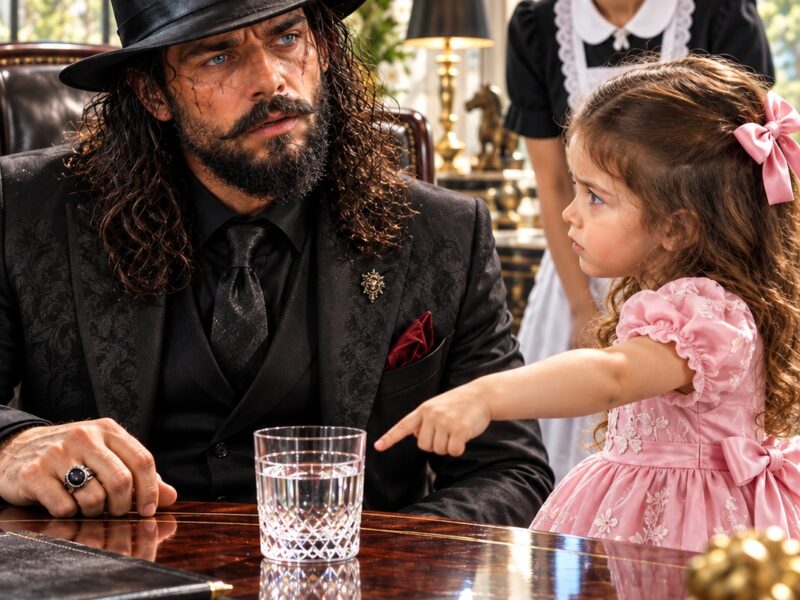
“You’re Not Tired, Sir, You’re Drugged,” the Maid’s Little Girl Told the Mafia Boss Calmly
The first time Dominic Ferrero thanked my daughter, he said the words like a man who had spent fifty-three years believing gratitude was a debt.
But that came later.
The beginning smelled like lemon polish, burnt espresso, and rain coming in from Boston Harbor.
I had worked at the Ferrero estate for eleven months when my seven-year-old daughter walked into a room full of men I had spent nearly a year teaching her never to look at—and calmly told the most feared man in the house that someone had poisoned his coffee.
My name is Alina Reva.
Back then, I cleaned the east wing of Dominic Ferrero’s mansion, a gray-stone estate perched above the harbor behind iron gates tall enough to make visitors understand they had entered someone else’s world. The gates opened only after a camera turned, a voice came through the speaker, and a man in a black coat gave permission.
I never asked who those men were.
That was one of the rules.
There were several.
Never read papers left on desks. Never enter Dominic’s study when the doors were closed unless Mrs. Bianchi sent you. Never linger when men arrived after dark. Never repeat something heard accidentally.
And most importantly, never mistake politeness for familiarity.
Dominic Ferrero was polite to the staff.
That did not make him ordinary.
Drivers lowered their voices when they said his name. Delivery men became extremely interested in their invoices when his footsteps approached. Once, I watched a contractor argue with Mrs. Bianchi for fifteen straight minutes, then apologize to the wallpaper when Dominic entered the hallway.
Yet in eleven months, he had never raised his voice to me.
When I dropped an entire tray of crystal glasses three weeks after I started, I froze on the marble floor with broken glass around my shoes, already calculating how many paychecks the damage would cost me.
Dominic had crouched beside me.
“Don’t touch it.”
“I can clean it, sir.”
“You can cut yourself.”
He had picked up one large piece carefully and placed it on the tray.
“Glass is cheaper than hands, Mrs. Reva.”
Then he had walked away.
That moment confused me more than cruelty would have.
I had spent four years raising Lucia alone after my husband, Paulo, died in what the police called a traffic accident. I understood obvious danger. I understood unpaid bills, late notices, exhausted doctors, and landlords who smiled while reminding you that sympathy did not extend a lease.
Dominic Ferrero was something harder to understand.
A dangerous man who remembered to ask whether the housekeeper’s arthritis was better.
A man whose businesses appeared in newspapers under words like shipping, restaurants, construction, and occasionally investigation.
A man no one contradicted.
Except, eventually, my daughter.
The Thursday everything changed began with a phone call from my mother at six fifteen in the morning.
“Alina, I have a fever.”
I sat on the edge of my bed, already dressed for work, while Lucia slept under a quilt in the room beside mine.
“How high?”
“One hundred and two.”
“You need a doctor.”
“I need soup.”
“You need both.”
Normally, my mother watched Lucia when school was closed. That Thursday, the district had scheduled a teacher-development day I had forgotten about until forty-eight hours earlier.
There was no one else.
I called two neighbors.
One was working.
The other had a dentist appointment.
At six forty, I stood in Lucia’s doorway watching her sleep and made a decision I had promised myself I would never make.
I brought my daughter to the Ferrero estate.
Mrs. Bianchi met us in the service entrance at seven thirty-seven.
She was sixty-one, Italian-American, five feet two inches tall, and capable of making grown men apologize with one movement of her eyebrows.
She looked at Lucia.
Then at me.
Then back at Lucia.
“School?”
“Closed.”
“Your mother?”
“Sick.”
Mrs. Bianchi inhaled through her nose.
I waited.
Finally she said, “Kitchen.”
Relief nearly weakened my knees.
“Thank you.”
“I did not say she could tour the property.”
“She won’t.”
“I did not say she could talk to guests.”
“She won’t.”
“I did not say—”
“Mama,” Lucia whispered, “I understand.”
Mrs. Bianchi looked down at her.
Lucia smiled.
Mrs. Bianchi’s expression softened by perhaps one percent.
“Kitchen,” she repeated.
That was permission.
As close as anyone got from Mrs. Bianchi.
I knelt to straighten Lucia’s collar before leaving her with crayons, paper, crackers, and enough warnings to frighten a much less curious child.
“Sit here. Draw. You may use the bathroom by the pantry. Do not go upstairs.”
“I know.”
“Do not open drawers.”
“I know.”
“Do not ask people what they’re doing.”
“I know.”
“And if Mr. Ferrero comes through here?”
Lucia considered.
“Say hello?”
“If he speaks to you first.”
“What if he doesn’t?”
“Then you become invisible.”
She giggled.
I did not.
“Lucia.”
Her smile disappeared.
“I’ll behave.”
“Especially around Mr. Ferrero.”
She lowered her voice dramatically.
“Especially Mr. Ferrero.”
I kissed her forehead.
She kissed my cheek.
Then I went upstairs believing the most dangerous thing that could happen that day was my daughter getting bored.
At eleven forty-eight, the first black sedan arrived.
By noon there were nine vehicles in the circular drive.
Black Mercedes.
Two Cadillacs.
A gray European sedan with New York plates.
One dark SUV I had seen only twice before, always followed by an unusually tense afternoon.
I counted them from an upstairs window while dusting the landing.
Men stepped out wearing expensive coats and careful expressions.
Nobody carried briefcases.
I had learned something during my months at the estate.
Men who appeared to carry nothing often had somebody else carrying the important things.
Dominic received them in the second-floor study.
Among them was Salvador Greco, an older man with silver hair, heavy eyebrows, and a ring on his right hand that caught light every time he gestured. Greco had known Dominic for decades and spoke to him with a freedom I rarely saw anyone else attempt.
And then there was Nico Ferrero.
Dominic’s nephew.
Thirty-four.
Handsome in the polished way expensive tailoring can make a person look more trustworthy than he deserves.
Nico was the son of Dominic’s late sister, Teresa, and her husband, Matteo Ferrero’s longtime business partner, Vittorio Marino. After both his parents died within three years of each other, Dominic had brought Nico deeper into the family companies.
He handled financial structures.
Contracts.
Accounts.
He was often introduced, half-jokingly, as the future.
Nico smiled more than his uncle.
He knew every maid’s name.
He tipped generously.
He remembered birthdays.
He also winked at people constantly.
I never trusted the wink.
Not because I had evidence.
Because my late husband Paulo used to say there were men who smiled because they were happy and men who smiled because they wanted you to stop looking.
Nico belonged to the second category.
At one, Mrs. Bianchi handed me a polished silver tray.
“Water upstairs.”
“For the study?”
She nodded.
My stomach tightened.
I hated entering during meetings.
Not because anyone had threatened me.
Because the room itself always felt like a held breath.
I carried the tray upstairs.
Two men stood outside the doors.
One opened them.
Cigar smoke moved toward me.
Thirteen men sat around Dominic’s long walnut table.
Contracts lay open.
Maps covered one end.
The harbor was visible through the tall windows behind Dominic, gray beneath a cloudy October sky.
He sat at the head of the table in a dark charcoal suit, white shirt, no tie.
He looked tired.
I noticed that.
But everyone had been saying he was tired for months.
“Dominic works too much.”
“Dominic hasn’t slept.”
“Dominic needs a vacation.”
Most of those comments came from Nico.
“Water, sir.”
Dominic nodded.
“Thank you, Mrs. Reva.”
I began replacing bottles.
Nico was seated to Dominic’s right.
“You’re still not eating,” he said.
Dominic barely glanced at him.
“I ate.”
“Coffee is not food.”
“According to my mother, neither is half the food I eat.”
Several men smiled politely.
Nico laughed.
Then he stood and crossed to the sideboard.
That was when I noticed the espresso.
A single white porcelain cup rested on a smaller silver tray.
Steam curled above it.
I had not brought it.
Normally coffee for the study came from the kitchen in a full service set, never alone.
Nico picked up the cup.
“At least drink this.”
Dominic looked at his nephew.
There was affection there.
Real affection.
That detail would matter later.
“All right,” Dominic said.
Nico placed the cup in front of him.
Dominic drank.
I left.
And for the rest of my life, that ordinary white cup would remain in my memory brighter than almost anything else in the room.
Because I saw it.
I saw Nico carry it.
I saw Dominic drink.
And I thought absolutely nothing.
Downstairs, Lucia’s chair was empty.
Her crayons were scattered across the kitchen table.
Three drawings remained.
A horse.
A house with too many windows.
And a tall man in a black coat whose hands were roughly the size of dinner plates.
I stopped breathing.
“Lucia?”
Nothing.
Mrs. Bianchi turned from the stove.
“What?”
“She’s gone.”
Her face changed.
We moved in opposite directions.
I searched the pantry.
Laundry corridor.
Breakfast room.
Back stairs.
By the time I reached the second-floor service passage, panic had become physical, a hard pounding behind my ribs.
Then I saw her.
Lucia sat on the floor beside the tall grandfather clock outside Dominic’s study.
Her knees were pulled against her chest.
She was not playing.
She was watching the door.
“Lucia.”
I whispered because shouting in that hallway felt dangerous.
She looked at me.
“Mama.”
I crossed the distance quickly.
“What did I tell you?”
“Something’s wrong.”
“Come downstairs.”
“With the man.”
I stopped.
“What man?”
“The tall one.”
My stomach tightened.
“Mr. Ferrero?”
She nodded.
“He came out before.”
“When?”
“When you were upstairs.”
“Why were you upstairs?”
She ignored that.
“He was on the phone.”
I crouched.
“What happened?”
“He held the wall.”
Children notice strange things.
Not the expensive suit.
Not the guarded study.
A hand on a wall.
“He might be tired.”
“That’s what the smiling man said.”
“Nico?”
“I don’t know.”
“The one who winks?”
“Yes.”
The hair rose along my forearms.
“What did he say?”
Lucia frowned, concentrating.
“He was on his phone.”
“What words?”
She looked at me.
“‘It’s working faster than they said.’”
For a moment, I heard nothing except the old clock.
Tick.
Tick.
Tick.
“What was working?”
“I don’t know.”
“Did he see you?”
“No.”
“You’re sure?”
“He was looking at the window.”
I took her hand.
“We’re going downstairs.”
“But Mr. Ferrero—”
“Now.”
I wish I could tell you I immediately understood.
That instinct turned me into a hero.
That I marched into the study and saved him.
I didn’t.
I did what ordinary people do when the truth is frightening and incomplete.
I explained it away.
Maybe Nico meant a business deal.
Maybe Dominic had the flu.
Maybe I had spent too much time hearing whispered stories about the family and was turning coincidence into danger.
Most of all, I was a widow with overdue dental work, a seven-year-old daughter, and a paycheck I could not afford to lose.
Courage sounds different when rent is due.
I started guiding Lucia toward the stairs.
Then the study door opened.
A man came out coughing, waving cigar smoke from his face.
Through the opening, I saw Dominic.
My feet stopped.
He sat at the head of the table gripping his chair with one hand.
His forehead was wet.
His face had lost color.
Someone asked him a question.
He answered.
The words came slowly.
Not slurred exactly.
Dragged.
As though language had become something heavy he had to pull toward the surface.
Nobody seemed alarmed.
That frightened me more than panic would have.
Power changes how people interpret weakness.
When ordinary men wobble, someone asks whether they’re sick.
When powerful men wobble, everyone waits for them to insist they’re fine.
“Dominic,” Salvador Greco said, “you’ve been running yourself into the ground.”
Nico leaned toward his uncle.
“Since spring.”
Dominic’s eyes moved slowly toward him.
“Don’t start.”
“Rest is a weapon too.”
A few men smiled.
Nico continued gently.
“Ten minutes. Let everyone step out.”
“No.”
“Uncle—”
“We finish the papers.”
Dominic reached for a folder.
His fingers missed by an inch.
Lucia pulled her hand from mine.
“No.”
I grabbed for her.
Too late.
She slipped past me, around the man in the doorway, and walked straight into the study.
I have lived through a car rolling twice on icy pavement.
I have felt the floor of an apartment shake during a gas explosion two buildings away.
Nothing compares to watching your seven-year-old daughter walk uninvited into a closed-door meeting at Dominic Ferrero’s table.
“Lucia.”
She kept going.
Thirteen men gradually stopped speaking.
One conversation died.
Then another.
Then another.
Lucia stopped at the corner of the table with her hands clasped in front of her exactly as I had taught her to stand during church.
“Mama, I’m sorry.”
My face burned.
“Come here.”
“I have to tell him.”
Nico stared at her.
Greco frowned.
Dominic turned his head slowly.
His eyes struggled to focus.
I stepped into the room.
“Mr. Ferrero, I apologize. She—”
“It’s all right, Alina.”
I froze.
He had never called me Alina.
Always Mrs. Reva.
“Let her speak.”
Lucia looked at him.
Not at the men.
Not at the doors.
At his face.
She studied him with the expression she used when working through a math problem she believed everyone else had solved incorrectly.
“You’re not tired, sir.”
Dominic blinked.
Lucia’s voice remained calm.
“You’re drugged.”
The room stopped.
Not figuratively.
Stopped.
Greco lowered his cup without drinking.
A man beside the window swallowed.
Someone’s chair creaked and the sound seemed impossibly loud.
And Nico—
Nico’s smile did not disappear.
It simply stopped moving.
Like somebody had paused him.
“Sweetheart,” he said, “that is a very serious word.”
Lucia did not look at him.
“My nana has sleeping medicine.”
Nobody interrupted.
“One time she took the wrong amount because she forgot she took it already. Her hands got cold and sweaty. Her eyes looked slow. She kept forgetting what she was saying before she finished.”
Dominic looked at his hands.
Lucia pointed toward him.
“You’re doing that.”
Greco stood.
Nico did too.
“Children remember things strangely,” Nico said.
Lucia finally looked at him.
“The ambulance man said if Nana went to sleep, maybe she wouldn’t wake up. He told me to keep her awake.”
She turned back to Dominic.
“And your coffee smelled sweet.”
My stomach dropped.
Dominic’s eyes moved toward the empty white cup beside his hand.
“Sweet?”
“Like Nana’s medicine.”
The room shifted.
Dominic touched the cup.
Then looked around the table.
“Who brought this?”
Nobody answered.
Not one man.
That was the first answer.
Everyone had watched the cup arrive.
Nobody claimed responsibility.
Dominic tried to stand.
For one second, he succeeded.
It was almost magnificent.
His shoulders straightened.
His jaw hardened.
The room remembered who he was.
Then his knees folded.
Greco caught him.
Two other men moved.
I screamed his name before I realized I had.
They lowered him into the chair.
“Get Renzo,” Nico snapped.
“No.”
My own voice shocked me.
Every face turned.
I had no right to speak.
I did anyway.
“Call an ambulance.”
Greco shook his head.
“We don’t bring ambulances here.”
“Then today should be different.”
“Dr. Renzo knows Dominic’s medical history.”
Nico already had his phone in his hand.
“He’s coming.”
I looked at him.
“How does he know?”
Nico’s thumb stopped.
“What?”
“You said he’s coming.”
“I called him.”
“When?”
“Ten minutes ago.”
Lucia spoke.
“But that was before he fell.”
Nico looked at her.
She tilted her head.
“You called when you said the medicine was working faster.”
The silence became something alive.
I could hear my heartbeat in my teeth.
Nico smiled.
“Lucia, was it?”
She nodded.
“You heard part of a business conversation.”
“No.”
His smile tightened.
“No?”
“You said, ‘It’s working faster than they said.’ Then you said, ‘Tell Renzo ten minutes.’”
I looked at Nico’s hands.
One had gone to his cufflink.
He twisted it.
Once.
Twice.
Again.
Paulo used to do something similar when he lied.
Not often.
But enough that I remembered.
My husband’s face could stay calm.
His hands could not.
That afternoon, standing in Dominic Ferrero’s study, I learned the same thing about Nico.
Dominic’s head tipped.
“Keep him awake,” Lucia said.
I moved without thinking.
I dropped beside his chair and took his hand.
Cold.
Damp.
Lucia had been right.
“Sir.”
His eyes opened.
“Talk.”
His voice was barely there.
“About what?”
“Anything.”
I panicked.
He closed his eyes again.
Lucia touched his arm.
“No sleeping.”
Dominic opened them.
“Bossy.”
“You’re welcome.”
A strange sound came from Greco.
Almost a laugh.
I squeezed Dominic’s hand.
“My husband,” I said.
His eyes shifted toward me.
“You asked once if I had family.”
He breathed slowly.
“Paulo.”
I stopped.
I had never told him Paulo’s name.
Not directly.
“How did you know?”
Something crossed Dominic’s face.
Recognition.
Then guilt.
“Paulo Reva.”
My throat closed.
“How do you know my husband?”
Before he could answer, footsteps sounded in the hall.
Dominic tightened his fingers around mine with surprising strength.
“Greco.”
Salvador bent close.
“Yes?”
“Not Renzo.”
Nico stepped forward.
“Uncle, stop.”
Dominic looked at him.
“Not. Renzo.”
Greco’s face changed.
Nico spread his hands.
“Dominic is confused.”
Dominic’s eyes remained on Greco.
“Take my phone.”
Greco removed it from Dominic’s jacket.
“Call emergency services from it. Public hospital.”
Several men around the table exchanged looks.
Nico’s voice softened.
“Uncle, you have known Dr. Renzo for nineteen years.”
Dominic managed the smallest expression of contempt.
“That…”
He swallowed.
“…is why.”
And suddenly the room understood the same thing at once.
Nico had brought the espresso.
Nico had called Renzo before Dominic collapsed.
Nico had suggested everyone step outside.
Nico had spent months telling people Dominic was exhausted.
Nico had prepared an explanation before anyone knew there was a crisis.
Trust had not failed because Dominic trusted too little.
It had failed because he trusted one man too much.
Nico stopped turning the cufflink.
“Nobody leaves.”
The sweetness disappeared from his voice.
Two men near the door moved.
Not Dominic’s security.
Nico’s.
I had seen them carrying his coat.
Opening his car door.
Laughing at his jokes.
Now they positioned themselves between thirteen people and the hallway.
Greco looked toward the exits.
“So that’s where we are.”
Nico’s jaw tightened.
“Don’t make this dramatic.”
“You drugged your uncle.”
“I called his doctor.”
“Before he needed one.”
“Because he’s been unwell.”
Lucia tugged the sleeve of one of the men nearest her.
I nearly screamed.
Instead she pointed.
“Why are you holding your phone like that?”
Every head turned.
The man had a phone pressed near his chest.
The screen glowed blue against his chin.
His thumb hovered over a message.
Greco crossed the room faster than I would have believed a man his age could move.
He took the phone.
The guard resisted for half a second.
Then Dominic said one word.
“Don’t.”
The man released it.
Greco read the message.
His face hardened.
Then he read it aloud.
“Renzo. Bring the second vial. Now.”
Thirteen people inhaled.
Not screamed.
Not shouted.
Breathed.
Together.
Greco looked at Nico.
“Second vial.”
Nico said nothing.
“The first was in the coffee.”
“You don’t know that.”
“What is the second one for?”
“Dominic has insomnia.”
“He has a private pharmacy.”
“He needed something stronger.”
Greco stepped closer.
“Then why hide it?”
Nico’s mask slipped.
Only slightly.
“I am not hiding anything.”
One of the men at the far end of the table set down his glass.
“You told us Dominic’s been sick since March.”
“Yes.”
“He hasn’t been.”
“He has.”
“According to whom?”
Nico opened his mouth.
The man continued.
“According to you.”
Another man shifted.
“You told me his memory was failing.”
Nico turned.
“He forgot the Providence figures twice.”
“No,” the man said slowly. “You told me he forgot them. I never heard him forget.”
The room began replaying months of conversations.
Different faces.
Different memories.
Same source.
Nico.
Dominic was tired.
Dominic was forgetful.
Dominic was short-tempered.
Dominic needed rest.
Dominic should delegate.
Dominic was getting too old.
Ideas repeated often enough had become observations.
But now everyone could see who had planted them.
Dominic breathed unevenly.
I still held his hand.
He looked toward Lucia.
Then me.
Then the door.
“Alina.”
“Yes?”
“Take her.”
“No.”
His eyes sharpened.
“Kitchen.”
“I’m not leaving you.”
“You have to.”
“Why?”
“Because if this goes wrong…”
He looked at Lucia.
“…you are leverage.”
My blood went cold.
I pulled her closer.
Dominic continued.
“Lock the kitchen. Mrs. Bianchi only.”
Lucia climbed onto the arm of his chair.
“Sir.”
He looked at her.
“Stay awake.”
A faint line appeared near his mouth.
“You are extremely demanding.”
“What did you eat for breakfast?”
Dominic stared.
Lucia repeated, “Breakfast.”
“Bread.”
“What kind?”
“Burnt.”
“Why?”
“My cook is angry at me.”
“Good. What’s his name?”
“Giuseppe.”
“What’s your mama’s name?”
His face changed.
“Sophia.”
The room blurred for him.
I could see it.
Lucia leaned closer.
“Tell me about her.”
Dominic swallowed.
“She grew tomatoes.”
“What color?”
“Red.”
“What kind?”
“I don’t know.”
Lucia looked offended.
“You should know.”
A broken laugh escaped him.
The most feared man in that house almost laughed while his own nephew stood ten feet away trying to decide whether his plan had failed.
That laugh bought Dominic seconds.
Lucia kept asking questions.
His first dog.
The street where he grew up.
His favorite sandwich.
The name of his fourth-grade teacher.
Dominic answered some.
Missed others.
But he remained awake.
Then the front doors opened.
Heavy footsteps crossed marble.
A friendly voice rose from the foyer.
“Nico?”
Every person in the study became still.
“I’m here.”
A moment later Dr. Renzo entered.
He was sixty, gray-haired, gentle-faced, wearing a dark wool coat and carrying a black leather medical bag.
He looked exactly like the kind of doctor frightened families trust.
That was when I finally understood the true weapon.
It had never been the drug.
It was credibility.
Renzo looked at Dominic.
“My God.”
His concern was perfect.
“Dominic, my friend.”
He placed the bag on the table.
“You look terrible.”
“Open it,” Greco said.
Renzo paused.
“What?”
“The bag.”
“Salvador, I need to examine him.”
“Open the bag.”
Renzo looked at Nico.
Only once.
That was enough.
Greco saw it.
I saw it.
Dominic saw it through whatever fog the drug had created.
Renzo rested his fingers on the clasp.
The room waited.
Then something inside the doctor seemed to collapse.
Not physically.
Morally.
He gave a tired smile.
“I told them you would notice.”
Dominic’s eyes narrowed.
“I said it would have to be someone you trusted.”
Nico stepped toward him.
“Doctor.”
Renzo ignored him.
“I’m tired, Nicolo.”
“You don’t know what you’re saying.”
“I know exactly what I’m saying.”
He looked at Dominic.
“Your sister’s husband opened the first door years ago.”
Dominic went still.
Even drugged.
“My sister?”
Renzo nodded.
“Vittorio Marino.”
Nico’s father.
Greco swore under his breath.
Renzo continued.
“He owed people money. Men who wanted access to your port operations. At first it was schedules. Containers. Which inspectors were paid, which were honest.”
Dominic stared at Nico.
Nico’s face had gone white.
“My father is dead.”
“Yes,” Renzo said. “And he left you the debts.”
Nico snapped.
“Stop talking.”
“You should have stopped years ago.”
Renzo looked at me.
Then back to Dominic.
“There was a driver.”
Something inside me tightened.
Renzo said, “He saw a transfer he was not supposed to see.”
Dominic closed his eyes.
No.
I knew before anyone said the name.
I knew.
“Paulo,” I whispered.
The doctor looked at me.
His face answered.
My body went numb.
Dominic forced his eyes open.
“Alina.”
I could not look at him.
“What company?”
“What?”
“Paulo.”
His voice cracked.
“What company did he drive for?”
My mouth felt dry.
“Marino Freight.”
Every face turned toward Nico.
Dominic stared at him.
“Your father’s company.”
Nico backed away.
“That proves nothing.”
The room disappeared around me.
Four years.
Four years of waking at three in the morning because Paulo’s side of the bed remained too empty.
Four years of explaining to Lucia that Daddy had gone to heaven because a truck crossed a red light.
Four years wondering why the driver who hit him was never charged.
Why the police report had contradictions.
Why the insurance settlement arrived unusually fast.
Why the company owner never attended the funeral but sent an envelope containing five thousand dollars.
Paulo had told me something the night before he died.
I heard it again.
“They changed my route.”
I had been washing dishes.
“What?”
“Dispatch moved me to Pier Nine tomorrow.”
“You hate Pier Nine.”
“It’s not mine.”
“Then say no.”
Paulo had kissed the back of my neck.
“You think I can say no to everybody.”
“I married you believing I could.”
He laughed.
That had been the last night we slept beside each other.
Now I looked at Dominic.
“Someone changed his schedule.”
Dominic’s expression broke.
“I know.”
I stood so quickly the chair beside me scraped.
“You know?”
“Six weeks.”
“What?”
His breathing was getting worse, but he forced the words.
“Six weeks ago, I found a ledger.”
My hands began shaking.
“Your husband’s name.”
I stared.
“The date.”
“Stop.”
“Payments.”
“Stop.”
“Initials.”
I pulled my hand from his.
The absence of contact seemed to hurt him more than I expected.
“You knew.”
“I suspected.”
“You knew enough.”
“Yes.”
“And you hired me.”
The room turned toward us.
I remembered Mrs. Bianchi calling me unexpectedly eleven months earlier.
A position.
Better pay than I requested.
Health insurance.
Flexible hours.
A recommendation I had never known anyone sent.
Dominic looked at the floor.
“I asked Mrs. Bianchi to find you.”
My stomach twisted.
“You brought me into this house.”
“To keep you safe.”
I laughed.
It sounded ugly.
“Safe?”
“I did not know who was involved.”
“So you put my daughter under their roof?”
“I had security around you.”
“You watched me.”
“Yes.”
“You paid Lucia’s school.”
His eyes lifted.
I froze.
A scholarship had appeared the previous year through a neighborhood education charity.
Anonymous donor.
I had cried when the letter came.
“That was you.”
“Yes.”
“Why?”
His answer took too long.
“Because Paulo died because of my family.”
Not near my family.
Not because of someone we knew.
Because of my family.
The room seemed to tilt.
Dominic continued.
“I wanted you protected before I told you.”
“You wanted to control when I learned.”
His eyes closed.
“Yes.”
That honesty hurt more.
“You wanted me grateful first.”
“No.”
“Then what?”
His voice dropped.
“I was a coward.”
Nobody in the room moved.
Dominic Ferrero had probably been called many things.
Not by himself.
Not that.
“I was afraid of your face,” he said.
I looked at him.
“When you learned what men under my name did to your husband.”
His voice cracked slightly.
“I told myself waiting protected you.”
He shook his head.
“It protected me.”
Nico laughed.
The sound came sharp.
Disbelieving.
“This is what we’ve become?”
Dominic looked at him.
Nico stepped away from the wall.
“This.”
He gestured toward me.
“A maid. A dead driver. A child. We are going to tear apart everything my father built because Uncle Dominic suddenly found a conscience?”
Greco turned.
“Careful.”
“No.”
Nico’s face transformed.
The charming nephew disappeared.
Not into a madman.
Into something colder.
Something long restrained.
“You were all thinking it.”
Nobody answered.
“He was going soft.”
Dominic watched him.
“You mean legitimate.”
“I mean weak.”
“I was closing the port operations.”
“You were destroying us.”
“I was moving the workers into registered freight companies.”
“You were giving everything away to lawyers.”
“I was getting them out.”
“You were giving away power.”
Dominic’s breathing slowed.
Not improved.
Focused.
“So you poisoned me.”
“Sedated.”
Renzo looked away.
Nico continued.
“You were supposed to wake tomorrow.”
Greco laughed bitterly.
“After signing what?”
Nico did not answer.
Dominic did.
“Succession papers.”
Everyone turned.
Dominic looked at the leather folio near Nico’s chair.
“Open it.”
Greco did.
Inside lay corporate resolutions.
Medical incapacity documents.
Temporary authority transfers.
And one prepared declaration naming Nico acting head of Ferrero Holdings.
Greco read silently.
Then looked at Nico.
“Your uncle becomes ill conveniently during a meeting. Family physician confirms incapacity. You take control before midnight.”
Nico’s eyes hardened.
“For his protection.”
Renzo whispered, “That was not all.”
Nico turned.
“Shut your mouth.”
Renzo looked at Dominic.
“The second vial.”
My skin went cold.
“What does it do?” Greco asked.
The doctor swallowed.
“A stronger sedative.”
“How strong?”
Renzo said nothing.
Dominic’s voice came low.
“How strong?”
“If his system was already compromised…”
Renzo stopped.
Lucia had gone very quiet.
I pulled her against me.
Greco finished the thought.
“He might not wake.”
Nico snapped, “That wasn’t the plan.”
“Then why bring it?”
“In case he fought the transfer.”
The room changed again.
Not suspicion now.
Certainty.
Two of Nico’s men moved toward Renzo’s bag.
Men on Dominic’s side blocked them.
Nobody drew a gun.
Thank God.
But everybody suddenly understood how fast the room could turn violent.
I covered Lucia’s head against my chest.
Dominic tried to stand.
He could not.
So he did the only thing left.
He spoke.
“Enough.”
It was not loud.
It did not need to be.
Everyone stopped.
Perhaps habit.
Perhaps respect.
Perhaps the last echo of the man they had followed for decades.
Dominic looked at Renzo.
“The antidote.”
Renzo’s face twisted.
“There is no direct antidote for everything in the mixture.”
“What helps?”
“Monitoring. Fluids. Respiratory support. There’s a reversal agent in the bag that may reduce part of the sedative effect.”
Nico stared at him.
“You said there wasn’t.”
“I lied.”
“Why?”
Renzo looked toward Lucia.
“Because I’m apparently not as far gone as you hoped.”
Lucia whispered, “Good.”
Renzo flinched.
Dominic drew a slow breath.
Then looked around the room.
“I want every man here to listen carefully.”
No one spoke.
“Nico planned to trade treatment for my signature.”
Nico shook his head.
“You don’t know that.”
Dominic looked at the papers.
“I know you.”
Nico went silent.
“If I sign, he controls the companies before morning.”
Dominic’s eyes found mine.
“And Mrs. Reva and her daughter know enough to become problems.”
My stomach turned.
Nico said quickly, “I would never touch a child.”
Dominic’s expression became terrifying.
“You already made her a witness.”
“She walked in.”
“Because you poisoned me in a house where she happened to exist.”
Nico looked away.
Dominic continued.
“So there will be no signature.”
Greco stepped closer.
“Dominic.”
“No.”
“You may die before an ambulance reaches us.”
“Then call faster.”
Someone swore.
Dominic looked toward his desk.
“The ledgers.”
Greco stared.
“All of them.”
Silence.
Nico’s face changed.
“Uncle.”
Dominic ignored him.
“Personal safe. Office vault. Harbor books.”
Greco’s eyes widened.
“Dominic, those records include—”
“Me.”
That stopped everyone.
Dominic nodded.
“Yes.”
“My name too.”
Nico stared.
“You’ll destroy the family.”
Dominic looked at Lucia.
My daughter still had one hand resting on his sleeve.
“I would rather destroy what we built than let her inherit the bill for it.”
Nobody moved.
He turned to Greco.
“Call the real police.”
A murmur moved around the table.
“Call federal investigators.”
Greco closed his eyes.
“Dominic.”
“You heard me.”
“You could go to prison.”
“I know.”
“Men here could go to prison.”
“I know.”
Greco stared at him.
“And after thirty years, you decide this now?”
Dominic’s eyes moved toward me.
Then Lucia.
“No.”
His voice softened.
“I should have decided it years ago.”
Renzo opened his bag.
His hands shook so badly the metal clasp rattled.
“Second drawer.”
Greco watched him.
“Blue vial.”
Renzo nodded.
“It can slow the sedative component.”
Nico stepped forward.
One of Dominic’s men stopped him.
Renzo removed the vial and syringe.
Lucia stared.
“Is that going to help him?”
Renzo looked at her.
“Yes.”
“Are you sure?”
He swallowed.
“Yes.”
Lucia’s face remained serious.
“Then you should have helped sooner.”
Renzo closed his eyes.
“I know.”
That sentence broke something in him.
After that, he cooperated.
The ambulance took eighteen minutes.
I know because Lucia counted.
She sat on the marble floor beside Dominic’s chair while we waited, telling him a story about a horse who wanted to become a doctor but was unable to hold a stethoscope because he had hooves.
It made no sense.
Dominic listened to every word.
When his eyes began closing, Lucia tapped his wrist.
“No sleeping.”
“Yes, doctor.”
“I’m not a doctor.”
“You are currently the most qualified person in the room.”
Greco laughed.
Lucia frowned.
“That’s bad.”
Even Dominic smiled.
Barely.
The sirens finally reached the gate.
Nobody stopped them.
Paramedics entered the Ferrero mansion for the first time anyone could remember.
They put Dominic on a stretcher.
An oxygen mask covered his face.
One paramedic checked his pulse and said, “Strong heart.”
Dominic pointed weakly toward Lucia.
“Her fault.”
The paramedic looked confused.
Lucia nodded.
“I kept him awake.”
“I believe you.”
Behind Dominic came another procession.
Police.
Federal agents.
Nico.
Renzo.
Two of Nico’s men.
Nico passed me in the foyer with his hands restrained in front of him.
He looked at me.
I expected hatred.
What I saw was worse.
Confusion.
As if he could not understand how eleven months of planning had been undone by a cleaning woman and a child with good hearing.
I almost told him the truth.
It was never us.
It was the little things.
A cup on the wrong tray.
A sentence spoken in a hallway.
A sweet smell.
A cufflink turned too many times.
A child who had watched her grandmother become dangerously sleepy once and remembered what the paramedic said.
His plan had not failed because we were brilliant.
It failed because he believed ordinary people were too insignificant to notice.
Dominic survived.
The first night was uncertain.
The drugs had depressed his breathing and affected his blood pressure badly enough that doctors kept him in intensive care.
Lucia slept in my lap in a waiting-room chair.
Greco sat across from us.
At three fourteen in the morning, he handed me coffee.
I stared at it.
He followed my eyes.
Then, unexpectedly, laughed.
“Fair.”
He drank from it himself.
I still did not touch it.
At four twenty, federal agents arrived.
At six, an attorney named Maria Castellani came to sit beside me.
“Mr. Ferrero asked that I represent you if needed.”
“He was barely conscious.”
“He apparently became extremely organized while barely conscious.”
“That sounds like him.”
Maria studied me.
“You know him well?”
“No.”
That was true.
And suddenly no longer true.
Over the next two days, I learned more about Dominic Ferrero than I had during eleven months inside his house.
His father had started as a dockworker.
Then trucking.
Then shipping.
Then things people did not put into corporate reports.
Dominic inherited an organization already wrapped around legitimate businesses.
For years he expanded both sides.
He was not innocent.
He never pretended to be.
But somewhere after fifty, something changed.
Maybe age.
Maybe guilt.
Maybe exhaustion.
He had spent nearly two years quietly moving employees into legitimate work, selling cash businesses, ending loan operations, and reducing the family’s grip on the port.
That was what Nico feared.
Not losing Dominic.
Losing the machine Dominic had finally decided should end.
And Paulo had become collateral damage years earlier because he saw one part of that machine operating.
I learned the full story from the ledger.
Paulo had been reassigned to Pier Nine because Vittorio Marino needed a trusted driver to move a sealed container without customs review.
Paulo was not supposed to open it.
He did not.
But he saw men loading it.
Then later saw the same container number in a news report tied to a federal seizure.
He asked his supervisor why he had been placed on the route.
That question reached Vittorio.
Vittorio panicked.
A “traffic accident” was arranged.
Not by Dominic.
But under a structure Dominic led.
The distinction mattered legally.
Emotionally, it did not matter enough.
Dominic had benefited from a world where men believed problems could be removed.
My husband had become one of those problems.
On the third morning, Dominic woke fully.
Lucia was already in his room.
I discovered that because I arrived carrying flowers and found my daughter sitting cross-legged near the foot of his hospital bed with a coloring book.
Dominic looked pale.
Older.
Smaller somehow.
Hospitals reduce everyone.
No tailored suit.
No office.
No bodyguards arranged behind him.
Just a man in a white gown with an IV line in his arm.
“Mama,” Lucia said, “he remembers Giuseppe burnt the bread.”
Dominic looked at me.
“I remember unfortunately many things.”
I sat beside the bed.
For a long time, neither of us spoke.
Rain tapped against the hospital window.
Lucia colored a horse purple.
Dominic finally said, “I owe you an apology.”
I looked at him.
“One?”
The corner of his mouth moved.
“That is fair.”
He looked toward the ceiling.
“I should have told you about Paulo the day I found the ledger.”
“Yes.”
“I told myself I needed evidence.”
“That part was reasonable.”
“I had enough evidence to warn you.”
“Yes.”
“I told myself moving you into the estate kept you protected.”
“It also kept me where you could watch me.”
“Yes.”
His honesty irritated me because I had prepared arguments.
He continued.
“I paid Lucia’s tuition because it was the only useful thing I could think to do without telling you why.”
“You could have told me.”
“I know.”
“Why didn’t you?”
His hand tightened slightly against the blanket.
“Because I knew what your face would look like.”
I said nothing.
“I have spent thirty years surrounded by people trained not to show me disgust.”
His eyes met mine.
“I was not eager to see it honestly.”
There was no defense in the sentence.
Just shame.
Lucia stopped coloring.
“Are you talking about Daddy?”
I looked at her.
She knew pieces.
Not everything.
Children always know when adults arrange silence around them.
“Yes.”
Dominic looked at her.
Lucia climbed off the bed.
“My daddy was nice.”
“I believe he was.”
“He made pancakes shaped like animals.”
Dominic swallowed.
“I did not know that.”
“He burned giraffes.”
“That seems difficult.”
“He was bad at giraffes.”
Dominic smiled.
Then Lucia became serious.
“Did you hurt him?”
There it was.
The question everyone else would have softened.
Dominic did not look at me.
He looked at her.
“No.”
Lucia waited.
He continued.
“But men who worked in a world I helped create did.”
I held my breath.
“And when I learned, I was afraid to tell your mother.”
Lucia frowned.
“You’re scary.”
Dominic almost laughed.
“So I am told.”
“Why were you scared?”
The question landed harder than accusation.
Dominic looked toward me.
“Because being frightening does not stop a person from being afraid.”
Lucia considered this.
Then returned to her coloring book.
Children sometimes accept truths adults spend decades avoiding.
Dominic looked at me again.
“Yesterday your daughter told me the truth in front of nine men who carry weapons and thirteen men who knew better than to contradict me.”
“She is seven.”
“Yes.”
His eyes moved toward Lucia.
“That is precisely why.”
The investigation widened quickly.
Dominic kept his promise.
Every ledger went to investigators.
Not edited.
Not sanitized.
Not just Nico’s pages.
All of them.
Maria Castellani spent three weeks negotiating what cooperation would look like.
Greco came voluntarily.
So did two company accountants.
Mrs. Bianchi gave a statement about service logs and visitor records with the terrifying efficiency of a woman who had always known where every body was metaphorically buried, even if she wanted nothing to do with literal ones.
Nico was indicted on charges that had nothing cinematic about them.
Conspiracy.
Financial crimes.
Attempted poisoning.
Obstruction.
Fraud.
The sort of words that sounded dry until you remembered a white espresso cup.
Dr. Renzo cooperated.
Not because anyone forgave him.
Because guilt had finally outweighed fear.
His testimony connected Vittorio Marino’s old network to Paulo’s death.
The driver who hit Paulo had died two years earlier, but surviving records showed payments made through a shell company three days after the crash.
For the first time in four years, Paulo’s death certificate remained the same while the story around it changed completely.
That mattered.
I had thought truth would heal something.
Instead, at first, it made grief worse.
Accident is senseless.
Murder has intention.
I began waking at night imagining Paulo’s last drive.
Did he know?
Did he see the truck?
Did he understand in the final seconds that it was not random?
I hated Dominic for making those questions possible.
Then I hated myself because he was also the reason I finally had answers.
Grief is untidy like that.
It refuses moral simplicity.
Dominic resigned from every operating position at Ferrero Holdings before prosecutors required him to.
He created an independent board to oversee the legitimate companies while the rest were sold, closed, or surrendered.
The port operation was transferred into a public-private trust monitored by federal regulators and state authorities.
Hundreds of workers kept jobs.
Some men cursed him.
Some called him a traitor.
Others quietly thanked him because, for the first time, their sons could work for Ferrero companies without inheriting Ferrero secrets.
Dominic did not become a saint.
That would have made the story dishonest.
He had signed documents years earlier that harmed people.
He had approved coercive business arrangements.
He had benefited from fear.
He knew it.
His cooperation reduced his sentence.
It did not erase responsibility.
He received three years in federal prison.
The number shocked people.
Some thought it too little.
Some thought any prison was betrayal after everything he gave prosecutors.
Dominic said almost nothing publicly.
At sentencing, the judge asked whether he wished to speak.
He stood.
He looked thinner than the man I had first met.
No expensive watch.
No Ferrero men filling the back benches.
Just Maria Castellani and Greco.
I sat near the aisle.
Lucia stayed with my mother.
Dominic said, “For most of my life, I believed responsibility meant protecting the structure I inherited. I understand now that sometimes responsibility means admitting the structure should not survive.”
The courtroom remained quiet.
He continued.
“I am cooperating because it is useful, not because cooperation makes me innocent.”
Then he sat.
That sentence was the first reason I began thinking someday I might forgive him.
Not because he apologized.
Because he stopped asking apology to erase consequence.
Before he surrendered, he asked to see Lucia and me.
I nearly refused.
Then Lucia said, “Is he going to jail because he was bad?”
I thought carefully.
“Because he did bad things.”
“That’s different.”
“Yes.”
“Can people who did bad things still eat lunch?”
I laughed despite myself.
“Usually.”
So we went.
The Ferrero estate no longer belonged to Dominic.
Most of it had been sold as part of restitution and restructuring.
But the new owners had not yet taken possession.
We met in the garden.
October had returned.
One year since the coffee.
Tomato vines climbed wooden frames near the stone wall.
Dominic’s mother, Sophia, had planted tomatoes there decades earlier.
Mrs. Bianchi had kept them alive.
Dominic sat on the stone bench holding one small red tomato in his hand.
No security.
No black sedan.
No men waiting for instructions.
He looked ordinary.
That unsettled me more than his power ever had.
Lucia sat beside him.
“I heard you’re going away.”
“Yes.”
“For three years?”
“If I behave.”
She narrowed her eyes.
“You should.”
“I intend to.”
He looked at me.
“I arranged something.”
I sighed.
“No.”
“You don’t know what it is.”
“If it’s money, no.”
“Technically part of it is.”
“No.”
Lucia whispered, “Mama.”
I gave her a look.
Dominic handed me a folder.
I did not take it.
“What is it?”
“A scholarship.”
“No.”
“For Lucia.”
“No.”
“Any school she chooses through college.”
“No.”
“And a house.”
I stood.
Absolutely not.
Dominic remained seated.
“Alina.”
“I am not taking a house from you.”
“It is not from me.”
“Whose name is on the deed?”
“Yours.”
“Then it is from you.”
His eyes dropped.
“Paulo should have come home.”
I stopped.
Dominic turned the tomato slowly.
“Every night.”
His voice became quieter.
“For the rest of his life.”
I could not move.
“I cannot return that.”
“No.”
“I cannot make you forgive me.”
“No.”
“I cannot give Lucia her father.”
My throat tightened.
“No.”
He looked at the folder.
“So do not call this payment.”
“What should I call it?”
“Something a coward should have done before he had the courage to tell you why.”
I stared at him.
He did not ask me to understand.
That mattered.
“The house belonged to one of the shell companies tied to Vittorio’s network,” he continued. “The government approved its transfer to the victim restitution program. Maria arranged for your claim to receive it.”
I frowned.
“So technically—”
“It is compensation.”
“From assets connected to the crime against Paulo.”
“Yes.”
That changed things.
Not enough to remove the discomfort.
Enough to make it mine to consider.
“And the scholarship?”
“A separate trust funded from my personal legitimate assets. It cannot be withdrawn. It requires nothing from you.”
I looked at Lucia.
She was studying a tomato.
Dominic said, “She saved my life.”
“She told the truth.”
“Exactly.”
He gave a tired smile.
“I spent most of my career paying people to tell me what they thought I wanted to hear.”
He looked at Lucia.
“She may be the first person I ever met who considered that an absurd way to live.”
Lucia glanced up.
“It is.”
Dominic laughed.
A real laugh.
Loud enough to startle a bird from the garden wall.
I had heard the beginning of that sound in the study while he was drugged.
Now nothing stopped it.
I sat.
“I will consider the house.”
He nodded.
“And the scholarship.”
Another nod.
“I am not forgiving you today.”
He looked at me.
“I know.”
“It may take years.”
“I have three.”
Lucia brightened.
“When you come back, you can eat soup at our house.”
Dominic looked at her.
“If your mother permits.”
“She makes good chicken soup.”
I sighed.
Lucia continued.
“And you should drink water.”
Dominic nodded solemnly.
“Water.”
“Not coffee.”
The smile returned.
“No coffee.”
“Coffee is suspicious.”
This time I laughed too.
Three years passed strangely.
Slowly while they were happening.
Quickly when I looked backward.
We moved into the little house.
It stood in Roslindale on a quiet street with a small yard, a cracked back step, and a lemon tree someone had foolishly tried to grow outdoors in Massachusetts.
The tree lasted one winter.
Lucia mourned it dramatically.
The scholarship paid for a better middle school.
I hated accepting that at first.
Then Maria reminded me it had been legally structured, independently administered, and belonged to Lucia whether Dominic lived another day or not.
So I learned to separate generosity from obligation.
That became important.
Greco visited Dominic in prison monthly until his own legal matters were resolved.
Greco had committed enough financial violations to receive probation and substantial fines, but his early cooperation kept him out of prison.
Mrs. Bianchi sent Dominic cookies every Christmas.
Giuseppe sent burned bread once.
The package arrived with a note.
For consistency.
Dominic kept it.
I know because he wrote Lucia letters.
Not many.
Four or five each year.
Never about crime.
Mostly books.
School.
Tomatoes.
Once about a pigeon that somehow entered the prison recreation yard and became more popular than any inmate.
Lucia answered every letter.
She never called him Mr. Ferrero in writing.
She called him “Sir,” because apparently one accidental act of lifesaving had created a permanent title.
At ten, she decided she wanted to become a veterinarian.
At eleven, a doctor.
At twelve, an astronaut for approximately seventeen days.
At thirteen, after my mother spent a week in the hospital, Lucia decided she wanted to become a nurse.
That one stayed.
Dominic was released three weeks after her fourteenth birthday.
The first Sunday afterward, someone knocked on our front door at eleven fifty-two.
Lucia ran to answer.
I called from the kitchen, “Check first.”
“I know.”
She looked through the window.
Then smiled.
“It’s him.”
I dried my hands.
When I reached the doorway, Dominic stood on the porch.
He wore a plain gray coat.
No driver visible.
No security.
No tailored intimidation.
His hair was almost completely silver now.
In one hand, he carried a paper bag filled with tomatoes.
In the other was a white porcelain espresso cup.
I stared at it.
He noticed.
“It’s empty.”
“That doesn’t help.”
Lucia laughed.
Dominic held it up.
“This is the cup.”
I stopped.
“The one from that day?”
“Yes.”
“How?”
“Evidence was released after Nico’s appeals ended.”
Nico had received a long sentence.
Renzo had served several years and lost his medical license permanently.
Neither mattered much to Lucia anymore.
Dominic looked at the cup.
“I asked for one object from the old house.”
“Why that?”
He ran his thumb along the rim.
“Because it nearly killed me.”
“That seems like an argument against keeping it.”
“Yes.”
He smiled.
“But everything else from that life tried to make danger look important.”
His gaze moved toward our kitchen.
“This made danger look ordinary.”
A cup.
Coffee.
Trust.
Small things.
“I wanted to remember.”
Lucia opened the door wider.
“Soup.”
Dominic stepped inside.
He placed the tomatoes on the counter.
The white cup went beside them.
I had prepared chicken soup, bread, salad, and far too much food because nervous people cook.
Dominic sat at our small kitchen table.
For several seconds, he simply looked around.
Family photographs.
Lucia’s school certificates.
A faded picture of Paulo holding her as a baby.
He looked at that photograph longest.
“I wish I’d known him.”
I stirred the soup.
“You benefited from not knowing men like him.”
He accepted the sentence.
“Yes.”
Lucia sat across from him.
“How do you feel?”
Dominic looked at her.
“Hungry.”
“No.”
She folded her hands.
Exactly the way she had in the study seven years earlier.
“How do you feel?”
He understood.
He considered carefully.
“Happy.”
Lucia narrowed her eyes, inspecting him.
“You’re not tired?”
“No.”
“Not dizzy?”
“No.”
“Hands normal?”
He held them up.
“Apparently.”
“Good.”
Then she smiled.
“You’re not tired, sir.”
Dominic waited.
Lucia’s smile widened.
“You’re just happy.”
For a moment, the old man said nothing.
His eyes moved toward the chipped white cup on our kitchen table.
Then toward Paulo’s photograph.
Then me.
Then Lucia.
His throat worked.
“Thank you.”
Two simple words.
He said them awkwardly.
Carefully.
Like a man setting down something heavy after carrying it too long.
Lucia shrugged.
“You already thanked me.”
“No.”
Dominic shook his head.
“I don’t think I knew how.”
She considered this.
“Did prison teach you?”
I nearly dropped the soup ladle.
Dominic stared at her.
Then laughed.
“Among other things.”
We ate.
Nobody talked about the Ferrero organization.
Nobody talked about Nico.
Nobody discussed prosecutors, ledgers, docks, or the empire Dominic had helped dismantle.
We argued about whether tomatoes belonged in chicken soup.
Lucia insisted no.
Dominic insisted Sophia Ferrero had once put tomatoes in everything.
I sided with Lucia.
For perhaps the first time in his adult life, Dominic Ferrero lost an argument and nothing terrible happened.
Years later, people still occasionally asked me what saved him.
They expected me to say courage.
Or fate.
Or a child’s innocence.
The truth is less dramatic and more important.
Attention saved him.
Lucia noticed what adults explained away.
A man stumbling.
Cold sweat.
Slowed speech.
A sweet smell.
A sentence spoken by someone who assumed no child was listening.
Then she did something the adults in that house had forgotten how to do.
She trusted what she saw enough to speak.
Dominic spent decades surrounding himself with men whose survival depended on reading power.
Yet when power began collapsing in front of them, most of those men could not see past the role.
The boss could not be drugged.
The boss could not be weak.
The nephew could not betray him.
The doctor could not lie.
The system could not be wrong.
A seven-year-old had none of those assumptions.
She simply saw a sick man.
And said so.
But that was only the first truth she forced into the room.
The harder truth came afterward.
Dominic survived the drugging.
Surviving himself took longer.
He had to learn that betrayal did not excuse everything he had done before it.
He had to look at Paulo’s name in a ledger and understand that not giving an order did not make him innocent of a system where such orders were possible.
He had to learn that protecting me without telling me the truth was still control.
That remorse did not purchase forgiveness.
That generosity did not erase guilt.
That doing the right thing after decades of doing easier things was not heroism.
It was responsibility arriving late.
I had lessons too.
I learned that forgiveness is not the same as forgetting.
It is not pretending something did not happen.
It is not returning trust to its original shape.
Some things should never return to their original shape.
I never looked at Dominic the way I might have before learning about Paulo.
There was always a room inside me where grief remained untouched.
He understood that.
Maybe that was why we eventually became something neither of us expected.
Not family exactly.
Not strangers.
Not creditor and debtor.
Two people connected by a truth neither had chosen and a child who refused to let either of us become dishonest about it.
Lucia is nineteen now.
She is in nursing school.
She still watches people closely.
Too closely, sometimes.
When someone says, “I’m fine,” she studies their hands.
When my mother insists she took her medicine correctly, Lucia checks the pill organizer.
When I tell her I am not worried, she raises one eyebrow in exactly the way Mrs. Bianchi used to.
Dominic is sixty-five.
He lives in a modest condominium overlooking the harbor.
Not the same part.
He says he has seen enough of the old docks for one lifetime.
Every September, near the anniversary of the day he drank from the white cup, he comes to our house.
Always tomatoes.
Always the cup.
He places it in the center of the table.
Lucia inspects him dramatically.
“Hands.”
He shows them.
“Eyes.”
He looks at her.
“Speech.”
He says, “This ritual becomes more insulting every year.”
She smiles.
“That sounded clear.”
Then she asks the same question.
“How do you feel?”
And every year, Dominic gives a slightly different answer.
“Old.”
“Hungry.”
“Annoyed.”
“Better than I deserve.”
Once, simply, “Peaceful.”
Last year, rain tapped against our kitchen window almost exactly the way it had against the hospital glass after he woke.
Dominic had brought tomatoes from a community garden he now volunteered at twice a week.
Lucia was home from college.
I was making soup.
The chipped white cup sat between them.
Lucia studied Dominic.
He sighed.
“I know.”
She folded her hands.
“Sir?”
“Yes, Doctor Reva?”
She was not a doctor.
He had been calling her that for twelve years anyway.
She watched him for several seconds.
Then smiled.
“You’re not tired, sir.”
Dominic smiled back.
“No?”
“No.”
She reached for the bread.
“You’re just happy.”
The old man looked toward me.
Once, that same face could silence thirteen men.
Now it held no threat.
Only memory.
Only gratitude.
Only the strange humility of someone who had finally understood that being saved and deserving to be saved were not the same question.
Dominic lifted the white cup.
It contained water.
Always water now.
“To suspicious coffee,” he said.
Lucia raised her glass.
“To listening.”
I looked at Paulo’s photograph on the shelf behind them.
Then at my daughter.
Then at the man whose family had taken something from mine that could never be returned, but who had finally learned not to hide behind that impossibility.
I lifted my glass.
“To telling the truth before a seven-year-old has to do it for you.”
Dominic laughed.
And somewhere inside that sound lived every version of him.
The boss at the long table.
The frightened man fighting sleep.
The uncle discovering betrayal.
The criminal opening his own ledgers.
The prisoner learning consequence.
The old man carrying tomatoes to a widow’s kitchen.
All because one child had looked past the suit, the reputation, the men around him, and the excuses everyone else found easier to believe.
She had seen the simplest truth in the room.
And said it calmly.
“You’re not tired, sir. You’re drugged.”









